In Sparks, I wrote about Fang Fang’s novel Soft Burial but at the time it hadn’t been translated into English. Now, thanks to the effort of UCLA professor Michael Berry, it has just been published by Columbia University Press.
In this review for The Atlantic magazine, I explain why Fang’s novel is so important. The key to understanding it is that land reform is so sensitive to how the PRC writes its own history. In its telling, it was a great, necessary step that fulfilled a promise of justice to rural Chinese.
In fact, it was an incredibly (and purposefully) brutal campaign to eliminate the local landed gentry, which posed a threat to the CCP’s new authoritarian rule. On top of that, the land that farmers did get was soon taken away from them–and to this day they still cannot own land.
Fang’s novel exposes this troubled history. Making it more significant is that Fang is not a dissident writer, but a pillar of the establishment. The book was also published by a reputable publishing house and even won a prize–until leftists attacked it. This seemed to make the government aware of how subversive the novel really was and they banned it.
So kudos to Berry and CUP for bringing out this book in English. It sheds new light on China’s past and makes more of Fang’s works available to the English-reading public. (Besides Soft Burial, they also published The Running Flame, about a woman on death row for killing her husband. And of course readers will know Fang’s Wuhan Diary, which made her internationally famous.)
For more on land reform, please check out the China Unofficial Archives, a registered nonprofit that serves as a home for banned Chinese books, magazines, and films. The archive, where I do volunteer work, has a page on land reform with a few other works on the topic, as well as a page dedicated to Fang Fang (no bio up there yet, but we’re working on it!).
I never thought I would read the Communist Manifesto. Growing up in Hong Kong, capitalism seemed as normal as the sun. This changed after visiting Singapore’s hawker center. Good food at cheap prices for hard working people who provide for themselves and their families. It did not seem that much different from food centres in Hong Kong. “Workers of the world unite” was the only thing I know about the Communist Manifesto, and at that moment that sentence cannot be more memorable. Then I realised, Marx was perhaps right, at least in part.
Walking by the 9–11 memorial in downtown New York everyday, as I am currently staying in a hotel a few blocks away, I cannot stop thinking about the horrifying events that has happened on that fate defining day many years ago. What is right beside the two giant memorial waterfalls, are countless gift shops selling various souvenirs. 满身罗绮者 不是养蚕人, a Chinese expression in Chinese that silk makers cannot be silk wearers. The shops sell products that commonly say “I love New York” or something similar. What they also say, is “Made in China”. They are shipped all the way to the other side of the world to be bought by tourists, sometimes Chinese, to take back home. What no one ever thinks of, is whether the workers that made these products even know Latin alphabet or where New York is. They never will have a passport or a US visa that would enable them to come to see the actual place, whose name is written on their work.
In this increasingly globalised world, the core of major international cities are becoming difficult to tell apart. In malls you have the same shops, and the jobs that the customers hold are typically similar as well. For some, moving from one country to another does not mean changing of lifestyles, just the flight time to home, if they even truly have one. Human brains are not good at understanding abstraction. We need certainty, something quantifiable. What could be more quantifiable today than the means of exchange? It is a single number you look at which determines, often unfairly, the treatment the person receives. The terms “lifestyle”, “status” have such weight on it, viewed so highly, in my mind, simply pretentious. No matter how rich you are, you still die (as of 2022). Why does it matter celebrity A is cheating, mogul B has just gotten married, why does it matter? Does it really provide “entertainment” or does it reinforce a system that is boring for everyone? At least Squid Game’s Il-nam told the truth, the poor nor the rich find the system fun.
Anna Sorokin was not shamed because of her spending habits, life style, or even because she is a con artist, one of the only people who find fun by playing the system. She is put on public display because she failed. Public image of hers will be very different if she did succeed and confess afterwards, it will just be another ‘rags to riches’ and ‘fake it till you make it’, inspirational story.
The New York Anna Sorokin is attracted to is not necessarily the same New York that attracts others. Pingtan County, Fujian Province is a small village in China that is infamous for residents engaging in irregular/illegal immigration. It goes the other way, too. Taxi driver talked to me about “buying a Vietnamese bride” in the same calm tone as asking where I am from. You can have a wife for as low as 800 USD, less than even the ticket to New York, where many from Pingtan ended up at. They did not go to New York to visit the United Nations, join the “high societies” or study in a foreign university. They spent a fortune to procure services from smugglers to simply earn a better living. New York’s 15 USD per hour minimum wage equates to earning a wife back home in 2 weeks, after they pay back some 2500 USD fee to the smugglers. Many would not ever leave the United States, and some goodbyes, permanent. They did not go live in a foreign country, they merely went to work very far from home.
America is perhaps not the greatest country in the world, but is certainly still the richest. Yet some declare bankruptcy because of hospital bills. Yet I know people whose only hope for their children is find a minimum-wage job that is full-time, because they can only get part-time ones which barely pay their bills. Yet when some Americans have never even travelled internationally, others are renouncing their US passport for tax reasons. “Workers have no country”, neither does the rich.
Marx was right, it never was a problem of value creation, just the distribution. The United States was built for “Life, liberty and the pursuit of happiness”, yet there are beggars on Wall Street. They certainly see more nationalities than the number of poor people out there.
Borders do not exist for the rich. Borders do not matter to the poor.
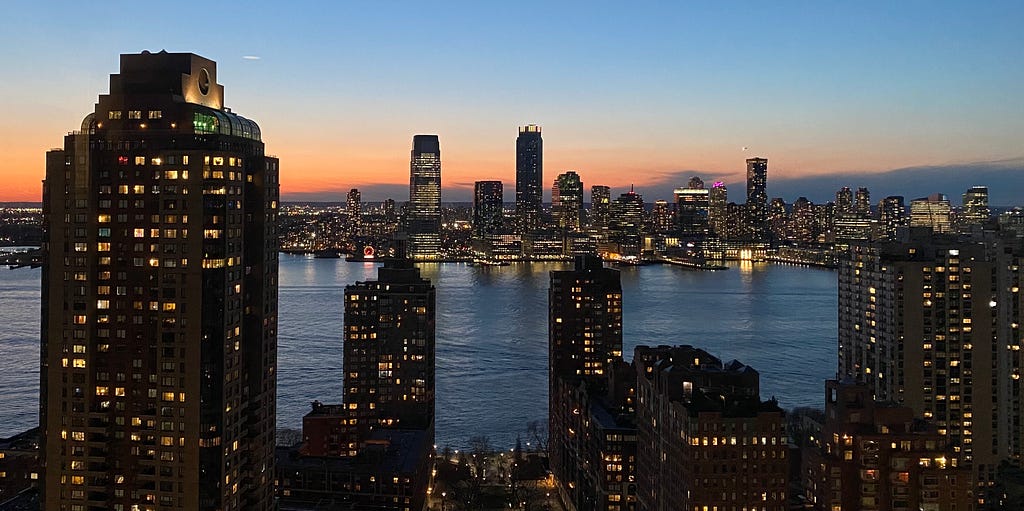
View of New Jersey from Financial District in Lower Manhattan

 Login
Login