Login
Login

EMERGENCY POD: Trump to Sell H200s to China
Here to discuss is of the Silverado Policy Accelerator.
We get into:
Why this is, in Dmitri’s words, “a disaster”
There are military balance of power implications for selling chips to China
Why the rest of the AI ecosystem is against selling chips to China, Why Trump made this call anyway, and why SME export liberalization might be next
Where the GAIN Act goes from here
Listen now on YouTube or your favorite podcast app.
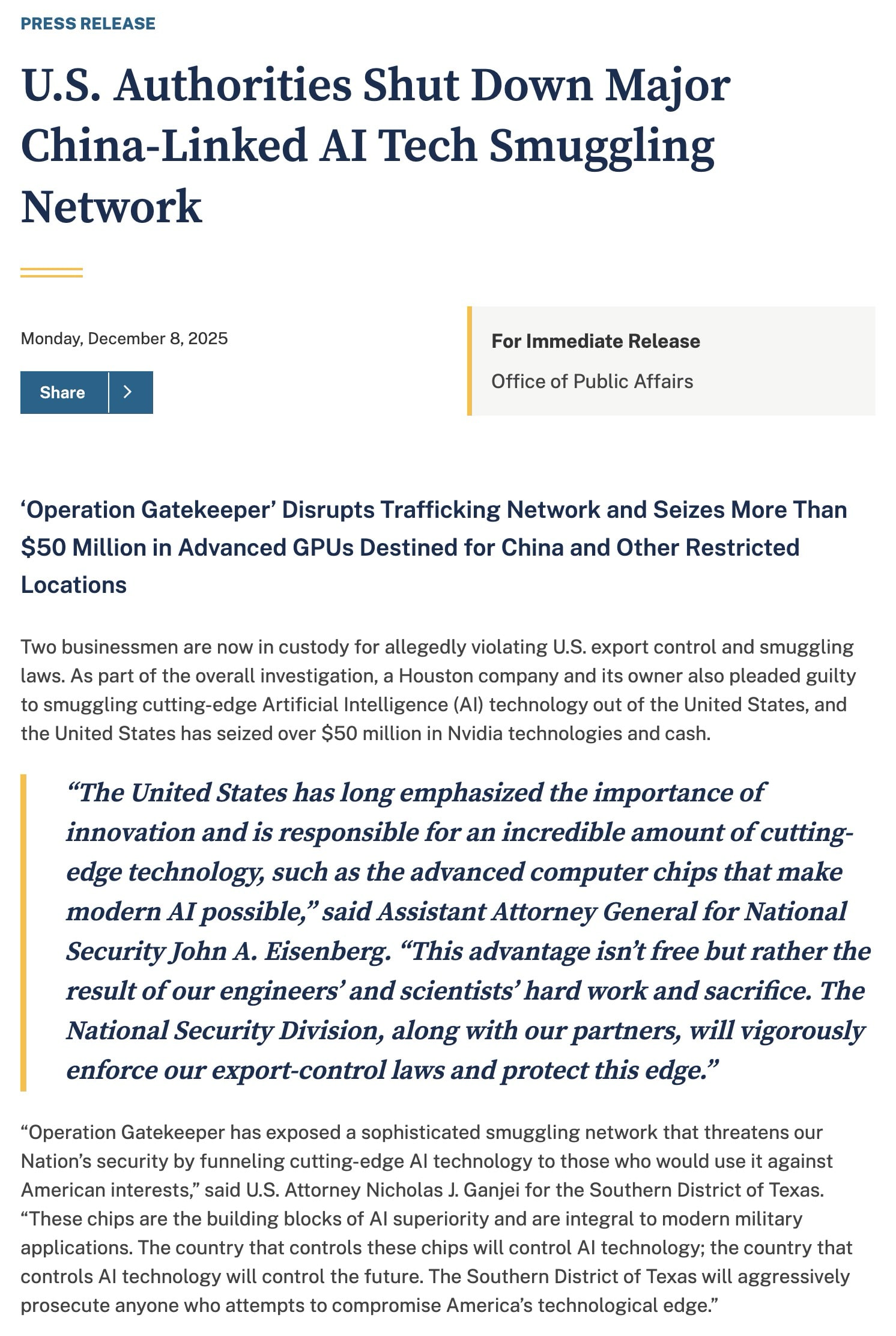
Jordan Schneider: Let’s first toast the unfortunate U.S. Attorney for the Southern District of Texas, Nicholas Jon Ganjei. On Monday morning, he proudly issued a press release for his cool-sounding “Operation Gatekeeper,” which intercepted $160 million worth of Nvidia H100s and H200s.
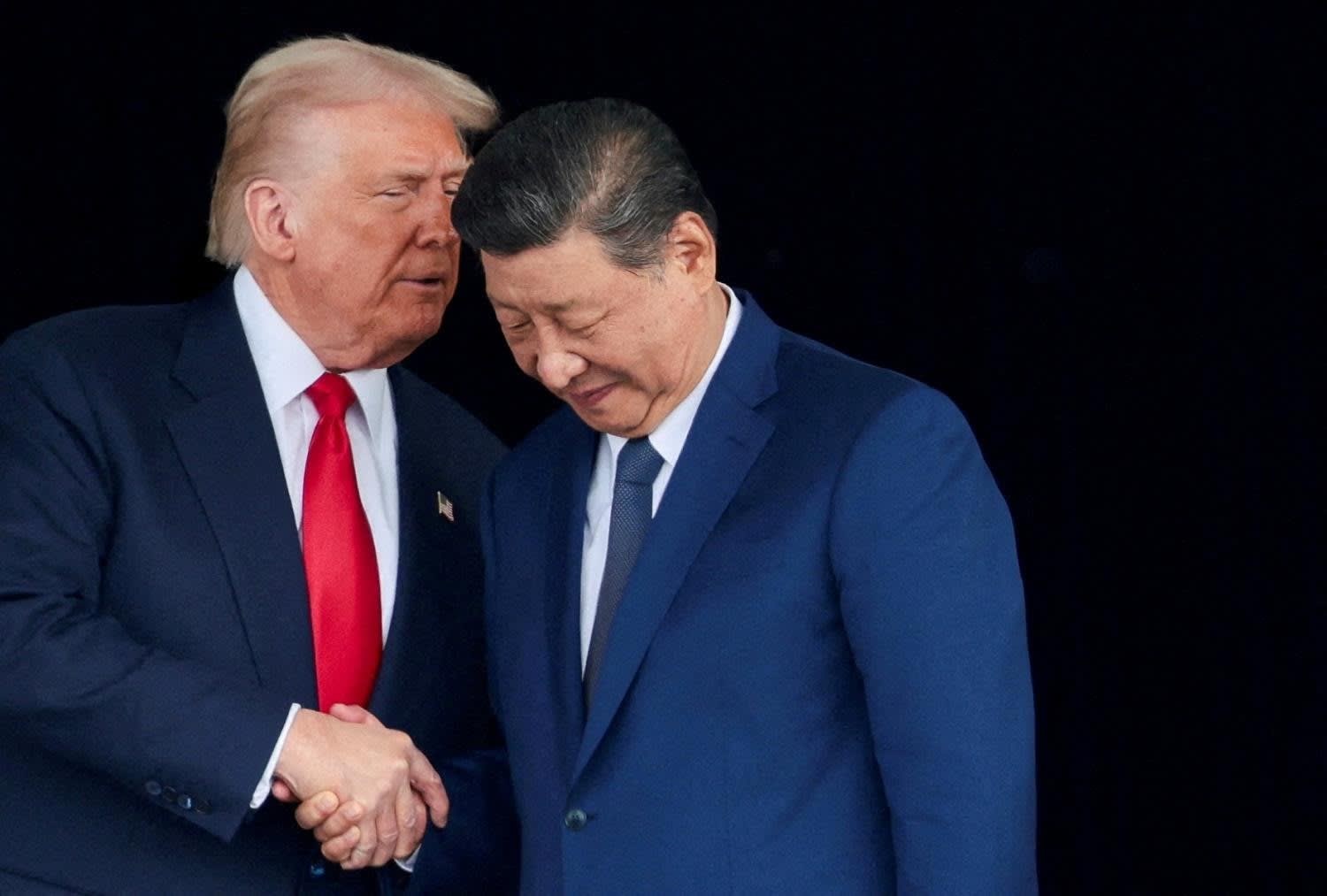
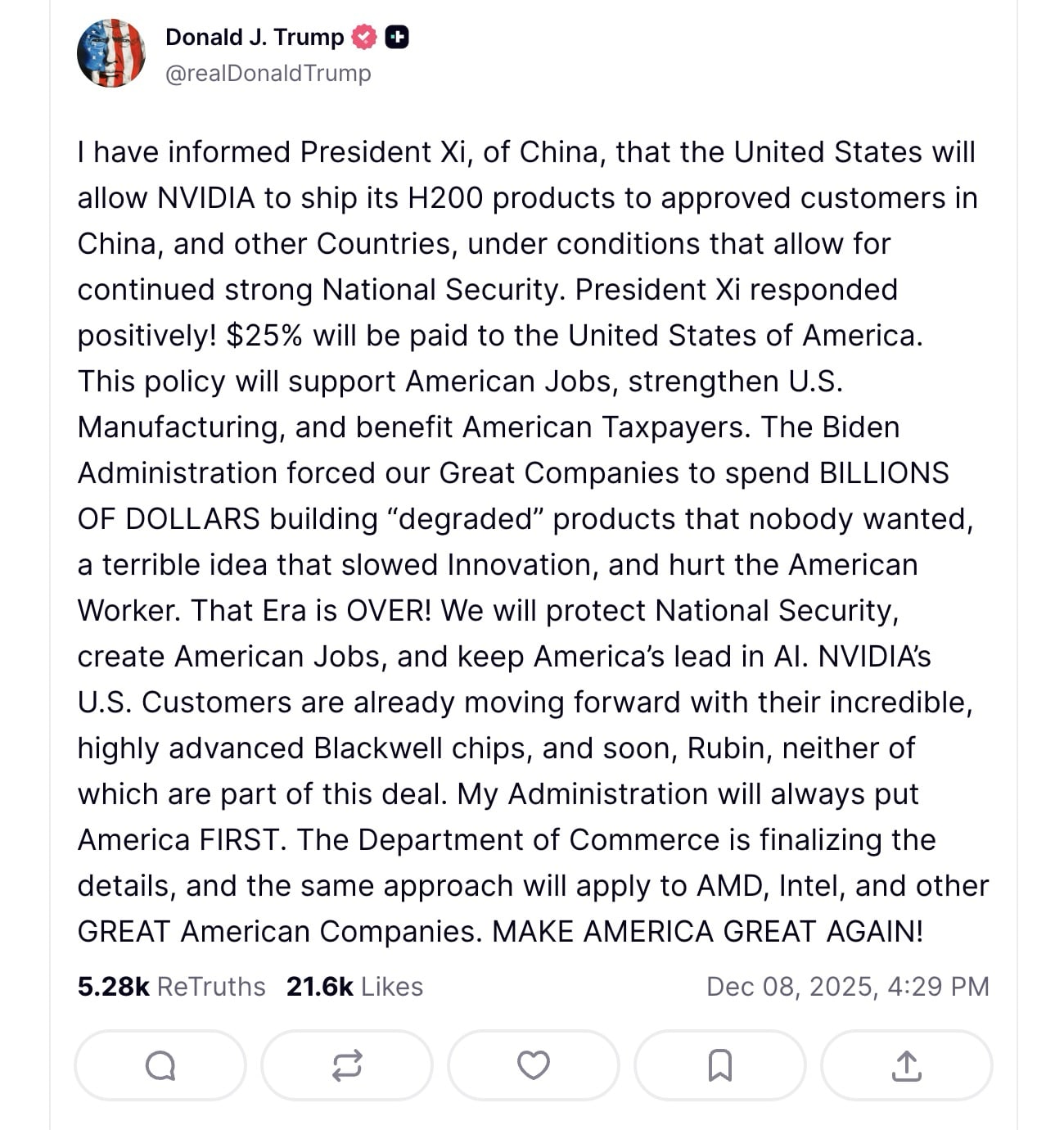
That afternoon, President Donald Trump announced on Truth Social that the United States would allow Nvidia to ship its H200 products to approved customers in China. Dmitri, please make sense of this for me.
Dmitri Alperovitch: There’s no way to sugarcoat this — it’s a disaster. This isn’t only about the Department of Justice. The U.S. Attorney General’s statement highlighted how critical AI is to military applications. The President’s own AI action plan discussed how the United States must aggressively adopt AI within its armed forces to maintain its global military preeminence, while ensuring that the use of AI is secure and reliable. This technology is essential to U.S. military dominance and the successes of the U.S. Intelligence community.
You have to give the administration credit — it is doing a lot to ensure all levels of the U.S. government are adopting AI. Why we would enable China to do the same is beyond me. Are we going to sell them aircraft carriers or Virginia-class submarines? Should we let them into AUKUS? This is effectively what we are doing.
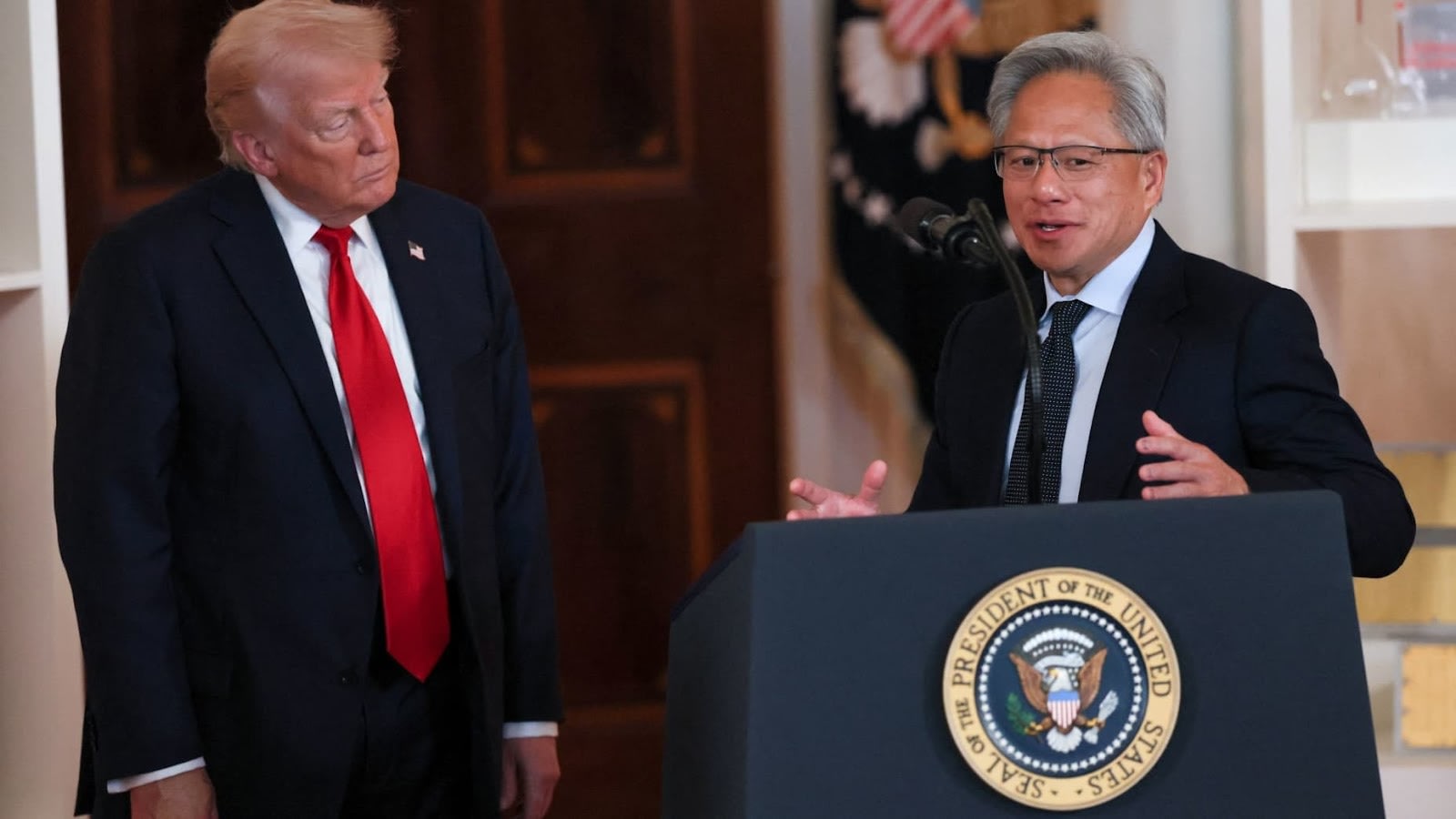
It is outrageous that Jensen Huang has been able to pull the wool over the eyes of people in government and on Capitol Hill, convincing them that arming our primary adversary — the one we are unquestionably in a cold war with — is somehow good for America. I understand it’s good for Nvidia’s sales and for him personally, but it is a disaster for our national security.
Jordan Schneider: What I find baffling is the contradiction in Nvidia’s public messaging. Jensen Huang and his company argue that their technology will revolutionize every conceivable industry, all requiring massive amounts of GPU capacity. But when asked directly about the military implications of selling these chips, Huang downplays the risk. He suggests that China’s military will acquire the necessary chips regardless and claims they are too sophisticated to use American technology for sensitive, dual-use applications. It’s ludicrous that this technology is transformative for every field except for the military.
Dmitri Alperovitch: It doesn’t make sense. AI will transform everything. Even in civilian uses, do we want China to win in automotive, energy, and everything else? Because that’s what you’re enabling by selling chips to them. The primary concern is their military and intelligence services, but we are also in an economic competition. I would rather kneecap Chinese competitors to enable our own companies to succeed. Why would you do otherwise?
This is equivalent to selling supercomputers to the Soviet Union in the 1970s. No one even considered doing that. You could make the case that it would support Soviet agriculture and feed starving people, but no one said that because those same computers could be used for nuclear weapons testing and countless other military applications. There was no debate about it — it was understood to be a bad idea.
50 years later, we’re in a cold war. This is unbelievably shortsighted — putting profit above national security. Jensen Huang said if you’re a China hawk, you’re unpatriotic and un-American. I think selling supercomputing capabilities to the Chinese military is as unpatriotic and un-American as it gets.
Jordan Schneider: Jensen, if you’re listening, you’re invited to come on ChinaTalk anytime to make your case.
Dmitri, what’s telling is that the rest of the tech industry is finally pushing back. After months of staying quiet for fear of losing access to Nvidia chips, major players like Microsoft and AWS are supporting measures like the GAIN Act. The benefit of selling chips to China is mostly limited to Nvidia. U.S. hyperscalers and AI labs now face a powerful new competitor for limited chip manufacturing, driving up prices. The upside seems narrow, especially when Nvidia’s strongest argument — that the world, including China, will be locked into CUDA — seems far-fetched.
Dmitri Alperovitch: Nvidia’s argument is knowingly false. The GAIN Act is the ultimate ‘America First’ act. It stipulates that before chips are sold to countries of concern like China, we must ensure that U.S. demand is satisfied. American companies are first in line. How anyone could argue against this is beyond me.
The Act doesn’t say, “we’ll cut China off completely to ensure their military doesn’t get chips” — we’re saying, “let’s make sure American companies have priority.” It’s a no-brainer. I’ve talked to hyperscalers who are supportive of this act, and even other chip companies are saying they agree with the concept. The fight wasn’t about the details — the fight was a push for no restrictions on sales to China, which is unbelievable.
Jensen’s argument that the U.S. wants to make China addicted to the American tech stack is ridiculous. There is no addiction — chips aren’t cocaine. You can see this today with every single hyperscaler — Google, Amazon, Microsoft with its Maia chip, and now Meta with its own custom chips — all saying they are moving off CUDA. Many already are.
The top two frontier models, Claude and Gemini, were reportedly trained on Amazon’s Trainium and Google’s TPUs, respectively. There aren’t enough chips to go around, and for cost and strategic reasons, pretty much every frontier company is now using a multi-chip architecture — CUDA, Trainium, TPUs, and others. There is no addiction. Companies were able to make that switch in months, it’s easy — this is software and APIs. You can give AI one API and tell it to rewrite it in the form of another. It’s a trivial task.
Now we’re selling China H200s. This is probably the start of a broader concession on Blackwell, and then Rubin. Jensen won’t stop at the H200 — he will want to sell everything. The Chinese want to receive the latest and greatest chips, not only the Hopper generation. We’re going to sell them these chips, and they’re going to build competitive models. DeepSeek, Qwen, and Kimi are already good — they’re at most 12 months behind. They will quickly catch up and become leading models.
China will keep investing in Huawei because the Chinese are not stupid. Jensen says that if we don’t sell them chips, they’ll invest in their own, like Huawei’s Ascend chips. They’re doing that anyway. Xi Jinping is going to demand it, which is why you’re seeing China’s response that they will restrict the importation of H200s to ensure there is still domestic demand for Huawei chips.
Huawei’s Ascend chips will eventually catch up, and Chinese companies — supposedly “addicted” to the American AI stack — will switch over in days or weeks. What will we have achieved? We will have relinquished our lead in frontier AI models, and eventually, they’ll have chips that replace Nvidia’s. It is myopic and stupid for Nvidia’s own business model. They are focused on the next quarter and the next year versus a couple of years from now when China dominates both chips and frontier models.
Jordan Schneider: If this goes through, and tens of billions of dollars worth of chips are exported to China, and the future you portend comes true, will there will be a political price to pay? This was a major talking point for Trump on his campaign — “Winning the AI race” and “American AI dominance”. A year or 18 months from now, if China is releasing crazy new AI-powered technologies that were all trained on Nvidia chips, that will be a tricky political dance. Nice calls from Jensen won’t be enough to smooth that over.
Dmitri Alperovitch: We are already there. Almost a year ago, there was a brouhaha over the release of DeepSeek. The surprise was unwarranted: it shouldn’t have shocked anyone paying close attention. But people reacted with, “Oh my God, the Chinese are catching up.” Of course they are. Deepseek was built on H100 chips, which, until recently, were not restricted. There will be another DeepSeek moment, but worse. DeepSeek was good, but it was still behind frontier models. The next models will be better.
Sam Altman is in panic mode over Gemini 3 because its capabilities eclipse his models. This will happen to all American frontier models and to the country more broadly. The Chinese will crush us with cheaper power, tons of researchers, and massive state subsidies. The one thing they were missing — compute — will now flow into China.
Jordan Schneider: The Financial Times reported Chinese companies were training models in Malaysia or Singapore. That’s not ideal and not as efficient as AliCloud’s operations in China. There, they can rapidly deploy numerous H100s while benefiting from straightforward communication, a reliable power grid, and lower energy costs.
Dmitri Alperovitch: We should have been cracking down on H100 access in Malaysia and elsewhere. Chips shipped directly to China will be prioritized for high-side intelligence and military networks. Chinese agencies can’t use public clouds in Malaysia for their classified data. But now they can grab those chips from private companies in China and prioritize them for military purposes, as they do with everything else.
Jordan Schneider: That seems like the most salient reason China would want the chips inside the country. Training models in Malaysia is annoying, but only 10%-annoying. There are also data privacy restrictions, which they can get around if they’re serving domestic consumers in China. What do they want complete control of their chips for? The sensitive stuff that they would never trust a random Singaporean cutout to do for you.
Dmitri Alperovitch: The U.S. government cannot get enough chips. Agencies have told me they are compute-dependent for inference and cannot get enough chips. Now we’re shipping part of that limited supply to China. How does that make sense?
Jordan Schneider: Let’s flip this around.
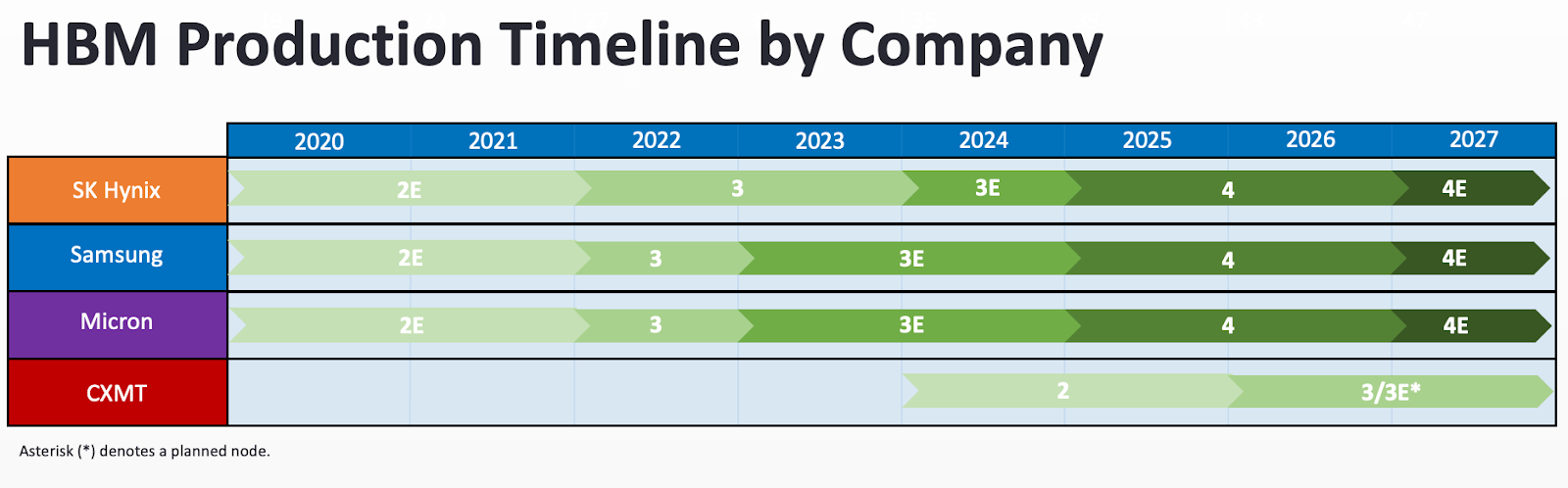
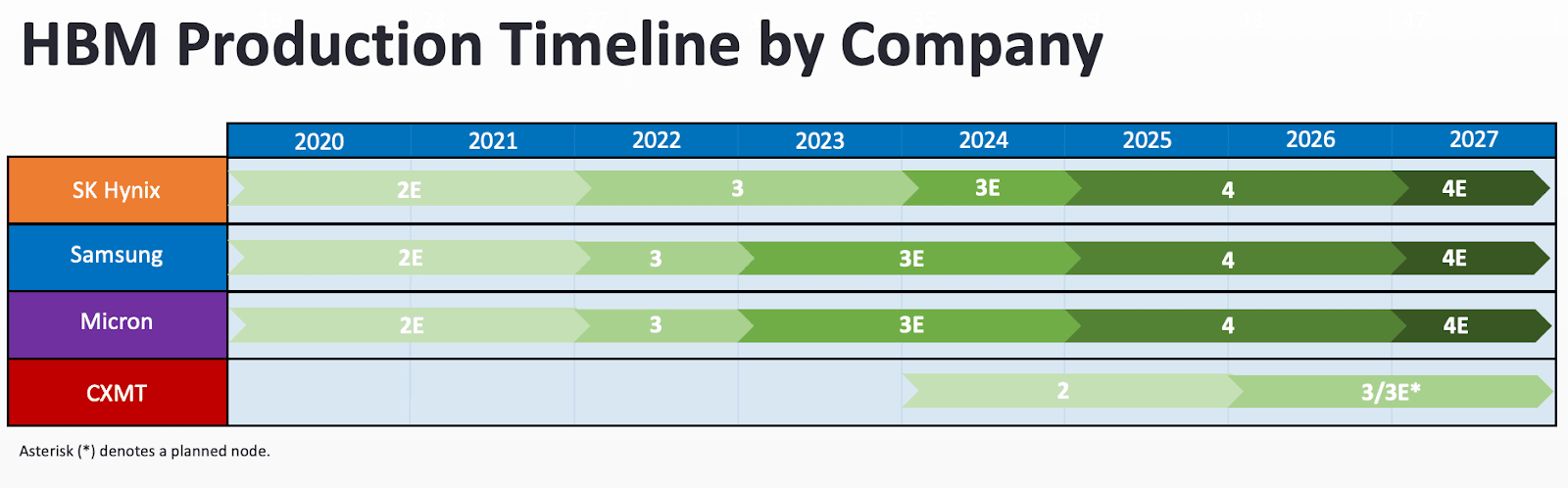
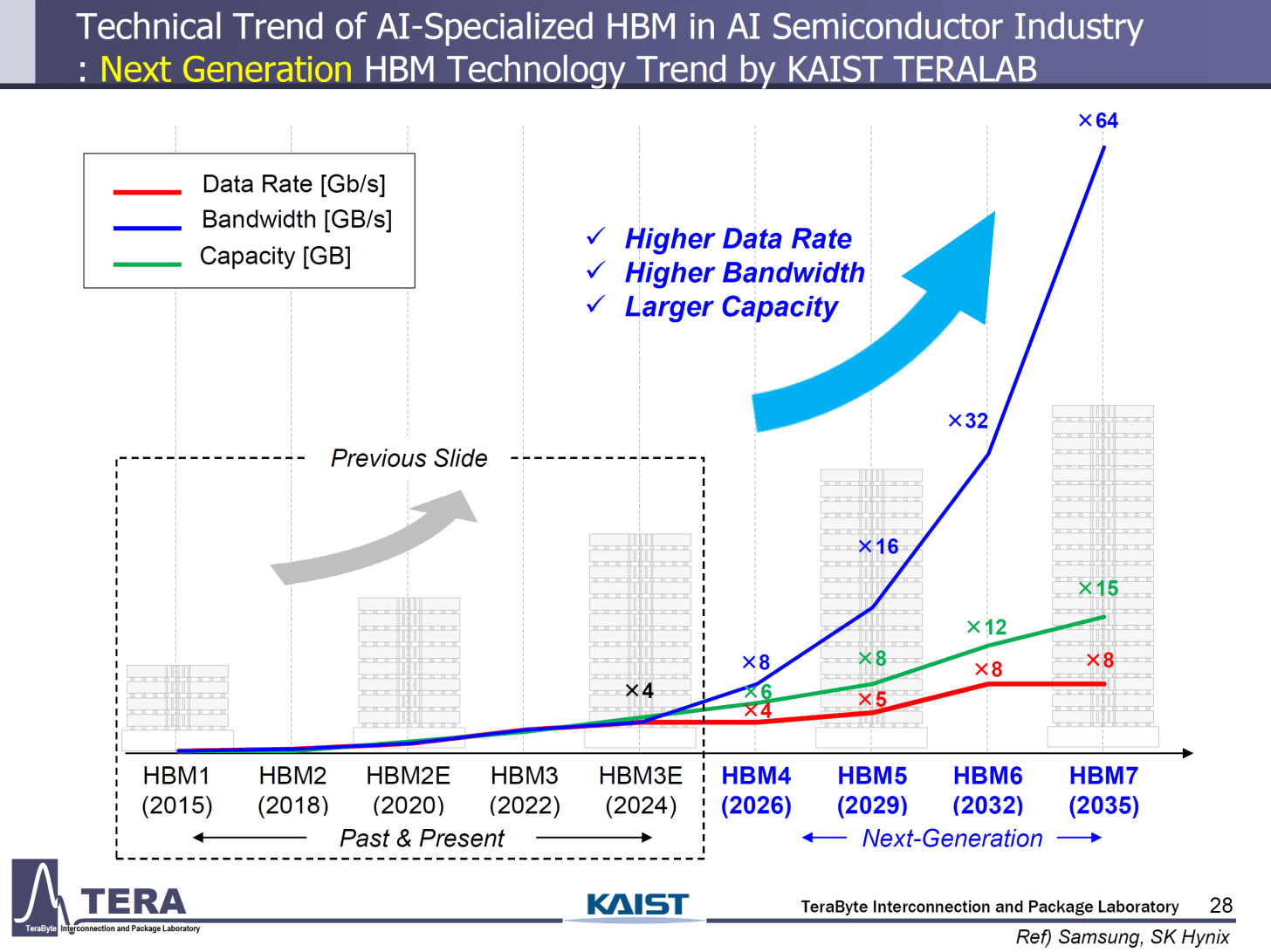
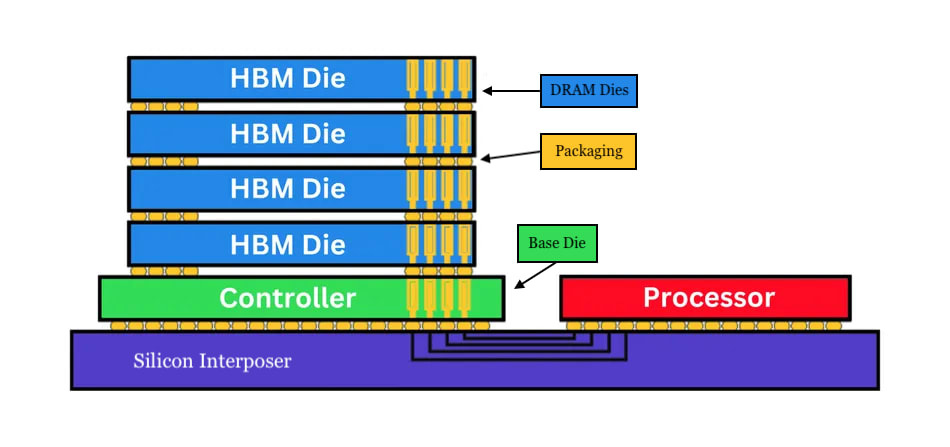
Dmitri Alperovitch: One more point. The H200 is from the Hopper generation, not the latest Blackwell generation, but it has High-Bandwidth Memory (HBM). We have a current ban on the export of HBM to China. The H200 decision calls HBM protections into question, as the technology is already being exported on Nvidia chips.
We may see a cascading failure of export controls. I am hearing of discussions about relaxing export controls on semiconductor manufacturing equipment, which would make it easier for Huawei to manufacture Ascend chips in China. I hope that doesn’t happen, but there are people in the administration pushing for it.
Jordan Schneider: A year ago, the administration was being pressured to restrict chip technology to China. First there was the H20 situation, then the Laura Loomer saga and teh “twilight of the China hawks.” Lawmakers Vasant, Greer, and Rubio even intervened right before the Xi Jinping meeting to urge against concessions. Now, only a month later, this policy has been enacted without any clear reciprocal action from China other than continued soybean purchases.
Dmitri Alperovitch: I don’t know.
Jordan Schneider: To be determined. The main thing they’ve done recently is bully Japan. That’s the only big new development. And now we’re deciding to throw this other carrot into the mix. It’s weird.
Dmitri Alperovitch: The crazy thing is that China isn’t even asking for this. It didn’t come up in the Trump-Xi meeting. This is a concession to Jensen Huang, enabling Nvidia to make money at the expense of U.S. national security. I could understand it if this were a trade to get something we desperately want from China, like rare earths or a commitment not to invade Taiwan — though they would never do that. But it’s not. We are getting nothing for it. It is a favor to Jensen, to China, and to the PLA.
Jordan Schneider: It’s not even a big favor to my 401(k) — it only went up by two and a half percent. Come on.
Dmitri Alperovitch: Nvidia is in trouble because its U.S. market is going to shrink. Its primary customers, all the major hyperscalers, are building their own chips and want to move off of Nvidia’s platform. It’s desperately looking for another market, in China and the Middle East. That is why the company is pushing so hard for these export controls to be lifted. Jensen probably sees this is an existential problem.
Jordan Schneider: Dmitri, I appreciate your energy. I am so tired of these guys. I have to give Jensen credit for his stamina in making those calls and fighting through this. He has delivered twice now.
Dmitri Alperovitch: And he killed the GAIN Act.
Jordan Schneider: The man’s on a roll — he’s scored a touchdown.
Dmitri Alperovitch: And by the way, he’s not only going after the China hawks. The entire industry — from the hyperscalers to other chip companies — is on the other side of the ledger. He’s single-handedly beating everyone in this town. It is astonishing.
King Jensen
Jordan Schneider: Last year I asked you why more rich people don’t invest their time and energy to shape political outcomes. The thesis was that if you put the time and work in, you can get results. This is Exhibit A for CEOs trying to push through initiatives that may not have polled well initially. If you put in enough legwork and time on the phones, you can make things happen.
Dmitri Alperovitch: You have to give him kudos — he’s done incredibly well at the influence game here in D.C. He is putting in the time, meeting with anyone. He even said he’ll meet with Elizabeth Warren, one of his chief critics on the Democratic side. He’s calling the President almost daily, it seems. He got this done by badgering the President, repeating, “Get me my chips, get me my chips, get me my chips.” Donald Trump finally said, “Fine, here you go.”
Jordan Schneider: This development suggests the administration dismisses both the national security and the economic arguments for restricting this technology. It ignores the reality that these chips are vital in a strategic military competition.
Economically, it also overlooks the fact that strengthening Chinese competitors will harm American industry for decades. We should be consolidating the technology that drives productivity, not ceding it to a rival.
Dmitri Alperovitch: I don’t agree. The majority of this administration is opposed to this decision and does believe we are in a strategic competition with China. Call it a cold war. I know people in the administration agree. The president was convinced that selling China American AI stack is good for American business, and that Chinese firms will be addicted to it. But it’s a nonsensical argument. Jensen lied, because there is no addiction to the stack — it’s easy to move off of it. Unfortunately, he has been able to carry the day for now.
Jordan Schneider: This isn’t selling the “stack.” Selling the stack would be Nvidia chips run by AWS or Google, running Western models. This is selling the lowest level of the stack. I guess if the semiconductor manufacturing equipment (SME) relaxations come true, we’ll be selling the two lowest levels.
Dmitri Alperovitch: This is the equivalent of selling Ford cars to China in the hope China will be “addicted” and not prefer any other car. It is stupid on its face.
Jordan Schneider: It’s not even selling the Ford car — it’s selling the axles.
Dmitri Alperovitch: That’s all it is. There are huge problems with this decision. First, this is enabling the Chinese military and intelligence services, which are adversaries we could one day be at war with. The DoD is planning for a fight with China and stressing the need to overmatch its capabilities. Second, it puts Chinese firms on equal footing with American firms. Why would we do that? It hurts American companies and the American economy.
Jensen’s argument against export controls is inconsistent with his own business practices. He claims controls only encourage strategic competitors to innovate. By that logic, he should open-source his proprietary CUDA framework to AMD, because God forbid they develop a superior alternative. He doesn’t practice what he preaches. He is protecting his technology with patents and trade secrets, like any other company. Yet, he insists the U.S. should use a different strategy at a national level. It’s insanity.
Demand for chips in the U.S. already outstrips supply. Diverting this limited resource to a strategic military and economic competitor is a self-defeating act — we are actively surrendering the Cold War. I’m not an “AI doomer” — this technology is profoundly important for economic and military power. That is why there is no valid argument for helping your main rival develop it.
Jordan Schneider: Hey, White House. Hey, Nvidia. If you want to come on ChinaTalk and make those arguments, we could hash it out here.
Maybe we’ll be saved by the Ministry of State Security, who convince themselves that this is a crazy CIA plot to backdoor hack the PLA. It’s a longshot.
An Institute for Progress chart shows the U.S. and its allies currently possess a large compute advantage over China, roughly a 13-to-1 ratio. Selling large volumes of chips to China could drastically change this balance.
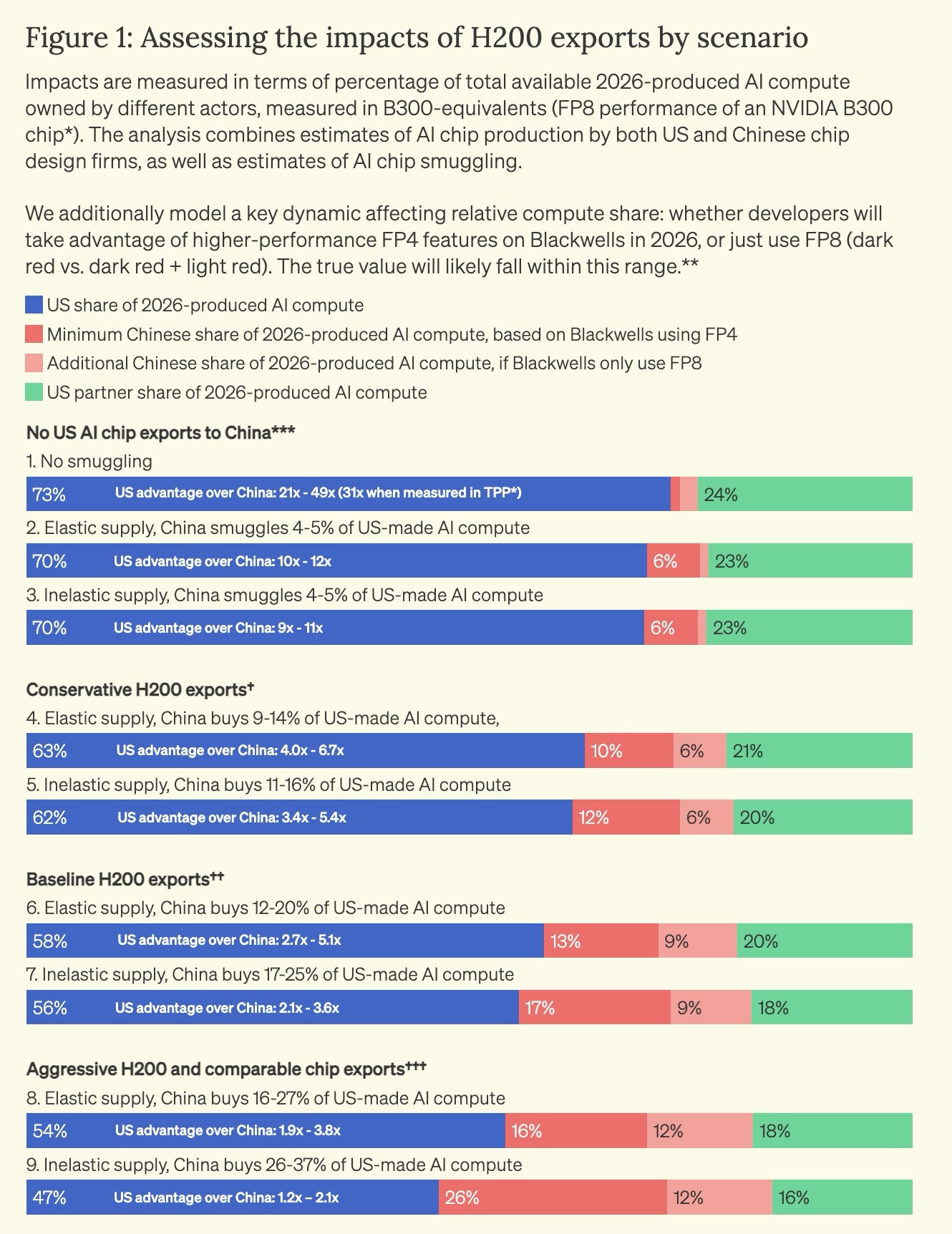
The main question is how Huawei’s domestic production compares to Nvidia’s global output from its fabs. If we withhold advanced equipment and AI chips from China, we can confidently expect a continued U.S. advantage. If these sales go through, it’s unclear who will lead in compute power in next 5 to 15 years.
Dmitri Alperovitch: It will be China, because they’re going to subsidize the hell out of this and we won’t.
It’s not over. Capital Hill is upset about this. Don’t count out Congress, the GAIN Act isn’t dead yet. There will be a fight to prioritize chips for American companies and to see what restrictions are possible — maybe export control reviews by Congress. There are bills floating around.
Also, Donald Trump often changes his mind. Others may convince him to revert this decision. The good thing about Donald Trump is that you’re never done. Whatever happens today can be undone tomorrow, and we need to take advantage of that.
Jordan Schneider: That’s the great irony in all of this. Given the political hesitancy on both side of the aisle and the possibility of Trump changing his mind, Alibaba, Tencent, or ByteDance are unlikely to bet their firms’ futures on Nvidia chips. This is going to be a political football, and one Truth Social post won’t end it. The strategy of “addicting Chinese firms” over the long term — setting aside Beijing’s own goal to indigenize chip production— won’t work.
Dmitri Alperovitch: Beyond politics, this strategy fails for basic business reasons.
China won’t get enough chips. You have Jensen acting as king, allocating a scarce supply of Nvidia chips to hyperscalers and now Chinese customers. Since there isn’t enough to go around, that scarcity forces them to rely on other chips.
No one wants to pay the “Nvidia tax” or be completely dependent on a single monopolistic supplier. Everyone wants to diversify, which is why you see them all building their architectures on multi-chip designs. Committing 100% to CUDA, politics aside, makes no commercial sense.
The Magic of AI
Jordan Schneider: Let’s close on some vibe-coding. I can’t be too depressed going into the holidays. Dmitri, I hear you’ve been having some fun with Opus 4.5 recently. What’s it done for you?
Dmitri Alperovitch: It’s magic. Anyone with a bachelor’s degree, not even in a technical field, can be a software engineer within three years, if not sooner. It is so easy to develop applications. I’ve built two mobile apps in the last month and a web app for personal use. Opus 4.5 is magic. I built a mobile app yesterday in 15 minutes, and most of that time was spent on setup, authorizing it on the Apple Store, and configuring my device. The capability is incredible, and it’s improving everyday.
This is the innovation we have to look forward to, and we want to make sure our American companies, our government, and our citizens are the primary beneficiaries. We want American frontier companies to be the best, and then we can restrict these models from actors we don’t want to have access.
I’m on the board of a number of companies, and I’m telling them all to start measuring their engineers on their use of AI in development tasks. Anyone who isn’t using AI should be considered for a performance improvement plan (PIP). This is the next hammer. It’s like when hammers were discovered tens of thousands of years ago — whoever didn’t use them fell behind. This is an unbelievable productivity tool.
One of my companies has a software engineering team developing their products. They’re also pulling people from other departments, like security, to help build the next module in Claude or other models. These teams are creating prototypes, and even production-ready versions. It’s unbelievable how you’re able to raise the productivity of everyone, not just software engineers.
Jordan Schneider: I want to say the same for analysts, think tankers, Hill staffers, and folks in the executive branch. It is a superpower. We were having a debate about whether Huawei can backfill Nvidia and what the ratio of chips would be. It took me 45 minutes to build an entire data visualization with sliders for different assumptions. How much HBM will China get? How tight will the export controls be? How much will they improve using DUV? How far behind will Huawei’s chips be compared to Nvidia’s?
Beyond the fun personal applications, it’s the “bicycle for the mind” aspect that people should experience, especially for thinking through policy problems. If you’re wrestling with a knotty issue that has numbers, contingencies, or second-order effects that are hard to hold in your head, ask Claude to help you visualize it or see the other side of the argument.
The hallucination issue is almost gone. You still need to fact-check the details and trust your gut if something seems off, but the improvement has been dramatic.
Dmitri Alperovitch: It depends on what you’re using it for. At some level, it’s garbage in, garbage out. If you’re training a model on Reddit and asking about something very esoteric, you’re not going to get a good answer.
Jordan Schneider: You are doing yourself a disservice if you haven’t spent time with these models. Try to integrate them into your day job. You should be hanging out on Cursor and Claude, trying to build little tools and apps to make your workflow easier or allow you to do new things.
Dmitri Alperovitch: Building apps was nostalgic for me. It brought back the emotions I felt as a kid in the 1980s when I learned programming. It was an amazing feel coding your first “Hello, World!” program or, in my case, a simple game in QBasic. The magic of seeing it run was a special feeling, and you felt so proud and accomplished.
This took me back. It made me think, “Oh my God, this is magic.” In the ‘80s and ‘90s, you had to have technical expertise and learn a programming language. You still need some technical skills today, particularly when you’re debugging or if you don’t understand how Swift works or how to deploy iOS apps. But all of that is going away.
Jordan Schneider: It’s going away.
Dmitri Alperovitch: The accessibility of this technology changing everything. For years, we thought only nerds could access the magic of programming. Now, everyone can, and that is going to revolutionize everything. The interesting thing about AI is not that it’s going to make tasks easier and faster, but that it’s going to make other things that you would never, ever do before accessible.
The cost of software engineering iwill drop to zero. Everyone will be building dozens of apps — for their grocery list, for managing their kids’ schedules, whatever it may be — because it’s so easy. You can custom build something that would be useful only to you, with no commercial value. Even for coders, we wouldn’t spend our time building those apps it was a lot of effort. Now, that effort is gone.
Jordan Schneider: The activation energy for doing a side project has dropped to zero. What I’m excited to see created, Dmitri, is the “senior policy official simulator.” That’s a classic nerdy ChinaTalk idea.
Dmitri Alperovitch: So nerdy.
Jordan Schneider: But you read all these memoirs from government officials. Jake Sullivan said the one thing you can’t experience beforehand is being in a crisis. You can have a Tim Geithner level — all of a sudden it’s 2009, and it’s not like you’ve lived through a financial crisis before.
Having a visceral experience — a VR Situation Room meeting, a VR flight on the plane with the president trying to convince him not to sell chips to China — getting reps in those high-stakes political, personal, and commercial situations could be transformative. It doesn’t have to be for politics and national security. We haven’t had a nuclear crisis in a long time.
Having the deeper, emergent human capabilities that AI simulations of these events can provide seems like a big upside for human competence when dealing with crises in the future. I’m excited about it. Rockstar Games, if you’re out there, give me a call. We can do some cool stuff together.
Dmitri, always a pleasure. Thank you so much for being a part of ChinaTalk.
Dmitri Alperovitch: Thanks for having me, Jordan.
ChinaTalk is a reader-supported publication. To receive new posts and support our work, consider becoming a free or paid subscriber.
Mood Music