Normal view

There are new articles available, click to refresh the page.
Yesterday — 17 January 2026Reading

The China Commission's Report

17 January 2026 at 21:10

The U.S.-China Economic and Security Review Commission late last year released its annual report to Congress. ChinaTalk welcomes two commissioners to the pod to discuss.

Before joining the Hoover Institution, Mike Kuiken spent two decades on the Hill with Senators Schumer and Durbin. He was appointed to the commission by Leader Schumer. Leland Miller, the co-founder and CEO of China Beige Book, was appointed by Speaker Mike Johnson.

We get into…

  • What the U.S.-China Commission does, and why “alligators closest to the boat” explains Congress’s blind spots,

  • The case for an economic statecraft agency, and reorganization lessons from post-9/11 sanctions reform,

  • The year supply chains became sexy — and the best-case scenario for responding to chokepoints like rare earths and pharmaceuticals,

  • Xi’s unresponsiveness to consumer spending concerns, and the military-tech developments he’s targeting instead,

  • The quantum software gap, synthetic biology in space, and Congress’s role in competing with China.

Listen now on your favorite podcast app.

Fishbowl Politics

Jordan Schneider: The U.S.-China Economic and Security Review Commission is out! Christmas has come early for U.S.-China policy nerds. Mike, what is the U.S.-China Commission?

Mike Kuiken: Next year marks the 25th anniversary of the U.S.-China Economic and Security Review Commission. Congress created it around the same time it was debating China’s accession to the World Trade Organization and the establishment of Permanent Normal Trade Relations. Congress approved these measures, but wanted to closely monitor China. The commission was created to keep tabs on both China and the executive branch as events unfolded. That’s our origin story.

Every year, we conduct a series of hearings — usually six — always co-chaired by a Republican and a Democrat in a bipartisan fashion. Then we publish an annual report with recommendations. We also engage regularly with the executive branch, including conversations with figures like Jamison Greer, Undersecretary of Commerce for Industry and Security Jeffrey Kessler, and military leaders. Earlier this year, we met with General Stephen D. Sklenka, among others.

Everyone on the commission brings experience from the Hill, the security space, or the economic policy, like Leland. It’s a fascinating mix of backgrounds, and we have a great team. We produce an 800-page report every year, which dives into a variety of issues. It is the definitive geek-out-on-China document. Our staff does an incredible job. Leland, what did I miss?

Leland Miller: You didn’t do your “alligators closest to the boat” riff. That one’s always good.

Mike Kuiken: Don’t worry, I’ll get to the alligator closest to the boat.

Leland Miller: A million people in D.C. are working on today’s issues. The China Commission focuses on more distant concerns — the ones on the horizon. What should we be paying attention to now? What should Congress be monitoring closely in economics, military affairs, and technology? How do we create smarter policy? We try to look further ahead and recommend ideas that Congress should be considering.

Mike Kuiken: Since Leland decided to trigger me, let me give you the “alligator closest to the boat” analogy. Folks on the Hill deal firsthand every day with the most immediate, pressing issues — the alligators closest to the boat. We’re looking at the horizon or beyond it, focusing on issues that aren’t making headlines yet. We raise awareness and call attention to them. Another part of our work is increasing literacy on these topics.

Vintage alligator hunting near Gainesville, Florida. Source.

Jordan Schneider: As someone who’s been reading this document for a decade now, it’s refreshing. The level of discourse in the American political ecosystem around these topics is often heated and not grounded in evidence. Having this report come out every year offers a different approach — something substantive and measured.

I get a similar feeling listening to nuanced Supreme Court discussions — “Oh, wow, here are people engaging with the world, engaging with facts, and trying to understand things.” You don’t write a 60-page report about China’s ambitions in space without doing research and putting in the work.

We have two commissioners here, and you guys get all the glory, but there’s a large team of staffers putting in the work. From my interactions with them, they take their jobs incredibly seriously. They examine issues in depth. Unlike the intelligence community, where only certain people see the analysis, this is a product for the American people. Thanks, guys, for all your work.

Leland Miller: The staff are the backbone of this operation. The commissioners drive the agenda — we all have our different, overlapping priorities. It’s common for staff to push back and say, “No, I don’t think you can base that on evidence.” We have a discussion, and they do the research — extensive research, constantly. By the time we publish something, it’s not just passing through us. It reflects our perspective, but it’s evidence-based. The report is fundamentally a research document that focuses on policy grounded in real data. The research component is critical.

Mike Kuiken: Before I joined the commission, I spent years with Leader Schumer accessing some of the most sophisticated intelligence in the world. My first year on the commission, as I read through the initial draft our staff put together, I highlighted at least five or ten sections to ask, “Where on earth did you get this?” I was amazed at the amount of information available in open sources and their ability to find and extract it.

Jordan Schneider: We’re not complaining about the seven citations to ChinaTalk this year. That’s how you know it’s good stuff.

Mike Kuiken: Is that too many or too few?

Jordan Schneider: We’ll chart it over time. We’ll have ChatGPT track how we’re doing. Now, make the case for Congress’s influence on U.S.-China issues.

Leland Miller: Start with the guy who’s been on the Hill longer.

Mike Kuiken: If you look at the big moves in U.S.-China policy over the last decade, many have come out of Congress. That includes sanctions bills, the CHIPS and Science Act, and the Foreign Investment Risk Review Modernization Act (FIRRMA), which reformed the Committee on Foreign Investment in the U.S. (CFIUS). The BIOSECURE Act hasn’t passed yet, but the idea for it came from the commission, a legislative branch entity. Outbound investment screening — many of these are ideas that either originated from the commission or from members of Congress.

The CHIPS and Science Act has an interesting origin story. Leader Schumer and Senator Young got together and created the legislation for one of the most significant pieces of industrial policy we’ve seen in a generation. If you look at the last 10 years, Congress has passed incredible, agenda-shaping legislation. The executive branch has broad authority in foreign policy, but many of the guardrails and tools the executive branch uses have been provided by Congress or have been driven by congressional agenda-setting. Leland, what do you think?

Leland Miller: Administrations are fleeting, but Congress is forever. If you want durable, lasting policy, you need Congress involved. Mike gave examples of topics Congress has been essential to. Look at outbound investment — it’s not a success story, at least not yet. It’s something the Biden and Trump administrations handled, but Congress hasn’t cemented the foundation for it in legislation. Right now, you don’t have a durable outbound investment mechanism. This is a call for Congress to constantly be on the tip of the spear, not just reacting to whatever one administration does as Republicans and Democrats alternate in the presidency.

Mike Kuiken: Congress passes a National Defense Authorization Act every year, and that is full of China policy, both on the economic and security side. Pieces of that legislation drive the agenda for both the Department of Defense and the broader executive branch.

Keep in mind that we updated the Taiwan Relations Act three or four years ago, which was also carried by the National Defense Authorization Act. That was driven by Congress, not the executive branch. It was done with a lot of push and pull from the administration, which was saying, “Oh my God, we can’t possibly do this or that.” Ultimately, it was Congress that said, “Yes, we can.”

Jordan Schneider: “Yes, we can.” What a throwback.

There’s this weird dynamic where the executive branch sometimes — perhaps increasingly — doesn’t do what legislation says they have to do. One of your recommendations is to more closely follow the Taiwan Relations Act update. We have the ongoing TikTok saga where both the Biden and Trump administrations have punted, and did not reflect the intent of the votes in the House and Senate. What happens when the executive branch doesn’t follow through on legislation on China-related issues?

Mike Kuiken: I was on the Armed Services Committee in the early days of the wars in Iraq and Afghanistan. Looking back now, I think it was like holding up a fishbowl. If I tilt it this way, the water sloshes one way — if I tilt it that way, it sloshes another. I use that analogy because it’s never perfectly in balance — maybe for brief periods, but not for a sustained time. There’s this historic push-pull relationship between the executive and legislative branches. It’s different with divided government versus one party in power, but there’s always some sloshing around.

Over the years, Congress has provided broad authority to the executive branch. When the executive doesn’t listen, Congress finds ways to put up guardrails, constraints, or funding prohibitions. That’s the tradition of our country. We’re seeing some of that sloshing now. I obviously worked for Democrats, so I see things a particular way, but the fishbowl is never going to sit perfectly settled on the counter. There’s always some rumbling in the water.

Leland Miller: Speaking of rumbling in the water — when administrations come to power, they have a million priorities. Most of the time, they’re not planning to make structural changes to the system. One of our recommendations this year was creating an economic statecraft agency or similar entity to improve coordination and integration among the various entities in government that handle sanctions, export controls, and other tools.

I’m not sure anybody on the Republican or Democrat side would look at that and say it’s a terrible idea. But if for the administration — whatever that administration might be — the last thing they want is to structurally change a bunch of things. What we’re saying is, “We have to focus on the mission, and if the mission is best conducted by restructuring or reintegrating things, then let’s do it.” That’s something an administration focused on getting a million things done in the next 24 hours often can’t do.

“Pulling Thread Through a Needle” 穿针引线

Jordan Schneider: Leland, you jumped the gun here. This is a theme I’ve been writing about and doing shows on for four or five years now — a new reorganization to bring disparate pieces of government that touch the China challenge together. You identify the Bureau of Industry and Security (BIS), the Office of Foreign Assets Control (OFAC), the export control part of the State Department, and the Defense Technology Security Administration (DTSA) — which does export controls for the Defense Department — as pieces that should work together.

During the Biden administration, there was internal disagreement among key officials overseeing economic policy. Each principal controlled different pieces — investment controls, export controls, and so on — and they disagreed about how aggressively to pursue these tools. If cabinet members are already at odds with each other, how would creating a unified economic statecraft entity solve that problem? Would this centralize decision-making in the White House, effectively removing authority from these cabinet-level officials? How exactly would this structure work?

Mike Kuiken: This is something Leland and I worked on together. Beloved Commissioner Randy Shriver and I wrote a piece earlier this year, arguing for reinvigorating the Department of Commerce’s export controls. We argued that similar sanction reforms to the ones at the Treasury Department post-9/11 are needed.

This year, as we held a series of hearings and meetings, I became so frustrated that I almost put my hand on my forehead and said, “Oh my God, we didn’t go big enough.” I’m frustrated that export controls — and also sanctions — happen at a mid-level layer in departments and sometimes don’t reach senior officials. As a result, they often languish — decisions languish — everything languishes. There’s no natural forcing function.

Rather than having these functions sitting at the Assistant Secretary level or below in multiple agencies and departments, you consolidate them. This creates a forcing function not within multiple silos, but in one. Hopefully, you have a senior leader — whether in the Department of Commerce, Treasury, or a standalone entity — that propels the issues to the top. You don’t need to go to the National Security Council every single time to get a resolution.

We’re silent on where this entity should go. The issue of export controls and sanctions is controversial in Congress. The Senate Banking Committee has jurisdiction over export controls and sanctions, while the House Foreign Affairs Committee has jurisdiction in the House. Other committees have significant equities, including the Foreign Relations, Foreign Affairs, and Armed Services Committees, among others. We’re silent on that piece, but we are clear-eyed that we’re in a period of economic statecraft. It’s going to be a cycle of measures and countermeasures between us and China. We need to be thoughtful and strategic in a consolidated way. That was the motivation behind this recommendation. Leland, what did I mess up?

Leland Miller: I’ll offer a pessimistic take. The current structure sets up export controls and sanctions to fail. At the Commerce Department, the undersecretary is in charge of export controls, but the secretary is in charge of promoting U.S. businesses abroad. He is structurally disincentivized from enacting tough policy.

Staffers at the secretary level are patriots and want good policy, but there’s an inherent tension in the system that prevents them from pushing policy if it interferes with their major mandate. The same thing happens at Treasury and, to a degree, at the State Department.

This proposal frees important national security policies from the structural disincentives built into the current system. This is a neglected element of policy we are trying to bring attention to. As long as the top policy is promoting business, it will be hard for a mid-level official to promote a conflicting policy.

Jordan Schneider: Regardless of where you put this entity, there will be counter-forces — parts of the government that want to promote exports, retain global financial stability, keep oil prices low, or other reasonable arguments against coercive actions against Iran, Iraq, Russia, China — pick your country. There is a cost to sharper economic measures the U.S. is considering. Are you arguing for a cabinet position whose job is to push for these tools?

Leland Miller: That would structurally set up the policies to succeed. None of this can succeed without a broader national economic security policy overlaying it. The one thing that administrations — plural — are missing right now is a national economic security strategy that integrates all these different pillars.

There are different reasons why people don’t want to have that — there are many issues in economic foreign policy — trade, investment restrictions, technology controls, supply chain resilience measures, and domestic re-industrialization, whether it’s the defense industrial base or advanced manufacturing. All these pillars are advocated for by people who want their policy to succeed.

Without a broader policy that weaves the pieces together as part of a broader mission, everybody is fighting in parallel for their own piece of the pie and their own resources. The focus on trade and tariffs might siphon focus from export controls and divert all attention from investment restrictions.

With an overarching strategy and structural reform, we could divide economic security issues into those with a national security dimension and those without. For issues with national security implications — supply chain resilience, investment screening, technology controls, trade policy — we need coordination, not competition, between departments. These tools should work in tandem, not against each other. The right policy framework, combined with a structure that doesn’t create conflicting incentives, would make coordination possible.

Jordan Schneider: The catch is that this costs money. Mike made the point earlier that politicians are focused on the alligator closest to the boat.

Mike Kuiken: He’s put it in your mind now. A former colleague of mine on the Armed Services Committee, Tom Goffus, used to talk about the alligator closest to the boat when we were on trips.

Jordan Schneider: The commission is focused on challenges two to five years out. China’s rare earth export controls this year should have been a massive wake-up call. For years, everyone worried China might use rare earths as leverage — and they finally did.

You’d think that would galvanize action — more funding, serious attention, bureaucratic reorganization, even Congress ceding some turf to address the sharp Sword of Damocles held by the Chinese government. You’d think it would accelerate exactly the kind of supply chain security and resilience measures Leland is pushing for. But I’m not seeing it. The moment that should have changed everything has changed little.

Leland Miller: I’m going to push back on your pessimism. Nobody was talking about supply chains until a few months ago — and now everyone is — because they weren’t seen as a tier-one national security priority. Supply chains are boring. If you had brought us on ChinaTalk a year ago and said, “Let’s talk supply chains,” it would have been a different conversation. Fewer people would have tuned in for a podcast on supply chains. They would think, “Oh, gosh, this is boring.”

The way to elevate supply chain resilience — a top-tier priority — is to make it a core pillar of a national economic security strategy. This strategy would define the five critical things we need to do regarding China and other competitors. Supply chains can’t be left to corporate decision-making — they’re a fundamental element of the U.S.-China relationship and require government attention.

Our sixth hearing this year examined Beijing’s choke points on critical U.S. supply chains. We’d been planning it for months, but by the time we held it, rare earths had finally captured everyone’s attention.

Other vulnerabilities will worsen over time, such as pharmaceuticals. China doesn’t ship many finished drugs to the U.S., but it dominates the active pharmaceutical ingredients (APIs) behind medications and the key starting materials (KSMs) behind those APIs. When you see statistics about U.S. pharmaceutical imports from India, most of those drugs trace back to Chinese source materials. How much exactly? We don’t know — even after months of research with full access to government data, we could only produce ranges. The FDA hasn’t been required to collect this information.

Subscribe now

The same pattern repeats across printed circuit boards and legacy semiconductors — these are potential choke points that Beijing has over the U.S. economy. APIs and KSMs sound technical and boring — until you realize China may control U.S. access to insulin, heparin, and antibiotics for both civilians and troops. That’s an enormous vulnerability. This needs to be part of our national security strategy. This perspective barely existed a year ago, but has finally entered the discussion in DC.

Supply chain resilience needs to be a core pillar of national security strategy, not just a talking point. Frame it that way, and the logic becomes clear — reducing Beijing’s leverage over critical supplies expands U.S. policy options. The goal is to identify five or six tier-one priorities and integrate them into a unified policy framework. You can debate which issues make the list, but they need to be recognized and addressed together to have a coherent China policy.

Mike Kuiken: When we worked on the CHIPS and Science Act in 2018-2019 — long before it was cool — we pushed supply chain issues. This was in the early days of the Endless Frontier Act debate. Industry pushed back hard — supply chains were their domain, and they didn’t want to share information. That resistance shaped Leland’s thinking.

The second formative experience was the post-9/11 integration of sanctions and intelligence. We embedded the sanctions community into the intelligence apparatus, so intelligence actively fueled Treasury’s work. That integration was crucial.

The Bureau of Industry and Security had access to the intelligence community but wasn’t integrated into it. The difference matters — with access, you get information when you ask. With integration, intelligence proactively dedicates resources to meet your needs. Right now, that industrial-scale effort doesn’t exist for export controls. A core part of our recommendation is to deeply integrate this entity into the intelligence community so it can leverage what we know about supply chains.

The U.S. government hasn’t been strategic about supply chains. We might track sensitive materials for specific defense systems, but we’ve never taken a coherent, comprehensive approach. That gap drove both our hearing and the commission’s recommendation.

Strategies for a Two-Speed China

Jordan Schneider: Leland, in 2024, you said, “supply chains weren’t sexy,” but they were in 2020 and 2021. I’m sure Mike can riff about how the chip crunch during COVID helped get the CHIPS Act across the finish line.

This stuff takes money, or does it? Do you need a double-digit-billion-dollar bill to address printed circuit boards (PCBs), active pharmaceutical ingredients (APIs), and rare earths? The executive branch has been creative with loan guarantees and buying small stakes in companies, but Congress has been inactive. Where’s the bill for this? What should it look like?

Mike Kuiken: None of these things run on fairy dust. They all run on money. Ensuring that we are appropriating the necessary funds to the defense side, but also to the non-defense side — which includes the Bureau of Industry and Security (BIS) — is an important piece.

As Congress evaluates our economic statecraft recommendation, it’ll decide whether to provide more resources to implement it, along with a variety of other decisions.

Jordan Schneider: Congress has been vocal in its displeasure with the lack of semiconductor export controls to China, through bipartisan letters and momentum behind the GAIN Act. Integrating intelligence into BIS sounds good in theory, but if the administration has effectively paused new export controls for a year, what’s the point?

A weaponized API crisis would have triggered more public alarm than temporary car factory shutdowns. What’s your read on congressional appetite for these measures more broadly? How are they thinking about economic security tools right now?

Leland Miller: Those in Congress and the administration who support export controls have to make a better case for why they’re important. Industry is arguing that we need to stop provoking China — “don’t poke the bear.” They argue we want better relations, so why are we acting in ways that could bring us closer to war?

A warning sign adorning the Nanjing Zoo bear enclosure. Source: Eleanor Randolph for ChinaTalk.

This perspective forgets the 30,000-foot view of China’s economy. China has a two-speed economy. The broader macroeconomy is slowing down significantly due to slowing domestic demand, weak consumption, and a deflating property bubble. But the national security side of the economy is running at a different pace. Xi Jinping has made it clear in the “Made in China 2025” sectors.

For our policy, we don’t care if China’s middle class gets richer — that might be a good thing if they import more U.S. goods. We should focus on the economic areas with a national security nexus that Xi Jinping is targeting. That requires smart trade policy, smart outbound investment policy, and smart export controls that target the critical inputs for China’s technological and military machine.

A potential nightmare scenario is China breaking quantum cryptography, achieving AGI, or making some other enormous breakthrough in AI first. Imagine they cure cancer. A shock would go through the system as we’ve never seen — our approach would have failed.

Jordan Schneider: I don’t know, if they cure cancer, hats off to them.

Leland Miller: We want someone to cure cancer, but we don’t want China to control the pipeline for that cure. If China has enormous success in AI, quantum, and biotech, it shows we are failing on the national security side.

Xi Jinping largely ignores the broader consumer economy, letting it generate enough growth to fund the technology and manufacturing sectors he cares about. If China achieves a major technological breakthrough using that model, the U.S. reaction would be severe — probably triggering broader decoupling and a more dangerous, confrontational relationship.

Jordan Schneider: The cancer example illustrates the challenge of deciding what counts as national security. In Washington, every issue becomes a “national security problem” when someone wants attention. You could theoretically connect cancer research to bioweapons or enhanced soldiers, but you need to draw a line somewhere.

Where is that line? Are we only restricting China’s access to advanced technology, or is there no space for cooperation on medical breakthroughs that benefit humanity?

Leland Miller: I’m not against cooperation, and obviously, everyone wants cancer cured. But if there’s going to be a winner in that race, U.S. industry — which funds enormous R&D — should be it. The alternative is China controlling those supply chains and the leverage that comes with them. We need a strategic approach, not a scattershot of policies. Identify what’s providing capital or technology to the Party or military, then shut those channels down. The problem isn’t only weak policies — it’s that we refuse to even track these flows.

Take supply chains. The issue isn’t that our policies are bad — it’s that we’ve refused to collect the basic data needed to understand our vulnerabilities. Why? We’re too concerned about encroaching on industry’s turf and potentially hurting companies.

That concern has merit, but national security priorities have to take precedence. The government needs to require the FDA to collect supply chain data from companies so we can see the problem. First get the data, then develop policies. Right now, we’re nowhere close to good policy because we don’t have good data — not only on supply chains, but on investment and technology flows as well.

Mike Kuiken: Let me approach the innovation cycle from a different angle. We can’t have meaningful conversations about supply chains unless we’re actively innovating. Our report makes several recommendations — on quantum computing, biotech, and other areas — that all stress the importance of protecting and nurturing our innovation ecosystem.

The Endless Frontier Act was designed as a $100 billion investment in innovation. For 80 years, America has reaped the benefits of investments we made during World War II. Those investments launched our innovation flywheel and kept it spinning. Now it’s time to fuel that flywheel again, especially given China’s manufacturing capabilities. They’ve built an impressive manufacturing machine. Our innovation machine is remarkably strong — I genuinely believe that — but it needs sustained investment.

Everything runs on money. If we want to plan for supply chains 10, 20, or 30 years down the road, we must invest in the innovation machine today. That means funding foundational science and early-stage development. These investments tell us what will go into future supply chains and what we’ll need to build tomorrow’s technologies. Without them, we’re guessing.

Jordan Schneider: That dynamic reminds me of Mike Kratsios giving speeches about Vannevar Bush while the government cut science funding.

Let’s shift to the parallel between Treasury sanctions and Commerce export controls. One recommendation that caught my eye was creating a whistleblower program for export control violations. That playbook has been incredibly successful for financial sanctions enforcement, but it doesn’t exist for export controls. Why is there a gap? Is it because export controls are harder to enforce — you’re dealing with physical goods across thousands of small companies rather than dollar flows through banks?

Subscribe now

Leland Miller: We have extensive recommendations for bolstering the Bureau of Industry and Security’s export control work. However, BIS is catastrophically under-resourced for the job it’s being asked to do. As export controls expand — especially to the Middle East — the workload grows while staffing remains skeletal. Some countries have one person doing inspections. More funding is coming, but nowhere near enough.

Our recommendations go beyond asking for more money. We focused on force multipliers — how can technology help? What about a whistleblower hotline, like the one that works for sanctions enforcement? Can we shift from a “sale” model to a “rent” model — where U.S. companies and the government maintain ongoing control over how chip technology is used abroad, instead of losing visibility after the initial transaction?

The goal is to make BIS’s job more effective and manageable, in addition to being better funded.

Jordan Schneider: Let’s do a history lesson on financial sanctions. What breakthroughs gave financial sanctions their teeth?

Mike Kuiken: The biggest breakthrough was after 9/11— we began to see how non-state actors were leveraging the financial system, and that invigorated the process. There was also a reorganization in the intelligence community. I don’t remember the exact year, but that allowed for more resources and thoughtfulness in that ecosystem. Those are the big parallels. The current debate isn’t about non-state actors, but a lot of the lessons learned from the post-9/11 sanctions reforms can be applied here.

Finally, the Foreign Investment Risk Review Modernization Act (FIRRMA) did a lot of important work — we need a FIRRMA 2.0 to hit a refresh key. This is a cycle of measure and countermeasure. We need to make sure that the entities involved in the economic statecraft elements of our government are resilient and flexible enough to respond to Chinese actions.

Jordan Schneider: We’ve all been doing this work for a long time. I appreciate Mike’s optimism and Leland’s urgency, but I’m skeptical. This reminds me of defense acquisition reform — everyone thought Ukraine would force fundamental change. Years later, some legislation has been passed, but no paradigm shift.

China’s rare earth controls should have been that catalyst. It wasn’t a surprise threat — it was a threat we’d discussed for years. Yet it hasn’t created a 9/11-style moment — no “enough is enough, we’re spending the money, getting new authorities, and building the government capacity to handle this mission.”

Instead, we have an executive branch divided on what to do. I like these recommendations, but this is the most pessimistic I’ve been in years about whether any of it will happen.

Mike Kuiken: I’ve worked in both the majority and minority in Congress, and I’ve always seen my job the same way — keep pushing. I’ve never been called sunny before, so I’ll take it. Don’t stop when the situation looks bleak.

Someone needs to feed ideas that look beyond the daily crisis — ideas focused on the horizon and beyond. Yes, we can be pessimistic about rare earths and critical minerals. We can also have a strategic conversation — this is happening now, the executive branch has the wheel, so what should we be considering to make ourselves more resilient long-term?

The rare earths problem is serious, but it’s also not going away. We can talk about building mining and processing facilities. We should also ask — what’s the innovation strategy? What alternatives are we investing in to work around this dependency? Are we being thoughtful about diversification, or reactive?

Leland Miller: We are doing that. I’ll be the cheery guy for a change. Let’s enjoy it while it happens. Big things are happening on critical minerals and rare earths. A year ago, nobody was focused on this. Sourcing isn’t the problem — processing is. We’ve all come around to that idea. The rare earth issue has received attention over recent months, partly because it disrupted the President’s trade and tariff agenda. It caught the White House’s attention.

The Pentagon’s response signals a new model — taking equity stakes in companies and establishing price floors. This addresses the fundamental supply chain problem — China has cheaper labor, and massively subsidizes anything it deems a national security priority. That’s why we’ve outsourced so much and become dependent on Chinese imports.

We’re shifting the paradigm. For designated national security priorities, we’re no longer relying on market economics alone. Price floors and equity stakes — like the Mountain Pass rare earths facility or coordination with Australia on processing plants — make sense for these specific cases.

Yes, the U.S. government only reacts to crises. But this mini-crisis has done more than trigger action — it’s prompted genuinely new thinking about economic models for critical supply chains. That’s meaningful progress.

Mike Kuiken: The Chinese are incredibly effective at boiling of the frog or salami-slicing the status quo, right underneath everyone’s nose. I wrote for RealClear about how America’s biotech future is now made in China. China has been steadily acquiring biotech manufacturing and research capabilities, and also the entire infrastructure layer underneath the biotech economy.

When policymakers hear “biotech,” they typically think pharmaceuticals. But it’s much broader — advanced materials, bio-cement from North Carolina companies, even purses made from mushrooms and sawdust in South Carolina.

China has acquired this infrastructure slowly over decades, as it did with rare earths. The spy balloon was unusual — a dramatic moment that broke through the noise. The typical pattern is gradual erosion. They chip away steadily, in Taiwan and across strategic technology sectors, building dependencies before anyone notices the shift.

Leland Miller: Our biggest challenge isn’t convincing Congress to take supply chains or even biotech seriously — those threats are visible. The harder sell is future technologies like quantum computing. Quantum will determine whether we control our own cryptography and digital infrastructure, but the payoff isn’t immediate.

That’s the spectrum we’re dealing with — urgent crises Congress can see versus medium and long-term threats. Quantum sits at the far end. We’ve recommended Congress develop a quantum strategy now, but can we get policymakers focused on tomorrow’s vulnerabilities when today’s are so pressing?

Share

Mike Kuiken: Jordan, I don’t know if you geeked out on quantum, but Leland and I led an incredible commission trip to the West Coast on quantum, and a few things became clear. First, the U.S. is pursuing multiple technological pathways to quantum computing — more diversity than we expected. Second, chemistry and materials science are critical. There’s a physical infrastructure layer to quantum that is often overlooked.

Third, surprisingly, quantum software doesn’t exist yet — not in a meaningful way. People hear “software” and assume Silicon Valley has it. They don’t. None of the major software companies are building software for quantum computers. Both the private and public sectors need to be strategic about these investments now, which is why quantum software made our top 10 recommendations.

Jordan Schneider: The second recommendation says, “See the commission’s classified recommendation annex for a recommendation and discussion related to U.S.-China Advanced Technology Competition.” Mike, blink twice if that’s a Manhattan Project for Unobtainium. Is this how we’re going to solve all our rare earth issues?

Mike Kuiken: I’ve worked in the classified space long enough to know my answer — look at the classified annex. I will note that the commission’s number one recommendation last year — which Cliff Sims and Jacob Helberg worked with me on — was a Manhattan-style project for AGI. We were way ahead of the curve on that conversation.

Jordan Schneider: You called it. Though you didn’t need government action — a few trillion dollars of global capitalism handled it for you.

Space Race 2.0

Jordan Schneider: Let’s close on space, which I know you love. What’s the space recommendation about?

Mike Kuiken: Working with Leader Schumer gave me visibility across all three space communities — civilian (NASA), military, and intelligence. At our hearing, General Salzman spoke more candidly about military space capabilities than I’ve heard from any military leader. We also heard from industry and think tanks on civilian space. You see the enormous public investment over 80 years and what the U.S. government can accomplish.

The problem is that much of that infrastructure, built during the shuttle program and moon race, is aging. Meanwhile, China is accelerating — pouring resources into launch capabilities, infrastructure, and deployable space technology. We’re cruising at 60 miles per hour, but they’re coming up behind us at 100.

“China’s reform and opening up is amazing,” Liu Xiqi, 1996. Source.

Two weeks ago at the iGEM synthetic biology conference, I had a realization. Sustaining life in space — whether in orbit, on the moon, or on Mars — requires synthetic biology. The biotech ecosystem isn’t only about Earth — it’s foundational for any future space presence, whether sustaining humans, plants, or other life support systems. That’s why we need to be strategic about who’s investing in and controlling these technologies now.

ChinaTalk is a reader-supported publication. To receive new posts and support our work, consider becoming a free or paid subscriber.

#153 谁在反抗,谁在背叛?

17 January 2026 at 08:41

伊朗的神棍政权把经济搞得一团糟,货币贬值,物价飞涨,老百姓生活苦不堪言。2025年12月28日,首都德黑兰一处集市发生抗议。抗议活动迅速蔓延到全国。1月8日,伊朗政府在全国断网,开始暴力镇压。一周内,外界估计至少有数千名抗议群众被杀害。

美国、欧洲从政府到民间,舆论大部分支持伊朗民众的抗议,谴责伊朗当局镇压。但美国和欧洲知识界,也有一种声音,虽然不敢直接说支持伊朗当局镇压,但转弯抹角,为镇压背书洗地,背刺抗议的伊朗民众。

我们举个例子。美国哥伦比亚大学有位教授,名叫Hamid Dabashi。他在半岛电视台,说伊朗国内的抗议是以色列煽动的,以色列煽动伊朗人抗议,是为了转移人们对加沙种族灭绝的关注。

这种说法的潜台词是:伊朗民众上街抗议神权政府,就等于是支持以色列;如果你支持伊朗民众的抗议,就等于帮以色列掩盖在加沙搞“种族灭绝”。

对于伊朗抗议的民众来说,这是一种极大的羞辱。它把伊朗人当成傻子,等于说他们上街抗议,不是因为日子太苦,不是反抗神权压迫,不是争取自由,而是做以色列的提线木偶。

过去这几十年,一些在西方大学的温室中长大的学者,把反美国、反以色列当成是最高正义。在他们看来,只要伊朗政权是反美反以色列的,压榨一下本国人民,镇压一下本国人民的反抗,都不是大问题。

很多流亡的伊朗人、记者和受害者家属,在社交媒体上对Dabashi这种言论进行了猛烈抨击。有人用家暴打比方。家暴受害者要反抗,要离婚,Dabashi说:“这都是邻居挑拨离间的结果。”

有伊朗人指出,Dabashi说的,跟伊朗政府镇压民众抗议的理由,完全是一个调调。一遇到国内危机,民众抗议,伊朗的神棍政权就说,“这是犹太复国主义的阴谋”。Dabashi做为美国著名大学的教授,实际上是躲在美国大学,为伊朗神权政府的宣传机器背书洗地。

Dabashi这种论调并不新鲜。在美国学术界,有个比他名声更大的教授,叫Eward Said,萨伊德。萨伊德发明了两个概念,一个叫“后殖民主义”,一个叫“东方主义”。他把美国和欧洲极左分子的“反帝反殖”意识形态,用一套概念包装成学术。二战以后,欧美学界时兴赶时髦,不管什么人弄出一堆什么新概念,都有人当成时尚追随。

萨伊德这种学术包装的意识形态垃圾,成了显学。他不满足于在学术界沽名钓誉,而是要为世界指明方向。

1979年,神棍霍梅尼革命成功,成了伊朗最高领袖。萨伊德用他的学术垃圾去迎合霍梅尼的神权政治,说那是被压迫国家反抗西方帝国主义的解放运动。他不但为神权压迫洗地,而且抨击西方媒体妖魔化霍梅尼政权。

Read more

💾

Before yesterdayReading

Richard Danzig on AI and Cyber

16 January 2026 at 19:29

We’re kicking off our Powerful AI and National Security series with the great Richard Danzig. He was Clinton’s Secretary of the Navy, is on the board of RAND, and has done a great many other things. He is also the author of the recent paper, Artificial Intelligence, Cybersecurity and National Security: The Fierce Urgency of Now. What will it take for America to, as Danzig puts it, get out of bed?

Our co-host today is Teddy Collins, who spent five years at DeepMind before serving in the Biden White House and helping to write the 2024 AI National Security Memorandum.

Thanks to the Hudson Institute for sponsoring this episode.

Do note we conducted this interview in July of 2025.

We discuss:

  • Why present bias and slow adaptation leave the national security establishment unprepared, and what real AI readiness requires today,

  • Why relying on a future “messianic” AGI instead of present-day “spiky” breakthroughs is a strategic error,

  • How the Department of War’s rigid, siloed structure chronically underweights domains like cyber and AI,

  • Parallels with the 16th century, including the age of exploration and the jump from feudalism to capitalism,

  • Plus: What AI is doing to expert confidence, Richard Danzig’s advice for parents, and book recommendations.

Listen now in your favorite podcast app.

Richard Danzig speaking at a Pentagon briefing as Secretary of the Navy, December 1999. Source.

A Continuous Revolution

Jordan Schneider: You start this paper with a 10-page section about the sorts of things we can reasonably expect AI to unlock rapidly when it comes to cybersecurity. Why don’t you run through a few of those to give folks a sense of what’s at stake here?

Richard Danzig: As everybody is noting, AI is a vastly transformative technology. Some people analogize it to the development of electricity. One analogy that appeals to me is that it’s like the coming of the market. If people sitting in 1500 tried to anticipate the consequences of the jump from feudalism to capitalism, they’d have an extraordinarily difficult job guessing what the next two centuries might look like. From restructuring of family life because people are no longer apprenticing in the family, to movement to the cities, changes in public health, and the rise of the nation-state — we just couldn’t predict it. In the same way, I don’t think we can predict the consequences of AI with much confidence.

Anticipating the next move, but not the next two centuries. The Game of Chess by Sofonisba Anguissola (1555). Source.

As Polanyi put it, The Great Transformation occurred in Europe between 1500 and 1700 — it took two centuries. Changes from AI are likely to occur in a much more compressed time period, perhaps less than a decade. They’ll have equivalent kinds of influences. My proposition is, in some respects, let’s just take a small corner of that to understand it. The small corner that I’m focused on is intrinsically important. But also, and now this is the context in which I mean it as representative — it’s a representative case. It’s suggestive and important.

The reason it’s important or foundational is that AI automates the capacity to both defend software and to attack it. There’s a lot of debate about which of those dominates over time. But my point is, whether you think our ability to patch exceeds our ability or others’ ability to attack, or vice versa, the thing that’s fundamental is that there’s a first-mover advantage that’s significant but perishable. If you get there first and you defend your systems before others attack them, you’re in a vastly better position. If you get there first and you can embed some exploits in the opponents’ software systems so that you can deter them from attacking you in any number of ways, including through software, you have a huge advantage.

I want to place an emphasis — this is why I speak about the fierce urgency of now — on getting there quickly because I think the existing establishment is quite content to be reactive and passive. I can say more about that, but that may be an overview of my approach.

Jordan Schneider: It’s interesting because on the one hand, you have the reactive and passive approach, assuming that nothing is going to change. Then you have this reactive and passive approach, assuming that AGI is going to solve all and every problem. There’s an interesting parallel going on there.

Richard Danzig: I think that’s right. The relatively passive stance at the moment gets rationalized in part by saying, “Well, everything will change with AGI.” A thing I’m trying to emphasize is no, it’s a continuous revolution, and it’s happening now — as, for example, in the capabilities to attack or defend software — and that’s extremely fundamental.

On top of that, I’m skeptical about the concept of AGI and even superintelligence and argue that AI is “spiky” — a term that Dave Aitel at OpenAI used. It occurs quickly in some particulars and more slowly in others. The coming of AGI or superintelligence will be uneven. Further, not only is it likely to be uneven, but its coming will not be like the coming of the Messiah, where it sweeps away everything in front of it. It’s part of a larger ecosystem, and the way in which it’s assimilated and the other components of that ecosystem are extremely important. For all those reasons, I would strongly urge attention to this now and vastly more effort on quickly assimilating what we are now without deferring to some uncertain future.

Share

Teddy Collins: What you’ve outlined is certainly consistent with the way I see this stuff. I can imagine that given the finite bureaucratic capacity that could be dedicated at a place like DoD for preparing for AI, there may be trade-offs in terms of preparing for scalable near-term automation of stuff that isn’t too crazy and preparing for, let’s set aside the term AGI, but preparing for really transformative capabilities that some people think could emerge in the relatively near future. I wonder if you have any thoughts about what those trade-offs look like and, under the uncertainty of the present day, how we should allocate resources accordingly.

Richard Danzig: Jordan rightly points to the last lines of my paper in which I say, the U.S. Department of Defense doesn’t need a wake-up call about AI — they’re well aware of it. What they need to do is to get out of bed. That’s what I’m urging. They need to get going.

My urging in that regard is to put more emphasis on the present. There’s always the inclination to defer. The future has high degrees of unpredictability, and the best path towards that uncertain future is by developing your expertise, your assimilative capacity, your relationships with the frontier companies, et cetera, with the fierce urgency of now. When you build that platform now, it leads you towards the longer term. There are these lines like, “Brazil is always the country of the future.” DoD has always got capacities on the horizon that look wonderful. I’m for now.

Jordan Schneider: Can you give some historical examples of the type of thinking that AGI is going to solve all of this, or sort of putting your eggs in the basic research, 10-plus years out basket, such that fast forward 10 years and you’re actually, it ends up being more of a crutch to make it easier to not do hard change than something that enables you to be more successful in the future?

Richard Danzig: I’d be interested in your answer to that because you’re a keen student of military history. But the example that most immediately comes to mind is the thought that with the coming of nuclear weaponry, people thought you didn’t have to have such strong conventional capabilities. The realization was no, you need the particular capabilities in the short term and at lower levels of the escalatory ladder. So that’s an example of an effort to kind of say, “Well, I can get by without attending to my near-term conventional needs because I have this ace or trump card in my hand.” I worry about that kind of thinking. If the rules of ChinaTalk permitted, I’d be interested in your answer, Jordan. Teddy, will you maybe put the question to him so he’ll answer it?

Teddy Collins: Yeah, I invoke my co-host privilege to transfer Rich’s question to you, Jordan.

Jordan Schneider: Have to get back to me… I mean, there are the assumptions of primacy that the U.S. had after the Cold War, which comes back to the cyber stuff. It’s like, “Sure, we can build all this stuff in the cloud, and we can have everything run off satellites,” because we’re going to assume that we’re going to have the same ability to act over bombing Iran and bombing the Taliban as we do in any other conflict we might get into in the future. I can’t claim to be a deep student of stealth or air defense in the 1990s and 2000s, but I imagine there was a lot of complacency and a lot of distraction. The sort of technological demands that you needed to track Ayman al-Zawahiri and try to do COIN stuff were different from the type of investments that you would make to really have a higher degree of confidence that you could beat off Russia or China in a conventional conflict.

Richard Danzig: I think that’s a good answer, Jordan. I’m glad that Teddy pressed the question upon you. I would just note that there’s a certain irony in your saying at the outset, “I subscribe vigorously to the fierce urgency of now, and I’ll have to get back to you about what that means.”

Jordan Schneider: Well, no, it’s hard, because you want to win the war you’re in. I imagine if you look at DARPA projects in the 2000s and 2010s, there was a lot more shifting to dealing with IEDs and jamming stuff.

Richard Danzig: Staying with the interesting thing, I think, is that it’s schizophrenic. There’s a tendency, as your comment earlier suggested, to emphasize the present above all. “We’re not going to invest in technology — readiness is what’s most important. I’ve got this urgent need for more munitions to ship to Ukraine, etc.” Those are real imperatives — I honor them. But then the other side of the schizophrenia is the tendency to put off the technology investments for the distant future when you’ll get everything that you need. The technology demands something that isn’t day-to-day now, but isn’t decade-to-decade in the future. It’s month-to-month or year-to-year. Finding that middle position is, as your question implies, challenging.

I remember in the 1990s, as Under Secretary of the Navy, I tried successfully actually to push the Joint Staff towards more attention to biological warfare. One manifestation of this was vaccination against anthrax for some troops. Some members of the Joint Staff thought, “Well, I don’t want to do that because the vaccine against anthrax has these various burdens and disadvantages. I’ll wait till I have a vaccine that manages to counter all possible biological threats.” Fortunately, I had in hand Josh Lederberg, a great figure, Nobel Prize winner, president of Rockefeller University, to say that’s a fantasy. But the tendency to wait for the fantasies is very strong.

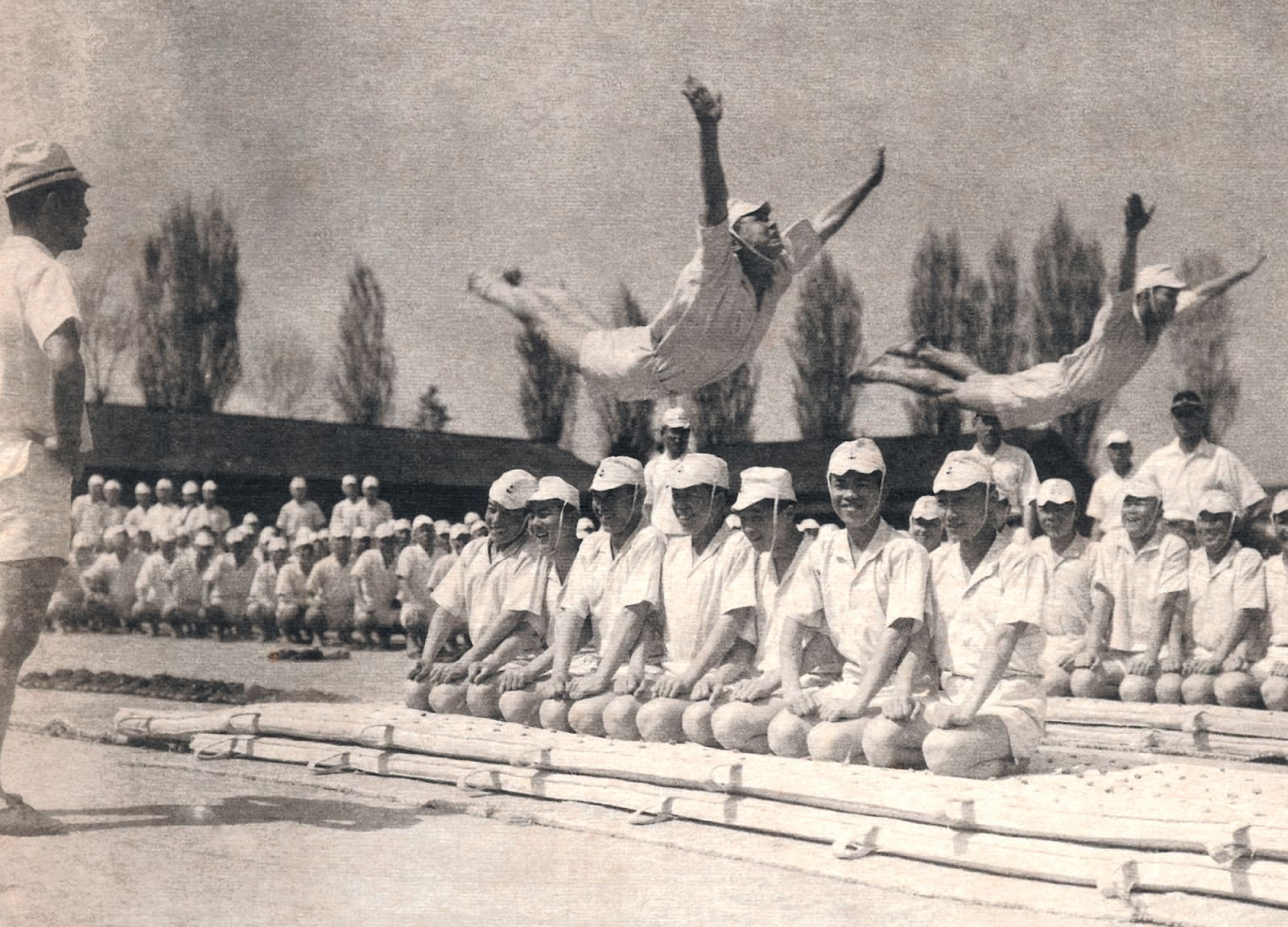
Jordan Schneider: I have one more for you. What Japan did in the late 1930s is optimize around the most exquisite version of what a plane and a pilot could be. They had these crazy hazing and training rituals that make SEAL Team 6 look like a walk in the park — where 100 candidates walk in and only one becomes a pilot. Then you have these really high-crafted, very high-risk jets where they couldn’t tolerate a lot of flak hitting them, but they were the fastest and baddest planes on the planet.

A training exercise for aviation students in imperial Japan. Source.

That worked well for a while until you were in this large industrial, national mobilization type conflict, where you really would have rather had 40 people pass that pilot program and have some decently good pilots, and a jet that could be more easily mass-produced and be able to take more damage at the cost of the exquisiteness of its speed and maneuverability. Not being able to conceptualize a war that was not number one on the priority list led you to not have more flexibility when it came to how you could use that force once things started not going entirely according to plan.

Richard Danzig: The general point is that the technological change is continuous, and you can’t take a vacation from it. You can’t say, “Well, it’s summertime — I’ll wait till after Labor Day to come to grips with this.” You don’t ever win. Definitely. And that’s true in cybersecurity. I have a paragraph in the paper where I say, it’s not that AI will end battles over cybersecurity. This is just not the end of history. It’s not a culmination or termination of warfare in this domain. It’s just a new form of armament that will evolve over time.

First Mover Statecraft

Teddy Collins: Well, first, I have one for you. Maybe it’s a bit of a provocation, and it comes from my experience with Biden’s National Security Memorandum, which was a third failure mode. If we think about these two failure modes that you outlined — one of really kicking the can down the road, and the other of being too focused on the really immediate problems — I found another failure mode was something sort of in between, which was limited incrementalist thinking. We would talk to a lot of people in different parts of DoD and the Intelligence Community about AI, and we would get responses along the lines of, “Absolutely, we completely understand AI is going to be a really big deal. There is this discrete, well-defined process, and we think that in the next 18 months, AI could speed that up by 30%.”

If that’s your framework, you’re sort of missing the forest for the trees — especially if we really do believe that this is going to be something on the order of electricity or markets. You wrote in the paper that, “Policymakers must shed a tendency to see AGI or superintelligence as transforming everything upon its appearance.” I think that’s true, but I actually found the opposite failure mode to be more common — I wanted people to think much more expansively about how deep and systematic the changes could be. I felt like people were often blind to the long tail of really transformative possibilities. In your view, is that at odds with what you’re saying, or is this all part and parcel of “getting out of bed”?

Richard Danzig: It’s the latter. You’re correctly observing a problem, and it’s part and parcel of our difficulty. But if you step back and say what is it we might agree on that we need most strongly? Square one from my standpoint would be expertise. Way too little real expertise on AI at senior levels. I’ve just seen too many examples of a lack of understanding about that in depth, the kind of cutting-edge ability. A second thing would be general knowledge and awareness. That is to say, it’s a problem that many senior military officers don’t have a working knowledge of this without deep expertise.

A third problem is the distance from the companies. The companies and the government are doing better about this. As I wrote the paper, various things were occurring over the six months I wrote the paper that improved the situation, but only marginally. It’s a very unusual circumstance that the center of this technology development is in the United States, but it is not substantially integrated with our national security. When you look at the priorities of the companies, national security isn’t terribly high on that. They worry about things like jailbreaks and bio-attacks derived from knowledge in AI, and the like, but they don’t really focus on national security.

I want, first, deep expertise in the government and growth in capacity, and we can talk about how to do that. Second, an enrichment of the general appreciation of the technology amongst the non-experts. Third, closer relationships with companies. And then fourth, I really do believe that the cyber transformations are the cutting-edge case. The general neglect of cyber as a domain within DoD is, to me, extremely troublesome. It’s amplified by the coming of AI.

I suggest in the paper that one of the challenges is that just as we talk about the models’ decision-making being shaped according to weights which are programmed in there, bureaucracies, which are analogous to the models, the mechanisms of group decision-making, and the like, bureaucracies are also weighted, and their decisions are not simply logical consequences. They’re consequences of the weights that they’re pre-programmed to give. So when you have an Army focused on land warfare, and a Navy focused on sea and under-sea and air, and an Air Force focused on air, and a Space Force focused on space, and you don’t have a cyber force focused on cyber, the tendency is to underweight that factor in the decision-making, the budgetary allocations, and the promotional processes, et cetera. That for me is a big problem.

Teddy Collins: Following up on that, this touches on something I find quite interesting. In addition to the challenge of AI being a powerful, dual-use technology that emerged from the private sector — which is historically unusual and makes it difficult for the government to adopt — another thing that seems distinct is the technology’s general purpose nature. Under the current paradigm, one single model tends to be very capable across many tasks.

This fundamentally challenges the organizational structure within government and the military, which tends to divide responsibilities into separate departments. Historically, if the IC or DoD wanted a really good system for Thing X, they would build a narrow, specialized system. If they wanted a system for Thing Y, they built another, entirely different one. We ended up with many bespoke, narrow capabilities.

Having systems that are inherently general-purpose and require immense resources for development (compute power) imposes significant bureaucratic difficulty because it forces different offices to pool resources. What are your thoughts on solving that problem?

Richard Danzig: That’s largely correct. But while the government certainly needs large amounts of compute, they are primarily involved in the work of inference — using pre-trained models — and not in the work of creating those foundational models. The computing power required for inference is notably lower.

The other point I would add is that what tends to happen is that the new technology is thought about in terms of the old techniques. The question is, “How do I do what I’ve always been doing, but do it better with the new technology?” This occurs for all users of all technologies in all circumstances. When IBM introduced the personal computer, I remember I was practicing law at the time, and the attitude in my law firm was, “This will be great for word processing.” It’s very hard to see, “Oh, it’s going to be different and transform all kinds of things.” So the military manifests this, I think, by saying, “Oh well, I’ll use AI to assist the pilot, or in target recognition, or the analyst.” Those are all attractive and meaningful things, but they don’t come to grips with the power of the revolution. I think that’s part of your point.

Jordan Schneider: The sort of forcing function that you get in the private sector or in law firms. You write in your conclusion, “Adapters eventually account for these effects, moderating some and amplifying others. Time eventually levels the field as those who do not adapt die.” But the feedback loops for militaries who fight big wars every, I don’t know, 30 years maybe is very different. The peacetime versus wartime innovation dynamics are just a really tough nut to crack. Aside from writing papers — I mean, we have a big war that is happening right now, and still, you’re unimpressed by what has been transpiring over the past few years with respect to the U.S. defense community. What else can we do, or how much can we even really expect?

Richard Danzig: I put the emphasis elsewhere. It’s true that they only fight the big wars after substantial intervals, but I think the military are very aware of, “Oh my God, I’m deploying ships to the Red Sea, and people are firing missiles at me, and what’s going on in the Ukraine and in Gaza and so on.” It is all very salient for them.

The problem is that to me, the engine of change in the private sector is the nature of competition and of startups. The enterprises that are aged either change or they die because of the internal competition. But in the Defense Department world, you don’t get that. We’re not generating alternative Navies. Nine out of 10 compete and nine out of 10 die and the 10th is better. We have to reform the existing established one. We don’t have the Schumpeterian creative destruction engine that we have in other arenas.

The best substitute for it in our system is when you get civilian leaders who are intense on driving change, and they pair with military leaders who are open-minded and sophisticated and committed to change. But the military leaders themselves can’t do it because of the institutional constraints. They can’t strip money away from the Navy and move it to the Army or whatever. As a former Navy Secretary, there’s such a strong institutional set of boundaries. You have to have that refreshment from strong civilian leadership. That’s part of what I’m preaching. The problem can only be lifted up by two hands. One is the internal military bureaucracy, and the other is the civilian leadership. I’m not seeing that, and that’s deeply troublesome to me.

Jordan Schneider: Okay, so we need the civilians to show up and also some excitement about change bubbling up from the officer side. To what extent is Congress irrelevant? Can Congress be leading on this stuff, or are they always following? What other forces in the system impact the way these developments play out besides folks working in the Pentagon?

Richard Danzig: First off, I don’t think it’s just a question of bubbling up from the military. There are some senior military officers whose capabilities in this arena are considerable, and who get it and are committed. It’s just that the chain of command, the nature of the consensus process, and the competition over resources make them, in my view alone, unlikely to be able to drive this. That is why you need the civilians who stand outside the system, and they have to together form a coalition for change.

Congress is extremely relevant to that, but more as a brake or an accelerator than as a steering wheel. It’s very difficult for Congress to lead the executive branch to dramatically better outcomes. What Congress can do is say, “We’re going to get behind this that these civilian creative leaders or these remarkable military leaders are pressing, and we’re going to validate it, and we’re going to make it easier by providing additional resources for it,” which makes it incomparably easier. Or they can retard it by saying, “We don’t like this, we’re going to under-cut resources,” et cetera. That, to me, is the greatest power of Congress in this arena.

Unfortunately, I just don’t think Congress can actually have the sustained attention and the micromanagement touch that you need to have. Just take one example — who gets promoted? Congress confirms — it can oppose people, it can warmly embrace them, but it can’t generate the choices. The executive branch, if it’s left simply to the military — when you deal with three- and four-star appointments, the Secretaries of the services recommend to the Secretary of Defense, who recommends to the President, who nominates to Congress. Below that rank, you have promotion boards and the like. But who you’re promoting to three and four stars and the commitment you ask of them before you nominate them for promotion, that’s something that only the executive branch can do. That is imperative. You begin to then populate the senior ranks of the military leadership with people who are adept at that, and then the message is transmitted through the ranks — “If you really want to be promoted to the senior levels and you want to participate in what’s happening, you need to get smart in this area and get behind it.” To me, that’s how change happens.

It’s interesting, though. What’s so striking to me is, and this is another theme in the paper, we talk about AI and its impacts, and the tendency for technologists is to think about it as a technology. For people like me who live in a bureaucratic world and worry about those problems, the emphasis is on assimilation in the human context. People like Jeff Ding and his admirable book have studied this and written about it. For me, it’s a phenomenon of co-evolution. The technology develops and changes, and the human adaptation adopts and changes, and the two interact with each other. How the technology will in fact evolve — what we use our models for, where we put our resources, how we invest in data and data centers — all that will be responsive, should be responsive, to the human elements of this, and the two intertwine.

On the risk side, I think it’s also important to recognize that technology has some inherent risks, which people talk about — guardrails and so on, the AI safety institutes — but the human risks are really very substantial, of actual malevolence, but also of accidents. I develop an offensive capability with my AI system and some of our opponents develop that capability and suddenly there is a cyber attack using an AI system. I don’t know whether that’s actually the machinery run awry or the equivalent of a lab escape in the biology arena, or an actual attack. How do humans respond to that and what do we do with the technology?

It’s not just that the technology risks running away on its own — it risks running away because of that co-evolution with the humans. So, both on the positive side (actually getting the benefit of it) and on the risk side, for me, the tale needs to be told in two dimensions. If you look at it one-dimensionally, just the technology or just the assimilation, you’re unfortunately going to arrive at a misunderstanding.

Jordan Schneider: Why don’t you tie that to how you hit really hard in this piece about having a first mover advantage and the importance of doing that adoption quickly as opposed to just being comfortable that it will come to you?

Richard Danzig: Well, if a model’s just out there and announced to the world, or even if it’s held private, and for example, you get the equivalents of DeepSeek or the Kimi model now in China, coming out with much more fast followers when the model’s announced, if everybody has equal access to it, you’re going to very quickly find that whoever is the quickest to pick it up has a substantial advantage because they can, in my example, cyber patch or attack before the other side is really well armed.

It’s astonishing to me that these are American companies at the cutting edge, but we haven’t really forged that national security nexus. We’ll see what the President says today. But the foreshadowing of his AI plan 180 days into his administration is one of emphasis on developing the AI systems and building data centers and the like. But it’s not, so far as I know at the moment, a real integration with the national security establishment.

Teddy, I’m a fan of what the Biden administration did and what you did in those contexts, but I don’t see, again, this strong national security part. I see an emphasis on AI safety and the development of the technology and appropriate concern about its ramifications in a number of dimensions. But from my standpoint — maybe because I’m a national security guy, that’s where I’ve spent my career — this seems pretty elemental and should be featured much more. Am I being unfair, Teddy, in my brief sketch?

Teddy Collins: I completely agree in terms of the fact that a lot more needs to be done. Probably the document that foregrounded this the most during the Biden administration was the National Security Memorandum, which at least as of the time of this recording, remains alive, unlike some of the other documents that we put together. But I think I and anyone else who worked on that would say that that was the first of the baby steps that are needed in order to get in the direction that we want to go and that we are very, very, very far short of where we want to be.

A huge piece of my job was just the most basic translation of taking things that people would say in Silicon Valley-speak and explaining what it meant in national security-speak to policymakers and vice versa. So yeah, I couldn’t agree more that we need these two worlds to be speaking to each other more extensively. We tried to lay a foundation for it in the NSM, but I totally endorse the idea that the government needs to get out of bed because we’re maybe in a slightly better situation than we were a few years ago, but we are not in, I would say, objectively a good situation in terms of the engagement between these two spheres.

The proposition is that AI is a General-Purpose Technology (like electricity or markets) whose impact will be widespread across all areas. Given this, what fundamental organizational and cultural changes are necessary within a large, heavily siloed institution like the Department of Defense (DoD) to ensure AI’s capabilities can be fully adopted and propagated throughout the entire system? This is a unique challenge because AI is not a discrete, specialized piece of equipment.

Jordan Schneider: We do have this thing called the NSA, and you sort of allude to it in your paper, that a lot of times the kind of mid- or senior-level expertise that goes into the Pentagon is detailed over what does and doesn’t work about having that organization as something that I assume folks can think, “Oh, not to worry, they got a handle on it. We don’t need to invest in this stuff at home.” Yeah, let’s do that one.

Richard Danzig: The NSA is just a terrific place. It has huge pools of expertise, but it’s got the same problem. The French call this la déformation professionnelle — the way in which professional identity causes us to narrow our perceptions and our activities.

As you well know, after much discussion, a structural change was made and CYBERCOM was created as a part of NSA and as a part of DoD, and now has increasing degrees of independence. CYBERCOM in its civilian side is staffed in substantial measure by NSA people. But the NSA people tend to be hugely focused on intelligence. They’re trained in that realm, promoted in that realm. They go to CYBERCOM for two or three years, and then they rotate back to NSA. So you don’t create a career force that has extraordinary capability in that regard.

On the military side, you do the same thing. Military are rotated in for two or three years for general purposes and then they go back to their mainstream careers. It doesn’t work for building an institution that would work.

We made it work with Special Operations Command, which is analogous, but that’s because we had previously developed in the services special operations operators and promoted them and developed that expertise. Whereas we’re not doing that with the digital world. Cyber is a manifestation of it. AI is a meta-manifestation of it.

It’s as though we developed airplane flight with propeller airplanes.

Jordan Schneider: Can you explain some more of your historical analogies?

Richard Danzig: Well, the suggestion in the paper is that the national authorities globally now with AI are like the European governments were in 1500 when they looked at the New World. They know it’s extremely important that it’s going to change things, that they have to be engaged with it. But they have fantasies about what it means. Nobody really knows. They think there’s a Northwest Passage and there’s a Fountain of Youth. The people who live there all grew up in India. Our understanding of AI is rather like that.

Therefore my effort to chart a small square of that territory — the cybersecurity — is an effort to try and say, “Hey, I can map this part of the New World and show you something about what it’s like.”

The 1597 Wytfliet map of the Northwest Passage region. Source.

Beyond that, other aspects of the analogy interest me. Two just to mention are the way in which the European powers project onto the New World their rivalries, et cetera. This goes back to my point earlier about co-evolution of the technology. The New World exercises power of its own. The old world shapes the new. That’s the way, in my view, it’ll be with AI as a technology. The technology will shape things by its inherent logic and its capabilities, but the humans will also shape it in the way that the Europeans shaped the New World, including bringing smallpox, et cetera — the equivalent of malevolence in the AI world.

But then the other thing is — and this is what you were referring to, Jordan — the role of private companies in developing the New World, the charters, et cetera. Obviously the expeditions to the Americas, but the example I particularly point to in the paper is the British East India Company founded in 1600, which winds up having an army twice as large as the British government. I quote William Dalrymple, the leading historian of the British East India Company, who says people think that the British conquered India. No, it was the East India Company.

We have this extraordinary complex of private enterprises now and then shaping the exploration and the development of the new territories and complicating and rendering more opaque the interactions of the governments. The whole thing becomes more difficult to predict, more complex, more intricate. Those are some of the aspects of that metaphor that make it instructive for me.

No single metaphor captures AI. I’ve suggested three or four in this call. There are many others that others have advanced, and I’m just contributing my ingredient to the pot.

Teddy Collins: Maybe one question building on this — what should the relationship look like between the government and the companies? This is something that a lot of people have different thoughts on, and I’d love to hear your take.

Richard Danzig: It should be closely collaborative and mutually supportive. The government should be investing more in the companies. There should be more exchange of personnel between the companies and the government. There needs to be more capacity inside the government. But there needs to be more acceptance in the priorities of the companies that national security — U.S. national security — has a front-ranking seat at the table in the discussion about what should be released, how guardrails should be constructed, where the directions of effort ought to be, et cetera.

I’d like to see a lot more of that. In the paper, I suggest if you can’t get it collaboratively, you’re going to get it through the regulatory mechanism. I’m not a fan of that, but I can’t imagine a future for AI in which the extraordinary power of a superintelligence was left in the private hands of leaders of OpenAI or xAI or Anthropic or Microsoft.

If you give me a superintelligence, all else aside, my impact on the political system can be huge through information and disinformation activities. My impact on the financial markets can be fundamentally disorienting because I can engage with way more skill and knowledge in high-frequency trading or other activities that enable me to give myself an advantage in the market. That’s before I even come to the national security point.

My observation in the paper is that it’s elemental that we think governments should have more capability in the domain of violence than any private citizen. We do not want a private citizen to have an army so big that the U.S. government can’t control them. Internationally, we want to be at least as capable as anybody else. AI is at least as powerful in its superintelligence mode as violence. The same principle applies. I don’t think the U.S. government can be secondary to anybody.

Now that still generates a huge amount of problems. How do you make that work? And for that matter, who guards the guardians? How do I feel about the U.S. government having this capability and how do I constrain that? I don’t think I’m offering a satisfying suite of answers, but I’m pretty sure that I’m pointing in the right direction, which is you’ve got to figure out how the government exercises control in this arena. If you don’t figure it out now, you’re going to wind up being desperate to figure it out later when some crisis of one kind or another occurs because you don’t have that government power. It’s private power.

Teddy Collins: Picking up on this question of “Who guards the guardians?” — you mentioned that one reason that it’s important to have government involvement is that there’s an extreme public interest, and we want to make sure that these systems are developed safely. I could also imagine to some extent some governance concerns going the other way, which is if we want to avoid something like Project Maven, is it possible that the companies that might have some ethical concerns about exactly how this stuff is used, if it does get used by the national security state, are there some requirements that they can, that they sort of have leverage to try and put in place as a precursor to any serious engagement with the national security community?

Richard Danzig: It’s an argument for collaboration because if I’m working closely with DoD, I’m arguing with them and saying, “Hey, if you want this, I need reassurance about this other thing.” But if I’m at arm’s length, I don’t have that. Whatever DoD does with its models when it acquires them on the market is opaque to me, and I don’t like that.

I want that. I also value the international aspects of this. It’s tempting to think, “If only the U.S. ruled the world without any opposition, the world would be better.” Well, maybe it would be better, but you’d worry about the unconstrained power of the U.S. government. The fact that other countries — for example, allies like Britain and the AI Safety Institute there — are working on these issues is helpful.

The fact that we have competitors is, in the long term, probably good for humanity, though I would not like those competitors to prevail. But they represent some controls on what we do. The trouble is that, as with anything, you can skew too much in the other direction, and the competition may cause all kinds of bad acts because people are paranoid about what will happen in the competition. “Paranoid” may not be the right word because they may be right.

Teddy Collins: Can you think of previous instances where private sector actors had something that was so potentially valuable to the national security state, but where the business of selling to the national security state represented such a small fraction of the company’s commercial interests?

Richard Danzig: Health supplies, pharmaceuticals are exemplary of that. If you think, for example, about the extraordinary achievements of the COVID time and the development of government incentives for companies to develop a COVID vaccine, you see that on their natural incentives, the companies pursue financial goals that are different. Only a fraction of what the companies do is responsive to the government as a government market. Now the fact that we have regulation in that area changes some of that calculus. Above all, the fact that we have the Medicare insurance schemes and Medicaid are really important. But the health industry in general has that attribute.

When you think about it, it’s true of most industries. The decisions that the energy companies are making about how to proceed show some deference to the government, either as a customer or as a regulator, but the bulk of their thinking is oriented towards the private market. That’s the way I think about this.

There’s a nice report that was just put out by a commission set up by the state of California, supported by some Berkeley folks, on AI. I wasn’t terribly taken with their executive summary or their statement of principles. But if you actually read the text of the report, it’s a pretty richly textured assessment of what’s going on. One of its virtues is that it thinks about analogies to AI in other markets. Whenever it recommends something, it tries to think of an analog in, for example, the way in which the EPA regulates carbon.

I’m absolutely delighted if this program generates some more readership for my piece. If both of you have read it, that in itself may double my readership. But I would recommend this as well.

Writing Well, Life Hacks, and Book Recs

Jordan Schneider: Speaking of writing papers, reading this, I felt like my brain had rotted, and I was very jealous of the sustained thought and attention that you can give to something where you’re both writing about developments that are happening in real-time, but writing for an audience for today and also for five and ten years from now. Going back to some of your other larger national security papers over the past decade, which we’ll link to in the show notes, it’s clear you’re doing is trying to look for what is enduring. Even things you’ve written about 10 years ago with respect to cybersecurity and acquisitions, when it comes to the idea of modularity and driving in the dark and trying to really grapple with the fact that so much about the future is by definition unknown, is a very different modality of thinking and writing than the vast majority of what I see coming out of the think tank and policy community.

Can you offer reflections on that? How about some lessons for folks who are trying to write enduring work in a field that is unfortunately biased toward writing for the present moment only?

Richard Danzig: I appreciate those comments first because I appreciate the compliment and the reinforcement. To the extent it gets people to look back at things like my Driving in the Dark paper, which is called 10 Propositions about Prediction, that’s great. People frequently still assign it or talk to me about it.

Having said that, though, I appreciate that there are just different functions. It’s like some chorus that sings in different voices — there are tenors and there are basses, et cetera. What you are doing, for example, is to cover a very wide area and then have a particular focus on China and technology issues. I think it’s very valuable to have that as well, and you can’t do both. You’re not going to take off six months to do the kind of work I did, and I’m not able to do this if I’m doing what you’re doing. So, I think that they all have a place.

Third and most fundamentally, an interesting thing happened to me at the end of this, which made me reflect about AI in another dimension. I stayed up late one night trying to finish this paper and was working on it toward 1:00 AM when a colleague sent me a paper that another colleague had elicited from a deep research inquiry to an AI model. It was on a related topic, in this case, offense-defense balance and cyber.

I looked at it and thought, “This is a very worthwhile paper.” I didn’t think it captured what for me was central. I had problems with the paper, but if a colleague sent it to me, I would think, “This is a reasonable colleague I want to interact with.” This was in the closing hours of my writing my piece, which piece I wrote essentially without AI involvement. It wasn’t an AI-drafted piece in any way. I used AI a little bit for some of the research.

Then my thought was, “You know, maybe what I’m doing, which you just nicely praised, is anachronistic.” Some of this is just my getting older and reflecting on this. What does it mean to have this capacity for AI? I’ve labored six months on this, and the AI labored six minutes on what it produced, and what it produced was in the ballpark. I’ll claim mine is better, but it’s not in a different league. Then I thought, “Boy, if this is causing me to have these doubts with all the advantages that I’ve had over the decades and the seniority I have with respect to doing projects like this, what is it like if you’re 25 and you’re thinking about doing projects like this?”

It’s a subtle aspect, maybe not so subtle, of AI and the kinds of issues it presents, transmitted in a very personal way for me around the kind of enterprise I’m engaged in. For sure, that enterprise will look different for people who are now undertaking it, and especially for people who are undertaking it for the first time in less mature, developed ways.

I just want to add one other thing, which is, there was a nice piece in the Times by O’Rourke, a woman and a poet, who very thoughtfully came to grips with her use of AI — her initial skepticism, then her appreciation, and then her reservations. It touched on this to some extent.

For me, writing is a way of figuring out for myself. Her point, and one that I also have arrived at, is that the real sacrifice may be not be so much in the product, but in the fact that the human who would learn a lot by developing the product doesn’t have that depth of learning. That’s an extraordinarily important thing that I think we need to grapple with, quite apart from the subject matter of this discussion about national security.

Jordan Schneider: The ability of computers in the summer of 2025 to do 85% of the work of a Richard Danzig 70-page think piece is a remarkable thing. Fast forward three years, and we’ll maybe get to 97%. The computers aren’t going to be making all the decisions. I have this whole riff about an AI President or an AI CEO, where 20 years from now, or even sooner, if you sort of have a president wear glasses and get all the data inputs that someone would have, plus presumably a lot more because there’s more processing power that a computer can do taking in stuff than a president or a Chief Executive, the sort of point decisions that that person will make almost certainly at some point in the future are just going to strictly dominate what a human can do on their own, at least on certain dimensions.

Not all of what happens in the Pentagon or the national security establishment is people thinking about policy papers. But I’m curious, as you sort of meditate on this, where do you think the humans are still going to be useful and relevant? Where does it not matter that we didn’t have someone doing the six months of thought around the topic? And where could it end up being really dangerous if we end up trusting this stuff too much?

Richard Danzig: There’s a lot here that I don’t know. Coming back to, what’s the impact of the market on human psychology in 1500? We’re predicting the next 200 years. You can’t do it.

My view, though, starts from a sense that we exaggerate the role of humans now. If you take an archetypal decision like a president’s decision to unleash nuclear weapons in response to an impending attack, what actually happens? He’s got 30 minutes for a decision, but what is he doing? He’s relying on machine inputs. The machines are telling him the missiles have launched. Does anybody actually see the missile launch? No. Satellites are detecting this through a variety of technologies that the president is unlikely to understand. They transmit that information, it gets introduced into models, and people say, “Here are the results.” It’s extremely unlikely that the underlying nature of the models is understood. By the time he’s got a very few minutes for decision-making, his decisions may be largely shaped already by those machines.

We exaggerate the degree of human opportunity here. Now you can argue that it’s still important that he can have an intuition about whether it is reasonable to expect that somebody would be attacking me in this context, et cetera. But I think the degree to which we allow decisions to be made by bureaucracies and markets — those are impersonal enterprises, but we’re all incredibly shaped by them. We delegate to them large numbers of decisions that affect our everyday lives, and they still occur. They have extra power to shape our judgments.

If you ask how many people go into public school teaching as compared to investment banking when they have an option, the market is shaping the weights that underlie their decisions. We think of it as a wonderful individual human decision. Some human beings have the ability to say, “I’ll ignore the market signals,” but the market signals shape most people most of the time.

I think we’re just going further down this path. What is that like, and where does that leave us as human beings? I just don’t know. I think it’s one of the very important things to be figuring out now and discussing and debating amongst ourselves. I can say more about it, but I don’t think my thoughts are worth any more than anybody else’s on this subject.

Jordan Schneider: Okay, let’s do some life hacks. Fiber One. I got that from you three months ago. Incredible. What else do you have for me?

Richard Danzig: I’m a big advocate of reading fiction. When I was Navy Secretary, the Marine Corps traditionally asked the Secretary to suggest books for Marine officers to read, and traditionally, they’re military histories. Partly for the pleasure of throwing them a curveball, and partly because I believed it, I gave them a list of 10 novels.

My argument was, and is, that if you really want to understand other human beings, the best way to do that is to read creations by other people that get into other people’s heads. I’m just amazed at this capability, so far exceeding anything I could do, to envision what the world looks like from the standpoint of someone else. So, I’m frequently encouraging people to read fiction and the like.

I’m a big fan of parenting. My general view about that is that people with our cultural predispositions are constantly trying to educate their kids and move them along and get them to progress and be more like adults. My view is do everything you can to retard their development. What you really want to do is have pleasure in kids at the age that they’re at, and they’re not going to be at that age in the time ahead. They outgrow their childhood, so enjoy it while you have it and treasure the way they look at the world.

I suppose, up there with Fiber One, are these two recommendations.

Jordan Schneider: All right, so we’re not taking sponsorship from Kellogg’s, but General Mills, if you want to reach out, there’s a conversation to be had.

Richard Danzig: See the power of the market there. Here I’m offering these highfalutin observations, and you’re reducing it to your quest for sponsors.

Jordan Schneider: I had a few points there. The threshold for me of AI writing compelling fiction was crossed only two weeks ago. I would really encourage folks to go to Kimi.com, the latest Chinese model. There’s something about its English that feels a little foreign in a way that ChatGPT and Claude have been honed to a T to not anger you and just be anodyne. That works for some functions, but not when you tell it to write you a Jewish story in the style of Tolstoy or whatever.

Let’s close, Richard, with some book recommendations. Should we spin around? Should we have you walk around with your laptop and give us a little library tour, see what speaks to you, or what’s right for cybersecurity and bureaucratic change?

Richard Danzig: My recommendations might induce a certain amount of queasiness in general, but walking around with my laptop for sure would do that. So I’ll restrain myself on that count.

Some stuff I’ve read recently: You’ve been an enthusiastic supporter of the Apple in China book, which I think is really worth attention. I’m just very impressed with it. I just finished reading Robert Graves’s Goodbye to All That, a memoir of World War I, which I’d never read before. The first 90 pages or so are engaging about his life before World War I, but not particularly special. The descriptions of his experiences during the war, very matter-of-factly delivered, are really worth reading. His post-war tough efforts to adjust, and difficulties with that, both physical and mental, are illuminating about Ukraine now and what people there are going through. So I very much recommend that.

Of novels I’ve read recently, I caught up with Rachel Cusk’s Outline, which I think is a remarkable book. It takes a narrative voice that everybody’s fiddled with — narrative voices for centuries in Western literature — and finds a relatively new way of doing this. The writing is frequently dazzling, and the insight about human relations is terrific. It’s just a few hundred pages. Those are three books that immediately pop into my head sitting here at my desk. I see that I’ve got the Anil Ananthaswamy book Why Machines Learn: The Elegant Math Behind Modern AI, which I think is a masterpiece of exposition. The math is at times beyond my patience or skills, but if you’re mathematically inclined, it’s a book I would definitely recommend on AI. I’m just impressed by it. So those are some diverse things that come to mind.

Jordan Schneider: I want to press you on this one more time because you kind of pivoted to the AIs being able to do the work, but I still want to get one more chance to get in your head. What are the questions you are asking yourself as you’re trying to write things that are both relevant to today and relevant for years from now?

Richard Danzig: I’m not sure I have a good answer for that. I’m pretty incremental. What amazed me in writing this paper is maybe three things.

  1. How much I kept changing my mind. Talking to other people — I cite a number of them in the acknowledgments — it’s really helpful. The driving force for me was trying to understand it better myself. That took me a number of iterations. I look back on where I started, and there were just a lot of things that I was naive about or didn’t understand.

  2. How difficult it was because the field was changing. People keep producing stuff, and you know, O3 comes out and starts doing achievements in math and on coding, and DeepSeek, you name it. I was constantly having to revise things, where I said “AI may be capable of this” into “AI already did this” or whatever.

  3. People are also being very productive in their commentary. Your team here at ChinaTalk, but also Jack Clark and his Substack and various other things, are trying to keep track of the field. I would have some original idea, I thought, and somebody else would publish it. Then I’d spend a while trying to develop the data on something and write it up over the course of three pages, and somebody else would publish 15 pages that did it better. You have this sense, it’s like the tide is rushing in, and you’d better scramble to find some high ground. Eventually, you just have to say, “Stop, I’ll publish it.”

The day I committed the manuscript to being done, the next day, there were two things I thought, “Oh God, I wish I’d known about this. I should have.” I didn’t quite catch up with the developments in that. Just as a concrete example, I talk a little bit about formal methods in the paper and point to the DARPA Hack-A-SAT experiment, where they demonstrate their ability to use formal methods to make helicopters safe against red team cyberattack. I described it briefly, but I hadn’t realized they had actually now completed the experiment. I wish I devoted more time to that, and I’m quite interested in it as a potential additional thing. But it was just on my horizon and not in the center of my focus when I wrote the paper.

There are all too many other examples of that. The world is moving so quickly. In my analogy to the market in 1500, it took two centuries for that to unfold, and it still is unfolding. But what happened in those two centuries will happen in single-digit years with AI in terms of the magnitude of change. We adjust to the speed of change in the same way as we adjust to routinely flying off to Europe in a way that would have been unimaginable to my grandparents. But it’s still astonishing. In a way, we lose track of that astonishment; we lose track of the character of modernity. Anything we grew up with, we take for granted. Anything we didn’t grow up with poses all kinds of challenges of assimilation.

Teddy Collins: Can I throw in one final question, just building on that? I know that this kind of runs up against the caveat that you gave at the beginning, which is it’s very difficult to make predictions in these domains, but I wonder if you have any intuitions about what we expect to see in terms of this magnitude of capability gaps between key players. Let’s say between two countries in terms of AI adoption, taking into account that these capabilities are, as you said, we may end up having technological change of the magnitude that previously took decades being compressed into a much shorter period of time.

Richard Danzig: You’re asking, Teddy, what I think is the likelihood that there are substantial gaps between, for example, the U.S. and China or other competitors?

I think that those gaps tend to be exaggerated and that the fast followers will follow fast. The gaps are short-lived. But there are two important qualifications. One is that a short-lived gap can be critical if the advantaged party knows how to use it.

The second is that it may be that there is the potential for takeoff through recursive self-improvement, so that if you’re in an advantaged position, you can amplify that advantage over the time ahead. You’re very familiar with these ideas. It’s hard for me to weigh them. We’ve talked a little bit, and Jordan rightly points out it’s been a long-standing concern of mine about prediction and the difficulties. I think it’s difficult to predict trends and what’s going to happen, but I think that’s doable and way easier than predicting how much weight to give to the different variables and the timing of the evolution of the different variables. Timing is the most difficult thing to predict.

I point out a little footnote in the paper that if you take the U.S. stock market, it’s so striking. This is an extraordinarily regulated environment with rules and requirements for disgorgement of information and regulation of trading and the like. Nobody’s figured out a way to actually time the market well. The two dominant variables of strategies are to get around that problem either by buying and holding and saying, “I’m indifferent to the timing fluctuations,” or at the opposite end by engaging in high-frequency trading. You trade so much every microsecond that, as a practical matter, you’re not as exposed to the issues of timing. You’re always trying to pair your trades, hedging them, etc.

It interests me that conceptually, I don’t think we’ve come to grips with these three propositions — one, how fast the followers are. Second, how difficult it is to give weight to the different variables we perceive. And third, the difficulties of predicting timing. It seems to me those are a part of the great mystery that I have spent time looking at over the course of my career and many others have grappled with as well, sometimes without realizing that it’s what they’re grappling with.

Jordan Schneider: I think that’s a pretty good articulation of our thesis statement for our Powerful AI and National Security series, which Teddy and I will be continuing throughout the rest of the year — we can’t know anything, but it is a worthwhile effort to try to start from the technologies themselves and build out an understanding of what sort of potential futures of what the technology gives and potential gaps that could be developed between the U.S. and its adversaries.

Richard Danzig: I’m grateful that the two of you are out there exploring this new world and applaud you for doing it. My biggest encouragement is, Teddy, keep asking Jordan questions.

Teddy Collins: I will enthusiastically embrace that mantle.

Jordan Schneider: I want to pick up on the parenting thing because that’s a nicer place to close. My daughter is turning one in a week, and we are at this beautiful, interstitial phase of saying her first words, but not entirely getting their meaning right or understanding what they are all the time. The semantic connections are not totally there. So “baby” is “baby,” but also it is a watch. Anytime someone gives her a watch to play with, that is “baby,” too. “Wow” is now associated with when she turns a light on, and when she sees books, and when she sees the sunlight in the morning. So, we’re watching a model train in real-time. It’s fun to play with the finished model, but it’s also fun to play with these weird artifacts that get spun up over the course of the training run.

Richard Danzig: I encourage you on two counts, Jordan. One is to continue that sense of wonder and not correct her when she sees light and says, “Wow.” Just say “Wow” yourself. The second thing is, you might think about having her keep sharing with the rest of us by having her on ChinaTalk.

Isn’t that really your ambition, that you would ask some question and your guest, in that case your daughter, would say, “Wow”?

Jordan Schneider: Once I had a kid, someone was like, “Jordan, you’re building a dynasty now. You need to inculcate her into the rites of ChinaTalk.” And, “We need to come up with different eras, and they can have another sibling and then battle for the throne.” I’m not sure this is quite the generational business that the New York Times has turned out to be, but anything’s possible in the world where a new printing press hits the planet.

Our Year in Review

15 January 2026 at 19:15

In 2025, ChinaTalk’s eighth year of existence and my third doing it full time, we did the thing. We put out on the newsletter over 150 editions that centered on China AI lab, policy, and application coverage.

On the podcast we published a hundred shows about:

  • Chinese elite politics and US-China policy

  • US-China chips and AI

  • Economic statecraft around export controls and tariffs, which made up the majority of our ten emergency pods this year (double 2024’s emergencies!)

  • A growing focus on defense, with the launch of our weekly Second Breakfast show, a good bit of military history and our AI and the Future of War series

ChinaTalk’s substack grew 60% this year to 65k subscribers. This is a really big number. The second largest think tank substack is SCSP, which has 35k. Recent CFR, the Atlantic Council, and Brookings annual reports say that, after two decades of building lists, they each have around 200k total email subscribers. Not a bad showing for ChinaTalk’s $500k budget and three years in the game.

The show gets 10-15k listens per show across the podcast and YouTube, and was downloaded a million times last year. These are also really big numbers. Across all of foreign policy think tank-dom, only one show (CFR’s The President’s Inbox) is bigger. And it’s not like Mass Ave isn’t trying. CSIS has 40 shows alone.

Why do so many people engage with our work?

  1. US-China tech is an covering important, underserved niche. A year after DeepSeek, to my endless surprise there are still only a handful of analysts working in English in public on tech and China. While there is more out there on the defense side, most coverage tends toward SpecOps bro, Zeihan geopolitics bro, or lifeless industry coverage.

  2. We make substantive, engaging content that resonates in today’s media landscape. In traditional think tanks, podcasts, newsletters and responses to news developments are afterthoughts to the long reports and small in-person events funders expect as outputs. Since podcasts and research with outputs under 10,000 words often aren’t directly funded and so happen on fellows’ personal time, talent in these areas isn’t hired for or developed. By only accepting unrestricted funding, we’ve had to limit our headcount growth, but it ensures we’re covering what matters today, not getting stuck writing long reports that won’t matter by the time they’re finished in the extremely fast-moving field of US-China and technology.

  3. Brands matter in DC way less than they used to. Writing a smart newsletter in some ways even gains you credibility vs working at a brand name think tank, university, or news organization. It blew my mind as well to learn that Jasmine Sun wrote that “I was shocked to learn from a senior WaPo reporter that they consider anything over 10,000 views good.” Our worst performing posts do more than this!

2025 was the year to test whether I wanted to grow a research team or continue to float along as an extended Ezra Klein cosplay, podcasting and writing when the mood strikes. The answer to that is a definitive yes to growing a team. It's been a pleasure getting to empower young talent in an open ended, self-driven think tank position I wish existed when I was in my 20s. We’ve brought on some great analysts who have all already contributed to the national conversation: Lily Ottinger, Irene Zhang, Nick Corvino, and Aqib Zakaria.

Unfortunately, funding is still holding us back from the fully humming ChinaTalk as we don’t have the money to grow headcount. If you’re interested in seeing ChinaTalk flourish even more in 2026, please get in touch!

What follows is a rundown of our most memorable podcasts and articles.

Our 10 Most Memorable Podcast Episodes of the Year

Here’s a spotify playlist to listen to them!

Contemporary Politics

PLA Purges with Jon Czin

Jon Czin, longtime CIA China analyst now in the think tank world, chatted PLA purges. I’ve done less domestic chinese political coverage of late, as not much surprising or dramatic has happened since the COVID response drama, but the PLA purges are easily the most interesting domestic elite political development in years.

I’m also pretty proud of my thumbnail for this one…

Jake Sullivan

Felt like I’ve been prepping for this one for five years. All the other podcasts he’s done since leaving government followed the same trajectory of the hosts beating up on him for Gaza/Ukraine leading Sullivan to spend his airtime defending his record. I wanted to do something different, instead trying to explore what the experience is like of serving as NSA. I think we succeeded.

Dan Wang

Dan Wang came over to my house to discuss Breakneck, exploring China’s “engineering state” versus America’s “lawyerly society” through the lens of brutal social engineering projects. Wang argues China’s engineering mindset — treating society “as liquid flows” where “all human activity can be directed with the same ease as turning valves” — enabled four decades of 8-9% growth lifting hundreds of millions from poverty but also created “novel forms of political repression humanity has never seen.” We also did a podcaster all-star show with Dan Wang + Ezra + Derek!

Allied Scale and Net Assessment with Rush Doshi

If America doesn’t use its allies, it will lose the 21st century. This interview with Rush Doshi explores how the U.S. should strategically compete with China by leveraging partnerships with allies. While China faces real challenges like demographics and debt, Doshi argues that China’s scale, manufacturing dominance, and industrial capacity pose enduring strategic threats. He critiques both the Biden and Trump approaches to alliances: Biden’s overemphasis on persuasion and Trump’s heavy-handed use of coercion. Instead, Doshi emphasizes the need for capacity-centric statecraft, where allies help each other build economic, technological, and military strength.

China’s Rare Earth Controls

An emergency pod with the Two Chrises ( and Chris McGuire) after China dropped their rare earth controls for the second time this fall. China successfully backing down the Trump administration by deploying rare earth controls felt like a turning point in the relationship.

Deepseek: What it Means and What Happens Next

Early in the year, and I reflected on the long term implications of the DeepSeek saga, looking into what the firm does and doesn’t illustrate about Chinese innovation and implications for future US policy. It holds up pretty well!

Liberation Day Pod: MAGA: A Guide for the Perplexed with Tanner Greer

In this podcast episode, recorded on Liberation Day, Tanner Greer and I talk through the chaotic dynamics of Trump’s second administration China policy. Greer explains Trump’s unpredictable decision-making style, his use of internal factional conflict as a management tool, and the administration’s disjointed tariff policies. The conversation explores four quadrants of Trump World ideology and how adherents of each quadrant approach trade, industrial policy, and Taiwan.

Trump’s Pivot to Putin + AGI and the Future of Warfare

Recorded the day after Trump’s disastrous meeting with Zelensky in the Oval Office, Mike Horowitz, Shashank and I discussed what the brave new world of Trump’s global diplomacy and just how much war is changing. The second Shashank show of the yar we did following up with Rob Lee exploring to what extent the war in Ukraine is a revolution in military affairs continues the theme.

History

Inside the Soviet Cold War Machine

Sergey Radchenko’s To Run the World explores the Cold War not as a clash of ideologies, but as a tragic and often absurd contest for prestige, legitimacy, and recognition among insecure leaders struggling to validate their power, both externally and at home. In this interview, Radchenko argues that authoritarian regimes, especially the USSR and China, pursued global influence to compensate for internal weakness.

Annihilate the American aggressors
A propaganda poster in support of North Korea. The title reads, “Annihilate the American aggressors!” ca. 1950. Source.

Part two came out in April, and it’s even better than part one! In this deep-dive, Radchenko unravels how personal egos and the battle for international prestige shaped Soviet decision-making — from Khrushchev’s downfall to Brezhnev’s Vietnam gamble, the paranoid Sino-Soviet split, Nixon’s unlikely détente, and the disastrous invasion of Afghanistan. This episode asks the question, what if boredom, not grand strategy, is what starts wars?

The Party’s Interests Comes First

Joseph Torigian’s biography of Xi Zhongxun reveals the CCP as simultaneously a religious organization and mafia — where suffering paradoxically deepens loyalty and persecution is a badge of honor. Our epic two-part interview explores the life of Xi Zhongxun, father of Xi Jinping, from his life as a young revolutionary to his purge and eventual rehabilitation.

The Long Shadow of Soviet Dissent: Disobedience from Moscow to Beijing

This ChinaTalk episode with historian Ben Nathans and longtime reporter Ian Johnson explores how Soviet dissidents built a moral and intellectual movement by demanding that the USSR live up to its own laws — a strategy pioneered by mathematician Alexander Volpin that later echoed in China’s rights-defense (维权) activism. Through episodes like the 1966 Sinyavsky-Daniel trial, dissidents transformed “socialist legality” and show trials into moral theater, using underground samizdat networks to expose the state’s hypocrisy and preserve truth.

The Pacific War

We explore Ian Toll’s incredibly expressive Pacific War trilogy, examining both his innovative narrative techniques and strategic questions about WWII’s Pacific theater. The conversation covers whether Allied victory was predetermined after Pearl Harbor, how Japan’s domestic political instability drove its military aggression abroad, the evolution of kamikaze tactics as a resource-scarcity solution, and the crucial role of media management in shaping military leaders like MacArthur and Halsey into national heroes. Part 1 and Part 2 here.

Most Memorable Articles of the Year

We already recapped our tech coverage in our “China AI in 2025 Wrapped” post, but I wanted to highlight a few more pieces that stood out.

On the travel side, Lily found some fascinating China connections travelling in Kyrgyzstan, Irene and Lily reflected on some Korean makeup and massacres, and I spent some time in Tel Aviv and the Bay Area.

On the war beat, we ran a piece by a Japanese colonel studying at Air War College in Alabama about lessons from how Japan intended to defend Taiwan against an American invasion in WWII.

I also updated my early career guide for folks who are interested in topics adjacent to ChinaTalk themes.

25 Biggest Events in US-China Relations This Century

Stealing ’s listicle format, I ranked the 25 most important events in US-China relations this century. If there’s interest I could explain my reasoning in a full piece. I’d also be interested in taking submissions on this theme!

  1. Xi Jinping becomes CCP General Secretary (18th Congress/1st plenum) — 11/15/2012

  2. China joins the WTO (trade-driven takeoff shorthand) — 12/11/2001

  3. Trump elected U.S. president — 11/08/2016

  4. China abolishes PRC presidential term limits — 03/11/2018

  5. Chen Shui-bian wins Taiwan presidential election — 03/18/2000

  6. Shinzo Abe returns as Japan’s PM (Second Abe Cabinet inaugurated) — 12/26/2012

  7. U.S. “Oct 7” export controls on advanced computing/semiconductor tools to China issued — 10/07/2022

  8. “Liberation Day” tariffs announced (Rose Garden speech) — 04/02/2025

  9. 9/11 attacks — 09/11/2001

  10. Dr. Li Wenliang dies as COVID escalates — 02/07/2020

  11. “Made in China 2025” issued by State Council — 05/19/2015

  12. Huawei added to the U.S. Entity List — 05/16/2019

  13. Tsai Ing-wen wins Taiwan presidential election — 01/16/2016

  14. Trump signs Section 301 action memo (trade war kickoff marker) — 03/22/2018

  15. Lehman Brothers files for bankruptcy (financial crisis kickoff) — 09/15/2008

  16. Hong Kong National Security Law takes effect — 06/30/2020

  17. NYT publishes the “Xinjiang Papers” leak (standing in for Xinjiang repression) — 11/16/2019

  18. DeepSeek releases R1 — 01/20/2025

  19. Bo Xilai sentenced to life imprisonment — 09/22/2013

  20. U.S. SecDef calls for halt to land reclamation/island-building (Shangri-La Dialogue) — 05/30/2015

  21. Tibetan unrest begins with Lhasa protests — 03/10/2008

  22. Beijing 2008 Olympics opening ceremony — 08/08/2008

  23. U.S. BIS issues denial order cutting off ZTE’s export privileges — 04/15/2018

  24. U.S.–China Anchorage talks open (Blinken/Sullivan vs. Yang/Wang) — 03/18/2021

  25. Obama delivers “pivot to Asia” speech (Australia Parliament) — 11/17/2011

Ins and Outs for 2026

And lastly, borrowing the format from , we’re doing some Ins and Outs for 2026. Predictions are NOT endorsements!

ChinaTalk is a reader-supported publication. To receive new posts and support our work, consider becoming a free or paid subscriber.

#152 斩杀线:中美惊人对比

15 January 2026 at 09:23

今天,我们说一说“斩杀线”(Kill Line)。前段时间,这个词在中文社交媒体上比较火,听着有点魔幻。我不打游戏,但听说过这么个词。在游戏中,对手生命值低到临界点,已经不堪一击,就能被一键击杀。这就是所谓“斩杀线”。

这个词能在中文世界火起来,推手是中国的舆论诈骗机器,就是党国的宣传喉舌。它编造的故事情节,大概是这样的:在美国,那怕你年薪十万、二十万,都是活在斩杀线边缘,一旦失业、生病,出点什么意外,人生就直接清零,妻离子散,流落街头。

昨天早上,看到朋友袁莉在《纽约时报》的专栏文章《中国宣传机器为何炒作美国“斩杀线”》。她是资深媒体人,分析这个现象,说的很透彻:按照党国的宣传逻辑,美国的景象越是惨淡,中国人对当下困境的容忍度就越高。当下中国经济下行,看不到底部,这种宣传的目的很明确,就是为中国老百提供一种情感慰藉,也是转移国外对中国领导人的批评。

换句话说,这次炒作美国斩杀线,是中国舆论诈骗机器,对中国人的一次精准投喂。它斩杀不着不认识中国字的美国人,它斩杀的是中国人,更具体地说,它斩杀的是中国人的智商和判断力。

读了袁莉的文章,我忍不住也想凑个热闹,说说美国的斩杀线和中文媒体的斩杀线炒作。

我们这个年纪的人,对中国宣传机器这类炒作多少有点免疫力。从小到大,见得太多了。英语中有句大俗话:“Fool me once, shame on you; fool me twice, shame on me”——你骗我一次,我上当了,是骗子可耻;你骗我两次,我还上当,是我自己脑子有问题。党国宣传机器骗中国老百姓,不只骗一次两次,赶上它勤快的时候,一天就骗好几次。凡是脑筋还没锈住的,对那种舆论诈骗,多少都有点免疫力。所以,要想天天骗,还能得手,就要不断变换花样。

我们小时候,毛主席他老人家的宣传机器,简单粗暴,就是整天喊“社会主义好,东风压倒西风”,世界革命很快烧到西半球,解放水深火热之中的美国人民。我们饿得肚子咕咕叫,听着听着,也信了。要是不信,它肯定让你比饿肚子还难受。

那时候,我五六岁,对毛主席的想象,就是他老人家整天坐在天安门上吃好的,一三五吃白面馍馍,二四六吃肉包子。村民平时吃地瓜面窝窝头,家家户户都一样。只有过年的时候,才吃点肉。邻村有个乞丐,来要饭,到哪家要,要到的饭都一样,没什么油水。有一阵没来,村民猜测,他是不是死了。后来他又出现了,人还好好的,就是出了点事。

前一阵,他出门要饭,到一户人家,家里没人。他看到锅台上,有一碗白花花的东西,以为是肥肉,就三下五除二,吃下去了。谁知道哪不是肥肉,是猪大油。他吃了一碗猪大油,回家上吐下泻,一个礼拜不能吃,不能喝。不能吃饭了,也就不需要出门要饭了。所以,消失了一阵。

那时候,一碗猪大油,在村里都是罕见的奢侈品。但我们老觉着,得去拯救水深火热火中的美国人民。

后来毛主席死了,才知道美国人吃的比我们好,说吃肉就吃肉,不但这顿有吃的,而且吃了这顿还有下顿。更要命的是,家里还有个叫电冰箱的神器,把后天吃的饭都存好了。

再后来,美国大使馆只要开门办公,门前大街上就开始排起长龙,排队的都是要来美国,申请美国签证,跟排队抽奖一样。

改革开放了几十年,普通中国人也有肉吃了,很多城市中产也过上了小康生活。但好日子不太长,就出了个土皇帝,撸起袖子穷折腾,眼看经济开始肚皮朝天,城市中产财富缩水,据说几年就缩水了200万亿人民币。很多人十年、二十年的努力,房价一跌,都成了泡影。那种感觉肯定好不了。这时候,人最需要的是精神鸦片。

有需求,就有供给。党国宣传机器发现,有中文肉喇叭在滴滴答答吹美国斩杀线,就如获至宝,全网推广。各种追流量的民间肉喇叭紧跟,瞬间就炒作起来。不管翻来覆去怎么炒,都是对着墙内觉得日子越来越难过的中国人喊话,翻译成人话,就一句:“你们别抱怨了,偷着乐吧,美国人的日子比你们更难过,一不小心,就流落街头”。

前面我们说那句英文大白话:“Fool me once, shame on you; fool me twice, shame on me”这说的是正常社会的正常人。但中国不是个正常国家,中国社会也不是个正常社会,而是个官方舆论诈骗机器全天候运转的国家。生活在这种国家,很多老百姓,被骗一次,他上当,被骗两次,他还上当,一天骗他好几次,他仍然上当。

美国有没有穷人?当然有,而且还不少。美国有没有从中产返贫的家庭?当然有。下面我们就分别说说各路中文肉喇叭热炒的,斩杀线下的美国穷人和“消失的中产”。

Read more

💾

Ben Buchanan on AI and Cyber

14 January 2026 at 18:42

Happy New Year! This is your reminder to fill out the ChinaTalk audience survey. The link is here. We’re here to give the people what they want, so please fill it out! ~Lily 🌸


Ben Buchanan, now at SAIS, served in the Biden White House in many guises, including as a special advisor on AI. He’s also the author of three books and was an Oxford quarterback. He joins ChinaTalk to discuss how AI is reshaping U.S. national security.

We discuss:

  • How AI quietly became a national security revolution — scaling laws, compute, and the small team in Biden’s White House that moved early on export controls before the rest of the world grasped what was coming,

  • Why America could win the AI frontier and still lose the war if the Pentagon can’t integrate frontier models into real-world operations as fast as adversaries — the “tank analogy” of inventing the tech but failing at operational adoption,

  • The need for a “Rickover of AI” and whether Washington’s bureaucracy can absorb private-sector innovation into defense and intelligence workflows,

  • How AI is transforming cyber operations — from automating zero-day discovery to accelerating intrusions,

  • Why technical understanding — not passion or lobbying — still moves policy in areas like chips and AI, and how bureaucratic process protects and constrains national security decision-making,

  • How compute leadership buys the U.S. time, not safety, and why that advantage evaporates without building energy capacity, enforcement capacity, and world-class adoption inside the government.

Listen now in your favorite podcast app.

The Biden Administration’s AI Strategy — A Retrospective

Jordan Schneider: We’re recording this in late 2025, and it’s been a long road. What moments, trends, or events stand out to you looking back at AI and policymaking since you joined the Biden administration?

Ben Buchanan: The biggest thing is that many hypotheses I held when we arrived at the White House in 2021 — hypotheses I believed were sound but couldn’t prove to anyone — have come true. This applies particularly to the importance of AI for national security and the centrality of computing power to AI development.

You could have drawn reasonable inferences about these things in 2021: AI would affect cyber operations, shape U.S.-China competition, and continue improving as computing power scaled these systems. That wasn’t proven in any meaningful way back then. But sitting here in 2025, it feels validated, and most importantly, it will continue in the years ahead.

Jordan Schneider: Maybe there’s a lesson here, going back to the 2015-2020 arc. People think many things will be “the next thing.” Was this just happenstance? Was there some epistemic lesson about how folks who identified AI as the next big thing recognized it?

Ben Buchanan: I’d love to say I knew exactly where this was heading when I started exploring AI in 2014-2015. The truth is, I simply found it intriguing — it raised fascinating questions about what technology could achieve. At the time, I was working extensively on cyber operations, which is interesting in its own right.

Fundamentally, though, cyber operations are a cat-and-mouse game between offense and defense — cops and robbers on the internet. That’s valuable as far as it goes, with plenty of compelling dynamics.

But around 2015, I thought, “AI is conceptually driving toward something bigger, forcing us to grapple with questions about intelligence and humanity, with an impact broader than cyber operations.” That’s what drew me in. Once I started digging deeper, it became clear this technology was improving at an accelerating rate, and we could project forward to see where it was headed.

The real turning point came somewhere in the 2018-2020 period when the scaling laws crystallized. That’s when I developed the conviction that AI would fundamentally matter for international affairs and that computing power was the fulcrum. I wrote a piece in Foreign Affairs in the summer of 2020 called “The U.S. Has AI Competition All Wrong,” which argued that we should stop focusing on data and start focusing on computing power. For the past five years, the scaling laws have held.

Scaling laws on display — more compute, more capability. Source.

Jordan Schneider: Can you reflect on how different pieces of the broader ecosystem woke up to AI? This is now a front-page story constantly. Nvidia is worth $5 trillion. The world has caught on, but looking back, different lights turned on at different times. What’s interesting about how that happened?

Ben Buchanan: Probably the strongest technical signal came in 2020 with the scaling laws paper from Dario Amodei and the team that later founded Anthropic. That paper put real math behind the intuition that a few people had about the importance of computing power in rapidly accelerating AI performance.

Then GPT-3 came out in May 2020 — a crazy time in America with COVID and the George Floyd protests. GPT-3 provided even more evidence that you could make big investments in this technology and see returns in terms of machine capability. That was enough for me and others heading to the Biden administration to have conviction about the importance of computing power.

We spent 2021 and 2022 getting the export controls into place. ChatGPT was released in November 2022. Since then, it’s been a parade of even bigger developments. The Kevin Roose article in the New York Times in 2023 brought AI to a new set of non-technical people. The increasing AI capabilities since then have only accelerated awareness.

I’m proud we got some of the biggest actions done before the whole world woke up. When that happened, we could say truthfully, “We’ve already done some of the most important policies here — there’s much more to do, but we’re already taking big steps.”

Jordan Schneider: The CHIPS Act wasn’t necessarily an AGI-focused policy from the start, was it?

Ben Buchanan: I’d differentiate between the CHIPS Act and the export controls. The CHIPS Act is the legislative step — I get no credit for that. Tarun Chhabra and Saif Khan deserve tremendous credit for working on it. That’s not an AGI-focused policy at all. It’s a supply chain policy recognizing that chips are important for many reasons, and we need domestic chip manufacturing like we had decades ago but no longer have. You can reach that policy outcome without believing in AGI or even really powerful AI systems.

On the chip control side, those policies don’t need AGI assumptions to be smart policies. When we justified them, we talked about nuclear weapons, cryptologic modeling, and all the applications possible with those chips before even considering really powerful AI systems. Everything in that justification is completely true. It’s a robustly good action given the importance of computing power — a long-overdue policy independent of AGI considerations.

Jordan Schneider: We had Jake Sullivan on recently discussing the Sullivan doctrine about maintaining as large a lead as possible. But the implementation wasn’t the maximalist version of “as large a lead as possible” regarding controls. Other considerations mediated where they landed in October 2022 and how they evolved over the following years. What are your reflections on bringing these policies to the table?

Ben Buchanan: The process started in 2021 when a small group of us arrived at the White House. Most of us have been on the ChinaTalk podcast before — folks like Tarun Chhabra, Chris McGuire, Saif Khan, Teddy Collins, and myself. We had these convictions about the importance of computing power.

Jake honestly gave us a lot of rope and deserves tremendous credit. At a time when not many people cared about AI — when the world focused on COVID, Afghanistan, Ukraine — Jake and the senior White House staff heard us out. Eventually in 2022, we reached the point where we were actually going to do it.

Everything in government is a slog sometimes, and this was an interagency process. Something like this shouldn’t be done lightly. It’s good there’s at least some process to adjudicate debates. As you mentioned, Jake gave a speech in September 2022 about maintaining as large a lead as possible in certain areas. My view was always maximalist — we should be very aggressive. But I recognize there are many constraints, and someone in Jake’s chair has to balance different concerns that a dork like me doesn’t have to balance. I’m just focused on AI, chips, and technical issues.

Everyone can draw their own conclusions about what we should have done and when. But I’m very proud we got the system to act even before AI became the mainstream phenomenon it quickly became.

Jordan Schneider: The hypothetical Jake entertained was doing the Foreign Direct Product Rule on semiconductor-manufacturing equipment from the beginning. You wouldn’t have this situation where, for example, BIS lists a company with some subsidiary, and one of their fabs is listed, but the fab across the street isn’t. Ultimately, you have this dramatic chart showing semi-equipment exports actually doubling after the controls came into place. Is that the big fork in the road? What else is contingent when looking at how China can manufacture chips today?

Ben Buchanan: On chip manufacturing equipment, the more aggressive option would have been using the FDPR to essentially blanket ban chip manufacturing equipment to China — rather than negotiating with the Dutch and Japanese — the way we did with chips. That’s probably one option.

If we were doing it again, we probably would have been more aggressive earlier on things like High-Bandwidth Memory. Or we would have used a different parameter. The parameter we used in 2023 related to the performance density of chips we would have targeted in 2022.

Anytime you’re doing something this technical, I’d love mulligans to get technical parameters right. But the core intuition and motivation for the policy has held up well, and most of the execution has been good from a policy perspective. I wouldn’t second-guess much of it. I wouldn’t change much except to say I would have loved to do even more, even faster. But that was my disposition throughout this process.

Jordan Schneider: What are the broader lessons? Is the key just “trust the nerds who are really excited about their niche areas”? Is there anything repeatable about the fact you had a team focused on this back when Nvidia was worth a lowly $500 billion?

Ben Buchanan: This is something I thought about in the White House. Jason Matheny asked this question well — “Okay, we found this one. How many other things like this are out there? Can we do this for 10 other things?” We did do something similar eventually in biology and biology equipment.

There probably were others. But there’s also a power law distribution for this kind of thing. The semiconductors, chip manufacturing equipment, and AI nexus were by far the highest leverage opportunities. I’m glad we found it. I’m glad we acted when we did. But I don’t know of another thing at that level of scale. There were probably others at lower impact levels that we could have pursued, and some we did pursue. But this was the biggest, highest leverage move available to us.

Jordan Schneider: What did you learn about how the world works sitting as a special advisor on AI in those final years?

Ben Buchanan: I learned a lot about process. I had this concept that someone — maybe the president — just makes a decision and then it all happens. Anyone who’s worked in government can tell you there’s much more process involved. Some of that process is good, some is annoying, but there’s a mechanism to it that’s important.

I recall a moment when I made some point in a meeting, and someone said, “Well, that’s great, Professor Buchanan, you’ve worked out the theory, but what we’re doing here is practice.” It turns out in many cases, the theory isn’t that difficult. Many of us had written about this in 2019 and 2020 — the theory was worked out long before. But it was still a cumbersome process to get the system to act. Sometimes for good reason.

Jordan Schneider: Why?

Ben Buchanan: I don’t know what the export market was at the time, but we’re talking about a company worth hundreds of billions of dollars — Nvidia. We’re talking about very important technology. We’re talking about essentially cutting off the world’s largest country by population from that technology. Those aren’t things that should be done lightly. It’s fair that there should be a gauntlet to run before the United States takes a decision like that.

Jordan Schneider: What are your state capacity takes after doing this work, in the vein of Jen Pahlka?

Ben Buchanan: There are real questions on enforcement. The best counterargument I never heard to our policies was simply, “The United States government isn’t capable of doing this. Maybe we could write the policies eventually, but the enforcement isn’t there. There will be subsidiaries. The Bureau of Industry and Security in the Department of Commerce, which carries out enforcement, is chronically underfunded.”

I don’t buy that argument. The U.S. Government should do this and could do this. I’m all for building state capacity in basically every aspect of AI policy. When I moved to one of my later roles in the White House — working with the Chief of Staff’s office and the domestic side where I had more control — this was a big priority. We hired probably more than a thousand people in 2023 and 2024 across a large variety of agencies to build that state capacity.

Jordan Schneider: If you had — maybe not 100% but 65% — the level of top cover that DOGE had in its first few hundred days to take big swings without worrying about getting sued two years later. I know you’ll say rule of law is important, but if you had your druthers and things worked out fine, what directions would you have liked to run harder on?

Ben Buchanan: Rule of law is important, but it’s actually easier to burn things down than build them up. We had substantial top cover — Jake Sullivan, Bruce Reed, and ultimately the President gave us top cover at every turn. But on the China competition front, I would have wanted to do more things faster and more aggressively, especially given what I now know about how correct the general theory was.

You mentioned chip manufacturing equipment — that was one. HBM is another that didn’t come till a couple years later. Obviously I would have bulked up enforcement capabilities with that kind of control. Much of that still holds up. The China Committee in the House did a good report maybe a month or two ago on things that could be done on chip manufacturing equipment. Those are robustly good actions. We should be doing them as soon as possible. If we could have done them earlier, that would have been great, but we certainly should be doing them now. That’s in the Trump AI action plan. This isn’t a partisan issue. They just haven’t done it yet. The Rickover Imperative

Jordan Schneider: Setting what Trump is going to do aside, what do you think the federal government is capable of? What do you think the federal government could really do if they put their mind to it?

Ben Buchanan: Wearing my AI hat more than my China hat, the most fascinating question of the moment is, what is the relationship between the public sector and the private sector here? This is a time when you have a revolutionary technology, probably the first one since the railroad, that is almost exclusively coming from the private sector. Nukes and space and all this other stuff, it’s coming from the government. Maybe the private sector is doing the work, but the government’s cutting the check.

This is a question that we just started to get our hands around, but if I had this level of control you’re talking about and I was still in the government, I’d be going to places like DOD and the intelligence community and saying, “You have to find ways to develop this technology and build it into your workflows and take what the private sector has built and really make sure we are using this for full national security advantage.”

I actually think the analogy there is maybe less like DOGE, though there’s some of that, and more like, who’s the Rickover of this era, and what does that look like? What does the Rickover look like for AI? Someone who’s taking the technology and really integrating it into military operations? The CORONA program and what the American spy agencies did were incredibly impressive, pushing the boundaries of the technological frontier. They basically took early spy satellites and dropped the film canisters from space. It’s just insane that it worked. That’s the kind of stuff that requires a lot of air cover, a lot of money in some cases, and a lot of ambition. I would be really pushing, and we did push to get government agencies to do that kind of work, to have similar levels of ambition, taking a private sector-developed technology and putting it to use for our very important missions.

Admiral Rickover, the “father of the nuclear navy.” January 1954. Source.

Jordan Schneider: Are there too many structural bounds on doing Rickover-type stuff for the national security complex as currently established to take those big swings?

Ben Buchanan: As someone who’s never worked in DOD or the IC, I don’t know that I have a high confidence view. But the answer probably is yes. We worked on the President’s National Security Memorandum on AI, and there’s a line in the introduction of that document which says something like, “This is not just about a paradigm shift to AI, but this is about a paradigm shift within AI.”

I think if you go to DOD or you go to the intelligence community, a lot of folks will say, “No, no, of course we do AI. We’ve done AI for a long time. Don’t you know, we funded a lot of AI research in the 1980s?” But really what we’re talking about is, how quickly after Google drops Gemini 3 or Anthropic drops Claude 4.5 can we get that into the intelligence community and DOD workflows, including classified spaces, and put it to use for the mission? How much can we redesign those workflows to accommodate what the technology can do in the same way that, in the early days of the industrial revolution, everyone had to redesign factories to account for the engines and electricity? I’m not saying I’m qualified to do any of that, but that’s where I’d put a lot of focus if I want to benefit American national security.

Jordan Schneider: Private sector firms will be able to outcompete other private sector firms by doing a better job of employing AI and whatever capabilities it unlocks. If that is automating low-level stuff, if that is informing strategic C-suite decisions, then you have a sort of natural creative destruction element going on. As Sam Altman said at one point, “If OpenAI isn’t the first company in the world to kick its CEO out of a job and hand the reins over to AI, then we’re doing something wrong.”

It is inevitable that governments all around the world are going to be slower adopting that than, you know, the five-person startup that’s worth $5 billion because they can be incredibly nimble and are really technically proficient in working at and even beyond the frontier of what is commercially acquirable. But the question is, aside from people sitting in the White House telling agencies to get their shit together, or just being scared of being outcompeted by China or Mexican cartels or whatever, what could the forcing function be to drive some of the legislative and executive branch action to have that stuff actually happen?

Ben Buchanan: There are a couple of points here.

First, the stakes are higher for DoD in the intelligence community than they are for the five-person startup. It is reasonable that, to some approximation, those places would go a little bit slower because we’re dealing with life and death and not cat yoga or whatever the startup is these days.

Second, the forcing function for students of history should be what you said, which is the fear of being outcompeted.

Jordan, you have sent me enough books on World War II over the years to know that the tank offers a very illustrative analogy here and that it was the British and the French who invented the tank in the waning years of World War I. They didn’t really know what to do with it. They didn’t know how to apply it. And then it was the Germans in the early days of World War II who figured out how to use it. And it offers the lesson that, you know, this technology was invented at the end of World War I and it kind of sits dormant, then the Germans pick it up, and then they use it to just roll across Europe with blitzkrieg. I am deathly afraid of that happening in AI, where it is America that invents this technology, the American private sector, but it is other nations that figure out how to use it for national security purposes and create strategic surprise for the United States. That should be the forcing function.

The first official photograph of a tank, the British-made Mark I, going into military action in September 1916. Source.
A line of German Panzer tanks, 1943. Source.

Realistically, you are going to need significant DoD leadership and intelligence community leadership to drive that. I’m worried we’re going in the wrong direction. Laura Loomer got Vinh Nguyen fired. He was the Chief AI Officer at NSA and one of the best civil servants I ever worked with. So I’m worried we’re going in the wrong direction on that front. But I do think that’s the imperative.

Jordan Schneider: The corollary of that, which makes it scarier, is this — America’s lead in compute suggests a world in which we could get away with not doing a good job on the operational level reimagining of intelligence and defense. But there are also many futures in which, even if America ends up having two or three times the compute power, the downstream creativity when it comes to employing that compute for national security purposes is such that you can’t just rest on your laurels of having more data centers. We aren’t just good because Nvidia makes better and more chips than Huawei.

Ben Buchanan: Emphatically not. Even the best defense of our policy to buy a lead or build a lead over China in terms of computing power is to say it buys us time. And then if we don’t use that time, we get zero points. It’s not like, “Oh, well, you get a B-plus because you built the lead and then you blew it.” You still blew the lead.

I view the AI competition with China as coming down to three parts.

  1. The competition to make the best models, the frontier. This is where compute really helps. The private sector is taking the lead.

  2. The competition to diffuse those capabilities out into the world, to win the global market, to win over developing nations and the like.

  3. National security adoption. To say, “Okay, we’re going to take this technology that we’re inventing, that only we are inventing at the frontier, and we’re going to put it to use our national security missions.”

It is entirely possible that we win the lead to the front, we win the race to the frontier. We have success in that competition. But if we don’t get our act together on the national security side, we still fall behind, just as the French and the British fell behind in the early days of the tank.

Jordan Schneider: The other thing folks don’t necessarily appreciate is that if you just win A, or you win part A and part B, it doesn’t solve everything. There are always other moves you can do if you feel like your adversary is winning in this dimension of the conflict, like data. America has 10 times more data centers. What happens when the lights go out? Or what happens when some drones fly into them? I mean, there’s just so much asymmetrical response. To bank your entire future on superintelligence seems like a rather foolhardy strategic construct.

Ben Buchanan: I would never advise a nation to bank its entire future on superintelligence. On the other hand, I would never advise a nation to cede preeminence in AI. Preeminence in AI is a very important goal for a nation and for the United States in particular, and shows up in all parts of economic and security competition. But definitely it’s not the case that, “Oh, we have more data centers and we’ve cut China off from chips. We’re good.” That is the beginning of the competition. It is far from its end.

AI and the Cyber Kill Chain

Jordan Schneider: All right, let’s do a little case study. Your first two books, The Cybersecurity Dilemma, a bestseller, and The Hacker and the State, which we were almost going to record a show on until Ben got a job. They’re all about cyber. What’s the right way to conceptualize the different futures of how AI could change the dynamics that we currently see?

Ben Buchanan: The intersection of AI and cyber operations is one of the most important and one of the most fascinating things I’ve been writing about for a long time. There’s a bunch of different ways you could break it down. Probably the simplest conceptual one is to say we know what’s sometimes called the kill chain — basically the attack cycle of cyber operations — looks like. We know what the defensive cycle looks like. For each of those steps, how can AI change the game?

There’s been so much hype here over the years, and we should just acknowledge that at the outset. But there is a reality to it, and as these systems continue to get better, we should expect the game of cyber operations will continue to change.

You could break that further into two parts. If you look at the offensive kill chain, I think you could say one key piece of this is vulnerability, discovery, and exploitation. That is a key enabler to many, though certainly not all cyber operations. We’ve seen some data that AI companies like Google are starting to have success doing AI-enabled program analysis and vulnerability research in a way that was just not the case a few years ago. The second one is actually carrying out offensive cyber operations with AI, moving through the attack cycle more quickly, more effectively with AI. We can come back to that, but let’s stick with the vulnerability for a second.

When I was a PhD student, a postdoc, DARPA ran something called the Cyber Grand Challenge in Las Vegas in 2016. It was an early attempt to say, “Could machines play Capture the Flag at the DEF CON competition, the pinnacle of hacking?” And the answer was, “Eh, kind of.” They could play it against each other, but they were not nearly as good as the best humans. This was so long ago, we weren’t even in the machine learning paradigm of AI.

Then, when I was in the government and we were looking for things in 2023 to do on AI, I was a big advocate of creating something called the AI Cyber Challenge, which essentially was the Cyber Grand Challenge again. We were saying, “Now we’re in a different era with machine learning systems, what can be done?” DARPA ran that in ‘24-‘25, and I think that told us a lot. There probably is something there about machine learning-enabled vulnerability discovery and either patching or exploitation. That’s probably where I’d start.

The final event of the Cyber Grand Challenge in Las Vegas, 2016. Source.

Jordan Schneider: Okay, let’s follow your framework. Let’s start on the offensive side of the divide that you gave. What is the right way to conceptualize what constitutes offensive cyber power, and how does AI relate to those different buckets?

Ben Buchanan: At its core, offensive cyber power is about getting into computer systems to which someone does not have legitimate access and either spying on or attacking those systems. A key part of that is this vulnerability research that we were talking about — finding an exploit in Apple iOS to get onto iPhones or in critical infrastructure to get onto their networks.

We are at long last starting to see machine learning systems that can contribute to that work. I don’t want to overhype this — we have a long way to go. But Google has used its AI system called Big Sleep to find significant zero-day vulnerabilities. Now they’re using the systems to patch those vulnerabilities as well. We’re starting to see evidence in 2025 of that kind of capability. It’s reasonable to expect that this is the kind of thing that nations will, if they’re not already interested, will before long be interested in because of how important that vulnerability discovery capability is to offensive cyber operations. That is a key part of national power, insofar as cyber is a key part of national power, getting access to AI systems that can discover vulnerabilities in your adversary networks.

Jordan Schneider: Presumably, this just comes down to talent. Just how many good folks can your government hire and put on the problem?

Ben Buchanan: Before you get to AI, it definitely comes down to talent. These are some of the most important people that work at intelligence agencies, those who can find vulnerabilities. It’s a very, very cognitively demanding, intricate art. Again, I don’t want to overhype it — but the argument goes, “Well, I can start to automate some of that,” and to some degree, that will be true. And to some degree, you’ll still need really high-end talent to manage that automation and to make sure it all actually works.

Jordan Schneider: It’s talent and it’s money, right? Because you can buy them as well. I guess we’re left with a TBD, like we are in many other professions, thinking about to what extent the AI paired with the top humans is going to be more powerful, whether it allows more entry-level people to be more expert, or whether we’ll just be in a world where the AI is doing the vast majority of the work that was previously a very artisan endeavor.

Ben Buchanan: It’s TBD, but there’s also a direction of travel that’s pretty clear here, which is towards increasing automation, increasing capability for vulnerability discovery by machines. And we should expect that to continue. We can debate the timelines and the pace, but I don’t see any reason why it wouldn’t continue.

It is worth saying that it might not be a bad thing. In a world in which we had some hypothetical future machine that could immediately spot insecure code and point out all the vulnerabilities, that would be a great thing to bake into Visual Studio and all the development environments that everyone uses. And then, the theory goes, we’ll never ship insecure code again. It is totally possible that this technology, once we get through some kind of transition period, really benefits the defensive side of cyber operations rather than the offensive.

Jordan Schneider: Staying on the offensive side, though, let’s go to the exploit part. I’m in Ben’s phone. I don’t want to get caught. I want to hang out there for a while and see all the DoorDash orders he’s making. Is that more or less of an AI versus a human game?

Ben Buchanan: Just to make sure we’re teeing the scenario up here — you have a vulnerability in a target, you’ve exploited that vulnerability, you’re on the system, then you want to actually carry out the operation. Can we do that autonomously? We are starting to see some evidence that hackers are already carrying out offensive cyber operations in a more autonomous way. Anthropic put out a paper recently where they attribute to China a set of activities that they say autonomously carried out key parts of the cyber operation.

It’s worth saying here, as a matter of full disclosure, I do some advising for Anthropic and other cyber and AI companies. I had nothing to do with this paper, so I claim no inside knowledge of it, but I think it’s fair to say OpenAI has published threat intelligence reporting as well, about foreign hackers using their systems to enable their cyber operations. There is starting to be some evidence essentially that AI can increase the speed and scale of actually carrying out cyber operations. That totally makes sense to me.

Jordan Schneider: There is a rough parallel between offense and defense — attackers want to find and exploit vulnerabilities, while defenders want to find and patch them. Is there any reason to believe AI will have a different ‘coefficient’ of impact on these distinct phases? Will AI be significantly better at finding flaws than it is at exploiting them, or should we expect these capabilities to develop roughly in parallel?

Ben Buchanan: I think it’ll roughly be in parallel. If we play our cards right, we can get to a defense-dominant world. Because if we had this magic vulnerability finder, we would just run it before we ship the code, and that would make the offense’s job much, much harder. Chris Rohlf of Meta has done good writing on this subject, and has made the case for it most forcefully. But we have to get there.

Best practices would solve so many cybersecurity problems, but no one follows the best practices — or at least, not enough people do. That’s why cybersecurity continues to be an industry, because it’s this cat-and-mouse game. I am cautiously optimistic that we can get to a better world because of AI and cyber operations, offensive and defensive. But I’m very cognizant we’re going to have a substantial transition period before we get there.

Jordan Schneider: Are there countries today that are really good at one half of the equation, but not the other?

Ben Buchanan: There are limits to what we can say in this setting about offensive cyber, but I think America has integrated cyber well into signals intelligence.

Jordan Schneider: I meant the split between finding the exploits and using the exploits. Is that basically the same skill?

Ben Buchanan: I think they’re very highly correlated. If anything, using the exploits is easier than finding them, and finding them is a very significant challenge. There are not that many found per year. But there’s a notion we have in cybersecurity of the script kiddie, someone who can take an off-the-shelf thing and use that themselves without really understanding how it was made. So, yeah, I think that’s the difference.

Jordan Schneider: And then, the net assessment on the defense side?

Ben Buchanan: It’s worth just saying that on the defensive side, huge portions of cyber defense are already automated with varying AI technologies. The reason why the scale of what we ask network defenders to do is so big is that you need to have some kind of machine intelligence doing the triaging. Otherwise, it’s just going to be impossible. This is a huge portion of the cybersecurity industry. It’s a huge portion of things as basic as spam filters and things that are more complex in intrusion detection. The picture you painted before about this race between offense and defense, and both sides using machine learning in the race, I think that’s basically right. It’s even more fundamental to the defensive operations than it is to the offensive side.

Making Tech Policy

Jordan Schneider: Broadening out theories of change for policy. What inputs matter and which ones don’t?

Ben Buchanan: In the current Trump administration or just more generally?

Jordan Schneider: More generally. Well, we’ve already talked about — one is individuals who are really passionate about a thing, get into the government and then convince their principals that their thing is important. But there clearly are other things going on besides staffers’ passions that end up in the policy, right?

Ben Buchanan: You shouldn’t win policy fights based on passion. You should bring some data. On subjects like technology policy, in a normal administration, there is still a lot of alpha in actually understanding the technology, or if you’re in a think tank, teeing up an understanding of the technology for the principal, because it is really complicated. If you’re looking at something like the chip manufacturing supply chain, there are so many components and tools — it’s probably the most complicated supply chain on earth. This is a case where technical knowledge — either on the part of the policymaker or on the part of a think tank author — is just a huge value above replacement. When my students and others come to me and say, “What kind of skills should I develop such that I can make contributions to policy down the line, either in the government or advising the government?” My answer is almost always, “Get closer to the tech.”

Jordan Schneider: It’s kind of a bigger question though. I mean, there’s money, there’s news reporting, etc. but what should you do as an individual? Just reflecting on the way debates have gone over the past five years around this, what is your sense of the pie chart of the different forces that act on these types of questions?

Ben Buchanan: Certainly, other forces include money, lobbying, and inputs from corporations that have vested interests. To some degree, that’s legitimate and part of the democratic process. And to some degree, that can become a corrosion of national security interests. We were able to push back on that a fair amount, and our record shows that. But it’s undeniable that that is a very key part of how the U.S. Government makes its decisions is just the incoming and lobbying from people who have a vested stake in what those decisions turn out to be.

Jordan Schneider: You know, the answer you gave is the one that we want to hear on ChinaTalk, like, “Oh yeah, you just learned the thing, and it’ll be good.” But what else ground your gears then?

Ben Buchanan: Maybe I’m presenting too rosy a view to ChinaTalk, but that was kind of my experience. Again, the process was longer than I would like and so forth, but big companies, Nvidia chief amongst them, were not happy about the policies that we put into place. I get that. But the policy stuck, and there’s becoming a bipartisan consensus on this that even lobbying has not been able to overcome. This is the case where I do think, with important exceptions, the facts have mostly won out, and I think that’s good. Now, there are probably a lot of aspects of national security policymaking where that’s not the case that I didn’t work on. But I feel lucky that I’m speaking about my experience here. And for the most part, my experience has been fair-minded. People in the government heard us out and made the right decision.

Jordan Schneider: What are the other big questions out there? What do you want? What do you want the kids to write their PhDs on?

Ben Buchanan: One of the most important questions at the moment is just how good AI is going to get and when. I see no signs of AI progress slowing down. If anything, AI progress is accelerating. One of the really interesting papers from earlier this year, something called Alpha Evolve from Google, which provided the best evidence we’ve seen thus far of recursive self-improvement, of AI systems enabling better and faster generation of the next generation of AI systems. That is really significant. In that case, the AI system discovered a better way of doing matrix multiplication, one of the core mathematical operations in training AI. No one in humanity expected this. We’ve done matrix multiplications the same way for the last 50-plus years. And this system found a way to do it 23% better. That kind of stuff suggests we are at the cusp of continued progress in AI rather than any kind of meaningful plateau.

Another subject that maybe is a little bit closer to the ChinaTalk reader is energy. You know better than I do the way in which China is just crushing the United States on energy production, which of course is fundamental for AI and data centers. I expected the Trump administration to be much better in this area than they actually were. They talked a very big game. Republicans in general are pro-building and so forth, but Trump has cut a lot of really important power projects, basically because they’re solar projects. Michael Kratsios, Trump’s science advisor, said, “We’re going to run our data centers on coal.” That’s obviously not realistic. That’s another fulcrum of competition with really clear application to AI between the United States and China.

Jordan Schneider: What have you been reading nowadays?

Ben Buchanan: I read a book recently called A Brief History of Intelligence by Max Bennett. It came out a couple of years ago. I thought that was a fascinating book on thinking about intelligence, because it’s not about AI, but basically how human intelligence developed. You can see over hundreds of millions or billions of years, depending on how you count the development of intelligence, you can see how evolution was working through a lot of same ideas that humans had to work through when we were developing AI systems over the last 70 or so years, in some cases picking many of the same solutions to some of the same or similar problems. What is it we’re actually talking about when we talk about intelligence? So much focus is on the artificial part. Let’s put some focus on the intelligence part. That was a great book.

Jordan Schneider: I feel like I would have trusted that book more if it came out in 2020 or 2019. I don’t know the field, and there was a whole lot of, “Oh, look how these models actually worked, just like the organelles.”

Ben Buchanan: I mean, sure, there’s some of that, but I think the bigger point is just put aside the analogy to AI if you want. It’s just a really interesting story of how our own brains developed and how human intelligence developed. I don’t know enough about neuroscience to say — maybe there’s a great rebuttal to it. But I found that history of intelligence development in the biological sense really interesting.

But one question that’s important, maybe for the ChinaTalk reader and analyst, is — what’s the relationship between the Chinese state and the Chinese tech industry? We talked a little bit earlier about how much of a challenge it is to get the U.S. private sector and public sector work together, at least canonically. It is easier for China to achieve that. I would love to know the degree to which that’s true in practice. And to what degree are companies like Alibaba, Tencent, Baidu, and DeepSeek working with the PLA or working with the Chinese state? Or to what degree are they creating some space for themselves? There was some media reporting a week or so ago. I forget exactly about Alibaba working with some part of the military apparatus. I would love the ChinaTalk treatment of the subject.

Jordan Schneider: I mean, my two cents are, it’d be weird if they weren’t. I mean, it’s fair to say that Microsoft and Google are part of the American military industrial complex in one way or another, at least on the cyber side, to be sure.

Ben Buchanan: On offensive cyber?

Jordan Schneider: Well, I think the Ukraine case is a pretty straightforward run about all the work that they ended up doing more on the defense side.

Ben Buchanan: I would draw a distinction because those companies are in the defensive cybersecurity business. But, I would love to know more about a company like Tencent, which is on the 1260H list, basically identified as working with aiding the Chinese military. ChinaTalk readers will be well served by a deep dive into those kinds of companies and what they’re doing for the state over there.

Share

Jordan Schneider: Reflecting back, I think it’s fair to say that the story of export controls was that it took a lot of political appointee expertise to come in and be the subject matter experts. We’ve had a lot of shows, and there have been a lot of papers written about how to build in more of a long-term analytical body to serve both Congress as well as the executive branch to get in front of this stuff. You don’t necessarily need CSET to exist to pay people to do it for you. What are your reflections on the ability for the government to grok emerging technologies? How would you structure this thing?

Ben Buchanan: It’s nascent, and it got better during the four years I was there. I am worried it is getting worse, and I’m worried we’ve bled a lot of talent from the intelligence community, and some of the people who I thought were the sharpest at understanding this technology are no longer there.

The analogy that I often drew upon was if you think about the early days of the Cold War, the United States and Soviet Union were each starting to push into space and spy satellites and all of that. We built entire agencies essentially out of whole cloth to do that analysis and build those capabilities. Getting our own intelligence capabilities up there and then understanding what the Soviets were doing, that was a totally new thing, and I think we basically have to do something like that here. Now I’m not saying it’s a new agency, but I do think it’s that magnitude of community-wide change to respond to just a completely different technical game than the IC is used to playing or historically has been used to playing. And I think we were lucky to work with a fair number of folks in the IC who, at leadership levels, got this. David Cohen at the CIA is one example. Avril Haines and Charles Luftig at ODNI are others. There were people who got it. It’s just a question of time and consistent leadership. The President signed a National Security Memorandum in October 2024 that provided a lot of top cover and direction. And then we were all out by January. I don’t know what the status is now, but a big change is required at the magnitude of what we did during the Cold War to extend the reach of intelligence to space.

The GRAB 1, the first US satellite used to spy on the Soviets, was launched in June 1960. Source.

Jordan Schneider: It’s tricky though, because even the space analogy, that’s a discrete technology. Then, it was like, someone’s going to have to build the satellites, and then we’re going to give the photos to the people who know something about Russian missiles and figure it out. But the sort of technological overhang that AI is presenting is that you have this tactical and operational stuff around our conversation with cyber, but there’s a broader question of how do you set up an organization?

The number of job descriptions that are going to change and the ways that private sector companies are going to evolve in their workflows has the potential to be extremely dramatic. And there is very little in the sort of regulatory or bureaucratic structure that gives me a lot of confidence that just having a sort of body over there is going to do it, and that these organizations have enough capacity for internal renewal to really do the thing.

Ben Buchanan: I agree. The answer I gave you was the answer to how the intelligence community confronts the technology itself, which is different from the question of how they confront their own way of doing business.

You’re right that AI will and should change key parts of organizational structures, including in the intelligence community, in a way that space fundamentally did not. And it is fair to say we articulated that question and sent the very beginnings of gestures of an answer to that question. But first of all, the tech wasn’t there in ’23 and ’24 when we were really working on a lot of stuff. You can only skate to where the puck is going. But it is something that if we were in now, I would hope we were spending a lot of time on.

Jordan Schneider: I had this conversation with Jake Sullivan about experience, and asked him something like, “In what dimensions did you get better in this job in year four than you were in year one?” And on one hand, he was like, “I was burned out. I needed a six-month break somewhere in there.” But also he was like, “Look, if you’re in, living through crises, being in this, there’s just, there’s no way to simulate it.” Then I got to thinking, we’re not that far from a world where I can tell GPT-7 to build me a VR simulation of being Ben Buchanan in the summer of 2021 and try to send some emails and talk in some meetings to convince people to do FDPR on semiconductor manufacturing equipment. From a sort of future policymaker education perspective, beyond doing a PhD, think tank reading, writing, analyzing stuff, what other skills would you have wanted to have come in? And is there a world in which AI can help serve as that educational bridge to allow people to operate at a higher octane than they would be going in cold?

Ben Buchanan: The first half of that question is very easy. The second half is very hard. The first half of the question, essentially, is where did I get better over four years? Or what skills did I wish I had that I didn’t have in 2021? It’s just understanding how the process works, understanding how the U.S. government makes decisions, understanding how you call people, how you run meetings, how you put together an interagency coalition. I was very lucky that I got to learn from some of the best people on earth in doing that. Tarun Chhabra is the obvious archetype. That was a skill that I did not have going in, though I felt confident on the technology side. And when I left, I felt much more confident, like, “Okay, I’ve learned this.” How could you learn that on the front end? I don’t know if it’s an AI thing. I guess you could, you could maybe do it. But there probably is something in there about, you know, role-playing to me always felt kind of hokey, but like, how would you role-play this, and how do you get people to practice this skill and so forth? Maybe there’s something there. I hope there is, because it’d be great if our policymakers could hit the ground running on that skill in a way that I definitely did not. But I don’t know what it looks like.

Jordan Schneider: You’ve had a year or a little less. You’ve had coming up on a year now to just have more time playing around with models. What have you been using this stuff for? What’s different now that you have more bandwidth and more time to read?

Ben Buchanan: It feels longer than a year, Jordan. I can tell you that it hasn’t been the fastest year of my life. I have more time, but also more access to this stuff. It’s crazy that basically for the whole time I was in the White House, this stuff was not accessible on government computers, even on unclassified networks. Again, back to the challenge we were talking about. We tried to make it a little bit better, but this is a heavy lift. I just have much more time to use this stuff now, and I can, I can use this. When I write something, I love giving it to Claude and saying, “Look, you’re a really aggressive editor, tell me all the reasons this is wrong.” And I don’t take all of its edits. But I do find that if you tell Claude to be really aggressive, it’ll go after your sentence structure. It’ll say this is unclear. It’ll say, “Have you thought about this counterpoint?” I really enjoyed just having access to tools like that on a day-to-day basis. I don’t do as much coding and the like as I used to, but if I were doing software development, it really does seem like that has just changed everyone’s workflow. And there’s probably a broader technology lesson from that too.

Jordan Schneider: You’re writing this book about AI. What are the parts that feel easier to write? What are the parts that you’re still noodling on, which feel harder?

Ben Buchanan: Writing about AI as a whole is harder than I expected because of the very same thing that makes AI so interesting — everything is interconnected. You have a technology story that’s unfolded over a couple of decades, but really accelerated in the last decade. That’s an algorithm story, a data story, but it’s also its own computing story and the complexity of the compute supply chain. You have a backward-looking story, but then you also have the forward-looking story of how this is going to get better and recursive self-improvement, etc. You have the core tech, and then you have its application to a bunch of different areas. We talked about cyber. And then you have a bunch of geopolitical questions. The United States, China, national security, adoption, chip controls, all of that. And then you have a bunch of domestic questions. Are AI companies getting too powerful? Will we have new antitrust and concentration of power issues? What’s the trade-off between privacy and security in the age of AI? The jobs question, the disinformation question, so forth.

I love it because it’s this hyper-object where everything is so connected. If I’ve got this huge hand of cards here and they’re all connected, what is the way in which I unfold these cards on the page? That has been the challenge in teaching it in the classroom and in writing about it. And it’s incredibly frustrating, and anyone who tells you otherwise has not done it because there’s no easy way to do it. But it does give me even more appreciation for just the depth and breadth of this subject. This is also why AI policy is so hard — it doesn’t fit in jurisdictional boundaries. All the mechanisms we’ve set up to govern our processes break down when you have something this all-encompassing.

Jordan Schneider: You will have written four books in the time in which I will have written zero. A lot of what ChinaTalk does is kind of live at the frontier of that hyper-object, whether it’s AI or Chinese politics. But the bid to write something more mainstream for a trade press about this is different from your older books. What was the appeal to you of trying to bring a more kind of holistic thesis statement that can be read by more people than already listen to ChinaTalk about this topic?

Ben Buchanan: There are three reasons, and I don’t know the honest weighting of which one’s the most.

  1. This subject is incredibly important. ChinaTalk is going to reach a lot of people. I’m not comparing audience sizes, but I do think a book-length deep dive treatment into this subject that’s accessible to a lot of people has value because it’s going to touch on many aspects of their lives and of policy. In a democracy, we all kind of have to engage with the most pressing issues.

  2. There’s a lot of value in refining my own thinking by trying to get it on the page and structure it in a book. And I think in many cases again, you can live in the milieu and feel like you understand the milieu, but your own thinking just gets so much sharper when you’ve got to structure it across 300 pages and say, “What are all the really important things I’m going to leave out and how do I prioritize this and how do I unfold the different pieces?” So that’s been incredibly frustrating, but I hope it pays off, not just for the reader, but also for me.

  3. I just get great joy out of explaining it or trying to explain it. Insofar as the promotions I got in the White House and the responsibilities I was given by the end being the White House Special Advisor for AI, I don’t think I got that because I had the deepest knowledge of AI in the world. You could take someone from Anthropic who could go much, much deeper into, “How do we do the reinforcement learning step of reasoning models?”

I think my comparative advantage was that I could understand it enough, and then I could explain it to people who don’t work in AI — the President, Jake, Bruce Reed — who have to manage the entire world, but who know this is important and want the crisp explanation. I’ve just gotten a lot of joy from doing that. That’s why I’m a professor, and why I was a professor before the White House.

Jordan Schneider: That’s very wholesome. But on that first point — when do ordinary people actually get a say in all of this? AI went from something only a handful of Bay Area and DC nerds cared about to something that now affects people’s 401ks and is starting to reshape workplaces. Returning to your earlier framework about what drives competition, the potential democratic backlash to the social and economic upheaval AI will cause feels like one of the biggest unknowns in the U.S.–China picture. To get the full benefits of this technology, we’re probably going to go through real social weirdness and real economic dislocation.

Ben Buchanan: It will be a political issue. And I think there’ll be a lot of dimensions of AI policy that show up in the 2028 presidential race. Jobs being one, data center infrastructure being another. Probably some national security dimensions to it as well. Child safety, another really important dimension, not my field, but one that I imagine is going to resonate in 2028. I think this is the case where you will see a lot of this show up in the political discussion. And I claim no ability to actually influence the political discussion, but insofar as I can help make it a little bit more informed by the technical facts, especially on the national security side, where I have a little more expertise, I think that’s a really important thing to do.

Jordan Schneider: Let’s talk a little bit about regulation. Social media came and went without any real kind of domestic regulatory action, and we’re dealing with the consequences of that. The shockwaves that will come if AI hits seem to be an order of magnitude or two larger than what we saw from Facebook and Twitter.

Subscribe now

What are the tripwires where Ben Buchanan wants the government to step in and shape this technology? And on the flip side, what are the tripwires from a public demand perspective — what will it take for the public to insist on regulation?

Ben Buchanan: I think a core purpose of the government is to manage tail risks that affect everyone but maybe no one else has an incentive to address. In AI, that’s things like bioterrorism or cyber risks as the technology continues to get better.

We took steps on that using the Defense Production Act to get companies to turn over their safety test results. President Trump has since repealed those, but I stand by them as robustly good things to do with very low imposition on the companies. One CEO estimated that the total compliance time for our regulation was something like one employee-day per year. Pretty reasonable, but it also had tractable benefits.

Where I don’t think the government should be is in the business of prescribing speech — outside of a national security context — telling companies, “You have to have this political view,” or “You’ve got to have this take when asked this question.” That strikes me as a road we don’t want to go down based on the evidence I’ve seen so far.

We tried to be very clear. Even on the voluntary side, we focused on national security risks and safety risks. That strikes me as the right place to start, and I would be hesitant to go too much further beyond those core, tractable risks.

Jordan Schneider: There’s an interesting U.S.-China dynamic here regarding the AI companion context. That’s where I can see a really dark future where we’re all best friends and lovers with AIs that have enormous power over us. The Chinese system has shown its willingness to ban porn or restrict video games for kids to 30-minute windows. It’ll be interesting to see if we end up having a new version of a temperance movement, or some big public demand for government controls — or even a rejection of what’s on offer in the coming years.

Ben Buchanan: Look, that may happen. I’m not even sure we can debate how it would be good or bad. There is probably some context in which we could say, for example, “AI systems should not be helping teenagers commit suicide.” This is not a complicated thing morally. But there’s a different question — should the federal government be the one doing this, and what does that look like?

We didn’t really go near any of that. We focused on the national security risks where I think we can all agree — yes, it is a core federal responsibility to make sure AI systems don’t build bioweapons. Frankly, the government has expertise around bio that the companies don’t. The companies were the first ones who told us that — they wanted a lot of assistance, which is why we created things like the AI Safety Institute.

Jordan Schneider: Well, that was a punt. But there better be an AI companion chapter in your new book, Ben.

Ben Buchanan: I don’t have developed thoughts on AI companions, except that I absolutely have concerns about the way in which AI will erode fundamental pillars of the social contract and social relationships.

Jordan Schneider: I mean, right now we’re all walking around with AirPods, playing music or books.

Ben Buchanan: And podcasts — mine play ChinaTalk.

Jordan Schneider: Great. But it’s still me on the other side of that, right? I worry about the level of socialization we’re going to end up with when it’s just optimized. Whatever is in your AirPods is perfectly calibrated for scratching that itch, making every neuron in your brain fire. It’s a weird one. But you said you don’t have thoughts on this, so we can move on.

Ben Buchanan: No, I don’t have smart thoughts on it, but I appreciate the concerns about “AI slop.” Ultimately, I think the trusted AI companies will be the ones that are explicitly humanistic in their values. These are questions that aren’t for the U.S. government to answer, but for U.S. society to answer.

Jordan Schneider: Sure. All right, let’s close on AI parenting. I bought the Amazon Alexa Kids the other day. They had some promotion. It was like 20 bucks. And I was so disappointed. You figure it could talk to you in a normal way? It’s still really dumb. It’s kind of shocking that there are not “smart friends” for children yet.

Ben Buchanan: I think there’s a lesson there about AI adoption and diffusion within the economy. You have a few companies — Google, OpenAI, Anthropic — inventing frontier tech, but the actual application of that tech to products is still very nascent, jagged, and uneven. I don’t know what LLM is in the Amazon Alexa, but the general trend is that we are in the very early innings of applying this stuff, even as we’re racing through the movie to invent more powerful versions of it.

Jordan Schneider: Ben, I used to ask people for their favorite songs, but we keep getting copyright struck. So we are now generating customized Suno songs based on the interview. I’m going to do one about creating export controls, but I need you to give me the musical genre.

Ben Buchanan: The musical genre? It has to be jazz. Clearly, there is an element in which every policymaking process is improvisation. You have some sense of where you’re going, but I certainly didn’t feel like I was reading from a sheet of music — not that I can read sheet music anyway. But it has to be jazz, Jordan.

Listen here on Suno.

我与我周旋久,为何总把自己当工具过度透支?

大家好,本期放学以后信号塔由正在葡萄牙里斯本游荡者的霸王花木兰轮值。

首先和大家预告一下,年终岁首的赞美感恩系列的第二期《60 打开你的箱子吧!看见生命的礼物,赞美它,感谢它》将于1月21日下周三北京时间0点全网上线,它和第一期《不包饺子包真心:这世界仍有什么值得我们赞美和感恩?》相互联系也彼此独立,所以可以放心听下去,也可以听完不过瘾再听听第一期。

以下是正文:

我现在正在里斯本市区一家小巧而文艺的 Airbnb 里,坐在狭小阁楼房间的一张木质小桌前。桌上有一盏台灯,灯一打开,原本昏暗的阁楼立刻有了氛围。如果从远处看,这张小桌子有点像荷兰画家伦勃朗的书桌。

但我不是伦勃朗。

我已经在这张桌子前坐了将近一个小时。中途站起来活动身体,打开阁楼顶的小窗户探出头看夕阳、吹风;也刷过手机,试图用搞笑视频让自己放松下来,好在莫不谷的飞机还有三小时落地、晚上要一起去吃川菜之前剩余的最后ddl时间,写出一篇 Newsletter。

但我没有。

即使我已经提前好几天就在心里计划这次要早早完成,甚至把它放进待办事项里,提醒自己减少每次熬夜赶稿的痛苦。事实却是,我比自己想象的慢太多,和理想中的自己相差甚远,这次依然是在更新前挣扎。

此刻脑子嗡嗡作响,像是一团杂乱的毛线球缠在一起,没有头绪。也许是时间压力,也许是这几天连续赶不同的活,本就疲惫的大脑已经进入“系统过热”状态,无法有序加载。

我翻了翻手机备忘录里前几天记下的素材,刚写了一会儿便兴致全无,心生退意。但我还是想写这期 Newsletter。无论是出于完成的需要,还是想抓住一次创作的机会,又或者只是固执地想证明些什么,我都还不想放弃。

于是我决定先让手动起来,在键盘上敲字,有什么就写什么,像是在和一个不会泄露秘密的人聊天,进行一些私下的坦白。即便我心里很清楚,自己一边写,一边仍在设想会有哪些人读到这些文字,但只要这个方法此刻还能往前推一点,我就先接受它。

写着写着,我又开始担心:这样的写法会不会只顾自己舒服,却缺乏逻辑,思考也不连贯,没有考虑阅读体验。而我又是一个很容易在意评价的人,常常在脑海里虚构一个严厉的自己,时不时审视打量自己。

做事时似乎并没有真正考虑别人,却又非常在意别人的看法。这种状态,我自己也觉得过于矛盾。

另一条思路在这时悄然浮现。我隐约意识到,自己也许有一点受虐心理,尽管我并不太愿意承认。

就像高中时,我渴望成为一个认真学习、及时完成作业、成绩优异、能考上好学校的人,但真实生活中的我却经常拖延、分心。这时我反而会畅享有一个极其严厉的老师出现,用批评和高压把我推回那个理想状态。即使没有真正做到,只要被训斥、被否定,心里似乎也会好受一些。

后来回看,我发现那更像是一种用痛苦来维持秩序的方式。

在下期即将更新的播客《60 打开你的箱子吧!看见生命的礼物,赞美它,感谢它》中,我也提到过自己曾有过一些极端而疯狂的念头。比如高中时,我幻想过如果真有《第八号当铺》那样的存在,只要能获得理想的成绩,我愿意用爱情、友谊,甚至未来的某些部分去交换;我也在宿舍床边贴过“生前不必久睡,死后自会长眠”的标语,用来自我激励熬夜学习,这其中也不乏表演性和自我感动式的努力。现在想来,那时的我,几乎像是被“应试教育学习教”完全洗脑后的偏执信徒。

也许正因为如此,我的厌学情绪在成绩进步的同时,在暗处悄然滋长。一想到学习,浮现的并不是获得新知的快乐,而是那些与学习牢牢绑定在一起的挫败、疲惫、痛苦和自我消耗。

而这种模式,并不只存在于学习中。面对我想在主流生活中获得的荣誉、认可和成绩,我似乎也采取了同样的策略:用力过猛地付出代价,哪怕方式是透支和折磨自己,也会觉得那是理所应当的交换条件。

离开主流路径之后,这种心理并没有自动消失,而是换了形式继续存在。比如当莫不谷提醒我要更认真地对待自己的大脑,正视记忆力下降、思维和表达变得混乱、阅读困难等问题时,我内心的第一反应却是:我好累,我改不了,这太难了。有没有可能,干脆换一个新的大脑?

如果真有一颗药丸,能让我在情绪最糟、精神最虚弱的时候“重启人生”,我大概连一秒都不会犹豫。

这样的回答常常把莫不谷气得不轻。她会反问说:如果换了一个大脑,那还是你吗?我甚至能想象她怒其不争的语气。但说实话,我并不太介意成为一个“新的人”,只要那个人能接近我想要的理想状态。

可转念一想,这个念头本身也未免太轻易了。为什么一个人可以如此随便地舍弃自己?上学、上班时舍弃情绪和身体,如今又愿意舍弃自己的大脑。这世界究竟有什么珍奇异宝,值得用一个人的情绪、健康、自我去交换?还是因为在我心里,这些东西被标价得太低,所以才显得如此容易被放弃?

“我与我周旋久,宁作我。”莫不谷曾在播客里分享过这句话。前几天我再次看到时,却并不觉得自己会是那个能坦然说出“宁作我”的人。

直到前些天,我在整理新一期播客的 shownotes,其中一条时间线写着:“这期播客发起的缘由:霸王花帮莫不谷搬家和荷兰打工换宿的故事。”莫不谷看到后指出,这并不是事情的真正缘由。她解释说,真正的缘由是为了说发现你身上有一个生命给予你的礼物,你对它没有心理障碍,我们可以一起来看见和赞美这样的礼物。”

如果人打开箱子,看到了生命给予的礼物,还会舍得虐待自己,轻易舍弃自己吗?

我在思考这个问题时,心里的答案是:不会。

我太少打开箱子,去看生命送到我手里的那些东西,也很少真正珍视它们。我习惯把自己当成工具过度使用,而不是作为目的去好好维护和照料。工具可以去旧换新,但人不是工具啊。

写到这里有点奇怪。刚开始的烦躁和隐隐的头痛,在此刻反而缓解了不少,人也安静下来,能感受到专注带来不少平静。

现在快到和莫不谷约定的饭点了,准备出发去她严选的里斯本川菜馆。提前点好一起研究的香辣猪蹄、油渣莲白、红油抄手,还有醪糟汤圆。等她飞机落地,我们就可以一起好好吃一顿了。

(在里斯本一家美丽brunch店,喜欢背后的画)

写在最后:这次Newsletter可能有我没表达清楚的,大家也可以收听下周三0点更新的播客了解更多。

成为放学以后Newsletter月度会员,可以解锁既往所有付费内容,解锁完记得在权益期及时查看所有付费内容,以最大化享受权益。如下月不再继续付费订阅,也记得及时解除,以防发生计划外扣费;爱发电支持购买单期付费播客或文章。大家可根据自身情况选择最适合的方式,苹果用户请不要下载appstore的爱发电app,是诈骗。

放学以后爱发电“电铺”:https://afdian.com/a/afterschool?tab=shop

《创作者手册:从播客开始说起》(小册子)系列https://afdian.com/item/ffcd59481b9411ee882652540025c377

run&rebel系列1《朋友们,Run and Rebel:快逃以及反抗!》https://afdian.com/item/2b3a33acfd3311ecb4d852540025c377

run&rebel系列2《在这个时代,做个反派》https://afdian.com/item/b9c74240bcff11ed86fe5254001e7c00

run&rebel系列3《爹和爹味,吐槽大会》https://afdian.com/item/6529d622092011ee8a1352540025c377

run&rebel系列4《活在历史的垃圾时间,我们如何度过时代的乱纪元?》https://afdian.com/item/90682ea4c68611ef8e645254001e7c00

run&rebel系列5《让我们不吐不快:各行各业,各个工种,各色牛马,吐槽齐发》https://afdian.com/item/87b95f1ac32111f0b10552540025c377

放学以后《莫路狂花今夜不设防:人如何不糊弄和痛恨自己,并找到自己的渴望呢?》https://afdian.com/item/e4b68686a67911ef8f2f5254001e7c00

放学以后《莫路狂花2:如何对自己充满爱意和敬意,免于混乱逃避低活力?》https://afdian.com/item/3572eaba3a6d11f0ac9052540025c377

放学以后《终身学习1:学会面对真问题,不逃避,下决心和谈分离》https://afdian.com/item/e96a78d4619c11f09e8552540025c377

游荡者平台:www.youdangzhe.com 或者www.youdangzhewander.com

The All-Star Chinese AI Conversation of 2026

14 January 2026 at 02:51

On January 10, Tsinghua University and Zhipu (the Beijing-based foundation model startup that recently went public) co-hosted AGI-Next, a summit for frontier AI, in Beijing.

The event included a series of keynotes by Tang Jie 唐杰 (Zhipu’s founder), Yang Zhilin 杨植麟 (CEO of Moonshot AI, which is behind the Kimi models), Lin Junyang 林俊旸 (tech lead for Qwen at Alibaba), and Yao Shunyu 姚顺雨 (current Principal AI Researcher at Tencent, formerly of OpenAI), followed by a panel.

Cyber Zen Heart 赛博禅心, a well-known tech influencer account (which we previously covered on ChinaTalk), released a transcript of the conversation online, and we’ve translated an abbreviated version into English here (we edited their discussion down to half of what was originally a 40-page Chinese transcript). This is a fascinating conversation on the AI landscape in China, covering the technical side, corporate dynamics, as well as the future as envisioned by China’s most important industry titans. The conversation includes:

  • A honest look at whether China’s open-source leadership has actually narrowed the technology gap with the US;

  • China’s emerging AI-for-business paradigm and why Palantir is an inspiration,

  • And what it will take for Chinese researchers to take riskier bets.

Image

A bit to taste from Tencent’s Yao Shunyu:

So, I think there are several key points. One is whether China can break through on lithography machines. If compute ultimately becomes the bottleneck, can we solve the compute problem? At the moment, we have strong advantages in electricity and infrastructure. The main bottlenecks are production capacity — especially lithography — and the software ecosystem. If these are solved, it would be a huge help.

Another question is whether, beyond the consumer side, China can develop a more mature and robust To-B market — or whether Chinese companies can really compete in international commercial environments. Today, many productivity-oriented or enterprise-focused models and applications are still born in the U.S., largely because willingness to pay is higher and the business culture is more supportive. Doing this purely within China is very difficult, so many teams choose to go overseas or pursue international markets. These are two major structural constraints.

More important are subjective factors. Recently, when talking with many people, our shared feeling is that China has an enormous number of very strong talents. Once something is proven doable, many people enthusiastically try it and want to do it even better.

What China may still lack is enough people willing to break new paradigms or take very risky bets. This is due to the economic environment, business environment, and culture. If we could increase the number of people with entrepreneurial or risk-taking spirit — people who truly want to do frontier exploration or paradigm-shifting work — that would help a lot. Right now, once a paradigm emerges, we can use very few GPUs and very high efficiency to do better locally. Whether we can lead a new paradigm may be the core issue China still needs to solve, because in almost everything else — business, industrial design, engineering — we are already, in some respects, doing better than the U.S.

In China, people still prefer to work on safer problems. For example, pretraining has already been proven to be doable. It’s actually very hard and involves many technical challenges, but once it’s proven doable, we’re confident that within a few months or some period of time, we can basically figure it out. But if today you ask someone to explore long-term memory or continual learning, people don’t know how to do it or whether it can even be done, which is still a tough situation.

And Lin Junyang who works at Alibaba on Qwen:

U.S. compute may overall exceed ours by one to two orders of magnitude. What I see is that whether it’s OpenAI or others, a huge amount of their compute is invested into next-generation research. For us, by contrast, we’re relatively constrained — just fulfilling delivery requirements already consumes the vast majority of our compute. This is a major difference.

Perhaps this is a long-standing question throughout history: is innovation spurred by the hands of hand of the rich or the poor? The poor are not without opportunities. We sometimes feel that the rich waste GPUs, training many things that turn out not to be useful. But when you’re poor, things like algorithm-infrastructure co-optimization become necessary. If you’re very rich, there’s little incentive to do that.

Going one step further, as Shunyu mentioned with lithography machines, there may be another opportunity in the future. From a hardware-software co-design perspective, is it possible to truly build something new? For example, could the next-generation model and chip be designed together?

Americans naturally have a very strong risk-taking spirit. A classic example is early electric vehicles — despite leaking roofs and even fatal accidents, many wealthy people were still willing to invest. In China, I believe wealthy people would not do this; they prefer safe things. But today, people’s risk-taking spirit is improving, and as China’s business environment improves, innovation may emerge. The probability isn’t very large, but it is real.

Comments in brackets [ ] are our clarifying notes


Three of the “Four Heavenly Kings” of open source were present [a Buddhist reference]—DeepSeek couldn’t attend for reasons everyone knows [they’re grinding to drop a new model].

One roundtable, with participants including: Yang Qiang, Tang Jie, Lin Junyang, Yao Shunyu (joining remotely).

The closing remarks came from the highly respected Academician Zhang Bo 张钹.

The event schedule. Source.

The AGI-Next event was convened by Professor Tang Jie—his ability to bring people together is in a league of its own.

Making Machines Think Like Humans

Speaker: Tang Jie (Chief Scientist at Zhipu, Professor at Tsinghua University)

[Note: Zhipu AI/智谱 is one of China’s leading AI companies, which focuses on serving state customers. They’ve had an executive appear on ChinaTalk and their flagship model is GLM.]

...

Starting in 2019, we began thinking: can we make machines truly think, even just a little bit, like humans? So in 2019, we spun off from Tsinghua’s research achievements [成果转化 - “achievement transformation,” is the formal Chinese term for university tech transfer/commercialization]. With strong support from the university at the time, we founded this company called Zhipu. I’m now Chief Scientist there. We’ve also open-sourced a lot — you can see many open-source projects here, and on the left there are various things related to large model API calls.

I’ve been at Tsinghua for about 20 years — I graduated in 2006, so this year marks exactly 20 years. Looking back at what I’ve actually been doing, I’d summarize it as just two things: First, I built the AMiner system back in the day [AMiner is an influential academic search and mining platform]; second, the large models I’m working on now.

I’ve always held a view that has influenced me quite a bit — I call it “doing things with the spirit of coffee.” This actually relates closely to one of our guests here today: Professor Yang Qiang. One time after meeting in the café, I said I’d been drinking way too much coffee lately, maybe I should quit, it can’t be good for my health. Professor Yang’s first response was “Right, you should cut back.” Then he said, actually no—if we could be as addicted to research as you are to coffee, wouldn’t our research be excellent?

This idea of being “addicted to coffee” [喝咖啡上瘾] really struck me at the time, and it’s influenced me from 2008 until now — the idea that doing things well probably means being focused, and just keeping at it. This time I happened to encounter AGI, which is exactly the kind of thing that requires long-term investment and sustained effort. It’s not quick wins — you don’t do it today, see results tomorrow, and wrap up the day after. It’s very long-term, which makes it precisely worth investing in.

In 2019, our lab was actually doing quite well internationally in graph neural networks and knowledge graphs. But at that time, we firmly paused both of those directions — temporarily stopped working on them. Everyone pivoted to large models, everyone started launching research related to large models. And as of today we’ve had some real accomplishments.

Zhongguancun Science and Technology Park (中关村科技园), a tech-industry hub in Beijing where many AI companies have taken root. Source.

Everyone still remembers earlier this year, I think there were two main directions: one was simple programming — doing Coding, doing Agents; the second was using AI to help us do research, similar to DeepResearch, even writing complex research reports. These two paths are probably quite different, and this is also a result of making choices. On one hand, you do Thinking and add some coding scenarios; on the other hand, you might want to interact with the environment, making the model more interactive, more dynamic — how do you do that?

In the end, we chose the path on the left — we gave it Thinking capability. But we didn’t abandon the right side either. On July 28th we did something that was relatively successful: we integrated coding, agentic, and reasoning capabilities together. On July 28th we released GLM 4.5, and got pretty good results in agents, reasoning, and code. All the models — domestically, including today’s Qwen and Kimi — are really chasing each other [a fun idiom 你追我赶 — “you chase me, I chase you”], Sometimes one is ahead, sometimes another is. On that particular day, we were in front.

We opened up this 4.5 for everyone to use — go ahead and code with it, our capabilities are pretty good now. Since we chose Coding and Agent, it could handle many programming tasks, so we let it write these very complex scenarios. Then users came back and told us: for example, if we want to code a Plants vs. Zombies game, this model can’t do it.

Real environments are often very complex. This game is automatically generated from a single prompt — including the whole game being playable, users can click to score, choose which plants, how to fight the zombies, zombies walking in from the right, including the interface, including the backend logic, all automatically written from one sentence by this program. At this point, 4.5 couldn’t do this scenario — lots of bugs appeared. What’s going on?

Later we discovered that in real programming environments, there are many problems inside. For example, in editing environments like the one above, there are many problems that need solving. This is exactly where RLVR [Reinforcement Learning with Verifiable Rewards] comes in — reinforcement learning with verifiable environments. So we collected a large number of programming environments, used the programming environment as reinforcement, plus some SFT data, enabling two-way interaction to improve the model’s effectiveness. Overall, it’s exploring through verification. So at that time we got very good scores on SWE Bench, and recently we’ve gotten very good scores as well.

Next question: can we continue scaling going forward? What’s our next AGI paradigm? We face more challenges ahead.

We just did some open-sourcing, and some people might feel excited, thinking China’s large models seem to have surpassed America’s. Actually, the real answer is probably that our gap might still be widening, because American large models are mostly still closed-source. We’re playing in open source to make ourselves feel good, but our gap hasn’t narrowed the way we imagined. In some areas we might be doing pretty well, but we still need to acknowledge the challenges and gaps we face.

What should we do next? I think from the entire development history of large models, it’s really referencing the human brain’s cognitive learning process. From the earliest large models — you had to memorize all the world’s long-term knowledge, just like children who first read books from a young age, memorize all the knowledge first, then gradually learn to reason, learn math problems, learn more deduction and abstraction.

For the future, it’s the same principle. For human brain cognitive learning, what capabilities exist that current large models don’t have, but humans far exceed us in:

First, 2025 was the year of multimodal adaptation. Many multimodal models including ours haven’t drawn much attention as most are working on improving text intelligence. For large models, how do we collect multimodal information and unify perception — what we often call “native multimodal models.” Later I thought about it, and native multimodal models are quite similar to human “sensory integration” [感统 - short for 感觉统合, sensory integration]. Human sensory integration is: I collect some visual information here, also collect some audio information, also collect some tactile information — how do I integrate all this information together to perceive something? Sometimes when humans have brain issues, often it’s insufficient sensory integration — problems from sensory integration dysfunction. For models, how do we build this next level of multimodal sensory integration capability?

Second, current model memory capability and continuous learning capability are still insufficient. Humans have several levels of memory systems — we have short-term memory, working memory, long-term memory. I even chatted with our students and lab members before, and I said it seems like a person’s long-term memory doesn’t actually represent knowledge. Why? Because we humans only really preserve knowledge when we record it — for example, for me, if my knowledge can’t be recorded on Wikipedia, maybe 100 years later I’ll be gone too, I won’t have contributed anything to this world, it doesn’t seem to count as knowledge. It seems like when training future human large models, my knowledge won’t be useful either, it’ll all become noise. How do we take our entire memory system from an individual’s three levels to humanity’s fourth level of recording? This whole memory system is what we humans need to build for large models in the future.

Finally, reflection and self-awareness. Actually, models already have some reflection capability now, but self-awareness in the future is a very difficult problem. Many people question whether large models can have self-awareness capability. Among us there are also many experts from foundational model labs — some support this, some oppose it. I’m somewhat supportive — I think it’s possible and worth exploring.

We’re teaching machines the capacity for self-reflection and self-learning — through the machine being able to continuously self-critique, to learn which things it should do, which things it could do more optimally.

Looking to the future, we still need to teach machines to learn even more. For instance, learning self-awareness [自我认知] — letting machines explain their own behavior. Say AI generates massive amounts of content: it can self-explain why it generated this content, what it is, what its goals are. At the ultimate level, perhaps one day AI will also have consciousness.

We’ve roughly defined these five layers of thinking.

From a computer science angle, computers wouldn’t frame things this abstractly. In my view, computers have three fundamental capabilities:

First, representation and computation. You represent data, then you can compute on it.

Second, programming. Programming is the only way computers interact with the outside world.

Third, at its core, search.

But when you stack these capabilities together: First, with representation and computation, storage capacity can far exceed humans. Second, programming can produce logic more complex than what humans can handle. Third, search can be done faster than humans. Stack these three computer capabilities together, and you might get so-called “superintelligence” [超级智能] — perhaps exceeding human capabilities in certain areas.

...

For 2026, what’s more important to me is staying focused and doing some genuinely new things.

First, we’ll probably keep scaling. But scaling the known means constantly adding data, constantly probing the ceiling. There’s also scaling the unknown — new paradigms we haven’t discovered yet.

Second, technical innovation. We’re going to do genuinely new model architecture innovation — solving ultra-long context, more efficient knowledge compression. And we’re going to achieve knowledge memory and continuous learning. Put these two together, and it might be an opportunity to make machines just a little bit stronger than humans.

Third, multimodal sensory integration [多模态感统] — this is a hot topic and key priority this year. Because only with this capability can AI enter into long tasks inside machines, time-extended tasks within our human work environments — inside our phones, inside our computers — completing our long tasks. Once it can complete our long tasks, AI will have achieved an occupation [工种, literally “job type” or “trade” — the implication is AI becomes a worker capable of doing a full job, not just discrete tasks]. AI becomes like us, able to help us get things done. Only then can AI achieve embodiment [具身], only then can it enter the physical world.

I believe this year might be an explosive year for AI for Science, because so many capabilities have dramatically improved — we can do so much more.

That concludes my presentation. Thank you, everyone!

Scaling Law, Model Architecture, and Agent Intelligence

Speaker: Yang Zhilin 杨植麟 (Founder of Moonshot AI & Kimi)

Yang Zhilin’s talk was packed with technical details and formulas; here’s a brief summary:

Optimizing along two dimensions — token efficiency and long context — will lead to achieving stronger agent intelligence.

Yang argued that the key reason Transformers outperform LSTMs isn’t in short sequences, but in long-context settings where the loss is significantly lower — which is exactly the core demand in the agent era. The team used the Muon second-order optimizer to achieve a 2× improvement in token efficiency, and addressed training instability with QK-Clip, successfully completing stable training on the trillion-parameter Kimi K2.

Their next-generation architecture, Kimi Linear, uses Delta Attention (a linear attention mechanism). It outperforms full attention for the first time on long-horizon tasks, while delivering a 6–10× speedup. K2 has become China’s first agent model, capable of two to three hundred steps of tool calls, and it surpasses OpenAI on core benchmarks such as Humanity’s Last Exam (HLE).

Yang emphasized that upcoming models will need more “taste”, because intelligence isn’t like electricity that can be exchanged equivalently — tokens produced by different models are inherently not the same. He quoted a conversation with Kimi: the reason to keep developing AGI is that giving it up would mean giving up the upper bound of human civilization — and we cannot allow fear to bring progress to a halt.

Towards a Generalist Agent

Speaker: Lin Junyang (Alibaba Qwen)

Open Source and Products

We’ve been doing open source for quite a while, starting on August 3, 2023. A lot of people ask us: why do open source at all? A lot of things came together through chance and circumstance. In any case, after sticking with open source all the way through, we ended up doing a lot of work that was, at the very least, fairly industrial in nature. There isn’t a lot of “stuff” in the repo — basically just some scripts that people can look at directly. But we do have a lot of models. Why so many, relatively? In the past, a lot of people didn’t understand why we built small models, but today everyone understands that small models are still quite valuable.

Small models ultimately originated from an internal 1.8B model we used for experiments. We were doing pretraining, and resources were limited — you can’t run every experiment on 7B, so we used 1.8B for validation. At the time, a junior labmate told me we should open-source this model, and I really didn’t understand. I said: in 2023 this model is almost unusable — why would we open-source it? He told me 7B consumes too much compute, and many master’s and PhD students don’t have the resources to run experiments. If we open-source 1.8B, a lot of students would finally be able to graduate on time. That was a really good original motivation.

Then as we kept working, phone manufacturers came to us and said 7B is too big and 1.8B is too small — could you make a 3-4B model for us? That’s easy; it’s not a hard thing to do. As we went along, we ended up with more and more variants and types. To some extent, it has to do with serving the needs of users.

A Xiaomi smartphone factory in China. Source.

Qwen3: Our Biggest Improvements This Year

The biggest progress this year is Qwen3. This is the mascot — kind of looks like a bear, but it’s actually a capybara.

When we were building it, I felt our teammates were working too hard; I didn’t want them to suffer so much. In an era that’s this competitive, being a bit more laid-back isn’t necessarily a bad thing. We’re working across relatively more directions, but you can see that each direction has its own internally consistent logic. For example, we work on Text and VL, and Omni; we’ve also spent relatively longer on vision, text, and speech generation. In the process, one thing that’s special about us is that we’re backed by Alibaba Cloud, and a lot of our business is closely related to Alibaba Cloud’s customers. Cloud customers are very diverse, and we also provide services to everyone such as embeddings and guardrails.

Today, we’ll introduce the main line around Text and VL, including Omni; Coder will be included under Text and discussed accordingly.

Text: Qwen3 Series

This year, for text models, it’s mainly the Qwen3 series, and we’ve already reached 3.5. We spent longer on 3, because the previous generation, 2.5, took a very long time, and one of its biggest characteristics was overall capability improvement. What’s more interesting this year is that reasoning capability needed to improve. If I were to add a bit of my personal understanding, I’d say that reasoning is somewhat different from the current straightforward Instruct models.

Second is the languages and dialects we support. The number of languages alone isn’t that large, but including dialects, it totals 119. Why did we do multilingual support? There were also some coincidences. In 2023, we felt that as long as we did Chinese and English well, we could serve the people we needed to serve. But one time I ran into Korean friends and asked them why, when they were working on the Solar model, they didn’t use our model. They said, “your model doesn’t understand any Korean at all.” I felt really hurt, so I went and checked, and later found that [solving this issue] was actually very simple, so I just went ahead and did it. Later we found that our global users were increasing. I remember some friends in Pakistan kept telling me, “hurry up and support Urdu — we really don’t have any large models we can use.” I thought that was indeed a good thing, so we supported more languages.

We still haven’t finished this. Data from Africa is indeed hard to collect, [so] African languages aren’t covered yet. Today I chatted with some phone manufacturers, and there are still many people in Africa using “dumb” feature phones. We’ve already entered the smartphone era, but they’re still dealing with that, so if you want to help all of humanity, the road ahead is truly long and the responsibility is heavy. If your goal isn’t to help all of humanity, I think it might be better not to do it at all. That’s why we will keep going.

Third is that today’s long text and long video may be one example of this. But I find it really interesting: if you truly want to build a model with self-awareness, first your context has to be long enough. Some people previously debated whether there’s any need to stuff lots of junk into a long context, but only after you have that can you achieve the deeper understanding that comes next. So now we’ve pushed it to over 1M; internally we’ve actually reached several million, and it still might not be enough. That’s why today I still want to say this is a very, very long-term undertaking.

Coding: From Olympiad Problems to Software Engineering

Today’s “coder” is different from what we had in the past. For example, last year and the year before, we were mostly solving straightforward competition problems: you’re given a problem and you see whether you can produce the answer. What are we doing today? Software engineering. Back in 2024, people were really surprised by the idea of whether AI could be like a programmer. Today, the task is: maintaining a project is actually pretty hard — if you can just do that, that’s already great.

In actual practice, doing this involves some quite complicated steps for humans. The simplest thing is at least I can open these folders, look at the file names, and know which one I should click into — this is really a multi-turn interaction process. One very important point in building agents today is why everyone talks about multi-turn environment interaction: put plainly, opening a folder and taking a look is itself a way of interacting with the environment. This is important and also very interesting, and it makes us really excited — it can genuinely generate productivity. We want today’s coding models to be productive; the fact that they can write a lot of code is really surprising.

Of course, China and the U.S. are different. I just got back from the Bay Area, and I could feel that the two sides aren’t quite the same. [The difference] is pretty dramatic. Is it that the models aren’t good enough, or that vibe coding still isn’t popular enough? I think the difference is really in how people perceive it. What we want to do is reach the same destination by different paths; everyone wants it to generate productivity.

At the time we paid especially close attention to two benchmarks. One was SWE-bench — can you submit a PR that solves the issue? A score of 70 is a pretty high bar; of course now you can see scores above 75. That was in July; back then, we felt that getting 67 and 69 was already pretty good. Terminal-Bench is also quite hard. Today everyone is using this series of products, and you’ll find that it really does connect directly to your productivity—unlike before. What we’re doing today is tasks that are close to real-world practice. Maybe today it’s only one or two benchmarks, but making it fit real environments and real production tasks better is what we want to do.

When it first came out it was quite popular, but now the competition is too intense. At one point our token consumption even made it to second place on OpenRouter — just to brag a little bit.

Visual Understanding: Equipping Models with Eyes

When you build language models, you also have to think about one question: can it have “eyes” to see the world? For example, we just mentioned wanting to build a coding agent to improve productivity: I have to let it operate a computer and see the computer screen. Without eyes it can’t see, so we worked on this with no hesitation. That’s a huge difference: just go and build visual understanding, don’t question it.

But today, many models can actually see things more clearly than humans. For example, I’m nearsighted and I have astigmatism, so my eyesight basically isn’t that great and there’s a lot that I can’t see clearly. But at least I can distinguish up, down, left, and right very easily. AI is interesting: it can see very fine details very clearly, yet when you ask it about front/back/left/right, it for some reason can’t tell. For a long time we evaluated a case called “live subject orientation.” I even asked our evaluators what “live subject” meant. It couldn’t tell whether something was on the left or the right — I found that pretty strange, but that’s exactly the problem we need to solve.

And it’s not just that. Another thing we need to do is make sure its intelligence doesn’t drop. We don’t expect it to dramatically raise its IQ, but at the very least it shouldn’t get dumber, because a lot of the time when you build VL models, they get dumber. This time, we finally made it stop getting dumber — it’s roughly on par with our 235B language model.

I want to share a more interesting case. People also ask me these days: how exactly did the open-source community help your team develop this model? If the open-source community hadn’t told us, we would never have thought of this issue ever in our daily lives. There was an image where we basically wanted to remove the person on the right side of the picture. You’d find that after [the model] removed them, when you overlaid the two images, the result looks blurry. It has shifted a bit; it’s no longer in the original position, but instead misaligned. For a lot of people who do Photoshop work, this needs to be extremely precise. You can’t just move things around arbitrarily. So the key focus of version 2511 was solving this problem. In version 2511, when I overlay the two images, the person is basically still in the original position. I think developers gave us a really good use case—showing that we can actually build things that genuinely help them

An example of visual understanding: Chinese internet users have been using Doubao’s videochat function to ask it for outfit instructions, to hilarious effect. Source.

Agent: Towards Simulated and Physical Worlds

Agents can actually move toward both the virtual world and the physical world, which is why there’s an approach like embodied reasoning. Internally we discussed a path: even if you’re building VLA models or coding models, when you strip it down, you’re still converting language into an embodied model. From this perspective it’s extremely encouraging, so we felt like going all-in and seeing whether we can move toward a digital agent. Being able to do GUI operations while also using APIs: that would be a truly perfect digital agent.

And if we move toward the physical world, could it pick up a microphone, and could it pour tea and water today? That’s something we really want to do.

Thank you all very much!

Panel: The Next Step for Chinese AI

Moderator: Li Guangmi

Panel Members: Yang Qiang (HKUST), Tang Jie (Zhipu), Lin Junyang (Qwen), Yao Shunyu (Tencent)

Opening Remarks:

Li Guangmi (Moderator): I am the moderator for the next panel, Li Guangmi. … Let’s start with the first — rather interesting — point: the clear fragmentation (分化) of Silicon Valley companies. Let’s start our conversation around this topic of “fragmentation.”

Anthropic’s model has actually been a great source of inspiration for China; in the face of such intense Silicon Valley competition, they didn’t entirely follow the rest and try to do everything. Instead, they focused on enterprise, coding, and agents. I also am wondering: in what directions will Chinese models end up fragmenting? I think this topic of fragmentation is really interesting.

… Shunyu, could you expand your views on this topic of model fragmentation? …

Yao Shunyu (Tencent): I think I have two major impressions: one is the clear divergence between “to consumer” and “to business” models, and the other is divergence between the path of vertical integration and the path of separating the model and application layers [模型和应用分层].

I’ll start with the first point. I think when people think of AI, the two biggest names are ChatGPT and Claude Code. They are both the canonical examples of “to consumer” versus “to business.” What’s really interesting is if you compare ChatGPT today versus ChatGPT from last year, there really isn’t a difference in feeling. On the other hand, Coding — to exaggerate slightly — has already reshaped how the entire coding industry works. People already don’t write code anymore, they instead talk with their computer in plain English.

The core point is that in respect to the “to consumer” models, the majority of people, the majority of the time, just don’t need to use that strong of AI. Maybe compared to last year today’s ChatGPT is stronger at abstract writing and Galois Theory [abstract mathematics], but most people most of the time can’t feel it. The majority of people, especially in China, use it as an enhanced search engine. Most of the time, they don’t know how to properly use it to elicit its “intelligence.”

But for business-facing models, it’s clear that higher intelligence represents higher productivity, which is more and more valuable. These things are all correlated.

There’s also another obvious point about business-facing models: most of the time, people want to use the strongest model. One model might cost $200 a month, and the second-best or slightly weaker model might be $50 or $20 a month. Today, we find that many Americans are willing to pay a premium for the best model. [Suppose] your salary is $200,000, and you have 10 tasks you have to do daily. A really good model can do eight or nine of those, while the weaker one can [only] do five or six. The problem is when you don’t know which five or six tasks they are, you have to spend extra effort monitoring it.

I think regardless of whether it’s people or models, in the “to business” market we’ve realized a really interesting phenomenon: the divergence between strong models and somewhat weaker models will become more and more pronounced. I think that’s the first observation.

The second observation is about the difference between vertically-integrated models and ones that separate the model and application layers. I think a good example is the difference between ChatGPT Agent and Claude or Gemini with an application-layer product like Manus. In the past, everyone thought that vertically-integrated paths would definitely be better, but at least today that’s not certain. First, the capabilities needed at the model layer versus the application layer are rather different. Especially in the case of business-facing or productivity scenarios, larger pre-training is still a key factor, and that’s really difficult for product companies (产品公司) to do. But if you want to use such a good model well, or if this sort of model has overflow capacity (溢出能力), you still need to do a lot of work on the application or environment side.

We also realize that for consumer-facing applications, vertical integration, whether it’s ChatGPT or Doubao (豆包), still holds; models and products are tightly coupled and iterate together. But for business-facing cases, this trend is almost flipped, as models are getting stronger and better, but there will still be models that do many application-layer things well being applied to different productivity workloads.

Li Guangmi (Moderator): Because Shunyu has a new role, what are you thinking about doing next in the Chinese market? Do you have any distinctive characteristics or keywords? Can you share anything with us right now?

Yao Shunyu (Tencent): I think Tencent is definitely a company with stronger consumer-facing genetics. I think we will think deeply about how we can make today’s large models or AI development give users a greater value. A core consideration is that we realize most of the time, in respect to our environment or stronger models, we need additional context.

腾讯元宝回应争议:使用不会改变内容版权归属
The logo for Yuanbao, Tencent’s AI app. Source.

Being business-facing in China is truly difficult. The productivity revolution, including many Chinese companies doing coding agents, requires breaking into foreign markets. We will think deeply about how to serve ourselves well first. The difference between a start-up and a big company doing coding [agents] is that the big company already has many kinds of application scenarios, many places where we need to improve productivity. If our models can do well in those areas, not only will these models have their unique advantages, not only will our company develop well, but, importantly, we will be able to capture data from real-world scenarios, which is really interesting. For example, startups like Claude, if they want more Coding Agent data, they need to find data vendors to label that data, they need to use all kinds of software engineers to think about what data they need to label. The thing is there are only a few data vendors in total, they’ve only hired so many people, so in the end they’re limited. But if you are a company with 100,000 people, there might be a few interesting attempts at trying to use real-world data well, rather than relying on data labellers or agreements.

Topic 2: The Next Paradigm 下一个范式

Li Guangmi (Moderator): Moving to the second interesting question. Today is a special moment in time [时间点特别特殊]. One reason is that pretraining has gone on for the past three years, and many people say we may now have captured 70-80% of the potential gains [“走到了七八成的收益” this is a fractional metaphor, not a literal statistic — the implication here is that the low hanging fruit has already been picked]. Reinforcement learning has also become a consensus, unlocking perhaps 40-50% of the remaining space, with huge room left in data and environment space. So the question of a new paradigm going forward is especially worth discussing. Professor Tang also mentioned autonomous learning and self-learning. Since the theme of today’s event is “Next” I think this is a topic particularly worth digging into.

Let’s start with Shunyu. You’ve worked at OpenAI, which is at the frontier. How do you think about the next paradigm? OpenAI is a company that has advanced humanity through the first two paradigms. Based on your observations, could you share some thoughts on what a third paradigm might look like?

Yao Shunyu (Tencent): Autonomous learning [自主学习] is a very hot term right now. In Silicon Valley — on every street corner and in every café [大街小巷咖啡馆里面] — people are talking about it, and it’s forming a kind of consensus. From my observations, though, everyone defines and understands it differently. I’ll make two points.

First, this is not really a methodology problem, but a data or task problem. When we talk about autonomous learning, the key question is: in what kind of scenario, and based on what kind of reward function, is it happening? When you’re chatting and the system becomes more and more personalized, that’s a kind of autonomous learning. When you’re writing code and it becomes increasingly familiar with each company’s unique environment or documentation, that’s another kind of autonomous learning. When it explores new science — like a PhD student going from not knowing what organic chemistry is to becoming an expert in the field — that’s also autonomous learning. Each type of autonomous learning involves different challenges and, in a sense, different methodologies.

Second — and I’m not sure if this is a non-consensus view — this is actually already happening. Very obviously, ChatGPT is using user data to continuously bridge the gap [the verb here is “弥合” — literally, “to prompt an open wound to heal” — which implies passivity/emergent behavior rather than active design] in understanding what human conversational styles are like, making it feel increasingly good to interact with. Isn’t that a form of self-learning?

Today, Claude has already written 95% of the code for the Claude project itself. It’s helping to make itself better. Isn’t that also a form of self-learning? Back in 2022 and 2023, when I was in Silicon Valley promoting this work, the very first slide I used said that the most important aspect of ASI was autonomous learning. Today’s AI systems essentially have two parts. First, there’s the model itself. Second, there’s a codebase. How you use the model — whether for reasoning or as an agent — depends on the corresponding codebase. If we look at the Claude system today, it essentially consists of two parts: one is a large amount of code related to the deployment environment, and the other is a large amount of code that governs how the system is used — whether that’s GPU-related, frontend-related, or environment-related. I think Claude Code is already doing this at scale today, though people may not fully realize it. These examples of autonomous learning are still confined to very specific scenarios, so they don’t yet feel overwhelmingly powerful.

This is already happening, but there are still efficiency constraints and other limitations — many different issues. Personally, I see this more as a gradual change rather than a sudden leap [更像是一个渐变,不是突变].

Li Guangmi (Moderator): Let me follow up on that. Some people are relatively optimistic about autonomous learning and think we might see signals as early as 2026. In your view, what practical problems still need to be solved before we see those signals? For example, long context, parallel model sampling, or other factors — what key conditions still need to fall into place before these signals really emerge?

Yao Shunyu (Tencent): A lot of people say we’ll see signals in 2026, but I think we’ll see them in 2025. Take Cursor, for example: every few hours they retrain using the latest user data, including new models, and they’re already using real-world environment data to train. People might feel this isn’t yet a “shock to the system” simply because they don’t have pretraining capabilities, and their models are indeed not as strong as OpenAI’s. But clearly, this is already a signal.

The biggest issue is imagination. It’s relatively easy for us to imagine what a reinforcement learning or reasoning paradigm might look like once it’s implemented. We can imagine something like o1: originally scoring 10 points on math problems, then jumping to 80 points thanks to reinforcement learning and very strong chains of thought. But if in 2026 or 2027 a new paradigm emerges — if I announce that a new model or system has achieved self-learning — what kind of task should we use to evaluate it? What kind of performance should it have for you to believe it’s real? Is it a profitable trading system that makes a lot of money? Does it genuinely solve scientific problems that humans previously couldn’t? Or something else entirely? I think we first need to imagine what it would actually look like.

Li Guangmi (Moderator): Shunyu, OpenAI has already driven two paradigm shifts. If a new paradigm emerges in 2027, which company globally do you think has the highest probability of leading that paradigm innovation — if you had to name just one?

Yao Shunyu (Tencent): Probably still OpenAI. Although commercialization and various other changes have weakened its innovative DNA to some extent, I still think it’s the place most likely to give birth to a new paradigm [最有可能诞生新范式的地方].

Li Guangmi (Moderator): Junyang just mentioned initiative, including personalization. Do you think that if we really achieve memory, we’ll see a breakthrough-level technological leap by 2026?

Lin Junyang (Qwen): My personal view is that many so-called “breakthroughs” in technology are really issues of observation. Technologically, things are developing in a linear way; it’s just that humans experience them very intensely. Even the emergence of ChatGPT, for those of us working on large models, was linear growth. Right now everyone is working on “memory.” Is this technology right or wrong? Many solutions aren’t inherently right or wrong, but the results, at least in our own experience, are often disappointing [the word used here is 献丑, a self-depreciating term meaning “to present ugliness; to put one’s own artistic incompetence on display.” You might use this term to describe your poor karaoke abilities.] — our memory knows what I’ve done in the past, but it’s really just recalling past events. Calling my name every time doesn’t actually make you seem very smart. The question is whether memory can reach some critical point where, combined with memory, it becomes like a person in real life. People used to say this about movies — that moment when it really feels human. Understanding memory might be that moment, when human perception suddenly bursts forth [人类的感受突然间迸发].

I think it will still take at least a year. Technology often doesn’t move that fast. Everyone feels very “involuted,” [比较卷] with something new every day, but technologically it’s still linear growth. It’s just that from an observational perspective, we’re in an exponential-feeling phase. For example, a small improvement in coding ability can generate a lot of productive value, so people feel AI is advancing very fast. From a technical standpoint, we’re just doing a bit more work. Every day when we look at what we’re building, it feels pretty crude [“挺土的” — literally, “quite rustic/earthy”] — those bugs are honestly embarrassing to talk about. But if we can achieve these results in this way, I think in the future, with better integration of algorithms and infrastructure, there may be much more potential.

A Chinese tech company’s office. Source.

Li Guangmi (Moderator): Let’s call on Professor Yang Qiang.

Yang Qiang (HKUST): I’ve always worked on federated learning. The core idea of federated learning is collaboration among multiple centers. What I’m seeing more and more now is that many scenarios lack sufficient local resources, yet local data comes with strong privacy and security requirements. So as large models become more powerful, we can imagine collaboration between general-purpose large models and locally specialized small models or domain-expert models. I think this kind of collaboration is becoming increasingly possible.

Take Zoom in the United States — Huang Xuandong and his team built an AI system with a large foundational base. Everyone can plug into this base, and in a decentralized state it can both protect privacy and communicate and collaborate effectively with general large models.

I think this open-source model is especially good: open sourcing knowledge, open sourcing code, and open sourcing at the model level.

In particular, in fields like healthcare and finance, I think we’ll see more and more of this phenomenon.

Tang Jie (Zhipu): I’m very confident that this year we’ll see major paradigm innovations. I won’t go into too much detail, but as I mentioned earlier — continual learning, memory, even multimodality — I think all of these could see new paradigm shifts.

There’s also a new trend I want to talk about: why would such a paradigm emerge? In the past, industry ran far ahead of academia. I remember going back to Tsinghua last year and the year before, talking with many professors about whether they could work on large models. The first issue wasn’t just a lack of GPUs — it was that the number of GPUs was almost zero. Industry had ten thousand GPUs; universities had zero or one. That’s a ten-thousand-fold difference. But now, many universities have a lot of GPUs, and many professors have begun doing large-model research. In Silicon Valley too, many professors are starting to work on model architectures and continual learning. We used to think industry dominated everything, but by late 2025 to early 2026, that gap won’t really exist anymore. Maybe there’s still a tenfold difference, but the seeds have been planted [孵化出种子]. Academia has the genes for innovation and the potential — this is the first point.

Second, innovation always emerges when there is massive investment in something and efficiency becomes a bottleneck. In large models, investment is already enormous, but efficiency isn’t high. If we keep scaling, there will still be gains — early 2025 maybe data went from 10 TB to 30 TB, and maybe we can scale to 100 TB. But once you scale to 100 TB, how much benefit do you get, and at what computational cost? That becomes the question. Without innovation, you might spend one or two billion and get very little return, which isn’t worth it.

On the other hand, for new intelligence innovations, if every time we have to retrain a foundation model and then retrain lots of reinforcement learning — when RL came out in 2024, many people felt continuing training had returns. But today, continuing aggressive RL still has returns, but not that much. It’s an efficiency-of-returns problem. Maybe in the future we need to define two things: one is that if we want to scale up, the dumbest way is just scaling — scaling does bring gains and raises the upper bound of intelligence. The second is defining “intelligence efficiency”: how efficiently we gain intelligence, how much incremental intelligence we get per unit of investment. If we can get the same intelligence gains with less input, especially when we’re at a bottleneck, then that becomes a critical breakthrough.

So I believe that in 2026, such a paradigm will definitely emerge. We’re working hard and hope it happens to us, but it might not.

Li Guangmi (Moderator): Like Professor Tang, I’m also very optimistic. For every leading model company, compute grows by about tenfold each year. With more compute and more talent flowing in, people have more GPUs, run more experiments, and it’s possible that some experimental engineering effort, some key point, will suddenly break through.

Topic Three: Agent Strategy

Li Guangmi (Moderator): Professor Tang just talked about how to measure intelligence. The third topic is Agent strategy. Recently I’ve talked with many researchers, and there’s another big expectation for 2026. Today, agents can reason in the background for 3–5 hours and do the equivalent of one to two days of human work. People expect that by 2026, agents could do one to two weeks of normal human work. This would be a huge change — it’s no longer just chat, but truly automating a full day or even a full week of workflows. 2026 may be a key year for agents to create economic value.

On the agent question, let’s open it up for discussion. Shunyu mentioned vertical integration earlier — having both models and agent products. We’ve seen several Silicon Valley companies doing end-to-end work from models to agents. Shunyu has spent a lot of time researching agents. From the perspective of 2026 — long agents really doing one to two weeks of human work — and from the standpoint of agent strategy and model companies, how do you think about this?

Yao Shunyu (Tencent): I think, as mentioned earlier, To B and To C are quite different. Right now, the To B side seems to be on a continuously rising curve, with no sign of slowing down.

What’s interesting is that there isn’t much radical innovation involved. It’s more about steadily making models larger through pretraining, and diligently doing post-training on real-world tasks. As long as pretraining keeps scaling up and post-training keeps grounding models in real tasks, they’ll get smarter and generate more value.

In a sense, for To B, all goals are more aligned: the higher the model’s intelligence, the more tasks it can solve; the more tasks it solves, the greater the returns in To B scenarios.

Also, I think education is extremely important. From what I observe, the gap between people today is enormous. More often than not, it’s not that AI is replacing human jobs; rather, people who know how to use these tools are replacing those who don’t. It’s like when computers first emerged — if you turned around and learned programming while someone else kept using a slide rule, the gap between you would be massive.

Today, the most meaningful thing China can do is to improve education — teaching people how to better use products like Claude or ChatGPT. Of course, Claude may not be accessible in China, but we can use domestic models like Kimi or Zhipu instead.

Li Guangmi (Moderator): Thank you, Shunyu. Next, we’d like Junyang to share his thoughts on agents. Qwen also has an ecosystem — Qwen builds its own agents and also supports a broader agent ecosystem. You can expand on that as well.

Lin Junyang (Qwen): This may touch on questions of product philosophy. Manus is indeed very successful, and whether “wrapper apps” [套壳] are the future is itself an interesting topic. At this stage, I actually agree with your view — that the model is the product [模型即产品]. When I talk with people at DeepMind, they call what they do “research,” and I really like that framing. From my perspective on OpenAI as well, there are many cases where research itself can become a product—researchers can effectively act as product managers and build things directly. Even internally, our own research teams can work on things that face the real world.

I’m willing to believe that the next generation of agents can do what we just discussed, and that this is closely tied to the idea of proactive or self-directed learning. If an agent is going to work for a long time, it has to evolve during that process. It also has to decide what to do, because the instructions it receives are very general tasks. Our agents have now become more like hosted or delegated agents, rather than something that requires constant back-and-forth iteration [来来回回交互].

From this perspective, the requirements on the model are very high. The model is the agent, and the agent is the product. If they are fully integrated, then building a foundation model is essentially the same as building a product. Seen this way, as long as you keep pushing up the upper bound of model capability — through scaling, for example — this vision is achievable.

Another important point is interaction with the environment. Right now, the environments we interact with aren’t very complex — they’re mostly computer-based environments. I have friends working on AI for Science. Take AlphaFold, for example: even if you achieve impressive results, it still hasn’t reached the stage where it can directly transform drug development. Even with today’s AI, it doesn’t necessarily help that much, because you still need to run experiments and perform physical processes to get feedback.

So the question is: could AI environments in the future become as complex as the real human world—where AI directs robots to run experiments and dramatically increase efficiency? Human efficiency today is extremely low. We still have to hire lots of outsourced labor to conduct experiments in lab environments. If we can reach that point, then that’s the kind of long-horizon work I imagine agents doing — not just writing files on a computer. Some of this could happen quite quickly this year, and over the next three to five years, it will become even more interesting. This will likely need to be combined with embodied intelligence.

Li Guangmi (Moderator): I want to follow up with a sharper question. From your perspective, is the opportunity for building general-purpose agents something for startups, or is it simply a matter of time before model companies inevitably build great general agents themselves?

Lin Junyang (Qwen): Just because I work on foundation models doesn’t mean I should act as a startup mentor — I won’t do that. I can only borrow a line from successful people: the most interesting thing about building general agents is that the long tail is actually where the real value lies. In fact, the greatest appeal of AI today is in the long tail.

If it were just a Matthew effect [that is, a “winners keep winning” dynamic], the head of the distribution [“头部” that is, high-frequency use cases] would be easy to solve. Back when we worked on recommendation systems, we saw how concentrated recommendations were — everything was at the head. We wanted to push items from the tail, but that was extremely difficult. As someone working in multimodality who tried to tackle the Matthew effect in recommendation systems, I was basically sprinting down a dead end [奔着死路去的].

What people now call AGI is really about solving this problem. When you build a general agent, can you solve long-tail problems? A user has a problem that they’ve searched for everywhere and simply cannot find anyone who can help — but at that moment, the AI can solve it. No matter where you look in the world, there’s no solution, yet the AI can help you. That’s the greatest charm of AI [这就是AI最大的魅力].

So should you build a general agent? I think it depends [“见仁见智” means something like, “reasonable people can disagree about this”]. If you’re exceptionally good at building wrapper applications and can do it better than model companies, then go for it. But if you don’t have that confidence, this may ultimately be left to model companies pursuing “model-as-product.” When they encounter a problem, they can just retrain the model or throw more compute at it [“烧卡” — literally, “to burn GPUs”], and the problem may be solved. So ultimately, it depends on the person.

Tang Jie (Zhipu): I think there are several considerations that determine the future trajectory of Agents.

First, does the Agent itself actually solve human problems, and are those problems valuable? How valuable? For example, when GPT first came out, many early Agents were built. But you later discovered that those Agents were extremely simple, and in the end a prompt alone could solve the problem. At that point, most Agents gradually died off. So the first issue is whether the problem an Agent solves is valuable and whether it actually helps people.

Second, how expensive is doing this? If the cost is extremely high, that’s also a problem. As Junyang just mentioned, perhaps calling an API can already solve the problem. But on the flip side, if calling an API can solve it, then when the API provider realizes the problem is very valuable, they might simply build it into the base model themselves. This is a contradiction — a very deep contradiction. The base model layer and the application layer are always in tension.

Finally, there’s the speed of application development. Suppose I have a six-month window and can quickly meet a real application need. Then, six months later, whether you can iterate, how you follow up, and how you keep moving forward all become critical.

Large models today are more oriented towards competing on speed and timing. Maybe our code is correct, maybe that lets us go a bit further — but if we fail, half a year may just be gone. This year we’ve only done a little in coding and Agents, but our coding API call volume is already quite good. I think this points to a new direction, just as working on Agents in the future is also a direction.

Li Guangmi (Moderator): Thank you. In the past, model companies had to chase after general capabilities, so they may not have put as much priority into exploration. After general capabilities catch up, we increasingly expect that by 2026, Zhipu and Qwen will have their own “Claude moments” and “memory moments.” I think that’s worth anticipating.

Topic Four: The Future of Chinese AI

Li Guangmi (Moderator): The fourth question and final question is quite interesting. Given the timing of this event, we need to look ahead. I’d like to ask everyone: three to five years from now, what is the probability that the world’s most advanced AI company will be a Chinese team? What key conditions are required for us to move from being followers today to leaders in the future? In short, over the next 3–5 years, what is the probability, and what key conditions still need to be fulfilled?

You’ve experienced both Silicon Valley and China — what is your judgment on the probability and on the key conditions?

File:Mountain View CA 13.jpg
Downtown Mountain View, California. Source.

Yao Shunyu (Tencent): I think the probability is actually quite high. I’m fairly optimistic. Right now, whenever something is discovered, China can replicate it very quickly and often does better in specific areas. This has happened repeatedly in manufacturing and electric vehicles.

So, I think there are several key points. One is whether China can break through on lithography machines. If compute ultimately becomes the bottleneck, can we solve the compute problem? At the moment, we have strong advantages in electricity and infrastructure. The main bottlenecks are production capacity — especially lithography — and the software ecosystem. If these are solved, it would be a huge help.

Another question is whether, beyond the consumer side, China can develop a more mature and robust To-B market — or whether Chinese companies can really compete in international commercial environments. Today, many productivity-oriented or enterprise-focused models and applications are still born in the U.S., largely because willingness to pay is higher and the business culture is more supportive. Doing this purely within China is very difficult, so many teams choose to go overseas or pursue international markets. These are two major structural constraints.

More important are subjective factors. Recently, when talking with many people, our shared feeling is that China has an enormous number of very strong talents. Once something is proven doable, many people enthusiastically try it and want to do it even better.

What China may still lack is enough people willing to break new paradigms or take very risky bets. This is due to the economic environment, business environment, and culture. If we could increase the number of people with entrepreneurial or risk-taking spirit — people who truly want to do frontier exploration or paradigm-shifting work — that would help a lot. Right now, once a paradigm emerges, we can use very few GPUs and very high efficiency to do better locally. Whether we can lead a new paradigm may be the core issue China still needs to solve, because in almost everything else — business, industrial design, engineering — we are already, in some respects, doing better than the U.S.

Li Guangmi (Moderator): Let me follow up with Shunyu on one question. Do you have anything you’d like to bring to attention regarding research culture in Chinese labs? You’ve experienced OpenAI and also DeepMind in the Bay Area. What differences do you see between Chinese and U.S. research cultures, and how do these research cultures fundamentally affect AI-native companies? Do you have any observations or suggestions?

Yao Shunyu (Tencent): I think research culture varies a lot from place to place. The differences among the U.S. labs may actually be larger than the differences between Chinese and U.S. labs, and the same is true within China.

Personally, I think there are two main points. One is that in China, people still prefer to work on safer problems. For example, pretraining has already been proven to be doable. It’s actually very hard and involves many technical challenges, but once it’s proven doable, we’re confident that within a few months or some period of time, we can basically figure it out. But if today you ask someone to explore long-term memory or continual learning, people don’t know how to do it or whether it can even be done, which is still a tough situation.

This is not only about preferring certainty over innovation. A very important factor is the accumulation of culture and shared understanding, which takes time. OpenAI started working on these things in 2022, while domestic efforts began in 2023, so there are differences in understanding. The gap may not actually be that large — much of it may simply be a matter of time. When cultural depth and foundational understanding accumulate, they subtly influence how people work, but this influence is very hard to capture through rankings or leaderboards.

China tends to place a lot of weight on leaderboard rankings and numerical metrics. One thing DeepSeek has done particularly well is caring less about benchmark scores and more about two questions: first, what is actually the right thing to do; and second, what feels genuinely good or bad in real use. That’s interesting, because if you look at Claude, it may not rank highest on programming or software-engineering leaderboards, yet everyone knows it’s one of the most usable models. I think we need to move beyond the constraints of leaderboards and stick with processes we believe are truly correct.

Li Guangmi (Moderator): Thank you, Shunyu. Let’s now ask Junyang to talk about probability and challenges.

Lin Junyang (Qwen): This is a dangerous question. In theory, at an occasion like this, you’re not supposed to pour cold water over everything. But if we talk in terms of probability, I want to share some differences I’ve felt between China and the U.S.

For example, U.S. compute may overall exceed ours by one to two orders of magnitude. What I see is that whether it’s OpenAI or others, a huge amount of their compute is invested into next-generation research. For us, by contrast, we’re relatively constrained — just fulfilling delivery requirements already consumes the vast majority of our compute. This is a major difference.

Perhaps this is a long-standing question throughout history: is innovation spurred by the hands of hand of the rich or the poor? The poor are not without opportunities. We sometimes feel that the rich waste GPUs, training many things that turn out not to be useful. But when you’re poor, things like algorithm-infrastructure co-optimization become necessary. If you’re very rich, there’s little incentive to do that.

Going one step further, as Shunyu mentioned with lithography machines, there may be another opportunity in the future. From a hardware-software co-design perspective, is it possible to truly build something new? For example, could the next-generation model and chip be designed together?

In 2021, when I was working on large models, Alibaba’s chip team came to me and asked whether I could predict whether three years later the model would still be a Transformer, and whether it would still be multimodal. Why three years? Because they needed three years to roll out a chip. At the time, my answer was: I don’t even know whether I’ll still be at Alibaba in three years! But today I’m still at Alibaba, and indeed it’s still Transformers and still multimodal. I deeply regret that I didn’t push them harder back then.

At that time, our communication was completely misaligned. He explained many things to me that I couldn’t understand at all; when I explained things to him, he also didn’t understand what we were doing. So we missed this opportunity. Could such an opportunity come again? Even though we’re a group of “poor people,” perhaps poverty forces change. Might innovation happen here?

Today, education is improving. I’m from the earlier 1990s generation, Shunyu is from the later 1990s, and we have many post-2000s in our team. I feel that people’s willingness to take risks is getting stronger and stronger. Americans naturally have a very strong risk-taking spirit. A classic example is early electric vehicles — despite leaking roofs and even fatal accidents, many wealthy people were still willing to invest. In China, I believe wealthy people would not do this; they prefer safe things. But today, people’s risk-taking spirit is improving, and as China’s business environment improves, innovation may emerge. The probability isn’t very large, but it is real.

Li Guangmi (Moderator): If you had to give a number?

Lin Junyang (Qwen): You mean a percentage?

Li Guangmi (Moderator): Yes. Three to five years from now, what’s the probability that the leading AI company will be a Chinese one?

Lin Junyang (Qwen): I think it’s 20%. Twenty percent is already very optimistic, because there are truly many historical factors at play here.

Li Guangmi (Moderator): Thank you, Junyang. Let’s invite Professor Yang. You’ve experienced many AI cycles and seen many Chinese AI companies become the strongest in the world. What is your judgment on this question?

Yang Qiang (HKUST): We can look back at how the internet developed. It also began in the United States, but China quickly caught up, and applications like WeChat became world-leading. I see AI as a technology rather than a finished end product. China has many talented people who can push this technology to its limits, whether in consumer or enterprise applications. Personally, I’m more optimistic about the consumer side, because it allows for many different ideas to flourish and for collective creativity to emerge. Enterprise applications may face some constraints—such as willingness to pay and corporate culture—but these factors are also evolving.

I’ve also recently been observing business trends and discussing them with some business school classmates. For example, there’s a U.S. company called Palantir. One of its ideas is that no matter what stage AI development is at, it can always find useful things within AI to apply to enterprises. There will inevitably be a gap, and they aim to bridge that gap. They use a method called ontology. I looked into it, and its core idea is similar to what we previously did with transfer learning — taking a general solution and applying it to a specific practice, using an ontology to transfer knowledge. This method is very clever. Of course, it’s implemented through an engineering approach, sometimes referred to as front-end engineering (FDE).

In any case, I think this is something very much worth learning from. I believe Chinese enterprises — especially AI-native companies — should develop such To B solutions, and I believe they will. So I think To C will definitely see a hundred flowers bloom, and To B will also quickly catch up.

Li Guangmi (Moderator): Thank you, Professor Yang. Let’s bring in Professor Tang.

Tang Jie (Zhipu): First, I think we do have to acknowledge that between China and the U.S., there is indeed a gap in research, especially in enterprise AI labs. That’s the first point.

But I think looking to the future, China is gradually getting better, especially the post-90s and post-2000s generations, who are far better than previous generations. Once, at a conference, I joked that our generation is the unluckiest: the previous generation is still working, we’re also still working, so we haven’t had our moment yet — and unfortunately, the next generation has already arrived, and the world has been handed over to them, skipping our generation entirely. That was a joke.

China may have the following opportunities.

First, there is now a group of smart people who truly dare to do very risky things. I think they exist now — among the post-2000s and post-90s generations — including Junyang, Kimi, and Shunyu, who are all very willing to take risks to do these things.

Second, the overall environment may be improving. This includes the broader national context, competition between large and small firms, challenges facing startups, and the business environment more generally. As Junyang mentioned earlier, he’s still tied up with delivery work. If we can further improve the environment so that smart, risk-taking people have more time to focus on real innovation—giving people like Junyang more space to do creative work—this is something the government and the country may be able to help with.

Third, it comes back to each of us personally: can we push through? Are we willing to stay on one path, dare to act, dare to take risks, and keep going even if the environment isn’t perfect? I think the environment will never be the best. But we are actually fortunate — we’re living through a period where the environment is gradually improving. We are participants in that process, and perhaps we’ll be the ones who gain the most from it. If we stubbornly persist, maybe the ones who make it to the end will be us.

Thank you, everyone.

Li Guangmi (Moderator): Thank you, Professor Tang. We also want to call on more resources and capital to be invested into China’s AGI industry — more compute, so that more young AI researchers can use GPUs, maybe for three to five years. It’s possible that in three to five years, China will have three to five of its own Ilyas [Ilysa Sutskever]. That’s what we’re really looking forward to.

Thank you all very much!

AGI-Next: Outlook
Speaker: Zhang Bo 张钹 (Academician of the Chinese Academy of Sciences, Professor at Tsinghua University)

What is our goal?
In the past, artificial intelligence was simply a tool. Today, we are in a deeply contradictory situation: on the one hand, we want AI to take on more and more complex tasks; on the other, we fear that it may surpass us and become a new kind of subject in its own right. This creates widespread anxiety. In the past, we only had one subject—humanity—and even that was difficult to manage, because humanity is plural rather than singular: each subject has different demands. If non-human subjects emerge, what should we do? How should we coexist with artificial intelligence? And how should we address these concerns?

In fact, future subjects can be divided into three levels.

First, functional or action-oriented subjects.

This is a stage we have already reached — and one we actively welcome— because it can be genuinely helpful to us.

Second, normative or responsibility subjects.
We have not yet reached this stage. One of the greatest difficulties is how to make machines capable of bearing responsibility. This is something we hope to achieve, but from the current situation, it is quite difficult — the technical challenges are very high. But I believe everyone will continue striving toward this.

Third, experiential–conscious subjects.
This is what people fear most. Once machines have consciousness, what should humans do?

If we are people actually running companies, we may not need to think that far ahead — we can focus on the first and second levels. But there are two issues that must be considered: alignment and governance.

The question of alignment has been discussed a lot. Must machines align with humans? This is a question worth discussing. Humans do not only have virtues; humans are also greedy and deceptive — machines originally had none of these traits. If machines align with humans, are humans already the highest standard? Clearly not.

As for governance, I believe the most important governance is not the governance of machines, but the governance of humans — namely, researchers and users.

This involves the responsibilities that enterprises and entrepreneurs in the AI era should bear.

Before large language models appeared, I strongly opposed my students starting businesses. Some students’ parents even agreed with me. But after large language models, I believe the most outstanding students should start businesses because artificial intelligence has redefined what it means to be an entrepreneur. As I mentioned earlier, artificial intelligence will define everything, and it will also define the entrepreneurs of the future.

In the future, entrepreneurs will need to take on six kinds of responsibilities. Let me briefly talk about one of them: redefining how value is created. Artificial intelligence is not simply about delivering products or services. Instead, it transforms knowledge, ethics, and applications into reusable tools that can benefit humanity. This represents a fundamental shift. AI should be treated as a general-purpose technology—like water or electricity—made broadly available to society. That places very high demands on entrepreneurs. Beyond building companies, they must also take responsibility for governance and for advancing inclusive and sustainable growth.

Therefore, entrepreneurs in the AI era carry many new missions. And it is precisely these missions that make entrepreneurship — and entrepreneurs themselves — honorable, even sacred, professions.

Thank you, everyone.

ChinaTalk is a reader-supported publication. To receive new posts and support our work, consider becoming a free or paid subscriber.

有些往事还没成为往事

13 January 2026 at 21:59

2020年5月25日是美国的阵亡将士“纪念日”。那天傍晚,17岁的高中生达妮拉·弗雷泽(Darnella Frazier)带着表妹茱迪娅上街买零食。茱迪娅刚过9岁生日,穿着一件瘦小的长袖绿色T恤,胸前印着一个大写的“LOVE”。在离家不远的芝加哥大道和38街路口有家店面,紫红色的遮阳篷上面挂着同样颜色的招牌“杯食”。这家便利店兼卖副食和各种风味的零食、小吃、冷热餐饮。店主马赫穆德·阿布马亚利(Mahmoud Abumayyaleh)是中东裔,人缘不错,一些老主顾叫他“麦克”。店员大都是年轻人,跟达妮拉年龄相仿。“杯食“地处明尼那波里斯市南郊,属于治安问题较多的区域。马赫穆德腰后挎着手枪,他既是店主,也是店里的保安。

达妮拉经常光顾“杯食”。“去过几百次,可能上千次”——十个月后,她在法庭上对陪审团说。“杯食”还有一位黑人常客,名叫乔治·弗洛伊德(George Floyd),长得高大粗壮。马赫穆德和很多店员都认识他,给他起了个外号叫“大泰迪熊”。纪念日晚上,马赫穆德提前离店。不久,弗洛伊德来店里买烟。19岁的店员克里斯多夫·马丁(Christopher Martin)收款后,怀疑他用的是一张20元假钞,报告了值班经理,经理打电话报警。

几分钟后,警察驱车赶到现场,在街边一辆汽车中找到弗洛伊德,命令他下车,反铐后把他带到停在“杯食“门口的警车边。弗洛伊德不愿进入警车,开始挣扎。两名警官把他从司机一侧塞进后车门。弗洛伊德在车中继续挣扎。三名警官从乘客一侧的后车门把他拖出来,肚皮朝下按倒在地上,用膝盖顶住他的脖子和后背。这时是晚上8点21分。达妮拉和表妹正走到警车和“杯食”之间的人行道上。她把表妹送进店中,回到警车旁,掏出手机录下警察制服弗洛伊德的场景。弗洛伊德被三名警官压在地上,动弹不得,反复说“我不能呼吸……我不能呼吸……” 路人开始聚集围观。几分钟后,他们听到弗洛伊德喊“妈妈、妈妈、妈妈……”他的妈妈两年前在得克萨斯的休斯顿市去世了。

马赫穆德在回家路上接到电话,一位女店员在电话中哭喊,说警察正在店门口杀人。他问是怎么回事,女店员只是喊“他们在杀他,他们在杀他。”马赫穆德让店员报警,把现场录下来。弗洛伊德趴在地上,已经不再出声,脖子被卡在坚硬的路面和警官的膝盖之间。有人冲警察喊,放开他吧,这样会弄死他。一名站在路边的女子对警察说自己是消防员,看样子那人快不行了,要马上放开他,给他测一下脉搏。据她后来在法庭证人席上回忆,一位警官对她说:“你要真是消防员,应该知道别乱管闲事。”

救护车赶到现场后,救护员让警察放开弗洛伊德。至此,他已经被压制在地上9分29秒。警察把膝盖从弗洛伊德脖子上移开,救护员发现他已经没有脉搏,瞳孔也已经放大,失去了生命迹象。那天晚上,人们从新闻中得知那名用膝盖压住他脖子的警官名叫德里克·沙文(Derek Chauvin)。

达妮拉收起手机,发现她表妹站在身后,目睹了刚刚发生的一幕。带表妹回家后,达妮拉把录制的视频帖到脸书上。案发第二天,明尼阿波里斯市警察局发布声明,称一名40多岁的男子涉嫌犯伪钞罪,拒捕被制服,警官发现他有发病迹象,叫来救护车,被送往医院后死亡。与此同时,达妮拉的现场视频已经传遍社交媒体,无数愤怒的民众走上街头抗议。明尼阿波里斯市警察局发布更正声明,称正根据新发现的证据对事件展开调查。随即,四名涉案警察被开除。同一天,美国司法部和联邦调查局发表联合声明,介入对弗洛伊德案的调查。

民众的示威抗议迅速蔓延,遍及2000多个城镇。据“皮尤研究中心”2020年6月12日的报告估测,全国参加示威的人数超过1500万,成为民权运动后最大规模的抗议活动。“凯瑟家庭基金会”估测参加示威的民众高达2600万。在一些城市,和平抗议演化成暴力骚乱。抗议蔓延到首都华盛顿,总统川普威胁动用《叛乱法》调遣军队维稳,遭到国防部高层文武官员公开反对。

明尼苏达检方以三项罪名起诉沙文。第一项是二级谋杀。与一级谋杀不同,在二级谋杀案中,被告的动机并不是杀死受害人,而是在犯另一项重罪过程中致人死亡。所以,二级谋杀也称为“非故意谋杀”或“重罪谋杀”。检方要证明沙文犯了二级谋杀罪,不需要证明他有杀死弗洛伊德的动机,只需要证明他暴力伤害弗洛伊德;因为伤害罪是重罪,在犯伤害罪的过程中导致弗洛伊德死亡,二级谋杀罪就可以成立。第二项罪名是三级谋杀。跟二级谋杀一样,三级谋杀也不需要证明杀人动机,但罪名成立的门槛比二级谋杀更低:检方不需要证明沙文犯了其他重罪,只需要证明他知道长久用膝盖顶压脖子可以致命,却不顾后果施暴,漠视弗洛伊德的生命。第三项罪名是二级过失杀人,即被告的行为严重过失,至人死命。

被正式起诉后,沙文试图跟检方达成认罪协议,承认三级谋杀罪,愿意坐十年牢,条件之一是司法部将来不再依据联邦法追诉他,条件之二是在联邦监狱服刑。在美国的监狱系统中,联邦监狱的条件比各州监狱好的多。当地政府期望能通过沙文主动认罪尽快结案,以平息街头动荡。因为认罪条件涉及联邦法,所以认罪协议必须经过司法部批准。上报到司法部后,协议被司法部长威廉·巴尔(William Barr)否决。当时,全国各地的示威风起云涌,巴尔担心州政府刚刚起诉,联邦检察官的调查还没有完全展开,就跟沙文达成认罪协议轻判,不但无法平息民众的愤怒,反倒会火上烧油。而且,案发地汉尼宾县的检察官正把案件移交给州检察官,巴尔想让州检察官做出是否达成认罪协议的决定。明尼苏达州检察官接手后,决定不再跟沙文谈认罪协议,将依照起诉的三项罪名为审判做准备。司法部和联邦调查局也继续依据联邦法律对案件进行调查。

整个夏天,全国各地的抗议时断时续,抗议者跟警察发生大量冲突。正值总统大选,竞选活动与抗议活动相互交织,两位候选人都试图利用弗洛伊德事件获得选民支持。离大选越近,民众越被大选吸引。大选之后,川普总统不认输,美国社会几乎所有注意力都集中在总统权力交接上,对弗洛伊德事件逐渐淡忘了。

在民众注意力集中于大选的半年多时间,明尼苏达州检察官紧锣密鼓地为案件搜集证据、寻找目击证人和专家证人。同时,沙文的辩护律师也在全国范围内寻找专家作证,以证明弗洛伊德不是死于沙文的伤害,而是死于心脏病发作和吸毒。

二、9分29秒

2021年3月,法庭开始审判的准备工作。第一步是挑选陪审团。跟美国大部分州一样,明尼苏达州刑事案审判的陪审团由12名成员组成。法庭从汉尼宾县居民中随机抽选了300多名候选人。双方律师从中挑选出正式陪审员和替补陪审员。12名正式陪审员中包括三名黑人男子、一名黑人妇女、两名多种族混血妇女、四名白人妇女和两名白人男子,年龄从20多岁到60多岁不等。

在刑事案中,12名陪审员必须一致同意,才能给被告定罪。所以,选择陪审团对检察官和辩护律师而言至关重要。只要有一名陪审员反对,沙文就无法被定罪。所以,检方要排除任何有明显种族歧视或无条件支持警察的候选人;辩方要排除任何痛恨警察和无条件支持“黑命也是命”的候选人。疫情期间,法庭不允许民众到法院现场旁听审判,主审法官彼得·卡黑尔(Peter Cahill)特许媒体全程现场转播,但要求媒体在审判期间对陪审团员的身份保密,在转播时不得显示陪审员的画面。

彼得·卡黑尔已经在汉尼宾县法院担任了14年法官。担任法官前,他曾经做过刑事辩护律师和检察官。3月29日,法庭开庭审判,卡黑尔法官向陪审团宣读指示,强调陪审团的职责是判定事实,在法庭上认真听取证人的证词,要排除在法庭外得到的信息,完全根据常识对控辩双方在法庭上提出的证据做出判断。每天庭审结束前,卡黑尔法官都对陪审团说:“晚安,记住不要看新闻。”

检方派出四名律师出庭,其中两名是职业检察官:州助理检察长艾琳·艾尔德里奇(Erin Eldridge)和马修·弗兰克(Matthew Frank)。他们负责在法庭上质询一部分证人。在审判中挑大梁的两名律师都不是现任职业检察官,而是明尼苏达州总检察长为本案任命的特别检察官。第一位特别检察官是斯蒂夫·施莱彻(Steve Schleicher),正式职业是私人律师,早年曾担任过13年联邦检察官。

施莱彻除了负责质询关键证人外,在法庭上的重头戏是做结案陈述。他在长达1 小时43分钟的结案陈述中强调,这场审判的被告不是弗洛伊德,也不是警察队伍,而是涉嫌犯罪的前警察沙文。沙文之所以被起诉和审判,“不是因为他的身份,而是因为他的行为。”他用膝盖把弗洛伊德的脖子顶在坚硬的地面上,导致他窒息而死,这种行为“不是执法,而是伤害。” 施莱彻解释刑事案定罪的法律标准——“排除合理怀疑”,说这是法律中最高的标准,但法律并不要求排除了“所有怀疑”或“不合理的怀疑”才能给沙文定罪。他向陪审团解释说:“不合理的怀疑不是基于常识,而是基于胡思乱想。法律并不要求你们接受那种胡思乱想。”他请求陪审团运用常识做出判断。

第二名特别检察官是黑人律师杰瑞·布莱克威尔(Jerry Blackwell)。他为本案义务工作,负责审判的开场陈述、对关键证人的质询、对辩方律师结案陈述的反驳。换言之,控辩双方在法庭上的较量是由他的发言开场,由他的结语告终。在开场陈述中,布莱克威尔为检方的指控定下基调——“9分29秒”,那是沙文警官把膝盖顶在弗洛伊德脖子上的时长。他对陪审团说:“你们将看到那9分29秒发生了什么,在这场审判中,你们将听到的最重要的数字是9.29。”在反驳辩方律师的最后陈述中,他对陪审团说:“有人告诉你们,弗洛伊德先生死了,弗洛伊德先生死了,是因为他的心脏太大……现在,你们看到了,也听到了所有证据,你们知道了真相。事实真相就是乔治·弗洛伊德之所以死了,是因为沙文先生的心太渺小。”

相比检方的强大阵容,沙文的律师团队显得单薄,只有埃里克·尼尔森(Eric Nelson)和他的助理艾米·沃斯(Amy Voss)两位律师。尼尔森是刑事辩护律师,跟其他十几位本地律师轮流担任明尼苏达警察协会法律辩护基金的法律顾问,为被指控违纪、违法的警察处理法律事务。沙文不是有钱人,不能像有钱人那样花大钱请大牌律师。从3月8日在法庭挑选陪审团到4月20日宣判,尼尔森在法庭上给人孤军奋战的感觉。他的助理律师并没有参与质询证人或做结案陈述。4月19日庭审最后一天,尼尔森自己做了3个小时的结案陈述,告诫陪审团不要被视频等表面证据和检方的专家所误导,请求他们全面考量所有证据,裁断弗洛伊德不是死于沙文的执法行为,而是死于心脏病发作和吸毒。

检方传唤了38名证人,包括现场目击证人、专家证人、急救员、消防员、警察等,还有弗洛伊德的弟弟和女朋友。年龄最小的目击证人只有9岁,年龄最大的是61岁。被告传唤了7名证人,包括前警察、验尸官、医学专家等。

传唤专家证人作证,检方的目的是证明沙文长久用膝盖顶住弗洛伊德的脖子是导致他死亡的重要原因。按照法律,要证明起诉的三条罪状成立,检方不需要证明沙文的行为是导致弗洛伊德死亡的唯一原因,只需要证明是重要原因。法庭上,检方的专家向陪审团解释,弗洛伊德死亡的原因是心脏缺氧,而导致他心脏缺氧的是沙文用膝盖把他的脖子顶在地上,令他无法呼吸。相反,沙文传唤的专家要在法庭上证明弗洛伊德死于心脏病发作和吸毒。专家要说服陪审团,除了专业知识和口才以外,还要诉诸常识。在这方面,沙文传唤的专家显然比检方的专家任务更为艰巨。

这场审判给人留下深刻印象的不是双方的专家证人,而是几位普通的目击证人。最令人难忘的是这些普通人面对陪审团作证时体现出的人性。任何法律和司法制度要正常运转,必须仰赖参与者的正常人性和对事实真相的追求。

审判的第二天,出庭作证的几位证人中有四位在案发时未成年,其中两位作证时仍然不满18岁。法官不允许媒体在转播时出现这四名证人的画面,只允许转播他们的声音;他指示检察官和辩护律师,在质询未成年证人时可以隐去他们的姓,不用称呼“先生”或“女士”,而只叫他们的名字。

布莱克威尔负责质询达妮拉。他播放事发当晚的监控录像,画面中三名警察把弗洛伊德制服在街面上,达妮拉把她表妹送进“杯食”,然后回到现场用手机录视频。布莱克威尔问她为什么这么做。达妮拉说,觉得警察那样不对劲,想记录下来,但不想让表妹看到这种暴力场景。她坦言,自己平时很内向,不愿跟人交往,但看着被压在地面上的那个人痛苦挣扎,忍不住要把场景录下来。“我看到了自己的父亲,看到了自己的兄弟,堂兄堂弟,他们都是黑人。被压在下面挣扎的可能是他们。” 布莱克威尔问,有没有听到弗洛伊德说什么。达妮拉说,他在求救,说不能呼吸,喊妈妈…妈妈。她向陪审团诉说事后的挣扎:“有很多夜晚睡不着,反复请求弗洛伊德原谅,后悔没有多做一点,去制止警察,或许能救他一命。”跟另外几位现场目击证人一样,达妮拉讲到此处泣不成声。

在几位证人中,9岁的茱迪娅语气最冷静。事发当晚,达妮拉把她送进“杯食”,但她不想让表姐自己在外面,就跟一些顾客出来,回到街上。她对陪审团说:“我觉得难过,很生气,他们伤害他,让他没法呼吸。”布莱克威尔问,警察是什么时候放开弗洛伊德的?茱迪娅说,救护车来了,急救员对警察说“放开他”,警察才放开他。

审判的第三天,检方传唤查尔斯·麦克米林(Charles McMillian)作证。负责质询的是助理检察长艾琳·艾尔德里奇。麦克米林61岁,是目击证人中年龄最大的一位,跟9岁的茱迪娅一样,小学三年级文化。在作证时,看到弗洛伊德痛苦中叫喊妈妈的视频画面,老头在证人席上失声痛哭,说觉得“太无助了”,眼看一个人被弄死,什么也做不了。他是社区的老居民,认识沙文警官,有时候见他开车巡逻路过,还打招呼。他回忆,救护车把弗洛伊德拉走后,他对沙文说:“五天前,我祝福你下班平安回家,碰到别人我也祝福人家平安回家。但今天,我看你就是个人渣。”

案发时,收到20元假钞报警的19岁店员克里斯多夫·马丁做证时说,他跟母亲就住在街边的楼上,出事后他先给母亲打电话,告诉她别下楼。看到弗洛伊德被窒息的场景,他双手抱头,不知所措。“不敢相信,觉得自己有罪”。助理检察长马修·弗兰克问:为什么?马丁说:“如果我当时拒收那张20元钞票,后来这些都可以避免。”当时他拿不准真假,只是怀疑。按照店里的政策,如果店员误收了假钞,要自己垫付。“但我还是收了,如果真是假钞,就自己垫上。但收了以后,我又怀疑自己。”在证人席上,马丁尽量少说话,可以看到他在努力控制感情波动。从法庭出来,他面对记者不再掩饰,自责而泣,说因为自己的失误,成了害死弗洛伊德那个多米诺骨牌上的一个环节。

法律不只是法条和司法程序,也不只是专业理论,在法庭审判中,常识往往比理论更有说服力,而普通证人的证词往往比专家的知识更能打动陪审团。在法庭的最后陈述中,布莱克威尔告诉陪审团,他们听取了45位证人的证词,但最重要的是常识——常识是没有出场的“第46位证人”:“你们实实在在地听了证人席上45位证人的证词,但还有第46位证人。这位证人在你们来法庭之前就已经在向你们作证……这也是在你们回到陪审员室审议时向你们说话的唯一证人。女士们,先生们,这位证人就是常识。常识。”

证人席上的几乎每一位目击证人都被负罪感所困扰。前联邦检察官格莱恩·克什纳(Glenn Kirschner)评论说,弗洛伊德并不是沙文暴行的唯一受害人,暴行也伤害其他有良知的民众,尤其是现场目击者。目击证人的恐惧、震惊和负罪感体现了这种伤害。

审判期间,“杯食”再度成为民众和媒体的关注点。审判进入第二周,CNN记者在店中遇到一位来修手机的明尼那波里斯居民,名叫特蕾希·寇文(Tracie Cowan)。她要了份炸鱼,边吃边等。电视上正播放证人作证的场景。看到弗洛伊德趴在“杯食”门口街上生命最后几分钟的视频,特蕾希说:“令人悲哀的是,一个人对另一个人干这种事,真能下得了手……太悲哀了,太悲哀了。”一边说,一边流泪。

普通人在言谈中表露的人性是一个社会最终的希望。制度和传统对维护良善的社会生活无比重要,但离开正常人性,什么制度和传统都玩不转。在这场审判的证人席上和许多关注这场审判的民众身上,人们看到的是被嘈杂的政治冲突掩盖的宝贵人性。

4月19日,控辩双方做完结案陈述,法官给陪审团做出评议指示。下午4点,陪审团进入秘密评议时段。这类波及深远的案件,三项罪名都事关重大。根据以往经验,外界估计陪审团可能需要几天时间审议证据,针对每一项指控的罪名,分别做出沙文是否有罪的裁断。同时,明尼那波里斯对宣判后可能出现的示威和骚乱严阵以待。市政府加强警力,州长调动国民卫队上街巡逻,并授权在紧急情况下借调邻州警力进驻执法。出乎很多人意料的是,第二天下午3点,媒体传出消息,说陪审团已经做出裁断。审议过程只花了10小时左右,比外界估计的快了很多。一小时后,法庭复庭。

离法庭不到10公里的“杯食”门前已经聚集了数百民众。在场的《巴尔的摩太阳报》记者听到有人喊:“安静,要宣判了!” 卡黑尔法官开始宣读陪审团的裁断:沙文被指控的三项罪名全部成立,被定二级谋杀罪、三级谋杀罪和二级过失杀人罪。每宣读一项定罪,人群就爆发出一波欢呼,伴随着哭泣。宣读完判决后,法官问每位陪审员这是不是陪审团真实的裁断。陪审员一一回答说是。法官感谢陪审团,称赞他们不仅为明尼苏达州履行了担任陪审员的公民职责,而且是履行了“重量级的陪审员职责”。

“杯食“门口的人群中有一位名叫詹妮弗·陶德的妇女对《巴尔的摩太阳报》记者说:“现在是愈合伤口的时候。悔改、问责、尊重。没有悔改,伤口就难以愈合。” 一场公正的司法审判只是愈合创伤的开始。它提供了一个契机,但历史上曾出现过的多次契机,都被有意或无意地错过了。警察过度使用暴力和结构性歧视在美国由来已久。时至今日,在明文法律和政治层面容易解决的问题大都或者得到解决,或者正在着手解决,但是,不易解决的问题解决起来的难度一点也没有减少。近七十年,法律和政治上的制度性歧视大多被废除了,但渗透到社会生活方方面面的结构性歧视仍然根深蒂固。一些只可意会不可言传的习俗、偏见和潜规则影响着执法人员的行为。美国改变种族隔离的法律,经历了近一个世纪,要在社会生活层面移风易俗,可能需要更长久的时间。

这场审判前,达妮拉刚过18岁生日。宣判后,她在脸书让写道,等待判决结果的那一小时太紧张了,心跳加速;听到有罪判决,她痛快地哭了一场,“正义终于得到伸张”。判决后,人们回顾案件的前后经过,禁不住问:如果没有达妮拉录下视频并公之于众,结果会怎样?沙文今天可能仍然是明尼那波里斯的警官。

刑事案审判在法律上会有输赢,但暴行一旦发生,没有赢家。对于受害者来说,法律正义永远是迟到的正义。对于谋杀案的受害者来说,即便法院做出公证判决,只有生者才有机会欢呼正义得以伸张。判罪后的几周内,法庭将给沙文量刑。尽管三项罪名全部成立,但因为都基于同一事实,所以在确定刑期时不会数罪并罚,而是根据刑期最高的二级谋杀罪量刑。明尼苏达州的量刑标准建议二级谋杀罪判刑12年半,但考虑案件的具体情况,最高可判40年。

2021年6月25日是法庭判刑的日子。按照法庭惯例,彼得·卡黑尔法官问德里克·沙文是否有话要说。沙文感谢法官,转身朝旁听席说,他想向弗洛伊德的家人表示哀悼,希望以后的进程能让他们心里有平安。沙文讲完后,卡黑尔法官宣判,他被判处22年半徒刑。长达22页的量刑书解释了为何刑期比明尼苏达量刑标准建议的12年半长出10年。卡黑尔法官在法庭上强调了两点,一是沙文作为警察执法犯法,本来的职责是保护民众,却利用职务杀人;二是沙文的行凶手段太残忍,用膝盖顶住弗洛伊德的脖子长达9分29秒。

宣判后,彼得·卡黑尔法官说,这是场令人痛苦的审判:“我想坦承,知道所有家庭,尤其是弗洛伊德有家人,遭受的深切、巨大的痛苦。请接受我们的同情,我知道,也能听到你们经受的痛苦。整个汉尼宾县,明尼苏达州,甚至整个国家,都经受了这种痛苦。但最重要的是,我们要认识到弗洛伊德家人的痛苦。”

那是一段6年前的往事。有些往事还没有成为往事。

选自刘宗坤《为幸福而生》。

#151 中国经济陷阱:三大痛苦选项

13 January 2026 at 12:50

每到岁末年初,华尔街都会玩一个猜谜游戏:中国下一年的 GDP 到底要增长多少?前几天,Goldman Sachs猜测,说2026年中国经济会增长4.8%。但是,如果你在中国生活得长一点,对中国官场有一点了解,可能会觉得这种精确到小数点的猜测有点滑稽。

在正常市场经济体,GDP是一个反应总体经济活动的指标。但在中国,GDP是政府制定的一个目标数字。中国政府自己定下一个目标,然后不惜一切代价,动用各种手段去实现那个目标。而且,更重要的是,无论外界怎么猜,中国国家统计局最后总能让GDP达到政府制定的目标。

以2024年为例,中国政府说目标是GDP增长“5%左右”。第二年初,统计局一锤定音,说增长了5.0%,一点不多,一点不少,跟党中央定的目标严丝合缝。

官方数字看着很漂亮,但很多生活在中国的普通人,很多民营企业家,他们对经济的体感却是寒意刺骨:收入在下降,工作越来越难找,房价跌跌不休,生意难做,很多店铺关门。有人说,实际增长可能只有2%到3%,甚至是负增长。

中国经济到底增长了多少?可能连中国统计局自己都搞不清楚,因为各个省报上来的基础数据,大都是经过层层编造的,跟地上的现实脱节。当然,每个省的脱节程度可能不一样。这是中国官场的常识。中国前总理李克强就说过,他不相信统计局的数字,更看重铁路货运量这类不容易造假的数据。

不过,今天我们不是讨论中国GDP数据的真假问题。我们要讨论一个更实质的问题,也是更可怕的问题:即使退一步说,假定中国统计局的数字是真的,中国经济真的增长了 5%,这一定是好事吗?

一位在中国工作多年的美国金融专家给出了一个颠覆常识的答案:增长5%,不但不是好事,反而是中国经济在泥潭中越陷越深的证据。为什么这么说呢?因为中国这些年的增长,大部分是靠债务驱动的“无效投资”堆出来的。用更容易理解的话来说,这是一场借新债还旧债、用无效生产硬凑数字的“庞氏骗局”。

这位专家就是Michael Pettis。要了解中国经济,绕不开Michael Pettis这个名字。我一直关注他的文章、访谈,还有推文,特别看重他对中国经济问题的分析。研究中国经济的美国专家也不少,我为什么特别关注他呢?主要有两大原因。

第一,他不是那种坐在办公室里,隔着太平洋看报表、玩模型的远程理论家。他对中国经济,尤其是中国金融市场的肌理,掌握宝贵的第一手经验。从 2002 年起,他就在中国教书。先是在清华大学,后来长期在北京大学光华管理学院担任教授。他在北京生活了二十多年,看着这个国家平地起高楼,然后高楼开始烂尾,出现坍塌迹象。他也是依据第一手观察,最早预测中国经济坠入陷阱的专家之一。

第二个原因,他不是那种只会掉书袋的书呆子。在进入学术界之前,他曾在华尔街投行工作多年,有着丰富的实操经验,特别是对主权债务和拉丁美洲的经济危机做过很多研究。

这种背景,能让他看穿金融游戏背后的猫腻。当大部分美国专家还在为中国宏大的基建工程欢呼时,他却在计算这些工程背后的现金流能不能覆盖利息;当很多专家在为中国亮眼的GDP增长数字鼓掌时,他却在分析每一块钱的增长背后,背负了几块钱的债务。

有这种背景的专家,做出的分析,往往比那些只会给中国唱赞歌,或者一路唱衰的中国崩溃论患者,要可信得多,也冷峻得多。

早在至少15 年前,Pettis就对中国经济做出了极其犀利的诊断。那时候,中国经济如日中天,全世界都在惊呼“中国奇迹”。Pettis已经看到了繁荣背后的阴影。

他对中国经济的观察,可以概括为一个简单的逻辑链条:政府通过压低老百姓的收入,来补贴生产和投资。

这听起来有点抽象。用老百姓容易理解的话说,就是在中国,政府通过压低工资、保持极低的存款利率、维持薄弱的社会保障体系,变相把财富从老百姓手里,转移到国有企业、地方政府手里,转移到基建项目上。

结果就是,普通老百姓手里的钱太少,导致国内消费严重不足。在正常的经济体中,居民家庭消费占GDP的比重通常在60%左右,美国甚至接近 70%。 而中国呢?这个数字长期徘徊在38%到40%之间,是全球主要经济体中最低的。

老百姓买不起自己生产出来的东西。那这些东西去哪儿了呢?

Read more

💾

❌
❌