Anon contributor “Soon Kueh” occasionally writes about China and delights in bureaucracy. You can read more of her guest posts here and here.
China’s renewable energy sector is booming. The Guardian recently reported that in 2025, clean energy industries contributed to 90% of the country’s investment growth, “making the sectors bigger than all but seven of the world’s economies.” Currently, many policies are issued based on the overarching 14th Five-Year Plan on Renewable Energy Development “十四五”可再生能源发展规划 that was released in 2022. In this plan, China ambitiously pledged to increase its renewable energy consumption to 25% by 2035. China now leads the world in the production of wind and solar energy, but these technologies are fundamentally intermittent. Energy storage can help, but there’s another obvious way to add green, non-intermittent power to the grid: geothermal. Given the country’s ambitious renewable energy goals and vast geothermal capacity, why is the potential of geothermal power production still untapped in China?
Today, we’ll explore the history of geothermal energy in China and the factors that make it unviable for the time being. China began exploring geothermal technology relatively late compared to other countries, and geothermal site exploration is technically challenging — but these are not insurmountable barriers compared with the power of the Chinese state. The short version of the story is that solar and wind are so dominant (and their supply chains so involuted) that they are crowding out investment at basically every level. But what does that mean for China’s climate goals, and what does this dynamic reveal about the role of entrenched interests in shaping Beijing’s decision-making?
Before we answer those questions, we have to look at the geothermal projects that emerged against all odds.
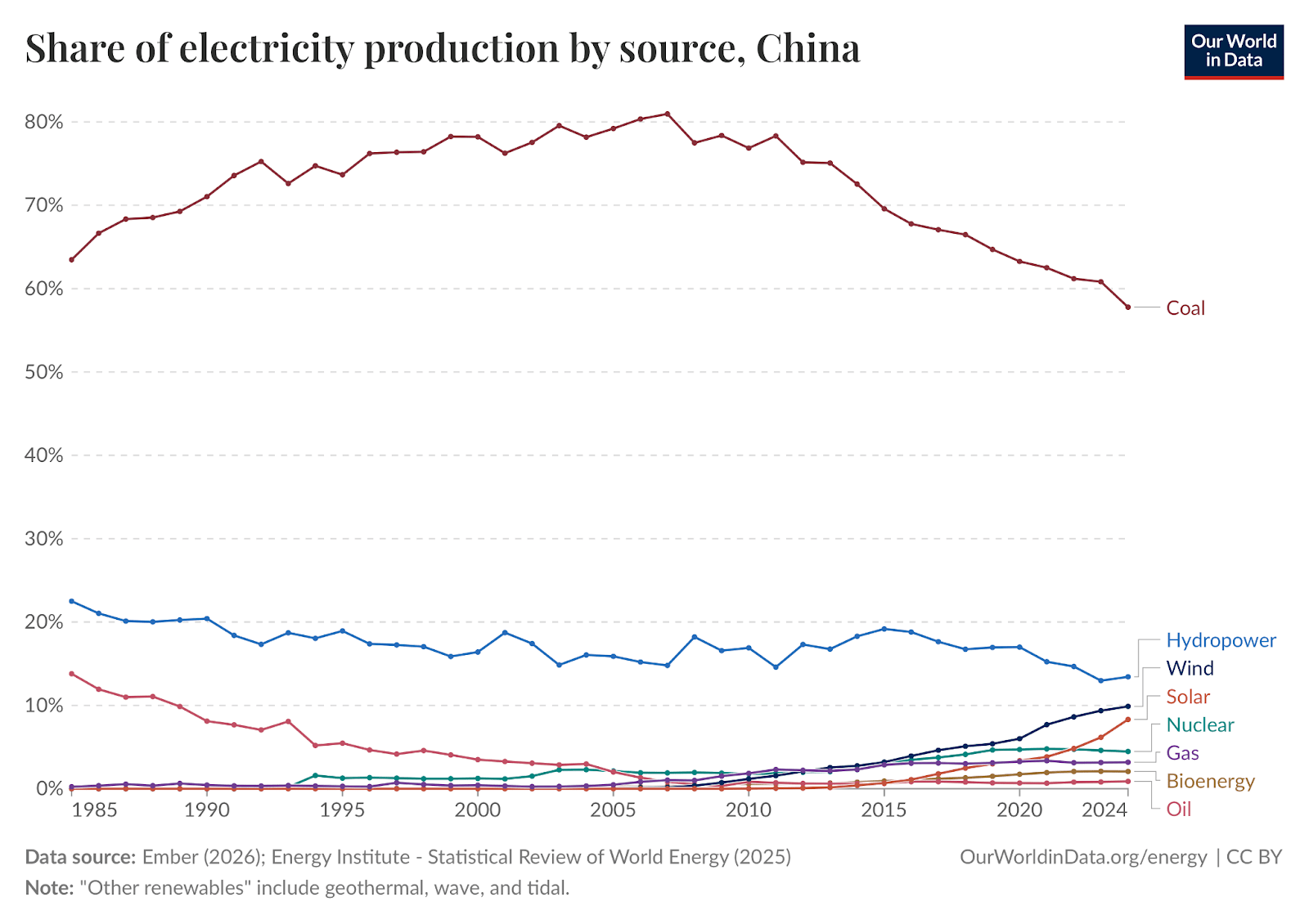
Figure 1: China’s share of electricity production from 1985-2024 (Source)
China still relies primarily on coal (57.77%) as its main electricity source. This disproportionate reliance is clear given that hydropower — the second-largest source at 13.43% — still generates roughly four times less electricity than coal. The numbers only get worse from there. Hydropower (13.43%), wind (9.88%), and solar (8.32%) unsurprisingly remain the most preferred renewable energy sources given the country’s historically robust dam infrastructure and intensive push into solar and wind development over the past two decades. China’s domestic wind and solar PV capacity significantly increased because wind projects were made financially viable after the 2006 Renewable Energy Law and generous subsidies were provided in 2010. The price of wind turbines also significantly fell since 2003, lowering the cost of production even further. The costs of manufacturing solar PV parts also dramatically dropped between 2010 and 2024.
Hydropower has always been a preferred option for the past few decades, coinciding with the CCP’s rise to power. Arunabh Ghosh writes that while Soviet influence encouraged large-scale dam projects, small hydropower plants ended up being the preferred method of power generation because they aligned with the party’s goal of water conservancy and were also more cost-efficient. Large-scale dam projects advised by the Soviets were also “poorly managed” then, contributing to the shift. Environmental historian Robert B. Marks attributes the explosion of mega dam projects in the late 1990s to early 2000s to poor regulations and the privatization of the State Power Company of China in 2002. When the company was “privatized and broken into five profit-making enterprises” that were mostly led by people well-connected to the CCP, these companies eagerly sought to divide the rivers, resulting in a “scramble for hydropower” and contributing to its present dominance.
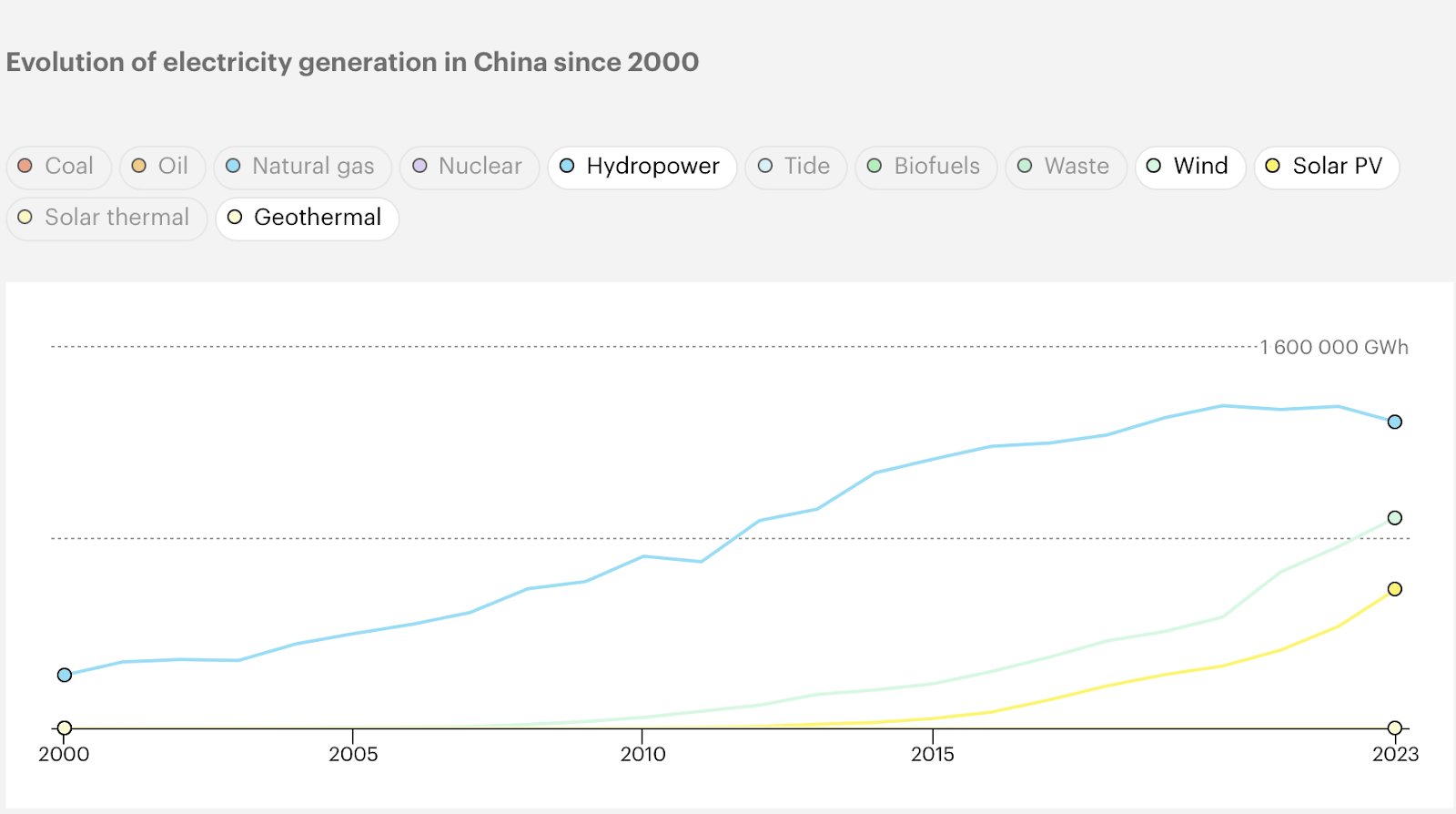
The government’s intense focus on those three types of renewables has left geothermal energy significantly underdeveloped. The Our World in Data project estimates that only 1.34% of China’s energy consumption is sourced from “other renewables” in 2024, while the International Energy Agency estimates that in 2023, China generated a measly 195 GWh of electricity from geothermal sources, compared to 1,285,850 GWh from hydropower, 885,870 GWh from wind, and 584,150 GWh from solar PV. Despite recent policy initiatives to ramp up geothermal energy development, it is unlikely that this vast gap can be bridged in the near future.
While geothermal energy is theoretically a viable option to achieve China’s clean energy goals faster, it is currently an unattractive one because of competing interests. Wind and solar remain dominant because of their competitive costs and long-term industry support. Coal still remains popular among local governments and corporations because they are “sources of employment, investment and revenue.” The reality that geothermal power generation is significantly riskier and more expensive to develop makes it an even less compelling option.
Figure 2: Evolution of electricity generation in China since 2000, data obtained from IEA. In descending order: hydropower, wind, solar PV, geothermal (Source)
Understanding geothermal energy
Harnessing geothermal energy for electricity production is historically complicated and enormously expensive. Building a geothermal power plant involves a few hefty steps: 1) site exploration; 2) drilling underground to create a geothermal well; 3) establishing the power plant, and finally; 4) electrical transmission.1 The difficulty of the first step — site exploration — is usually sufficient to deter prospectors. It is extremely difficult to accurately identify a geothermal site suitable for electricity production, and drilling in unproductive sites can be very wasteful. In fact, the early parts of geothermal exploration contribute to most of its costs. The Colorado School of Mines estimates that “over 80% of the Levelized Cost of Electricity (LCOE)2 is driven by capital costs, and exploration accounts for around 5%.” These costs usually add up to 54% of the total cost of preparation and drilling. Currently, remote sensing techniques are employed to analyse potential sites. However, they remain extremely expensive because the analysis of one geothermal site exploration may not replicate well at other sites.
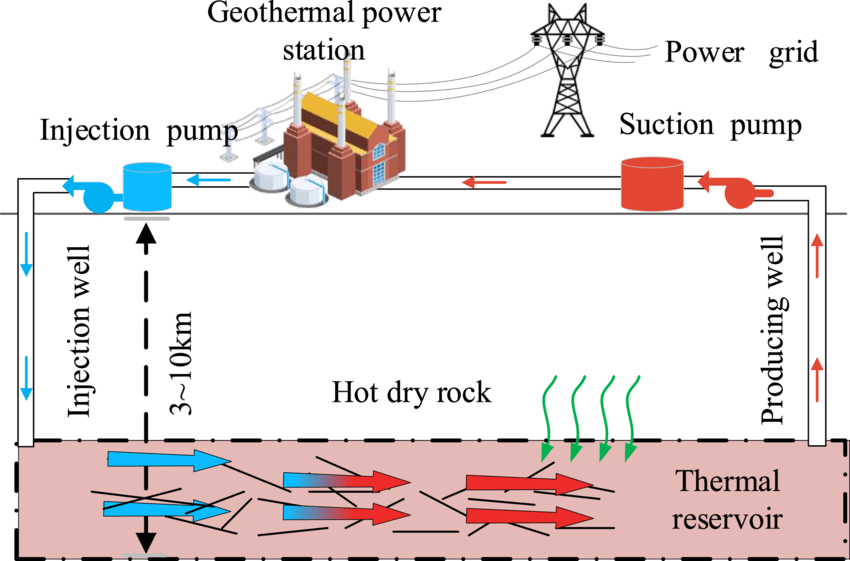
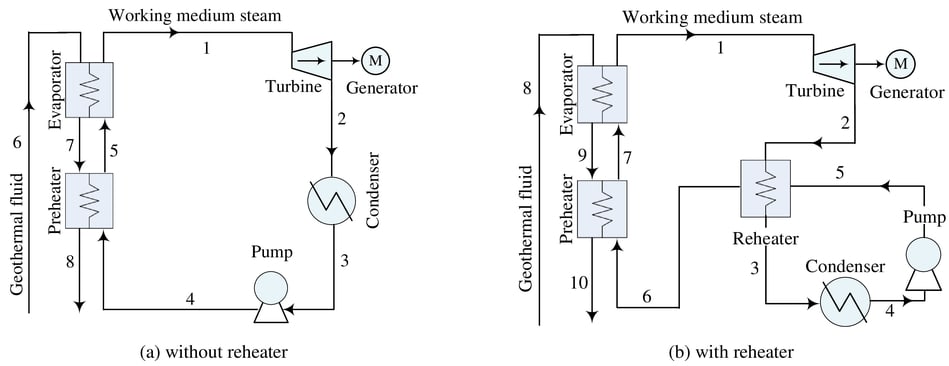
HDR geothermal systems employ similar technology to oil and gas fracking, where a geothermal power plant is built by creating a geothermal reservoir by drilling deep wells into hot rocks. Drilling fractures the rocks and helps to create a system to facilitate heat transfer that generates electricity. Once the rocks are fractured, injection and production wells are established so that water pumped down through the injection well can circulate through the fracture network, absorb heat from the surrounding hot dry rock, and return to the surface via the production well. At that point, a heat exchanger is used to transfer the heat from the hot water to a working fluid. This fluid then changes into “high-temperature and high-pressure [vapor] in the evaporator, and then enters the turbine to expand and do work,” generating electricity in the process (Figures 3 and 4).
Figure 3: Operation of a geothermal HDR power plant (Source)
Figure 4: How a geothermal HDR power plant works (Source)
While the NEA acknowledges the tremendous potential of HDR resources, infrastructure is currently lacking to harness them on a large scale. When this finding was published in 2023, obtaining accurate drilling data was also difficult because the latest geological data was published six years prior, in 2017.
China’s current geothermal landscape
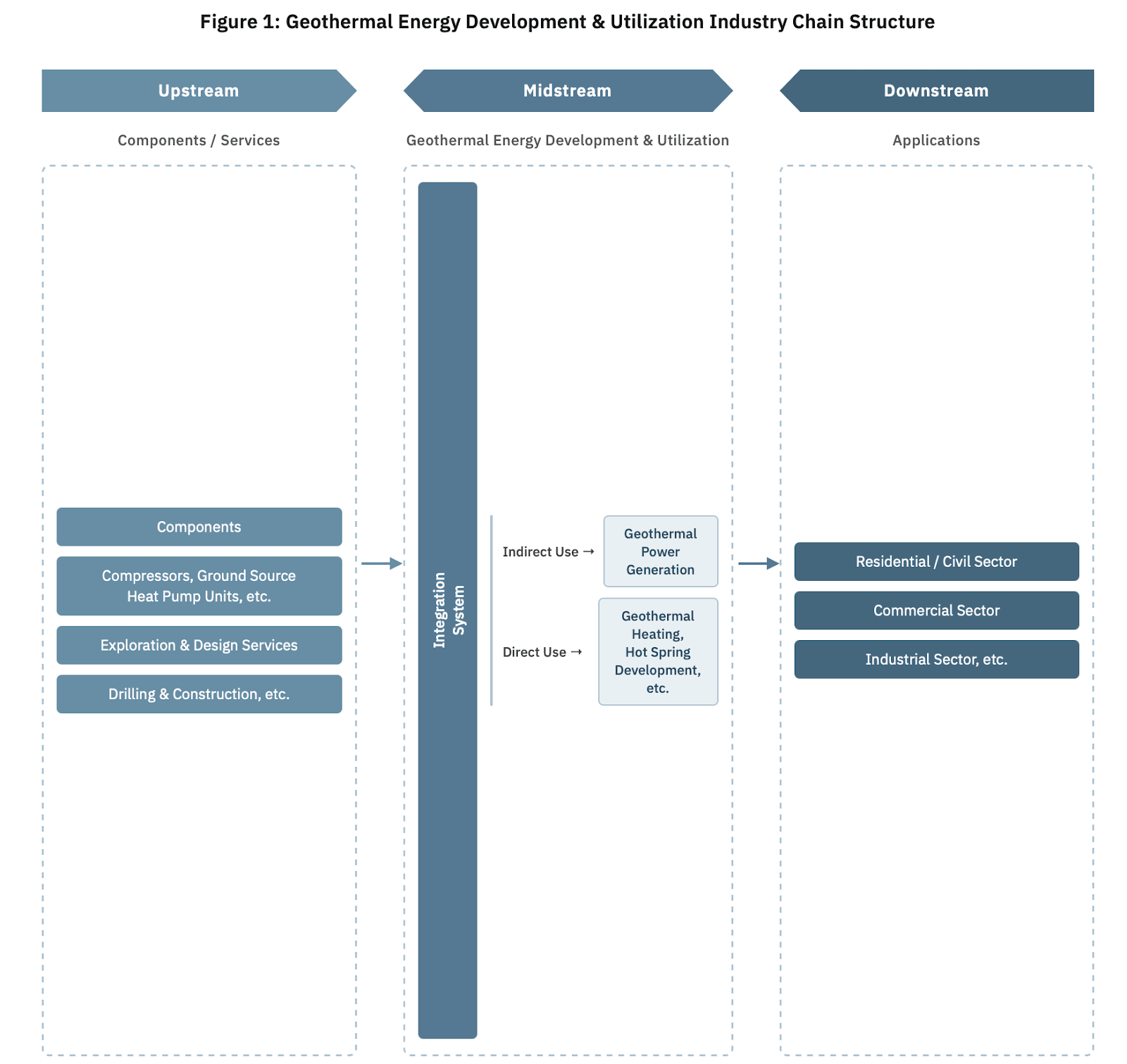
Figure 5: The upstream, midstream, and downstream production chain of geothermal development in China (Translated) (Source)
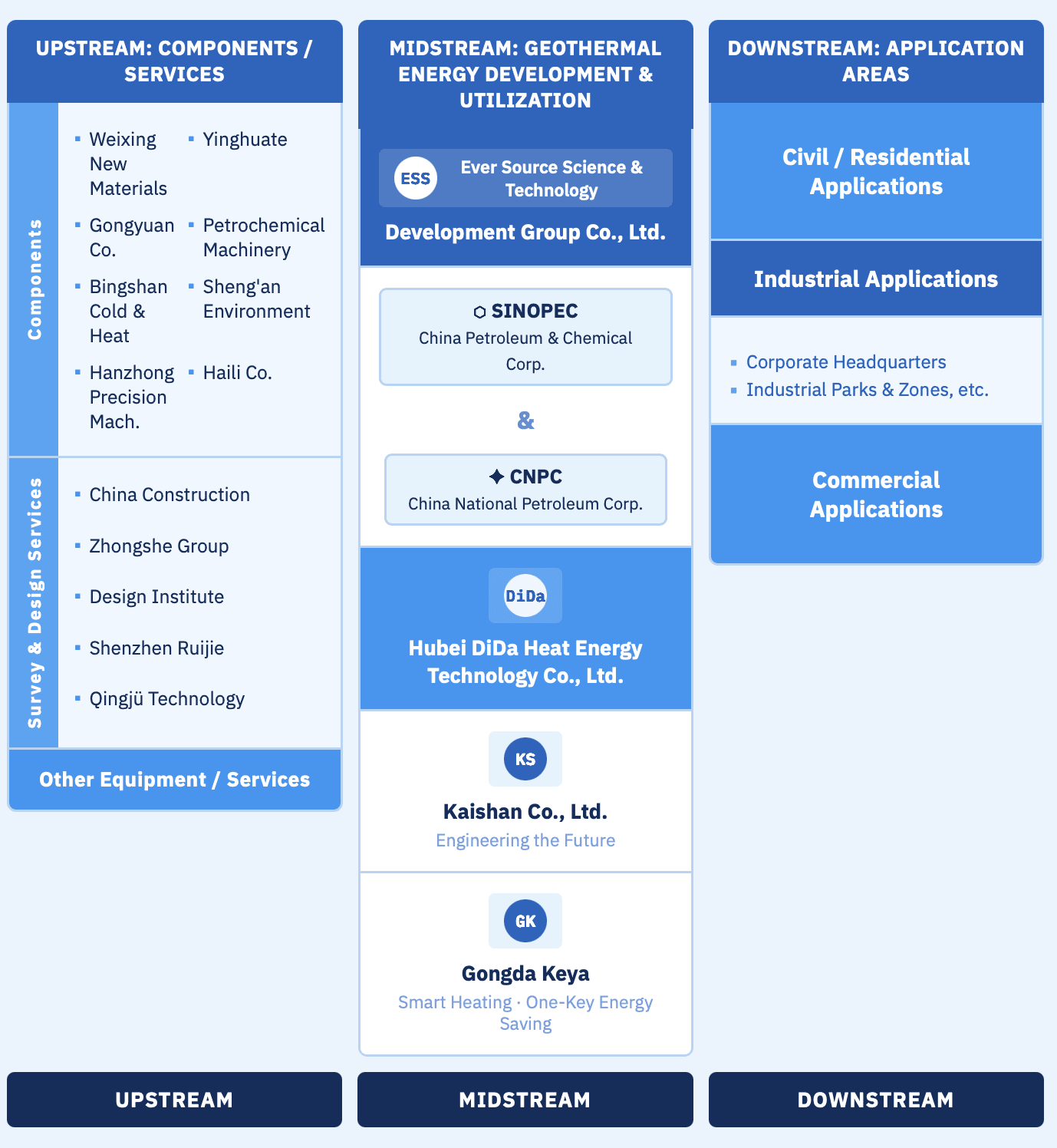
Figure 6: The parties responsible for the upstream, midstream, and downstream processes of geothermal development in China (Translated) (Source)
Geothermal’s development trajectory
To further illustrate the lack of support for geothermal energy projects, there is currently only one significant geothermal power plant operating commercially in China — the Yangyi Geothermal Power Station 羊易地热电站 in Tibet. This station has replaced China’s previously largest geothermal plant — the Yangbajain Geothermal Field 羊八井地热田 —which was decommissioned a few years ago because of “low electricity prices and aging equipment.” Yangyi is located approximately 50 kilometres from Yangbajing.
Development of the Yangyi Geothermal Power Station stalled for a good 20 years from 1991 to 2001 because of low local government interest. The key reason was that project funding was “designated for national use and would not have passed through local government channels” in a likely effort to reduce corruption. As local governments would not have been able to personally profit from these projects, they were not interested in spending their time on such thankless endeavours. Geothermal funding in China remains unstandardised, but recent projects seem to favour mutual partnerships between the state and state-owned enterprises (SOEs) such as Sinopec.
Even when a private developer from Zhejiang Province 浙江 expressed interest in developing Yangyi and local geological survey authorities offered to relinquish their equity stakes and share their prior exploration results, Yangyi’s development remained stalled by uncertain electricity prices. Because the National Development and Reform Commission (NDRC) insisted that electricity tariffs could only be confirmed upon the project’s completion, developers were wary of the financial risk and eventually abandoned the project. It was only in 2011 when the Jiangxi Huadian Power Company 江西华电 expressed interest in restarting Yangyi’s development.
Thereafter, Yangyi’s operations finally commenced in 2018, and it now generates 16 MW of electricity and “operates continuously for more than 8300 hours annually.” Nonetheless, profitability still remains an issue because feed-in tariffs in Tibet are still much lower than in the mainland. Proper waste disposal of geothermal fluid is also a problem. Previously, the Yangbajing Geothermal Power Station discharged more than 50% of its geothermal wastewater directly into the river, contributing to severe water pollution.
With the updated 2020 Resource Tax Law 资源税法, geothermal energy has been classified as an energy mineral and is now subject to taxation at a rate of 1%–20% of the raw mineral value, or 1–30 yuan per cubic meter of the water consumed in geothermal projects. As a result, nearly half of the electricity revenue collected goes toward paying geothermal resource taxes and water resource fees, further reducing the financial viability of geothermal projects for private developers. The President of the Tibet Geothermal Industry Association commented that this law was “completely unreasonable” because unlike coal, petroleum, and natural gas, geothermal is a “renewable energy resource that generates heat and power without consuming water” and should not be taxed based on the volume of water consumed. Prominent geothermal expert Zhao Fengnian 赵丰年 also emphasizes the need to distinguish between using geothermal resources for commercial purposes and power generation. Taxing commercial hot springs and baths is justified because these enterprises profit from the consumption of geothermal resources, whereas generating renewable energy from geothermal resources should be exempted because no resources are consumed.
There are several non-commercially operating medium-low temperature geothermal plants scattered in Ruili 瑞丽, Yunnan province 云南, Xian County 献县, Hebei province 河北 and Datong 大同, Shanxi province 山西. However, these geothermal plants are mainly used for experimental research and demonstration pilots 示范性质. Seven medium-low temperature geothermal plants were built in the 1970s, but all of them have since been decommissioned. This is unsurprising because the use of medium-low temperature geothermal energy for electricity production is still not very widespread, even in the US (which ranks first in geothermal power production).
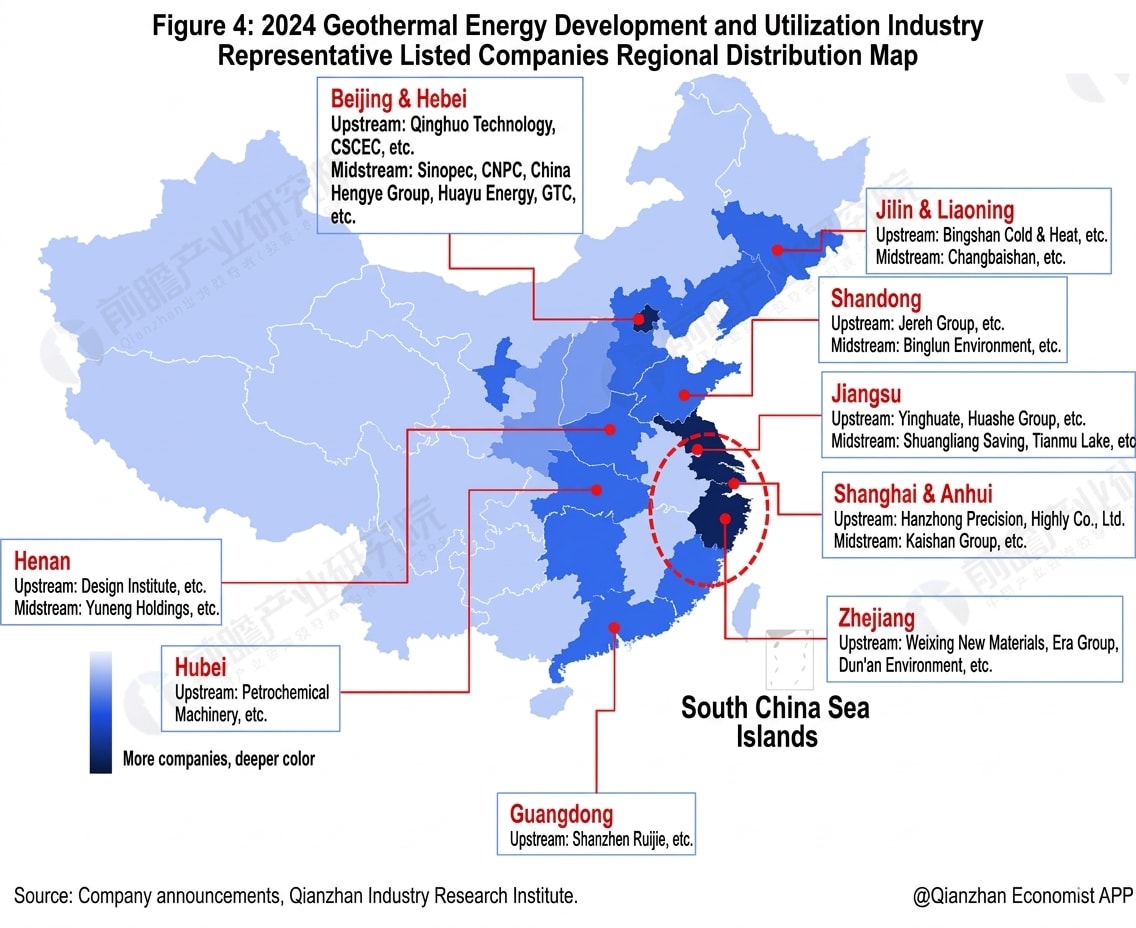
Figure 7: Translated map of geothermal development in China in 2024. These are ongoing plans but none of them are in full commercial operation so far. (Source)
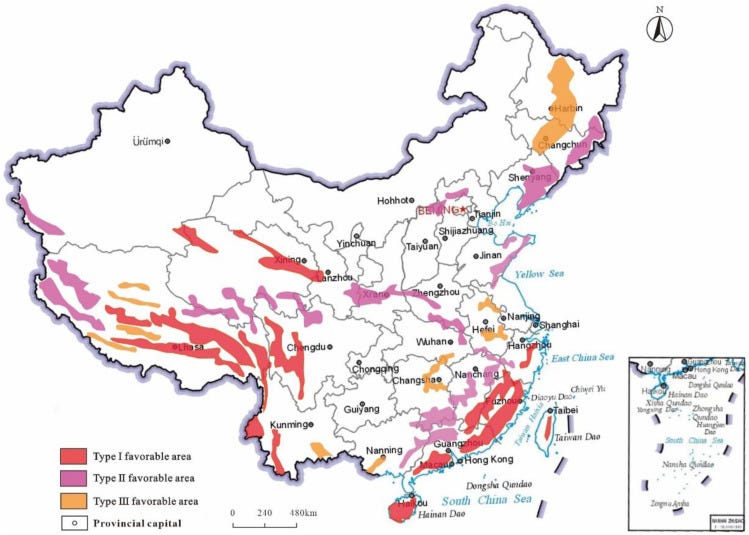
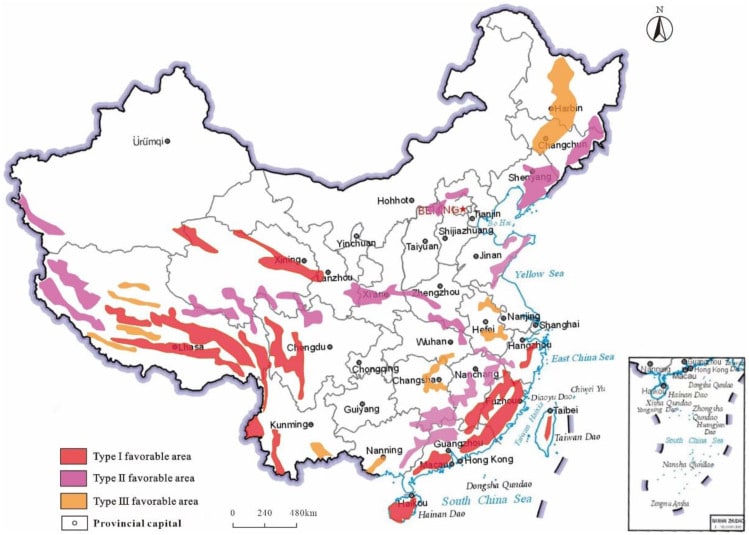
Figure 8: Map of the favorable geothermal distribution areas in China based on geothermal source distribution. Currently, the exact definitions of Type I/Type II/ Type III areas have not been released yet. However, Type I areas are considered to be most favourable for geothermal development. (Source)
Considering that up until now, only the Yangyi geothermal plant — which took a good 20-30 years to build — is in full commercial operation, China’s intensified geothermal development efforts in 10 provinces and two directly-administered municipalities (Shanghai and Beijing) in 2024 signal the state’s renewed interest in capacity-building for geothermal energy development.
Figure 7 shows that geothermal development in China is currently concentrated in Northeastern China and Eastern coastal provinces. Comparing Figures 7 and 8 reveals that current geothermal developments do not exactly strategically mirror areas where geothermal conditions are most favourable. For instance, the most favourable areas are in Southwestern China (Tibet, Sichuan, Yunnan) and Southern China (Guangzhou, Fujian, Jiangsu). This strategic misalignment is because provinces where geothermal power is most feasible are already dominated by wind and solar.
The map does not perfectly encompass all of China’s current geothermal developments because it fails to include capacity-building efforts. For instance, while provinces such as Yunnan are not mentioned in Figure 7, they are also actively engaging in capacity-building efforts to pave the way for future development. In February 2022, the Geothermal Energy Science and Technology Research Institute was established in Dali 地热能科学技术(大理)研究院. The institute has 45 staff members and currently receives technical support from universities, state-owned enterprises, and private companies. Similarly, in 2020, the state-owned Shanghai Geological and Mineral Engineering Investigation company 上海市地矿工程勘察(集团)有限公司 established a geothermal research institute to further assist Shanghai’s geothermal developments. These capacity-building efforts highlight that part of China’s geothermal development efforts involves building research centers that are strategically located near potential geothermal hotspots (i.e. Dali and Shanghai).
In late 2025, there was a significant breakthrough in China’s geothermal site exploration capabilities. Fuzhou University, in collaboration with the China National Administration of Coal Geology 中国煤炭地质总局, released a groundbreaking map titled “China’s Unified Geothermal Map Platform” 中国地热一张图 that integrates 3D spatial modelling, massive datasets, AI modelling, and “key core technologies” 关键核心技术. This collaboration started in 2023 and aimed to create the foundational repository to analyze China’s geothermal resources and assist in geological site surveys. As of now, the platform has catalogued 2407 hot springs and 2057 geothermal wells, but press releases thus far have not shed much light on the datasets and AI modelling involved. This new map potentially lays the foundation for replicable geothermal site analysis and significantly reduces the costs of geological site exploration, hence addressing the shortcomings that have historically contributed to geothermal energy’s underdevelopment.
There has not been any documented opposition to geothermal development from civil society in China on the basis of earthquake risk or pollution. While seismic risks depend on the geographical location, current risk assessments for geothermal exploitation in Xi’an 西安 and the HDR development of Gonghe Basin in Qinghai province show that seismic activity remains low. However, this risk might change as “the probability of a large earthquake event increases as the total injected fluid volume [into the HDR well] increases.” More research is needed to create a comprehensive risk assessment for geothermal HDR development in China.
The invisible hand of policy
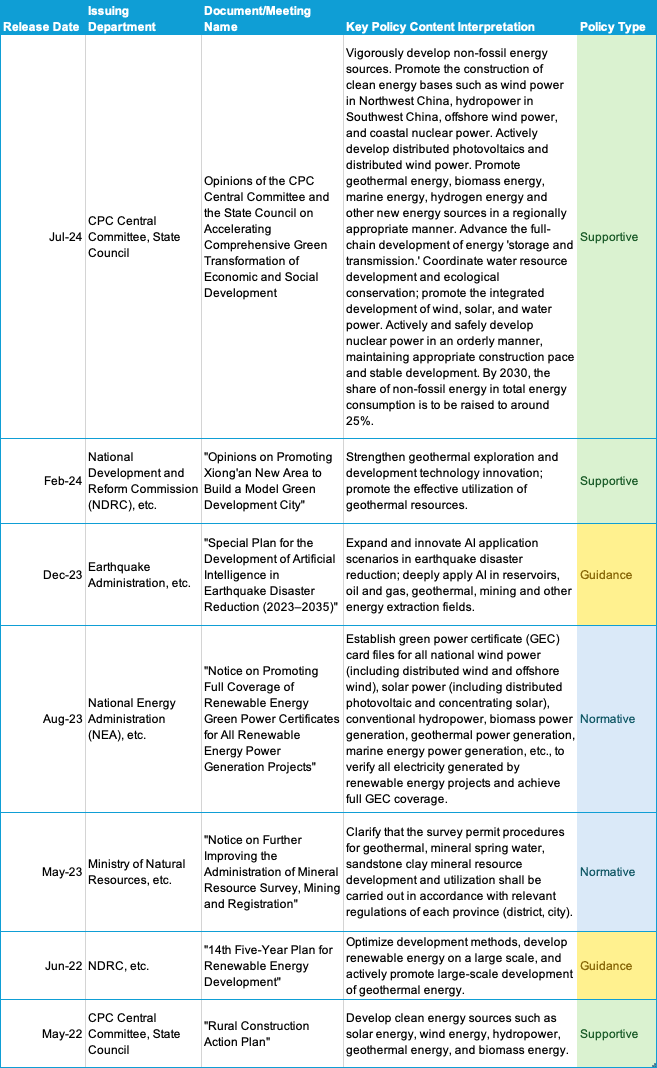
Figure 9: Renewable energy policy directives issued over the recent years (Data Source)
These initiatives did not appear out of thin air but were instead guided by policy directives in recent years. Qianzhan Research Institute highlighted a few key policies that have been instrumental to renewing geothermal development efforts (Figure 9). In general, the Central Committee, the State Council, and the National Development and Reform Commission (NDRC) are responsible for issuing broad, general policy directives in speeding up renewable energy development. It is clear that geothermal energy lacks a clear target and is instead lumped with other, much more popular and scalable forms of renewable energy.
Moreover, while state agencies such as the China Earthquake Administration, National Energy Administration, and the Ministry of Natural Resources have issued more specialized directives in response to the 14th Five-Year Plan, there is no clear unified policy that specifically targets geothermal energy development. Figure 9 shows that geothermal development regulation is often lumped with mining and oil and gas regulation in the realm of administration. The recently released 15th Five-Year Plan also barely mentions geothermal energy and lacks concrete initiatives compared to wind and solar.
The trajectory of these policy developments suggests that while there is progress in China’s geothermal capacity-building efforts, local governments remain strategically conservative. To avoid channeling too many resources into geothermal energy development, which is evidently not as prioritised compared to wind and solar, local governments prefer less risky capacity-building initiatives such as building research institutes and enhancing their current surveying technologies instead of outright investing in new geothermal developmental efforts. Such efforts can be interpreted as strategic hedging, where local governments try to align with national policy directives while minimising resource mobilisation efforts.
Looking into the future
For now, geothermal energy remains unattractive in China and is sidelined by wind and solar. This is a result of multiple factors including the high cost of production, lack of policy coordination, and entrenched industrial and national interests. Current geothermal development projects are still in the capacity-building process of establishing research institutions and acquiring more mining data. These are strategic, low-risk endeavours that allow local governments to show that they are funneling resources into geothermal developments without suffering from severe financial losses. Nonetheless, given that geothermal energy development, especially HDR technology, is still in its infancy in China, any form of research and capacity-building initiative should be welcomed.
The deprioritization of geothermal energy development in China suggests that decarbonization and pollution reduction are not Beijing’s top priorities, especially when new green energy risks threatening local champions (i.e. wind and solar manufacturers). The Economist also reports that coal remains expensive to phase out, because China currently “lacks a flexible, nationwide power market” that efficiently dispatches clean power when needed. Reforms have been slow, making coal a still preferred source of electricity and a key source of maintaining energy security. Thus, renewable energy development is only prioritized if it strategically aligns with national and industrial interests.
On the bright side, geothermal development may receive more overall international support in the upcoming years. Because of the similarities between fracking and harnessing geothermal energy, the IEA predicts that advances in fracking technology would greatly assist geothermal development. However, it is unlikely that this will have any substantial impact on geothermal energy development in China anytime soon, unless there is a unified geothermal policy to assist research and development efforts to harness this technology. Until Beijing reconsiders its heavy taxation on geothermal power projects and makes geothermal eligible for feed-in tariffs, geothermal will continue to struggle to compete with wind and solar.
ChinaTalk is a reader-supported publication. To receive new posts and support our work, consider becoming a free or paid subscriber.
Standard coal here 标准煤 refers to the standard coal equivalent, which is a standard unit of measurement that compares the calorific value of different energy carriers against a reference coal with a calorific value of 7,000 kcal/kg.
What can we learn from its past glories and failures, and where should we take this next? We have of the Foundation for American Innovation to discuss:
The Pendleton Act myth — Why civil service reform didn’t begin or end with Pendleton, and why starting the story there misses what actually made the system work.
The rise of the subject-matter state — How early 20th-century agencies staffed with real experts — entomologists, engineers, agronomists — made the U.S. bureaucracy arguably the most capable in the world.
From expertise to org charts — How mid-century functional reorganization hollowed out mission-driven agencies and replaced subject knowledge with process management.
What competence delivered — From agricultural breakthroughs to infrastructure build-out, what a serious, technically grounded civil service was able to accomplish.
Whether we can rebuild — DOGE, the abundance movement, state capacity, and why this might be the best time in decades to make the government work again.
Jordan Schneider: Where do we start the clock? Everyone always wants to start with the Pendleton Act, but I hear you have a contrarian take on this.
Kevin Hawickhorst: The history of the U.S. civil service is defined by the people who were hired to do jobs for the government, whether they did well or poorly, and whether they had training. The civil service existed before the Pendleton Act and long after it. The real question is, how good were the people at different points in time? Did Congress think agencies were trustworthy?
We should start the clock at the major inflection points of the federal bureaucracy — where agencies became competent and managed to set up recruitment pipelines of civil servants who could actually do the job and command respect across the country. Questions like the Pendleton Act, merit exams, and removal protections are important, but they are secondary to the actual question of who was working for the federal government, and whether they knew what they were talking about.
Jordan Schneider: How did we go from being John Adams’s son or just a hack who got a job in the Postal Service to actually having real experts who knew what was up?
Kevin Hawickhorst: It’s a story in two acts. Under the Federalists and the Jeffersonians, we had a very “gentlemanly” conception of civil service — any well-brought-up person of quality could do basically any job. The Jacksonians expanded that to the idea that anyone who volunteered for the campaign could do any job. That was the low point.
By the middle of the 1800s, the country was completely awash in patronage. Tens of thousands of people were fired after each presidential election. At the height of the system, there were about 70,000 patronage positions in the Post Office alone. There were tens of thousands of hacks at the Post Office. We are talking about an unpromising foundation.
However, that was also an opportunity. The starting point was so bad that only truly excellent bureaucrats could overcome it and set up agencies and recruit the right people. In other countries, the civil service was a non-controversial, gentlemanly pursuit. In the U.S., only outstandingly well-run agencies could rise above the patronage morass, creating pressure to build excellence.
How did they do that? There were early experiments that didn’t take, but served as a playbook. The first worth looking at is the Topographical Corps in the U.S. Army. These were professional engineers and surveyors who mapped roads and bridges. It was an elite group that commanded respect from Congress, especially in the Western states where most of the surveys were done. The playbook was simple — recruit people from technical societies and put them at the disposal of Congress. It didn’t last due to the politics leading to the Civil War, but the idea remained and was foundational.
Topographical engineers in Yorktown, VA, Camp Winfield Scott. May 1862. Source.
“Map of the United States and their territories between the Mississippi and the Pacific Ocean and part of Mexico” (1850) by U.S. Army Corps of Engineers. Source.
The real start of the upswing, where the civil service started clearly getting better, I’d peg it at about the 1870s or 1880s — right around the time of Pendleton, but starting a little before it. The first agency where professionalization was a really big story was the U.S. Public Health Service. Originally a loose federation of doctors who provided care for people in and around the military, it was revamped in the 1870s when the director decided to get serious. He restructured it as almost a paramilitary corps of surgeons — military-style uniforms, military ranks, recruited from medical schools around the country, and partnered with state hospitals.
Then, a lot of the bureaus of the Department of Agriculture were extremely good, professionalizing in the 1890s and the first decade of the 1900s. Agencies like the Bureau of Entomology, the Forest Service (around 1905), and the Bureau of Soils punched well above their weight in recruiting high-quality talent.
Jordan Schneider: The other professional thing we have from the start of the republic is the profession of arms. West Point goes back a pretty long time. To what extent was that a model for some of this much more domestic-focused, expertise-generating stuff?
Kevin Hawickhorst: 100% it’s the model. In most of the United States, people would work their civil service jobs for a couple of years at most and then get kicked out after the next election. But in the military, there were a few heads of bureaus who were almost all-powerful, serving for literal decades — 10 to 35 years. That would be unimaginable even today. In particular, the Quartermaster Bureau under General Meigs was outstandingly good. Provisioning the entire far-flung United States was a very difficult job, and they had to be excellent at it.
When you talk about military inspiration, the idea of professionalizing through uniforms, ranks, and standard training is part of it. But it’s actually the more civilian and logistical side of the military that was the bigger inspiration. The Quartermaster Bureau — people don’t talk about how outstandingly good it was, but it was world-class. It’s an underrated story.
Bug Scientists and Quartermasters
Jordan Schneider: Alright, let’s continue the narrative, Kevin.
Kevin Hawickhorst: I’ve set the stage for the late 1800s and said that these details about these agencies matter more than the Pendleton Act. Why do I think that? First, for your listeners — what was the Pendleton Act? In short, it was passed after President Garfield was assassinated by a man who thought Garfield had promised him a federal job. Reformers who wanted to get rid of patronage had basically the perfect story, and they muscled through Congress a bill saying you could only recruit people through merit tests — you had to test people and give the job to the most competent person. It was meant to get rid of patronage and graft.
Jordan Schneider: Wait, do we think Guiteau is a plant?
Kevin Hawickhorst: When I was doing my research, I was sworn to secrecy on this point.
Jordan Schneider: He was actually in favor of big meritocracy. It was the AI safety lobby of the late 1800s.
Kevin Hawickhorst: Guiteau’s secret double life aside — he was the one who shot Garfield, of course.
Kevin Hawickhorst: My real goal is to get General Meigs at the Quartermaster Bureau a Netflix show. Or the leaders of the U.S. Public Health Service.
Montgomaery Meigs, Quartermaster General of the U.S. Army. Source.
Matthew MacFayden as Garfield’s assassin Guiteau. Source.
People say the Pendleton Act is when we decided to get rid of politics and recruit real experts. Here’s the thing — first, it was just a law, and it was not implemented very quickly. It applied to only a very small number of positions for decades. More than that, it was still just a law. The civil service is a bunch of people who work for the government and do stuff, and laws only matter if they make you recruit different people who do different stuff. The fundamental question is when did the government start recruiting better people who started doing better stuff? The Pendleton Act helped change the trajectory — it’s a major factor — but it is not directly the answer to that question. One has to look at different agencies and ask when they started recruiting much better people and how they managed to do it. The history of civil service law is not the history of the civil service.
Having made my anti-Pendleton screed, we reach these bureaus I love so much — the U.S. Public Health Service, the Bureau of Entomology, the Bureau of Soils, the Forest Service, and all the rest. Why were they good? My theory from reading all of this history is that agencies were organized differently and had a different relationship to Congress and civil society than we have today.
This struck me when I was reading about the Department of Agriculture and thinking about the different agencies — Bureau of Entomology, Bureau of Plant Industry, Bureau of Animal Industry, and Bureau of Soils. These are such charmingly old-fashioned names. The concrete, old-fashioned names reflected something real about what they did and the vision they embodied about what government is and does.
Take my favorite example — the Bureau of Entomology at USDA. It brought together all the different facets of entomology. Employees would do research, usually working with state land-grant colleges. They would regulate diseased crops, usually working with state regulators. And they would administer grant programs to help farmers insect-proof their crops. They combined every function of government, all related to a single subject, and were then able to draw on technical vocations.
If the government were making a pitch to entomologists, they’d say, sure, the private sector can pay you more, but this is going to be literally the most interesting job in the world for an entomologist. You’re going to see every corner of it in your career — from research to enforcement to helping people on the ground. That was a very attractive proposition for technical people.
When the agency was filled to the brim with people with a slightly autistic fixation on their subjects, it commanded real respect because it clearly had expertise that most people just didn’t have. If you’re a Bureau of Entomology filled with hard-charging experts going around putting a stop to outbreaks of weevils, that’s clearly impressive. During the patronage era, people would look at jobs in the post office and say, “I could do that.” They’d look at jobs in the Treasury Department processing paperwork and say, “I could do that.” But then you look at a Bureau of Entomology filled with uniformed entomologists with PhDs — in an era when nobody had PhDs — going around ending outbreaks of infestations, and people would not say, “I could do that.” They would say, “I’m glad that there are people who can do that.” That’s basically the attitude that lets some agencies rise above the morass of patronage in the late 1800s.
The Ashland Station (1915-1919), composed of members of the Bureau of Entomology and the Forest Service, carried out studies on bark beetle infestations which led to proposals for control methods. Source.
Jordan Schneider: How far did we get with this trend? Give us some of the highlights of the accomplishments this setup ended up unlocking.
Kevin Hawickhorst: They recruited people with the strength of their pitch, and then for the actual doing, they paired heavily with state regulators, state universities, and similar institutions to make themselves known throughout the entire country and build up congressional support. It wasn’t just “they could do the thing” — it was “they can do the thing, and everyone knows they can do the thing because they are doing the thing throughout the U.S.”
The Progressive Era playbook of these technical agencies was first to organize around a single subject that corresponds to some vocational community — engineers, doctors, whatever. Second, offer this technical resourcing to institutions throughout the country — state universities, state regulators, ordinary people through grant aid — to make it known that you have this expertise and are putting it at their disposal. Get the right people in and then get them out to show them to the world.
What Competence Delivered
Jordan Schneider: We have all these really smart specialists doing research and counting up insects and whatnot. What does that end up unlocking for the American people — economic development, governance that didn’t exist when you were stuck with hacks getting their Postal Service gig?
Kevin Hawickhorst: Just at the level of vibes, people don’t appreciate how good it was. At the USDA in 1910, if you look at the top appointees who ran the agencies — formally political appointees, even though the president normally appointed career experts — two-thirds of them had graduate degrees in their subject. That would be almost unimaginable today, and it was astounding back then when basically nobody had a graduate degree.
The agencies had very good leadership, and outcomes were much better than is customarily remembered. European bureaucrats went on trips to visit the USDA headquarters in the 1900s and 1910s because they considered it possibly the best-run bureaucracy on the planet. It really did manage to do some big things.
The growth of productivity for American farmers was not quite the laissez-faire rugged individualism we remember. The USDA spent lavishly on research, and there was enormous outreach to bring information to U.S. farmers and boost productivity. It was a significant factor in helping the agrarian sector, which was the great majority of the United States, well into the 1900s.
A lot of the infrastructure connecting the United States was also laid during that era — not physical infrastructure, but the basic setups. The U.S. Bureau of Public Roads started the earliest programs of federal supervision of road building and was extremely elite. The head of it in the early 1900s had studied at the French École des Ponts et Chaussées, one of the most prestigious civil engineering schools in the world. It set technical standards, and much of the planning about road layout eventually evolved through the New Deal and ultimately into the Interstate Highway System. People remember the actual building of the Interstate Highway System, but the Bureau of Public Roads started raising standards for state and local roads, writing plans, and getting politicians aligned on plans that bore fruit much later. Their vision had great staying power — it was very path-dependent.
Then there was a fundamental boost to the U.S. economy through the Postal Service. Toward the end of the 1800s, there was a backlash against the fact that the post office was incredibly expensive and worked poorly. The Post Office tried to professionalize, and as it did, it said, we’ve become much more competent, we’ve got our costs under control, we’re hiring professional people and kicking out the corrupt ones. We want to do more. They proposed setting up a delivery network for parcels and magazines throughout the entire United States — before that, the post office basically just handled letters.
They convinced Congress, rolled it out nationwide, and it was transformative, especially for rural areas. You’ve probably heard stories about people in rural communities reading their Sears and Roebuck catalog deciding what to buy. It was once transformative that you could even do that. Where did the delivery service come from? How did Sears and Roebuck send you the stuff you ordered, or even the catalog? The post office set up a highly subsidized delivery network for magazines and parcels, which enabled big manufacturers to sell throughout the entire United States. You got a mass market for goods on one hand, the rural areas connected to the modern economy on the other, and the post office was at the center of it.
It also broke up the personalistic power relations in certain rural communities, where the person who owned the general store was the king of the castle — everyone had to buy goods from him. Now you could buy from anyone who would deliver to you. You could just get their catalog and order it.
The actual stakes of civil service were much higher than just whether we had too many people getting fired. It was about whether we were building the infrastructure of the United States, bringing modernity to rural areas through delivery networks, agricultural research, and more. The accomplishments are foundational, and they’re forgotten because people over-index on asking what the laws were like instead of asking what the bureaucracy was like—what they were doing and whether they were good at it.
The Lost Literature of Public Administration
Jordan Schneider: Let’s take a detour to talk about the literature around these questions. A year or two ago, I tweeted asking who’s got good books on the history of federal bureaucracy, and you responded with a book from 1957 — a good book, but also kind of the only book. There’s one Italian professor who has written a contemporary thing about the history of the primarily post-World War II American civil service. But Kevin, you’ve put together an annotated bibliography about this. Give the audience a sense of the scholarship that’s out there for you to be able to make these claims.
Kevin Hawickhorst: First, a horror story for your listeners — a book from 1957 is one of the more comparatively recent books on my bibliography. Many of them are from the 1920s and ’30s.
For why that’s the case, it’s useful to ask, how did I get interested in this, and how did I find these books? I got interested in grad school while studying economics and wanting to know more about the politics and implementation of programs. I had this question — was the government more competent in the past? Lots of people have asked that, but I got frustrated at the level of generality the debate often stayed at. To exaggerate, people would say, “Well, in the past we hired real experts and gave them real authority but had real accountability,” or some similarly meaningless thing. That’s just a platitude.
There’s a prima facie case — we won World War II, built the Interstate Highway System, and put a man on the moon, and now we don’t do much of any of those things. Given that we pulled this off, there must have been concrete nuts-and-bolts things we did differently. I wanted to know how we wrote job descriptions for the Tennessee Valley Authority’s engineers. How did they hire them? How did they do budgetary oversight for New Deal infrastructure? How did they train managers for the Interstate Highway System program?
There’s just very little written about this. There’s a lot of discussion of high politics, but it treats the stopping point as a law being passed or a consensus brought about. The real question is what bureaucracies were doing — how they budgeted, hired, and trained people. At the end of the day, the civil service is a bunch of people who work for the government and do stuff. The question of public administration is — who were those people, and how did they do what they did?
It turned out, first, that there’s almost nothing written about this. But second, it’s not actually that difficult to find out. Most of this stuff is public domain government office manuals that have been digitized on Google Books. You could look up the answers without getting up from your desk.
A whole lot of my sources are just primary sources — agencies explaining what worked well and why and how they did it. I find that vastly more interesting and actionable than the secondary literature, which is often quite vague and sands away almost all the technical details of how agencies budgeted for projects, classified jobs, and so on. Primary sources are way better because they’re the words of the bureaucracy talking about itself — how it thought, what people thought they were doing and why. You don’t get that except by reading primary sources.
Then you get to the old-fashioned books about civil service history, written probably from the 1920s to the early 1960s. Why do I recommend those rather than more modern books? Here’s an anecdote — in my early days studying public administration, I saw a monograph about the Canadian budget system written around 1915. I have a friend who worked for the Budget Office of Canada, so I sent it to him and asked if it was accurate. He said he’d read it for a laugh — Americans writing about the Canadian budget system more than 100 years ago, he’d be surprised if they got one thing right. A month or two later, he texted me, “Not only was it good, but it’s probably better than anything that’s been written since then, and it answered several questions I’ve always had at the back of my mind about why my job worked the way that it does.”
These old-fashioned books have something to be said for them. The culture of academic work was very different. To briefly lapse into the register of one of those annoying Roman statue accounts on Twitter — we were a serious country back then. Research was focused on collecting the raw mass of facts, taxonomizing it, and saying “here is everything there is to know about the subject,” with not much big-picture interpretation but utterly comprehensive in its collection of facts. Today, that isn’t the fashion for academic or think-tank policy research. There’s much more focus on having the right big-picture idea, a vision, an interesting narrative. But in the past, studies were content to collect everything known about the subject, organize it logically, and say, “Here’s how it looks, but we’re telling you everything we know — come up with your own conclusions.”
The good thing is you can come up with your own conclusions, and these books teach you things you’d never have thought to ask about — the fairly bizarre experiments tried at different times, which sometimes worked brilliantly, sometimes were astounding failures, sometimes you’re surprised anyone even attempted. Policy was like stamp-collecting for the people who wrote these books. They wanted to collect all of it and arrange it carefully, and they believed you’d be just as fascinated by the different ways to do budgeting as they were.
Paradise Lost — Functional Reorganization
Jordan Schneider: Let’s come back to our timeline. How does it all fall apart, Kevin?
Kevin Hawickhorst: I’ve given you paradise, and now it’s time for Paradise Lost. Let’s recap the scene in the 1910s and 1920s. We’ve got entomologists spending their entire day thinking about ants. We’ve got civil engineers who look at roads more often than they look at human faces. We’ve got all of these people in the bureaucracy, and then in civil society, researchers spending their days writing 400-page books comparing the U.S. budgetary system to the Canadian and British ones. A beautiful time to be a bureaucrat. What happened?
Walter S. Abbott of the Bureau of Entomology in Plus Extra, an Argentinian magazine. 1923. His Abbott’s Formula calculated insecticide efficiency corrected for natural deaths. Source.
I mentioned earlier that the agency names for the Department of Agriculture were old-fashioned — Bureau of Entomology, Bureau of Plant Industry, Bureau of Soils, and Forest Service. They sound old-fashioned because we don’t have agencies like that anymore. Why?
From about the 1930s to the 1950s, there was a movement called functional reorganization. The viewpoint was that the government was organized in an unscientific way — just a random collection of entomologists and soil scientists and whatever, a grab bag of vocations that had managed to plant their flagpole in the federal government. Reformers said what we really need is a very clean, tidy org chart that can expand or contract to do anything the government wants to do. Specifically, they said the government should be reorganized to separate by function rather than subject matter.
In practice, here’s what that meant — I’ll use the Department of Agriculture. The Bureau of Entomology researched insects, regulated insects, and ran grant programs about insect-proofing crops. The Bureau of Soils researched soil, ran grant programs to help farmers prevent erosion, and regulated things that cause erosion. And so on.
Functional reorganization grabbed each function from the different agencies. They created a Bureau of Agricultural Research and pulled in the soil research, insect research, and all other types. Then, a Bureau of Grant Programs pulling all the grant work from each subject bureau. Finally, a Bureau of Agricultural Regulation pulling all the regulatory work. Now there was nothing left in the Bureau of Entomology or the Bureau of Soils — they were reorganized out of existence.
The new org chart was organized around functions — all research here, all grant programs there, all regulation over there. It was no longer organized around topics like entomology, soil or roads. That’s why the names of the old bureaus sound old-fashioned. They’re very concrete. Today, we have pretty vague names about functions rather than things you can look at and touch.
Jordan Schneider: And why is this the worst thing to happen since the invention of the forward pass?
Kevin Hawickhorst: What made these agencies so good in the first place? It was the fact that they said, we have a really unified mission that ought to be appealing to any technical person. If you want to do entomology, at the Bureau of Entomology you’re going to do grants about bugs, research about bugs, and regulate the bugs. If you’re just wild about bugs, this is the place to be. And entomologists loved it. They went bananas.
What happens when you completely undo that and organize according to the opposite principle? First, you no longer have that pitch. You’re a really good entomologist considering Monsanto versus the Department of Agriculture. Agriculture says, would you like to work in the Bureau of Agricultural Regulation? Maybe. The Bureau of Agricultural Research, where you’ll be one of many priorities? Maybe. Doing aid and processing paperwork? Probably not. And then Monsanto says, would you like us to pay you 10 times more and fly you around to industry conferences? Sold to the highest bidder. The government just didn’t have a pitch to recruit technical people because it didn’t really have a place to put them anymore.
On top of that, the new agencies had much more pathological cultures. In the old subject-matter system, the Bureau of Entomology had a balanced mission — they gave aid to farmers, but that was never all they cared about, because they wanted to get back to research. They regulated farmers, but that wasn’t all they cared about either. No one element was dominant.
Under the functional system, there was much more of a monoculture. If you’re the Bureau of Regulation, there’s a lot more incentive to be harsher to the entities you regulate, because you don’t work with them and see the consequences. If you’re the bureau of just research, it rapidly became very academic and not very applied, because they weren’t working with real people, with farmers and state regulators. Then, probably the worst behavior was in bureaus devoted to grant programs. If you’re an agency that distributes grants, the only way to get more prestige, funding, and personnel is to open up the spigots further. Agencies devoted to grant writing are completely identified with their interest groups, which decreased the autonomy agencies had and the independent technical judgment they used to embody.
The functional reorganization from about the 1940s and 1950s — that is my original sin. That’s what takes us from paradise to paradise lost.
Kevin Hawickhorst: The first implicit premise is, is there a path back? It would be nice, since that’s ostensibly what I talk about for my day job. It would be a problem for me if the answer were “no, we’re screwed.”
Luckily, there is a path, at least, to point us more in the right direction. Today, you see a lot more interest in rethinking the ossified and outdated bureaucratic processes we used to just put up with. Dysfunctional processes around permitting, federal hiring — the opposite of a technical viewpoint focused on achieving actual results. For a long time, there was learned helplessness. People in the policy world would say that maybe things could be 5% more one way or the other, but they could never be all that different.
Today, we live in the era of Trump round two and DOGE, and whatever else can be said, it cannot be said that they are limited to making things 5% one way or the other. There has been a real expansion of people’s conception of what is possible. I’ve even heard this from Democrat friends, who’ve said things along the lines of — what fools we were in the Biden administration to care so much about doing things the way they’ve always been done. When the Trump administration is just going out and doing stuff, they say, we should have too — we’re going to care about the law a lot more, but we won’t care about anything else besides that.
The Trump round two experience of shaking things up has changed the conception of what’s possible, what can be done. You could make a good case that the results will be a lot worse than we thought possible. You could make a good case that they’ll be a lot better. But the range of outcomes is much wider.
There’s also a lot going on that doesn’t make the news as much but is shaking things up in a probably more lasting way. For example, the administration is revamping federal hiring. It used to be the case that federal resumes were 10 to 15 pages long — absolutely insane by any private-sector standard. People have talked about improving this for years or decades. The administration hit on a simple solution. They changed USAJobs so it rejects anything more than two pages long.
There’s excitement in civil society about the idea of just trying to be more competent, making things run better, and caring if they do. The abundance movement is all the rage — people saying we have to promise our firstborn child for debt peonage to buy a house, and wouldn’t it be nicer if that weren’t the case? They’ve organized to make it easier to build houses and roads and have a better, more abundant future. That’s a very American thing — the belief that you really can make things better if you get together and argue and fight hard enough to change the rules of the game.
There’s a lot of excitement around what people call state capacity. The government should be able to do stuff. It can’t, but it should. Why can’t it? Because it can’t hire people, it can’t update its IT systems. But there’s excitement about diving into these gory details and trying to fix things. At the Foundation for American Innovation, I’m constantly struck by the fact that this is actually a great time to be in policy. There are other think tanks — the Institute for Progress, the Niskanen Center — hiring younger, harder-charging people who want to argue that things could be much better, not just 5% better or worse. There’s a lot of movement in philanthropy, too — the Recoding America Fund raised about $100 million to improve IT and hiring processes.
The path back requires a foundation. Things have been shaken up politically, culturally, socially, and institutionally. People realize things have to change and they’re putting resources toward it. I said earlier, somewhat jokingly, that we were a serious society back then. I see evidence that we’re at least interested in becoming a serious society again. That’s one step removed from bringing the bug scientists back to the government. But it’s the foundation for any big change.
Jordan Schneider: Anything else we should close on, Kevin?
Kevin Hawickhorst: The biggest thing would be to make a pitch. I enjoy ranting about the history of bureaucracy, but it would be nice to go from “I talk about bureaucracy” to “we become a serious country again.” If there’s anyone out there who thinks it does sound cool to read 400 pages about the budgetary system of the United Kingdom in 1910 and talk about what that means for IT procurement today, please get in touch. Message me on LinkedIn, Substack, wherever. There are just a few enough people who care about making things work well, and I’m hoping that some of your listeners do. In any event, it’s been a real pleasure to talk about this.
Jordan Schneider: For what it’s worth, I’ve really been enjoying Kevin’s scholarship and activism around this stuff. His writing and deep dives into this space are fascinating. The world needs more young, hungry historians and policy entrepreneurs trying to make the civil service a more exciting and vibrant place. Hats off to you, Kevin. Do reach out if you thought this stuff was cool. Keep digging.
Kevin Hawickhorst: We need more entomology stories from the 1910s. There will be more bugs to come.
ChinaTalk is a reader-supported publication. To receive new posts and support our work, consider becoming a free or paid subscriber.
Today’s guest post is from Zilan Qian, a programme associate at the Oxford China Policy Lab and a Season Fellow at the Centre for the Governance of AI.
“Thank god right now the PRC……doesn’t strike me as being that AGI-pilled. But if they get AGI-pilled… Especially, you know, the later you are to a thing, the higher the cost you have to pay. Dangerous outcomes are very possible.”
“Encourage technological innovation in multimodal AI, agentic AI, embodied AI, swarm intelligence, and related fields, and explore pathways toward the development of Artificial General Intelligence (通用人工智能). Promote the parallel advancement ofgeneral-purpose large models (通用大模型)and industry-specific models, leveraging high-value application scenarios to drive model deployment and iterative improvement.”
Many people tracking the US-China AI competition used to share a “thank god” instinct. Reading high-level AI policy or watching Chinese big tech fiercely compete for markets, they concluded that China mainly saw AI as a powerful economic engine, rather than an unprecedented, civilization-altering technology for humanity. And for many, this was a blessing: it bought time for the US to press its frontier advantage, or for AI safety to catch up with AI’s accelerating risks.
However, that reading is becoming increasingly harder to sustain. While in 2017 the term “通用人工智能” used by Beijing could safely be interpreted as general-purpose AI rather than AGI, the same cannot be asserted now that the term has resurfaced in 2026. The Five-Year Plan quote explicitly distinguishes AGI from general-purpose large models, treating them as separate tracks. What’s more, like their Silicon Valley counterparts, more and more AI scientists in China see AI self-improvement as a promising pathway to AGI.
However, Chinese scientists’ vision of AGI and self-improvement looks quite different from that of Silicon Valley. Rather than a rapid software-driven intelligence explosion — AI building AI in a recursive loop — Chinese thinking converges on something more embodied: human-level intelligence that requires physical-world interactions. In contrast to a top-down Manhattan Project, this vision of AGI appears to be a bottom-up movement driven by constraint in compute, gradually gaining influence in Beijing’s top policy circle.
The differences in perceiving AGI result in two distortions. On one hand, in the future, when Beijing decides to “race” towards AGI rather than “explore” it, it will not rush to build the software machine god that the U.S. frontier labs have in mind. On the other hand, even if Chinese labs are already doing things that Silicon Valley would recognize as precursors to AGI, they may not frame the activities as AGI, as they understand the word differently.
The American Approach to AGI
Today in the U.S., especially among the frontier AI labs, Recursive Self-Improvement (RSI)— AI being able to improve itself without human assistance — has become the dominant working theory of how AGI gets built. In January 2026, Dario Amodei described that when AI is good enough at coding and research, it would be used to produce the next generation of models, creating a self-accelerating cycle. He added that AI could do most, if not all, of what software engineers currently do within six to twelve months — at which point, he noted, progress could move faster than most expect. Similarly, OpenAI also sees RSI as a viable path towards AGI, with Sam Altman targeting fully automated AI to build the next generation of itself in 2028. While some argue that the messier, coordination-heavy aspects of AI development — such as organizational and project management — are harder to automate, there is a broad consensus among frontier lab researchers that AI agents will increasingly take over significant portions of AI R&D work. Agentic coding is widely seen as the most critical capability to be automated first — and by most accounts, the process has already begun inside leading labs.
This narrative of RSI shapes how the “racing against China” discourse is framed in SF and DC: if automating AI research is the decisive lever, then whoever initiates RSI first wins. China, on current assessments, is not close. Against that backdrop, what the broader Chinese AI ecosystem is doing seems largely irrelevant to the question that matters, whether it is investing in embodied AI, supporting open-source, or promoting AI deployment. Some argue that Chinese AI, now characterized by open-source and low-cost, only iterates rather than innovates, catching up on the commodity layer while losing the battle of the real capability. So even as China appears to lead the AI diffusion race that yields more immediate economic benefits, with the prospect of RSI, which promises rapid self-compounding gains through automated AI research, the US is still ahead, and the gap will soon increase rapidly.
This seems to be a reasonable prediction–except that not all developments in China solely focus on near-term social and economic benefits. After all, the concept of machine self-improvement leading to human-level intelligence is not uniquely American. What differs is the underlying theory of how intelligence works and what it would take to achieve it.
Embodied Closed-Loop, AGI with Chinese Characteristics
“First, you build a brain. This brain has all kinds of capabilities — language ability, image understanding, the ability to judge and recognize the physical world. Then you equip it with hands and feet so it can call upon the world model to solve problems, predict what will happen in the world, and interact with the world. The results of that interaction are fed back as a reinforcement signal. I immediately receive this signal, learn again, and modify my model. This forms a closed loop.”
— Zhang Peng (张鹏), Z.ai CEO; translated by Kyle Chan
Z.ai is far from the only voice in China discussing AGI. Western observers tend to treat DeepSeek as the lone AGI-focused lab in China, or reach a generalized argument that China is not interested in AGI. But that framing misses a growing number of important actors — from other frontier AI startups to academicians from the Chinese Academy of Science — who have named AGI as their explicit goal.
Skeptics may dismiss Zhang’s statement as business-motivated hype, given that it came from an interview just before Z.ai went for IPO, and he is far from the only one with an agenda. As in the US, Chinese AI actors speak about AGI for mixed reasons: commercial positioning, alignment with state rhetoric, or intellectual differentiation. However, the convergence of a similar architecture across company founders, academic researchers, and state-adjacent scientists suggests something more than coordinated messaging. Below, I trace how each component of Zhang’s loop recurs across Chinese AI discourse.
Step 1: Multimodality and World Models
Multimodality enables more dynamic real-world engagement by expanding the range of inputs a system can process and act on. The argument is that language alone cannot provide the perceptual grounding necessary for genuine environmental interaction. MiniMax’s CEO Yan Junjie (闫俊杰) states that AGI is inherently multimodal. In 2025, DeepSeek’s Liang Wenfeng (梁文峰) acknowledged that the lab has internally bet on three paths towards AGI, with multimodality being one besides math/coding and natural language.
But richer inputs are only part of the problem. To act intelligently in the world, many anticipate a system knowing how the world responds to its actions. Unlike the inference-time planning in reasoning models, which searches over reasoning steps in language space, world models plan in state space, simulating the physical consequences of actions before acting. One of China’s key state-affiliated AI labs, Beijing Academy of Artificial Intelligence (BAAI, 智源研究院), predicts that world models will emerge as the primary pathway to AGI in 2026. The lab argues that the industry starts to move from “predict the next word” to “predict the next state of the world,” marking AI beginning to grasp spatial-temporal continuity and causality. ByteDance identifies the world model as one pathway to AGI, viewing it as a key way to “explore the frontier of AI’s cognitive ability.”
Multimodality has become the common practice, and the U.S. labs like Google DeepMind and World Labs are also building world models. But for many Chinese researchers, these two are not standalone paths towards AGI but the brain that makes the next step possible.
Step 2: Embodied AI
If world models provide a simulated interface for environmental feedback, embodied AI, or AI-empowered robotics, provides a physical one. What makes the physical world especially appealing is the abundance of data. Although a virtual world can provide rich synthetic data, the physical world is irreducibly more complex, and interacting with it generates training signals that simulations can hardly match. Many prestigious Chinese scientists see embodied AI as crucial to achieving AGI. Turing award winner Andrew Yao (姚期智) states that the development of embodied AI is crucial for AI to acquire the capacity to comprehend the physical world. BAAI director Wang Zhongyuan (王仲远) claims that embodied AI’s interaction with humans in the real physical world is the key ability for AGI. Shanghai AI Lab director Zhou Bowen (周伯文) places embodied interaction at the final stage of AGI development, where AI can actively learn from and simulate the world through physical presence.
Among these scientists is academician Zhang Bo (张钹), the Director of the Institute for Artificial Intelligence at Tsinghua University, who pioneered embodied AI studies in China in the 1980s. He describes the road to AGI as passing through three successive stages of interaction: between language models and humans, between AI agents and the virtual world, and finally between embodied AI and the physical world. In his view, most approaches to AI have treated thinking as separable from the body and its environment, modeling reasoning or perception in isolation without connecting them to physical action. Embodied AI breaks from this by insisting that genuine intelligence only emerges when an agent can perceive the world, act upon it, and integrate the results back into its own cognition.
Some researchers push the claim further, extending the scope of what AI can potentially learn. Zhu Song-chun (朱松纯), dean of the Beijing Institute for General Artificial Intelligence, argues that natural abilities such as emotions and languages are the true embodiment of human intelligence. The institute actively works on embodied AI to facilitate learning and interaction with human societies in the physical world, allowing the AI to build intrinsic value systems from human examples.
Step 3: Closing the loop
With embodied AI, the loop can finally be closed. A unified multimodal brain perceives the world across modalities. A world model builds predictive representations of how the environment responds to actions. Embodied presence generates the physical feedback that neither language interaction nor simulation can fully replicate.
Alibaba CEO Wu Yongming (吴泳铭) argues that AI’s self-improvement loop cannot close on static data alone, which, however vast, is ultimately bounded by what humans have already expressed. As AI penetrates more physical world scenarios, it gains the opportunity to build its own training infrastructure, optimize its data pipelines, and upgrade its own model architectures. Each physical interaction becomes a fine-tuning, each feedback a parameter optimization — and through enough cycles of that loop, Wu argues, AI will iterate itself toward intelligence that surpasses its own training.
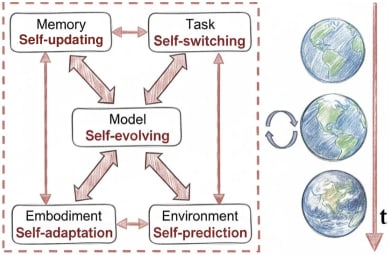
Although Wu’s vision has yet to be realized, the components of the closed-loop are being assembled at speed. Across China, a growing number of companies are racing to build what the industry calls the ‘brain’ for robots: Alibaba launched RynnBrain, Ant Group open-sourced LingBot-VLA as a ‘universal brain’ for physical AI — explicitly framing it as a step toward AGI — while startups like Spirit AI and X Square Robot are developing VLA models that learn through physical reinforcement learning rather than static data. Local governments havefunded robot boot camps where hundreds of robots practice real-world tasks via human teleoperation and autonomous collection, generating the kind of physical interaction data that no static corpus can provide. Moreover, researchers from Tsinghua University envision a “self-evolving embodied AI” paradigm — unlike AI that improves by rewriting its own code, this proposed system closes the loop through its physical body, continuously updating its memory, goals, physical capabilities, and underlying model based on what it learns from acting in the real world.
An illustration of a self-evolving embodied AI paradigm; source.
Unlike the RSI discourse at the U.S. frontier lab, which increasingly coalesced around agentic coding as the primary lever, the Chinese ecosystem has no single consensus path. DeepSeek focuses on multimodality without a clear interest in embodiment. Z.ai treats coding agents as central while starting to invest in multimodality-enabled physical AI. MiniMax has long emphasized multimodal architectures. ByteDance and Tencent have invested more heavily in world models. Among leading scientists, Zhang Bo and Zhou Bowen see embodied AI as the final stage of AGI development; Ya-qing Zhang (张亚勤), the founding Dean of the Tsinghua Institute for AI Industry Research, adds a biological layer beyond that; Andrew Yao maintains that large models will remain the core foundation to support all subsequent advances, including embodied AI.
What is nonetheless striking is how rarely coding is presented as a silver bullet, and how consistently Chinese researchers reach for paradigms that go beyond language models — emphasizing the full complexity of human intelligence rather than one slice of it. Rather than a superbrain built from code as perceived by many in Silicon Valley, Chinese AI actors increasingly narrate a different endpoint of AI: something closer to building a human from the ground up. Compared with the months-long timelines offered by many U.S. AI executives, the Chinese self-improvement loop is larger, more integrated with physical reality, and far slower to close—by design.
A Bottom-Up Constraint-Driven AGI
Beijing is AGI-curious, not AGI-pilled. The embodied closed-loop approach to AGI emerging in China is not a secretive Manhattan Project but a bottom-up movement shaped by existing constraints and competitive pressures, that is gradually finding its way into the top-level vision.
Despite its aim to “explore AGI,” the top policymakers have many other near-term issues they want AI to solve. AGI does not make its way into the executive summary of the new Five-Year Plan. Poe Zhao points out that the government’s 2026 AI agenda still prioritizes “concrete deployment targets” over “general AI ambitions.” Similarly, many AI governance researchers in China still believe that DeepSeek, and maybe now Z.ai, are the only labs in China that are chasing AGI, while the rest of the companies are more practically focused on deployment. They are less concerned with replicating human intelligence and more focused on addressing the immediate development challenges. Gong Ke, the dean of the Chinese Institute of New Generation AI Development Strategies, states that, compared to chasing the grand narrative of AGI, practically diffusing and delivering AI to everyone is more important to China. Huawei’s Ren Zhengfei holds a similar view, arguing that China’s focus is on deploying AI to tackle practical development issues, in contrast to the US pursuit of AGI to answer philosophical questions about human and superhuman existence. Informed by these perspectives, when the state says it supports embodied AI, it probably has in mind addressing economic and societal gaps resulting from China’s low birth rate and contraction of the future workforce, rather than self-improving humanoid robots running loose on the street.
Meanwhile, the scientists who want those self-improving robots are initiating bottom-up discourse wrapped in the framework of that top-down rhetoric. State-backed labs are creatively interpreting the AI+ initiative to justify their AGI-oriented research, including in areas like AI agents development and AI+science. Academics from elite universities and institutions are publishing reports theorizing how AGI can contribute to key areas like the manufacturing industry, public data governance, and scientific research, thereby seeking to align the presumed benefits of human-level intelligence with the state’s objectives. The official message can be interpreted in various ways, depending on individual focus, thus justifying the societal and economic utility of general, or even super, intelligence.
Shanghai Innovation Institute, one of China’s leading state-backed AI labs, cites the AI+ initiative’s emphasis on AI agents to introduce their research. Their “cognitively agentic AI” (“能动”认知智能) is claimed to have autonomously discovered new AI architectures.
The emphasis on embodied closed-loop AGI is also driven by resource constraints. Chinese AI companies face real compute ceilings, and if RSI-through-coding-automation were the primary pathway to AGI, those constraints would represent a central bottleneck. Rather than treating compute as an existential gap to close at all costs, there might be strong incentives to develop theories of AGI where it isn’t the decisive near-term variable — where physical-world interaction, robotics infrastructure, and embodied data pipelines matter more than raw model capability, and where the timeline is long enough for China’s chip position to improve. Within this paradigm, embodied AI is not a consolation prize but a potential leapfrog: a path to AGI where China’s manufacturing base and deployment scale become structural advantages. In this case, constraint-driven diversification, top-down focus on deployment, and genuine ideological beliefs have probably coevolved into something coherent — an embodied closed-loop to AGI.
Although bottom-up, these AGI-minded voices are gradually gaining more influence at the top. The new Five-Year Plan’s emphasis on “multimodal AI (多模态), agentic AI (智能体), embodied AI (具身智能), swarm intelligence (群体智能)” as ways to explore intelligence, as well as “the parallel advancement of general-purpose large models and industry-specific models,” tracks closely with how Chinese AI scientists had already been framing the path to AGI. Ya-qing Zhang highlighted how “agent swarm” (智能体群) creates “collective intelligence” (群体智能) in a speech on AGI in 2025, while the idea of fusing general-purpose and industry-specific models exactly mirrored Zhou Bowen’s thinking of “the fusion of generalist and expert (通专融合)” as the pathway to AGI expressed in 2024.
The most direct example of this influence came in April 2025, when Zheng Nanning 郑南宁, a professor at Xi’an Jiaotong University, briefed China’s Politburo study session (with Xi Jinping in the chair). Zheng sees AGI as machines that can perceive, act in, and adapt to the physical and social world, not merely process data. In July 2025, at China’s most important AI conference, he further touched on the idea of self-improvement loops, arguing that AI systems should be intent-driven by linking information processing to goal-directedness — given a high-level objective, the system decomposes it into tasks, acts, and feeds results back to refine its own behavior continuously.
RSI without RSI: What We Lost in the AGI Debate
China’s belief that AGI needs physical embodiment may seem reassuring to US labs that believe software capabilities will become the decisive advantage in AI. After all, with the advantage in chips, US labs can scale compute much faster than their Chinese counterparts. Even though China may catch up on chips in the future, RSI may kick off quickly enough to compound US software capabilities to a point no Chinese lab could match. From this view, Chinese scientists are pursuing a theory of AGI that will matter far less than the one American labs are betting on.
But this thinking misses an important point: what matters is not only what Chinese AI researchers and Beijing believe AGI is, but also what happens quietly beneath those beliefs. Capabilities that don’t fit the official vision, including those that look a lot like the US version of RSI, will be built without the accompanying proclamations.
Shanghai Innovation Institute (SII), a state-backed research lab, published research on its “agentic cognitive intelligence” research in September 2025. It claims to have the scaffold automatically capture real-world agent-tool interaction trajectories and feeds them directly back into model training — what the lab itself calls a “self-evolving closed loop” (自进化闭环). Moreover, the system autonomously discovered over 100 new neural network architectures in two days. Meanwhile, in February 2026, MiniMax — a company widely seen by its Chinese peers as purely commercially-oriented with no AGI ambition — claimed that AI was already generating 80% of its newly committed code. More broadly, almost all frontier AI companies–Z.ai, MiniMax, Moonshot–are doubling down on AI coding agents.
By most technical readings, SII and MiniMax are trying to do RSI. However, neither of them mentioned anything about RSI, or its Chinese equivalent (递归自我改进). SII phrased the whole research around the idea of “能动性” (agentic capability) and the state’s AI+ adoption targets, while MiniMax only briefly mentioned it was near “infinite agent scaling.”
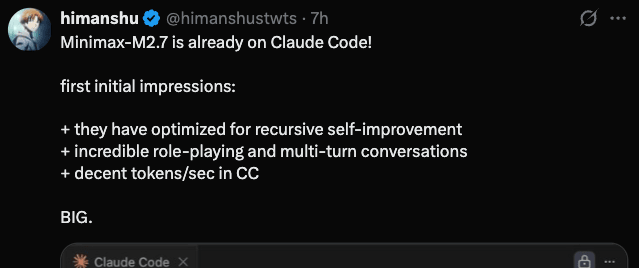
An AI researcher argued that MiniMax’s newest model optimized for RSI.
Are Chinese labs deliberately obscuring their ambitions? Not really. Like their American peers, Chinese AI companies are maximizing their software engineering capabilities. Automating the coding process and using AI to empower research is instrumentally useful regardless of what you believe about AGI. One does not need to cite RSI as a theory or publicly announce the coming of AGI to pursue a very similar process in practice.
This means that it is wrong to treat instances where RSI or AGI appear in top policy documents or corporate speeches as signaling how determined China is to push for frontier AI capabilities. There is a conceptual gap in the frontier of AI across the Pacific. The gap distorts near-term strategic signals relying on surface reading, as Western analysts are listening for language that Chinese researchers have no incentive to use. Rather than filtering Chinese AI through a Silicon Valley lens, Chinawatching in AI needs to understand architectural divergence and track real capability signals.
Meanwhile, the lens Silicon Valley or DC uses to envision AGI is also motivated by its own constraints and competitive position. Just as China sees the future of AI through its manufacturing strength and chip shortage, the U.S., with abundant chips and less manufacturing capabilities, sees a different version. The U.S. and China’s roads to AGI appear to be different, and perhaps the destinations do too. But if each side’s vision of AGI is shaped by what it already controls, then neither is well-positioned enough to recognize what the other is actually building.
Acknowledgement:
Zilan is grateful to Anton Leicht and Scott Singer for their mentorship on this project during the GovAI fellowship period. Zilan also wants to thank Suchet Mittal, Jason Zhou, Kayla Blomquist, and Zac Richardson for their feedback on early drafts.
ChinaTalk is a reader-supported publication. To receive new posts and support our work, consider becoming a free or paid subscriber.
Why AI could help governments cut through regulatory cruft, but can’t replace the political will needed to reform it,
How state-level competition and experimentation could accelerate government reform,
Why even obvious bureaucratic fixes are difficult — nearly every dysfunctional policy has a constituency that benefits from it,
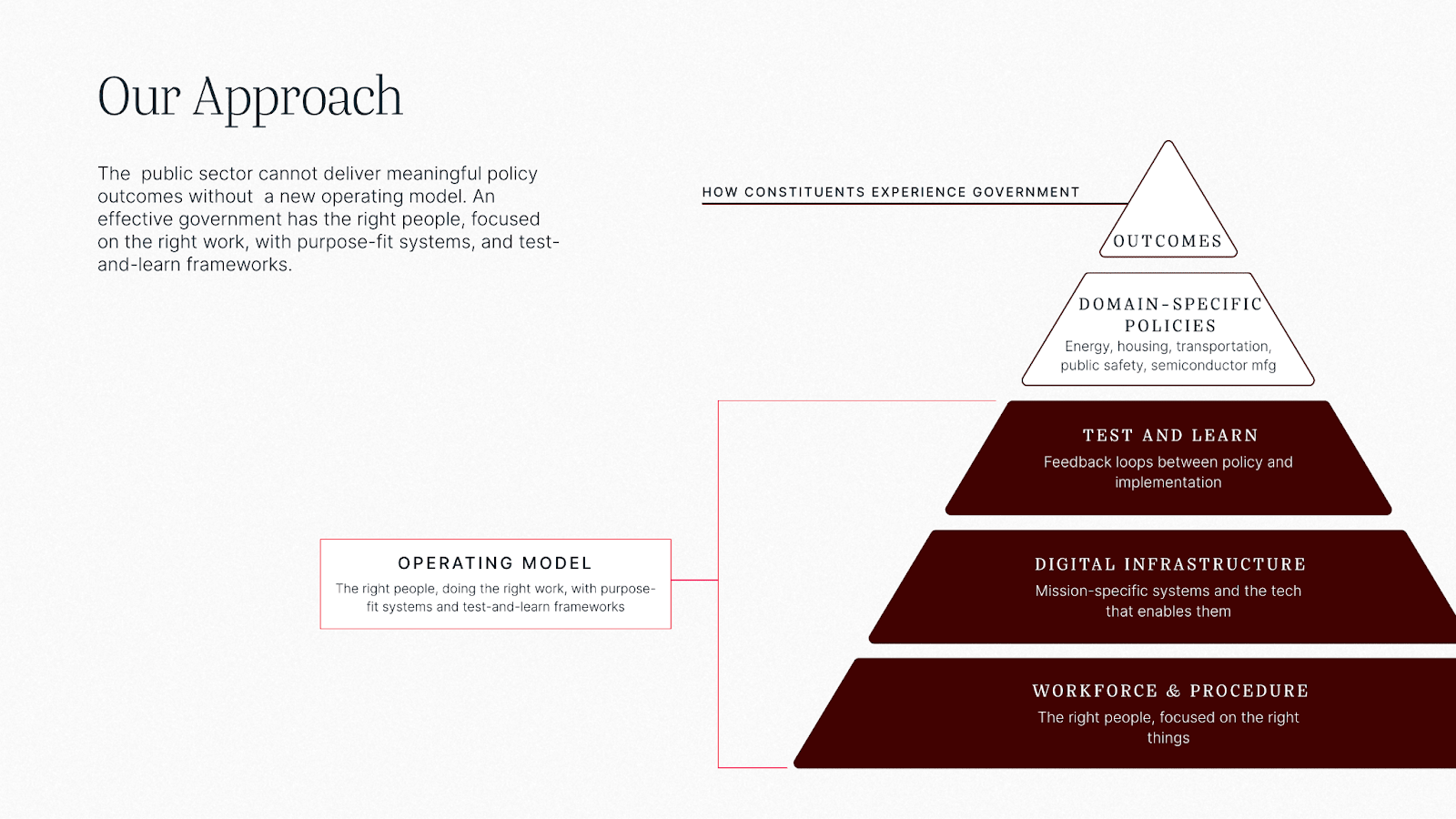
The Recoding America Fund’s mission to build a cross-ideological coalition to modernize the government’s operating model.
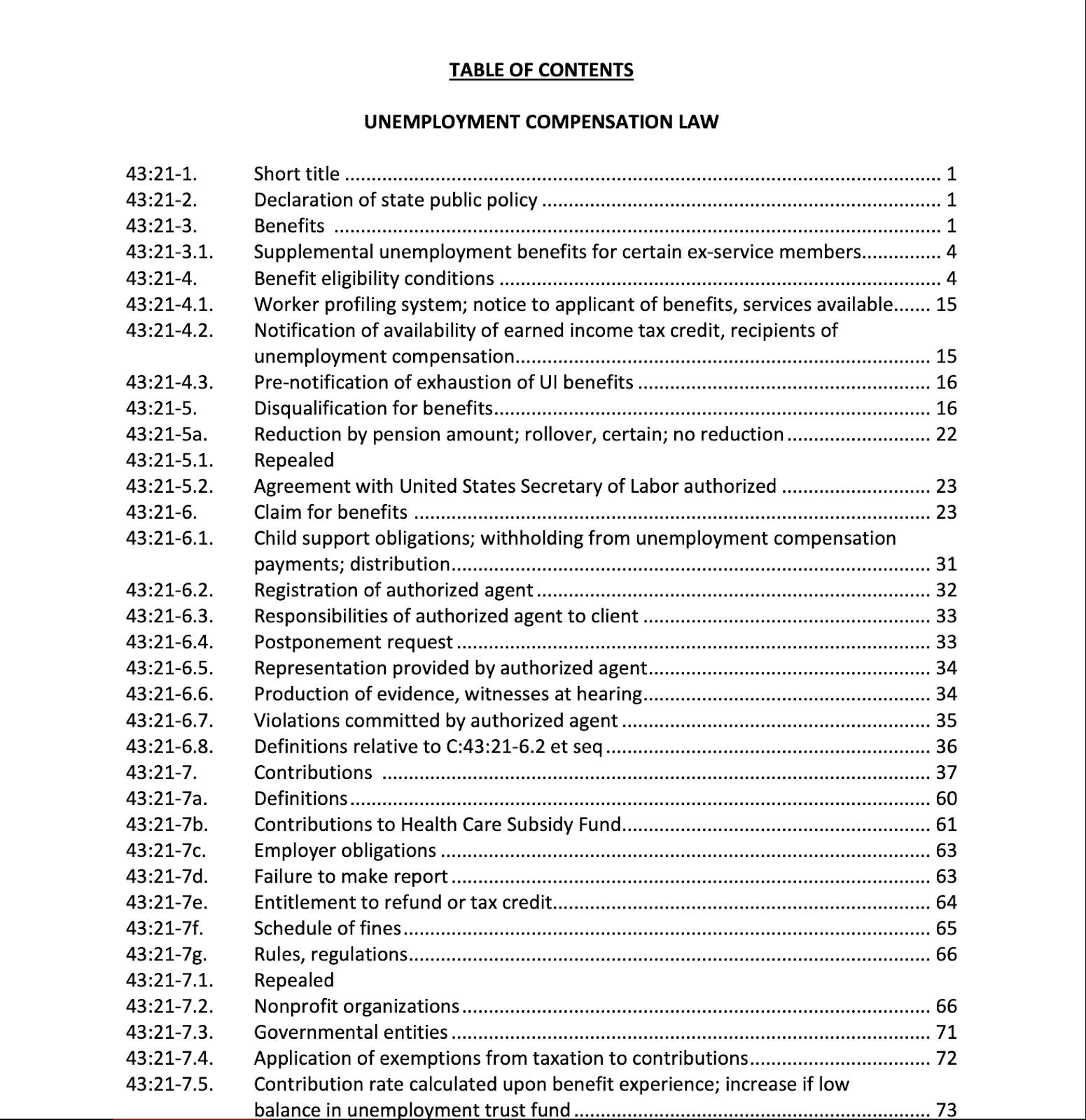
Plus, we talk about 7,119 pages of New Jersey unemployment insurance regulations, why drastically cutting the defense budget might improve national security, and why the toughest questions about public programs aren’t technical, but fundamentally political.
Jordan Schneider: Jen Pahlka, American hero. Welcome to ChinaTalk.
Jen Pahlka: It’s really an honor to be here, though you’re overstating things already.
Jordan Schneider: Where should we begin? I want to talk about the Recoding America Fund and the bright future you envision for American governance. If this all goes great, what can we expect our federal, state, and local governments to accomplish?
Jen Pahlka: That’s a good question. We tend to go straight to the negative, and there’s plenty of negative to talk about — but people are driven more by wanting to get to a good place than away from a bad one. Government is supposed to meet people’s needs, both individual and societal, and we’re really struggling to do that right now. We’re stuck trying to get 10% better here or 15% better there, instead of asking — what do we actually need to leapfrog to? Whether it’s administering a social safety net that protects people in vulnerable times or deterring adversaries, we need to start thinking in terms of actually meeting the moment rather than moving slightly ahead from where we are today.
When I started in government reform in the late 2000s and early 2010s, the basic argument was that if you want to meet people’s needs, you have to recognize that their expectations have changed. They expect to be able to do business online. If there’s a real gap between how people get things done in their private lives and the burden we impose on them when dealing with government, that is not good for democracy. If we can close that gap — which AI has now blown wide open — people will support a government that works, and they will care about institutions that work for them.
Jordan Schneider: We’re running this in parallel with an episode featuring Kevin Hawickhorst from FAI on the history of the civil service. There’s this idea that we had a golden age in the early-to-mid 20th century, after Progressive Era reforms kicked in, with truly excellent organizations and people. On one hand you have that degradation, but on the other, the expectations of what government should do have also increased as private-sector service delivery has dramatically improved over the past 50 years. Do you want to apportion blame between those two factors? Is there anything else going on?
Jen Pahlka: What you had was a very effective administrative state — the glory days Kevin talks so eloquently about — that was fit for purpose for that moment. Part of why it was fit for purpose is that it built in its own sense of renewal. Kevin talks about a practice under the Eisenhower administration of constantly renewing and streamlining business processes — it was called “work simplification.” You read that and think, that is exactly what we need now. It doesn’t require much translation to the current era.
A process chart from a Work Simplification guide from the 1940s. Source.
What we lost was that notion of constantly re-examining things. We got lazy and let policy and process accumulate like layers of cruft — archaeological layers you can dig back through. Our legislators and policymakers came to believe that success means adding rules, mandates, and constraints, instead of constantly asking — what should this process look like? What do we need to remove to make it effective? It is, in some sense, a return to past practices, but those past practices were good precisely because they weren’t frozen in time.
Jordan Schneider: You blurbed a paper by Luukas Ilves called The Agentic State. It analyzes transformation through 12 functional layers. The six implementation layers where agents can deliver immediate value include — “public service design that becomes proactive and personalized; workflows that self-orchestrate; policymaking that adapts continuously based on evidence; regulatory compliance that operates in real time; crisis response that coordinates at machine speed; and procurement systems that negotiate autonomously within policy constraints.” That seems pretty compelling.
Jen Pahlka: Luukas said it very well. And the next piece covers six enablement layers that go with that — complicated, but important.
Jordan Schneider: I want to stay on this question of the path forward. We have 75 years of accumulated cruft, Nader-era pushback, and deliberate erosion of state capacity.
Jen Pahlka: We have undone state capacity. I would agree with that. But we’ve undone it by doing too much in a certain way. It’s primarily the laziness of not cleaning up our messes rather than the intentional undoing of anything. In some ways, the intentional undoing of what has been done would create more state capacity.
Jordan Schneider: The human man-hours that would take to undo this…You recently did a show with Greg Allen where you talked about the 7,000 pages New Jersey unemployment insurance has to operate under.
Jen Pahlka: 7,119 pages of active UI regulations.
Jordan Schneider: Unwinding that would take tens of thousands of man-hours to map and rationalize — or you just have an AI get 95% of the way there. It seems like the only way out.
Jen Pahlka: The good news is that the moment we arrive at the realization that 7,119 pages creates an unadministrable program — and I think we’re starting to get there — the tools have arrived to make that problem a lot easier. That brittleness is especially dangerous for a program that operates at low volumes day-to-day but needs to scale 10x or 20x in claims during a crisis. Scalability is a core requirement.
The pushback I get is that AI can’t be in the driver’s seat. But people can be in the driver’s seat if they choose to use these tools. The AI cannot do anything about the political will required to unwind the memos, guidance, policy, regulations, and statutes that need to be unwound. But we haven’t really tested that political will, because nobody has been able to articulate what the target should look like. How many pages should it take to describe a program that gives someone money for a certain number of weeks under certain circumstances? It’s certainly not 20 pages, but it needs to be a lot less than 7,000. Until we put forward what we think that should look like, we haven’t tested the will of our political leaders to get us there.
246 supplementary pages to New Jersey’s 7,000+ pages of unemployment compensation law. Source.
Jordan Schneider: Two things could block this future — politics and fear of AI. I’m relatively optimistic on the fear side. I remember people being terrified of Uber and Airbnb. The daily utility people are getting from these tools is only going to grow — everyone is going to have a personal assistant, and maybe part of the answer is that people just outsource their government interactions to their AI agent, which cushions some of the pain, though that doesn’t answer whether the unemployment check is actually coming. Still, I think demand for these tools will grow from politicians, government workers, and the public alike. Are people going to get over their fear?
Jen Pahlka: People will. The question is whether we will have already put too many rules in place — such that the cultural barriers dissolve, but the statutory and regulatory barriers were locked in before we really understood what was possible.
When the Biden AI executive order came out and OMB was developing its guidance, Dan Ho and I submitted a letter that restated a paper I wrote called “AI Meets the Cascade of Rigidity.” The concept is that while people can create guardrails that sound perfectly reasonable on paper, in a risk-averse, overburdened bureaucracy, those guardrails don’t function as guardrails. They function as barriers you simply cannot overcome.
The unemployment regulation example is actually a useful corrective to AI fear, because it illustrates what AI genuinely can and cannot do. It can rewrite the law, but it cannot get that law passed. It can rewrite policy, but it cannot get that policy enacted. Humans have to do that. If you want an example where there’s no fear that AI will take over — because it structurally can’t — that’s it. You realize at the end of the day that it is a tool in the hands of people trying to make government better, and that the binding constraint isn’t the AI. It’s our political system.
Jordan Schneider: What didn’t exist in 2024, or even for most of 2025, is the idea that software is basically free — or that software engineering productivity is now 10x or 100x, and people who never imagined themselves writing code can now build tools.
Jen Pahlka: It’s extraordinary — and yet basically the entire federal government and most state governments are not adapting to it. They still have contracts with vendors that have people writing code. Those people may or may not be using AI coding tools, partly because policy clarification hasn’t come down. But even setting that aside, those contracts don’t account for the dramatic drop in the cost of software development. It’s going to be decades before government actually pays less for software — and right now we’re probably going to start paying more.
We should be running a five-alarm fire. How does government get the software it needs dramatically faster and cheaper? That’s not entirely what’s happening yet — and I don’t say that to dismiss the great leaders I meet who are pushing hard on this. But they are held back not just by AI guidance, but by procurement systems, contracting rules, legal reviews, and the legacy ways of doing things that, in the Recoding America framework, sit at the very bottom of the Maslow’s hierarchy of government needs. These foundational processes don’t look like they have anything to do with AI on a day-to-day basis — but they fundamentally either enable or constrain government’s ability to enter an AI era. And at the very bottom of that pyramid, everything rests on one question — do we have a functioning workforce? Is our civil service fit for purpose for this era?
Jordan Schneider: Give us a 30-second introduction to Recoding America.
Jen Pahlka: Here’s a little backstory. My book Recoding America came out in 2023, and as I went around talking about it, people kept saying that I was describing the dysfunction of government and how critical it is to fix it, yet there’s no political power or momentum behind the recommendations — they’re ideas without a constituency. It was Kumar Garg at Renaissance Philanthropy who said the way to put teeth on this agenda is to raise funds and act as a field catalyst for government reform. Not the flavor of reform we’ve had over the past couple of decades, but reform that leapfrogs government into an AI era. Whatever you care about — deterring adversaries, the abundance agenda, a functioning social safety net —
Jordan Schneider: Or small government.
Jen Pahlka: Small government cuts across all of it. But whether your issue is education, housing, transportation, or criminal justice, what you realize is that you can bring in better policy and still not get the intended impact. That’s because, just as Maslow’s hierarchy says you can’t achieve self-actualization if you’re not fed and housed, you can’t iterate meaningfully on policy when the basics aren’t covered. The basics are the operating model of government — and ours is an industrial-era model that was excellent for its time. We slapped websites on the front end of it when the internet arrived without fundamentally adapting it, and now we’re entering the AI era needing to leapfrog it entirely.
The thesis of the Recoding America Fund is that if you want government to achieve its policy goals, it needs to hire, manage, and retain the right people — which means civil service reform. Those people need to be focused on the right work — which means procedural reform and cutting the policy cruft we discussed. They need purpose-fit systems, including but not limited to AI. And they need to operate in test-and-learn frameworks rather than the waterfall methodology that infuses everything government does. We’re trying to catalyze a field of civil society organizations that push and enable government to make that leap.
Jordan Schneider: On the vision — you walk through many policy areas where people have strong feelings and don’t always agree. How close are we to the Pareto frontier of effectiveness before we start hitting genuinely ideological tradeoffs? Can we keep the middle 75% of the political spectrum aligned on this agenda?
Jen Pahlka: Let me qualify first by noting that we naturally focus on the federal government, but we also work with states — and updating an operating model is largely independent of whether you’re talking about education or national defense. States are valuable because you have more opportunities to find where the energy is, prove it works, and let other states and cities adopt it. The federal government can learn from that too. The classic line applies — the future is here, it’s just unevenly distributed.
One area where people will have very strong feelings is civil service reform, which hasn’t meaningfully happened since 1947. The Civil Service Reform Act of 1978 tinkered around the edges more than pulled us into the paradigm we need. Civil service reform is going to be hard, especially given legitimate concerns about protecting civil servants’ independence. We have to be careful that in the interest of building a properly manageable workforce, we don’t create massive turnover with every change in administration and a culture of fear. That would be a very bad outcome.
That said, there are already real opportunities at the state level. North Carolina’s legislature looked at their system, declared it unfit for purpose, and asked the state HR director to propose a complete reboot — a major, major reform. We’ve been fortunate to support that with fellows helping push their thinking. That’s the dream — working on a real civil service system. Since we believe in test-and-learn frameworks, it’s great to do this with North Carolina while we look for opportunities to replicate it elsewhere. You need to start building the muscle and riding the bike around the block while you wait for the larger policy windows to open.
Jordan Schneider: That felt like a dodge — let me try again. Take our 7,000 pages of unemployment insurance regulation. Let’s say 75% of it is just dumb and silly. Then you start hitting real tradeoffs. Do we prioritize people with children? Do claimants have to prove they’re looking for work? And we recently saw a reconciliation bill where the projected Medicaid savings were predicated on new regulatory cruft intentionally designed to create friction so people don’t access benefits. Is your sense that we can go really far or 50% of the way to our beautiful functioning future? Like at what point does this agenda hit the wall of principled disagreement that only legislators and elections can resolve?
Jen Pahlka: I won’t give you a percentage because I genuinely don’t know, but you want to distinguish between things like Medicaid work requirements — which are deliberately designed to make the system operate poorly — and things that are just capture by the status quo that accidentally make things worse without intending to.
Even in that second, less politicized category, change is still hard, because there are always people whose business model is built around the dysfunction. One of my learning arcs over the past 15 years has been moving away from the belief that you can wash all of that away as soon as you demonstrate how dumb it is. There are constituencies for every dumb thing, even when it’s not as cynical as intentionally rationing Medicaid dollars through friction — which is just a terrible way to allocate scarce resources.
The deeper conclusion I’ve reached is that in a better world, instead of legislating down to an incredible degree of procedural specificity, you tell agencies here’s the goal, and give them far more freedom to get there. That’s what we call outcomes-driven legislation — the PopFox Foundation has a great outline of what that looks like. We could move much further in that direction and still not be at the ideal.
The real problem is that we often have outcomes-driven legislation’s opposite precisely because legislators don’t actually agree on the outcome. They can agree on the rules of the system, and then you’re locked into administering those rules. One person thinks the point of a program is to make sure people don’t end up in the emergency room and another thinks it’s to keep costs down. They’re not necessarily mutually exclusive, but what they’ve agreed on is the rules, not actually the goal. That is going to be a significant obstacle to where we want to go.
The positive future is one where we are much clearer on goals and have the agency tools to tack toward them, rather than just executing steps A through B through C in a waterfall. On the role of politics — yes, ultimately, voters will have to reject things like Medicaid work requirements. The problem is that right now, we don’t have a responsive feedback cycle. Implementation takes so long that voters are always reacting to something two administrations ago — there’s no perceived correlation between a harmful policy and electoral consequences.
We need to speed up implementation so that when you do something good or bad, you actually feel the consequences in the next election.
Jordan Schneider: So you won’t give the number. But I think it’s about 80% you can fix before you hit genuinely hard ideological trade-offs.
Jen Pahlka: I love that number, and you may be right about the percentage of stuff that’s more trivial. But we still have to face the capture embedded even in that 80% — it’s much less, but it’s there. We still have to get people into a trade-off mindset.
Jordan Schneider: So — how to make legislators’ jobs more fun. We have our 7,000 pages. Let’s say 6,000 of them are just dumb requirements everyone agrees can be AI’d away — fax mandates, wet signature requirements, that kind of thing. What excites me is the idea of teeing up the actual decisions — here are the 10 questions where, if you give me answers, I can reach the next Pareto-optimal policy improvement. The AI figures out all the mechanical stuff. It’s not up to the AI to decide whether single mothers should get more than two-parent households or how to structure alimony. But once you get into that territory, the political valence of the AI doing the teeing-up gets really tricky.
Jen Pahlka: Do you mean teeing up the policy decision, or making a benefit determination?
Jordan Schneider: I mean the model not just doing the boring stuff, but facilitating the discussion, doing the modeling, and ultimately generating recommendations on the hard normative questions. We have the CBO, which is the closest thing to objective scoring we have — imperfect, but both sides interact with it as a form of shared truth. I can imagine a version of the CBO where an AI does that for an enormous swath of tradeoffs and decisions, with models rather than beleaguered congressional staffers providing the simulations, ground truth, data, and projections. It could be a really strange future.
Jen Pahlka: It will be strange. By the way, I love the framing of “let’s make the legislators’ jobs more exciting.” I’m going to use it and pitch that.
But one thing that excites me is that it gives you the ability to actually interrogate goals. You can ask much more easily now — will this policy intervention, properly implemented, help more people return to work? In the unemployment insurance context — if one goal of UI is to prevent people from falling into deeper poverty so they can get re-employed — that whole world is changing dramatically right now. We need to be asking, is that one of the goals? And if so, does the way we verify the terms of someone’s separation from their last job actually advance that goal? Enormous amounts of administrative burden go into that question, and it might not make much difference to what the program is actually trying to achieve. Not as damaging as Medicaid work requirements, but still significant. We need to ask, what is the right design of this program if what we actually want is to prevent chronic unemployment?
Jordan Schneider: Coming back to my idea that people will embrace these tools — maybe this is part of the amazing future — but the experience you have with Claude Code where it keeps asking for permissions and you just say “sure, just do it,” within three to five years, the things models will strictly dominate humans on — especially a lot of government work, which is just taking rules and applying them — we’re going to be handing a lot over to technology. Government will be slower, but in many corners of life, you’ll be delegating to your model. And we still have elections and legislators.
Constraints, Competition, and Crises
Jen Pahlka:But that’s exactly it — when the moment comes where it is just patently obvious that handing that over is the right thing to do, will we have already constrained ourselves? We’re sitting in New York, which has passed a law saying you cannot change a public servant’s job because of AI. I understand the logic. But it could fundamentally exacerbate the gap between public and private sector effectiveness in ways that are devastating.
Jordan Schneider: Those dumb constraints will go the way of the dodo when Pennsylvania and New Jersey don’t adopt them and end up literally ten times more effective. Though it took phonics a very long time to get out into the world, so who knows?
Jen Pahlka: No, that’s actually true — something that was very clearly the right answer took a minute.
Jordan Schneider: At least at the state level, you have that competitive dynamic. I’m thinking ahead to 2030, when everyone’s gotten it, and we’ve already moved past most of the ideological debates because AI has gotten us 95% of the way there. That’s the future we’re working toward. Are people genuinely freaked out about this?
Jen Pahlka: That’s one of the reasons having 50 states is great. New York might pass a law, that I think is a terrible mistake, but they’ll hopefully be forced to revisit it when their neighbors are kicking their ass.
Jordan Schneider: That competitive dynamic will drive proliferation in the private sector. The New York–New Jersey–Connecticut–Pennsylvania feedback loop is slow but real. For the federal government, we have elections every two years — is that what unlocks AI-era government services? We had a version of that with DOGE, though I’m not sure if that’s the future. Then there’s the defense establishment, which confronts this daily in the intelligence community, and we seem to be in a conflict every month now. Where do you put different institutions on the spectrum from “constant competitive pressure to modernize” to “the IRS”?
Jen Pahlka: It’s interesting. The fact that we’re in a near-constant state of conflict ought to kick us into crisis mode, and our history is that we act in crisis. The transformation into the digital era has really only come in leaps. Healthcare.gov is the perfect example — I was in the White House at the time, trying to stand up what became US Digital Service (USDS), and it was moving very, very slowly. Truthfully, I don’t think it would have happened without the crisis of the healthcare.gov launch.
Being in a hot war with Iran might change things at the Pentagon. But one core problem is that we just keep giving the defense establishment more money. Constraints drive creativity — they’re part of transformation. I was sitting next to a very senior Air Force leader at an event once and said that after my four years on the Defense Innovation Board, my conclusion was that you could only defend the country better by cutting the budget, because the bigger these projects get, the more rules accumulate, the slower everything moves, and the more people are touching it. I half-apologized because I felt I was insulting him. He said, “No. Let me edit what you just said. A cut is not enough. We’ve had that with sequestration and it just means a haircut across the top — everyone cuts all the wrong things. You need to cut the budget by half.” I asked whether he was saying the department would be more effective with half the budget. He said, “Absolutely.”
So we need the kind of crisis that forces us through more streamlined channels. Will war do that? Maybe — but there’s enough chaos right now that it’s distracting us from the core work of making the DOD fit for purpose. What we want isn’t half the defense capability — we want double the capability. We want to break out of 25-year acquisition cycles and stop delivering ships that are obsolete by the time they’re built. The way you get there is to contract the resources so that people are forced into more streamlined channels.
Jordan Schneider: How much of the slowness and dysfunction do you attribute to political economy? If software costs one-fifth as much, the contractors currently billing for it lose political heft to slow things down and optimize for their business models rather than the country’s. Is that a big part of the problem?
Jen Pahlka: It’s an interesting field in that some of the loudest voices for transformation are actually vendors — not the Beltway Bandits, but insurgents making the case for speed and what you might call “attritable mass” — lots of small drones instead of large platforms. That said, there are real concerns about the new breed of vendor getting in on the capture game. It’s just the natural cycle. But yes — big to medium part of the problem.
Call to Action
Jordan Schneider: You guys have $120 million?
Jen Pahlka: No. We’re fundraising. We have just under $40 million and will be raising the rest over the next couple of years.
Jordan Schneider: What’s the email?
Jen Pahlka: jen@recodingamerica.fund.
Jordan Schneider: What does going from $40 million to $120 million get you?
Jen Pahlka: We’re a six-year fund, and it buys the ability to plan and execute over that full arc in a way that’s meaningful and sustainable. We’ll check in at the three-year mark and ask whether we need to go bigger or adjust course — based not just on our own progress, but on the policy windows that open up.
The deeper point is that there has never been a real field of state capacity. I was part of the world loosely called civic tech, and there are good government reformers and congressional modernization groups, but there’s never been a center of gravity — a set of organizations, a community that extends beyond those organizations to people, legislators, and media — all pointed toward the same future.
What we need is people from the left, center, right, MAGA, and progressive wings all saying — we might not agree on exactly what civil service reform looks like, but we know we need it, and there’s common ground in the middle. Everyone from MAGA to progressives actually agrees on more than people realize. Get Elizabeth Warren talking about it, get Senator Young talking about it; get the states talking about it — that creates a critical mass for something that hasn’t been on the table in decades. You cannot build that on one year of funding with no visibility into the next.
Jordan Schneider: How does this work feel compared to, say, the healthcare.gov rescue or writing the book?
Jen Pahlka: It feels inevitable, frankly. Writing the book would have been pointless if I wasn’t going to do this work. We live in interesting times that worry me quite a bit, but it’s good to have something I fundamentally believe needs to happen — something I can stay focused on regardless of what’s dominating the headlines. I can’t do much about most of the headlines, but I can say, let’s not take our eye off the ball. We know we need civil service reform. That’s my lane, and I’m staying in it.
Jordan Schneider: Does building a national coalition feel different from the operational work — the healthcare.gov-era stuff, building USDS?
Jen Pahlka: I should note I wasn’t on the healthcare.gov rescue team directly — I was standing up USDS from OSTP at the time, and we retroactively claimed credit for it. Wonderful people did that work, not me. But to your question — they all feel part of a whole. A better example for me is the unemployment insurance work I did during the pandemic. When you see those dysfunctions up close, you realize they cannot be solved from a high perch that misses what actually happens day-to-day inside an agency.
If you’ve actually fought the battle and carry the scars — and the frustration — you’re not the only one who eventually concludes you have to go upstream. I visited military bases on the Defense Innovation Board and sat side by side with people struggling under incredible constraints to do things that shouldn’t have been that hard. That experience informs the strategy at every layer up. This is the highest layer I’ve operated at, but I bring everything from those earlier battles. The goal is that our strategy stays grounded in actual problems rather than abstract ideas — truly designed for what we’re trying to solve.
Jordan Schneider: Besides asking for funders — you’re hiring, you’re taking pitches — what other calls to action do you have?
Jen Pahlka: Open positions are on our LinkedIn. We’re actively looking for major funders. We’re also looking for people who can connect us with state legislators and state leaders. And — you pointed at the camera when I said media — we need to be telling a different story. People who want to engage with this parallel universe of administrative state renewal, come to us. We’ve got stories to point you at. Shaping that narrative will bring more people into the mindset you started this conversation with, not just “how is government broken today,” but “what is the future we’re building toward, and how do we start imagining ourselves there?”
ChinaTalk is a reader-supported publication. To receive new posts and support our work, consider becoming a free or paid subscriber.
Caleb Harding is a Mandarin-speaking BYU CS graduate. He previously interned at the US Embassy in Jakarta and Doublethink Lab in Taiwan. He is currently based in D.C.
When you think of the biggest technologies of today, the most promising fields for the future, what comes to mind? If your first two thoughts were AI and quantum tech, congratulations — the Chinese Communist Party agrees with you. But what they listed third on the list of “Cutting-edge S&T breakthrough efforts” (前沿科技攻关) in their 15th Five-Year Plan might surprise you: nuclear fusion.
The detailed table entry for nuclear fusion indicates that the CCP is paying close attention to nuclear fusion and is invested in its success. Their goals for the next five years are described as follows:
“Achieve breakthroughs in key fusion technologies including tritium fuel preparation and recycling, materials irradiation testing, high-performance lasers, and superconducting magnet manufacturing; conduct plasma operation experiments on deuterium-tritium fusion and feasibility verification across multiple technical approaches; advance the engineering development process for nuclear fusion R&D.”
Who will execute on this? A whole network of researchers, national labs, and SOEs is driving ahead on the necessary research and manufacturing developments. But China’s most promising assets may lie outside of that system: a handful of startups that are iterating aggressively to take fusion commercial.
Yang Zhao 杨钊 is the CEO and cofounder of China-based Energy Singularity (能量奇点), one of the key players in this space. After graduating with a PhD in theoretical physics1 from Stanford in 2017, Yang spent a year drifting before deciding on his mission in life: to accelerate the timeline for commercial fusion.
After getting a grasp of start-up operations at an AI education firm, Yang Zhao and three other friends2 founded Energy Singularity in Shanghai in 2021. Their approach is similar to that taken by Commonwealth Fusion Systems (CFS), one of the most well-known US companies in the US. With a new kind of more powerful magnet, both companies intend to make fusion viable by shrinking the scale of reactors and, by extension, their cost.
Yang Zhao, CEO and cofounder of Energy Singularity. Source
Energy Singularity has had some significant breakthroughs since then. Last year, they achieved first plasma on Honghuang 70 (HH-70, 洪荒70), the world’s first functioning high-temperature superconducting (HTS) tokamak. Design and construction of that experimental reactor was completed in just two years, at record speed. This year, they created a magnet capable of producing a magnetic field of 21.7 teslas, passing CFS’s previous record of 20 teslas.
CFS may yet beat them to the punch. Energy Singularity built HH70 as a proof-of-concept device for HTS tokamaks — an impressive feat. But it doesn’t achieve a Q value greater than 1. The Q-value is a ratio of energy output to input; Q = 1 is break-even, and achieving Q >= 10 is considered the key milestone to prove the commercial viability of fusion. With significant funding and a few years’ head start, CFS is skipping the proof-of-concept device and already working on their Q >= 10 device, SPARC.
First plasma (systems operational) for SPARC is expected in 2026, with net energy production aimed for 2027. Construction on HH170, Energy Singularity’s Q >= 10 device, is expected to finish by the end of 2027, with first plasma and energy production to follow.
But Energy Singularity has some advantages. With their stronger magnets, design experience, and domestic supply chain, they believe their reactors will be the most cost-effective in the world. They report that HH70 cost them USD$16 million (120 million RMB) to build, and project HH170 will cost $420 million. Having already built a first-in-class HTS tokamak under budget and on time, I trust their estimate.
When SPARC was announced in 2018, the budget was $400 million, and it was supposed to achieve net power in 2025. Currently at 65% complete, the new estimate is around $500 million, and the timeline has already been pushed back two years. That being said, both Energy Singularity and CFS’ cost estimates are on the order of 50 times cheaper than the International Thermonuclear Experimental Reactor (ITER) currently under construction in France, which also has Q > 10 as a key goal.
The US may be in for another DeepSeek moment, and China may be poised for explosive growth in fusion come 2035.
The interview has many fascinating tidbits. But at 2.5 hours long, the full transcript might be a bit much for most. Below I’ve provided some extended snippets with occasional commentary. Or if you want to put your nuclear fusion Mandarin vocabulary to the test (惯性约束 is definitely not a term you hear everyday), you can listen to the podcast or watch the video.
Topics Included:
What’s in a Name?
When Cost is Key, Build a Startup
How to Compare Reactors
How to Design a Novel Reactor
Build Your Own Supply Chain
Science Risk vs. Engineering Risk
Why Not to Invest in Helion
China and the US: Independent Fusion Ecosystems
AI Can Accelerate Fusion
Fusion => Interstellar?
Contribute Where You Have Leverage
What’s in a Name?
Zhang Xiaojun: How did you come up with [the name for] your first-generation device, Honghuang 70? Why call it Honghuang?
Yang Zhao: Honghuang is from Chinese mythology — a very primordial, abundant state [Note: before the formation of the universe]. It’s chaotic but full of energy. Fusion is similar: you take a lot of originally disordered energy and convert it into electricity. So we named this series Honghuang. The “70” is a key design parameter — the major radius. It’s 70 centimeters, so we call it “70.”
The Oxford Chinese-English dictionary definition for 洪荒 is “primeval chaos.” If we were picking a fusion winner based on the coolest name, Energy Singularity has got it, hands down.
The idea of ITER (the International Thermonuclear Experimental Reactor) was first conceived in the 80’s, and the groundbreaking for the massive reactor took place in 2007. 18 years later… it still has 10+ years to go, with massive cost and time overruns (more on that later). In Yang Zhao’s mind, the science is there, it is simply a matter of building it cheap enough.
Yang Zhao: So in 2021 I set the goal: reduce fusion’s cost per kWh to coal levels or lower. The value our company offers is to continuously improve cost-performance and lower fusion kWh cost through every possible means. That’s why we insisted on designing the entire device ourselves. From magnet design, manufacturing to final testing and operation, we had to do it ourselves because those are the things that most significantly affect device cost. Subsequently, we developed most core subsystems in-house.
From the perspective of cost-effectiveness, small design changes can lead to huge cost differences. Your core subsystems affect interfaces with every other system; even minor design changes can drastically change the entire device. If I can push my costs to be mostly raw-material costs, meaning the team discovers and owns the knowledge, then we can lower the costs, and the higher upstream you go in production the cheaper the raw materials can be.
So we decided in design to do everything ourselves: core subsystems, in-house manufacturing, design, production, final commissioning and operation. Only when the device is not a black box and everything is transparent can you set new targets and know which systems to adjust to optimize cost at higher parameters. We figured this out in 2021. At the beginning I had only four people; for example, Dong was responsible for the overall work, the physics design, and later the experimental operation. Our most critical initial system was the magnet, which we fully manufactured ourselves. That was beneficial. Of course, this approach requires high demands on team operations and funding. New team members joined; initially about four people were doing this work.
Zhang Xiaojun: Why do it in the form of a startup? Why not use more efficient paths, like existing institutions?
Yang Zhao: That’s exactly the point. What we need to do is achieve, in the shortest time and with the least cost, a rapid, order-of-magnitude improvement in fusion cost-performance. That is essentially what a startup is suited for. From the industrial perspective, what we’re doing is similar to what SpaceX did.
Organizationally, the shortest decision pipelines and most efficient execution to take something from the lab to low-cost, large-scale use is what a commercial company does best. That’s not what universities or research institutes are best at.
So once the problem of fusion shifted from proving scientific and engineering feasibility to proving commercial feasibility, the best vehicle to do that turned out to be a startup. Once we knew our goal and what kind of team and organizational form we needed, we started doing this around 2021.
…
Zhang Xiaojun: You claim your cost will be half of comparable US efforts and the device will be smaller. How do you achieve that? Chinese teams tend to be more economical, with today’s AI being one example.
Yang Zhao: That’s our team goal and reflects our values: extreme efficiency combined with pragmatism. Our target is the “170” device: the world’s lowest-cost, highest cost-performance machine that achieves Q ≥ 10. From the start of design, everything — overall device layout, raw material choices, supplier selection, and manufacturing routes — has been done with that target in mind.
So within the limits of our understanding and design constraints, we aimed for the lowest-cost when designing the 170. Based on the entire construction process of the 70, we have a very clear and detailed BOM model for the cost of each subsystem, which we use to optimize the whole device. The final design resulted in a device costing roughly 3 billion RMB (USD$420 million). We’re not really sure why in the US this would require 1 billion USD — they haven’t publicly shared their cost breakdown. But having optimized to this extent, we feel further cost optimization would be quite difficult.
Achieving such low cost requires that the overall design is cost-minimal. We use suppliers available on the market with high competition and, frankly, overcapacity. Otherwise, if it were relatively monopolistic, or only one or two suppliers could do it, they would have strong bargaining power. If it’s a piece of equipment that we are going to need to use long-term, we develop it ourselves. Then we only need to buy the materials.
So through this approach — from design to manufacturing, to processes, to experimental operation — we optimize with the lowest-cost mindset. The final design may well be thelowest-cost device in the world capable of achieving this level of performance.
Construction completed on the first toroidal field (TF) coil of the Honghuang-70 Tokamak in Mar 2024. Source
How to Compare Reactors
As of 2024, there were 45 different fusion startups pursuing 23 different reactor designs. How can you compare them, and tell who is up to snuff? One of the key things to look at is the “triple product” values that they have published. Yang Zhao explains what that is all about.
Yang Zhao: This comes from the past sixty or seventy years of fusion research, summarized from hundreds of devices and thousands of experiments. To achieve a sufficiently high energy gain — the so-called energy gain is your output power divided by input power, that is, the energy you produce divided by the energy you consume — that’s called energy gain.
Zhang Xiaojun: That’s the key break-even value, right?
Yang Zhao: Right. If it equals one, that’s break-even. For a power plant, it has to be much greater than one. For example, if it equals ten, your output energy is ten times your input. After all, in real operation there are losses, right?
So energy gain is actually determined by a physical parameter called the triple product. Simply put, it’s the plasma density multiplied by the temperature multiplied by the confinement time — these three numbers multiplied together, hence “triple product.” When this product reaches roughly 10^21 in a certain, relatively complex set of units, physics from first principles tells you that no matter what method you use, if you take deuterium and tritium as fuel, that triple product corresponds to Q≈1. If it’s slightly higher, in the range of 10^21 to 10^22, the energy gain Q can grow from one to very large values, almost like an avalanche. Once you pass this break-even line, even a small increase in parameters can yield a very large energy gain.
So if a startup’s intended reactor design has only published triple product values of 10^10 or even 10^17… it might be best to stay away for the time being. Read more on that in the “Why Not to Invest in Helion” section.
So what does this logic tell us? To increase energy gain, you need to increase the triple product, because it determines the energy gain. Over the past sixty or seventy years of research, engineers have found that the most effective ways to increase the triple product are either to make the device large enough or to make the magnetic field strong enough. These are the two main approaches.
This is exactly the difference between ITER and CFS/Energy Singularity. Production for HTS magnets didn’t really reach the required scale until 2018 - long after plans had been made and construction begun on ITER, which consequently had to take the “go big” approach — at great expense. With HTS magnets, the second route is now an option, and promises to be much more cost-effective.
How to Design a Novel Reactor
I have never had to approach this complicated a problem before. However, after hearing him describe the process in detail, it isn’t quite as formidable as I imagined it. Extremely hard - yes. But even an elephant can be eaten, one bite at a time.
Yang Zhao: A device’s design goes through several stages.
First is the physics design: what is the core goal you want the device to achieve? Based on that goal, you determine the plasma state — the core physical parameters the plasma must reach.
From the physics design you move to conceptual design: what must each subsystem achieve in terms of parameters to meet your overall physics goals? For example, how strong and what shape must the magnetic field be? What does the vacuum vessel look like? What are the operating temperatures of each subsystem? When do you add fuel, when do you run diagnostics to observe its current state, and when do you apply control? Based on the physics targets, you define each subsystem’s core objectives, its operating conditions, and its interfaces with other subsystems. If you don’t do that, subsystems will conflict and you won’t be able to assemble the machine.
…
After finishing the conceptual design and converting it into physical targets, every system has a design concept that shows feasibility — basically whether the thing can be built.
Once you reach that stage, the next step is the engineering design. For example, if I need a low-temperature system with a certain flow rate, temperature, and flow speed, engineering design answers how to actually implement it: what distribution valves and boxes are needed, what liquid helium tanks, what refrigerants, etc. All those engineering devices are fully designed. At that point, after having the concept for each system, you make an engineering design package that can be used for manufacturing, machining, or equipment procurement — you produce drawings and technical specifications. That’s the third step: engineering design.
After completing engineering design, you enter the manufacturing stage. For some components, we give drawings to external machining or manufacturing suppliers, such as vendors who do welding and fabricate tanks or vacuum pressure vessels, and have them manufactured and returned to us. For some items, like magnets, we manufacture them ourselves in another workshop.
…
After subsystems are manufactured, they go through acceptance: does each subsystem, at the subsystem level, meet your design specifications? If yes, you accept it; if not, you fix what needs to be fixed or send it back to the manufacturer. Once subsystem acceptance is complete, you begin overall assembly: you install different subsystems and turn them into a complete tokamak, like the device you see downstairs.
During assembly there are of course tests. After installation you do system integration and commissioning to see whether the whole system can operate according to design and within the design parameters. Then you reach the final experimental operation stage where you test whether you can accomplish the original design goals, like achieving first plasma. Or, for our goal this year, can you maintain a thousand second steady operation?
From initial design, step-by-step detailed design, manufacturing, assembly, to final operation, it’s basically an acceptance process: does the completed machine meet your originally defined design goals? That completes the whole cycle. Each stage requires different capabilities.
The approach they have taken to cutting costs (discussed in the “When Cost is Key” section) and basically building things from scratch is indeed reminiscent of researchers at DeepSeek, who in the face of compute constraints dramatically increased the efficiency of their training.
Zhang Xiaojun: What does the industry supply chain look like?
Yang Zhao: The supply chain is still at a very early stage. Different groups build devices differently. Many universities and research institutions build small experimental devices, and these are often outsourced or assembled by other research units or groups that can piece a device together. Partial subsystems are sometimes handed to other research units to finish and return, so the supplier might itself be another research institute.
Our approach was different: we didn’t want black boxes in device design and construction. We do full in-house design and make the core systems ourselves. That means we directly contact raw material suppliers and, once we have drawings, we send them to competitive machining, welding, and manufacturing vendors to produce parts.
Upstream for us is mostly raw materials, plus highly competitive machining, welding, manufacturing suppliers, and common electronic components and mass-produced parts. The industry chain hasn’t really formed yet, so under our working model a lot of things have to be self-developed.
Science Risk vs. Engineering Risk
You’d think that a company designing a nuclear fusion reactor would be chock full of nuclear physicists. Not so. The core of Energy Singularity’s approach is to avoid anything that is a “scientific risk” - they want “engineering risks.”
Zhang Xiaojun: What backgrounds did they [the early design team] have? Physics?
Yang Zhao: Not many pure physicists. Early on there were a few theorists and experimentalists, but most were engineers: structural engineers, cryogenics engineers, vacuum engineers. We had to develop our own magnets, so we had magnet process engineers as well — lots of engineering staff. Even now, people doing pure physics research are not that many — maybe around twenty. The engineering team is much larger.
…
Yang Zhao: The basic logic is this. From design to delivery of a device, you have a physics design, conceptual design, and engineering design. We’re following the HTS tokamak route, and in the physics-design stage we chose a relatively conservative approach, the same design path that ITER used 30 years ago. We don’t want to take on physics or scientific risk; we base our design on physics that already has a lot of experimental evidence.
In other words, if you use those well-established formulas and parameters for the physics design, then as long as your engineering parameters meet the design targets, the probability of achieving the intended plasma performance is very high. Because our physics assumptions are very conservative and traditional, the only thing you need is that the engineering input parameters meet the design requirements. So we transformed the risk that the final device might not reach, say, Q > 10 — a system-level physics risk — into engineering risk.
Engineering risk itself splits into two parts. First: since my device requires very high engineering parameters, can I actually build subsystems with those high parameters? ... The other point is integration. Even if you can build all these subsystems, can you assemble them and still get the expected performance?
Why Not to Invest in Helion
Basically, Helion has gone the opposite route of Energy Singularity and CFS in assuming a lot of scientific risk.
Zhang Xiaojun: Is your technical route different from Helion Energy, which Sam Altman invested in?
Yang Zhao:
It’s not quite the same. Helion also uses magnetic confinement, but the configuration of its magnetic field is linear, unlike ours, which is shaped like a torus — a doughnut. Their setup is called a “field-reversed configuration,” or FRC for short. Based on publicly available academic data, the highest-performing FRC device so far has achieved a triple product of around 10¹⁷ [see the “How to Compare Reactors” section to understand this value], maybe not quite reaching 10¹⁸. So there’s still a gap of about four orders of magnitude from 10²¹. That’s why we feel this is a technological path with very high scientific risk.
Let me give an example. Suppose I want to build an airplane, and right now I only have experimental flight data for altitudes between 0 and 10 meters. Then I take that data and try to extrapolate it to design a plane that can fly at 10,000 meters. In the process of extrapolating, I might not even realize that the air gets thinner and the temperature gets lower at higher altitudes. So if I use aerodynamic data from 0 to 10 meters and extrapolate it to 10,000 meters — about a difference of three orders of magnitude — then the aircraft I design might simply not be able to fly at that altitude.
Similarly, if you only have experimental data up to about 10¹⁷ and you extrapolate to 10²¹, you face the same problem. You don’t know whether new, emergent physical processes will appear in the range from 10¹⁷ to 10²¹ that would change the equations — processes that weren’t there before. If such processes exist, your extrapolated design could fail.
If you’re very lucky and no new physics appears, or the new physics even helps you, that’s great. But in my view these are scientific risks — it’s even uncertain whether the answer exists. So, in principle, these kinds of high-scientific-risk problems are more suitable for research institutes or universities to pursue.
Helion’s plane may fly. Maybe. Thankfully for him, even if Sam Altman loses his investment, his finances are secure.
Zhang Xiaojun: Helion claims to build the world’s first fusion power plant in 2028. You’re targeting 2035.
Yang Zhao: Right, building a fusion power plant by 2028 is indeed extremely ambitious. Even within our team, we don’t fully understand from a theoretical standpoint why their approach would work. Of course, that company has released very little information, and there’s hardly any academic material available. So it’s actually quite difficult for us to judge; it’s possible that there are some physical principles we haven’t taken into account and that they have some very unique understanding of the physics. But based on all the publicly available information and on what is generally known in the field of physics, we don’t fully understand how their technical approach will ultimately achieve energy breakeven.
Conceptual Design of Helion Energy’s fusion device. Source
China and the US: Independent Fusion Ecosystems
Zhang Xiaojun: How do you see the China-US fusion landscape and progress — are there differences?
Yang Zhao: The basic situation is that both China and the US are developing very quickly. Most of the investment and progress is concentrated in these two places. The markets are also naturally separate: it’s unlikely China’s fusion tech will rely on the US to realize it, so China needs domestic teams to do it. Likewise, the US probably won’t import fusion technology from China; they will have domestic teams. From demand, funding capacity, talent pool, supply chain and technical reserves, these two regions are the most likely earliest achievers of fusion. Each will have its own teams.
At present, most commercial investment is in the US and Western countries. Total funding in the fusion field is approaching about $6 billion. There are roughly 40 startups in the US/West. In China there are probably fewer than ten startups, just a handful. In China the total funding scale is on the order of ten billion RMB, which corresponds to around one to two billion US dollars. I haven’t audited exact details, but that’s the rough scale.
Our judgment is that China and the US are the most likely earliest places for commercial fusion, and both regions will have relatively independent technical efforts — you don’t really know what others are doing and vice versa; everyone works independently.
Zhang Xiaojun: The technical routes might also differ.
Yang Zhao: The routes are actually similar in many cases. For example, many US startups follow a tokamak + high-temperature-superconductor route similar to CFS. Some domestic startups follow approaches similar to Helion. It’s likely that some leading companies in the US will have comparable counterparts in China.
With cross-border tech sharing, capital investments, and reactor construction totally off the table, it seems likely that the US and China will develop a sort of mirror ecosystem, with their own champions pursuing each of the same families of tech.
How AI Can Accelerate Fusion
Here’s Yang Zhao’s thoughts on how AI can continue to drive down the costs of fusion:
Yang Zhao: AI is also a very effective way to cut costs and improve efficiency for fusion. Broadly speaking, AI has several major roles for fusion. First, during device operation it can rapidly and precisely provide real-time AI-driven control.
The real-time demands for control are very high. Traditional physics models are computationally heavy and too complex for real-time control. But with AI acceleration and AI-based surrogate models for very complex physical processes, you can get algorithms that are both precise and fast enough to use in real-time control. That’s a huge help for device control.
A year or two ago, DeepMind used AI to control a tokamak in Europe; with very few iterations and in a short time they achieved experimental configurations that previously required a lot of trial and error to reach. So the first contribution is strong help for real-time control.
Second, AI can help substitute for diagnostic hardware. Many high-end diagnostics are costly and difficult to develop. This is similar to applying AI in imaging or medicine to enhance diagnostic capability: you don’t necessarily need an expensive new hardware device — AI algorithms can give you higher precision or better resolution in diagnosis. Using AI in diagnostics is a major direction people are researching now. It’s another way to reduce cost and improve efficiency.
Third, for plasma simulation: if our simulations were accurate enough in principle we wouldn’t need experiments. But reality and simulation diverge. For example, you may design an ideal device, but manufacturing and assembly have offsets — tenths of a millimeter, a millimeter, a few millimeters — and those gaps can create effects that the first-principles ideal model did not capture.
If we build AI models trained on real experimental data for a specific, already-built machine, and our predictive ability for that machine becomes strong, we can greatly reduce the number of experiments needed to find desired parameters. Where you might originally need 100 experiments, you might only need two, because your simulation environment already gives good predictions. That means many intermediate experiments aren’t necessary and you can move on to the next stage faster.
So by providing faster and more accurate plasma predictions, AI shortens experimental iteration cycles. Overall, AI’s effect on fusion is to cut costs and increase efficiency — saving time and capital. The main application areas are control, diagnostics, and experiment operations; these can all receive substantial help from AI.
Fusion → Interstellar?
Zhang Xiaojun: If D–D fusion[3] becomes possible and energy becomes effectively unlimited, what would the world become like?
Yang Zhao: If energy becomes extremely cheap, civilization would change dramatically. Many issues would be different. For example, whether food needs to be grown naturally or could be industrially synthesized — energy cost is the key factor. If energy is very cheap, many products that currently rely on natural processes could be produced synthetically.
Thinking about leaving Earth: spaceflight consumes enormous energy. If energy is cheap, you wouldn’t worry about that as much; you could provide the energy needed for interstellar colonization. That’s the basic idea.
Contribute Where You Have Leverage
Xiaojun probed Zhao on his choice to go all-in on fusion, and I was impressed with his response.
Zhang Xiaojun: When did you decide to work on controlled nuclear fusion?
Yang Zhao: I first thought about it back in undergrad. As physics students we get exposure to various subfields, and I asked myself: which research areas will have the biggest impact on humanity’s future? I concluded early on that fusion could be one of the most consequential developments. I’m talking about a relatively near-term future — say on the scale of decades rather than a century. For me, fusion felt like a historical inevitability that would have a massive impact on civilization. That kind of project attracts me: things that history will eventually accomplish, where participating means contributing to an inevitable development.
…
Other major trends include quantum computing — that’s clearly a big direction — and artificial intelligence, which is certainly going to happen as well. But some of those areas, like AI, might not be where I’m best able to contribute. There are historically inevitable developments where your participation can accelerate timelines, turning a ten-year progress into five years, for example. But there are also things where your involvement doesn’t change much, so you might choose not to get involved. For AI, it’s an inevitable direction, but it isn’t necessarily the field where my background gives me the greatest leverage.
…
Before graduating I was thinking I might either start a company or become a scientist. I wanted to do things that are hard to do unless you really focus on them, things that take a long time and aren’t easily replicated by just swapping people. For me, whether it’s producing a new theoretical result in research or creating something in the real world through a company that didn’t exist before, both bring strong personal satisfaction.
ChinaTalk is a reader-supported publication. To receive new posts and support our work, consider becoming a free or paid subscriber.
D-D fusion uses only Deuterium as a fuel source. Deuterium is an isotope of hydrogen (one proton and one electron) that is plentifully available in seawater. D-T fusion, which is the main type now, uses tritium (one proton and two neutrons). Tritium is rare, unstable, and a controlled substance since it is used to make nuclear warheads.

 Login
Login