A member of the UK armed forces who died in Ukraine has been named as Lance Corporal George Hooley of the Parachute Regiment.
On Tuesday, the Ministry of Defence said the 28-year-old was killed observing Ukrainian forces test "a new defensive capability, away from the front lines".
Paying tribute to the paratrooper in the Commons on Wednesday, Prime Minister Keir Starmer said: "His life was full of courage and determination.
"He served our country with honour and distinction around the world in the cause of freedom and democracy, including as part of the small number of British personnel in Ukraine."
This breaking news story is being updated and more details will be published shortly. Please refresh the page for the fullest version.
You can receive Breaking News on a smartphone or tablet via the BBC News App. You can also follow @BBCBreaking on X to get the latest alerts.
Sharaz Ali was convicted of four counts of murder and one of attempted murder
A man has been found guilty of murdering his ex-girlfriend's sister and her three children in a house fire in Bradford.
Sharaz Ali killed Bryonie Gawith, 29, and her children Denisty, nine, Oscar, five, and 22-month-old Aubree Birtle, after deliberately setting fire to their home in a revenge attack when Bryonie's sister, Antonia, ended their relationship.
The 40-year-old was also found guilty of the attempted murder of Antonia Gawith, following a trial at Doncaster Crown Court.
Co-accused Calum Sunderland, 26, was cleared of murder and attempted murder but found guilty of four counts of manslaughter for his role in breaking into the family's house where Antonia had been staying.
West Yorkshire Police
Calum Sunderland was found guilty of four counts of manslaughter
Prosecutors said Ali then ordered Sunderland to kick down the door before he went inside and poured petrol around the property.
In her evidence, Antonia told jurors she had confronted Ali on the ground floor of the property.
During a scuffle he poured petrol over her before she managed to run into the garden in the hope he would follow her out of the house.
The court heard he tried to get upstairs but was confronted by Bryonie and forced back down where he took a lighter from his pocket and set the house alight.
Bryonie and her three children, who were asleep upstairs, were unable to escape.
Four Afghan men were ordered to report to the Taliban government's department of vice and virtue for dressing in costumes inspired by the TV series Peaky Blinders.
The friends were told that their clothing was "in conflict with Afghan and Islamic values", a Taliban spokesman told the BBC, adding the values in Peaky Blinders went against Afghan culture.
In videos posted online, the men, who have been released, can be seen posing in flat caps and three-piece suits similar to those worn in the series set in England soon after World War One.
Since the Taliban seized power in 2021, they have imposed a number of restrictions on daily life in accordance with their interpretation of Islamic Sharia law.
"Even jeans would have been acceptable, but the values in the Peaky Blinders series are against Afghan culture," Saiful Islam Khyber, a spokesman for the Taliban government's provincial department of Vice and Virtue in Herat city told the BBC.
The men, all in their early twenties, come from the town of Jibrail in Herat province. They were ordered to report to the Taliban's "morality police" on Sunday, and presented themselves for questioning in Herat the following day.
"They were promoting foreign culture and imitating film actors in Herat," Khyber wrote on social media, adding that they had undergone a "rehabilitation programme".
The were not formally arrested, "only summoned and advised and released", Khyber told the BBC's US partner CBS News.
"We have our own religious and cultural values, and especially for clothing we have specific traditional styles," he said.
"The clothing they wore has no Afghan identity at all and does not match our culture. Secondly, their actions were an imitation of actors from a British movie. Our society is Muslim; if we are to follow or imitate someone, we should follow our righteous religious predecessors in good and lawful matters."
The men could be seen thanking officials for their advice and saying they were unaware they had violated any laws in a video released by the ministry after they were questioned - though it is unclear under what circumstances the interview was recorded.
"I have innocently been sharing content that was against Sharia which had many viewers," one said in the recording.
He said he had been "summoned and advised", and would no longer do "anything like this".
In an interview with YouTube channel Herat-Mic uploaded at the end of November, before they were summoned, the friends said they admired the fashion displayed in the series, adding that they had received positive reactions from locals.
"At first we were hesitant, but once we went outside, people liked our style, stopped us in the streets, and wanted to take photos with us," one of the men said, according to a translation by CBS News.
María Corina Machado was last seen in public at a protest on 9 January
María Corina Machado, the winner of this year's Nobel Peace Prize, is "safe" and will come to Oslo, but will not be able to make the awards ceremony scheduled for 12:00 GMT on Wednesday, the Nobel Institute has said.
The Nobel Institute awarded the Venezuelan opposition leader the prize for "her struggle to achieve a just and peaceful transition from dictatorship to democracy" in her home country.
There has been much speculation about whether Machado, who has been living in hiding, would be able to defy a travel ban to attend the ceremony in Norway's capital.
Organisers said her daughter would accept the award in her stead.
In an audio recording shared by the Nobel Institute, Machado said "I will be in Oslo, I am on my way."
However, the director of the Nobel Institute, Kristian Berg Harpviken, said that Machado was expected to arrive "sometime between this evening and tomorrow morning" - too late for the ceremony.
In her mother's absence, Ana Corina Sosa is expected to give the speech Machado had prepared.
Earlier on Wednesday, the Nobel Institute had said they were in the dark about Machado's whereabouts, triggering concern among her supporters.
Two of her children and her mother are in Oslo, hoping to be reunited with Machado after being separated for more than a year.
Machado went into hiding shortly after Venezuela's disputed presidential election in July 2024.
The last time she was seen in public was on 9 January when she spoke to her supporters at a rally protesting against the swearing-in of Nicolás Maduro to a third term as president.
The elections were widely dismissed both by the opposition in Venezuela and on the international stage as rigged, and sparked protests across the country.
Around 2,000 people were arrested in the crackdown which followed, among them many members of Machado's opposition coalition.
Machado, who had managed to unite the bitterly divided opposition ahead of the election, went into hiding for fear of arrest.
She continued to give interviews and uploaded videos onto social media urging her followers not to give up.
The announcement that she had been chosen as this year's Nobel Peace Prize winner galvanised her supporters and triggered immediate speculation as to whether she would be able to travel to Oslo.
Total secrecy has surrounded her travel plans and it is not know how she managed to leave her place of hiding or by what means she has reached Europe.
Two US fighter jets were tracked circling the Gulf of Venezuela on Tuesday as tensions continue to escalate between the two countries.
The F/A-18 Super Hornets appeared on flight tracking sites near Maracaibo, Venezuela's second-largest city, at around 13:00 (17:00 GMT), before circling the gulf for about 40 minutes.
A US defence official told the Associated Press the F/A-18 jets had conducted a "routine training flight" in the area.
The incident comes amid a wave of US strikes against boats in the Caribbean Sea, which the White House said were trafficking drugs to the US from Venezuela. Experts have raised questions over the legality of the strikes, which have killed more than 80 people.
Venezuelan President Nicolás Maduro has accused the US of using the strikes to destabilise the country and oust him from power.
In an interview conducted with Politico the day before the jets approached Venezuela's coastline, Trump declared that Maduro's days in power were "numbered", and declined to comment on whether US troops could be deployed to the country.
A separate jet, an EA-18G Growler, also appeared just before the F/A-18s on the tracking site FlightRadar24. Data shows the jet flew loops just north of Venezuela's coast.
But the F/A-18s, which are capable of engaging targets both on the ground and in the air, appear to be the first to approach the Venezuelan coastline so publicly in recent months. The F/A-18s came within 20 nautical miles of the coastline, flight tracking data showed.
Neither the F/A-18s or the Growler showed a point of origin or a destination on FlightRadar24, and all three aircraft only turned on their transponders when they arrived near the Venezuelan coastline. Justin Crump, head of the risk consultancy Sibylline, suggested the move was intended to "support the administration's signalling and put pressure on the [Venezuelan] leadership".
The F/A-18s - which operated under the callsigns RHINO11 and RHINO12 - flew six loops up and down the Gulf of Venezuela. Meanwhile, the Growler jet - flying under the codename GRIZZLY2 - also flew circles along the coast.
Greg Bagwell, a former RAF air marshall and president of the Air and Space Power Association, told BBC Verify that the flights appeared to be "probing" Venezuelan defence and trying to check for responses such as radio traffic and encrypted signals related to defence systems.
"The Growlers would have been listening for [signals intelligence], whilst the Super Hornets would have been providing air defence cover for the Growlers," Baswell said. He said the Growlers would also detect "active missile sites".
"It could be construed as the early gathering of intelligence for subsequent operations, or just a warning of such," he added.
Crump said the jets also had the capacity to test out "jamming capabilities", adding: "This also helps send a message, when successful, potentially indicating to Venezuela's leadership that these systems cannot or should not be relied upon," he said.
On Tuesday the US Southern Command published photos of an F/A-18 operating from the USS Gerald Ford, the world's largest aircraft carrier, which has been sent to the Caribbean.
Analysis of satellite images and ship tracking websites by BBC Verify has made it possible to identify at least nine military vessels that have been deployed to the region over recent weeks.
Satellite images also show that an airbase in Puerto Rico, which was closed in 2004 by the Pentagon, has been re-activated. Repairs have been carried out to the runway at Roosevelt Roads base and F-35s - America's most advanced fighter - have been sent to the base.
'Battle of the Sexes' will not damage women's sport - Sabalenka
Image source, Getty Images
Image caption,
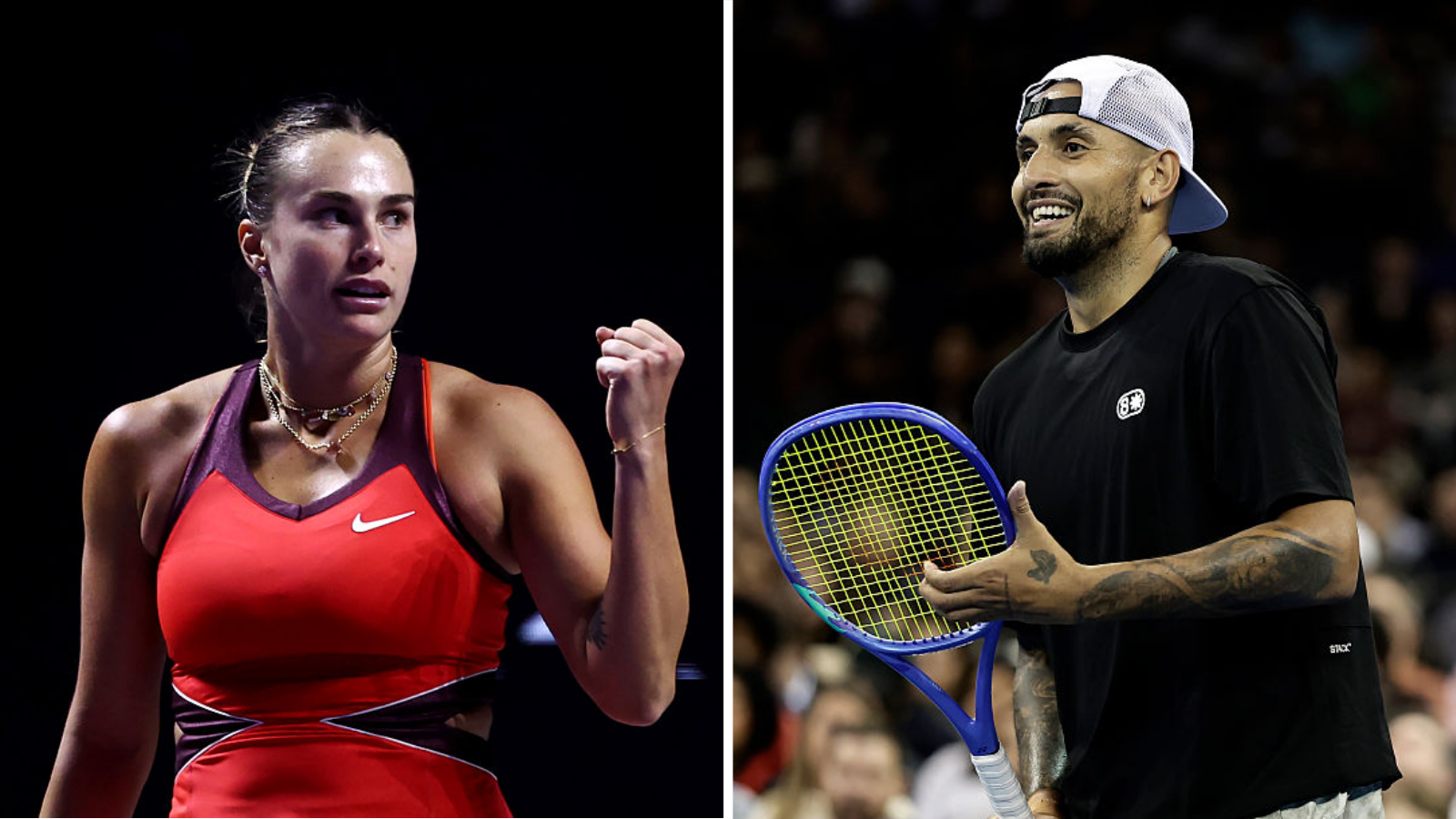
Aryna Sabalenka and Nick Kyrgios took part in an exhibition, alongside Naomi Osaka and Tommy Paul, at a packed Madison Square Garden in New York this week
Published
Aryna Sabalenka says her controversial Battle of the Sexes-style match against Nick Kyrgios will not damage women's sport.
Sabalenka, the women's world number one and four-time major champion, faces 2022 Wimbledon runner-up Kyrgios in an exhibition match on 28 December.
The event will be held in Dubai and shown live on the BBC.
Some people see it is as harmless entertainment between two high-profile players, but others believe it could belittle the women's game if Sabalenka loses.
Asked if it could be damaging, Sabalenka told BBC Sport: "I don't agree.
"I am not putting myself at any risk. We're there to have fun and bring great tennis. Whoever wins, wins."
She added: "It's so obvious that the man is biologically stronger than the woman, but it's not about that.
"This event is only going to help bring women's tennis to a higher level."
Belarusian Sabalenka, 27, has been one of the standout players on the WTA Tour over the past few seasons, capping another marvellous season by winning the US Open in September.
Kyrgios, 30, played only five professional matches in 2025 as he attempts to rebuild a career which he feared would be ended by a wrist injury.
The controversial Australian is ranked 672nd in the world and many have questioned what Sabalenka stands to gain from the event.
The concept is the brainchild of the pair's shared agent Stuart Duguid, who said the players will "do fine" financially from the match but that money is "not what is driving this".
It is not known if the winner will receive a cash prize or both players will get appearance fees or a share of revenue.
"It's not going to be an easy match for Nick," Sabalenka said.
"I'm going to be there competing and showing women are strong, powerful and good entertainment.
"He's in a lose-lose situation. I'm in a win-win situation."
In 1973 Billie Jean King faced Bobby Riggs in a match dubbed the 'Battle of the Sexes', attracting a worldwide television audience of 90 million and going down in cultural folklore with the aid of a Hollywood depiction.
King's victory over former Wimbledon champion Riggs - a self-proclaimed chauvinist aged 55 - was a landmark in the fight for gender equality and laid the path for equal pay at the top of the game.
With WTA players now among the world's highest-paid athletes, critics argue that this latest iteration of the 'man versus woman' format is unnecessary.
But Kyrgios and Sabalenka say it will attract a new audience to tennis, with their promises of more entertainment and celebrity fans sitting courtside.
"Tennis doesn't really have that (razzmatazz) that often and I think that when something like this occurs it is pretty special," said Kyrgios.
Sabalenka said: "We are helping tennis to grow.
"It's fun, it's challenging and I think that's what people want to see."
I'm more mature now - Kyrgios
Critics have questioned Kyrgios' suitability as the male protagonist, given he admitted assaulting an ex-girlfriend in 2021 and has made a series of comments which have been considered misogynistic.
Last year Kyrgios shared a post from controversial influencer Andrew Tate before later distancing himself from the self-proclaimed misogynist.
Asked if he understood the criticism given his previous behaviour, Kyrgios told BBC Sport: "Of course. But that's what life is. You make comments when you're younger and you change."
The former world number 13 said he is a "different person" now, adding: "I'm not going to sit here and say I'm an amazing role model, but I've grown and I'm definitely more mature now."
Kyrgios said he has not given "a thought" to the possibility he could become a poster boy for misogynists ready to criticise women's sport if he beats Sabalenka.
"This is the only thing I'm good at - hitting a ball over a net and giving people a show," he said.
"So I can't do anything other than hope me and Aryna play our best tennis and, at the end of the day, whoever wins, that our handshake afterwards solidifies the union between males and females in the tennis world."
Kyrgios, who has been open about his alcohol and drug abuse in the past, said he is not concerned about losing face if he is beaten by Sabalenka.
"I'm never worried. I know how I've responded with things in my life," he said.
"This is all a bonus. I've lost tennis matches before, so it's not really a big deal."
Kyrgios said he sees the event, as well as recent exhibitions in Atlanta and New York alongside Sabalenka, Naomi Osaka, Ben Shelton and Tommy Paul - as crucial preparation for a fuller return to the ATP Tour in 2026.
A knee injury means he has not played on the tour since the Miami Open in March, but he said there are "real positive signs" in his fitness.
Tourists from dozens of countries including the UK could be asked to provide a five-year social media history as a condition of entry to the United States, under a new proposal unveiled by American officials.
The new condition would affect people from dozens of countries who are eligible to visit the US for 90 days without a visa, as long as they have filled out an Electronic System for Travel Authorization (ESTA) form.
Since returning to the White House in January, President Donald Trump has moved to toughen US borders more generally - citing national security as a key reason.
Analysts say the new plan could pose an obstacle to potential visitors, or harm their digital rights.
The US expects a major influx of foreign tourists next year, as it hosts the men's football World Cup alongside Canada and Mexico, and for the 2028 Olympics in Los Angeles.
The proposal document was filed by Customs and Border Protection (CBP) and the Department of Homeland Security (DHS), of which the agency is part.
US media reported that it appeared in the Federal Register, which is the official journal of the US government. The BBC has asked DHS for comment.
It says "the data element will require ESTA applicants to provide their social media from the last 5 years", without giving further details of which specific information will be required.
The existing ESTA requires a comparatively limited amount of information from travellers, as well as a one-off payment of $40 (£30). It is accessible to citizens of about 40 countries - including the UK, Ireland, France, Australia and Japan - and allows them to visit the US multiple times during a two-year period.
As well as the collection of social media information, the new document proposes the gathering of an applicant's telephone numbers and email addresses used over the last five and 10 years respectively, and more information about their family members.
The text cites an executive order from Trump in January, titled "Protecting the United States From Foreign Terrorists and Other National Security and Public Safety Threats".
Getty Images
The plan would affect people from countries including the UK, which can fill out an ESTA form in lieu of a visa
The Trump administration has previously required foreign nationals to make their social media accounts public if they are applying for student visas or H1B visas for skilled workers - the latter of which now also entail a much higher fee.
A senior state department official said of the student visa policy: "It is an expectation from American citizens that their government will make every effort to make our country safer, and that is exactly what the Trump Administration is doing every single day."
Officers were instructed to screen for those "who advocate for, aid, or support designated foreign terrorists and other threats to national security; or who perpetrate unlawful anti-Semitic harassment or violence".
As part of the administration's broader effort to toughen borders, officials recently said an existing travel ban - affecting 19 countries in Africa, the Middle East and the Caribbean - could soon be expanded.
That move was announced in the wake of a shooting attack on two National Guard members in Washington DC, in which an Afghan man has been named as the suspect.
The new proposal regarding ESTA data collection for tourists invites views from the public for 60 days.
Sophia Cope, of digital rights organisation the Electronic Frontier Foundation, criticised the plan, telling the New York Times that it could "exacerbate civil liberties harms".
Meanwhile, immigration law practice Fragomen suggested there could be practical impacts as applicants could face longer waits for ESTA approvals.
Experts have previously suggested that the changes to travel policies introduced under Trump have had an impact on the American tourism industry.
Earlier this year, the World Travel & Tourism Council said the US was the only one of 184 economies that it analysed that was expected to see a decline in international visitor spending in 2025.
Other Trump administration policies have also appeared to impact tourism to the country, such as many Canadians boycotting US travel as a form of protest against Trump's tariffs.
October marked the 10th straight month of decline in the number of Canadian travellers to the US. In the past, Canadians have made up about a quarter of all international visitors to the US, spending more than $20bn (£15.1bn) a year, according to the US Travel Association.
María Corina Machado was last seen in public at a protest on 9 January
María Corina Machado, the winner of this year's Nobel Peace Prize, is "safe" and will come to Oslo, but will not be able to make the awards ceremony scheduled for 12:00 GMT on Wednesday, the Nobel Institute has said.
The Nobel Institute awarded the Venezuelan opposition leader the prize for "her struggle to achieve a just and peaceful transition from dictatorship to democracy" in her home country.
There has been much speculation about whether Machado, who has been living in hiding, would be able to defy a travel ban to attend the ceremony in Norway's capital.
Organisers said her daughter would accept the award in her stead.
In an audio recording shared by the Nobel Institute, Machado said "I will be in Oslo, I am on my way."
However, the director of the Nobel Institute, Kristian Berg Harpviken, said that Machado was expected to arrive "sometime between this evening and tomorrow morning" - too late for the ceremony.
In her mother's absence, Ana Corina Sosa is expected to give the speech Machado had prepared.
Earlier on Wednesday, the Nobel Institute had said they were in the dark about Machado's whereabouts, triggering concern among her supporters.
Two of her children and her mother are in Oslo, hoping to be reunited with Machado after being separated for more than a year.
Machado went into hiding shortly after Venezuela's disputed presidential election in July 2024.
The last time she was seen in public was on 9 January when she spoke to her supporters at a rally protesting against the swearing-in of Nicolás Maduro to a third term as president.
The elections were widely dismissed both by the opposition in Venezuela and on the international stage as rigged, and sparked protests across the country.
Around 2,000 people were arrested in the crackdown which followed, among them many members of Machado's opposition coalition.
Machado, who had managed to unite the bitterly divided opposition ahead of the election, went into hiding for fear of arrest.
She continued to give interviews and uploaded videos onto social media urging her followers not to give up.
The announcement that she had been chosen as this year's Nobel Peace Prize winner galvanised her supporters and triggered immediate speculation as to whether she would be able to travel to Oslo.
Total secrecy has surrounded her travel plans and it is not know how she managed to leave her place of hiding or by what means she has reached Europe.
At least 19 people have been killed and a further 16 injured after two buildings collapsed in the Moroccan city of Fez.
The two four-storey residential buildings that came down early on Wednesday morning contained eight families, state media report, citing local officials.
Several Moroccan news outlets report that the buildings - located in the south-westerly Al Massira suburb of the new part of the city - had shown signs of deterioration for several years.
Fez, in north-eastern Morocco, is one of the North African nation's oldest cities, with parts dating back to the 8th Century, as well as being its third-most populous.
A search and rescue operation is ongoing to find anyone who may still be trapped under the rubble. Footage from the scene shows people and diggers sifting through the debris under the cover of darkness.
In one clip, published by news site Akhbarona, a body can be seen being carried away on a stretcher by emergency services.
Residents of nearby buildings have been evacuated as a preventative measure, state media report.
Those taken to hospital suffered varying injuries.
Nine were killed when a condemned building collapsed in a different neighbourhood of Fez in May.
Prior to that, five people were killed when a house in the old city crumbled in February 2024, following heavy rain and strong winds.
Elon Musk wielded a chainsaw to symbolise government cost-cutting at the Conservative Political Action Conference in February
Elon Musk says he would not lead the Department of Government Efficiency (Doge) if he had his time again, but has maintained that its tumultuous efforts to shrink the size of the US government under President Donald Trump was "a little bit successful".
The billionaire boss of Tesla and SpaceX gave his reflections during a nearly-hour long interview on The Katie Miller Podcast on Tuesday.
Musk left Doge in May after initially promising to save as much as $2tn (£1.5bn) a year by slashing federal jobs and shuttering government programmes, among other cost-cutting measures.
Doge's website, which was last updated on 4 October, claims to have saved an estimated $214bn so far this year.
Conservative podcast host Miller, a former White House adviser herself who worked as a spokesperson for Doge, asked Musk whether he would do his work for the organisation again if he could rewind to the start of the year.
"I mean no, I don't think so," Musk replied.
Instead, he said he would have "worked in my companies, essentially", explaining that "they wouldn't have been burning the cars".
His comments reference a series of vandalism attacks on Tesla showrooms and vehicles earlier this year, which came in response to the highly visible political role in the Trump administration for the world's richest man.
Musk's involvement in US politics sparked global protests and boycotts against Tesla, and led to a spike in vandalism of Tesla's Cybertruck vehicles. In April, the firm said sales had fallen to their lowest level in three years and warned investors that "changing political sentiment" could continue to hurt demand.
But Musk said he believed Doge had been "a little bit successful, we were somewhat successful".
"You really want the least amount done by government as possible," he explained, adding that Doge had "stopped a lot of funding that really just made no sense".
Musk told Miller that Doge, which was created by an executive order on Trump's first day back in the White House, was a "made-up" name "based on internet suggestions".
The advisory group, which is not an official government department, tackled Musk's vision at a fierce pace. It pushed for massive reductions in the federal workforce, as well as the shuttering of programmes and even agencies such as the US Agency for International Development (USAID).
Some of Doge's moves were met with legal fights, or were reversed. When the group's cost-cutting resulted in bird flu officials at the US Department of Agriculture being fired, the Trump administration looked to re-hire them days later.
Reuters
Musk spoke to podcast host Katie Miller, a former Trump adviser herself who is also married to White House Deputy Chief of Staff Stephen Miller
Musk's time at the helm of Doge not only appeared to cause issues for his business empire - it also led to an explosive falling-out with the president himself.
Musk donated millions of dollars to the Trump campaign during the election and was a fixture at the White House for months, speaking at cabinet meetings and standing behind the president at events in the Oval Office.
But that relationship came to a grinding halt in June when Musk broke with the White House narrative and criticised a Trump-backed spending bill.
It led to a war of words on social media, with Trump at one point threatening to order Doge to look into Musk's own business dealings with the US government.
The pair's relationship now seems to be mended. Musk was spotted at a White House dinner with Saudi Crown Prince Mohammad bin Salman in November.
And Musk spoke positively of Trump in his interview with Miller, saying the president was the funniest person he knows and has "great sense of humour".
The British author Madeleine Wickham, who wrote under the name Sophie Kinsella, became a force in commercial fiction upon the 2000 release of “Confessions of a Shopaholic.”
While the United States is not yet close to a full-on autocracy, the New York Times editorial board outlines some of the warning signs of democratic erosion already taking place, thanks to the efforts of President Trump.
Tourists from dozens of countries including the UK could be asked to provide a five-year social media history as a condition of entry to the United States, under a new proposal unveiled by American officials.
The new condition would affect people from dozens of countries who are eligible to visit the US for 90 days without a visa, as long as they have filled out an Electronic System for Travel Authorization (ESTA) form.
Since returning to the White House in January, President Donald Trump has moved to toughen US borders more generally - citing national security as a key reason.
Analysts say the new plan could pose an obstacle to potential visitors, or harm their digital rights.
The US expects a major influx of foreign tourists next year, as it hosts the men's football World Cup alongside Canada and Mexico, and for the 2028 Olympics in Los Angeles.
The proposal document was filed by Customs and Border Protection (CBP) and the Department of Homeland Security (DHS), of which the agency is part.
US media reported that it appeared in the Federal Register, which is the official journal of the US government. The BBC has asked DHS for comment.
It says "the data element will require ESTA applicants to provide their social media from the last 5 years", without giving further details of which specific information will be required.
The existing ESTA requires a comparatively limited amount of information from travellers, as well as a one-off payment of $40 (£30). It is accessible to citizens of about 40 countries - including the UK, Ireland, France, Australia and Japan - and allows them to visit the US multiple times during a two-year period.
As well as the collection of social media information, the new document proposes the gathering of an applicant's telephone numbers and email addresses used over the last five and 10 years respectively, and more information about their family members.
The text cites an executive order from Trump in January, titled "Protecting the United States From Foreign Terrorists and Other National Security and Public Safety Threats".
Getty Images
The plan would affect people from countries including the UK, which can fill out an ESTA form in lieu of a visa
The Trump administration has previously required foreign nationals to make their social media accounts public if they are applying for student visas or H1B visas for skilled workers - the latter of which now also entail a much higher fee.
A senior state department official said of the student visa policy: "It is an expectation from American citizens that their government will make every effort to make our country safer, and that is exactly what the Trump Administration is doing every single day."
Officers were instructed to screen for those "who advocate for, aid, or support designated foreign terrorists and other threats to national security; or who perpetrate unlawful anti-Semitic harassment or violence".
As part of the administration's broader effort to toughen borders, officials recently said an existing travel ban - affecting 19 countries in Africa, the Middle East and the Caribbean - could soon be expanded.
That move was announced in the wake of a shooting attack on two National Guard members in Washington DC, in which an Afghan man has been named as the suspect.
The new proposal regarding ESTA data collection for tourists invites views from the public for 60 days.
Sophia Cope, of digital rights organisation the Electronic Frontier Foundation, criticised the plan, telling the New York Times that it could "exacerbate civil liberties harms".
Meanwhile, immigration law practice Fragomen suggested there could be practical impacts as applicants could face longer waits for ESTA approvals.
Experts have previously suggested that the changes to travel policies introduced under Trump have had an impact on the American tourism industry.
Earlier this year, the World Travel & Tourism Council said the US was the only one of 184 economies that it analysed that was expected to see a decline in international visitor spending in 2025.
Other Trump administration policies have also appeared to impact tourism to the country, such as many Canadians boycotting US travel as a form of protest against Trump's tariffs.
October marked the 10th straight month of decline in the number of Canadian travellers to the US. In the past, Canadians have made up about a quarter of all international visitors to the US, spending more than $20bn (£15.1bn) a year, according to the US Travel Association.
Fans of codebreaking, maths and brainteasers can now try their hand at the latest cryptic Christmas challenge set by GCHQ, the UK's intelligence agency.
The card was created by "schoolchildren as well as spies", according to GCHQ, after hundreds of young people entered a design competition in the lead-up to the festive period.
It contains seven puzzles set by "GCHQ's in-house puzzlers", geared towards testing a range of problem-solving skills, including "intuitive reasoning" and "lateral thinking".
Somewhere on the card is a special seven letter word which has no repeated letters, and no letters which are next to each other in the alphabet. Can you find it? * Answer at the bottom of the page
Students were asked to draw their response to the question: "What do you think GCHQ looks like on Christmas Day?". They were challenged to embed hidden codes, and ciphers into their designs.
Three winners were selected by a panel of judges across three age groups.
The famously tricky puzzles "aren't meant to be solved alone", GCHQ said, adding: "We believe the right mix of minds means we can solve seemingly impossible problems."
"Puzzles are at the heart of GCHQ's work to keep the country safe from hostile states, terrorists and criminals; challenging our teams to think creatively and analytically every day", said GCHQ Director Anne Keast-Butler.
She said she hoped the puzzle encourages the next generation "to explore STEM subjects and consider the rewarding careers available in cybersecurity and intelligence".
Meanwhile, the spy agency's "Chief Puzzler", known only as "Colin", said the puzzles are designed to test "the same blend of skills our teams use every day to keep the country safe."
* The answer is: Special (the clue is written into the text)
'I'm sorry on behalf of my father,' abuser's daughter says
The daughter of the man believed to be the most prolific serial abuser to be associated with the Church of England (CofE) says finally learning the truth about his attacks on 130 boys was shocking and horrifying.
Fiona Rugg, 47, is the youngest daughter of barrister and Christian charity chairman John Smyth QC, who died before he was ever brought to justice.
In the late 1970s and early 1980s, Smyth subjected about 130 boys and young men to extreme physical and sexual abuse under the guise of spiritual discipline.
In the years since, Ms Rugg, who now lives in Bristol, has slowly come to terms with the disturbing truth but has often grappled with feelings of "shame by association".
"I can rationally understand that I'm in no way to blame, but you feel guilty that my father could do this to someone, and of course, he was unrepentant," she said.
"So much of my dad's story and how he got away was cover-up and deception, but I want to fly in the face of that and bring things into the light."
The Makin Review, published in 2024, found the church's handling of the allegations against Smyth amounted to a cover-up, with one cleric admitting: "I thought it would do the work of God immense damage if this were public."
Speaking openly to the BBC for the first time, Ms Rugg said learning the truth about the extent of her father's "shocking" abuse has helped her to heal.
"I have forgiven him, but it doesn't take away the pain or make it OK. I don't feel in the grip of it or feel so ashamed, but it doesn't diminish the horror of what he did," she said.
"There was nothing in his camp coming from him about being sorry. I'm sorry on behalf of my father for what he's done to these boys."
Warning - this story contains distressing content and references to child abuse
Ms Rugg recalls an oppressive childhood plagued by "hypervigilance" of her father's unpredictable moods.
"I think the overriding feeling is actually fear, as long as I can remember," she recalled.
"I felt afraid around dad, who was very volatile.
"He was very angry, and so there was a sense of fragile moods, walking on eggshells, wondering what dad's mood was like. A feeling of guilt as a young child I didn't like dad and sometimes I hated him."
Passion Pictures
Ms Rugg said her father evaded suspicion because he was "adored" by so many
Ms Rugg said her father "completely disregarded" her as a child, to the extent she questioned her own judgement of his "volatile" character.
"What I saw was confusing to me," she said. "He was so frightening, so angry and unkind, so hard to stand up to. I wanted to get as far away from him as possible, but what I saw was people who adored him."
While Smyth laughed and played outside with boys and young men in the sun, she would watch from the window, having been told to stay away as an "unwanted distraction".
"We were experiencing a completely different John Smyth to the reputation he presented to the world," she explained.
"The natural conclusion you draw when you are young is 'he must be right and I must be the problem. I'm the one who is not seeing this correctly here'."
Passion Pictures
Ms Rugg (R) said it felt like their entire world and family "orbited" around their domineering father
Smyth gained access to Winchester College in 1973 through the school's Christian union and began abusing pupils after inviting them to his family home for Sunday lunch.
He forced his victims to strip naked and endure violent canings in a soundproofed shed at his family home, where he beat them so badly they bled.
Smyth, an evangelical Christian, would frame the abuse as a form of punishment and repentance for "sins" such as pride or masturbation.
An internal review by the Iwerne Trust uncovered the scandal in 1982, describing the attacks as "prolific, brutal and horrific", detailing how eight of the boys had suffered a total of 14,000 lashes.
But rather than alerting authorities, senior evangelical figures in the CoE facilitated Smyth's silent departure from the UK, allowing him to evade justice for decades.
When their family were ushered to Zimbabwe in 1984, Ms Rugg said it was framed by her father as "noble work", sacrificing his "glittering career" to become a missionary.
But his wake of destruction followed them across the globe, and he soon opened Christian camps where he would enforce nudity and beat young boys.
The following year, tragedy unfolded when a 16-year-old boy named Guide Nyachuru was found dead at one of Smyth's camps within 12 hours of arrival, resulting in a manslaughter charge, but the case collapsed.
Passion Pictures
Smyth would control his victims by framing the abuse as repentance for "sin"
When Ms Rugg moved back to England aged 18, she started to have more and more questions about her father.
"It would come up that I'm dad's daughter and I would see a shadow pass across someone's face," she recalled.
"People didn't react like 'oh what a great guy', it was the opposite of that. It was a stony silence. There seemed to be so little connection with the UK, which struck me as odd."
She confronted her father with the rumours on Christmas Eve, and he burst into a blind rage, accusing her of being "disloyal" to their family by daring to question his integrity.
"His reaction was so powerfully extreme, I remember thinking 'well now I know for sure'. There's never that much smoke without a fire," she said.
Passion Pictures
Smyth was completely estranged from his family at the time of his death in 2018
Reports of Smyth's abuse were first made public through an investigation by Channel 4 in February 2017.
Ms Smyth switched on the news one evening to see her father's face staring back at her, his name plastered across the screen against a backdrop of horrendous crimes.
"These were people's young, vulnerable sons whose lives were ruined. I have a son," she added.
"As cruel as I'd seen him to be, I had no idea he had committed this extensive criminal abuse. It was horrifying and so shocking, but it made sense.
"His whole life was about doing 'the Lord's work'. Everything was backed up with his Christian faith, and I found the hypocrisy of that really abhorrent."
In August 2018, Smyth received a summons from Hampshire Police to return to England for questioning, under the threat of extradition.
Fiona Rugg says facing the truth of her father's "horrific" acts has helped her to heal
Ms Rugg said she can now speak about her father "without bitterness or hatred" and finally feels at peace.
"In my experience, if you face what dad's done you can heal from it and you can forgive it," she explained.
"There are moments of upset but I no longer feel that knot when I think about my dad, and that is progress. It's not mine to carry and not mine to be controlled by.
"It's changed from something that was imposed on me, to 'I'm choosing what I do with that'."
If you would like to learn more about John Smyth's history of abuse, head to Channel 4's two-part documentary titled See No Evil.
Nnena Kalu has been gaining recognition in the art world in recent years
Nnena Kalu has won this year's Turner Prize, the UK's most high-profile art award, for her "bold and compelling" sculptures and drawings - and has made history as the first artist with a learning disability to win.
The judges praised Kalu's brightly-coloured sculptures - which are haphazardly wrapped in layers of ribbon, string, card and shiny VHS tape - and her drawings of swirling, tornado-like shapes.
Kalu, 59, is an autistic, learning disabled artist with limited verbal communication.
Charlotte Hollinshead, who has worked with her for 25 years, said on stage at the ceremony: "This is a major, major moment for a lot of people. It's seismic. It's broken a very stubborn glass ceiling."
'Idol, legend, winner'
In a moving speech delivered alongside Kalu, she said: "This amazing lady has worked so hard for such a long time.
"It's wonderful she's finally getting the recognition she rightly, rightly deserves."
PA Media
Kalu and her supporters wore rosettes saying "Idol, legend, winner, whatever"
Glasgow-born, London-based Kalu was announced as the winner of the award - and its £25,000 prize money - at a ceremony in Bradford, the UK's current city of culture, on Tuesday.
She accepted the honour while wearing a rosette bearing her photo and the words: "Idol, legend, winner, whatever."
Kalu has been gradually gaining recognition in the art world in recent years after working as a resident artist with Action Space, which supports artists with learning disabilities, since 1999.
Ms Hollinshead, her studio manager and artistic facilitator, said: "We are so happy that Nnena's talent and beautiful work is now out in the world for you all to see this complex artist who creates gorgeous, complex forms - all while listening to disco music, often as loud as possible.
"Nnena's career reflects the long, often very frustrating journey we've been on together... to challenge people's preconceptions about differently abled artists, but especially learning disabled artists, an important creative community so undervalued.
"When Nnena first began working with Action Space in 1999, the art world was not interested.
"Her work wasn't respected, not seen, and certainly wasn't regarded as cool.
"Nnena has faced an incredible amount of discrimination, which continues to this day, so hopefully this award smashes that prejudice away.
"Nnena Kalu, you've made history!"
'Beautiful intricacy'
PA Media
Tape, ribbons, string and cardboard are among the materials used to make Nnena Kalu's sculptures
Kalu's work has divided opinion among art critics, but the Turner Prize judges were impressed by the "really compelling sculptures and drawings that could only be made by Nnena", according to the jury chairman, Tate Britain director Alex Farquharson.
Her drawings, which come in sets of two or three near-identical shapes, have "a beautiful intricacy to them" and "look like swirling vortexes", he said.
Getty Images
Her sculptures, meanwhile, are hanging shapes covered in reams of re-purposed materials including fabric, rope, parcel tape, cling film and paper.
They resemble three-dimensional versions of abstract expressionist paintings, Mr Farquharson said.
"But they're not paintings, they're not flat on the wall. They're suspended in the space that you're in, like brightly coloured rocks or creatures.
"They're at almost your eye level. Although there are no figurative features at all, they appear to be communing among themselves and with you.
"The use of materials is highly unusual, including video tape that gets wrapped round and round.
"The colours and the lines the materials make are very like brush marks translated into three dimensions. They're very gestural, they're very expressive, they're very compelling."
Getty Images
'Quality and uniqueness'
The judges deliberated for two or three hours, Mr Farquharson said, and stressed that their choice of winner was based purely on merit.
"The result wasn't about wanting, first and foremost, to give the prize to Nnena as the first neurodiverse artist. That wasn't a driving factor," he said.
"It was an interest in, and a real belief in, the quality and uniqueness of her practice, which is inseparable from who she is."
It is a historic moment, though, he told BBC News.
"It breaks down walls between, if you like, neurotypical and neurodiverse artists. It becomes really about the power and quality of the work itself, whatever the artist's identity is.
"So maybe what's historic about it is it's one more move to include really great neurodiverse artists in the picture we present of art today."
Getty Images
All of the shortlisted artists' works are on show at thye Cartwright Hall gallery in Bradford
The result was announced at a ceremony at Bradford Grammar School, the former school of artist David Hockney.
Works by all four shortlisted artists are currently on show at the Turner Prize exhibition at the nearby Cartwright Hall gallery, which will run until 22 February 2026.
The other nominees were Rene Matić, Zadie Xa and Mohammed Sami, who will receive £10,000 each.
The Turner Prize has been the UK's most coveted and controversial art award since it was founded in 1984. Past winners include Lubaina Himid, Jeremy Deller, Grayson Perry, Steve McQueen and Damien Hirst.
The 2025 season has ended and McLaren have won both the constructors' and drivers' championships - but now things are about to change in Formula 1.
Next year, the sport will enter a new dawn of technical regulations and also welcome an 11th team on the grid.
BBC Sport runs down the key things to look out for in the 2026 season.
Bold new era of rules
Image source, FIA
Image caption,
Next year's cars will be more environmentally friendly and use fully sustainable fuels
The new rules being brought in for 2026 are the biggest change in F1 for years - if not ever.
Cars will be smaller, nimbler and more environmentally friendly.
They will be 30kg lighter, 10cm narrower and have engines with a near 50-50 split between electric and internal combustion power - and use fully sustainable fuels.
Will the racing be any different? Yes, but how different is one of many unknowns.
The chassis and engine rules have never both been changed at the same time to this extent.
There will be new aerodynamic rules, and the power units, while of similar architecture to the past 12 years, have been significantly modified in terms of technology.
The engines remain 1.6-litre V6 turbo hybrids, but the MGU-H, which recovers energy from the exhaust and turbo, has been removed, while the proportion of power produced by the hybrid part of the engine has been more or less doubled to about 50%.
This has required major changes to aerodynamics. Not only has the venturi-underbody ground effect philosophy introduced in 2022 been abandoned, but movable front and rear wings have been introduced. That's to increase straight-line speed to enable more energy harvesting under braking.
For some time, there have been varying levels of concern expressed by the drivers about how this will affect the racing.
There will be some idiosyncrasies, it seems. The internal combustion engine will spend a fair bit of its time acting as a generator for the battery. So engines will be at maximum revs in some corners, for example.
The DRS overtaking aid has gone, because the opening of the rear wing is required for other purposes. So instead there will be a push-to-pass button that gives extra electrical energy for a time.
"It's really, really hard to predict what it's going to be like," says Lewis Hamilton. "I don't want to dog it. I don't want to say too many negative things.
"It feels so much different and I'm not sure you're going to like it. But maybe I'll be surprised. Maybe it'll be amazing. Maybe overtaking will be incredible. Maybe it'll be easier to overtake. I don't know.
"We have less downforce, more torque. Driving in the rain, I can imagine it's going to be very, very, very tough. Much harder than it is already with what we have today. But as I said, we might arrive and we might have better grip than we anticipated."
Brit teenager Lindblad makes debut
Image source, Getty Images
Image caption,
Arvid Lindblad was born 10 months after Aston Martin driver Fernando Alonso won his first drivers' title in 2006
The majority of the drivers will remain the same in 2026, but there are a few changes to look out for, including a British rookie.
Frenchman Isack Hadjar, who claimed his first F1 podium at the Dutch Grand Prix, makes the step up from Racing Bulls to replace Yuki Tsunoda as Max Verstappen's team-mate at Red Bull.
Taking Hadjar's seat at Red Bull's sister team will be 18-year-old Briton Arvid Lindblad.
Lindblad, who has a Swedish father and a mother of Indian descent, finished his Formula 2 campaign with Campos Racing in sixth place and will be team-mate to New Zealander Liam Lawson.
Cadillac joins the grid
Image source, Cadillac
Image caption,
Valtteri Bottas (left) has 10 races wins in Formula 1 while Sergio Perez (right) has six
Ten teams will become 11 next season when Cadillac, backed by US car giant General Motors, joins the grid.
Cadillac have opted for experience over youth and chosen ex-Mercedes man Valtteri Bottas and former Red Bull driver Sergio Perez, with 106 podium finishes between them, as their inaugural line-up.
Briton Graeme Lowdon, who has previously worked for former F1 teams Virgin and Marussia, will be team principal.
The American team will purchase and use power units from Ferrari for their first three seasons, with their own GM-developed engines set to arrive for 2029.
Sauber become Audi
Image source, Getty Images
Image caption,
Audi took 100% ownership of Sauber at the beginning of the year
Audi are another new name for next season, but - unlike Cadillac - the German manufacturer has taken over the Swiss-based Sauber team, who finished ninth in the 2025 constructors' championship.
Audi is designing an engine for its entry, which coincides with the introduction of the new power-unit regulations.
Jonathan Wheatley will be team boss and work alongside former Ferrari principal Mattia Binotto, who is head of Audi's F1 project.
German driver Nico Hulkenberg and Brazilian Gabriel Bortoleto, Sauber's driver pairing in 2025, will be Audi's maiden line-up.
Ford return and Renault engines fall silent
Image source, Getty Images
Image caption,
Red Bull team principal and Ford chief executive officer Jim Farley at the Italian Grand Prix in September
Red Bull will begin an engine partnership deal with US car giant Ford, which is part-funding the power-units Red Bull are designing for the new regulations.
That brings to an end Red Bull's partnership with Honda. The Japanese manufacturer will now be the works power unit supplier to Aston Martin, where F1 design legend Adrian Newey is to become team principal as part of a major restructure.
There is another significant engine change after Renault ended its F1 power unit programme. Renault's Alpine team will now be paying to use Mercedes engines.
Madrid replaces Imola on calendar
Image source, Getty Images
Image caption,
Construction work taking place on the Madring circuit that will host the 2026 Spanish Grand Prix
The F1 calendar is once again 24 races - starting in Australia in March and ending in Abu Dhabi in December - but there will be two trips to Spain instead of one next year.
The Spanish Grand Prix will be held on a new circuit in Madrid and effectively replaces the Emilia-Romagna Grand Prix in Imola.
The Madring will be a hybrid track, a mixture of public roads and private land with that section under construction.
It will be held from 11-13 September as the final race of an uninterrupted European leg of the season.
Barcelona remains on the calendar and is now known as the Barcelona-Catalunya Grand Prix, taking place 12-14 June.
Canada's race weekend switches from June to 22-24 May so it can take place in the same month as the Miami Grand Prix, which is pencilled in for 1-3 May.
As a result, Monaco moves back, from May to 5-7 June.
As for sprint events, Silverstone is among the six tracks chosen to host a shorter race next season along with China, Miami, Canada, the Dutch Grand Prix at Zandvoort - which is in its final year on the calendar - and Singapore.

 Login
Login