The BBC knew about a police investigation into DJ Scott Mills in 2017, the corporation has confirmed.
But the Radio 2 presenter was sacked after "new information" about his conduct came to light in recent weeks, the BBC said.
Mills was previously questioned by police over historical allegations of serious sexual offences, but no charges were brought after prosecutors decided in 2019 there was insufficient evidence to proceed with the case.
Mills has not yet responded to repeated requests for comment.
BBC News understands that the director general at the time of the police investigation, Tony Hall, did not know about the allegations.
The BBC's statement on Wednesday came after mounting pressure on the broadcaster to explain what led to the Radio 2 DJ's sudden departure.
In a statement, a BBC spokesperson said: "Scott Mills had a long career across the BBC, he was hugely popular and we know the news this week has come as a shock and surprise to many.
"We also recognise there's been much speculation in the media and online since Monday. We hope people understand that there is a limit to what we can say because we have to be mindful of the rights of those involved.
"What we can confirm is that in recent weeks, we obtained new information relating to Scott and we spoke directly with him. As a result, the BBC acted decisively in line with our culture and values and terminated his contracts on Friday 27 March."
The spokesperson added: "Separately, we can confirm the BBC was made aware in 2017 of the existence of an ongoing police investigation, which was subsequently closed in 2019 with no arrest or charge being made. We are doing more work to understand the detail of what was known by the BBC at this time."
The statement concluded that the BBC has made "a significant commitment to improve its culture, processes and standards".
"Last year, following an independent culture review, we set out the behavioural expectations for everyone who works with or for the BBC and we were clear action would be taken if these were not met."
On Monday, it was announced that the former Radio 1 presenter had been sacked by the BBC over allegations related to his personal conduct.
The allegations, first published on Monday by the Mirror, relate to the period between 1997 and 2000, police said, when Mills would have been in his mid-twenties.
On Tuesday, the BBC apologised for not looking into a separate allegation of "inappropriate communications" involving Mills, first reported in the Telegraph, raised by a freelance journalist last year.
The UK will pursue closer economic ties with the European Union in light of the war in Iran, Sir Keir Starmer has said.
The prime minister told a news conference he would use a summit with the EU later this year to seek more cooperation with the bloc on the economy and security.
It comes as relations between the US and the UK have been increasingly strained by the PM's refusal to be drawn further into the war with Iran.
In his speech, Sir Keir warned the conflict would impact the UK but sought to reassure the public the government was taking action to ease the cost of living.
The PM is facing calls from opposition parties to set out now how the government plans to protect people from rising energy costs.
The Liberal Democrats are also calling for the increase not to go ahead, while the Greens say the government should commit billions of pounds now to subsidise energy bills from July, when the price cap is recalculated.
Plaid Cymru said the government should set out now what support would be available if energy bills rise, while the SNP argues Holyrood should control energy policy.
Sir Keir said: "No matter how fierce this storm we are well-placed to weather it and we have a long-term plan to emerge from it a stronger and more secure nation."
He highlighted a number of measures coming into force from this month aimed at easing the cost of living, including removing some green levies from energy bills and increasing the national living wage.
The PM insisted the government had been "ahead of the game" in its focus on the cost-of-living.
Asked if he would reassure motorists that the increase in fuel duty would not go ahead, Sir Keir said the rate remained set until September.
He added that support for households would be kept under review but "a lot will depend on how long the conflict goes on" and how quickly the Strait of Hormuz can be reopened.
Meanwhile, the foreign secretary is hosting 35 nations - including European and Gulf counties - on Thursday.
The PM said the meeting would discuss possible measures to make the Strait of Hormuz "accessible and safe after the fighting has stopped".
He added that "this will not be easy" but said it was in the UK's national interest for the strait to reopen.
Iran has effectively blocked the strait - one of the world's busiest oil shipping channels - leading to soaring wholesale oil and gas prices.
A sustained rise in the price of oil is likely to lead to a jump in household energy bills in the UK, when the current cap is reset in July.
The PM and Chancellor Rachel Reeves have made a number of interventions in recent months arguing for a closer trading relationship with the EU.
However, Sir Keir argued that this was more urgent because of the impact of the US-Israel conflict with Iran.
"It is increasingly clear that as the world continues down this volatile path, our long-term national interest requires closer partnership with our allies in Europe and with the European Union," he said.
He added that Brexit "did deep damage to our economy" and "the opportunities to strengthen our security and cut the cost of living.... are simply too big to ignore".
Sir Keir said this year's summit "will not just ratify existing commitments made at last year's summit" but would be "more ambitious".
The PM was asked if the UK was heading towards rejoining the EU single market, which enables goods, service and people to move freely between member states, with countries applying many common rules and standards.
"I do think that we should strengthen our cooperation on defence, security, energy, emissions and the economy," he replied.
"I'm ambitious that we can do more in relation to the single market, because I think that's hugely in our economic interests."
However, he said Labour's election manifesto commitment that there would be no return to the single market, the customs union or freedom of movement remained.
Pressed over whether he was choosing Europe over the US, Sir Keir insisted: "I'm not going to choose because I think it's in our interest to have a strong relationship with the US and with Europe."
He argued that closer ties with Europe would strengthen the UK's relationship with the US as well, since successive US presidents had been pushing for Europe to do more on defence and security.
President Donald Trump has repeatedly criticised Sir Keir in recent weeks, following his refusal to allow the US to use UK bases for its initial offensive strikes against Iran.
The UK has since given permission for its bases to be used for defensive action against Iranian missile strikes.
Asked about the remarks, Sir Keir said the UK was "fully committed to Nato", which he described as "the single most effective military alliance the world has ever seen".
He added: "Whatever the pressure on me and others, whatever the noise, I'm going to act in the British national interest in the decisions that I make.
"That's why I've been absolutely clear that this is not our war and we're not going to get dragged into it."
Apollo Go is Baidu's robotaxi service operating in China
A mass robotaxi outage in the Chinese city of Wuhan caused at least a hundred self-driving cars to stop mid-traffic, sparking renewed debate around the safety of driverless vehicles.
Local police said initial findings suggested a "system malfunction" caused multiple vehicles to stop in the middle of the road on Tuesday.
Videos on social media have documented the outage, with one appearing to show it resulting in a highway collision, although police said no injuries had been reported and passengers exited their vehicles safely.
Baidu did not immediately respond to a request for comment.
According to the police statement, posted on social media site Weibo, the cause of the incident is still under further investigation.
Baidu operates its Apollo Go driverless taxi service in dozens of cities across the world, mostly in China.
In December 2025, ride-sharing apps Uber and Lyft announced partnerships with the Chinese technology giant to test its Apollo Go cars on UK roads, aiming to start trials in 2026.
However, both still need approval from regulators before they can begin the pilot programmes.
Reuters
Social media users posted photos and videos of Apollo Go cars stranded in the middle of the roads due to the outage
While driverless tech may be safer on average than human drivers, this incident showed it could "still go wrong in completely new ways," said Jack Stilgoe, professor of science and technology policy at University College London.
"If we're going to make good choices about this technology, we need to understand entirely new types of risk," he told BBC News.
The outage is not the first time self-driving cars have faced technical difficulties.
Pio Esposito missed the first penalty in Italy's shootout defeat in Bosnia
Leaning against a wall near a news-stand in central Rome, Tommaso Silvestri, 65, scans the morning's front pages, their headlines swinging between "apocalypse," "scandal" and "disaster" after Italy's latest footballing collapse.
"We've made a real mess of it," he says, shaking his head. "We had players who couldn't even find the target."
"The golden days of Italian football are well and truly gone."
On Tuesday night in Zenica, four-time World Cup winners Italy failed to qualify for the tournament for a third consecutive time, losing 4-1 on penalties to Bosnia and Herzegovina after being reduced to 10 men before halftime.
Since winning the World Cup in 2006, the Azzurri have largely disappointed in international tournaments - with the exception of their surprise victory at the Euros in 2021 against England at Wembley.
"We are what our results say we are," Silvestri said. "When you shoot and can't even hit the goal, you're not going to go far. When it comes to taking the game home, Italy just doesn't get there anymore."
Last night's defeat drew swift and emotional reactions across Italian politics and society.
"Everything has a limit," lamented Ignazio La Russa, president of the Senate and a senior figure in Prime Minister Giorgia Meloni's far-right Brothers of Italy party.
In a post on X, he wrote: "We're not going to the World Cup. We supported them, we hoped, we even railed against a couple of questionable refereeing decisions... but deep down we feared it. In fact, we knew it."
Gomorrah author and anti-mafia writer Roberto Saviano also weighed in, pointing to deeper structural failures in Italian football, from governance to youth development.
"Clubs are corrupt and at the mercy of criminal organisations. True laundering vaults. No investment in young players, no care for second-generation talent. It's easier to buy foreign players than to develop new athletes," he said in a post on Instagram.
Getty Images
Italy won the Euros at Wembley in 2021
Across Italy, a legendary football nation with a rich history of producing world-class talent, many are wondering what went wrong. Giovanni Colli, 71, rolling his eyes while sipping an espresso at a café near the Pantheon, says he feels "betrayed."
"Not going to the World Cup three times in a row, how on earth did it happen? What a huge disappointment. Everyone should resign. Give the young players a chance," he says.
Italy's World Cup heartbreak was crystallised in the tear-streaked face of coach Rino Gattuso, who struggled to hold back his emotions after the national team's defeat.
"We don't deserve this, it's not fair. I'm sorry I couldn't make it happen," Gattuso said, eyes glistening, before retreating to the dressing room.
The legendary 2006 World Cup-winning midfielder was only given the job of coach last June.
Despite the disappointment, Gattuso expressed pride in his players: "I'm proud of my boys and what they gave on the pitch."
The match, decided on penalties after Italy were reduced to 10 men following Alessandro Bastoni's early red card, gave a brief moment of hope to Italians with Moise Kean's goal, only for it to end in dismay.
Getty Images
"I'm sorry I couldn't make it happen," coach Gattuso said after Tuesday's defeat
Gattuso admitted the team's shortcomings: "When you have chances and don't take them, football punishes you."
Reflecting on their elimination, he added: "This hurts. We gave everything we could. It's a real shock."
Sport journalist Elisabetta Esposito of La Gazzetta dello Sport told the BBC that Italian football was facing a difficult period - one that would take time to overcome, during which loyalty to individual clubs was outweighing support for the national team.
"The risk is that this third consecutive failure to qualify will deepen young people's disengagement from the Azzurri," she said.
"The disappointment is profound, but the country is not only disappointed but almost disillusioned. It's as if a new generation no longer knows what it means to cheer for their country."
Reflecting on Tuesday's match, Esposito added: "From a technical standpoint, everything went wrong. The team hasn't worked together enough. Rebuilding will require a long-term strategy, chasing immediate wins with rushed decisions won't succeed."
On a busy street in central Rome, 56-year-old Teresa is walking her dog among tourists and commuters rushing to work.
"Oh, we are not going to the World Cup?" she asks. "I don't know much about football, but that's a bit of disaster, isn't it?"
A cable car has been linking Morro da Urca and Sugarloaf Mountain since 1912. The zipwire was planned to run parallel to it.
A judge in Brazil has blocked a project to build a zipline connecting the famous Sugarloaf Mountain in Rio de Janeiro to a nearby hill, Morro da Urca.
The attraction's developer said it would allow visitors to descend from Sugarloaf Mountain at speeds of almost 100km/h (62mph) via four ziplines covering a distance of 755m (0.47 miles).
The project - which started four years ago - had triggered protests from locals and environmentalists, who argued that the construction work was causing irreparable damage to the Unesco World Heritage Site.
The developer is expected to appeal against the decision.
CARL DE SOUZA/AFP via Getty Images
Locals and environmentalists organised protests against the project
Gricel Osorio Hor-Meyll, one of the activists who had led the campaign against the zipline told AFP news agency that the ruling was "a huge victory".
Those opposed to the attraction argued that in order to build the platforms needed to access the zipline, the rock on top of Sugarloaf Mountain would have to be excavated.
The company which manages the site said that excavation would be kept to a minimum by using areas with existing construction.
The project had the approval of both Rio City Council and the National Historical and Artistic Heritage Institute (IPHAN).
As part of Tuesday's ruling, the judge ordered that IPHAN and the project's developer pay 30m reals ($5.77m, £4.35m) in damages, stressing the "inestimable value of Sugarloaf Mountain, not only for Brazilians but for people worldwide".
The project has been at the centre of a legal battle for years and construction had been halted on a number of occasions as the company argued its case in court.
In January, construction work restarted after the high court had ruled that stopping would cause more damage than finishing the project at this late stage.
It added that the project was 95% completed.
That decision has now been overturned by Tuesday's ruling.
However, the legal saga is likely to continue with the company behind the project expected to lodge an appeal.
Threatening to pull out of NATO, President Trump portrayed the alliance as a “paper tiger” and said Europe was on its own in trying to secure the Strait of Hormuz.
Strikes on the Lebanese capital of Beirut have continued this week
Israel has intensified its attacks on Lebanon this week, hitting areas outside of Hezbollah's control on Tuesday.
Strikes without warning hit a vehicle north of Beirut and the Jnah neighbourhood in the heart of the capital.
Attacks also continued in the city's southern suburbs and the country's south, both where Hezbollah has a strong presence.
A building was destroyed on the road to Beirut's airport after an evacuation order, and in the south, a strike hit a health facility, killing a paramedic, according to Lebanon's health ministry.
Israel's military said it had hit Hezbollah infrastructure in Beirut and killed a senior commander and another senior figure from the Iran-backed armed group.
Hezbollah joined the ongoing regional war on 2 March, sending missiles towards Israel, after the US and Israel attacked the armed group's ally Iran on 28 February.
Israeli attacks have kept bombarding Lebanon as its troops have moved into the country's south.
On Tuesday, a vehicle was targeted in the Mansourieh area, a predominantly Christian residential neighbourhood north of Beirut.
Meanwhile, the Jnah neighbourhood in the heart of the capital was attacked after midnight. The Lebanese health ministry said the Al-Zahraa Hospital had received and treated "a number of those injured in the air strike".
Hassan Jalwan, who lives near Jnah, told AFP he heard several "big explosions" overnight.
"Nobody knows what's happening," he said, adding that "displaced people have been sleeping in the open" in the area.
The Dahieh neighbourhood to the south of Beirut, where Hezbollah has a strong presence, continues to be a target. A building was destroyed on Tuesday in Ghobeiry on the road to the airport following an evacuation order.
Also on Tuesday, Lebanon's health ministry said at least seven people had been killed by Israeli strikes in the country's south, including the paramedic.
The number of health workers who have been killed since the start of the war has now reached 53.
Earlier, the Lebanese army cleared its last positions in the south, pulling out from Ain Ibel and Rmeish villages a day after an army checkpoint was hit and a soldier was killed by an Israeli air strike, according to the Lebanese Armed Forces. The Israeli military has not appeared to have commented yet on the reported death.
However, some residents of the villages refuse to leave.
In the predominantly Christian village of Rmeish, Father Najib Al Amil appeared in a video on social media, where he said: "There is grass and soil. We rely on God and will stay in our village. We either all die together and lose our land or live and our villages will live with us."
KAWNAT HAJU / AFP via Getty Images
A photograph shows the aftermath of an Israeli strike in the area of Aamriyeh, south of Tyre in southern Lebanon
Israel has announced its decision to control large swathes of land in southern Lebanon - up to the Litani River, about 30km from the border with Israel - to create a buffer security zone.
Israeli Defence Minister Israel Katz said Israel would keep security control over the territory even after the end of the current war against Hezbollah. The plan has drawn criticism from the UN.
Hundreds of thousands of people have been forced to leave the south, but there are still tens of thousands who have refused to go.
Supply lines to the south have been cut by Israel targeting bridges and infrastructure, making villages in the south uninhabitable.
Katz said more than 600,000 displaced Lebanese residents would be "completely prohibited" from returning to that area until the safety of residents of northern Israel was guaranteed.
The Israeli defence minister also said all houses in villages near the border in Lebanon will be destroyed "according to the model of Rafah and Beit Hanoun in Gaza".
In total, 1,268 people in Lebanon have been killed since the beginning of the attacks, the country's health ministry said on Tuesday.
More than one million people have been displaced, the UN reported.
This is critical time for Lebanon and the residents of the south. Many see Israel's strategy in the south mimicking that of Gaza - destruction, depopulation and occupation.
The government said earlier that this constitutes a violation of the country's sovereignty.
South Lebanon previously lived under Israeli occupation for nearly 18 years, between 1982 and 2000.
Some Lebanese have lived the displacement and loss of land generation after generation.
Many in Lebanon believe that Israel is more powerful than Hezbollah and capable of destroying the south with its advanced missiles and drones. At the same time, if Israel is to stay in the south, Hezbollah is more powerful on the ground and can engage in a guerrilla war to wear out the Israelis and prevent them from staying put.
In short, for the hundreds of thousands who have been forced out of their homes, this war is not ending anytime soon.
The An-26 is a Soviet-era aircraft designed primarily for military use (file photo)
A Russian military plane has crashed in the occupied Ukrainian peninsula of Crimea, killing 29 people on board, the Russian defence ministry has said.
Wreckage of the An-26 aircraft was found on Tuesday after the plane lost contact with authorities during a "routine flight", according to the ministry.
It blamed a "technical failure" and reported no external damage to the aircraft, implying that missiles, drones or birds are not suspected of causing the crash.
Seven crew members and 23 passengers had been on board as it flew over the Ukraine's Crimean peninsula, which Russia illegally annexed in 2014.
Russia's Investigative Committee confirmed the crash and said it had opened an inquiry into a flight safety violation.
News agency Tass reported that communication with the plane was lost at about 18:00 local time (15:00 GMT) on Tuesday, and the wreckage was found following a search and rescue effort.
Ukraine has not commented on the crash.
The An-26 is a Soviet-era aircraft mainly used in a military capacity to transport heavy cargo and smaller numbers of passengers over a short-to-medium distance. It is manufactured by the Ukrainian aerospace company Antonov.
The planes have been used since the late 1960s, and have been involved in several deadly crashes.
Fighting between Ukrainian and Russian forces has been ongoing in Crimea since Moscow launched its full-scale invasion four years ago.
Ukrainian strikes have largely targeted Russian military bases in the peninsula, which borders the partly Russian-occupied Kherson region in southern Ukraine.
Ukrainian President Volodymyr Zelensky has repeatedly demanded Russia withdraw from Crimea as part of a ceasefire. In November, a US-backed peace plan proposed Kyiv would cede control of Crimea.
Striker Cédric Bakambu said he "can't wait" to return to the capital Kinshasa and join the celebrations
Authorities in the Democratic Republic Congo have declared Wednesday a public holiday after the national football team qualified for their first World Cup in 52 years.
The Leopards reached the finals on Tuesday when Axel Tuanzebe's extra-time goal gave them a 1-0 win over Jamaica in the play-off.
DR Congo's ministry of labour and employment said that as a result of the "historic" victory, the nation could have the day off work to "celebrate in unity, fervour and national pride".
The central African nation has only played in the World Cup once before - in 1974 when the country was named Zaire.
Videos of elated football fans celebrating in the capital, Kinshasa, have been circulating on social media. In the neighbourhood of Kingabwa, supporters took to the streets chanting "Christiano Ronaldo is next".
DR Congo's first match will be against Ronaldo's Portugal in the US city of Houston on 17 June.
They will also play Colombia and Uzbekistan in the group stages.
DR Congo are the 10th African nation to reach this year's expanded World Cup finals, hosted by the US, Mexico and Canada.
Additional reporting from Emery Makumeno in Kinshasa
Before the revision, custody was typically granted to one parent after divorce - in most cases the mother
Divorced couples in Japan are now allowed to share custody of their children, after a landmark revision to Japan's Civil Code took effect on Wednesday.
Before the amendment was approved by parliament in 2024, Japan was the only G7 country that did not recognise the legal concept of joint custody.
Custody was typically granted to one parent - in most cases the mother - who had power to cut off the other parent's access to their children.
Domestic and international criticism has been mounting against the sole custody system in Japan, which critics say led many divorcees to become estranged from their children after losing custody of them.
Previously, divorcing couples in Japan were free to decide custody and visitation arrangements. But if they went to court over it, custody would only be awarded to one parent.
Under the new law, a family court can decide whether to grant sole or joint custody to divorcing couples.
Parents who divorced under the old system are also now eligible to have their custody arrangement reviewed by the family court.
The Civil Code revision also mandates child support payments after divorce, allowing the parent living with the child to claim 20,000 yen (£95; $125) from their ex-spouse every month.
Some are hopeful that the changes will help prevent cases of parental abduction, which have come into the spotlight in recent years - especially after allegations made by foreigners with Japanese ex-spouses.
In 2023, Japanese table tennis star Ai Fukuhara was accused by her Taiwanese ex-husband of abducting their son. He said she had cut off contact with him and refused to bring their son back to Taiwan. The pair later came to a settlement.
During the Tokyo Olympics in 2021, a French father who was based in Japan staged a hunger strike, calling attention to what he said was the kidnapping of his children by his ex-wife.
While some see the joint custody bill as a way to solve such controversies, not everyone is supportive of the revision. Some previously told BBC that they feared joint custody would force women to maintain ties with husbands even in cases of domestic violence.
Under the new law, the court will grant sole custody to divorcing couples if it finds instances of domestic violence or abuse.
Anthony Albanese said that no government could fully shield Australians from the global pressures
Australia's Prime Minister has warned the economic shock from the war involving Iran will "be with us for months", as he delivered a rare televised address to the nation.
Speaking on Wednesday, Anthony Albanese said the conflict had driven the biggest spike in petrol and diesel prices in history, and households were already feeling the strain.
"Australia is not an active participant in this war. But all Australians are paying higher prices because of it," he added.
Addresses of this kind have been used at moments of international importance, last seen in the country during the Covid pandemic and before that the 2008 financial crisis.
Australia is among a host of nations that have seen fuel prices increase sharply since the start of the US-Israel war with Iran and the effective closure of the Strait of Hormuz.
Albanese has previously sought to reassure motorists following reports of panic-buying and petrol stations running dry.
During the address, he acknowledged that the "months ahead may not be easy", and said that no government could fully shield Australians from the global pressures.
The Australian government has announced a series of temporary measures aimed at easing immediate cost pressures, including halving fuel excise - a sales tax - and scrapping road user charges for heavy vehicles for three months.
Officials are also seeking to shore up domestic supply and increase fuel imports through regional partners as part of a newly agreed National Fuel Security Plan.
Alongside government action, Albanese urged Australians to limit unnecessary usage of fuel, including switching to public transport where possible to preserve supplies for essential industries.
"You should go about your business and your life, as normal", he said.
"Enjoy your Easter. If you're hitting the road, don't take more fuel than you need - just fill up like you normally would. Think of others in your community, in the bush and in critical industries.
"And over coming weeks, if you can switch to catching the train or bus or tram to work, do so".
The address ended on a note of unity and said the country will "deal with these global challenges, the Australian way".
"Working together - and looking after each other. As we always have".
Oracle co-founder Larry Ellison (pictured) is one of the world's richest people
Tech giant Oracle made "significant" job cuts on Tuesday, according to senior employees posting online, as it makes big investments in artificial intelligence (AI).
Some 10,000 people are believed to have lost their jobs so far, one employee told the BBC, citing a drop in the number of staff active on Oracle's internal messaging system Slack.
Oracle declined to comment, but one senior staff member said online the cuts were not performance based.
Oracle has been using AI tools internally and executives have previously said they are seeing fewer employees able to do more work.
"The use of AI coding tools inside Oracle is enabling smaller engineering teams to deliver more complete solutions to our customers more quickly," Mike Silicia, Oracle's other co-chief executive, said earlier this month.
Silica noted at the time that such AI tools had helped create new ways of generating sales leads and the automatic selling of Oracle services. He said the company recently used AI to build out its new company website.
Oracle is one of the largest tech companies in the world and it offers software and cloud computing infrastructure to other companies.
Larry Ellison, one of the richest people in the world, is Oracle's co-founder, chairman, and chief technology officer.
Michael Shepard, a senior manager, was not affected by the job cuts but wrote on LinkedIn on Tuesday "senior engineers, architects, operations leaders, program managers, and technical specialists" had been let go.
Shepard said the "significant reduction in force" was not based on employee performance.
"The individuals affected were not let go because of anything they did or didn't do," he added.
His was one of dozens of such posts describing the layoffs.
Former Oracle employee Kendall Levin said on LinkedIn her role was "eliminated as part of the company's mass reduction in force".
She added that she remains "a genuine believer" in where the firm is headed.
Several others described receiving early morning emails informing them they were no longer employed and would receive one month of severance pay.
Talk inside Oracle of a significant layoff began earlier this year.
Similar claims of being able to use AI tools to do more worth with fewer employees have come from tech leaders like Mark Zuckerberg of Meta and Jack Dorsey of Block.
Both executives have also overseen layoffs at their companies already this year.
However, such leaders in the tech industry have been conducting mass layoffs every year for the last several years. Previous rounds of cuts have not been blamed on AI.
The job cuts at Oracle come as it has invested heavily in AI, spending both on its own infrastructure and on partnerships with other companies like OpenAI.
It plans to spend at least $50bn (£37.8bn) on infrastructure this year, and it has also raised $50bn in debt in order to "meet demand" for even more AI infrastructure.
Oracle is also part of the Stargate initiative, alongside OpenAI, Softbank and MGX, an AI investment fund backed by US President Donald Trump.
Stargate is a $500bn project to build up data center capacity in the US, which backers say is needed for planned increases in AI processing and power requirements over the next several years.
"Investing in AI infrastructure is capital-intensive, but our operating model is optimized to ensure profitability," Clayton Magouyrk, Oracle's co-chief executive, said earlier this month.
"It's unprecedented to scale a capital-intensive business so quickly."
The former chairman of a financial group was brought to China in handcuffs, the latest high-level capture in a widening investigation into organized crime.
Seven pedestrians were seriously hurt when they were struck by a car in Friar Gate in Derby
A man who was charged after a car hit a group of pedestrians in Derby city centre has appeared in court.
Seven people were seriously injured when they were hit by a black Suzuki Swift in Friar Gate at about 21:30 GMT on Saturday.
Sandhu Ponnachan, 36, from Alvaston, who only spoke to confirm his name and address, has been charged with six counts of grievous bodily harm (GBH) with intent and one count of attempted GBH with intent, one count of dangerous driving, and one count of possession of a bladed article.
Ponnachan, who police said was originally from India, appeared at Southern Derbyshire Magistrates' Court on Wednesday, where he was remanded to appear at Derby Crown Court on 29 April.
Derbyshire Police said four men and three women, aged between 36 and 52, suffered serious but non life-threatening injuries during the incident.
Four have since been released from hospital, the force added.
Lurgan town centre was closed on Tuesday after a security alert at the police station
Dissident republican groups still have the capacity, ability and desire to carry out attacks on police despite their small numbers, Northern Ireland's justice minister has said.
It comes after a delivery driver was hijacked and told he would be killed if he did not drive a bomb, which was placed into the boot of his car, to the police station in Lurgan.
The device was found to be a "crude, but viable improvised explosive device", and police believe it is "highly likely" that dissident republicans are behind the attack.
Naomi Long said while there have been no concerns about an uptick in activity, those involved are "wedded" to destruction and violence.
"From our perspective, we take it seriously. I know the PSNI [Police Service of Northern Ireland] work very hard to keep people safe, to suppress the activities of these organisations and where they can do so, bring the people involved to justice.
"But we can't be complacent about the risks."
PA Media
Justice Minister Naomi Long was speaking to Good Morning Ulster
Long said there were "not large numbers" of people still involved in these groups, but the attack in Lurgan is a "demonstration for anyone who has any doubt that these are people who are completely wedded to destruction, to disruption".
"We are talking about people who have been fairly committed to what they're doing over many years, and I think we can see that they remain wedded to violence and they're not in any sense trying to depart from that," she said.
"I think it's more likely that this is some kind of rallying the troops sort of issue ahead of Easter, but no consideration for an innocent person going to deliver pizza and end up being hijacked at gunpoint and forced to drive a bomb through the town."
She continued: "No regard whatsoever for the people who could have been killed had it exploded prematurely and no regard for the delivery driver and the PSNI who then had to deal with the aftermath of this."
The justice minister said while those responsible may try and "dress it up" as an attack on police, the incident is a "reckless attack on the people of Lurgan".
Lurgan attack 'shocking'
Sinn Féin assembly member John O'Dowd said it was a "shocking" incident, particularly for the delivery driver.
He said thousands of people had gathered in Lurgan weeks ago to celebrate St Patrick's Day, and that the "starkness of this event" casts a shadow on the town.
PA Media
John O'Dowd said there is no support for dissident republican groups
When asked about the potential of dissident republicans being involved in the attack, O'Dowd, who represents Upper Bann, said he did not see support for the groups.
"What they class themselves or what they call themselves is a matter for themselves, but I do think and I know that the vast majority of people in Lurgan want to move on and we have seen huge progress over this last 20, 25 years," he told Good Morning Ulster.
"I would appeal to anyone who believes there's going to be a return to the past to think again and to follow the course that has been set out by the people."
Tánaiste (Irish Deputy Prime Minister) Simon Harris said the attempted bomb attack was "deeply chilling".
Speaking to reporters in Dublin on Wednesday morning, Harris said: "The dark history needs to be left just there, and it is a reminder of the fact that we can never ever let our guard down in relation to that.
"We have a peace process on the island of Ireland, an enduring one, an ongoing one, and this chilling event is deeply concerning."
What happened in Lurgan?
At about 22:30 BST on Monday, a delivery driver in a white Audi was stopped by two masked men - one of whom was armed with a pistol - on Deramore Drive in the Kilwilkie estate.
He was threatened at gunpoint and ordered to drive his car to the police station on Church Place in the town.
When he arrived he told security staff there was a bomb in the car, which later triggered a security operation. About 100 homes were evacuated overnight, with residents taking refuge in Lurgan town hall and a number of roads in town centre were closed.
Pacemaker
Assistant Chief Constable Ryan Henderson (left) and District Commander Superintendent Brendan Green spoke to the media on Tuesday
A controlled explosion was also carried out.
At a press conference on Tuesday, police confirmed that the device, while crude, was viable.
Assistant Chief Constable Ryan Henderson said: "As unsophisticated as it was, it posed a significant risk to the terrified delivery driver, our security staff and the local community."
Who are dissident republicans?
The term "dissident republicans" describes a range of individuals who do not accept the Good Friday Agreement - the 1998 peace deal which ended the worst of the Troubles in Northern Ireland.
The Provisional IRA - the main armed republican paramilitary group for most of the Troubles - declared a ceasefire in the run up to the agreement and officially ended its violent campaign in 2005.
Dissident republicanism is made up of various groups which broke away from the Provisional IRA in the 1980s, 1990s and 2000s, including the Continuity IRA and New IRA.
The groups are much smaller than the Provisional IRA, although they have access to high-calibre weapons and have used improvised explosive devices and mortars in attacks and attempted attacks.
Weather looks favourable for Artemis launch despite cloud
Image source, Getty Images
Image caption,
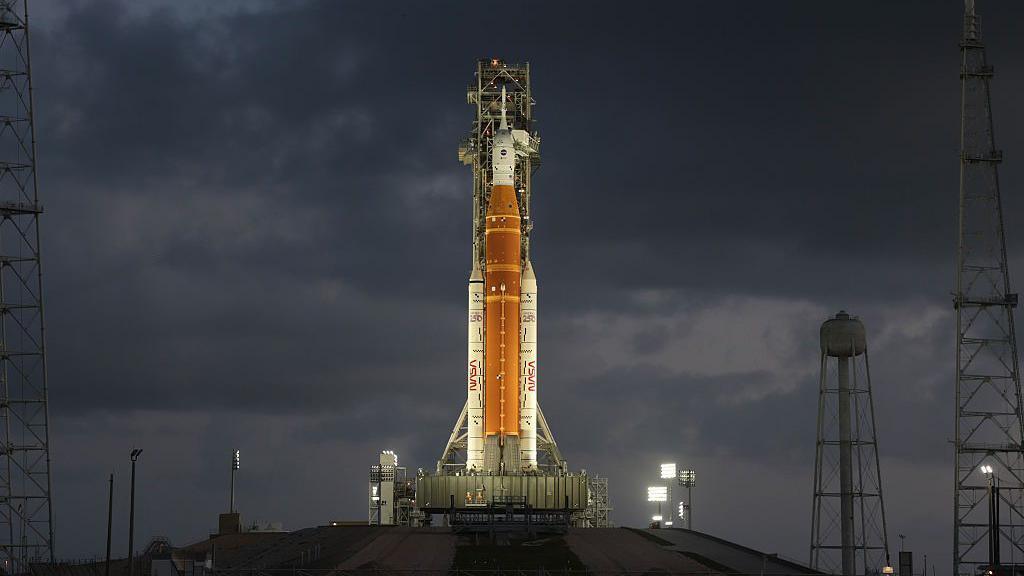
Nasa's Artemis II Space Launch System rocket and Orion spacecraft sits on Launch Pad 39B at the Kennedy Space Center on March 31 in anticipation of lift off
Nasa hopes to launch the first crewed mission around the Moon in more than 50 years, but weather may decide if the Artemis astronauts actually take off.
If the conditions aren't right then the space agency's meteorologists will be the ones to "scrub" or cancel the mission.
The Artemis II rocket contains nearly 750,000 gallons of propellant, so lightning is one of the biggest risks to safety.
So what are the chances of the weather delaying the launch from Cape Canaveral in Florida?
Image source, Getty Images
Image caption,
Thunderstorms like this one hitting the Kennedy Space Center in March 2025 will delay rocket launches due to safety concerns
April showers
With the launch window opening up on 1 April at 18:24 EDT (23:24 BST) and lasting for two hours, a threat of convective - known as cumulus - cloud, showers, strong winds and even solar activity is being closely monitored.
In Florida the spring sunshine is now bringing more heat and warmer days. Meanwhile, high pressure in the western Atlantic is producing an easterly breeze blowing from the ocean, bringing increased moisture to the eastern coast of Florida.
This combination of heat and moisture can lead to lots of cumulus cloud developing. As these grow thicker, they bring the threat of showers and thunderstorms.
Official Nasa forecasts suggest the weather will be 80% favourable for launch within the two hour window.
It is hoped that any clouds or strong winds may stay far enough away to allow the rocket to get airborne and safely through Earth's atmosphere.
If not, 2-6 April are also potential launch days.
Image caption,
There are rules around the type of cloud, lightning and electrical field, weather and temperature around Cape Canaveral that need to be cleared before the weather officer gives a 'go for launch'
Weather forecasts for launches are provided by the 45th Weather Squadron where Mark Burger, primary launch weather officer for Artemis II has been monitoring conditions for months.
"Our job is to ensure, from a meteorological perspective, that it is safe to launch", he said.
Rocket launches can be impacted by different 'weather rules' which need to be met before the launch weather officer on duty can give the 'go' decision on weather.
Historically, almost half of all rocket launches that end up scrubbed have been a result of unsafe weather, said Burger.
The weather rules include atmospheric electricity, types of cloud, specifically cumulus and disturbed weather like rain or strong winds.
Using a percentage chance of a violation of the rules, launch weather officers use a combination of meteorological and climatological data, local knowledge, and experience to forecast this probability.
Lightning is one of the biggest risks, but it is not only the natural lightning from a thunderstorm - or cumulonimbus cloud - that forecasters will be concerned about.
Rocket-induced lightning from an enhanced atmospheric electric field is also a major risk.
"Some types of clouds, even if they're not producing lightning, carry an electrical charge where a rocket passing through them at high speeds with a trail of exhaust can act like a lightning rod and trigger a lightning strike," said Burger.
This rocket-induced lightning can be triggered much more easily than natural lightning.
Other events, external such as heavy rain, strong winds, high or low temperatures or extreme weather can also jeapordise a rocket launch.
Throughout a countdown the launch weather officer must be clear and convinced that none of the weather criteria are violated in order to give the weather 'go' call for launch.
Ahead of the Artemis launch window, the 45th Weather Squadron will not only be looking at conditions at Cape Canaveral but also in other areas such as potential recovery sites in the North Atlantic where "the weather is not particularly favourable at this time of year" in case things go wrong.
With the peak in the solar cycle, they will also be keeping an eye on solar activity and enhanced radiation which could affect the astronauts.
Image source, Department of Defense (DoW)
Image caption,
Launch weather officer for Artemis II, Mark Burger looking at weather data to provide up to date forecasts for launches
"I'm very excited... it is the culmination of a lifelong dream being able to do this and take part in this whole mission," said Burger.
Meteorological planning for the Artemis II launch started many months ago.
"Launching a rocket like Artemis II is much more complicated [compared to other launches]… there are different constraints we need to learn about and now Artemis II is at the pad, it is exposed and vulnerable to weather and so daily forecasting and monitoring has begun".
In February, cold weather disrupted the preparations for the first launch opportunity. Freezing weather meant Nasa had to postpone the first full dress rehearsal as it was too cold to fuel the SLS rocket.
As for the actual launch, the decision to announce 'weather go' can be made right up to the last moments of a countdown.
In August 2025, a Crew-11 launch was scrubbed at T-minus 1 minute due to cloud cover and a small thunderstorm near Cape Canaveral violating weather safety criteria.
The authorities in Wuhan, the site of one of the world’s largest experiments in self-driving cars, cited a “system failure” after widespread reports on Tuesday evening.
President Trump said he expected the U.S. military campaign in Iran to end in two or three weeks, and the White House said he would address the nation about the war on Wednesday.
A group of President Donald Trump’s MAGA allies released a playbook Wednesday to fulfill the largest deportation push in U.S. history. It could very well split Trump’s coalition.
The plan from the Mass Deportation Coalition — an organization led by some prominent Trumpworld veterans, immigration restrictionist groups and hawkish policy experts — rests on one crucial pillar: A major immigration enforcement crackdown on workplaces, modeling the strategy that former President Dwight D. Eisenhower’s administration used to deliver the nation’s largest deportation initiative in history.
“There is no chance for a mass deportation program if worksite enforcement is not the centerpiece,” the playbook, shared first with POLITICO, reads. “Enforcement at scale means focusing on physical areas where illegal aliens are concentrated: worksites.”
That strategy almost certainly promises to alienate some of the Trump administration’s allies in the agriculture, construction and hospitality industries, which all rely heavily on undocumented labor. Farm groups in particular hold significant sway in Trump’s Washington and have already shown prowess in steering the administration away from worksite enforcement when those efforts disrupted the industry.
Worksite raids could also prove deeply unpopular with voters, whose views have turned increasingly negative toward Trump on immigration and seemingly forced the administration to ramp down its deportation push.
The release of the group’s playbook — which also offers recommendations from digitizing the employment verification process to barring unauthorized immigrants from accessing credit — comes as the Trump administration enters a new stage of internal immigration enforcement.
In the months since an immigration surge in Minneapolis left two U.S. citizens dead, the administration pivoted its message on mass deportations while overhauling its leadership at the Department of Homeland Security. Border czar Tom Homan replaced Customs and Border Protection chief Greg Bovino in Minneapolis and drew down the immigration enforcement presence in the city; the president ousted DHS Secretary Kristi Noem and tapped then-Sen. Markwayne Mullin (R-Okla.) to replace her; and a POLITICO review of official administration social media accounts found that references to “mass deportations” sharply decreased in March.
In a statement, White House spokesperson Abigail Jackson denied that the White House has shifted its deportation approach.
“Nobody is changing the Administration’s immigration enforcement agenda,” she said in a statement. “President Trump’s highest priority has always been the deportation of illegal alien criminals who endanger American communities. As the Department of Homeland Security has repeatedly said, approximately 70 percent of deportations to date have been illegal aliens with criminal records.”
Still, the Mass Deportation Coalition is trying to push the White House back toward a more aggressive immigration approach. Its members include Mark Morgan, the former acting commissioner of CBP under Trump; Erik Prince, a Trump ally and former Blackwater CEO who has pitched the White House on privatizing immigration detention operations; and a number of conservative organizations like the Heritage Foundation.
The group commissioned a poll last month by McLaughlin & Associates, one of Trump’s pollsters, that found a majority of likely U.S. voters support deporting all migrants who entered the country illegally. The poll also found that 70 percent of likely voters support “strengthening workplace immigration enforcement to help raise wages for American workers.”
However, those results differ drastically from other recent polling on immigration, like a January POLITICO poll amid the Minneapolis surge which found that nearly half of U.S. adults say Trump’s mass deportation campaign was too aggressive, including 1 in 5 of his 2024 voters.
“Special interests and industry have been able to operate in the shadows, and to lean on lawmakers and administration officials,” said Mike Howell, president of the Oversight Project and a member of the Mass Deportation Coalition. “We're taking that fight public, and we don't think that they're well situated to win that fight, because their arguments don't sell with the American people.”
The group’s stated goal of 1 million deportations in 2026 mirrors a private goal among White House officials, the Washington Post reported last year. It would mark a significant uptick in apprehensions: The Department of Homeland Security said it deported just over 600,000 individuals in 2025, though independent analyses put the number lower.
“The president made clear where he stands on the issue, and made clear how he wants to see the policy enforced,” said John Hollay, president of the National Council of Agricultural Employers. “If [immigration raids] were to occur again on farm operations, that’s going to disrupt the food supply chain, and we’ve made that very clear. We know the president is committed to ensuring our food supply chain is not disrupted and that prices at the grocery store are not raised unnecessarily.”
【404文库】是由中国数字时代运营的一个"因审查而被屏蔽或删除(404 not found)文章"的存档项目。在相当长的一段时间内,中国数字时代通过在标题前加注【404文库】的方式,对大量需要抢救性保存的文章进行了归档、发布。自2021年起,为便于列表化呈现与系统化检索,中国数字时代设立了【404文库】专页。(在专页上,您还可以查看文章的原始链接、发布平台、话题分类、删除时间等信息。)
The justices will consider the constitutionality of President Trump’s executive order ending birthright citizenship for the children of undocumented people and some temporary foreign visitors.
Sandra and Norman Wong, the grandchildren of Wong Kim Ark, whose victory in the 1898 Supreme Court case affirmed automatic citizenship for nearly all children born in the United States.
Israel has issued sweeping evacuation warnings, and pressed some Christian and Druse leaders to expel Shiite Muslims from their towns, the leaders said.

 Login
Login