Normal view

There are new articles available, click to refresh the page.
Before yesterdayCombined | Arts and Tech

Explainer: Network file systems

By: hoakley
25 April 2026 at 15:00

A regular file system like APFS or HFS+ gives access to local storage by providing a low-level API normally accessed by apps through higher-level functions in the operating system. Most file systems don’t extend to storage connected over a network, or to cloud storage, so there need to be network file systems like AFP and SMB that operate over TCP/IP network connections. In macOS, cloud storage is given a separate high-level FileProvider API instead.

Among the dozens of network file systems, those you are most likely to come across on Macs are Network File System (NFS), WebDAV, and the primitive File Transfer Protocol (FTP), in addition to AFP and SMB. The remainder of this article concentrates on the last two as they’re the most commonly used with Macs, although NFS still has its uses, and WebDAV is used for special purposes including calendar access using CalDAV.

In the OSI model of network layers, network file systems mostly operate in layer 7 at the top, the same as other common network protocols including HTTP. They thus depend on a great deal of infrastructure, including TCP/IP.

At their most basic, network file systems provide operations to connect to and disconnect from a share, to negotiate details of that connection, to open, read, write and close remote files, and to obtain a listing of a directory. Those can then be used by higher-level functions when accessing a server over the network, instead of calls to the API for a local file system. The sharing service on the server operates its side of the protocol, working through equivalent calls to the API of its local file system.

Modern local file systems have many more sophisticated features, though. If a network file system doesn’t support extended attributes, for example, it would effectively strip all such metadata from APFS files. Popular network file systems commonly lack provision for APFS sparse and clone files, which leads to transfer and storage inefficiency, as explained later.

AFP (1988)

Apple Filing Protocol, AFP, originated in Classic Mac OS days as part of the Apple File Service suite, and until OS X 10.8 Mountain Lion was the primary network file protocol for Macs. Recent versions rely on TCP/IP over port 548 to establish communication. Although it supports file naming, permissions, extended attributes and advanced locking much as HFS+ does locally, it remains incompatible with sharing of APFS volumes.

AFP became popular in NAS systems when an open source AFP server named Netatalk became available, and could be ported to NAS operating systems including Linux. Support has also been integrated into many network products such as Novell NetWare and Microsoft Windows Server (up to 2008), and of course Apple’s own Time Capsules.

SMB (2013)

Server Message Block, SMB, originated in IBM, for network sharing using IBM PC DOS, and was then adopted by Microsoft. For a while in the mid-1990s it was rebranded as Common Internet File System, CIFS, and it has been implemented independently in Samba, which was used by Apple to provide SMB support in Macs until Mac OS X 10.7 Lion in 2012. Apple then switched to its own implementation SMBX, which became its primary network file system in place of AFP, in OS X 10.9 Mavericks in 2013.

Early versions of SMB were a poor fit for macOS. To overcome the limitations of SMB servers it was often necessary to flatten extended attributes with file data into AppleDouble format, but later versions support what in Windows terms are alternate data streams (ADS), or named streams, which could require configuring an SMB server.

From the outset, SMB has also supported network access to printers, and SMB3 still contains that. Although this is available for connections to Windows printers from macOS, through Printers & Scanners settings, it seems considerably less reliable than using AirPrint, when it’s available.

Apple’s implementation of SMB has endured many bugs and problems over the years, but is now widely used and generally more stable and a lot less inefficient than in the past. However, it doesn’t support APFS special file types. If you copy a sparse file of 1 GB nominal size, occupying a few MB of disk space, then SMB will transfer the whole 1 GB to the share, where the file won’t be in sparse format, and will require 1 GB of shared storage. When that is copied back to local APFS, it remains 1 GB and isn’t reconstituted as an APFS sparse file.

Such are the joys of file sharing.

Networking changes coming in macOS 27

By: hoakley
23 April 2026 at 14:30

Apple seldom gives advanced notice of significant changes coming in the next major version of macOS, before its first beta-release at WWDC. One significant exception to this are changes to networking that could impact enterprise users. This year, with just over six weeks to go before that first beta of macOS 27, we already have two warnings of what might be coming.

AFP and network storage

Apple made SMB its primary file-sharing protocol in OS X 10.9 Mavericks, over 12 years ago, and has repeatedly told us that support for its predecessor AFP will be removed in the future. It repeated those warnings with macOS Sequoia 15.5, but still hasn’t confirmed when AFP will be lost.

Those who are most likely to be affected by this are still using Time Capsules, or elderly NAS systems that don’t support SMB3. As removal of AFP support won’t be retrospective, provided that none of your Macs will be upgraded to macOS 27, you’ll still be able to use AFP for your file shares and Time Machine backups. But if you have an Apple silicon Mac and AFP support is dropped from macOS 27, that would leave you unable to upgrade without replacing your network storage.

TLS and servers

Most recently, Apple has warned that a future version of macOS, and its device OSes, will require connections to certain servers to be made using at least TLS 1.2, with additional requirements. I’m grateful to Rich Trouton’s Der Flounder blog for drawing attention to this.

Although Apple carefully avoids being too specific, it warns that this change could come “as early as the next major software release”, although one of the purposes behind its support article is to gauge the impact the change might have on its enterprise customers. If there would be major problems, it may decide to delay its introduction.

This change is more technical, and largely applies to servers involved in supporting MDM, DDM, Automated Device Enrolment, app distribution and installation, and Apple software updates. Fortunately, if you run a local Content Caching server, that won’t be affected.

Unlike the removal of AFP, it’s far harder to tell whether a connection to a server complies with the new rules, which require:

  • support for TLS 1.2 or later, with TLS 1.3 recommended,
  • use of ATS-compliant ciphersuites,
  • presentation of valid certificates meeting ATS standards.

The most reliable way to check is to audit connections made to each server, by screening log entries from the Mac or device. That’s further complicated by the fact that the log doesn’t normally gather the information that’s required. So the first step is to install a network diagnostics logging profile available from Apple. The support article explains how to collect a logarchive using sysdiagnose, and provides a monster predicate to extract relevant entries:
"p=appstoreagent|appstored|managedappdistributionagent|managedappdistributiond|ManagedClient|ManagedClientAgent|
mdmclient|mdmd|mdmuserd|MuseBuddyApp|NanoSettings|Preferences|profiled|profiles|RemoteManagementAgent|
remotemanagementd|Setup|'Setup Assistant'|'System Settings'|teslad|TVSettings|TVSetup|XPCAcmeService AND s=com.apple.network AND m:'ATS Violation'|'ATS FCPv2.1 violation'"

And yes, Apple is encouraging system administrators to copy and paste a command into Terminal, because there’s no GUI app in macOS that could be used to do that, although you can use it in Ulbow, and I suspect in LogUI with a little modification.

If you’re within the scope of this proposed change, you’ll need to read Rich Trouton’s account, and Apple’s full article. I wish you the best of luck. As with AFP, this change shouldn’t apply retrospectively.

Timescale

  • 27.0 developer beta due on 8 June 2026
  • 27.0 public beta due around 8 July 2026
  • 27.0 release most probably in mid-September 2026, only five months away.

Painting Spring blossom 1

By: hoakley
18 April 2026 at 19:30

We still haven’t got New Year right, have we? Rather than putting it in the middle of winter, it should surely coincide with the arrival of Spring and blossom on trees. If you’re in a northern temperate latitude, now’s the time that you should be watching for the full flush of cherry and other flowering trees. In Washington DC its blossom festival extends a month from mid-March, in Japan rather later, and it’s even celebrated in Perth, in Western Australia, during the austral Spring.

This weekend I celebrate the end of the winter with two days of paintings of blossom on trees, today’s from the nineteenth century, and tomorrow from the twentieth.

palmerinshorehamgarden
Samuel Palmer (1805–1881), In a Shoreham Garden (c 1830), watercolour on paper, dimensions not known, Victoria and Albert Museum, London. Image courtesy of and © Victoria and Albert Museum, London.

Early in Samuel Palmer’s career, when he was living in Shoreham in Kent, he painted this watercolour of exuberant blossom In a Shoreham Garden, in about 1830.

millaisspring
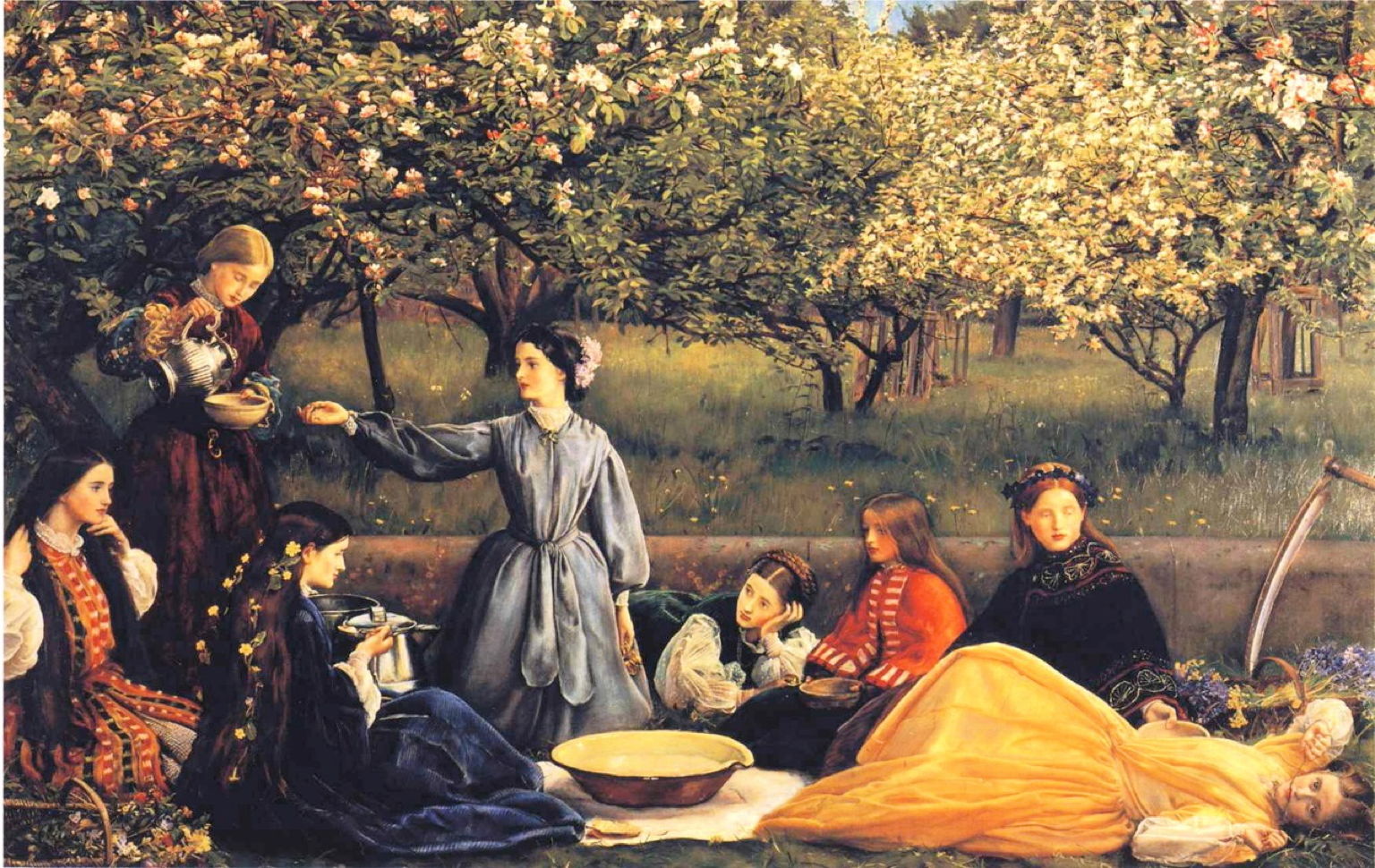
John Everett Millais (1829–1896), Spring (Apple Blossoms) (1856-59), oil on canvas, 110.4 x 172.7 cm, Lady Lever Art Gallery, Liverpool, England. Wikimedia Commons.

The Pre-Raphaelite movement emphasised painting from life; when John Everett Millais came to paint Flora and her Spring, in 1856-59, he added subtle allusions to Botticelli’s famous Primavera and classical myth. The blossom here is on apple trees, which are probably second only to May or Hawthorn in the English countryside at this time of year.

daubignyspring
Charles-François Daubigny (1817–1878), Spring Landscape (1862), oil on canvas, 133 x 240 cm, Alte Nationalgalerie, Berlin. Wikimedia Commons.

In the year that Charles-François Daubigny moved to Auvers-sur-Oise and founded the artists’ colony there, he painted this blossom-rich view of the Spring Landscape (1862). Vincent van Gogh was later to spend his final two months of painting near here.

milletspring
Jean-François Millet (1814–1875), Spring (1868-1873), oil on canvas, 86 x 111 cm, Musée d’Orsay, Paris. Wikimedia Commons.

In the closing years of Jean-François Millet’s life, he painted a commissioned series including this startling study of light, Spring (1868-73). This features a double rainbow at the upper left, with fleeting sunshine flooding the centre and dazzling on the abundant blossom. From the crops and seasonal flowers in the foreground to the inky black shower-clouds in the sky, this is a perfect summary of Spring in the countryside, and April showers.

sisleyterracestgermainspring
Alfred Sisley (1839–1899), The Terrace at Saint-Germain, Spring (1875), oil on canvas, 73.6 x 99.6 cm, Walters Art Museum, Baltimore, MD. Wikimedia Commons.

My favourite Impressionist painting of blossom has to be Alfred Sisley’s panorama of The Terrace at Saint-Germain, Spring, painted soon after he had moved to Marly-le-Roi in 1875.

haverswasherwomen
Alice Havers (1850–1890), Washerwomen (date not known), oil, dimensions not known, Walker Art Gallery, Liverpool, England. Wikimedia Commons.

Alice Havers’ Washerwomen, which given her tragically brief life must have been painted around 1880, shows a large orchard of fruit trees in blossom on the far side of the river.

By any measure, the nineteenth century master of blossom was Vincent van Gogh. Like several of his contemporaries, he had become a collector of Japanese woodcut prints, and was fascinated by one of their dominant themes, cherry blossom.

Vincent van Gogh (1853–1890), The Pink Orchard (1888), oil on canvas, 64 x 80 cm, Van Gogh Museum, Amsterdam. Wikimedia Commons.

Before he went to Arles, Vincent van Gogh had copied Utagawa Hiroshige’s woodblock print The Plum Orchard in Kameido. Shortly after his arrival there in 1888, the fruit trees came into flower, and he painted a triptych for his brother Theo’s apartment, including The Pink Orchard above, and The Pink Peach Tree below.

Vincent van Gogh (1853–1890), The Pink Peach Tree (1888), oil on canvas, 80.5 x 59 cm, Van Gogh Museum, Amsterdam. Wikimedia Commons.

Van Gogh’s approach to painting blossoming fruit trees is completely different from that of the Japanese prints. His trees are built anatomically, with trunk and branches drawn in outline, often using contrasting colour. Flowers are applied using impasto; sadly some of these have faded since, and some paint that now appears white or off-white was originally pinker.

Vincent van Gogh (1853–1890), View of Arles, Flowering Orchards (1889), oil on canvas, 72 × 92 cm, Neue Pinakothek, Munich. Wikimedia Commons.

Van Gogh’s View of Arles, Flowering Orchards (1889) is a complex composition, with trunks in the foreground, fruit trees in flower in the middle distance, and the town of Arles behind, integrating his previous explorations of each element.

larssonappleblossom1894
Carl Larsson (1853–1919), Apple Blossom (1894), watercolour, dimensions not known, Private collection. Wikimedia Commons.

Among Carl Larsson’s many intimate views of life at home is this watercolour of his daughter under the Apple Blossom from 1894. He uses his favourite colour contrast between the earth red of the barns behind with the pink of the girl’s bonnet, against the rich green vegetation around her.

serusierwhitecow
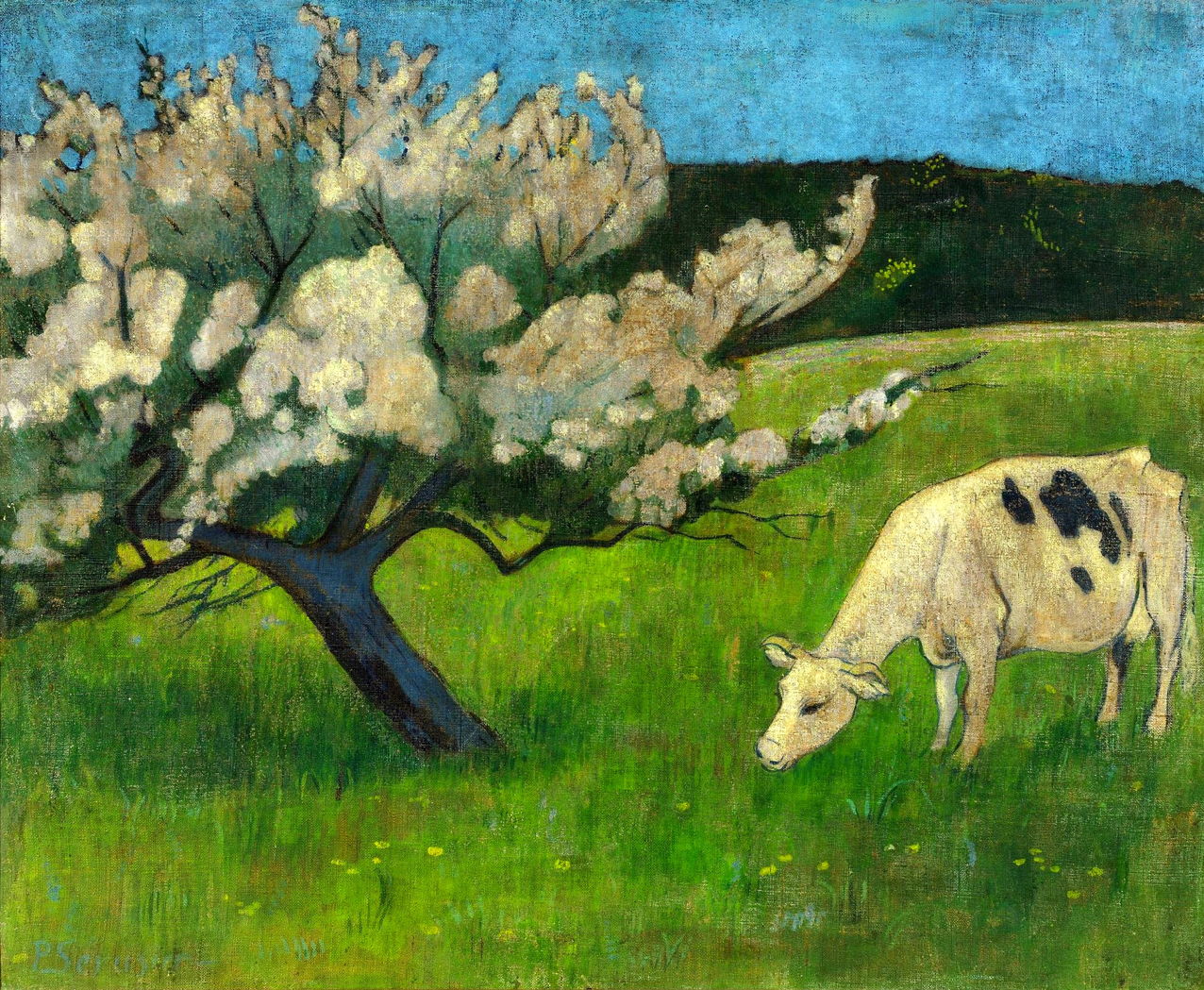
Paul Sérusier (1864–1927), The White Cow (c 1895), tempera on canvas, 60 x 73 cm, Muzeum Narodowe w Warszawie, Warsaw, Poland. Wikimedia Commons.

Some sixty-five years after Palmer’s exuberant clouds of blossom, Paul Sérusier employed a similar technique in The White Cow, from about 1895.

ringspringkahlers
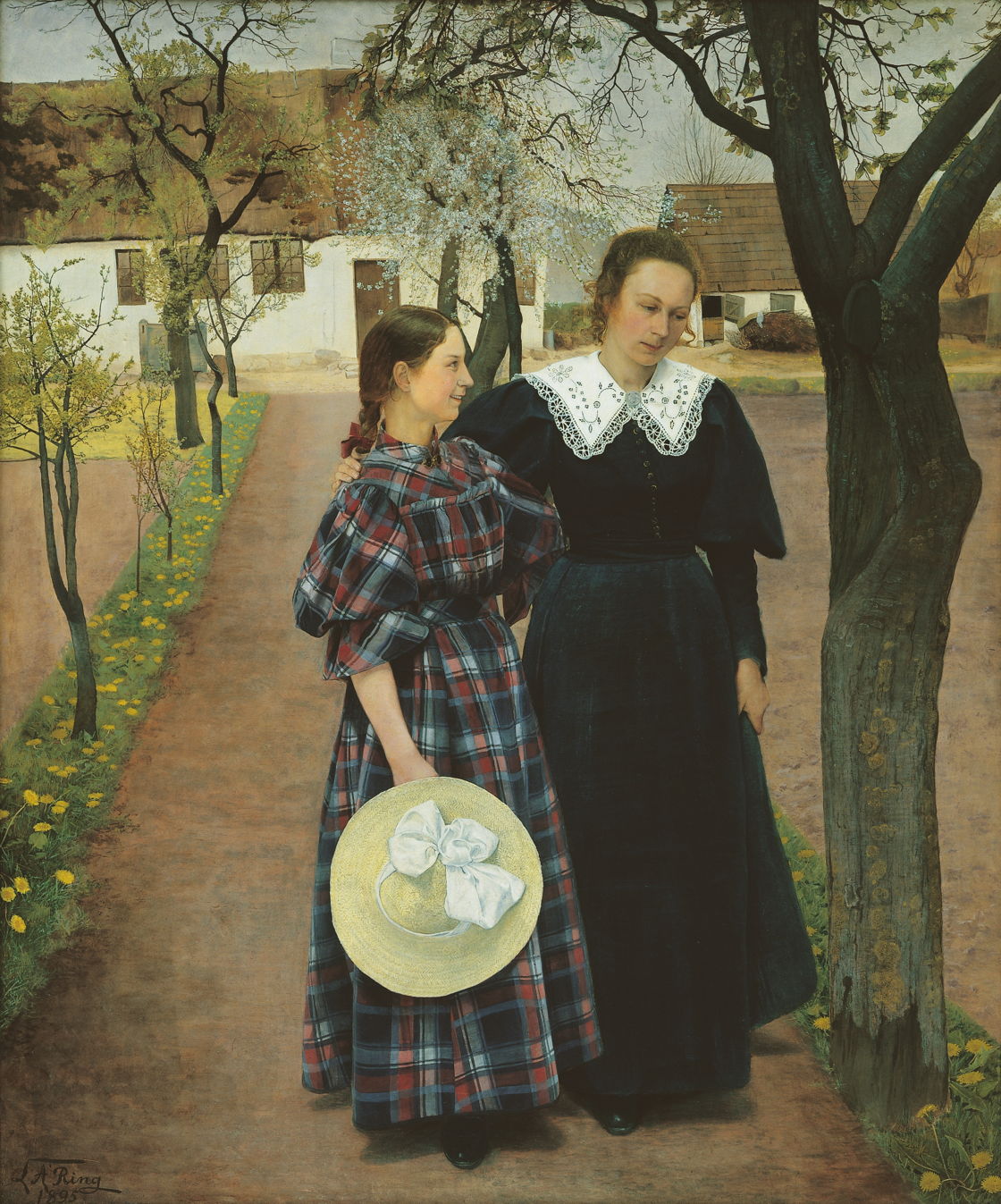
Laurits Andersen Ring (1854–1933), Spring. Ebba and Sigrid Kähler (1895), oil on canvas, 189.5 x 159 cm, Den Hirschsprungske Samling, Copenhagen, Denmark. Wikimedia Commons.

Laurits Andersen Ring’s finely detailed double portrait of Spring. Ebba and Sigrid Kähler from 1895 appears to show a mother and her daughter talking in their garden, but the two are actually sisters. At the right is Sigrid, the year before her wedding, at the left is her sister Ebba, who was fifteen at the time. Ring uses a light touch with the blossom and Spring flowers to avoid overwhelming the figures.

Naturalists: The modern meal

By: hoakley
10 April 2026 at 19:30

Eating together with family and friends is one of the great social events, and became a popular theme in nineteenth century painting. It was enthusiastically adopted by several of the leading Naturalist painters, as shown below.

manetluncheonongrass
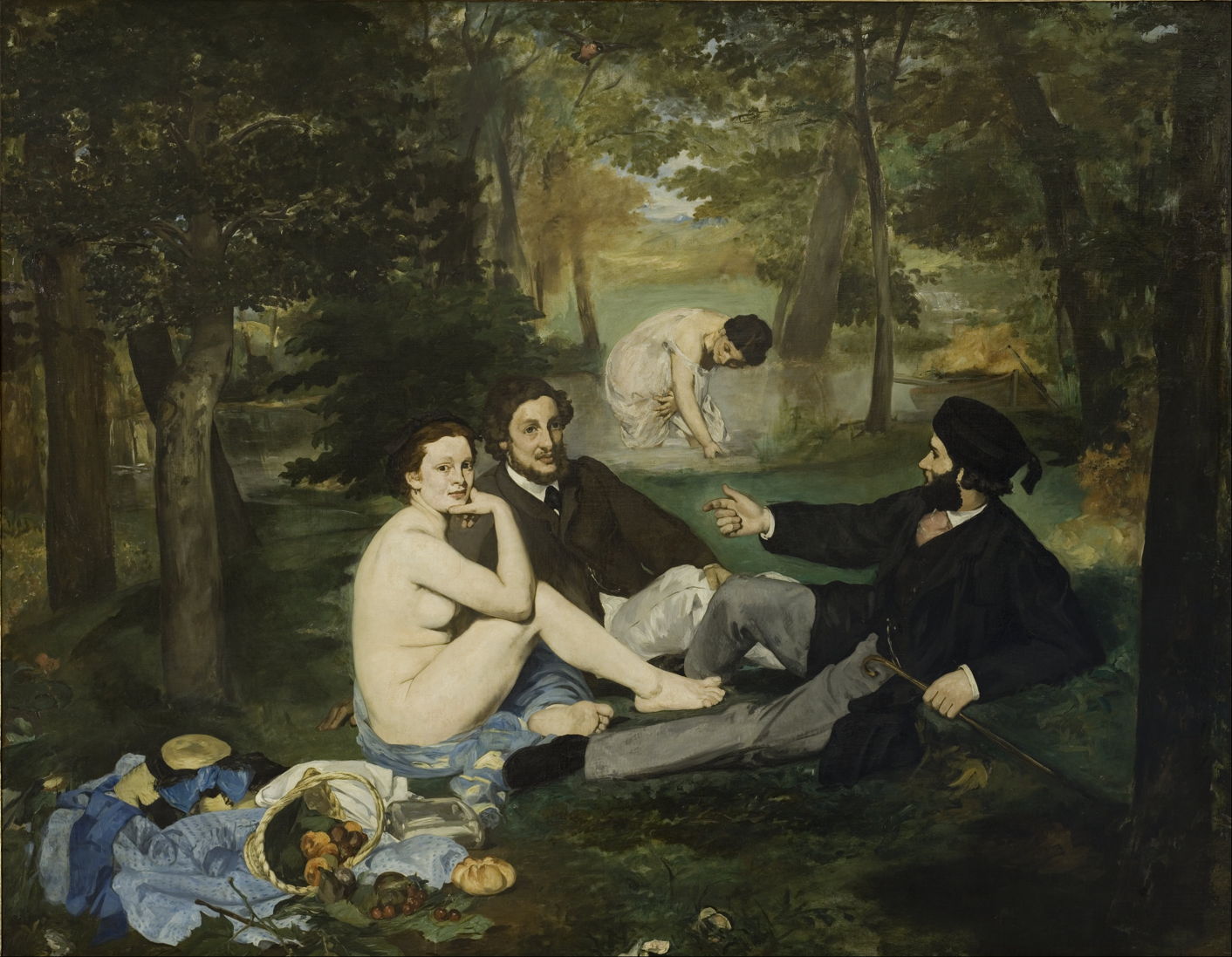
Édouard Manet (1832-1883), Le Déjeuner sur l’herbe (Luncheon on the Grass) (1863), oil on canvas, 208 × 264.5 cm, Musée d’Orsay, Paris. Wikimedia Commons.

Édouard Manet’s Le Déjeuner sur l’herbe from 1863 is one of the best-known if not infamous paintings of a social meal. Two couples are apparently disinterested in the token picnic of fruit and bread that has spilled out from its basket in the left foreground. As the two men talk, fully dressed, a conspicuously naked woman stares unnervingly at the viewer, and the other woman is washing herself in the river behind. This was rejected by the Salon of that year, ensuring its lasting fame and influence.

lepoittevinpicnic
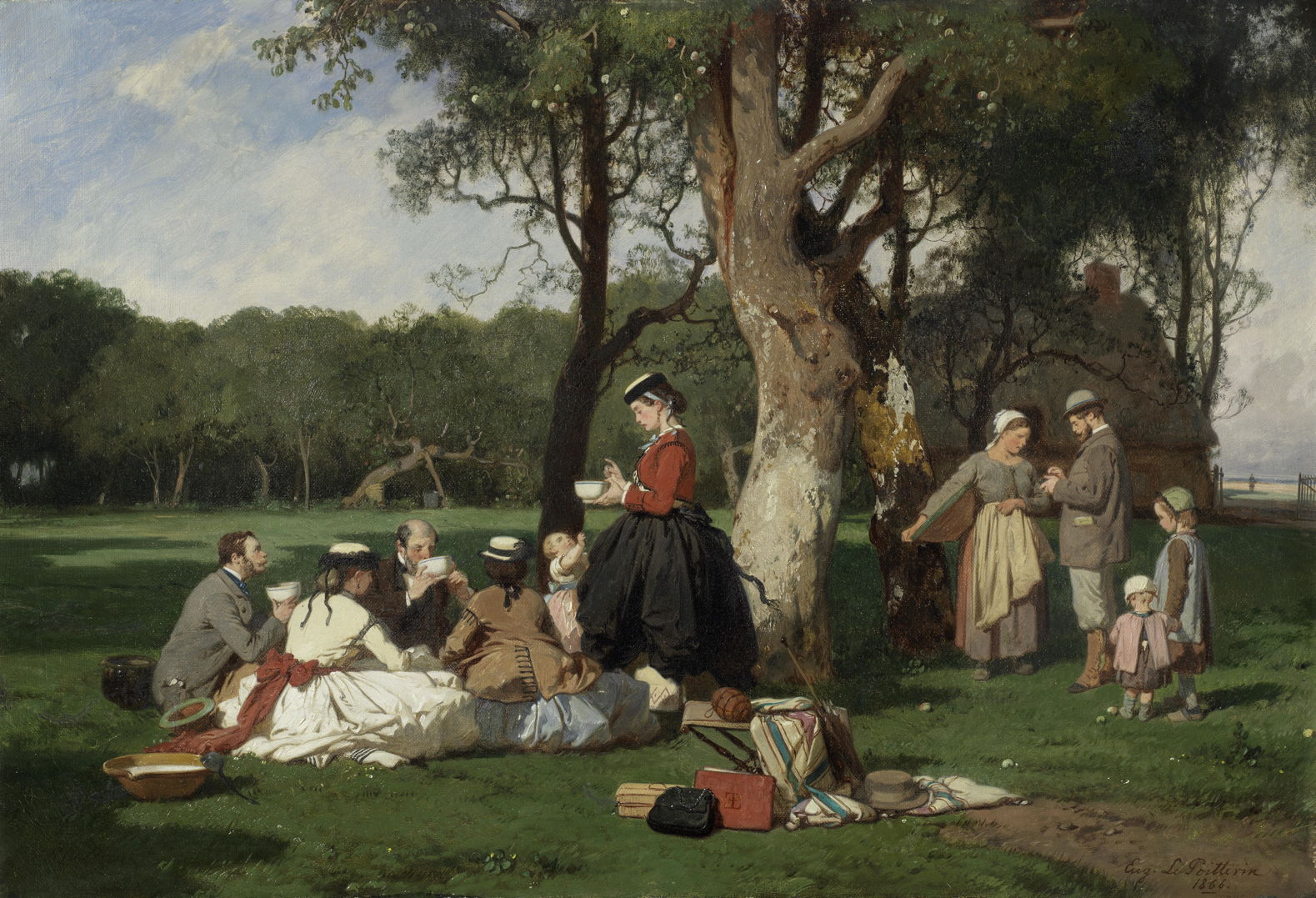
Eugène Lepoittevin (1806-1870), A Picnic (1866), oil on canvas, 43 x 62.5 cm, location not known. Wikimedia Commons.

A far cry from Manet’s meal, Eugène Lepoittevin’s Picnic from 1866 captures a picnic’s distinctive combination of the planned and impromptu. This group has lugged crockery, soup and a folding stool for their simple meal sitting on the grass under some trees.

renoirluncheonboatingparty
Pierre-Auguste Renoir (1841–1919), Luncheon of the Boating Party (1880-81), oil on canvas, 130.2 x 175.6 cm, The Phillips Collection, Washington, DC. Wikimedia Commons.

Renoir’s masterpiece Luncheon of the Boating Party (1880-81) is set on the Île de Chatou under the awning of the Restaurant Fournaise. Among his models are his partner and later wife Aline Charigot (left foreground, with affenpinscher dog), the actress Jeanne Samary (upper right), and fellow artist Gustave Caillebotte (seated, lower right). This meal seems all but over, the wineglasses near-empty as the party turns from eating to conversation.

denittisbreakfastingarden
Giuseppe De Nittis (1846–1884), Breakfast in the Garden (c 1883), oil on canvas, 81 x 117 cm, Pinacoteca De Nittis, Barletta, Italy. By LPLT, via Wikimedia Commons.

In summer, breakfast became a favourite meal in your own garden. Just a year before his untimely death in 1884, the Italian peri-Impressionist Giuseppe De Nittis painted this startling Breakfast in the Garden, with its contrast between the detail of the glass soda syphon, covered bowl, glasses, and other reflective materials on the table, and its wonderfully sketchy garden background.

ringboygirllunch
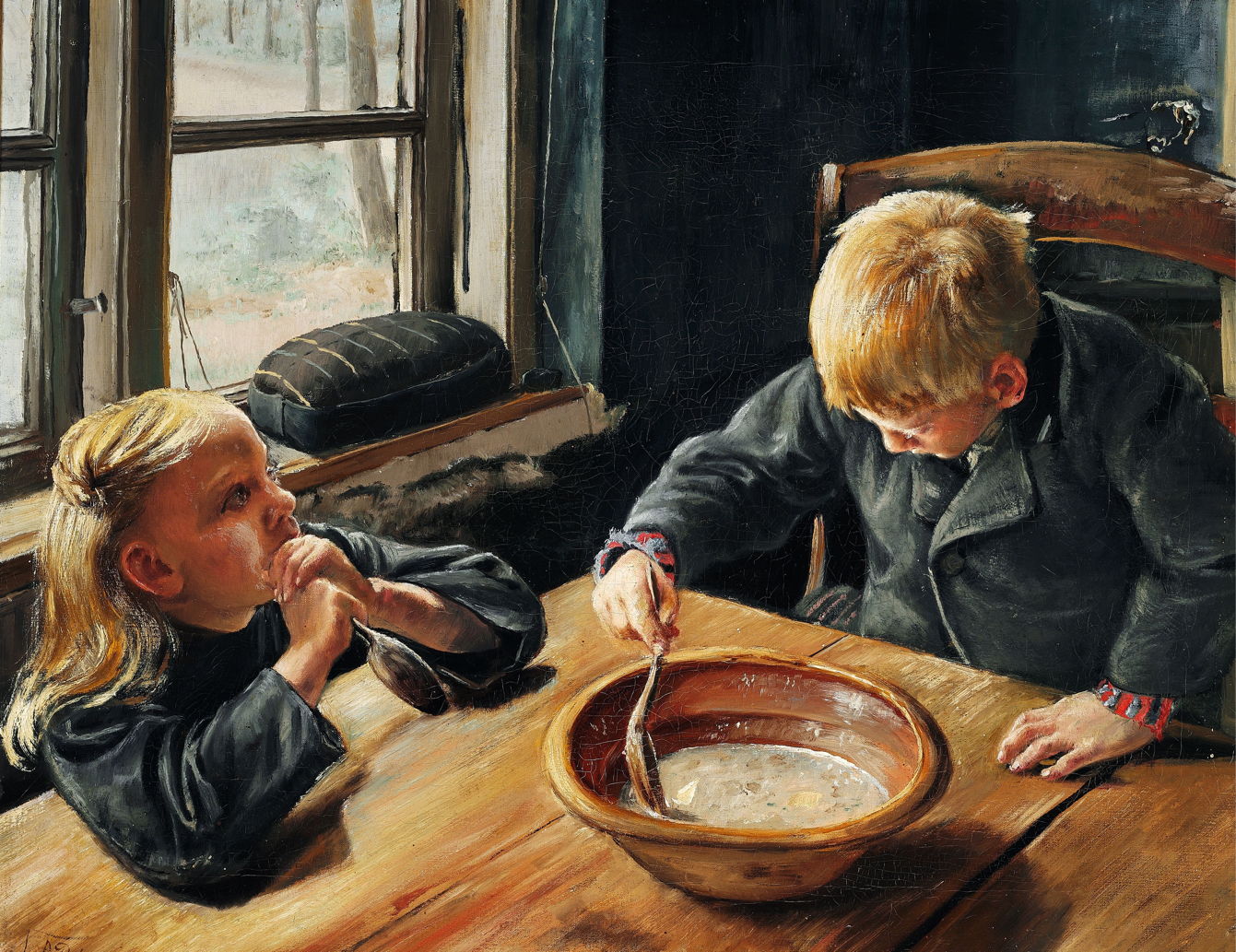
Laurits Andersen Ring (1854–1933), A Boy and a Girl Eating Lunch (1884), oil on canvas, 44 x 56 cm, location not known. Wikimedia Commons.

Laurits Andersen Ring was more pointed in his social message in A Boy and a Girl Eating Lunch, from 1884. Paupers’ children, they have a single bowl of broth between them, and there’s not even a hint of wine and fruit. The girl looks up in tears, hoping for a miracle to change their lives, and take them away from this bare wooden table and blackened walls.

MSKG - Het begrafenismaal - Léon Frédéric (1886)
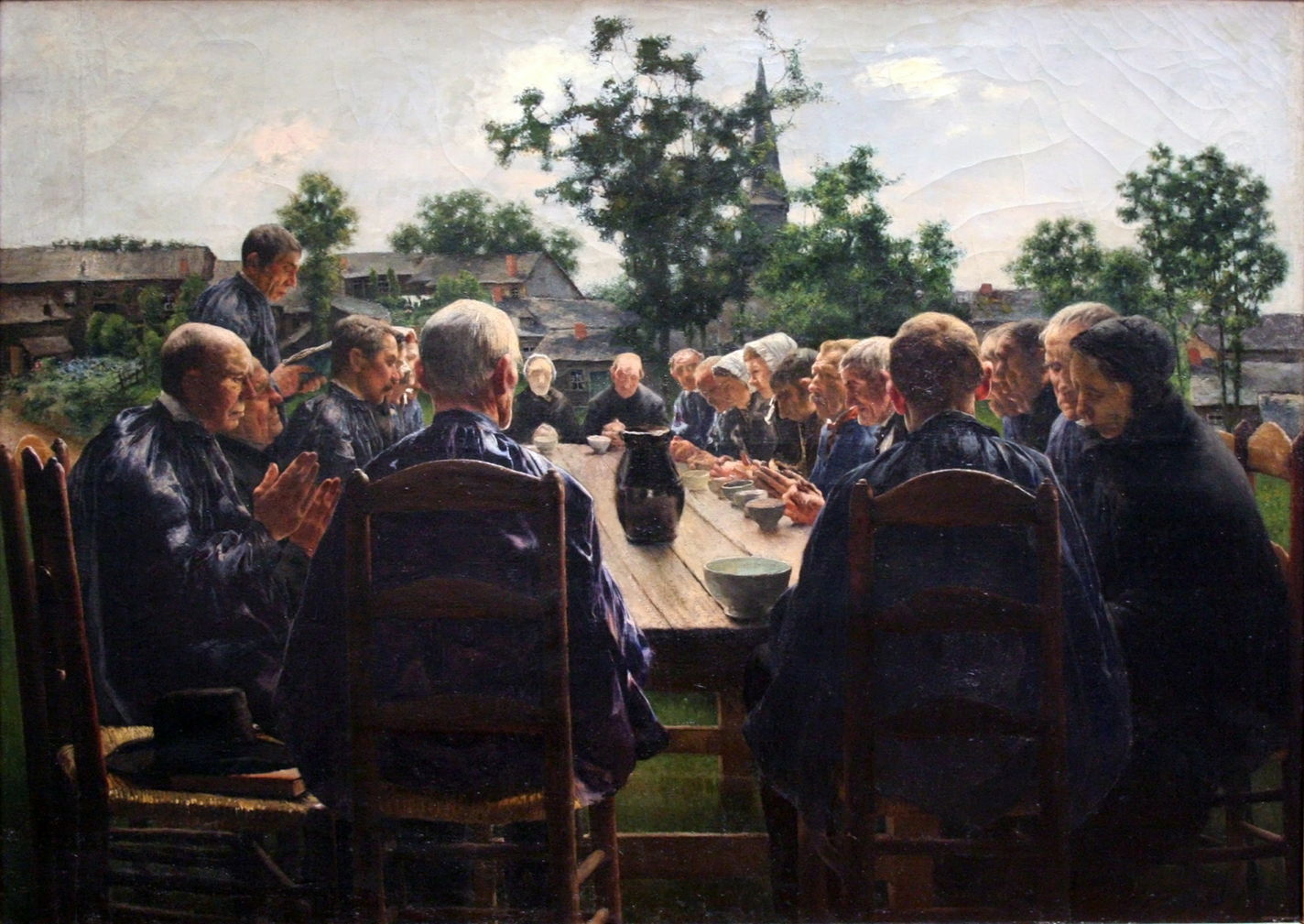
Léon Frédéric (1856–1940), The Funeral Meal (1886), oil on canvas, 125.5 x 177.5 cm, Museum voor Schone Kunsten, Ghent, Belgium. Image by Ophelia2, via Wikimedia Commons.

Léon Frédéric’s Funeral Meal from 1886 shows a large group of mourners sitting outside in the summer sunshine to remember the deceased following their funeral. Their meal is simple if not frugal, and there are neither glasses of wine nor mugs of beer. This is the moment that grace, or perhaps a eulogy for the deceased, is being read.

friantcanotiersmeurthe
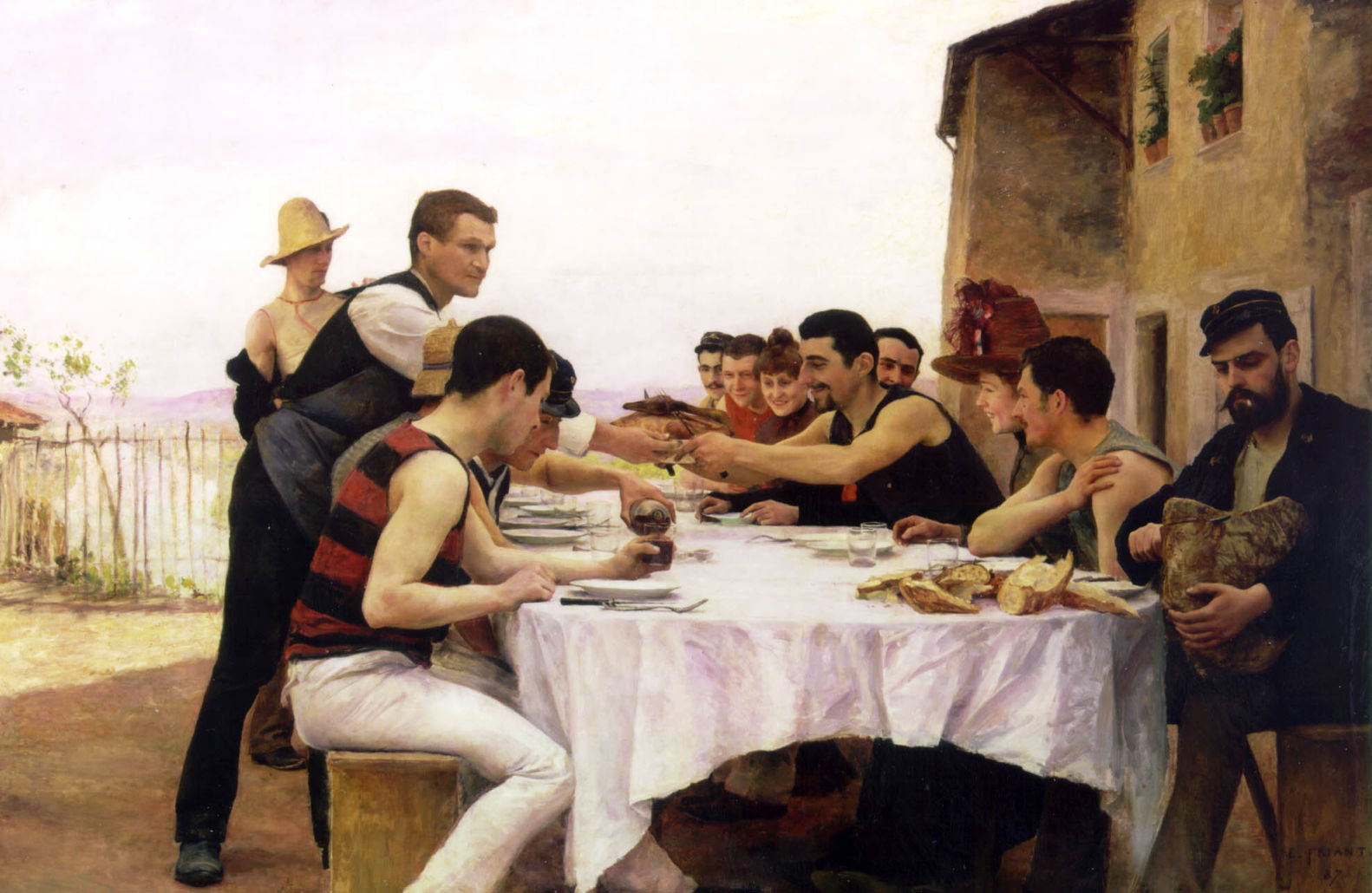
Émile Friant (1863–1932), The Meurthe Boating Party (Reunion of the Meurthe Boating Party) (1887), oil on canvas, 110 x 166 cm, Musée de l’École de Nancy, Nancy, France. Wikimedia Commons.

Now almost forgotten is Émile Friant’s masterpiece The Meurthe Boating Party, also known as Reunion of the Meurthe Boating Party or The Oarsmen of the Meurthe, from 1887. This shows the artist’s watersporting friends eating lunch together on the river Meurthe in Nancy. This can be read as a broad message of well-being and conviviality: healthy, fit young men engaged in team sports; fraternity; and harmony across different classes within society. It was exhibited at the Salon in 1888, and as a result of its success was featured as a full page in the popular magazine Le Monde Illustré, bringing Friant instant fame.

paulibreakfasttime
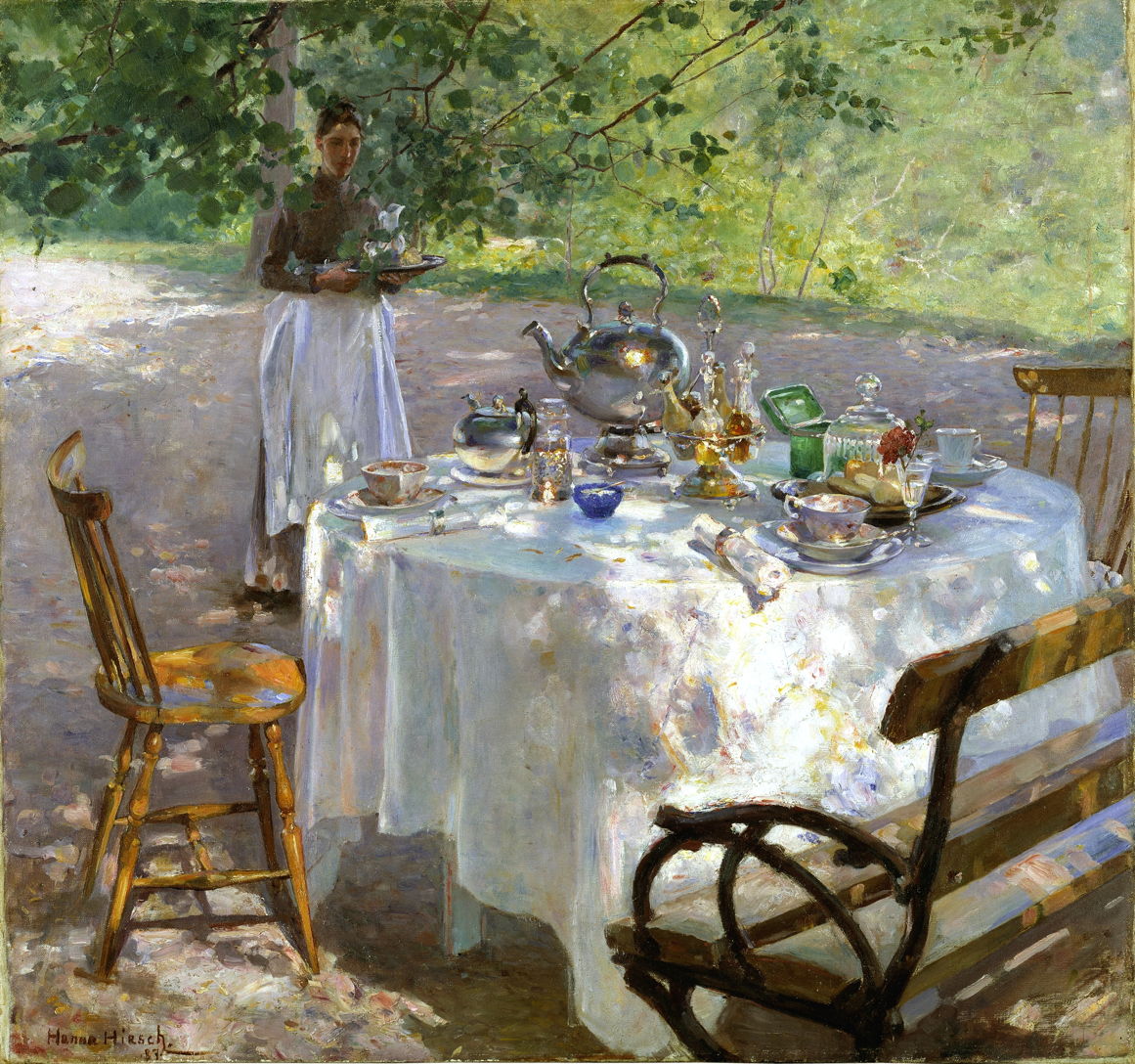
Hanna Pauli (1864-1940), Breakfast-Time (1887), oil on canvas, 87 x 91 cm, Nationalmuseum, Stockholm, Sweden. Wikimedia Commons.

That same year the 23-year-old Swedish painter Hanna Pauli made the meal table the centrepiece of her virtuoso painting of Breakfast-Time (1887). She uses it as a demonstration of her skills in depicting the reflective surfaces of silverware, porcelain and abundant glassware, but its table is now deserted.

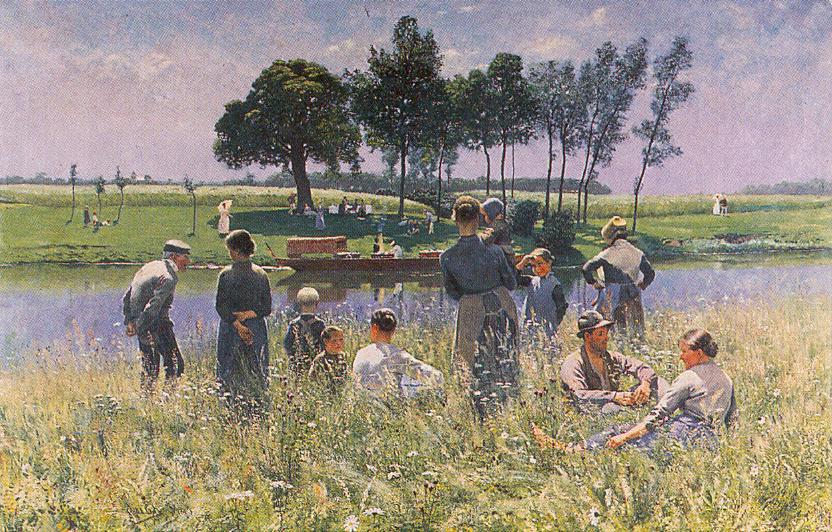
Émile Claus, Pique-nique, paysage la Lys (The Picnic) (1887), oil on canvas, 129 x 198 cm, Institut Royal du Patrimoine artistique, Brussels. WikiArt.
Émile Claus (1849-1924), Pique-nique, paysage la Lys (The Picnic) (1887), oil on canvas, 129 x 198 cm, Institut Royal du Patrimoine artistique, Brussels. WikiArt.

The Belgian artist Émile Claus also painted The Picnic in 1887. It’s set in the French/Belgian countryside around the River Lys, in the area of Ypres, which was devastated during the First World War. The plain clothing worn indicates these are poor farmworkers rather than landowners.

On Reflection: Realism in the late 19th century

By: hoakley
19 March 2026 at 20:30

In the late nineteenth century, Realist landscape painters challenged themselves with increasingly difficult reflections, where the water surface isn’t mirror-like, but broken.

Gustave Caillebotte, Rain on the Yerres (1875), oil on canvas, 81 x 59 cm, Indiana University Art Museum, Bloomington IN. WikiArt.
Gustave Caillebotte (1848–1894), Rain on the Yerres (1875), oil on canvas, 81 x 59 cm, Indiana University Art Museum, Bloomington IN. WikiArt.

Gustave Caillebotte’s Rain on the Yerres (1875) is an innovative study of a reflective water surface disrupted by circles projected by raindrops.

ricocanalvenicemet
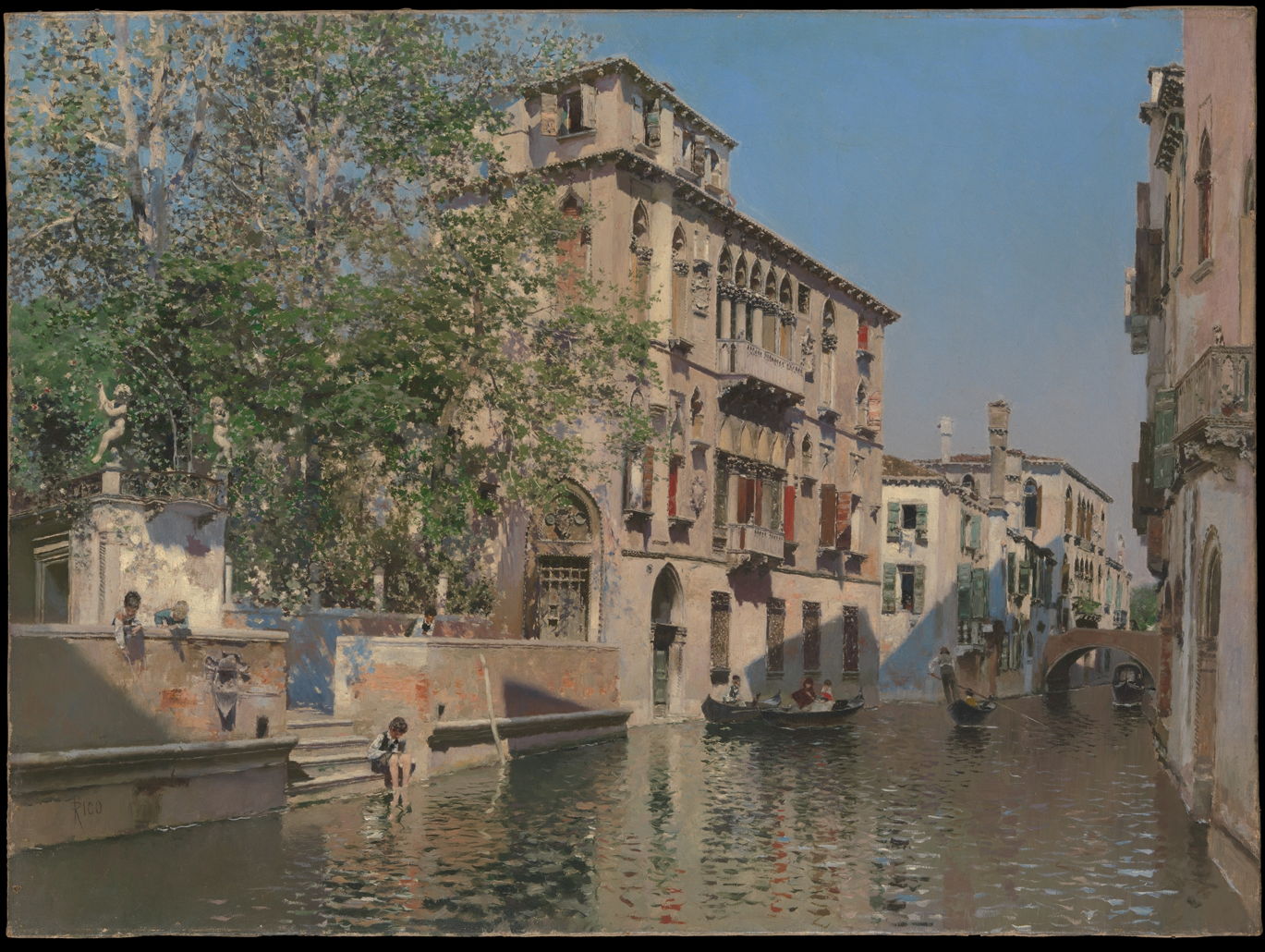
Martín Rico y Ortega (1833–1908), A Canal in Venice (c 1875), oil on canvas, 50.2 x 67.9 cm, The Metropolitan Museum of Art, New York, NY. Wikimedia Commons.

The broken reflections in Martín Rico’s A Canal in Venice from about the same time may have been painted mostly en plein air, despite their fine detail.

ricocanalveniceaic
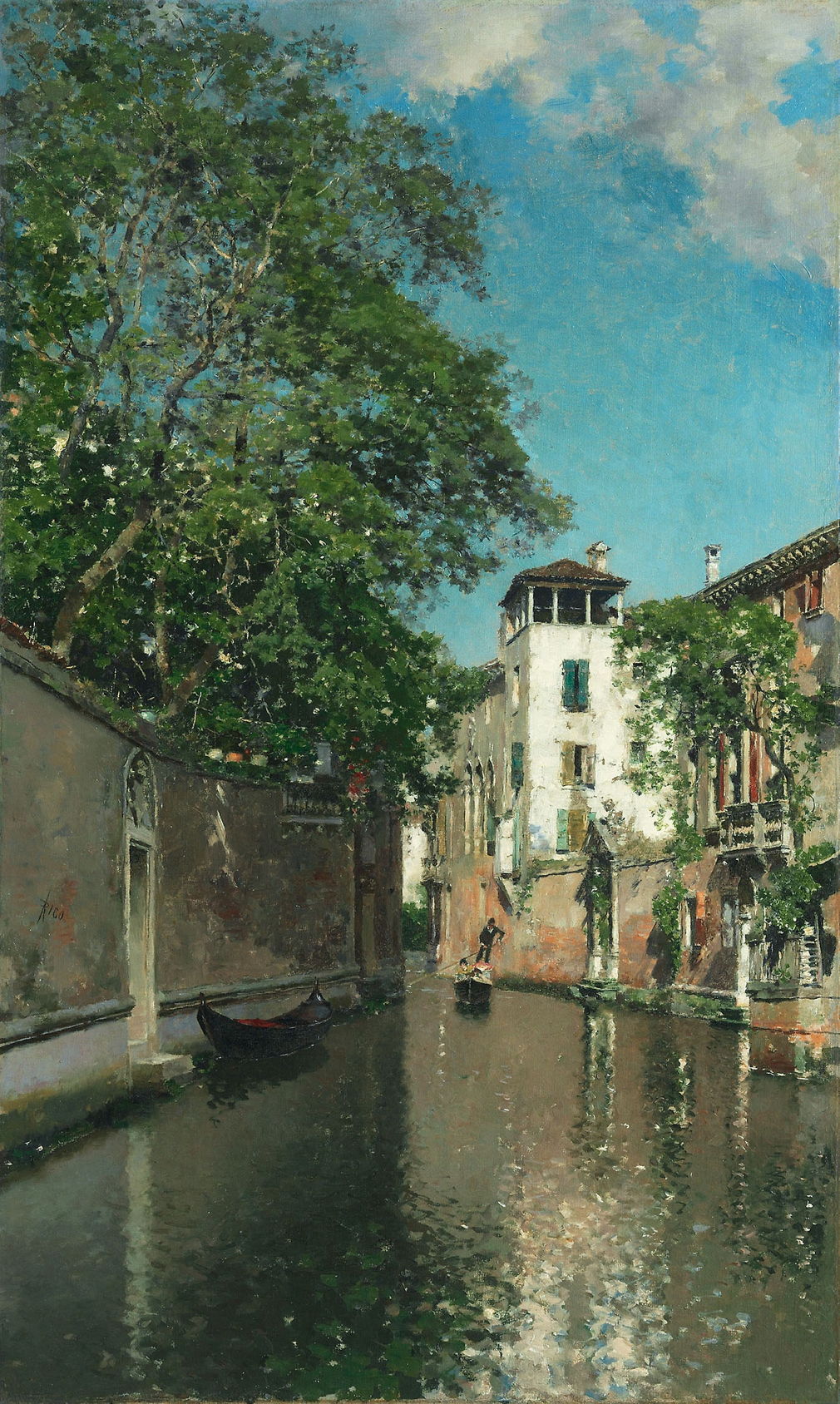
Martín Rico y Ortega (1833–1908), Canal in Venice (date not known), oil on canvas, dimensions not known, The Art Institute of Chicago, Chicago, IL. Wikimedia Commons.

Rico’s Canal in Venice uses more painterly marks in its reflections.

At the same time, Eilert Adelsteen Normann was painting the grander effects seen in the fjords of Norway.

normannfromromsdalfjord
Eilert Adelsteen Normann (1848–1918), From Romsdal Fjord, 1875 (1875), oil on canvas, dimensions not known, Bergen kunstmuseum (Kunstmuseene i Bergen), Bergen, Norway. Wikimedia Commons.

Normann’s From Romsdal Fjord, also from 1875, shows the ninth longest fjord in Norway as it carves its way through this huge mountain gorge. Although much of the water surface is glassy calm, there’s a slight blur of fine ripples, and patches where it’s more disrupted by gentle breeze.

normannsteamship
Eilert Adelsteen Normann (1848-1918), The Steamship (date not known), further details not known. Wikimedia Commons.

The unidentified fjord in Normann’s undated The Steamship shows a similar repertoire of subtle optical effects.

ringaldertrunks
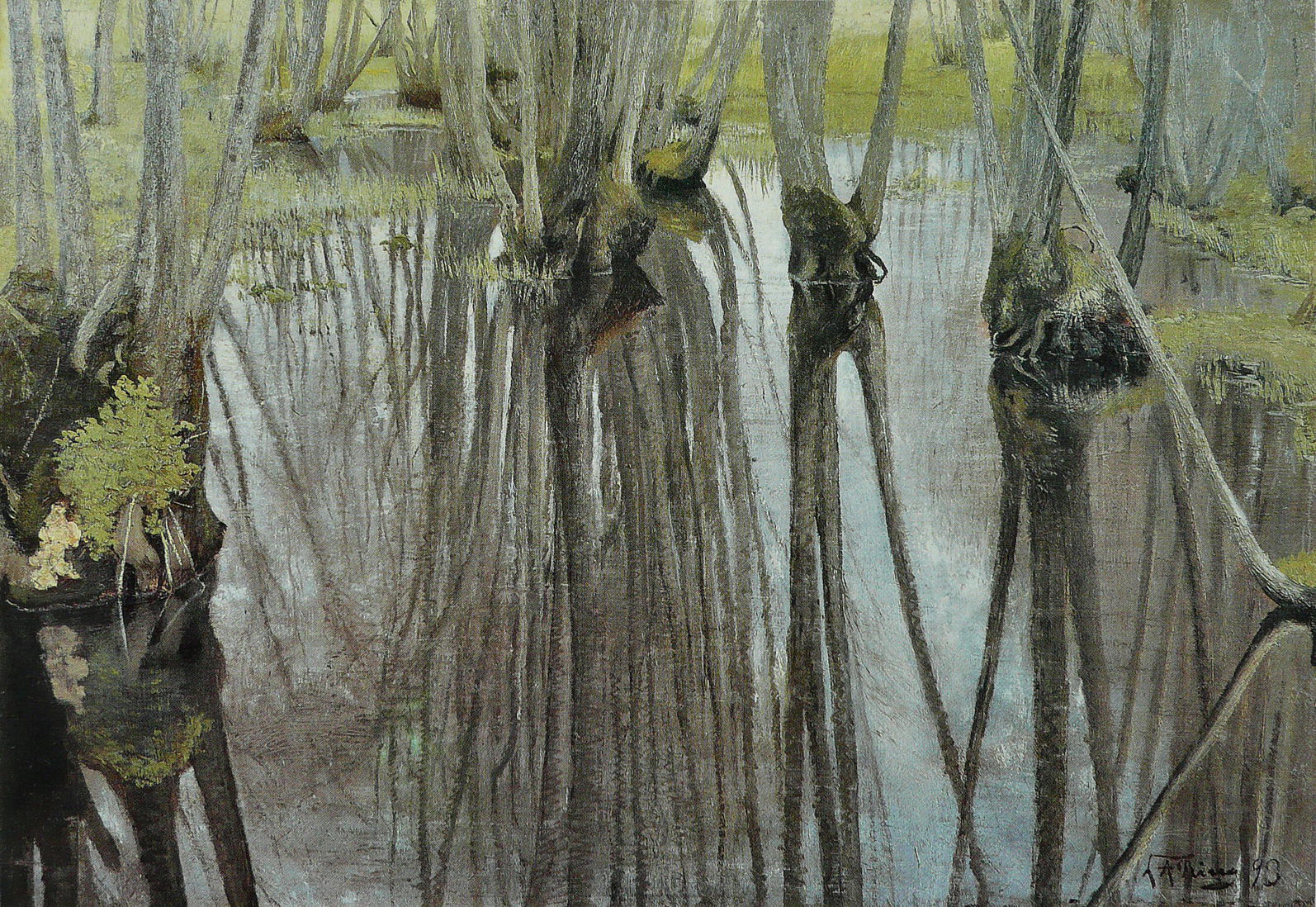
Laurits Andersen Ring (1854–1933), Alder Trunks (1893), oil on canvas, 52.9 x 73.5 cm, Collection of Her Majesty the Queen Margrethe II, Copenhagen, Denmark. Wikimedia Commons.

Alder Trunks from 1893 is one of Laurits Andersen Ring’s finest landscapes, and has earned its place in the Danish Royal Collection. He shows these old coppiced alders mainly in reflection. Although their details are quite painterly, the overall effect is that of meticulous realism.

The specialist of this period is the Norwegian Frits Thaulow.

thaulowwinterriversimoa
Frits Thaulow (1847–1906), Winter at the River Simoa (1883), oil on canvas, 49.5 x 78.5 cm, Nasjonalgalleriet, Oslo, Norway. Wikimedia Commons.

Thaulow seems to have discovered what was going to be his recurrent theme for much of his career by 1883, when he painted this scene of Winter at the River Simoa. A lone woman, dressed quite lightly for the conditions, is rowing her tiny boat over the quietly flowing river, towards the tumbledowns on the other side. The surface of the river shows the glassy ripples so common on semi-turbulent water, and the effect on reflections is visibly complex. The distant side of the river is also partly frozen, breaking the reflections further.

thaulowmillsmontreuil
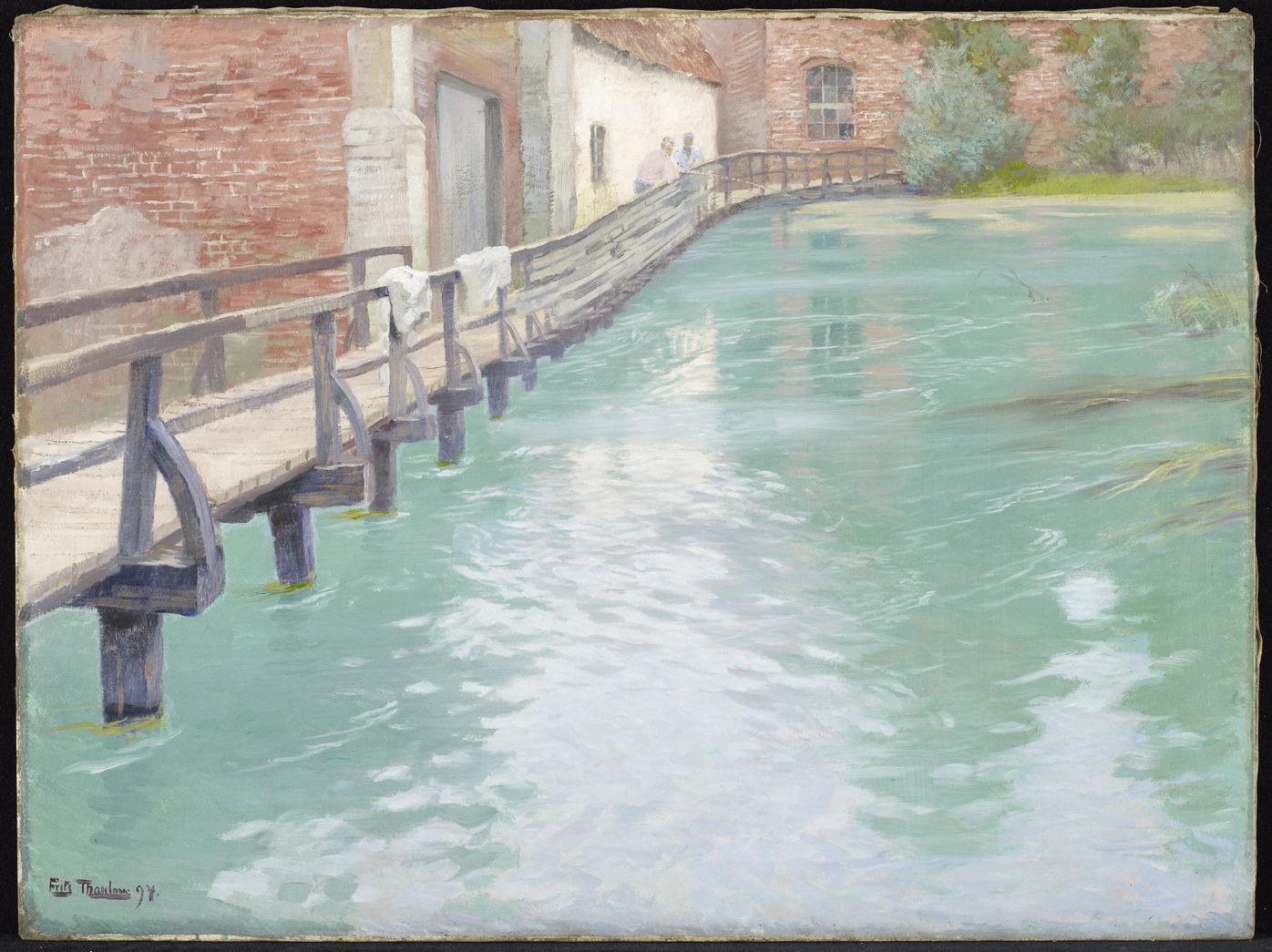
Frits Thaulow (1847–1906), The Mills at Montreuil-sur-Mer, Normandy (1894), oil on canvas, dimensions not known, Minneapolis Institute of Art, Minneapolis, MN. Wikimedia Commons.

Thaulow later returned to his studies of flowing rivers, for example in The Mills at Montreuil-sur-Mer, Normandy. This painting has been claimed to date from 1891, before the artist moved to Montreuil, but I think that its date reads 1894.

thaulowadigeriververona
Frits Thaulow (1847–1906), The Adige River at Verona (c 1894), oil on canvas, 81 x 100 cm, Walters Art Museum, Baltimore, MD. Wikimedia Commons.

In 1894, Thaulow travelled across northern Italy to Venice, stopping off to paint The Adige River at Verona. This shows the five arches of the Ponte della Pietra, with wonderfully disrupted reflections describing the river’s turbulent flow.

thaulowdordogne
Frits Thaulow (1847–1906), La Dordogne (1903), oil, further details not known. Wikimedia Commons.

Soon after Thaulow had settled at Beaulieu in central France, he found form with the magnificent river surface and lighting of La Dordogne (1903), whose precise detail in the foreground quickly yields to a more sketchy background.

A few artists rose to the challenge of combined reflected and refracted images, among them Kazimierz Sichulski.

sichulskifish
Kazimierz Sichulski (1879–1942), Fish (1908), pastel on paperboard, 63 x 82 cm, Muzeum Narodowe w Poznaniu, Poznań, Poland. Wikimedia Commons.

Sichulski’s Fish (1908) is a startlingly unusual pastel painting, a virtuoso combination of reflections from and views through this water surface. It’s an essay in practical optics.

❌
❌