Normal view

There are new articles available, click to refresh the page.
Before yesterdayCombined | Arts and Tech

Paintings of Beatrice Portinari: after 1862

By: hoakley
10 May 2026 at 19:30

Beata Beatrix was Dante Gabriel Rossetti’s next step, started in earnest in 1864, two years after Lizzie’s death, and completed in 1870, although he had been making preliminary studies when she was still alive. The background sets this in Florence, with its distinctive Ponte Vecchio over the River Arno, and the sundial sets the time as nine o’clock in the morning, the time of Beatrice Portinari’s death.

Beata Beatrix c.1864-70 by Dante Gabriel Rossetti 1828-1882
Dante Gabriel Rossetti (1828–1882), Beata Beatrix (c 1864–70), oil on canvas, 86.4 x 66 cm, The Tate Gallery (Presented by Georgiana, Baroness Mount-Temple in memory of her husband, Francis, Baron Mount-Temple 1889), London. Photographic Rights © Tate 2018, CC-BY-NC-ND 3.0 (Unported), https://www.tate.org.uk/art/artworks/rossetti-beata-beatrix-n01279

Behind the ecstatic figure of Beatrice are Dante (right) with his cap, and the angelic figure of Love at the left. Beatrice is pale and her death is approaching. Her eyes are closed, waiting for release. A red bird with a halo has brought her a poppy flower, a direct association with sleep and laudanum. Beatrice is unmistakably Lizzie.

For once, we have the artist’s account of the reading of his own painting, in a letter Rossetti wrote to its first owner in 1871. He establishes that his literary reference is Vita Nuova, and the work embodies “symbolically the death of Beatrice as treated in that work.” But it doesn’t represent death as such, rather ‘renders’ it “under the semblance of a trance”, in which she is suddenly “rapt” from Earth to Heaven.

The red bird is the messenger of death, who drops a poppy flower into Beatrice’s hands, as she has closed her eyes to see the face of God. This could equally have referred to Lizzie rather than Beatrice.

Rossetti never worked this obsession out of his system. In 1871, he returned to the theme in what proved to be his largest painting ever, based on an original watercolour study, now in the Tate Gallery, he had made as early as 1856.

rossettidantesdream
Dante Gabriel Rossetti (1828–1882), Dante’s Dream on the Day of the Death of Beatrice (1880), oil on canvas, 135.2 x 200.6 cm, Dundee Art Galleries and Museums Collection, Dundee, Scotland. Wikimedia Commons.

A decade after Lizzie’s death, Rossetti wove the more complex Dante’s Dream on the Day of the Death of Beatrice, of which this is the artist’s 1880 copy of his 1871 original. There are references to Beata Beatrix, in the red birds at the left and right edges, and his model for Beatrice was Jane Morris, wife of William Morris, designer and close friend. Jane Burden, as she was before her marriage to William Morris, had a similar background to Lizzie Siddall, from humble origins to artists’ model, then into the Pre-Raphaelite circle. Jane and Rossetti became lovers in around 1865 when he was still working on Beata Beatrix, but their relationship cooled later.

Rossetti casts the dream insert in red, for love, showing a red and winged angel of love kissing the dying Beatrice. He clutches not a flower – there are red roses strewn all over the floor – but an arrow of love. The model for the woman on the right was Marie Spartali Stillman, and her husband William James Stillman modelled for Dante’s face.

rossettisalutationbeatrice1880
Dante Gabriel Rossetti (1828–1882), The Salutation of Beatrice (1880-82), oil on canvas, 154.3 x 91.4 cm, Toledo Museum of Art, Toledo, OH. Wikimedia Commons.

The finest among Rossetti’s last paintings of Beatrice is The Salutation of Beatrice (1880-82), painted in the last couple of years of his life. It is drawn in part from the figure of Beatrice in the left panel of his earlier Salutation of Beatrice, again using Jane Morris as his model. Sat on a well in the distance are the figures of Dante and the same red angel of Love, or maybe death after all.

In that couple of years before his death, as Rossetti was working on his last paintings of Dante’s beloved Beatrice, two other artists associated with the Pre-Raphaelites were also at work on their depictions of her. Henry Holiday was researching for his 1883 painting Dante meets Beatrice at Ponte Santa Trinita, and Marie Spartali Stillman painted the first of her several watercolours of Dante and Beatrice.

holidaydantebeatrice
Henry Holiday (1839–1927), Dante meets Beatrice at Ponte Santa Trinita (1883), oil on canvas, 140 x 199 cm, Walker Art Gallery, Liverpool, England. Wikimedia Commons.

The year after Rossetti’s death, Henry Holiday completed his painting of the second occasion on which Dante claimed he had met with his beloved, in Dante meets Beatrice at Ponte Santa Trinita (1883). Holiday devoted great effort to making this view as authentic as possible. In 1881, the year before Rossetti’s death, he travelled to Florence to make studies, and researched the buildings at the time, which he turned into clay models for a 3D reference. He also got John Trivett Nettleship, a noted animal painter, to paint the pigeons so that they were faithful.

Marie Spartali, as she was before her marriage in 1871, was one of a trio of beautiful young women from Greek migrant families in London who had become known as the Three Graces. Her father, then a wealthy merchant, entertained Pre-Raphaelite painters including Rossetti, who referred to Marie as a “stunner”.

The Three Graces modelled for the artists of the day, and Marie appears as one of the figures in Rossetti’s painting of Dante’s Dream on the Day of the Death of Beatrice (1871, 1880). She learned to paint in private lessons from Ford Madox Brown, and was soon making her own images based on the writings of Dante, and Rossetti’s translations of them into English.

stillmandantecertainladies
Marie Spartali Stillman (1844–1927), “Certain ladies of her companionship gathered themselves unto Beatrice…” (1880), watercolour and gouache over traces of graphite on paper on backing, 85.1 x 63.5 cm, Private collection. Wikimedia Commons.

The full title of her “Certain ladies of her companionship gathered themselves unto Beatrice…” (1880) actually quotes even more from Dante’s Vita Nuova: “Certain ladies of her companionship gathered themselves unto Beatrice where she kept alone in weeping. And as they passed in and out, I would hear them speak concerning her, how she wept.”

This refers to the ladies of Florence who paid their respects to Beatrice as she kept vigil following her father’s death. Dante is shown sat outside the house, wearing his customary chaperon hat, his head bowed, and being comforted by two of the women who had visited Beatrice inside.

stillmanbeatrice1896
Marie Spartali Stillman (1844–1927), Beatrice (1896), watercolour and gouache on paper mounted on board, 57.6 × 43.2 cm, Delaware Art Museum, Wilmington, DE. Wikimedia Commons.

In 1896, Marie Spartali Stillman revisited Dante’s Vita Nuova through Dante Gabriel Rossetti’s popular translation into English. Her earlier version of Beatrice (1896) shows Dante’s beloved Beatrice lost in contemplation while reading, an intimate insight set firmly in the Pre-Raphaelite mediaeval, also seen in detail below.

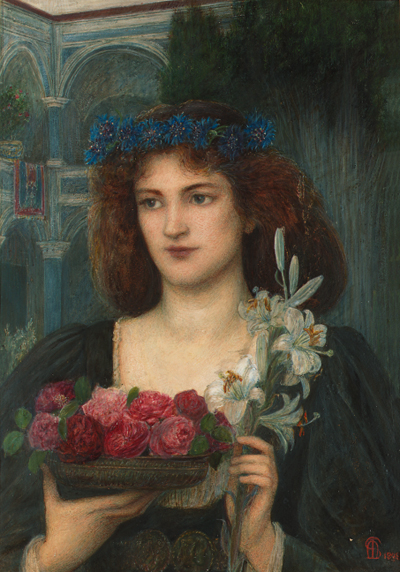
stillmanbeatrice1896det
Marie Spartali Stillman (1844–1927), Beatrice (detail) (1896), watercolour and gouache on paper mounted on board, 57.6 × 43.2 cm, Delaware Art Museum, Wilmington, DE. Wikimedia Commons.
stillmanbeatrice1898
Marie Spartali Stillman (1844–1927), Beatrice (1898), watercolour, gouache and graphite, 54.6 x 36.9 cm, Private collection. Wikimedia Commons.

Her second treatment of Beatrice (1898) employs similar floral language, perhaps emphasising innocence in its lilies, but is less contemplative and more sensual, in a manner perhaps more typical of Rossetti.
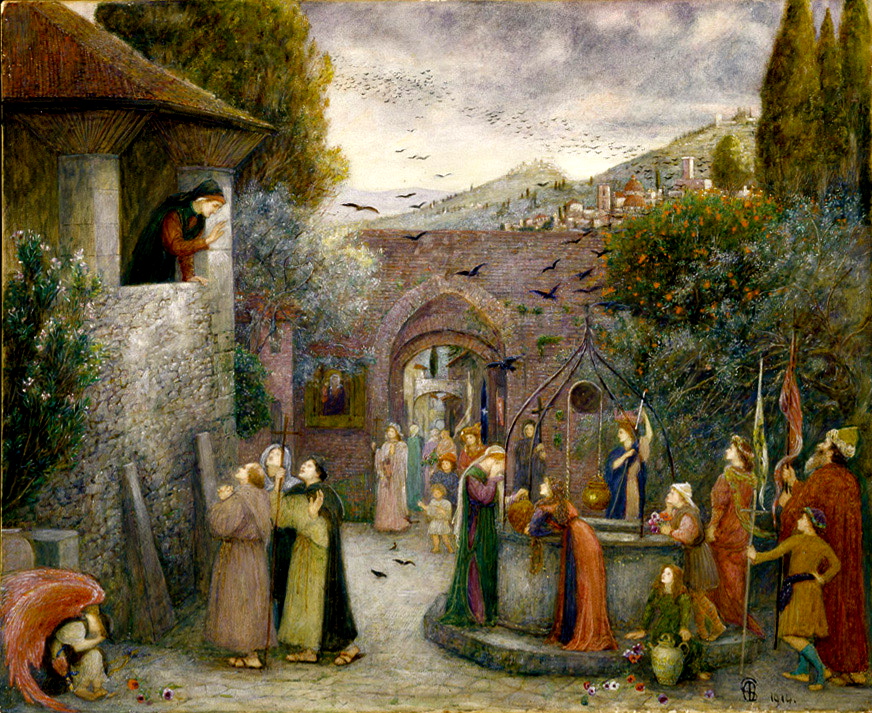
stillmanpilgrimfolk
Marie Spartali Stillman (1844–1927), The Pilgrim Folk (1914), watercolor and gouache on paper, 56.8 × 70.3 cm, Delaware Art Museum, Wilmington, DE. Wikimedia Commons.

In the months before the outbreak of the First World War, she painted The Pilgrim Folk (1914), which may well have been a double valediction, as both her last major painting and her farewell to Italy. It again refers to Dante’s Vita Nuova via Rossetti, a quotation from which was shown with the painting. This passage contains Dante’s account of Beatrice’s death to a group of newly-arrived pilgrims.

Dante leans out from a window at the left, addressing three pilgrims below. At the lower left corner, the winged figure of Love crouches in grief, poppies scattered in front of him, a reference to Rossetti’s paintings. Pilgrims around the well are taking refreshment after their travels, and more are arriving through the alley beyond. Black crows fly in flocks above, symbolising death. The landscape behind is very Italian, and the whole has a fairy-tale unreality about its mediaeval details.

Stillman had used Rossetti’s symbols elsewhere too, including in one of her finest paintings, Love’s Messenger completed in 1885, three years after his death.

stillmanlovesmessenger
Marie Spartali Stillman (1844–1927), Love’s Messenger (1885), watercolor, tempera and gold paint on paper mounted on wood, 81.3 × 66 cm, Delaware Art Museum, Wilmington, DE. Wikimedia Commons.

A young woman stands by her embroidery at an outside window. On her right hand is a messenger dove/pigeon, to which a letter is attached. She clutches that letter to her breast with her left hand, implying that its contents relate to matters of the heart. The dove is being fed corn, which could either be its reward for having reached its destination (thus the woman is the recipient of the message), or preparation for its departure (she is the sender).

On balance, the presence of corn on the windowsill implies that it is more likely that the dove has just arrived, and the woman is the recipient. But look closely at the embroidery, and she is making an image of one of Rossetti’s angels of love, complete with red wings and a bow and arrow.

There’s another artist who is perhaps the most surprising of all those who painted Beatrice: Odilon Redon (1840–1916), a contemporary of Stillman, who is perhaps as different as you could get in terms of background and style.

redonbeatrice
Odilon Redon (1840–1916), Beatrice (1885), pastel on paper, dimensions not known, Private collection. Wikimedia Commons.

Redon’s pastel portrait of Beatrice from 1885 was turned into a print a decade or so later, and appears to have been laid down in pure gold. Like so many other portraits of her, it contains no literary references to indicate whether she is the possibly physical Beatrice from Vita Nuova, or the spiritual guide from the Divine Comedy.
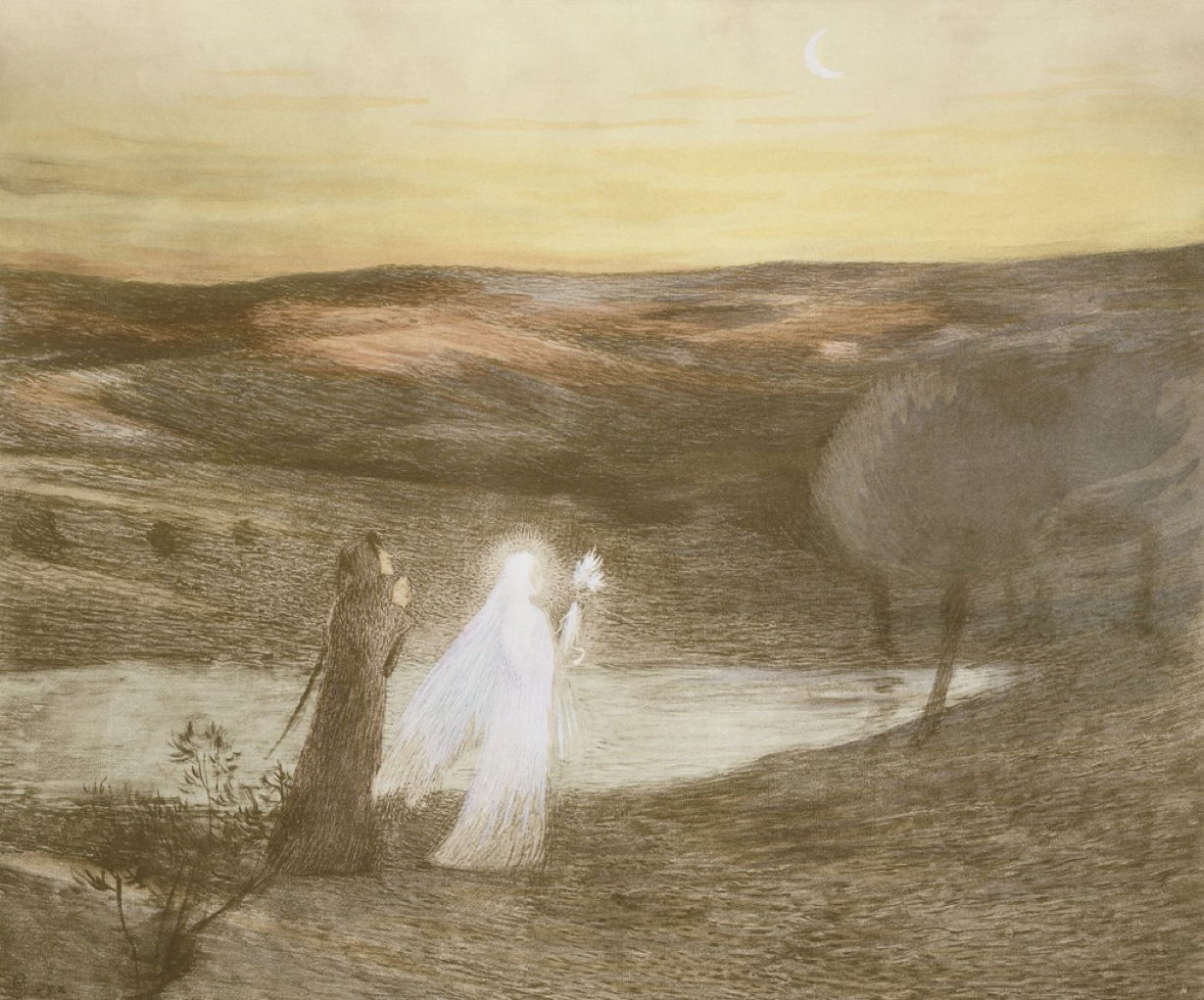
martindantebeatrice
Henri-Jean Guillaume Martin (1860–1943), Dante Meeting Beatrice (1898), colour lithograph, 25.5 x 31 cm, The British Museum, London. Wikimedia Commons.

Throughout his career, Henri-Jean Guillaume Martin painted scenes from Dante’s Divine Comedy. This colour lithograph refers to the end of the middle book Purgatory, in which Dante is reunited with his beloved Beatrice, who leads him through the final book, Paradise.
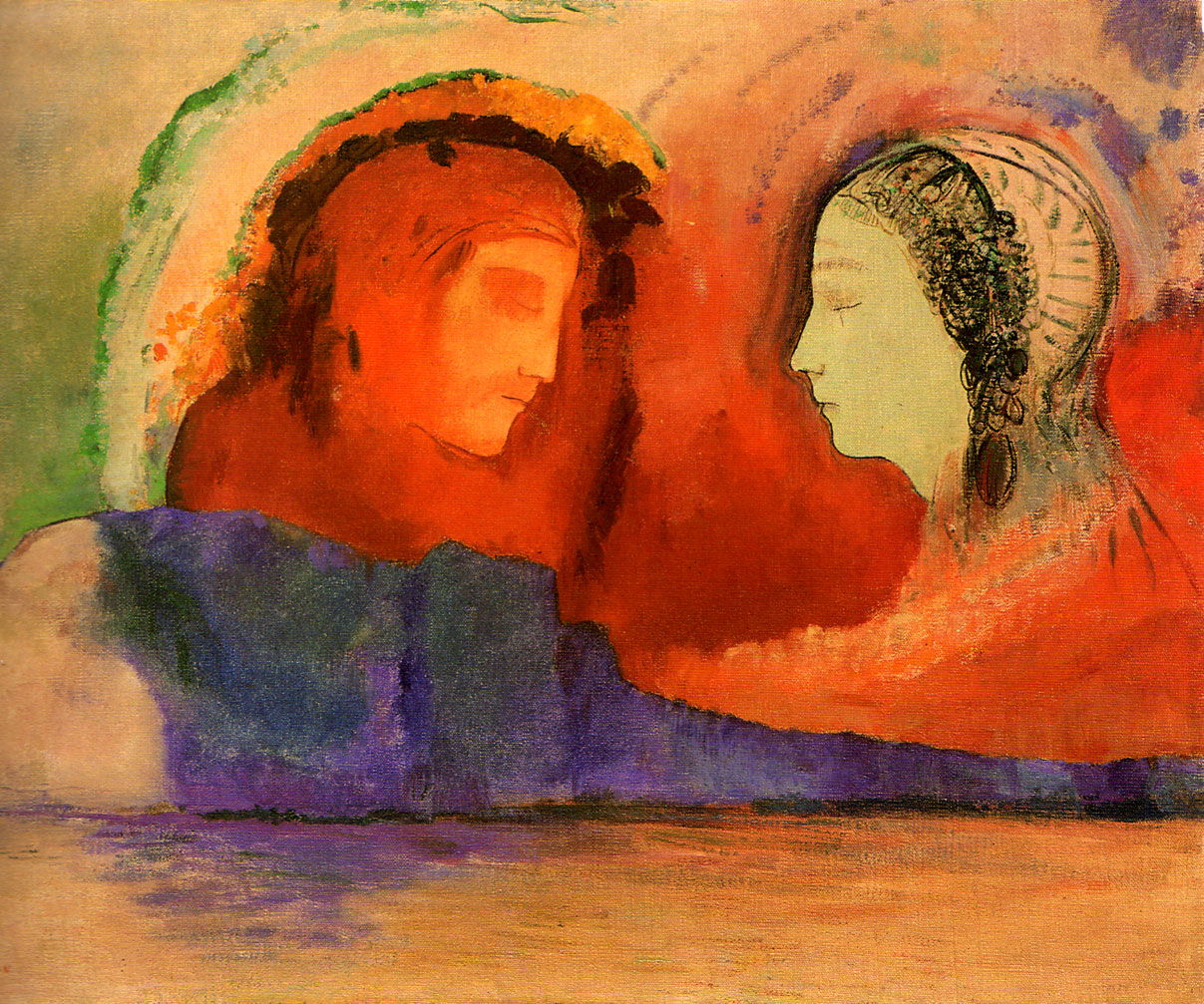
redondantebeatrice
Odilon Redon (1840–1916), Dante and Beatrice (1914), oil on canvas, 50 x 65.3 cm, Fujikawa Galleries Inc., Tokyo, Japan. Wikimedia Commons.

At the same time that Stillman was painting her Pilgrim Folk above, Redon painted one of his relatively few works in oils, of Dante and Beatrice (1914). Their heads, with eyes closed so they can see their God, are among the clouds above the cliffs of a coastline suggestive of Purgatory.

So who was Beatrice Portinari?

Born in Florence in about 1265, making her about the same age as Dante, she was the daughter of a rich banker. By the time she was about 22, she had married another banker, Simone dei Bardi. She is mentioned in the will that her father made in 1287, and is thought to have died in Florence on 8 June 1290, at the age of about 25.

Beyond that, and Dante’s non-specific references to a Beatrice, who could quite easily be someone completely different, or a symbolic figure, there seems nothing to tell. But there are so many wonderful paintings of such an unknown woman.

Jerusalem Delivered: 13 Leading characters

By: hoakley
20 April 2026 at 19:30

Over the last three months I have illustrated a summary of Torquato Tasso’s epic Jerusalem Delivered, concluding that last week. To draw this to a close, this article considers the stories and fate of its six leading characters.

The three leading men are Godfrey of Bouillon, Prince Tancred, and Rinaldo. The leading women are Clorinda the ‘pagan’ knight, Princess Erminia of Antioch, and Armida the sorceress. One fact is immediately apparent: Tasso’s heroes are all crusaders, but the heroines all ‘pagans’, supposedly their enemies.

Godfrey of Bouillon

According to Tasso, the hero of heroes was Godfrey of Bouillon, who led the crusaders to a remarkable victory. Current historical analysis differs: despite the astonishing success of the crusaders at Jerusalem, at no time did they appear to have a single person in overall command, and much of their success was due to Count Raymond of Toulouse rather than Godfrey.

overbeckarchangelgabrielgodfrey
Johann Friedrich Overbeck (1789-1869), The Archangel Gabriel Appears to Godfrey of Bouillon (1819-27), fresco, dimensions not known, Casa Massimo, Rome, Italy. Image by Sailko, via Wikimedia Commons.

As with Tasso’s poetry, the paintings of Godfrey portray him as a pious warrior, as in this section of Johann Friedrich Overbeck’s magnificent frescoes in the Casa Massimo in Rome. Here The Archangel Gabriel Appears to Godfrey of Bouillon, reminding him of the pressing need to get on with the delivery of the Holy City.

overbeckgodfreykneels
Johann Friedrich Overbeck (1789-1869), Consecration of Godfrey (1819-27), fresco, dimensions not known, Casa Massimo, Rome, Italy. Image by Sailko, via Wikimedia Commons.

This is reiterated in Overbeck’s Consecration of Godfrey, where Peter the Hermit stands holding the crucifix, as Godfrey, still wearing his armour, sinks on bended knee.

As a pious knight and leader, Godfrey never succumbs to the temptations offered by Armida. As far as we’re told, he remains pure and celibate in both body and mind, his sole mission being to deliver the city.

Tancred and Rinaldo are very different, hot-blooded young knights who fight like there’s no tomorrow, and engage in amorous adventures that get about as explicit as you’ll encounter in literature of this period. But their relationships are each unusual.

Tancred and Clorinda

Clorinda, one of two women warriors featured by Tasso (the other being Gildippe, a crusader), is in love at first sight with Tancred.

overbecksofroniaolindosaved
Johann Friedrich Overbeck (1789-1869), Sophronia and Olindo Saved by Clorinda (1819-27), fresco, dimensions not known, Casa Massimo, Rome, Italy. Image by Sailko, via Wikimedia Commons.

Clorinda is portrayed from her arrival as upholding the standards of chivalry, fighting ferociously but fairly, and being morally sound. She first arrives on her charger and holds up her right hand to tell those about to burn Olindo and Sophronia at the stake to hold fire, and quickly secures their release.

She has a vindictive streak, though, which becomes apparent when she decides to torch the wooden siege towers after the first day’s assault on the city walls. This backfires when she is caught outside those walls by Tancred; knowing it’s him, she forces him to fight, resulting in her death.

tintorettodomenicotancredbaptizingclorinda
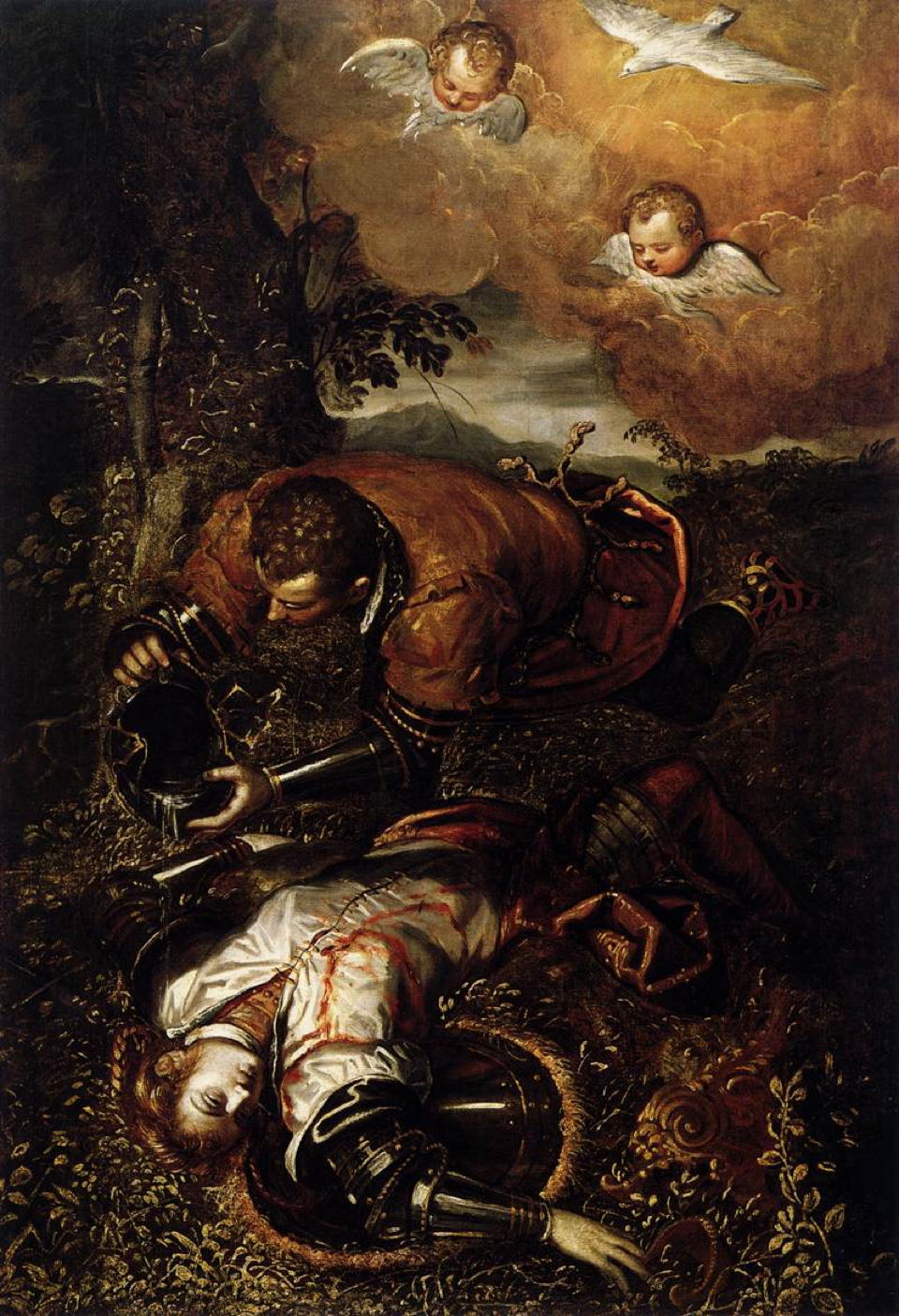
Domenico Tintoretto (1560–1635), Tancred Baptizing Clorinda (c 1585), oil on canvas, 168 x 115 cm, Museum of Fine Arts, Houston, TX. Wikimedia Commons.

Predictably perhaps for a Catholic of his age, Tasso ends this part of the story with her baptism in the moments before her death, shown so brilliantly in Domenico Tintoretto’s Tancred Baptizing Clorinda of about 1585. Tasso also provides details of Clorinda’s ‘unfortunate’ upbringing outside the Christian faith of her mother, reinforcing that her sacrifice in battle was to her ultimate benefit in life after death, a thoroughly moralising thread.

Erminia and Tancred

From the outset Erminia is noble, cultured, and in love with Tancred, who had treated her well after the fall of Antioch and the slaughter of the rest of her family. But her love for Tancred isn’t returned: he’s smitten by Clorinda instead.

pretierminia
Mattia Preti (1613–1699), Erminia, Princess of Antioch (date not known), oil on canvas, 98 x 73 cm, location not known. Wikimedia Commons.

Mattia Preti’s undated portrait of Erminia, Princess of Antioch expresses well Tasso’s descriptions of her.

This unfortunate threesome doesn’t unravel until after Clorinda’s death. Before that, following the first round of the duel between Tancred and Argante, it becomes more complex. Seeing Tancred wounded in that battle, Erminia leaves the city of Jerusalem wearing Clorinda’s armour. Although that provides her passport to exit the city, she is recognised as Clorinda by crusaders, and is forced to flee from her bid to tend to her beloved Tancred.

That sets up an almost comical situation, in which Tancred leaves the crusaders’ camp in pursuit of a woman he thinks is Clorinda, whom he loves, who is in fact Erminia (who loves him) wearing Clorinda’s armour.

delacroixerminiashepherdsd1
Eugène Delacroix (1798–1863), Erminia and the Shepherds (detail) (1859), oil on canvas, 82 x 104.5 cm, Nationalmuseum, Stockholm, Sweden. Wikimedia Commons.

Eugène Delacroix shows this in his Erminia and the Shepherds of 1859, a detail of which I show above. Here is Erminia dressed as Clorinda, with Tancred erroneously in pursuit, heading for trouble in Armida’s magic castle.

Tasso doesn’t develop this confusion any further, but picks up the one-sided relationship again when Argante is dead and Tancred badly wounded, outside Jerusalem. Erminia gets her chance to revive the ailing Tancred, sacrificing her tresses to fabricate improvised bandages.

turchierminiafindstancred
Alessandro Turchi (1578–1649), Erminia Finds the Wounded Tancred (c 1630), oil on canvas, 147 x 233.5 cm, Kunsthistorisches Museum, Vienna, Austria. Wikimedia Commons.

This is shown best in Alessandro Turchi’s Erminia Finds the Wounded Tancred (c 1630). We are left in suspense over the further development, even consummation, of this relationship.

Armida and Rinaldo

By far the most complex of Tasso’s characters is Armida. The niece of a ‘pagan’ ruler and sorceror Hydrotes, her mission is to wreak havoc in the crusader camp, so destroying command, unity and morale, as she does so effectively.

stillmanrosefromarmidasgarden
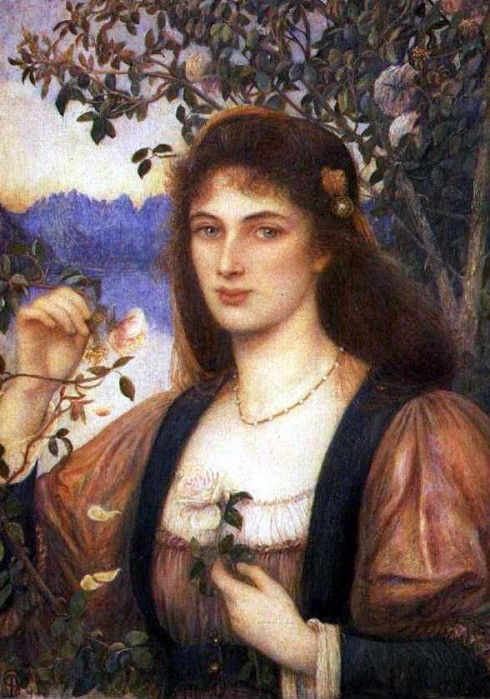
Marie Spartali Stillman (1844–1927), A Rose in Armida’s Garden (1894), watercolour and graphite on paper, 64.8 x 43.2 cm, Private collection. Wikimedia Commons.

But Tasso is ambiguous about Armida, and early on reveals some of the complexity of her character. In a lyrical passage about a rose in her garden, Tasso’s poetry inspired Marie Spartali Stillman’s exquisite watercolour of A Rose in Armida’s Garden from 1894.

Having literally seduced many of the crusaders, led them astray, and sold them into slavery, she gets her hands on Rinaldo, who has stormed off under Godfrey’s over-zealous sentence of death. Although Prince Tancred (whom she also imprisons for a while) is one of the crusaders’ finest knights, Tasso repeatedly shows Rinaldo as the most valiant of all. That’s probably the result of Rinaldo being a fictional ancestor of Tasso’s patron.

Armida’s original plan was to beguile Rinaldo and murder him, but she falls in love and devises a more mutually satisfying fate: she abducts him to her enchanted garden, where he becomes her on-call gigolo.

hayezrinaldoarmida
Francesco Hayez (1791–1881), Rinaldo and Armida (1812-13), oil on canvas, dimensions not known, Gallerie dell’Accademia, Venice, Italy. Wikimedia Commons.

Francesco Hayez in his Rinaldo and Armida from 1812-13 is almost as explicit as Tasso’s lines in depicting their relationship. It’s only Charles and Ubaldo who save Rinaldo from a life of empty pleasure, making love not war, achieved by getting the knight to see himself for what he has become in his self-reflection.

Hell hath no greater fury than Armida spurned: with her lover’s departure, she joins forces with the King of Egypt to exact her vengeance, being promised Rinaldo’s head on a plate, in the manner of John the Baptist’s for Salome (although that reinterpretation didn’t become popular until the late nineteenth century).

The last great battle to secure Jerusalem, which is probably based on the crusaders’ battle at Ascalon, is thus not just between Godfrey and the King of Egypt, representing the forces of God and those of the devil, but a personal feud between Armida and Rinaldo.

teniersreconciliationrinaldoarmida
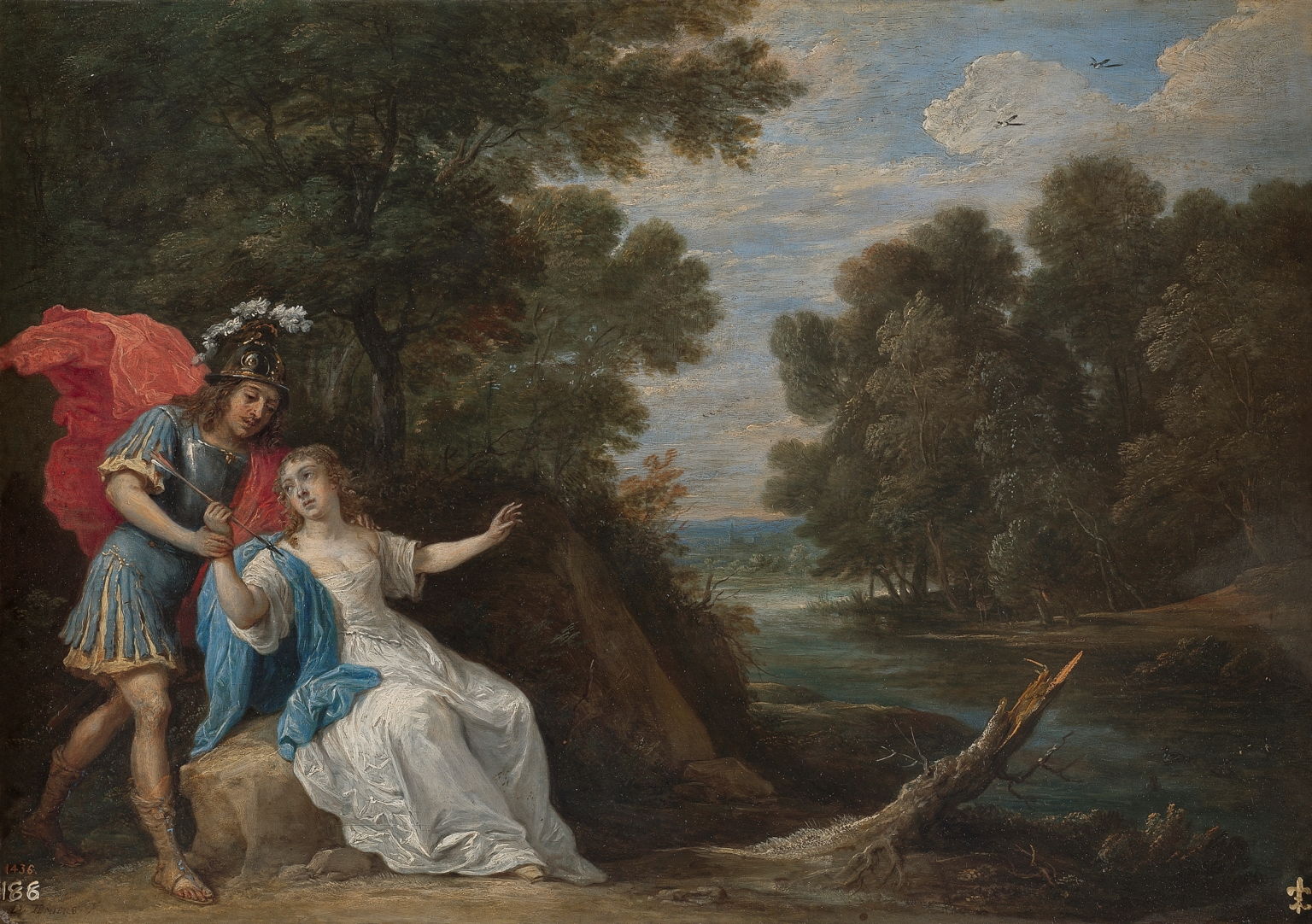
David Teniers the Younger (1610–1690), Reconciliation of Rinaldo and Armida (1628-30), oil on copper, 27 x 39 cm, Museo Nacional del Prado, Madrid, Spain. Wikimedia Commons.

That concludes with Armida in despair, trying to take her own life with one of Cupid’s symbolic bolts of love, and her rescue by Rinaldo. He then promises to be her servant and her champion, in the hope that true faith will be revealed and convert her to Christianity.

Armida has often been compared to Circe and other sorceresses who anticipated the more modern concept of the femme fatale. Tasso’s Armida is still more complex, and the fate of her relationship with Rinaldo left open to speculation.

References

Wikipedia on Jerusalem Delivered.
Wikipedia on Torquato Tasso.

Project Gutenberg (free) English translation (Fairfax 1600).

Librivox audiobook of the Fairfax (1600) English translation (free).

Thomas Asbridge (2004) The First Crusade, A New History, Free Press, ISBN 978 0 7432 2084 2.
Anthony M Esolen, translator (2000) Torquato Tasso, Jerusalem Delivered, Gerusalemme Liberata, Johns Hopkins UP. ISBN 978 0 801 863233. A superb modern translation into English verse.
John France (1994) Victory in the East, a Military History of the First Crusade, Cambridge UP. ISBN 978 0 521 589871.
Joanthan Riley-Smith, ed (1995) The Oxford Illustrated History of the Crusades, Oxford UP. ISBN 978 0 192 854285.
Jonathan Riley-Smith (2014) The Crusades, A History, 3rd edn., Bloomsbury. ISBN 978 1 4725 1351 9.
Johathan Unglaub (2006) Poussin and the Poetics of Painting, Pictorial Narrative and the Legacy of Tasso, Cambridge UP. ISBN 978 0 521 833677.

Jerusalem Delivered: 9 Armida’s Garden

By: hoakley
23 March 2026 at 20:30

The crusaders led by Godfrey of Bouillon desperately need Rinaldo back if they are to resume their assault on Jerusalem. Guelph’s party, notably the knights Charles (Carlo) and Ubaldo, have gone in search of him. But Rinaldo has been lured into a trap by the sorceress Armida, who intended to kill him. At the last moment, though, she falls in love with him and abducts him in her chariot.

That flies the couple to the distant, deserted and enchanted Fortunate Isles, where she lives in her garden that is perpetually in Spring. The wizard explains this to Charles and Ubaldo, to aid them in their mission to rescue the knight.

teniersmagiciandiscoverscarlosubaldo
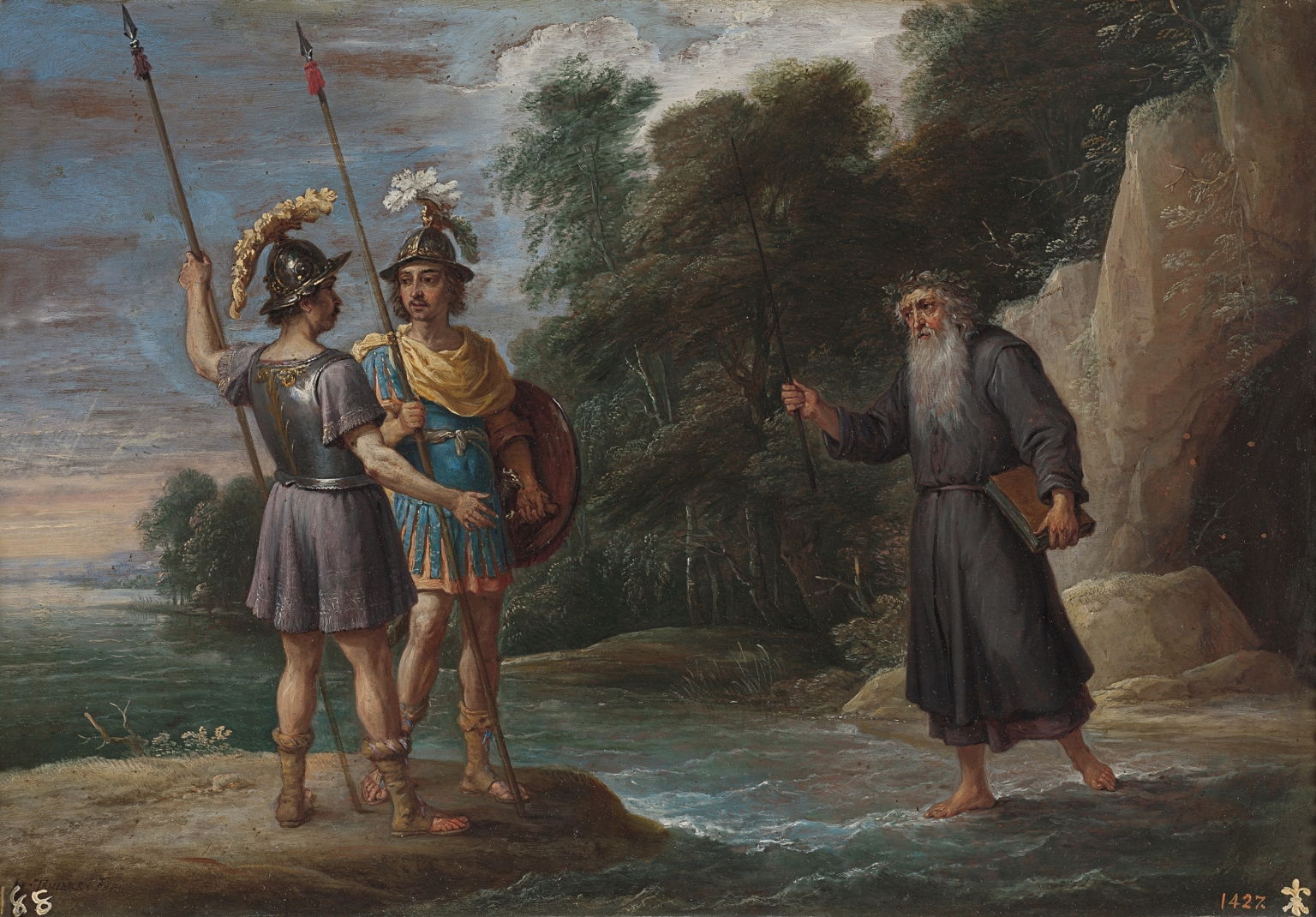
David Teniers the Younger (1610–1690), The Magician Shows Carlos and Ubaldo the Whereabouts of Rinaldo (The search for Rinaldo) (1628-30), oil on copper, 27 x 39 cm , Museo Nacional del Prado, Madrid, Spain. Wikimedia Commons.

David Teniers the Younger’s The Magician Shows Carlos and Ubaldo the Whereabouts of Rinaldo (The search for Rinaldo) from 1628-30 is a small oil on copper painting in his series telling this section of Tasso’s epic. Here the wizard despatches the two knights to the Fortunate Isles.

At the start of canto fifteen, Charles and Ubaldo set off to retrace their steps with the wizard as their guide. The river takes them gently down to the sea, where a ship awaits. They board, and sail at miraculous speed past Ascalon and the mouths of the River Nile, westward through the Mediterranean, and through the Pillars of Hercules into the Atlantic Ocean. They eventually approach the Fortunate Isles, pull into a harbour, and the two knights disembark.

They spend the night at the foot of the mountain they have to climb to reach Armida’s garden with the captive Rinaldo. They set off at dawn, only to encounter their first obstacle: a fearsome dragon blocking their passage up the mountain. Charles draws his sword ready to slay the dragon, but Ubaldo waves a golden wand, a gift of the wizard, which drives it away.

poussincompanionsrinaldo
Nicolas Poussin (1594–1665), The Companions of Rinaldo (c 1633-4), oil on canvas, 119 x 101 cm, The Metropolitan Museum of Art, New York, NY. Wikimedia Commons.

Poussin’s The Companions of Rinaldo (c 1633-4) shows the two knights confronting this dragon. Charles stands in the centre with his sword ready, but Ubaldo behind him leaves his weapon in its scabbard and brandishes his golden wand instead. In the background at the left is the magic ship in which they sailed, and standing in its prow is the maiden who steered it.

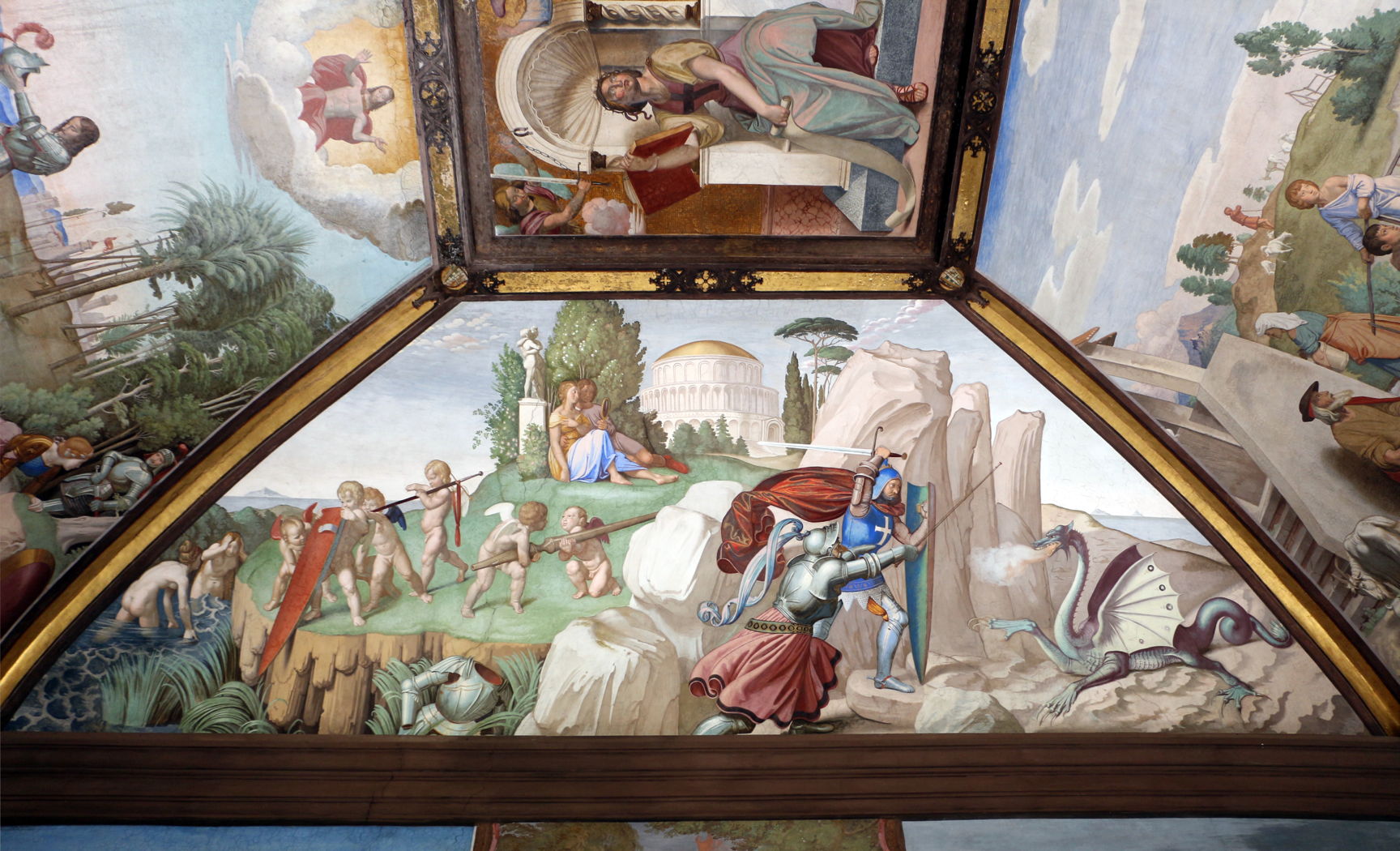
overbeckubaldocarloliberaterinaldo
Johann Friedrich Overbeck (1789-1869), Ubaldo and Carlo free Rinaldo from Armida’s Castle (1819-27), fresco, dimensions not known, Casa Massimo, Rome, Italy. Image by Sailko, via Wikimedia Commons.

Johann Friedrich Overbeck’s fresco of Ubaldo and Carlo free Rinaldo from Armida’s Castle from 1819-27, in the Casa Massimo, Rome, shows an interesting composite scene. To the right of centre, Charles and Ubaldo wield their sword and wand, and in the distance are Armida and Rinaldo in the garden on the summit. Amorini are playing with Rinaldo’s weapons, and his empty suit of armour has been cast into the undergrowth.

Next the pair have to face a lion, which is similarly dismissed with a wave of the wand. After that comes an army of animals they disperse readily, and Charles and Ubaldo are on the ascent towards the stretch of snow and ice they must cross before reaching Armida’s eternal Spring. Once up at the top, the two knights pause from their strenuous climb, slaking their thirst in a mountain stream. Grassy banks either side of the stream have a fine banquet laid out on them, and there are two naked young women cavorting in the water.

tenierscarlosubaldoislands
David Teniers the Younger (1610–1690), Carlos and Ubaldo in The Fortunate Isles (1628-30), oil on copper, 27 x 39 cm, Museo Nacional del Prado, Madrid, Spain. Wikimedia Commons.

David Teniers the Younger’s Carlos and Ubaldo in The Fortunate Isles (1628-30) shows this moment, with the banquet laid out on a clean white tablecloth rather than grass. Surrounded by trees and standing proud on the skyline is Armida’s palace, their destination.

delafossedanishwarriors
Charles-Alexandre Coëssin de la Fosse (1829–1910), Danish Warriors in the Garden of Armida (1848), others detail unknown, but believed to be oil on canvas and the original in colour. By Salon 1913, via Wikimedia Commons.

I only have this monochrome image of Charles-Alexandre Coëssin de la Fosse’s painting of Danish Warriors in the Garden of Armida from 1848. The two knights are dallying rather longer than their mission had intended.

Once Charles and Ubaldo can tear themselves away from these nymphs, they press on to the circular outer wall of the palace, which opens the sixteenth canto as they enter Armida’s garden.

mullergardenofarmida
Édouard Muller (1823-1876), The Garden of Armida (1854), block-printed wallpaper, 386.1 x 335.3 cm, Philadelphia Museum of Art, Philadelphia, PA. Wikimedia Commons.

In the eighteenth and nineteenth centuries, Armida’s garden appeared on all manner of products. This wallpaper designed by Édouard Muller in 1854 is now in the Philadelphia Museum of Art, while smaller images appeared on coffee cups and much else.

Tasso gives a brief description of the garden with its figs, apples and grape vines. Birds sing, and the wind murmurs softly. One bird speaks to the two knights, telling of the chaste and modest rose flower that springs virgin from its green leaves.

stillmanrosefromarmidasgarden
Marie Spartali Stillman (1844–1927), A Rose in Armida’s Garden (1894), watercolour and graphite on paper, 64.8 x 43.2 cm, Private collection. Wikimedia Commons.

This passage about the rose was the inspiration for Marie Spartali Stillman’s exquisite watercolour of A Rose in Armida’s Garden from 1894, given by the artist as a wedding gift to a family friend.

Charles and Ubaldo then peer through the leaves and spot a loving couple, who they presume to be Rinaldo and Armida. The knight’s head rests in Armida’s lap. He then stands up and takes a crystal glass hanging at his side. Armida uses this as a mirror to adjust her hair, telling Rinaldo to keep looking into her eyes.

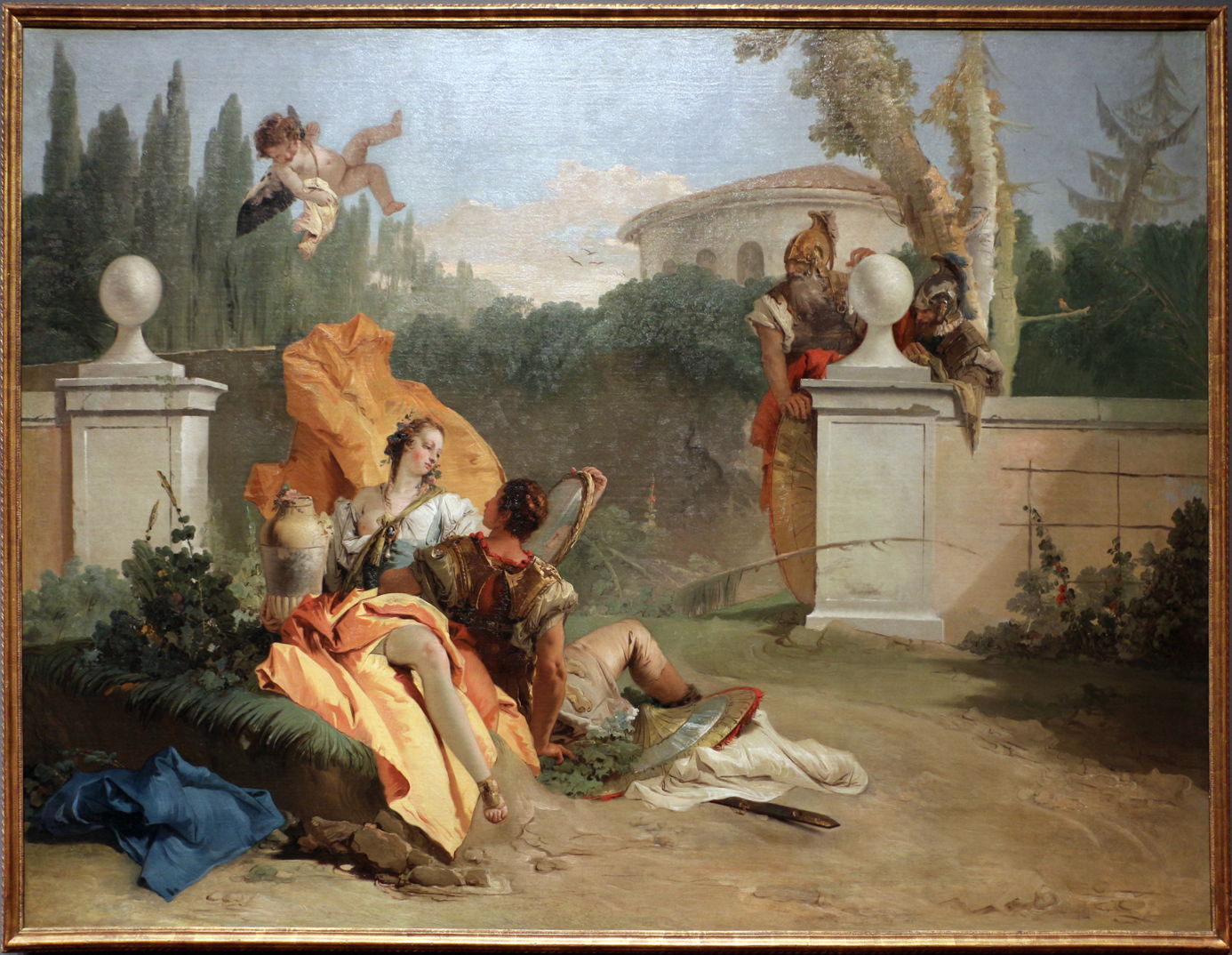
tiepolorinaldoarmidagarden
Giovanni Battista Tiepolo (1696–1770), Rinaldo and Armida in Her Garden (1742-45), oil on canvas, 187 x 260 cm, The Art Institute of Chicago, Chicago, IL. Image by Sailko, via Wikimedia Commons.

Tiepolo paints this clearly in his Rinaldo and Armida in Her Garden from 1742-45, now in The Art Institute of Chicago. It was originally hung in a special room dedicated to Tasso’s epic in the Palazzo Corner a San Polo in Venice, where it belonged to the noble Serbelloni family.

kauffmannrinarm
Angelica Kauffman (1741–1807), Rinaldo and Armida (1771), oil on canvas, 130.8 x 153 cm, Yale Center for British Art, New Haven, CT. Wikimedia Commons.

In Angelica Kauffman’s Rinaldo and Armida from 1771, the crystal glass is ready at Armida’s feet, and she is busy distracting him by sprinkling flowers over his head.

hayezrinaldoarmida
Francesco Hayez (1791–1881), Rinaldo and Armida (1812-13), oil on canvas, dimensions not known, Gallerie dell’Accademia, Venice, Italy. Wikimedia Commons.

Francesco Hayez shows a variation in his Rinaldo and Armida from 1812-13. Anticipating the next part of Tasso’s narrative, instead of Rinaldo wearing the crystal glass at his side, his circular shield rests on the ground next to Armida. Charles and Ubaldo are shown peering from behind a tree trunk, safely in the distance.

Armida then kisses Rinaldo goodbye and leaves. Charles and Ubaldo see their opportunity and step out from the bushes, dressed in full armour. Ubaldo holds a highly polished shield up so that Rinaldo can see himself for what he has become, a woman’s dandy, not a warrior knight.

References

Wikipedia on Jerusalem Delivered.
Wikipedia on Torquato Tasso.

Project Gutenberg (free) English translation (Fairfax 1600).

Librivox audiobook of the Fairfax (1600) English translation (free).

Thomas Asbridge (2004) The First Crusade, A New History, Free Press, ISBN 978 0 7432 2084 2.
Anthony M Esolen, translator (2000) Torquato Tasso, Jerusalem Delivered, Gerusalemme Liberata, Johns Hopkins UP. ISBN 978 0 801 863233. A superb modern translation into English verse.
John France (1994) Victory in the East, a Military History of the First Crusade, Cambridge UP. ISBN 978 0 521 589871.
Joanthan Riley-Smith, ed (1995) The Oxford Illustrated History of the Crusades, Oxford UP. ISBN 978 0 192 854285.
Jonathan Riley-Smith (2014) The Crusades, A History, 3rd edn., Bloomsbury. ISBN 978 1 4725 1351 9.
Johathan Unglaub (2006) Poussin and the Poetics of Painting, Pictorial Narrative and the Legacy of Tasso, Cambridge UP. ISBN 978 0 521 833677.

❌
❌