US President Donald Trump has filed a defamation lawsuit against the BBC over an edit of his 6 January 2021 speech in a Panorama documentary.
Trump has requested billions of dollars in damages, according to court documents filed in Florida.
The BBC apologised to Trump in November, but rejected his demands for compensation and disagreed there was any "basis for a defamation claim".
Trump's legal team accused the BBC of defaming him by "intentionally, maliciously, and deceptively doctoring his speech". The BBC has not yet responded to the lawsuit being filed.
This breaking news story is being updated and more details will be published shortly. Please refresh the page for the fullest version.
You can receive Breaking News on a smartphone or tablet via the BBC News App. You can also follow @BBCBreaking on X to get the latest alerts.
Thousands of drivers could have speeding fines cancelled after a fault saw some cameras falsely triggered on English A roads and motorways.
National Highways said it had found 2,650 wrongful speed camera activations since 2021 due to a delay between cameras and variable speed signs.
Affected drivers will be contacted by police and be reimbursed for any fines while points will be removed from their licences where needed.
Not all camera activations are enforced, so not all of the wrongful activations will have resulted in fines.
National Highways apologised for the error and chief executive Nick Harris said a fix for the issue has been identified.
"Safety is our number one priority… All drivers should continue observing the posted speed limits as normal. Anyone who has been impacted will be contacted by the relevant police force," he said.
National Highways, which runs England's motorways, blamed an "anomaly" in how variable speed cameras were interacting with signs on some A roads and motorways.
It meant a delay of around 10 seconds between cameras and relevant variable speed signs, meaning some drivers were incorrectly identified as speeding after the limit had changed.
The body said the 2,650 incidents since 2021 represent fewer than two each day, compared with more than 6 million activations of speed cameras on the affected roads over the same period.
It said the anomaly has impacted 10% of England's motorways and major A roads.
It is working with police to check activations and promised nobody will now be wrongly prosecuted.
Meanwhile, police forces have stopped issuing fines from variable cameras until they have confidence in their accuracy.
A Department for Transport spokesperson said: "We apologise to anyone who has been affected. Safety was never compromised, and we are working with policing to ensure nobody is incorrectly prosecuted in future.
"Enforcement is still in place, and the public can remain confident that only motorists who break the rules will be penalised."
Trade minister Chris Bryant and his Korean counterpart Yeo Han-koo announced the deal in London
The UK and South Korea have finalised a trade deal which the government says will create thousands of jobs and bring billions into the British economy.
British industries including pharmaceuticals, car manufacturing, alcohol and financial services are expected to benefit from an extension to the current tariff-free trade on most goods and services.
The deal is the fourth such agreement struck by the Labour government, following deals with the EU, US and India — none of which have had a material impact on the UK's economy so far.
South Korean culture, including music, cosmetics and food, has become much more popular in the UK in recent years.
Trade minister Chris Bryant announced the deal in Samsung's flagship store in London on Monday night, accompanied by his Korean counterpart Yeo Han-koo.
Under the deal, 98% of trade will continue to be tariff free, the same terms that the EU has with South Korea, and which the UK maintained temporarily after Brexit.
The UK's agreement with South Korea was set to expire in January 2026, but the new agreement will protect £2bn of UK exports from an increase in tariffs.
Prime Minister Keir Starmer said the deal was "a huge win for British business".
"This deal making trade even easier between us will help boost the economy - supporting jobs and growth which will be felt all over the country," he said.
Bryant said the deal would give "cast-iron protections to our key industries to speed up economic growth as part of our Plan for Change".
South Korea is the UK's 25th largest trading partner, according to the Department for Business and Trade. In the 12 months to the end of June this year, it accounted for 0.8% of the UK's total trade.
Over that same 12-month period, official figures show UK exports to South Korea fell 16.4% and South Korean exports to the UK fell 10.8%.
South Korea's trade minister told the BBC that South Korea and Britain's economies "are complimentary", and denied that the fall in trade between the nations suggested the relationship wasn't as important as it used to be.
Han-koo said the new agreement was more about reducing non-tariff barriers, such as making rules around product origin more business friendly, and creating new digital and investment protections.
"So these two economies can win by cooperating closer through this kind of framework," he added.
Han-koo also said Britain can serve as a gateway for South Korea in its trade with Europe, while South Korea can serve as a gateway to Asia for British companies.
The South Korean deal is the latest in a series of post-Brexit trade agreements, but the independent budget forecaster, the OBR, has so far deemed deals done with those larger partners as unlikely to make a measurable impact on the UK economy by 2030.
The government has said that its various trade agreements struck this year will grow the British economy by creating jobs and cutting red tape for small businesses.
But its own assessment showed that the deal with India will only increase GDP by between 0.11% and 0.14%.
That deal in particular was criticised for potentially undercutting British workers.
India is the UK's 10th-largest trading partner, accounting for 2.5% of British trade.
'Great news'
UK companies including Bentley Motors, Jaguar Land Rover (JLR) and Guinness owner Diageo welcomed the news of the South Korean deal.
Frank-Steffen Walliser, chairman and chief executive of Bentley Motors, said that South Korea is a key market for the company and the wider luxury vehicle market.
"To secure immediate ongoing access to South Korea and a positive long term trade deal, is great news. Smooth international trade is vital to UK automotive business growth."
Diageo's interim chief executive Nik Jhangiani said it would "help satisfy the growing demand from South Korean consumers" for Guinness, which is canned in Runcorn, Cheshire.
Emily Weaver Roads, interim international director at the Scotch Whisky Association, said the Asia-Pacific region was the largest regional market by value for whisky.
"The reduction of trade barriers in the Republic of Korea will further enhance Scotch Whisky's access to an important market, especially for single malts."
Trump and Xi last met face-to-face in October, when both of them visited South Korea
US President Donald Trump says he has asked Chinese leader Xi Jinping to "consider" releasing Jimmy Lai, the Hong Kong pro-democracy tycoon who was earlier this week found guilty under the city's controversial national security law.
"I feel so badly," Trump told reporters. "I spoke to President Xi about it and I asked to consider his release."
The UK similarly called for the 78-year-old to be "immediately released", with UK Foreign Secretary Yvette Cooper condemning the ruling, calling it a "politically motivated persecution".
Lai, who is a British citizen, has been in jail since December 2020 and is due to be sentenced early next year. He faces a maximum term of life in prison.
Trump made the brief comment to reporters at the White House on Monday - but did not specify when he had brought Lai's case up to Xi.
"He's an older man and he's not well. So I did put that request out. We'll see what happens, okay?," he said.
His comments come after a Hong Kong court on Monday found Lai guilty of colluding with foreign forces.
The verdict was welcomed by Hong Kong's chief executive John Lee, who said that Lai's actions had "damaged the country's interests and the welfare of Hong Kongers", but rights groups called it "a cruel judicial farce".
"He has been targeted by the Chinese and Hong Kong governments for peacefully exercising his right to freedom of expression," UK Foreign Secretary Yvette Cooper had told Parliament on Monday, calling for Lai's "immediate release".
She added that the Foreign Office has summoned the Chinese Ambassador to "underline our position in the strongest terms", adding that it was "heartbreaking that such a violation of a British man's rights could occur in Hong Kong".
China's foreign ministry had earlier on Monday dismissed criticisms of Lai's trial, describing them as "brazen defamation and smearing of the judicial system in Hong Kong".
Lai was on Monday convicted under the city's controversial national security law - which rights groups say is used to crush dissent, but which Beijing defends as essential for the city's stability.
He was also convicted of publishing seditious material on Apple Daily under a separate colonial-era law.
His detention and conviction have drawn concern from rights groups and foreign leaders, who have long called for his release.
His children have voiced serious concerns about Lai's deteriorating health in prison, with Sebastien telling the BBC earlier this year that given his father's age and health, he could "die in prison".
Trump and Xi last met face-to-face in October, when both of them visited South Korea
US President Donald Trump says he has asked Chinese leader Xi Jinping to "consider" releasing Jimmy Lai, the Hong Kong pro-democracy tycoon who was earlier this week found guilty under the city's controversial national security law.
"I feel so badly," Trump told reporters. "I spoke to President Xi about it and I asked to consider his release."
The UK similarly called for the 78-year-old to be "immediately released", with UK Foreign Secretary Yvette Cooper condemning the ruling, calling it a "politically motivated persecution".
Lai, who is a British citizen, has been in jail since December 2020 and is due to be sentenced early next year. He faces a maximum term of life in prison.
Trump made the brief comment to reporters at the White House on Monday - but did not specify when he had brought Lai's case up to Xi.
"He's an older man and he's not well. So I did put that request out. We'll see what happens, okay?," he said.
His comments come after a Hong Kong court on Monday found Lai guilty of colluding with foreign forces.
The verdict was welcomed by Hong Kong's chief executive John Lee, who said that Lai's actions had "damaged the country's interests and the welfare of Hong Kongers", but rights groups called it "a cruel judicial farce".
"He has been targeted by the Chinese and Hong Kong governments for peacefully exercising his right to freedom of expression," UK Foreign Secretary Yvette Cooper had told Parliament on Monday, calling for Lai's "immediate release".
She added that the Foreign Office has summoned the Chinese Ambassador to "underline our position in the strongest terms", adding that it was "heartbreaking that such a violation of a British man's rights could occur in Hong Kong".
China's foreign ministry had earlier on Monday dismissed criticisms of Lai's trial, describing them as "brazen defamation and smearing of the judicial system in Hong Kong".
Lai was on Monday convicted under the city's controversial national security law - which rights groups say is used to crush dissent, but which Beijing defends as essential for the city's stability.
He was also convicted of publishing seditious material on Apple Daily under a separate colonial-era law.
His detention and conviction have drawn concern from rights groups and foreign leaders, who have long called for his release.
His children have voiced serious concerns about Lai's deteriorating health in prison, with Sebastien telling the BBC earlier this year that given his father's age and health, he could "die in prison".
The group contains some of the most prominent women in UK tech, including Dr Anne-Marie Imafidon, BT Group boss Allison Kirkby and Dr Hayaatun Sillem,
The government has launched a new taskforce it says will help women "enter, stay and lead" in the UK tech sector.
Led by technology secretary Liz Kendall, it will see female leaders from tech companies and organisations advise the government on how to boost diversity and economic growth in the industry.
BCS, the Chartered Institute for IT, recently suggested women accounted for only 22% of those working in IT specialist roles in the UK.
Ms Kendall said the Women in Tech group would "break down the barriers that still hold too many people back".
"When women are inspired to take on a role in tech and have a seat at the table, the sector can make more representative decisions, build products that serve everyone," she said.
BCS, the Chartered Institute for IT, warned in December the amount of women working in the UK tech sector still lagged far behind men.
It said the government should look to help close the gender gap in order to meet its ambitious AI goals.
"We cannot create high-trust, high-integrity AI systems if the profession behind them is missing out on the talents and perspective of half the population," said chief executive Sharron Gunn.
Ms Kendall will lead the taskforce alongside Anne-Marie Imafidon, founder of Stemettes, who has been appointed as the Women in Tech Envoy.
Dr Imafidon, who passed A-level computing aged 11 and received a Master's Degree in Maths and Computer Science from the University of Oxford aged 20, has sought to encourage more young women into careers in Stem - science, technology, engineering and maths.
She told the BBC her role would build on more than a decade of work to establish greater equality for - and representation of - women.
But now, amid what she called "a fourth industrial revolution", was a key moment to "be part of shifting who is making those decisions for what comes next".
"This isn't just about having women being the driving force and building the technology, but this is about building technology that benefits everybody," she said.
'Equality long overdue'
The government said the taskforce will advise on ways to make the tech sector more representative and "ensure the UK accesses the full talent pool, market opportunities, and innovation capacity needed for economic growth".
BT Group boss Allison Kirkby, Revolut chief executive Francesca Carlesi and Dr Hayaatun Sillem, chief executive of the Royal Academy of Engineering, are among its 15 founding members.
It also includes TUC assistant general secretary Kate Bell, director of public policy at Uber Emma O'Dwyer, and Sue Daley, director of technology and innovation at industry group techUK.
"Entry routes, career progression to leadership, and access to capital are just some of the barriers women in tech still face today," Ms Daley said.
"Achieving gender equality is long overdue, and I am honoured to join the Women in Tech taskforce alongside Liz Kendall and several inspiring women from across the industry, working together to chart a path forward for true gender equality."
'All we can do': Sydney residents line up for hours to donate blood after Bondi attack
Sunday dawned hot and clear at Bondi - not a cloud in the sky, the sun shining as the waves crashed onto the sand.
It was a day made for the beach. By midday, the entire stretch was heaving with thousands of people and the sea was full of swimmers and surfers. Our family of four, on holiday at Bondi Beach, was among them.
As we headed to the beach, crossing on a footbridge from the carpark of Campbell Parade, I noticed people were setting up white tents on the grass next to a children's playground.
A truck arrived, carrying a climbing wall. Later we would learn they were preparing for a Jewish community event, called Chanukah by the Sea, to celebrate the start of the Jewish festival of Hanukkah.
In the late afternoon, loud upbeat music boomed from the speakers and across the beach. The event had begun. Our family packed up our things at the beach at about 18:00 local time (07:00 GMT) to go back to the holiday home we had rented nearby.
As we crossed the footbridge again, we saw hundreds of people - families with young children and grandparents - at the event. A stage had been set up for live performances with rows of chairs set out in front. Activity stations and stalls lined the green. The mood was relaxed and festive as laughter and children's cries floated in the air.
Scores more people were streaming into the event via an entry point with what looked like bag checks. Metal barriers had been set up to fence the event off from the rest of the green, but there appeared to be minimal security.
As the event looked like it could have food stalls, I suggested to my husband we check it out for dinner. "Let's just get pizza back at the house," he sighed - the kids were getting cranky and needed a shower.
So I went back with the children, while my husband stopped by a pizzeria for a takeaway.
BBC reporter Tessa Wong took this picture as she left Bondi Beach early on Sunday evening, shortly before the attack
Half an hour later, he returned home with the pizzas, and a worried look. While he was buying dinner, people had run past him in a panic. One of them stopped to say, "Mate, get away from here, something bad's happened."
We could hear police sirens and the roar of helicopters. We checked the news, and I quickly went to the scene, which was just 100m from where we were staying.
Police officers were just starting to cordon off the car park in front of the footbridge where my family and I had crossed over - and which the attackers used, not even an hour later, as a vantage point to shoot at the festival we had seen earlier.
Many people had gathered at a corner close to the cordon where there were bars and restaurants. Lively music blared during a beautiful sunset - an incongruous setting for what had become a deadly evening at the beach.
EPA
People were anxiously milling about, some crying and in shock. A few were desperately trying to get in touch with their loved ones who were stuck in the area that was being cordoned off.
"My daughter's at the surf club just over there, and I can't contact her," one woman told me, her eyes filling with tears. Some were arguing with police at the cordon, insisting they needed to find their relatives or get to their cars or homes.
I caught a man running past - he told me his name was Barry. He had just fled the festival with his two children. When he heard gunshots, they dropped to the ground, he said.
"And as we're lying there on the floor, with my kids, I saw a shooter or two on the bridge on the side towards Bondi beach, shooting at all of us," he said. "It was pandemonium and chaos."
Soon the restaurants and bars on the corner shut down, even as the crowd of onlookers and media grew.
As the night wore on, police and emergency vehicles moved in and out of the zone, clearing what we learnt later was a car filled with IEDs.
A fierce wind whipped up from the beach, as officers tried to hold the cordon.
BBC correspondent at scene of Bondi Beach shooting
The next morning, the main stretch of Bondi was deserted. Uncertainty, shock and anxiety still lingered. At the police cordon, a crowd thronged a cafe, buying coffees while worriedly discussing what had happened the previous night.
Watching the scene were Bondi residents Ali Pattillo, Abby Agwunobi and Brooke Schlesinger. The three women, all Americans, live in an apartment overlooking the shooting site. When they heard the gunshots, they thought it was fireworks.
"I started hearing people kind of screaming and running, grabbed the dog and hid in the bathroom," Ms Pattillo said. "And then you could just sort of hear the entire thing play out in this like horrible dream."
Ms Schlesinger said the attack was such a shock because "what appealed to us most about the Australian lifestyle is that sense of security and safety and community".
Although the Bondi community was "incredibly tight", Ms Agwunobi said she was worried about "the backlash and fallout that might happen from this", particularly with "the kind of climate with people being very anti-immigration."
"So, yeah, I'm very afraid for the next few days. And my heart just goes to the Jewish community as well because... it's just such a violation to happen, especially on a holy celebration".
Across the street, some people began laying out bouquets of flowers, balloons and an Australian flag at the corner of a primary school, in an impromptu memorial for the dead.
Soon, more people arrived to grieve at the spot. Some draped Israeli flags around their shoulders and wore kippahs, or Jewish skullcaps. People wept openly and embraced one another.
Others expressed fear and despair, including Jewish people who said they had been feeling vulnerable after a spate of antisemitism-related offences. Yvonne Haber, a Bondi resident who is Jewish, said an attack like this has "been waiting to happen, and we've been saying this is gonna happen. And now that it's happened... it's absolutely horrific."
Reuters
Thousands of flowers have been laid outside the Bondi Pavilion
As the sun began to set, I went to Bondi Pavilion, which had become an enormous shrine for for mourners after police removed part of the cordon.
Israeli and Australian flags hung on the closed gates of the pavilion, as hundreds of people gathered to lay wreaths, bouquets, candles and pebbles from the beach. The enormous pile of flowers framed a handwritten sign: "We stay united, no more hate, just love."
As 18:47 neared - the time of the attack the day before - a group of local Jewish leaders stepped forward with a large menorah with candles. They announced they were going to light the candles - a ritual associated with Hanukkah - to remember those killed in the attack, and urged the crowd to light their own candles from the menorah and take it home with them.
"We invite the crowd to take the light, to spread peace and tolerance. We have survived for thousands of years... light will always prevail," Rabbi Yossi Shuchat announced to the crowd.
Then the group began singing traditional Jewish songs, with many in the crowd joining in. Their voices soared, cracked with grief, enveloping those gathered in a wave of pure emotion.
A woman behind me quietly sobbed as she sang and clapped along to the more spirited songs. At one point, the crowd broke out into the Australian national anthem.
Afterwards, Rabbi Shuchat told me that he and his friends had decided that morning to hold the ceremony for the victims - and to make a powerful statement.
"Darkness has no power where light arrives, and therefore we implore everyone to be that light in their surroundings. Don't allow evil to come. The best way to banish evil is to shine a light."
US President Donald Trump has filed a defamation lawsuit against the BBC over an edit of his 6 January 2021 speech in a Panorama documentary.
Trump has requested billions of dollars in damages, according to court documents filed in Florida.
The BBC apologised to Trump in November, but rejected his demands for compensation and disagreed there was any "basis for a defamation claim".
Trump's legal team accused the BBC of defaming him by "intentionally, maliciously, and deceptively doctoring his speech". The BBC has not yet responded to the lawsuit being filed.
This breaking news story is being updated and more details will be published shortly. Please refresh the page for the fullest version.
You can receive Breaking News on a smartphone or tablet via the BBC News App. You can also follow @BBCBreaking on X to get the latest alerts.
A little boy faces the camera. He is pale and has no hair.
"I am seven years old and I have cancer," he says. "Please save my life and help me."
Khalil - who is pictured above in a still from the film - didn't want to record this, says his mother Aljin. She had been asked to shave his head, and then a film crew hooked him up to a fake drip, and asked his family to pretend it was his birthday. They had given him a script to learn and recite in English.
And he didn't like it, says Aljin, when chopped onions were placed next to him, and menthol put under his eyes, to make him cry.
Aljin agreed to it because, although the set-up was fake, Khalil really did have cancer. She was told this video would help crowdfund money for better treatment. And it did raise funds - $27,000 (£20,204), according to a campaign we found in Khalil's name.
But Aljin was told the campaign had failed, and says she received none of this money - just a $700 (£524) filming fee on the day. One year later, Khalil died.
Across the world, desperate parents of sick or dying children are being exploited by online scam campaigns, the BBC World Service has discovered. The public have given money to the campaigns, which claim to be fundraising for life-saving treatment. We have identified 15 families who say they got little to nothing of the funds raised and often had no idea the campaigns had even been published, despite undergoing harrowing filming.
Nine families we spoke to - whose campaigns appear to be products of the same scam network - say they never received anything at all of the $4m (£2.9m) apparently raised in their names.
A whistleblower from this network told us they had looked for "beautiful children" who "had to be three to nine years old… without hair".
We have identified a key player in the scam as an Israeli man living in Canada called Erez Hadari.
Watch how three children, including Ana from Colombia, appeared in campaign videos
Our investigation began in October 2023, when a distressing YouTube advert caught our attention. "I don't want to die," a girl called Alexandra from Ghana sobbed. "My treatments cost a lot."
A crowdfunding campaign for her appeared to have raised nearly $700,000 (£523,797).
We saw more videos of sick children from around the world on YouTube, all strikingly similar - slickly produced, and seemingly having raised huge amounts of money. They all conveyed a sense of urgency, using emotive language.
We decided to investigate further.
The campaigns with the biggest apparent international reach were under the name of an organisation called Chance Letikva (Chance for Hope, in English) - registered in Israel and the US.
Identifying the children featured was difficult. We used geolocation, social media and facial recognition software to find their families, based as far apart as Colombia and the Philippines.
Chance Letikva
A Chance Letikva campaign for Ana in Colombia - falsely claiming she had two months to live
While it was difficult to know for sure if the campaign websites' cash totals were genuine, we donated small amounts to two of them and saw the totals increase by those amounts.
We also spoke to someone who says she gave $180 (£135) to Alexandra's campaign and was then inundated with requests for more, all written as if sent by Alexandra and her father.
In the Philippines, Aljin Tabasa told us her son Khalil had fallen ill just after his seventh birthday.
"When we found out it was cancer it felt like my whole world shattered," she says.
Aljin says treatment at their local hospital in the city of Cebu was slow, and she had messaged everyone she could think of for help. One person put her in touch with a local businessman called Rhoie Yncierto - who asked for a video of Khalil which, looking back, Aljin realises was essentially an audition.
Another man then arrived from Canada in December 2022, introducing himself as "Erez". He paid her the filming fee up front, she says, promising a further $1,500 (£1,122) a month if the film generated lots of donations.
Erez directed Khalil's film at a local hospital, asking for retake after retake - the shoot taking 12 hours, Aljin says.
Months later, the family say they had still not heard how the video had performed. Aljin messaged Erez, who told her the video "wasn't successful".
"So as I understood it, the video just didn't make any money," she says.
But we told her the campaign had apparently collected $27,000 (£20,204) as of November 2024, and was still online.
"If I had known the money we had raised, I can't help but think that maybe Khalil would still be here," Aljin says. "I don't understand how they could do this to us."
When asked about his role in the filming, Rhoie Yncierto denied telling families to shave their children's heads for filming and said he had received no payment for recruiting families.
He said he had "no control" over what happened with the funds and had no contact with the families after the day of filming. When we told him they had not received any of the campaigns' donations he said he was "puzzled" and was "very sorry for the families".
Nobody named Erez appears on registration documents for Chance Letikva. But two of its campaigns we investigated had also been promoted by another organisation called Walls of Hope, registered in Israel and Canada. Documents list the director in Canada as Erez Hadari.
Photos of him online show him at Jewish religious events in the Philippines, New York and Miami. We showed Aljin, and she said it was the same person she had met.
We asked Mr Hadari about his involvement in a campaign in the Philippines. He did not respond.
We visited further families whose campaigns were either organised by, or linked to, Mr Hadari - one in a remote indigenous community in Colombia, and another in Ukraine.
As with Khalil's case, local fixers had got in touch to offer help. The children were filmed and made to cry or fake tears for a nominal fee, but never received any further money.
In Sucre, north-west Colombia, Sergio Care says he initially refused this help. He had been approached by someone called Isabel, he says, who offered financial assistance after his eight-year-old daughter, Ana, was diagnosed with a malignant brain tumour.
But Isabel came looking for him at the hospital treating Ana, he says, accompanied by a man who said he worked for an international NGO.
The description Sergio gave of the man matched that of Erez Hadari - he then recognised him in a photo we showed him.
"He gave me hope... I didn't have any money for the future."
Demands on the family did not end with the filming.
Isabel kept ringing, Sergio says, demanding more photos of Ana in hospital. When Sergio didn't reply, Isabel started messaging Ana herself - voice notes we have heard.
Ana told Isabel she had no more photos to send. Isabel replied: "This is very bad Ana, very bad indeed."
In January this year, Ana - now fully recovered - tried to find out what happened to the money promised.
"That foundation disappeared," Isabel told her in a voice note. "Your video was never uploaded. Never. Nothing was done with it, you hear?"
But we could see the video had been uploaded and, by April 2024, appeared to have raised nearly $250,000 (£187,070).
Ana and her dad live in a remote indigenous community in Colombia
In October, we persuaded Isabel Hernandez to speak to us over video link.
A friend from Israel, she explained, had introduced her to someone offering work for "a foundation" looking to help children with cancer. She refused to name who she worked for.
She was told only one of the campaigns she helped organise was published, she says, and that it had not been successful.
We showed Isabel that two campaigns had in fact been uploaded - one of them apparently raising more than $700,000 (£523,797).
"I need to apologise to [the families]," she said. "If I'd known what was going on, I would not have been able to do something like this."
In Ukraine, we discovered that the person who approached the mother of a sick child was actually employed in the place where the campaign video was filmed.
Tetiana Khaliavka organised a shoot with five-year-old Viktoriia, who has brain cancer, at Angelholm Clinic in Chernivtsi.
One Facebook post linked to Chance Letikva's campaign shows Viktoriia and her mother Olena Firsova, sitting on a bed. "I see your efforts to save my daughter, and it deeply moves us all. It's a race against time to raise the amount needed for Viktoriia's treatments," reads the caption.
Olena says she never wrote or even said these words and had no idea the campaign had been uploaded.
It appears to have raised more than €280,000 (£244,000).
Tetiana, we were told, was in charge of advertising and communications at Angelholm.
The clinic recently told the BBC it didn't approve filming on its premises - adding: "The clinic has never participated in, nor supported, any fundraising initiatives organised by any organisation."
Angelholm says it has terminated Tetiana Khaliavka's employment.
Olena with her daughter Viktoriia, who has recently been diagnosed with another brain tumour
Olena showed us the contract she had been asked to sign.
In addition to the family's $1,500 (£1,122) filming fee on the day, it states they would get $8,000 (£5,986) once the fundraising goal was met. The amount for the goal, however, has been left blank.
The contract showed an address in New York for Chance Letikva. On the organisation's website, there is another - in Beit Shemesh, about an hour from Jerusalem. We travelled to both, but found no sign of it.
And we discovered Chance Letikva seems to be one of many such organisations.
The man who filmed Viktoriia's campaign told our producer - who was posing as a friend of a sick child - that he works for other similar organisations.
"Each time, it's a different one," the man - who had introduced himself as "Oleh" - told her. "I hate to put it this way, but they work kind of like a conveyor belt."
"About a dozen similar companies" requested "material", he said, naming two of them - Saint Teresa and Little Angels, both registered in the US.
When we checked their registration documents, we once again found Erez Hadari's name.
What is not clear is where the money raised for the children has gone.
More than a year after Viktoriia's filming, her mother Olena rang Oleh, who seems to go by Alex Kohen online, to find out. Shortly afterwards, someone from Chance Letikva called to say the donations had paid for advertising, she says.
This is also what Mr Hadari told Aljin, Khalil's mother, when she confronted him over the phone.
"There is cost of advertising. So the company lost money," Mr Hadari told her, without giving any evidence to support this.
Charity experts told us advertising should not amount to more than 20% of the total raised by campaigns.
Someone previously employed to recruit children for Chance Letikva campaigns told us how those featured had been chosen.
They had been asked to visit oncology clinics, they said - speaking on condition of anonymity.
"They were always looking for beautiful children with white skin. The child had to be three to nine years old. They had to know how to speak well. They had to be without hair," they told us.
"They asked me for photos, to see if the child is right, and I would send it to Erez."
The whistleblower told us Mr Hadari would then send the photo on to someone else, in Israel, whose name they were never told.
As for Mr Hadari himself, we tried to reach him at two addresses in Canada but could not find him. He replied to one voice note we had sent him - asking about the money he had been apparently crowdfunding - by saying the organisation "has never been active", without specifying which one. He did not respond to a further voice note and letter laying out all our questions and allegations.
Erez Hadari
Erez Hadari sent this photo of himself to Khalil's mum, Aljin
Campaigns set up by Chance Letikva for two children who died - Khalil and a Mexican boy called Hector - still appear to be accepting money.
Chance Letikva's US branch appears to be linked to a new organisation called Saint Raphael, which has produced more campaigns - at least two of which seem to have been filmed in Angelholm clinic in Ukraine, as the clinic's distinctive wood panelling and staff uniforms can be seen.
Olena, Viktoriia's mother, says her daughter has been diagnosed with another brain tumour. She says she is sickened by the findings of our investigation.
"When your child is… hanging on the edge of life, and someone's out there, making money off that. Well, it's filthy. It's blood money."
The BBC contacted Tetiana Khaliavka and Alex Kohen, and the organisations Chance Letikva, Walls of Hope, Saint Raphael, Little Angels and Saint Teresa - inviting them to respond to the allegations made against them. None of them replied.
The Israeli Corporations Authority, which oversees the country's non-profit organisations, told us that if it has evidence founders are using entities as "a cover for illegal activity", then registration inside Israel may be denied and the founder could be barred from working in the sector.
UK regulator, the Charity Commission, advises those wishing to donate to charities to check that those associations are registered, and that the appropriate fundraising regulator should be contacted if in doubt.
Additional reporting by: Ned Davies, Tracks Saflor, Jose Antonio Lucio, Almudena Garcia-parrado, Vitaliya Kozmenko, Shakked Auerbach, Tom Tzur Wisfelder, Katya Malofieieva, Anastasia Kucher, Alan Pulido and Neil McCarthy
If you have any information to add to this investigation please contact simi@bbc.co.uk
At a meeting of his cabinet at the White House two weeks ago, US President Donald Trump looked around the long room filled with his top advisers, administration officials and aides, and made a prediction.
The next Republican presidential candidate, he said, is "probably sitting at this table".
"It could be a couple of people sitting at this table," he added, hinting at possible electoral clashes to come.
Despite a constitutional amendment limiting him to two four-year terms, his supporters chanted "four more years" at a rally last Tuesday night in Pennsylvania. Trump said at the time that the final three years of his second term amount to an "eternity".
But in the cabinet room last week, when talking about prospects for the 2028 Republican president nomination, he was clear: "It's not going to be me."
The next presidential election may seem a long way off, but Trump's own speculation – and certain frictions within Trump's coalition - suggest that the jockeying to succeed and define the Make America Great Again (Maga) movement after Trump is well under way.
EPA/Shutterstock
At 78 when he was sworn in for the second time, Trump was the oldest person ever elected president - some media outlets suggested may be slowing him down; Trump called such speculation "seditious"
In last month's local elections, the Republican Party lost support among the minority and working-class voters who helped Trump win back the White House in 2024.
Members of his team have feuded over policy. And some, most notably Congresswoman Marjorie Taylor Greene, have cut loose from his orbit, accusing the president of losing touch with the Americans who gave him power.
There has been speculation about fractures within the Maga base in certain quarters of the international press, as well as at home. On Monday, a headline in The Washington Post asked: "Maga leaders warn Trump the base is checking out. Will he listen?"
The warning signs are there. While Trump has long been known for being in tune with his base, the months ahead will pose a series of challenges to the president and his movement. Nothing less than his political legacy is at stake.
From Vance to Rubio: A team of rivals?
It was all smiles and talk of historic presidential achievements inside the friendly confines of Trump's newly redecorated, gold-bedecked cabinet room two weeks ago.
But the presidential aspirants Trump may have had in mind as he looked around the table hint at just how hard it could be to keep his Maga movement from stretching apart at the seams.
Vice-President JD Vance sat directly across from the president. As his running mate, he is widely considered to be Trump's most likely heir apparent – the favourite of Trump's sons and libertarian Silicon Valley tech billionaires.
Getty Images
Vance, more than perhaps anyone in Trump's inner circle, is allied with those trying to give Trumpism an ideological foundation
Secretary of State Marco Rubio was on the president's immediate right. The former Florida senator, who competed with Trump for the Republican nomination in 2016, had spent the past 10 years undergoing a Maga transformation.
He has jettisoned his past support for liberalising immigration policy and his hard line on Russia in lieu of Trump's America First foreign policy. But if there is anyone close to an old-guard Republican with influence in Trump's party, Rubio tops the list.
Then there is Secretary Robert F Kennedy Jr, whose vaccine scepticism and "Make America Healthy Again" agenda have sent earthquakes through the US health bureaucracy; he sat two down from Rubio. The Democrat-turned-independent-turned-Republican is a living embodiment of the strange ideological bedfellows Trump made on his way to re-election last year.
And finally, Kristi Noem, the homeland security secretary, was tucked off to the corner of the table. While the former South Dakota governor is not considered a major presidential contender, her advocacy for aggressive immigration enforcement – including a recent call for a full travel ban on "every damn country that's been flooding our nation with killers, leeches and entitlement junkies" – has made her a prominent face of administration's policies.
Reuters
The jockeying to succeed and define the Maga movement after Trump is already under way
Each might believe they could, if they chose to run, become Trump's political heir and take control of the political movement that has reshaped American politics over the last decade.
But to paraphrase Benjamin Franklin's comments at the birth of American democracy, whoever wins the Republican nomination will have been given a winning coalition – if they can keep it.
The Republican empire transformed
Of course none of this is guaranteed - nor is it certain that the next generation of Maga leaders will be someone from the president's inner circle. Trump stormed the White House as a political outsider. The next Republican leader may follow a similar path.
"It's going to be up to the next Republican president who follows Trump to set him or herself apart," says former Republican Congressman Rodney Davis of Illinois, who now works for the US Chamber of Commerce.
"But at the same time make sure that you don't go too far away, because clearly it's Donald Trump [who] got elected president twice."
When the November 2028 presidential election rolls around, American voters may not even want someone like Trump. Some public opinion polls suggest that the president may not be as popular as he once was.
A survey by YouGov earlier this month indicated the president had a net approval rating of -14, compared with +6 when he took office again in January. Then there are concerns about the economy and his relentless efforts to push the boundaries of presidential power.
Getty Images
Leadership of Trump's movement still represents the keys to the Republican empire
Leadership of Trump's movement still represents the keys to the Republican empire, however, even if that empire has drastically changed in recent years.
"I think the Republican coalition has become fundamentally different over the last few decades," said Davis, who served in Congress from 2013 to 2023. "The Republican coalition that existed when Ronald Reagan was elected is not the Republican coalition anymore."
Back in the 1980s, the Reagan coalition was a fusion of free-market economics, cultural conservatism, anti-communism and international foreign affairs, says Laura K Field, author of Furious Minds: The Making of the Maga New Right.
Trump's party, she continues, was perhaps best described by long-time Trump adviser and current state department official Michael Anton in a 2016 essay advocating for Trump's election. In contrast with the Reagan era, its core principles include "secure borders, economic nationalism and America-first foreign policy".
'Normie Republicans' versus 'the edgelords'
Earlier this month, the conservative Manhattan Institute released a comprehensive survey of Republican voters, shedding more light on the composition of Trump's coalition.
It suggested that 65% of the current Republican Party are what it calls "core Republicans" – those who have supported party presidential nominees since at least 2016. (If they were alive in the 1980s, they may well have voted for Reagan.)
On the other hand, 29% are what the Institute called "new entrant Republicans". It is among those new Republicans that the challenge to the durability of Trump's coalition presents itself.
Only just over half said they would "definitely" support a Republican in next year's mid-term congressional elections.
According to the survey, the new entrants are younger, more diverse and more likely to hold views that break with traditional conservative orthodoxy. They hold comparatively more left-leaning views of economic policy, they tend to be more liberal on immigration and social issues, and they may also be more pro-China or critical of Israel, for example.
AFP via Getty Images
Trump was able to attract 'new entrant Republican' voters into his coalition - the question is whether he and his political heirs can keep them, or if they even want to
Jesse Arm, vice-president of external affairs at the Manhattan Institute, told the BBC in an email: "A lot of the conversation about the future of the right is being driven by the loudest and strangest voices online, rather than by the voters who actually make up the bulk of the Republican coalition."
Perhaps not surprisingly, the so-called new entrant Republican voters are significantly less supportive of some of Trump's would-be heirs. While 70% of core Republicans have positive views of Rubio and 80% for Vance, just over half of new entrants feel that way about either.
Other findings could be more concerning for Republicans.
More than half of new entrants believe the use of political violence in American politics "is sometimes justified" – compared to just 20% among core Republicans.
It also suggests they may be more likely to be tolerant of racist or anti-Semitic speech and more prone to conspiratorial thinking – on topics like the moon landings, 9/11 and vaccines.
Trump was able to attract these voters into his coalition. The question is whether he and his political heirs can keep them there – or if they even want to.
"The real takeaway is not that these voters will 'define' the post-Trump GOP, but that future Republican leaders will have to draw clear lines about who sets the agenda," argues Mr Arm.
"The heart of the party remains normie Republicans, not the edgelords that both the media and the dissident right are strangely invested in elevating."
Clashes in the conservative ranks
The divides revealed in the Manhattan Institute poll helps explain some of the most notable frictions within the Trump coalition over the past few months.
The Trump-Greene feud that culminated in the latter's resignation from Congress began with her backing of a full release of the government files connected to the Jeffrey Epstein underage sex-trafficking case – long a source of conservative conspiracy theories.
It broadened, however, into a critique of Trump's Middle East policy and accusations of his failure to address cost-of-living and healthcare concerns for low-income American voters.
An earlier high-profile Maga split erupted over Trump's economic policy, with billionaire Elon Musk, a strong supporter and member of Trump's inner circle at the start of the year, going on to condemn certain tariffs and government spending policies.
Reuters
An earlier high-profile Maga split erupted over Trump's economic policy
The president has, for the moment, largely tried to stay out of another bitter clash within conservative ranks over whether Nick Fuentes, a far-right political commentator and Holocaust denier, is welcome within the conservative movement.
It's a dispute that has roiled the influential Heritage Foundation and pitted some powerful right-wing commentators against each other.
According to Ms Field, those who follow Trump may find it a difficult conflict to avoid. "Nick Fuentes has a huge following," she says. "Part of how the conservative movement got the energy and power that they've got is by peddling to this part of the Republican Party."
In the halls of the Republican-controlled Congress, some signs of friction with the president's agenda are showing. Despite White House lobbying, it couldn't stop the House from passing a measure mandating release of the Epstein files.
The president has also been unable to convince Senate Republicans to abandon the filibuster, a parliamentary procedure Democrats in the minority have been able to block some of Trump's agenda.
AFP via Getty Images
Even a defeat next year – or in 2028 – is unlikely to mark the end of Trumpism
Meanwhile, Trump's party has been stumbling at the polls, with the Democrats winning governorships in Virginia and New Jersey last month by comfortable margins.
In dozens of contested special elections for state and local seats over the past year, Democrats have on average improved their margins by around 13% over similar races held in last November's national elections.
The future of Trumpism
All of this will be front of mind for Republicans ahead of the 2026 mid-term congressional elections - and it will do little to ease the concerns held by some that, without Trump at the top of the ticket, their coalition will struggle to deliver reliable ballot-box victories.
Yet even a defeat next year – or in 2028 – is unlikely to mark the end of Trumpism.
The ascent by Trump's Maga movement to the pinnacle of American power has been far from a smooth one. It includes a mid-term rout in 2018 and Trump himself losing in 2020, before his re-election last November.
But the changes that Trump has wrought within the Republican Party itself appear to be foundational ones, according to Ms Field. His Maga coalition builds on strains of populist movements in the US that date back decades or more – from Barry Goldwater's insurgent presidential campaign in 1964 to the Tea Party protests during Barack Obama's presidency.
"These things are not coming out of nowhere. They are forces in American politics that have been underground for a while, but have been just kind of fermenting."
The old Republican order, she argues, is a relic of the past.
"The Trump movement is here to stay and there's no real likelihood of the old establishment returning with any sort of clout - that much is clear."
Top picture credit: Getty Images
BBC InDepth is the home on the website and app for the best analysis, with fresh perspectives that challenge assumptions and deep reporting on the biggest issues of the day. You can now sign up for notifications that will alert you whenever an InDepth story is published - click here to find out how.
Epstein took dozens more flights to the UK than were previously known
Almost 90 flights linked to Jeffrey Epstein arrived at and departed from UK airports, some with British women on board who say they were abused by the billionaire, a BBC investigation has found.
We have established that three British women who were allegedly trafficked appear in Epstein's records of flights in and out of the UK and other documents related to the convicted sex offender.
US lawyers representing hundreds of Epstein victims told the BBC it was "shocking" that there has never been a "full-scale UK investigation" into his activities on the other side of the Atlantic.
The UK was one of the "centrepieces" of Epstein's operations, one said.
Testimony from one of these British victims helped convict Epstein's accomplice Ghislaine Maxwell of child sex-trafficking in the US in 2021. But the victim has never been contacted by UK police, her Florida-based lawyer Brad Edwards told the BBC.
The woman, given the name Kate in the trial, was listed as having been on more than 10 flights paid for by Epstein in and out of the UK between 1999 and 2006.
The BBC is not publishing further details about the women in the documents because of the risk this might identify them.
US lawyer Sigrid McCawley said the British authorities have "not taken a closer look at those flights, at where he was at, who he was seeing at those moments, and who was with him on those planes, and conducted a full investigation".
US Attorney's Office SDNY
More information has emerged about Epstein, pictured here with Maxwell, and his UK links
Under the Jeffrey Epstein Transparency Act, the deadline to release all US government files on the sex-offender financier is Friday.
But the flight logs were among thousands of documents from court cases and Epstein's estate which have been already made public over the past year, revealing more about his time in the UK, such as trips to royal residences.
The BBC examined these documents as part of an investigation trying to piece together Epstein's activities in the UK.
It revealed that:
The incomplete flight logs and manifests record 87 flights linked to Epstein - dozens more than were previously known - arriving or departing from UK airports between the early 1990s and 2018
Unidentified "females" were listed among the passengers travelling into and out of the UK in the logs
Fifteen of the UK flights took place after Epstein's 2008 conviction for soliciting sex from a minor, which should have raised questions from immigration officials
Although Epstein died in jail in 2019, before his trial on charges of trafficking minors for sex, legal experts have told the BBC a UK investigation could reveal whether British-based people enabled his crimes.
Two months ago the BBC sent the Metropolitan Police, which has previously examined allegations about Epstein's activities in Britain, publicly available information about the UK flights with suspected trafficking victims on board.
Later, we sent the Met a detailed list of questions about whether it would investigate evidence of possible British victims of Epstein trafficked in and out of the UK.
The Met did not respond to our questions. On Saturday, it released a broader statement saying that it had "not received any additional evidence that would support reopening the investigation" into Epstein and Maxwell's trafficking activities in the UK.
"Should new and relevant information be brought to our attention", including any resulting from the release of material in the US, "we will assess it", the Met said.
Sigrid McCawley, who represents hundreds of Epstein victims, criticised the Met for declining to investigate
US lawyer Brad Edwards, who has been representing Epstein victims since 2008, told us "three or four" of his clients are British women "who were abused on British soil both by Jeffrey Epstein and others".
Other victims were recruited in the UK, trafficked to the United States and abused there, he said.
Mr Edwards said he is also representing women of other nationalities who say they were trafficked to the UK for abuse by Epstein and others.
Our analysis shows Epstein used commercial and chartered flights, as well as his private planes, to travel to the UK and to arrange transport for others, including alleged trafficking victims.
More than 50 of the flights involved his private jets, mostly flying to and from Luton Airport, with several flights at Birmingham International Airport, and one arrival and departure each at RAF Marham in west Norfolk and at Edinburgh Airport.
Limited records of commercial and chartered flights taken by Epstein, or paid for by him, show dozens more journeys, mainly via London Heathrow, but also Stansted and Gatwick.
In a number of the logs of Epstein's private planes, including some detailing trips to the UK, women on the flight are identified only as unnamed "females".
"He's absolutely choosing airports where he feels it will be easier for him to get in and out with victims that he's trafficking," said Ms McCawley.
Private aircraft did not have to provide passenger details to UK authorities before departure in the same way as commercial aircraft during the period covered by the documents we examined. The Home Office told us they were "not subject to the same centralised record-keeping".
That loophole was only closed in April last year.
Kate, the British woman who testified against Maxwell, was on some of the commercial flights in the records we examined. She described in court that she had been 17 when Maxwell befriended her and introduced her to Epstein - who then sexually abused her at Maxwell's central London home.
In the 2021 trial, she described how Maxwell gave her a schoolgirl outfit to wear and asked her to find other girls for Epstein. As well as the dozen flights to and from the UK, Kate told the court she had been flown to Epstein's island in the US Virgin Islands, New York and Palm Beach in Florida, where she says the abuse continued into her 30s.
Reuters
Kate, pictured on the right with her face blurred, testified at Maxwell's trial
Mr Edwards, her lawyer, told BBC News that even after that testimony, Kate has "never been asked" by any UK authorities any questions about her experience - "not even a phone call".
He said that if British police were to launch an investigation into Epstein's activities and his enablers, Kate would be happy to help.
Prof Bridgette Carr, a human-trafficking expert at the University of Michigan Law School, said trafficking cases usually require many people working together.
"It's never just one bad person," she said. "You don't think about the accountant and the lawyer and the banker - or all the bankers - and all these people that had to implicitly, and sometimes explicitly, be OK with what was happening for it to continue."
There are also questions about how Epstein was able to travel freely to the UK after his 2008 conviction for soliciting a minor for sex, which meant he had to register as a sex offender in Florida, New York and the US Virgin Islands.
Epstein was released from prison in 2009 after serving 13 months. Documents suggest Epstein took a Virgin Atlantic flight from the US to London Heathrow in September 2010, just two months after he completed his probation on house arrest.
Home Office rules at the time said foreign nationals who received a prison sentence of 12 months or more should, in most cases, have been refused entry.
But immigration lawyer Miglena Ilieva, managing partner at ILEX Law Group, told us that US citizens did not usually require a UK visa for short stays, so there was no application process where they would be asked about criminal convictions.
"It was very much at the discretion of the individual immigration officer who would receive this person at the border," she said.
The Home Office said it does not hold immigration and visa records beyond 10 years and added "it is longstanding government policy that we do not routinely comment on individual cases".
During the 1980s, Epstein also used a foreign passport - issued in Austria with his picture and a false name - to enter the UK as well as France, Spain and Saudi Arabia, according to US authorities.
Epstein also listed London as his place of residence in 1985, when he applied for a replacement passport, ABC News has previously reported.
Brad Edwards says his British client Kate has never been contacted by UK police
In its statement on Saturday, the Met said it had contacted "several other potential victims" when it examined 2015 allegations by Virginia Giuffre that she had been trafficked for sexual exploitation by Epstein and Maxwell.
Ms Giuffre also said she was forced to have sex with Andrew Mountbatten-Windsor on three occasions, including when she was 17 at Maxwell's home in London, in 2001. The former prince has consistently denied the allegations against him.
The Met said its examination of Ms Giuffre's claims "did not result in any allegation of criminal conduct against any UK-based nationals" and it concluded that "other international authorities were best placed to progress these allegations".
That decision was reviewed in August 2019 and again in 2021 and 2022 with the same result, it said.
But for lawyer Sigrid McCawley, the message the Met is sending to victims is "that if you come to law enforcement and this is a powerful person you're reporting on… it will not get investigated."
More UK families will "know what sacrifice for our nation means" as the nation seeks to deter a potential confrontation with Russia, the head of the military has said.
Sir Richard Knighton said the country's security "cannot be outsourced to the armed forces" and "requires a whole-of-society response", including harnessing UK universities and manufacturing.
While the chief of the defence staff suggested there was only a remote chance of Russia directly attacking the UK, he told an event at the Royal United Services Institute that so-called hybrid attacks showed the threat was worsening.
He referenced a Russian spy ship that was recently suspected of mapping undersea cables near UK waters.
"Every day the UK is subject to an onslaught of cyber-attacks from Russia and we know that Russian agents are seeking to conduct sabotage and have killed on our shores," he added.
At the same time, Russia's military had become a "hard power [which] is growing quickly".
While Russia's full-scale invasion of Ukraine had been a strategic failure, he said, "we should be under no illusions that Russia has a massive, increasingly technically sophisticated, and now highly combat-experienced military".
Sir Richard said the UK needed to make itself a "harder target" for hybrid threats and to avoid war.
Building the nation's resilience went beyond strengthening the military and "more people being ready to fight for their country", and included harnessing the UK's universities, energy and manufacturing industries, and the NHS.
It also meant building industrial capacity "to meet the demands in the UK and of our allies to re-stock and re-arm".
"Building this industrial capacity also means we need more people who leave schools and universities to join that industry."
He added that "we need defence and political leaders to explain the importance of the industry to the nation, and we need schools and parents to encourage children and young adults to take up careers in the industry".
Addressing a skills gap highlighted in a recent report by the Royal Academy of Engineering, Sir Richard also talked about the need to work with industry and young people, announcing £50m for new defence technical excellence colleges.
In recent weeks, both France and Germany have outlined plans for voluntary national service.
Last year, the then-Conservative government set out its own compulsory proposals, which Labour dismissed as a gimmick.
Sir Richard, who became chief of the defence staff in September, said he found himself in a position none of his predecessors had: "looking at the prospect of the largest sustained increase in defence spending since the end of the Cold War".
"Sons and daughters, colleagues, veterans will all have a role to play - to build, to serve, and if necessary, to fight," Sir Richard said. "And more families will know what sacrifice for our nation means.
"That is why it's so important we do explain the changing threat and the need to stay ahead of it."
Trade minister Chris Bryant and his Korean counterpart Yeo Han-koo announced the deal in London
The UK and South Korea have finalised a trade deal which the government says will create thousands of jobs and bring billions into the British economy.
British industries including pharmaceuticals, car manufacturing, alcohol and financial services are expected to benefit from an extension to the current tariff-free trade on most goods and services.
The deal is the fourth such agreement struck by the Labour government, following deals with the EU, US and India — none of which have had a material impact on the UK's economy so far.
South Korean culture, including music, cosmetics and food, has become much more popular in the UK in recent years.
Trade minister Chris Bryant announced the deal in Samsung's flagship store in London on Monday night, accompanied by his Korean counterpart Yeo Han-koo.
Under the deal, 98% of trade will continue to be tariff free, the same terms that the EU has with South Korea, and which the UK maintained temporarily after Brexit.
The UK's agreement with South Korea was set to expire in January 2026, but the new agreement will protect £2bn of UK exports from an increase in tariffs.
Prime Minister Keir Starmer said the deal was "a huge win for British business".
"This deal making trade even easier between us will help boost the economy - supporting jobs and growth which will be felt all over the country," he said.
Bryant said the deal would give "cast-iron protections to our key industries to speed up economic growth as part of our Plan for Change".
South Korea is the UK's 25th largest trading partner, according to the Department for Business and Trade. In the 12 months to the end of June this year, it accounted for 0.8% of the UK's total trade.
Over that same 12-month period, official figures show UK exports to South Korea fell 16.4% and South Korean exports to the UK fell 10.8%.
South Korea's trade minister told the BBC that South Korea and Britain's economies "are complimentary", and denied that the fall in trade between the nations suggested the relationship wasn't as important as it used to be.
Han-koo said the new agreement was more about reducing non-tariff barriers, such as making rules around product origin more business friendly, and creating new digital and investment protections.
"So these two economies can win by cooperating closer through this kind of framework," he added.
Han-koo also said Britain can serve as a gateway for South Korea in its trade with Europe, while South Korea can serve as a gateway to Asia for British companies.
The South Korean deal is the latest in a series of post-Brexit trade agreements, but the independent budget forecaster, the OBR, has so far deemed deals done with those larger partners as unlikely to make a measurable impact on the UK economy by 2030.
The government has said that its various trade agreements struck this year will grow the British economy by creating jobs and cutting red tape for small businesses.
But its own assessment showed that the deal with India will only increase GDP by between 0.11% and 0.14%.
That deal in particular was criticised for potentially undercutting British workers.
India is the UK's 10th-largest trading partner, accounting for 2.5% of British trade.
'Great news'
UK companies including Bentley Motors, Jaguar Land Rover (JLR) and Guinness owner Diageo welcomed the news of the South Korean deal.
Frank-Steffen Walliser, chairman and chief executive of Bentley Motors, said that South Korea is a key market for the company and the wider luxury vehicle market.
"To secure immediate ongoing access to South Korea and a positive long term trade deal, is great news. Smooth international trade is vital to UK automotive business growth."
Diageo's interim chief executive Nik Jhangiani said it would "help satisfy the growing demand from South Korean consumers" for Guinness, which is canned in Runcorn, Cheshire.
Emily Weaver Roads, interim international director at the Scotch Whisky Association, said the Asia-Pacific region was the largest regional market by value for whisky.
"The reduction of trade barriers in the Republic of Korea will further enhance Scotch Whisky's access to an important market, especially for single malts."
The couple were found dead in their home with multiple stab wounds, according to the BBC's US partner CBS News
A son of film director Rob Reiner and Michele Singer Reiner has been arrested and booked on suspicion of murder after the couple were found dead in their Los Angeles home.
The Los Angeles Police Department said on Monday that Nick Reiner, 32, had been arrested and that he was in custody with no bail.
The deceased couple's 28-year-old daughter, Romy, found her parents in their home with multiple stab wounds on Sunday, sources told the BBC's US partner CBS News.
Rob Reiner is known for directing several iconic films in a variety of genres, including When Harry Met Sally, This is Spinal Tap, Stand By Me, Misery and A Few Good Men.
Emergency services were called to provide medical aid at the Reiners' Brentwood, California, home at around 15:38 local time (23:38 GMT) on Sunday.
The Los Angeles Fire Department said two people - later identified as Rob Reiner, 78, and his wife Michele, 68 - were pronounced dead at the scene.
Police said Nick Reiner was arrested several hours later, at about 21:15 local time on Sunday. Investigators have not publicly outlined a motive and said the investigation remains ongoing.
Getty Images
Rob Reiner and his family, including son Nick (fourth from left) attend a movie premiere
Nick Reiner has spoken publicly about his struggles with addiction and homelessness. His experiences formed the basis of the semi-autobiographical film Being Charlie, which he made with his father in 2015.
The family's home is in Brentwood, a wealthy celebrity enclave full of large mansions, boutique shops and restaurants. On Monday morning, a security guard stood outside the home as media gathered outside the front gate.
Rob Reiner, the son of comedy great Carl Reiner, began his career in the 1960s and rose to fame playing Meathead in the TV sitcom All in The Family.
He cemented his success with the cult mockumentary This Is Spinal Tap in 1984, which he directed and starred in.
Reiner was married to Laverne & Shirley actress Penny Marshall from 1971 to 1981 and is the adoptive father to Marshall's daughter, actress Tracy Reiner.
He married Michele Reiner in 1989, who he said he met during the making of the romantic comedy-drama film When Harry Met Sally. The couple have three children together.
EPA
A guard stood in front of the Reiner home on Monday as people and media gathered after hearing the news
Michele Reiner was an actress, photographer and producer, and the founder of Reiner Light, a photography agency and production company.
Rob Reiner was also known for his outspoken political activism and support for Democratic candidates.
In a post calling their deaths "very sad", President Donald Trump criticised Reiner, saying that they "reportedly" died "due to the anger he caused others through his massive, unyielding, and incurable affliction" with "Trump Derangement Syndrome".
"He was known to have driven people CRAZY by his raging obsession of President Donald J. Trump," the president wrote.
It is not clear what reports the president was referring to, and while the investigation is being treated as a homicide, police have yet to comment on any possible motive.
The president and his allies often used the term Trump Derangement Syndrome in reference to those who are critical of him. Reiner was a vocal critic of Trump's.
Several Republicans criticised Trump over the post, including former ally Marjorie Taylor Greene, who said the deaths were a "family tragedy, not about politics or political enemies".
"Many families deal with a family member with drug addiction and mental health issues. It's incredibly difficult and should be met with empathy especially when it ends in murder," she said.
"These go to 11" - watch Rob Reiner in the amplifier scene from This is Spinal Tap, one of the films he directed
Trump's post was also met with anger by some of the Reiners' friends.
In a post on X, Maria Shriver, the former first lady of California and longtime friend of the Reiners, said the couple were "devoted parents".
"They deeply loved all their children and they never gave up trying to care for them," she said.
Sir Elton John, who made an appearance in this year's Spinal Tap sequel, said: "I am in disbelief at today's news of Rob and Michele.
"They were two of the most beautiful people I'd ever met and they deserved better."
Fellow actor John Cusack, who appeared in Reiner's 1985 film The Sure Thing, called him "a great man", while Elijah Wood, who starred in 1994's North, said he was "horrified" by the couple's deaths.
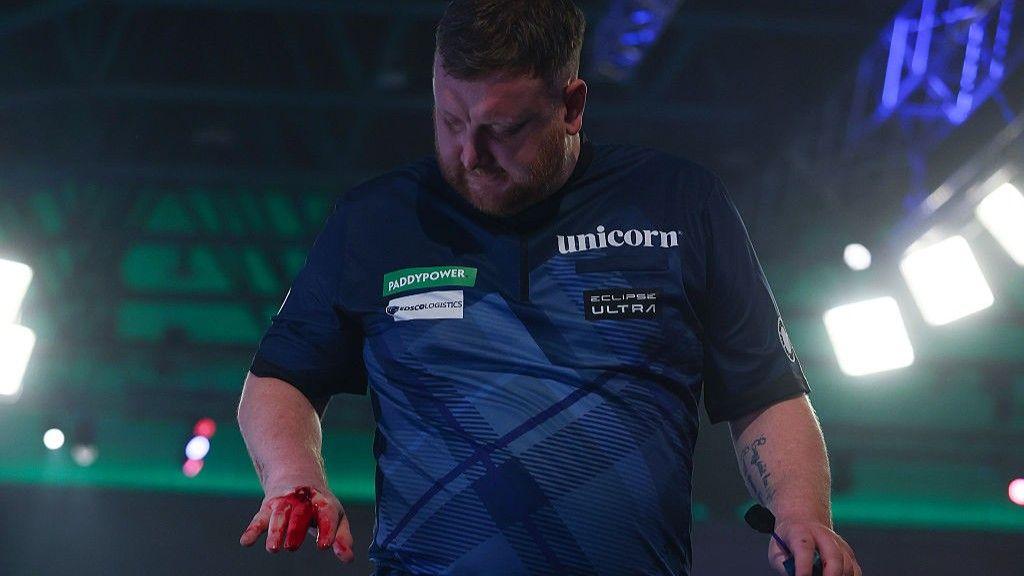
Cameron Menzies was pictured with blood on his right hand as he left the stage
Published
Cameron Menzies has apologised for angrily punching a drinks table after his five-set defeat by Charlie Manby in the first round of the PDC World Championship.
The 26th seed from Scotland hit the underside of the table three times before holding his hand up in apology to the Alexandra Palace crowd as he left the stage.
Menzies, 36, was pictured with blood pouring from a gash on his right hand.
He had led 1-0 and 2-1 in sets before highly rated English debutant Manby, 20, fought back and clinched victory with his seventh match dart.
In a statement released after the match, Menzies said: "First of all, I would like to apologise for what happened. I am sorry that I reacted in the manner that I did.
"It's not an excuse, but I have had a lot of things on my mind recently and I suppose it all just became too much at the end.
"It has not been an easy time for me with my uncle Gary passing away recently. I saw him four days before he died and he gave me a look which told me how much he thought of me.
"Had I won the game against Charlie, my second match would have been on the day of Gary's funeral and that hasn't been lost on me.
"Let me say again, that's no excuse for what I did on the stage. It was the wrong thing to do and I don't want it to take anything away from Charlie. He played well.
"This is not how I would like people to view me. Yes, I can get emotional at times, but not like that and that wasn't right."
Professional Darts Corporation chief executive Matt Porter said: "I spoke with Cameron and his management before he left the venue, and he knows there is support available from the PDC and the PDPA [Professional Darts Players Association].
"Any incident of this nature is reported to the Darts Regulation Authority for review, but our main priority is the player's health and wellbeing."
It is the second year running that Menzies has been knocked out in the first round, after he broke down in tears during and following his exit to Leonard Gates last December.
Menzies later revealed his father Ricky had been ill in hospital at the time.
Image source, Getty Images
Image caption,
Menzies was directed off stage by the referee after punching a drinks table
Image source, Getty Images
Image caption,
Menzies held his hand up in apology to the crowd when leaving the stage
Players can be sanctioned under Darts Regulation Authority rules for aggressive, disruptive or abusive behaviour.
Former World Championship semi-finalist Wayne Mardle said on Sky Sports: "The frustration boiled over, the anger and the anguish of losing, but you've got to control that. That's what conducting yourself in the right way is all about.
"He let himself down and I'm sure he'll be punished accordingly by the Darts Regulation Authority, but hopefully the Professional Darts Players Association are there for him.
"You've got to control yourself and he didn't and you can't do that anywhere, let alone on the biggest stage of them all. I hope he can correct his behaviour and move forward."
Former champion Wright safely through
Also in Monday's afternoon session, two-time champion Peter Wright made it through to round two with a straight-set win over Noa-Lynn van Leuven.
The 55-year-old Scot, wearing a festive-themed outfit, landed a 152 checkout in the first set and was taken to a deciding leg in the second, before closing out victory comfortably in the third.
Wright, who will face German Arno Merk in round two, told Sky Sports: "I know I didn't play well but I will play well in the next round. You've got to grow into the tournament."
Wright, the winner in 2020 and 2022, has struggled for form in recent times and has slipped to 30th in the PDC world rankings as a result.
Peter Wright hit nine of his 16 attempts at doubles during his first-round victory
Van Leuven, who became the first transgender player to appear at the PDC World Championship last year, was one of five players from the Women's Series to qualify for the event at Alexandra Palace.
Beau Greaves topped the series and faces Daryl Gurney first on Friday as she looks to become only the second female player to win a match in the tournament, after fellow qualifier Fallon Sherrock, who won twice at the event in December 2019.
Three places were on offer from the series, along with a spot for the Women's Matchplay winner - a title taken by Lisa Ashton, who lost to 2023 world champion Michael Smith in the first round on Thursday.
With Greaves qualifying in her own right as runner-up on the Development Tour, that meant Women's Series runner-up Sherrock, Van Leuven in fourth and Gemma Hayter, who finished fifth, joined third-placed Ashton.
Northern Ireland's Brendan Dolan hit a 170 checkout to seal the second set in his 3-1 victory over England's Tavis Dudeney, while Austria's Mensur Suljovic beat Canada's David Cameron by the same scoreline.
Rishi Sunak has said there was no "toolkit" to deal with the economic shock caused by the Covid pandemic.
The former Conservative prime minister, who was chancellor during the crisis, told an inquiry there was "not a playbook" to guide how to respond and deal with the economy being ground to a halt due to the lockdown.
"We were dealing with something no one had dealt with before," he said.
Sunak added job losses as a result of people being told to stay at home were unavoidable, but said the government was "successful in preventing mass unemployment".
The former PM was giving evidence to the public inquiry into the pandemic on Monday, answering questions on the policies he set out to support workers' incomes and keep businesses afloat.
He said that at the outbreak of the crisis, there was an "enormous amount of uncertainty", with policymakers and experts unsure of the scale and duration of the virus and how the population would respond to any measures imposed by the government.
"There was not a toolkit, there was not a playbook that you could pull of the shelf that said this is how you tend to deal with pandemics in the same way you somewhat have with other economic shocks or financial shocks," he said.
Over the past three weeks, the inquiry has been delving into the economic response to the pandemic, hearing from former ministers, treasury officials and central bankers.
Sunak's appearance on Monday was the second time he has taken the stand, after previously giving evidence in December 2023 when he was still prime minister.
He was appointed chancellor of Boris Johnson's government on 13 February, and was preparing to present a Budget before the pandemic hit UK shores and the country was put into lockdown a month later.
Sunak told the inquiry that one of his priorities was to prevent mass unemployment and said "speed was paramount" in the government's response.
He said there was an "acknowledgement" in the Treasury that they were not going to "get everything right straight away".
"We could not let perfect be the enemy of the good," he said. "We had to get things out fast."
Sunak said it was not possible "to save every person's job", but said that "as it turned out, the impact on living standards particularly for the most vulnerable in society... were stronger that I would have perhaps anticipated going into this and I'm very proud of that".
The coronavirus job retention scheme, known as furlough, was announced by Sunak in March 2020.
At his previous appearance in front of the inquiry, Sunak defended his Eat Out to Help Out policy, which was one of the government's policy measures aimed to support businesses reopening after the first lockdown.
Narges Mohammadi was given temporary release from prison on medical grounds last year (file photo)
Iranian Nobel Peace Prize winner Narges Mohammadi was taken to hospital after being beaten when she was arrested last week, her family says.
The 53-year-old human rights activist told them in a phone call on Sunday that she was brought to an emergency department twice after being "attacked by plain clothed agents with severe and repeated baton blows to the head and neck", according to the Narges Foundation.
There was no comment from Iranian authorities, but they have said she was detained for making "provocative remarks" at a memorial ceremony in the city of Mashhad on Friday.
The Nobel Committee and award-winning film-maker Jafar Panahi are among those calling for her release.
Ms Mohammadi, the vice-president of the Defenders of Human Rights Center in Iran, was awarded the 2023 Nobel Peace Prize for her activism against female oppression in Iran and promoting human rights.
She has spent more than 10 years of her life in prison. Since 2021, she has been serving a 13-year sentence on charges of committing "propaganda activity against the state" and "collusion against state security", which she denied.
In December 2024, she was given a temporary release from Tehran's notorious Evin prison on medical grounds.
She has continued campaigning while undergoing treatment.
On Friday, she gave a speech at a memorial ceremony in Mashhad for Khosrow Alikordi, a human rights activist and lawyer who was found dead earlier this month in what human rights groups described as "suspicious" circumstances.
According to the Narges Foundation, eyewitnesses cited by Ms Mohammadi's family said that she was attacked by around 15 plainclothes agents at the memorial, and that some were seen pulling her hair and beating her with clubs and batons.
On Sunday evening, Ms Mohammadi made a brief phone call to her family and told them that "the intensity of the blows was so heavy, forceful, and repeated that she was taken to the hospital emergency room twice", a statement said.
"She emphasised that she does not even know which security authority is currently detaining her, and that no explanation has been given in this regard. Her physical condition at the time of the call was not good, and she appeared unwell," it added.
The Narges Foundation cited Ms Mohammadi as saying that she was accused of "co-operating with the Israeli government" and that they had made a death threat, telling her: "We will put your mother into mourning."
The statement said that two other activists detained at the memorial ceremony, Sepideh Gholian and Pouran Nazemi, were also beaten by the plainclothes agents.
Mashhad prosecutor Hasan Hematifar told reporters on Saturday that Ms Mohammadi was among 39 people arrested.
He said that she and Khosrow Alikordi's brother, Javad, had encouraged those present "to chant norm-breaking slogans" and "disturb the peace".
The Norwegian Nobel Committee said on Friday that it was deeply concerned by what it called the "brutal arrest" of Ms Mohammadi and called on Iranian authorities to "ensure her safety and integrity, and to release her without conditions".
Mariah Carey has sold more than 200 million albums since her debut in 1990
Published
American singer-songwriter Mariah Carey will perform at the opening ceremony of next year's Winter Olympics.
The five-time Grammy award-winner will be one of the "leading performers" for the event at Milan's San Siro stadium - the home of football clubs Inter and AC Milan - on Friday, 6 February.
The Games in Milan and Cortina run from 6-22 February.
Athletes will be able to participate in the ceremony from other venues in Milan, Cortina, Valtellina and Val di Fiemme.
Carey, 56, has headlined major sporting events in the past, having sung the USA's national anthem before the NFL's Super Bowl in 2002 and at the NBA All-Star game in 2003, and performed her own song at the 2020 US Open women's tennis final.
She will be following in the footsteps of Celine Dion and Lady Gaga, who both performed at the opening ceremony of the 2024 Summer Olympics in Paris.
The Louvre museum in Paris was forced to close on Monday as its employees went on strike over working conditions and pay, leaving thousands of would-be visitors disappointed.
The walkout at the world's most visited museum in the French capital was earlier backed unanimously by some 400 staff, trade unions announced.
They said understaffed museum workers were being required to cope with ever increasing flows of people. The management did not comment immediately.
In their strike notice to Culture Minister Rachida Dati, the CFDT, CGT and Sud unions pointed to "deteriorating working conditions" and "insufficient resources" at the Louvre.
"We need a change of approach... regarding the priorities and urgent needs" of the museum, CGT representative Christian Galani was quoted as saying by BFMTV news website.
The Louvre's reception and security sector, he said, had "lost 200 full-time equivalent positions in the space of 15 years, while visitor numbers have increased by half".
Some people had already purchased tickets for Monday.
"I'm very disappointed because the Louvre was the main reason for our visit in Paris, because we wanted to see the Mona Lisa," Minsoo Kim, who travelled from Seoul with his wife for their honeymoon, told AFP news agency.
Natalia Brown, a Londoner, said she was also disappointed. "At the same time, I understand why they're doing it, it's just unfortunate timing for us," she added.
The unions said Louvre employees would gather on Wednesday morning to decide what to do next.
The museum - which is closed on Tuesdays for maintenance - said it welcomed 8.7 million visitors in 2024.
In the back of a police van immediately after the attack, Doyle told officers "I've just ruined my family's life"
A man who used his car as a "weapon" to plough into more than 100 people at Liverpool's victory parade told police he did it out of fear and panic, a court has heard.
But prosecutors said these were lies told by Paul Doyle and he had lost his temper and driven at crowds in a rage on Water Street during the celebrations.
At Liverpool Crown Court earlier, victims of his Water Street rampage on 26 May spoke about their terror and injuries.
Sheree Aldridge, 37, said she thought her baby son Teddy Eveson had died after his pram was thrown into the air after being hit by Doyle's car, adding that she thought she would "be next".
She said: "I felt an overwhelming pain in my leg and looked up to see Teddy's pushchair on its side further up the road. I thought my Teddy was dead.
"I thought I was next. I thought my children would grow up without a mother."
Hers was one of a number of victim impact statements read during the first day of Doyle's two-day sentencing hearing, with others describing how they have suffered "emotional and psychological injury" as well as "frequent flashbacks".
A 12-year-old boy, who cannot be named for legal reasons, said: "I found myself on the floor having been hit by a car I did not see coming, I have never felt so scared before in my life."
The boy's mother said in her statement her heart sank when she saw her child motionless on the floor.
She said: "The sight of my son lying motionless on the road, not moving for those few seconds, and the sound of the car hitting people will live with me forever."
PA Media
The court heard people were sent "flying in the air"
In the back of a police van immediately after the attack, Doyle told officers "I've just ruined my family's life".
He previously pleaded guilty to 31 offences relating to seriously injuring people during the victory parade when thousands of Liverpool fans were in the city.
The former Royal Marine, of Croxteth, Liverpool, changed his plea on the second day of his trial last month.
He admitted to dangerous driving, affray, 17 charges of attempting to cause grievous bodily harm (GBH) with intent, nine counts of causing GBH with intent and three counts of wounding with intent.
Doyle was picking up friends from the parade when, in the space of two minutes between 17:59 and 18:01 BST, he used his Ford Galaxy "as a weapon" and hit more than 100 supporters, Paul Greaney KC, prosecuting, said.
The 54-year-old cried frequently as horrifying CCTV and dashcam footage was played to the court.
In the footage, Doyle can be heard shouting "move" and swearing at the crowd, including after he struck a 10-year-old girl.
Footage shows car plough into crowd at Liverpool FC parade
Mr Greaney described Doyle as a "man out of control" as a 15-second CCTV clip was played of the moment his vehicle hits Teddy's pram.
The Honorary Recorder of Liverpool, Judge Andrew Menary KC, lifted reporting restrictions preventing the media from publishing the baby's name as his parents had agreed for their son to be identified.
Mr Greaney said Teddy "remarkably" escaped injury.
Five other children, who Doyle either injured or attempted to injure, cannot be named for legal reasons.
Other footage showed the windscreen of his car smashed after a man landed on it.
Mr Greaney told the court: "The strong sense from the dashcam footage is that the defendant regarded himself as the most important person on Dale Street, and considered that everyone else needed to get out of his way so that he could get to where he wanted to get to.
"The truth is a simple one. Paul Doyle just lost his temper in his desire to get to where he wanted.
"In a rage, he drove into the crowd, and when he did so, he intended to cause people within the crowd serious harm.
"He was prepared to cause those in the crowd, even children, serious harm if necessary to achieve his aim of getting through."
PA Media
He told the court that when Doyle was interviewed by police, he claimed he had stopped the car as soon as he realised he had struck someone.
Mr Greaney said: "The defendant could not have failed to see that he had struck very many people on his journey down Dale Street and Water Street, stopping to reverse and then drive on a number of times."
The court was told a man named Daniel Barr, labelled a "hero" by prosecutors, had "bravely" jumped into the back of the Galaxy and placed the vehicle into park.
"In any event, what brought the Galaxy to a halt was a combination of the number of people trapped beneath the vehicle and the actions of Daniel Barr - not the decision of Paul Doyle," Mr Greaney said.
"[Barr] saw the Galaxy weaving and hitting people, who were sent flying into the air.
"All of a sudden, the vehicle stopped right beside him. Daniel Barr instinctively pulled open the rear passenger-side door and climbed in. He did so with the intention of stopping the driver.
"As the car set off again, he leaned forward and moved the gear selector into "park". He held it there as hard as he could. The Galaxy did not stop immediately, but in the end it did.
"However, Daniel Barr describes how even after he had brought the vehicle to a halt, the defendant continued to keep his foot on the accelerator.
"That proposition is supported by other witnesses, too."
The hearing is set to continue on Tuesday morning.
Zachary Gordon (left) and Robert Capron starred in 2010's Diary of a Wimpy Kid, based on the best-selling books
Amazon has apologised after an error meant it showed a child a 15-rated film by mistake when they had tried to watch a PG movie.
The child's parent had paid to rent Diary of a Wimpy Kid from the firm's Prime Video service, but they soon realised it was incorrectly streaming Love & Other Drugs - which the British Board of Film Classification says contains "strong sex and sex references".
They complained to the media regulator Ofcom, which found Amazon in breach of its rules.
Amazon has apologised and fixed the issue, which it said was a result of the firm which licensed the films giving both the same code behind-the-scenes, when it is meant to be unique.
The BBC has approached Amazon for comment.
According to Ofcom's report, the tech giant said the issue was resolved in "less than 48 hours" - but during that time 122 customers had attempted to watch Diary of a Wimpy Kid.
It said it had "updated its existing internal processes" to stop similar mistakes in the future.
Ofcom has not fined Amazon for the error, however it said the firm had breached its rules.
"The complainant said they had rented the film for their young children to watch, but after the selected content began playing, the complainant became aware that the film that had actually played was a different film containing strong sexual content," the regulator said.
"The complainant said they contacted the service provider by telephone three times but received no call back. The complainant then made their complaint to Ofcom.
"Parents and carers would have accessed Diary of a Wimpy Kid on the basis that it was appropriate for their children to view, potentially unaccompanied by an adult (as had the complainant in this case)."
Mr Ahmed managed to wrestle the gun from the attacker in the struggle
A "hero" bystander who was filmed wrestling a gun from one of the Bondi Beach attackers has been named as 43-year-old Ahmed al Ahmed.
Video verified by the BBC showed Mr Ahmed run at the gunman and seize his weapon, before turning the gun round on him, forcing his retreat.
Mr Ahmed, a fruit shop owner and father of two, remains in hospital, where he has undergone surgery for bullet wounds to his arm and hand, his family told 7News Australia.
Eleven people were killed in the shooting on Sunday night, as more than 1,000 people attended an event to celebrate Hanukkah. The attack has since been declared by police as a terrorist incident targeting the Jewish community.
Mr Ahmed's cousin, Mustafa, told 7News Australia: "Still he is in hospital and we don't know exactly what is going on, the doctor says he is OK.
"We hope he is OK, he is a hero, 100% he is a hero. He has two shots, one in his arm and one in his hand, he has had to have an operation."
Watch: Eyewitness captures moment man tackles and disarms Bondi shooter
Two gunmen are believed to have carried out the attack, with police investigating whether others were involved. One of the gunmen was killed, with a second in "critical condition," police say.
The footage of Mr Ahmed's intervention has been shared widely online.
It shows one of the gunmen standing behind a palm tree near a small pedestrian bridge, aiming and shooting his gun towards a target out of shot.
Mr Ahmed, who was hiding behind a parked car, is seen leaping out at the attacker, who he tackles.
He manages to wrestle the gun from the attacker, pushes him to the ground and points the gun towards him. The attacker retreats.
He then lowers the weapon and raises one hand in the air, appearing to show police he was not one of the shooters.
Nearby on the bridge, another gunman continues firing. It's unclear who or what he is aiming at.
At a news conference late on Sunday, New South Wales Premier Chris Minns paid tribute to the bravery of Mr Ahmed, who was unnamed at the time.
"That man is a genuine hero, and I've got no doubt there are many, many people alive tonight as a result of his bravery."
Australian Prime Minister Anthony Albanese said: "We have seen Australians today run towards danger in order to help others.
"These Australians are heroes, and their bravery has saved lives."
How Bondi Beach shooting unfolded minute by minute
It was a night that promised to bring "joy and light" to Sydney's iconic Bondi Beach as crowds of Jewish families gathered at a park to celebrate the first night of Hanukkah, also known as the festival of light.
They were among thousands of other swimmers, surfers and sunbathers who had flocked to Australia's most famous beach on a scorching summer's afternoon.
But not long after the Hanukkah event kicked off at 17:00 local time and the first free donuts were doled out, festive music was drowned out by the sounds of screams and the echo of gunshots.
It's unclear exactly when the first shot was fired, but the initial call to police was made at 18:47. In the minutes that followed, two gunmen would kill at least 15 people, and injure dozens more, authorities said.
A local high school teacher, Chavi, told the BBC she dropped to the ground to protect her baby as "bullets were flying above us".
"It was pandemonium and chaos," another attendee, who identified himself as Barry, said as he described watching a throng of people trying to escape the scene that had suddenly devolved into a nightmare.
In one video verified by the BBC, upbeat music from the Hanukkah event can still be heard in the background as people crouch down and shots are heard, interspersed between shrieks.
The eerily jubilant music continues playing while the camera pans over the grass, revealing prostrate bodies completely still, their condition unclear.
Separate footage shows groups of people lying atop one another on the grass, as one woman tries to cover a young child's head with her hand.
Panic soon spread from the park to the sand, where videos show terrified beach goers sprinting away from the gunfire.
Screams, honking car horns and ambulance sirens fill the air in the next chaotic minutes. Some cars crashed as people desperately tried to get away, witnesses have told the BBC.
Eyewitness video shows people fleeing beach as shots are fired
A nearly 11-minute video, verified by the BBC, provides perhaps the clearest timeline of the attack - though it is unclear exactly how far into it the recording started.
It begins as the two gunmen make their way across Campbell Parade - the long stretch of road, lined with cafes, that curves around the beach - and onto a pedestrian bridge above the park where the Hannukah event was taking place.
It is from there that two men - named as Sajid Akram, 50, and his son Naveed, 24 - allegedly use the elevated position to carry out the remainder of the attack, using what an expert told the BBC were "two sporting shotguns".
One man, believed to be Naveed Akram, remains on the bridge, while the other makes his way towards the park on foot. Shots continue to echo at one-second intervals in some of the footage, while people can be heard screaming.
As the older man, believed to be Sajid Akram, begins to move away from the bridge, he starts firing at people.
Fairfax Media
Dozens of emergency services flooded Bondi Beach following the shooting
Just a few minutes later, a passerby - who is seen crouching behind parked cars - catches Sajid off guard and is able to wrestle the firearm off him within a few seconds.
The gunman stumbles away, and the man, who has been identified as Ahmed al Ahmed, points the firearm at him, before laying the weapon down against a tree and putting his hands up to signal to officers that he is not the suspect.
Ahmed, who was shot twice during the attack, has been hailed as a hero and credited by New South Wales Premier Chris Minns for saving "countless lives" with his brave actions.
Less than a minute after being disarmed, however, Sajid Akram returns to the bridge and resumes shooting at people with another weapon.
The shooting stops about two minutes later when it appears both men are hit by police fire.
About seven-and-a-half minutes into the clip, police arrive at the bridge where they are confronted with a highly charged scene - two men with gunshot wounds - the alleged gunmen - and a crowd of bystanders, some of whom appear to kick the men on the ground.
Police later confirmed that one of the gunmen, Sajid Akram, was found dead at the scene, while the other was critically wounded and taken to hospital, where he remains.
Police say both men lived about an hour's drive from Bondi Beach at a house in Bonnyrigg, a suburb in Sydney's west.
Days before the attack, however, they had decamped to a short-term rental in Campsie - about 30 minutes closer to the beach, media reports said.
Their family home in Bonnyrigg has become one of the main focuses of the police investigation. Officers raided it on Sunday night.
Footage of the raid shows three people coming out of it with their hands up, while heavily armed police officers in tactical gear surrounded the perimeter.
Those people were arrested, but have since been released without charge.
EPA
Police search the home in Bonnyrigg on Sunday night
It is still unclear if the guns used in the attack were owned by the two men, but Sajid Akram owned six registered firearms and held a recreational gun license.
His son, Naveed, was examined over his close ties to a Sydney-based Islamic State (IS) cell after authorities became aware of his activity in 2019, the ABC reported.
But Australian Prime Minister Anthony Albanese said an "assessment was made that there was no indication of any ongoing threat or threat of him engaging in violence".
Residents on the otherwise quiet, suburban street have described how the tumult of the last 48 hours has unsettled the neighbourhood.
"My daughter was yelling at me, 'mum look outside' and I saw lots of police, lots of cars, sirens and loudspeakers calling them to come out," Lemanatua Fatu, who lives opposite the men, told the BBC.
"Then I saw the news - I thought oh my goodness, it can't be them."
Additional reporting by Gabriela Pomeroy and Thomas Spencer
Watch Panorama's undercover filming: "You'll make no money my friend unless you get all your parcels out. Get them all out."
When Becky ordered a Barbie doll for her daughter, she got a notification from delivery firm Evri saying it had arrived. There was just one problem: it was nowhere to be seen.
There was no parcel at her front door, in the Hampshire village of Twyford, and the photo she was sent of its location was not one she recognised.
Becky turned detective - and she discovered that reports of similar incidents nearby had "snowballed".
Around the corner, her neighbour Jonathan had received a similar notification. It showed a photo of a parcel of tools he was expecting - taken inside a car - but nothing had been delivered. He tried to take it up with Evri, but told BBC Panorama that "they don't respond - it's very frustrating".
"You feel like you're playing Russian roulette" as to whether the parcel is going to arrive, says customer Becky
With millions relying on delivery companies to send their parcels this Christmas, we have been investigating Evri, including sending a journalist undercover as a courier.
The company is a market leader, but a recent customer survey of the 11 biggest delivery firms by industry regulator, Ofcom, suggested Evri had the most issues for parcels not being delivered and the highest level of customer dissatisfaction.
Amazon and FedEx came top for customer satisfaction.
While Evri disputes Ofcom's findings, 30 current and former workers have told us problems are being caused by growing pressures on couriers."They have to deliver so much volume now for a decent pay," one told us.
The link between poor service and work pressures was further borne out by Panorama's investigation, which found:
Couriers at an Evri depot in the Midlands describing how to cut corners to complete deliveries on time - with one telling our undercover reporter: "You can even throw the parcel at the back door"
Changes to Evri's pay rates have led some workers to claim they are earning less than minimum wage
New, lower pay rates for so-called "small packets" were also affecting courier earnings, we were told
Larger items being "misbanded" as small packets, some couriers told us, including heavy flatpack furniture and radiators
In Hampshire, parcels started to go missing in Twyford six months after a regular courier, Dave, left Evri. He worked as an Evri courier for six years, often with his wife, and they earned about £60,000 a year between them.
Like all Evri couriers, Dave was self-employed. But, because Evri pays couriers by the parcel, and sets the rate per parcel, it felt like the company was in the driving seat.
Changes to Evri's parcel rates last January, meant it no longer made financial sense to carry on, Dave told us. It would have led to him being paid less than the minimum wage, he says.
The amount Evri couriers are paid depends on the size and weight of the parcels they deliver and how far they must travel.
Couriers like Dave, who was on an Evri Plus contract, are supposed to be guaranteed at least the National Minimum Wage - currently £12.21 per hour for those aged 21 and over.
Dave says he estimated that with Evri's changes, including a new "small packets" rate, he would earn £10 an hour.
"You were always looking over your shoulder, wondering what might come next in terms of reducing your rates," he told us. "So that you're paid less for what you're doing even though you're doing the same job."
Another Evri Plus courier told Panorama he could earn as little as £7 or £8 an hour at times, once fuel and his vehicle's running costs had been taken into account.
If I had accepted the pay cut, I would have been earning "well below minimum wage", says ex-Evri driver Dave
This shouldn't be happening - according to what Evri's legal director, Hugo Martin, told a parliamentary select committee in January. The company's paid-per-parcel model, he told MPs, made sure that "couriers earn well above national minimum wage".
The committee chair, Labour's Liam Byrne, has now told Panorama that because of the "categorical assurances" that people were not paid below the minimum wage, the company should now be recalled to Parliament to investigate the full picture.
His comments come as a separate, cross-party group of MPs expressed their own concerns about Evri's delivery record last week.
Evri gave us "categorical assurances that people were not paid below the minimum wage", says Liam Byrne, chair of the Business and Trade Committee at Westminster
We put Mr Byrne's comments to Evri and a spokesperson said company couriers "generate earnings significantly above the National Living Wage".
The National Living Wage and the National Minimum Wage are currently the same for anyone aged over 21 - £12.21 an hour.
Average courier earnings, the Evri spokesperson continued, "exceeded £20 an hour". The "sector is highly competitive, but we benchmark pay locally", they added.
Small packets, small fees
It wasn't just Dave who told us the introduction of Evri's "small packets" has made it harder to make a living.
Other couriers told us they had started to see more of them in their rounds, and that it was eating into their earnings because they received less money to deliver them.
Rates vary, but Evri pays couriers as little as 35p to deliver one.
The company told us it had introduced the new "small packets" sizing in January to "remain competitive".
However, big parcels, for which couriers would be paid more per delivery, keep getting mislabelled as small packets, some couriers told the BBC.
Getty Images
Evri introduced "small packets" parcel size in January - which it can pay couriers as little as 35p to deliver
Evri does not do enough to check the items are being accurately weighed and measured by senders, they said - with heavy flatpack furniture and radiators listed as examples of large items which had been "misbanded" and paid for as small packets.
One courier told us he delivered "countless numbers of misbands", leaving him short-changed.
Parcels are labelled by clients, not Evri, the company told the BBC. It said that 99.2% of all parcels were correctly banded - and that "couriers can request checks and upgrades via the courier app, if they think a parcel has been misbanded".
'There's a safe space for everything, mate'
An Evri courier of 10 years told us their colleagues were "cutting corners" because they had to deliver so much in terms of volume to get a decent wage.
"They are not doing the job correctly… parcels go missing," he added. "Piles of parcels are found in hedges."
Our undercover reporter, who we are calling Sam because he wants to remain anonymous, was told by another courier, "if you want to earn money, you need to find a safe place and leave it there".
"You can even throw the parcel at the back door, you only get paid if the parcel is delivered," the courier explained during Sam's six-day stint in October at Evri's West Hallam delivery unit near Nottingham.
As a new starter, Sam was put on a Flex contract, which does not include sick or holiday pay and does not commit to paying the minimum wage, unlike the Plus contract.
It can be difficult for new starters to earn the same as more experienced couriers, as they don't know their patch, so they won't be as efficient.
Sam was told he could be eligible for some extra cash. New starters get payments to ensure they earn adequately while they get used to the work, Evri's lawyers told the BBC.
Couriers told us they are not paid extra for the time it takes to scan the parcels and load them into their vehicles at depots - but Evri says it factors this time into its parcel rates.
"You only get paid if the parcel is delivered. Never take it back," said one courier
Couriers are also only paid if a package is delivered and a photograph is taken - which is supposed to mean giving it to the customer, a neighbour, or finding a safe place, and not leaving it in plain sight outside the delivery address.
If drivers cannot deliver a parcel, they should make at least two more attempts to do so - according to Evri rules - but this takes time.
Back at the depot, a courier told Sam there was not much point trying to redeliver because couriers did not get paid for going back.
"You'll make no money, my friend, unless you get all your parcels out. Get them all out," he said. "There's a safe space for everything, mate."
You can deliver 50 parcels an hour on a round, a supervisor tells our undercover reporter
The company says it will deliver about 900 million parcels this year, going to almost every single home in the UK.
But 7% of customers in the six months between January and July said they had reported an Evri parcel not having been delivered - compared to an industry average of 4% - according to Ofcom's recent consumer survey.
The survey also suggested Evri had the most issues for delays in the UK, with 14% of customers reporting a parcel arriving late in the same period. The industry average is 8%, says Ofcom.
Evri told us it provides "a fast, reliable, and cost-effective delivery service" and that its "couriers are local people… and the vast majority do an excellent job and strictly follow our delivery standards".
If "a courier receives a low customer rating for a delivery, this is immediately investigated", it says.
The company, which rebranded from Hermes UK in 2022, has been owned since last year by the American investment firm Apollo Global Management. In the financial year 2023-24, Evri's pre-tax profit almost doubled to nearly £120m.
"I think Evri are making a fortune off the couriers' backs and I think the couriers are being totally ripped off," one courier told us.
For Becky and Jonathan in Hampshire, at least, all was not lost.
Becky started a spreadsheet for other people in the area to list their missing Evri parcels, after seeing how many comments were being left on the village Facebook group.
Almost 90 incidents were reported to the police. A man was arrested but never charged.
Lawyers for Evri told the BBC that this was an isolated incident and that the company took prompt action.
"The performance of our couriers is tracked in real time, with mandatory photo proof for every delivery," the company said.
Becky got a refund from the seller and bought a new Barbie, and Jonathan got his tools replaced by the seller.
Police inspect a bridge used by the gunmen as a firing-point
Two gunmen - identified by authorities as a father and son - opened fire on hundreds of people marking a Hanukkah event on Sydney's Bondi Beach on Sunday, killing 15 and leaving 27 in hospital with injuries.
The father was killed in an exchange of fire with police at the scene while the son is in hospital with critical injuries.
Among the victims of the country's worst mass shooting in decades, which targeted Jewish people and is being treated as a terrorist incident, are a 10-year-old girl, a Holocaust survivor and two rabbis.
The attackers are both said to have pledged allegiance to the Islamic Sate group. Here is what we know about them.
Minister for Home Affairs Tony Burke confirmed the relationship between the two gunmen without naming them.
Australian public broadcaster ABC did name them as Naveed Akram, 24 - who is in hospital under police guard - and his dead father Sajid Akram, 50.
Burke indicated the father held permanent residency in Australia, without giving details of his nationality.
The minister said he arrived in the country on a student visa in 1998. Later, in 2001, he transferred to a partner visa and subsequently obtained Resident Return Visas after trips overseas.
The son, he said, is an Australian-born citizen.
'Allegiance to Islamic State'
The son first came to the attention of the Australian intelligence agency (ASIO) in 2019, Prime Minister Anthony Albanese has confirmed.
"He was examined on the basis of being associated with others and the assessment was made that there was no indication of any ongoing threat or threat of him engaging in violence," the prime minister said.
Albanese said the two gunmen had acted alone and were not part of a wider extremist cell. They had, he said, been "clearly" motivated by "extremist ideology".
Two IS flags were found in the men's car at Bondi, senior officials told ABC, speaking on condition of anonymity.
A senior JCTT official, again speaking on condition of anonymity, said the ASIO had taken an interest in Naveed Akram in 2019 after police foiled plans for an IS attack.
Naveed Akram, the official said, was "closely connected" to Isaac El Matari, who was jailed in 2021 for seven years in Australia for terrorist offences.
Matari had declared himself the IS commander for Australia.
Firearms licence
The gunmen appear to have used long-barrelled guns during the attack, firing them from a small bridge.
A number of improvised explosive devices were also found in the gunmen's car, Albanese said.
New South Wales Police Commissioner Mal Lanyon said the force had recovered six firearms from the scene and confirmed that six firearms had been licensed to the father.
Sajid Akram had met the eligibility for a firearms licence for recreational hunting, Commissioner Lanyon said.
"In terms of a firearms licence, the firearms registry conducts a thorough examination of all applications to ensure a person is fit and proper to hold a firearms licence," he said.
Eligibility for a game hunting licence in NSW depends on the type of animal individuals wish to hunt, the reason for hunting and the land they want to hunt on.
'Normal people'
Watch: BBC's Katy Watson reports from Bondi gunmen's house
Naveed and Sajid Akram lived in the south-west Sydney suburb of Bonnyrigg, about an hour's drive inland from Bondi.
A few weeks before Sunday's shooting, the two men moved into an Airbnb in the suburb of Campsie, a drive of 15 to 20 minutes.
Three people at the house in Bonnyrigg were arrested overnight during a police raid but released without charge and brought back to the property.
BBC News tried to approach them on Monday but they would not come out to speak to the media.
According to the Sydney Morning Herald, a woman who identified herself as the wife and mother of the gunmen had told them on Sunday evening that the pair had said they were going on a fishing trip before heading to Bondi
Reuters news agency describes Bonnyrigg as a working-class, well-kept enclave with an ethnically diverse population.
Local residents told the agency that the Akram family had kept to themselves but seemed like any other in the suburb.
"I always see the man and the woman and the son," said Lemanatua Fatu, 66. "They are normal people."
'Not everyone who recites the Quran understands it'
Naveed Akram studied the Quran and Arabic language for a year at Al Murad Institute in western Sydney after applying in late 2019, ABC reports.
Institute founder Adam Ismail said the Bondi shooting was a "horrific shock" and such attacks were forbidden in Islam.
"What I find completely ironic is that the very Quran he was learning to recite clearly states that taking one innocent life is like killing all of humanity," he said on Monday.
"This makes it clear that what unfolded yesterday at Bondi is completely forbidden in Islam. Not everyone who recites the Quran understands it or lives by its teachings, and sadly that appears to be the case here."
Supporters of José Antonio Kast celebrated his victory
Chile is perceived by many of its neighbours in the Latin American region as a safer, more stable haven.
But inside the country, that perception has unravelled as voters worried about security, immigration and crime chose José Antonio Kast to be their next president.
Kast is a hardline conservative who has praised General Augusto Pinochet, Chile's former right-wing dictator whose US-backed coup ushered in 17 years of military rule marked by torture, disappearances and censorship.
To his critics, Kast's family history, including his German-born father's membership in the Nazi Party and his brother's time as a minister under Pinochet, is unsettling.
However, some of Kast's supporters openly defend Pinochet's rule, arguing that Chile was more peaceful then.
In a nod to Chile's past and to accusations levelled at other right-wing leaders in the region after they imposed military crackdowns on organised crime, the 59-year-old pledged in his first speech as president-elect that his promise to lead an "emergency government" would not mean "authoritarianism".
Sunday's election makes Chile the latest country in Latin America to decisively swing from the left to the right, following Argentina, Bolivia, Costa Rica, Ecuador, El Salvador and Panama.
Peru, Colombia and Brazil face pivotal elections next year.
Kast's victory places Chile within a growing bloc of conservative governments likely to align with US President Donald Trump, particularly on migration and security.
In some cases, like that of Argentina, inflation and economic crisis drove the shift. In others, it was a backlash against leftist governments mired in corruption or infighting.
In Chile, immigration and crime seemed to swing it.
Kast promised a border wall and mass deportations of undocumented migrants.
At rallies, he counted down the days until the inauguration and warned that those without papers should leave by then if they wanted the chance to ever return.
His message resonated in a country which has seen a rapid growth in its foreign-born population. Government figures show that by 2023 there were nearly two million non-nationals living in Chile, a 46% increase from 2018.
The government estimates about 336,000 undocumented migrants live in Chile, many from Venezuela.
The speed of that change has unsettled many Chileans.
"Chile was not prepared to receive the wave of immigration it did," says Jeremías Alonso, a Kast supporter who volunteered to mobilise young voters during the campaign.
He rejects critics' accusations that Kast's rhetoric amounts to xenophobia.
"What Kast is saying is that foreigners should come to Chile, let them come to work, but they should enter properly through the door, not through the window," he says, arguing that undocumented migrants are a strain on taxpayer-funded public services.
He says his working-class neighbourhood has experienced "the social changes that irregular immigration brings in terms of crime, drug addiction and security".
Jeremías Alonso supported José Antonio Kast in the election
Kast has blamed rising crime on immigration, an allegation that resonates politically even as the number of murders has fallen since peaking in 2022, and despite some studies suggesting migrants commit fewer crimes on average.
Many voters cite organised crime, drug trafficking, thefts and carjackings as contributing towards their sense of insecurity.
Kast's victory message is that migrants will be welcome if they comply with the law, criminals will be locked up and order will return to the streets.
He, like Trump, is expected to move quickly to demonstrate an "iron fist" approach, deploying the military to the border and probably promoting his crackdown through social media.
But in practice, large-scale deportations will be difficult.
Venezuela does not accept deportees from Chile and deportations have so far been limited.
Kast seems to hope his rhetoric will encourage irregular migrants to leave voluntarily. But this is unlikely to compel hundreds of thousands to pack up.
Gabriel, who is from Venezuela, felt hurt by comments diners made about migrants
For irregular migrants already in Chile, the future feels uncertain.
Gabriel Funez, a Venezuelan waiter, moved to Chile four years ago, crossing the land border irregularly to escape his country's "very, very bad economic situation".
He has since submitted his documents to police and immigration authorities and received a temporary ID so he can pay taxes but has so far had no response to his visa request.
His salary is currently being paid into a friend's bank account. "I'm basically a ghost here," he says.
While he fears deportation, his bigger concern is a rise in xenophobia, which he says has already increased.
"Kast is expressing what many Chileans want to express. He's validating it," he said.
He recalls how at the restaurant where he works, he served diners who were discussing how migrants should leave.
"It was uncomfortable. I'm a foreigner, and I'm hearing all those super hurtful words."
He explains that about 90% percent of the restaurant's staff are migrants.
With migrants increasingly key to Chilean businesses, Kast could come up against opposition from those relying on foreign labour for their business.
Carlos Alberto Cossio, a Bolivian national who has lived in Chile for 35 years, runs a business making and delivering salteñas, savoury Bolivian pastries.
Carlos Alberto Cossio says migrant workers are key to his business
He says he has often employed workers from Haiti, Colombia and Venezuela and insists that "the migrant workforce is very important".
He explains that migrants are eager to work and less likely to change jobs as they rely on their employer for a contract visa until they are issued with a permanent visa.
"Many companies, especially in fruit harvesting, employ migrant workers who are not necessarily registered," he adds.
Expelling unregistered workers "will impact Chile's export economy and make raw materials more expensive," he warns.
Mr Cossio acknowledges that there has been some friction since large numbers of migrants arrived from Venezuela to escape the economic and political crisis there.
"Many of the customs they have brought haven't been compatible with Chilean customs," he says, lamenting how this has damaged the reputation of migrants who want to work and contribute.
Mr Kast's party lacks a majority in Congress, meaning some of his proposals, from tougher sentencing to maximum-security prisons, may require compromise and negotiation.
But for many voters, the perception of control may matter just as much as delivering results as anxiety over crime, insecurity and migration is sweeping the continent.
At least 15 civilians have been confirmed dead in Sunday's shooting attack at Bondi beach.
Many were attending an event to mark the first day of the Jewish festival of Hanukkah.
Authorities have confirmed that two rabbis, a Holocaust survivor and a 10-year-old girl were among the victims.
This is what we know about those identified so far:
Matilda, 10
Authorities confirmed that a 10-year-old girl, named by her family to local media as Matilda, was among the dead.
Irina Goodhew, who organised a fundraiser for the girl's mother and said she was the child's former teacher, wrote: " I knew her as a bright, joyful, and spirited child who brought light to everyone around her.'
The Harmony Russian School of Sydney also confirmed that she was one of its students.
"We are deeply saddened to share the news that a former student of our school has passed away in the hospital due to injuries sustained from a gunshot," the school wrote on Facebook.
"Our thoughts and heartfelt condolences go out to her family, friends, and everyone affected by this tragic event … Her memory will remain in our hearts, and we honor her life and the time she spent as part of our school family."
Meanwhile her aunt spoke to ABC news and said that Matilda's sister, who was with her when she was shot, was struggling to come to terms with the loss.
"They were like twins — they've never been separated," she told the ABC.
Rabbi Eli Schlanger
Supplied
Eli Schlanger was known as the Bondi rabbi
Known as the "Bondi Rabbi", Eli Schlanger, 41, was one of the key organisers of Sunday's event. He was head of the local Chabad mission, an international Hasidic Jewish organisation based in Brooklyn.
The death of the British-born father of five was confirmed by his cousin, Rabbi Zalman Lewis.
"My dear cousin, Rabbi Eli Schlanger @bondirabbi was murdered in today's terrorist attack in Sydney," Zalman wrote on Instagram. "He leaves behind his wife & young children, as well as my uncle & aunt & siblings … He was truly an incredible guy".
In a post on its website, Chabad said Schlanger's youngest child was just two months old.
"He was the most godly, humane, kind, gracious human being I think I've ever met," Alex Ryvchin of the Executive Council of Australia Jewry, told reporters at Bondi on Monday morning.
Dan Elkayam
The death of French national Dan Elkayam was confirmed by Frances's Foreign Minister Jean-Noël Barrot.
"It's with immense sadness that we have learnt that our compatriot Dan Elkayam was among the victims of the terrorist attack that hit Jewish families gathered on the beach at Bondi in Sydney," he wrote on social media. "We mourn with his family and loved ones, with the Jewish community and the Australian people."
According to his LinkedIn profile, Elkayam worked as an IT analyst for NBCUniversal and had moved to Australia last year.
He was also a keen footballer, and "an integral member" of our premier league squad, the Rockdale Ilindin Football Club in west Sydney wrote on its Facebook page.
He was "an extremely talented and popular figure amongst team mates. Our deepest and sincerest condolances to Dan's family, friends and all that knew him. He will be missed," the club wrote.
Alexander Kleytman
Alexander Kleytman was a holocaust survivor who came to Australia from Ukraine.
"I have no husband. I don't know where is his body. Nobody can give me any answer," his wife Larisa Kleytman told reporters outside a Sydney hospital late on Sunday.
"We were standing and suddenly came the 'boom boom', and everybody fell down. At this moment he was behind me and at one moment he decided to go close to me. He pushed his body up because he wanted to stay near me," she told the Australian.
Chabad wrote on X that Alexander "died shielding her from the gunman's bullets. In addition to his wife, he leaves behind two children and 11 grandchildren."
The couple shared some of their life story with Jewish Care in 2023.
"As children, both Larisa and Alexander faced the unspeakable terror of the Holocaust," the health organisation wrote in its annual report.
"Alex's memories are particularly harrowing; recalling the dreadful conditions in Siberia where he, along with his mother and younger brother, struggled for survival."
How Bondi Beach shooting unfolded minute by minute
Peter Meagher
Former police officer Peter Meagher was working as a freelance photographer at the Hanukkah event when he was killed, his rugby club confirmed.
"For him it was simply a catastrophic case of being in the wrong place and at the wrong time," Mark Harrison, the general manager of Randwick Rugby Club, wrote on its website.
"'Marzo, as he was universally known, was a much loved figure and absolute legend in our club, with decades of voluntary involvement, he was one of the heart and soul figures of Randwick Rugby."
The club said he had spent almost four decades in the NSW Police Force where he was "hugely respected by colleagues".
"The tragic irony is that he spent so long in the dangerous front line as a Police Officer and was struck down in retirement while taking photos in his passion role is really hard to comprehend," the club said.
Reuven Morrison
Reuven Morrison migrated to Australia from the former Soviet Union in the 1970s as a teenager, according to an interview he gave to the ABC exactly a year ago.
"We came here with the view that Australia is the safest country in the world and the Jews would not be faced with such anti-Semitism in the future, where we can bring up our kids in a safe environment," he told the national broadcaster.
Confirming his death, Chabad said that he was a longtime resident of Melbourne, but that he "discovered his Jewish identity in Sydney".
"A successful businessman whose main goal was to give away his earnings to charities dear to his heart, notably Chabad of Bondi," the organisation wrote on X.
Bondi Beach is almost unrecognisable. The sun is out but the surf is empty. The usually heaving main street is hushed.
Helicopters track overhead. Forensic investigators - bright blue figures in the distance - comb over the crime scene from Sunday afternoon when two gunmen opened fire at an event marking the Jewish festival of Hannukah, killing at least 15 people and injuring more than 40 others.
Beach chairs, crumpled towels, wads of clothing, a pair of children's sandals lie in a neat pile at the edge of the sand - all the things people left behind as they fled what police are calling Australia's deadliest terror attack.
Nearby, a wall of floral tributes has begun to grow over the footpath. Milling around are shocked locals. Hands cover trembling lips. Sunglasses do their best to hide puffy eyes.
"I've grown up in fear my whole life," 22-year-old Jess tells the BBC. As a Jew, this felt inevitable, she adds.
That is the overriding sentiment here today – this is shocking for such a "safe" country and yet predictable for one that has been grappling with rising antisemitism.
"Our innocence is over, you know?" says Yvonne Harber who was at Bondi on Monday to mourn the previous day's horror.
"I think we will be forever changed, a bit like Port Arthur," she adds, referring to the massacre in 1996 – Australia's worst – which prompted sweeping, pioneering gun reform.
Many Australian Jews say they've been fearing an attack like this
More than 24 hours on, the Jewish community is still locating the missing and counting the dead.
Among them is a prominent local Rabbi, Eli Schlanger, who only a month ago had welcomed his fifth child.
"The family broke. They are falling apart," his brother-in-law Rabbi Mendel Kastel told reporters after a sleepless night. "The rabbi's wife, her best friend, [they] both lost their husbands."
The youngest victim is a 10-year-old named Matilda, whose only crime was being Jewish, says Alex Ryvchin, the co-CEO of the Executive Council of Australian Jewry, the main body for the Jewish community here.
"A man who I knew well, in his 90s, survived the Holocaust in the Soviet Union, only to be slaughtered standing next to his wife at a Hannukah event on Bondi Beach."
Mr Ryvchin says he is somehow both numb and distraught. "It's our worst fear, but it's also something that was outside the realm of possibilities."
His organisation has been warning about a spike in recorded antisemitism incidents since Hamas's 7 October 2023 attack on Israel and the subsequent war in Gaza. But, Mr Ryvchin says, authorities didn't heed the alarm.
"I know these people. They get up every morning to try to keep Australians safe. That's all they wanna do. But they failed, and they will know it better than anybody today."
BBC/Isabelle Rodd
Evidence of the night's chaos lingered on Bondi Beach on Monday
From the moment news of this attack broke, leaders including Prime Minister Anthony Albanese, New South Wales premier Chris Minns and the state's Police Commissioner Mal Lanyon have fielded questions to this effect – why wasn't this prevented?
There have been a spate of antisemitism-related offences in Australia recently. A synagogue was set on fire in Melbourne last year, a Jewish MP's office was vandalised and a car was torched in Sydney. A childcare centre in Sydney was also set alight and sprayed with anti-Jewish graffiti in January.
Two Australian nurses were suspended and charged this year after a video appeared to show them threatening to kill Israeli patients and boasting about refusing to treat them. There was also an anti-Jewish protest outside the New South Wales (NSW) parliament in November, organised by a neo-Nazi group.
As people began to quietly gather on a grassy slope on Monday in front of the iconic Bondi Pavillion, reflecting on the terror of the night before, Prime Minister Albanese visited to pay his respects.
"What we saw yesterday was an act of pure evil - an act of terror and an act of antisemitism," he said later on Monday, before rattling through a list of things he says his government has done to stamp it out.
This includes setting up a federal police taskforce to investigate antisemitic incidents, and an amendment to hate crime laws. Hate symbols, including performing a Nazi salute, and terror offences are now punishable with mandatory jail terms. NSW set up its own state-level task force because many of the recent incidents were in Sydney.
BBC/Isabelle Rodd
Katherine Pierce is worried about the country's future
But Albanese's words were nowhere near enough to console Nadine Saachs.
Standing side by side with her sister, both draped in Israeli flags, she says the government set the tone in October 2023 on the day after the horrific attack on Israel by Hamas. She points to the official response to a protest outside the Opera House, where some members of the crowd started offensive chants.
"If they had put their foot down straight away this would not have happened. The Albanese government is a disgrace as far as I'm concerned."
"They have blood on their hands," her sister Karen Sher adds.
Down the beach, a young woman kneels, eyes closed, palms up, praying.
Katherine Pierce, 26, tell me she's driven from Tahmoor, about an hour and a half away, to commemorate those who died.
"I just feel concern for our country… I think Australia needs to wake up to be honest," she says.
'Australia has your back'
'All we can do': Sydney residents line up for hours to donate blood after Bondi attack
As the Bondi community and Jewish Australians reeled on Monday, hospital workers were still desperately trying to heal many of the injured.
They include Syrian Ahmed al Ahmed, who was captured on camera valiantly disarming one of the attackers. He was shot multiple times, his parents have told the Australian Broadcasting Corporation.
Police were combing the house where the attackers – now revealed to be a father-son duo, 50-year-old Sajid Akram and 24-year-old Naveed – lived. They also searched a rental property where they are believed to have planned the assault.
Other community leaders tried to quell divisions. What connections the attackers might have had are not clear, but police admitted they're worried about reprisals.
Authorities have been clear there's also been a drastic uptick in Islamophobia since 7 October.
Leaders from every state and territory met to weigh up tougher gun control measures, a lever they pulled the last time Australia experienced something even remotely like this.
"Do we need a gun crackdown like John Howard carried out after Port Arthur? He took leadership on that. Will you?" Albanese was asked by a journalist on Monday.
Getty Images
Mourners gather at the Bondi Pavillion
There has also been an outpouring of support.
When the agency which oversees Australia's blood banks revealed stocks had dipped dangerously low, hundreds of people heeded their call.
The overwhelming demand crashed the booking website, so people like Jim just turned up and joined a queue estimated to be six hours long at some locations.
He says he barely slept, and woke resolved to help.
"I don't necessarily agree with what is happening overseas, but that doesn't mean that you open fire on innocent people here... They cannot justify [it] by saying there are dead children over there, so a… little girl should die here on the beach," he said.
Gesturing to the line stretching out in the sun behind him, 21-year-old Alex Gilders said he hoped the city's reaction was a comfort to the Jewish community.
"Australia has your back."
Additional reporting by Katy Watson.
Watch: BBC's Katy Watson reports from Bondi gunmen's house
This week's five-day doctor strike in England will go ahead after British Medical Association members voted to continue with a planned walkout despite a new offer from the government.
The strike by resident doctors, the new name for junior doctors, is due to start at 07:00 on Wednesday with ministers warning patients will be put at risk because of the huge pressures on hospitals which are battling a wave of flu.
Some 83% voted for the strike to go ahead in the online poll held over the weekend.
The BMA agreed to the snap poll last week after the government came forward with a fresh deal which included increasing speciality training posts and covering out-of-pocket expenses like exam fees.
But it did not include any promises on pay – Health Secretary Wes Streeting has maintained he will not negotiate on that after resident doctors pay has been increased by nearly 30% in the past three years.
The union argues that, despite the pay rises, resident doctors' pay is still a fifth lower than it was in 2008, once inflation is taken into account.
This will be the 14th strike in the long-running dispute which began in March 2023.
Resident doctors, which represent nearly half the medical workforce, will walk out of both emergency and non-urgent care. Senior doctors will be drafted in to provide cover.

 Login
Login