Normal view

There are new articles available, click to refresh the page.
Today — 2 April 2026BBC | Top Stories

Funeral director who kept bodies for months admits 30 counts of preventing lawful burial

2 April 2026 at 21:49
BBC Breaking NewsBBC

A funeral director has admitted preventing the burials of 30 bodies and stealing donations made to charities by mourners.

Robert Bush, 48, was arrested after police investigated Hull-based Legacy Independent Funeral Directors following a report of "concern for care of the deceased" in March 2024.

Bush, formerly of East Yorkshire and now living in West Yorkshire, pleaded guilty at Hull Crown Court to 30 counts of preventing a lawful and decent burial, and one of theft relating to charitable donations.

He previously admitted presenting families with the ashes of strangers and fraudulently selling funeral plans. He will be sentenced at a later date.

This breaking news story is being updated and more details will be published shortly. Please refresh the page for the fullest version.

You can receive Breaking News on a smartphone or tablet via the BBC News App. You can also follow @BBCBreaking on X to get the latest alerts.

We thought we'd buried my grandma, but her body was still at the funeral home

2 April 2026 at 18:54
Tristan Essex Tristan Essex on the left next to Jessie Stockdale who is in a hospital bed wearing a pink dressing gown.Tristan Essex
Tristan Essex says his memories of his nana, Jessie Stockdale, are "tainted" after Robert Bush kept her body for five months after her funeral

Warning: This article contains details some people may find distressing.

Tristan Essex says his memories of his nana, Jessie Stockdale, are now "tainted" after funeral director Robert Bush kept her body for five months after her family were told her funeral had taken place.

Bush, who ran Legacy Independent Funeral Directors in Hull, has admitted a series of offences, including preventing the burials of 30 bodies, after police uncovered widespread wrongdoing at the business.

According to Tristan, with the benefit of hindsight, there had been warning signs.

"There was an awful smell in the funeral directors," he recalled. "My grandma was changed into different coffins every time we viewed her, and we obviously picked a specific coffin.

"She was put into larger coffins which were wider, longer, different colours, different trims. She was in at least three or four different coffins.

"We complained because the frill on the coffin was splattered with blood.

"There was black, thick mould around the inside of the coffin as well."

Victims and their families have been waiting for justice since the investigation began two years ago.

Bush, 48, specialised in low-cost funerals and claimed on his company's social media to offer "dignified personal care".

Behind the scenes, officers found a very different picture.

Humberside Police described its inquiry as "complex, protracted and highly sensitive", triggered by a report of "concern for care of the deceased" in March 2024.

Within days, 35 bodies and half a tonne of human ashes were recovered from the firm's premises on Hessle Road in Hull.

The body of Tristan's grandmother, Jessie, was among those discovered.

Tristan, 26, said his family were "knocked off our feet" when they were told Jessie was a victim.

"Thirty-five bodies were found inside Legacy and one of them had an ankle bracelet with my nana's name on," he said.

Legacy Independent Funeral Directors Robert Bush has short ginger hair. He is wearing a white shirt, a black tie and a black jumper.Legacy Independent Funeral Directors
Robert Bush, 48, abused the trust of those at their lowest ebb

Bush had been due to stand trial in October, but during a hearing at Hull Crown Court on Thursday he admitted 30 counts of preventing a lawful and decent burial.

He also pleaded guilty to one charge of stealing money from charity collection boxes.

The admissions followed others in October last year, when Bush pleaded guilty to 35 offences of fraud by false representation, relating to the proper care of remains and the return of ashes. Four of the charges related to giving women ashes that he falsely claimed were those of their unborn babies.

He also previously admitted a charge of fraudulently running a business. This related to the sale of funeral plans. There were 172 victims relating to this count alone.

In total, there were 254 victims of Bush's crimes, police said.

Many families were distraught to learn ashes they were given did not belong to their loved ones.

Some had unwittingly worn the ashes of strangers close to their body in the form of specially made jewellery.

One told us how a friend had the ashes mixed with tattoo ink and pushed deep into their skin.

PA Media Police and forensic officers, wearing white suits, stand outside Legacy Independent Funeral Directors off Hessle Road in Hull.PA Media
The parlour in Hessle Road, Hull, has been described as "a hoarder's house"

Bush's disregard for the dead and their families did not end there.

More than 1,000 items, including love letters, baby clothes and treasured possessions belonging to the victims were found on the funeral director's premises, a crisis response team told the BBC.

"It was like a hoarder's house," said Kevin Curreri of Kenyon Emergency Services.

The team is typically brought in by governments in the wake of natural disasters, plane crashes and terrorism incidents.

This time, it was appointed by Hull City Council to recover the scene, after police had finished with it.

According to Curreri, human remains and personal possessions had been treated "so disrespectfully" that it showed "a pretty significant breach of trust".

Linsey Smith/BBC A sign and a bunch of fake flowers attached to the black railings around the former Legacy premises.Linsey Smith/BBC
Families left tributes to their loved ones at the former Legacy parlour in Hessle Road, Hull

Following the police searches, floral tributes were left outside the parlour.

Some of the notes attached to them demonstrated the unbridled rage felt towards the person responsible for causing this close-knit community so much heartache.

In stark contrast to Bush's large detached home in Kirk Ella – a desirable village in the East Riding of Yorkshire – his funeral business, which opened in 2010, stood in Hessle Road, a working-class street that was once the beating heart of Hull's fishing industry.

Bush hid behind a veneer of respectability, his neighbours painting a picture of a family man who was willing to run errands and help complete DIY tasks for them.

Professionally, too, nothing appeared to be too much trouble for Bush, with some of his customers telling the BBC how he had offered them the chance to pay him in installments when they told him they were struggling to cover a relative's funeral costs.

One woman said Bush had personally bought their funeral flowers when they ran out of money.

"I just felt so grateful," she said. "I didn't ask questions."

Emma Hardy, MP for Hull West and Haltemprice, said Bush had deliberately pushed low-cost funerals at a vulnerable community.

"He pretended he was their friend," she said.

Bush was anything but.

Kevin Newton sat on a chair looking directly into the camera. He is wearing a blue top.
Kevin Newton bought a funeral plan from Robert Bush to save his children from financial burden

Not even charities escaped his greed.

Bush stole an unknown amount of cash from charity collection boxes. The donations, in memory of loved ones, were made at funeral services Bush organised.

Families believed the money would go directly to causes close to their hearts.

But it did not.

Between September 2017 and 6 March 2024, a number of good causes, including the Salvation Army, Macmillan Cancer Support, Dove House Hospice, Help for Heroes, the RNLI and Oakwood Dog Rescue were deprived of their funds.

More than 170 people bought non-existent funeral plans through Legacy, including 70-year-old Kevin Newton.

He paid £2,239 in 2012 for his plan.

Kevin said he was "mortified" when he contacted a third-party insurer and was told there was no trace of the plan on its database.

His daughter, Kerry, 36, said: "It's absolutely shocking because it's a lot of money for my dad to fork out and it's not like he can [afford it] again.

"It's unforgivable."

Kevin was able to recover the money as he paid using a card.

The funeral business was dissolved at a court hearing in May 2024 with debts of more than £40,000.

Bush has been bailed to be sentenced on 27 July.

Listen to highlights from Hull and East Yorkshire on BBC Sounds, watch the latest episode of Look North or tell us about a story you think we should be covering here.

Related internet links

Artemis II is in orbit - what happens next?

2 April 2026 at 20:20
Watch the moment Artemis II blasts into space on historic mission

You could almost hear a sigh of relief from Nasa on Wednesday as its Artemis II rocket finally blasted off.

There's a lot riding on this mission - the safety of its four astronauts, Nasa's reputation, and the credibility of America's claim to be leading the new global space race.

There are mundane questions too: Could the onboard toilet break again? When can the crew nap?

Here's what the next 24 hours should look like for Artemis II.

Where are the astronauts now?

Commander Reid Wiseman, Victor Glover, Christina Koch and Jeremy Hansen are now orbiting Earth about 42,500 miles away, testing out the Orion spacecraft.

The craft's solar wings were fully deployed not long after launch, giving it power to help sustain its journey.

About the size of a minibus, its never been flown in space before by humans so pilot Victor Glover is spending the day pushing it to the extreme.

Nasa want to be sure Orion is voyage-worthy before the crew push on into deep space from where there is no easy return.

They're testing out the life support systems too. But if something goes wrong, the crew has specially-designed suits that could keep them alive for around six days.

What are the crew doing?

Unlike the Apollo missions in the 1960s and 1970s, we can watch a huge amount of what's happening on this voyage as Nasa livestreams the mission.

Cameras above the astronauts' heads show them checking monitors, holding up mobile phones, and pressing buttons.

Then about eight hours after launch, the crew were allowed their first sleep onboard.

EPA Astronauts Victor Glover, Jeremy Hansen, Reid Wiseman and Christina Koch walk of a Nasa building before launchEPA
The crew are "safe, secure and in great spirits", according to a Nasa official

On the radio the crew use to communicate with mission command, we heard Commander Reid Wiseman asking where are the team's pyjamas.

He asked for their "comfort garments", before the astronauts went into the sleeping area for about four hours.

Schedules in space are incredibly strict. Every minute is accounted for by Mission Control.

The crew can sleep for about four hours at a time, adding up to eight hours over a 24-hour period.

Sleeping in space can be tricky. The crew must strap themselves in, and generally some astronauts struggle to nod off as their bodies adapt to weightlessness.

But others say their best sleep ever is in space.

This crew have strict instructions to exercise for 30 minutes every day to protect their muscle and bone density as they live without gravity.

Reid Wiseman and Victor Glover went first, testing out Orion's "flywheel exercise device", which is about the size of a carry-on suitcase.

Christina Koch and Jeremy Hansen were scheduled to exercise later on - using the wheel for rowing, squats and deadlifts.

We assume they've had their first meals too, from Nasa's tailor-made Artemis II menu.

NASA A view of Earth from Orion spacecraftNASA
The crews' view from the Orion spacecraft during the last few hours

There is no fridge in Orion, so a lot of the food is freeze-dried and activated using water from an onboard tap.

The crew were allowed to pick their meals in advance, which include macaroni cheese, beef brisket, and five different hot sauces.

They're allowed two drinks a day, including coffee or a "chocolate breakfast drink".

And crucially, as far as we know, the toilet is working. During launch, the facilities broke, raising worries that the team would have to spend 10 days in a craft without a toilet.

After giving astronaut Christina Koch instructions on how to fix the specially-designed loo, Mission Control radioed the crew: "Happy to report that toilet is go for use.... We do recommend letting the system get to operating speed before donating fluid".

When do they go to the Moon?

Today is building up to the snazzily named "trans-lunar injection" burn. Basically, it is a massive push that will propel them out of Earth's orbit and on course to the Moon.

It is supposed to happen Thursday night UK time, but if there are problems, it could be postponed or even cancelled.

A cancellation would be a major setback for Nasa and America as it tries to become the first country to land humans again on the lunar surface by 2028.

If it all goes to plan, the burn will fire for six minutes to send them on a trajectory around the Moon that also uses lunar gravity to slingshot them back to Earth.

Eventually they should fly 6,400 miles (10,299km) beyond the far side of the Moon, which always faces away from the Earth.

That's meant to happen on Monday (6 April). The astronauts will be the first people to see some areas of the far side, although probes from countries including India and China have previously documented this region.

They'll be taking photographs and making observations of this mysterious place for us to see and learn from back on Earth.

Fifa is charging up to $10,990 for World Cup final tickets in first open sale

2 April 2026 at 21:10

The $11k World Cup final ticket - what we learned from first open sale

The World Cup on display on a white stand prior to the draw in December in Washington with Fifa World Cup 2026 in big gold letters in the background.Image source, Getty Images
Image caption,

World Cup tickets were put on open sale for the first time on Wednesday

By
Football issues correspondent

The first open sale of tickets for the 2026 World Cup showed Fifa is charging up to $10,990 (£8,333) to be at the final.

It is thought to be the most expensive ever general admission to a football match.

In its World Cup bid book, the US, Canada and Mexico said tickets to the final would cost a maximum of $1,550 (£1,174).

Then, when the first batch of tickets went on sale in December, the most expensive was listed at $8,680 (£6,581).

Tickets for the Qatar World Cup final cost the equivalent of $1,604 (£1,214) for the top-priced seat.

Establishing the actual cost of tickets for this summer's tournament is difficult as Fifa has never released its pricing structures.

It is also using a version of dynamic pricing, whereby prices change at the start of each sales point depending on past demand.

Late last year the cost of the initial ticket releases was described as a "monumental betrayal". In December, Fifa announced a small number of $60 (£45) tickets.

On Wednesday tickets were put on open sale for the first time - and gave another glimpse at what is being charged.

What prices have been observed for the final

It is impossible to assess the overall ticket pricing with no information on the prices, or the volume available in each category.

Going through the Fifa ticketing website and seeing what is still available and what is being charged gives a good indication. However, that does not confirm if there are either more expensive tickets still, or if more were available in more affordable categories.

From what has been observed, ticket prices for the World Cup final increased by as much as 38% in the open sale compared to December's release.

Apart from the $10,990 (£8,333) category one ticket:

  • Category two was up 32.78% from $5,575 (£4,227) to $7,380 (£5,596).

  • Category three increased 38.23% from $4,185 (£3,173) to $5,785 (£4,386).

Fifa also gave no advanced notice of which games would be available on Wednesday, or at what prices, as the "last-minute sales" period began.

Those who did get through found that prices had gone up for the most in-demand fixtures - including the top teams and other key knockout games.

What we learned when we joined the queue

BBC Sport joined the queue for World Cup tickets alongside the supporters on Wednesday at about 15:20 BST.

A holding message was in place, and at 16:00 this changed to a red circle with the message: "Almost there…"

By 17:00 a countdown clock had appeared. We were two minutes from the front when the time suddenly jumped back up to 15 minutes.

When we did gain access, we experienced the same technical glitch as thousands of fans.

Supporters who logged on early were wrongly directed into a queue for "PMA tickets", reserved for fans of this week's play-off winners.

Once through, users were sent to a page where a code was required to open up a sale for those fixtures.

By the time the mistake was realised, those supporters were forced to start again at the back of the correct virtual line. Any chance of securing a ticket for one of the more attractive matches had gone.

Fifa did not provide a reason for the error but said that by 17:00 the links were working properly.

Once back in the queue it took six hours and 14 minutes to be granted access to the ticket page.

Of the 72 group games, 35 matches were listed with tickets available - but there was no allocation for the England or Scotland games, or any of the knockout matches, when we initially made it through.

Across the 35 matches, prices ranged from $140 (£106) to $2,985 (£2,261). The average price of those displayed was $358 (£271).

The most expensive group stage match seen was the first of the tournament between Mexico and South Africa at $2,985 (£2,261), with only a tiny proportion of the 87,000 capacity available.

Additionally, we were able to view corporate hospitality packages, including one for England v Panama which was $124,800 (£94,444) for a luxury suite with 24 match tickets, food and drink - $5,200 (£3,935) per person.

The availability of games appears to be changing all the time, and Fifa has indicated new tickets could be released for any game right up to kick-off.

By 08:00 on Thursday, 13 games were still showing - though six of these only had wheelchair companion tickets, which should not be sold to the general public.

Controversially, Fifa has not made free tickets available to the assistants of fans using wheelchairs. Tickets must be bought at full price and they may not be situated next to each other.

The USA's opening game against Paraguay on 13 June had the most tickets still on sale, with 1,406 category one tickets priced at $2,735 (£2,072).

Canada's first match against Bosnia-Herzegovina was the only other match with relatively good supply - 846 category one tickets still on sale at a cost of $2,240 (£1,697).

Fifa's resale platform, which will likely bring even higher prices - with both buyer and seller charged a 15% fee - reopens on Thursday.

Iranian Nobel laureate suffered suspected heart attack in prison, family says

2 April 2026 at 20:44
Reuters Narges Mohammadi (file photo)Reuters
Narges Mohammadi was moved to a prison in north-west Iran after being handed an additional seven-year sentence (file photo)

The brother of Iranian Nobel Peace Prize winner Narges Mohammadi says he fears her life is in imminent danger after she suffered a suspected heart attack in prison in north-western Iran.

Hamidreza Mohammadi, who is based in Norway, told the BBC that the 53-year-old human rights activist was found unconscious in her bed by fellow inmates at Zanjan Prison last week.

She was taken to the prison infirmary but officials refused to transfer her to a hospital despite her history of heart and lung problems, he said. She also suffers from severe blood pressure fluctuations.

He demanded that she be released immediately for a thorough medical examination.

He also warned that strikes and explosions near the prison since the start of the US-Israeli war with Iran a month ago had only added to her stress.

"This war has had a terrible effect on prisoners in Iran. If the prison gets hit, if the prisoners need immediate medical attention, they will not get anything and their lives are in danger," he told the BBC's Newsday programme.

"It's been really difficult for her family... Her children have gone through a lot. Now they experience very uncertain time when they don't know even if in the future there will be any peace or if their mother is going to live or die," he added.

Narges Mohammadi, the vice-president of the Defenders of Human Rights Center in Iran, was awarded the 2023 Nobel Peace Prize for her activism against female oppression in Iran and promoting human rights.

She has spent more than a decade of her life in prison. In 2021, she began serving a 13-year sentence on charges of committing "propaganda activity against the state" and "collusion against state security", which she denied.

In December 2024, she was given a temporary release from Tehran's notorious Evin prison on medical grounds.

She continued campaigning while undergoing treatment and was arrested in the north-eastern city of Mashhad last December after giving a speech at the memorial ceremony of a fellow human rights activist. Her family said she was taken to hospital after being beaten on the head and neck during the arrest.

A few weeks later protests against Iran's clerical establishment swept across the country. At least 6,508 protesters were killed and 53,000 others arrested in an unprecedented crackdown by security forces on the unrest, according to the US-based Human Rights Activists News Agency (HRANA).

In early February, Mohammadi was sentenced by a Revolutionary Court in Mashhad to an additional seven and a half years in prison after being convicted of "gathering and collusion" and "propaganda activities", her lawyer said.

She was transferred without warning the following week to Zanjan prison and has been allowed only limited communication with her family since then.

Last Sunday, her legal team and one family member were allowed to visit to visit her in prison under heightened surveillance.

The Free Narges Coalition said in a statement on Tuesday that "her general health was extremely poor, and she appeared pale and weak with significant weight loss when brought to the visitation room by a prison nurse".

It then cited Mohammadi's cellmates as saying that on 24 March she "was found unconscious in her bed, with her eyes rolled back", and that this lasted more than an hour. She was carried to the prison infirmary by fellow inmates, where medication was administered to restore her consciousness, it added.

"Despite this medical emergency, and evident indications of a heart attack, authorities refused to transfer Mohammadi to a hospital or allow her to visit a specialist."

Mohammadi also reported that she had suffered debilitating headaches, nausea, double vision since her violent arrest, and that bruises were still visible on her body, according to the coalition.

"According to the Iranian law, in wartime, when they [authorities] cannot guarantee safety of the prisoners, especially prisoners who are not dangerous to society, they must be allowed to leave the prison until the war is over," Hamidreza Mohammadi said.

"But not only [have they not done] it, they have denied all the political prisoners any medical attention, and their excuse is 'it is wartime'. So our demand is that she immediately be released for a thorough medical examination."

"We know her medical history, we know that she has heart problems and pulmonary problems. She must be in a hospital."

Ancient golden helmet recovered more than a year after Dutch heist

2 April 2026 at 22:20
ANP/AFP A gold helmet and two gold braceletsANP/AFP
Two of the recovered bracelets were exhibited with the crown, but one bracelet is still missing

A 2,500-year-old golden helmet considered one of Romania's greatest treasures has been recovered more than a year after it was stolen during a raid on a Dutch museum.

It and two golden bracelets dating back to about 450BC were unveiled as having been returned to the museum on Thursday, secured behind a glass case with two armed police guarding them. A third bracelet has not yet been found.

The theft of the Coțofenești helmet and bracelets by an armed gang who broke into the Drents Museum in Assen caused outrage in Romania and raised questions about security for priceless artefacts on loan to other countries.

"It's a long-awaited result," Romanian prosecutor Daniela Buruiană told journalists.

"We are happy that we are now witnessing here the recovery of the Romanian artefacts," she added.

The treasures, which date from the Dacian era - an Iron Age civilisation that existed roughly where Romania is now - had been on loan from Romania's national history museum when they had been stolen.

Their theft prompted a spat between the two governments that led to the Dutch government paying a reported €5.7m (£5m; $6.5m) in insurance compensation.

Romanian officials refused to discuss what would happen to that money now.

Getty Images A golden helmetGetty Images
The helmet was finally returned to authorities on Tuesday, a year and two months after it was stolen

Robert van Langh, director of the Drents Museum in the northern Netherlands, said the helmet had been slightly dented but could be restored. The bracelets remained in perfect condition, he said.

Romanian prosecutor Rareș-Petru Stan spoke of the "major impact" that the theft had had in his home country, and praised his Dutch colleagues for their "hard work and keeping the faith".

"We are continuing the investigation to find the last bracelet," he added, "and we are grateful that we will be able to return this treasure to the Romanian people."

Dutch public prosecutor Corien Fahner revealed that the helmet and bracelets were handed over to authorities on Wednesday following negotiations involving lawyers for the three suspects.

Two men in their mid-30s and one aged 21 will face trial later this month.

The suspects were arrested within days of the gang using explosives to break into the museum, but by then there was no trace of the priceless items.

Art experts have suggested that the helmet and bracelets were stolen to order by a criminal gang.

Several Dutch provincial museums have been targeted in recent years because of the difficulty in providing adequate security for priceless artefacts. The helmet and bracelets were in a glass case that provided little resistance to the armed group.

In 2024, two works by Andy Warhol were stolen from a gallery in the southern Netherlands, and six years ago a Frans Hals painting called Two Laughing Boys was stolen from a small museum in the central town of Leerdam.

The former head of the national history museum in Bucharest, Ernest Oberländer-Târnoveanu, faced considerable domestic criticism for loaning the gold objects abroad and lost his job within days of the theft.

He spoke of his relief that the helmet had been retrieved.

"This is a unique item in European and even global cultural heritage," he told RTL Nieuws. "The helmet is an important social and political symbol of Dacian civilisation."

Baby shot dead in pram in New York City, police say

2 April 2026 at 21:43
NYPD CCTV footage of the two suspects on a moped.NYPD
Police believe they have apprehended the shooter while the driver remains at large

A seven-month-old girl was shot and killed in while sitting in her pushchair in "broad daylight" in New York City's borough of Brooklyn, police have said.

Police believe the baby was the unintended victim of a suspected gang-related shooting.

Footage from the scene shows two men driving against the flow of traffic through the Williamsburg neighbourhood when a man sitting on the back of the motorbike takes out a gun and fires "at least two rounds", New York City Police Commissioner Jessica Tisch told a news conference.

The bike then crashed and the suspected shooter was apprehended, but a "massive" manhunt was under way for the driver, she said.

"A life that had barely begun was taken in an instant," New York City Mayor Zohran Mamdani said.

"Today is a devastating reminder of how much more work there is to be done to combat gun violence across this city."

Several adults and children, two of whom were in buggies, had been on a street corner when the shooting occurred.

The seven-month-old's parents ran for cover in a nearby corner shop, where they realised their child had been shot, the BBC's US partner CBS reported.

"All the kids started ducking in the corner. The family went to the store and the mom started screaming when she noticed the baby was bleeding from [her] head," witness Bernius Maldonado told CBS.

Emergency services were called at around 13:21 local time (17:21 GMT).

The child was taken to the nearby Woodhull Hospital where she was pronounced dead. Police reported no other people killed or injured in the incident.

"As a mother, I cannot imagine the pain that this family is feeling or the grief that they now carry with them," Tisch said. "It is unspeakable."

Footage seen by police showed the suspects crashing into a car shortly after fleeing the scene.

Both suspects were throw from the moped - but the rear passenger landed so hard he lost "both of his shoes", Tisch said.

An ambulance was called for the injured male and was brought to Brooklyn Hospital, where he was then taken into police custody.

Investigators believe he fits the description of the shooter, based on the clothing he was wearing and his appearance, but was taken into custody as part of an unrelated investigation.

Police are working to connect him to the shooting.

What nearly went wrong on Nasa's space mission - and what still could

2 April 2026 at 22:04
Getty Images NASA's Artemis II Space Launch System rocket and Orion spacecraft blasts off from the Kennedy Space Center. A vertical pillar of flame erupts from the rocket as it shoots off into the blue sky.Getty Images

In the tense final hours before Nasa's astronauts flew into space, a series of technical issues threatened to ground their landmark mission.

A faulty toilet and issues involving two safety systems were reported over the radio.

Nasa managed to resolve the problems by being "quick on their feet", an official later said.

The Artemis II crew are now hurtling around the Earth's orbit, carrying out final tests and checks before they head towards the Moon.

Here's what nearly went wrong - and what still could.

'Toilet is go'

The crew quickly discovered that even a trip to the Moon comes with very down‑to‑earth plumbing problems.

Sensors in the spacecraft's waste‑management system threw up some readings they did not expect, according to flight controllers.

Astronaut Christina Koch reportedly acted as a plumber, dismantling parts of the toilet under instruction from mission control.

Watch: How will the Artemis astronauts go to the toilet in space?

"Happy to report that toilet is go for use," mission control later said over the radio. "We do recommend letting the system get to operating speed before donating fluid".

The lack of gravity in space means waste management is a key issue in space travel.

Nasa has spent more than $23m (£17.4m) developing the "Universal Waste Management System".

Both men and women are able to use the system, which includes a funnel attached to a hose to process urine while using gentle airflow to eliminate spills.

A specialised seat allows for stools to be sucked into a sealed container, with tethers and restraints being used to stop the crew from floating away.

The Orion - the spacecraft on which they're travelling - also has plenty of backup options, from alternative collection bags to different ways of routing liquids.

Issue with safety systems

There were also issues reported with the flight termination system and the launch abort system - two safety systems that protect astronauts and the public.

The flight termination system allows engineers on the ground to destroy the rocket if it veers off course. It reportedly had a communications issue, which was resolved by using hardware from the previous Space Shuttle programme.

The launch abort system is Orion's emergency escape tower, designed to pull the crew capsule away from the rocket in the event of an emergency during launch or ascent. It reportedly gave a higher-than-expected temperature reading, but it was judged that it wouldn't affect the launch.

With these issues resolved, the countdown clock was held at 10 minutes while engineers went through final preparations.

We then heard the staccato rhythm of the calls by each engineer responsible for the rocket's critical systems.

One by one the voices came back: "Booster, go", "GNC, go", "Range, go" - each reply, a tiny release of tension and a build-up of expectation.

"Artemis II, this is Launch Director – you are go for launch," the crew was told. "We go for all humanity," Commander Reid Wiseman responded.

The rocket then launched into the sky, to the awe of those watching at the Kennedy Space Centre and around the world.

Graphic showing the Earth and the Moon, with the spacecraft’s figure of eight orbital trajectory highlighted. Specific points are labelled. These are: 1. Lift-off at the Kennedy Space Centre, 2. Orbit around the Earth, 3. Rocket separation, 4. Main engine fires to take spacecraft to the Moon, 5. Lunar fly-by, 6. Return to Earth, 7. Crew module separates, 8. Splashdown in Pacific Ocean

Trying to break spacecraft

Now safely in the Earth's orbit, the crew have been directed to spend hours quietly trying to break their spacecraft - on purpose.

They cycle computers through different modes, switch radios between ground stations and relay satellites, and deliberately move around the cabin to see how the life‑support system copes as carbon dioxide and humidity build up.

Engineers also command small thruster firings and check the European‑built service module responds exactly as the models predict.

All of this is designed to answer a simple question: is the ship healthy enough to risk flying hundreds of thousands of kilometres from home with no quick way back?

If any of these tests throws up something they do not understand, Nasa will not hesitate to call off the trans-lunar injection burn and use Orion's engine to bring the astronauts straight back to earth.

Additional reporting by Esme Stallard and Tom Bennett

How a chance meeting shaped Canadian Jeremy Hansen's mission to the Moon

2 April 2026 at 17:28
Watch the BBC's interview with Artemis astronaut Jeremy Hansen

Long before he was chosen to orbit the Moon in the ongoing Artemis II mission, Jeremy Hansen was a young cadet at the Royal Military College of Canada. He carried a dream - and had a chance interaction that would help shape his future.

In 1995, during his first year at the military college, Hansen met one of his heroes: Canadian astronaut Chris Hadfield.

That was before Hadfield had served as commander of the International Space Station. But Hansen saw in his compatriot much of what he aspired to be: a fighter pilot and an astronaut.

Hansen asked Hadfield for his email address, and got it on the spot.

The brief encounter marked the beginning of a journey that would see Hansen follow closely in his hero's footsteps - first as a fighter pilot, and then by joining the Canadian Space Agency (CSA) in 2009.

Throughout his astronaut training, his mentor along the way was Hadfield, a young Hansen told the BBC in 2014.

The simple but lasting advice he was given: follow what makes you passionate.

"Jeremy has been getting ready for this flight since he was five years old," Hadfield told Canadian singer Emm Gryner in a podcast in March.

Hansen, now 50, grew up on a farm near London, Ontario, where his fascination with aviation began early.

As a child, he came across a page in an encyclopedia featuring Neil Armstrong and the picture of an astronaut on the Moon from the 1969 Apollo mission.

"That page is still burnt in my brain," Hansen told Spaceflight Now in an interview posted last month.

Soon after, he transformed his childhood treehouse into his own imaginary rocket ship.

In his teens, he went on to join the air cadets youth programme, and to study space science and physics at university.

He eventually became a fighter pilot, flying CF-18s out of the army base in Cold Lake, Alberta, and working with North American Aerospace Defense Command (Norad).

Fourteen years after joining the CSA, Hansen was selected for Artemis II: the first crewed mission to travel around the Moon in more than 50 years.

Over the course of 10 days, the crew of four astronauts will travel farther from Earth than any human before them.

Hansen is the only non-American on board. He is joined by mission commander Reid Wiseman, pilot Victor Glover, and fellow mission specialist Christina Koch.

Watch the moment Artemis II blasts into space on historic mission

In an interview with the CSA, Hansen said he was aware that the Artemis II mission might not go smoothly.

"To do something that has never been done before means that your team is very likely to face failure," Hansen said. "I like the fact that in space, we are committed to bold goals to the extent that we will not let periodic failure stop our forward progress," he said.

For the mission, Hansen is carrying four Moon-shaped pendants, each with a birthstone representing his wife and three teenage children.

His blue spacesuit has a mission patch he commissioned Anishinaabe artist Henry Guimond to design, with contributions from Dave Courchene III of Sagkeeng First Nation, Manitoba.

The heptagonal shape and the animals on it refer to a set of indigenous teachings that guide how people should treat one another - with love, respect, courage and humility.

Hansen has said the patch is his way of recognising the Indigenous peoples in Canada and their traditional knowledge.

Earlier this week, he told the BBC science editor Rebecca Morelle and 13 Minutes podcast presenter Tim Peake that he was excited for his first views of Earth during his first hour of space flight.

He anticipated that the mission would later afford him a view with the Moon in the foreground and Earth hanging in the distance.

"I hope humanity will stop for a moment when four humans are on the far side of the Moon, and just look at some of the imagery that we are sharing - and just be reminded that we can do a better job as humans of just lifting each other up," he said.

"Not destroying but creating together."

Funeral director admits preventing 30 burials and theft

2 April 2026 at 20:08
BBC Breaking NewsBBC

A funeral director has admitted preventing the burials of 30 bodies and stealing donations made to charities by mourners.

Robert Bush, 48, was arrested after police investigated Hull-based Legacy Independent Funeral Directors following a report of "concern for care of the deceased" in March 2024.

Bush, formerly of East Yorkshire and now living in West Yorkshire, pleaded guilty at Hull Crown Court to 30 counts of preventing a lawful and decent burial, and one of theft relating to charitable donations.

He previously admitted presenting families with the ashes of strangers and fraudulently selling funeral plans. He will be sentenced at a later date.

This breaking news story is being updated and more details will be published shortly. Please refresh the page for the fullest version.

You can receive Breaking News on a smartphone or tablet via the BBC News App. You can also follow @BBCBreaking on X to get the latest alerts.

Storm Dave set to batter UK with gales and blizzards over Easter weekend

2 April 2026 at 18:57

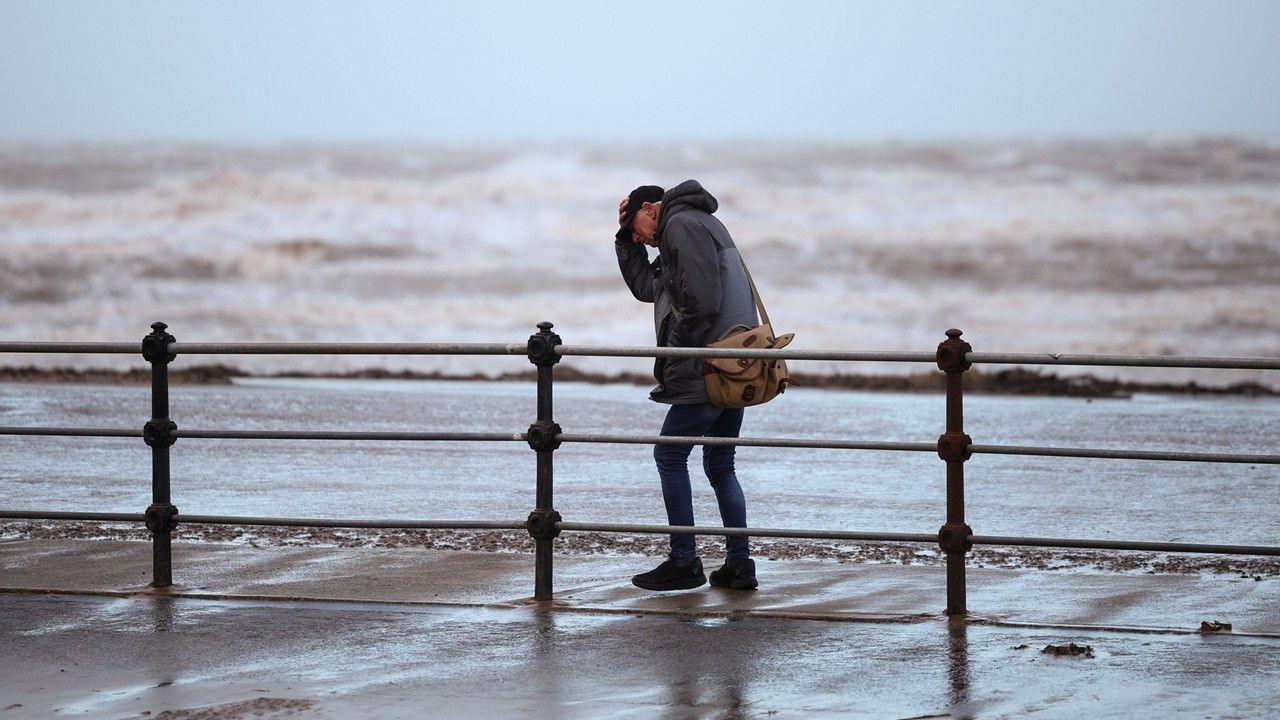
Storm Dave set to batter UK with gales and blizzards over Easter weekend

A man clutches his hat while walking along a windy seafront with rough waves in the backgroundImage source, Adam Vaughan/Shutterstock
ByBen Rich
Lead Weather Presenter
  • Published

Storm Dave has been named by the Met Office and threatens to bring severe gales and blizzards in the north of the UK over the Easter weekend.

Yellow warnings for wind and snow have been issued for Saturday night and Sunday with a deep area of low pressure expected to pass across the north-west of the country.

Damage, power cuts and travel disruption are likely.

It is just one part of a very mixed Easter forecast which will bring heavy downpours alongside spells of warm sunshine.

A storm spun up by a powerful jet stream

Huge temperature contrasts across the USA and Canada have helped to supercharge the jet stream - the flow of strong winds high in the atmosphere that spins up weather systems and guides them around the globe.

And confidence is growing that this will propel a deep area of low pressure towards the UK on Saturday.

A pressure chart showing a deep low and a set of weather fronts passing across the UK
Image caption,

The centre of Storm Dave is expected to pass across the north of Scotland

The Met Office has issued yellow warnings for wind covering all of Scotland and Northern Ireland, as well as large swathes of northern England and north Wales.

The warnings are valid at various times on Saturday afternoon, overnight and into Sunday.

Widespread gusts of 50-60mph (80-97km/h) are expected with the chance of 70mph (113km/h) gusts in exposed areas, especially around coasts.

Central and northern parts of Scotland could see winds peaking at 80-90mph (129-144km/h) with large waves bringing dangerous conditions along the coasts.

Winds as strong as these bring the threat of damage, power cuts and significant travel disruption.

Some roads and bridges could close, which could have major impacts on what is predicted to be the busiest Easter in four years for drivers.

Disruption to train and ferry services is also possible.

A weather map showing yellow warnings across the north of the UK
Image caption,

Numerous yellow warnings have been issued by the Met Office for Saturday and Sunday

A Met Office warning for snow has also been issued for parts of north-west Scotland during Saturday evening and overnight.

5-10cm (2-4in) of snow may accumulate, mainly over high ground above 200m (650ft) elevation, with a small chance of 20cm (8in) in a few locations.

Coupled with the strong winds this could give blizzards, drifting and blowing snow, and very poor visibility on the roads.

A mixed bag of Easter weather

Storm Dave is just one part of a weather story that will bring a real variety of conditions across the UK over the long weekend.

Good Friday will start mostly cloudy with outbreaks of rain.

Many parts of England and Wales will hold on to grey and damp weather for much of the day but in Northern Ireland and Scotland some sunny spells should develop - albeit with a scattering of showers.

It will be fairly windy with a wide range of temperatures - from 7C (45F) in northern Scotland to 15C (59F) in eastern England.

A band of cloud and rain will move northwards across the country on Saturday - turning to snow over Scottish mountains - with a few sunny spells either side of this zone of wet weather.

Winds will strengthen through the day ahead of Storm Dave's arrival.

Sun and snow on Easter Sunday

Easter Sunday will be a day of big weather contrasts as the storm begins to loosen its grip.

Strong winds will continue to blow across Scotland, Northern Ireland and northern England, bringing a chilly feel and frequent showers.

Some of these will be wintry over hills and mountains but snow is even possible at low levels in the north of Scotland for a time.

Further south it will be breezy with a few showers, but for large swathes of Wales and southern England it should be predominantly dry with sunny spells.

Three lambs in a field of green grass, bathed in sunshineImage source, BBC Weather Watchers / Peter and Leah
Image caption,

Temperatures on Easter Sunday will range from 7C (45F) in northern Scotland to 13C (55F) in southern England

As winds ease on Sunday night things will get cold with a touch of frost developing in many areas.

However after a cold start to Monday temperatures will climb through the day thanks to southerly winds, reaching 11-17C (52-63F) by the afternoon.

Most areas will be dry with patchy cloud and sunny spells, which is expected to bring high or very high pollen levels.

UV levels expected to peak at moderate in the sunniest spots.

Beyond the Easter weekend the forecast looks rather changeable with warmth likely to give way to April showers and perhaps more strong winds - although computer weather models disagree on the details.

You can always keep up-to-date with the longer range prospects with our monthly outlook.

King and Queen give away money in ancient Easter tradition

2 April 2026 at 19:52
PA Media King Charles III and Queen Camilla arriving at St Asaph Cathedral, DenbighshirePA Media
It is the second time the service has been held in Wales in its 800-year history

King Charles III and Queen Camilla have been taking part in the annual Maundy service in north Wales, only the second time the service has been held in Wales in its 800-year history.

The King and Queen attended the service at St Asaph Cathedral, Denbighshire, in a ceremony featuring music by Welsh composers and musicians.

The event takes place annually on the final Thursday before Easter Sunday and commemorates the Last Supper and the importance of humility and service to others.

The Dean of St Asaph Cathedral, Nigel Williams, said they were "deeply honoured" to host the service, hoping it would be a "memorable experience" for those who attended.

Reuters King Charles and Queen Camilla posing for a group photo outside St. Asaph Cathedral. Four children can be seen stood infront of the royals, each holding flowers.Reuters
King Charles and Queen Camilla posed for a group photo after attending the service

The first recorded Royal Maundy service was held in 1210 by King John and commemorates the Last Supper of Jesus Christ, with the distribution of alms becoming a tradition.

Charles will present gifts to 77 men and 77 women from Wales and other dioceses across the UK in recognition of outstanding Christian service and for helping people in their communities.

Recipients will be given two purses – a white purse including a set of specially minted silver Maundy coins totalling 77 pennies, to match the King's age, and a red pursue containing a £5 coin marking 100 years since the late Queen's birth, as well as a 50p coin celebrating the 50th anniversary of The King's Trust charity.

The last time the Maundy Service was held in Wales was in 1982 in St Davids, Pembrokeshire.

Gregory Cameron bishop of St Asaph stood outside St Asaph Cathedral
The Bishop of St Asaph, the Rt Revd Gregory Cameron admitted he was "nervous" about leading the "ancient" service on Maundy Thursday

Grahame Davies, director of mission for Church in Wales, said it was "hugely significant" for the service to be held in north Wales for the first time.

The Bishop of St Asaph, Gregory Cameron, said the Royal Maundy was a "deeply meaningful occasion which we are pleased to welcome to St Asaph".

He admitted he was "nervous" about leading the "ancient" service on Maundy Thursday which marks the day of the last supper when Jesus washed his disciples' feet.

The Cross of Wales, a gift from the King to the Christians of Wales, will be used in the service. The Cross headed the King's 2023 coronation at Westminster Abbey.

Diocese of Bangor Susan and Roger stood outside standing next to each other. Susan has long grey hair and glasses on top of her head. She is wearing a black polo shirt and navy blue jacket. Roger has short grey hair. He is wearing glasses, a dark grey blazer, green vest, striped shirt and tie with blue, green and purple fish on it.Diocese of Bangor
Husband and wife Susan and Roger Whitehouse from Tywyn are among those who the King will present Royal Maundy gifts to

Among those who will receive gifts from the King are Susan and Roger Whitehouse from Tywyn, Gwynedd.

The couple said they were "very surprised" to be recognised together, having never sought recognition for their service.

"We've simply tried to serve where needed," they said.

"Our faith informs what we do and why we do it, and it has drawn us deeper into the life of the church while also helping us look outward to the wider community."

Reuters A police officer pulls a tarp over the words "Not Our King" painted on a wall outside St. Asaph Cathedral.Reuters

Crowds lined the high street in St Asaph ahead of the royal couple's arrival, while graffiti saying "Not our King" was also covered up at the cathedral before the visit.

Workers in hi-vis jackets were seen attempting to remove the message which was sprayed using red paint on a wall in the grounds of the cathedral.

A small group of republican protesters with flags and banners calling for the end of the monarchy also gathered across the road from the cathedral as the King and Queen arrived.

Thin, purple banner promoting the Royal Watch newsletter with text saying, “Insider stories and expert analysis in your inbox every week”. There is also a graphic of a fleur-de-lis in white.

Sign up here to get the latest royal stories and analysis every week with our Royal Watch newsletter. Those outside the UK can sign up here.

Everything you need to know about Nasa's Artemis II mission

2 April 2026 at 18:08
NASA The image shows four astronauts in bright orange space suits posing for a formal group portrait against a dark background. The suits are bulky with blue joints, straps and pockets, emphasising their technical design. Three astronauts stand behind one who is seated, all facing the camera. They all have fairly neutral expressions, keeping the focus on the uniforms. Mission-style patches and flags, including US and Canadian flags, are visible on their arms and chests. Soft, focused lighting makes the vivid orange suits stand out dramatically.NASA
Artemis II Crew: left Christina Koch, back Victor Glover (pilot), front Reid Wiseman (commander), right Jeremy Hansen

Nasa's target of a March launch for the first crewed mission around the Moon in more than 50 years has been delayed after a fault was detected.

Nasa had set a target of 6 March, but 24 hours later said the newly discovered fault made a March launch "out of consideration".

The Artemis II mission, which will last about 10 days, could take its astronauts further into space than anyone has been before.

It aims to set the stage for an eventual human landing on the lunar surface for the first time since the Apollo missions of the 1960s and 70s.

When will Artemis II launch?

With a March launch no longer being considered, the next possible dates are April 1, 3, 4, 5 and 6.

A potential February launch was ruled out after a pre‑flight test - known as a wet dress rehearsal - was cut short when hydrogen rocket fuel leaked from an umbilical connection linking the launch tower to the rocket.

Beyond resolving the technical issues, mission planners also have to wait until the Moon is in the right part of its orbit, so launch windows are timed accordingly.

In practice, this creates a pattern of roughly one week at the start of each month when the rocket can be pointed in the right direction, followed by about three weeks with no launch opportunities.

Watch: Timelapse shows Nasa rocket's 12-hour journey to launch pad

Who are the Artemis II crew?

Artemis II's crew of four is made up of Nasa commander Reid Wiseman, pilot Victor Glover and mission specialist Christina Koch. A second mission specialist, Jeremy Hansen of the Canadian Space Agency, will also be on board.

Wiseman is a US Navy veteran of 27 years. A pilot and engineer, he lives in Baltimore, Maryland. He was selected as an astronaut by Nasa in 2009 and served as Flight Engineer aboard the International Space Station (ISS) for Expedition 41 in 2014.

Glover was selected as a Nasa astronaut in 2013. He previously served as the pilot of SpaceX Crew-1 and holds three master's degrees. He was born in California and is married with four children.

Koch grew up in Michigan and became an astronaut in 2013. She worked on the International Space Station in 2019, setting a record for the longest single spaceflight by a woman. She also participated in the first all-female spacewalk.

Hansen joined the Canadian Space Agency in 2009 after a career as a fighter pilot. He became the first Canadian to lead astronaut training at Nasa's Johnson Space Centre and will be the first Canadian to go to the Moon.

What will the Artemis crew do during the Moon mission?

The mission involves the first crewed flight of Nasa's gigantic Space Launch System (SLS) rocket and the Orion space capsule.

Once they are safely in orbit, the astronauts will test how the Orion handles. This will involve manually flying the capsule in Earth orbit to practise steering and lining up the spacecraft for future Moon landings.

They will then head out to a point thousands of kilometres beyond the Moon to check Orion's life‑support, propulsion, power and navigation systems.

Graphic showing the Earth and Moon, with the Artemis II's figure of 8 orbital trajectory highlighted. Specific points are labelled. These are: 1. Lift off at the Kennedy Space Centre, 2. Orbit around Earth, 3. Rocket separation, 4. Main engine fires to take spacecraft to the Moon, 5. Lunar flyby, 6. Return to Earth, 7. Crew module separates, 8. Splashdown in Pacific Ocean.

The crew will also act as medical test subjects, sending back data and imagery from deep space.

They will work in a small cabin in weightlessness. Radiation levels will be higher than on the ISS, which is in low‑Earth orbit, but still safe.

On return to Earth, the astronauts will experience a bumpy return through the atmosphere and a splashdown off the west coast of the US, in the Pacific.

Will Artemis II land on the Moon?

No. This mission is to lay the ground for a lunar landing by astronauts in the Artemis III mission.

Nasa says the launch of Artemis III will take place by 2028. But experts believe that is a very ambitious timeline.

The final choice of a spacecraft to take the crew down to the lunar surface has not yet been made. It will either be SpaceX's Starship lander or a craft designed by Jeff Bezos's Blue Origin.

New spacesuits made by US company Axiom are also not ready.

When Artemis III finally flies, the astronauts will be heading to the Moon's south pole.

After this, the aim is to have a sustained human presence on the Moon.

Artemis IV and V will begin building Gateway, a small space station circling the Moon. That will be followed by more Moon landings, extra sections being added to Gateway, and new robotic rovers operating on the surface.

More countries will be involved in keeping people living and working on and around the Moon for longer periods.

An illustration showing how the Artemis II astronauts will be arranged in the Orion crew module at launch. The four astronauts sit reclined, in two rows of two, facing up with their backs to the ground. During the mission the four crew members will spend 10 days in about nine cubic metres of living space. The image shows that the crew module makes up about half of the Orion spacecraft - with the service module being around the same size - and that, on the launchpad, Orion is only a small section of the 98m (320ft) Space Launch System rocket.

When was the last Moon mission?

The last crewed Moon mission was Apollo 17, which landed in December 1972 and returned to Earth later that month.

In all, 24 astronauts have travelled to the Moon and 12 of them have walked on its surface, all during the Apollo programme. Of the 24 to have been to the Moon, just five are still alive.

America first went in the 1960s, primarily to beat the Soviet Union to assert its geopolitical and technological dominance. Once that goal was achieved, political enthusiasm and public interest ebbed, as did the money for future Moonshots.

The Artemis programme grew out of a desire to return humans to the Moon, but this time for a longer-term presence built around new technology and commercial partnerships.

Do other countries plan to send astronauts to the Moon?

Several other countries have ambitions to put people on the Moon in the 2030s.​

European astronauts are set to join later Artemis missions and Japan has also secured seats.

China is building its own craft, targeting a first landing near the Moon's south pole by 2030.

Russia continues to talk about flying cosmonauts to the surface and building a small base sometime between about 2030 and 2035. However, sanctions, funding pressures and technical setbacks mean its timetable is highly optimistic.

India has also expressed ambitions to one day see its own astronauts walking on the Moon.

Following the success of Chandrayaan 3's landing near the lunar south pole in August 2023, India's space agency set out a goal of sending astronauts to the Moon by about 2040. This would be part of a push to move its human spaceflight programme beyond low Earth orbit.

Additional reporting by Kevin Church and Emily Selvadurai.

How memories of my grandma are tainted by funeral boss's crimes

2 April 2026 at 18:54
Tristan Essex Tristan Essex on the left next to Jessie Stockdale who is in a hospital bed wearing a pink dressing gown.Tristan Essex
Tristan Essex says his memories of his nana, Jessie Stockdale, are "tainted" after Robert Bush kept her body for five months after her funeral

Warning: This article contains details some people may find distressing.

Tristan Essex says his memories of his nana, Jessie Stockdale, are now "tainted" after funeral director Robert Bush kept her body for five months after her family were told her funeral had taken place.

Bush, who ran Legacy Independent Funeral Directors in Hull, has admitted a series of offences, including preventing the burials of 30 bodies, after police uncovered widespread wrongdoing at the business.

According to Tristan, with the benefit of hindsight, there had been warning signs.

"There was an awful smell in the funeral directors," he recalled. "My grandma was changed into different coffins every time we viewed her, and we obviously picked a specific coffin.

"She was put into larger coffins which were wider, longer, different colours, different trims. She was in at least three or four different coffins.

"We complained because the frill on the coffin was splattered with blood.

"There was black, thick mould around the inside of the coffin as well."

Victims and their families have been waiting for justice since the investigation began two years ago.

Bush, 48, specialised in low-cost funerals and claimed on his company's social media to offer "dignified personal care".

Behind the scenes, officers found a very different picture.

Humberside Police described its inquiry as "complex, protracted and highly sensitive", triggered by a report of "concern for care of the deceased" in March 2024.

Within days, 35 bodies and half a tonne of human ashes were recovered from the firm's premises on Hessle Road in Hull.

The body of Tristan's grandmother, Jessie, was among those discovered.

Tristan, 26, said his family were "knocked off our feet" when they were told Jessie was a victim.

"Thirty-five bodies were found inside Legacy and one of them had an ankle bracelet with my nana's name on," he said.

Legacy Independent Funeral Directors Robert Bush has short ginger hair. He is wearing a white shirt, a black tie and a black jumper.Legacy Independent Funeral Directors
Robert Bush, 48, abused the trust of those at their lowest ebb

Bush had been due to stand trial in October, but during a hearing at Hull Crown Court on Thursday he admitted 30 counts of preventing a lawful and decent burial.

He also pleaded guilty to one charge of stealing money from charity collection boxes.

The admissions followed others in October last year, when Bush pleaded guilty to 35 offences of fraud by false representation, relating to the proper care of remains and the return of ashes. Four of the charges related to giving women ashes that he falsely claimed were those of their unborn babies.

He also previously admitted a charge of fraudulently running a business. This related to the sale of funeral plans. There were 172 victims relating to this count alone.

In total, there were 254 victims of Bush's crimes, police said.

Many families were distraught to learn ashes they were given did not belong to their loved ones.

Some had unwittingly worn the ashes of strangers close to their body in the form of specially made jewellery.

One told us how a friend had the ashes mixed with tattoo ink and pushed deep into their skin.

PA Media Police and forensic officers, wearing white suits, stand outside Legacy Independent Funeral Directors off Hessle Road in Hull.PA Media
The parlour in Hessle Road, Hull, has been described as "a hoarder's house"

Bush's disregard for the dead and their families did not end there.

More than 1,000 items, including love letters, baby clothes and treasured possessions belonging to the victims were found on the funeral director's premises, a crisis response team told the BBC.

"It was like a hoarder's house," said Kevin Curreri of Kenyon Emergency Services.

The team is typically brought in by governments in the wake of natural disasters, plane crashes and terrorism incidents.

This time, it was appointed by Hull City Council to recover the scene, after police had finished with it.

According to Curreri, human remains and personal possessions had been treated "so disrespectfully" that it showed "a pretty significant breach of trust".

Linsey Smith/BBC A sign and a bunch of fake flowers attached to the black railings around the former Legacy premises.Linsey Smith/BBC
Families left tributes to their loved ones at the former Legacy parlour in Hessle Road, Hull

Following the police searches, floral tributes were left outside the parlour.

Some of the notes attached to them demonstrated the unbridled rage felt towards the person responsible for causing this close-knit community so much heartache.

In stark contrast to Bush's large detached home in Kirk Ella – a desirable village in the East Riding of Yorkshire – his funeral business, which opened in 2010, stood in Hessle Road, a working-class street that was once the beating heart of Hull's fishing industry.

Bush hid behind a veneer of respectability, his neighbours painting a picture of a family man who was willing to run errands and help complete DIY tasks for them.

Professionally, too, nothing appeared to be too much trouble for Bush, with some of his customers telling the BBC how he had offered them the chance to pay him in installments when they told him they were struggling to cover a relative's funeral costs.

One woman said Bush had personally bought their funeral flowers when they ran out of money.

"I just felt so grateful," she said. "I didn't ask questions."

Emma Hardy, MP for Hull West and Haltemprice, said Bush had deliberately pushed low-cost funerals at a vulnerable community.

"He pretended he was their friend," she said.

Bush was anything but.

Kevin Newton sat on a chair looking directly into the camera. He is wearing a blue top.
Kevin Newton bought a funeral plan from Robert Bush to save his children from financial burden

Not even charities escaped his greed.

Bush stole an unknown amount of cash from charity collection boxes. The donations, in memory of loved ones, were made at funeral services Bush organised.

Families believed the money would go directly to causes close to their hearts.

But it did not.

Between September 2017 and 6 March 2024, a number of good causes, including the Salvation Army, Macmillan Cancer Support, Dove House Hospice, Help for Heroes, the RNLI and Oakwood Dog Rescue were deprived of their funds.

More than 170 people bought non-existent funeral plans through Legacy, including 70-year-old Kevin Newton.

He paid £2,239 in 2012 for his plan.

Kevin said he was "mortified" when he contacted a third-party insurer and was told there was no trace of the plan on its database.

His daughter, Kerry, 36, said: "It's absolutely shocking because it's a lot of money for my dad to fork out and it's not like he can [afford it] again.

"It's unforgivable."

Kevin was able to recover the money as he paid using a card.

The funeral business was dissolved at a court hearing in May 2024 with debts of more than £40,000.

Bush has been bailed to be sentenced on 27 July.

Listen to highlights from Hull and East Yorkshire on BBC Sounds, watch the latest episode of Look North or tell us about a story you think we should be covering here.

Related internet links

Dozens more people tell BBC of 'alarming' safety breaches at Travelodge hotels

2 April 2026 at 13:02
Wendy Griffith said her "heart aches" for the victim of a sex attack at a Travelodge in Maidenhead

A woman has told the BBC how she was "trapped" in her Travelodge hotel room for an hour last summer while a naked man banged on her door and performed "vile" sex acts in the corridor.

Wendy Griffith is among a growing number of guests who believe the chain has failed to take "alarming" experiences seriously "for years" and has been consistently "fobbing people off".

Dozens of people have shared their stories after the BBC revealed how a woman woke up to a man sexually assaulting her in her bed at the chain's Maidenhead branch in 2022 after staff gave him a key card and her room number.

A Travelodge spokesperson said it was "deeply sorry" to hear about Wendy Griffth's experience. Earlier this week, Travelodge's CEO, Jo Boydell, apologised to people that have had "frightening" experiences.

Outside of Travelodge London Straford hotel. It looks like a block of flats with branding on the first floor
Wendy Griffth was targeted by a man at Travelodge London Stratford in July 2025

The company, which is based in Thame, Oxfordshire, said it had already "strengthened" its room access policy.

Marketing consultant Wendy Griffith, from Norfolk, was staying at Travelodge London Stratford in July 2025 when she said a man started banging on her door.

She then witnessed him through the door's peephole performing sex acts.

She recalled "rising panic" over the hour as she was "essentially trapped" in the middle of the night trying and failing "multiple times" to contact hotel staff.

With no room phone and no emergency contact number in her room, she used her mobile to try and call the Travelodge website number.

She said she was "incredibly traumatised and not able to summon help", then dialled 999 in desperation.

"The police were incredible," she remembered, "given I was a female staying in a hotel room on my own, three cars pulled up within five minutes to arrest the man.

"It was a very dramatic scene, he attempted to run back in his room, barricade the door, the police had to force their way in, use pepper spray."

The man, Trevor Reece, 40, pleaded guilty to outraging public decency in September 2025.

He was sentenced by magistrates to four months of alcohol dependency treatment and ordered to pay £185 court costs and £50 compensation to his victim, which she says has yet to be paid.

In a previous interview with the BBC, Travelodge chief executive Jo Boydell said the company had made changes to its policies

"The impact that has resulted in terms of the psychological impact, the flashbacks, the impact to my business, my livelihood, all of it, and my situation was not as extreme as the lady in the Travelodge Maidenhead hotel," Wendy Griffth told the BBC.

"When I saw the story break recently, I broke down in tears because it was validation - that other people were experiencing these issues with Travelodge - and just complete and utter devastation that that had happened to that woman.

"That could have potentially happened to me and that's what keeps me awake at night."

She subsequently discovered, during a lull in the hour she was targeted, her tormentor - who was also a hotel guest - had gone to reception and asked for a replacement room key but gave her room number instead of his own.

"That moment when the desk clerk said 'he asked for a key to your room' the blood drained from my body," she recalled.

She said he was only refused as the clerk told her he knew the man was a long staying guest and the number he gave was not his own room.

She insisted Travelodge's responses to her subsequent complaints, which the BBC has seen, have been "categorically not good enough" and she feels "dismissed" and "palmed off".

She said no-one from Travelodge "proactively" offered her a refund, she had to chase them and her case was "pushed out" to the firm's insurers which denied liability.

She also believes CEO Jo Boydell's response to the 2022 Maidenhead attack has been "poor" and was shocked to hear her admit to not being aware of it until the attacker's trial at the end of 2025.

"To take so long to respond," she said, "and now only under media scrutiny and pressure and the fact that their business looks bad," she said.

"If there is ever a situation in your hotel where the police have become involved, that should be an automatic escalation to the CEO for a formal investigation."

A Travelodge spokesperson said: "We were deeply sorry to hear about the distressing experience Ms Griffith had at our London Stratford hotel and our handling of her case.

"We have since rolled out training to all of our hotels to ensure that the hotel phone number is on every key card wallet given to a customer so they can reach our team at any time, day or night."

Charlotte Bingley A woman looks straight at the camera. She has curly brown hair and is wearing a pink topCharlotte Bingley
Charlotte Bingley, from Birmingham, is among many people who have contacted the BBC about their Travelodge experiences

A growing number of MPs have also demanded better hotel safety procedures and the privately-owned hotel chain's crisis over guest safety continues to escalate.

The BBC has been contacted by people who have been "terrified" by "strangers" coming into their rooms and many have provided evidence of their subsequent complaints to Travelodge and direct emails to its CEO.

Others have reported accidentally walking into occupied rooms after being given the wrong room key.

The guests said Travelodge's responses had been "lacking", "dismissive", "totally uninterested" and "appalling".

One described three room key mistakes in one night.

Charlotte Bingley, from Birmingham, checked into a Travelodge in the south west of England in February and within an hour an "intimidating" staff member entered her room without knocking.

"I've never been so scared in my life," she said, "I really thought he was going to really hurt me and I was [shouting] 'just get out of the room'."

She said it took "ages for him to leave" and as there was no inside lock on her door, she was "petrified" he would "come back in the middle of the night", so she left.

She described the company's response to her repeated complaints - which the BBC has seen - as "despicable".

A Travelodge spokesperson said: "Our response to Ms Bingley was wholly inappropriate and we are very sorry.

"The team member has since been dismissed and no longer works for the business

"Any case of unauthorised access to a guest's room is a significant cause for concern and what happened to Ms Bingley was very upsetting and shouldn't have happened."

Gordon Hollingsworth A woman and a man appear together in the photo. The man has short grey hair and he is wearing shaded glasses. The woman has blonde hair and is smilingGordon Hollingsworth
Sian and Gordon Hollingsworth said their complaints about a "total failure" of security procedures were "glossed over"

Gordon Hollingsworth, from Essex, said a stranger walked into his and his "horrified" wife's room at midnight at Travelodge Leatherhead in January.

He recalled the unknown man being "as stunned as I was", having been given the key to the couple's room by staff.

He said he rarely writes complaints, but was so shocked by the "lack of organisational care and procedure", he contacted Travelodge because he "could see the very obvious threat".

He "took exception" to how they responded and said: "They just glossed over it. With no mitigations in place to prevent reoccurrence... that will repeat itself."

A Travelodge spokesperson said: "Any case of an unauthorised person entering a guest's room is a significant cause for concern and what happened to Mr Hollingsworth and his family was very upsetting and shouldn't have happened and we have apologised for this."

Sophia Farley, from Bournemouth, was also dissatisfied by Travelodge's reaction to her complaints about "dark figures" appearing in her room at night at the London Belvedere in June 2025.

She emailed CEO Jo Boydell spelling out that she was "shaken and frightened" and stressed her customer service team's initial reply "minimises what was a significant safeguarding failure" and was "wholly insufficient".

She told the BBC when she heard about the Maidenhead attack: "My first thought was, if that happened years ago, why did that then happen to me?

"Nowhere near as bad for me as it was for that poor young woman, but it could have been."

A Travelodge spokesperson said: "Our initial response to Ms Farley was inappropriate.

"In a subsequent response, our Customer Services team apologised profusely to Ms Farley for what happened during her stay, acknowledged her experience and confirmed we had retrained the hotel team. We subsequently processed a full refund of her stay at her request."

Wendy Griffth A Travelodge key card holder which is showing a phone number for staffWendy Griffth
Travelodge London Stratford has since put its direct-to-staff phone number on the front of its key card holders

In response to growing numbers of people reporting safety issues at the hotel chain, Wendy Griffiths said she felt a "responsibility" to speak up.

"If this many incidences are occurring of reported cases, what is not being reported because women are too afraid to come forward?" she said.

"I want compensation for not just myself, but for [other] victims and I want to make sure that this doesn't happen to other women."

She did receive a "profound and sincere apology" from Travelodge London Stratford's manager and her calls for improvements prompted the hotel to print a staff contact number on its key card holders.

A Travelodge spokesperson said: "We have recently commissioned an independent review which will look at every aspect of our room security procedures and in the meantime we have also strengthened our room access policy and brought in additional training for colleagues.

"Our focus remains on ensuring that everyone feels safe when staying in our hotels."

If you have been affected by issues in this story, BBC Action Line has details of available support.

You can follow BBC Berkshire on Facebook, X, or Instagram.

Funeral director admits preventing 30 burials and stealing donations

2 April 2026 at 18:17
BBC Breaking NewsBBC

A funeral director has admitted preventing the burials of 30 bodies and stealing donations made to charities by mourners.

Robert Bush, 48, was arrested after police investigated Hull-based Legacy Independent Funeral Directors following a report of "concern for care of the deceased" in March 2024.

Bush, formerly of East Yorkshire and now living in West Yorkshire, pleaded guilty at Hull Crown Court to 30 counts of preventing a lawful and decent burial, and one of theft relating to charitable donations.

He previously admitted presenting families with the ashes of strangers and fraudulently selling funeral plans. He will be sentenced at a later date.

This breaking news story is being updated and more details will be published shortly. Please refresh the page for the fullest version.

You can receive Breaking News on a smartphone or tablet via the BBC News App. You can also follow @BBCBreaking on X to get the latest alerts.

Dream of space travel reignites with journey to circle the Moon

2 April 2026 at 11:09
Watch the moment Artemis II blasts into space on historic mission

Nasa's Artemis II mission thundered away from Florida's coast, taking its four crew members on their historic journey to circle the Moon.

There was a deep rumbling as a sheet of brilliant white flame suddenly erupted, momentarily engulfing the whole launch pad as the mightiest rocket Nasa has ever built rose into the sky.

Nasa's Space Launch System (SLS) majestically crept upwards - slow at first, then gathering pace, riding on two blinding pillars of flame that crackled and roared with increasing volume until the rumbling was almost deafening, a sound we could feel in our bodies as we watched on in amazement, three miles (4.8km) away from the launch pad.

There were small cheers from those in the know as the rocket past the moment of maximum danger - one minute and 10 seconds into the launch. This is where the pressure hits the rocket the hardest, and when engineers know that even a small structural weakness can be disastrous.

There was no weakness, and SLS arced out over the Atlantic like a fiery white angel, leaving a white smoky trail as the sound subsided and the spacecraft disappeared from view, shrinking to a single bright star as it chased the Moon.

Chip Somodevilla/Getty Images Artemis is taking off in the distant background, and people watch, many with tripods. The US flag flutters above them on a flag pole.Chip Somodevilla/Getty Images
Spectators are kept at a safe distance, but the deep rumbling of the rocket launch can still be physically felt

Afterwards, there was a giddy euphoria among staff at the Kennedy Space Center.

One person told me they felt quite emotional and another said they wanted to cry – no doubt a release of tension built up over the past few months when Artemis II came close to launch, but ended up being scrubbed for various reasons.

Tonight, though, Nasa employees were laughing and clapping - this is the moment that they have spent years working towards. There is still work to do, but for now they are bathing in the moment of triumph.

In the hour before take-off there were issues which threatened the launch.

They concerned the launch abort system, which enables Nasa engineers to eject the astronauts and blow up the rocket if there is a malfunction.

The countdown clock was held at 10 minutes while engineers resolved the problem. They worked quickly, but it was an agonising wait to see if the launch could still go ahead.

Then came the staccato rhythm of the calls by each engineer responsible for the rocket's critical systems: "booster, go", "GNC, go", "range, go" – each reply, a tiny release of tension and a build-up of expectation.

"Artemis II, this is launch director," said Charlie Blackwell-Thompson, the first woman to hold the position at Nasa.

"You are go for launch," she told the crew. "We go for all humanity", Commander Reid Wiseman responded.

Cheesy words in normal circumstances, but that was the moment our spines began to tingle and we knew we were about to witness history.

Gerardo Mora/Getty Images A group of people watches the launch, most holding phones or cameras up to the sky.Gerardo Mora/Getty Images
Many thousands of people gathered at viewing locations around the Kennedy Space Center in Florida to watch the launch

The Kennedy Space Center was built to send astronauts to the Moon, but that hasn't happened since 1972 when Apollo 17 blasted off. Today, the centre was back in business, doing what it was made for.

The press corps headed outside, where clouds that had threatened to cancel the launch had evaporated.

As the countdown clock restarted, the atmosphere turned to electric anticipation.

The four RS 25 engines and twin solid rocket boosters lit up, driving more than 8.8 million pounds of thrust into the Florida evening sky.

"God Speed Artemis II" Blackwell-Thompson said in another echo from the past. The same words were used in a launch from here in 1962 to send John Glenn, the first American to orbit the Earth, on his way.

NASA Four astronauts stand side by side inside a cramped white spacecraft or support module, wearing bright orange launch and entry suits with blue trim and mission patches. Their arms are folded confidently across their chests.NASA
On their way to the Moon: Commander Reid Wiseman, pilot Victor J Glover, and mission specialists Christina Koch and Jeremy Hansen

I have been lucky enough to see launches of the Space Shuttle to the International Space Station from the Kennedy Space Center. Those launches are almost as impressive in flight, surging into space with an enormous bang and rising at the speed of a bullet.

But the SLS launch was not only more beautiful, it meant much more: a moment full of emotion for all those who saw it, perhaps because it reminded us of what humanity can do when it comes together, or perhaps because we may be entering a new era of space travel.

In the 1990s, I had the opportunity to speak to Neil Armstrong, who, in 1969, became the first person to ever walk on the moon.

Our discussion came at a time when the dream of human space travel seemed to be over. I asked him whatever happened to that dream? He smiled and said "the reality may have faded but the dream is still there and it will come back in time".

Today was the day the dream returned.

Trump leaves key questions unanswered as he seeks to calm nerves over war

2 April 2026 at 11:22
Trump says US "on the cusp" of ending Iran war in televised address

President Donald Trump's address from the White House on Wednesday evening was - despite some speculation beforehand - largely a rehash of what he has been saying for days about the Iran war.

In a 20-minute primetime speech, he said the "core strategic objectives" of the US-Israeli military operation were "nearing completion" after a month of war and projected it would last another two to three weeks.

There were the usual threats against Iran, too, including a repeated pledge to bomb the country "back to the stone age".

If you were to copy and paste his posts on Truth Social over the last week or so, you would not be far off this address to the nation.

The president did attempt to persuade Americans of the merits of this war. There is good reason for that, as polls suggest a consistent majority of voters disapprove of the military operation he launched on 28 February.

Trump urged Americans to see this war as an "investment" in their future, and suggested it was nothing compared to other conflicts over the past century or more in which the US has ended up being involved for far longer.

But there was little here for those hoping for clear answers on where this war is heading or potential exit ramps for the US. There were glaring omissions which leave a plethora of questions unanswered.

Firstly, Israel is still attacking Iran and taking incoming drone and missile attacks – including earlier on Wednesday in Tel Aviv just hours before the beginning of Passover.

A key question is whether Prime Minister Benjamin Netanyahu's government agrees with the timetable of a few more weeks that was provided by Trump. We simply do not know at this point in time.

Secondly, what happened to the 15-point peace plan the White House was urging Iran to accept just days ago? There was no mention of it by Trump on Wednesday night. Is Washington now ditching many of those demands, including the retrieval of its stockpile of enriched uranium?

That, too, is unclear.

Former Nato ambassador: 'Lack of clarity' in Trump's war aims

The reopening of the Strait of Hormuz, one of the world's busiest oil shipping channels which has been effectively closed off by Iran, is a central issue in this conflict.

The president, however, does not appear to have a settled view on it.

One moment he is demanding Iran allow tankers through, and the next he is telling allies to go and sort it out for themselves. "Go to the strait and just take it, protect it, use it for yourselves," he said on Wednesday. "The hard part is done, so it should be easy."

He then simply said, without expanding further, that the strait would reopen "naturally" when the war was over. That is unlikely to reassure those concerned about oil prices.

Trump's pointed criticism of some allies - he said at one point that they should "build up some delayed courage" and lead an operation to reopen the strait - came after he floated the idea of pulling out of the Nato military alliance in an interview earlier on Wednesday.

But that rhetoric was completely absent from this speech, despite briefings suggesting it would be a key part of his words tonight.

'Something needs to be done' - Americans struggle as gas prices surge

Another key unanswered question relates to ground troops. What are the thousands of marines and paratroopers actually going to be doing in the region as they continue to arrive?

The truth is that after this national address, we are really none the wiser about what the president sees as victory in this war.

And given the often conflicting nature of his statements from one day to the next, everything could change at any time.

Meanwhile, the average price of gas in the US has topped $4 for the first time in nearly four years and the president's approval ratings are cratering, just months before the crucial midterm elections which will determine control of Congress.

This is a US president looking for a way out of this war – and he is still casting about to find one.

UK to host virtual summit on reopening the Strait of Hormuz

2 April 2026 at 16:48
Reuters Close up of a ship on blue water in the background. In the foreground are rocksReuters
The amount of cargo traffic in the Strait of Hormuz has drastically decreased since war broke out

A coalition of about 30 nations are to discuss plans to reopen the vital Strait of Hormuz shipping lane in the Middle East, at a virtual summit hosted by the UK on Thursday.

The virtual summit is expected to consider what diplomatic and political steps could be taken to reopen the important shipping route, though the US was not set to attend.

Iran has attacked several vessels in the strait in response to the war waged against it by the US and Israel, severely disrupting energy exports and sending global fuel prices soaring.

On Wednesday, US President Donald Trump said it was for other nations to "build up some delayed courage" and reopen the route.

Trump said allies "should have done it" earlier, adding: "Go to the Strait and just take it. Protect it. Use it for yourselves."

Washington has repeatedly accused allies of not doing enough to secure the shipping route or to support its war effort, leaving the UK and other nations weighing how to contribute to securing the strait without becoming involved in the wider war.

Foreign Secretary Yvette Cooper is set to chair Thursday's virtual meeting.

The summit was expected to involve governments which signed a joint statement in mid-March calling on Iranian forces to halt attacks against commercial ships.

That statement was supported by some Gulf nations, as well as France, Germany, Japan, Australia and others.

The statement says: "We express our readiness to contribute to appropriate efforts to ensure safe passage through the Strait.

"We welcome the commitment of nations who are engaging in preparatory planning."

The talks come a day after Prime Minister Sir Keir Starmer said the UK was "exploring each and every diplomatic avenue that is available" to reopen the route.

He also said British military planners would consider what could be done in the future to "make the Strait accessible and safe after the fighting has stopped".

At the same time, governments around the world are weighing how to respond to cost-of-living pressures triggered by rising energy prices.

About a fifth of the world's oil and gas passes through the Strait of Hormuz.

The price of a barrel of Brent crude, the global benchmark for oil prices, has jumped from $73 (£55) to well over $100 in recent weeks.

Petrol and diesel prices see biggest rise on record in March

2 April 2026 at 15:41
Getty Images A woman looking at her mobile phone while filling up her car at a petrol stationGetty Images

The jump in the price of oil triggered by the conflict in the Middle East has raised the possibility of higher fuel costs for motorists.

Following the attacks by the US and Israel on Iran, the price of oil leapt by 10% and gas prices also surged.

The reason for the jump is that Iran has warned vessels not to pass through the Strait of Hormuz, a crucial waterway in the south of the country through which about 20% of the world's oil and gas is shipped.

If these restrictions persist and oil prices remain high for some time, the worry is this will have knock-on effects on prices of a number of goods.

However, there remains a huge amount of uncertainty at this stage as to whether the conflict will have a lasting effect on the price of oil, gas and wider energy costs.

How quickly will rising oil prices show in fuel prices?

Crude oil is a key ingredient in petrol and diesel, meaning higher oil prices could eventually drive up prices at the pumps.

The AA motoring group says that over the next few weeks fuel costs could return to where they were at the start of the year.

That would be a change to the general trajectory of fuel prices, which have been falling on UK forecourts over the past few weeks.

Further rises will depend on the magnitude and duration of the conflict, the AA said.

Currently, the average price for petrol is 132.6p a litre and 142.3p for diesel, according to AA data.

Simon Williams, from rival motoring group the RAC, said: "If oil were to climb to and stay at the $80 a barrel mark, then drivers could expect to pay an average of 136p for petrol.

"At $90, we'd be looking at over 140p a litre and $100 would take us nearer to 150p, but it's all too soon to know."

What could the impact be on food prices?

As well as affecting prices at the pump, if higher fuel costs persist they could have further knock-on effects on the prices of goods on the shelf.

More expensive petrol and diesel will increase the transport costs of those businesses moving food and other goods around the country.

These increased costs might then be passed on by shops and supermarkets to the consumer. As a result, the cost of living goes up.

There might also be a more direct impact on food. "Some elements of crude oil are used in fertiliser, and so there could be a cost implication in terms of food prices," Benjamin Goodwin, partner at banking advisory firm PRISM Strategic Intelligence told the BBC.

However, if the disruption is short lived then it is unlikely to result in an immediate increase in food prices, he said.

Will my energy bills rise?

In the short-term, millions of UK householders' domestic gas and electricity bills are shielded from any impact on wholesale costs paid by suppliers.

People whose energy bills are governed by the price cap already know what their unit prices are now, and will be for the three months from April. They have already been set.

However, the impacts of the conflict could potentially be seen on domestic variable energy tariffs from the subsequent price cap, for the three months from July.

How will this affect UK inflation and interest rates?

UK inflation, which measures the pace of price rises, has eased relative to the heights reached immediately after Russia launched its full-scale invasion of Ukraine four years ago.

It has meant that the Bank of England has been able to cut interest six times since August 2024 to 3.75%.

The Bank recently said further cuts to borrowing costs are likely this year with another cut widely expected later this month, but if the oil price continues to rise is this now less likely?

Much depends on how long crude prices remain elevated, according to Subitha Subramaniam, chief economist and head of investment strategy at Sarasin & Partners.

If they do, she said: "It will start to cascade into other prices such as food, agriculture, industrial commodities and that's just going to really bleed into inflation."

The Bank's rate-setting committee next meets in a couple of weeks' time which really isn't enough time to assess the impact of higher oil prices on inflation.

So, in the short-term, Subramaniam said: "I would say the prudent course for the Bank of England would be to remain on hold."

Man dies in Athens storm as Saharan dust shrouds Crete

2 April 2026 at 15:54
NIKOS CHALKIADAKIS/EPA/Shutterstock A man takes a picture while cars drive with their headlights on in red air.NIKOS CHALKIADAKIS/EPA/Shutterstock
A man takes pictures as the city of Heraklion that is covered in red dust coming from Africa

A man has died near Athens as a storm hits parts of Greece with gale-force winds and flooding, while a Saharan dust storm enveloped the island of Crete.

The man was found under a car in the Nea Makri rural area early on Thursday, according to the fire department.

Storm Erminio has flooded streets, closed some schools and moored ferries. Meanwhile, some flights were disrupted on Crete on Wednesday after dust from an African storm filled the air, turning the sky red-orange.

The weather is expected to be bad on Thursday in most areas of the country "with long-lasting and intense rains and storms and possibly with local hail", according to the national meteorological service.

Stefanos Rapanis/Anadolu via Getty Images People walk along a waterfront with boats, buildings and the sea in the background. The sky is orange.Stefanos Rapanis/Anadolu via Getty Images
Crete cloaked by a Saharan dust storm on 1 April

A red warning is in place in Crete, mainly in the west and south, from midday until late at night on Thursday.

The fire department received 674 calls for assistance from Wednesday through the early hours of Thursday. The majority were in the Attica region that encompasses Athens, with most calls for fallen trees.

High winds have kept ferries moored in ports, with Greek media reporting some departures may resume on Thursday, weather permitting.

Streets as well as the basement of the local police station in Nea Makri were flooded. A bridge was knocked down on the island of Poros and vehicles have reportedly been swept away. Some schools have also been closed.

Stefanos Rapanis/Anadolu via Getty Images Two people walk in jackets long a street beside a shop and building. The sky and everything is coloured red-orange.Stefanos Rapanis/Anadolu via Getty Images
Crete cloaked by Saharan dust storm on 1 April

Elon Musk's SpaceX set to go public in $1 trillion share listing

2 April 2026 at 15:05
Reuters Elon Musk waving to a crowd from a stage wearing a black blazer and a black t-shirt.Reuters

Elon Musk's SpaceX is poised to become one of the most valuable publicly traded companies in the world.

The company, which manufactures rockets, space exploration technology and Starlink satellites, is currently privately held. But on Wednesday it made a confidential filing with the US Securities and Exchange Commission (SEC) for an initial public offering, which would allow shares to be traded in the stock market.

The value of SpaceX once it goes public is expected to surpass $1tn (£751bn). That would make its eventual stock market debut one of the most financially significant in history.

Musk's own holding in SpaceX would put the billionaire on track to become the world's first trillionaire.

The BBC has contacted SpaceX for comment.

The company is aiming to officially go public sometime in June, according to reports in Bloomberg, Reuters and the New York Times.

A confidential IPO filing with the SEC allows a company to avoid immediately revealing information to the public while it requests feedback from the regulator. The next step will be for company executives to hold "roadshows" - meetings with big investors to convince them to buy shares.

By making shares of SpaceX available for purchase by the public, the company is looking to raise $50bn or more, according to the reports.

Earlier this year, SpaceX took over xAI, Musk's artificial intelligence venture. After that all-stock merger, SpaceX is believed to have become the most valuable private company in the world, with an internal valuation of $1.25tn.

Recently, Musk's various companies have been becoming increasingly intertwined.

Last year, xAI, best known for its chatbot Grok, took over X, the social media platform previously called Twitter that Musk bought in 2022.

This degree of consolidation was a clear sign to investors that SpaceX was preparing to go public.

Emily Zheng, a senior analyst at Pitchbook, earlier told the BBC that by bringing xAI under SpaceX, Musk could show potential investors that he was consolidating costs and able to easily share resources between his companies.

With its large-scale ambitions, SpaceX is in need of a massive cash infusion that going public can provide, Zheng added. The company is racing to keep up with the "sheer cost of compute, infrastructure, and energy" needed to expand, she said.

Earlier this year, Tesla, Musk's electric vehicle company, revealed it had invested more than $2bn in xAI.

The billionaire said a significant share of Tesla's manufacturing would begin to shift toward building robots, which would make use of xAI technology like Grok.

Grok is already included in some Teslas as an AI assistant.

SpaceX would also partner with Tesla and xAI in the massive chipmaking endeavour Musk announced last month, which he is calling Terafab.

"Tesla, xAI and SpaceX have all done amazing things that people did not think could be done before," Musk said in a March presentation discussing Terafab.

Musk started SpaceX in 2002 with the aim of reducing the cost of launching crafts into space, mainly by making rockets that could be launched more than once. It first contracted with Nasa in 2006.

Today, most of SpaceX's work continues to revolve around rockets and the operation of Starlink, a fleet of satellites offering internet connectivity across the globe.

But Musk often discusses grander ambitions for the company, including putting data centers needed for AI in space and building a self-sufficient city on Mars, which many experts have said could be impossible to realise.

Blind marathon runner to be guided by smart glasses

2 April 2026 at 13:05
BBC Clarke running in a residential area, wearing a colourful Fight for Sight-branded running jersey that reads "Mr Dot, Blind, Tech-Guided"BBC
Clarke Reynolds ran the London Marathon with the help of a physical guide - but plans on running the Brighton Marathon relying on people watching and talking through his glasses

A blind runner plans to run a marathon using technology that allows sighted people to see what he sees - and to give him directions - in real time.

By day, 45-year-old Clarke Reynolds is a creator who turns braille into works of art to raise help raise awareness of sight loss.

But he said that running has given him "another opportunity to spread the word."

He previously completed the London marathon with the help of a physical guide runner - but plans on running his next with the help of a worldwide network of virtual volunteers.

Clarke is standing in front of a small art workshop shed. It's painted yellow and a white large model of a lion is visible but out of focus. Clarke is wearing a colourful jersey and black glasses and looking to his left at someone out of frame.
Reynolds is planning on running the Brighton marathon later this month

He is being supported by Fight for Sight, a charity which funds research into sight loss, for which he is an ambassador.

Reynolds, from Havant, is also known as "Mr. Dot" - an alter-ego he employs when he travels around the country teaching braille through art in schools.

He has been visually impaired in his right eye from the age of six, but 13 years ago noticed a shadow in his left eye.

"I went to the hospital and they sat me down and said, 'Mr. Reynolds, do you drive?", he said.

"I said yes, and they said, 'hand over your licence, you're going blind.' And that's how you were told."

He describes his sight now as like "being underwater" - he can see shapes, shadows and some colour.

Despite that, he creates visual art using braille - such as the replica of Nirvana's iconic "Nevermind" album cover.

A replica of Nirvana's "nevermind" album cover made using a coloured mosaic of Braille. It depicts a more abstracted image of the album's cover - a baby floating underwater.
The braille on a replica of Nirvana's iconic album cover spells out the lyrics to the band's song "Smells Like Teen Spirit".

But he's now found another way to raise awareness.

With the help of a tethered guide runner, he ran the London marathon three years ago to raise funds for charity.

Later this month, he'll be running the Brighton Marathon - but is upping the ante.

Rather than using a physical guide, an app called Be My Eyes will connect him with a worldwide network of sighted volunteers.

Through the camera and speakers on his smart glasses, they'll be able to see what he sees and speak to him in real time, directing him through the 26.2 miles (42.2km),

"They tell me if there's a bin or there's a parked car through the glasses - but the majority of the time we're just discussing, what is sight loss?", he said.

A close up of Clarke's face showing his eyes and nose, with the black glasses. The Ray Ban brand is visible etched on the frames and glass.
The Ray-Ban Meta glasses feature an in-built camera (visible on the top left-hand side of the frame) which, with the help of an app, allows sighted people to see what he sees in real time

Be My Eyes is usually used for day-to-day tasks - a volunteer might help a visually impaired person find the right button on a TV remote, for example.

So it can be surprising when they connect and see Reynolds mid-run.

"They probably think, 'oh my god, this is a bit strange'," he said.

He has been training by running laps of the 0.7 mile-long crescent (1.1km) where lives - a route he knows by heart.

And he said he's had over 100 people supporting him - some from as far afield as Jordan.

The volunteers for race day are being organised by the charity Reynolds works with, Fight for Sight, with the help of the company behind Be My Eyes.

There will also be a back-up guide runner in case the technology fails.

And although he said he was "really scared" before taking on the London Marathon, he feels confident about taking on Brighton.

"I'm really excited to do this," he said.

"If you had told me 13 years ago that I'd be an ambassador for a major charity and I'd be inspiring visually impaired children around the world, I'd never have believed you."

Where responsibility lies when social media inspired mountaineers get into trouble

2 April 2026 at 07:08
BBC A montage image showing a person from the Langdale Ambleside Mountain Rescue Team bringing a stretcher down and an image from Scotland, Argyll and Bute, Glencoe, Buachaille Etive Mor, frozen mountainous regionBBC

Two walkers find themselves stranded on a remote hillside as night closes in, hundreds of miles from home, after being inspired out into the wilderness by a TikTok video. It might sound like an unusual emergency - but for Mike Park, CEO of Mountain Rescue England and Wales, it's become a familiar story.

"We had two people stuck on a hill at 8pm, no torches. One was in their early 20s and the other was late 30s. It was their first time on a hill. They'd travelled a long way because they'd seen a TikTok route. They set off on their walk at 2pm - too late - wearing shorts, T‑shirts and carrying only a picnic," he recalls.

"They got off‑route, found themselves in unfamiliar ground – but they did the right thing by calling for help."

Park says this recent rescue, just a few days ago in the Lake District, is typical of the kind of callouts many colleagues now see.

Getty Images A view of the Lake District and the River Brathay 

Getty Images
Mike Park has spent the past 40 years rescuing people on the hills of the Lake District

His rescue team were able to safely find the pair and walk them off the hill – but the incident perfectly captures some changing behaviours. Their situation was self-inflicted; they weren't prepared and got into trouble, extra layers and some good torches could have seen them rescue themselves - but they were also quick to call for help when they knew something was wrong - a decision Park says saved them from far more severe consequences.

"If we hadn't reached them, they'd have been stuck all night in the dark. By morning, I'm confident they'd be suffering hypothermia - possibly unable to walk."

Over the past few years, mountain rescue teams say there's been a stark rise in the number of people needing to be rescued.

This has ignited a delicate but important debate. Who is responsible for safety on our mountains? And, are increased warning signs and even barriers the answer to saving lives in our most dangerous landscapes, or is risk the price we pay for true adventure?

The rise in callouts

Mountain rescue callouts have been steadily rising for decades. Sport England figures suggest there's been a particular boom in recent years, with the number of us regularly climbing a hill or mountain rising from 2.8m people in 2018 to 3.6m in 2024.

Living an active lifestyle is something the public body estimates could be saving the NHS billions each year, by reducing the number of people developing chronic conditions.

However, it's also contributed to sharp rises in the number of rescues required by the volunteers who make up the UK's so-called "fourth emergency service".

In England and Wales, the number of callouts rescue teams attend has doubled in the past decade, reaching well over 3,000 a year by 2024, according to Mountain Rescue England and Wales.

So what's changed?

One of the key themes rescue teams pick up on is how incidents featuring younger adventurers, aged 18 to 24, have soared in recent years. Callouts for the age group almost doubled in England and Wales between 2019 and 2024, from 166 to 314.

It now makes them the most rescued age group, overtaking walkers in their 50s who had previously needed the most help.

Mike Park has spent the past 40 years on the hills of the Lake District, rescuing those in danger. He has observed a significant shift among younger people in embracing the outdoors - but says he believes better technology and wider social changes in the past few decades have also fed into the overall rise.

"It doesn't matter what age you are - society is more adventurous, more reliant on help, less outdoor‑aware, and less prepared," he says.

"When I first started our team did 10-15 callouts a year. We average around 100 now. The rise hasn't been steady - it's steepened sharply, especially in the last 10 years and after Covid-19."

Park believes part of what makes the mountains of the UK so attractive is that most can be easily accessed for a day-trip - at worst a short weekend break. They are on our doorstep, via the same motorways and service stations we might stop at on our way to a theme park or music gig.

This can breed a sense of overfamiliarity - with some misjudging just how alien and dangerous these environments can be, he suggests.

Corbis via Getty Images Participants crossing stepping stones in YorkshireCorbis via Getty Images
Park believes part of what makes the mountains of the UK so attractive is that most can be easily accessed for a day-trip

Park says decades ago, many people who went into the UK's mountains would have it as their sole major pastime, they were "hillwalkers or mountaineers, that was it". Now, outdoor adventures are easy to pick up alongside the many other work and leisure activities people juggle.

"There's so much to do now, we don't concentrate on any one thing. People might do the outdoor environment one week, swimming the next, holiday the week after," he says.

Rescuers say it should be seen as only good news that millions of people are now inspired each year to venture into the outdoors themselves, encouraged by stories of the physical and mental health benefits - and beautiful images spread across social media.

But the reality of having so many novices is also starting to take its toll on some of the UK's busiest rescue teams, who are increasingly grappling with exhaustion and stretched staffing.

It's important to note that no rescue team we spoke to begrudge doing these kinds of rescues - they are grateful they can help those who need it and avoid the situation getting any worse. It doesn't matter how you got there, just that they can help you get down safely.

But according to Park, the fact people are seemingly more willing to take risks in the first place - and then more willing to pick up the phone when things go wrong - has fundamentally changed what kind of rescues his teams do.

"Ten years ago, 70% of callouts were because someone physically couldn't get off a hill," he says.

"Now, most people haven't physically injured themselves - it's that they're mentally unable to get down, because they weren't prepared for the environment."

In other words, people's bodies are capable of getting them off the mountains, but they lack the experience, confidence or equipment to do it safely.

Online influencers

Many mountain rescuers believe the increase in online influencers is playing a role. There are pictures and videos across sites like TikTok and Instagram encouraging people to venture out to beautiful plateaus and waterfalls.

Seeing people influenced by social media "used to be rare, but now it's constant," explains Martin McMullan, from the Mourne Mountain Rescue Team in Northern Ireland.

"People search out iconic locations made popular by influencers. Some go just to experience it - others are trying to create their own content for their platforms."

BBC/ Getty Images Martin McMullan on the left and on the right is an image of a man walking in the Mourne mountains in Northern Ireland
BBC/ Getty Images
Martin McMullan says: "People search out iconic locations made popular by influencers"

In some rare cases, McMullan says influencers may even be attempting to get rescued - to create more interesting content for their channels. He became suspicious of one case a few years ago, when his team was called to Northern Ireland's highest peak in "very serious" sub-zero winter conditions.

At the summit McMullan says they found a group of young people who they escorted part of the way down, before calling in a helicopter to evacuate them to safety. It was only days later, when a friend alerted him to it, that McMullan realised the whole thing had been filmed by the group, clutching onto their phones as they were rescued.

"They'd been livestreaming parts of it - even when things became dangerous. We were oblivious to it at the time. They probably thought it made great social media content."

McMullen says although being far from the first time he'd had a rescue filmed by members of the public keen to capture the drama of the job, it was the first time his team suspected a group had gone out with the idea of getting rescued, something they denied.

Hotspots

The vast majority of mountain rescue teams, thankfully, rarely find themselves called out to a death. But the spread is far from even and there are certainly hotspots.

The rescue team covering Yr Wydffa, Snowdon, is far and away the busiest in the UK. The team is often called to fatal incidents and has seen a rise in deaths. Across north Wales, there were 14 fatalities in the mountains back in 2015. Last year there were 23.

Getty Images Autumn landscape image of view along Nant Fracon valley in Yr Wydffa, Snowdonia National Park, with dramatic evening sky 
Getty Images
The rescue team covering Yr Wydffa, Snowdon, is the busiest in the UK

So-called body recovery callouts can have a significant impact on the rescuers, with a growing importance being placed on welfare checks and support for the teams who regularly battle the elements to retrieve bodies so they can be returned to their loved ones.

There have been suggestions that putting up physical warning signs, or even fencing, on some of the UK's most dangerous ridges and waterfalls could potentially save lives. The National Trust and conservation project, Fix the Fells, recently decided signs were needed to prevent accidents on England's highest mountain, Scafell Pike.

Over eight years, four people died and more than 40 were rescued from the treacherous ravine known as Piers Gill, before a sign and large rocks were placed on the nearby route to encourage people away from the area.

In mid-Wales, one assistant coroner has recommended multiple times that signs be put up around some of the region's impressive waterfalls. Five people have died at the beauty spots in the past few years, which has prompted the assistant coroner for south Wales central, Rachel Knight, to write three Prevention of Future Death Reports - recommending improvements.

In the most recent one, she argued clearer warning signs were needed for walkers who risked falling from the paths above the waterfalls – suggesting without them, many would fail to understand "the significant risks they face" in the area and more people were likely to die.

So could putting up signs work in other remote areas?

Andy Buchan is due to take over Mike Park's role at Mountain Rescue England and Wales in May.

In some of the most extreme areas, like Crib Goch, a notorious knife edge ridge in north Wales with annual fatalities, Buchan says some ideas should be considered.

Andy Buchan in walking gear on a mountainside
Andy Buchan, the incoming CEO of England and Wales Mountain Rescue

"I won't call it signposting in terms of actually putting signs up on the mountain, but certainly signposting towards more information could really help."

Buchan suggests that in rescue hotspots such as Crib Goch, which does already have some warnings placed on the route, more could be done to help walkers access weather forecasts and safety information before they get to an area - potentially by placing additional signs or QR codes in car parks hikers are likely to use before heading out.

However, what Buchan and others I speak to really don't want to see - despite some potential benefits - is the same widespread canvassing of signs and fencing witnessed in other countries.

Danger do not enter signal at Yosemite national park at Glacier point with its famous overhanging rock
Buchan does not want to see the same widespread canvassing of signs and fencing witnessed in other countries

"There are other parts of the world that I've travelled, like the US, where you can get to remote places and then all of a sudden, when you want to go and have a look at the view over the cliff, there's a big metal barrier around and there's concrete being put in place and it kind of destroys the remoteness of the location that you're in," Buchan explains.

'The mountain isn't going anywhere'

In preparing for the role, Buchan has had plenty of time to think about the current challenges, but is overwhelmingly positive about seeing more people out on the hills.

"We encourage people to get outside for their physical and mental wellbeing," he says. "People recognise the countryside is a cost‑effective way to have great experiences. It's great - but it does come with risk."

Universal Images Group via Getty Images View to Crib Goch and the Pyg Track with Llyn Glaslyn and Llyn Llydaw from Snowdon summit, Gwynedd, Wales, United Kingdom
Universal Images Group via Getty Images
Buchan suggests that in rescue hotspots more could be done to help walkers access weather forecasts and safety information

The story of Jack Carne is testament to that. Jack and his two best friends had travelled a few hours from their hometown of Barnsley to reach the mountains of Eryri, also known as Snowdonia, in north Wales. Inspired, after the Covid-19 lockdowns, by the freedom the mountains offered them, the trio in their 20s had been out hiking at every possible opportunity. They were committed, fit and experienced - but on this occasion, just "10 metres from the top" of Glyder Fawr, a peak thousands of feet up, everything went wrong.

A rock Jack had grabbed hold of broke away in his hands. His friends could do nothing as they watched him fall. In just an instant he was gone - disappearing out of sight beneath them. Three friends went up the mountain that day. Only two came back.

It was the starkest reminder possible about the unpredictability and the dangers lurking just beneath the surface of the UK's most picturesque landscapes – even for those who come prepared.

Left to right - Jack, Matty and Brandan on one of their trips
Jack Carne (left) and his two best friends Matty and Brandan

At the inquest into Jack's death, the coroner remarked how the young men were all well-equipped and experienced enough for the route they'd chosen.

"It was a scramble - nothing harder than anything we'd done before," Matty Belcher, one of those three friends, told me. "In fact it was easier than a lot of stuff we'd done," added the 27-year-old.

"Mountain Rescue said the boulder that actually took Jack was a freak accident," adds Brandan Smith, 25, the group's third member.

"That rock could have gone in a week's time, a year's time."

One week after Jack's death, Brandan and Matty were back at the same peak - this time making it the additional 10m to the summit, where they had time to reflect alongside Jack's dad, who they'd brought with them.

"Jack's dad wanted to see it - put his mind at ease, instead of guessing what happened," explains Matty.

For Brandan and Matty, it was a key moment - that inspired them to keep adventuring and not give up on the beauty of our landscape, despite the risks.

Brandan unfurls a flag to remember Jack at a summit
Brandan says Jack "was probably the best of us at climbing – he was brilliant"

"Jack was the one who absolutely loved it the most out of us," says Brandan. "He was probably the best of us at climbing - he was brilliant - he always pushed me, believed I could do it even when I didn't.

"If we'd stopped going out after he died, Jack would've kicked us for it."

The key thing, both men say, is for those looking to adventure, to always be aware of the risks.

"For us, if someone isn't feeling safe, we turn back. No question. There's always another day," says Brandan. "It's always going to be there - the mountain isn't going anywhere."

Top picture credit: Getty Images

Thin, lobster red banner with white text saying ‘InDepth newsletter’. To the right are black and white portrait images of Emma Barnett and John Simpson. Emma has dark-rimmed glasses, long fair hair and a striped shirt. John has short white hair with a white shirt and dark blazer. They are set on an oatmeal, curved background with a green overlapping circle.

BBC InDepth is the home on the website and app for the best analysis, with fresh perspectives that challenge assumptions and deep reporting on the biggest issues of the day. Emma Barnett and John Simpson bring their pick of the most thought-provoking deep reads and analysis, every Saturday. Sign up for the newsletter here

'We go for all humanity' - emotional scenes as rocket launches

2 April 2026 at 11:09
Watch the moment Artemis II blasts into space on historic mission

Nasa's Artemis II mission thundered away from Florida's coast, taking its four crew members on their historic journey to circle the Moon.

There was a deep rumbling as a sheet of brilliant white flame suddenly erupted, momentarily engulfing the whole launch pad as the mightiest rocket Nasa has ever built rose into the sky.

Nasa's Space Launch System (SLS) majestically crept upwards - slow at first, then gathering pace, riding on two blinding pillars of flame that crackled and roared with increasing volume until the rumbling was almost deafening, a sound we could feel in our bodies as we watched on in amazement, three miles (4.8km) away from the launch pad.

There were small cheers from those in the know as the rocket past the moment of maximum danger - one minute and 10 seconds into the launch. This is where the pressure hits the rocket the hardest, and when engineers know that even a small structural weakness can be disastrous.

There was no weakness, and SLS arced out over the Atlantic like a fiery white angel, leaving a white smoky trail as the sound subsided and the spacecraft disappeared from view, shrinking to a single bright star as it chased the Moon.

Chip Somodevilla/Getty Images Artemis is taking off in the distant background, and people watch, many with tripods. The US flag flutters above them on a flag pole.Chip Somodevilla/Getty Images
Spectators are kept at a safe distance, but the deep rumbling of the rocket launch can still be physically felt

Afterwards, there was a giddy euphoria among staff at the Kennedy Space Center.

One person told me they felt quite emotional and another said they wanted to cry – no doubt a release of tension built up over the past few months when Artemis II came close to launch, but ended up being scrubbed for various reasons.

Tonight, though, Nasa employees were laughing and clapping - this is the moment that they have spent years working towards. There is still work to do, but for now they are bathing in the moment of triumph.

In the hour before take-off there were issues which threatened the launch.

They concerned the launch abort system, which enables Nasa engineers to eject the astronauts and blow up the rocket if there is a malfunction.

The countdown clock was held at 10 minutes while engineers resolved the problem. They worked quickly, but it was an agonising wait to see if the launch could still go ahead.

Then came the staccato rhythm of the calls by each engineer responsible for the rocket's critical systems: "booster, go", "GNC, go", "range, go" – each reply, a tiny release of tension and a build-up of expectation.

"Artemis II, this is launch director," said Charlie Blackwell-Thompson, the first woman to hold the position at Nasa.

"You are go for launch," she told the crew. "We go for all humanity", Commander Reid Wiseman responded.

Cheesy words in normal circumstances, but that was the moment our spines began to tingle and we knew we were about to witness history.

Gerardo Mora/Getty Images A group of people watches the launch, most holding phones or cameras up to the sky.Gerardo Mora/Getty Images
Many thousands of people gathered at viewing locations around the Kennedy Space Center in Florida to watch the launch

The Kennedy Space Center was built to send astronauts to the Moon, but that hasn't happened since 1972 when Apollo 17 blasted off. Today, the centre was back in business, doing what it was made for.

The press corps headed outside, where clouds that had threatened to cancel the launch had evaporated.

As the countdown clock restarted, the atmosphere turned to electric anticipation.

The four RS 25 engines and twin solid rocket boosters lit up, driving more than 8.8 million pounds of thrust into the Florida evening sky.

"God Speed Artemis II" Blackwell-Thompson said in another echo from the past. The same words were used in a launch from here in 1962 to send John Glenn, the first American to orbit the Earth, on his way.

NASA Four astronauts stand side by side inside a cramped white spacecraft or support module, wearing bright orange launch and entry suits with blue trim and mission patches. Their arms are folded confidently across their chests.NASA
On their way to the Moon: Commander Reid Wiseman, pilot Victor J Glover, and mission specialists Christina Koch and Jeremy Hansen

I have been lucky enough to see launches of the Space Shuttle to the International Space Station from the Kennedy Space Center. Those launches are almost as impressive in flight, surging into space with an enormous bang and rising at the speed of a bullet.

But the SLS launch was not only more beautiful, it meant much more: a moment full of emotion for all those who saw it, perhaps because it reminded us of what humanity can do when it comes together, or perhaps because we may be entering a new era of space travel.

In the 1990s, I had the opportunity to speak to Neil Armstrong, who, in 1969, became the first person to ever walk on the moon.

Our discussion came at a time when the dream of human space travel seemed to be over. I asked him whatever happened to that dream? He smiled and said "the reality may have faded but the dream is still there and it will come back in time".

Today was the day the dream returned.

Petrol and diesel prices rise at record rate in March, says RAC

2 April 2026 at 07:59
Getty Images A woman looking at her mobile phone while filling up her car at a petrol stationGetty Images

The jump in the price of oil triggered by the conflict in the Middle East has raised the possibility of higher fuel costs for motorists.

Following the attacks by the US and Israel on Iran, the price of oil leapt by 10% and gas prices also surged.

The reason for the jump is that Iran has warned vessels not to pass through the Strait of Hormuz, a crucial waterway in the south of the country through which about 20% of the world's oil and gas is shipped.

If these restrictions persist and oil prices remain high for some time, the worry is this will have knock-on effects on prices of a number of goods.

However, there remains a huge amount of uncertainty at this stage as to whether the conflict will have a lasting effect on the price of oil, gas and wider energy costs.

How quickly will rising oil prices show in fuel prices?

Crude oil is a key ingredient in petrol and diesel, meaning higher oil prices could eventually drive up prices at the pumps.

The AA motoring group says that over the next few weeks fuel costs could return to where they were at the start of the year.

That would be a change to the general trajectory of fuel prices, which have been falling on UK forecourts over the past few weeks.

Further rises will depend on the magnitude and duration of the conflict, the AA said.

Currently, the average price for petrol is 132.6p a litre and 142.3p for diesel, according to AA data.

Simon Williams, from rival motoring group the RAC, said: "If oil were to climb to and stay at the $80 a barrel mark, then drivers could expect to pay an average of 136p for petrol.

"At $90, we'd be looking at over 140p a litre and $100 would take us nearer to 150p, but it's all too soon to know."

What could the impact be on food prices?

As well as affecting prices at the pump, if higher fuel costs persist they could have further knock-on effects on the prices of goods on the shelf.

More expensive petrol and diesel will increase the transport costs of those businesses moving food and other goods around the country.

These increased costs might then be passed on by shops and supermarkets to the consumer. As a result, the cost of living goes up.

There might also be a more direct impact on food. "Some elements of crude oil are used in fertiliser, and so there could be a cost implication in terms of food prices," Benjamin Goodwin, partner at banking advisory firm PRISM Strategic Intelligence told the BBC.

However, if the disruption is short lived then it is unlikely to result in an immediate increase in food prices, he said.

Will my energy bills rise?

In the short-term, millions of UK householders' domestic gas and electricity bills are shielded from any impact on wholesale costs paid by suppliers.

People whose energy bills are governed by the price cap already know what their unit prices are now, and will be for the three months from April. They have already been set.

However, the impacts of the conflict could potentially be seen on domestic variable energy tariffs from the subsequent price cap, for the three months from July.

How will this affect UK inflation and interest rates?

UK inflation, which measures the pace of price rises, has eased relative to the heights reached immediately after Russia launched its full-scale invasion of Ukraine four years ago.

It has meant that the Bank of England has been able to cut interest six times since August 2024 to 3.75%.

The Bank recently said further cuts to borrowing costs are likely this year with another cut widely expected later this month, but if the oil price continues to rise is this now less likely?

Much depends on how long crude prices remain elevated, according to Subitha Subramaniam, chief economist and head of investment strategy at Sarasin & Partners.

If they do, she said: "It will start to cascade into other prices such as food, agriculture, industrial commodities and that's just going to really bleed into inflation."

The Bank's rate-setting committee next meets in a couple of weeks' time which really isn't enough time to assess the impact of higher oil prices on inflation.

So, in the short-term, Subramaniam said: "I would say the prudent course for the Bank of England would be to remain on hold."

New laws to make it easier to cancel subscriptions and get refunds

2 April 2026 at 14:09
Getty Images Close up of a person holding a TV remote, pointing at a smart TVGetty Images
The laws will enable people to cancel subscriptions "with the click of a button".

New laws will make it easier to cancel subscriptions and get refunds for unwanted auto-renewals, the government has said.

A crackdown on "subscription traps" could save the average person nearly £170 a year, according to the Department for Business and Trade (DBT).

Consumers will no longer have to make "endless phone calls" to cancel a subscription, and they will be given a 14-day cooling off period after the end of a trial period, or when an annual subscription automatically renews.

The changes are expected to come in to force in spring 2027.

The laws will enable people to cancel subscriptions "with the click of a button", the DBT said.

Companies will be forced to give clear information upfront to prevent consumers from being "silently rolled onto expensive contracts", it added.

Firms will also have to give customers reminders when a free or discounted trial is about to end, or when contracts that are a year or longer are about to be renewed.

The 14-day cooling off period will allow people to get a "full or proportionate refund" if they forget to cancel after a free trial, or the subscription auto-renews.

The changes could save the public a total of £400m a year, the DBT said.

Kim Biggs from Lincolnshire told BBC News she has been "caught out" by annual subscription fees that renew automatically.

Kim was notified that her free trial of AVG, the anti-virus software was about to end..she said trying to cancel the subscription was "exasperating".

"It took quite a lot of time to wade through all the pages, all the information that was presented when you first clicked onto the 'unsubscribe' part on the website.

"Eventually I clicked on the right options to get an online form to request a refund. I completed this but did not receive my refund."

Kim said the phone number for AVG 's support centre was not easy to find online.

When she did speak to a support agent Kim said she was told "the form that I'd sent in is basically disregarded by them, that you have to speak to them through the support centre to get your refund, which was really annoying".

"I had to keep repeating that I just wanted a refund, as she was very persistent in pushing the products available, trying to get me to change my mind."

The BBC has asked AVG for a comment.

'Nothing more frustrating'

Sue Davies, the head of consumer rights policy at Which?, said subscription traps can "wreak havoc on finances".

"These new rules will help put consumers in the driving seat with proper transparency and protection," she said.

Certain memberships for charitable, cultural and heritage organisations will be excluded from the new rules.

The DBT estimates that there are 10 million unwanted, active subscriptions across the UK.

It said that more than 3.5 million people are being "quietly rolled from free or discounted trials into fully costed contracts", while another 1.3 million are caught out by unexpected auto-renewals.

Elon Musk's SpaceX moves to become a publicly traded company

2 April 2026 at 06:35
Reuters Elon Musk waving to a crowd from a stage wearing a black blazer and a black t-shirt.Reuters

Elon Musk's SpaceX is poised to become one of the most valuable publicly traded companies in the world.

The company, which manufactures rockets, space exploration technology and Starlink satellites, is currently privately held. But on Wednesday it made a confidential filing with the US Securities and Exchange Commission (SEC) for an initial public offering, which would allow shares to be traded in the stock market.

The value of SpaceX once it goes public is expected to surpass $1tn (£751bn). That would make its eventual stock market debut one of the most financially significant in history.

Musk's own holding in SpaceX would put the billionaire on track to become the world's first trillionaire.

The BBC has contacted SpaceX for comment.

The company is aiming to officially go public sometime in June, according to reports in Bloomberg, Reuters and the New York Times.

A confidential IPO filing with the SEC allows a company to avoid immediately revealing information to the public while it requests feedback from the regulator. The next step will be for company executives to hold "roadshows" - meetings with big investors to convince them to buy shares.

By making shares of SpaceX available for purchase by the public, the company is looking to raise $50bn or more, according to the reports.

Earlier this year, SpaceX took over xAI, Musk's artificial intelligence venture. After that all-stock merger, SpaceX is believed to have become the most valuable private company in the world, with an internal valuation of $1.25tn.

Recently, Musk's various companies have been becoming increasingly intertwined.

Last year, xAI, best known for its chatbot Grok, took over X, the social media platform previously called Twitter that Musk bought in 2022.

This degree of consolidation was a clear sign to investors that SpaceX was preparing to go public.

Emily Zheng, a senior analyst at Pitchbook, earlier told the BBC that by bringing xAI under SpaceX, Musk could show potential investors that he was consolidating costs and able to easily share resources between his companies.

With its large-scale ambitions, SpaceX is in need of a massive cash infusion that going public can provide, Zheng added. The company is racing to keep up with the "sheer cost of compute, infrastructure, and energy" needed to expand, she said.

Earlier this year, Tesla, Musk's electric vehicle company, revealed it had invested more than $2bn in xAI.

The billionaire said a significant share of Tesla's manufacturing would begin to shift toward building robots, which would make use of xAI technology like Grok.

Grok is already included in some Teslas as an AI assistant.

SpaceX would also partner with Tesla and xAI in the massive chipmaking endeavour Musk announced last month, which he is calling Terafab.

"Tesla, xAI and SpaceX have all done amazing things that people did not think could be done before," Musk said in a March presentation discussing Terafab.

Musk started SpaceX in 2002 with the aim of reducing the cost of launching crafts into space, mainly by making rockets that could be launched more than once. It first contracted with Nasa in 2006.

Today, most of SpaceX's work continues to revolve around rockets and the operation of Starlink, a fleet of satellites offering internet connectivity across the globe.

But Musk often discusses grander ambitions for the company, including putting data centers needed for AI in space and building a self-sufficient city on Mars, which many experts have said could be impossible to realise.

Utah teen identified as victim of serial killer Ted Bundy

2 April 2026 at 06:35
Police handout Laura Aimee, in a school photo from the 1970s. She has long brown hair parted down the middle and brown eyes, and wears a patterned blouse. Police handout

Officials in Utah have formally closed a 51-year-old cold case after using new DNA technology to identify a murdered teenager as a victim of serial killer Ted Bundy.

Laura Ann Aime, 17, disappeared after leaving a party on Halloween in 1974. Her body was discovered about one month later by hikers in the American Fork Canyon.

On Wednesday, the Utah County Sheriff's Office announced that new testing "confirmed irrefutably that DNA evidence recovered from Laura's body verified the existence of DNA belonging to Bundy".

Between February 1974 and February 1978 Bundy murdered at least 30 women. He has also been linked to many more killings throughout the country.

Before he was executed in Florida in 1989, Bundy confessed to Laura's killing, but since he would not elaborate or give any detail to his actual involvement in her death, "the Sheriff's Department elected to keep this case open until investigators could prove, without a shadow of doubt", that he was her killer, the sheriff said in a statement.

"This case is now officially closed," Utah County Sheriff Mike Smith declared during a news conference, according to The Salt Lake Tribune.

The sheriff added that if Bundy were still alive, prosecutors would pursue the death penalty against him.

Bundy is among America's most infamous serial killers, and began his spree by attacking victims throughout the Pacific Northwest of the US. He later killed victims in Colorado, Utah and Florida.

At the time of Laura's death, he was living in Salt Lake City and studying law at the University of Utah.

The sheriff's statement said Laura is remembered as an "outgoing free spirit who enjoyed outdoor activities and shared a passion for riding horses, hunting, and caring for her several siblings".

Getty Images (Original Caption) Miami, FLA.: Theodore Bundy, seated in court, charged with the killings of two FSU coeds.
Getty Images

Bundy was known to often approach women in public places, gain their trust with his charm or a fake injury, and then lure them to secluded areas and kill them.

He was first arrested in 1975 for kidnapping a woman and sentenced to 15 years in jail.

But in 1977 he escaped by jumping out of a prison library window.

He was recaptured for eight days and then escaped again, continuing to kill until he was finally caught in 1978.

❌
❌