Normal view

There are new articles available, click to refresh the page.
Before yesterdayThe Eclectic Light Company

Portraits of trees: Introduction

By: hoakley
28 May 2026 at 19:30

Trees are prominent features of every continent apart from Antarctica, and even our more densely urban areas find room for a few of them. From our origins in East Africa to the city parks of New York, London and Tokyo, humans and trees have lived together. As a result, trees feature in a great many paintings. This series explores how they have been depicted in European and North American art from before the Renaissance to the early twentieth century.

Peter Paul Rubens (1577–1640), Landscape (c 1635-40), gouache, 24 × 45 cm, Hermitage Museum, Saint Petersburg, Russia. Wikimedia Commons.

Like many artists since, Peter Paul Rubens made studies of trees to support his studio paintings in oils. This one, known simply as Landscape, is a careful and quite detailed sketch in gouache (opaque watercolour) of a group of trees on the bank of a small river, painted during the last five years of his life. The evidence from the tree in the mid-right is that he constructed them anatomically, by putting in the structural curves and lines of the branches, then laying down areas of foliage, a method developed during the Renaissance and still widespread today.

This practice of painting studies from life was recommended by the great landscape artist and teacher Pierre Henri Valenciennes (1750-1819), who wrote in his book Elements of Practical Perspective for the Use of Artists:
“Be sure to make several painted studies of beautiful trees, whether standing alone or in groups. Pay close attention to every detail of the bark, moss, roots, branches, and the ivy that surrounds and clings to them; above all, make good choices and study the variety of wood, bark, and foliage, which is of the utmost importance.” (Second edition, 1820.)

Landscape specialists like John Constable painted studies of trees throughout their career, to inform finished works.
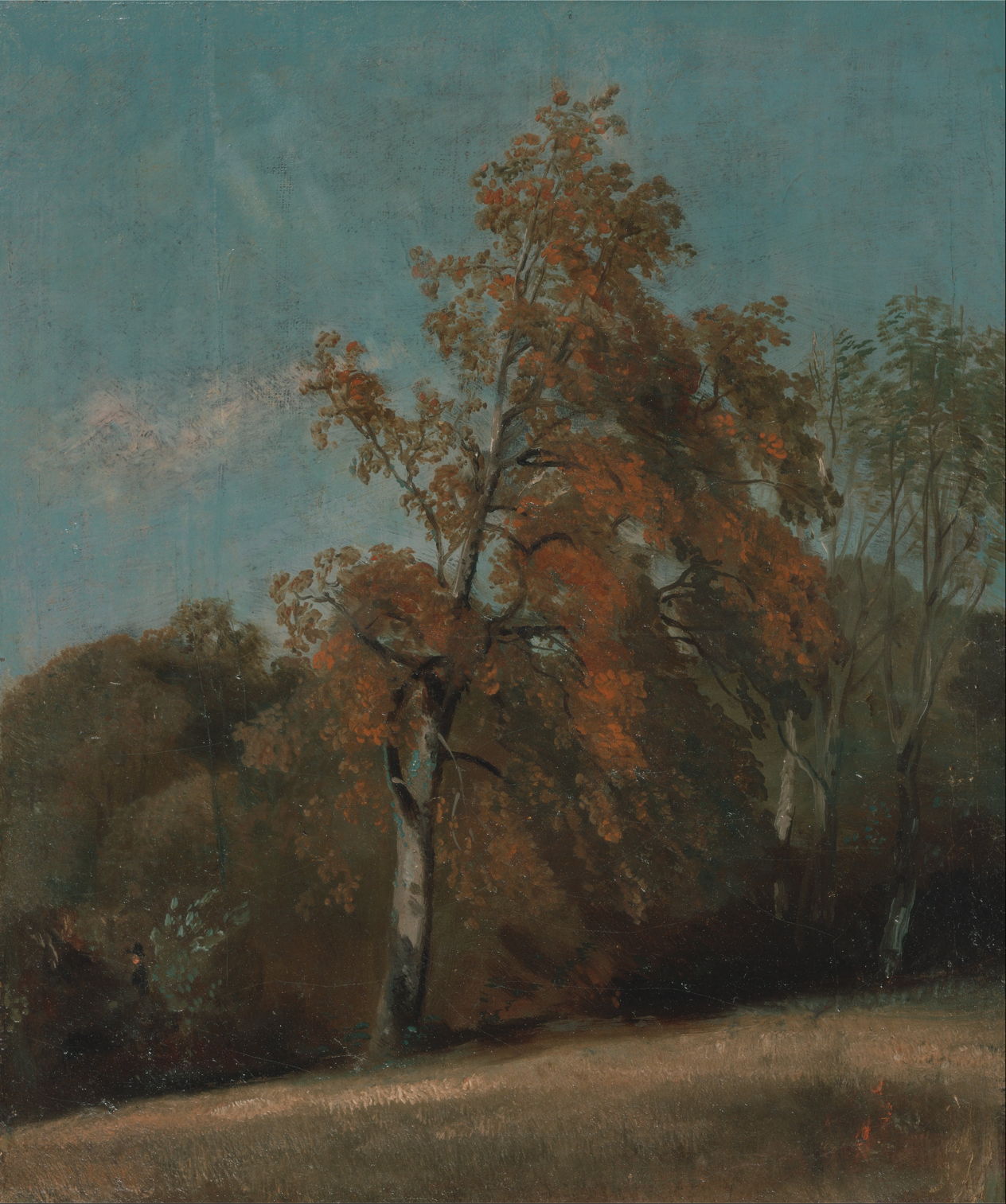
John Constable (1776–1837), Study of an Ash Tree (1801-3 or 1810-30), oil on canvas laid to artist's board, 39.4 x 29.8 cm, Yale Center for British Art, New Haven, CT. Wikimedia Commons.
John Constable (1776–1837), Study of an Ash Tree (1801-3 or 1810-30), oil on canvas laid to artist’s board, 39.4 x 29.8 cm, Yale Center for British Art, New Haven, CT. Wikimedia Commons.

He learned to create plein air sketches in oils, which he used extensively for ‘skying’ particularly around Hampstead Heath near London, and for remarkable studies of trees, such as this ash, seen in its autumn colours. Here he too has taken the time to construct the tree anatomically, and to detail its foliage.

This continued through the middle of the nineteenth century, when landscape painting was evolving towards Impressionism.
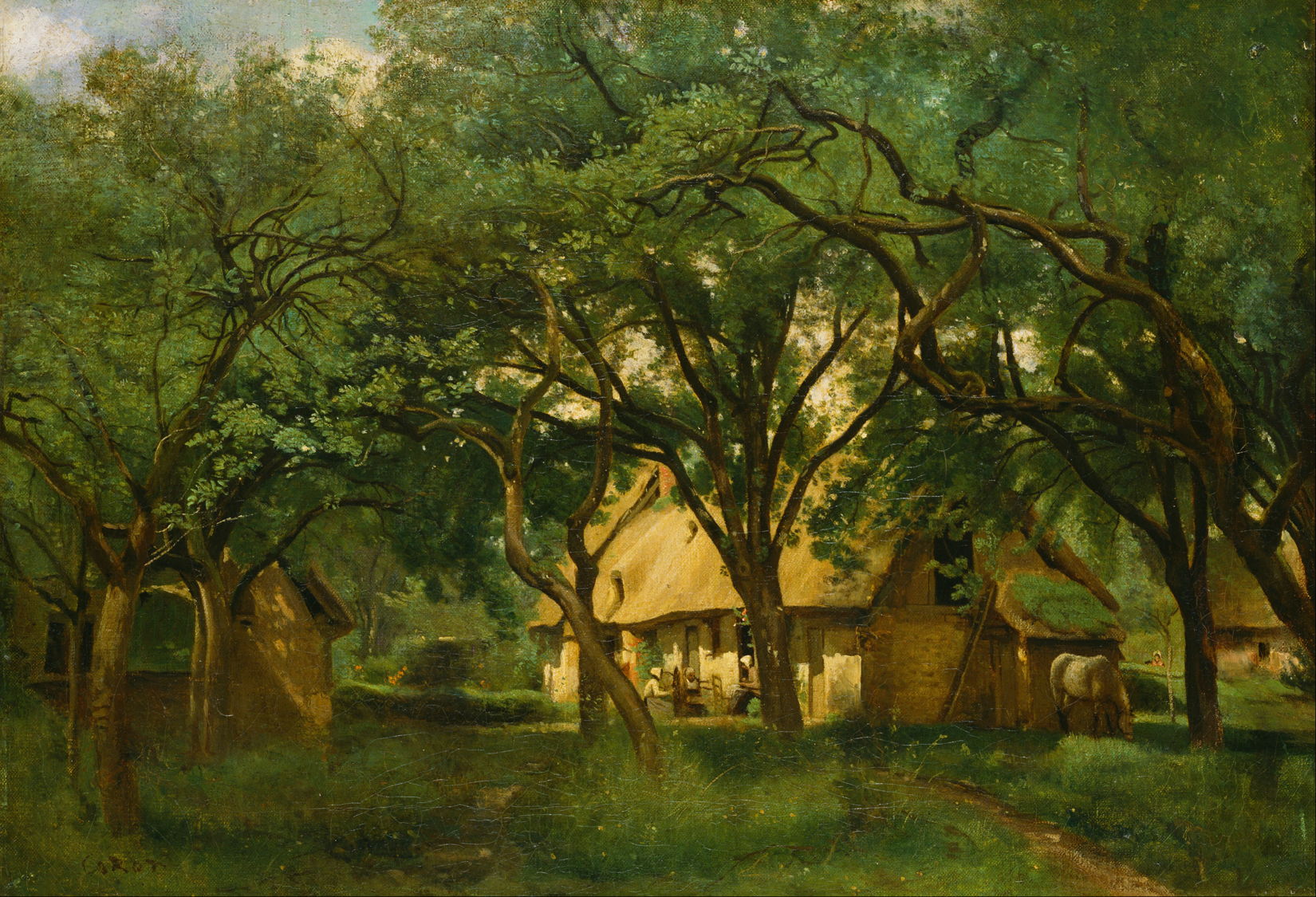
Jean-Baptiste-Camille Corot (1796–1875), The Toutain Farm, Honfleur (c 1845), oil on canvas, 44.4 × 63.8 cm, Bridgestone Museum of Art, Tokyo. Wikimedia Commons.

Camille Corot’s The Toutain Farm, Honfleur from about 1845 appears to be a finished studio painting, perhaps intended for the Salon. Its trees are marvellous and all but obscure and upstage the farmhouse beyond. Their sinuous limbs reflect his structured approach to painting their canopies with a catalogue of ways the trunk can give rise to branches. The canopy itself is shown in careful detail, although at the upper left it seems more vague and sketchy.

Europe has a rich and varied flora of tree species, and one of the challenges in painting its landscapes has been to capture their distinctive characteristics.

vanruisdaelroadthroughoakforest
Jacob Isaakszoon van Ruisdael (1628/9–1682), Road through an Oak Forest (c 1646-7), oil on canvas, 65 x 85 cm, Statens Museum for Kunst, København, Denmark. Wikimedia Commons.

Jacob van Ruisdael gave insight into the stages in the life and looks of oak trees. In Road through an Oak Forest (c 1646-7) he captures the later life of a stag-headed oak on the left, which lost its crown long ago, a flush of new growth on a fallen trunk, and another still clinging onto life despite a great split at its base. Judging by the girth of their trunks, the oaks shown here are around 400 years old, making it likely they were saplings in the thirteenth century, possibly even earlier. They form a remarkable window in time back to the late Middle Ages.

Camille Pissarro (1830-1903), The Big Walnut Tree in Spring, Éragny (1894), oil on canvas, 60 x 73 cm, Private collection. Wikimedia Commons.

Camille Pissarro’s Big Walnut Tree in Spring, Éragny from 1894 celebrates a species that is a source of binder in oil paint, in walnut oil, although it’s used far less frequently than linseed. Its wood is also sought after, making this tree a long-term investment for the landowner’s heirs.

Vincent van Gogh, Cypresses (1889), oil on canvas, 93.4 x 74 cm, The Metropolitan Museum of Art, New York, NY. Wikimedia Commons.
Vincent van Gogh (1853-1890), Cypresses (1889), oil on canvas, 93.4 x 74 cm, The Metropolitan Museum of Art, New York, NY. Wikimedia Commons.

Vincent van Gogh’s Cypresses (1889) are some of the best-remembered of all. As he moved style on beyond Impressionism, his swirling brushstrokes form solid but thoroughly living trees. These are most probably Italian cypresses, which are characteristic of the landscape around the Saint-Paul-de-Mausole asylum where he was living at that time, and throughout Provence.

Vincent van Gogh, Olive Grove (1889), oil on canvas, 72 x 92 cm, Kröller-Müller Museum, Otterlo. WikiArt.
Vincent van Gogh (1853-1890), Olive Grove (1889), oil on canvas, 72 x 92 cm, Kröller-Müller Museum, Otterlo. WikiArt.

In his Olive Grove (1889), those swirling strokes of foliage complement the tortuous curves of the branches and gnarled blue-grey trunks.
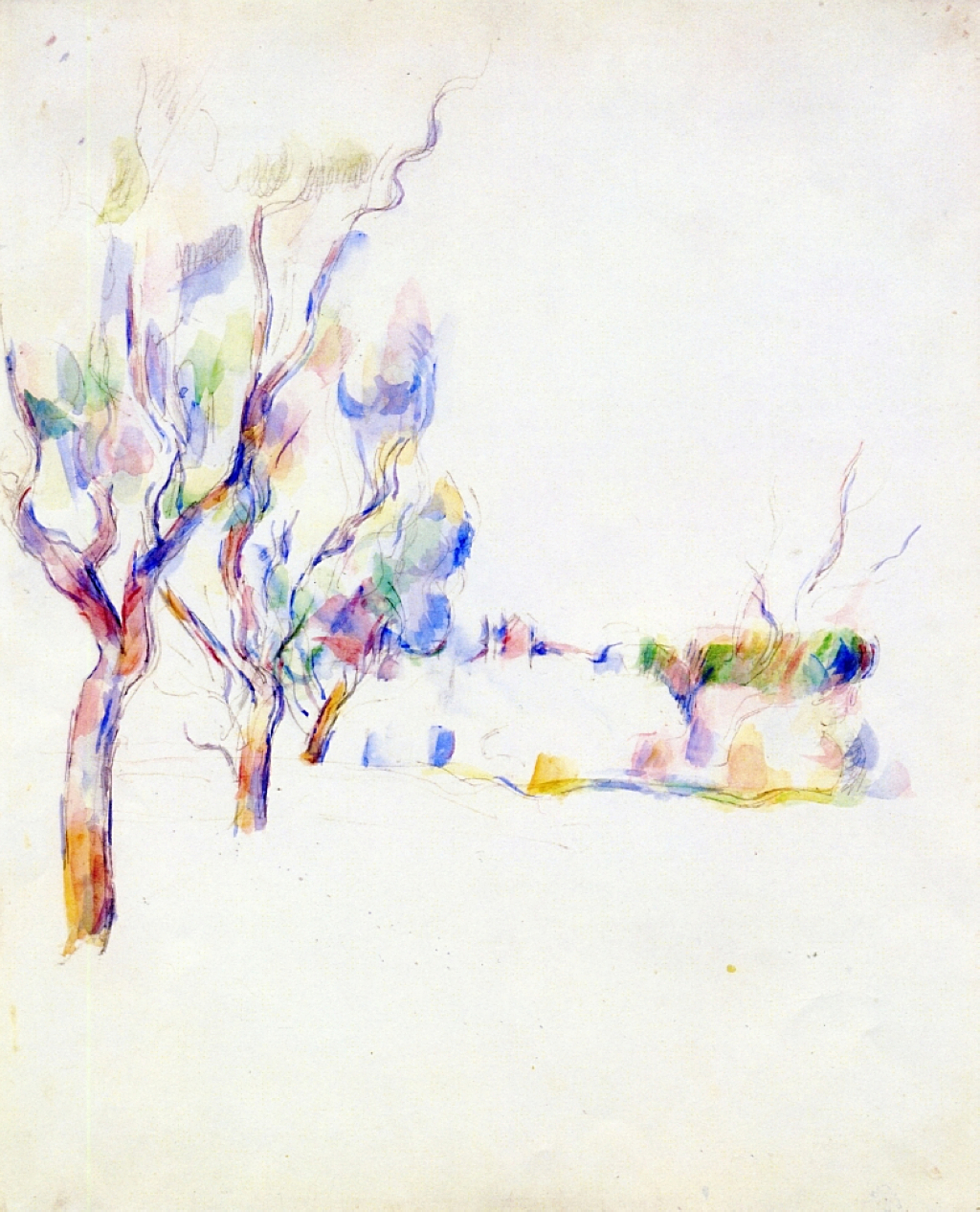
Paul Cézanne, Almond Trees in Provence (1900). Graphite and watercolour on paper, 58.5 x 47.5 cm, private collection (WikiArt).
Paul Cézanne (1839–1906), Almond Trees in Provence (1900). Graphite and watercolour on paper, 58.5 x 47.5 cm, private collection (WikiArt).

Paul Cézanne’s oil paintings of trees, although abundant, show his emphasis on patterned brushstrokes in what is known as his constructive stroke. This isn’t true of his watercolours, as shown in Almond Trees in Provence (1900), where each tree rises in a flare of brilliant colours.
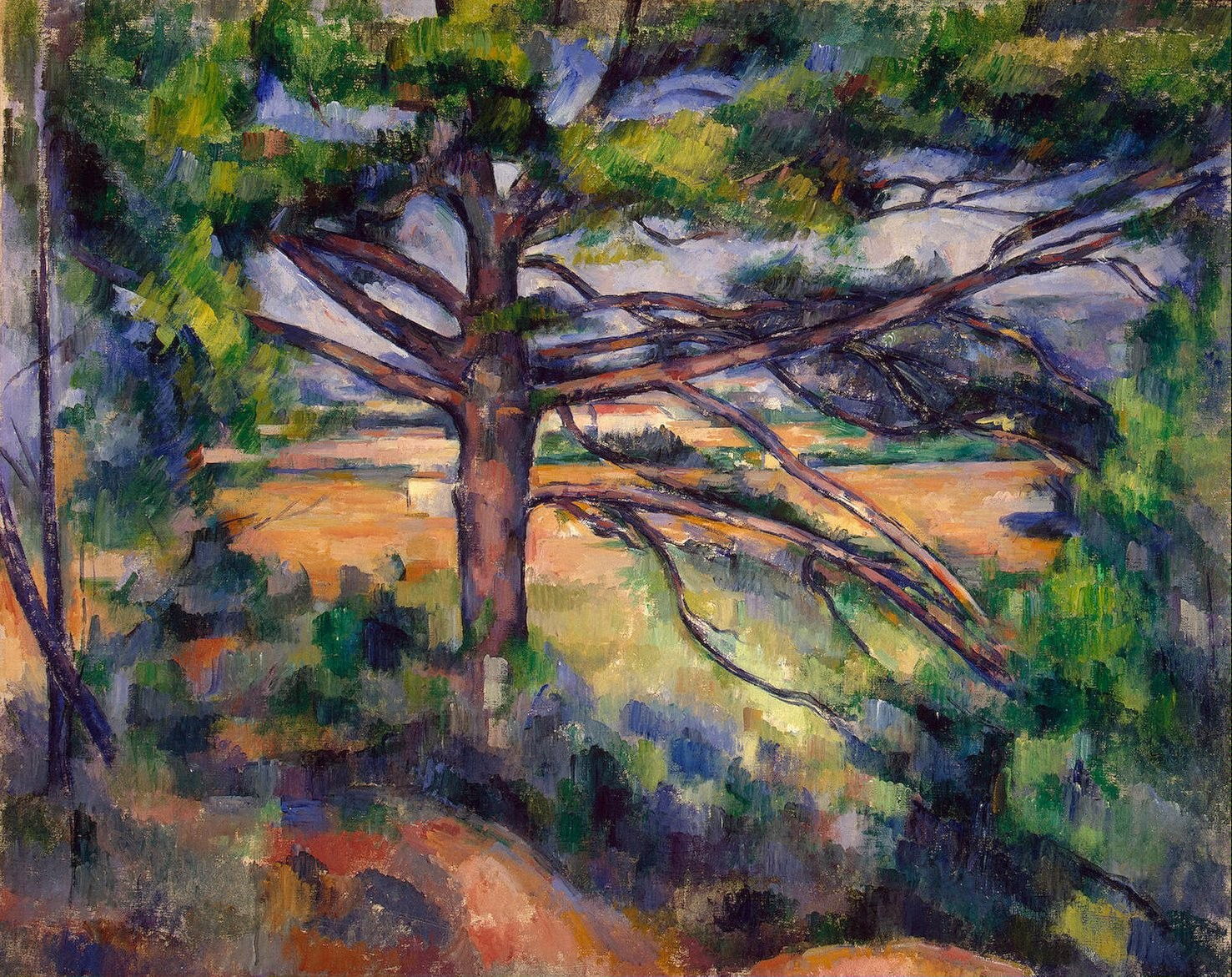
cézannelargepineredearth1895
Paul Cézanne (1839–1906), Grand pin et terres rouges (Large Pine and Red Earth) (1890–95), oil on canvas, 72 x 91 cm, Hermitage Museum, St. Petersburg. Wikimedia Commons.

Cézanne’s constructive stroke became more prominent and started to dominate the structure of his oil paintings after 1890. In Large Pine and Red Earth (1890–5) it’s used throughout the foreground foliage and vegetation, and has even started to appear in some patches on the trunk.

Théo van Rysselberghe, Pine by the Mediterranean Sea (1916), oil on canvas, 81 x 199 cm, Centraal Museum, Utrecht. WikiArt.
Théo van Rysselberghe (1862-1926), Pine by the Mediterranean Sea (1916), oil on canvas, 81 x 199 cm, Centraal Museum, Utrecht. WikiArt.

Finally, Théo van Rysselberghe’s Pine by the Mediterranean Sea (1916) appears almost as substantial as the bleached rocks below it. Contrast between the lit segments and those in cast shadow behind is wide, as is seen on the shores of the Mediterranean.

I hope you will join me in exploring these and many other fine portraits of trees over the coming weeks.

On Reflection: Impressionism

By: hoakley
25 March 2026 at 20:30

The original intent of the French Impressionists was to paint quickly in front of the motif so as to capture its impression. Although many Impressionist depictions of reflections aren’t optically faithful, in practice there’s nothing to prevent them from that. This was amply demonstrated by the grandfather of Impressionism, Camille Corot, during his formative years spent developing his skills in Rome.

Jean-Baptiste-Camille Corot, The Island and Bridge of San Bartolomeo (1825/8), oil on paper on canvas, 27 x 43.2 cm, National Gallery of Art, Washington DC. WikiArt.
Jean-Baptiste-Camille Corot (1796-1875), The Island and Bridge of San Bartolomeo (1825/8), oil on paper on canvas, 27 x 43.2 cm, National Gallery of Art, Washington DC. WikiArt.

Corot’s earliest plein air works are truly prodigious in their quality, and his development of the art. By the time that the Impressionists were painting outdoors, after 1841, oil paint was widely available in far more convenient metal tubes. But when Corot was in Italy he enjoyed no such luxuries: paint came in small bladders that were far less portable and messier to work with. Despite that, his view of The Island and Bridge of San Bartolomeo from 1825/8 appears optically accurate.

Jean-Baptiste-Camille Corot, View of Rome: The Bridge and Castel Sant'Angelo with the Cupola of St. Peter's (1826-7), oil on paper on canvas, 26.7 x 43.2 cm, Fine Arts Museums of San Francisco. WikiArt.
Jean-Baptiste-Camille Corot (1796-1875), View of Rome: The Bridge and Castel Sant’Angelo with the Cupola of St. Peter’s (1826-7), oil on paper on canvas, 26.7 x 43.2 cm, Fine Arts Museums of San Francisco. WikiArt.

Corot’s View of Rome: The Bridge and Castel Sant’Angelo with the Cupola of St. Peter’s from 1826-7 is another brilliant example painted on paper in front of the motif.

Claude Monet’s reflections are generally shown on broken water, and appear intended to be optically correct.

Claude Monet (1840–1926), The Thames below Westminster (1871), oil on canvas, 47 x 73 cm, The National Gallery, London. Wikimedia Commons.

Monet painted The Thames below Westminster while he was in London in 1871, and returned over thirty years later to paint more radical series of views in different lighting conditions.

monetimpressionsunrise
Claude Monet (1840–1926), Impression, Sunrise (1872), oil on canvas, 48 x 63 cm, Musée Marmottan Monet, Paris. Wikimedia Commons.

The following year, he painted this view of his home port of Le Havre, which gave rise to the movement’s name, Impression, Sunrise. This appears to be a brisk oil sketch of fog and the rising sun, and is one of his series depicting the port at different times and in varying lights, exhibited in the First Impressionist Exhibition two years later.

Alfred Sisley, The Canal Saint-Martin, Paris (1872), oil on canvas, 38 x 46 cm, Musée d'Orsay, Paris. EHN & DIJ Oakley.
Alfred Sisley (1839–1899), The Canal Saint-Martin, Paris (1872), oil on canvas, 38 x 46 cm, Musée d’Orsay, Paris. EHN & DIJ Oakley.

The same year, Alfred Sisley’s view of The Canal Saint-Martin, Paris shows a placid and almost disused stretch of canal near the centre of Paris. This too appears to be optically correct.

monetautumnonseine1873
Claude Monet (1840-1926), Autumn on the Seine, Argenteuil (1873), oil on canvas, 54.3 × 73.3 cm, High Museum of Art, Atlanta, GA. Wikimedia Commons.

In 1873, Monet painted his masterwork Autumn on the Seine, Argenteuil, a textbook example of a river landscape in autumn painted in high Impressionist style, with high chroma, loose brushstrokes and faithful reflections.

Claude Monet, 1883, View of the Church at Vernon, oil on canvas, 65 x 81 cm, Yamagata Museum of Art, Japan. (WikiArt)
Claude Monet (1840-1926), View of the Church at Vernon (1883), oil on canvas, 65 x 81 cm, Yamagata Museum of Art, Japan. (WikiArt)

Although Monet’s View of the Church at Vernon from 1883 doesn’t appear entirely optically accurate, its intent is clear. The reflection of the large house at the right is extended a little too far to the right, as if there had been a tall tree beside it on the bank, where the original image shows another lower house set further back.

Some of Monet’s later series relied on reflections for their visual effects, although they also take more optical liberties.

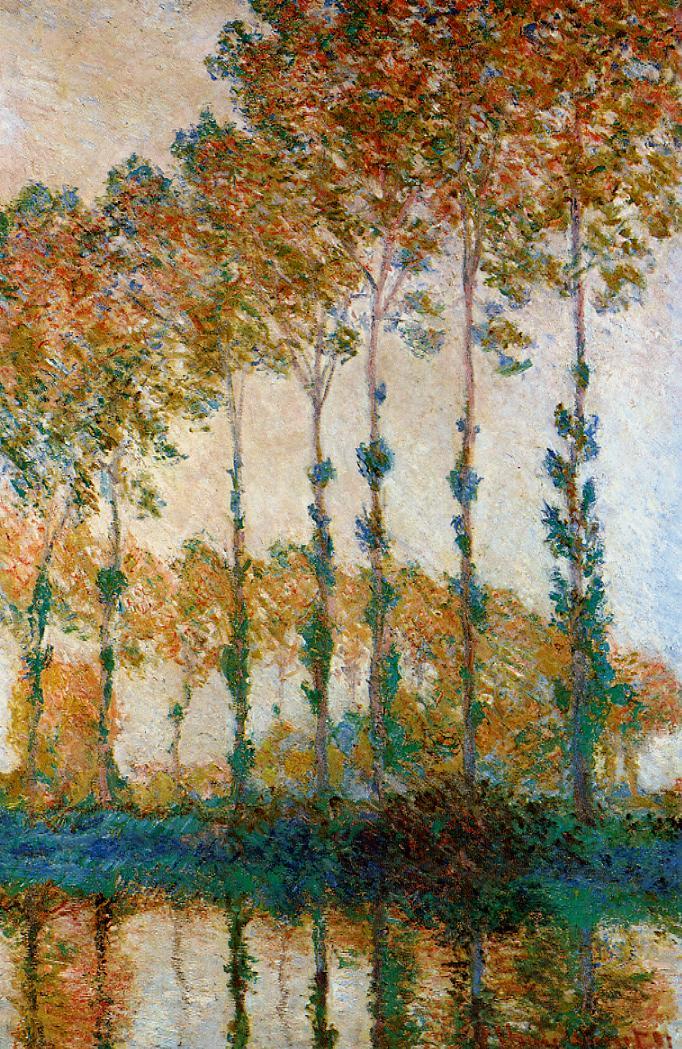
Claude Monet, Poplars on the Bank of the Epte, Autumn (1891) W1297, oil on canvas, 100 x 65 cm, Museum of Fine Arts, Boston. WikiArt.
Claude Monet (1840-1926), Poplars on the Bank of the Epte, Autumn (1891) W1297, oil on canvas, 100 x 65 cm, Museum of Fine Arts, Boston. WikiArt.

In 1891, Monet painted his first formal series showing poplars, including Poplars on the Bank of the Epte, Autumn. These articulate the contrasts in form within each tree, with sections of bare trunk, and those of extensive canopy, the colours cast by light and those of the leaves themselves, the rhythmic assembly of the line of trees, their reflections on the water, and the formation of the line of poplars into sweeping curves in depth.

sisleybendloingmoret
Alfred Sisley (1839–1899), The Bend on the Loing at Moret (1886), oil on canvas, 54 x 74 cm, Private collection. Wikimedia Commons.

The broken water surface in Sisley’s Bend on the Loing at Moret from 1886 remains surprisingly faithful.

Alfred Sisley, Moret Bridge in the Sunlight (1892), oil on canvas, 65 x 81 cm, Private collection. WikiArt.
Alfred Sisley (1839-1899), Moret Bridge in the Sunlight (1892), oil on canvas, 65 x 81 cm, Private collection. WikiArt.

In Moret Bridge in the Sunlight from 1892, Sisley captures the reflections of the buildings dominating the centre of this small town on the River Loing.

Claude Monet (1840–1926), The Houses of Parliament, Sunset (1903), oil on canvas, 81.3 × 92.5 cm, The National Gallery of Art, Washington, DC. Wikimedia Commons.

Claude Monet’s return to London in 1903 revisits The Houses of Parliament, Sunset fairly faithfully.

❌
❌