Normal view

There are new articles available, click to refresh the page.
Before yesterdayThe Eclectic Light Company

Painting Spring blossom 1

By: hoakley
18 April 2026 at 19:30

We still haven’t got New Year right, have we? Rather than putting it in the middle of winter, it should surely coincide with the arrival of Spring and blossom on trees. If you’re in a northern temperate latitude, now’s the time that you should be watching for the full flush of cherry and other flowering trees. In Washington DC its blossom festival extends a month from mid-March, in Japan rather later, and it’s even celebrated in Perth, in Western Australia, during the austral Spring.

This weekend I celebrate the end of the winter with two days of paintings of blossom on trees, today’s from the nineteenth century, and tomorrow from the twentieth.

palmerinshorehamgarden
Samuel Palmer (1805–1881), In a Shoreham Garden (c 1830), watercolour on paper, dimensions not known, Victoria and Albert Museum, London. Image courtesy of and © Victoria and Albert Museum, London.

Early in Samuel Palmer’s career, when he was living in Shoreham in Kent, he painted this watercolour of exuberant blossom In a Shoreham Garden, in about 1830.
millaisspring
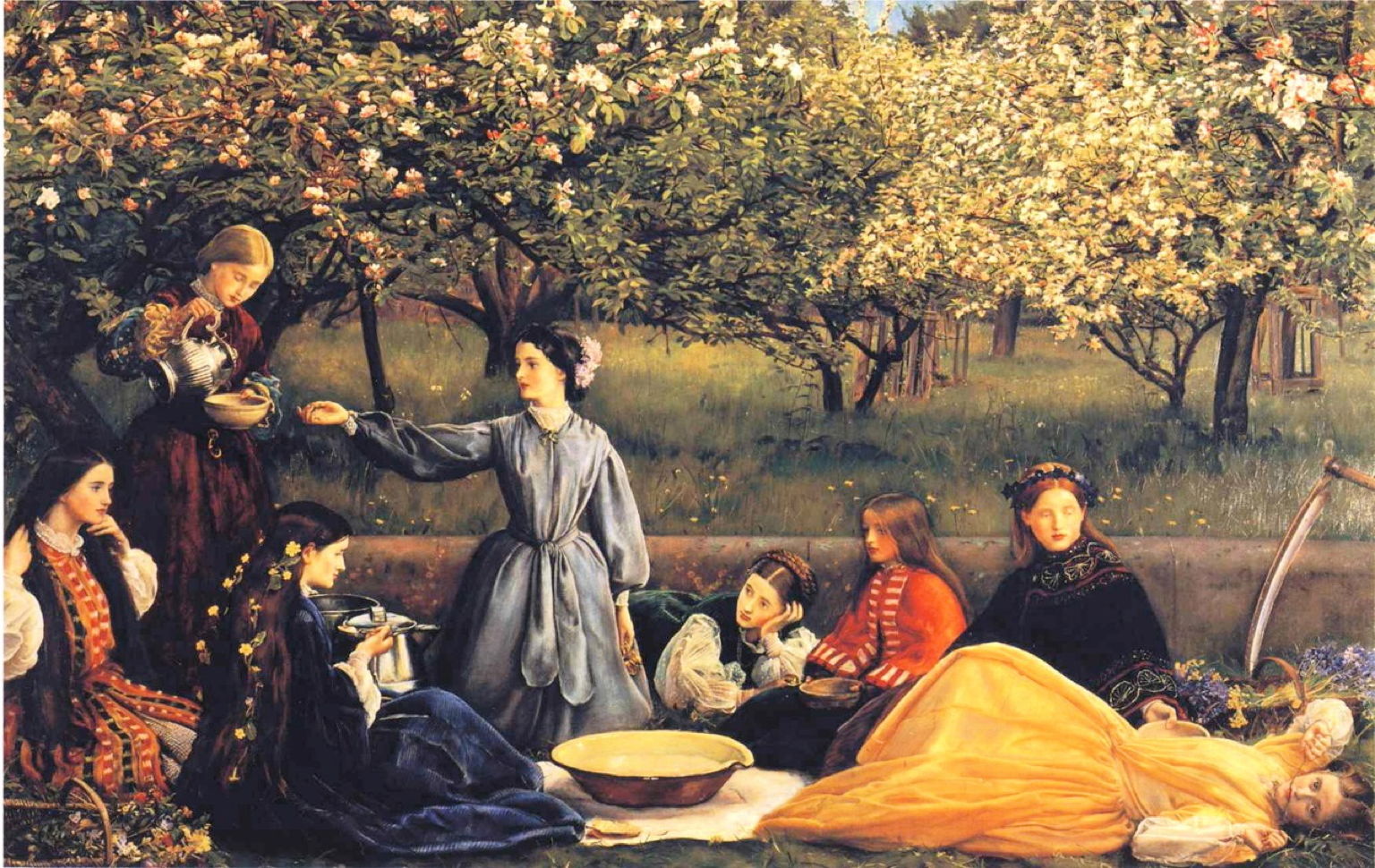
John Everett Millais (1829–1896), Spring (Apple Blossoms) (1856-59), oil on canvas, 110.4 x 172.7 cm, Lady Lever Art Gallery, Liverpool, England. Wikimedia Commons.

The Pre-Raphaelite movement emphasised painting from life; when John Everett Millais came to paint Flora and her Spring, in 1856-59, he added subtle allusions to Botticelli’s famous Primavera and classical myth. The blossom here is on apple trees, which are probably second only to May or Hawthorn in the English countryside at this time of year.

daubignyspring
Charles-François Daubigny (1817–1878), Spring Landscape (1862), oil on canvas, 133 x 240 cm, Alte Nationalgalerie, Berlin. Wikimedia Commons.

In the year that Charles-François Daubigny moved to Auvers-sur-Oise and founded the artists’ colony there, he painted this blossom-rich view of the Spring Landscape (1862). Vincent van Gogh was later to spend his final two months of painting near here.

milletspring
Jean-François Millet (1814–1875), Spring (1868-1873), oil on canvas, 86 x 111 cm, Musée d’Orsay, Paris. Wikimedia Commons.

In the closing years of Jean-François Millet’s life, he painted a commissioned series including this startling study of light, Spring (1868-73). This features a double rainbow at the upper left, with fleeting sunshine flooding the centre and dazzling on the abundant blossom. From the crops and seasonal flowers in the foreground to the inky black shower-clouds in the sky, this is a perfect summary of Spring in the countryside, and April showers.

sisleyterracestgermainspring
Alfred Sisley (1839–1899), The Terrace at Saint-Germain, Spring (1875), oil on canvas, 73.6 x 99.6 cm, Walters Art Museum, Baltimore, MD. Wikimedia Commons.

My favourite Impressionist painting of blossom has to be Alfred Sisley’s panorama of The Terrace at Saint-Germain, Spring, painted soon after he had moved to Marly-le-Roi in 1875.

haverswasherwomen
Alice Havers (1850–1890), Washerwomen (date not known), oil, dimensions not known, Walker Art Gallery, Liverpool, England. Wikimedia Commons.

Alice Havers’ Washerwomen, which given her tragically brief life must have been painted around 1880, shows a large orchard of fruit trees in blossom on the far side of the river.

By any measure, the nineteenth century master of blossom was Vincent van Gogh. Like several of his contemporaries, he had become a collector of Japanese woodcut prints, and was fascinated by one of their dominant themes, cherry blossom.

Vincent van Gogh (1853–1890), The Pink Orchard (1888), oil on canvas, 64 x 80 cm, Van Gogh Museum, Amsterdam. Wikimedia Commons.

Before he went to Arles, Vincent van Gogh had copied Utagawa Hiroshige’s woodblock print The Plum Orchard in Kameido. Shortly after his arrival there in 1888, the fruit trees came into flower, and he painted a triptych for his brother Theo’s apartment, including The Pink Orchard above, and The Pink Peach Tree below.

Vincent van Gogh (1853–1890), The Pink Peach Tree (1888), oil on canvas, 80.5 x 59 cm, Van Gogh Museum, Amsterdam. Wikimedia Commons.

Van Gogh’s approach to painting blossoming fruit trees is completely different from that of the Japanese prints. His trees are built anatomically, with trunk and branches drawn in outline, often using contrasting colour. Flowers are applied using impasto; sadly some of these have faded since, and some paint that now appears white or off-white was originally pinker.

Vincent van Gogh (1853–1890), View of Arles, Flowering Orchards (1889), oil on canvas, 72 × 92 cm, Neue Pinakothek, Munich. Wikimedia Commons.

Van Gogh’s View of Arles, Flowering Orchards (1889) is a complex composition, with trunks in the foreground, fruit trees in flower in the middle distance, and the town of Arles behind, integrating his previous explorations of each element.

larssonappleblossom1894
Carl Larsson (1853–1919), Apple Blossom (1894), watercolour, dimensions not known, Private collection. Wikimedia Commons.

Among Carl Larsson’s many intimate views of life at home is this watercolour of his daughter under the Apple Blossom from 1894. He uses his favourite colour contrast between the earth red of the barns behind with the pink of the girl’s bonnet, against the rich green vegetation around her.
serusierwhitecow
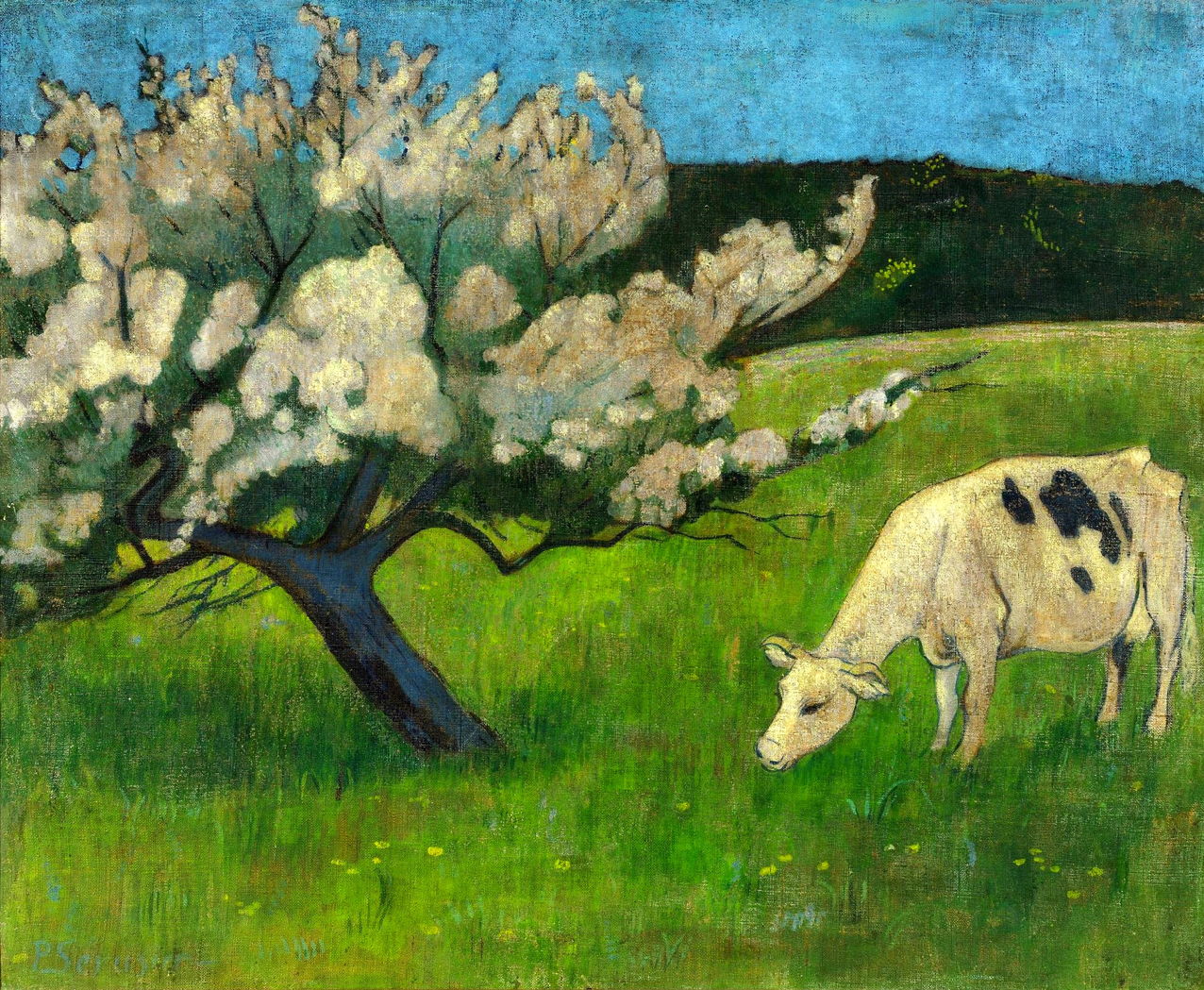
Paul Sérusier (1864–1927), The White Cow (c 1895), tempera on canvas, 60 x 73 cm, Muzeum Narodowe w Warszawie, Warsaw, Poland. Wikimedia Commons.

Some sixty-five years after Palmer’s exuberant clouds of blossom, Paul Sérusier employed a similar technique in The White Cow, from about 1895.
ringspringkahlers
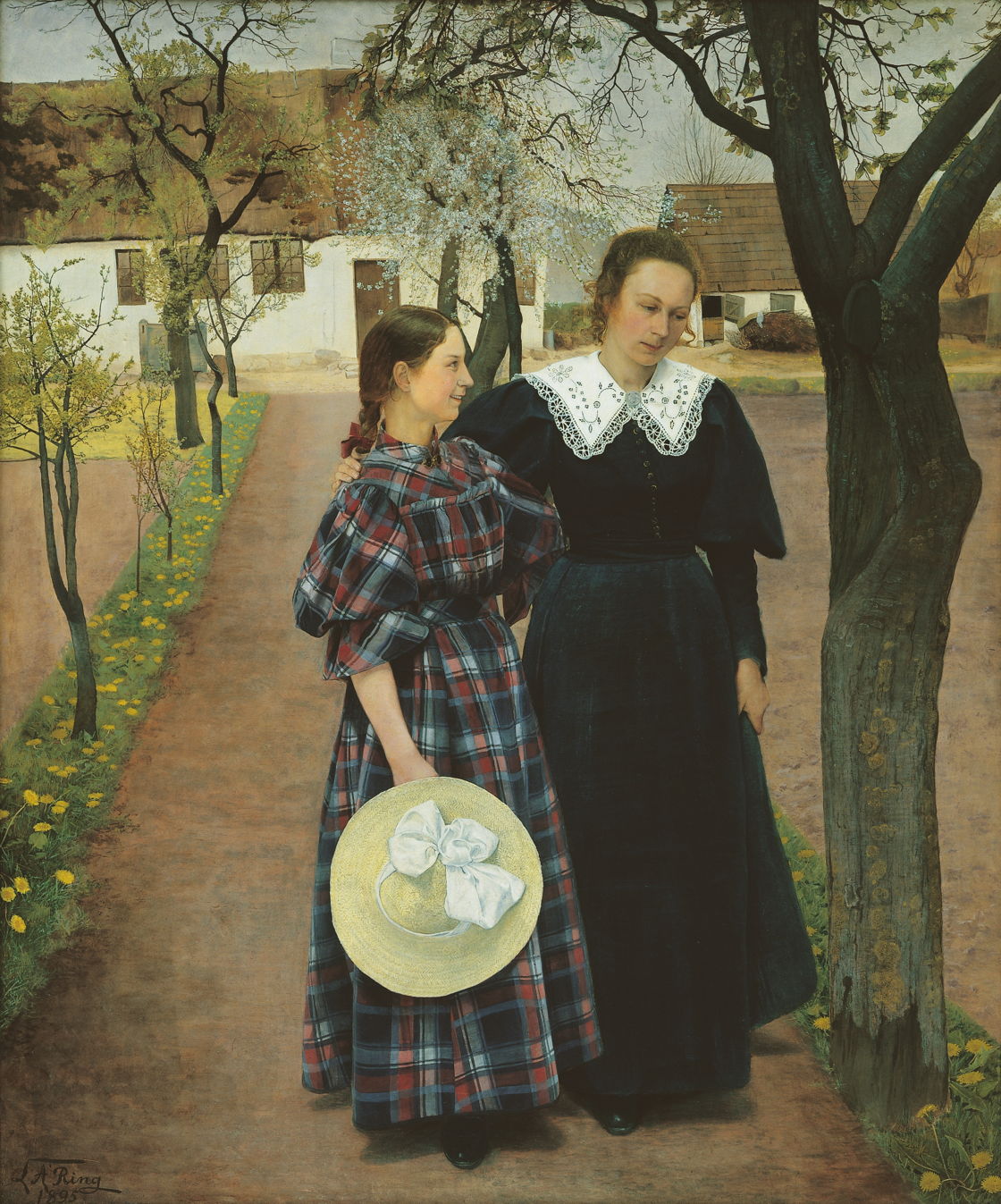
Laurits Andersen Ring (1854–1933), Spring. Ebba and Sigrid Kähler (1895), oil on canvas, 189.5 x 159 cm, Den Hirschsprungske Samling, Copenhagen, Denmark. Wikimedia Commons.

Laurits Andersen Ring’s finely detailed double portrait of Spring. Ebba and Sigrid Kähler from 1895 appears to show a mother and her daughter talking in their garden, but the two are actually sisters. At the right is Sigrid, the year before her wedding, at the left is her sister Ebba, who was fifteen at the time. Ring uses a light touch with the blossom and Spring flowers to avoid overwhelming the figures.

On Reflection: Impressionism

By: hoakley
25 March 2026 at 20:30

The original intent of the French Impressionists was to paint quickly in front of the motif so as to capture its impression. Although many Impressionist depictions of reflections aren’t optically faithful, in practice there’s nothing to prevent them from that. This was amply demonstrated by the grandfather of Impressionism, Camille Corot, during his formative years spent developing his skills in Rome.

Jean-Baptiste-Camille Corot, The Island and Bridge of San Bartolomeo (1825/8), oil on paper on canvas, 27 x 43.2 cm, National Gallery of Art, Washington DC. WikiArt.
Jean-Baptiste-Camille Corot (1796-1875), The Island and Bridge of San Bartolomeo (1825/8), oil on paper on canvas, 27 x 43.2 cm, National Gallery of Art, Washington DC. WikiArt.

Corot’s earliest plein air works are truly prodigious in their quality, and his development of the art. By the time that the Impressionists were painting outdoors, after 1841, oil paint was widely available in far more convenient metal tubes. But when Corot was in Italy he enjoyed no such luxuries: paint came in small bladders that were far less portable and messier to work with. Despite that, his view of The Island and Bridge of San Bartolomeo from 1825/8 appears optically accurate.

Jean-Baptiste-Camille Corot, View of Rome: The Bridge and Castel Sant'Angelo with the Cupola of St. Peter's (1826-7), oil on paper on canvas, 26.7 x 43.2 cm, Fine Arts Museums of San Francisco. WikiArt.
Jean-Baptiste-Camille Corot (1796-1875), View of Rome: The Bridge and Castel Sant’Angelo with the Cupola of St. Peter’s (1826-7), oil on paper on canvas, 26.7 x 43.2 cm, Fine Arts Museums of San Francisco. WikiArt.

Corot’s View of Rome: The Bridge and Castel Sant’Angelo with the Cupola of St. Peter’s from 1826-7 is another brilliant example painted on paper in front of the motif.

Claude Monet’s reflections are generally shown on broken water, and appear intended to be optically correct.

Claude Monet (1840–1926), The Thames below Westminster (1871), oil on canvas, 47 x 73 cm, The National Gallery, London. Wikimedia Commons.

Monet painted The Thames below Westminster while he was in London in 1871, and returned over thirty years later to paint more radical series of views in different lighting conditions.

monetimpressionsunrise
Claude Monet (1840–1926), Impression, Sunrise (1872), oil on canvas, 48 x 63 cm, Musée Marmottan Monet, Paris. Wikimedia Commons.

The following year, he painted this view of his home port of Le Havre, which gave rise to the movement’s name, Impression, Sunrise. This appears to be a brisk oil sketch of fog and the rising sun, and is one of his series depicting the port at different times and in varying lights, exhibited in the First Impressionist Exhibition two years later.

Alfred Sisley, The Canal Saint-Martin, Paris (1872), oil on canvas, 38 x 46 cm, Musée d'Orsay, Paris. EHN & DIJ Oakley.
Alfred Sisley (1839–1899), The Canal Saint-Martin, Paris (1872), oil on canvas, 38 x 46 cm, Musée d’Orsay, Paris. EHN & DIJ Oakley.

The same year, Alfred Sisley’s view of The Canal Saint-Martin, Paris shows a placid and almost disused stretch of canal near the centre of Paris. This too appears to be optically correct.

monetautumnonseine1873
Claude Monet (1840-1926), Autumn on the Seine, Argenteuil (1873), oil on canvas, 54.3 × 73.3 cm, High Museum of Art, Atlanta, GA. Wikimedia Commons.

In 1873, Monet painted his masterwork Autumn on the Seine, Argenteuil, a textbook example of a river landscape in autumn painted in high Impressionist style, with high chroma, loose brushstrokes and faithful reflections.

Claude Monet, 1883, View of the Church at Vernon, oil on canvas, 65 x 81 cm, Yamagata Museum of Art, Japan. (WikiArt)
Claude Monet (1840-1926), View of the Church at Vernon (1883), oil on canvas, 65 x 81 cm, Yamagata Museum of Art, Japan. (WikiArt)

Although Monet’s View of the Church at Vernon from 1883 doesn’t appear entirely optically accurate, its intent is clear. The reflection of the large house at the right is extended a little too far to the right, as if there had been a tall tree beside it on the bank, where the original image shows another lower house set further back.

Some of Monet’s later series relied on reflections for their visual effects, although they also take more optical liberties.

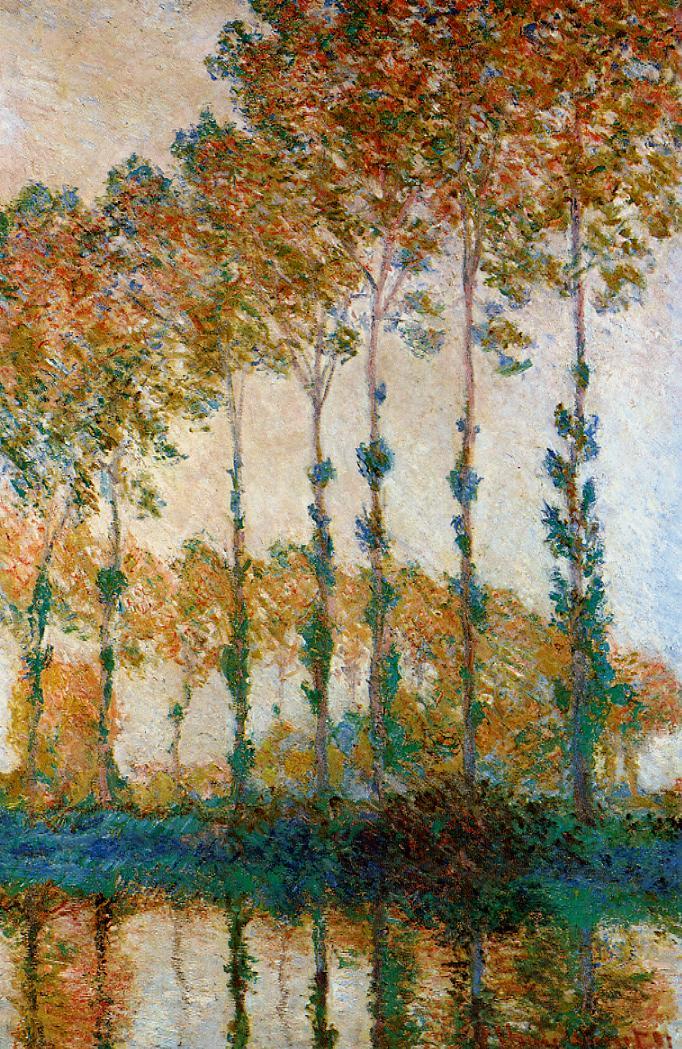
Claude Monet, Poplars on the Bank of the Epte, Autumn (1891) W1297, oil on canvas, 100 x 65 cm, Museum of Fine Arts, Boston. WikiArt.
Claude Monet (1840-1926), Poplars on the Bank of the Epte, Autumn (1891) W1297, oil on canvas, 100 x 65 cm, Museum of Fine Arts, Boston. WikiArt.

In 1891, Monet painted his first formal series showing poplars, including Poplars on the Bank of the Epte, Autumn. These articulate the contrasts in form within each tree, with sections of bare trunk, and those of extensive canopy, the colours cast by light and those of the leaves themselves, the rhythmic assembly of the line of trees, their reflections on the water, and the formation of the line of poplars into sweeping curves in depth.

sisleybendloingmoret
Alfred Sisley (1839–1899), The Bend on the Loing at Moret (1886), oil on canvas, 54 x 74 cm, Private collection. Wikimedia Commons.

The broken water surface in Sisley’s Bend on the Loing at Moret from 1886 remains surprisingly faithful.

Alfred Sisley, Moret Bridge in the Sunlight (1892), oil on canvas, 65 x 81 cm, Private collection. WikiArt.
Alfred Sisley (1839-1899), Moret Bridge in the Sunlight (1892), oil on canvas, 65 x 81 cm, Private collection. WikiArt.

In Moret Bridge in the Sunlight from 1892, Sisley captures the reflections of the buildings dominating the centre of this small town on the River Loing.

Claude Monet (1840–1926), The Houses of Parliament, Sunset (1903), oil on canvas, 81.3 × 92.5 cm, The National Gallery of Art, Washington, DC. Wikimedia Commons.

Claude Monet’s return to London in 1903 revisits The Houses of Parliament, Sunset fairly faithfully.

❌
❌