Jessica Fuentes with her children at the Community Kitchen in West Harlem in December. Ms. Fuentes said she was struggling to keep up with the costs of all of her necessities, like food.
Belgian Prime Minister Bart De Wever is yet to be convinced that the money held in Belgium should be loaned to Ukraine (file pic)
European Union leaders begin two days of talks in Brussels with a momentous decision to be taken on whether to loan tens of billions of euros in frozen Russian assets to Ukraine to fund its military and economic needs.
Most of Russia's €210bn (£185bn; $245bn) worth of assets in the EU are held by Belgium-based organisation Euroclear, and so far Belgium and some other members of the bloc have said they are opposed to using the cash.
Without a boost in funding, Ukraine's finances are set to run dry in a matter of months.
One European government official described being "cautiously optimistic, not overly optimistic" that a deal would be agreed. Russia has warned the EU against using its money.
It has filed a lawsuit against Euroclear in a Moscow court in a bid to get its money back.
The Brussels summit comes at a pivotal moment.
US President Donald Trump has said a deal to end the war - which began with Russia's full-scale invasion of Ukraine in February 2022 - is "closer now than we have been ever".
Although Russia has not responded to the latest peace proposals, the Kremlin has stressed that plans for a European-led multinational force for Ukraine supported by the US would not be acceptable.
President Vladimir Putin made his feelings towards Europe clear on Wednesday, when he said the continent was in a state of "total degradation" and "European piglets" - a derogatory description of Ukraine's European allies - were hoping to profit from Russia's collapse.
Alexander KAZAKOV/POOL/AFP
Those in favour of loaning Ukraine the money believe it will help deter Putin from continuing the war
The European Commission - the EU's executive arm - has proposed loaning Kyiv about €90bn (£79bn) over the next two years - out of the €210bn of Russian assets sitting in Europe.
That is about two-thirds of the €137bn that Kyiv is thought to need to get through 2026 and 2027.
Until now the EU has handed Ukraine the interest generated by the cash but not the cash itself.
"This is a crunch time for Ukraine to keep fighting for the next year," a Finnish government official told the BBC. "There are of course peace negotiations but this gives Ukraine leverage to say 'we're not desperate and we have the funds to continue fighting'."
Commission chief Ursula von der Leyen says it will also ramp up the cost of war for Russia.
Russia's frozen assets are not the only option on the table for EU leaders. Another idea, backed by Belgium, is based on the EU borrowing the money on the international markets.
However, that would require a unanimous vote and Hungary's Viktor Orban has made it clear he will not allow any more EU money to help Ukraine.
For Ukraine, the hours ahead are significant and President Volodymyr Zelensky is expected to attend the EU summit.
Ahead of the Brussels meeting, EU leaders were keen to stress the momentous nature of the decision.
"We know the urgency. It is acute. We all feel it. We all see it," von der Leyen told the European Parliament.
EPA
Ursula von der Leyen told the European Parliament that two choices were on the table for EU leaders
German Chancellor Friedrich Merz has played a leading role in pushing for the Russian assets to be used, telling the Bundestag on the eve of the summit it was about sending a "clear signal" to Moscow that continuing the war was pointless.
EU officials are confident they have a sound legal basis to use the frozen Russian assets, but so far Belgian Prime Minister Bart De Wever remains unconvinced.
His Defence Minister Theo Francken warned ahead of the talks that it would be a big mistake to loan the Euroclear cash.
Hungary is seen as the biggest opponent of the move and, ahead of the summit, Prime Minister Orban and his entourage even suggested that the frozen assets plan had been removed from the summit agenda. A European Commission official stressed that was not the case and it would be a matter for the 27 member states at the summit.
Slovakia's Robert Fico has also opposed using the Russian assets, if it means the money being used to procure weapons rather than for reconstruction needs.
When the pivotal vote does finally take place, it will require a majority of about two-thirds of member states to go through. Whatever happens, European Council President António Costa has promised not to go over the heads of the Belgians.
"We're not going to vote against Belgium," he told Belgian public broadcaster RTBF. "We'll continue to work very intensively with the Belgian government because we don't want to approve something that might not be acceptable for Belgium."
Belgium will also be aware that ratings agency Fitch has placed Euroclear on a negative watch, partly because of "low" legal risks to its balance sheet from the European Commission's plans to use the Russian assets. Euroclear's chief executive has also warned against the plan.
"There are many hiccups and obstacles of course still on the way. We have to find a way to respond to Belgium's worries," the Finnish official added. "We are on the same side as Belgium. We will find a solution together to make sure all the risks are checked as much as they can be checked."
However, Belgium is not the only country to have doubts, and a majority is not guaranteed.
Italian Prime Minister Giorgia Meloni has told Italian MPs she will endorse the deal "if the legal basis is solid".
"If the legal basis for this initiative were not solid, we would be handing Russia its first real victory since the beginning of this conflict."
Malta, Bulgaria and the Czech Republic are also said to be unconvinced by the controversial proposals.
If the deal is passed and the Russian assets are given to Ukraine, the worst-case scenario for Belgium would be one in which a court would order it to hand the money back to Russia.
Some countries have said they would be prepared to provide billions of euros in financial guarantees, but Belgium will want to see the numbers add up.
At any rate, Commission officials are confident that the only way for Russia to get it back would be by paying reparations to Ukraine - at which point Ukraine would hand its "reparations loan" back to the EU.
Hospitals across the UK are seeing high levels of flu cases this winter.
The NHS in England has said it is on "on high alert" after seeing the highest ever number of flu cases in hospital for this time of year, in the week ending 14 December.
You can use our tool below to find out how many flu patients there are in hospitals near you.
Figures relating to flu cases in hospitals are collected in different ways in each UK nation.
In England it is the weekly number of beds occupied by patients with a laboratory confirmed flu case.
This data is provided at NHS Trust level. Trusts are organisations which include hospitals, community services and providers of other forms of patient care. You can find which trust your local hospital belongs to on the NHS England website.
In Scotland the figures relate to the number of patients admitted to hospital with a laboratory confirmed flu case taken between 14 days before the admission date and 48 hours after the admission date.
In Wales it is the weekly number of patients in hospital with a laboratory confirmed flu case taken from 28 days before the admission date if tested outside of hospital, or within two days after admission.
Figures for Scotland and Wales are provided at NHS Health Board level. Health boards are responsible for all frontline healthcare services. You can find which Health Board your local services belong to on the NHS Scotland or NHS Wales websites.
In Northern Ireland the figures show the number of new flu cases admitted to hospital that were acquired outside of hospital.
This data is provided at Health and Social Care Trust level. Trusts are responsible for providing local and regional health services. You can find which trust your local hospital belongs to on the NI direct website.
Farmers are "bewildered and frightened" with many questioning the future of their businesses because of the government's proposed changes to inheritance tax, an independent review of farm profitability has found.
The long-awaited government-commissioned report was published on Thursday with 57 recommendations designed to improve productivity, investment and resilience in agriculture.
But author Baroness Minette Batters, former president of the National Farmers' Union (NFU), warned there was "no silver bullet" to making farms in England profitable.
Environment secretary Emma Reynolds said the government and the farming and food industries would work much more closely together in the future.
Getty Images
Baroness Batters said that farmers "don't want handouts from the state"
That would be done through a newly created farming and food partnership board made up of senior industry and government leaders that would "drive growth, productivity and long-term profitability across the sector", she explained.
"When farming thrives, the whole country benefits. British farmers are central to our food security, our rural economy and the stewardship of our countryside," the secretary of state added.
"This is about serious action to remove barriers, unlock investment and make the food system work better, so farm businesses can grow, invest and plan for the future with confidence."
Baroness Batters' review called for a "new deal for profitable farming" that would recognise the true cost of producing food and delivering for the environment.
The report did not look in detail at the government's proposed changes to inheritance tax, which are set to apply to farm businesses worth more than £1 million at a rate of 20% from April 2026.
But Baroness Batters said it was raised as the single biggest concern by almost everyone in the farming sector she talked to as part of the review.
'Questioning viability'
She said the sector had faced a sharp rise in costs and increasingly extreme weather, with severe drought this year.
Uncertainty surrounding the closure of applications to the sustainable farming incentive scheme - the post-Brexit agricultural payments scheme - and proposed changes to inheritance tax had created "significant" ongoing concern, with some farmers "questioning viability let alone profitability".
In the review, she said: "The farming sector is bewildered and frightened of what might lie ahead."
The report added that costs would be 30% higher in 2026 than they were in 2020, while the £2.4bn farming budget for England had been almost the same since 2007 - even as farmers and growers are asked to do more to comply with environmental legislation, with less funding and no certainty.
Baroness Batters added: "Farmers don't want handouts from the state, they want nothing more than to run thriving, profitable farming businesses, by earning a fair return for what they produce."
The NFU said it was "a thorough and complex report" which was "right to recognise reform is needed".
President Tom Bradshaw said that of the issues raised, fairness in the supply chain was a "top priority" alongside planning reforms and focus on growing exports.
"But alongside this, there are other immediate actions that are needed to boost British farming like providing much-needed clarity and certainty on the future of the sustainable farming incentive and doing the right thing on the pernicious inheritance tax changes," he added.
Gavin Lane, president of the Country Land and Business Association, which represents rural businesses and landowners, welcomed the review and said it was now time for "urgent action".
"As this report highlights, profitability across the sector is perilously slim, with farmers battling high input costs, low commodity prices and volatile weather conditions.
"Many farm businesses are marginal or loss-making, yet will soon be hit with unaffordable inheritance tax bills, which in many cases will dwarf their annual profit," he explained.
In response to the review, the government said it was also taking action on planning reform to make food production a clearer priority, speed up on-farm reservoirs, polytunnels and farm shops, and make it easier for farmers to invest.
The government is also stepping up action on supply chain fairness, tackling barriers to private finance and supporting exports and new markets, a spokesman for the Department for Environment, Food and Rural Affairs (Defra) said.
An interest rate tells you how much it costs to borrow money, or the reward for saving it.
The Bank of England's base rate is what it charges other banks and building societies to borrow money, which influences what they charge their own customers for mortgages as well as the interest rate they pay on savings.
When inflation is above that target, the Bank can decide to put rates up. The idea is that this encourages people to spend less, reducing demand for goods and services and limiting price rises.
How will the interest rate cut affect mortgages, loans and savings rates?
About 500,000 homeowners have a mortgage that "tracks" the Bank of England's rate.A 0.25 percentage point cut is likely to mean a reduction of £29 in the monthly repayments for the average outstanding loan.
For the additional 500,000 homeowners on standard variable (SVR) rates - assuming their lender passed on the benchmark rate cut - there would typically be a £14 a month fall in monthly payments for the average outstanding loan.
But the vast majority of mortgage customers have fixed-rate deals. While their monthly payments aren't immediately affected by a rate change, future deals are.
Mortgage rates have been falling recently, partly owing to the expectation the Bank would cut rates in December.
As of 18 December, the average two-year fixed residential mortgage rate was 4.82%, according to financial information company Moneyfacts. A five-year rate was 4.90%.
The average two-year tracker rate was 4.66%.
About 800,000 fixed-rate mortgages with an interest rate of 3% or below are expected to expire every year, on average, until the end of 2027. Borrowing costs for customers coming off those deals are expected to rise sharply.
You can see how your mortgage may be affected by future interest rate changes by using our calculator:
Bank of England interest rates also influence the amount charged on credit cards, bank loans and car loans.
Lenders can decide to reduce their own interest rates if Bank cuts make borrowing costs cheaper.
However, this tends to happen very slowly.
Getty Images
Savings
The Bank base rate also affects how much savers earn on their money.
A falling base rate is likely to mean a reduction in the returns offered to savers by banks and building societies.
The current average rate for an easy access savings account is 2.55%, according to Moneyfacts.
Any further cut in rates could particularly affect those who rely on the interest from their savings to top up their income.
Will interest rates fall further?
Most analysts had expected the December cut, but the vote among members of the nine-member monetary policy committee (MPC) was divided. Five were in favour of a cut.
The Bank said rates were likely to continue dropping in the future, but warned decisions on further cuts in 2026 would be contested.
"We still think rates are on a gradual path downward but with every cut we make, how much further we go becomes a closer call," said the Bank's governor Andrew Bailey.
The latest inflation data for November, published the day before the MPC meeting, showed a larger than expected drop to 3.2%.
That means prices are still rising, but by less than seen in the summer.
What is happening to interest rates in other countries?
In recent years, the UK has had one of the highest interest rates in the G7 - the group representing the world's seven largest so-called "advanced" economies.
In June 2024, the European Central Bank (ECB) started to cut its main interest rate for the eurozone from an all-time high of 4%.
More than 79,600criminal cases are now caught in the courts backlog in England and Wales, new figures show.
The Crown Court backlog has been at a record high since early 2023 and is projected to hit 100,000 by 2028, according to the Ministry of Justice (MoJ). The delays mean that for some serious crimes charged today the victims and suspects could be left waiting years for justice as they are unlikely to see the case come to trial before 2030.
This crisis has prompted the government to announce radical reforms to the criminal courts, including removing juries - a fundamental part of our criminal justice system - from a number of trials in England and Wales in an attempt to speed up justice and slash the backlog.
The latest MoJ figures show there has been a huge growth in cases taking two years or more to conclude, something that was a rarity before 2010 budget cuts began to bite, and which was later exacerbated by the pandemic and other factors.
About a quarter of violence and drug offences, many of which do not require the defendant to be detained pre-trial, have been in the backlog for at least a year. More than 30% of sexual offences have been in the system for at least that long. For context, in 2019 there were around 200 sexual offences that had been open for more than a year. Now there are more than 4,000.
It means the situation has become significantly worse for victims, defendants, witnesses and everyone else who works in the system, and shows the scale of the problem the government is now grappling with.
So how did we get here? At the heart of this story is funding - and the lack of it - which started in 2010.
Back then the coalition government pledged to slash spending to balance the books - and the MoJ took a huge cut to its £9bn budget. It means its total spending today is £13bn, which is £4.5bn lower in real terms than it would have been had it kept pace with the average government department, according to the Institute of Fiscal Studies.
Why did that cut happen?
When the coalition government began making austerity cuts, the MoJ took a bigger hit than some other departments such as health and defence. It delivered some of its cuts by shutting court rooms, and by 2022, eight crown court centres and more than 160 magistrates courts were gone, according to ministerial answers to parliamentary questions.
Ministers also introduced a cap on the number of days judges are paid to sit in court and hear cases, to help reduce spending.
In 2016-17 there were 107,863 of these "sitting days" recorded, but that had fallen to 81,899 by the eve of the pandemic. If there's no judge, there's no hearing, which meant individual courtrooms were left idle even if the rest of a court complex was still hearing cases.
Then the Covid pandemic happened, which left all Crown Courts closed for two months during the first lockdown other than for urgent and essential work. When they reopened, many individual courtrooms could not be used for trials because they were too small to comply with social distancing requirements. Everything slowed to a snail's pace and the backlog exploded.
This is when the unintended consequences of earlier closures began to bite harder. Take for example Blackfriars Crown Court in London. Its nine court rooms were once an important centre for serious organised crime cases, but ministers decided to close it in 2019 and hoped to sell the land.
Many of its cases were shifted to Snaresbrook in east London, but since the pandemic it has been overwhelmed. At the end of September 2019 it had 1,500 cases on its books, official figures show, but as of September this year it was juggling more than 4,200.
Before the pandemic, only 5% of outstanding cases for violence across England and Wales had been in the system for more than a year - now a quarter of cases have taken that long. There have been similar increases in the length of time taken for criminal damage, possession of weapons and drug offence cases.
During the Covid pandemic, temporary "Nightingale courts" were introduced to help alleviate pressure on the court system by keeping some cases moving, sitting for 10,000 days between July 2020 and 2024.
But they could not deal with serious crime involving custody because they were often in conference centres or hotels with no cells or appropriate security. Today there are still five Nightingale courts operating, all of which are due to close by March 2026.
Sometimes the MoJ re-opened a court it had closed. Chichester's Crown Court was shut down, despite local opposition, in 2018. It was temporarily re-opened to help deal with the overflow of cases from Guildford 40 miles away - and its future remains uncertain, despite the backlogs.
Getty Images
David Lammy has announced radical reforms to the courts system
But there is another element that has made everything much harder to fix.
The national legal aid system pays for barristers and solicitors to act for a defendant who cannot afford to pay for their own lawyer. It both helps ensure a fair trial and keeps cases moving through the courts, but the funding for this system has been repeatedly cut or frozen over the past 25 years, which in turn has led to a fall in barristers taking criminal cases.
The National Audit Office found there has been a real term reduction in legal aid spending by the MoJ of £728m between 2012-13 and 2022-23.
And there has also been a 12% fall in the number of barristers doing criminal work between 2018-19 and 2024-25, according to the Criminal Bar Association.
In 2021, the government was advised to inject £135m extra funding into legal aid but it did not go far enough for many in the profession and triggered months-long strike action from defence barristers the following year. This created a second wave of chaos in the courts because, just like in the pandemic, cases could not progress through the system.
The shortages in judges and lawyers contrast sharply with what happened to policing. In 2019 former prime minister Boris Johnson promised to hire 20,000 extra police officers across England and Wales, reversing the fall that began during austerity cuts. That meant more suspects charged and sent to trial - but critics said there was no corresponding planning for how this would impact the courts.
Prosecutions can also take longer because of changes to how evidence is gathered by police, particularly involving our digital lives. Many cases today, especially those involving serious sexual offences, involve a huge amount of evidence taken from digital sources such as mobile phone chats, which can take months to comb through ahead of a trial and more time going through it with a jury.
The backlog also has a knock-on effect on prisons. There are nearly 17,700 people on remand in England and Wales, almost double the number in 2019 . This includes people who have been convicted of a crime but have not yet been sentenced, and nearly 12,000 people who are waiting for a trial.
People held on remand accounts for around 20% of the prison population. The number of prisoners in England and Wales is already projected to top 100,000 by 2030 according to the MoJ.
If people on remand don't have their cases completed then they can't be released or sent to serve a sentence, which means prisons will quickly fill up again. But while the courts try to prioritise remand cases at the expense of everyone else entering the system, the growing queue of cases has become ever longer.
President Trump promised active duty troops a $1,776 check from revenue raised by tariffs, without acknowledging that the Supreme Court is weighing the legality of the powers used to impose the levies.
Belgian Prime Minister Bart De Wever is yet to be convinced that the money held in Belgium should be loaned to Ukraine (file pic)
European Union leaders begin two days of talks in Brussels with a momentous decision to be taken on whether to loan tens of billions of euros in frozen Russian assets to Ukraine to fund its military and economic needs.
Most of Russia's €210bn (£185bn; $245bn) worth of assets in the EU are held by Belgium-based organisation Euroclear, and so far Belgium and some other members of the bloc have said they are opposed to using the cash.
Without a boost in funding, Ukraine's finances are set to run dry in a matter of months.
One European government official described being "cautiously optimistic, not overly optimistic" that a deal would be agreed. Russia has warned the EU against using its money.
It has filed a lawsuit against Euroclear in a Moscow court in a bid to get its money back.
The Brussels summit comes at a pivotal moment.
US President Donald Trump has said a deal to end the war - which began with Russia's full-scale invasion of Ukraine in February 2022 - is "closer now than we have been ever".
Although Russia has not responded to the latest peace proposals, the Kremlin has stressed that plans for a European-led multinational force for Ukraine supported by the US would not be acceptable.
President Vladimir Putin made his feelings towards Europe clear on Wednesday, when he said the continent was in a state of "total degradation" and "European piglets" - a derogatory description of Ukraine's European allies - were hoping to profit from Russia's collapse.
Alexander KAZAKOV/POOL/AFP
Those in favour of loaning Ukraine the money believe it will help deter Putin from continuing the war
The European Commission - the EU's executive arm - has proposed loaning Kyiv about €90bn (£79bn) over the next two years - out of the €210bn of Russian assets sitting in Europe.
That is about two-thirds of the €137bn that Kyiv is thought to need to get through 2026 and 2027.
Until now the EU has handed Ukraine the interest generated by the cash but not the cash itself.
"This is a crunch time for Ukraine to keep fighting for the next year," a Finnish government official told the BBC. "There are of course peace negotiations but this gives Ukraine leverage to say 'we're not desperate and we have the funds to continue fighting'."
Commission chief Ursula von der Leyen says it will also ramp up the cost of war for Russia.
Russia's frozen assets are not the only option on the table for EU leaders. Another idea, backed by Belgium, is based on the EU borrowing the money on the international markets.
However, that would require a unanimous vote and Hungary's Viktor Orban has made it clear he will not allow any more EU money to help Ukraine.
For Ukraine, the hours ahead are significant and President Volodymyr Zelensky is expected to attend the EU summit.
Ahead of the Brussels meeting, EU leaders were keen to stress the momentous nature of the decision.
"We know the urgency. It is acute. We all feel it. We all see it," von der Leyen told the European Parliament.
EPA
Ursula von der Leyen told the European Parliament that two choices were on the table for EU leaders
German Chancellor Friedrich Merz has played a leading role in pushing for the Russian assets to be used, telling the Bundestag on the eve of the summit it was about sending a "clear signal" to Moscow that continuing the war was pointless.
EU officials are confident they have a sound legal basis to use the frozen Russian assets, but so far Belgian Prime Minister Bart De Wever remains unconvinced.
His Defence Minister Theo Francken warned ahead of the talks that it would be a big mistake to loan the Euroclear cash.
Hungary is seen as the biggest opponent of the move and, ahead of the summit, Prime Minister Orban and his entourage even suggested that the frozen assets plan had been removed from the summit agenda. A European Commission official stressed that was not the case and it would be a matter for the 27 member states at the summit.
Slovakia's Robert Fico has also opposed using the Russian assets, if it means the money being used to procure weapons rather than for reconstruction needs.
When the pivotal vote does finally take place, it will require a majority of about two-thirds of member states to go through. Whatever happens, European Council President António Costa has promised not to go over the heads of the Belgians.
"We're not going to vote against Belgium," he told Belgian public broadcaster RTBF. "We'll continue to work very intensively with the Belgian government because we don't want to approve something that might not be acceptable for Belgium."
Belgium will also be aware that ratings agency Fitch has placed Euroclear on a negative watch, partly because of "low" legal risks to its balance sheet from the European Commission's plans to use the Russian assets. Euroclear's chief executive has also warned against the plan.
"There are many hiccups and obstacles of course still on the way. We have to find a way to respond to Belgium's worries," the Finnish official added. "We are on the same side as Belgium. We will find a solution together to make sure all the risks are checked as much as they can be checked."
However, Belgium is not the only country to have doubts, and a majority is not guaranteed.
Italian Prime Minister Giorgia Meloni has told Italian MPs she will endorse the deal "if the legal basis is solid".
"If the legal basis for this initiative were not solid, we would be handing Russia its first real victory since the beginning of this conflict."
Malta, Bulgaria and the Czech Republic are also said to be unconvinced by the controversial proposals.
If the deal is passed and the Russian assets are given to Ukraine, the worst-case scenario for Belgium would be one in which a court would order it to hand the money back to Russia.
Some countries have said they would be prepared to provide billions of euros in financial guarantees, but Belgium will want to see the numbers add up.
At any rate, Commission officials are confident that the only way for Russia to get it back would be by paying reparations to Ukraine - at which point Ukraine would hand its "reparations loan" back to the EU.
Watch: Trump says service members will receive $1,776 "warrior dividend"
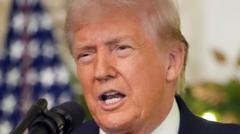
US President Donald Trump has announced a "warrior dividend" payment to US service members, in a speech in which he also defended his track record on the economy after 11 months back in office.
In a televised address to the nation on Wednesday, Trump said cheques for $1,776 (£1,329) for 1.45 million US service members were already on the way" and should arrive before Christmas. He said they would be paid for, in part, by his tariffs.
In the combative address, Trump also touted his achievements on immigration while railing against opposition Democrats.
Speaking loudly and quickly, he seemed determined to convince Americans that the US was doing well - and things would only get better.
He claimed prices were falling, at a time when polls show that many Americans are unhappy about the cost of housing, childcare and healthcare.
Democrats were critical of the speech. Senate Minority Leader Chuck Schumer said the president's words "showed he lives in a bubble completely disconnected from the reality everyday Americans are seeing and feeling".
Schumer added: "People are feeling squeezed harder and harder every day and tonight Donald Trump took a victory lap."
In the brief, 18-minute address, Trump said the "warrior dividend", which totals $2.57bn (£1.9bn), would be distributed "in honour of our nation's founding in 1776".
"Nobody deserves it more than our military," he said.
The president offered little new information in the speech, and some of his assertions were either exaggerated or unfounded.
Much of Trump's address focused on his economic record and the administration's efforts to bring down prices - which he blamed on former US President Joe Biden and the Democrats. Trump mentioned the former president seven times.
"Now, under our leadership, they [prices] are all coming down and coming down fast," he said. "Democrat politicians also sent the cost of groceries soaring, but we are solving that too."
While fuel and egg prices have indeed fallen, many other food items are more expensive.
Economic data from September shows the US inflation rate hit 3% for the first time since January, while consumer confidence fell to its lowest level since April due to concerns over the cost of living, jobs and the wider economy.
Trump has previously acknowledged that concerns over rising prices have contributed to a lacklustre performance for candidates from his Republican Party during elections held in November - with the Democrats having success in Virginia, New Jersey and New York City, as well as more recently in Miami and Georgia.
He has also acknowledged that incumbent presidents and their parties often fare poorly in mid-term elections, which will take place next year.
The White House has since been wrestling with how to address voter concerns about the economy, while at the same time pushing back on repeated Democratic criticism over rising prices.
The political dilemma faced by the Trump administration has been highlighted by recent polling.
One poll, from Politico, showed that about half of overall voters - and 4 in 10 people who voted for Trump in 2024 - felt the cost of living was the worst it has been in their lives.
Another poll, released in November by CBS News/YouGov, suggested that Trump's approval on economic issues had dropped 15 points since March - with 36% of Americans approving his handling of the issue.
More broadly, other polls show that Trump is at or near the lowest approval ratings of his second term, with concerns about the economy playing a significant role.
While the president offered little in the way of empathy over prices, he did point to Republican efforts - such as tax reform legislation passed earlier this year - that he said would benefit many Americans in the coming year.
When he ran for re-election last year, Trump promised immediate results. And after 11 months in office, many Americans say they still haven't seen substantive change, and the president's speech might be unlikely to change their minds.
Trump, in part, focused his remarks on the promise of improvements during 250th birthday celebrations for American's founding next year.
"When the world looks at us next year, let them see a nation that is loyal to its citizens, faithful to its workers, confident to its identity, certain to its destiny, and the envy of the entire globe," he said.
"We are respected again, like we have never been respected before," he added.
Poipet is known for being a major casino hub and the biggest land crossing between the two countries
Thailand says it has bombed a "logistics centre" near the Cambodian town of Poipet, known for being a major casino hub and the biggest land crossing between the two countries.
The bombings comes as renewed border clashes show no sign of abating.
Cambodia's defence ministry said Thai forces dropped two bombs, while the Thai side said that they targeted a facility storing rocket systems.
The renewed fighting this month has killed at least 21 people in Thailand and 17 in Cambodia, while displacing around 800,000, officials say.
In a statement, the Cambodian defence ministry said Thai forces dropped two bombs in the area of Poipet municipality at around 11:00 am (0400 GMT) Thursday.
Shortly after, Thai Air Force spokesman Air Marshal Jackkrit Thammavichai said that the Thai military had attacked the centre outside Poipet that had been used to store BM-21 rockets and that no civilians were harmed.
BM-21 rockets are weapons that are typically fired in volleys from the back of an armoured vehicle.
The bombings appear to be the first on Poipet, which is known for casinos popular with Thai gamblers and its international border checkpoint.
On Tuesday, Thailand said Tuesday that between 5,000 and 6,000 Thai nationals remained stranded in Poipet after Cambodia closed its land border crossings between the two countries.
Cambodia's interior ministry said the border closures were a "necessary measure" to reduce risks to civilians, adding that air travel remained an option for those seeking to leave.
The century-old border dispute between the South East Asian neighbours dramatically escalated on 24 July with a Cambodian rocket barrage into Thailand, followed by Thai air strikes. That set off five days of intense fighting, which left dozens of soldiers and civilians dead.
The two countries later agreed to an "immediate and unconditional ceasefire" brokered by Malaysian Prime Minister Anwar Ibrahim and US President Donald Trump - who at the time threatened to stop tariff negotiations until the hostilities stopped.
But that ceasefire fell apart again last week, with both sides blaming each other for re-igniting the fighting, which has seen air strikes and exchanges of artillery fire.
Trump claimed last week that he could stop the fighting between Thai and Cambodian forces that broke out by just picking up the phone, but it has continued.
Earlier this week, Cambodia accused Thai forces of bombing Siem Reap province, home to the ancient Angkor temples - the country's top tourist draw - for the first time in the latest round of clashes.
Nigeria’s Foreign Minister Yusuf Tuggar with the now released servicemen
Nigeria's Foreign Minister Yusuf Tuggar has formally apologised to Burkina Faso for the unauthorised entry of a Nigerian military jet into Burkinabè airspace, an incident that led to the detention of 11 Nigerian servicemen.
Tuggar's spokesperson told the BBC that the detained personnel had been released and were due to return to Nigeria, without saying when.
The plane was flying to Portugal when it developed a technical problem and had to land in Burkina Faso, according to the Nigerian Air Force.
The unauthorised landing sparked a diplomatic row with the Alliance of Sahel States (AES) made up of Burkina Faso and its neighbours, Mali, and Niger.
In a statement, AES characterised it as an "unfriendly act" and said member states‘ respective air forces had been put on maximum alert and authorised to "neutralise any aircraft" found to violate the confederation's airspace.
The three AES states, all run by the military, have withdrawn from the West African regional bloc, Ecowas, and moved closer to Russia, while most Ecowas members remain allied to the West.
Tuggar led a delegation to the Burkinabè capital, Ouagadougou, on Wednesday, to discuss the incident with military leader Captain Ibrahim Traoré.
"There were irregularities concerning the overflight authorisations, which was regrettable, and we apologise for this unfortunate incident," Tuggar said on national TV.
It remains unclear when the military personnel, said to be in "high spirits", and the aircraft will return to Nigeria.
According to Nigeria's foreign ministry, both sides agreed to "sustain regular consultations and pursue practical measures to deepen bilateral cooperation and regional integration".
Getty Images/BBC
Go to BBCAfrica.com for more news from the African continent.
The US accuses Rwanda of backing the M23 rebels - which it denies
The rebel group which last week seized the Democratic Republic of Congo city of Uvira say they have begun withdrawing, promising to complete the pullout on Thursday, following pressure from the US.
The M23 group captured the strategic city near the border with Burundi, days after a "historic" US-brokered peace deal between Congolese and Rwandan governments aimed at ending the long-running conflict in eastern DR Congo.
However, DR Congo's government says the reported withdrawal is a "diversion" and needs verification.
On Thursday morning some Uvira residents told the BBC it was not clear if the M23 were leaving, with some of their trucks still moving around the city.
The capture of Uvira sparked US condemnation and warning of sanctions against Rwanda. The US accuses Rwanda of backing the rebels, which it denies.
M23 leader Bertrand Bisimwa said on Wednesday that the withdrawal was "under way," with spokesman Willy Ngoma adding that this was "for the sake of peace".
In a post on X, Bisimwa urged mediators and international partners to ensure the city was protected from "reprisals, violence and remilitarisation".
A local civil society member, who did not want to be named for his own safety, told the BBC that some M23 troops had started withdrawing. However, he said police officers from the same group were still moving in.
Another resident expressed doubts about the withdrawal.
"It seems they are still here. In fact, yesterday I saw them bringing in the police trucks," the resident told the BBC on Thursday morning.
DR Congo government spokesman Patrick Muyaya told the BBC Newsday programme that the M23's announcement was meant "to distract the American mediation team, which is preparing to take measures against Rwanda".
Muyaya described the M23's decision to leave Uvira as a "positive sign" but said the government needed to confirm the situation on the ground.
Earlier he had called for "vigilance" in response to the "alleged withdrawal".
"Who can verify it? Where are they going? How many were there? What are they leaving behind in the city? Mass graves? Soldiers disguised as civilians?" he said in a post on X.
The Uvira offensive left dozens dead, at least 100 wounded and more than 200,000 displaced, according to the UN. At least 30,000 civilians fled into Burundi.
It came despite the 4 December peace deal signed in Washington between Rwandan President Paul Kagame and his DR Congo counterpart, Felix Tshisekedi, at a ceremony in Washington hosted by President Donald Trump.
The rebels were not signatories to that peace deal but they have been part of a parallel peace process led by Qatar, a US ally that has strong ties with Rwanda.
Mario Pineida played for Barcelona SC for nine years
Published
Ecuador defender Mario Pineida has died at the age of 33 after being shot in Guayaquil.
Local media reported that Pineida was shot on Wednesday by two people on motorbikes who opened fire on him, his mother and another woman outside a shop in the north of the city.
Ecuador's interior ministry said it has sent a special police unit to investigate.
Guayaquil has become a hotspot for gang violence and drug trafficking, with 1,900 murders recorded between January and September - the highest in Ecuador.
Three second-tier footballers were killed in September and a local player was wounded in a shooting in October.
Pineida won nine caps for Ecuador between 2014 and 2021.
He began his club career at Independiente DV before moving to Barcelona SC in Guayaquil in 2016.
He also spent time on loan at Fluminese and El Nacional.
Independiente and Fluminese paid tribute to Pineida on social media, while Barcelona SC said "this unfortunate news makes all of us who are part of this institution deeply dismayed".
In a statement, the Ecuadorian Football Federation condemned the violence and passed on condolences to Pineida's family.
Despite sky-high inflation, water and energy cuts and prospects for a deal with the U. S. dimming, President Masoud Pezeshkian has apparently thrown up his hands.
A paramilitary attack in April was one of the most brutal of Sudan’s civil war. Now, hunger is spreading as Western aid cuts have reduced U.N. rations.
People displaced in April after attacks by the Rapid Support Forces on the Zamzam camp in North Darfur, Sudan. A revised toll is over three times as great as earlier estimates.
The legislation, which would make thousands more permits available, is part of a package of City Council bills aimed at helping the city’s vendors get on the right side of the law.
Food carts and other street vendors are a ubiquitous sight in New York City, but an arcane permitting process means many cart operators are unlicensed.
The proposed Department of Community Safety would send mental health teams to respond to 911 calls, rather than the police, according to Mayor-elect Zohran Mamdani’s plans.

 Login
Login