South Africa’s government is in talks with Russia to bring home 17 South African men fighting for Russia in Ukraine, after the men were allegedly tricked on to the frontlines of the war by a daughter of former South African president Jacob Zuma.
Duduzile Zuma-Sambudla has been accused in multiple lawsuits of luring the 17 South African and two Botswanan men to Russia in July, by telling them they would be training as bodyguards for her father’s uMkhonto weSizwe political party or attending a personal development course.
Vincent Magwenya, a spokesperson for South Africa’s president, Cyril Ramaphosa, said: “The process to retrieve those young men remains a very sensitive process. They are in a dangerous environment. They are facing grave, grave danger to their lives and we are still in discussions with various authorities, both in Russia as well as in Ukraine, to see how we can free them from the situation they are in.
“In fact, the emphasis is more with the authorities in Russia and less so with the authorities in the Ukraine, because the information that we have is that they were bungled into the Russian military forces,” he said, in answer to a reporter’s question at a press briefing on Monday.
He said the engagements with Russia were ongoing and that the issue was “receiving the highest possible attention in our government”. Russia’s embassy in South Africa did not reply to a request for comment.
On 6 November, South Africa’s government said it had received distress calls from the men. Later that month, another of Zuma’s daughters, Nkosazana Zuma-Mncube, filed a police report alleging that Zuma-Sambudla and two others had deceptively recruited the men, who included eight of her family members.
Zuma-Sambudla filed her own police report, claiming she had been deceived by Blessing Khoza, another of those accused by her half-sister. She alleged he had tricked her into recruiting the men for what she had believed was a legitimate paramilitary training course that she herself had attended.
Khoza and Siphokazi Xuma, the third person accused of luring the men to Russia, could not be reached for comment.
On 5 December, at least 13 relatives and friends of the men protested outside Durban city hall, carrying signs with messages such as “Save Our Men. Home Is Where They Belong”, “Bring Our Men Home – End The War” and “Bring Them Back Alive. Bring Them Back Safe”.
An unnamed mother told the national broadcaster SABC: “What makes it worse is hearing what they are being put through. They are being ill-treated and slowly they are breaking down. They are pleading with us every day to bring them home. That’s all we want at this stage, for them to come back home alive.”
One mother told The Guardian she had not heard from her son since 27 August, when he called her to say he was being forced to sign a contract in Russian that he did not understand, but was worried he was being sent to the frontlines in Ukraine.
Police 'put their lives on the line', says New South Wales premier
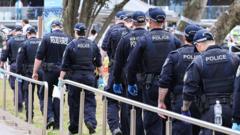
The New South Wales (NSW) premier has strongly rejected criticism of the police response to the attack on a Jewish festival at Bondi Beach, saying officers acted with "bravery and integrity".
Some witnesses have suggested police were too slow to disarm the two gunmen, who killed 15 people and injured dozens at an event celebrating Hanukkah at Australia's best known beach.
"There are two officers in critical care... at the moment," Chris Minns said after sustained questioning from reporters. "They weren't shot in the back as they were running away. They were shot in the front."
There have also been questions about whether adequate security was provided before the shooting took place.
"They shoot, shoot, change magazine and just shoot," one witness, Shmulik Scuri, told reporters the day of the assault, adding he thought officers "froze".
Asked about these criticisms, Minns said the "rush to conclusions" about the police operation was "disrespectful".
"They didn't take a backward step. They engaged the gunmen on the footbridge with handguns. The offenders had long range rifles," Minns said.
"If there's any suggestion that NSW Police didn't live up to their responsibilities to the people of this state, it should be rejected because it's not consistent with the facts."
NSW Police Commissioner Mal Lanyon avoided questions about how many officers had been deployed to police the event in advance. He told reporters police "regularly patrol that area as we did on that day" and that police presence was based "on the threat that exists at the time".
Australia's security agency has said the younger alleged gunman in the father-son duo, Naveed Akram, had come to their attention in 2019 due to his associations, but that there was nothing to suggest he was a risk of violence.
"Had there been intelligence that there was a particular threat at that location, or to that event, we may have had a different policing response," Commissioner Lanyon said.
NSW Police established Operation Shelter after the 7 October 2023 Hamas attack on Israel to investigate antisemitic hate crimes. As part of the operation, regular patrols are conducted of high-risk locations. The eastern suburbs of Sydney, including Bondi, which has a significant Jewish population, is a key focus.
Another taskforce, Strike Force Pearl, was set up later to investigate hate crimes in Sydney.
Getty
NSW Premier Chris Minns says police responding to the attack at Bondi 'didn't take a backwards step'
Police received reports of gunfire at a park in Bondi Beach at 18:47 (07:47 GMT) on Sunday. The gunmen carried out a shooting spree that lasted around ten minutes before police shot both men, killing one and critically injuring the other.
Dr Vincent Hurley, a former police officer who lectures on policing at Macquarie University, told the BBC it was "unrealistic" to expect police to be able to know how to react to every possible scenario.
"To respond to a mass shooting and mass killing event like that, there's no training that can be done."
He pointed out that police officers would have initially been reliant on calls to emergency operators "and everyone would have given them a different story".
"Then they have to fight through traffic at Bondi Beach which is a nightmare at the best of times."
At the scene, police would have been confronted with "absolute chaos" as thousands of people attempted to flee.
Individual officers would also have been faced with difficult choices such as whether to stop and render assistance to injured individuals or to go and look for the gunmen, decisions for which there is no protocol.
And even once the offenders had been identified, he says the risk of hurting bystanders in the crossfire would have complicated responses.
"There would be no way as a police officer, I would have drawn my firearm because all of the innocent individuals", he added. "It's not what you see on Netflix."
The US military says it has carried out strikes on three boats it has accused of trafficking drugs in the Pacific Ocean, killing eight people.
The US Southern Command posted footage of the strikes on social media and said the vessels were "transiting along known narco-trafficking routes... and were engaged in narco-trafficking".
More than 20 vessels in the Pacific and the Caribbean have been targeted in recent months, killing at least 90 people, as part of President Donald Trump's escalating campaign against gangs he accuses of transporting drugs in the region.
Some experts say the strikes could violate laws governing armed conflict.
The first attack by the US - on 2 September - has drawn particular scrutiny as there was not one but two strikes, with survivors of the first killed in the second.
The Trump administration has accused Venezuela of funnelling narcotics into the US and has intensified its efforts to isolate President Nicolas Maduro in recent months.
Thousands of troops and the USS Gerald Ford have been positioned within striking distance of Venezuela.
On 10 December, US forces seized an oil tanker off the Venezuelan coast, which it claimed was being used to transport sanctioned oil from Venezuela and Iran in an "illicit oil shipping network supporting foreign terrorist organisations".
Venezuelan Foreign Minister Yvan Gil called the seizure "international piracy" and has claimed Trump wants Venezuela's energy resources.
The South American nation - home to some of the world's largest proven oil reserves - also accuses Washington of seeking to steal its resources.
At a meeting of his cabinet at the White House two weeks ago, US President Donald Trump looked around the long room filled with his top advisers, administration officials and aides, and made a prediction.
The next Republican presidential candidate, he said, is "probably sitting at this table".
"It could be a couple of people sitting at this table," he added, hinting at possible electoral clashes to come.
Despite a constitutional amendment limiting him to two four-year terms, his supporters chanted "four more years" at a rally last Tuesday night in Pennsylvania. Trump said at the time that the final three years of his second term amount to an "eternity".
But in the cabinet room last week, when talking about prospects for the 2028 Republican president nomination, he was clear: "It's not going to be me."
The next presidential election may seem a long way off, but Trump's own speculation – and certain frictions within Trump's coalition - suggest that the jockeying to succeed and define the Make America Great Again (Maga) movement after Trump is well under way.
EPA/Shutterstock
At 78 when he was sworn in for the second time, Trump was the oldest person ever elected president - some media outlets suggested may be slowing him down; Trump called such speculation "seditious"
In last month's local elections, the Republican Party lost support among the minority and working-class voters who helped Trump win back the White House in 2024.
Members of his team have feuded over policy. And some, most notably Congresswoman Marjorie Taylor Greene, have cut loose from his orbit, accusing the president of losing touch with the Americans who gave him power.
There has been speculation about fractures within the Maga base in certain quarters of the international press, as well as at home. On Monday, a headline in The Washington Post asked: "Maga leaders warn Trump the base is checking out. Will he listen?"
The warning signs are there. While Trump has long been known for being in tune with his base, the months ahead will pose a series of challenges to the president and his movement. Nothing less than his political legacy is at stake.
From Vance to Rubio: A team of rivals?
It was all smiles and talk of historic presidential achievements inside the friendly confines of Trump's newly redecorated, gold-bedecked cabinet room two weeks ago.
But the presidential aspirants Trump may have had in mind as he looked around the table hint at just how hard it could be to keep his Maga movement from stretching apart at the seams.
Vice-President JD Vance sat directly across from the president. As his running mate, he is widely considered to be Trump's most likely heir apparent – the favourite of Trump's sons and libertarian Silicon Valley tech billionaires.
Getty Images
Vance, more than perhaps anyone in Trump's inner circle, is allied with those trying to give Trumpism an ideological foundation
Secretary of State Marco Rubio was on the president's immediate right. The former Florida senator, who competed with Trump for the Republican nomination in 2016, had spent the past 10 years undergoing a Maga transformation.
He has jettisoned his past support for liberalising immigration policy and his hard line on Russia in lieu of Trump's America First foreign policy. But if there is anyone close to an old-guard Republican with influence in Trump's party, Rubio tops the list.
Then there is Secretary Robert F Kennedy Jr, whose vaccine scepticism and "Make America Healthy Again" agenda have sent earthquakes through the US health bureaucracy; he sat two down from Rubio. The Democrat-turned-independent-turned-Republican is a living embodiment of the strange ideological bedfellows Trump made on his way to re-election last year.
And finally, Kristi Noem, the homeland security secretary, was tucked off to the corner of the table. While the former South Dakota governor is not considered a major presidential contender, her advocacy for aggressive immigration enforcement – including a recent call for a full travel ban on "every damn country that's been flooding our nation with killers, leeches and entitlement junkies" – has made her a prominent face of administration's policies.
Reuters
The jockeying to succeed and define the Maga movement after Trump is already under way
Each might believe they could, if they chose to run, become Trump's political heir and take control of the political movement that has reshaped American politics over the last decade.
But to paraphrase Benjamin Franklin's comments at the birth of American democracy, whoever wins the Republican nomination will have been given a winning coalition – if they can keep it.
The Republican empire transformed
Of course none of this is guaranteed - nor is it certain that the next generation of Maga leaders will be someone from the president's inner circle. Trump stormed the White House as a political outsider. The next Republican leader may follow a similar path.
"It's going to be up to the next Republican president who follows Trump to set him or herself apart," says former Republican Congressman Rodney Davis of Illinois, who now works for the US Chamber of Commerce.
"But at the same time make sure that you don't go too far away, because clearly it's Donald Trump [who] got elected president twice."
When the November 2028 presidential election rolls around, American voters may not even want someone like Trump. Some public opinion polls suggest that the president may not be as popular as he once was.
A survey by YouGov earlier this month indicated the president had a net approval rating of -14, compared with +6 when he took office again in January. Then there are concerns about the economy and his relentless efforts to push the boundaries of presidential power.
Getty Images
Leadership of Trump's movement still represents the keys to the Republican empire
Leadership of Trump's movement still represents the keys to the Republican empire, however, even if that empire has drastically changed in recent years.
"I think the Republican coalition has become fundamentally different over the last few decades," said Davis, who served in Congress from 2013 to 2023. "The Republican coalition that existed when Ronald Reagan was elected is not the Republican coalition anymore."
Back in the 1980s, the Reagan coalition was a fusion of free-market economics, cultural conservatism, anti-communism and international foreign affairs, says Laura K Field, author of Furious Minds: The Making of the Maga New Right.
Trump's party, she continues, was perhaps best described by long-time Trump adviser and current state department official Michael Anton in a 2016 essay advocating for Trump's election. In contrast with the Reagan era, its core principles include "secure borders, economic nationalism and America-first foreign policy".
'Normie Republicans' versus 'the edgelords'
Earlier this month, the conservative Manhattan Institute released a comprehensive survey of Republican voters, shedding more light on the composition of Trump's coalition.
It suggested that 65% of the current Republican Party are what it calls "core Republicans" – those who have supported party presidential nominees since at least 2016. (If they were alive in the 1980s, they may well have voted for Reagan.)
On the other hand, 29% are what the Institute called "new entrant Republicans". It is among those new Republicans that the challenge to the durability of Trump's coalition presents itself.
Only just over half said they would "definitely" support a Republican in next year's mid-term congressional elections.
According to the survey, the new entrants are younger, more diverse and more likely to hold views that break with traditional conservative orthodoxy. They hold comparatively more left-leaning views of economic policy, they tend to be more liberal on immigration and social issues, and they may also be more pro-China or critical of Israel, for example.
AFP via Getty Images
Trump was able to attract 'new entrant Republican' voters into his coalition - the question is whether he and his political heirs can keep them, or if they even want to
Jesse Arm, vice-president of external affairs at the Manhattan Institute, told the BBC in an email: "A lot of the conversation about the future of the right is being driven by the loudest and strangest voices online, rather than by the voters who actually make up the bulk of the Republican coalition."
Perhaps not surprisingly, the so-called new entrant Republican voters are significantly less supportive of some of Trump's would-be heirs. While 70% of core Republicans have positive views of Rubio and 80% for Vance, just over half of new entrants feel that way about either.
Other findings could be more concerning for Republicans.
More than half of new entrants believe the use of political violence in American politics "is sometimes justified" – compared to just 20% among core Republicans.
It also suggests they may be more likely to be tolerant of racist or anti-Semitic speech and more prone to conspiratorial thinking – on topics like the moon landings, 9/11 and vaccines.
Trump was able to attract these voters into his coalition. The question is whether he and his political heirs can keep them there – or if they even want to.
"The real takeaway is not that these voters will 'define' the post-Trump GOP, but that future Republican leaders will have to draw clear lines about who sets the agenda," argues Mr Arm.
"The heart of the party remains normie Republicans, not the edgelords that both the media and the dissident right are strangely invested in elevating."
Clashes in the conservative ranks
The divides revealed in the Manhattan Institute poll helps explain some of the most notable frictions within the Trump coalition over the past few months.
The Trump-Greene feud that culminated in the latter's resignation from Congress began with her backing of a full release of the government files connected to the Jeffrey Epstein underage sex-trafficking case – long a source of conservative conspiracy theories.
It broadened, however, into a critique of Trump's Middle East policy and accusations of his failure to address cost-of-living and healthcare concerns for low-income American voters.
An earlier high-profile Maga split erupted over Trump's economic policy, with billionaire Elon Musk, a strong supporter and member of Trump's inner circle at the start of the year, going on to condemn certain tariffs and government spending policies.
Reuters
An earlier high-profile Maga split erupted over Trump's economic policy
The president has, for the moment, largely tried to stay out of another bitter clash within conservative ranks over whether Nick Fuentes, a far-right political commentator and Holocaust denier, is welcome within the conservative movement.
It's a dispute that has roiled the influential Heritage Foundation and pitted some powerful right-wing commentators against each other.
According to Ms Field, those who follow Trump may find it a difficult conflict to avoid. "Nick Fuentes has a huge following," she says. "Part of how the conservative movement got the energy and power that they've got is by peddling to this part of the Republican Party."
In the halls of the Republican-controlled Congress, some signs of friction with the president's agenda are showing. Despite White House lobbying, it couldn't stop the House from passing a measure mandating release of the Epstein files.
The president has also been unable to convince Senate Republicans to abandon the filibuster, a parliamentary procedure Democrats in the minority have been able to block some of Trump's agenda.
AFP via Getty Images
Even a defeat next year – or in 2028 – is unlikely to mark the end of Trumpism
Meanwhile, Trump's party has been stumbling at the polls, with the Democrats winning governorships in Virginia and New Jersey last month by comfortable margins.
In dozens of contested special elections for state and local seats over the past year, Democrats have on average improved their margins by around 13% over similar races held in last November's national elections.
The future of Trumpism
All of this will be front of mind for Republicans ahead of the 2026 mid-term congressional elections - and it will do little to ease the concerns held by some that, without Trump at the top of the ticket, their coalition will struggle to deliver reliable ballot-box victories.
Yet even a defeat next year – or in 2028 – is unlikely to mark the end of Trumpism.
The ascent by Trump's Maga movement to the pinnacle of American power has been far from a smooth one. It includes a mid-term rout in 2018 and Trump himself losing in 2020, before his re-election last November.
But the changes that Trump has wrought within the Republican Party itself appear to be foundational ones, according to Ms Field. His Maga coalition builds on strains of populist movements in the US that date back decades or more – from Barry Goldwater's insurgent presidential campaign in 1964 to the Tea Party protests during Barack Obama's presidency.
"These things are not coming out of nowhere. They are forces in American politics that have been underground for a while, but have been just kind of fermenting."
The old Republican order, she argues, is a relic of the past.
"The Trump movement is here to stay and there's no real likelihood of the old establishment returning with any sort of clout - that much is clear."
Top picture credit: Getty Images
BBC InDepth is the home on the website and app for the best analysis, with fresh perspectives that challenge assumptions and deep reporting on the biggest issues of the day. You can now sign up for notifications that will alert you whenever an InDepth story is published - click here to find out how.
柏林的安全會議上,除了美國表態願意提供烏克蘭安全保證,德國、法國、英國等歐洲領袖也發表了聯合聲明,稱如今跟美國已有高度共識,將成立由歐洲主導、美國支持的多國部隊,以先前提出的「志願者聯盟」(Coalition of the Willing)為框架,部署於烏克蘭境內執行任務,協助烏克蘭軍隊重建、保障其領空及海上安全。在和平時期,烏克蘭軍隊應維持在80萬人左右。
At a meeting of his cabinet at the White House two weeks ago, US President Donald Trump looked around the long room filled with his top advisers, administration officials and aides, and made a prediction.
The next Republican presidential candidate, he said, is "probably sitting at this table".
"It could be a couple of people sitting at this table," he added, hinting at possible electoral clashes to come.
Despite a constitutional amendment limiting him to two four-year terms, his supporters chanted "four more years" at a rally last Tuesday night in Pennsylvania. Trump said at the time that the final three years of his second term amount to an "eternity".
But in the cabinet room last week, when talking about prospects for the 2028 Republican president nomination, he was clear: "It's not going to be me."
The next presidential election may seem a long way off, but Trump's own speculation – and certain frictions within Trump's coalition - suggest that the jockeying to succeed and define the Make America Great Again (Maga) movement after Trump is well under way.
EPA/Shutterstock
At 78 when he was sworn in for the second time, Trump was the oldest person ever elected president - some media outlets suggested may be slowing him down; Trump called such speculation "seditious"
In last month's local elections, the Republican Party lost support among the minority and working-class voters who helped Trump win back the White House in 2024.
Members of his team have feuded over policy. And some, most notably Congresswoman Marjorie Taylor Greene, have cut loose from his orbit, accusing the president of losing touch with the Americans who gave him power.
There has been speculation about fractures within the Maga base in certain quarters of the international press, as well as at home. On Monday, a headline in The Washington Post asked: "Maga leaders warn Trump the base is checking out. Will he listen?"
The warning signs are there. While Trump has long been known for being in tune with his base, the months ahead will pose a series of challenges to the president and his movement. Nothing less than his political legacy is at stake.
From Vance to Rubio: A team of rivals?
It was all smiles and talk of historic presidential achievements inside the friendly confines of Trump's newly redecorated, gold-bedecked cabinet room two weeks ago.
But the presidential aspirants Trump may have had in mind as he looked around the table hint at just how hard it could be to keep his Maga movement from stretching apart at the seams.
Vice-President JD Vance sat directly across from the president. As his running mate, he is widely considered to be Trump's most likely heir apparent – the favourite of Trump's sons and libertarian Silicon Valley tech billionaires.
Getty Images
Vance, more than perhaps anyone in Trump's inner circle, is allied with those trying to give Trumpism an ideological foundation
Secretary of State Marco Rubio was on the president's immediate right. The former Florida senator, who competed with Trump for the Republican nomination in 2016, had spent the past 10 years undergoing a Maga transformation.
He has jettisoned his past support for liberalising immigration policy and his hard line on Russia in lieu of Trump's America First foreign policy. But if there is anyone close to an old-guard Republican with influence in Trump's party, Rubio tops the list.
Then there is Secretary Robert F Kennedy Jr, whose vaccine scepticism and "Make America Healthy Again" agenda have sent earthquakes through the US health bureaucracy; he sat two down from Rubio. The Democrat-turned-independent-turned-Republican is a living embodiment of the strange ideological bedfellows Trump made on his way to re-election last year.
And finally, Kristi Noem, the homeland security secretary, was tucked off to the corner of the table. While the former South Dakota governor is not considered a major presidential contender, her advocacy for aggressive immigration enforcement – including a recent call for a full travel ban on "every damn country that's been flooding our nation with killers, leeches and entitlement junkies" – has made her a prominent face of administration's policies.
Reuters
The jockeying to succeed and define the Maga movement after Trump is already under way
Each might believe they could, if they chose to run, become Trump's political heir and take control of the political movement that has reshaped American politics over the last decade.
But to paraphrase Benjamin Franklin's comments at the birth of American democracy, whoever wins the Republican nomination will have been given a winning coalition – if they can keep it.
The Republican empire transformed
Of course none of this is guaranteed - nor is it certain that the next generation of Maga leaders will be someone from the president's inner circle. Trump stormed the White House as a political outsider. The next Republican leader may follow a similar path.
"It's going to be up to the next Republican president who follows Trump to set him or herself apart," says former Republican Congressman Rodney Davis of Illinois, who now works for the US Chamber of Commerce.
"But at the same time make sure that you don't go too far away, because clearly it's Donald Trump [who] got elected president twice."
When the November 2028 presidential election rolls around, American voters may not even want someone like Trump. Some public opinion polls suggest that the president may not be as popular as he once was.
A survey by YouGov earlier this month indicated the president had a net approval rating of -14, compared with +6 when he took office again in January. Then there are concerns about the economy and his relentless efforts to push the boundaries of presidential power.
Getty Images
Leadership of Trump's movement still represents the keys to the Republican empire
Leadership of Trump's movement still represents the keys to the Republican empire, however, even if that empire has drastically changed in recent years.
"I think the Republican coalition has become fundamentally different over the last few decades," said Davis, who served in Congress from 2013 to 2023. "The Republican coalition that existed when Ronald Reagan was elected is not the Republican coalition anymore."
Back in the 1980s, the Reagan coalition was a fusion of free-market economics, cultural conservatism, anti-communism and international foreign affairs, says Laura K Field, author of Furious Minds: The Making of the Maga New Right.
Trump's party, she continues, was perhaps best described by long-time Trump adviser and current state department official Michael Anton in a 2016 essay advocating for Trump's election. In contrast with the Reagan era, its core principles include "secure borders, economic nationalism and America-first foreign policy".
'Normie Republicans' versus 'the edgelords'
Earlier this month, the conservative Manhattan Institute released a comprehensive survey of Republican voters, shedding more light on the composition of Trump's coalition.
It suggested that 65% of the current Republican Party are what it calls "core Republicans" – those who have supported party presidential nominees since at least 2016. (If they were alive in the 1980s, they may well have voted for Reagan.)
On the other hand, 29% are what the Institute called "new entrant Republicans". It is among those new Republicans that the challenge to the durability of Trump's coalition presents itself.
Only just over half said they would "definitely" support a Republican in next year's mid-term congressional elections.
According to the survey, the new entrants are younger, more diverse and more likely to hold views that break with traditional conservative orthodoxy. They hold comparatively more left-leaning views of economic policy, they tend to be more liberal on immigration and social issues, and they may also be more pro-China or critical of Israel, for example.
AFP via Getty Images
Trump was able to attract 'new entrant Republican' voters into his coalition - the question is whether he and his political heirs can keep them, or if they even want to
Jesse Arm, vice-president of external affairs at the Manhattan Institute, told the BBC in an email: "A lot of the conversation about the future of the right is being driven by the loudest and strangest voices online, rather than by the voters who actually make up the bulk of the Republican coalition."
Perhaps not surprisingly, the so-called new entrant Republican voters are significantly less supportive of some of Trump's would-be heirs. While 70% of core Republicans have positive views of Rubio and 80% for Vance, just over half of new entrants feel that way about either.
Other findings could be more concerning for Republicans.
More than half of new entrants believe the use of political violence in American politics "is sometimes justified" – compared to just 20% among core Republicans.
It also suggests they may be more likely to be tolerant of racist or anti-Semitic speech and more prone to conspiratorial thinking – on topics like the moon landings, 9/11 and vaccines.
Trump was able to attract these voters into his coalition. The question is whether he and his political heirs can keep them there – or if they even want to.
"The real takeaway is not that these voters will 'define' the post-Trump GOP, but that future Republican leaders will have to draw clear lines about who sets the agenda," argues Mr Arm.
"The heart of the party remains normie Republicans, not the edgelords that both the media and the dissident right are strangely invested in elevating."
Clashes in the conservative ranks
The divides revealed in the Manhattan Institute poll helps explain some of the most notable frictions within the Trump coalition over the past few months.
The Trump-Greene feud that culminated in the latter's resignation from Congress began with her backing of a full release of the government files connected to the Jeffrey Epstein underage sex-trafficking case – long a source of conservative conspiracy theories.
It broadened, however, into a critique of Trump's Middle East policy and accusations of his failure to address cost-of-living and healthcare concerns for low-income American voters.
An earlier high-profile Maga split erupted over Trump's economic policy, with billionaire Elon Musk, a strong supporter and member of Trump's inner circle at the start of the year, going on to condemn certain tariffs and government spending policies.
Reuters
An earlier high-profile Maga split erupted over Trump's economic policy
The president has, for the moment, largely tried to stay out of another bitter clash within conservative ranks over whether Nick Fuentes, a far-right political commentator and Holocaust denier, is welcome within the conservative movement.
It's a dispute that has roiled the influential Heritage Foundation and pitted some powerful right-wing commentators against each other.
According to Ms Field, those who follow Trump may find it a difficult conflict to avoid. "Nick Fuentes has a huge following," she says. "Part of how the conservative movement got the energy and power that they've got is by peddling to this part of the Republican Party."
In the halls of the Republican-controlled Congress, some signs of friction with the president's agenda are showing. Despite White House lobbying, it couldn't stop the House from passing a measure mandating release of the Epstein files.
The president has also been unable to convince Senate Republicans to abandon the filibuster, a parliamentary procedure Democrats in the minority have been able to block some of Trump's agenda.
AFP via Getty Images
Even a defeat next year – or in 2028 – is unlikely to mark the end of Trumpism
Meanwhile, Trump's party has been stumbling at the polls, with the Democrats winning governorships in Virginia and New Jersey last month by comfortable margins.
In dozens of contested special elections for state and local seats over the past year, Democrats have on average improved their margins by around 13% over similar races held in last November's national elections.
The future of Trumpism
All of this will be front of mind for Republicans ahead of the 2026 mid-term congressional elections - and it will do little to ease the concerns held by some that, without Trump at the top of the ticket, their coalition will struggle to deliver reliable ballot-box victories.
Yet even a defeat next year – or in 2028 – is unlikely to mark the end of Trumpism.
The ascent by Trump's Maga movement to the pinnacle of American power has been far from a smooth one. It includes a mid-term rout in 2018 and Trump himself losing in 2020, before his re-election last November.
But the changes that Trump has wrought within the Republican Party itself appear to be foundational ones, according to Ms Field. His Maga coalition builds on strains of populist movements in the US that date back decades or more – from Barry Goldwater's insurgent presidential campaign in 1964 to the Tea Party protests during Barack Obama's presidency.
"These things are not coming out of nowhere. They are forces in American politics that have been underground for a while, but have been just kind of fermenting."
The old Republican order, she argues, is a relic of the past.
"The Trump movement is here to stay and there's no real likelihood of the old establishment returning with any sort of clout - that much is clear."
Top picture credit: Getty Images
BBC InDepth is the home on the website and app for the best analysis, with fresh perspectives that challenge assumptions and deep reporting on the biggest issues of the day. You can now sign up for notifications that will alert you whenever an InDepth story is published - click here to find out how.
The US military says it has carried out strikes on three boats it has accused of trafficking drugs in the Pacific Ocean, killing eight people.
The US Southern Command posted footage of the strikes on social media and said the vessels were "transiting along known narco-trafficking routes... and were engaged in narco-trafficking".
More than 20 vessels in the Pacific and the Caribbean have been targeted in recent months, killing at least 90 people, as part of President Donald Trump's escalating campaign against gangs he accuses of transporting drugs in the region.
Some experts say the strikes could violate laws governing armed conflict.
The first attack by the US - on 2 September - has drawn particular scrutiny as there was not one but two strikes, with survivors of the first killed in the second.
The Trump administration has accused Venezuela of funnelling narcotics into the US and has intensified its efforts to isolate President Nicolas Maduro in recent months.
Thousands of troops and the USS Gerald Ford have been positioned within striking distance of Venezuela.
On 10 December, US forces seized an oil tanker off the Venezuelan coast, which it claimed was being used to transport sanctioned oil from Venezuela and Iran in an "illicit oil shipping network supporting foreign terrorist organisations".
Venezuelan Foreign Minister Yvan Gil called the seizure "international piracy" and has claimed Trump wants Venezuela's energy resources.
The South American nation - home to some of the world's largest proven oil reserves - also accuses Washington of seeking to steal its resources.
Police 'put their lives on the line', says New South Wales premier
The New South Wales (NSW) premier has strongly rejected criticism of the police response to the attack on a Jewish festival at Bondi Beach, saying officers acted with "bravery and integrity".
Some witnesses have suggested police were too slow to disarm the two gunmen, who killed 15 people and injured dozens at an event celebrating Hanukkah at Australia's best known beach.
"There are two officers in critical care... at the moment," Chris Minns said after sustained questioning from reporters. "They weren't shot in the back as they were running away. They were shot in the front."
There have also been questions about whether adequate security was provided before the shooting took place.
"They shoot, shoot, change magazine and just shoot," one witness, Shmulik Scuri, told reporters the day of the assault, adding he thought officers "froze".
Asked about these criticisms, Minns said the "rush to conclusions" about the police operation was "disrespectful".
"They didn't take a backward step. They engaged the gunmen on the footbridge with handguns. The offenders had long range rifles," Minns said.
"If there's any suggestion that NSW Police didn't live up to their responsibilities to the people of this state, it should be rejected because it's not consistent with the facts."
NSW Police Commissioner Mal Lanyon avoided questions about how many officers had been deployed to police the event in advance. He told reporters police "regularly patrol that area as we did on that day" and that police presence was based "on the threat that exists at the time".
Australia's security agency has said the younger alleged gunman in the father-son duo, Naveed Akram, had come to their attention in 2019 due to his associations, but that there was nothing to suggest he was a risk of violence.
"Had there been intelligence that there was a particular threat at that location, or to that event, we may have had a different policing response," Commissioner Lanyon said.
NSW Police established Operation Shelter after the 7 October 2023 Hamas attack on Israel to investigate antisemitic hate crimes. As part of the operation, regular patrols are conducted of high-risk locations. The eastern suburbs of Sydney, including Bondi, which has a significant Jewish population, is a key focus.
Another taskforce, Strike Force Pearl, was set up later to investigate hate crimes in Sydney.
Getty
NSW Premier Chris Minns says police responding to the attack at Bondi 'didn't take a backwards step'
Police received reports of gunfire at a park in Bondi Beach at 18:47 (07:47 GMT) on Sunday. The gunmen carried out a shooting spree that lasted around ten minutes before police shot both men, killing one and critically injuring the other.
Dr Vincent Hurley, a former police officer who lectures on policing at Macquarie University, told the BBC it was "unrealistic" to expect police to be able to know how to react to every possible scenario.
"To respond to a mass shooting and mass killing event like that, there's no training that can be done."
He pointed out that police officers would have initially been reliant on calls to emergency operators "and everyone would have given them a different story".
"Then they have to fight through traffic at Bondi Beach which is a nightmare at the best of times."
At the scene, police would have been confronted with "absolute chaos" as thousands of people attempted to flee.
Individual officers would also have been faced with difficult choices such as whether to stop and render assistance to injured individuals or to go and look for the gunmen, decisions for which there is no protocol.
And even once the offenders had been identified, he says the risk of hurting bystanders in the crossfire would have complicated responses.
"There would be no way as a police officer, I would have drawn my firearm because all of the innocent individuals", he added. "It's not what you see on Netflix."
Several of those who have already updated to macOS Tahoe 26.2 have remarked how much larger their download was than the 3.78 GB expected for Apple silicon Macs, with some reporting over 10 GB. Here I ponder how that could happen.
How is macOS now updated?
My understanding of the broad processes involved in current macOS updates is that the total downloaded for Macs of the same architecture starting from the same version should be identical.
Major components required for each update include:
contents of the System volume that have changed from the starting version for that update;
standard cryptexes containing Safari and its supporting components, and dyld caches. The latter differ between Intel Macs, which only receive Intel versions, and Apple silicon Macs, which receive Intel versions to support Rosetta 2 as well as their own Arm versions. Those probably account for much of the difference in size between Intel and Apple silicon updates. Note that Apple silicon Macs may also require updates to cryptexes used in AI, but those are most likely obtained outside the macOS update;
architecture-specific firmware;
new Recovery system;
the ‘update brain’ to run the update, including creation of the new SSV with its hash tree.
Those contrast with what’s required for a full installer upgrade (or reinstall), which consists of a single Universal app containing the whole contents of the SSV, cryptexes and firmware for both architectures, Recovery and the update brain.
Following decompression of the download, changed components are installed in the System volume, a snapshot made of that, and its hash tree is constructed. Updated cryptexes replace those from the previous version, the new Recovery system and firmware updates are installed.
For all Macs of both architectures being updated from the previous public release of macOS, creation of the new SSV should be identical, as their old SSVs are all signed with the same signature, as their contents are identical.
Combo updates
In any update, changed contents of the System volume depend greatly on the starting version of macOS installed. Updating from a previous beta can require different files to be replaced, compared with those from the last public release. In some cases, Apple may be able to provide a single updater that will convert both a Release Candidate and the last public release into the new version.
If that’s not feasible, Macs that are updating from a beta, or a public release before the last, will require what we used to call a Combo update, consisting of all changed contents since the last major version, in this case 26.0. Combo updates are inevitably significantly larger than single-step Delta updates from the last public release, but should remain smaller than a full installer.
Recent upgrades between major versions of macOS, such as 15.6 to 26.0, have tried to avoid full installers where possible, by adopting what’s effectively a Combo-style update, but slightly larger as a Combo+.
Thus, updates to 26.2 most probably consist of:
a Delta update from the last public release, 26.1, which might also be suitable for some beta releases;
a Combo update from 26.0, 26.0.1 or some beta releases.
a Combo+ update or full installer from earlier major versions of macOS.
As later minor versions are released, the size of the Combo update rises, as it’s required to incorporate more changes than for previous updates.
What would be surprising would be for two Macs of the same architecture updating from the same starting version of macOS to be provided with updates of significantly different size. I look forward to hearing from you if you consider that happened with the 26.2 update.
No BSI/RSR
What is puzzling about the 26.2 update is that it wasn’t preceded by a Background Security Improvement (BSI) or Rapid Security Response (RSR). Two of the top security vulnerabilities fixed in 26.2 (and in the Safari updates for 15.7.3 and 14.8.3) are both in WebKit, which is supplied in the Safari cryptex. These are for CVEs 2025-43529 and 2025-14174. Both were documented as already being exploited in older versions of macOS, in sophisticated attacks on targeted individuals. Both would appear to have been suitable for distribution prior to 26.2 in updated cryptexes, either by the existing RSR system or its replacement in Tahoe 26.1 of the BSI.
This appears to have been another missed opportunity for an RSR/BSI to have proved its value.

 Login
Login