Intelligence authorities in the Philippines say the father and son apparently slipped out of Davao City during their monthlong stay, but details remain sketchy.
Andrew and Zoë met while on a cycling holiday through Thailand, Cambodia and Vietnam in 2014
Just a few days before her sudden death in late May, Zoë and her husband Andrew had a conversation that he returns to time and again.
They were driving to see a friend when the 38-year-old mum of their two young boys told him "she had everything she ever wanted in life".
Six months after losing his "kind, caring, clever and beautiful" partner to sudden adult death syndrome, he says remembering that "heart-to-heart in the car... makes me feel so much better".
Andrew, a 42-year-old mechanical engineer who works in the nuclear power industry, says the pair had been busy "doing life" until then.
Surrounded by toys, photographs and cats in the family home in Timperley, Greater Manchester, he says you can never tell your loved ones too often how much they mean to you.
"I think you take so much for granted in that they are there – that you get to just touch them, cuddle them. But do you ever tell them, 'Oh yeah, you look really good today' or 'I'm so happy that you're here'?
"You don't, do you? I wish I'd done more, I wish I'd shown more how I felt. Zoë knew but..."
Andrew and Zoe
Andrew and Zoë's sons Joey and Tommy were born in 2021 and 2023
Facing his first Christmas without his wife, Andrew thinks this is indicative of our wider inability to talk about death, to even contemplate facing our worst nightmare.
Many people just do not know what to say, how to behave or how to best support a family member, friend or colleague who has lost their partner.
Andrew admits he used to be "terrible at this - I was always the person that hid away and didn't approach it".
There had been nothing to suggest Zoë, a partner in a Manchester law firm, was unwell before the unexplained cardiac arrest that took her life.
Having experienced such a traumatic loss, Andrew has thought about what people can do.
"Just acknowledging the pain, the grief and there's nothing to say... being there for them is enough," he says.
"Don't ask what you can do - just do what you can do. Because I don't know what I want, I don't know what I need. I just need people to do something that they're willing to do.
"Buy me some food or deliver some food. It doesn't matter if I eat it or not – you've at least given me the choice, but you'venot asked me to choose.
"Because if you would ask me 'Shall I bring some food round?' I'm probably gonna say 'no' because I don't care. I will survive without it. But if you just do it, it's there isn't it?"
'Overwhelming responsibility'
If the bereaved person does not immediately respond, he says you should not be surprised.
"In the early days I was getting text messages all the time from people. And if you were the last one I read before I went to sleep at night, that person got everything - they just got a horrible griefy message summarising my day."
He says Benjamin Brooks-Dutton's best-selling book - It's Not Raining Daddy, It's Happy - offers an invaluable insight into the new reality of living without your partner while supporting and looking after young children.
The pain and sense of overwhelming responsibility is so clear when Andrew talks about their beloved boys, four-year-old Joey and Tommy, who was a month away from turning two when his mum died.
"I'm not their dad anymore - I'm their parent," Andrew explains. "My role has changed."
Sounding wistful for a moment, he continues: "I really liked being Dad. But I can't be the dad that I was - I have to be this. I have to do some of what she did."
Andrew and Zoë
Zoë was living in Manchester when Andrew decided to move from Abu Dhabi to be with her
Widows and widowers talk about the pain of the "firsts" without their late partner - anniversaries, birthdays, major life events.
Andrew thought he would be celebrating Zoë's 39th birthday on 23 December, quickly followed by the glorious chaos of Christmas with family, friends and their boys' wide-eyed excited innocence.
The couple met by chance in September 2014 after independently booking a cycling holiday in Thailand, Cambodia and Vietnam.
Andrew remembers the first time they met, thinking: "Wow - she is amazing!"
He adds: "I guess the beauty of a cycling holiday is that you have to look ahead - you can't look at the person - you just talk and we talked and we hit it off."
The young couple knew it was meant to be, and Andrew soon moved from Abu Dhabi to be with Zoë in Manchester, a city where he did not know anybody else.
"It's what you dream of," he says. "You know you've got this person who understands you, believes in you, accepts you, loves you, lets you be yourself and you learn that as your relationship grows."
They moved in together before getting married in May 2017, enjoying what Andrew describes as "the perfect life - on Fridays we went to restorative yoga after work and then have a restorative pint on the way home".
After struggling to conceive naturally and a failed course of IVF, their dream of having children finally came true when Zoë became pregnant with Joey, who was born in April 2021. Little brother Tommy followed in June 2023.
Andrew
Andrew with his sons Joey, four, and Tommy, two
Andrew says he will spend much of the festive period potty-training his younger son.
Many widows and widowers raise an eyebrow when they hear well-meaning people urging them to "be strong" and saying things like "I don't know how you do it."
Andrew says: "You do have a choice but you don't have a choice. It's like I have to be. I feel this level of expectation from her - that's who she was, that's what she was.
"So for her to be proud of me - and that's all I can do for her now, to honour her memory - is to be there for the boys, to be the best possible parent for the boys.
"Make sure they're – I don't like this – as impacted as little as possible by her loss. And they can be the people they were going to be.
"I really struggle with that because if I do a really good job as a parent her loss will be minimised. But if I do a really bad job as a parent that's the loss of her."
'Hurts so much'
Andrew, who returned to work two months after he was widowed, says he only now fully appreciates his "male privilege" and everything that "amazing mother" Zoë did to support him and their boys.
He says time is now his most precious commodity, adding: "You just don't have that backstop, do you? That extra support."
Using a sporting analogy, the keen runner - who completes Parkruns every week by pushing his sons in their buggy - says: "When a player gets sent off in a football match, you still try and win the match with 10 men don't you? And you just have to work a little bit harder.
"I feel that's the point, that I still want the boys to enjoy life. And for the boys to enjoy life, I have got to enjoy life at some point."
Andrew talks about Zoë being his "safety blanket that made me feel whole - she's gone and I don't feel whole. That's love, I think, and that's why it hurts so much."
He says seeing happy couples walk hand-in-hand while Christmas shopping, just like he and his wife used to, is incredibly hard.
"It's just accentuated at this time of year," he says. "I'm trying to wrap presents - I hate wrapping presents."
Talking about how that job always fell to Zoë, while he occupied the boys, he says: "I haven't got 'me' to distract the kids."
Andrew
Andrew finds it hard that he can no longer just be "Dad" to his young sons
When you are rushing around, trying to do everything for your children and hold down a demanding job, how are there enough hours in the day?
Andrew says: "The bit that I struggle with is time. You don't have space or time to grieve and feel or reflect. I think I had two months off work. After that, I was always busy.
"And I think I was – and I still am – scared of time on my own. I'm really scared because time on my own is actually time with Zoë.
"Because she's there with me but you almost don't want that because she's not with you. You have to have it in your head."
He struggles when asked what he thinks Zoë would want for him this Christmas and in the years to come.
Eventually, he replies: "It's a horrible way to put it but she's not here to live anymore.
"It's silly for me not to live 'cos she can't. She would want me to live. I can't put it any other way."
If you have been affected by the issues in this story, information and support is available via the BBC Action Line
日本时间12月20日上午,在东京都内一家酒店首次举行了“中亚+日本”对话(CA+JAD,Central Asia plus Japan Dialogue,简称“卡加德”)首脑会议。会议在高市早苗首相主持下召开,哈萨克斯坦总统托卡耶夫、吉尔吉斯斯坦总统扎帕罗夫、塔吉克斯坦总统拉赫蒙、土库曼斯坦总统别尔德穆哈梅多夫、乌兹别克斯坦总统米尔济约耶夫以及各国部长等出席了会议。
When Apple released macOS Ventura on 24 October 2022, it made an unannounced change. For the first time in over twenty years, the upgrade to the new major version wasn’t an upgrade at all, just an update. If that seems too subtle a distinction, let me spell out how profoundly that has changed macOS, and who makes the decisions.
When we upgraded from Big Sur to Monterey the year before, Software Update downloaded the full installer app from the App Store and ran that if you authenticated as an admin user. If you were only a standard user, you couldn’t install the upgrade, so there was no danger of someone in your family, for example, inadvertently upgrading your Mac without your involvement, assuming they are only a standard user and you have the power of being the admin user.
During the beta-testing phase of Ventura, many of us realised that Apple intended to change how upgrades would work. Because this wasn’t included in any of the beta documentation, nor announced officially by Apple, we were unable to warn folk until Apple released Ventura, by which time it was too late for many. As I warned at the time:
“If you’re intending to upgrade to Ventura, this is being performed as an update rather than a full install, so for an Apple silicon Mac already running Monterey 12.6 should only be around 6.37 GB in size. This should work for all Macs running macOS 12.3 and later, although download sizes will vary.”
It was Tom Bridge who first spelled out the profound consequences:
“As Admins inadvertently discovered — as Apple did not document this at WWDC or in the material that followed — during the beta period, macOS 12.3 – 12.6 see these “delta” updates as minor software updates, even if they would result in a major upgrade. That means the following things are true:
Delta updates do not require admin rights to install
Delta updates are substantially smaller
Delta updates install substantially faster
These are all great things for end users. No more 60 minute major upgrades that have to happen when the user can spare an hour! Standard users can upgrade on their own! Upgrades are much smaller!”
You might wonder why standard users should even be able to update macOS between minor versions. As Classic Mac OS was thoroughly egalitarian and never made any distinction between different classes of user, you could equally argue that every user should have admin rights anyway. What is clearly wrong here is that silently changing the upgrade mechanism has brought such a profound change in what standard users can do by themselves.
The evidence points to Apple not appreciating the consequences either: over three years later, its documentation still claims that “before installation” [of a macOS update] “begins, you’re asked to enter your administrator password.” That was published on 5 December 2025, and at its end it even explains carefully the difference between updates and upgrades, although that seems to have come to an end over three years ago.
Apple doesn’t appear to lay down any hard and fast definition of what differences there are between standard and admin users, other than the guidance that “standard users can install apps and change their own settings, but can’t add other users or change other users’ settings.” That’s consistent with a more general rule of thumb that a standard user’s actions should be constrained to those that only affect their own user account, whereas an admin user can undertake actions that affect other user accounts as well.
Applying that to macOS updates and upgrades suggests that standard users should be prevented from initiating either, as they clearly affect all users. It’s wholly inappropriate that someone who isn’t trusted to add another user should be trusted to install updates/upgrades that could render installed apps unusable, or in the worst case make that Mac unbootable.
Allowing standard users to update/upgrade macOS isn’t just a quirk that we have to get used to. By further blurring the distinction between the two classes of user, it questions whether all users should have admin privileges, and be done with the pretence that somehow being a standard user is in any meaningful way protective.
Perhaps the motivation behind this is Apple’s relentless drive to get us all to update/upgrade macOS immediately. That’s an obsession that ignores the many professional users who can’t afford to have their production platforms broken when crucial third-party products can’t work with the latest version of macOS. I think particularly of those involved in audio production, whose problems should be only too well appreciated by Apple.
As we prepare ourselves to enter the year that will bring macOS 27 to Apple silicon Macs, Apple needs to reconsider the status of standard user, and either block it from installing macOS updates/upgrades, or do away with it altogether.
An army patrol in Bekkersdal township - file photo
South African police say a manhunt is under way after a shooting at a tavern left nine people dead and another 10 injured in a township near Johannesburg.
They say about 12 unidentified gunmen arrived in two cars in Bekkersdal, "opened fire at tavern patrons and continued to shoot randomly as they fled the scene".
The shooting happened at about 01:00 local time on Sunday (23:00 GMT Saturday). The police added that the tavern was licensed.
South Africa has one of the highest murder rates in the world, at 45 people per 100,000 according to 2023-24 figures from the United Nations Office on Drugs and Crime.
Itzik Gvili demands the return of his son Ran, the last dead hostage in Gaza, in Tel Aviv's Hostages Square
In central Tel Aviv, the main stage has now been dismantled in Hostages Square, the focal point for the campaign over the past two years to bring back Israelis held in Gaza.
Nearby, signs and posters have been taken down, and the Hostages and Missing Families Forum has vacated the offices that served as its nerve centre. Of the 251 hostages seized by Hamas and other Palestinian armed groups in the 7 October 2023 attacks, 168 have been brought back alive from Gaza, eight have been rescued. Only one deceased hostage, Ran Gvili, remains.
With songs and prayers instead of mass rallies, the Gvili family and a small crowd of supporters assemble in Hostages Square each Friday to mark the start of the Jewish Sabbath; this week, a candle for the Hanukkah holiday was also lit.
They are determined to bring back the young police officer who was killed by Hamas fighters after he rushed to help people being attacked in Kibbutz Alumim in southern Israel in October 2023.
"I feel every day is still the 7 October. We didn't pass the 7 October, but we are strong, and we're waiting for him. We do whatever we need," says Itzik Gvili, Ran's father. "This gives us hope: the support of the people."
Reuters
The Hostages and Missing Families Forum's slogan is: "Bring them home now"
From the start, people power has been key to the hostage families. As its operations wind down, members of the Hostages Families Forum have been reflecting on its extraordinary evolution which turned the grassroots group into a powerful international lobbying force.
In the terrible aftermath of the 2023 Hamas-led assault on southern Israel, which also killed some 1,200 people, a huge group of distraught relatives gathered for the first time in Tel Aviv desperately seeking answers about their missing loved ones. Because of the incoming rocket fire from Gaza, they met in an underground car park.
"We were together, shocked, and it fell on me that this is actually real, that now we are going to face this unbelievable challenge of understanding where all these people are, getting them home," recalls Gil Dickmann, whose cousin Carmel Gat had been snatched from Kibbutz Be'eri.
"And the second thing is that we're going to do this together. I'm not going to stand alone."
Reuters
Gil Dickmann (2nd R) said the public support gave him hope after kidnapping of his cousin, Carmel Gat
The formation of the new forum, with its slogan: "Bring them home now", gave the hostages' families a much-needed sense of regaining control.
"It was very, very powerful to feel that when the government and Israeli state, in a way collapsed in those very first few days after 7 October, it felt like nothing was working, what was working was Israeli society," Mr Dickmann says. "So many wonderful people came to help. That brought me a lot of hope."
Dividing its efforts between supporting the families - many of whom were bereaved and displaced from their homes following the attacks - and campaigning in Israel and around the world, the Hostages Families Forum worked with more than 10,000 volunteers. They included former Israeli diplomats, lawyers and security officials.
Funded entirely by donations, it began to pay some staff, and a high-tech company loaned its central Tel Aviv office space.
Reuters
A makeshift tunnel symbolizing Hamas's tunnel network in Gaza was constructed at Hostages Square
In November 2023 - more than six weeks into the brutal war in Gaza, which had by then killed more than 14,000 Palestinians according to the Hamas-run health ministry - Israel and Hamas agreed to a Qatar-mediated truce.
This saw most women and children hostages returned in exchange for Israel releasing more than 240 Palestinian prisoners, all women and children. Hamas also freed some foreign nationals.
But after a week, the fighting resumed with ferocity. About half of the hostages were left in Gaza. In December, three Israeli hostages were killed by Israeli soldiers in Gaza despite the fact they were shirtless, waving a makeshift white flag, and calling out in Hebrew.
Israeli Prime Minister's Office/handout via Reuters
Itay Regev and his sister Maya were released during the November 2023 ceasefire
Those were difficult days for the Hostages Families Forum and in early 2024, with polls suggesting more Israelis prioritised eliminating Hamas over the return of those still held captive, it brought in political strategist, Lior Chorev, as campaign manager.
"We were in deep war in Gaza, deep war in Lebanon, there was the Iranian threat, and it appeared that everything was stuck, and public opinion was against us," Mr Chorev explains.
"As a civil society organisation, we could not impact whether or not there's going to be a deal, but we could work hard on the Israeli public opinion to ensure that if a deal came into place, it would have a sound civilian majority within the country."
Reuters
Gaza has been devastated by the two-year war sparked by 7 October 2023 Hamas-led attacks on Israel
As well as Saturday evening demonstrations in the plaza in front of the Tel Aviv Museum of Art, now renamed Hostages Square, there were near-daily actions by the Hostages Families Forum ranging from concerts and art installations to civil disruption. Media and diplomatic teams helped keep the hostages at the centre of attention.
"They kept going 24/7 for two years," comments Times of Israel political correspondent Tal Schneider who, like visiting foreign officials, often went to the forum's HQ.
"This place became like a foreign ministry for the country, for the families of 250 people."
Looking back, Michael Levy says his intensive campaigning helped him deal with the "emotional rollercoaster" after his sister-in-law, Einav, was killed at the Nova Festival and his younger brother, Or, was taken hostage alive.
"The only thing that helped me was becoming active. I was interviewed all the time. I went with 15 different delegations to over 12 countries. I spoke to whoever was willing to listen and didn't want to stop and think," Mr Levy says.
"You need to stay optimistic all the time. You need to tell yourself every morning that today is going to be the day that he's going to be released, even though you know you are lying to yourself."
Reuters
Michael Levy's brother, Or, was released during the ceasefire that lasted from January to March 2025
Although a hostage-prisoner exchange deal to end the war laid out in mid-2024 was described by then-US President Joe Biden as an Israeli proposal, Israel's Prime Minister Benjamin Netanyahu was widely seen as dragging out hostilities to aid his own political survival – a claim he rejected.
Tensions rose between the Hostages Families Forum and Israel's government; there was open animosity from some government supporters.
The situation worsened after a Netanyahu aide was accused of deliberately acquiring and illegally leaking a top-secret document to a German newspaper to influence how Israel's public viewed negotiations on a ceasefire and hostage deal.
The document was misleadingly cast as suggesting that pressure on the prime minister played into the hands of Hamas.
Reuters
Hundreds of people were killed or taken hostage at the Nova music festival during the 7 October 2023 attacks
For Mr Dickmann and Mr Levy, there was a low point when they headed to Washington for Netanyahu's address to a joint meeting of US Congress in July 2024 with other forum members.
They showed off T-shirts saying "Seal the deal" during an ovation for the Israeli leader and were arrested for an unlawful demonstration. "That was one of the moments in which I felt most alone," Mr Dickmann says. "It was one of the most frightening things and it was while Carmel was still alive in captivity."
The worst news came a month later when Carmel and five other hostages were killed by their Hamas captors, as the Israeli military closed in nearby.
Mr Dickmann says it was only an "unbelievable support group" of younger forum members that helped him get through the ordeal.
After the Israeli deaths were confirmed, angry protesters flooded the streets of Israeli cities. The forum puts the total number at 600,000.
In Tel Aviv, a crowd of hostage families and their supporters marched with six prop coffins. A crowd gathered outside Israel's military headquarters and clashed with police on a major road.
EPA
The killing of Carmel Gat and five other hostages by their Hamas captors sparked a huge protest in Tel Aviv
By the start of 2025, international opposition to the devastating Gaza war had reached new heights as the number of Palestinians killed approached 48,000, according to Gaza's health ministry.
In Israel, polls indicated a clear shift in Israeli public opinion, with a growing majority backing a hostage deal to end the war. With the election of a new US president, the Hostages Families Forum was increasingly directing its efforts stateside.
"They needed to bypass their own government," comments Ms Schneider. "The most important person for the job was obviously [US] President [Donald] Trump. There were signs written in English carried by the people and they would pack all their messages into a one-minute video, and they'd send it to him."
Working with regional mediators, the US secured a new Gaza deal between Israel and Hamas in January 2025, just as Trump took office. The first stage brought back 33 hostages – eight of whom were dead – in exchange for nearly 2,000 Palestinian prisoners and detainees. Five Thai hostages were also released.
But in mid-March, Israel ended the ceasefire, resuming its heavy bombing of Gaza, without starting talks on the deal's second stage, which involved a full end to fighting and the return of the remaining hostages.
The White House
Released hostages travelled to Washington to ask President Donald Trump to ensure the return of those left behind in Gaza
Frail and emaciated following his release in February under the ceasefire deal, Or Levy was emotionally reunited with his three-year-old son, his parents and brother Michael. However, Michael's joy was short-lived. He quickly resumed his campaigning with others in the Hostages Families Forum.
"I got what I wanted, I got my brother back, but I couldn't just stop," he says, "I couldn't be happy because in those 491 days, they became my family. I almost felt I knew all the other hostages, that every hostage still there was part of my family."
Newly freed hostages gave TV interviews saying they had been starved and beaten in captivity, sometimes in response to the ill-treatment of Palestinian prisoners held by Israel.
Despite their trauma and fragile health, a few of the former hostages travelled to the White House urging President Trump to use his influence to bring back all the living and dead Israelis they had left behind in Gaza.
Reuters
Evyatar David was among the last 20 living hostages freed shortly after the current ceasefire began in October
There were more dramatic moments.
In September, an Israeli air strike unsuccessfully targeted the exiled Hamas leadership as it met in Qatar, a regional mediator, to discuss a new ceasefire proposal presented by the US.
However, the ultimate effect was to push the Trump administration - backed up by its Arab allies – towards a new plan to end the war, which had by then killed more than 67,000 people in Gaza, according to the territory's health ministry.
Israel and Hamas agreed a ceasefire deal, under which all 20 living and 28 dead hostages still in Gaza would be handed over in return for almost 2,000 Palestinian detainees and prisoners in Israeli jails, as well as a surge in humanitarian aid and a partial Israeli withdrawal.
Reuters
Israel released about 250 Palestinian prisoners and 1,700 detainees from Gaza in exchange for the living hostages
When Trump's Middle East envoy, Steve Witkoff, and the president's son-in-law, Jared Kushner, arrived in Israel just after the latest ceasefire started on 10 October, they were greeted by rapturous applause on stage in Hostages Square.
On 13 October, the remaining living hostages came back.
"I'll never have a happier day in my life," says Mr Dickmann, remembering seeing his best friends reunited with their loved ones.
Mr Chorev, the Hostage Families Forum's chief strategist, considers that long-held Jewish and Israeli traditions won through.
"This basic value of the Israeli theme that you don't leave anyone behind, that you're responsible for each and every Israeli held by the enemy, this was something that was unclear to certain elements in the Israeli government," he says. "But it was very clear to the Israeli public."
Tali (L) has been helping out hostages' families since the beginning of the war
Slowly, 27 of the dead hostages' bodies have been returned to Israel over the past two months.
Amid the ruins of Gaza, where health ministry officials say the number of Palestinians killed has risen to more than 70,000, Hamas operatives and the Red Cross have been searching for Ran Gvili's body east of Gaza City.
Now, the last funds of the Hostages Families Forum are being used to support the Gvilis and a few dozen volunteers continue to head to Hostages Square on Fridays.
"We have been here in the rain and in nearly 50-degree [Celsius] heat, from winter to summer," says Tali, from Tel Aviv. "Now that this is nearly over, I have mixed emotions. There is still one hostage who hasn't come back. I told myself I would stay until the last one."
A symbolic tunnel, a large "Hope" sign and a piano put in the square in honour of now released hostage, Alon Ohel - a musician - have not yet been removed, nor has the giant countdown board which marks the days since 7 October 2023. A final mass rally is promised for when Ran Gvili's body is returned for burial.
Itzik and Talik Gvili are determined to bring their son Ran home for a proper burial
Israel's prime minister has never appeared in Hostages Square, but he has met with released hostages and hostage families, including those from a small, alternative group to the Hostages Families Forum, the Tikva Forum. The Gvilis belong to both.
The family joined a candle-lighting ceremony on the first night of Hanukkah with Netanyahu.
"We will bring Ran back, just as we brought back 254 out of our 255 abductees," the prime minister said. "Some did not believe. I believe. My friends in the government believed. They said: 'It will be a miracle.' I said: 'This nation performs miracles.'"
But in Israel, painful questions linger over why more hostages' lives were not saved.
The Hostages Families Forum recently released harrowing Hamas videos recovered in Gaza which show the six hostages who were later murdered, including Carmel Gat, celebrating Hanukkah in a tunnel in 2023.
The hostage crisis continues to cast a long shadow over Israeli society; even as many take heart from the families' message of endurance and solidarity.
Additional reporting by Davide Ghiglione and Gidi Kleiman
Jimmy Lai, 78, faces life in prison for national security offences
On a winter morning in 2022 Raphael Wong and Figo Chan walked into Hong Kong's Stanley prison to meet Jimmy Lai, the media billionaire who had been arrested two years before and was awaiting trial charged with national security offences.
They had all been part of the turbulent protests that had rocked Hong Kong in 2019, when hundreds of thousands took to the streets demanding democracy and more freedom in the Chinese territory.
They would also often meet for dinner, sometimes lavish meals, gossiping and bantering over dim sum, pizza or claypot rice.
In prison, he "loved eating rice with pickled ginger," Chan said. "No-one could have imagined Jimmy Lai would eat something like that!"
But neither had they imagined a reunion at a maximum security prison, the protests crushed, friends and fellow activists jailed, Hong Kong just as boisterous and yet, changed. And gone was the owner of the irreverent nickname "Fatty Lai": he had lost considerable weight.
Decades apart - Lai in his 70s, Wong and Chan about 40 years younger - they had still dreamed of a different Hong Kong. Lai was a key figure in the protests, wielding his most influential asset, the hugely popular newspaper, Apple Daily, in the hope of shaping Hong Kong into a liberal democracy.
That proved risky under a contentious national security law imposed in 2020 by China's Communist Party rulers in Beijing.
Lai always said he owed Hong Kong. Although he is a UK citizen, he refused to leave.
"I got everything I have because of this place," he told the BBC hours before he was arrested in 2020. "This is my redemption," he said, choking up.
He wanted the city to continue to have the freedom it had given him. That's what drove his politics - fiercely critical of the Communist Party and avowedly supportive of Hong Kong's pro-democracy movement. It cost him his own freedom.
Watch: Jimmy Lai's last interview as a free man in 2020
Lai harboured "a rabid hatred" of the Chinese Communist Party and "an obsession to change the Party's values to those of the Western world", the High Court ruled on Monday as it delivered the verdict in his trial.
It said that Lai had hoped the party would be ousted - or, at the very least, that its leader Xi Jinping would be removed.
Lai was found guilty on all counts of charges he had always denied. The most serious one - colluding with foreign forces - carries a maximum sentence of life in prison.
"Never," Lai had said to that charge when he testified, arguing that he had only advocated for what he believed were Hong Kong's values: "rule of law, freedom, pursuit of democracy, freedom of speech, freedom of religion, freedom of assembly".
Monday's verdict was welcomed by Hong Kong's chief executive John Lee, who said Lai had used his newspaper to "wantonly create social conflicts" and "glorify violence". The law, he added, never allows anyone to harm the country "under the guise of human rights, democracy and freedom".
Getty Images
Lai's wife Teresa and son Shun-yan at court for Lai's verdict, along with Cardinal Joseph Zen, former bishop of Hong Kong who baptised Lai in 1997
Back in 2022, before Wong and Chan left the prison, Lai asked them to pray with him, to Wong's surprise.
Lai's Catholic faith had deepened in solitary confinement - an arrangement he had requested, according to authorities. He prayed six hours a day and he made drawings of Christ, which he sent in the mail to friends. "Even though he was suffering," Wong said, "he didn't complain nor was he afraid. He was at peace."
Peace was not what Jimmy Lai had pursued for much of his life - not when he fled China as a 12-year-old, not while he worked his way up the gruelling factory chain, not even after he became a famous Hong Kong tycoon, and certainly not as his media empire took on Beijing.
For Lai, Hong Kong was everything that China was not - deeply capitalist, a land of opportunity and limitless wealth, and free. In the city, which was still a British colony when he arrived in 1959, he found success - and then a voice.
Apple Daily became one of the top-selling papers almost instantly after its debut in 1995. Modelled on USA Today, it revolutionised the aesthetics and layout of newspapers, and kicked off a cut-throat price war.
From a guide to hiring prostitutes in the "adult section" to investigative reports, to columns by economists and novelists, it was a "buffet" targeting "a full range of readers", said Francis Lee, a journalism professor at the Chinese University of Hong Kong.
Former editors and employees spoke of Lai's encouragement - "If you dared to do it, he would dare to let you do it" - and his temper. One said he often swore.
They describe him as unconventional, and as a visionary who wasn't afraid to bet on experiments. "Even before the iPhone was launched, he kept saying mobile phones would be the future," recalled one of the paper's editors, adding that he was full of ideas. "It was as if he asked us to create a new website every day."
It had been the same when he owned a clothing label. "He was not afraid of disrupting the industry, and he was not afraid of making enemies," said Herbert Chow, a former marketing director at a rival brand.
That was both his making and undoing, Chow said: "Otherwise, there would have been no Apple Daily. Of course, he wouldn't have ended up like this either."
An early TV commercial for Apple Daily featured the then 48-year-old Lai biting the forbidden fruit while dozens of arrows took aim at him.
It became a self-fulfilling prophecy.
Jimmylai.substack.com
The Apple Daily commercial when it launched in 1995
Escape from China
It was his first taste of chocolate that beckoned Lai to Hong Kong as a boy.
After carrying a passenger's luggage at a railway station in China, Lai was given a tip, and a bar of chocolate. He took a bite. "I asked him where he's from. He said Hong Kong. I said, 'Hong Kong must be heaven' because I had never tasted anything like that," Lai said of the encounter in a 2007 documentary, The Call of the Entrepreneur.
Life in Mao Zedong's China was punctuated by waves of oppressive campaigns - to industrialise China overnight, to weed out capitalist "class enemies". The Lais, once a family of business people, were blacklisted. His father fled to Hong Kong, leaving them behind. His mother was sent to a labour camp.
Decades later, Lai wrote of how of he and his sisters would be dragged out of their homes to watch a crowd forcing their mother to kneel while she was shoved and taunted - cruel public shaming that soon became the norm. The first time, Lai wrote, was terrifying: "My tears flowed freely and wet my shirt. I dared not make a move. My body was burning with humiliation."
Uncowed, his grandmother finished every story with the same message: "You have to become a businessman even if you only sell seasoned peanuts!"
And so, at the age of 12, he set off for Hong Kong, among millions who fled the mainland - and Mao's devastating rule - over the years.
The day he arrived, on the bottom of a fishing boat, along with about 80 seasick travellers, he was hired by a mitten factory. He described the long working hours as a "very happy time, a time that I knew I had a future". It was there that one of his co-workers helped him learn English. Years later, he would give interviews and even testify at court in fluent English.
By his early 20s, he was managing a textile factory and after making money on the stock market, he started his own, Comitex Knitters. He was 27.
Getty Images
Jimmy Lai at his home in Hong Kong in 1993
Business often took Lai to New York, and on one of those trips, he was lent a book that came to define his worldview: The Road to Serfdom by Nobel Prize-winning economist Friedrich Hayek, a champion of free-market capitalism. "People's spontaneous reaction" and "the exchange of information" have created the best in the world, was his takeaway. To him, that was Hong Kong's strength.
The book spurred a voracious reading habit. He would read the same book multiple times, and read every book by authors he admired. "I want to turn the author's thoughts into my backyard garden. I want to buy a garden, not cut flowers," he said in a 2009 interview.
After a decade in manufacturing, he was "bored" and founded the clothing chain Giordano in 1981, which became a fast-fashion pioneer. It was so successful that Tadashi Yanai sought advice from Lai when his Japanese label Uniqlo opened shops.
Lai launched stores in China, which had begun to open up after Mao died. He was "excited", China "was going to be changed, like a Western country", he said in the 2007 documentary.
Then in 1989, Beijing crushed pro-democracy protests in Tiananmen Square: a rude awakening for Lai and Hong Kong, which was set to return to Chinese rule in 1997 under a recent agreement by China and the UK.
Giordano sold tees with photos of Tiananmen protest leaders and anti-Beijing slogans, and put up pro-democracy banners in stores across Hong Kong.
A million people marched in Hong Kong in solidarity with student protesters in Beijing. Until 2020, Hong Kong held the largest vigil that mourned the massacre.
Lai said later that he "didn't feel anything about China" until then. He had always wanted to forget that part of his life but "all of a sudden, it was like my mother was calling in the darkness of the night".
Getty Images
Lai was a frequent attendee at Hong Kong 's annual vigils in memory of those who died at Tiananmen Square in 1989
'Choice is freedom'
The following year Lai launched a magazine called Next, and in 1994 published an open letter to Li Peng, "the Butcher of Beijing" who played a key role in the Tiananmen massacre. He called him "the son of a turtle egg with zero intelligence".
Beijing was furious. Between 1994 and 1996, Giordano's flagship store in Beijing and 11 franchises in Shanghai closed. Lai sold his shares and stepped down as chairman.
"If I just go on making money, it doesn't mean anything to me. But if I go into the media business, then I deliver information, which is choice, and choice is freedom," Lai said in the 2007 documentary.
He soon became a "very active participant" in Hong Kong's pro-democracy movement, meeting leaders to discuss strategy, said Lee Wing Tat, a former lawmaker from the Democratic Party.
He became an outspoken critic of the CCP, writing in 1994: "I entirely oppose the Communist Party because I hate everything that restrains personal liberties." He also started to voice concerns about the looming handover of Hong Kong, from Britain to China, in 1997.
"After more than a century of colonial rule, Hong Kongers feel proud to return to the embrace of the motherland," he wrote. "But should we love the motherland even if it doesn't have freedom?"
During the handover, however, China's then-leader Jiang Zemin promised that Hongkongers would govern Hong Kong and the city would have a high degree of autonomy for the next 50 years.
Getty Images
Lai at an "Occupy Central" protest in Admiralty in October 2014
The 2014 Umbrella Movement sparked by Beijing's refusal to allow completely free elections in Hong Kong became another turning point for Lai.
Protesters occupied the city's main commercial districts for 79 days. Lai turned up from 9am to 5pm every day, undeterred after a man threw animal entrails at him. "When the police started firing tear gas, I was with Fatty," the former lawmaker Lee recalled.
The movement ended when the court ordered protest sites to be cleared, but the government did not budge. Five years later, in 2019, Hong Kong erupted again, this time because of a controversial plan that would have allowed extradition to mainland China.
What began as peaceful marches became increasingly violent, turning the city into a battleground for six months. Black-clad protesters threw bricks and Molotov cocktails, stormed parliament and started fires; riot police fired tear gas, rubber bullets, water cannons and live rounds.
Lai was at the forefront of the protests and served 20 months for participating in four unauthorised assemblies. A protester told the BBC he was surprised to see Lai: "To me, he's a busy businessman, but he showed up."
Getty Images
Lai at a pro-democracy march in 2019
Apple Daily provided blanket coverage or, as critics would argue, a sounding board for an anti-government movement.
Government adviser Ronny Tong said Lai was "instrumental" in the protests because Apple Daily carried a "totally false" slogan – anti-extradition to China – which "caught the imagination of people who wanted to cause havoc in Hong Kong".
Whether Apple Daily played a seditious role, and how much control Lai exerted over its stance was at the centre of his 156-day national security trial.
Lai instructed the editorial team to "urge people to take to the streets", according to Cheung Kim-hung, former chief executive of Apple Daily's parent company Next Digital, and a defendant-turned-prosecution witness. After the National Security Law took effect, the newspaper was raided twice and eventually shut down in 2021.
During the height of the protests, Lai flew to the US where he met then Vice-President Mike Pence to discuss the situation in Hong Kong. A month before the National Security Law was imposed, Lai launched a controversial campaign, despite internal pushback, urging Apple Daily readers to send letters to then US President Donald Trump to "save Hong Kong".
All of this, the court ruled, amounted to a public appeal for a foreign government to interfere in Hong Kong's internal affairs.
"Nobody in their right mind should think that Hong Kong can undergo any kind of political reform without at least tacit acceptance from Beijing," Tong said. The protests in 2014 and 2019 "are totally against common sense".
Getty Images
Copies of the last Apple Daily newspaper early on June 24, 2021
Beijing says Hong Kong has now moved from "chaos to governance" and onto "greater prosperity" because of the national security law and a "patriot-only" parliament. But critics, including hundreds of thousands of Hongkongers who have since left, say dissent has been stifled, and the city's freedoms severely curbed.
Lee, the lawmaker, is among them: "When I first came to the UK, I had nightmares. I felt very guilty. Why could we live in other places freely, while our good friends were jailed?"
Lai's family has been calling for his release for years, citing concerns for his health because he is diabetic, but their calls have been rejected so far. The government and Lai's Hong Kong legal team have said that his medical needs are being met.
Carmen Tsang, Lai's daughter-in-law who lives in Hong Kong with her family, says her children miss grandpa - and the big family dinners he hosted every two weeks. His loud voice scared her daughter when she was younger, but "they loved going to grandpa's place… They think he's a funny guy".
She is not sure today's Hong Kong has a place for Lai.
"If there's a speck of dust in your eye, you just get rid of it, right?"
Watch: What does the Jimmy Lai verdict mean for democracy in Hong Kong?
Faure Gnassingbé is cultivating a range of sometimes opposing alliances
While some West African nations are choosing to cement old ties with France and others cultivate a new relationship with Russia, one country is trying to have the best of both worlds.
As the 7 December attempted military coup in Benin collapsed, the rebels' leader, Lt Col Pascal Tigri, made his discreet escape, apparently over the border into neighbouring Togo. From this temporary refuge, it seems he was then able to travel on to a more secure offer of asylum elsewhere - probably in the Burkina Faso capital Ouagadougou, or Niamey in Niger.
The opacity surrounding Togo's rumoured role in this affair is typical of a country that, under the leadership of Faure Gnassingbé, knows how to extract the maximum diplomatic leverage by defying convention and cultivating relations with a variety of often competing international partners.
The Lomé regime is far too shrewd to be caught out openly supporting a challenge to Benin's President Patrice Talon – with whom its relations are guarded at best – or officially confirming the Béninois belief that it secured coup-leader Tigri's passage to safety. Both governments are members of the beleaguered Economic Community of West African States (Ecowas).
Yet Gnassingbé makes no secret of cultivating affable and supportive relations with Burkina Faso and the fellow Sahelian military governments in Niger and Mali – all three of whom walked out of Ecowas last January.
Nor is he afraid of reminding France, Togo's traditional main international partner, that he has other options.
On 30 October President Emmanuel Macron welcomed Gnassingbé to the Élysée Palace for talks aimed at strengthening bilateral relations.
But less than three weeks later, the Togolese leader was in Moscow for a notably warm encounter with Russian President Vladimir Putin. They formally approved a defence partnership allowing Russian vessels to use Lomé port, one of the best-equipped deepwater harbours on the western coast of Africa and a key supply gateway for the landlocked Sahelian states that, following the military coups of 2020 to 2023, have become key Kremlin protégés.
While Gnassingbé's trip to Paris was fairly low-key, his Moscow excursion was high-profile and wide-ranging.
The bilateral military accord provides for intelligence and joint military exercises (although Lomé has no plans to provide a base for the Africa Corps, the Kremlin-controlled successor to the now disbanded Wagner mercenary outfit). All this was supplemented with plans for economic cooperation and an announcement of the reopening of their respective embassies, both closed back in the 1990s.
Anadolu via Getty Images
Most people in Togo have only ever known life under the Gnassingbé family
Inevitably all this has unsettled France, for whom Togo was once regarded as among the most devoted of allies.
When Lt Col Tigri launched his coup attempt in Benin, Macron was quick to show other Ecowas governments that it was France that could rapidly provide emergency specialist military support for their intervention to protect constitutional order.
The Togolese insist that their move to strengthen ties with Russia is not a conscious move to break ties with the West. Instead, Lomé presents the move as a natural diversification of relationships.
And there is some coherence to this argument.
Three years ago Togo and Gabon opted to complement their longstanding participation in the grouping of French-speaking countries, the International Francophonie Organisation (IOF), with membership of the Commonwealth too. Meanwhile, last year English-speaking Ghana, a Commonwealth stalwart, joined the Francophonie.
Indeed, these days many West African governments become exasperated with the outside world's tendency to view such connections as a choice between a new Cold War alignment or taking sides in a parochial anglophone-francophone competition between former colonial powers.
They say they want to be friends with a wide range of international partners and see no reason why such relationships should be exclusive.
Togo's premier, perhaps more than any other leader in West Africa, has sought to extend this diversified approach to his regional dealings.
Lomé is a major freight and travel hub whose port can accommodate the largest ocean-going container ships, with feeder vessels distributing transhipped cargo to a range of other smaller or shallower ports that could not do so. From Lomé's airport, local flights fan out across western and central Africa. The city is also home to banks and other regional financial entities.
These connections have helped to diversify the economic foundations of a country whose rural areas remain relatively poor.
AFP via Getty Images
French-speaking Togo recently joined the Commonwealth - a club of mainly former British colonies
Togo needs to remain at the heart of the Ecowas regional grouping and, in fact, sits astride the key Lagos-Abidjan transport corridor, a major development priority for the bloc.
But Gnassingbé has concluded that he also needs to maintain strong relations with the breakaway military-run regimes, now grouped in their own Alliance of Sahelian States (AES) – which Togo's Foreign Minister, Prof Robert Dussey has even speculated about joining.
But this is about more than economic or diplomatic diversification. It also connects to Gnassingbé's domestic political strategy.
A constitutional change announced in 2024 and implemented this year transformed the presidency – which carries a term limit – into a purely ceremonial role and shifted all executive authority into the post of prime minister, now dubbed "president of the council" in a borrowing of Spanish and Italian terminology. This latter post is subject to no term limit.
That allowed Gnassingbé to hand over the presidency to a low-profile regime stalwart and take on the new strong premier role, with little prospect of an end limit on his rule, given the longstanding dominance of his political party, Union for the Republic (UNIR) in successive parliamentary elections.
This was hugely controversial. But protest was rapidly snuffed out.
AFP via Getty Images
Togo lies at the heart of some of West Africa's major trade routes
Individuals even peripherally connected to demonstrations are in custody. High-profile critics such as the rapper Aamron (real name Narcisse Essiwé Tchalla) or the former defence minister Marguerite Gnakadè – who was married to Gnassingbé's late elder brother – have been threatened with prosecution. Journalists say they have been intimidated.
Members of the government have accused protesters of violence. They have warned of "fake news" on social media, argued that human rights arguments are being used to destabilise the situation, accusing elements of civil society of fabricating allegations against the security forces.
In the words of one minister: "Effectively it's terrorism when you encourage people to commit unprovoked violence."
In September, the European Parliament approved a resolution demanding the unconditional release of political prisoners, including the Irish-Togolese dual national Abdoul Aziz Goma, who has been in detention since 2018.
Togo's government responded by calling in the EU ambassador to tell him that the country's justice system operated with total independence.
Through his diverse international strategy, Gnassingbé is seeking to warn off Western critics, signalling that he has choices and options and does not need to cede to Europe, or anyone else.
However, Togo has a history of sudden eruptions of protest or unrest.
And despite his bullish tone, the new "president of the council" may quietly have concluded that it would be wise to afford a gesture of magnanimity, to salve the resentments that still bubble under the surface.
In a state of the nation address earlier this month, he said he would instruct the justice minister to look at possible prisoner releases.
This hint of retreat from the earlier crackdown shows that even Gnassingbé's nimble international networking cannot defuse the underlying political discontent at home.
AFP via Getty Images
Russia now has access to the landlocked Sahel juntas it backs, through Togo's deepwater port
Watch: 'You can't let fear win' - Bondi beachgoers return after fatal attack
Katy Watson,Australia Correspondent at Bondi Beachand
Harry Sekulich
Australia's Prime Minister Anthony Albanese has announced a review into the police and national intelligence agencies after last weekend's Bondi Beach attack.
"The ISIS-inspired atrocity last Sunday reinforces the rapidly changing security environment in our nation," Albanese said, using an acronym for the Islamic State group. "Our security agencies must be in the best position to respond."
A national day of reflection was being held on Sunday to mourn the 15 people killed after two gunmen opened fire at a Jewish festival at the Sydney beach.
Amid tight security, a minute of silence will be observed at 18:47pm local time (07:47 GMT), marking exactly a week since the shooting began.
Police allege the attack on December 14, which they have declared a terrorist incident, was committed by a father-son duo, inspired by "Islamic State ideology".
Naveed Akram, 24, has been charged with 59 offences, including 15 counts of murder and one of committing a terrorist act. His father Sajid was killed during the attack.
Albanese said the intelligence review, due by April 2026, would focus on ensuring authorities were equipped to tackle extremism.
He said: "The Department of Prime Minister and Cabinet will examine whether federal law enforcement and intelligence agencies have the right powers, structures, processes and sharing arrangements in place to keep Australians safe in the wake of the horrific antisemitic Bondi Beach terrorist attack."
In the wake of Australia's deadliest mass shooting in almost three decades, the government has announced plans to tighten gun controls, while the New South Wales is pushing to crack down on hate speech.
Surfers and swimmers pay tribute to victims of Bondi shooting on Friday
As part of a national day of reflection, Bondi was to host a memorial later on Sunday, exactly one week after the tragedy.
Earlier in the day, Governor-General Samantha Mostyn addressed a vigil held in Bondi, hosted by the National Council of Jewish Women Australia, where attendees largely wore white to symbolise peace.
"The entire Jewish community, whether it's here in Bondi or across our nation, you are part of the belonging story and the success of this country," she said.
Australians across the country are still reeling and there's a sense of shock and disbelief that something like this could have happened.
But this weekend, normality returned in some ways. Bondi promenade was once again filled with surfers, runners and dog-walkers returning to their regular routine.
While a sombre mood lingers, children's surf club activities – known locally as 'nippers' – resumed on Sunday as a sign of the community showing resilience.
The bridge where two gunmen opened fire on a crowd of people at a Jewish festival at Bondi beach on Sunday, 14 December.
Bullet holes in a car's windshield parked at Bondi a harrowing reminder of the violent attack
North Bondi's Surf Life Saving president Steve Larnach told the BBC they had considered cancelling the regular nippers events.
"We were also aware of the sensitivity towards our Jewish community," Larnach said. "We did ask their opinion, they were very supportive of us going ahead but also extremely grateful for what we did."
Lifeguard volunteers were among the first on the scene at the shooting last week providing first aid, Larnach said.
Some surf lifesavers have been hailed as heroes, including one who was photographed sprinting from a neighbouring beach with a red first aid kit slung over his shoulder.
Geraldine Nordfelft, who brought her daughter to nippers, said "it was really important to return to whatever this new normal is as soon as we could".
"You have to return, you can't stay away, you can't let fear win. The beach is the Australian way of life and we all love it," she told the BBC.
Geraldine Nordfelft brought her daughter to 'nippers' on Sunday
England's Bazball project is in tatters as yet another Ashes in Australia was lost in three Tests.
The tourists were defeated by 82 runs on the fifth day of the third Test in Adelaide to go 3-0 down and extend a winless run in this country to 18 matches.
Australia were delayed by a 40-minute rain shower, England pair Jamie Smith and Will Jacks, and a hamstring injury to spinner Nathan Lyon.
Smith had 60 when he miscued Mitchell Starc. Jacks battled past lunch for his 47 then edged the same bowler to first slip, where Marnus Labuschagne again took a breathtaking catch.
When Josh Tongue edged Scott Boland to Labuschagne, England were all out for 352 and their misery in this country prolonged to 14 years and counting.
This was supposed to be England's opportunity to finally compete in Australia, the most highly-anticipated Ashes in recent memory.
Instead it has turned into the worst tour in recent times, leaving the futures of captain Ben Stokes, head coach Brendon McCullum and director of cricket Rob Key in doubt.
England have surrendered the chance to win the Ashes in only 11 days of cricket and now must find a result in either Melbourne or Sydney to avoid the ultimate humiliation of a 5-0 clean sweep.
This is the fourth successive Ashes tour in which England have lost the first three Tests. By the time Australia visit the UK in 2027, it will be 12 years since England's previous Ashes win.
Who is in charge of England by then will come in for intense debate. Stokes and McCullum have contracts until the end of that series. In theory, Key has most sway over the fate of both men, but is probably under more pressure than either.
This is a stunning win for the Australians, who began the series with questions over selection and the age of their squad.
Captain Pat Cummins missed the first two Tests, Josh Hazlewood is out for the entire series, Lyon was omitted for the second Test and Steve Smith is absent in Adelaide.
Australia have still been far too good for England, as they have been on home turf since 2011.
To play this video you need to enable JavaScript in your browser.
This video can not be played
Media caption,
'It's frustrating' - Smith out for 60 after poor shot
Stokes said this tour was the chance for his England team to "create history", while McCullum declared the Ashes could "define" the group.
England will be defined as losers in this country, their history entwined with all the other Ashes tourists to be humbled down under.
The Bazball ideology has been exposed by Australia's hard-nosed, ruthless and relentless Test cricket. There was always suspicion, even derision, in this country of England's style of play, despite a 2-2 draw in the UK two years ago. Australia have been proved right.
England's selection, preparation and method have all been found wanting. This tour will be remembered for showing disdain to warm-up matches, a holiday in Noosa and Stokes talking about "weak men" in his dressing room.
Architects of their own downfall in the first two Tests, England improved in Adelaide, yet still committed too many errors.
The tourists went into the game without a specialist spinner, dropped Usman Khawaja on the first morning, and Ollie Pope and Harry Brook were guilty of poor shots in the first and second innings respectively. In England's defence, they did get the wrong end of the Alex Carey Snicko controversy.
The 5-0 embarrassment looks unavoidable. Pope will surely be left out of the fourth Test in Melbourne, although England's only reserve batter is Jacob Bethell – a 22-year-old still to score a first-class hundred.
Shoaib Bashir was chosen to be England's first-choice spinner and looks unselectable. Matthew Potts and Matthew Fisher are the two seamers yet to play in this series, though neither would be in the squad if other bowlers were fit and available.
Ashes defeats in Australia usually mean sweeping changes to an England regime and the bloodletting will soon begin. Before then, things could get much worse on the field.
Awesome Australia do it again
To play this video you need to enable JavaScript in your browser.
This video can not be played
Media caption,
Labuschagne takes brilliant catch at slip from Jacks as Australia close in on win
Australia were billed as ageing, ravaged by injuries and struggling to settle on an opening partnership.
Might this series have turned out differently had Travis Head not been promoted to open in place of the injured Khawaja for the second innings of the first Test in Perth? Head's match-winning century was one of the great Ashes moments and gave Australia momentum they have not relinquished.
Starc's bowling decimated England in the first two Tests – covering for Cummins and Hazlewood almost single-handedly. Carey is putting together one of the greatest exhibitions of glovework seen by a wicketkeeper in a single series.
Cummins was in danger of missing the series because of a back injury but hastened his rehabilitation to return in Adelaide. Despite not bowling a ball since July, the captain was outstanding.
In what will certainly be the last home Ashes for a number of these players, they will now set their sights on joining the three other Australia teams to have inflicted 5-0 annihilations of the English.
After that comes the return series in the UK in the summer of 2027 and the final frontier of winning an away Ashes – something Australia have not achieved since 2001.
Last rites in City of Churches
To play this video you need to enable JavaScript in your browser.
This video can not be played
Media caption,
Smith smashes Lyon with slog sweep for six over deep mid-wicket
England began the day on 207-6, 228 away from pulling off the highest successful chase in Test history. Admission prices were cut, though the Adelaide Oval was only one-third full.
Smith swiped two sixes over the leg side before the rain break and there was concern when Jacks rolled his ankle setting off for a single.
Smith continued to attack with crisp drives following the resumption, while Lyon left after making a diving stop on the fine-leg boundary and is now a doubt for the rest of the series.
Australia took the second new ball and Smith reached his first Ashes half-century by driving Cummins back over his head, only to attempt a shot too many at Starc. Cummins took a fine catch back-pedalling at mid-on to end a seventh-wicket stand of 91.
Jacks found a willing ally in Brydon Carse for a partnership of 52. Starc returned after lunch, Jacks edged and, for the second time in the match, Labuschagne swooped low to his left to claim a sensational one-handed grab.
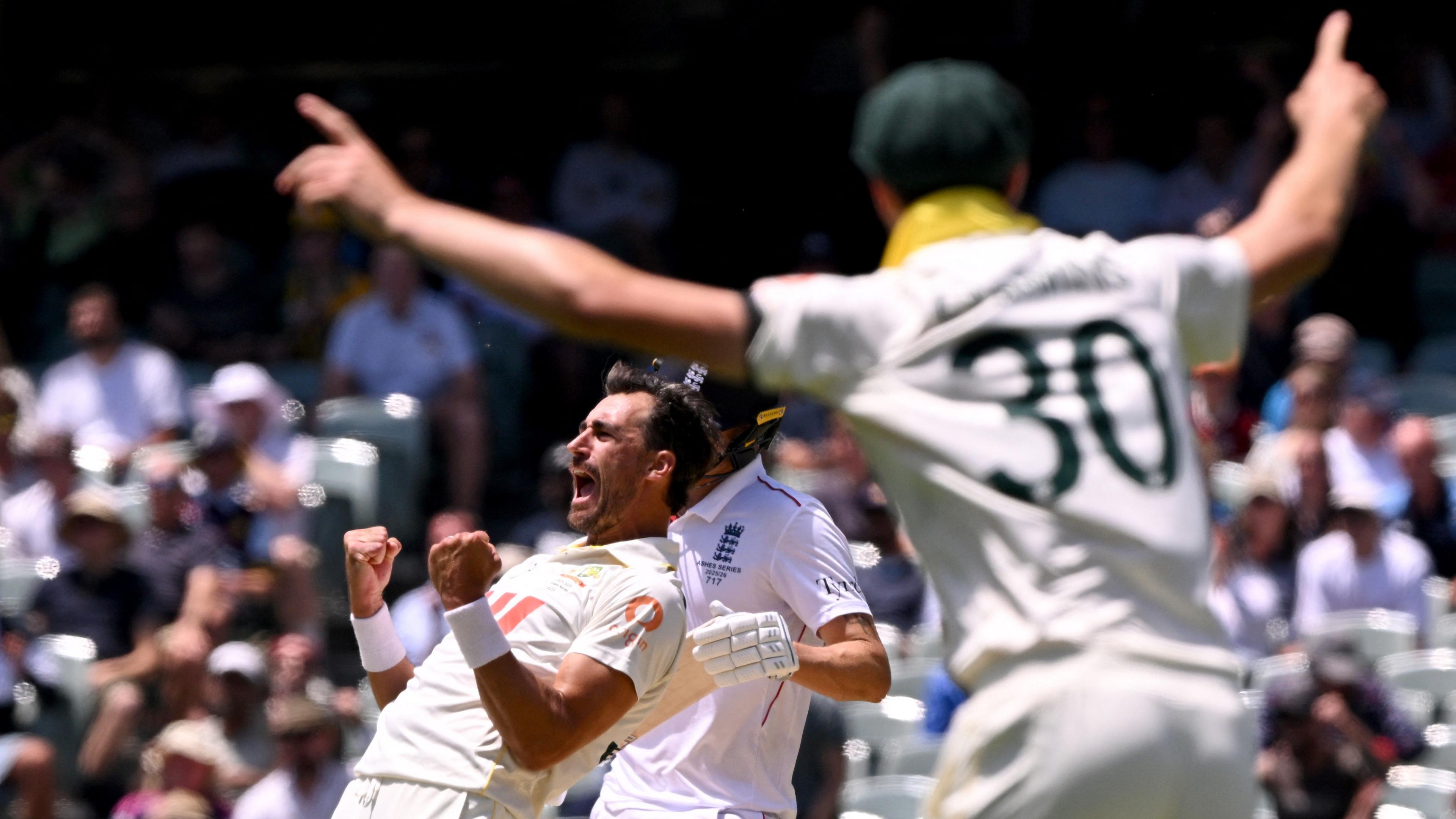
Starc had Jofra Archer cut to deep point, last-man Tongue poked at Boland and the Ashes were secure in Australian hands once more.
Australia have retained the Ashes at the earliest opportunity by taking an unassailable 3-0 lead over England with victory in the third Test in Adelaide.
It is the fourth consecutive Ashes series down under where Australia have gone 3-0 up - and this time England unravelled in just 11 days of cricket.
Some might say it was over before it began because of England's preparation but here are the top 10 moments that decided the 2025-26 Ashes on the field...
Costly collapse in Perth
To play this video you need to enable JavaScript in your browser.
This video can not be played
Media caption,
'Where has this come from?' - Australia take three England wickets in six balls
After a brilliant fast bowling display to dismiss Australia for 132, England were 65-1 in their second innings shortly after lunch on day two of the first Test in Perth, leading by 105 and seemingly in control.
What followed was a horrific collapse, including losing three wickets for no runs in six balls, to be bowled out for 164.
Head's astonishing century
To play this video you need to enable JavaScript in your browser.
This video can not be played
Media caption,
'Top-class' Head century has Australia cruising towards win over England
Australia still needed 205 to win on a tricky pitch at Perth Stadium and England had a chance of victory if their bowlers could fire again.
But Travis Head, promoted to open because of Usman Khawaja's back spasms, savagely took England down - smashing a sublime 123 off 83 balls to help seal an eight-wicket win inside two days.
Brook gifts wicket away in Brisbane
To play this video you need to enable JavaScript in your browser.
This video can not be played
Media caption,
Australia 'gifted' wicket as Brook's thick outside edge is caught by Smith at second slip
Brisbane has provided plenty of Ashes misery for England, with 1986 the last time the tourists won a Test at the Gabba.
However, England won the toss in the day-night second Test, batted first and were well placed at 176-3.
Then came Harry Brook's brain fade when set on 31 - flaying a wild drive at pink-ball maestro Mitchell Starc to second slip in the twilight. Ben Stokes made a mistake to be run out by Josh Inglis shortly after.
Although Joe Root went on to hit his first century in Australia, England only made 334 on a good batting surface.
Dismal drops at the Gabba
To play this video you need to enable JavaScript in your browser.
This video can not be played
Media caption,
'Despair' on day two for England with missed opportunities in the field
Again England had the chance to make up for their mistakes, only to put in a woeful fielding performance on day two at the Gabba.
They dropped or missed five clear chances overall, the most costly being wicketkeeper Jamie Smith's drop of Head on three and Ben Duckett shelling Alex Carey on nought.
Head only scored 30 more runs but that drop set the tone. Australia went on the attack, reaching 100 off just 17.2 overs, while Carey would go on to make 63.
Starc's 77 gives Aussies commanding lead
To play this video you need to enable JavaScript in your browser.
This video can not be played
Media caption,
'Outstanding' Starc reaches half-century with 'clubbing' hit through mid-wicket for four
England still had hope of quickly dismissing Australia on day three in Brisbane to limit their first-innings deficit.
But Starc, who had tormented the tourists with the ball, showed them how to bat too. The left-hander struck a superb 77 to help the hosts post 511 - a lead of 177.
Crawley and Pope make same mistake
To play this video you need to enable JavaScript in your browser.
This video can not be played
Media caption,
'It's a shocker!' - Pope and Crawley both caught and bowled
England needed to show discipline to erase Australia's lead and give their bowlers a challenging target to defend.
They reached 90-1, but under-pressure duo Ollie Pope and Zak Crawley both drove on the up to chip return catches to Michael Neser and England crumbled to 241 all out.
It took Australia just 10 overs to pass their target of 65, with Steve Smith crashing a six to seal victory after a fiery exchange with Jofra Archer.
Brook drops recalled Khawaja
To play this video you need to enable JavaScript in your browser.
This video can not be played
Media caption,
Brook drops Khawaja on five off the bowling of Tongue
Usman Khawaja's Ashes - and perhaps even international career - looked to be over when he was ruled out of the second Test with a back injury and then initially not picked in the XI for the third Test at the Adelaide Oval.
But Steve Smith's illness saw him recalled to bat at number four and he arrived at the crease inside 10 overs as Australia slipped to 33-2.
Khawaja had five when he nicked a flaying drive off Josh Tongue to second slip, where Brook shelled a tough chance but one he would expect to take. It would have left Australia 50-3. Instead, Khawaja went on to make 82.
Carey reprieved by Snicko error
To play this video you need to enable JavaScript in your browser.
This video can not be played
Media caption,
Carey survives England review for caught behind appeal as Snicko shows phantom spike
Australia were 245-6 and Carey on 72 when England thought they had him caught behind off Tongue. Umpire Ahsan Raza rejected the appeal and England immediately reviewed.
Despite a large of sound on the Snicko technology, TV umpire Chris Gaffaney did not overturn the decision because the ball appeared to be away from the bat when the sound occured.
It later emerged it was a mistake by the Snicko operator, who used the microphone at the bowlers' end used, rather than the strikers' end.
BBG Sports, the company that owns Snicko, accepted culpability and there was more controversy around the technology involving England keeper Smith the following day.
Meanwhile, Carey went on to make a crucial century on his home ground as Australia posted 371.
To play this video you need to enable JavaScript in your browser.
This video can not be played
Media caption,
'Terrific' Carey makes first Test century against England
Cummins removes Root (again)
To play this video you need to enable JavaScript in your browser.
This video can not be played
Media caption,
England suffer big blow as Cummins dismisses Root for 19
England needed to make use of a decent day-two Adelaide pitch to bat well on - but Australia's supreme bowling attack put in their finest display of the series.
Captain Pat Cummins starred on his return from injury, picking up the key wicket of Joe Root to leave England reeling on 71-4.
Speaking on Test Match Special, former England spinner Alex Hartley said: "It's done, it's dusted, Australia - give them the urn."
Cummins got Root again in the second innings and has dismissed him 13 times in Tests - more than any other bowler.
Another Head ton puts Aussies in total control
To play this video you need to enable JavaScript in your browser.
This video can not be played
Media caption,
Head's 'wonderful' 170-run innings puts Australia firmly in control
Stokes and Archer fought admirably to reduce the damage and England trailed by 85 after the first innings.
With the hosts 149-4 in their second innnings, 234 ahead, England perhaps even had hope of knocking the rest over cheaply and leaving themselves a tough but not unfeasible chase.
Head had other ideas. Australia's makeshift masterstroke of moving Head to opener paid off once again as the South Australian smacked a sublime 170 on his home ground to put the Test beyond England.
Chasing a nominal 435 to win, Australia off-spinner Nathan Lyon worked his magic on a turning track before the seamers finished the job as England fell to an 82-run defeat.

 Login
Login