The craft of the blacksmith goes back long before the Iron Age, but once our ancestors had learned to work cast iron (by turning it first into wrought iron), in about 1200 BCE, it became one of the key crafts in many societies. It’s also the only craft represented by a deity in the classical Greek pantheon, in the god Hephaistos, translated by the Romans to Vulcan.
He had the misfortune to have been born lame, as a result of which Hera tried to be rid of him, and threw him into the sea. He was there cared for by Thetis and others. He later assumes his role as the god of fire, volcanoes, and crafts allied to blacksmithing, including sculpture.
In paintings, Vulcan is characteristically seen in his forge, as in Tintoretto’s painterly Vulcan’s Forge (1578), one of four mythological paintings he made for the Atrio Quadrato in the Palazzo Ducale in Venice. Tintoretto was clearly familiar with the division of labour in a blacksmith’s workshop. The two well-muscled men wielding large hammers are strikers, whose brute force is more important. Vulcan is the older man at the left, who strikes the casting with his small hammer to tell them where theirs should strike.
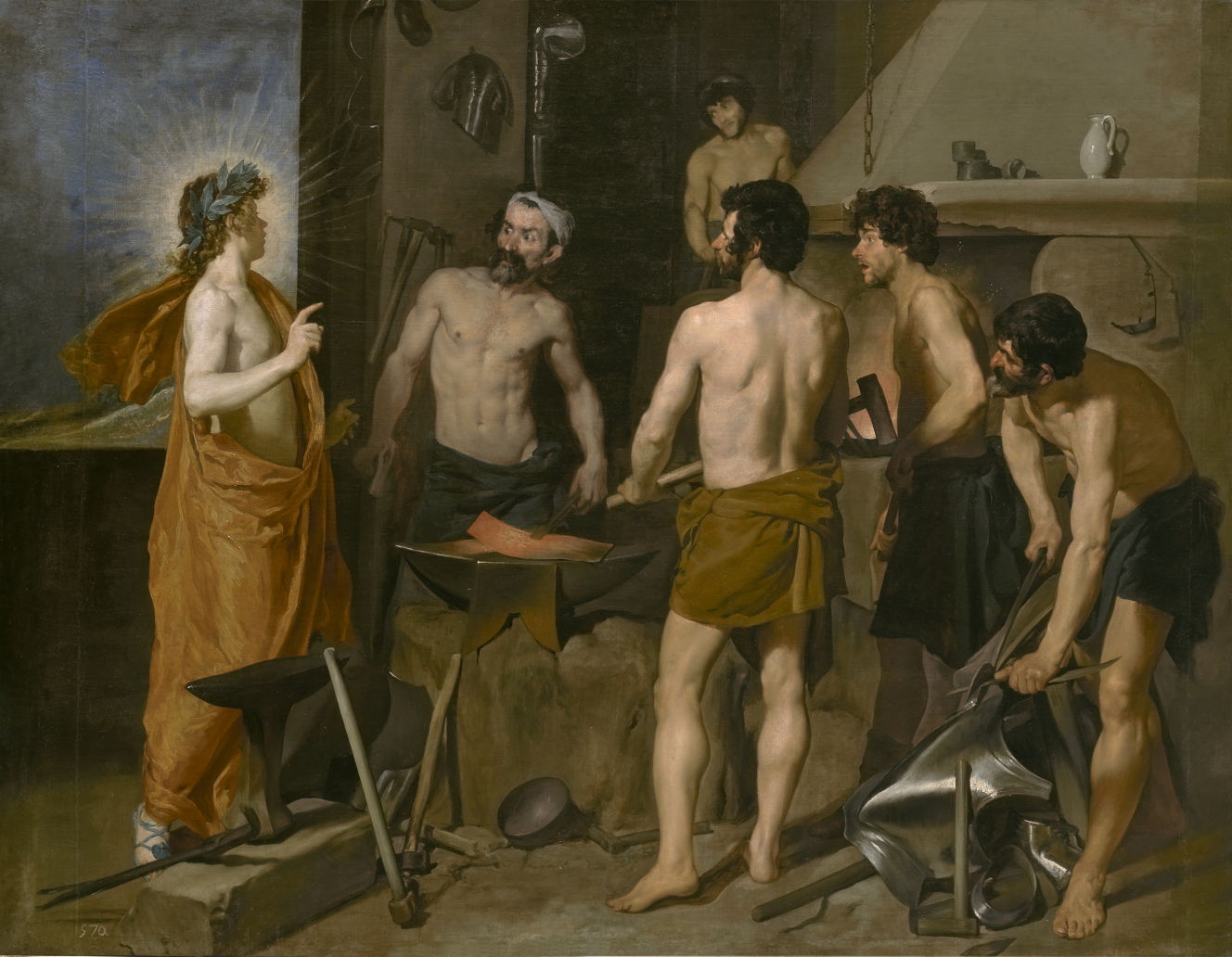
Diego Velázquez (1599–1660), The Forge of Vulcan (1630) [41], oil on canvas, 223 x 290 cm, Museo Nacional del Prado, Madrid, Spain. Wikimedia Commons.
Homer’s story of the adulterous affair of the wife of Hephaistos, Aphrodite (Venus), with Ares (Mars) is retold by Ovid in his Metamorphoses, the likely source for Diego Velázquez’s The Forge of Vulcan from 1630. This shows Apollo, at the left, visiting Hephaistos (to the right of Apollo) in his forge, to tell him about this infidelity.
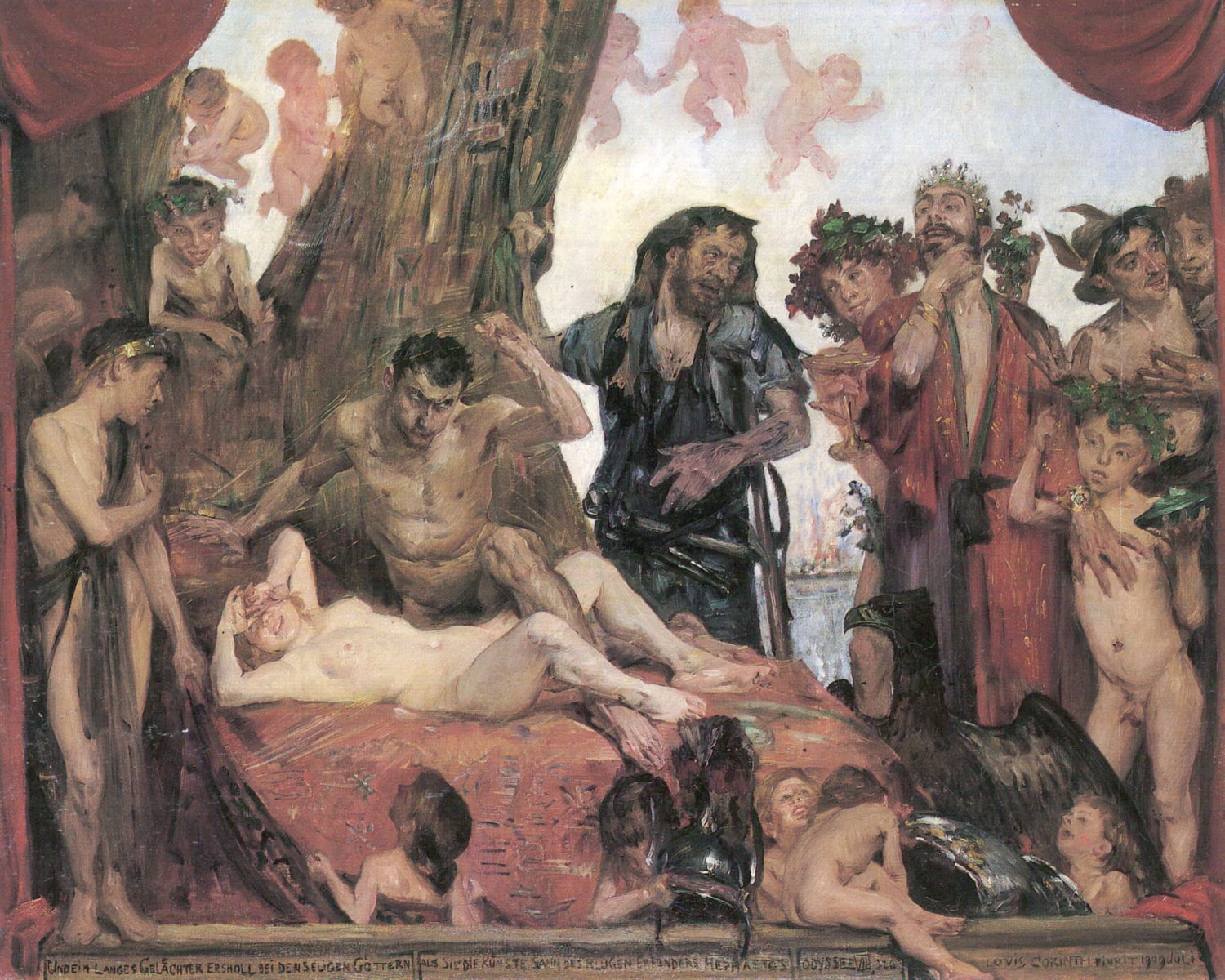
Lovis Corinth (1858–1925) Homeric Laughter (1909), oil on canvas, 98 × 120 cm, Bayerische Staatsgemäldesammlungen, Munich. Wikimedia Commons.
Homeric Laughter (1909) is one of Lovis Corinth’s most complex, even abstruse, paintings of classical myth. He provides a good clue as to its interpretation in his inscription (originally in German translation): unquenchable laughter arose among the blessed gods as they saw the craft of wise Hephaistos
together with the reference to Homer’s Odyssey book 8 line 326.
In this first version, Corinth shows Aphrodite recumbent on the bed, shielding her eyes from the crowd around her. Ares struggles with the net securing the couple, looking frustrated. Hephaistos, clad in black with his tools slung around his waist, is talking to Poseidon (who wears a crown) with Dionysos/Bacchus behind him (clutching a champagne glass). At the right edge is Hermes/Mercury, with his winged helmet. Sundry putti are playing with Ares’ armour, and an arc of putti adorns the sky.
The blacksmith also features in some accounts of the origin of Pandora.
John Dixon Batten (1860-1932), The Creation of Pandora (1913), tempera on fresco, 128 x 168 cm, Reading University, Reading, England. Wikimedia Commons.
John Dixon Batten’s The Creation of Pandora was painted anachronistically in egg tempera on a fresco ground by 1913. Batten was one of the late adherents of the Pre-Raphaelite movement, and is now almost forgotten. This work had been put into storage in 1949 and wasn’t rediscovered until 1990.
Pandora is at the centre, having just been fashioned out of earth by Hephaestus, who stands at the left, his foot on his anvil. Behind them, other blacksmiths work metal in his forge. At the right, Athena is about to place her gift of a robe about Pandora’s figure, and other gods queue behind to offer their contributions.
There are several fine paintings of regular blacksmiths at work over the centuries. The earliest I have been able to locate is a disturbing detail in the central panel of Hieronymus Bosch’s triptych The Last Judgment from about 1495-1505.
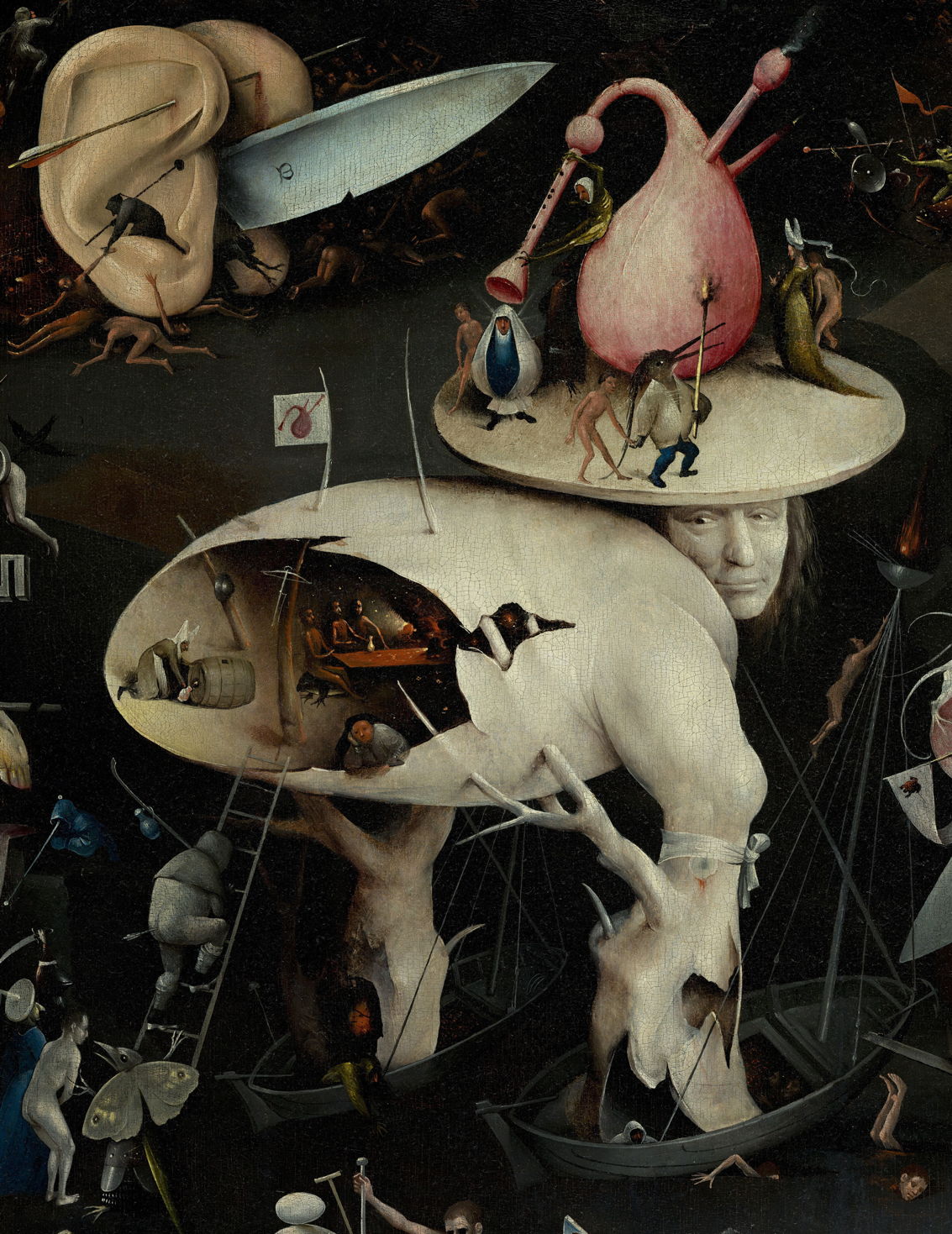
Hieronymus Bosch (c 1450–1516), The Last Judgment (central panel, detail) (c 1495-1505), oil on oak panel, left wing 99.5 x 28.8 cm, central panel 99.2 × 60.5 cm, right wing 99.5 × 28.6 cm, Groeningemuseum, Bruges, Belgium. Wikimedia Commons.
Among the torments featured in the centre panel are painful punishments in the blacksmith’s at the top.
Francisco Goya (1746–1828), The Forge (1812-16), oil on canvas, 181.6 x 125.1 cm, The Frick Collection, New York, NY. Wikimedia Commons.
Francisco Goya’s Forge from 1817 is a superb depiction of the physically demanding work of the blacksmith. Its extensive use of black is also a herald of the Black Period to come in Goya’s paintings at the end of that decade.
Alfred Sisley (1839-1899), Forge at Marly-le-Roi (1875), oil on canvas, 55 x 73.5 cm, Musée d’Orsay, Paris. EHN & DIJ Oakley.
Sisley’s Forge at Marly-le-Roi from 1875 shows the village blacksmiths still at work long after the Industrial Revolution brought steam-powered hammers.
Ernst Josephson (1851–1906), Spanish Blacksmiths (1882), oil on canvas, 128.5 x 107 cm, Nasjonalgalleriet, Oslo, Norway. Wikimedia Commons.
Ernst Josephson’s Spanish Blacksmiths from 1882 shows a smith in the shredded remains of his white shirt, and his striker to the right in his black waistcoat, with a horseshoe hanging below the roof of their forge in Seville.
Döme Skuteczky (1849–1921), In the Smithy (1897), mixed media, 28 × 21 cm, location not known. Wikimedia Commons.
Döme Skuteczky’s painting In the Smithy from 1897 shows another smithy, this time in Slovakia.
These days, across much of Europe the traditional blacksmith earns their keep from forging horseshoes for the many horses ridden for pleasure.
Bosch’s greatest masterpiece, and one of the greatest paintings in the world, presents an intriguing and intricate vision. Unique in its content, it remains a conversation piece half a millennium after it was painted. Having looked at the structure and higher-level reading of this extraordinarily complex triptych, this article completes my account by delving deeper into some of its details, and trying to put this together in a better understanding of its reading and purpose.
Garden of Eden
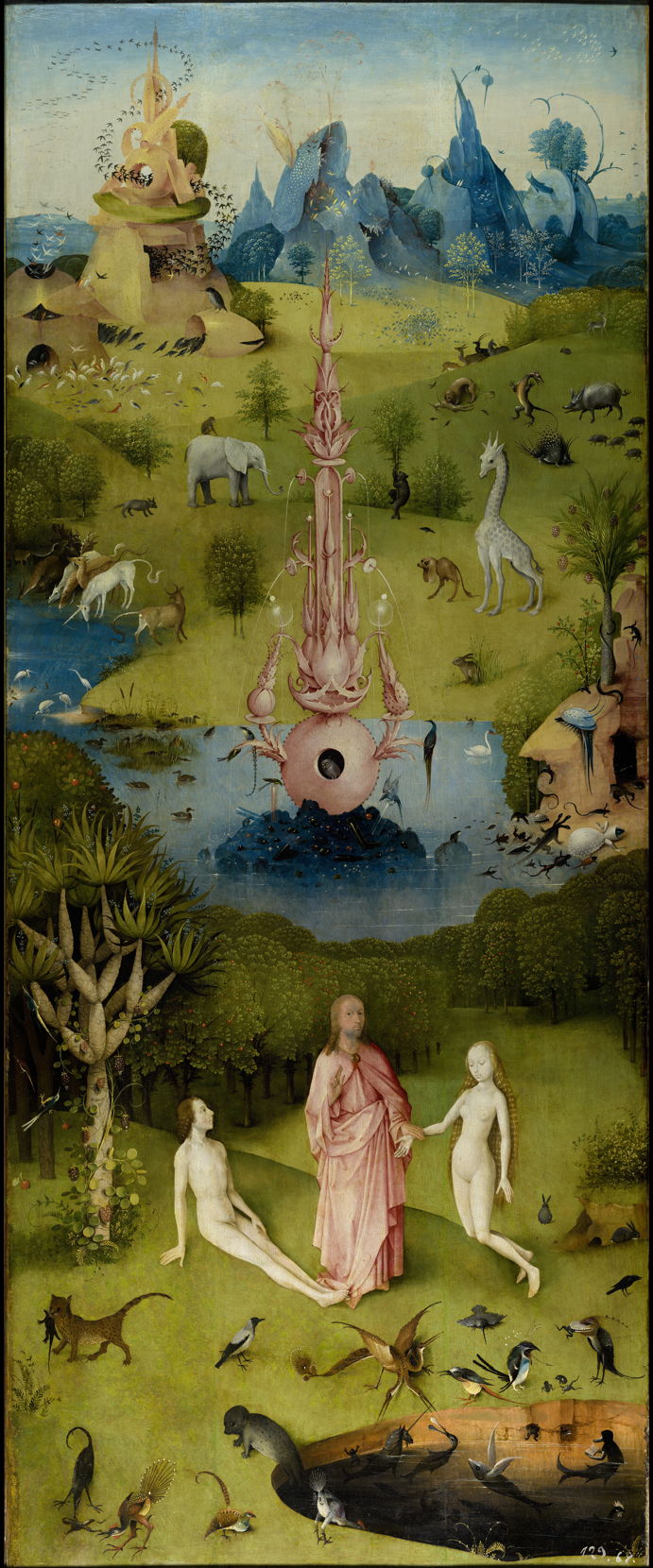
Hieronymus Bosch (c 1450–1516), The Garden of Earthly Delights (left panel) (c 1495-1505), oil on oak panel, central panel 190 × 175 cm, each wing 187.5 × 76.5 cm, Museo Nacional del Prado, Madrid. Wikimedia Commons.
The Garden of Eden in the left panel is the most conventional part of the painting, and compares with other works showing similar scenes from Genesis, if you overlook Bosch’s idiosyncratic beasts and structures.
Hieronymus Bosch (c 1450–1516), The Garden of Earthly Delights (left panel, detail) (c 1495-1505), oil on oak panel, central panel 190 × 175 cm, each wing 187.5 × 76.5 cm, Museo Nacional del Prado, Madrid. Wikimedia Commons.
God, Adam, and Eve are fairly traditional in their depiction, and Bosch chooses a happy moment. At this stage, there is no danger from the serpent, and no warning of the Fall that is to come.
Hieronymus Bosch (c 1450–1516), The Garden of Earthly Delights (left panel, detail) (c 1495-1505), oil on oak panel, central panel 190 × 175 cm, each wing 187.5 × 76.5 cm, Museo Nacional del Prado, Madrid. Wikimedia Commons.
On the left, the prominent tree bears bunches of grapes, but others in this wood carry apples, one of which has fallen to the ground. At the right are two rabbits and a crow, two of the few recognisable rather than fanciful species; another is the cat carrying prey in its mouth in front of the tree.
The strange species seen by the small lake in the immediate foreground are portmanteaux, in that each is made up of a composite of parts from other species, with visual references made to peacocks, spoonbills, seals, ducks, unicorns, and others. One duck-fish in the lake is even reading a book, and a bird on the shore has three heads. Several other paintings by Bosch use the same technique to create strange creatures.
Hieronymus Bosch (c 1450–1516), The Garden of Earthly Delights (left panel, detail) (c 1495-1505), oil on oak panel, central panel 190 × 175 cm, each wing 187.5 × 76.5 cm, Museo Nacional del Prado, Madrid. Wikimedia Commons.
The other dominant object is the fountain tower in the middle of the panel, the centre where the Tree of Knowledge (of good and evil) might be expected. This fantastic structure is made up of elements derived from plants, a technique Bosch used in other and earlier paintings. Like the panels themselves, this tower has informal symmetry about its midline, which is placed along the midline of the whole panel.
The small rocky cliff at the right edge is arranged to look like the profile view of a human face, with its eye closed.
A mixture of real, legendary, and portmanteau creatures decorate this area as well. Recognisable species include the ox, deer, elephant, monkey, black bear, giraffe, porcupine, egret, duck, and rabbit, but the more fanciful includes a lizard with three heads. Coiled around the tree at the right is a black snake, the serpent that led to the Fall.
Hieronymus Bosch (c 1450–1516), The Garden of Earthly Delights (left panel, detail) (c 1495-1505), oil on oak panel, central panel 190 × 175 cm, each wing 187.5 × 76.5 cm, Museo Nacional del Prado, Madrid. Wikimedia Commons.
The distant spires are the domain of the birds. Swift-like birds swirl out of the rock at the left, the flock weaving its way through the upper parts of its spire, and off into the sky. Others flock on the ground by species. The more distant blue pinnacles are based on plant structure, incorporating forms from other objects too.
Overall these details make this panel a most explicit and detailed vision of Paradise before the Fall of Man, assembled from Bosch’s rich and inventive imagination.
Pleasure garden
Hieronymus Bosch (c 1450–1516), The Garden of Earthly Delights (centre panel) (c 1495-1505), oil on oak panel, central panel 190 × 175 cm, each wing 187.5 × 76.5 cm, Museo Nacional del Prado, Madrid. Wikimedia Commons.
The pleasure garden in the centre panel is all about people, their pleasures and pleasuring. In stark contrast to the left panel, which contains only three human figures, the centre panel contains many hundreds. Although other objects are also involved, one of the main themes associated with pleasure here is fruit.
Hieronymus Bosch (c 1450–1516), The Garden of Earthly Delights (centre panel, detail) (c 1495-1505), oil on oak panel, central panel 190 × 175 cm, each wing 187.5 × 76.5 cm, Museo Nacional del Prado, Madrid. Wikimedia Commons.
With limited facilities to store or preserve soft fruit in particular, eating fruit and fruit itself was associated with sensual, even carnal, pleasure. Although Bosch’s innumerable figures are naked, almost without exception, strict convention forced him to allude to carnal pleasures indirectly, often here through the eating of fruit.
Hieronymus Bosch (c 1450–1516), The Garden of Earthly Delights (centre panel, detail) (c 1495-1505), oil on oak panel, central panel 190 × 175 cm, each wing 187.5 × 76.5 cm, Museo Nacional del Prado, Madrid. Wikimedia Commons.
In the left foreground, men and women are seen playing with fruit, often of greatly exaggerated size, and feeding fruit to one another. One couple is touching one another inside a transparent sphere, placed on top of a fanciful fruit floating on the lake. Another couple, who have progressed further in their lovemaking, are discreetly tucked inside the part-closed shell of a blue mussel. Giant birds watch this from the left, and a huge small tortoiseshell butterfly investigates a blue thistle flower.
Hieronymus Bosch (c 1450–1516), The Garden of Earthly Delights (centre panel, detail) (c 1495-1505), oil on oak panel, central panel 190 × 175 cm, each wing 187.5 × 76.5 cm, Museo Nacional del Prado, Madrid. Wikimedia Commons.
There are similar scenes in the right foreground, where just below the camel at the top there is a threesome taking place under a transparent dome, in which the woman to the right is clearly pregnant.
Hieronymus Bosch (c 1450–1516), The Garden of Earthly Delights (centre panel, detail) (c 1495-1505), oil on oak panel, central panel 190 × 175 cm, each wing 187.5 × 76.5 cm, Museo Nacional del Prado, Madrid. Wikimedia Commons.
The procession of animals and riders in the middle distance still uses symbolic fruit extensively, but also alludes to riding, hunting, and other mounted sports, common pleasures among the nobility of the day. The central circular pond contains figures of women, while those riding animals appear to be exclusively men: this may allude to the hunting of partners and the division of roles in courtship.
Hieronymus Bosch (c 1450–1516), The Garden of Earthly Delights (centre panel, detail) (c 1495-1505), oil on oak panel, central panel 190 × 175 cm, each wing 187.5 × 76.5 cm, Museo Nacional del Prado, Madrid. Wikimedia Commons.
Flying in the skies above are several strange objects, based sometimes on angels (right), sometimes on legendary or imaginary creatures, complete with more fruit and one tree.
Hieronymus Bosch (c 1450–1516), The Garden of Earthly Delights (centre panel, detail) (c 1495-1505), oil on oak panel, central panel 190 × 175 cm, each wing 187.5 × 76.5 cm, Museo Nacional del Prado, Madrid. Wikimedia Commons.
The towers in the background form the stage for other activities, and in the single example seen in the porthole in the base of the central dark blue tower, almost show explicit sexual activity. As with other structures, Bosch bases these towers on largely vegetable forms, and gives them informal symmetry about the midline of the panel.
The centre panel thus gives a delicately non-explicit and figurative account of the many physical pleasures which the nobility would have engaged in. It matches what we know of Bosch’s likely patron, Count Henry III of Nassau-Breda, who had a vast bed onto which drunk guests would be placed, so that he could act as voyeur over what they got up to.
Garden of Hell
Hieronymus Bosch (c 1450–1516), The Garden of Earthly Delights (right panel) (c 1495-1505), oil on oak panel, central panel 190 × 175 cm, each wing 187.5 × 76.5 cm, Museo Nacional del Prado, Madrid. Wikimedia Commons.
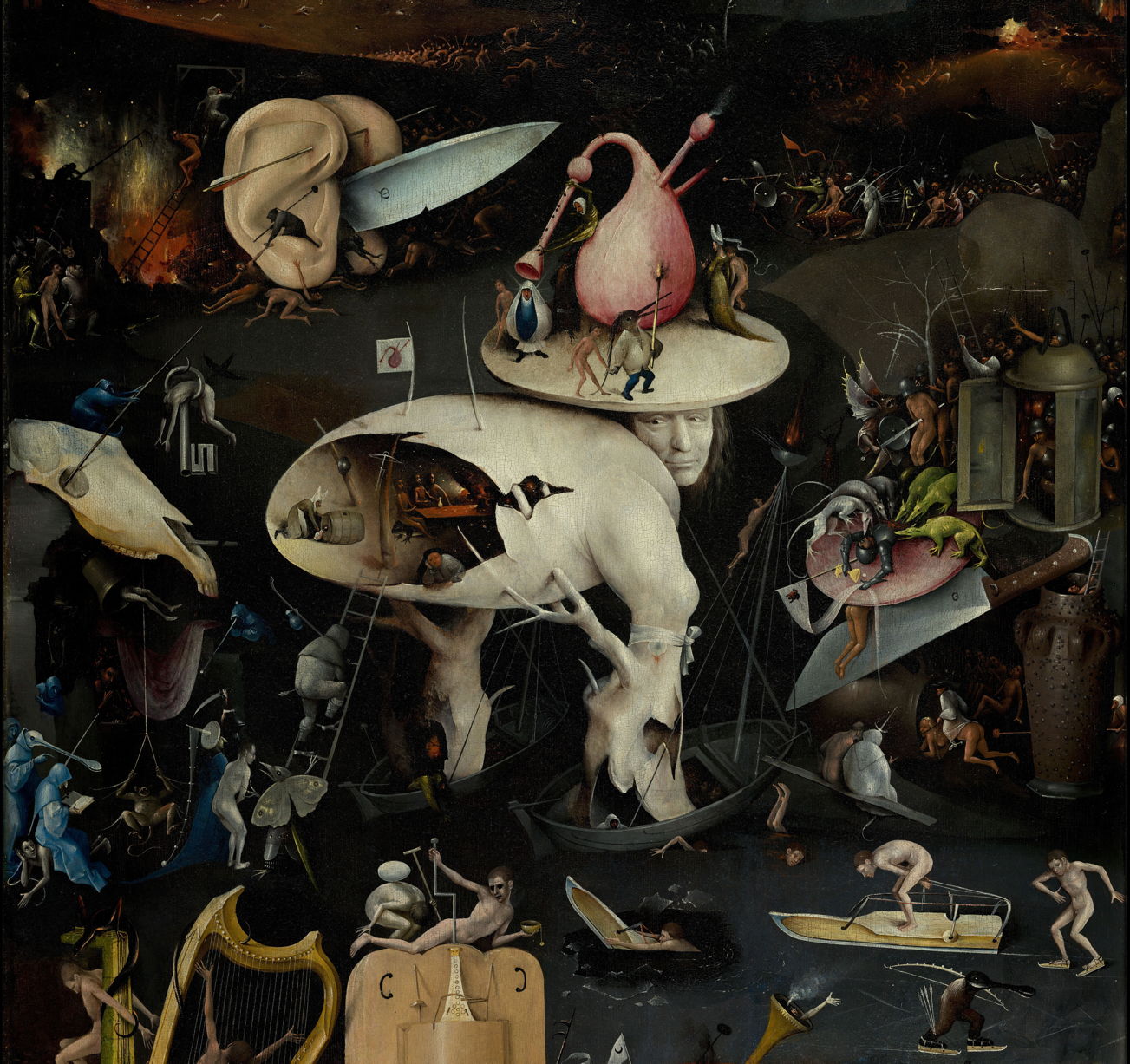
The ‘garden’ of Hell in the right panel is derived from the more restrained panels that Bosch had painted of Saint Anthony, such as that in his Hermit Saints triptych. This is here taken to its nightmare conclusion, in which its many figures are mutilated and tormented, in a landscape harking back to Bosch’s experience when, at the age of 13, he witnessed his home town almost burned to the ground. It moves from the mass of humanity in the centre panel to greater dominance of non-human creatures, and alarming objects.
Hieronymus Bosch (c 1450–1516), The Garden of Earthly Delights (right panel, detail) (c 1495-1505), oil on oak panel, central panel 190 × 175 cm, each wing 187.5 × 76.5 cm, Museo Nacional del Prado, Madrid. Wikimedia Commons.
In the foreground, a huge blue bird, wearing a cauldron on its head and swallowing a whole human, presides over the scene. That bird is sat on an elevated commode, defaecating blue bubbles containing the people it has been ingesting. Faces stare up from the foul brown waters of the cesspit underneath.
The two main groups of victims are clustered around objects associated with gaming and gambling, and those for making music. Placing the former on the road to hell isn’t surprising, but tormenting figures with a harp and other musical instruments may seem strange today. Various religious sects have viewed music as being sinful and the work of the devil, and some of its associated activities, particularly dancing, have attracted wider moral condemnation.
The instruments shown, at greatly exaggerated size, are (left) a lute, a harp, and a hurdy gurdy, a string instrument played by turning the crank shown at its top.
Another notable if not iconic feature in the foreground is the pig dressed partly as a nun, kissing a man, at the right lower corner.
Hieronymus Bosch (c 1450–1516), The Garden of Earthly Delights (right panel, detail) (c 1495-1505), oil on oak panel, central panel 190 × 175 cm, each wing 187.5 × 76.5 cm, Museo Nacional del Prado, Madrid. Wikimedia Commons.
On the near-black frozen surface of the river behind, there are skaters, one of whom has fallen through the ice. Another is tied to his ice craft. Above them is the Tree-Man, a unique structure to Bosch that appears in one of his drawings, presumably a study in preparation for this triptych.
Hieronymus Bosch (c 1450–1516), The Tree-Man (date not known), cat. 35, pen and brown ink on paper, 27.7 x 21.1 cm, Albertina, Vienna. Wikimedia Commons.Hieronymus Bosch (c 1450–1516), The Garden of Earthly Delights (right panel, detail) (c 1495-1505), oil on oak panel, central panel 190 × 175 cm, each wing 187.5 × 76.5 cm, Museo Nacional del Prado, Madrid. Wikimedia Commons.
At its top, on a circular disc, is another strange portmanteau object, which looks to be a cross between bagpipes and an alchemical vessel from an alembic. Further back is a pair of severed ears between which is the blade of a knife.
Hieronymus Bosch (c 1450–1516), The Garden of Earthly Delights (right panel, detail) (c 1495-1505), oil on oak panel, central panel 190 × 175 cm, each wing 187.5 × 76.5 cm, Museo Nacional del Prado, Madrid. Wikimedia Commons.
The background appears apocalyptic. Large armies are on the move: cavalry cross a bridge, and other battalions of infantry fill the roads and fields. A yacht, its sail lit, heads across the water in front of a city. Tiny figures are silhouetted against the light from fires within the large buildings there, apparently engaged in its capture and destruction. Other bodies fall spreadeagle through the air as they leap from the tops of buildings. The moon, hidden behind cloud, casts rays lighting broken clouds and the thick palls of smoke rising from the ruins.
The right panel builds a vivid picture of the torment and destruction of Hell.
Owls
There are some repeated objects shown across the triptych, of which I will consider owls. Several of Bosch’s earlier paintings, even those with little or no fanciful content, have incorporated owls, implying that he used them as a form of graphical signature. This triptych follows the pattern.
Hieronymus Bosch (c 1450–1516), The Garden of Earthly Delights (left panel, detail) (c 1495-1505), oil on oak panel, central panel 190 × 175 cm, each wing 187.5 × 76.5 cm, Museo Nacional del Prado, Madrid. Wikimedia Commons.
There are four obvious and prominent owls shown in the triptych. The first appears in the porthole cut out from the base of the central fountain tower of the left panel.
Hieronymus Bosch (c 1450–1516), The Garden of Earthly Delights (centre panel, detail) (c 1495-1505), oil on oak panel, central panel 190 × 175 cm, each wing 187.5 × 76.5 cm, Museo Nacional del Prado, Madrid. Wikimedia Commons.
Another giant owl appears at the left edge of the centre panel, being embraced by one of its figures.
Hieronymus Bosch (c 1450–1516), The Garden of Earthly Delights (centre panel, detail) (c 1495-1505), oil on oak panel, central panel 190 × 175 cm, each wing 187.5 × 76.5 cm, Museo Nacional del Prado, Madrid. Wikimedia Commons.
The second owl in the centre panel is perched on top of a couple towards the right edge. It’s being tempted by the offer of fruit, but doesn’t appear interested.
Hieronymus Bosch (c 1450–1516), The Garden of Earthly Delights (centre panel, detail) (c 1495-1505), oil on oak panel, central panel 190 × 175 cm, each wing 187.5 × 76.5 cm, Museo Nacional del Prado, Madrid. Wikimedia Commons.
The third owl in the centre panel is perched on the ‘horn’ of one of Bosch’s fanciful creatures in the procession of animals and riders.
Claims that Bosch’s owls are symbols of ignorance, false knowledge, or evil, lack support in his paintings. That one appears in the Garden of Eden, three in the garden of pleasure, and none in the garden of Hell, supports their association with more positive concepts rather than bad ones.
Synthesis
A plain grisaille painting starts the sequence off with its depiction of the creation, the perfect cover for an account in three images of the condition of mankind. We then see the first step in our history, when Adam and Eve were still secure in the Garden of Eden, surrounded by the wonders of God’s creation.
Some have suggested that the left panel, with its depiction of the emergence of animals from water, somehow hints at an evolutionary process. Viewed with a modern mind, this might appear attractive and imbue the painting with even greater meaning and magic. Half a millennium ago that would have been inconceivable: Bosch makes clear his literal belief in the Biblical account, throughout this and his other paintings. Without concepts of geological time or processes (key to the concept of evolution), such modern thinking is as alien as quantum physics.
After the Fall of Man and the expulsion from the Garden of Eden, men and women flourished and engaged in pleasures that were highly carnal and very earthly, detached from God, and outwith his commandments. These only too easily, through sins of gambling and lascivious activities associated with music, take humanity on the road to Hell, with its many torments and great suffering. Ultimately, the final panel may also refer specifically to Armageddon, the end of humanity and its world too.
Bosch takes us through this narrative with some of the richest imagery of any painting in the European canon. Its little scenes may be beautiful, puzzling, enticing, amusing, alarming, gruesome, but they are always fascinating, and the most elaborate conversation piece that you could want.
Falkenburg R (2011) The Land of Unlikeness: Hieronymus Bosch, The Garden of Earthly Delights, WBOOKS. ISBN 978 9 040 07767 8.
Fischer S (2013, 2016) Hieronymus Bosch, The Complete Works, Bibliotheca Universalis, Taschen. ISBN 978 3 8365 3850 3.
Matthijs Ilsink, Jos Koldeweij et al. (2016) pp 356-379 in Hieronymus Bosch, Painter and Draughtsman: Catalogue Raisonné, Yale UP and Mercatorfonds. ISBN 978 0 300 22014 8.
Schwartz G (2016) Jheronimus Bosch, The Road to Heaven and Hell, Overlook Duckworth. ISBNB 978 1 4683 1373 4.
This weekend I look at one of the greatest paintings in the world, Hieronymus Bosch’s Garden of Earthly Delights, painted between about 1495-1505. Unique in its content, it remains a conversation piece half a millennium after it was completed. This article starts at the top level, and tomorrow’s sequel delves a little into its rich and intriguing details.
Most triptychs were intended for use in places of worship, particularly as altarpieces. This one appears to have been commissioned primarily as a conversation piece for the well-educated nobility, specifically Count Henry III of Nassau-Breda (1483-1538), in what is now Belgium. It’s also one of Bosch’s best documented paintings, first being recorded only a year after his death, and described by a succession of viewers ever since.
Ilsink and others consider that Bosch’s main inspiration and source for the material in this painting was Hartmann Schedel’s extensively illustrated Weltchronik (history of the world) published in Nuremberg in 1493. This uses the same Biblical quotation that appears on the exterior of this painting. Despite those descriptions, extensive research, and many published studies since, it remains one of the most enigmatic paintings, with many different interpretations. Being so detailed, and with details which are so unusual, it is all too easy to get lost among its hundreds of cavorting figures and weird portmanteau objects.
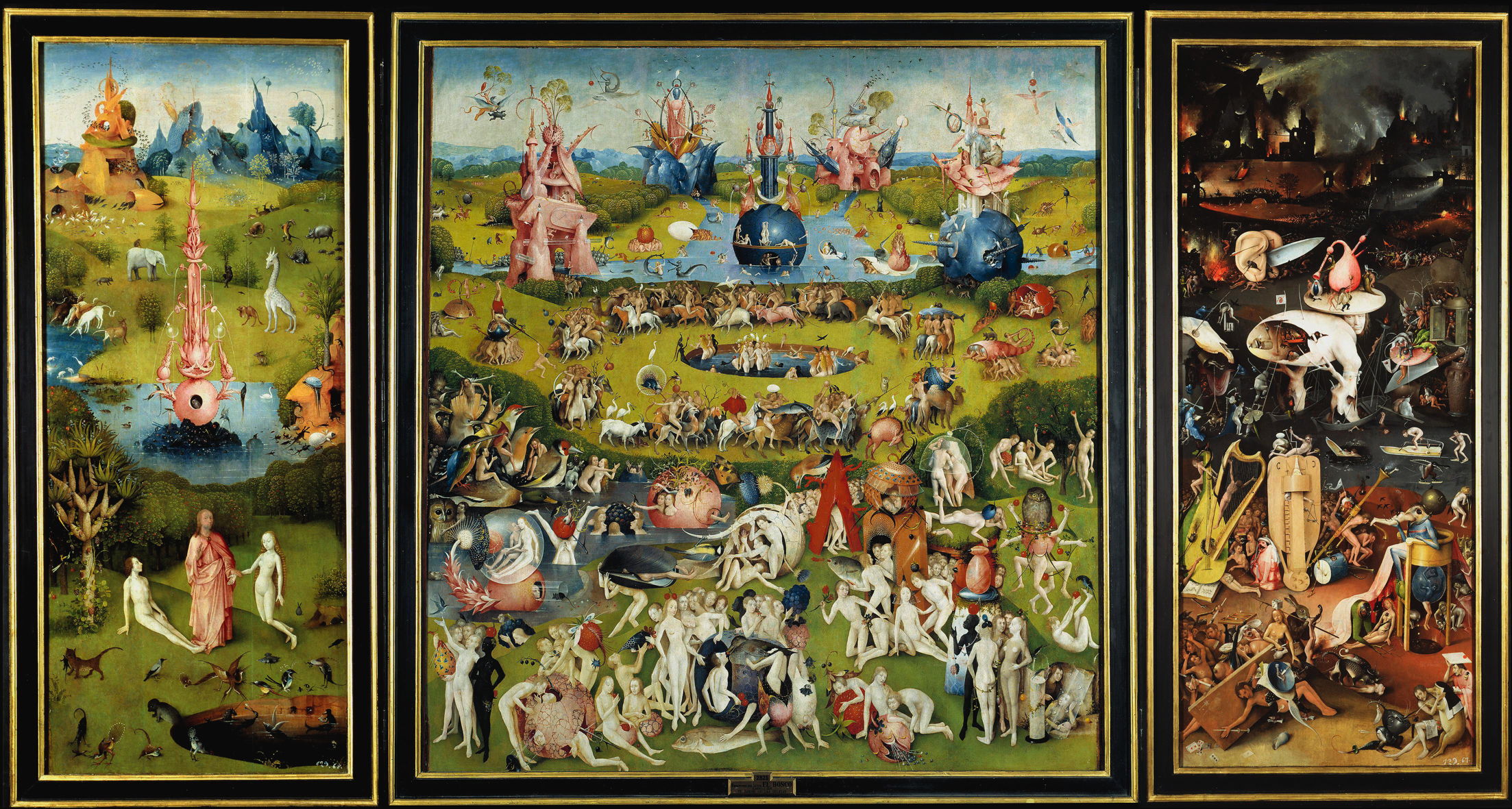
The exterior presents an understated grisaille showing the creation. The interior has three extraordinary panels showing fantastic landscapes which are quite densely covered with figures, real and fictional creatures, and bizarre structures. At first sight these may appear overwhelming, but on more careful examination each panel has a theme and its own pictorial structure. The themes (from the left) are based on creation (the Garden of Eden), pleasure (a pleasure garden), and destruction (the garden of Hell itself).
Exterior
Hieronymus Bosch (c 1450–1516), The Garden of Earthly Delights (exterior) (c 1495-1505), oil on oak panel, central panel 190 × 175 cm, each wing 187.5 × 76.5 cm, Museo Nacional del Prado, Madrid. Wikimedia Commons.
The exterior features a grisaille painting of a portion of the earth within an orb. The surface of that earth is shown at the end of the third day of creation according to the account in Genesis: the land has been separated from water, and plants have started to develop and grow. At the top left is a miniature showing God the Father, apparently based on an engraving in Weltchronik (1493).
The inscription above the painting reads: (left) Ipse dixit et facta sunt (right) Ipse mandavit et creata sunt. This is verse 9 of Psalm 33 from the Latin Vulgate, and is translated into English as ‘For He spake and it was done; He commanded, and it stood fast.’ Opening this restrained and modest cover brings a heady rush of bright colours, greens, reds, and blues, and its seething mass of detail.
Hieronymus Bosch (c 1450–1516), The Garden of Earthly Delights (c 1495-1505), triptych, oil on oak panel, 220 x 390 cm, Museo Nacional del Prado, Madrid. Wikimedia Commons.
Left panel, creation
Hieronymus Bosch (c 1450–1516), The Garden of Earthly Delights (left panel) (c 1495-1505), oil on oak panel, central panel 190 × 175 cm, each wing 187.5 × 76.5 cm, Museo Nacional del Prado, Madrid. Wikimedia Commons.
The left panel shows an innovative view of the Garden of Eden, divided into tiers as it recedes into the background. The foreground is dominated by a scene from the account of the creation of man in Genesis, in which God has just created Eve, and introduces Eve to Adam. Adam is seated on the ground on the right hand of God. God holds Eve, on his left, by the right wrist. She appears to be kneeling on the grass on which they are stood. God wears red robes, Adam and Eve are of course naked.
Hieronymus Bosch (c 1450–1516), The Garden of Earthly Delights (left panel, detail) (c 1495-1505), oil on oak panel, central panel 190 × 175 cm, each wing 187.5 × 76.5 cm, Museo Nacional del Prado, Madrid. Wikimedia Commons.
Closer to the viewer is a small lake which is teeming with extraordinary fish, other aquatic creatures, birds, and land animals. In all about thirty are shown, few of which resemble earthly species. Behind this foreground is dense woodland, with one tree of strange form prominent at the left, similar to a type of palm.
Hieronymus Bosch (c 1450–1516), The Garden of Earthly Delights (left panel, detail) (c 1495-1505), oil on oak panel, central panel 190 × 175 cm, each wing 187.5 × 76.5 cm, Museo Nacional del Prado, Madrid. Wikimedia Commons.
The wood drops down to another lake, in the middle of which is a rocky outcrop containing gems, on which a strange red fountain tower stands. The base of that tower is a sphere with a porthole cut out, and an owl peering out from that hole. At the right is a small rock cliff, with an exotic tree growing at the top. This lake has various waterfowl on it, and at the upper left several mammals including a unicorn are drinking.
Hieronymus Bosch (c 1450–1516), The Garden of Earthly Delights (left panel, detail) (c 1495-1505), oil on oak panel, central panel 190 × 175 cm, each wing 187.5 × 76.5 cm, Museo Nacional del Prado, Madrid. Wikimedia Commons.
Further into the background the land is open grass with scattered trees, and a menagerie of animals including an elephant and a giraffe. At the far (top) left is a complex rock structure from which, and into which, a dense and long flock of swift-like birds are flying. In the far distance to the right is a low but rugged range of pale blue rock spires. The sky is clear, blue, and has many birds in flight.
Hieronymus Bosch (c 1450–1516), The Garden of Earthly Delights (centre panel) (c 1495-1505), oil on oak panel, central panel 190 × 175 cm, each wing 187.5 × 76.5 cm, Museo Nacional del Prado, Madrid. Wikimedia Commons.
Centre panel, pleasure
The centre panel shows a rolling deer park with lakes, overrun by a dense mass of naked men and women, and bizarre objects.
Hieronymus Bosch (c 1450–1516), The Garden of Earthly Delights (centre panel, detail) (c 1495-1505), oil on oak panel, central panel 190 × 175 cm, each wing 187.5 × 76.5 cm, Museo Nacional del Prado, Madrid. Wikimedia Commons.
The foreground contains a dense group of people frolicking on grass with large fruit objects, including strawberries, blackcurrants, blackberries, apples, cherries, and others. Behind that on the left is a small lake, again densely packed with people and extremely large birds, including a kingfisher.
Hieronymus Bosch (c 1450–1516), The Garden of Earthly Delights (centre panel, detail) (c 1495-1505), oil on oak panel, central panel 190 × 175 cm, each wing 187.5 × 76.5 cm, Museo Nacional del Prado, Madrid. Wikimedia Commons.Hieronymus Bosch (c 1450–1516), The Garden of Earthly Delights (centre panel, detail) (c 1495-1505), oil on oak panel, central panel 190 × 175 cm, each wing 187.5 × 76.5 cm, Museo Nacional del Prado, Madrid. Wikimedia Commons.
The middle distance is dominated by a central circular pond, in which there are more groups of people. Around them is a procession of people riding horses, camels, and other mammals, in an anticlockwise direction around the central pond. To the left and right are more groups of people interacting, apparently in playful ways, with bizarre objects, such as the tail of a massive lobster.
Hieronymus Bosch (c 1450–1516), The Garden of Earthly Delights (centre panel, detail) (c 1495-1505), oil on oak panel, central panel 190 × 175 cm, each wing 187.5 × 76.5 cm, Museo Nacional del Prado, Madrid. Wikimedia Commons.
Further into the distance is a larger lake, fed by two rivers leading off into the central distance, and one at each side of the panel. Five fantastic tower structures are by or on the river. The central deep blue tower is based on a sphere, in and on which people are active. The other four towers alternate red and blue in colour, and feature various strange superstructures and ornaments. The two in the far distance, towards the top of the panel, are built over the river.
Far beyond is rolling, wooded countryside. The skies above are blue, cloudless, and contain several bizarre flying contraptions.
Hieronymus Bosch (c 1450–1516), The Garden of Earthly Delights (right panel) (c 1495-1505), oil on oak panel, central panel 190 × 175 cm, each wing 187.5 × 76.5 cm, Museo Nacional del Prado, Madrid. Wikimedia Commons.
Right panel, destruction
The right panel is a complete contrast to the other two in showing a nighttime scene full of suffering, violence, and destruction. It is segregated into three tiers by dominant colour.
Hieronymus Bosch (c 1450–1516), The Garden of Earthly Delights (right panel, detail) (c 1495-1505), oil on oak panel, central panel 190 × 175 cm, each wing 187.5 × 76.5 cm, Museo Nacional del Prado, Madrid. Wikimedia Commons.
The foreground, based on mid-browns, shows two substantial groups of naked men and women apparently in torment or violence. The nearer group has playing cards, dice, a backgammon set, and the trappings of gaming and gambling. Behind them is a separate group apparently undergoing torment with large musical instruments including a lute, harp, and hurdy gurdy. These scenes, on the left, are being overseen by a large bird sitting on an elevated commode.
Hieronymus Bosch (c 1450–1516), The Garden of Earthly Delights (right panel, detail) (c 1495-1505), oil on oak panel, central panel 190 × 175 cm, each wing 187.5 × 76.5 cm, Museo Nacional del Prado, Madrid. Wikimedia Commons.
The middle distance changes to dark grey and black. There is a frozen river, and rising up from that is a weird shell similar to the upper torso of a man’s body, and head, with its arms formed from hollow tree trunks resting in small boats. People there are being tormented by bizarre portmanteau creatures.
Hieronymus Bosch (c 1450–1516), The Garden of Earthly Delights (right panel, detail) (c 1495-1505), oil on oak panel, central panel 190 × 175 cm, each wing 187.5 × 76.5 cm, Museo Nacional del Prado, Madrid. Wikimedia Commons.
The far distance, based on black with red fire and pale yellow shafts of light, is far darker and objects are only made out in silhouette. It shows strife, fire and destruction in the massive buildings of a city.
Composition
Each of the three panels shows a landscape receding into the background. The prominent features within each panel are composed with informal symmetry within that panel, and across the triptych as a whole.
Hieronymus Bosch (c 1450–1516), The Garden of Earthly Delights (c 1495-1505), triptych, oil on oak panel, 220 x 390 cm, Museo Nacional del Prado, Madrid. Wikimedia Commons.
In the left panel, the dominating passages are the foreground figures, centred on God who is in the midline, the red tower in the lake, which is in the midline, and in the distance four pinnacles spread across the skyline.
In the centre panel, the round pond in the middle distance is in the midline, and just above the centre of the panel. The five distant towers are arranged symmetrically about the midline, with the central dark blue tower in the midline.
The dominant feature of the right panel is the ‘man-tree’ structure, which is in the midline just above the centre of the panel.
There are no comparable paintings from the same era, or indeed any period prior to the twentieth century, against which this can reasonably be compared.
History
There has never been any serious doubt that this is an authentic work by Bosch’s hand, and its provenance has been traced back to 1517, when it was at the Nassau Palace in Brussels. Later that century it moved to Spain, and was presented to the Escorial by Philip II in 1593.
Various periods of conservation work have been undertaken, including some retouching and other work to address wear and deterioration in the paint surface. The last major work was undertaken in 1999-2000.
Falkenburg R (2011) The Land of Unlikeness: Hieronymus Bosch, The Garden of Earthly Delights, WBOOKS. ISBN 978 9 040 07767 8.
Fischer S (2013, 2016) Hieronymus Bosch, The Complete Works, Bibliotheca Universalis, Taschen. ISBN 978 3 8365 3850 3.
Matthijs Ilsink, Jos Koldeweij et al. (2016) pp 356-379 in Hieronymus Bosch, Painter and Draughtsman: Catalogue Raisonné, Yale UP and Mercatorfonds. ISBN 978 0 300 22014 8.
Schwartz G (2016) Jheronimus Bosch, The Road to Heaven and Hell, Overlook Duckworth. ISBNB 978 1 4683 1373 4.
Long before paintings became movable objects of great value used by the rich as investments, artists and the owners of their paintings wanted to protect the paint layer that had been so carefully applied to the ground. From the early Middle Ages onwards, one popular means of doing this has been to apply some form of protective layer, a varnish.
Varnishes have been widely used not only for protection. Careful choice of their composition can enhance the appearance of a painting, through the optical properties of the varnish medium and its smooth, glossy surface. Until the late nineteenth century, the great majority of painters either applied final layers of varnish themselves, or advised their patrons and clients to do so.
Three types of varnish have come into common use:
Drying oil and resin, in effect a resin-rich transparent and unpigmented paint layer, that usually becomes an integral part of that. Some artists have added pigment, perhaps to make a general colour adjustment. There isn’t any clear distinction between that and a final paint glaze.
Solvent and resin, from which the solvent will evaporate, leaving a thin surface coat of resin.
Water-based washes such as egg white, known as glair, vegetable gums like gum arabic, and animal glues.
Resins used in varnishes have rich and sometimes strange histories. Most are exudates from trees in exotic locations, and have evocative names like mastic, sandarac, colophony and dammar. They’re usually highly insoluble, either in drying medium that has to be heated to make oil-based varnishes, or in turpentine or similar organic solvents. A great many recipes have been proposed, and there’s always the lure of the perfect, and inevitably top secret, formula.
Rembrandt Harmenszoon van Rijn (1606–1669), Bathsheba at her Toilet (1643), oil on panel, 57.2 x 76.2 cm, Metropolitan Museum of Art, New York, NY. Wikimedia Commons.
The biggest problems with varnishes are their propensity to yellow or grey with age, and their tendency to take up dirt and atmospheric contaminants. Rembrandt’s first painting of Bathsheba at her Toilet from 1643 has sadly lost much of its detail into the gloom of old varnish, which can be almost impossible to clean off when composed of drying oil and resin, without damaging the paint layer underneath.
Any work older than a few decades that has been varnished or had any form of surface treatment is unlikely to appear today with the colours the artist intended. Multiple layers of old varnish and trapped dirt give a misleading impression of what we would have seen soon after the work was completed. Painstaking work by conservation specialists can often restore old paintings to what we presume is their former glory, in full colour again.
Hieronymus Bosch’s Christ Carrying the Cross (1490-1510) is seen above before recent conservation work, and below is the result of thousands of hours of painstaking cleaning and treatment.
Another problem for the conservation specialist is a painting like Edward Poynter’s A Visit to Aesculapius from 1880. Although this is little more than a century old, the evidence from contemporary prints made from this work is that it was originally far from being so dark. Sadly it’s now almost impossible to read as a result of its near-black shadows.
A good varnish should be both colourless and transparent, but painters haven’t always respected that.
Théodore Géricault (1791–1824), The Raft of the Medusa (detail) (1818-19), oil on canvas, 491 × 716 cm, Musée du Louvre, Paris. Wikimedia Commons.
When finishing his monumental Raft of the Medusa in 1819, Théodore Géricault is thought to have applied glazes or varnish containing asphalt to give the painting a deep brown tone. Asphalt is not only completely unprotective and almost attracts dirt, but it never fully dries, and can have adverse effects on underlying paint too. It hasn’t helped that this two hundred year-old painting was rolled up and stored in a friend’s studio when it remained unsold, and was then transported to London still rolled up the following year.
Conventional wisdom says that it’s best to leave an oil painting to dry for at least six months before varnishing it. JMW Turner sometimes varnished over paint layers that were far from dry. In the case of The Opening of the Wallhalla, 1842 (1843), painted on mahogany, Ruskin reported that it had “cracked before it had been eight days in the Academy Rooms”, although this overall view shows little evidence of that damage.
Hellen and Townsend attribute this to Turner’s extensive use of Megilp, here a product sold by his colourman containing leaded drying oil and mastic varnish. Used sparingly and with great caution, such medium modifiers don’t necessarily cause serious ill-effects. But Turner has used Megilp to excess, to produce a soft impasto used in the foreground figures, in particular. This has resulted in wide and shallow drying cracks, as the surface has dried quickly and shrunk over trapped layers of liquid paint.
Varnishes do provide mechanical protection to the paint layer, but at the cost of locking out atmospheric oxygen, required for drying oils to polymerise properly in their drying process. Applied too early, varnishes can therefore greatly slow drying of underlying paint layers; the danger is that they may saponify (turn to soap) instead of drying normally.
Despite these dangers, varnishes can, when used with care by those who understand them properly, be valuable beyond simply providing a protective coat. Kirsty Whiten’s The Quing of the Now People (2015) achieves its superbly realistic effect by the skilful combination of conventional oil paint with varnish.
In the late nineteenth century, attitudes to varnishing oil paintings changed markedly, as Impressionists like Camille Pissarro started to prescribe that their works should on no account be varnished. This was to preserve the soft matte surface of the paint as applied by the artist, and became increasingly popular in the twentieth century.
For such paintings, protection can be provided by glass, when necessary. That isn’t of course an option for many extremely large oil paintings on canvas, which will probably need to be varnished and cleaned periodically well in the future, as they have in the past.
Varnishes, usually of the third type containing vegetable gums or animal glues, have also been used extensively on paint layers other than oils.
Samuel Palmer (1805–1881), Tintern Abbey at Sunset (1861), watercolor, gouache and varnish over graphite with scratching out on heavy card, 33.3 x 70.5 cm, Yale Center for British Art, New Haven, CT. Wikimedia Commons.
These are reported in Samuel Palmer’s Tintern Abbey at Sunset, above, and Dante Gabriel Rossetti’s Lucrezia Borgia, below. Gum or glue varnishes can have impressive optical effects when used carefully on watercolours.
Unfortunately, their tendency to yellow can also cause colour shifts. William Blake liked to apply glue varnish to his watercolours and perhaps to his glue tempera paintings as well. In the case of his Penance of Jane Shore in St Paul’s Church from about 1793, this has resulted in a generalised yellow shift and loss of chroma.
Henry Ossawa Tanner (1859–1937), The Destruction of Sodom and Gomorrah (1929-30), tempera and varnish on cardboard, 52 x 91.4 cm, High Museum of Art, Atlanta, GA. Wikimedia Commons.
Other artists appear to have been more successful: Henry Ossawa Tanner apparently applied varnish to this tempera painting of The Destruction of Sodom and Gomorrah almost a century ago, and it doesn’t appear to have suffered any adverse consequences, yet.
Varnishing has become such an accepted process that major exhibitions have incorporated ‘varnishing days’, although what happens on those occasions can be quite different. In Turner’s day at the Royal Academy in London, Varnishing Day was an occasion for artists to make any last-minute changes, and Turner himself seems to have turned up armed with paint and brushes and continued to work on his paintings.
Varnishing Day in the Paris Salon was completely different, attended normally by the artists’ colourmen, who applied a coat of varnish to the paintings for which they were responsible. The artists themselves don’t seem to have been involved, unless they chose to apply the varnish in person.
Since ancient times people have written, drawn and painted using pigments and dyes in water, often without any binder to adhere them to the ground. These are generically termed inks, and distinct from other media such as watercolours or the temperas. Most common among them is India ink, whose essential ingredients are carbon particles from soot, suspended in water. When applied to a suitably absorbent ground that has stood the test of centuries.
Hieronymus Bosch (c 1450–1516), The Owl’s Nest (c 1505-1516), pen and brown ink on paper, 14 x 19.6 cm, Museum Boijmans Van Beuningen, Rotterdam. Wikimedia Commons.
Hieronymus Bosch’s study of The Owl’s Nest from around 1505-1516 is a good example of a pen and ink drawing starting to transcend into painting.
Egbert van der Poel (1621–1664), The Fire in the Nieuwe Kerk, Amsterdam, in 1645 (c 1645), brush and gray wash and black wash with touches of pen and brown ink, 12.5 × 19.4 cm, location not known. Wikimedia Commons.
Washes applied using a brush became common in sketches made in front of the motif, such as Egbert van der Poel’s Fire in the Nieuwe Kerk, Amsterdam, in 1645. Known for his paintings of fires, he used these sketches to paint his famous brandjes in the studio. Landscape artists such as Nicolas Poussin and Claude Lorrain used the same sketching media working en plein air to build image libraries for the idealised landscapes used in their finished paintings.
Samuel Palmer (1805-1881), Cornfield and Church by Moonlight (c 1830), black ink on paper, 15.2 x 18.4 cm, Yale Center for British Art, New Haven, CT. Wikimedia Commons.
By the early nineteenth century, artists like Samuel Palmer were creating works that are to all intents and purposes full-blown paintings using black and coloured inks, such as this atmospheric nocturne of Cornfield and Church by Moonlight from about 1830.
Arthur Rackham (1867–1939), Illustration for Edition of ‘A Christmas Carol’ (1915), pen, ink and watercolour, further details not known. Images from the British Library and others, via Wikimedia Commons.
Used without a binder, inks normally rewet and smudge or blur, so have to be applied after any watercolour. Adding a binder such as shellac to India ink makes it waterproof when it has dried, and this was used in combination with watercolours by illustrators and painters such as the great Arthur Rackham, here in one of his illustrations for an edition of Charles Dickens’ A Christmas Carol.
A related medium that also crossed over from drawings and illustrations into paintings is casein, a protein-based tempera. It too has a long history, but didn’t become popular among artists until the late nineteenth century. Casein is a protein originally obtained from sour milk, but by the nineteenth century it was more usually prepared by the addition of rennet, enzymes used in cheese manufacture, extracted from the stomachs of calves.
Casein powder is then turned into paint by dispersion in an alkaline solution, typically made from lime or borax, and pigment is ground in. When lime is used the paint works best on porous grounds, but must be used fresh. When a little linseed oil is added to borax casein, a shelf-life of several months or more is possible. Casein paints dry as quickly as egg tempera, but can be reworked for a period until their binder has fully hardened. Once that has taken place, their paint film is robust and stable.
William Morris Hunt (1824–1879), Niagara (1879), casein on canvas, 158.1 × 253.4 cm, Museum of Fine Arts, Boston, MA. Wikimedia Commons.
The earliest painting I have seen that is known to have been made using casein paints is William Morris Hunt’s unusual view of Niagara from 1879. Hunt deviated here from his customary use of oils, although he still applied his paint to a prepared canvas support.
Gustav Klimt (1862–1918), Beethoven Frieze (‘The Hostile Powers’) (1902), casein, stucco, gold leaf, on mortar, 217 x 639 cm, Österreichische Galerie Belvedere, Vienna, Austria. Wikimedia Commons.
One of the most famous artists to have used casein paint is Gustav Klimt. In 1902, he used it in a frieze of 24 metres (nearly 80 feet) length for the fourteenth exhibition of the Vienna Secession, his Beethoven Frieze, of which that above is a section known as The Hostile Powers, and that below is Nagging Grief. He applied his casein paint directly onto mortar with added stucco, gold leaf, and other materials. This is known to be a robust form of wall-painting that is much more accommodating than fresco, and just as enduring, but has never become popular.
Gustav Klimt (1862–1918), Beethoven Frieze (‘Nagging Grief’) (1902), casein, stucco, gold leaf, on mortar, 220 x 640 cm, Österreichische Galerie Belvedere, Vienna, Austria. Wikimedia Commons.Colin Campbell Cooper (1856–1937), Flatiron Building, Manhattan (c 1908), casein on canvas, 102 x 76.2 cm, Dallas Museum of Art, Dallas, TX. Wikimedia Commons.
A few of Colin Campbell Cooper’s skyscraper cityscapes were painted using casein media, including this view of Flatiron Building, Manhattan from about 1908. He was equally proficient in watercolour and oils, and I don’t know why he experimented with casein, nor why he used it so infrequently.
Albin Egger-Lienz (1868–1926), Totentanz (Dance of Death) IV (1915), casein on canvas, 201.5 × 243 cm, Leopold Museum (Die Sammlung Leopold), Vienna, Austria. Wikimedia Commons.
Another Vienna-based artist, Albin Egger-Lienz, also used casein on occasion, here in this fourth of several different versions of Totentanz (Dance of Death) from 1915.
During the twentieth century, casein paints didn’t become popular but continued in use, particularly by those who also made illustrations. Just when they were attracting a following among artists such as Andy Warhol, they were rapidly displaced by acrylics. Despite that, casein paint is still available today, sold by Pelikan under the brand name of Plaka.
The appearance of new objects or unexpected phenomena in the sky was an event of great significance in the past, and often considered to be a portent of the future, good or bad. This article considers the few that were recorded in paintings, and starts with the most famous of all, the star of Bethlehem that appears in many depictions of the birth of Christ.
The linked stories of the birth of Christ in a shed at Bethlehem, and the subsequent adoration of the infant by three wise men, kings or Magi “from the east”, are among the most popular and enduring among paintings in the Christian canon. The outlines given in the Gospels of Luke, chapter 2, and Matthew, chapter 2, have conventionally become elaborated.
Three wise men had seen a new star, possibly a comet or an unusually bright planet, which they believed would lead them to the birth of a great prophet. They travelled by the guidance of that star, to arrive at Bethlehem. There they found the newborn Christ with Mary his mother, paid homage to him in the shed in which the holy family was lodging, and presented their gifts of gold, frankincense, and myrrh.
Giotto di Bondone (1266–1337), The Adoration of the Magi (c 1305), fresco, approx 200 x 185 cm, Scrovegni Chapel, Padua. Wikimedia Commons.
Giotto’s Adoration of the Magi from about 1305 shows the star as a celestial ball of fire streaking across the sky, and the three wise men pay their respects to the newborn Christ and his mother.
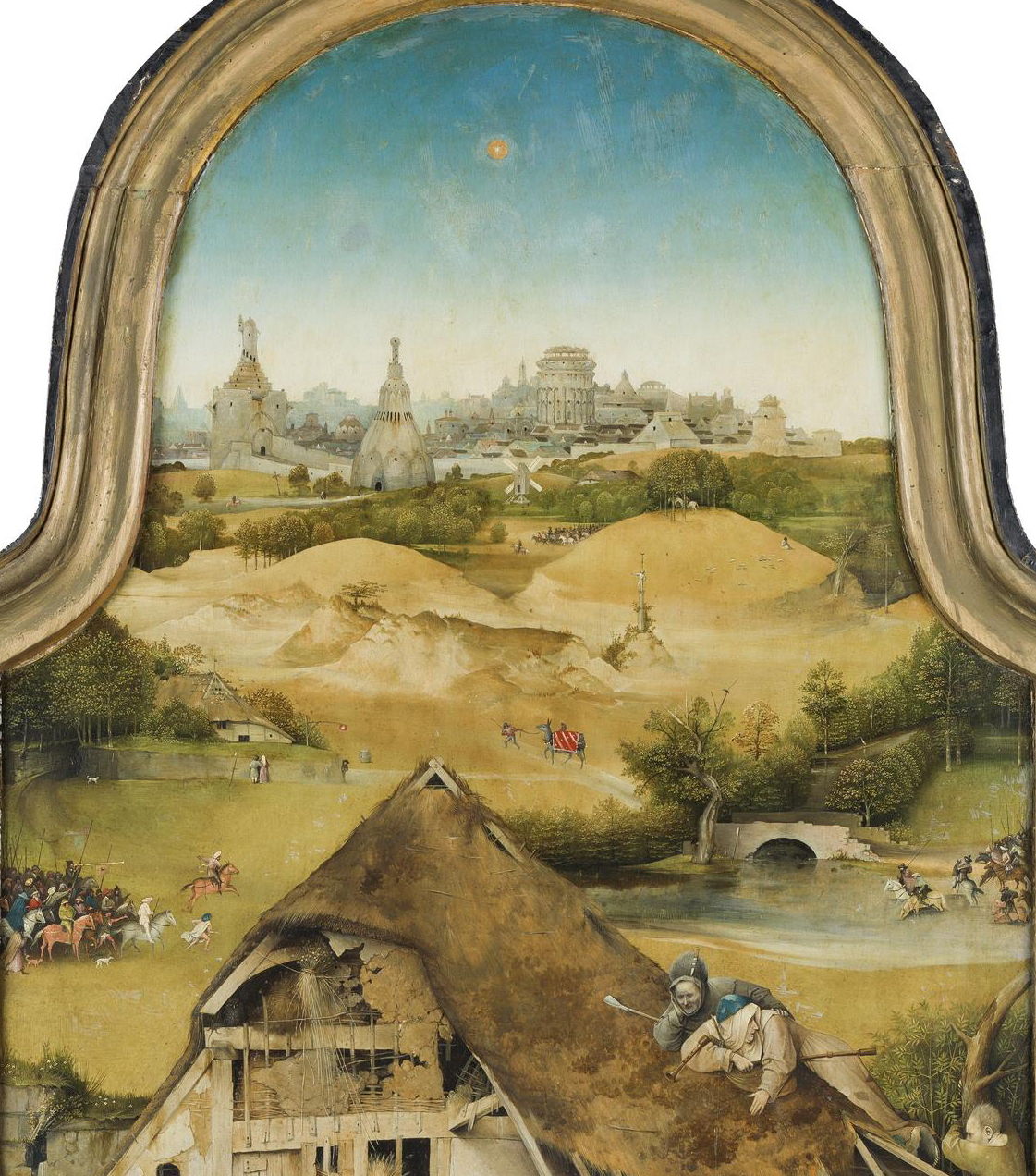
Hieronymus Bosch (c 1450–1516), The Adoration of the Magi (Interior) (Saint Peter with donor, The Adoration of the Magi, Saint Agnes with donor) (1490-1500) (CR no. 9), oil on oak panel, 138 cm x 138 cm overall when open, Museo Nacional del Prado, Madrid. Wikimedia Commons.
Above Bosch’s view of the local Brabant countryside in his Adoration of the Magi of 1490-1500 he places a more modest and stationary star shining bright over its distant city, as shown in the detail below.
Hieronymus Bosch (c 1450–1516), The Adoration of the Magi (detail) (centre panel) (The Adoration of the Magi) (1490-1500) (CR no. 9), oil on oak panel, 138 cm x 138 cm overall when open, Museo Nacional del Prado, Madrid. Wikimedia Commons.William Blake (1757–1827), Adoration of the Kings (1799), tempera on canvas, 25.7 x 37 cm, Brighton and Hove Museums & Art Galleries, Brighton, England. The Athenaeum.
Blake’s version of the Adoration of the Kings is conventional in showing the three wise men presenting their gifts to Jesus and his parents. At the left, outside, shepherds are tending to their flocks of sheep beneath a stylised star, and at the right are the ox and ass.
There remains controversy over what celestial event might have occurred at the time.
Very few paintings show known events in the sky, and I know of only one depicting a full solar eclipse.
Enrique Simonet Lombardo (1866–1927), Eclipse (1905), oil on canvas, 75 x 55 cm, location not known. Wikimedia Commons.
Although many painters, particularly the Impressionists, have shown fleeting effects of light and the occasional rainbow, Enrique Simonet took the opportunity of a solar eclipse on 30 August 1905 to paint his Eclipse (1905). This was visible across eastern and northern Spain between about 1300 and 1320 UTC, and this painting is one of its few remaining records.
Realistic paintings of comets are also rare, and unimpressive.
William Dyce (1806–1864), Pegwell Bay, Kent – a Recollection of October 5th 1858 (c 1858), oil on canvas, 635 cm x 889 cm, The Tate Gallery, London. Wikimedia Commons.
Generally acclaimed as William Dyce’s finest painting, Pegwell Bay, Kent – a Recollection of October 5th 1858 (c 1858) shows this bay on the Kent coast, during a family holiday visit: a coastal scene worked up into a large finished oil painting. Although not easily seen in this image, there’s a small point of light high in the middle of the sky which is Donati’s comet, not due to return until 3811. Couple that with the inclination of the sun and the state of the tide, and you should be able to place this view precisely in both time and space, and confirm that it does indeed show this bay on 5 October 1858.
A few paintings show impossible celestial events.
John Martin (1789–1854), The Deluge (1834), oil on canvas, 168.3 x 258.4 cm, Yale Center for British Art, New Haven, CT. Wikimedia Commons.
John Martin’s painting of The Deluge from 1834 has two points of reference: the Biblical account of the flood, and Martin’s personal belief in prior catastrophe. As the sciences became ascendant during the nineteenth century, some educated people believed that in the past there had been an alignment of the sun, earth, and moon, and the collision of a comet resulting in global flooding. This was promoted by the French natural scientist Baron Georges Cuvier, and subscribed to by Martin.
True to form, his painting is dark and apocalyptic: near the centre, tiny survivors are just about to be overwhelmed by an immense wave bearing down at them from the left and above. The misaligned sun and moon barely penetrate the dense cloud, and to the top right is a melée of rock avalanche and lightning bolt. This was awarded a gold medal at the Paris Salon of 1835.
Paul Nash (1892–1946), Landscape of the Vernal Equinox (III) (1944), oil on canvas, 63.5 x 76.2 cm, Scottish National Gallery of Modern Art, Edinburgh, Scotland. The Athenaeum.
Several of Paul Nash’s surrealist landscapes show the moon in its phases, among them Landscape of the Vernal Equinox (III) from 1944, which presents the impossible view of a full moon and the sun visible close together and just above the horizon.
The humble domestic chicken is probably the most common and widely distributed farm animal. It originated in about 8,000 BCE in south-east Asia and spread its way steadily across every continent except Antarctica. It probably reached Europe before the Roman Empire, and since then has been commonplace. Perhaps because of its small size and frequent presence, it features in relatively few paintings.
The cruel sport of cockfighting accompanied its spread, and is depicted in Jean-Léon Gérôme’s first successful painting in 1846.
Jean-Léon Gérôme (1824–1904), The Cock Fight (Young Greeks Attending a Cock Fight) (1846), oil on canvas, 143 x 204 cm, Musée d’Orsay, Paris. Wikimedia Commons.
This motif had started from a relief showing two adolescent boys facing off against one another. Gérôme felt he needed to improve his figurative painting, and after Delaroche’s advice decided to develop that image by replacing one of the boys with a girl. In both Greek and English (but not French) the word cock is used for both the male genitals and a male chicken, and the youthful Gérôme must have found this combined visual and verbal pun witty and very Neo-Greek.
There’s a curious ambivalence in its reading too: two cocks are fighting in front of the young couple. Is one of the birds owned by the girl, and if so, is it the dark one on the left, which appears to be getting the better of the bird being held by the boy? Either way, it’s a lightly entertaining reflection on courtship and gender roles, and a promising debut. The Cock Fight earned Gérôme a third-class medal, and he sold the painting for a thousand francs. With the benefit of favourable reviews from critics, the following year brought him lucrative commissions, and a growing reputation.
A dead chicken plays a significant role in one of Rembrandt’s most famous group portraits.
Rembrandt Harmenszoon van Rijn (1606–1669), The Night Watch (1642), oil on canvas, 363 x 437 cm, Rijksmuseum Amsterdam, Amsterdam, The Netherlands. Wikimedia Commons.
His vast group portrait of The Night Watch (1642) is the most famous of all those of militia in the Dutch Republic. It features the commander and seventeen members of his civic guard company in Amsterdam. Captain Frans Banninck Cocq (in black with a red sash), followed by his lieutenant Willem van Ruytenburch (in yellow with a white sash) are leading out this militia company, their colours borne by the ensign Jan Visscher Cornelissen. The small girl to the left of them is carrying a dead chicken, a curious symbol of arquebusiers, the type of weapon several are carrying.
For a young child, cockerels can appear large and threatening, as used by Gaetano Chierici in a delightful visual joke.
Gaetano Chierici (1838-1920), A Scary State of Affairs (date not known), oil, dimensions and location not known. Wikimedia Commons.
His undated painting of A Scary State of Affairs calls on our experience of the behaviour of cockerels and geese. An infant has been left with a bowl on their lap, and their room is invaded first by cockerels, then by those even larger and more aggressive geese. The child’s eyes are wide open, their mouth at full stretch in a scream, their arms raised, and their legs are trying to fend the birds away.
Being among the most humble and everyday domestic species, chickens seldom make the limelight in religious narratives.
Bartolomé Esteban Murillo (1617–1682), The Adoration of the Shepherds (c 1650), oil on canvas, 187 x 228 cm, Museo Nacional del Prado, Madrid, Spain. Wikimedia Commons.
Murillo’s Adoration of the Shepherds from about 1650 is an exception featuring unusual additional details including the old woman carrying a basketful of eggs, and chickens in front of the kneeling shepherd.
In most paintings including chickens, though, they are just extras in the farmyard.
Paulus Potter (1625–1654), Figures with Horses by a Stable (1647), oil on panel, 45 x 38 cm, Philadelphia Museum of Art, Philadelphia, Pennsylvania. Wikimedia Commons.
Paulus Potter’s Figures with Horses by a Stable (1647) includes finely painted horses, chickens, a dog, and distant cattle, with a magnificent tree in the centre and a sky containing several birds.
Hans Thoma (1839–1924), Chickenfeed (1867), oil on canvas, 104.5 × 62 cm, Staatliche Kunsthalle Karlsruhe, Karlsruhe, Germany. Wikimedia Commons.
In Chickenfeed from 1867, Hans Thoma tackles this genre scene in a traditional and detailed realist style.
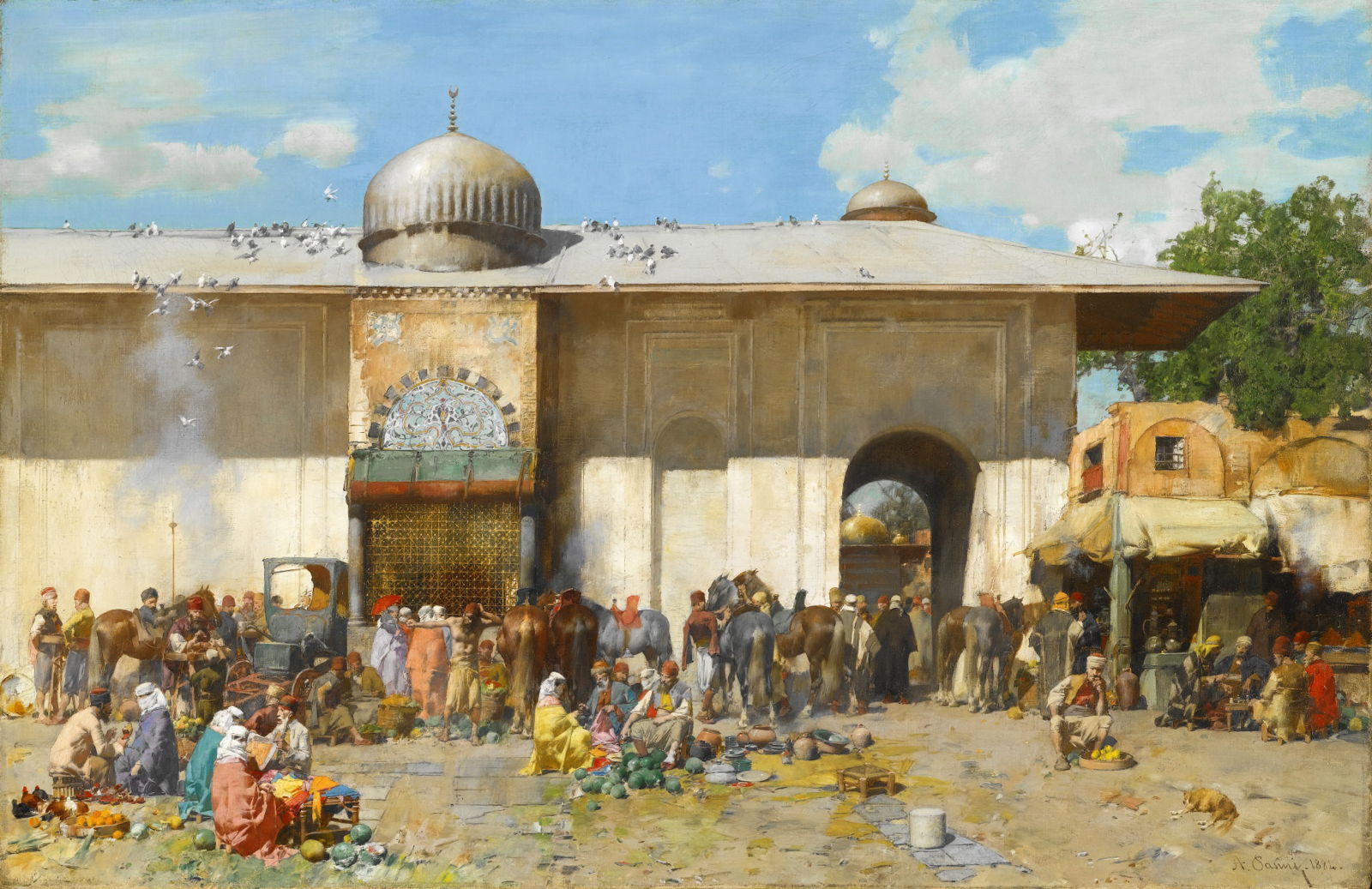
Alberto Pasini (1826–1899), A Market Scene (1884), further details not known. Wikimedia Commons.
Alberto Pasini’s Market Scene from 1884 has an eclectic mixture of produce, ranging from live chickens to pots and the artist’s signature melons.
Évariste Carpentier (1845–1922), Eating in the Farmyard (date not known), oil on canvas, 115 x 164 cm, Château de Gaasbeek, Lennik, Belgium. Wikimedia Commons.
Évariste Carpentier’s undated Eating in the Farmyard, an example of the rural deprivation which sparked Naturalist art, shows two kids surrounded by animals and birds in this much-used space.
Évariste Carpentier (1845–1922), Feeding the Chickens (date not known), oil on canvas, dimensions not known, Private collection. Wikimedia Commons.
Here, Carpentier’s old woman is busy Feeding the Chickens.
Friedrich Eckenfelder (1861–1938), Zollernschloss, Balingen (c 1884-5), oil on wood, 16.8 x 22.8 cm, Private collection. Wikimedia Commons.
Friedrich Eckenfelder’s Zollernschloss, Balingen from about 1884-5 shows a small yard just below the back of this castellated farm in Germany, with its lively flock of chickens.
Gustav Klimt (1862–1918), After the Rain (Garden with Chickens in St. Agatha) (1898-99), oil on canvas, 80.3 × 40 cm, Lentos Kunstmuseum Linz, Linz, Austria. Wikimedia Commons.
Gustav Klimt had probably painted his first small landscapes between 1881-87, and returned to the genre more seriously in about 1896. This work, variously known as After the Rain,Garden with Chickens in St. Agatha, or similar, is thought to have been painted when Klimt stayed in the Goiserer Valley with the Flöge family in the summer of 1898.
Very occasionally, a chicken may come as something of a surprise.
Hieronymus Bosch (c 1450–1516), The Ship of Fools (fragment of left wing of The Wayfarer triptych) (1500-10), oil on oak panel, 58.1 x 32.8 cm, Musée du Louvre, Paris. Wikimedia Commons.
Hieronymus Bosch’s Ship of Fools, a fragment from a larger Wayfarer triptych painted in 1500-10, is actually a small boat, into which six men and two women are packed tight. Its mast is unrealistically high, bears no sail, and has a large branch lashed to the top of it, in which is Bosch’s signature owl. Its occupants are engaged in drinking, eating what appear to be cherries from a small rectangular tabletop, and singing to the accompaniment of a lute being played by one of the women. A man has climbed a tree on the bank to try to cut down the carcass of a chicken from high up the mast.

 Login
Login