Claude Monet had first visited London as he sought refuge from the Franco-Prussian War in 1870-71, when he painted one of the early impressions of the River Thames in mist, shown in yesterday’s article. He was to return just before the end of the century, when his fortunes had changed and he could afford to travel in search of motifs. Where better than the River Thames for the optical effects of mist, fog and smog?
Monet had started painting formal series during the 1880s, when he was enjoying commercial success at last. From about 1896, almost all his works were part of a series. He started travelling through Europe in search of suitable motifs for these, visiting Norway in 1895, and later Venice. When he returned to London in 1899, and in the following two years, Monet chose a different view of the Palace of Westminster, from a location at the opposite end of Westminster Bridge, for his series of 19 paintings. These were all started from the second floor of the Administrative Block at the northern end of the old Saint Thomas’s Hospital on the ‘south’ bank, and completed over the following three or four years.
Claude Monet (1840–1926), The Houses of Parliament, Sunlight Effect (1903), oil on canvas, 81.3 × 92.1 cm, Brooklyn Museum, New York, NY. Wikimedia Commons.
His The Houses of Parliament, Sunlight Effect (1903) is more radical than his painting of thirty years earlier, showing little more than the Palace in silhouette, the sun low in the sky, and its broken reflections in the water.
Claude Monet (1840–1926), The Houses of Parliament, Sunset (1903), oil on canvas, 81.3 × 92.5 cm, The National Gallery of Art, Washington, DC. Wikimedia Commons.
The Houses of Parliament, Sunset (1903) shows the same view in better visibility, but with the sun setting and a small boat on the move in front of the Palace.
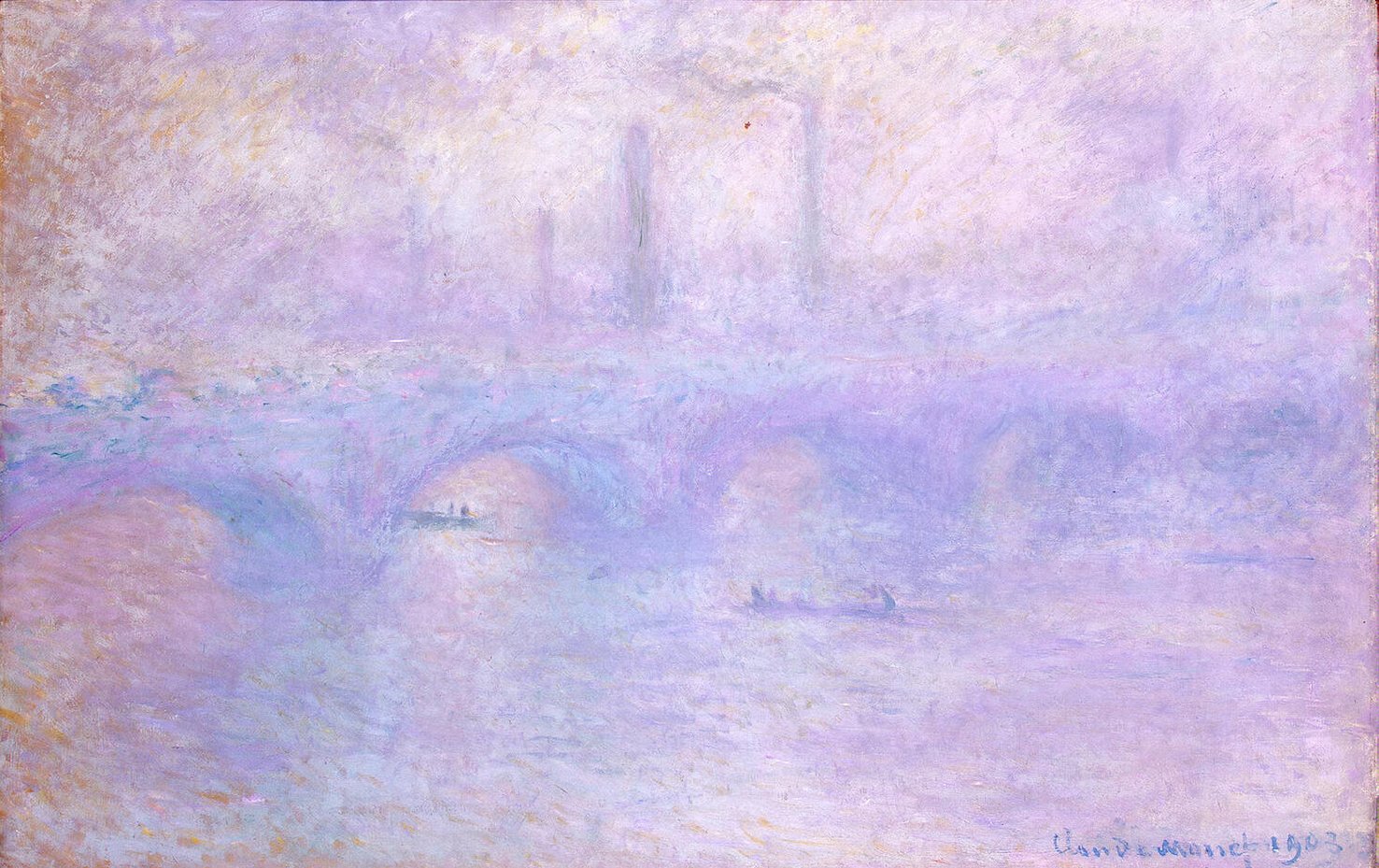
Claude Monet (1840–1926, Waterloo Bridge. Effect of Fog (1903), oil on canvas, 65.3 x 101 cm, Hermitage Museum Государственный Эрмитаж, Saint Petersburg, Russia. Wikimedia Commons.
Monet’s Waterloo Bridge from 1903 is the ultimate conclusion of his paintings of fog, in which only the softest of forms resolve in its pale purple and blue vagueness, his common destination with the paintings of Turner over fifty years earlier.
Claude Monet (1840–1926), The Houses of Parliament, Stormy Sky (1904), oil on canvas, 81.5 × 92 cm, Palais des Beaux-Arts de Lille, Lille. Wikimedia Commons.
In The Houses of Parliament, Stormy Sky (1904) the sun is higher and further to the south, allowing Monet to balance the silhouette of the Palace with its shadow cast on the water, and the brightness in the sky with its fragmented reflections.
Henri Le Sidaner (1862–1939), St. Paul’s from the River: Morning Sun in Winter (1906-07), oil on canvas, 90 x 116 cm, Walker Art Gallery, Liverpool, England. Wikimedia Commons.
Henri Le Sidaner also visited Britain on several occasions, and in 1906-07 painted this view of St. Paul’s from the River: Morning Sun in Winter, which may have been inspired by Monet’s series paintings of Rouen Cathedral, here expressed using his own distinctive marks.
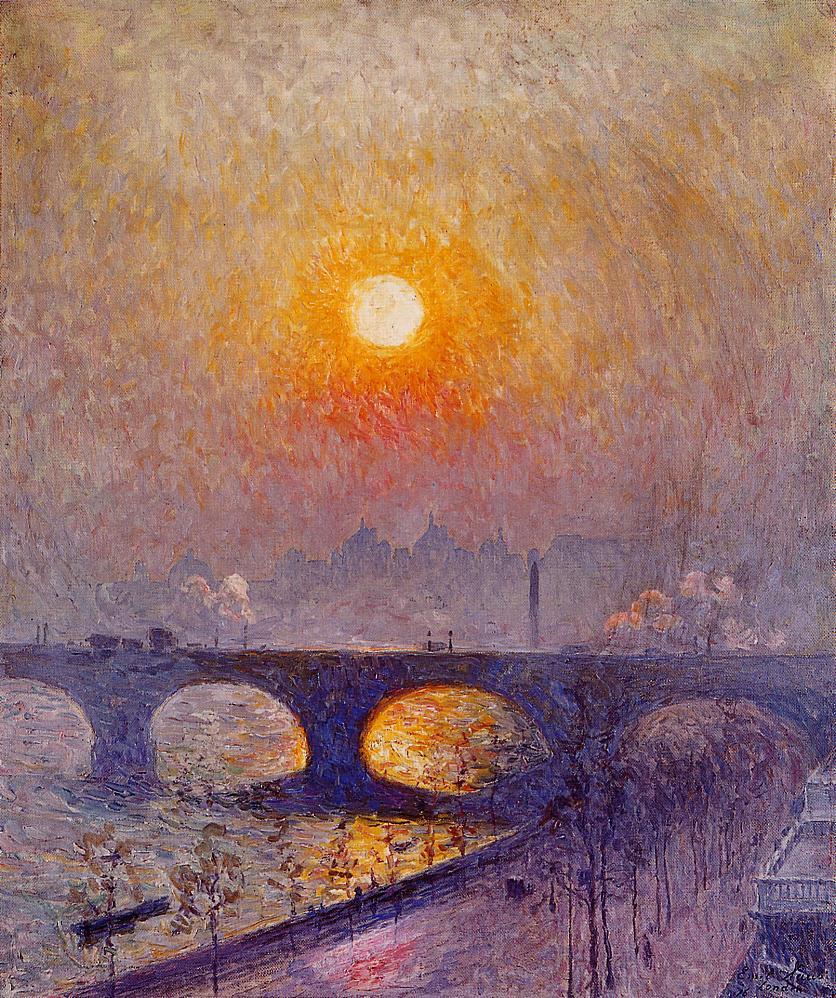
Émile Claus (1849-1924), (Sunset over Waterloo Bridge) (1916), oil on canvas, dimensions not known, location not known. WikiArt.
Emile Claus’s Sunset over Waterloo Bridge (1916) was painted from a location on the north bank of the Thames slightly to the east of Waterloo Bridge, the north end of which is prominent, and looks south-west into the setting sun, up river. Claus painted several views of Waterloo Bridge while he was in London, but doesn’t appear to have attempted any formal series, such as Monet’s.
Claus isn’t formulaic in his treatment. He uses billowing clouds of steam and smoke to great effect, and his inclusion of the road, trees and terraces in the foreground, on the Embankment, provides useful contrast with the crisp arches of the bridge, and the vaguer silhouettes in the distance. Like Monet’s series, this was probably painted from a temporary studio inside a building.
Emile Claus (1849–1924), Morning Reflection on the Thames in London (1918), oil on canvas, 72 x 92 cm, Museum voor Schone Kunsten, Ghent, Belgium. Wikimedia Commons.
Claus’s Morning Reflection on the Thames in London, from 1918, is a view over the Embankment and river that’s desaturated and made vaguer by fog.
Lesser Ury (1861–1931), London in Fog (1926), oil on canvas, 67 x 97 cm, location not known. Wikimedia Commons.
My last example is another view over the River Thames, this time by Lesser Ury. London in Fog from 1926 doesn’t appear to be a nocturne, but looks at the effects of fog on both lights and their reflections.
On 4 December 1952, a high pressure system settled over London. The wind fell away, and fog and smoke were trapped under a temperature inversion. The following day the whole of the city and an area totalling over one thousand square miles were blanketed in smog that remained until 9 December. It’s estimated that directly caused over ten thousand deaths. A succession of laws and a major campaign to eliminate open coal fires in London resulted in great improvement, although a decade later there was another lesser smog, perhaps the event I remember from my childhood. The beauty of those paintings can also be deadly.
One of the enduring memories of my childhood, spent partly in London, is walking in smog, then commonly known as a pea-souper. The combination of dense fog and smoke was so thick I could barely make out street lights, and the streets were for once almost empty, as vehicles could only proceed at walking pace.
This weekend I present a selection of paintings of mist, fog and maybe even a touch of smog on the River Thames, in and near London. Today’s paintings come from the pioneers of the nineteenth century, and tomorrow’s from the twentieth.
Many of JMW Turner’s greatest paintings take advantage of the optical effects of mist and fog. Being a Londoner, he must have experienced these all too frequently.
These peaked in Turner’s famous painting of a Great Western Railway train crossing the River Thames at Maidenhead: Rain, Steam, and Speed, exhibited at the Royal Academy in 1844. The whole image is fogbound and vague, and proved a precursor to the approach of the Impressionists after his death.
Claude Monet (1840–1926), The Thames below Westminster (1871), oil on canvas, 47 x 73 cm, The National Gallery, London. Wikimedia Commons.
Less than thirty years later, when he was taking refuge from the Franco-Prussian War, Claude Monet’s The Thames below Westminster (1871) is less Impressionist. Painted from the Embankment to the north of Westminster Bridge, near what is now Whitehall, the three towers to the south are almost superimposed, and aerial perspective is exaggerated by the mist. The river is bustling with small paddleboat steamers. In the foreground a pier under construction is shown almost in silhouette. Small waves and reflections on the river are indicated with coarse brushstrokes, suggesting this is a rapid and spontaneous work.
Winslow Homer (1836–1910), The Houses of Parliament (1881), watercolour on paper, 32.3 x 50.1 cm, Hirshhorn Museum and Sculpture Garden, Washington, DC. Wikimedia Commons.
A decade later, The Houses of Parliament is Winslow Homer’s faithful representation of the Palace of Westminster when viewed from the opposite bank of the Thames, to the north (downstream) of the end of Westminster Bridge. The tide is high under the arches of Westminster Bridge, and small boats are on the river. This classic watercolour makes an interesting contrast with Monet’s later oil paintings I show tomorrow: Homer provides little more detail, the Palace being shown largely in silhouette, but works with the texture of the paper and careful choice of pigment to add granularity. He provides just sufficient visual cues to fine detail, in the lamps and people on Westminster Bridge, and in the boats, to make this a masterly watercolour.
Jules Bastien-Lepage (1848–1884), The Thames, London (1882), oil on canvas, 54 x 74.3 cm, Philadelphia Museum of Art, Philadelphia, PA. The Athenaeum.
The following year, Jules Bastien-Lepage paid a return visit to the city, when he painted The Thames, London. This view of industrial docklands further downstream maintains detail into the far distance, except where it’s affected by the smoky and hazy atmosphere typical of the city at that time. It was this section of the river that was also painted on several occasions by James Abbott McNeill Whistler.
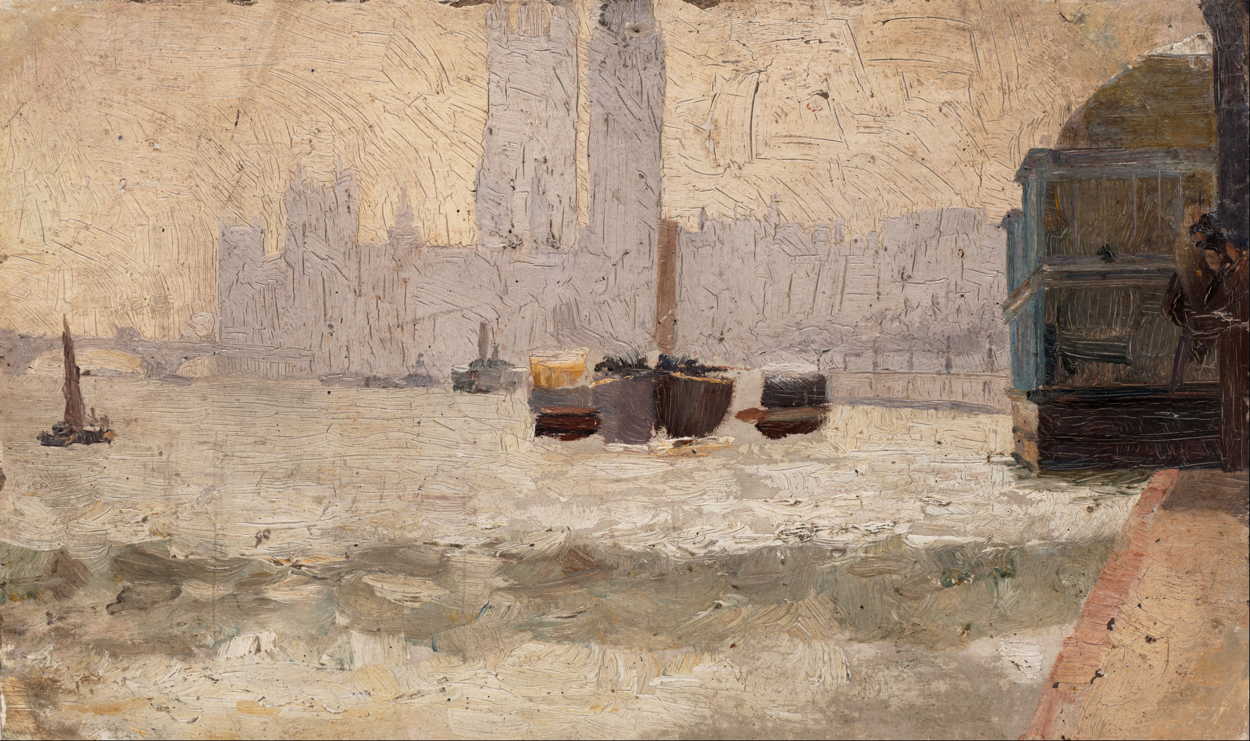
Tom Roberts (1856-1931), Fog, Thames Embankment (1884), oil on paperboard, 31.6 x 46 cm, Art Gallery of New South Wales, Sydney. Wikimedia Commons.
Tom Roberts’ Fog, Thames Embankment (1884) is painted from a similar location to Monet’s The Thames below Westminster above, on the Embankment to the north of Westminster Bridge, but is cropped more tightly, cutting off the tops of the Victoria and Elizabeth Towers. The Palace and first couple of arches of Westminster Bridge appear in misty silhouette, with moored barges and buildings on a pier shown closer and crisper. He renders the ruffled surface of the river with coarse brushstrokes, different from those of Monet.
Camille Pissarro (1830–1903), Charing Cross Bridge, London (1890), oil on canvas, 60 x 90 cm, National Gallery of Art, Washington, DC. Wikimedia Commons.
Among six paintings that Camille Pissarro started work on during his visit to England in 1890 was this view of Charing Cross Bridge, London from Waterloo Bridge. For this he made a sketch in front of the motif, then following his return to his studio in Éragny he painted this in oils. This looks south-west, towards a skyline broken by the Palace of Westminster and the familiar tower of Big Ben.
Frederick Childe Hassam (1859-1935), Houses of Parliament, Early Evening (1898), oil on canvas, 33 x 41.6 cm, Private collection. WikiArt.
In Frederick Childe Hassam’s Houses of Parliament, Early Evening (1898), the sun has already set, and he is viewing the Palace in the gathering dusk from a point on the opposite (‘south’) bank, perhaps not as far south as Lambeth Palace. The Victoria Tower is prominent in the left of the painting, the Central Tower is in the centre, and the most distant Elizabeth Tower is distinctive with its illuminated clock face. Moored boats in the foreground provide the only other detail. His rough facture gives a textured surface to the water.
Billboard 与一个叫 Mediabase 的监测机构合作,利用自动识别技术(audio fingerprinting),监控这些电台在每小时、每个地区播放了哪些歌,统计播放次数、时间段、地区等,最终形成榜单。
这意味着,Xania Monet 的歌想要被电台播放,仍然需要编辑加入到播放列表当中。她能登顶,恰恰意味着这些歌已经被不少 R&B 电台认可并轮播,进入了日常听众的耳朵中。
平时开着车、做着家务而随手打开电台的听众,可能根本不知道她是 AI 歌手。
这使得她登顶的榜单,意义更加独特:她恰恰是因为已经在社交媒体上很红了,才进入电台视野。
简单点说:Xania Monet 无论是在流量层面,还是在品质层面,都出现了一些「逆转」。尽管专业圈内人还是批评态度,一般听众却相当受感动。
类似的评论还有很多,般听众并不会细究创作过程,他们更关心歌曲本身能带来怎样的情绪体验。
不过,这并不意味着 AI 就已经登峰造极,可以写出打动人心的歌了——尤其是 Xania Monet 的例子里,她的旋律和演唱是由 AI 生成的,可是歌词,却完全是来自人类创作者。
Xania Monet 背后,是一位叫做 Telisha “Nikki” Jones 的创作者,她并非专业歌手,但是热爱写诗填词。今年她接触到了 Suno,尝试把自己写的诗歌和歌词输入进去,设定诸如「灵魂唱腔」「慢板 R&B 风格」「轻吉他配重鼓点」等一系列风格关键词,然后让 AI 创作出完整的歌曲。
歌词 100% 源自琼斯本人的经历和情感,例如《How Was I Supposed to Know?》,灵感正是来自 Jones 童年时就失去父亲的真实创痛,这些发自肺腑的诗句后来成为歌曲的核心。
歌词和主题的确是 Xania Monet 最出挑的地方,当然,歌曲和演唱也没有拖后腿,都是在平均水准之上的。主歌旋律通常舒缓真挚,副歌迸发情感张力。
在 Jones 的设定中,Monet 的嗓音突出灵魂乐质感,唱腔也一下就抓住了听众的耳朵。再加上歌词写得细腻动人,全部加在一起,这才能如此受到欢迎。
可以说,Xania Monet 提供了一个 AI 创作的「高分示范」:保证核心内容(主题歌词)的品质,同时完全原创,从而规避版权风险。从音乐作品到人设都走真情路线,而不是「为了 AI 而 AI」,把生成本身当噱头。
听众更容易把她看作一个有血有肉的新人歌手来欣赏,自然比面对一个夸张虚拟网红时更能产生好感。
最关键的一点:作品本身够打动人。这也是最「背反」的一点,回想我一开始听 Xania Monet 的歌时,已经知道了她是 AI,所以从未关注她的唱法,却能够一下子识别出歌词和主题是她的突出点。
Following their return to the outskirts of Paris after the Franco-Prussian war and Paris Commune, Alfred Sisley, Claude Monet and Auguste Renoir had painted in and around the Monets’ home in Argenteuil on the north bank of the River Seine. Monet commuted into the city by train, the Sisleys shared their house, and Renoir visited in the summer.
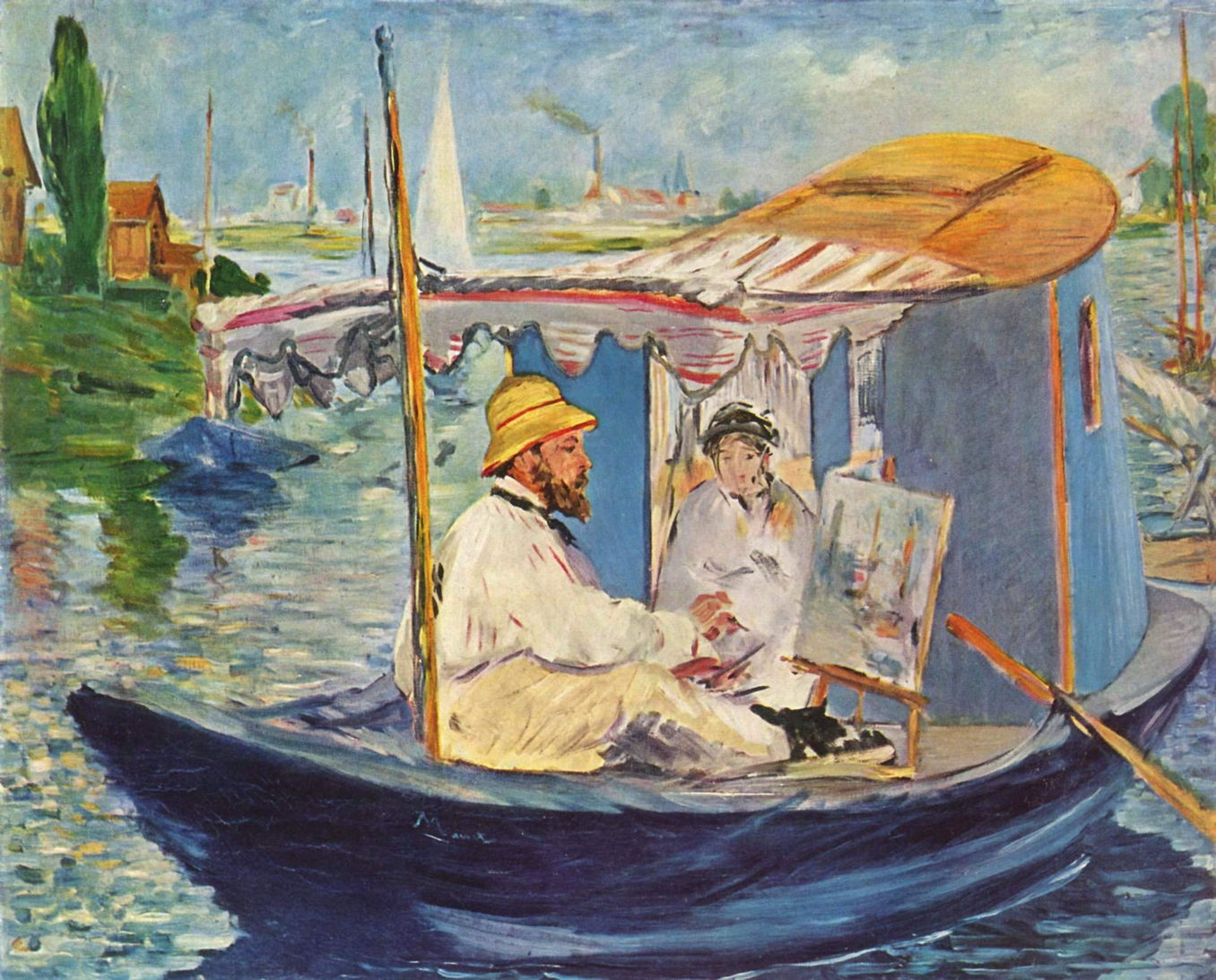
Édouard Manet (1832–1883), Claude Monet in Argenteuil (1874), oil on canvas, 80 × 98 cm, Neue Pinakothek, Munich, Germany. Wikimedia Commons.
Édouard Manet was another visitor, and painted this oil sketch of Claude Monet in Argenteuil in 1874, showing Monet working in his floating studio. His position in the boat appears relaxed, but would have become uncomfortable if maintained for long, as he would have had to keep bending forward to paint, suggesting he might have posed for this painting.
In 1876, Monet’s wife Camille became seriously ill, deteriorating further with the birth of their second son in 1878. The family moved to share a house with his patron Ernest Hoschedé in Vétheuil, further out to the north-west. The Sisleys moved to Moret-sur-Loing on the opposite side of Paris, leaving only Renoir to continue his summer visits.
Pierre-Auguste Renoir (1841–1919), Les Canotiers à Chatou (The Boating Party at Chatou) (1879), oil on canvas, 81 × 100 cm, The National Gallery of Art, Washington, DC. Wikimedia Commons.
Renoir’s The Boating Party at Chatou (1879) shows watersports taking place further down the river, with a combination of social rowing in the foreground, and two sports rowers further out in the river.
Pierre-Auguste Renoir (1841–1919), By the Water or Near the Lake (c 1880), oil on canvas, 46.2 × 55.4 cm, Art Institute of Chicago, Chicago, IL. Wikimedia Commons.
Renoir’s By the Water from about 1880 is believed to have been painted on the terrace of the Restaurant Fournaise on the Île de Chatou, which he was soon to use for his major work Luncheon of the Boating Party (below). If that’s the case, then what appears to be a lake in the background is really the River Seine.
Pierre-Auguste Renoir (1841–1919), Luncheon of the Boating Party (1880-81), oil on canvas, 130.2 x 175.6 cm, The Phillips Collection, Washington, DC. Wikimedia Commons.
During the summer of 1880, Renoir started work on another of his masterpieces, that he didn’t complete until the following year: Luncheon of the Boating Party (1880-81), with its complex group of figures.
This was again set on the Île de Chatou at the Restaurant Fournaise, and funded by commissioned portraits over this period. Among his models are his partner and later wife Aline Charigot (left foreground, with affenpinscher dog), the actress Jeanne Samary (upper right), and fellow artist Gustave Caillebotte (seated, lower right). This was exhibited at the Seventh Impressionist Exhibition in 1882, where it was praised by several critics.
Pierre-Auguste Renoir (1841–1919), The Bridge at Argenteuil in Autumn (1882), oil on canvas, 54.3 x 65.8 cm, Private collection. Wikimedia Commons.
Later in 1882, Renoir painted The Bridge at Argenteuil in Autumn, close to another bridge over the river for which Monet had a particular affection.
In 1881, Gustave Caillebotte acquired a property at Petit-Gennevilliers, near Argenteuil, where he had a boatyard, and moved there permanently in 1888. He and Renoir maintained the tradition of painting this section of the River Seine.
Gustave Caillebotte (1848–1894), Boat Moored on the Seine at Argenteuil (c 1884), oil on canvas, 65.4 × 54.2 cm, Nelson-Atkins Museum of Art, Kansas City, MO. Wikimedia Commons.
Caillebotte’s Boat Moored on the Seine at Argenteuil from about 1884 has thoroughly Impressionist style and facture, with its obvious brushstrokes forming the broken reflection of the boat on the water, and even detail through the depth of the painting.
Gustave Caillebotte (1848–1894), The Bridge at Argenteuil and the Seine (1885), oil on canvas, 65.5 x 81.6 cm, Private collection. WikiArt.
Although Caillebotte didn’t make formal series of views that became such a feature of the art of Monet and Pissarro, in the mid-1880s he painted several views of the modern bridges over the River Seine near Argenteuil. The Bridge at Argenteuil and the Seine (1885) is Impressionist in style, with its broken water surface. This features a steam paddle tug towing a laden barge towards the next bridge, which I think is the railway bridge that Claude Monet painted at least twice.
In 1888, Renoir spent the summer painting at Argenteuil and Bougival, where he rediscovered his landscape form.
Pierre-Auguste Renoir (1841–1919), The Seine at Argenteuil (1888), oil on canvas, 54 x 65 cm, Barnes Foundation, Philadelphia and Merion, PA. Wikimedia Commons.
Renoir’s The Seine at Argenteuil from 1888 is another view of leisure boating, painted in a style more similar to Sisley’s high Impressionist landscapes, with coarse high chroma brushstrokes laid to form the surface of the water.
Gustave Caillebotte (1848-1894), Sailboats on the Seine at Argenteuil (1892), oil on canvas, Private collection. WikiArt.
For Gustave Caillebotte and his friends, this was the place to come to enjoy a day’s sailing, as shown in his late painting of Sailboats on the Seine at Argenteuil from 1892, just two years before his untimely death at the age of only forty-five. With that, Argenteuil and Chatou were abandoned and Impressionism moved on.
When the French Impressionists reassembled after the Franco-Prussian War and the Paris Commune, they gathered a little further up river from Louveciennes and Bougival, at the small town of Argenteuil on the north bank of the River Seine. At the time it was just on the outer edge of the north-western suburbs of the city, about 12 km (7.6 miles) from the centre, and was only fifteen minutes by train to the Gare Saint-Lazare in Paris. Claude Monet was able to commute into the metropolis, and the Sisleys moved in with the Monets in 1872. This weekend I show a small selection of the best-known paintings that were made in and around Argenteuil, and particularly at Chatou, down river.
Claude Monet (1840–1926), The Artist’s House at Argenteuil (1873), oil on canvas, 60.2 × 73.3 cm, The Art Institute of Chicago, Chicago, IL. Image by Rlbberlin, via Wikimedia Commons.
Although Monet was barely making a living from his art at this time, he was among the few who could afford to use cadmium yellow, which has been found in his painting of The Artist’s House at Argenteuil from 1873.
This marked the start of a highly productive period for Alfred Sisley, and, in conjunction with Monet and Renoir, changed his art. The three concentrated their efforts on the recording of transient effects of light using colour, removing black from their palettes, and abandoning the traditional ‘finish’ of their paintings.
Alfred Sisley (1839–1899), Footbridge at Argenteuil (1872), oil on canvas, 39 x 60 cm, Musee d’Orsay, Paris. Wikimedia Commons.
Sisley’s Footbridge at Argenteuil from 1872 is dominated by the perspective projection of the bridge itself, almost to the exclusion of the river below. His figures are gestural but look natural in their forms.
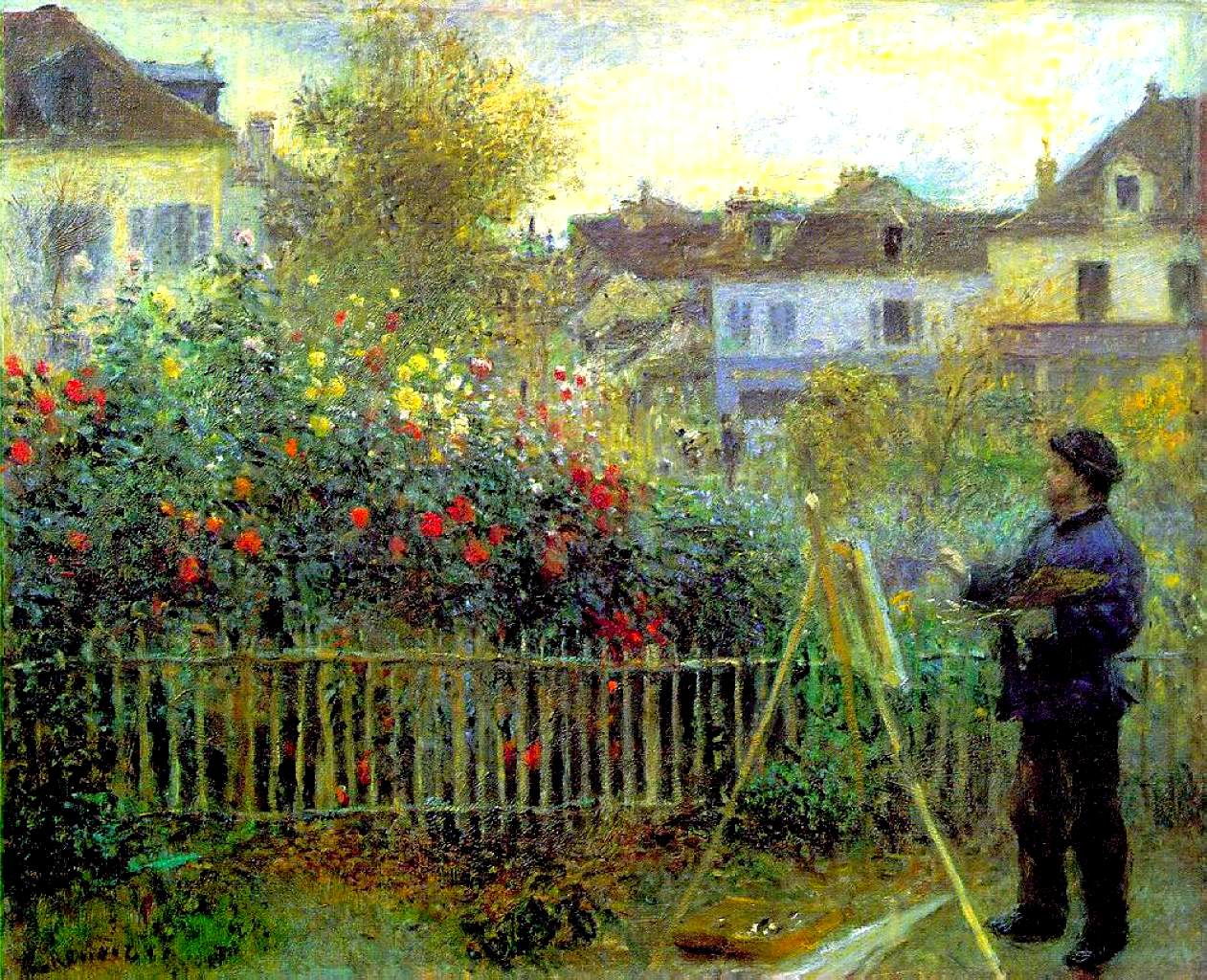
Pierre-Auguste Renoir (1841–1919), Monet Painting in his Garden in Argenteuil (1873), oil on canvas, 46 × 60 cm, Wadsworth Atheneum, Hartford, CT. Wikimedia Commons.
The Impressionists occasionally painted themselves at work, particularly during the earlier years of the movement. Above is Pierre-Auguste Renoir’s Monet Painting in his Garden in Argenteuil from 1873. He is using a conventional lightweight wooden easel, with a small canvas allowing him to work standing, with his oil paints in the pochade box under the easel.
Claude Monet (1840–1926), The Railway Bridge at Argenteuil (1873), oil on canvas, 60 × 99 cm, Private collection. Wikimedia Commons.
Monet’s The Railway Bridge at Argenteuil (1873) is one of his several landscapes centred on the railway from the years immediately after the Franco-Prussian War. The following year, he painted the same bridge, as seen below in The Railway Bridge at Argenteuil (1874).
Claude Monet (1840–1926), The Railway Bridge at Argenteuil (1874), oil on canvas, 54 × 71 cm, Musée d’Orsay, Paris. Wikimedia Commons.
Claude Monet (1840–1926), Arrival of the Normandy Train, Gare Saint-Lazare (1877), oil on canvas, 59.6 x 80.2 cm, Art Institute of Chicago, Chicago, IL. Wikimedia Commons.
Monet’s commute ended at the Gare Saint-Lazare in Paris, where in 1877 he obtained permission to paint a series of works showing the station. By the third Impressionist Exhibition of April of that year, Monet had assembled seven views of the station, including one that even seemed to please the critics. Among the paintings from that campaign is his Arrival of the Normandy Train, Gare Saint-Lazare (1877).
Pierre-Auguste Renoir (1841–1919), The Duck Pond (1873), oil on canvas, 50.2 x 61 cm, Dallas Museum of Art, Dallas, TX. Wikimedia Commons.
One of the products of Renoir’s painting with Monet was this highly chromatic view of The Duck Pond (1873) at a farm near Argenteuil.
Pierre-Auguste Renoir (1841–1919), The Seine at Chatou (1874), oil on canvas, 50.8 x 63.5 cm, Dallas Museum of Art, Dallas, TX. Wikimedia Commons.
The following summer, Renoir visited Argenteuil again, to paint in the company of both Monet and Manet. The Seine at Chatou (1874) is one of his more vigorously crafted works, with a water surface similar to those being painted at the time by Sisley.
Claude Monet (1840-1926), Autumn on the Seine, Argenteuil (1873), oil on canvas, 54.3 × 73.3 cm, High Museum of Art, Atlanta, GA. Wikimedia Commons.
Monet’s masterwork Autumn on the Seine, Argenteuil from 1873 is a textbook example of a river landscape in autumn painted in high Impressionist style, with high chroma and loose brushstrokes.
With the Paris Commune crushed in 1871, and order being restored to France under the new Republic, the Pissarros returned to live a more settled life in Louveciennes again, after the shock of discovering that most of his 1500 or so paintings had been damaged or destroyed by occupying Prussian soldiers. There Pissarro lived close to Alfred Sisley, and the two often painted in company. Renoir’s mother also lived in the village, enabling the three painters to meet frequently.
Among Pissarro’s favourite motifs in this post-war period were numerous views of the Route de Saint-Germain and other roads around Louveciennes, and the River Seine at Bougival.
Camille Pissarro (1830–1903), Louveciennes, Route de Saint-Germain (1871), watercolour over black chalk, 30.2 x 49.2 cm, J. Paul Getty Museum, Los Angeles, CA. Wikimedia Commons.
Less known are his watercolours, such as this view of Louveciennes, Route de Saint-Germain from 1871, and are reminiscent of the paintings of Johan Jongkind.
Camille Pissarro (1830-1903), Avenue in the Parc de Marly (c 1871), oil on canvas, 45 x 55 cm, Museo Thyssen-Bornemisza, Madrid. Wikimedia Commons.
Pissarro painted this woodland view of an Avenue in the Parc de Marly in the autumn of 1871. It looks towards the village of Marly-le-Roi from the Port du Phare, inside the grounds of the Château de Marly. His skilful use of staffage draws the eye towards the far end of the avenue. The artist seems to have sold this painting quite quickly to an unknown buyer, from whom Durand-Ruel bought it in early 1873.
Alfred Sisley (1839–1899), The Seine at Bougival (1872), oil on canvas, 50.8 x 65.5 cm, Yale University Art Gallery, New Haven, CT. Wikimedia Commons.
Alfred Sisley also painted here en plein air, as seen in The Seine at Bougival from 1872. The water surface is mirror-smooth, and Sisley has been careful to paint the reflection of the buildings with optical precision.
Camille Pissarro (1830–1903), The Post-House, the Route de Versailles, Louveciennes, Effect of Snow (1872), oil on canvas, 55 x 91 cm, location not known. Wikimedia Commons.
This is Pissarro’s wintry scene of The Post-House, the Route de Versailles, Louveciennes, Effect of Snow from 1872. This looks from the ‘Royal Gate’ of the Château de Marly towards the post-house, a landmark featured in several of his works from this period. This painting was bought that Spring by Durand-Ruel, who sold it a year later to Jean-Baptiste Faure, the opera singer, Pissarro’s first collector and Sisley’s enduring patron.
Camille Pissarro (1830–1903), Chestnut Grove at Louveciennes (1872), oil on canvas, 41.5 x 53.3 cm, Nelson-Atkins Museum of Art, Kansas City, MO. Wikimedia Commons.
Pissarro must have taken delight in the weird forms of the trees in this Chestnut Grove at Louveciennes, painted in 1872. In the far distance is the massive warm cream stone of Marly Aqueduct.
Although the Pissarros were able to live on the money generated by Camille’s painting, they must have got by in relative poverty. However, in 1872, he sold four stretched canvas overdoor panels depicting the seasons to the banker Achille Arosa for 100 Francs each. Pissarro tried to buy them back when they came up for auction in 1891, but despite appealing to Vincent van Gogh’s brother Theo, they were sold for just over a thousand Francs to the Bernheim-Jeune Gallery, and have remained in private collections since.
In April 1872, the Pissarros moved from Louveciennes to Pontoise, where they rented a house and Camille established his studio.
Alfred Sisley (1839–1899), Snow on the Road, Louveciennes (1874), 38 × 56 cm, Private collection. Wikimedia Commons.
Sisley wasn’t as prolific as Pissarro in either ‘road’ or snow scenes. His Snow on the Road, Louveciennes (1874) clearly comes from the same school, but his trees and buildings remain distinctive.
Alfred Sisley (1839–1899), The Aqueduct at Marly (1874), oil on canvas, 54.3 x 81.3 cm, Toledo Museum of Art, Toledo, OH. Wikimedia Commons.
Sisley’s Aqueduct at Marly (1874) shows the massive form of this aqueduct which appeared in the distance in Pissarro’s Chestnut Grove at Louveciennes above. This and the nearby Machine de Marly, which Sisley also painted, were part of a monumental hydraulic network built in the 1680s for Louis XIV, to supply water to the Château de Marly and the royal gardens of the Palace at Versailles. The stone tower at the right end of the aqueduct is the Tour de Levant, used by Prussian troops as a vantage point for observing the besieged city of Paris, a point that won’t have escaped Sisley’s attention.
Alfred Sisley (1839-1899), Forge at Marly-le-Roi (1875), oil on canvas, 55 x 73.5 cm, Musée d’Orsay, Paris. EHN & DIJ Oakley.
Sisley’s Forge at Marly-le-Roi from 1875 shows the village blacksmiths at work.
Félicien Rops (1833–1898), Sunday in Bougival (1876), media and dimensions not known, Musée Provincial Félicien Rops, Namur, Belgium. Image by Paul Hermans, via Wikimedia Commons.
In 1876, Félicien Rops must have visited one of the popular bathing resorts nearby, to paint his Sunday in Bougival. This shows a lecherous old man watching two young women preparing to bathe there, a mere 15 km (10 miles) from the heart of Paris.
By this time, the Impressionists had moved away from Louveciennes, and were painting elsewhere.
Alfred Sisley (1839–1899), The Road from Versailles to Louveciennes (c 1879), oil on canvas, 45.7 x 55.9 cm, The Metropolitan Museum of Art, New York, NY. Wikimedia Commons.
Although Sisley was now living near Sèvres, he must have returned in about 1879 for one last painting in front of the motif, on The Road from Versailles to Louveciennes. This is an example of his more sketchy plein air paintings from his time at Sèvres, and a more traditional perspective view of a road of the time. This section of the road is close to Louveciennes, on the main route between Versailles and Saint-Germain-en-Laye.
At that point, the Impressionists finally left Élisabeth Louise Vigée Le Brun to rest in peace.
When the prolific portraitist in pastels Élisabeth Louise Vigée Le Brun retired to live near Paris, she chose a small hamlet to the west of the city, between the palace at Versailles and Saint-Germain-en-Laye, Louveciennes. She died there in 1842, and is buried in the graveyard not far from her house.
Twenty-seven years later it became the focus for a group of friends, who went on to become the core of the French Impressionists. For the next few years Louveciennes and the adjacent villages of Bougival and Marly-le-Roi were to appear in well over a hundred of their paintings, a few of which I show this weekend.
Just beyond Chatou, the River Seine sweeps to the right in a bend with a series of long islands with popular bathing houses, among them the famous La Grenouillère. In the summer of 1869, Auguste Renoir was living at his parents’ house in Louveciennes, just to the south of this bend, where Camille Pissarro and his family were renting a house. He visited Claude Monet and his family, who were living near Bougival, also on that bend, and they often painted together.
Some of the formative moments in Impressionism if not European art occurred when Monet and Renoir visited La Grenouillère.
Pierre-Auguste Renoir (1841–1919), La Grenouillère (1869), oil on canvas, 66.5 x 81 cm, Nationalmuseum, Stockholm, Sweden. Wikimedia Commons.
Renoir painted at least three different views of La Grenouillère that summer: that above is now in Stockholm, and that below, which is most similar to Monet’s, is in the Oskar Reinhart Collection in Switzerland; the third (not shown here) is in the Pushkin Museum in Moscow. Originally conceived as plein air sketches preparatory to more finished paintings for submission to the Salon the following year, they came to define these brilliant shimmering images formed from high chroma brushstrokes as Impressionist style.
Pierre-Auguste Renoir (1841–1919), La Grenouillère (1869), oil on canvas, 65.1 x 92 cm, Oskar Reinhart Collection, Winterthur, Switzerland. Wikimedia Commons.
If Impressionism has to have a single moment of birth, it’s surely in the summer of 1869 at La Grenouillère.
Claude Monet, Bathers at la Grenouillère (1869), oil on canvas, 73 x 92 cm, The National Gallery, London. WikiArt.
Monet’s Bathers at la Grenouillère is his early statement of his Impressionist agenda. The pair realised that Impressionism was about these sketched instants. This also reveals Monet’s preference for modern pigments, as most of the brighter mid-blues here use cobalt blue, introduced earlier in the nineteenth century.
Claude Monet, Bathers at la Grenouillère (detail) (1869), oil on canvas, 73 x 92 cm, The National Gallery, London. WikiArt.
In addition to Renoir, Pissarro and Monet, Alfred Sisley maintained a studio nearer the river in Bougival, where the four artists painted, starved and fought off despair together.
Camille Pissarro (1830–1903), Road to Versailles at Louveciennes (Snow Effect) (1869), oil on canvas, 38.4 × 46.3 cm, Walters Art Museum, Baltimore, MD. Wikimedia Commons.
Pissarro painted a succession of views of the roads around the village. His Road to Versailles at Louveciennes (Snow Effect) (1869) is typical of his earlier ‘road’ paintings, showing an avenue of tall, bare-branched trees, brushed in coarsely.
Camille Pissarro (1830-1903), Route de Versailles, Louveciennes, Winter Sun and Snow (c 1870), oil on canvas, 46 x 55.3 cm, Museo Thyssen-Bornemisza, Madrid. Wikimedia Commons.
The following winter his paintings concentrated on road scenes around Louveciennes, a theme which continued for many years, spanning the seasons.
Camille Pissarro (1830-1903), Winter Landscape at Louveciennes (c 1869), oil on canvas, 37 x 46 cm, Musée d’Orsay, Paris. EHN & DIJ Oakley.
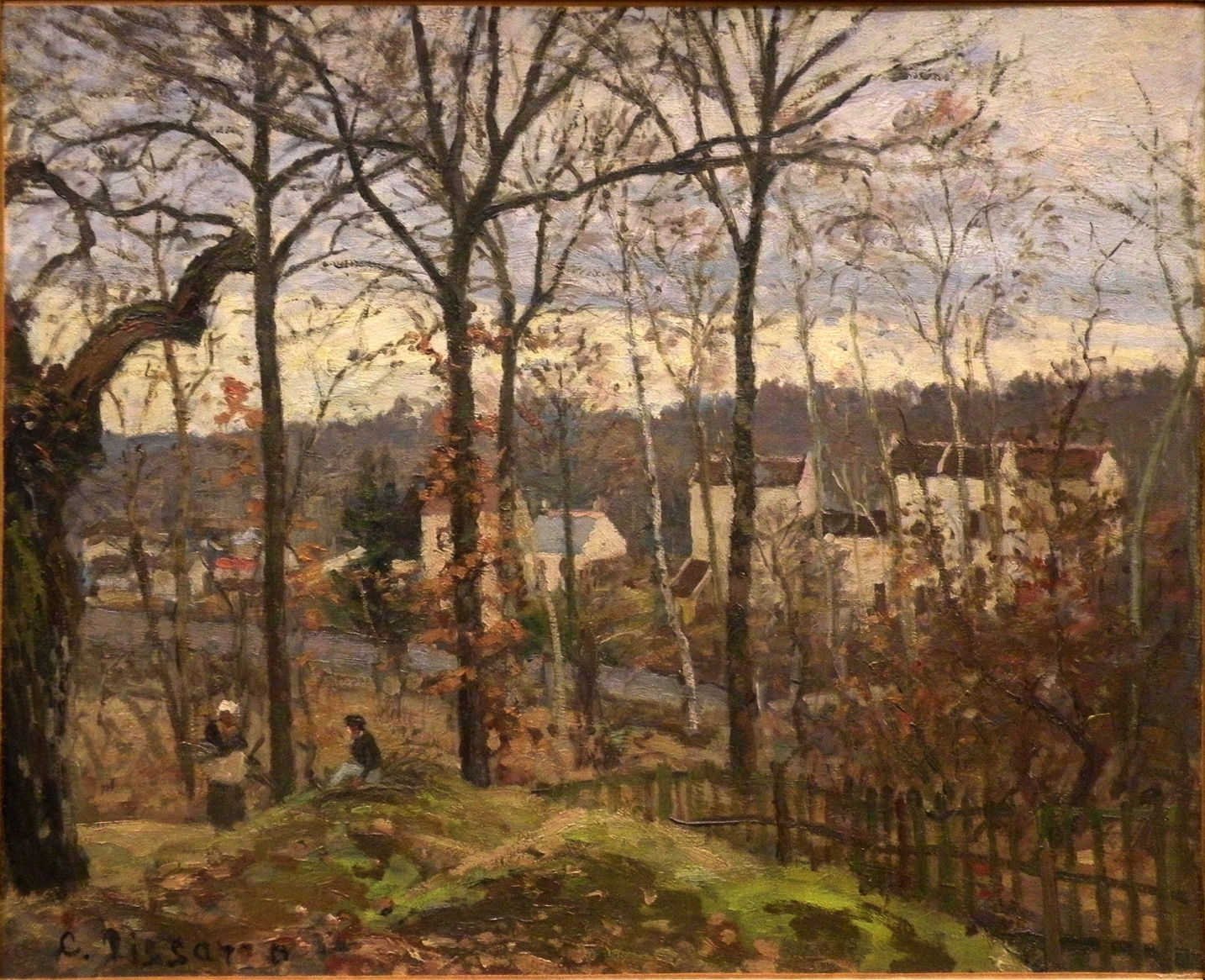
As many artists before him, Pissarro used trees to frame his motifs in repoussouir, but during the late 1860s they started to invade more central areas of the canvas. In about 1869, in his Winter Landscape at Louveciennes for the first time tree trunks and branches spread across his canvas, breaking up the motif behind into small sections.
Camille Pissarro (1830–1903), Houses at Bougival, Autumn (1870), oil on canvas, 88.9 x 115.9 cm, J. Paul Getty Museum, Los Angeles, CA. Wikimedia Commons.
Pissarro’s Houses at Bougival, Autumn is clearly dated 1870, although by that time he had moved from Louveciennes. It is also thought to have been exhibited at the Salon that year, suggesting it may have been started in late 1869.
Alfred Sisley (1839–1899), Early Snow in Louveciennes (1870), oil on canvas, 54 x 73 cm, Museum of Fine Arts Boston, Boston, MA. Wikimedia Commons.
Like Pissarro, Sisley started depicting the streets of suburbs, including Early Snow in Louveciennes. This has been dated to 1870, although it appears more likely that it was painted en plein air late the previous year.
Following the outbreak of the Franco-Prussian War, in September 1870 the Pissarros’ house in Louveciennes was requisitioned by the invading Prussians. The family fled first to their friends in Montfoucault, then in December travelled on to England, where they settled in Norwood, at that time an outer suburb of London. When in England, Pissarro met Paul Durand-Ruel, who became his dealer, and Claude Monet, who had also fled to London.
Bougival was also overrun by Prussian soldiers, who commandeered Sisley’s studio; many of his early works were lost, as Pissarro’s were in Louveciennes, just over a mile away. The Sisleys were forced into the city of Paris, and despite Alfred’s British nationality, they remained trapped through the siege of the city into the following year. Worse still, the Sisley family business collapsed and his parents were in no position to support the artist.
The appearance of new objects or unexpected phenomena in the sky was an event of great significance in the past, and often considered to be a portent of the future, good or bad. This article considers the few that were recorded in paintings, and starts with the most famous of all, the star of Bethlehem that appears in many depictions of the birth of Christ.
The linked stories of the birth of Christ in a shed at Bethlehem, and the subsequent adoration of the infant by three wise men, kings or Magi “from the east”, are among the most popular and enduring among paintings in the Christian canon. The outlines given in the Gospels of Luke, chapter 2, and Matthew, chapter 2, have conventionally become elaborated.
Three wise men had seen a new star, possibly a comet or an unusually bright planet, which they believed would lead them to the birth of a great prophet. They travelled by the guidance of that star, to arrive at Bethlehem. There they found the newborn Christ with Mary his mother, paid homage to him in the shed in which the holy family was lodging, and presented their gifts of gold, frankincense, and myrrh.
Giotto di Bondone (1266–1337), The Adoration of the Magi (c 1305), fresco, approx 200 x 185 cm, Scrovegni Chapel, Padua. Wikimedia Commons.
Giotto’s Adoration of the Magi from about 1305 shows the star as a celestial ball of fire streaking across the sky, and the three wise men pay their respects to the newborn Christ and his mother.
Hieronymus Bosch (c 1450–1516), The Adoration of the Magi (Interior) (Saint Peter with donor, The Adoration of the Magi, Saint Agnes with donor) (1490-1500) (CR no. 9), oil on oak panel, 138 cm x 138 cm overall when open, Museo Nacional del Prado, Madrid. Wikimedia Commons.
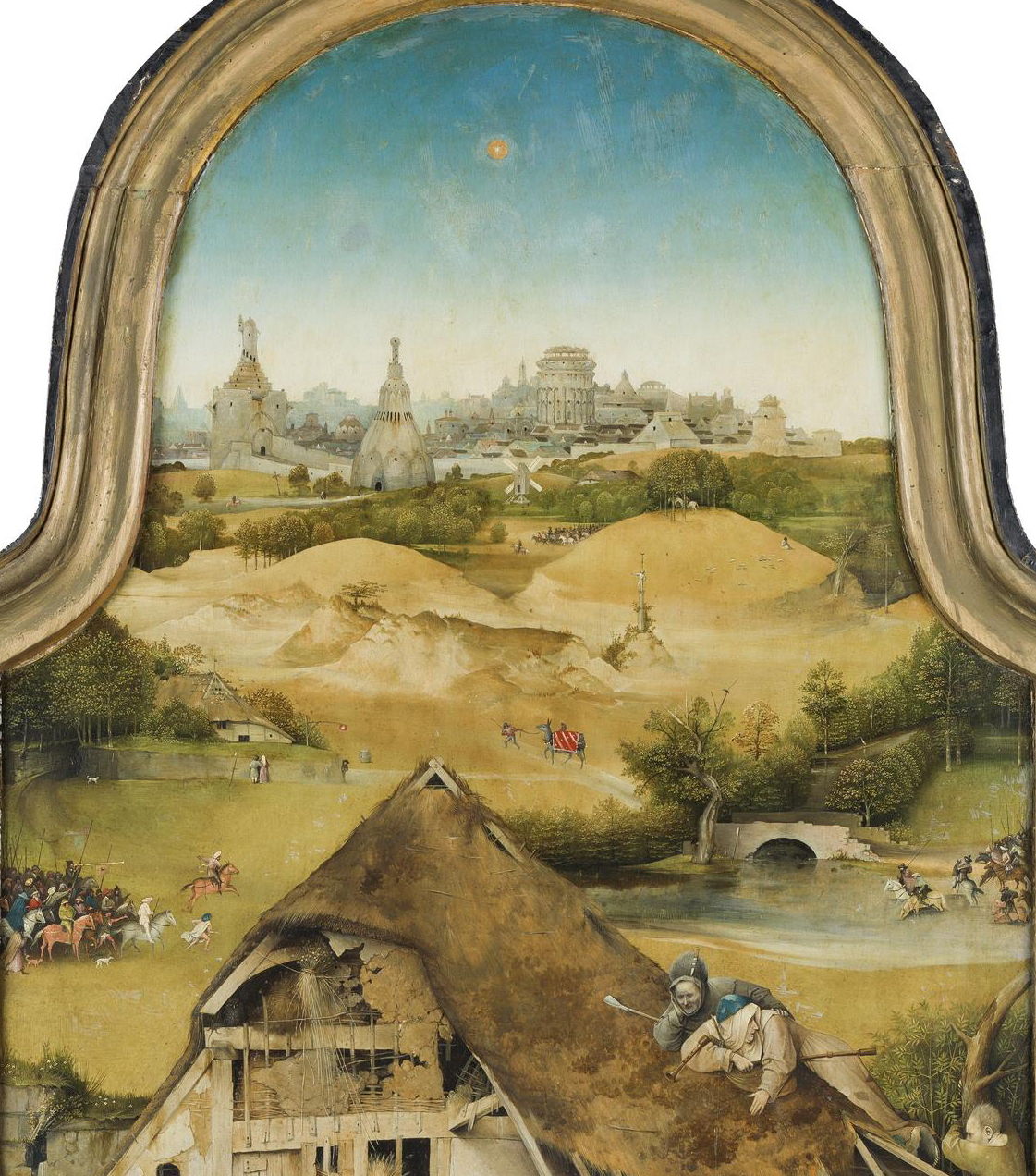
Above Bosch’s view of the local Brabant countryside in his Adoration of the Magi of 1490-1500 he places a more modest and stationary star shining bright over its distant city, as shown in the detail below.
Hieronymus Bosch (c 1450–1516), The Adoration of the Magi (detail) (centre panel) (The Adoration of the Magi) (1490-1500) (CR no. 9), oil on oak panel, 138 cm x 138 cm overall when open, Museo Nacional del Prado, Madrid. Wikimedia Commons.William Blake (1757–1827), Adoration of the Kings (1799), tempera on canvas, 25.7 x 37 cm, Brighton and Hove Museums & Art Galleries, Brighton, England. The Athenaeum.
Blake’s version of the Adoration of the Kings is conventional in showing the three wise men presenting their gifts to Jesus and his parents. At the left, outside, shepherds are tending to their flocks of sheep beneath a stylised star, and at the right are the ox and ass.
There remains controversy over what celestial event might have occurred at the time.
Very few paintings show known events in the sky, and I know of only one depicting a full solar eclipse.
Enrique Simonet Lombardo (1866–1927), Eclipse (1905), oil on canvas, 75 x 55 cm, location not known. Wikimedia Commons.
Although many painters, particularly the Impressionists, have shown fleeting effects of light and the occasional rainbow, Enrique Simonet took the opportunity of a solar eclipse on 30 August 1905 to paint his Eclipse (1905). This was visible across eastern and northern Spain between about 1300 and 1320 UTC, and this painting is one of its few remaining records.
Realistic paintings of comets are also rare, and unimpressive.
William Dyce (1806–1864), Pegwell Bay, Kent – a Recollection of October 5th 1858 (c 1858), oil on canvas, 635 cm x 889 cm, The Tate Gallery, London. Wikimedia Commons.
Generally acclaimed as William Dyce’s finest painting, Pegwell Bay, Kent – a Recollection of October 5th 1858 (c 1858) shows this bay on the Kent coast, during a family holiday visit: a coastal scene worked up into a large finished oil painting. Although not easily seen in this image, there’s a small point of light high in the middle of the sky which is Donati’s comet, not due to return until 3811. Couple that with the inclination of the sun and the state of the tide, and you should be able to place this view precisely in both time and space, and confirm that it does indeed show this bay on 5 October 1858.
A few paintings show impossible celestial events.
John Martin (1789–1854), The Deluge (1834), oil on canvas, 168.3 x 258.4 cm, Yale Center for British Art, New Haven, CT. Wikimedia Commons.
John Martin’s painting of The Deluge from 1834 has two points of reference: the Biblical account of the flood, and Martin’s personal belief in prior catastrophe. As the sciences became ascendant during the nineteenth century, some educated people believed that in the past there had been an alignment of the sun, earth, and moon, and the collision of a comet resulting in global flooding. This was promoted by the French natural scientist Baron Georges Cuvier, and subscribed to by Martin.
True to form, his painting is dark and apocalyptic: near the centre, tiny survivors are just about to be overwhelmed by an immense wave bearing down at them from the left and above. The misaligned sun and moon barely penetrate the dense cloud, and to the top right is a melée of rock avalanche and lightning bolt. This was awarded a gold medal at the Paris Salon of 1835.
Paul Nash (1892–1946), Landscape of the Vernal Equinox (III) (1944), oil on canvas, 63.5 x 76.2 cm, Scottish National Gallery of Modern Art, Edinburgh, Scotland. The Athenaeum.
Several of Paul Nash’s surrealist landscapes show the moon in its phases, among them Landscape of the Vernal Equinox (III) from 1944, which presents the impossible view of a full moon and the sun visible close together and just above the horizon.
Impressionist painting is today known overwhelmingly from the many landscapes painted by Claude Monet and Camille Pissarro. The figurative paintings of Auguste Renoir are often thought of as more of a commercial undertaking, those of Edgar Degas are seen as exceptions, and Paul Cézanne’s are usually glossed over altogether.
One of the reasons that Impressionist figurative painting is now largely ignored is that its greatest exponent was killed in 1870, just as he was reaching his peak. When Frédéric Bazille was shot dead by Prussian soldiers during the Franco-Prussian War, that changed the course of Impressionism. This weekend I show some of the paintings from the seven short years of his career as an oil painter before his sudden death.
Jean Frédéric Bazille was born into an affluent family in Montpellier, France, a city on the Mediterranean coast with one of the oldest universities in the world. He was inspired to paint when he saw some of Delacroix’s works, but his family wanted him to study medicine. An accommodation was reached, and in 1859, he started his medical studies at Montpellier University.
In November 1862, Bazille left his home city to transfer to medical studies in Paris. A friend introduced him to Charles Gleyre’s studio, and some time in early 1863, he seems to have started as a pupil there, while continuing his medical training. He met Claude Monet there in March or April of that year, and started painting en plein air with him, probably with Sisley and Renoir too. By the end of 1863, he seems to have been making good progress with Gleyre, although his parents were keen to remind him of the precedence of his medical studies.
In January 1864, he started renting his first studio, and that summer travelled to Normandy with Monet. Shortly after that, he failed his medical exams, and dropped out from those studies, leaving him painting full-time.
Frédéric Bazille (1841–1870), La Robe Rose (The Pink Dress) (1864), oil on canvas, 147 x 110 cm, Musée d’Orsay, Paris. Wikimedia Commons.
In the late summer of 1864, in an effort to convince his family that he was serious about his career in art, Bazille started work on his La Robe Rose (The Pink Dress). Using his cousin Thérèse des Hours, aged fourteen, as his model, he painted this from a drawing he made at Méric, looking towards the village of Castelnau-le-Lez, near Montpellier.
In his drawing, the model is looking to the right and out of the picture plane, with her head rotated by about ninety degrees from that shown in this painting. As this was his first painting of a figure set in a landscape, Bazille seems to have wanted to avoid tackling her face, and opted for her looking away from the viewer.
This painting wasn’t seen by the public until 1910, but since then has become accepted as one of his major works, which is surprising for such a challenging motif and such a relative novice.
In the autumn of 1864, when he returned to Paris, Bazille didn’t go back to Gleyre’s studio, but painted mostly from the models in Monet’s studio. In January 1865, the two painters moved into a new studio together, above Delacroix’s former flat in rue de Furstenberg.
Frédéric Bazille (1841–1870), Self-Portrait with Palette (1865), oil on canvas, 108.9 x 71.1 cm, The Art Institute of Chicago, Chicago, IL. Wikimedia Commons.
It’s not clear exactly when he painted his Self-Portrait with Palette, but it was most probably in 1865. It’s a remarkably accomplished work, given the complexity of arranging the mirror and canvas to result in this unusual pose.
Frédéric Bazille (1841–1870), Landscape at Chailly (1865), oil on canvas, 81 x 100.3 cm, The Art Institute of Chicago, Chicago, IL. Wikimedia Commons.
In May 1865, Bazille left the city for the Forest of Fontainebleau, where the Barbizon School had been centred. There he painted Landscape at Chailly in company with Monet, and possibly Renoir and Sisley. Although clearly influenced by that style, Bazille’s colours are much brighter, and escape the sombre browns and greens that dominated Barbizon paintings.
Frédéric Bazille (1841–1870), The Beach at Sainte-Adresse (1865), oil on canvas, 58.4 x 140 cm, The High Museum of Art, Atlanta, GA. Wikimedia Commons.
In May of the previous year, Bazille and Monet had travelled to the Channel coast, to Le Havre. This was Monet’s home ground, but the first time that Bazille had explored this coast. Oddly, Bazille painted The Beach at Sainte-Adresse a year later, in May 1865, as one of a pair of paintings for an uncle. It appears to have been partially copied from a painting of the same name by Monet, made when the two had visited Sainte-Adresse the year before. Bazille re-arranged the yachts and changed the staffage of the beach, but the sea, sky, and coastline are essentially the same.
During the summer of 1865, Bazille painted Monet lying in bed, injured, at the Lion d’Or Inn, in The Improvised Field Hospital (1865); sadly I have been unable to find a good image of that painting.
In the late autumn, Gustave Courbet visited Monet and Bazille, and congratulated them on their work. However, in January 1866, Bazille left their shared studio to set up in his own at last. In the Spring, he submitted two paintings to the Salon, of which one, Still Life with a Fish, was accepted. For a while during the winter of 1866-67, Monet lodged in Bazille’s studio.
Frédéric Bazille (1841–1870), The Little Gardener (1865-67), oil on canvas, 128 x 168.9 cm, Museum of Fine Arts, Houston, TX. Wikimedia Commons.
During this period, he started to paint The Little Gardener (1865-67), but seems to have abandoned it with the foreground incomplete. It was another step in his development of figures in landscapes, and a precursor to his paintings of 1868.
Frédéric Bazille (1841–1870), The Western Ramparts at Aigues-Mortes (1867), oil on canvas, 60 x 100 cm, The National Gallery of Art, Washington, DC. Wikimedia Commons.
Bazille first wanted to paint at Aigues-Mortes, east of Montpellier, in the summer of 1866, but didn’t get there until May 1867. He then produced one of his most painterly and brilliant landscapes of The Western Ramparts at Aigues-Mortes, as well as several other views, including many sketches.
Frédéric Bazille (1841–1870) (attr), Portrait of Paul Verlaine (1867), oil on canvas, dimensions not known, Private collection. Wikimedia Commons.
I include this Portrait of Paul Verlaine (1867) because of its controversial history. On the strength of the signature on it (which isn’t legible in this image), it had been attributed to Gustave Courbet, but most recently has been claimed to have been painted by Bazille. If that’s accurate, its painterly style is surprising and impressive.
In the Spring of 1867, Bazille submitted two more paintings for the Salon, but both were refused. He drafted a petition calling for a new Salon des Refusés, which was signed by Daubigny, a distinguished member of the Salon jury at the time.
Frédéric Bazille (1841–1870), Portraits of the *** Family (The Family Gathering) (1868), oil on canvas, 152 x 230 cm, Musée d’Orsay, Paris. Wikimedia Commons.
During the summer of 1867, Bazille started work on Portraits of the *** Family also known as The Family Gathering, which he didn’t complete until January the following year. This seems to have been one of his most carefully composed paintings, and he devoted a series of sketches to getting the arrangement of the figures and the terrace just right.
The figures include the artist, squeezed in last at the extreme left, an uncle, Bazille’s parents seated on the bench, Bazille’s cousin Pauline des Hours and her husband standing, an aunt and Thérèse des Hours (model for The Pink Dress) seated at the table, his brother Marc and his partner, and at the right Camille, the youngest of the des Hours sisters. This painting marked a special version of a regular summer meeting, as Pauline des Hours and Bazille’s brother Marc married the partners shown in the late summer of 1867.
At the time, such group portraits were exceptional in French art, although they were popular in Britain, and had been so in the past in the Netherlands, of course. It’s perhaps unsurprising that it was exhibited at the Salon in 1868, and remains one of Bazille’s finest and most innovative works.
In January 1868, Bazille moved into a new studio with Renoir, at what was renamed the following year rue La Condamine, in the Batignolles. He was a regular attender at the Café Guerbois with Manet, Degas, Duranty, Zola, Astruc, and Cézanne.
Frédéric Bazille (1841–1870), View of the Village (1868), oil on canvas, 137.5 × 85.5 cm, Musée Fabre, Montpellier, France. Wikimedia Commons.
Bazille painted another of his best-known works, View of the Village, during the summer of 1868. He based this on sketches made in the Spring at Saint-Sauveur, of a farmer’s daughter in her Sunday-best dress, in Bel-Air Wood, overlooking the River Lez, near Montpellier. Its location and composition are variations of the theme he first developed in The Pink Dress, and he was also reminded of his model for that painting, his cousin Thérèse des Hours.
He probably completed this in the autumn and early winter of 1868, and the following year it was exhibited at the Salon. Puvis de Chavannes and several of the critics were full of praise for it, and for Bazille. He also made an etching of it, the only print made from one of Bazille’s paintings during his lifetime. It remains his greatest success.

 Login
Login