Normal view

There are new articles available, click to refresh the page.
Before yesterdayMain stream

Reading Visual Art: 237 Blacksmith

By: hoakley
4 December 2025 at 20:30

The craft of the blacksmith goes back long before the Iron Age, but once our ancestors had learned to work cast iron (by turning it first into wrought iron), in about 1200 BCE, it became one of the key crafts in many societies. It’s also the only craft represented by a deity in the classical Greek pantheon, in the god Hephaistos, translated by the Romans to Vulcan.

He had the misfortune to have been born lame, as a result of which Hera tried to be rid of him, and threw him into the sea. He was there cared for by Thetis and others. He later assumes his role as the god of fire, volcanoes, and crafts allied to blacksmithing, including sculpture.

tintorettovulcansforge
Jacopo Tintoretto (c 1518-1594), Vulcan’s Forge (E&I 204) (1578), oil on canvas, 145 x 156, Palazzo Ducale, Venice, Italy. Wikimedia Commons.

In paintings, Vulcan is characteristically seen in his forge, as in Tintoretto’s painterly Vulcan’s Forge (1578), one of four mythological paintings he made for the Atrio Quadrato in the Palazzo Ducale in Venice. Tintoretto was clearly familiar with the division of labour in a blacksmith’s workshop. The two well-muscled men wielding large hammers are strikers, whose brute force is more important. Vulcan is the older man at the left, who strikes the casting with his small hammer to tell them where theirs should strike.
velazquezapolloinforge
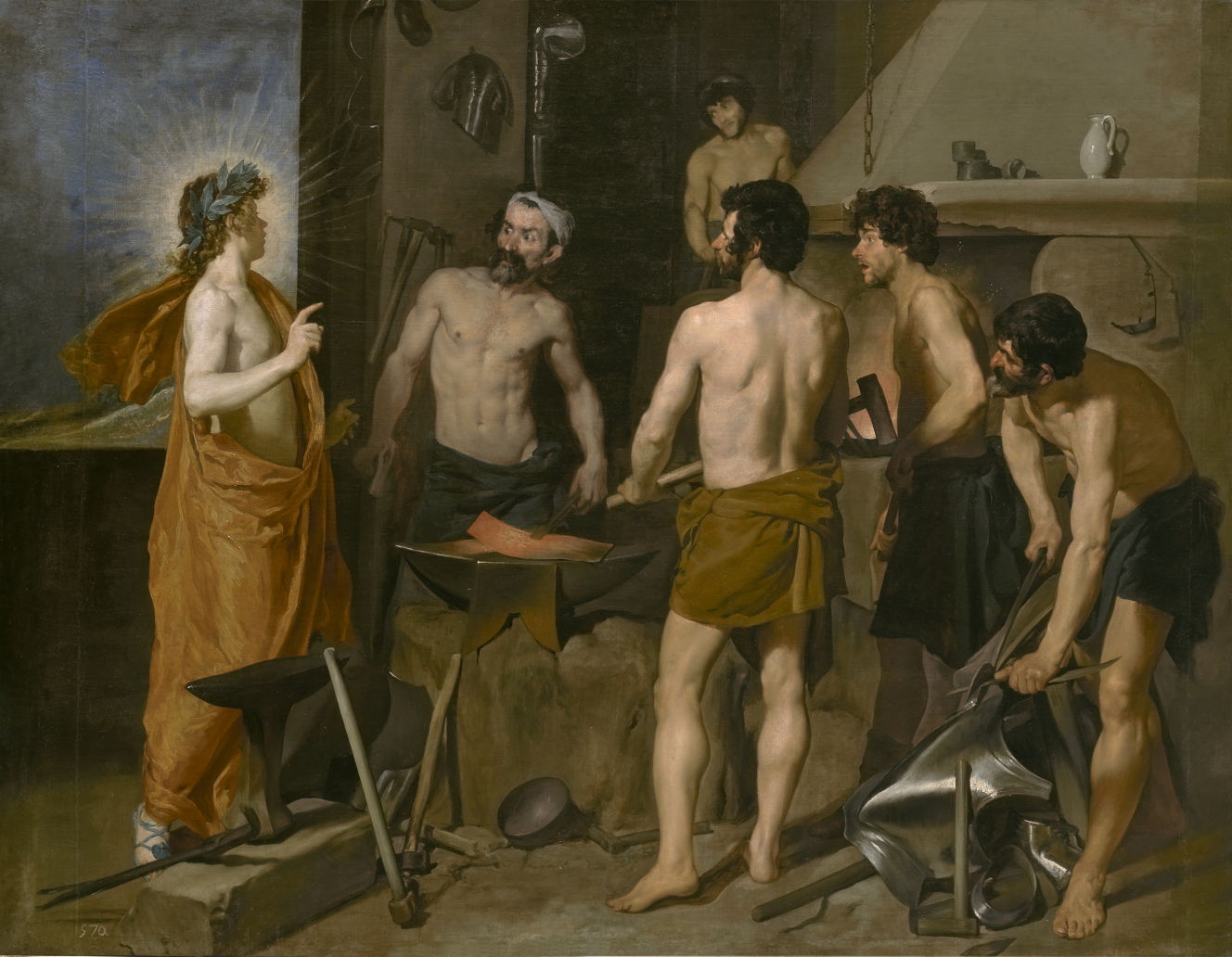
Diego Velázquez (1599–1660), The Forge of Vulcan (1630) [41], oil on canvas, 223 x 290 cm, Museo Nacional del Prado, Madrid, Spain. Wikimedia Commons.

Homer’s story of the adulterous affair of the wife of Hephaistos, Aphrodite (Venus), with Ares (Mars) is retold by Ovid in his Metamorphoses, the likely source for Diego Velázquez’s The Forge of Vulcan from 1630. This shows Apollo, at the left, visiting Hephaistos (to the right of Apollo) in his forge, to tell him about this infidelity.
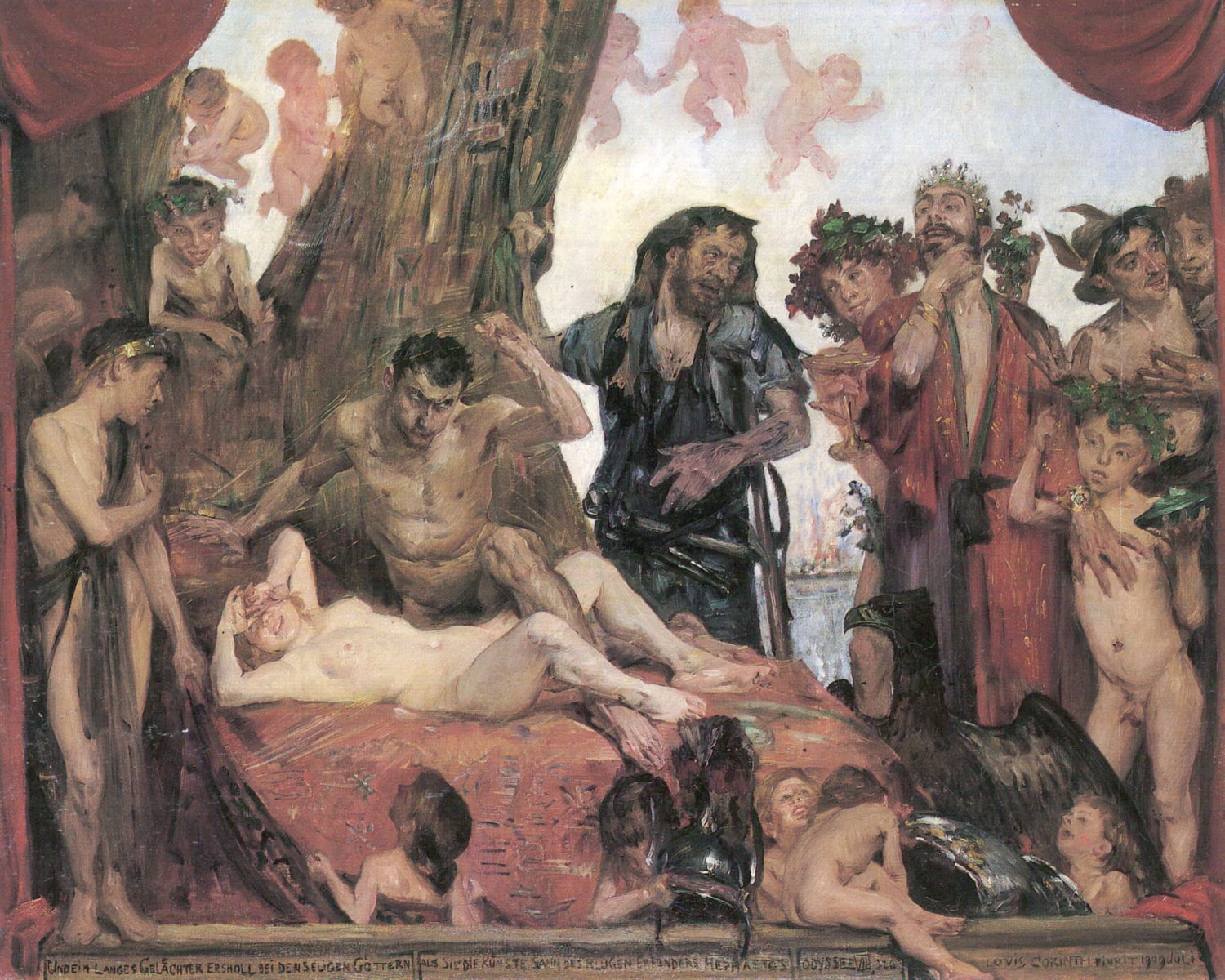
corinthhomericlaughter
Lovis Corinth (1858–1925) Homeric Laughter (1909), oil on canvas, 98 × 120 cm, Bayerische Staatsgemäldesammlungen, Munich. Wikimedia Commons.

Homeric Laughter (1909) is one of Lovis Corinth’s most complex, even abstruse, paintings of classical myth. He provides a good clue as to its interpretation in his inscription (originally in German translation):
unquenchable laughter arose among the blessed gods as they saw the craft of wise Hephaistos
together with the reference to Homer’s Odyssey book 8 line 326.

In this first version, Corinth shows Aphrodite recumbent on the bed, shielding her eyes from the crowd around her. Ares struggles with the net securing the couple, looking frustrated. Hephaistos, clad in black with his tools slung around his waist, is talking to Poseidon (who wears a crown) with Dionysos/Bacchus behind him (clutching a champagne glass). At the right edge is Hermes/Mercury, with his winged helmet. Sundry putti are playing with Ares’ armour, and an arc of putti adorns the sky.

The blacksmith also features in some accounts of the origin of Pandora.

battenpandora
John Dixon Batten (1860-1932), The Creation of Pandora (1913), tempera on fresco, 128 x 168 cm, Reading University, Reading, England. Wikimedia Commons.

John Dixon Batten’s The Creation of Pandora was painted anachronistically in egg tempera on a fresco ground by 1913. Batten was one of the late adherents of the Pre-Raphaelite movement, and is now almost forgotten. This work had been put into storage in 1949 and wasn’t rediscovered until 1990.

Pandora is at the centre, having just been fashioned out of earth by Hephaestus, who stands at the left, his foot on his anvil. Behind them, other blacksmiths work metal in his forge. At the right, Athena is about to place her gift of a robe about Pandora’s figure, and other gods queue behind to offer their contributions.

There are several fine paintings of regular blacksmiths at work over the centuries. The earliest I have been able to locate is a disturbing detail in the central panel of Hieronymus Bosch’s triptych The Last Judgment from about 1495-1505.

boschlastjudgementbrcentd2
Hieronymus Bosch (c 1450–1516), The Last Judgment (central panel, detail) (c 1495-1505), oil on oak panel, left wing 99.5 x 28.8 cm, central panel 99.2 × 60.5 cm, right wing 99.5 × 28.6 cm, Groeningemuseum, Bruges, Belgium. Wikimedia Commons.

Among the torments featured in the centre panel are painful punishments in the blacksmith’s at the top.

goyaforge
Francisco Goya (1746–1828), The Forge (1812-16), oil on canvas, 181.6 x 125.1 cm, The Frick Collection, New York, NY. Wikimedia Commons.

Francisco Goya’s Forge from 1817 is a superb depiction of the physically demanding work of the blacksmith. Its extensive use of black is also a herald of the Black Period to come in Goya’s paintings at the end of that decade.

Alfred Sisley, Forge at Marly-le-Roi (1875), oil on canvas, 55 x 73.5 cm, Musée d'Orsay, Paris. EHN & DIJ Oakley.
Alfred Sisley (1839-1899), Forge at Marly-le-Roi (1875), oil on canvas, 55 x 73.5 cm, Musée d’Orsay, Paris. EHN & DIJ Oakley.

Sisley’s Forge at Marly-le-Roi from 1875 shows the village blacksmiths still at work long after the Industrial Revolution brought steam-powered hammers.

josephsonspanishblacksmiths
Ernst Josephson (1851–1906), Spanish Blacksmiths (1882), oil on canvas, 128.5 x 107 cm, Nasjonalgalleriet, Oslo, Norway. Wikimedia Commons.

Ernst Josephson’s Spanish Blacksmiths from 1882 shows a smith in the shredded remains of his white shirt, and his striker to the right in his black waistcoat, with a horseshoe hanging below the roof of their forge in Seville.

skuteckysmithy
Döme Skuteczky (1849–1921), In the Smithy (1897), mixed media, 28 × 21 cm, location not known. Wikimedia Commons.

Döme Skuteczky’s painting In the Smithy from 1897 shows another smithy, this time in Slovakia.

These days, across much of Europe the traditional blacksmith earns their keep from forging horseshoes for the many horses ridden for pleasure.

Reading Visual Art: 235 Fish B

By: hoakley
14 November 2025 at 20:30

In the first of these two articles I showed paintings of fish in myth and other narrative, and had reached examples of fish for sale when it had been landed on the beach.

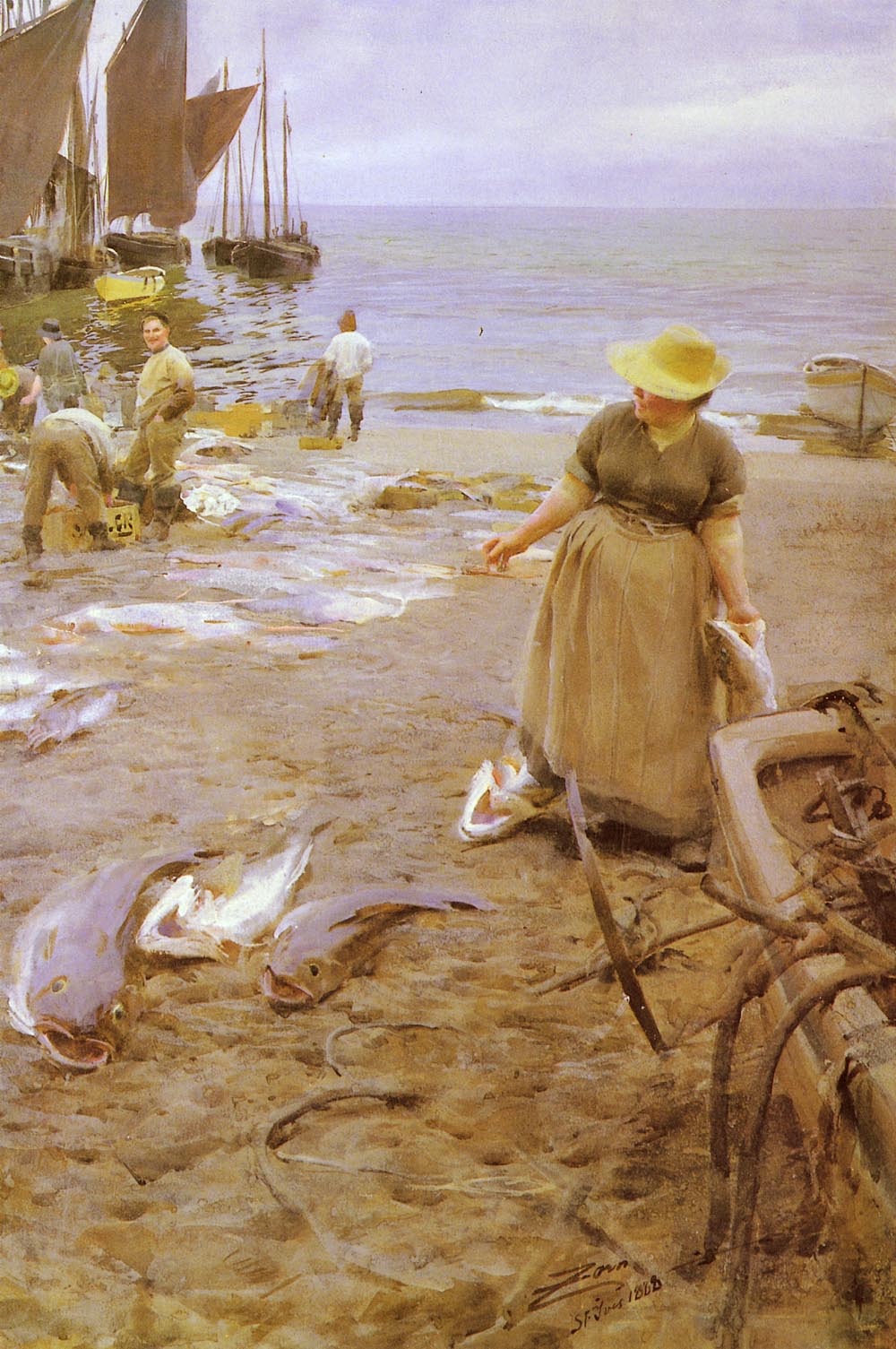
Anders Zorn, Fish Market in Saint Ives (1888), watercolour, 100 x 76.5 cm, Private collection. Wikimedia Commons.
Anders Zorn (1860-1920), Fish Market in Saint Ives (1888), watercolour, 100 x 76.5 cm, Private collection. Wikimedia Commons.

When Anders Zorn was making the transition from watercolour to oil painting, he travelled to the fishing village of Newlyn, near Penzance in Cornwall, where there was an artist’s colony. When there in 1888 he visited the fishing port of Saint Ives, where he painted this Fish Market in Saint Ives.

Although Joaquín Sorolla had been brought up in Valencia and painted its fishing industry and beaches extensively, remarkably few of his paintings show fish.

sorollaayamonte
Joaquín Sorolla y Bastida (1863–1923), Ayamonte, Tuna Fishing (1919), oil on canvas, 349 x 485 cm, Hispanic Society of America, New York, NY. Wikimedia Commons.

In 1919, when he was painting his series of views of Spain for the Hispanic Society of America, those included the tuna market in Ayamonte, Tuna Fishing.

Fish have also appeared in more unusual settings.

sichulskifish
Kazimierz Sichulski (1879–1942), Fish (1908), pastel on paperboard, 63 x 82 cm, Muzeum Narodowe w Poznaniu, Poznań, Poland. Wikimedia Commons.

Kazimierz Sichulski’s Fish (1908) is a startlingly original pastel painting, a virtuoso combination of reflections from and views through this water surface, to the fish beneath.

lesliegoldfishseller
George Dunlop Leslie (1835–1921), The Goldfish Seller (date not known), oil on canvas, 74.9 x 110.5 cm, location not known. Wikimedia Commons.

George Dunlop Leslie’s undated Goldfish Seller shows a hawker trying to sell goldfish to an upper middle class Victorian family. He may have arrived in the horse-drawn cart glimpsed outside the gate, and wears a bowler hat typical of itinerant traders, with a long green smock. The daughter and young son appear particularly unimpressed.

corinthwomanwithfishtank
Lovis Corinth (1858–1925), Woman with a Fishtank (the Artist’s Wife) (1911), oil on canvas, 74 × 90.5 cm, Österreichische Galerie Belvedere, Vienna, Austria. Wikimedia Commons.

Lovis Corinth’s Woman with a Fishtank from 1911 shows the artist’s wife Charlotte in their flat on Klopstockstraße in Berlin. The aquarium, full of goldfish, is surrounded by quite a jungle of indoor plants, her little corner of vegetation within their city flat.

Walter Crane (1845–1915), A Diver (date not known), watercolour and gouache on paper mounted on canvas, 55.9 x 66 cm, location not known. Wikimedia Commons.

Painted in a combination of transparent watercolour and gouache, Walter Crane’s undated Diver is an unusual and challenging motif.

Finally, fish have been popular objects included in still life paintings, in what has become termed fruits de mer, the fruit of the sea.

peetersfishcandlestick
Clara Peeters (fl 1607-1621), Still Life of Fish and a Candlestick (1611), oil on panel, 50 x 72 cm, Museo Nacional del Prado, Madrid. Wikimedia Commons.

Clara Peeters’ Still Life of Fish and a Candlestick is one of the earliest and most accomplished such paintings. She painted this in 1611, when she was in Amsterdam.

chardinraylouvre
Jean-Baptiste-Siméon Chardin (1699–1779), The Ray (1727), oil on canvas, 114.5 x 146 cm, Musée du Louvre, Paris. Wikimedia Commons.

Among the first of Jean-Baptiste-Siméon Chardin’s successful still lifes is The Ray from 1727, exhibited the following year to secure his place in the Académie Royale de Peinture et de Sculpture. This is an extraordinary combination of objects, dominated by the ghostly ‘face’ of the hanging fish, ably supported by the anger of the cat.

vallayercostermackerelglassware
Anne Vallayer-Coster (1744–1818), A Still Life of Mackerel, Glassware, a Loaf of Bread and Lemons on a Table with a White Cloth (1787), further details not known. Wikimedia Commons.

After Chardin’s death in 1779, his successor Anne Vallayer-Coster reached her zenith, in brilliant displays such as A Still Life of Mackerel, Glassware, a Loaf of Bread and Lemons on a Table with a White Cloth from 1787. Although reminiscent of Clara Peeters’ fish, these lack the open-mouthed gawp.

The one artist who probably painted more fish than any other was William Merritt Chase, who characteristically dashed off a fish still life to warm up his brushes each day when he was teaching.

chaseyieldofwaters
William Merritt Chase (1849–1916), The Yield of the Waters (A Fishmarket in Venice) (1878), oil on canvas, 124.5 x 165.1 cm, Detroit Institute of Arts, Detroit, MI. Wikimedia Commons.

After completing his studies in Munich, Chase spent several months in Venice, where he painted one of his best-known still lifes, The Yield of the Waters, also known as A Fishmarket in Venice, (1878). This was probably his most complex and detailed still life, showing a wide variety of the fish and seafood available in the Mediterranean. It also established his own specialist sub-genre of still life: fish, characteristically set against a dark background.

Reading Visual Art: 231 Tiger

By: hoakley
17 October 2025 at 19:30

In Europe, tigers were best known from the Bengal tiger of the Indian subcontinent, although there were also Caspian tigers in Turkey until they became extinct in the 1970s. As the latter had bright rust-red fur with brown stripes, it should be possible to distinguish them, but I haven’t seen any matching that description in European paintings.

In mythology, tigers are most commonly associated with Bacchus/Dionysus, whose chariot they draw, although there’s considerable variation in the species depicted.

corinthariadnenaxos
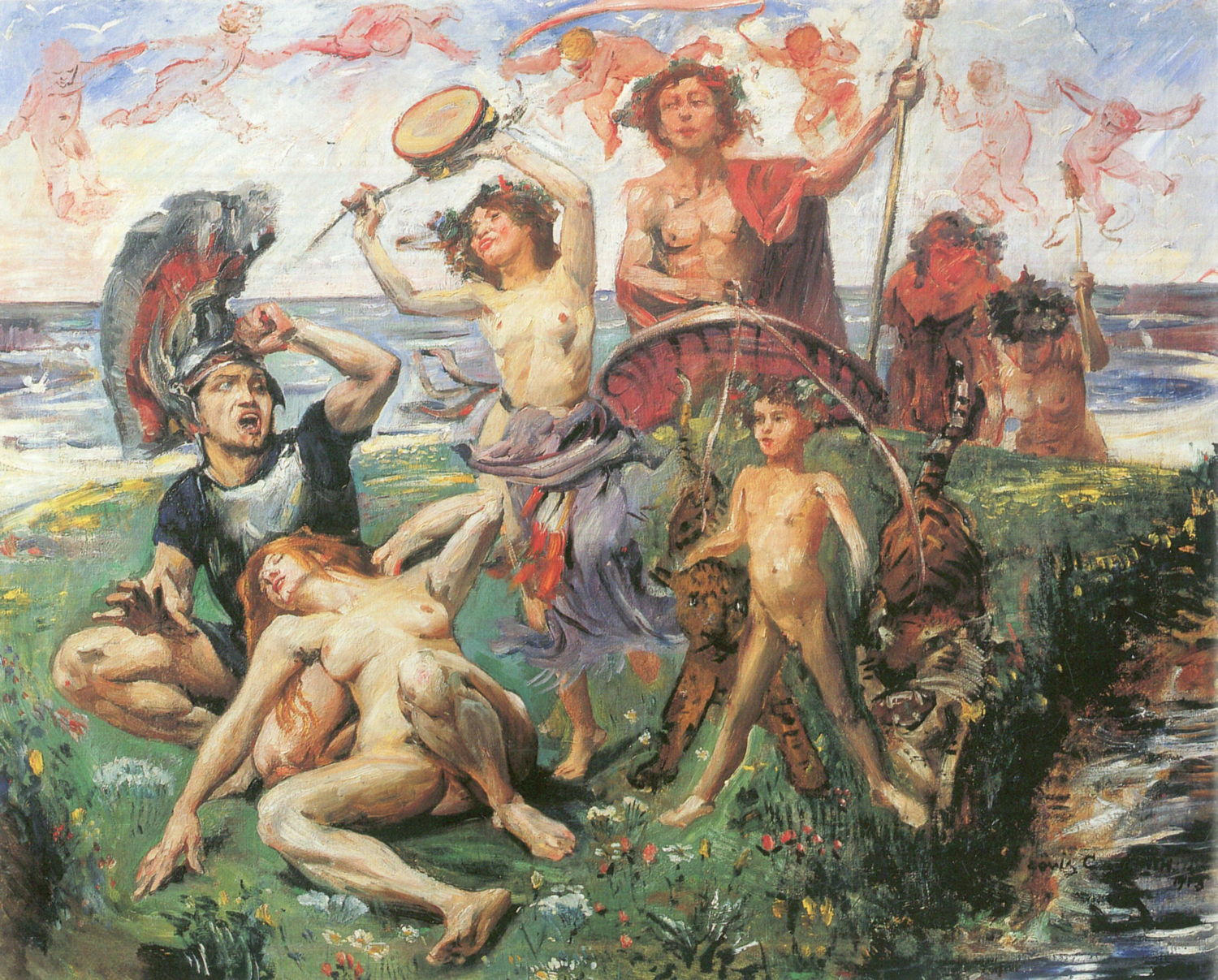
Lovis Corinth (1858–1925) Ariadne on Naxos (1913), oil on canvas, 116 × 147 cm, Private collection. Wikimedia Commons.

Ariadne on Naxos (1913) is one of Lovis Corinth’s most sophisticated mythical paintings, and was inspired by the first version of Richard Strauss’s opera Ariadne auf Naxos, rather than any classical account.

corinthariadnenaxosdet2
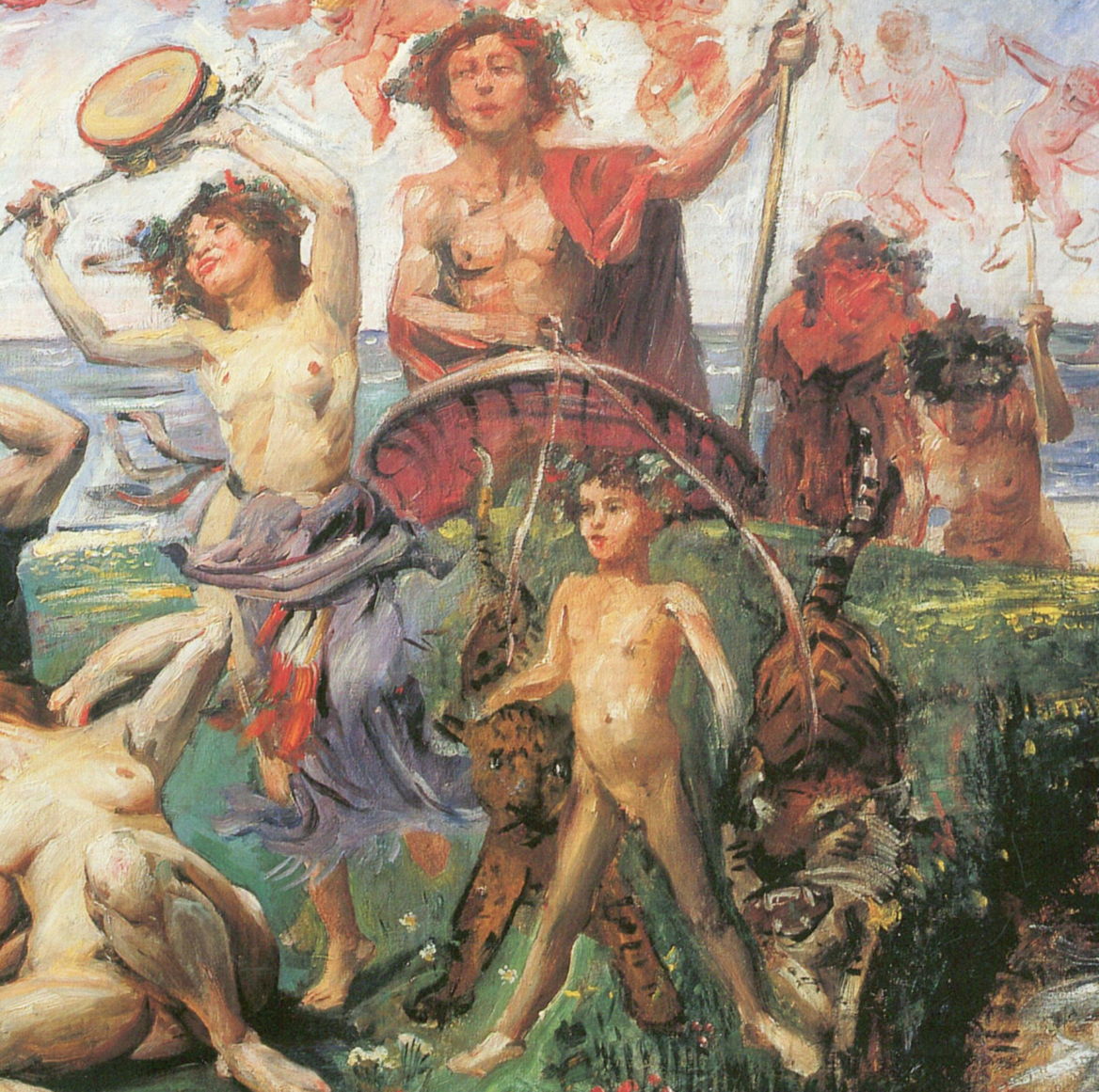
Lovis Corinth (1858–1925) Ariadne on Naxos (detail) (1913), oil on canvas, 116 × 147 cm, Private collection. Wikimedia Commons.

The group in the middle and right is centred on Dionysus, who clutches his characteristic staff in his left hand, and with his right hand holds the reins to the leopard and tiger drawing his chariot. Leading those animals is a small boy, and to the left of the chariot is a young bacchante.

Tigers also feature with other species of large cat including lions in depictions of Christian martyrdom.

NGV114845
Briton Rivière (1840-1920), A Roman Holiday (1881), oil on canvas, 99.5 x 178.2 cm, National Gallery of Victoria, Melbourne, Australia. Wikimedia Commons.

I expect that Briton Rivière was well aware of the contemporary paintings of Gérôme showing scenes of gladiatorial combat and martyrdom in classical Rome. Those may have inspired his A Roman Holiday (1881), showing a wounded Christian inscribing a cross in the sand as a tiger lies dead by him, and another snarls behind.

Tigers became popular in zoos and other animal collections around Europe. When he was in Paris, one of Eugène Delacroix’s favourite activities was to visit the zoo at the city’s Jardin des Plantes and sketch the big cats there.

delacroixtigerpreparingspring
Eugène Delacroix (1798–1863), Tiger Preparing to Spring (c 1850), pastel on paper, 23 by 31 cm, location not known. Wikimedia Commons.

His pastel painting of a Tiger Preparing to Spring from about 1850 demonstrates his mastery of the medium.

rousseausurprised
Henri Rousseau (1844–1910), Tiger in a Tropical Storm (Surprised!) (1891), oil on canvas, 128.9 x 161.9 cm, National Gallery, London. Wikimedia Commons.

Henri Rousseau’s Tiger in a Tropical Storm (Surprised!) from 1891 is a fine portrait of a tiger moving through dense vegetation in torrential rain.

rubenstigerhunt
Peter Paul Rubens (1577–1640), The Tiger Hunt (c 1616), oil on canvas, 253 x 319 cm, Musée des Beaux-Arts, Rennes, France. Wikimedia Commons.

Peter Paul Rubens’ Tiger Hunt from about 1616 packs its canvas with hunters, their horses, and a collection of big cats, including two tigers, a lion and a leopard. A Samson-like figure in the left foreground is wrestling with the lion’s jaws, as one of the tigers buries its teeth into the left shoulder of the Moorish hunter in the centre.

rivieretigerhunt
Briton Rivière (1840–1920) (attr), Tiger Hunt (date not known), oil on canvas, 121 x 108 cm, location not known. Wikimedia Commons.

Colonial powers used elephants when hunting big game such as tigers in countries like India, as seen in this painting attributed to the animal specialist Briton Rivière, Tiger Hunt.

Those tigers that were killed had an unusual fate, as their skin became a prop for beautiful women.

godwarddolcefarniente1897
John William Godward (1861–1922), Dolce Far Niente (1897), oil on canvas, 77.4 x 127 cm, Private collection. Wikimedia Commons.

John William Godward’s Dolce Far Niente from 1897 adopts a classical Roman setting, with his model lying and doing sweet nothing on a tiger skin.

❌
❌