President Trump and one of his top cabinet officials are sending mixed messages on how the U.S. government is handling the most destructive weapons in the world.
Energy Secretary Chris Wright said the testing ordered up in a surprise announcement by President Trump last week would focus on “the other parts” of nuclear weaponry.
There’s a long and ancient tradition of performing what would now be considered to be crude experiments in physics and chemistry, most commonly aimed at transforming one substance into another. Founded on flawed principles such as matter consisting of four elements, its best-known goal was the transformation of ‘base’ metals like lead into precious metals, particularly gold. In their quest for this, alchemists developed exotic equipment including a range of blown glass such as alembic vessels, trademarks of alchemy.
At least in popular perception, alchemy was one of the ‘dark arts’ and allied with witchcraft and sorcery. Myths like the rejuvenation of Jason’s father Aeson by the sorceress Medea have been depicted as involving both.
Domenicus van Wijnen (1661- c 1695), Medea Rejuvenating Aeson (date not known), oil on canvas, 46 × 53 cm, Musée des beaux-arts de Pau, Pau, France. Wikimedia Commons.
In the late seventeenth century Domenicus van Wijnen painted his account of Medea Rejuvenating Aeson, invoking both alchemy and witchcraft. Medea, naked and reclining in Hecate’s golden chariot, points her wand at the body of Aeson lying on the ground as she casts a spell. A glass sphere above her contains a small devil and shoots a trail of flame and sparks like a rocket. Medea is assisted by four putti and has what appears to be Hecate herself behind her, and a full moon is rising above the horizon. Scattered around the scene are objects associated with the ‘dark arts’, including a glass cauldron, a jar of brown liquid, a sacrificial knife, old books, and a burning candle.
Bartolomeo Guidobono (1654–1709), Medea Rejuvenates Aeson (c 1700), oil on canvas, 173 x 212 cm, Private collection. Wikimedia Commons.
Bartolomeo Guidobono’s Medea Rejuvenates Aeson from about 1700 is more of a puzzle to read, as Medea, now dressed in an unkempt and wild manner, is accompanied by two men. The near-lifeless and pale body of Aeson rests behind her, but a younger man, possibly the rejuvenated Aeson, is materialising under a table. There is now a panoply of symbols associated with magic, including a snake and toad, large tomes of spells on top of which is a lizard, an open fire on a small stand, and an assortment of more normal animals including a dog, fox, and deer. The table in the background has further magical equipment, such as an orrery, and a bat is flying to the right of Medea’s head.
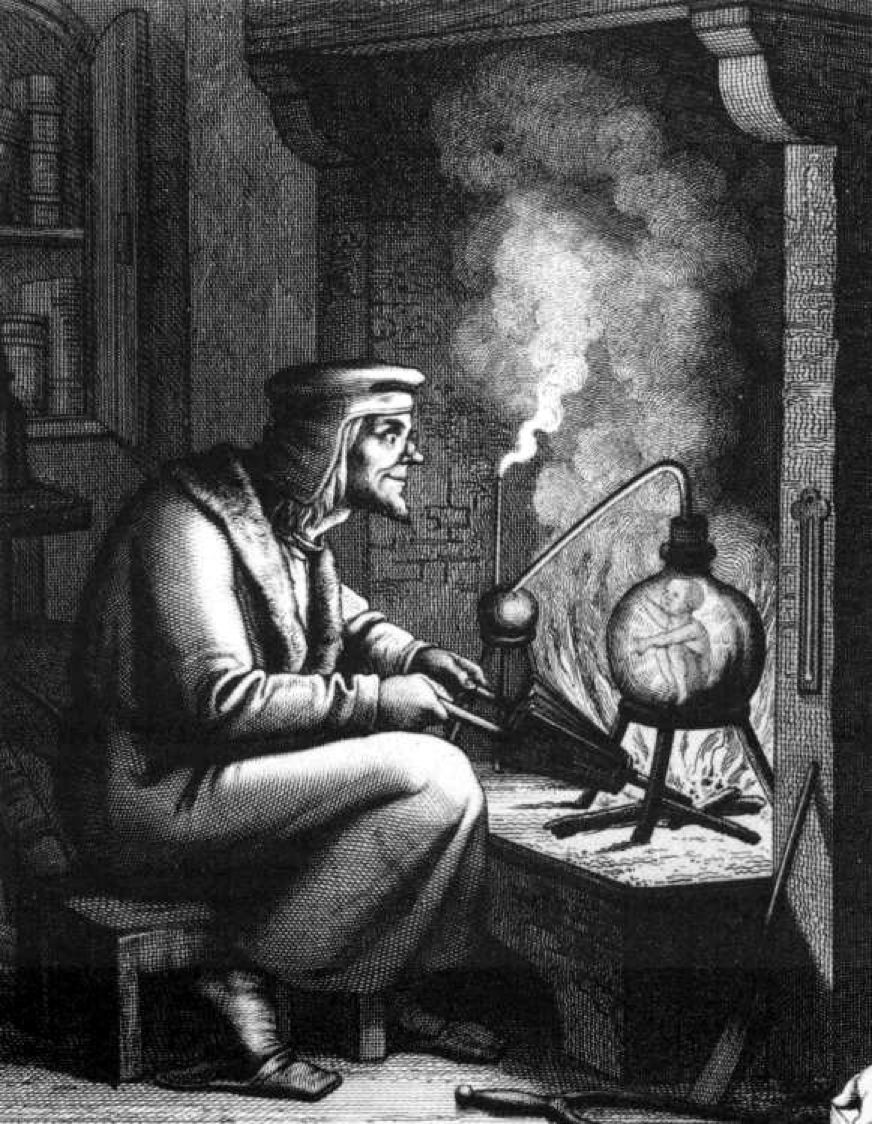
A similar combination is seen in visual accounts of part two of Goethe’s Faust. When Faust is taken unconscious into his old study, Mephistopheles poses as Faust and interviews his young student Wagner, and the latter uses alchemical processes to create a homunculus. This is the one scene from this second part to prove popular with artists.
Alfred van Muyden (1818-1898), Scene: Laboratory, Wagner Creates the Homunculus (c 1840), engraving by Franz Xaver Steifensand (1809–1876) of original drawing, published in Goethe, ‘Faust, Part two’, J. G. Cottáscher Verlag. Wikimedia Commons.
Alfred van Muyden’s illustration of Scene: Laboratory, Wagner Creates the Homunculus from about 1840 is an early example referring to popular imaginings of such alchemical processes.
Artist not known, Homunculus, Faust part 2 (date not known), further details not known. Wikimedia Commons.
This anonymous version of Homunculus, Faust part 2 is simpler in conception.
Franz Xaver Simm (1853-1918), Homunculus in the Vial (1899), illustration for Goethe, ‘Faust, Part two’, Deutsche Verlagsanstalt. Wikimedia Commons.
Franz Xaver Simm’s Homunculus in the Vial from 1899 uses light very effectively.
Moritz Retzsch (1779–1857), “I see in a delicate shape / A kind man to behave. / What do we want, what more does the world want now?” (1836), illustration to Faust Part 2, further details not known. Wikimedia Commons.
Moritz Retzsch’s line drawing for an illustration from 1836 is more detailed and better-developed. Wagner holds the large glass vial in which the homunculus has been created, as Mephistopheles points towards the collapsed figure of Faust in his study, at the left.
With the age of Enlightenment, alchemy was viewed as a proto-science to be debunked with the arrival of early modern chemistry and physics.
Joseph Wright of Derby (1734–1797), The Alchymist, in Search of the Philosopher’s Stone, Discovers Phosphorus, and Prays for the Successful Conclusion of his Operation, as was the Custom of the Ancient Chymical Astrologers (1771-95), oil on canvas, 127 x 101.6 cm, Derby Museum and Art Gallery, Derby, England. Wikimedia Commons.
Today’s concept of alchemy as a mixture of magic and charlatanism hadn’t been established at the time that Joseph Wright of Derby was painting. The Alchymist, in Search of the Philosopher’s Stone, Discovers Phosphorus, and Prays for the Successful Conclusion of his Operation, as was the Custom of the Ancient Chymical Astrologers (1771-95), which summarises its narrative in the title, is comparatively sympathetic to alchemy.
Wright created this image in 1771 from a variety of sources, including drawings provided by Peter Perez Burdett from his new chemical laboratory in Liverpool, and classical engravings. It is particularly appropriate in depicting the purification of phosphorous, which was seen as a productive and positive outcome from the ancient pursuit of alchemy.
Elihu Vedder (1836–1923), The Dead Alchemist (c 1868), oil on panel, 36.6 × 51 cm, Brooklyn Museum, New York, NY. Photo courtesy of Brooklyn Museum, via Wikimedia Commons.
By the late nineteenth century, when Elihu Vedder painted The Dead Alchemist (c 1868), that had changed. Vedder shows a lone figure, slumped and apparently dead against a carved chest. Scattered around him is the equipment that might previously have been used by an alchemist.
Félicien Rops (1833–1898), The Incantation (c 1878), tempera, watercolour, pen and ink, 32 x 18 cm, Musée Provincial Félicien Rops, Namur, Belgium. Wikimedia Commons.
The eccentric Belgian artist Félicien Rops conjured with various images of devils and witches. One of his more gentle paintings of the occult is The Incantation (c 1878). A Faustian character sits in front of an open copy of Compendium Maleficarum, a witch-hunter’s manual first published in Latin in 1608. He’s surrounded by the tools of his trade: alembics from alchemy, a sprig of mandrake, a pelican, an owl, and a black cat is behind his chair. He has just conjured up a naked young woman, who is popping out of a picture frame. It all seems good fun, as if witchcraft and alchemy should be hobbies for every family.
John Collier (1850–1934), The Laboratory (1895), other details not known. WikiArt.
In John Collier’s The Laboratory (1895), there’s clearly a narrative between the old alchemist and a young woman, who is trying to take an object from the man’s right hand. This may be a reference to a written narrative that Collier was exploring prior to painting his real problem pictures.
The Eurasian wolf has been subject to a general campaign of extermination across much of Europe since the Middle Ages. The last in England was killed by the end of the fifteenth century, in Scotland in 1684, Denmark in 1772, and Norway in 1973. This hasn’t deterred artists from reminding Europeans of their sinister reputation.
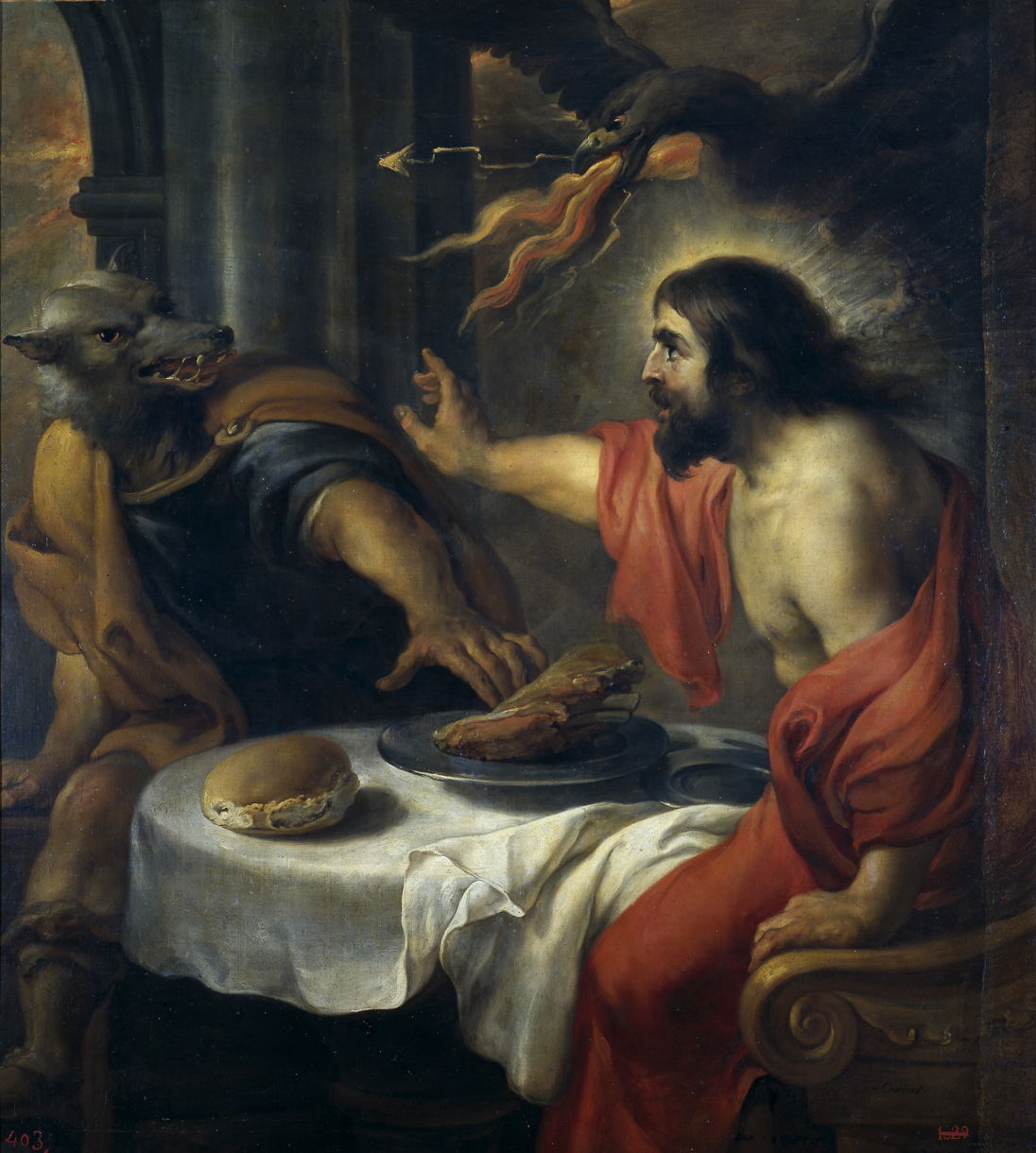
Early in Ovid’s Metamorphoses, he tells of Lycaon, who was transformed into a wolf by Jupiter as punishment for cheating him.
Jan Cossiers (1600–1671), Jupiter and Lycaon (c 1640), oil on canvas, 120 × 115 cm, Museo Nacional del Prado, Madrid. Wikimedia Commons.
Jan Cossiers’ impressive Jupiter and Lycaon from about 1640 shows Jupiter’s eagle vomiting thunderbolts at Lycaon, who is hurrying away as he is being transformed into a wolf, becoming the prototype for the werewolf of the future (see below).
Wolves got a better press in the popular account of the origins of Romulus and Remus, founders of Rome. Numitor’s daughter, a Vestal Virgin, was discovered to be pregnant. Although that would by tradition have led to her death, Amulius’ daughter interceded, and she was merely kept in solitary confinement. She gave birth to twin boys, who were superhuman in their size and beauty. Amulius ordered one of his servants to take the twins away and drown them in the river, but they were put first into a trough that functioned as a boat. As a result they were washed ashore downstream still alive. A she-wolf then fed the babies, and a woodpecker watched over them; both were later considered to be sacred to the god Mars.
Ludovico Carracci (1555–1619) and/or Annibale Carracci (1560–1609), She-Wolf Suckling Romulus and Remus (1589-92), fresco, dimensions not known, Palazzo Magnani, Bologna, Italy. Wikimedia Commons.
One of the frescoes in the Palazzo Magnani, probably painted by Ludovico Carracci and/or Annibale Carracci, shows the She-Wolf Suckling Romulus and Remus (1589-92). The twins are still inside the trough in which they had survived their trip down the river, and on the opposite bank a woodpecker is keeping a close watch.
Peter Paul Rubens (1577–1640), Romulus and Remus (1615-16), oil on canvas, 213 x 212 cm, Musei Capitolini, Rome, Italy. Wikimedia Commons.
Peter Paul Rubens shows Romulus and Remus being discovered by Faustulus, in his painting of 1615-16. Not only is the she-wolf taking care of the twins, but a family of woodpeckers are bringing worms and grubs to feed them, and there are empty shells and a little crab on the small beach as additional tasty tidbits.
Despite that, the wolf had a fearsome reputation in Europe, no doubt amplified by those who sought its extinction.
Pieter Brueghel the Younger (1564–1638), The Good Shepherd (1616), oil on canvas, dimensions not known, Musées royaux des Beaux-Arts de Belgique, Brussels, Belgium. Image by Rama, via Wikimedia Commons.
Pieter Brueghel the Younger’s The Good Shepherd from 1616 shows a shepherd being attacked by a wolf, as he tries to save his flock, which are running in panic into the nearby wood.
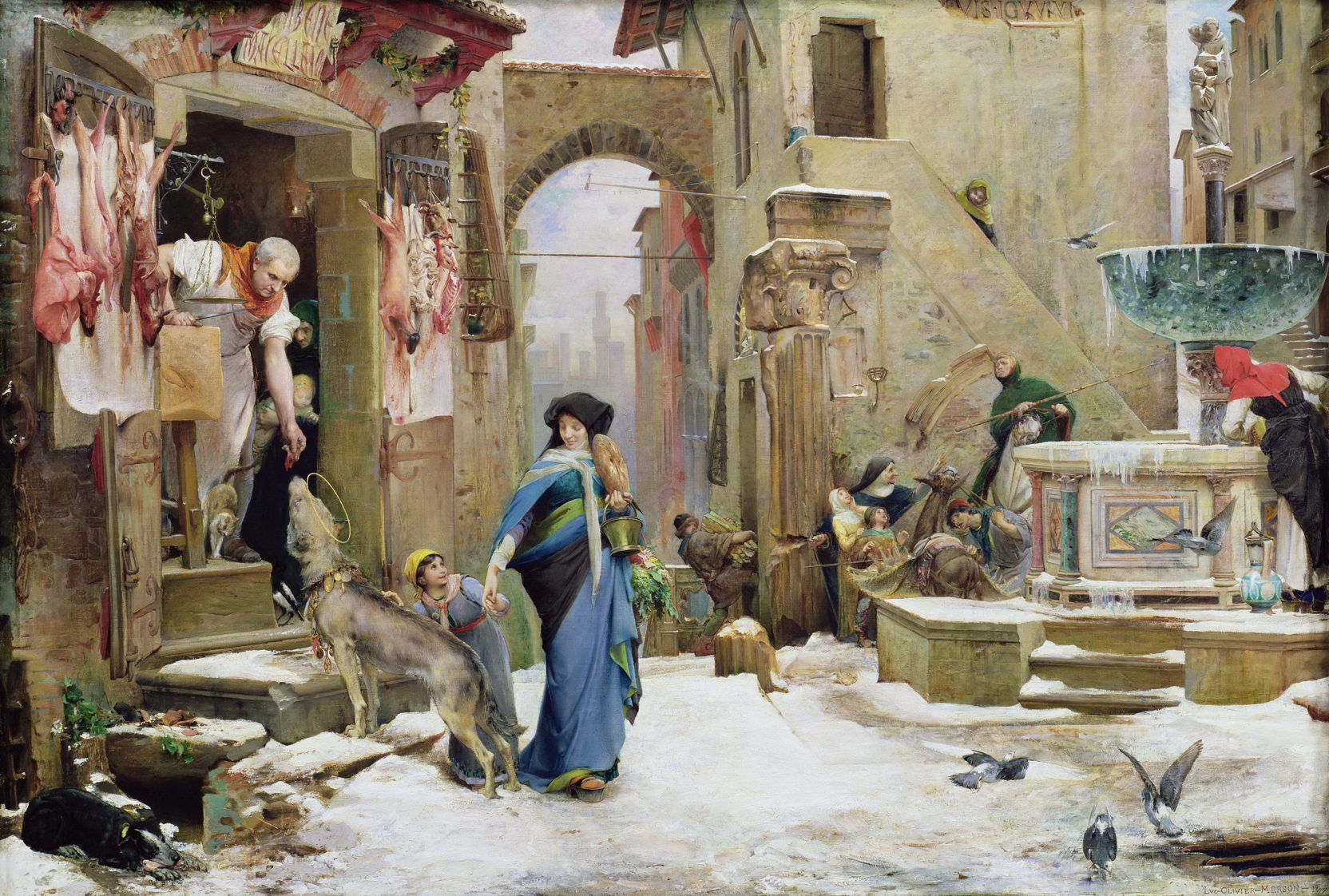
Christian associations can be more positive, particularly in the legend of Saint Francis of Assisi and the wolf of Agubbio, or Gubbio, a small mediaeval town in the Apennine Mountains in central Italy. The saint did a deal with the wolf, where the animal would stop terrorising the town, in return for its people providing it with food.
Luc-Olivier Merson (1846–1920), The Wolf of Agubbio (1877), oil on canvas, 88 x 133 cm, Palais des Beaux-Arts de Lille, Lille, France. Wikimedia Commons.
Luc-Olivier Merson’s marvellous painting of The Wolf of Agubbio from 1877 is set in the town’s central piazza, where it’s a cold winter’s day, so cold that the waters of its grand fountain are frozen as they cascade over its stonework. As the townspeople go about their business, there’s the large wolf of its title with a prominent halo, standing at the door of the butcher’s shop. Leaning out from that door, the butcher is handing a piece of meat to the wolf, as shown in the detail below.
Luc-Olivier Merson (1846–1920), The Wolf of Agubbio (detail) (1877), oil on canvas, 88 x 133 cm, Palais des Beaux-Arts de Lille, Lille, France. Image by Chatsam, via Wikimedia Commons.
A wolf may also appear in association with the Christian virtue of charity, as depicted by Pierre Puvis de Chavannes.
Pierre Puvis de Chavannes (1824–1898), Charity (1887), oil on canvas, 56 x 47 cm, Musée d’Orsay, Paris. Image by Rama, via Wikimedia Commons.
His Charity from 1887 is a personification of one of the seven Christian virtues set in timeless classical terms. She is the mother of twins, one of whom she holds by her breast. She is clasping the back of the neck of a dark wolf, lying beside her, adding an unusual touch. This had apparently become a popular motif, and only nine years previously had been painted by William-Adolphe Bouguereau in contrasting Academic style.
Jean-Baptiste Camille Corot (1796–1875), Dante and Virgil (1859), oil on canvas, 260.4 x 170.5 cm, Museum of Fine Arts Boston, Boston, MA. Wikimedia Commons.
A wolf is one of the three fearsome animals to threaten Dante in the opening of his Divine Comedy. Camille Corot’s painting of Dante and Virgil from 1859 shows Dante as he started to walk up a hill, only to find his way blocked first by a leopard, then by a lion, and finally by a wolf.
Wolves have made their way into other legends and fables.
Jean-Baptiste Oudry (1686–1755), The Wolf and the Lamb (date not known), oil on canvas, 104.1 x 125.7 cm , Private collection. Wikimedia Commons.
Jean-Baptiste Oudry’s undated The Wolf and the Lamb tells a popular story (Perry 155, La Fontaine I.10) in which a wolf tries to justify killing a lamb on the strength of its criminal record. The lamb proves each crime claimed by the wolf to have been impossible, so the wolf says that the offences must have been committed by someone else in the lamb’s family, therefore it can proceed to kill the lamb anyway.
Gustave Moreau (1826–1898), The Wolf and the Lamb (1889), original presumed to be in colour, further details not known. Wikimedia Commons.
Gustave Moreau revisited Aesop’s fables late in his career. The Wolf and the Lamb of 1889 is, I believe, a monochrome image of a painting made in full colour, whose wolf looks more threatening than Oudry’s.
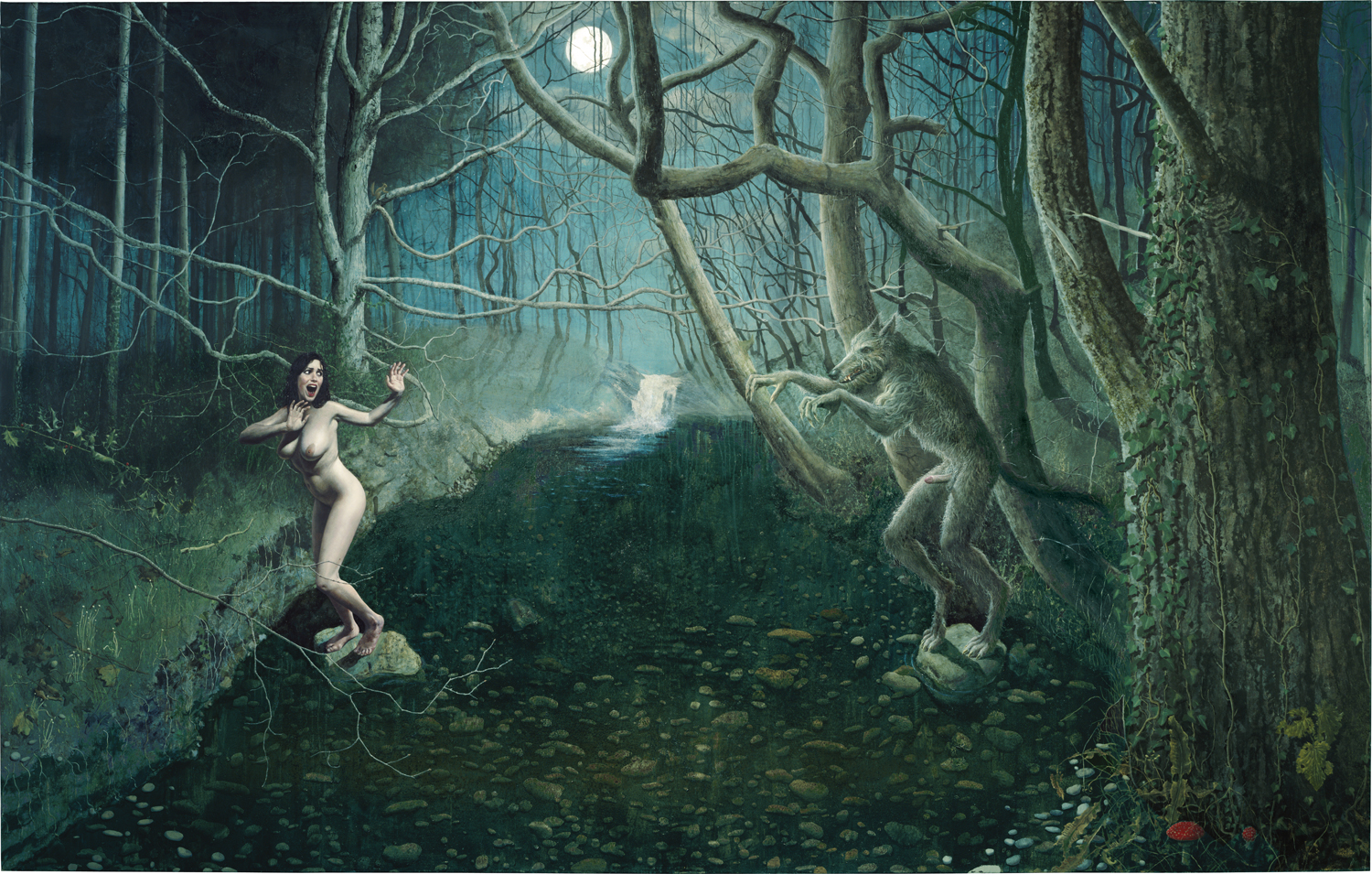
Mediaeval folk mythology developed stories of humans turning into wolves, although these were temporary transformations associated with cannibalistic episodes. They became progressively refined and popularised into the Gothic ‘horror’ stories of werewolves feeding on human blood, although those didn’t reach painting until the twentieth century.
Stuart Pearson Wright’s magnificent Woman Surprised by a Werewolf (2008) was inspired by the movie An American Werewolf in London (1981), itself a further transformation of werewolf stories into comedy horror form. The artist intended “to explore that uncharted place where the mystery and sublime of the romantic landscape meets the high camp and melodrama of Hammer horror”, which has come a long way from Ovid’s original story of lycanthropy.
Finally, wolves can sometimes be depicted as hunting quarry.
Peter Paul Rubens (1577–1640), Wolf and Fox Hunt (c 1616), oil on canvas, 245.4 x 376.2 cm, Metropolitan Museum of Art, New York, NY. Wikimedia Commons.
Peter Paul Rubens’ Wolf and Fox Hunt from about 1616 is one of his brilliant series of hunting scenes, here featuring two large wolves.
The good news is that, since the 1950s, populations of wolves in Europe have been recovering, and with the exception of the British Isles, they’re gradually re-establishing themselves in those countries that had previously hunted them to death.

 Login
Login