Until the Industrial Revolution brought the wide availability of iron, and even well into the twentieth century, the carpenter who worked wonders in wood was one of the key trades. It’s thus odd that remarkably few paintings show carpenters at work, at least until the middle of the nineteenth century.
They also play no role in the best-known classical myths, with the exception of one painting by Piero di Cosimo.
Piero di Cosimo (1462–1522), Vulcan and Aeolus (c 1490), tempera and oil on canvas, 155.5 × 166.5 cm, National Gallery of Canada Musée des beaux-arts du Canada, Ottawa, Canada. Wikimedia Commons.
Piero sometimes assembled his own mythical narratives, such as that in Vulcan and Aeolus from about 1490. From the left the figures are a river god, Vulcan forging a horseshoe, a figure (possibly Aeolus, keeper of the winds) riding a horse, a man curled asleep in a foetal position, a couple and their infant son, and four carpenters erecting the frame of a building. Among the animals are a giraffe and a camel. It’s thought this shows early humans developing crafts at the dawn of civilisation.
Christian religious painting has a better opportunity, with Joseph, husband of the Virgin Mary, the most famous carpenter in European history.
Jacopo Tintoretto (c 1518-1594), The Annunciation (E&I 264) (c 1582), oil on canvas, 440 x 542 cm, Sala terrena, Scuola Grande di San Rocco, Venice, Italy. Wikimedia Commons.
Tintoretto’s Annunciation is thought to have been painted in about 1582. Its composition is unusual by any contemporary standards, with natural rendering of brickwork, a wicker chair, and a splendidly realistic carpenter’s yard at the left. This is coupled with an aerial swarm of infants, at the head of which is the dove of the Holy Ghost in a small mandorla. Christ’s origins are here very real, tangible, and contemporary, in stark contrast to most traditional depictions of this scene.
John Everett Millais’ painting of Christ in the House of His Parents, also known as The Carpenter’s Shop, is one of the foundational paintings of the Pre-Raphaelite Brotherhood, from 1849-50. It was exhibited at the Royal Academy in 1850 with a quotation from the Old Testament book of Zechariah 13:6: “And one shall say unto him, What are those wounds in thine hands? Then he shall answer, Those with which I was wounded in the house of my friends.” It shows an entirely imagined scene, one not even alluded to in the Gospels, in which the young Jesus Christ is being comforted by his kneeling mother, after he has cut the palm of his left hand on a nail.
It’s rich with symbols of Christ’s life and future crucifixion: the cut on his palm is one of the stigmata, and blood dripped from that onto his left foot is another. The young Saint John the Baptist has fetched a bowl of water, indicating his future baptismal role. A triangle above Christ’s head symbolises the Trinity, and a white dove perched on the ladder is the Holy Spirit. A flock of sheep outside represents the Christian flock.
William Holman Hunt (1827–1910), The Shadow of Death (1870-73), oil on canvas, 214.2 x 168.2 cm, Manchester Art Gallery, Manchester, England. Wikimedia Commons.
In William Holman Hunt’s later painting of The Shadow of Death from 1870-73, the young Jesus Christ is seen in his father’s carpentry workshop, holding his arms up to savour the bright sunlight. His cast shadow on the rack of tools and wall behind shows him crucified on the cross, with his mother Mary already on her knees, as shown in so many paintings of the crucifixion.
Christian allusions to carpentry became more popular from the start of the nineteenth century.
William Blake’s The Christ Child Asleep on the Cross, or Our Lady Adoring the Infant Jesus Asleep on the Cross from 1799-1800 is among the few of his glue tempera paintings that has retained its colours. This shows at best an apocryphal if not invented scene, in which the young Jesus anticipates his eventual fate by sleeping on a wooden cross, surrounded by the carpenter’s tools, including compasses or dividers.
Fritz von Uhde (1848–1911), A Difficult Journey (Transition to Bethlehem) (1890), oil on canvas, 117 × 127 cm, Neue Pinakothek, Munich, Germany. Wikimedia Commons.
Fritz von Uhde’s A Difficult Journey from 1890 imagines Joseph and the pregnant Mary walking on a rough muddy track to Bethlehem, in a wintry European village. Joseph has his carpenter’s saw on his back as the tired couple move on through dank mist.
Hans Andersen Brendekilde (1857–1942), People by a Road (1893), oil on canvas, 200 x 263 cm, Statens Museum for Kunst (Den Kongelige Malerisamling), Copenhagen, Denmark. Wikimedia Commons.
There’s a more complex story behind Hans Andersen Brendekilde’s People by a Road from 1893. The group at the left are old road-workers, breaking larger rocks into coarse gravel. They lived out under the wooden shelter behind them, as they made their way slowly around the country roads. The woman holds what is either a small shovel or spade used in their work. Standing and apparently preaching to them is a cleanly dressed carpenter, his saw held in his left hand. The building behind them, on the opposite side of the road, is a church, from which a large congregation has just emerged.
Erik Henningsen (1855–1930), Evicted (1892), oil on canvas, dimensions not known, Statens Museum for Kunst (Den Kongelige Malerisamling), Copenhagen, Denmark. Wikimedia Commons.
This association with the Holy Family may extend to Erik Henningsen’s Evicted from 1892 with its family of four being evicted into the street in the winter snow. With them are their meagre possessions, including a saw suggesting the father may be a carpenter. In the background he is still arguing with a policeman.
It was only then, at the end of the nineteenth century, that artists started to paint portraits of carpenters at work.
Laurits Andersen Ring (1854–1933), Workers at a Water Pipe at Søndersø (1891), oil on canvas, 155 x 185 cm, Fuglsang Art Museum, Lolland, Denmark. Wikimedia Commons.
In 1891 Laurits Andersen Ring painted these Workers at a Water Pipe at Søndersø, in the north of the central Danish island of Fyn (Funen). Two are skilled carpenters, who are sawing a plank of wood to be used in the construction work in progress behind them. The third worker, in his light blue jacket, wears rubber overboots on his wooden clogs, implying he has been working down in the trench. This is one of a series painted by Ring showing trades and crafts.
Long before paintings became movable objects of great value used by the rich as investments, artists and the owners of their paintings wanted to protect the paint layer that had been so carefully applied to the ground. From the early Middle Ages onwards, one popular means of doing this has been to apply some form of protective layer, a varnish.
Varnishes have been widely used not only for protection. Careful choice of their composition can enhance the appearance of a painting, through the optical properties of the varnish medium and its smooth, glossy surface. Until the late nineteenth century, the great majority of painters either applied final layers of varnish themselves, or advised their patrons and clients to do so.
Three types of varnish have come into common use:
Drying oil and resin, in effect a resin-rich transparent and unpigmented paint layer, that usually becomes an integral part of that. Some artists have added pigment, perhaps to make a general colour adjustment. There isn’t any clear distinction between that and a final paint glaze.
Solvent and resin, from which the solvent will evaporate, leaving a thin surface coat of resin.
Water-based washes such as egg white, known as glair, vegetable gums like gum arabic, and animal glues.
Resins used in varnishes have rich and sometimes strange histories. Most are exudates from trees in exotic locations, and have evocative names like mastic, sandarac, colophony and dammar. They’re usually highly insoluble, either in drying medium that has to be heated to make oil-based varnishes, or in turpentine or similar organic solvents. A great many recipes have been proposed, and there’s always the lure of the perfect, and inevitably top secret, formula.
Rembrandt Harmenszoon van Rijn (1606–1669), Bathsheba at her Toilet (1643), oil on panel, 57.2 x 76.2 cm, Metropolitan Museum of Art, New York, NY. Wikimedia Commons.
The biggest problems with varnishes are their propensity to yellow or grey with age, and their tendency to take up dirt and atmospheric contaminants. Rembrandt’s first painting of Bathsheba at her Toilet from 1643 has sadly lost much of its detail into the gloom of old varnish, which can be almost impossible to clean off when composed of drying oil and resin, without damaging the paint layer underneath.
Any work older than a few decades that has been varnished or had any form of surface treatment is unlikely to appear today with the colours the artist intended. Multiple layers of old varnish and trapped dirt give a misleading impression of what we would have seen soon after the work was completed. Painstaking work by conservation specialists can often restore old paintings to what we presume is their former glory, in full colour again.
Hieronymus Bosch’s Christ Carrying the Cross (1490-1510) is seen above before recent conservation work, and below is the result of thousands of hours of painstaking cleaning and treatment.
Another problem for the conservation specialist is a painting like Edward Poynter’s A Visit to Aesculapius from 1880. Although this is little more than a century old, the evidence from contemporary prints made from this work is that it was originally far from being so dark. Sadly it’s now almost impossible to read as a result of its near-black shadows.
A good varnish should be both colourless and transparent, but painters haven’t always respected that.
Théodore Géricault (1791–1824), The Raft of the Medusa (detail) (1818-19), oil on canvas, 491 × 716 cm, Musée du Louvre, Paris. Wikimedia Commons.
When finishing his monumental Raft of the Medusa in 1819, Théodore Géricault is thought to have applied glazes or varnish containing asphalt to give the painting a deep brown tone. Asphalt is not only completely unprotective and almost attracts dirt, but it never fully dries, and can have adverse effects on underlying paint too. It hasn’t helped that this two hundred year-old painting was rolled up and stored in a friend’s studio when it remained unsold, and was then transported to London still rolled up the following year.
Conventional wisdom says that it’s best to leave an oil painting to dry for at least six months before varnishing it. JMW Turner sometimes varnished over paint layers that were far from dry. In the case of The Opening of the Wallhalla, 1842 (1843), painted on mahogany, Ruskin reported that it had “cracked before it had been eight days in the Academy Rooms”, although this overall view shows little evidence of that damage.
Hellen and Townsend attribute this to Turner’s extensive use of Megilp, here a product sold by his colourman containing leaded drying oil and mastic varnish. Used sparingly and with great caution, such medium modifiers don’t necessarily cause serious ill-effects. But Turner has used Megilp to excess, to produce a soft impasto used in the foreground figures, in particular. This has resulted in wide and shallow drying cracks, as the surface has dried quickly and shrunk over trapped layers of liquid paint.
Varnishes do provide mechanical protection to the paint layer, but at the cost of locking out atmospheric oxygen, required for drying oils to polymerise properly in their drying process. Applied too early, varnishes can therefore greatly slow drying of underlying paint layers; the danger is that they may saponify (turn to soap) instead of drying normally.
Despite these dangers, varnishes can, when used with care by those who understand them properly, be valuable beyond simply providing a protective coat. Kirsty Whiten’s The Quing of the Now People (2015) achieves its superbly realistic effect by the skilful combination of conventional oil paint with varnish.
In the late nineteenth century, attitudes to varnishing oil paintings changed markedly, as Impressionists like Camille Pissarro started to prescribe that their works should on no account be varnished. This was to preserve the soft matte surface of the paint as applied by the artist, and became increasingly popular in the twentieth century.
For such paintings, protection can be provided by glass, when necessary. That isn’t of course an option for many extremely large oil paintings on canvas, which will probably need to be varnished and cleaned periodically well in the future, as they have in the past.
Varnishes, usually of the third type containing vegetable gums or animal glues, have also been used extensively on paint layers other than oils.
Samuel Palmer (1805–1881), Tintern Abbey at Sunset (1861), watercolor, gouache and varnish over graphite with scratching out on heavy card, 33.3 x 70.5 cm, Yale Center for British Art, New Haven, CT. Wikimedia Commons.
These are reported in Samuel Palmer’s Tintern Abbey at Sunset, above, and Dante Gabriel Rossetti’s Lucrezia Borgia, below. Gum or glue varnishes can have impressive optical effects when used carefully on watercolours.
Unfortunately, their tendency to yellow can also cause colour shifts. William Blake liked to apply glue varnish to his watercolours and perhaps to his glue tempera paintings as well. In the case of his Penance of Jane Shore in St Paul’s Church from about 1793, this has resulted in a generalised yellow shift and loss of chroma.
Henry Ossawa Tanner (1859–1937), The Destruction of Sodom and Gomorrah (1929-30), tempera and varnish on cardboard, 52 x 91.4 cm, High Museum of Art, Atlanta, GA. Wikimedia Commons.
Other artists appear to have been more successful: Henry Ossawa Tanner apparently applied varnish to this tempera painting of The Destruction of Sodom and Gomorrah almost a century ago, and it doesn’t appear to have suffered any adverse consequences, yet.
Varnishing has become such an accepted process that major exhibitions have incorporated ‘varnishing days’, although what happens on those occasions can be quite different. In Turner’s day at the Royal Academy in London, Varnishing Day was an occasion for artists to make any last-minute changes, and Turner himself seems to have turned up armed with paint and brushes and continued to work on his paintings.
Varnishing Day in the Paris Salon was completely different, attended normally by the artists’ colourmen, who applied a coat of varnish to the paintings for which they were responsible. The artists themselves don’t seem to have been involved, unless they chose to apply the varnish in person.
Over the previous fifteen articles Dante has taken us through his vision of Hell. As he journeys on to Purgatory, this article offers an overview of the best-known book in his Divine Comedy.
Sandro Botticelli (1445–1510), Map of Hell (1480-90), silverpoint, ink and distemper, 33 x 47.5 cm, Biblioteca Apostólica Vaticana, Vatican City. Wikimedia Commons.
It was Botticelli who provided the clearest pictorial map of Dante’s journey, as he descended with Virgil through a succession of circles, each with its own class of sinner. Highest are the woods where Dante was wandering when he encountered the three wild beasts. At the left, Virgil led Dante down to the area where the cowards are trapped, neither being allowed admittance to Heaven, nor to Hell. Charon’s boat then crosses the River Acheron, shown in blue, taking Dante and Virgil to the First Circle of Limbo.
This journey starts just before dawn on Good Friday in 1300, when the poet is wandering lost in a dark wood. His way is blocked first by a leopard, then by a lion, and finally by a wolf.
Jean-Baptiste Camille Corot (1796–1875), Dante and Virgil (1859), oil on canvas, 260.4 x 170.5 cm, Museum of Fine Arts Boston, Boston, MA. Wikimedia Commons.
Forced to retreat back into the wood, Dante comes across a man who introduces himself by way of a riddle, leading Dante to recognise him as the ghost of the classical Roman poet Virgil. He tells Dante that the only way out is to pass through the eternity of Hell. When the pair reach the gate of Hell, they read its warnings, culminating in the bleak exhortation: leave behind all hope, you who enter.
They first encounter those stuck forever on the periphery, those whose lives were too cowardly to enter Heaven or Hell, who are stung repeatedly by flies and wasps.
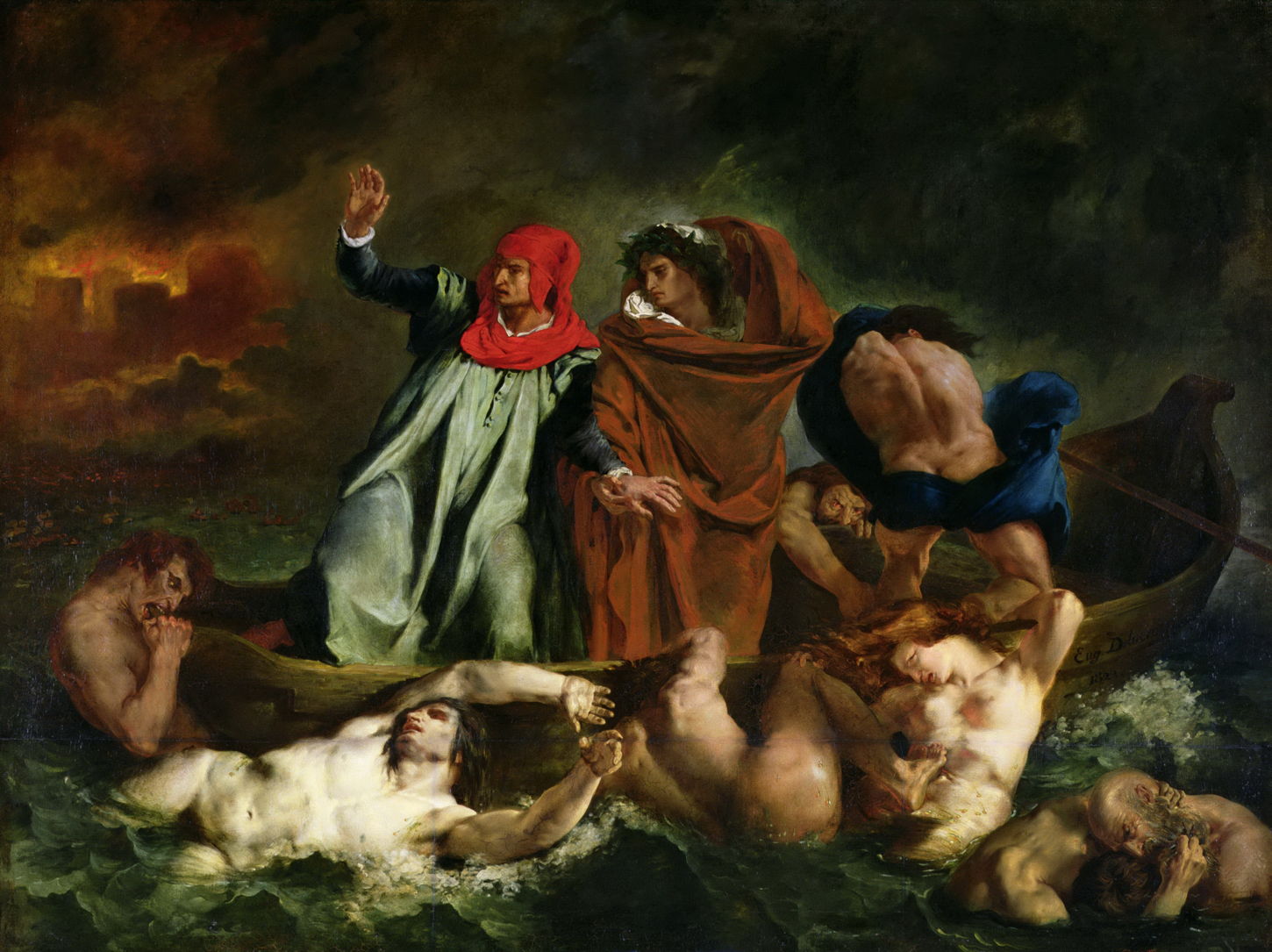
Eugène Delacroix (1798–1863), The Barque of Dante (Dante and Virgil in Hell) (1822), oil on canvas, 189 x 241 cm, Musée du Louvre, Paris. Wikimedia Commons.
They then cross the River Acheron in Charon’s ferryboat, and enter the First Circle of Limbo, a place of tranquil and calm. Here are the souls of those who led honourable lives before the Christian era, and others who never had the opportunity to follow Christ. These include the great classical writers: Homer, Horace the satirist, Ovid and Lucan. Together with Virgil, these five invite Dante himself to join them as the sixth among the ranks of great writers, in an ambitious piece of self-promotion.
Virgil leads Dante down to the Second Circle, for those guilty of the sin of lust.
William Blake (1757–1827), The Circle of the Lustful: Francesca da Rimini (The Whirlwind of Lovers) (c 1824), pen and watercolour over pencil, 36.8 x 52.2 cm, Birmingham Museums and Art Gallery, Birmingham, England. The Athenaeum.
Here the lustful are thrown around by vicious winds, and Dante hears the tragic story of Paolo and Francesca da Rimini, that inspired many fine paintings.
Gustave Doré (1832–1883) Paolo and Francesca da Rimini (1863), oil on canvas, 280.7 x 194.3 cm, Private collection. Wikimedia Commons.
Passing the three-headed dog-monster Cerberus, Virgil takes Dante on to the Third Circle, full of gluttons wallowing in stinking mud, under a constant deluge of rain, sleet and snow. In the Fourth Circle, they see a mixture of the avaricious and prodigals pushing great boulders in opposite directions.
William Blake (1757–1827), The Stygian Lake, with the Ireful Sinners Fighting (Dante’s Inferno) (1824-27) pen, ink and watercolour over pencil, dimensions not known, National Gallery of Victoria, Melbourne, Australia. Wikimedia Commons.
The Fifth Circle holds the swamp of the River Styx, in which sullen spirits are submerged and the wrathful fight one another. Dante and Virgil cross this in a boat piloted by Phlegyas, who deposits them at the gate to the city of Dis, entrance to the lower parts of Hell. The gate is slammed shut on them, and requires a messenger from Heaven to let them through.
William Blake (1757–1827), Farinata degli Uberti (Dante’s Inferno) (1824-27) media and dimensions not known, The British Museum, London. Wikimedia Commons.
Here Dante enters the Sixth Circle, for heretics who denied the soul’s immortality, among them the Florentine Farinata degli Uberti, who is imprisoned in a tomb. The pair are carried by Nessus the Centaur on to the Seventh Circle, for the violent.
William Blake (1757–1827), The Wood of the Self-Murderers: The Harpies and the Suicides (Dante’s Inferno) (1824-27), graphite, ink and watercolour on paper, dimensions not known, National Gallery of Victoria, Melbourne, Australia. Wikimedia Commons.
These not only include tyrannical warriors like Attila the Hun, murderers and bandits, but those whose violence was directed at their own lives in suicide, who are trees in a wood and kept in perpetual pain by harpies feeding on them. The pair then cross a desert on which fire rains to torment the souls of blasphemers, sodomites, and usurers.
William Blake (1757–1827), The Symbolic Figure of the Course of Human History Described by Virgil (Dante’s Inferno) (1824-27), further details not known. Wikimedia Commons.
Dante learns of a statue of an old man on Mount Ida, on the island of Crete, whose tears form the rivers of Hell.
Virgil guides Dante onto the back of Geryon, formerly a king slain by Hercules and condemned to suffer in Hell for his fraud, who flies the pair on to the Eighth Circle, for the fraudulent. This is divided into a series of rottenpockets, depressions in which different types of fraudster are confined. They pass through the areas for pimps, flatterers, corrupt religious leaders, sorcerers, corrupt officials and hypocrites.
William Blake (1757–1827), The Simonist Pope (Dante’s Inferno) (1824-27), watercolour, 52.5 x 36.8 cm, The Tate Gallery, London. Wikimedia Commons.
Among the corrupt religious leaders or simonists is Pope Nicholas III, who had been shamelessly nepotistic.
Joseph Anton Koch (1768-1839), Thieves (1825-28), fresco, dimensions not known, Casa Massimo, Rome, Italy. Image by Sailko, via Wikimedia Commons.
The later rottenpockets contain thieves, those who gave fraudulent counsel, those who sowed discord, and falsifiers and imposters of various kinds. Thieves are attacked repeatedly by snakes to undergo their own reptilian transformation.
Dante and Virgil are lowered into the Ninth Circle by Antaeus, one of the giants who stand guard around its periphery.
Gustave Doré (1832–1883), Dante and Virgil in the ninth circle of hell (1861), oil on canvas, 311 x 428 cm, Musée de Brou, Bourg-en-Bresse, France. Wikimedia Commons.
There is the lake of Cocytus, in which those guilty of treachery are frozen and suffering for eternity. These include souls of those who were treacherous against their relatives, their homeland, guests and benefactors.
William Blake (1757–1827), Count Ugolino and His Sons in Prison (c 1826), pen, tempera and gold on panel, 32.7 x 43 cm, Fitzwilliam Museum, University of Cambridge, Cambridge, England. The Athenaeum.
Among them is Count Ugolino, who sinks his teeth into the neck of Archbishop Ruggieri, who left him to starve to death in a cell.
Joseph Anton Koch (1768-1839), Hell (study for Casa Massimo frescoes) (c 1825), watercolour and gouche, dimensions and location not known. Wikimedia Commons.
The artists
William Blake (1757–1827) was a British visionary painter and illustrator whose last and incomplete work was an illustrated edition of the Divine Comedy for the painter John Linnell. Most of his works shown in this series were created for that, although he did draw and paint scenes during his earlier career. I have a major series on his work here.
Sandro Botticelli (1445–1510) was one of the leading painters of the early Southern Renaissance, working in his native city of Florence. In addition to his huge egg tempera masterpieces of i (c 1482) and The Birth of Venus (c 1485), he was a lifelong fan of Dante’s writings. He produced drawings which were engraved for the first printed edition of the Divine Comedy in 1481, but these weren’t successful, most copies only having two or three of the 19 which were engraved. He later began a manuscript illustrated edition on parchment, but few pages were ever fully illuminated.
William-Adolphe Bouguereau (1825–1905) was a precocious and highly-acclaimed academic painter who dominated the Salon in the late nineteenth century with his figurative works, often drawn from mythology. Classically-trained at the École des Beaux-Arts, he grew infamous for his nudes painted against false settings, and his vehement opposition to Impressionism. However, he taught at the Académie Julian, and worked tirelessly even when his paintings fell from favour.
Jean-Baptiste Camille Corot (1796–1875) was French, and one of the most prolific and greatest European landscape artists of the nineteenth century, who was key to the development of Impressionism. Following in the classical tradition, he also painted several narrative works set in those landscapes.
Eugène Delacroix (1798–1863) was a major French painter whose Romantic and painterly style laid the groundwork for the Impressionists. In addition to many fine easel works, he painted murals and was an accomplished lithographer too. Many of his paintings are narrative, and among the most famous is Liberty Leading the People from 1830. This article introduces a series featuring his major works.
Gustave Doré (1832–1883) was the leading French illustrator of the nineteenth century, whose paintings are still relatively unknown. Early in his career, he produced a complete set of seventy illustrations for translations of the Inferno, first published in 1857 and still being used. These were followed in 1867 by more illustrations for Purgatorio and Paradiso.This article looks at his paintings.
Joseph Anton Koch (1768-1839) was an Austrian landscape painter, who worked mainly in Neoclassical style. During his second stay in Rome, he was commissioned to paint frescos in the Villa Massimi on the walls of the Dante Room there, which remain one of the most florid visual accounts of Dante’s Inferno. He completed those between 1824-29. He also appears to have drawn a set of illustrations for Dante’s Inferno in about 1808.
Purgatory and Paradise
Although Heaven and Hell have clear biblical roots, the concept of Purgatory as part of the Christian life after death is more recent. It originated in the early Christian Church, flourished in the Middle Ages, and ripened only in the Catholic Church after the schism of Protestants in the Reformation during the sixteenth century. It can be seen as a route to Heaven for those who had sinned on earth, so long as they had confessed and repented.
Dante had much greater freedom in imagining what Purgatory might be, and adopted a physical structure that is the exact inverse of his vision of Hell: a mountain rising through seven terraces to culminate in a terrestrial paradise at the summit. Each terrace then accommodates a class of sin, rising from pride at the foot to lust just below Paradise.
The least-known of the three books in Dante’s Divine Comedy,Paradise was its most important to contemporary readers. Having given gruesome detail of what would await them in Inferno, and the penance they would have to pay in Purgatory, Paradise must be everyone’s ultimate aspiration. Dante invokes classical cosmology in nine concentric shells rather than the simple physical structures of the two previous realms, which for many readers is more nebulous.
Robin Kirkpatrick (trans) (2012) Dante, The Divine Comedy, Inferno, Purgatorio, Paradiso, Penguin Classics. ISBN 978 0 141 19749 4.
Richard Lansing (ed) (2000) The Dante Encyclopedia, Routledge. ISBN 978 0 415 87611 7.
Guy P Raffa (2009) The Complete Danteworlds, A Reader’s Guide to the Divine Comedy, Chicago UP. ISBN 978 0 2267 0270 4.
Prue Shaw (2014) Reading Dante, From Here to Eternity, Liveright. ISBN 978 1 63149 006 4.
Dante and Virgil move on from their encounter with Count Ugolino towards a great contraption that looks like a windmill from the distance. As they grow closer, they pass by shades of the dead frozen and stacked up.
Joseph Anton Koch (1768-1839), Hell (study for Casa Massimo frescoes) (c 1825), watercolour and gouche, dimensions and location not known. Wikimedia Commons.
Joseph Anton Koch (1768-1839), Lucifer (1825-28), fresco, dimensions not known, Casa Massimo, Rome, Italy. Image by Sailko, via Wikimedia Commons.
Joseph Anton Koch (1768-1839), Lucifer (detail) (1825-28), fresco, dimensions not known, Casa Massimo, Rome, Italy. Image by Sailko, via Wikimedia Commons.
Virgil then shows Dante the ruler of Hell, a huge giant frozen up to his chest. He has three faces: one looking forward is bright red, that on the right a dirty yellow, and on the left black. Behind each face is a pair of vane-like wings fanning the ice-cold wind blowing across Lake Cocytus.
William Blake (1757–1827), Lucifer, Canto 34 (Dante’s Inferno) (1824-27), further details not known. Wikimedia Commons.
Gustave Doré (1832–1883), Lucifer, King of Hell (c 1857), engraving, dimensions and location not known. Image by Karl Hahn, via Wikimedia Commons.
His six eyes are weeping, and each mouth is chewing one of the souls from that pit of Hell. Virgil points out that one of them, his legs protruding from Lucifer’s lips, is Judas Iscariot, who betrayed Jesus Christ for thirty pieces of silver. The other two are Brutus and Cassius being punished for their assassination of Julius Caesar.
Artist not known, illustration to Dante’s Divine Comedy, Canto 34 (c 1350), folio 48r, media and dimensions not known, Bibliotheca Gymnasii Altonani, Hamburg, Germany. Wikimedia Commons.
John Flaxman (1755–1826), Ruler of the Realm of Sadness (Divine Comedy) (1793), engraving by Tommaso Piroli from original drawing, media and dimensions not known, Cornell University Library, Ithaca, NY. Wikimedia Commons.
Virgil tells Dante that he has now seen the whole of Hell, and it’s time for them to leave. They make their way up some steps through a fissure in the rock.
Gustave Doré (1832–1883), Inferno Canto 34 (c 1857), engraving, dimensions and location not known. Wikimedia Commons.
Where Dante expects to see the body of Lucifer again, he sees just his legs.
Artist not known, illustration to Dante’s Divine Comedy, Canto 34 (c 1350), folio 48v, media and dimensions not known, Bibliotheca Gymnasii Altonani, Hamburg, Germany. Wikimedia Commons.
Virgil tells him they must move on quickly, now the sun is rising. They walk through a cavern, along a path long and arduous. Eventually they emerge below the stars. With that, Dante’s account of his visit to Hell is complete.
Filippo Napoletano (1589–1629), Dante and Virgil in the Underworld (1622), oil on slate, 44 × 60 cm, Private collection. Wikimedia Commons.
Wilhelm Trübner (1851–1917), Hell, Scene from Danté’s Divine Comedy (1880), oil on canvas, 137 x 249 cm, Museumslandschaft Hessen Kassel, Kassel, Germany. Wikimedia Commons.
The artists
William Blake (1757–1827) was a British visionary painter and illustrator whose last and incomplete work was an illustrated edition of the Divine Comedy for the painter John Linnell. Most of his works shown in this series were created for that, although he did draw and paint scenes during his earlier career. I have a major series on his work here.
Gustave Doré (1832–1883) was the leading French illustrator of the nineteenth century, whose paintings are still relatively unknown. Early in his career, he produced a complete set of seventy illustrations for translations of the Inferno, first published in 1857 and still being used. These were followed in 1867 by more illustrations for Purgatorio and Paradiso.This article looks at his paintings.
John Flaxman (1755–1826) was a British sculptor and draughtsman who occasionally painted too. When he was in Rome between 1787-91, he produced drawings for book illustrations, including a set of 111 for an edition of The Divine Comedy. In 1810, he was appointed the Professor of Sculpture to the Royal Academy in London, and in 1817 made drawings to illustrate Hesiod, which were engraved by William Blake.
Joseph Anton Koch (1768-1839) was an Austrian landscape painter, who worked mainly in Neoclassical style. During his second stay in Rome, he was commissioned to paint frescos in the Villa Massimi on the walls of the Dante Room there, which remain one of the most florid visual accounts of Dante’s Inferno. He completed those between 1824-29. He also appears to have drawn a set of illustrations for Dante’s Inferno in about 1808.
Filippo Napoletano (1589–1629), whose real name was Filippo Teodoro di Liagno, was an Italian painter who worked in Naples, Florence and Rome, mainly painting dramatic landscapes. He was a court painter to the Medicis from around 1617, who also painted a nocturne of the burning of Troy.
Wilhelm Trübner (1851–1917) was a successful realist painter who was born in Heidelberg and worked almost entirely in Germany. In 1872, with Hans Thoma and others he formed a circle who admired the work of Wilhelm Leibl (1844-1900). His peak is claimed to have occurred in the mid-1870s, and in 1901 he joined the Berlin Secession. During his later years he was a professor in Karlsruhe.
Robin Kirkpatrick (trans) (2012) Dante, The Divine Comedy, Inferno, Purgatorio, Paradiso, Penguin Classics. ISBN 978 0 141 19749 4.
Richard Lansing (ed) (2000) The Dante Encyclopedia, Routledge. ISBN 978 0 415 87611 7.
Guy P Raffa (2009) The Complete Danteworlds, A Reader’s Guide to the Divine Comedy, Chicago UP. ISBN 978 0 2267 0270 4.
Prue Shaw (2014) Reading Dante, From Here to Eternity, Liveright. ISBN 978 1 63149 006 4.
After meeting some political traitors, Dante and Virgil have come across Count Ugolino, who is gnawing the back of the head of Archbishop Ruggieri as a dog chews a bone. Their story is one of the most famous and horrific in the whole of the Divine Comedy.
Ugolino raises his mouth from the cleric’s head and wipes his lips on his victim’s hair. He then introduces himself and the Archbishop. He explains how he, a leading politician at the time, was imprisoned with his young sons and left to starve to death. In his hunger he tried gnawing his own hands, but his sons suggested that their father should eat them instead.
Pierino da Vinci (1530–1553), Count Ugolino and his Children in Prison, Visited by Hunger (date not known), pen and black ink, brown wash, and pierre noire, 24 x 23.7 cm, Musée des Beaux-Arts, Marseille, France. Wikimedia Commons.Jan van der Straet, alias Giovanni Stradano (1523-1605), Canto 33 (A) (1587), further details not known. Wikimedia Commons.Joseph Anton Koch (1768-1839), Count Ugolino and Archbishop Ruggieri (1825-28), fresco, dimensions not known, Casa Massimo, Rome, Italy. Image by Sailko, via Wikimedia Commons.William Blake (1757–1827), Count Ugolino and His Sons in Prison (c 1826), pen, tempera and gold on panel, 32.7 x 43 cm, Fitzwilliam Museum, University of Cambridge, Cambridge, England. The Athenaeum.
This glue tempera painting by William Blake is one of the few that isn’t taken from his last works illustrating the Divine Comedy, but is a prior work. Unfortunately, its equivalent in Blake’s last series got no further than a pencil sketch before the artist’s death.
Gustave Doré (1832–1883), Ugolino gnawing the Head of Ruggieri (c 1857), engraving, dimensions and location not known. Image by Karl Hahn, via Wikimedia Commons.
Ugolino stopped gnawing his own flesh, and sat in silence day after day, watching his sons die in front of him. By the time the last was dead, the Count himself had gone blind. Once confident there was no life left in their bodies, his hunger overcame his grief.
In history, Ugolino was born into a Ghibelline family in the city of Pisa. He soon changed allegiance to the Guelphs, whom he helped in their quest for power in Pisa. When that was unsuccessful, the Count was imprisoned and exiled, but later led Pisan naval forces against its rival Genoa, for which he was made Pisa’s leader.
In an act of political expediency, Ugolino then handed over Pisan castles to Lucca and Florence, following which he conspired with Ghibellines including Archbishop Ruggieri. This backfired on him, and the Archibishop had him imprisoned with his two sons, two grandsons, and another young man. After eight months there, the door was locked and nailed shut, and its key thrown into the river. Ugolino and the five young men died fairly quickly of starvation.
Joshua Reynolds (1723–1792), Count Ugolino and his Children in the Dungeon (1770-73), oil on canvas, 52 x 72 cm, The National Trust, Knole, England. Wikimedia Commons.
As far as I’m aware, this painting of Count Ugolino and his Children in the Dungeon is the only work by Joshua Reynolds taken from Dante’s Divine Comedy. Exhibited at the Royal Academy in 1773, nearly five hundred years after the death of the Count, I’m not aware that Reynolds had access to any contemporary images of his subject.
Artist not known, Portrait of Ugolino della Gherardesca (1775-78), engraving in Johann Caspar Lavater’s Fragments of Physiognomy, further details not known. Wikimedia Commons.
It’s therefore revealing that this slightly later copy was one of many images of the faces of the famous and infamous on which Lavater based his textbook of physiognomy, which in turn was popular among painters, making it a self-fulfilling fantasy.
Jan van der Straet, alias Giovanni Stradano (1523-1605), Canto 33 (B) (1587), further details not known. Wikimedia Commons.
Dante and Virgil move on from Ugolino’s tragedy to meet more traitors frozen into Lake Cocytus in Hell, as they make their way towards the bottom of its pit, and Lucifer himself.
The artists
William Blake (1757–1827) was a British visionary painter and illustrator whose last and incomplete work was an illustrated edition of the Divine Comedy for the painter John Linnell. Most of his works shown in this series were created for that, although he did draw and paint scenes during his earlier career. I have a major series on his work here.
Pierino da Vinci (1530–1553) was an Italian Renaissance sculptor, the son of Leonardo da Vinci’s younger brother. He died of malaria, which was still endemic in much of Europe at that time, at the age of only 23, leaving few examples of his work.
Gustave Doré (1832–1883) was the leading French illustrator of the nineteenth century, whose paintings are still relatively unknown. Early in his career, he produced a complete set of seventy illustrations for translations of the Inferno, first published in 1857 and still being used. These were followed in 1867 by more illustrations for Purgatorio and Paradiso.This article looks at his paintings.
Joseph Anton Koch (1768-1839) was an Austrian landscape painter, who worked mainly in Neoclassical style. During his second stay in Rome, he was commissioned to paint frescos in the Villa Massimi on the walls of the Dante Room there, which remain one of the most florid visual accounts of Dante’s Inferno. He completed those between 1824-29. He also appears to have drawn a set of illustrations for Dante’s Inferno in about 1808.
Johann Caspar Lavater (1741-1801) was a Swiss poet and philosopher who was a friend of the painter Henry Fuseli. Between 1775-78, he published an early textbook on physiognomy, in which he related physical appearance, particularly of the face, to specific character traits of individuals. He did this using many illustrations of famous and infamous people. This attracted a popular following, including many artists.
Sir Joshua Reynolds (1723–1792) was the major portrait painter of his day, one of the co-founders and first president of the Royal Academy of Arts in London. He enjoyed royal patronage, and moved in the highest of artistic circles. However, his work and teaching were lambasted by William Blake, and some of his paintings have suffered serious problems in their paint layer as a result of his experimentation with pigments and technique.
Jan van der Straet, also commonly known by his Italianised name of Giovanni Stradano (1523-1605), was a painter who started his career in Bruges and Antwerp in Belgium, but moved to Florence in 1550, where he worked for the remainder of his life. Mannerist in style, he worked with printmakers in Antwerp to produce collections of prints, including an extensive set for The Divine Comedy.
Robin Kirkpatrick (trans) (2012) Dante, The Divine Comedy, Inferno, Purgatorio, Paradiso, Penguin Classics. ISBN 978 0 141 19749 4.
Richard Lansing (ed) (2000) The Dante Encyclopedia, Routledge. ISBN 978 0 415 87611 7.
Guy P Raffa (2009) The Complete Danteworlds, A Reader’s Guide to the Divine Comedy, Chicago UP. ISBN 978 0 2267 0270 4.
Prue Shaw (2014) Reading Dante, From Here to Eternity, Liveright. ISBN 978 1 63149 006 4.
After Dante and Virgil have heard the story of an alchemist who claimed to be able to transform base metals into gold, Dante mentions examples of those who have fallen victim to sudden changes of fate, in Thebes and Troy. But none compares to two of the spirits who sink their teeth into the flesh of others in this tenth rottenpocket. One is named as Gianni Schicchi, a Florentine fraudster who once impersonated a dead man to draw up a false will.
William-Adolphe Bouguereau (1825–1905), Dante and Virgil In Hell (1850), oil on canvas, 280.5 x 225.3 cm, Musée d’Orsay, Paris. Wikimedia Commons.Gustave Doré (1832–1883), Inferno Canto 30 verse 33 (c 1857), engraving, dimensions and location not known. Wikimedia Commons.
The other is Myrrha, who had incestuous desires for her father so passed herself off as another woman in order to sleep with him. Myrrha was transformed into the tree of that name, and her son was Adonis, the much-admired lover of Venus.
Gustave Doré (1832–1883), Inferno Canto 30 verse 38 (c 1857), engraving, dimensions and location not known. Wikimedia Commons.
They also see Adam a notorious counterfeiter, Sinon the Greek who persuaded the Trojans to bring the wooden horse into their city, and Potiphar’s wife, who repeatedly tried to seduce Joseph before accusing him of trying to seduce her.
Virgil leads Dante on from the eighth circle of Hell towards the next, for the treacherous. As they approach in fog they hear a deafening horn, and Dante then sees what he thinks are the towers of a distant town; Virgil tells him that they are giants who stand circling the rim of Hell, among them the Titans who waged war against the gods of Olympus.
Gustave Doré (1832–1883), Inferno Canto 31 Titans and Giants (c 1857), engraving, dimensions and location not known. Wikimedia Commons.
One of them, Antaeus, takes first Virgil then Dante in his hand to carry them onto Cocytus, the frozen lake forming the ninth circle of Hell.
William Blake (1757–1827), Antaeus Setting Down Dante and Virgil (Dante’s Inferno) (1824-26), ink and watercolour on paper, dimensions not known, National Gallery of Victoria, Melbourne, Australia. Wikimedia Commons.Gustave Doré (1832–1883), The Giant Antaeus lowering Dante and Virgil (c 1857), engraving, dimensions and location not known. Image by Karl Hahn, via Wikimedia Commons.
Here, Dante finds contemporaries who betrayed their kin. Among them are two frozen together almost as one, the Tuscan Sassolo Mascheroni who murdered his cousin for an inheritance, and Camiscion de’ Pazzi who murdered his cousin for property.
Henry Fuseli (1741–1825), Dante and Virgil on the Ice of Kocythos (1774), pen and sepia, watercolour, 39 x 27.4 cm, Kunsthaus Zürich, Zürich, Switzerland. Wikimedia Commons.Gustave Doré (1832–1883), Dante and Virgil in the ninth circle of hell (1861), oil on canvas, 311 x 428 cm, Musée de Brou, Bourg-en-Bresse, France. Wikimedia Commons.Gustave Doré (1832–1883), Inferno Canto 32 verse 97 (c 1857), engraving, dimensions and location not known. Wikimedia Commons.
Next they meet political traitors, including Bocca degli Abati, a Guelph who aided the opposing Ghibellines. They eventually come across Count Ugolino, who is gnawing the back of the head of Archbishop Ruggieri just like a dog chewing a bone. Their story opens the next article in this series.
The artists
William Blake (1757–1827) was a British visionary painter and illustrator whose last and incomplete work was an illustrated edition of the Divine Comedy for the painter John Linnell. Most of his works shown in this series were created for that, although he did draw and paint scenes during his earlier career. I have a major series on his work here.
William-Adolphe Bouguereau (1825–1905) was a precocious and highly acclaimed academic painter who dominated the Salon in the late nineteenth century with his figurative works, often drawn from mythology. Classically trained at the École des Beaux-Arts, he grew infamous for his nudes painted against false settings, and his vehement opposition to Impressionism. However, he also taught at the Académie Julian, and worked tirelessly even when his paintings fell from favour.
Gustave Doré (1832–1883) was the leading French illustrator of the nineteenth century, whose paintings are still relatively unknown. Early in his career, he produced a complete set of seventy illustrations for translations of the Inferno, first published in 1857 and still being used. These were followed in 1867 by more illustrations for Purgatorio and Paradiso.This article looks at his paintings.
Henry Fuseli (1741–1825) was a Swiss artist (originally Johann Heinrich Füssli) who first came to Britain in 1765, where he worked for much of his life. A successful portraitist and figurative painter, many of his works show the supernatural usually in melodramatic chiaroscuro and were unusual for the time. A professor of painting at the Royal Academy in London, his pupils included John Constable and William Etty, and he was an influence on William Blake. I have two articles about his career and extraordinary work, here and here.
Robin Kirkpatrick (trans) (2012) Dante, The Divine Comedy, Inferno, Purgatorio, Paradiso, Penguin Classics. ISBN 978 0 141 19749 4.
Richard Lansing (ed) (2000) The Dante Encyclopedia, Routledge. ISBN 978 0 415 87611 7.
Guy P Raffa (2009) The Complete Danteworlds, A Reader’s Guide to the Divine Comedy, Chicago UP. ISBN 978 0 2267 0270 4.
Prue Shaw (2014) Reading Dante, From Here to Eternity, Liveright. ISBN 978 1 63149 006 4.
After they have talked with the notorious thief Vanni Fucci, Dante and Virgil move on and meet a centaur, identified by Virgil as Cacus, who had been killed by Hercules. Dante’s classical reference here is a little strange in that he gives an account of the killing of Cacus according to Livy, rather than Virgil’s version in his Aeneid.
John Flaxman (1755–1826), And I Saw a Centaur (Divine Comedy) (1793), engraving by Tommaso Piroli from original drawing, media and dimensions not known, Cornell University Library, Ithaca, NY. Wikimedia Commons.William Blake (1757–1827), The Centaur Cacus Threatens Vanni Fucci (Dante’s Inferno) (1824-27), watercolour, 52.5 x 37 cm, The Tate Gallery, London. Wikimedia Commons.
The centaur flees, leaving the pair to meet three more tormented souls. A lizard-like creature then attaches itself to one of them named Agnello, a member of a prominent Florentine Ghibelline family, and their two bodies become one. Another is pierced by a serpent through his navel, and Dante witnesses other horrific reptilian transformations.
Jan van der Straet, alias Giovanni Stradano (1523-1605), Canto 25 (1587), further details not known. Wikimedia Commons.Gustave Doré (1832–1883), Agnello changing into a Serpent (c 1857), engraving, dimensions and location not known. Image by Karl Hahn, via Wikimedia Commons.
Having found five citizens of Florence in this rottenpocket of Hell, Virgil leads Dante through shattered rock to the eighth, where each of the souls is burning with fire in the pit in return for their fraudulent lives.
Gustave Doré (1832–1883), The Flaming Spirits of the Evil Counsellors (c 1857), engraving, dimensions and location not known. Image by Karl Hahn, via Wikimedia Commons.
Virgil explains that among them are Ulysses and Diomedes, who are united in a single flame, telling an invented story of their final and fateful voyage. Dante didn’t have direct access to Homeric accounts of the adventures of Odysseus, so based this on Virgil’s contrasting retelling of the deception of the Trojan horse.
William Blake (1757–1827), Ulysses, Canto 26 (Dante’s Inferno) (1824-27), pen and ink and watercolour over pencil, 52.5 x 37 cm, The Tate Gallery, London. Wikimedia Commons.
After that, another flame identifies itself as Guido da Montefeltro, and relates some of its life as a sly Ghibelline military leader who later repented and became a Franciscan friar.
Virgil takes Dante on to the ninth rottenpocket, where those who used fraud to incite division are suffering for their crimes. The gruesome sight awaiting them here is of gross mutilations, bodies chopped up and torn apart so that their organs spill out. They meet a succession of dismembered and dissected spirits, including Mosca de’ Lamberti, both of whose hands have been cut off. He had been responsible for creating the rift between Guelphs and Ghibellines that scarred Florentine history for so long. Another body passes by carrying its severed head like a lantern from one of its hands. The head tells them that he is Bertran de Born, a Provençal troubadour who sowed discord between King Henry II of England and his son Prince Henry.
John Flaxman (1755–1826), Bertrand de Born (Divine Comedy) (1793), engraving by Tommaso Piroli from original drawing, media and dimensions not known, Cornell University Library, Ithaca, NY. Wikimedia Commons.Gustave Doré (1832–1883), The Severed Head of Bertrand de Born Speaks (c 1857), engraving, dimensions and location not known. Image by Karl Hahn, via Wikimedia Commons.
Dante is so astonished by this display of butchery that he stands and stares at the bodies, but Virgil reminds him that they must move on.
Gustave Doré (1832–1883), Virgil Reproves Dante’s Curiosity (c 1857), engraving, dimensions and location not known. Image by Karl Hahn, via Wikimedia Commons.
The pair then reach a viewpoint over the last of the rottenpockets, from which arises a foul smell. The souls there are all covered with festering sores and scabs, and can only crawl over one another.
William Blake (1757–1827), The Pit of Disease: The Falsifiers (Dante’s Inferno) (c 1824), ink and watercolour on paper, 37.2 x 52.7 cm, The Tate Gallery, London. Wikimedia Commons.
There they hear the story of Capocchio, an alchemist who falsely claimed to be able to transform base metals into gold.
The artists
William Blake (1757–1827) was a British visionary painter and illustrator whose last and incomplete work was an illustrated edition of the Divine Comedy for the painter John Linnell. Most of his works shown in this series were created for that, although he did draw and paint scenes during his earlier career. I have a major series on his work here.
Gustave Doré (1832–1883) was the leading French illustrator of the nineteenth century, whose paintings are still relatively unknown. Early in his career, he produced a complete set of seventy illustrations for translations of the Inferno, first published in 1857 and still being used. These were followed in 1867 by more illustrations for Purgatorio and Paradiso.This article looks at his paintings.
John Flaxman (1755–1826) was a British sculptor and draughtsman who occasionally painted too. When he was in Rome between 1787-91, he produced drawings for book illustrations, including a set of 111 for an edition of The Divine Comedy. In 1810, he was appointed the Professor of Sculpture to the Royal Academy in London, and in 1817 made drawings to illustrate Hesiod, which were engraved by William Blake.
Jan van der Straet, also commonly known by his Italianised name of Giovanni Stradano (1523-1605), was a painter who started his career in Bruges and Antwerp in Belgium, but moved to Florence in 1550, where he worked for the remainder of his life. Mannerist in style, he worked with printmakers in Antwerp to produce collections of prints, including an extensive set for The Divine Comedy.
Robin Kirkpatrick (trans) (2012) Dante, The Divine Comedy, Inferno, Purgatorio, Paradiso, Penguin Classics. ISBN 978 0 141 19749 4.
Richard Lansing (ed) (2000) The Dante Encyclopedia, Routledge. ISBN 978 0 415 87611 7.
Guy P Raffa (2009) The Complete Danteworlds, A Reader’s Guide to the Divine Comedy, Chicago UP. ISBN 978 0 2267 0270 4.
Prue Shaw (2014) Reading Dante, From Here to Eternity, Liveright. ISBN 978 1 63149 006 4.
When a group of devils armed with long hooks threatens Dante, Virgil hurries him along towards the next rottenpocket in Hell. They work their way around some of the damage wrought by Christ’s harrowing of Hell following his crucifixion. With those devils still hanging around, they then reach a pit of boiling tar, in which the spirits of barrators are trapped. These had traded in public office and bought influence in courts of law.
The devils pull out one of the souls for Dante and Virgil to talk to, but quickly return to hacking with their hooks.
John Flaxman (1755–1826), Canto 22 (Divine Comedy) (1793), engraving by Tommaso Piroli from original drawing, media and dimensions not known, Cornell University Library, Ithaca, NY. Wikimedia Commons.Gustave Doré (1832–1883), Inferno Canto 23 verses 52-54 (c 1857), engraving, dimensions and location not known. Wikimedia Commons.
Unlike others, he springs free and escapes their lunges as he plunges back into the pitch.
Gustave Doré (1832–1883), Inferno Canto 22 verses 137-139 (c 1857), engraving, dimensions and location not known. Wikimedia Commons.Gustave Doré (1832–1883), Ciampolo Escaping from the Demon Alichino (c 1857), engraving, dimensions and location not known. Image by Karl Hahn, via Wikimedia Commons.
Dante and Virgil leave the devils attacking other barrators, and walk on in silence. Dante reflects on one of Aesop’s fables about the frog, the rat and the hawk. He blames himself for the tormenting of the devils behind them, but as he looks back he sees them on the wing again heading towards them. As they cross into the next rottenpocket, they realise the pack of devils can’t pursue them beyond that point.
Next are hypocrites, who are dressed up in hooded habits like monks. Although those are coloured bright gold, they’re weighted with lead, forcing the hypocrites into eternal labour against the mass of their clothes.
Gustave Doré (1832–1883), The Hypocrites Address Dante (c 1857), engraving, dimensions and location not known. Image by Karl Hahn, via Wikimedia Commons.
Dante meets two Bolognese friars, Catalano de’ Malavolti and Loderingo degli Andalò, who formed a fake religious order. They point out a figure staked out naked on the ground, who is Caiaphas, the High Priest of Jerusalem who advised scribes and pharisees that Christ’s death would be a good solution.
Jan van der Straet, alias Giovanni Stradano (1523-1605), Hypocrites, Canto 22 (1588), further details not known. Image by Sailko, via Wikimedia Commons.Gustave Doré (1832–1883), Inferno Canto 23 verses 117-120 (c 1857), engraving, dimensions and location not known. Wikimedia Commons.
Virgil moves Dante on towards the damaged crossing to the next rottenpocket for thieves. After negotiating their descent, Dante sees its pit full of snakes, binding the hands of the souls there and covering their naked bodies.
A snake strikes one of the sinners at the back of the neck, causing the ghost to burst into flames then turn into ash, which falls onto the ground and reconstitutes itself.
John Flaxman (1755–1826), Thieves Tortured by Serpents (Divine Comedy) (1793), engraving by Tommaso Piroli from original drawing, media and dimensions not known, Cornell University Library, Ithaca, NY. Wikimedia Commons.Joseph Anton Koch (1768-1839), Thieves (1825-28), fresco, dimensions not known, Casa Massimo, Rome, Italy. Image by Sailko, via Wikimedia Commons.
There they talk with one of the thieves by the name of Vanni Fucci, a black Guelph from Pistoia near Florence who had stolen holy objects from a chapel and betrayed an accomplice for execution in his place. The snakes then take charge of him, winding their coils around his neck and body, and putting him into a reptile straightjacket.
Dante and Virgil move on and meet a centaur.
The artists
William Blake (1757–1827) was a British visionary painter and illustrator whose last and incomplete work was an illustrated edition of the Divine Comedy for the painter John Linnell. Most of his works shown in this series were created for that, although he did draw and paint scenes during his earlier career. I have a major series on his work here.
Gustave Doré (1832–1883) was the leading French illustrator of the nineteenth century, whose paintings are still relatively unknown. Early in his career, he produced a complete set of seventy illustrations for translations of the Inferno, first published in 1857 and still being used. These were followed in 1867 by more illustrations for Purgatorio and Paradiso.This article looks at his paintings.
John Flaxman (1755–1826) was a British sculptor and draughtsman who occasionally painted too. When he was in Rome between 1787-91, he produced drawings for book illustrations, including a set of 111 for an edition of The Divine Comedy. In 1810, he was appointed the Professor of Sculpture to the Royal Academy in London, and in 1817 made drawings to illustrate Hesiod, which were engraved by William Blake.
Joseph Anton Koch (1768-1839) was an Austrian landscape painter, who worked mainly in Neoclassical style. During his second stay in Rome, he was commissioned to paint frescos in the Villa Massimi on the walls of the Dante Room there, which remain one of the most florid visual accounts of Dante’s Inferno. He completed those between 1824-29. He also appears to have drawn a set of illustrations for Dante’s Inferno in about 1808.
Bartolomeo Pinelli (1781-1835) was a Roman illustrator and engraver who provided illustrations for a great many books, and specialised in the city of Rome. He made 145 prints to illustrate Dante’s Divine Comedy, most probably in the early nineteenth century.
Jan van der Straet, also commonly known by his Italianised name of Giovanni Stradano (1523-1605), was a painter who started his career in Bruges and Antwerp in Belgium, but moved to Florence in 1550, where he worked for the remainder of his life. Mannerist in style, he worked with printmakers in Antwerp to produce collections of prints, including an extensive set for The Divine Comedy.
Robin Kirkpatrick (trans) (2012) Dante, The Divine Comedy, Inferno, Purgatorio, Paradiso, Penguin Classics. ISBN 978 0 141 19749 4.
Richard Lansing (ed) (2000) The Dante Encyclopedia, Routledge. ISBN 978 0 415 87611 7.
Guy P Raffa (2009) The Complete Danteworlds, A Reader’s Guide to the Divine Comedy, Chicago UP. ISBN 978 0 2267 0270 4.
Prue Shaw (2014) Reading Dante, From Here to Eternity, Liveright. ISBN 978 1 63149 006 4.
The appearance of new objects or unexpected phenomena in the sky was an event of great significance in the past, and often considered to be a portent of the future, good or bad. This article considers the few that were recorded in paintings, and starts with the most famous of all, the star of Bethlehem that appears in many depictions of the birth of Christ.
The linked stories of the birth of Christ in a shed at Bethlehem, and the subsequent adoration of the infant by three wise men, kings or Magi “from the east”, are among the most popular and enduring among paintings in the Christian canon. The outlines given in the Gospels of Luke, chapter 2, and Matthew, chapter 2, have conventionally become elaborated.
Three wise men had seen a new star, possibly a comet or an unusually bright planet, which they believed would lead them to the birth of a great prophet. They travelled by the guidance of that star, to arrive at Bethlehem. There they found the newborn Christ with Mary his mother, paid homage to him in the shed in which the holy family was lodging, and presented their gifts of gold, frankincense, and myrrh.
Giotto di Bondone (1266–1337), The Adoration of the Magi (c 1305), fresco, approx 200 x 185 cm, Scrovegni Chapel, Padua. Wikimedia Commons.
Giotto’s Adoration of the Magi from about 1305 shows the star as a celestial ball of fire streaking across the sky, and the three wise men pay their respects to the newborn Christ and his mother.
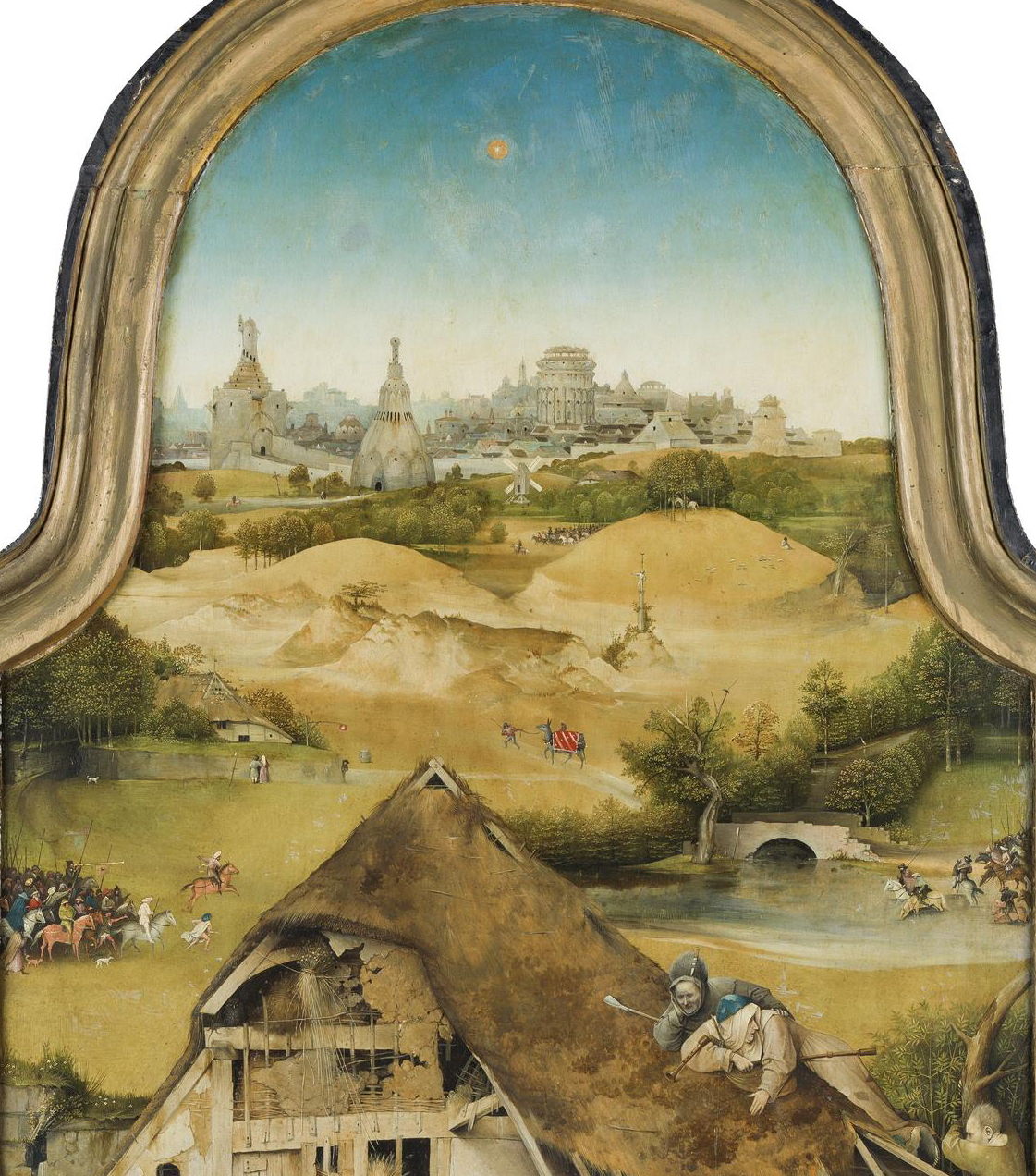
Hieronymus Bosch (c 1450–1516), The Adoration of the Magi (Interior) (Saint Peter with donor, The Adoration of the Magi, Saint Agnes with donor) (1490-1500) (CR no. 9), oil on oak panel, 138 cm x 138 cm overall when open, Museo Nacional del Prado, Madrid. Wikimedia Commons.
Above Bosch’s view of the local Brabant countryside in his Adoration of the Magi of 1490-1500 he places a more modest and stationary star shining bright over its distant city, as shown in the detail below.
Hieronymus Bosch (c 1450–1516), The Adoration of the Magi (detail) (centre panel) (The Adoration of the Magi) (1490-1500) (CR no. 9), oil on oak panel, 138 cm x 138 cm overall when open, Museo Nacional del Prado, Madrid. Wikimedia Commons.William Blake (1757–1827), Adoration of the Kings (1799), tempera on canvas, 25.7 x 37 cm, Brighton and Hove Museums & Art Galleries, Brighton, England. The Athenaeum.
Blake’s version of the Adoration of the Kings is conventional in showing the three wise men presenting their gifts to Jesus and his parents. At the left, outside, shepherds are tending to their flocks of sheep beneath a stylised star, and at the right are the ox and ass.
There remains controversy over what celestial event might have occurred at the time.
Very few paintings show known events in the sky, and I know of only one depicting a full solar eclipse.
Enrique Simonet Lombardo (1866–1927), Eclipse (1905), oil on canvas, 75 x 55 cm, location not known. Wikimedia Commons.
Although many painters, particularly the Impressionists, have shown fleeting effects of light and the occasional rainbow, Enrique Simonet took the opportunity of a solar eclipse on 30 August 1905 to paint his Eclipse (1905). This was visible across eastern and northern Spain between about 1300 and 1320 UTC, and this painting is one of its few remaining records.
Realistic paintings of comets are also rare, and unimpressive.
William Dyce (1806–1864), Pegwell Bay, Kent – a Recollection of October 5th 1858 (c 1858), oil on canvas, 635 cm x 889 cm, The Tate Gallery, London. Wikimedia Commons.
Generally acclaimed as William Dyce’s finest painting, Pegwell Bay, Kent – a Recollection of October 5th 1858 (c 1858) shows this bay on the Kent coast, during a family holiday visit: a coastal scene worked up into a large finished oil painting. Although not easily seen in this image, there’s a small point of light high in the middle of the sky which is Donati’s comet, not due to return until 3811. Couple that with the inclination of the sun and the state of the tide, and you should be able to place this view precisely in both time and space, and confirm that it does indeed show this bay on 5 October 1858.
A few paintings show impossible celestial events.
John Martin (1789–1854), The Deluge (1834), oil on canvas, 168.3 x 258.4 cm, Yale Center for British Art, New Haven, CT. Wikimedia Commons.
John Martin’s painting of The Deluge from 1834 has two points of reference: the Biblical account of the flood, and Martin’s personal belief in prior catastrophe. As the sciences became ascendant during the nineteenth century, some educated people believed that in the past there had been an alignment of the sun, earth, and moon, and the collision of a comet resulting in global flooding. This was promoted by the French natural scientist Baron Georges Cuvier, and subscribed to by Martin.
True to form, his painting is dark and apocalyptic: near the centre, tiny survivors are just about to be overwhelmed by an immense wave bearing down at them from the left and above. The misaligned sun and moon barely penetrate the dense cloud, and to the top right is a melée of rock avalanche and lightning bolt. This was awarded a gold medal at the Paris Salon of 1835.
Paul Nash (1892–1946), Landscape of the Vernal Equinox (III) (1944), oil on canvas, 63.5 x 76.2 cm, Scottish National Gallery of Modern Art, Edinburgh, Scotland. The Athenaeum.
Several of Paul Nash’s surrealist landscapes show the moon in its phases, among them Landscape of the Vernal Equinox (III) from 1944, which presents the impossible view of a full moon and the sun visible close together and just above the horizon.
In their descent into the depths of Hell, Virgil and Dante have just entered circle eight for those who committed fraud in its broadest sense. This consists of what Dante refers to as malebolge, best translated as rottenpockets, a series of ten deep trenches each of which caters for a different type of fraud. Dante compares these to the defensive earthworks surrounding the outer walls of castles of the day.
Virgil leads Dante into the first of these rottenpockets, where souls are being lashed by demons to keep them moving constantly. These are pimps and seducers, among whom is a Bolognese man, a Guelph, who pimped his sister, the beautiful Ghisolabella, for political gain.
The pair move on past other sinners being scourged, where they see Jason, who seduced then abandoned the young Hypsipyle, queen of Lemnos, and later did the same with Medea. They then enter the second rottenpocket, for flatterers, who are wallowing in excrement.
Jan van der Straet, alias Giovanni Stradano (1523-1605), Canto 18 (1587), further details not known. Image by Sailko, via Wikimedia Commons.Gustave Doré (1832–1883), Inferno Canto 18 verses 116-117 (c 1857), engraving, dimensions and location not known. Wikimedia Commons.
They find a contemporary figure from Lucca, and see Thaïs, a Greek courtesan who notoriously flattered her partners. She is now covered in filth and thoroughly crabby.
Gustave Doré (1832–1883), Virgil shows Dante the Shade of Thaïs (c 1857), engraving, dimensions and location not known. Image by Karl Hahn, via Wikimedia Commons.
In the third rottenpocket, Dante and Virgil come across corrupt religious leaders or Simonists, who sold church privileges, and are trapped headfirst in rock holes, their protruding feet being roasted with flames. The key figure here is Pope Nicholas III, who at first confuses Dante with Pope Boniface VIII, who is also in the same rottenpocket. Pope Nicholas was known for his nepotism, which included appointing three of his own family as cardinals.
William Blake (1757–1827), The Simonist Pope (Dante’s Inferno) (1824-27), watercolour, 52.5 x 36.8 cm, The Tate Gallery, London. Wikimedia Commons.Gustave Doré (1832–1883), Dante Addresses Pope Nicholas III (c 1857), engraving, dimensions and location not known. Image by Karl Hahn, via Wikimedia Commons.
Virgil carries Dante on to the fourth rottenpocket, reserved for soothsayers. Their heads are turned to face backwards, so that the tears streaming from their eyes wet their buttocks.
Jan van der Straet, alias Giovanni Stradano (1523-1605), Canto 20 (1587), further details not known. Wikimedia Commons.
Virgil identifies several of them from classical times, including the Theban Tiresias; Dante recounts how he became a soothsayer after he had twice changed gender, as told by Ovid in his Metamorphoses. The list concludes with three near-contemporaries: Michael Scot, a scholar and astrologer to Emperor Frederick II, and two well-known Italians.
The fifth rottenpocket they find to be filled with corrupt public officials, or barrators, who sold public appointments and are immersed in a sea of boiling pitch, while being further tormented by a pack of vicious devils known as malebranche, ‘evil-claws’.
Giotto di Bondone (–1337), Devils Over City Landscape, detail of The Devotion of the Devils from Arezzo, scene in The Life of Saint Francis of Assisi (1296-1298), fresco, dimensions not known, Basilica di San Francesco d’Assisi, Assisi, Italy. Wikimedia Commons.
The latter are armed with long hooks, which they use to push the souls down into the pitch, much as you might push down lumps of meat that rise to the surface of a stew. Those devils are so evil as to threaten Dante, so Virgil whisks him on to the next rottenpocket for hypocrites.
Gustave Doré (1832–1883), The Demons Threaten Virgil (c 1857), engraving, dimensions and location not known. Image by Karl Hahn, via Wikimedia Commons.
Any resemblance to real persons, living or dead, is not only intentional, but of their own making.
The artists
William Blake (1757–1827) was a British visionary painter and illustrator whose last and incomplete work was an illustrated edition of the Divine Comedy for the painter John Linnell. Most of his works shown in this series were created for that, although he did draw and paint scenes during his earlier career. I have a major series on his work here.
Gustave Doré (1832–1883) was the leading French illustrator of the nineteenth century, whose paintings are still relatively unknown. Early in his career, he produced a complete set of seventy illustrations for translations of the Inferno, first published in 1857 and still being used. These were followed in 1867 by more illustrations for Purgatorio and Paradiso.This article looks at his paintings.
Giotto di Bondone (c 1267–1337) was one of the great masters who bridged between the late Middle Ages and the early Renaissance. He was born near Florence, and is reputed from about 1296 to have painted a cycle of frescoes in the Basilica di San Francesco d’Assisi, in Assisi. This is hotly disputed though, and those may have been painted by Cimabue instead. The scene of The Devotion of the Devils from Arezzo shows what may, directly or indirectly, have been an inspiration to Dante, although I don’t know whether there is any evidence that the poet ever visited Assisi.
Jan van der Straet, also commonly known by his Italianised name of Giovanni Stradano (1523-1605), was a painter who started his career in Bruges and Antwerp in Belgium, but moved to Florence in 1550, where he worked for the remainder of his life. Mannerist in style, he worked with printmakers in Antwerp to produce collections of prints, including an extensive set for The Divine Comedy.
Robin Kirkpatrick (trans) (2012) Dante, The Divine Comedy, Inferno, Purgatorio, Paradiso, Penguin Classics. ISBN 978 0 141 19749 4.
Richard Lansing (ed) (2000) The Dante Encyclopedia, Routledge. ISBN 978 0 415 87611 7.
Guy P Raffa (2009) The Complete Danteworlds, A Reader’s Guide to the Divine Comedy, Chicago UP. ISBN 978 0 2267 0270 4.
Prue Shaw (2014) Reading Dante, From Here to Eternity, Liveright. ISBN 978 1 63149 006 4.
From their tragic encounter with tormented souls in the Suicide Wood, Virgil leads Dante onto a barren and sandy plain, where groups of spirits are in different postures, naked under steady showers of flakes of fire. These fall on their flesh, and set the sand afire underneath them. They are being punished for their differing acts of violence against God: blasphemers lie flat on their backs, sodomites are moving at all times, and usurers crouch with purses strung from their necks.
Gustave Doré (1832–1883), The Violent, Tortured in the Rain of Fire (c 1857), engraving, dimensions and location not known. Image by Karl Hahn, via Wikimedia Commons.
The two talk with Capaneus, a huge man who was once a powerful king and waged war against the city of Thebes, and a blasphemer who was struck by a thunderbolt for his arrogance towards the (classical and pagan) gods.
Gustave Doré (1832–1883), Brunetto Latini accosts Dante (c 1857), engraving, dimensions and location not known. Image by Karl Hahn, via Wikimedia Commons.
Among the sodomites is the prominent Guelph encyclopaedist Brunetto Latini (c 1220-94), who may well have been Dante’s mentor at one time. Also identified are Priscian a Latin grammarian, Francesco d’Accorso a legal scholar, and Andrea de’ Mozzi a bishop of Florence, together with three other Florentines.
Virgil explains some more of the topography of Hell, how waters originating from a statue on Mount Idaeus (Ida) on the island of Crete flow down to form its three principal rivers, the Acheron, Styx and Phlegethon. The statue of the Old Man of Crete has a gold head, silver arms, brass torso, and iron below, apart from a terracotta foot. This follows the mythical ‘ages of mankind’ in descent, and its tears feed the waters of Hell.
John Flaxman (1755–1826), Inside the Mountain (Divine Comedy) (1793), engraving by Tommaso Piroli from original drawing, media and dimensions not known, Cornell University Library, Ithaca, NY. Wikimedia Commons.William Blake (1757–1827), The Symbolic Figure of the Course of Human History Described by Virgil (Dante’s Inferno) (1824-27), further details not known. Wikimedia Commons.
Dante is next led down towards a vile monster with the face of an honest man but the body of a serpent, its body seemingly tattooed with knots and whorls, and a sting at the end of its great tail: this is Geryon, in classical myth a cruel king who was killed by Hercules, and here forming an image of fraud.
Before reaching that monster, the pair see some usurers on the ground. They are identified as contemporary members of prominent Florentine and Paduan families known for their riches and usury.
Gustave Doré (1832–1883), Inferno Canto 17 verse 7 (c 1857), engraving, dimensions and location not known. Wikimedia Commons.
Virgil then jumps onto Geryon’s back, and encourages Dante to have courage to join him there. Once they have both boarded, Virgil tells Geryon to fly off, and the monster carries them down through a hundred spiralling turns to the foot of a high cliff.
Virgil and Dante have now descended to circle eight.
The artists
William Blake (1757–1827) was a British visionary painter and illustrator whose last and incomplete work was an illustrated edition of the Divine Comedy for the painter John Linnell. Most of his works shown in this series were created for that, although he did draw and paint scenes during his earlier career. I have a major series on his work here.
Gustave Doré (1832–1883) was the leading French illustrator of the nineteenth century, whose paintings are still relatively unknown. Early in his career, he produced a complete set of seventy illustrations for translations of the Inferno, first published in 1857 and still in current use. They were followed in 1867 by more illustrations for Purgatorio and Paradiso.This article looks at his paintings.
John Flaxman (1755–1826) was a British sculptor and draughtsman who occasionally painted too. When he was in Rome between 1787-91, he produced drawings for book illustrations, including a set of 111 for an edition of The Divine Comedy. In 1810, he was appointed the Professor of Sculpture to the Royal Academy in London, and in 1817 made drawings to illustrate Hesiod, which were engraved by William Blake.
Joseph Anton Koch (1768-1839) was an Austrian landscape painter, who worked mainly in Neoclassical style. During his second stay in Rome, he was commissioned to paint frescos in the Villa Massimi on the walls of the Dante Room there, which remain one of the most florid visual accounts of Dante’s Inferno. He completed those between 1824-29. He also appears to have drawn a set of illustrations for Dante’s Inferno in about 1808.
Bartolomeo Pinelli (1781-1835) was a Roman illustrator and engraver who provided illustrations for a great many books, and specialised in the city of Rome. He made 145 prints to illustrate Dante’s Divine Comedy, most probably in the early nineteenth century.
Francesco Scaramuzza (1803–1886) was an Italian painter who specialised in mythological and historical narratives. He became obsessed with Dante’s Divine Comedy, and for much of his career worked on producing paintings and drawings of its scenes. He worked mainly in Parma, in Italy.
Bertel Thorvaldsen (1770–1844) was the greatest Danish sculptor, and one of the foremost in Europe. He worked most of his life in Italy, although the Thorvaldsens Museum with much of his work is in the city of Copenhagen, in a place of honour by the Christiansborg Palace. From humble origins, he trained at the Royal Danish Academy of Art, where he was extremely successful. He arrived in Rome in 1797, and remained there until 1838, when he was welcomed as a returning hero in Copenhagen.
Robin Kirkpatrick (trans) (2012) Dante, The Divine Comedy, Inferno, Purgatorio, Paradiso, Penguin Classics. ISBN 978 0 141 19749 4.
Richard Lansing (ed) (2000) The Dante Encyclopedia, Routledge. ISBN 978 0 415 87611 7.
Guy P Raffa (2009) The Complete Danteworlds, A Reader’s Guide to the Divine Comedy, Chicago UP. ISBN 978 0 2267 0270 4.
Prue Shaw (2014) Reading Dante, From Here to Eternity, Liveright. ISBN 978 1 63149 006 4.

 Login
Login