The Forest of Fontainebleau covers an area of about 250 square kilometres (almost 100 square miles) to the south-east of Paris. It’s mixed deciduous woodland, much of it ancient, with a royal castle at its centre. Around the edge of the forest are several small villages that have attracted painters since the early nineteenth century, and inspired two schools of painting: Barbizon, named after the village where most of its adherents gathered, and Impressionism. This weekend I show some of their paintings, starting today with examples from the Barbizon period up to the early 1860s.
The forest has been a favourite hunting ground for French kings, and for the Emperor Napoleon.
François Flameng (1856–1923), Napoleon hunting in the forest of Fontainebleau (date not known), further details not known. Wikimedia Commons.
Among the paintings of François Flameng showing the Napoleonic period, one of the most striking is this scene of Napoleon Hunting in the Forest of Fontainebleau, where the pack is closing in on a cornered stag as the sun sets.
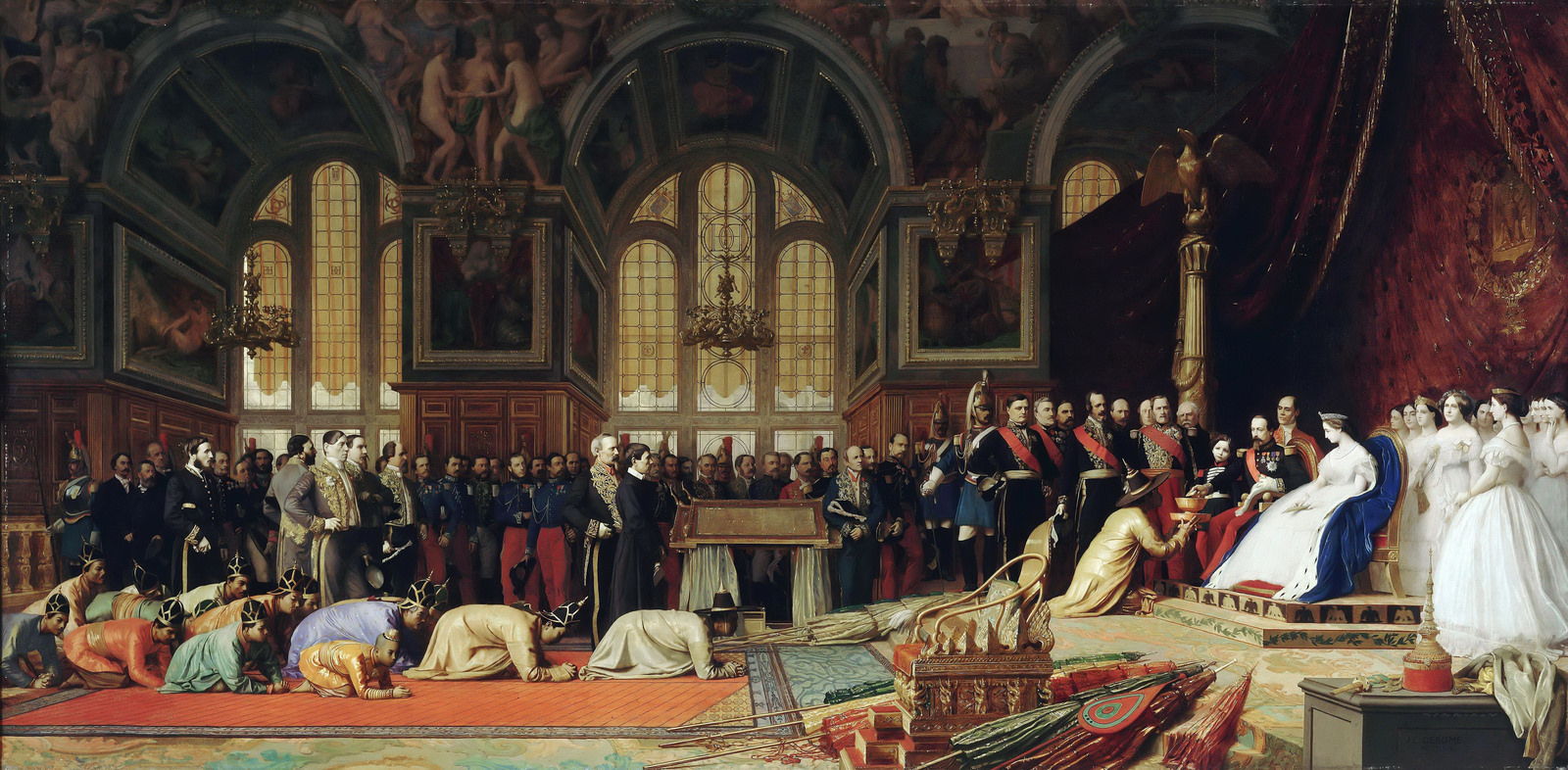
The royal castle, Château de Fontainebleau, was later used by Napoleon III for receptions.
Jean-Léon Gérôme (1824–1904), Reception of Siamese Ambassadors by Napoleon III (1864), oil on canvas, 128 x 260 cm, Château de Versailles, Versailles, France. The Athenaeum.
Jean-Léon Gérôme articulated Napoleon III’s aspirations for empire in his elaborate formal painting of the Reception of Siamese Ambassadors by Napoleon III (1864), depicting the grand reception held at Fontainebleau on 27 June 1861. Gérôme attended in the role of semi-official court painter, made sketches of some of the key figures, and was further aided by photographs made by Nadar. He also included himself, and the older artist Ernest Meissonier (1815-1891), in the painting: I believe that they are both at the back, at the far left.
Achille Etna Michallon (1796–1822), The Fallen Branch, Fontainebleau (c 1816), oil on canvas on card, dimensions not known, Minneapolis Institute of Art, Minneapolis, MN. Wikimedia Commons.
Achille Etna Michallon was one of the first great landscape artists to paint en plein air in the forest. His study of The Fallen Branch, Fontainebleau from about 1816 anticipates the Barbizon School in its motif, style and location. This large branch looks more like a dying animal.
Richard Parkes Bonington (1802–1828), In the Forest at Fontainebleau (c 1825) (188), oil on millboard, 32.4 x 24.1 cm, Yale Center for British Art, New Haven, CT. Wikimedia Commons.
A decade later, the British artist Richard Parkes Bonington visited briefly and both sketched and painted In the Forest at Fontainebleau (c 1825). The rocks here are particularly painterly, suggesting that this may have been started, if not completed, in front of the motif.
Towards 1830, inspired by the paintings of John Constable, several young French landscape painters started visiting the forest. The first was probably Camille Corot, who first painted there in 1822, and returned in earnest in the Spring of 1829, after his long stay in Italy to learn plein air painting technique in the Roman campagna.
Jean-Baptiste-Camille Corot (1796–1875), Fontainebleau Forest (The Oak) (c 1830), oil on canvas, 48 x 59 cm, Private collection. Wikimedia Commons.
In Corot’s Fontainebleau Forest (The Oak) from about 1830, the twisted limbs of the oak have taken time and care, sufficient to give texture and shadows to the trunks and branches. Where the canopy is more broken he painted the leaves in considerable detail.
Corot was joined by Théodore Rousseau, Constant Troyon, Jean-François Millet, Paul Huet, and later Charles-François Daubigny and Henri Harpignies. Although many of their paintings were made in the forest, few have been located with certainty.
Henri Harpignies (1819–1916), Fir Trees in Les Trembleaux, near Marlotte (1854), oil on canvas, 41.3 x 32.1 cm, Metropolitan Museum of Art, New York, NY. Wikimedia Commons.
When Harpignies was on the edge of the Forest of Fontainebleau, he painted largely en plein air, including this fine view of Fir Trees in Les Trembleaux, near Marlotte from 1854.
Rosa Bonheur (1822–1899), Deer in the Forest of Fontainebleau (1862), pencil, watercolor and gum arabic, 34.4 × 50 cm. Private collection. Wikimedia Commons.
The great animalière Rosa Bonheur lived on the edge of the forest, where she painted some fine watercolours, including her Deer in the Forest of Fontainebleau (1862). By that time, the next generation was getting ready to take over from the Barbizon School.
The humble domestic chicken is probably the most common and widely distributed farm animal. It originated in about 8,000 BCE in south-east Asia and spread its way steadily across every continent except Antarctica. It probably reached Europe before the Roman Empire, and since then has been commonplace. Perhaps because of its small size and frequent presence, it features in relatively few paintings.
The cruel sport of cockfighting accompanied its spread, and is depicted in Jean-Léon Gérôme’s first successful painting in 1846.
Jean-Léon Gérôme (1824–1904), The Cock Fight (Young Greeks Attending a Cock Fight) (1846), oil on canvas, 143 x 204 cm, Musée d’Orsay, Paris. Wikimedia Commons.
This motif had started from a relief showing two adolescent boys facing off against one another. Gérôme felt he needed to improve his figurative painting, and after Delaroche’s advice decided to develop that image by replacing one of the boys with a girl. In both Greek and English (but not French) the word cock is used for both the male genitals and a male chicken, and the youthful Gérôme must have found this combined visual and verbal pun witty and very Neo-Greek.
There’s a curious ambivalence in its reading too: two cocks are fighting in front of the young couple. Is one of the birds owned by the girl, and if so, is it the dark one on the left, which appears to be getting the better of the bird being held by the boy? Either way, it’s a lightly entertaining reflection on courtship and gender roles, and a promising debut. The Cock Fight earned Gérôme a third-class medal, and he sold the painting for a thousand francs. With the benefit of favourable reviews from critics, the following year brought him lucrative commissions, and a growing reputation.
A dead chicken plays a significant role in one of Rembrandt’s most famous group portraits.
Rembrandt Harmenszoon van Rijn (1606–1669), The Night Watch (1642), oil on canvas, 363 x 437 cm, Rijksmuseum Amsterdam, Amsterdam, The Netherlands. Wikimedia Commons.
His vast group portrait of The Night Watch (1642) is the most famous of all those of militia in the Dutch Republic. It features the commander and seventeen members of his civic guard company in Amsterdam. Captain Frans Banninck Cocq (in black with a red sash), followed by his lieutenant Willem van Ruytenburch (in yellow with a white sash) are leading out this militia company, their colours borne by the ensign Jan Visscher Cornelissen. The small girl to the left of them is carrying a dead chicken, a curious symbol of arquebusiers, the type of weapon several are carrying.
For a young child, cockerels can appear large and threatening, as used by Gaetano Chierici in a delightful visual joke.
Gaetano Chierici (1838-1920), A Scary State of Affairs (date not known), oil, dimensions and location not known. Wikimedia Commons.
His undated painting of A Scary State of Affairs calls on our experience of the behaviour of cockerels and geese. An infant has been left with a bowl on their lap, and their room is invaded first by cockerels, then by those even larger and more aggressive geese. The child’s eyes are wide open, their mouth at full stretch in a scream, their arms raised, and their legs are trying to fend the birds away.
Being among the most humble and everyday domestic species, chickens seldom make the limelight in religious narratives.
Bartolomé Esteban Murillo (1617–1682), The Adoration of the Shepherds (c 1650), oil on canvas, 187 x 228 cm, Museo Nacional del Prado, Madrid, Spain. Wikimedia Commons.
Murillo’s Adoration of the Shepherds from about 1650 is an exception featuring unusual additional details including the old woman carrying a basketful of eggs, and chickens in front of the kneeling shepherd.
In most paintings including chickens, though, they are just extras in the farmyard.
Paulus Potter (1625–1654), Figures with Horses by a Stable (1647), oil on panel, 45 x 38 cm, Philadelphia Museum of Art, Philadelphia, Pennsylvania. Wikimedia Commons.
Paulus Potter’s Figures with Horses by a Stable (1647) includes finely painted horses, chickens, a dog, and distant cattle, with a magnificent tree in the centre and a sky containing several birds.
Hans Thoma (1839–1924), Chickenfeed (1867), oil on canvas, 104.5 × 62 cm, Staatliche Kunsthalle Karlsruhe, Karlsruhe, Germany. Wikimedia Commons.
In Chickenfeed from 1867, Hans Thoma tackles this genre scene in a traditional and detailed realist style.
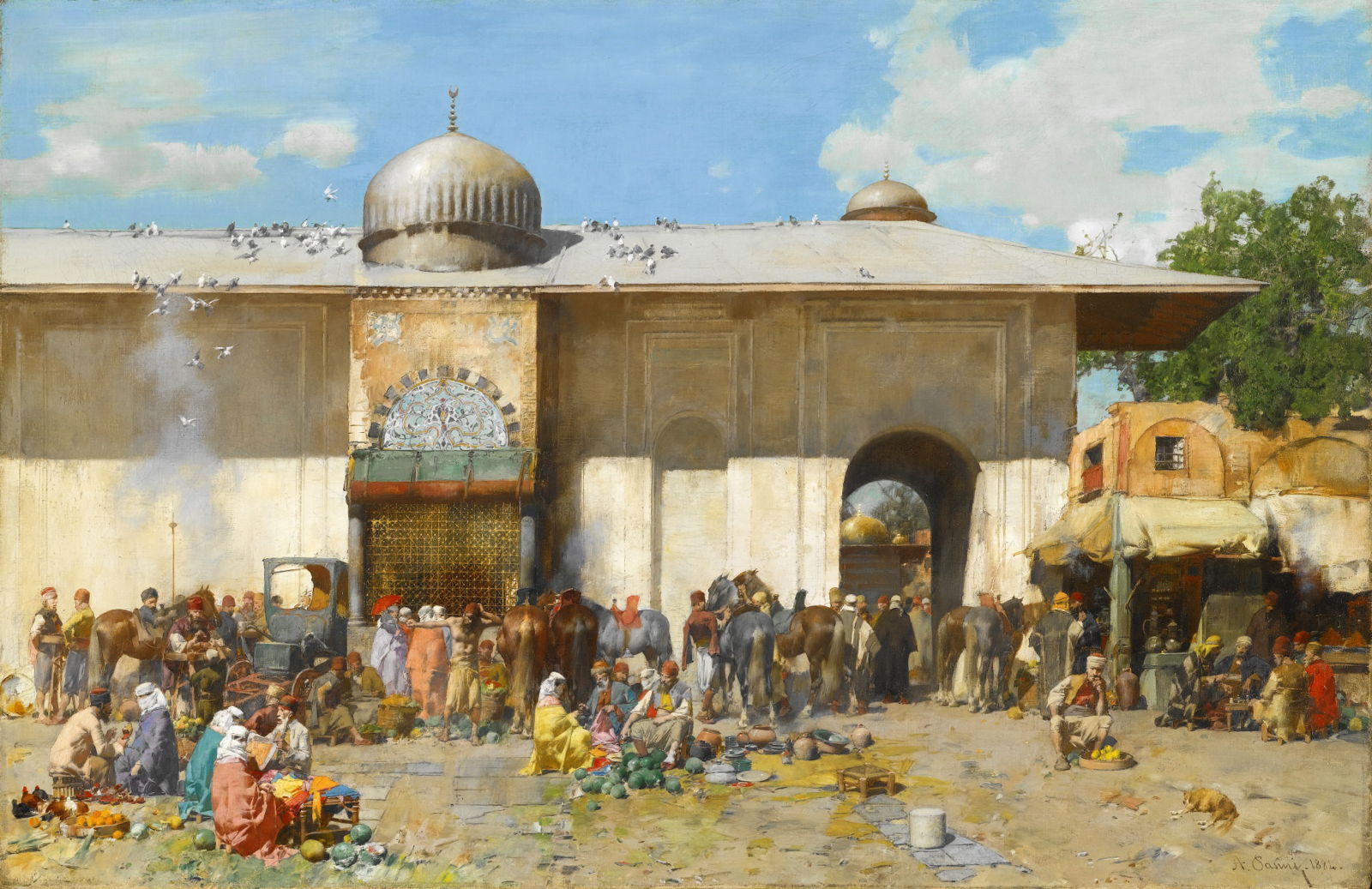
Alberto Pasini (1826–1899), A Market Scene (1884), further details not known. Wikimedia Commons.
Alberto Pasini’s Market Scene from 1884 has an eclectic mixture of produce, ranging from live chickens to pots and the artist’s signature melons.
Évariste Carpentier (1845–1922), Eating in the Farmyard (date not known), oil on canvas, 115 x 164 cm, Château de Gaasbeek, Lennik, Belgium. Wikimedia Commons.
Évariste Carpentier’s undated Eating in the Farmyard, an example of the rural deprivation which sparked Naturalist art, shows two kids surrounded by animals and birds in this much-used space.
Évariste Carpentier (1845–1922), Feeding the Chickens (date not known), oil on canvas, dimensions not known, Private collection. Wikimedia Commons.
Here, Carpentier’s old woman is busy Feeding the Chickens.
Friedrich Eckenfelder (1861–1938), Zollernschloss, Balingen (c 1884-5), oil on wood, 16.8 x 22.8 cm, Private collection. Wikimedia Commons.
Friedrich Eckenfelder’s Zollernschloss, Balingen from about 1884-5 shows a small yard just below the back of this castellated farm in Germany, with its lively flock of chickens.
Gustav Klimt (1862–1918), After the Rain (Garden with Chickens in St. Agatha) (1898-99), oil on canvas, 80.3 × 40 cm, Lentos Kunstmuseum Linz, Linz, Austria. Wikimedia Commons.
Gustav Klimt had probably painted his first small landscapes between 1881-87, and returned to the genre more seriously in about 1896. This work, variously known as After the Rain,Garden with Chickens in St. Agatha, or similar, is thought to have been painted when Klimt stayed in the Goiserer Valley with the Flöge family in the summer of 1898.
Very occasionally, a chicken may come as something of a surprise.
Hieronymus Bosch (c 1450–1516), The Ship of Fools (fragment of left wing of The Wayfarer triptych) (1500-10), oil on oak panel, 58.1 x 32.8 cm, Musée du Louvre, Paris. Wikimedia Commons.
Hieronymus Bosch’s Ship of Fools, a fragment from a larger Wayfarer triptych painted in 1500-10, is actually a small boat, into which six men and two women are packed tight. Its mast is unrealistically high, bears no sail, and has a large branch lashed to the top of it, in which is Bosch’s signature owl. Its occupants are engaged in drinking, eating what appear to be cherries from a small rectangular tabletop, and singing to the accompaniment of a lute being played by one of the women. A man has climbed a tree on the bank to try to cut down the carcass of a chicken from high up the mast.

 Login
Login