Normal view

There are new articles available, click to refresh the page.
Before yesterdayMain stream

Reading Visual Art: 233 Sirens

By: hoakley
6 November 2025 at 20:30

Sirens are mythical woman-like creatures with alluring voices, best-known from their appearance in Homer’s Odyssey, but also featuring in other tales including that of Jason and the Argonauts. Typically their singing lures sailors to their death, and that reputation has led them to represent anything that’s dangerously attractive. Originally they weren’t described in any physical detail, but visual representations soon envisaged them as having the upper bodies of beautiful young women, and the lower bodies and legs of birds, and that has been incorporated and elaborated in later accounts and retelling.

At the end of the year that Odysseus and his crew stayed with the sorceress Circe, she helpfully advised him that he would have to sail past the sirens, two to five creatures who lured men to their death with their singing. In preparation, Odysseus got his sailors to plug their ears with beeswax before they reached the sirens, so they couldn’t hear their song, and to bind him to the mast. He gave them strict instructions that under no circumstances, no matter what he said at the time, were they to loosen his bonds, as he would be listening to the sirens’ song.

As the group reached the sirens, Odysseus told his men to release him, but instead they bound him even more closely to the mast. Once they had passed safely from earshot of the sirens, Odysseus used his facial expression to inform his men, who then released him, and they sailed on.

(c) Manchester City Galleries; Supplied by The Public Catalogue Foundation
William Etty (1787–1849), The Sirens and Ulysses (c 1837), oil on canvas, 297 x 442.5 cm, Manchester Art Gallery, Manchester, England. Wikimedia Commons.

William Etty’s The Sirens and Ulysses from about 1837 is one of the pioneering accounts in paint of this story from the Odyssey. His three naked sirens are all woman, one playing a lyre, another holding double pipes aloft, all three doing their best to draw the sailors from Odysseus’ ship to a shore where there are the remains of earlier victims.

poyntersiren
Edward Poynter (1836–1919), The Siren (c 1864), oil on canvas, dimensions not known, Private collection. Wikimedia Commons.

Edward Poynter’s The Siren from about 1864 has Aesthetic overtones in the lyre she is playing.

boecklinsirens
Arnold Böcklin (1827–1901), Sirens (1875), tempera on canvas, 46 × 31 cm, Alte Nationalgalerie, Berlin. Wikimedia Commons.

Arnold Böcklin takes an unusual approach of almost dereferencing Odysseus in his painting of Sirens from 1875, although there is an approaching vessel that could be his. The two sirens filling the canvas are very human down to the waist, below which they resemble birds. One sits facing us, clearly in full voice, and highly alluring in looks. The other, her back towards us, is playing an aulos and looks rather obese, to the point of almost being comical, her right breast laid upon a flat-topped rock. At their feet are three human skulls and other bones to indicate their graver intentions.

moreausirens
Gustave Moreau (1826–1898), The Sirens (1882), watercolor and gouache, brown ink, and black chalk on cream wove paper, 32.8 x 20.9 cm, Harvard Art Museums/Fogg Museum (Bequest of Grenville L. Winthrop), Cambridge, MA. Courtesy of Harvard Art Museums.

Gustave Moreau’s The Sirens (1882) shows them as beautiful figures in a static scene, with a saturnine setting sun. There is, though, a lone sail on the horizon that hasn’t yet attracted their attention. Their lower legs turn into the writhing coils of sea serpents.

moreausirens1885
Gustave Moreau (1826–1898), The Sirens (c 1885), oil on canvas, 89 x 118 cm, Musée National Gustave-Moreau, Paris. Wikimedia Commons.

Moreau’s slightly later group portrait of The Sirens from about 1885 is more complete, with Odysseus sailing past, but its three figures are clearly all woman and no bird.

thomaeightdancingwomen
Hans Thoma (1839–1924), Eight Dancing Women with Bird Bodies (1886), oil on panel, 38 × 58.5 cm, location not known. Wikimedia Commons.

Eight Dancing Women with Bird Bodies (1886) is one of Hans Thoma’s unusual mythological paintings. The best-known women with bird bodies were the sirens, who range in number from two to five. In another painting showing the sirens trying to lure a passing ship, Thoma paints similar figures, suggesting these are intended to be sirens.

waterhouseulyssessirens
John William Waterhouse (1849–1917), Ulysses and the Sirens (1891), oil on canvas, 100.6 x 201.7 cm, National Gallery of Victoria, Melbourne, Australia. Wikimedia Commons.

John William Waterhouse’s Ulysses and the Sirens (1891) is closer to the Homeric account, although he provides a total of seven sirens, shown as large eagle-like birds of prey with only the head and neck of beautiful women. He has added bandage wrappings around the head of each sailor to make it clear that their ears are stopped from hearing sound, a visual device that links neatly with the text. His sirens are clearly singing, particularly the one closest to the viewer, who is challenging the hearing protection of one of the sailors. Another sailor, at the stern of the ship (left of the painting), is seen clutching his ears.

waterhousesiren1900
John William Waterhouse (1849–1917), The Siren (1900), oil on canvas, 81 x 53 cm, location not known. Wikimedia Commons.

Almost a decade later, Waterhouse painted this non-narrative portrait of The Siren (1900).

raesirens
Henrietta Rae (1859–1928), The Sirens (1903), oil on canvas, 114.3 × 254 cm, Private collection. Wikimedia Commons.

The Sirens (1903) marked Henrietta Rae’s return to painting narrative works featuring classical nudes. Odysseus’ ship is in the distance, as three beautiful sirens use their aulos and lyre to lure its occupants.

Late mythology suggests an unpleasant end for these sirens: Hera challenged them to a singing contest against the Muses. When the latter won, the penalty they exacted of the sirens was to have all their feathers plucked out to turn into crowns. As a result of that disgrace, the sirens turned white, fell into the sea, and formed the islands including modern Souda, on the north-west coast of Crete in the Mediterranean.

Sirens have steadily spread their presence into other paintings, particularly during the twentieth century.

jannybadendesirenen
Georg Janny (1864–1935), Sirens Bathing by the Sea (1922), gouache on cardboard, further details not known. Wikimedia Commons.

Georg Janny’s fantasy painting of Sirens Bathing by the Sea from 1922 is throughly other-worldly, and there’s no trace of their bird legs.

nashpnestsiren
Paul Nash (1892–1946), Nest of the Siren (1930), oil on canvas, 77 x 51.2 cm, HM Treasury, London, England. The Athenaeum.

More cryptic is Paul Nash’s Surrealist Nest of the Siren (1930), which brings together the incongruous, and hardly refers to Homer’s story. The painting is framed by brightly-painted walls with pillared decorations, perhaps ornate wainscot panelling. In the middle of these is what might be a painting, but also seems to be a three-dimensional plant trough containing sinuous shrubs. In the middle of those is a small nest, like an acorn cup.

Standing in front of this is a structure resembling a weather-vane, mounted on a turned wooden shaft. At the weather end of the vane is the faceless figure of a siren; the leeward end appears purely decorative. Three red rods appear to have detached themselves from the walling, two protruding from the plant trough, the third resting on the floor.

They even manage to sneak symbolically into other classical stories.

girodetmeetingoresteshermione
Anne-Louis Girodet de Roucy-Trioson (1767-1824), The Meeting of Orestes and Hermione (c 1800), pen and brown and black ink, point of brush and brown and gray wash, with black chalk and graphite, heightened with white gouache on cream wove paper, 28.5 x 21.8 cm, Cleveland Museum of Art (Leonard C. Hanna, Jr. Fund), Cleveland, OH. Courtesy of Cleveland Museum of Art.

In Girodet’s ink and chalk drawing of The Meeting of Orestes and Hermione (c 1800), Hermione is seen at the right, her arms folded, looking coy as Orestes approaches her. The second woman, with Orestes, is presumably Hermione’s maid. This is one of a series of illustrations made by Girodet to accompany Racine’s play, and has subtleties you might expect from a great narrative artist. Visible in the gap between the figures is a table-leg in the form not of a Fury foretelling Orestes’ fate, but of a siren, implying that Hermione is luring Orestes to her. Hermione, for all her apparent coyness, has let the right shoulder-strap of her robe slip, in her enticement of Orestes. She has assumed the role of femme fatale, as portrayed by Euripides and Racine.

In more recent literature, sirens appear in the less-known second part of Goethe’s play Faust.

hofheinzdoringsirens
Margret Hofheinz-Döring (1910–1994), With the Sirens (1962), pastel, 34 x 25 cm, Galerie Brigitte Mauch Göppingen. Image by Peter Mauch, courtesy of Margret Hofheinz-Döring/ Galerie Brigitte Mauch Göppingen, via Wikimedia Commons.

Margret Hofheinz-Döring is one of the few artists who has painted from this second part. With the Sirens from 1962 is her pastel painting showing the sirens among rocky inlets of the Aegean Sea, a sub-scene concluding the second act.

The way of the Spartans 2

By: hoakley
2 November 2025 at 20:30

In the first of these two articles showing paintings of Spartans from the city-state in ancient Greece, I illustrated some of the laws laid down by the founder of its warrior tradition, Lycurgus.

When those laws were all in place and in practice, Lycurgus told an assembly of all Spartans that he needed to return to the oracle at Delphi to consult on one final measure. He made the Spartans take an oath to abide by these unwritten laws until his return, then departed for Delphi. There he obtained the approval of the oracle, which he recorded in writing and sent back to Sparta.

palmalycurgusgivinglaw
Jacopo Palma il Vecchio (c 1480-1528) or Bonifazio Veronese (1487-1553), Lycurgus Gives the Laws to the Spartans (date not known), oil on canvas, 209.5 x 209.5 cm, location not known. Wikimedia Commons.

This undated painting of Lycurgus Gives the Laws to the Spartans has been attributed to either Jacopo Palma il Vecchio (c 1480-1528) or Bonifazio Veronese (1487-1553). It shows an elderly Lycurgus apparently giving a volume of written law to the Spartans in the marketplace, but could equally be of Lycurgus addressing his last assembly of all Spartans before he left for his second visit to Delphi.

blondellycurgusofsparta
Merry-Joseph Blondel (1781–1853), Lycurgus of Sparta (1828), oil, dimensions not known, Musée de Picardie, Amiens, France. Wikimedia Commons.

Merry-Joseph Blondel’s portrait of Lycurgus of Sparta from 1828 also shows him as an older man, here with written scrolls on his right thigh. Given the oral nature of Lycurgus’ laws, this can only be interpreted as the moment that Lycurgus has written his message reporting the oracle’s approval of his laws, ready to send it back to the city.

Lycurgus then did something extraordinary in its selfless ingenuity: having put the whole of Sparta under oath to keep his laws until his return, he then starved himself to death, ensuring that oath could never expire. The laws of Lycurgus lasted through fourteen kings, and five hundred years, without change, until gold and other spoils of war entered Sparta during the reign of King Agis.

The single most celebrated event in Spartan history is the Battle of Thermopylae in 480 BCE, in which three hundred Spartan soldiers, with 700 Thespians and 400 Thebans, were claimed to have kept over one hundred thousand Persians at bay for three days. This is the more remarkable for the fact that the Spartans and their supporters fought to the death, following which the Persians overran Boeotia and captured Athens. It is thus an example of self-sacrifice in the face of overwhelming odds, resulting in most noble defeat.

davidleonidasthermopylae
Jacques-Louis David (1748–1825), Leonidas at Thermopylae (1814), oil on canvas, 392 × 533 cm, Musée du Louvre, Paris. Wikimedia Commons.

The only major painting that I have been able to discover of this is Jacques-Louis David’s Leonidas at Thermopylae (1814). Leonidas, the Spartan King and commander of the force, is at the exact centre of the painting, the viewer fixed in his emotionless gaze. Around him are his three hundred Spartan warriors, with supporting trumpeters, a lyre hanging on the tree, and laurel crowns being handed round.

David leaves some clues to his narrative in inscriptions, which have unfortunately become barely legible. A soldier has climbed up to carve an inscription in Greek at the upper left, the word HERAKLEOS appears on a plinth to the left of Leonidas, and by his right foot is an anachronistic piece of paper bearing more Greek words.

More subtle, perhaps, are the small groups driving pack animals along a narrow path at the upper right: the Persians were shown a mountain path around the narrow pass at Thermopylae, enabling them to gain an advantage over the Spartans.

Recent artistic interest in Thermopylae seems to have started around 1960, and first reached popular culture in Rudolph Maté’s 1962 movie, The 300 Spartans, which has been interpreted as comment on the Cold War at the time. This in turn inspired Frank Miller’s graphic novel 300, which was first published in 1998, and made into a highly successful movie of the same name by Zack Snyder, released in 2006.

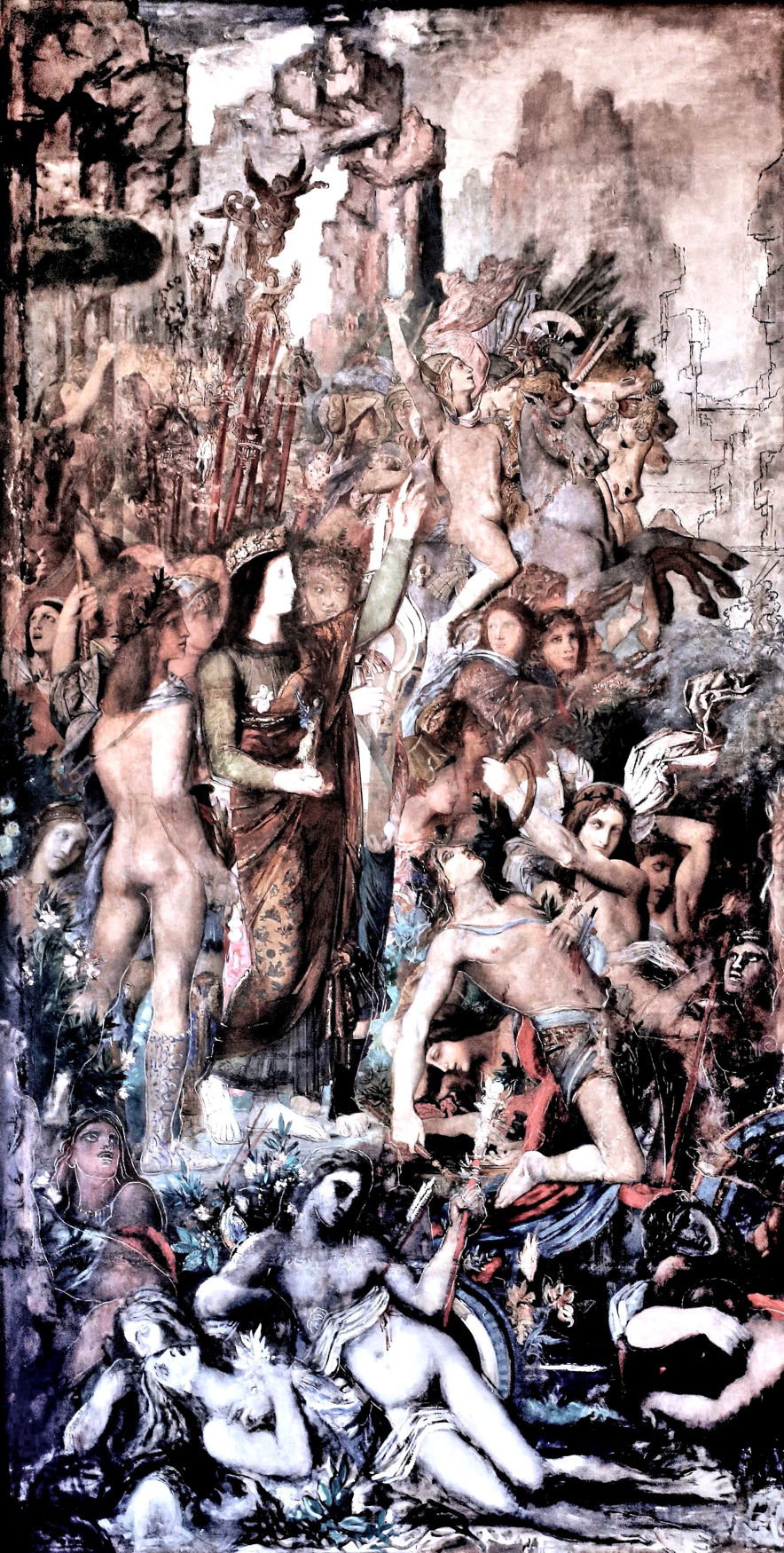
In contrast, Sparta’s three wars against the state of Messenia are little-known. Gustave Moreau’s fascination for esoteric ancient history led him to start painting a scene from the Second Messenian War in about 660-650 BCE.

moreautyrtee
Gustave Moreau (1826–1898), Tyrtaeus Singing During the Combat (1860-, unfinished), oil on canvas, 415 x 211 cm, Musée National Gustave-Moreau, Paris. Image by jean louis mazieres via flickr, https://www.flickr.com/photos/mazanto/13943362382/in/photostream/

Moreau seems to have worked on Tyrtaeus Singing During the Combat in the early 1860s, abandoned it, then returned to have it enlarged in about 1883, and work it further for a period, before finally giving it up altogether.

moreautyrteed1
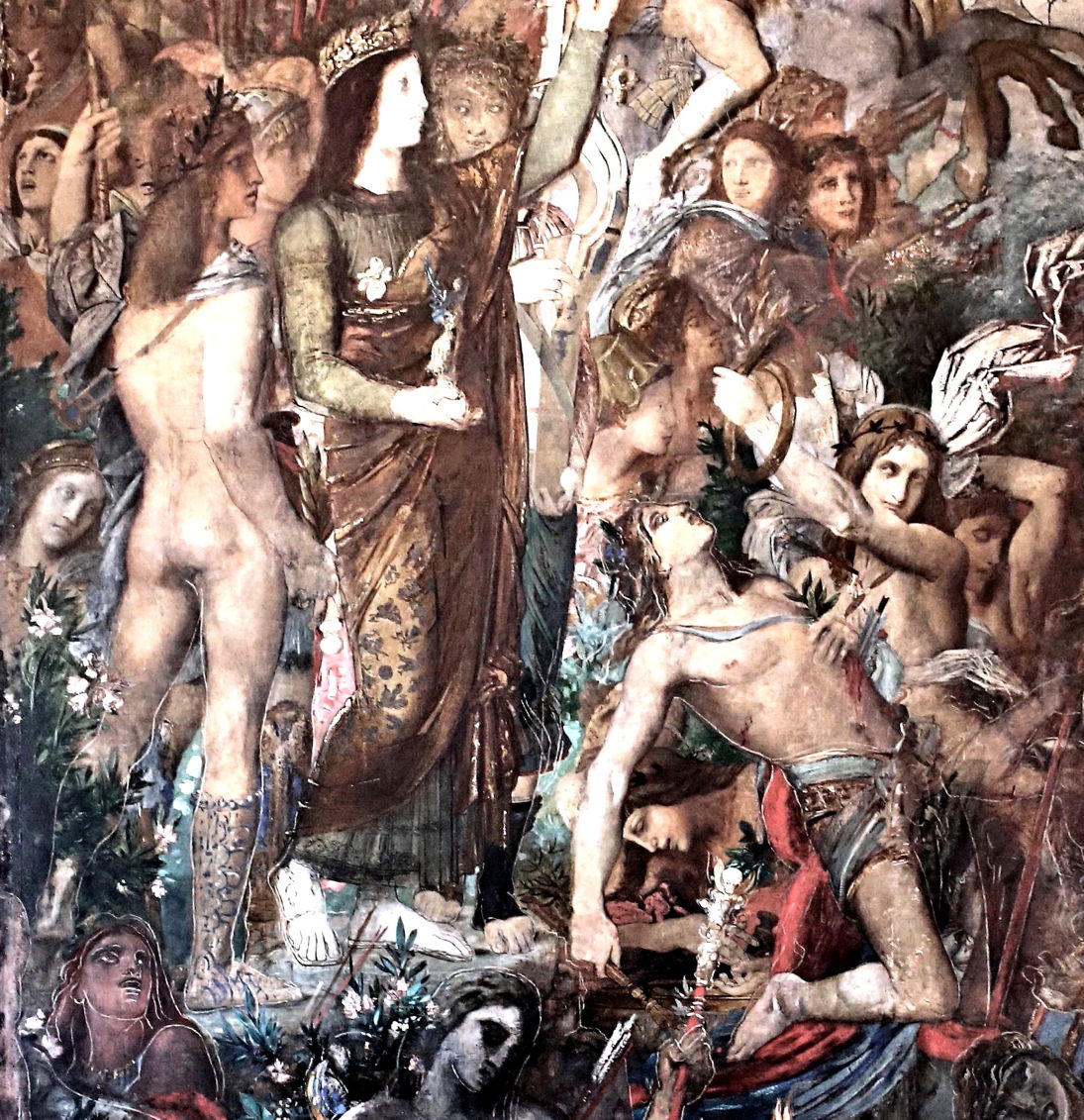
Gustave Moreau (1826–1898), Tyrtaeus Singing During the Combat (detail) (1860-, unfinished), oil on canvas, 415 x 211 cm, Musée National Gustave-Moreau, Paris. Image by jean louis mazieres via flickr, https://www.flickr.com/photos/mazanto/13943362382/in/photostream/

This detail shows much of his original painting, which is full to bursting with androgynous and near-naked young men. The priestess-like figure to the left of the centre appears to be Tyrtaeus, an elegiac Greek poet whose verse exhorted the Spartans to fight bravely against the Messenians. He is shown here in action, inspiring the young Spartan warriors to victory. The strange collage-like effect is a combination of Moreau’s emphasis on establishing the form of his figures, and I suspect edge-enhancement in the image’s processing.

Spartans also played a central role in the war with Troy, the result of Paris’s abduction of Helen, a Spartan woman whose origins are the subject of dispute. Later Roman accounts, the basis of most more recent paintings, claim she was the outcome of the union of Leda, wife of Tyndareus, King of Sparta, with Zeus, in the form of a swan. Those dating back to the time of the Cypria and the Epic Cycle are more complex, and make Helen’s mother Nemesis, the personification of public disapproval.

In the Greek version, Zeus appeared to Leda as a swan. Both he and Tyndareus impregnated Leda at about the same time, but as Zeus was then in the form of a swan, her twin pregnancies resulted in two eggs: one hatched into Castor, who was human because his father was Tyndareus; the other hatched into Polydeuces (Latin Pollux), who was divine as his father was Zeus. Despite their different fathers, the twins were known as the Dioskuroi, who were later to rescue Helen.

anonledaswan
Unknown follower of Leonardo da Vinci (1452–1519), Leda and the Swan (early 1500s), oil on panel, 131.1 × 76.2 cm, Philadelphia Museum of Art, Philadelphia, PA. Wikimedia Commons.

This interpreted copy of Leonardo da Vinci’s Leda and the Swan, probably painted in the early 1500s and now in the Philadelphia Museum of Art, summarises the later account of Helen’s unique birth, with two eggs and a fourth baby, Clytemnestra. Later paintings, perhaps wisely, concentrated on Leda and Zeus, and skipped the incredible egg phase altogether.

According to most accounts, when Helen was still under age, she was abducted by Theseus, the ‘hero’ who abandoned Ariadne on the island of Naxos. Helen’s adopted brothers the Dioskuroi were unimpressed by this, so they paid Theseus a visit, and persuaded him to return their step-sister. In return for her son’s offence, Aethra, mother of Theseus, was made Helen’s slave, and wasn’t freed until after the fall of Troy many years later.

gassieshelendelivered
Jean-Bruno Gassies (1786–1832), Castor and Pollux rescuing Helen (1817), oil on canvas, 113.2 x 145.4 cm, location not known. Wikimedia Commons.

Jean-Bruno Gassies’ painting of Castor and Pollux Rescuing Helen was runner-up in the Prix de Rome in 1817. The woman being escorted away at the left may have been intended to be Theseus’ mother Aethra, although she appears remarkably young.

Helen’s beauty only grew over time, and her hand was sought by many suitors in a contest organised by her brothers Castor and Polydeuces. Among those suitors were many prominent figures, including Odysseus. Helen’s father, King Tyndareus, feared that in choosing between her suitors he would offend and cause trouble. The suitors therefore agreed to swear an oath, under which they would all defend the successful suitor in the event that anyone should quarrel with them, the crucial Oath of Tyndareus. Under that, Menelaos, King of Sparta, was chosen as Helen’s husband.

Helen was the bribe offered by Aphrodite to Paris for judging her the winner of the golden apple of discord. For nine days, Helen’s husband Menelaos entertained Paris as a guest, while Paris plied her with gifts. On the tenth day, Menelaos was called away to Crete for his grandfather’s funeral. He left his house in Helen’s charge, reminding her to ensure their guests were well cared-for, although clearly not in the way that Paris was intending.

tintorettorapehelen
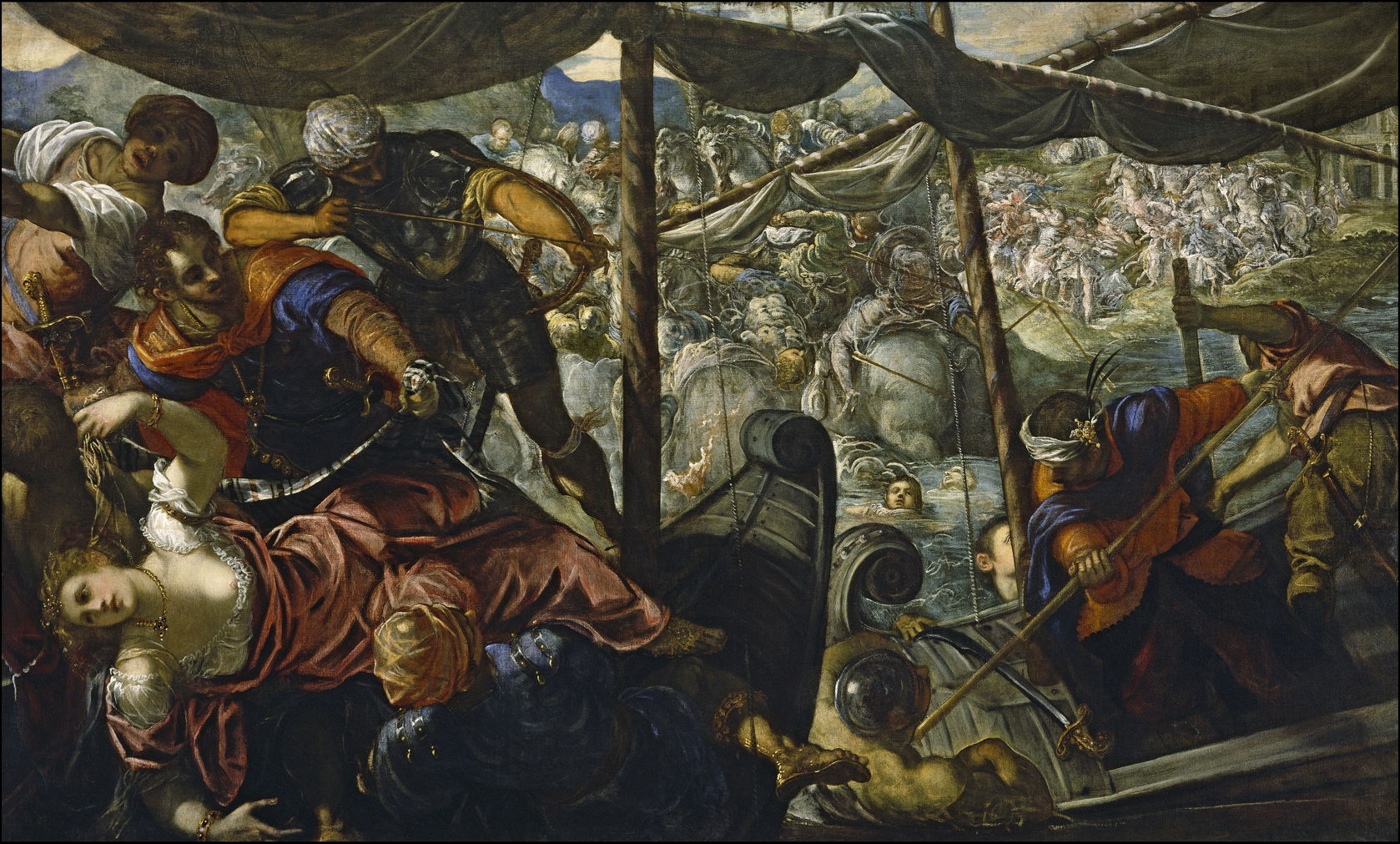
Tintoretto (1519–1594), The Rape of Helen (1580), oil on canvas, 186 x 307 cm, Museo Nacional del Prado, Madrid, Spain. Wikimedia Commons.

For Tintoretto, The Rape of Helen (1580) was nothing short of war. As an archer is about to shoot his arrow, and another Trojan fends off attackers with a pike, Helen, dressed in her finery, is manhandled onto Paris’s ship like a stolen statue.

Thus the Spartans were at the centre of the Trojan War.

Reading Visual Art: 230 Wolf

By: hoakley
10 October 2025 at 19:30

The Eurasian wolf has been subject to a general campaign of extermination across much of Europe since the Middle Ages. The last in England was killed by the end of the fifteenth century, in Scotland in 1684, Denmark in 1772, and Norway in 1973. This hasn’t deterred artists from reminding Europeans of their sinister reputation.

Early in Ovid’s Metamorphoses, he tells of Lycaon, who was transformed into a wolf by Jupiter as punishment for cheating him.

cossiersjupiterlycaon
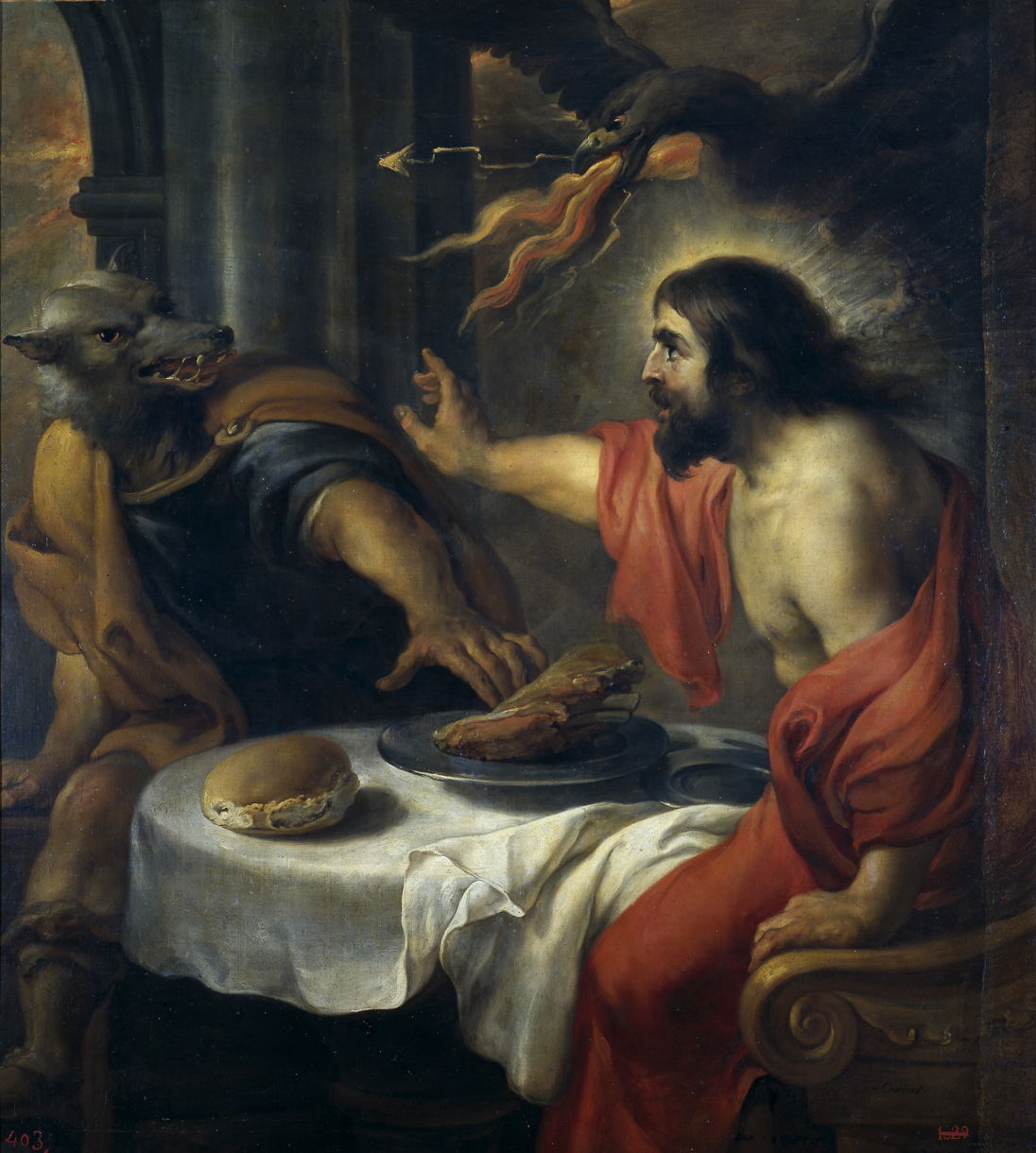
Jan Cossiers (1600–1671), Jupiter and Lycaon (c 1640), oil on canvas, 120 × 115 cm, Museo Nacional del Prado, Madrid. Wikimedia Commons.

Jan Cossiers’ impressive Jupiter and Lycaon from about 1640 shows Jupiter’s eagle vomiting thunderbolts at Lycaon, who is hurrying away as he is being transformed into a wolf, becoming the prototype for the werewolf of the future (see below).

Wolves got a better press in the popular account of the origins of Romulus and Remus, founders of Rome. Numitor’s daughter, a Vestal Virgin, was discovered to be pregnant. Although that would by tradition have led to her death, Amulius’ daughter interceded, and she was merely kept in solitary confinement. She gave birth to twin boys, who were superhuman in their size and beauty. Amulius ordered one of his servants to take the twins away and drown them in the river, but they were put first into a trough that functioned as a boat. As a result they were washed ashore downstream still alive. A she-wolf then fed the babies, and a woodpecker watched over them; both were later considered to be sacred to the god Mars.

carracciromulusremus
Ludovico Carracci (1555–1619) and/or Annibale Carracci (1560–1609), She-Wolf Suckling Romulus and Remus (1589-92), fresco, dimensions not known, Palazzo Magnani, Bologna, Italy. Wikimedia Commons.

One of the frescoes in the Palazzo Magnani, probably painted by Ludovico Carracci and/or Annibale Carracci, shows the She-Wolf Suckling Romulus and Remus (1589-92). The twins are still inside the trough in which they had survived their trip down the river, and on the opposite bank a woodpecker is keeping a close watch.

rubensromulusremus
Peter Paul Rubens (1577–1640), Romulus and Remus (1615-16), oil on canvas, 213 x 212 cm, Musei Capitolini, Rome, Italy. Wikimedia Commons.

Peter Paul Rubens shows Romulus and Remus being discovered by Faustulus, in his painting of 1615-16. Not only is the she-wolf taking care of the twins, but a family of woodpeckers are bringing worms and grubs to feed them, and there are empty shells and a little crab on the small beach as additional tasty tidbits.

Despite that, the wolf had a fearsome reputation in Europe, no doubt amplified by those who sought its extinction.

brueghelpgoodshepherd
Pieter Brueghel the Younger (1564–1638), The Good Shepherd (1616), oil on canvas, dimensions not known, Musées royaux des Beaux-Arts de Belgique, Brussels, Belgium. Image by Rama, via Wikimedia Commons.

Pieter Brueghel the Younger’s The Good Shepherd from 1616 shows a shepherd being attacked by a wolf, as he tries to save his flock, which are running in panic into the nearby wood.

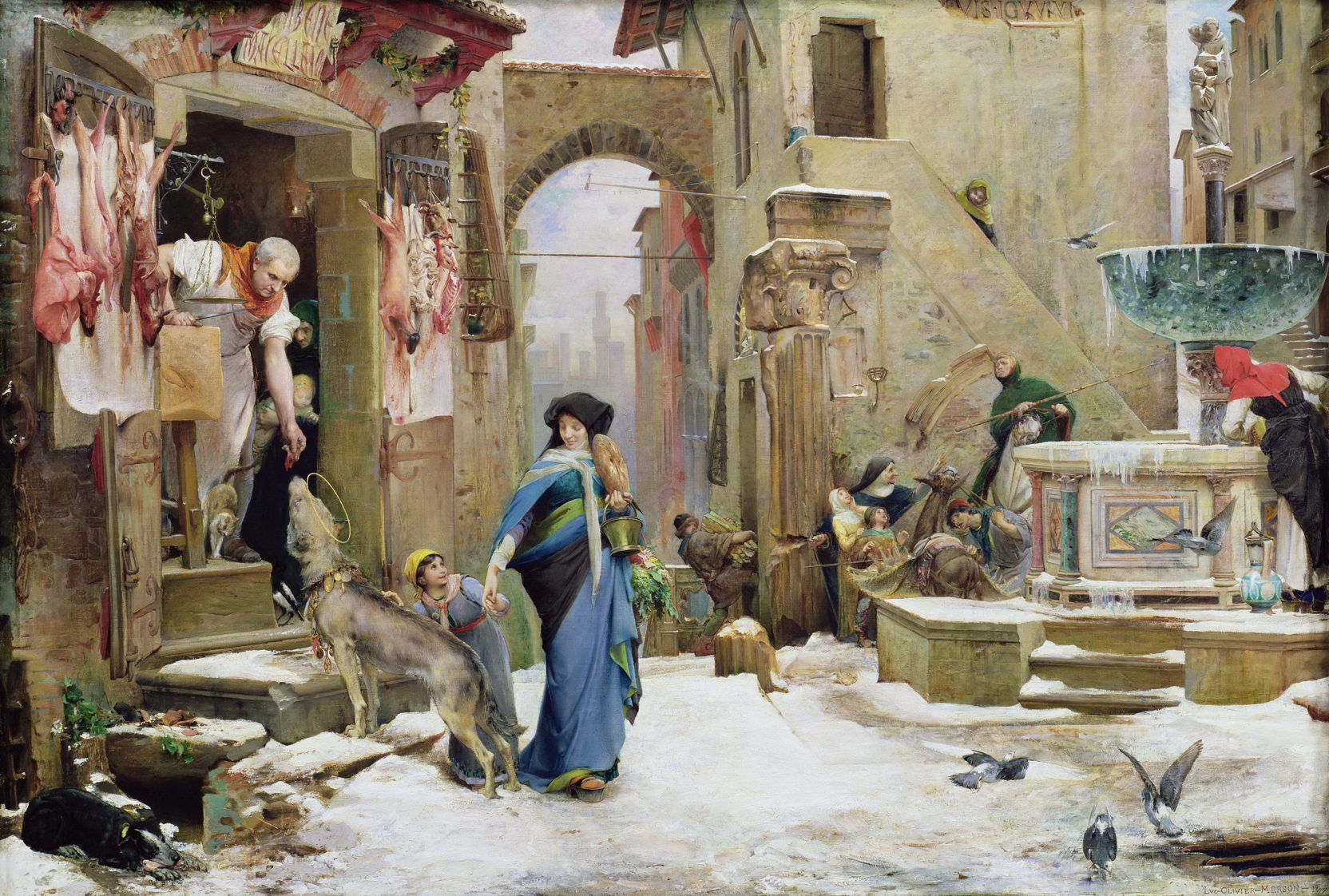
Christian associations can be more positive, particularly in the legend of Saint Francis of Assisi and the wolf of Agubbio, or Gubbio, a small mediaeval town in the Apennine Mountains in central Italy. The saint did a deal with the wolf, where the animal would stop terrorising the town, in return for its people providing it with food.

mersonwolfofaggubio
Luc-Olivier Merson (1846–1920), The Wolf of Agubbio (1877), oil on canvas, 88 x 133 cm, Palais des Beaux-Arts de Lille, Lille, France. Wikimedia Commons.

Luc-Olivier Merson’s marvellous painting of The Wolf of Agubbio from 1877 is set in the town’s central piazza, where it’s a cold winter’s day, so cold that the waters of its grand fountain are frozen as they cascade over its stonework. As the townspeople go about their business, there’s the large wolf of its title with a prominent halo, standing at the door of the butcher’s shop. Leaning out from that door, the butcher is handing a piece of meat to the wolf, as shown in the detail below.

mersonwolfofaggubiod1
Luc-Olivier Merson (1846–1920), The Wolf of Agubbio (detail) (1877), oil on canvas, 88 x 133 cm, Palais des Beaux-Arts de Lille, Lille, France. Image by Chatsam, via Wikimedia Commons.

A wolf may also appear in association with the Christian virtue of charity, as depicted by Pierre Puvis de Chavannes.

puvischarity
Pierre Puvis de Chavannes (1824–1898), Charity (1887), oil on canvas, 56 x 47 cm, Musée d’Orsay, Paris. Image by Rama, via Wikimedia Commons.

His Charity from 1887 is a personification of one of the seven Christian virtues set in timeless classical terms. She is the mother of twins, one of whom she holds by her breast. She is clasping the back of the neck of a dark wolf, lying beside her, adding an unusual touch. This had apparently become a popular motif, and only nine years previously had been painted by William-Adolphe Bouguereau in contrasting Academic style.

corotdantevirgil
Jean-Baptiste Camille Corot (1796–1875), Dante and Virgil (1859), oil on canvas, 260.4 x 170.5 cm, Museum of Fine Arts Boston, Boston, MA. Wikimedia Commons.

A wolf is one of the three fearsome animals to threaten Dante in the opening of his Divine Comedy. Camille Corot’s painting of Dante and Virgil from 1859 shows Dante as he started to walk up a hill, only to find his way blocked first by a leopard, then by a lion, and finally by a wolf.

Wolves have made their way into other legends and fables.

oudrywolfandlamb
Jean-Baptiste Oudry (1686–1755), The Wolf and the Lamb (date not known), oil on canvas, 104.1 x 125.7 cm , Private collection. Wikimedia Commons.

Jean-Baptiste Oudry’s undated The Wolf and the Lamb tells a popular story (Perry 155, La Fontaine I.10) in which a wolf tries to justify killing a lamb on the strength of its criminal record. The lamb proves each crime claimed by the wolf to have been impossible, so the wolf says that the offences must have been committed by someone else in the lamb’s family, therefore it can proceed to kill the lamb anyway.

moreauthewolfandthelamb
Gustave Moreau (1826–1898), The Wolf and the Lamb (1889), original presumed to be in colour, further details not known. Wikimedia Commons.

Gustave Moreau revisited Aesop’s fables late in his career. The Wolf and the Lamb of 1889 is, I believe, a monochrome image of a painting made in full colour, whose wolf looks more threatening than Oudry’s.

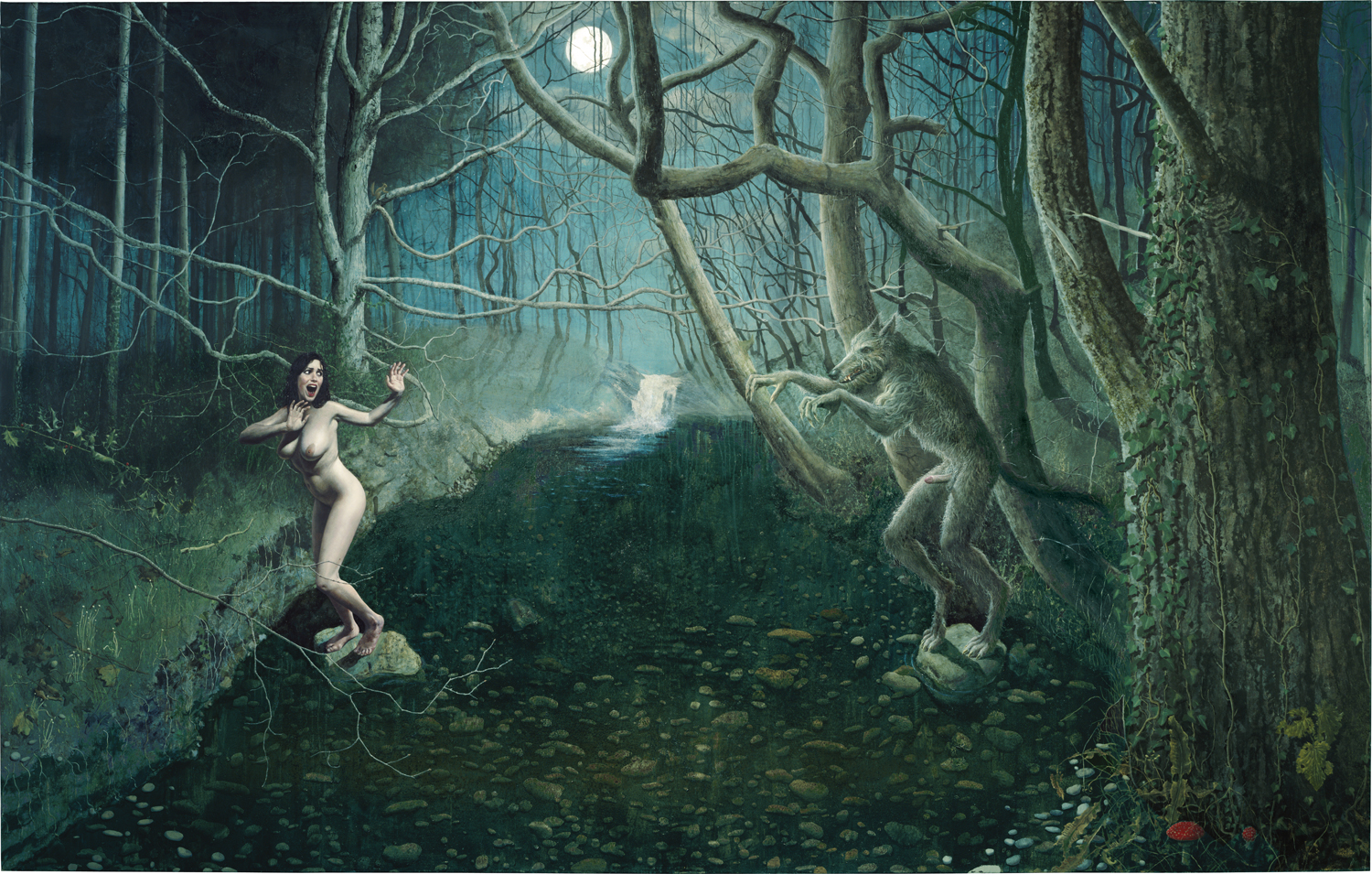
Mediaeval folk mythology developed stories of humans turning into wolves, although these were temporary transformations associated with cannibalistic episodes. They became progressively refined and popularised into the Gothic ‘horror’ stories of werewolves feeding on human blood, although those didn’t reach painting until the twentieth century.

wrightwomansurprisedbyawerewolf
Stuart Pearson Wright (b 1975), Woman Surprised by a Werewolf (2008), oil on linen, 200 x 315 cm. Courtesy of and © Stuart Pearson Wright.

Stuart Pearson Wright’s magnificent Woman Surprised by a Werewolf (2008) was inspired by the movie An American Werewolf in London (1981), itself a further transformation of werewolf stories into comedy horror form. The artist intended “to explore that uncharted place where the mystery and sublime of the romantic landscape meets the high camp and melodrama of Hammer horror”, which has come a long way from Ovid’s original story of lycanthropy.

Finally, wolves can sometimes be depicted as hunting quarry.

rubenswolffoxhunt
Peter Paul Rubens (1577–1640), Wolf and Fox Hunt (c 1616), oil on canvas, 245.4 x 376.2 cm, Metropolitan Museum of Art, New York, NY. Wikimedia Commons.

Peter Paul Rubens’ Wolf and Fox Hunt from about 1616 is one of his brilliant series of hunting scenes, here featuring two large wolves.

The good news is that, since the 1950s, populations of wolves in Europe have been recovering, and with the exception of the British Isles, they’re gradually re-establishing themselves in those countries that had previously hunted them to death.

❌
❌