By the early 1860s, the large and ancient Forest of Fontainebleau, to the south-east of Paris, had been attracting those of the Barbizon School, who painted realist landscapes in front of the motif. The next generation started visiting in 1865, and went on to form the French Impressionists.
Frédéric Bazille (1841–1870), Landscape at Chailly (1865), oil on canvas, 81 x 100.3 cm, The Art Institute of Chicago, Chicago, IL. Wikimedia Commons.
In May 1865, the young Frédéric Bazille left the city of Paris for the Forest of Fontainebleau, where he painted Landscape at Chailly (1865) in company with Claude Monet, and possibly Auguste Renoir and Alfred Sisley. Although clearly influenced by the Barbizon School, his colours are much brighter, and escape the rather sombre browns and greens that dominated much of the work of that earlier art.
Alfred Sisley (1839–1899), Avenue of Chestnut Trees in La Celle-Saint-Cloud (1865), oil on canvas, 125 x 205 cm, Petit Palais, Paris. Wikimedia Commons.
Sisley painted this Avenue of Chestnut Trees in La Celle-Saint-Cloud to the west of the forest in 1865, again in Barbizon style. He didn’t submit it to the Salon until 1867, when it was refused. It then remained unsold for ten years before being bought by Sisley’s patron Jean-Baptiste Faure, a celebrated opera singer.
The following year, Sisley walked through the forest with Renoir. He then stayed in the village of Marlotte, where Renoir, Monet, Bazille, Pissarro and Cézanne also visited to paint.
Alfred Sisley (1839–1899), Women Going to the Woods (1866), oil on canvas, 65.2 x 92.2 cm, Bridgestone Museum of Art ブリヂストン美術館, Tokyo, Japan. Wikimedia Commons.
Sisley was more successful with Women Going to the Woods, completed in 1866. This was one of his two paintings exhibited at the Salon that year, and shows the main street in the village of Marlotte with a little rustic staffage.
Pierre-Auguste Renoir (1841–1919), Clearing in the Woods (1865), oil on canvas, 57.2 x 82.6 cm, Detroit Institute of Arts, Detroit, MI. Wikimedia Commons.
Clearing in the Woods (1865) is Renoir’s first substantial (surviving) landscape painting, and shows strong influence from Corot. He adopts quite a detailed realist style in this view of a clearing in the midst of massive chestnut trees. These are believed to be near the small village of La Celle-St-Cloud, to the west of Paris not far from Bougival, rather than in the forest. It’s likely that he painted there in the company of Alfred Sisley, who made two views of the same site in very different style.
Pierre-Auguste Renoir (1841–1919), Jules Le Coeur and his Dogs in the Forest of Fontainebleau (1866), oil on canvas, 112 x 90 cm, Museu de Arte de São Paulo (MASP), São Paulo, Brazil. Wikimedia Commons.
The following year Renoir painted his friend Jules Le Coeur and his Dogs in the Forest of Fontainebleau. This is unusual among his works, as it was preceded by two studies, and all three were made using the palette knife rather than brushes. This makes it most likely to have been painted before Renoir abandoned the knife and returned to the brush, by the middle of May 1866.
Abbott Handerson Thayer (1849–1921), Landscape at Fontainebleau Forest (c 1876), oil on cardboard, 54.6 x 45.7 cm, Private collection. Wikimedia Commons.
The following year Abbott Handerson Thayer, an American artist who trained in Paris, painted this wonderful oil sketch of Landscape at Fontainebleau Forest (c 1876). This is probably the loosest and most Impressionist painting of his career.
Henri Rouart (1834–1912), In Fontainebleau Forest (date not known), oil on canvas, 59.5 x 73.2 cm, Private collection. Wikimedia Commons.
At some time in the late nineteenth century, the wealthy industrialist, amateur painter and patron of Impressionism, Henri Rouart painted In Fontainebleau Forest. This may have been inspired by Corot, but is a realist study in light, shade, and the texture of bark.
John Ferguson Weir (1841-1926), Forest of Fontainebleau (c 1902), oil on canvas, 48.9 x 61 cm, Private collection. The Athenaeum.
John Ferguson Weir was another American painter who had trained in Paris, and became the first director of the School of Fine Arts at Yale University. He visited in about 1902, when he painted Forest of Fontainebleau (c 1902), with its tiny solitary figure against the fallen trunk.
In 1867 Théodore Rousseau died in the village of Barbizon, and he was followed in 1875 by Jean-François Millet. By the twentieth century the forest had fallen out of favour with the new generation.
In 1868, Frédéric Bazille completed two of his most successful figurative paintings, The Family Gathering, started the previous summer, and View of the Village.
Frédéric Bazille (1841–1870), Fisherman with a Net (1868), oil on canvas, 137.8 × 86.6 cm, Arp Museum, Remagen, Germany. Wikimedia Commons.
Another painting of figures in a landscape he made that summer is Fisherman with a Net (1868), which the following year was refused by the Salon jury. This was painted on the banks of the River Lez, close to Bazille’s family’s estate at Méric. Unlike most of his other figures in a landscape, it was executed relatively quickly with a single preparatory drawing.
The stark contrast between the flesh figures and the rich greens of the surrounding vegetation makes the two men pop out almost incongruously.
Frédéric Bazille (1841–1870), Pierre Auguste Renoir (1868-69), oil on canvas, 61.2 × 50 cm, Musée Fabre, Montpellier, France. Wikimedia Commons.
Bazille remained productive through the following winter, in part because he and Renoir reorganised their shared studio. His portrait of Pierre Auguste Renoir (1868-69) was a quick oil sketch that probably filled in some free time when waiting for models to become available. It was painted over an abandoned still life, and is a wonderfully painterly snapshot in oils.
Frédéric Bazille (1841–1870), Woman in Moorish Costume (1869), oil on canvas, 99.7 x 59.1 cm, Norton Simon Museum, Pasadena, CA. Wikimedia Commons.
His growing success ensured that he had no difficulty finding models. Woman in Moorish Costume was painted during the winter of 1868-69, and is a nod towards the vogue of ‘orientalism’ at the time.
Frédéric Bazille (1841–1870), Edmond Maître (1869), oil on canvas, 83.2 × 64 cm, The National Gallery of Art, Washington, DC. Wikimedia Commons.
He also painted his second portrait of Edmond Maître in early 1869. He had met Maître (1840-1898) in 1865. Like Bazille, he had moved to Paris to study, in his case law in 1859, but had become a civil servant to allow him sufficient free time to enjoy his pursuits, including music and art. They were to remain close friends until Bazille’s death.
He was visited by Daubigny, and Alfred Stevens invited him to his evening meetings. With continuing hostility from some members of the Salon jury, notably Jean-Léon Gérôme, Bazille had only one painting, View of the Village, accepted for the Salon of 1869. However, he wasn’t discouraged, and seems to have relished the ongoing battle between the Impressionists and Gérôme.
Frédéric Bazille (1841–1870), Summer Scene (Bathers) (1869-70), oil on canvas, 160 × 160.7 cm, Fogg Art Museum, Harvard University, Cambridge, MA. Wikimedia Commons.
Bazille started painting Summer Scene, also known as Bathers, during the summer of 1869 when he was on holiday in Montpellier. He had already made a series of compositional studies starting in February that year, but when he was working on the canvas, he found it hard going, and complained of headaches and other pains.
He eventually opted for a composition based on strong diagonals, in which the bathers in the foreground are in shade, while the two wrestlers in the distance are lit by sunshine. The landscape background was painted from the hot green mixture of grass with birch and pine trees, typical of the banks of the River Lez near Montpellier. He completed this in early 1870, and it was accepted for the Salon of that year, where it was well-received by the critics.
Frédéric Bazille (1841–1870), La Toilette (1870), oil on canvas, 130 x 128 cm, Musée Fabre, Montpellier, France. Wikimedia Commons.
La Toilette (1870) was one of his three planned projects for the winter of 1869-70. However, with three models required, he had to ask his father for money to cover their cost. This was refused by the Salon jury of 1870, when Daubigny resigned from the jury in protest.
Frédéric Bazille (1841–1870), Bazille’s Studio (The Studio on the Rue La Condamine) (1869-70), oil on canvas, 98 x 128.5 cm, Musée d’Orsay, Paris. Wikimedia Commons.
Bazille’s Studio, or The Studio on the Rue La Condamine, was another project he worked on during that winter.
Bazille clearly liked painting his studio, but the three canvases he completed showing his different studios aren’t as simple as they might appear. Inspired by Fantin-Latour’s A Studio in the Batignolles Quarter (1869-70), which includes Bazille, it is in some ways its antithesis.
Bazille was careful in the choice of paintings shown, which include View of the Village on the easel, Fisherman with a Net, Terrace at Méric, and La Toilette as yet unfinished. The largest painting hanging is Renoir’s Landscape with Two Figures, and there is also a small still life by Monet. Bazille used these as pictures within a picture to map his career, from the past to his aspirations for the Salon in 1870, not in his successes so much as in the paintings refused, and better appreciated by the colleagues shown.
Frédéric Bazille (1841–1870), Flowers (c 1870), oil on canvas, 63 x 48.5 cm, Musée Fabre, Montpellier, France. Wikimedia Commons.
Flowers (c 1870) is one of a small group of floral paintings made during the Spring of 1870, when he moved to his own studio in the rue des Beaux-Arts.
Frédéric Bazille (1841–1870), La négresse aux pivoines (Young Woman with Peonies) (1870), oil on canvas, 60.5 × 75.4 cm, Musée Fabre, Montpellier, France. Wikimedia Commons.
Bazille painted two related but different versions of La négresse aux pivoines (Young Woman with Peonies) in the Spring of 1870. His professional model is the same as that used for La Toilette. She is normally read as being a servant engaged in making the floral arrangement, although in the other version (at the National Gallery of Art in Washington) she appears to be a flower seller.
At the time, the dominant flower, the peony, was a relatively recent import to France, and would probably have been seen as bringing a touch of exoticism to the two paintings. The striking vase may have been borrowed from Fantin-Latour. Rishel has proposed that this painting in Montpellier was intended as homage to Gustave Courbet, and that in Washington to Eugène Delacroix.
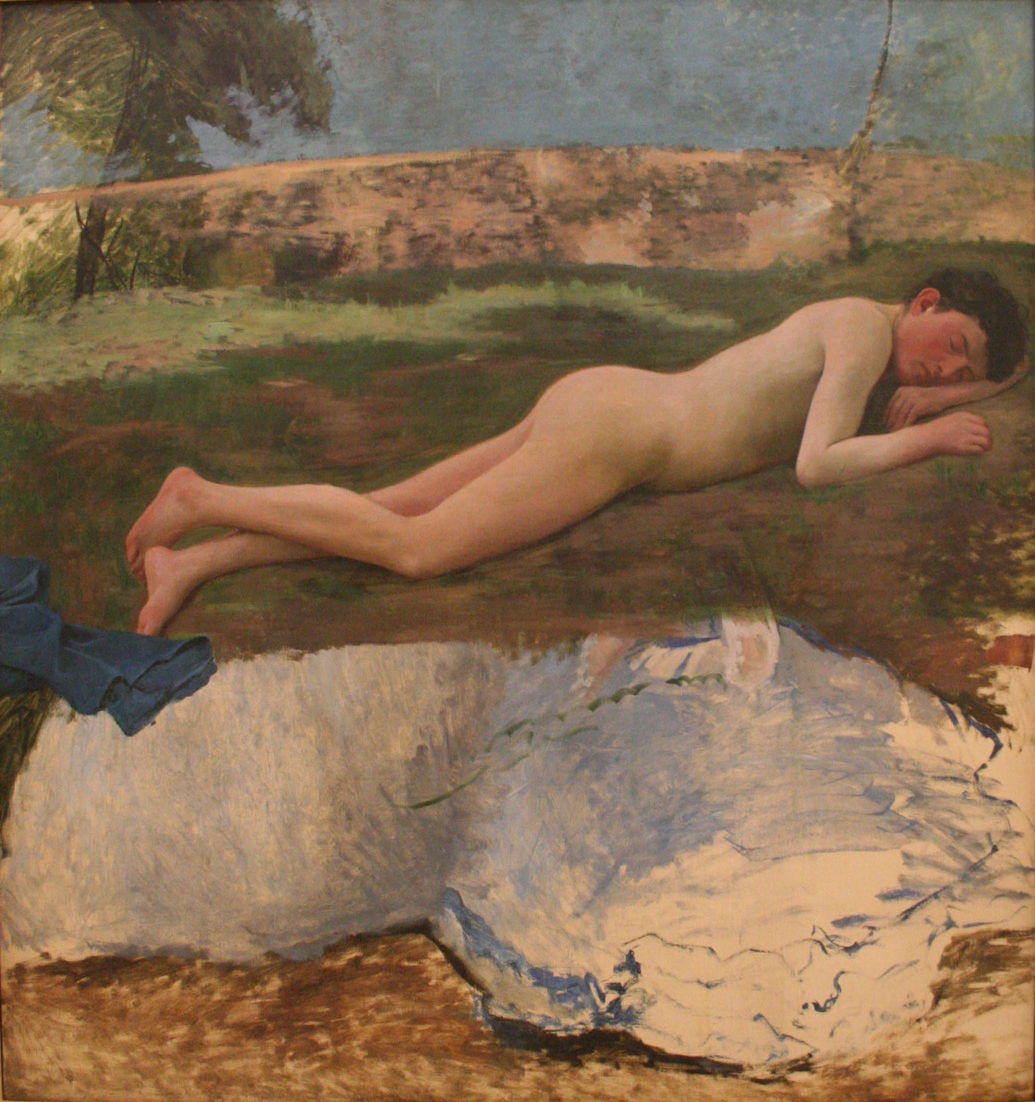
Frédéric Bazille (1841–1870), Study for a Young Male Nude (1870), oil on canvas, 147.5 x 139 cm, Musée Fabre, Montpellier, France. Wikimedia Commons.
In the summer of 1870, Bazille worked on three paintings when he was staying alone at Méric. Study for a Young Male Nude appears odd because it was painted over an unfinished painting of two women in a garden, and the lower third of the canvas shows the lower part of their dresses.
On 19 July 1870, France declared war on Prussia. Within a month, Bazille had enlisted in the Third Zouave Regiment. He spent September training in Algeria, then returned into combat in France. On 28 November 1870, Bazille was killed at the Battle of Beaune-la-Rolande. He would have celebrated his twenty-ninth birthday just over a week later.
In but eight years of painting, Bazille had shown great technical skill, originality, and high promise for his future in the Impressionist movement. Unlike his close friends Monet and Renoir, he was particularly interested in and adept at depicting figures in landscapes. That brilliant future, which would surely have changed Impressionism too, was abruptly ended in a futile attempt to relieve the Siege of Paris.
Impressionist painting is today known overwhelmingly from the many landscapes painted by Claude Monet and Camille Pissarro. The figurative paintings of Auguste Renoir are often thought of as more of a commercial undertaking, those of Edgar Degas are seen as exceptions, and Paul Cézanne’s are usually glossed over altogether.
One of the reasons that Impressionist figurative painting is now largely ignored is that its greatest exponent was killed in 1870, just as he was reaching his peak. When Frédéric Bazille was shot dead by Prussian soldiers during the Franco-Prussian War, that changed the course of Impressionism. This weekend I show some of the paintings from the seven short years of his career as an oil painter before his sudden death.
Jean Frédéric Bazille was born into an affluent family in Montpellier, France, a city on the Mediterranean coast with one of the oldest universities in the world. He was inspired to paint when he saw some of Delacroix’s works, but his family wanted him to study medicine. An accommodation was reached, and in 1859, he started his medical studies at Montpellier University.
In November 1862, Bazille left his home city to transfer to medical studies in Paris. A friend introduced him to Charles Gleyre’s studio, and some time in early 1863, he seems to have started as a pupil there, while continuing his medical training. He met Claude Monet there in March or April of that year, and started painting en plein air with him, probably with Sisley and Renoir too. By the end of 1863, he seems to have been making good progress with Gleyre, although his parents were keen to remind him of the precedence of his medical studies.
In January 1864, he started renting his first studio, and that summer travelled to Normandy with Monet. Shortly after that, he failed his medical exams, and dropped out from those studies, leaving him painting full-time.
Frédéric Bazille (1841–1870), La Robe Rose (The Pink Dress) (1864), oil on canvas, 147 x 110 cm, Musée d’Orsay, Paris. Wikimedia Commons.
In the late summer of 1864, in an effort to convince his family that he was serious about his career in art, Bazille started work on his La Robe Rose (The Pink Dress). Using his cousin Thérèse des Hours, aged fourteen, as his model, he painted this from a drawing he made at Méric, looking towards the village of Castelnau-le-Lez, near Montpellier.
In his drawing, the model is looking to the right and out of the picture plane, with her head rotated by about ninety degrees from that shown in this painting. As this was his first painting of a figure set in a landscape, Bazille seems to have wanted to avoid tackling her face, and opted for her looking away from the viewer.
This painting wasn’t seen by the public until 1910, but since then has become accepted as one of his major works, which is surprising for such a challenging motif and such a relative novice.
In the autumn of 1864, when he returned to Paris, Bazille didn’t go back to Gleyre’s studio, but painted mostly from the models in Monet’s studio. In January 1865, the two painters moved into a new studio together, above Delacroix’s former flat in rue de Furstenberg.
Frédéric Bazille (1841–1870), Self-Portrait with Palette (1865), oil on canvas, 108.9 x 71.1 cm, The Art Institute of Chicago, Chicago, IL. Wikimedia Commons.
It’s not clear exactly when he painted his Self-Portrait with Palette, but it was most probably in 1865. It’s a remarkably accomplished work, given the complexity of arranging the mirror and canvas to result in this unusual pose.
Frédéric Bazille (1841–1870), Landscape at Chailly (1865), oil on canvas, 81 x 100.3 cm, The Art Institute of Chicago, Chicago, IL. Wikimedia Commons.
In May 1865, Bazille left the city for the Forest of Fontainebleau, where the Barbizon School had been centred. There he painted Landscape at Chailly in company with Monet, and possibly Renoir and Sisley. Although clearly influenced by that style, Bazille’s colours are much brighter, and escape the sombre browns and greens that dominated Barbizon paintings.
Frédéric Bazille (1841–1870), The Beach at Sainte-Adresse (1865), oil on canvas, 58.4 x 140 cm, The High Museum of Art, Atlanta, GA. Wikimedia Commons.
In May of the previous year, Bazille and Monet had travelled to the Channel coast, to Le Havre. This was Monet’s home ground, but the first time that Bazille had explored this coast. Oddly, Bazille painted The Beach at Sainte-Adresse a year later, in May 1865, as one of a pair of paintings for an uncle. It appears to have been partially copied from a painting of the same name by Monet, made when the two had visited Sainte-Adresse the year before. Bazille re-arranged the yachts and changed the staffage of the beach, but the sea, sky, and coastline are essentially the same.
During the summer of 1865, Bazille painted Monet lying in bed, injured, at the Lion d’Or Inn, in The Improvised Field Hospital (1865); sadly I have been unable to find a good image of that painting.
In the late autumn, Gustave Courbet visited Monet and Bazille, and congratulated them on their work. However, in January 1866, Bazille left their shared studio to set up in his own at last. In the Spring, he submitted two paintings to the Salon, of which one, Still Life with a Fish, was accepted. For a while during the winter of 1866-67, Monet lodged in Bazille’s studio.
Frédéric Bazille (1841–1870), The Little Gardener (1865-67), oil on canvas, 128 x 168.9 cm, Museum of Fine Arts, Houston, TX. Wikimedia Commons.
During this period, he started to paint The Little Gardener (1865-67), but seems to have abandoned it with the foreground incomplete. It was another step in his development of figures in landscapes, and a precursor to his paintings of 1868.
Frédéric Bazille (1841–1870), The Western Ramparts at Aigues-Mortes (1867), oil on canvas, 60 x 100 cm, The National Gallery of Art, Washington, DC. Wikimedia Commons.
Bazille first wanted to paint at Aigues-Mortes, east of Montpellier, in the summer of 1866, but didn’t get there until May 1867. He then produced one of his most painterly and brilliant landscapes of The Western Ramparts at Aigues-Mortes, as well as several other views, including many sketches.
Frédéric Bazille (1841–1870) (attr), Portrait of Paul Verlaine (1867), oil on canvas, dimensions not known, Private collection. Wikimedia Commons.
I include this Portrait of Paul Verlaine (1867) because of its controversial history. On the strength of the signature on it (which isn’t legible in this image), it had been attributed to Gustave Courbet, but most recently has been claimed to have been painted by Bazille. If that’s accurate, its painterly style is surprising and impressive.
In the Spring of 1867, Bazille submitted two more paintings for the Salon, but both were refused. He drafted a petition calling for a new Salon des Refusés, which was signed by Daubigny, a distinguished member of the Salon jury at the time.
Frédéric Bazille (1841–1870), Portraits of the *** Family (The Family Gathering) (1868), oil on canvas, 152 x 230 cm, Musée d’Orsay, Paris. Wikimedia Commons.
During the summer of 1867, Bazille started work on Portraits of the *** Family also known as The Family Gathering, which he didn’t complete until January the following year. This seems to have been one of his most carefully composed paintings, and he devoted a series of sketches to getting the arrangement of the figures and the terrace just right.
The figures include the artist, squeezed in last at the extreme left, an uncle, Bazille’s parents seated on the bench, Bazille’s cousin Pauline des Hours and her husband standing, an aunt and Thérèse des Hours (model for The Pink Dress) seated at the table, his brother Marc and his partner, and at the right Camille, the youngest of the des Hours sisters. This painting marked a special version of a regular summer meeting, as Pauline des Hours and Bazille’s brother Marc married the partners shown in the late summer of 1867.
At the time, such group portraits were exceptional in French art, although they were popular in Britain, and had been so in the past in the Netherlands, of course. It’s perhaps unsurprising that it was exhibited at the Salon in 1868, and remains one of Bazille’s finest and most innovative works.
In January 1868, Bazille moved into a new studio with Renoir, at what was renamed the following year rue La Condamine, in the Batignolles. He was a regular attender at the Café Guerbois with Manet, Degas, Duranty, Zola, Astruc, and Cézanne.
Frédéric Bazille (1841–1870), View of the Village (1868), oil on canvas, 137.5 × 85.5 cm, Musée Fabre, Montpellier, France. Wikimedia Commons.
Bazille painted another of his best-known works, View of the Village, during the summer of 1868. He based this on sketches made in the Spring at Saint-Sauveur, of a farmer’s daughter in her Sunday-best dress, in Bel-Air Wood, overlooking the River Lez, near Montpellier. Its location and composition are variations of the theme he first developed in The Pink Dress, and he was also reminded of his model for that painting, his cousin Thérèse des Hours.
He probably completed this in the autumn and early winter of 1868, and the following year it was exhibited at the Salon. Puvis de Chavannes and several of the critics were full of praise for it, and for Bazille. He also made an etching of it, the only print made from one of Bazille’s paintings during his lifetime. It remains his greatest success.

 Login
Login