Oil paint has been applied to many different supports, of which the most popular and enduring have been wooden panels and stretched canvas. Panels have tended to become uncommon in recent centuries because of their weight and cost, but in the nineteenth century reappeared in novel form among those sketching in front of the motif, who took to using wood from cigar boxes.
Smoking cigars became popular during that century, particularly among the better-off living in cities. Made from chopped tobacco wrapped in a tobacco leaf, cigars are delicate and affected by humidity, so are sold in small wooden boxes often made from cedar wood. Their lids, particularly those of about 13 by 26 cm (5 x 10 inches) size, were repurposed as the support for many oil sketches. When reading their description, if they’re given as oil on panel with similar dimensions, you should suspect that they may well have been painted on a cigar-box.
The earliest artists who are known to have painted on cigar-boxes are the Italian painters known as the Macchiaioli, a breakaway movement centred on Tuscany in northern Italy from about 1850, that in many ways anticipated Impressionism.
Odoardo Borrani (1833-1905), Peasant Child at Castiglioncello (c 1865), oil on panel, 23.3 x 14.7 cm, Private collection. Wikimedia Commons.
Odoardo Borrani joined the Macchiaioli in 1855, and in about 1865 painted this Peasant Child at Castiglioncello on a wooden panel of 23.3 x 14.7 cm that had almost certainly originated in a cigar box. The unusual linear cracks seen here are characteristic of the thin cedar wood popular in cigar boxes, when used without an adequate ground.
Giovanni Fattori (1825-1908), The Rotonda at Palmieri (1866), oil on panel, 12 x 35 cm, Galleria d’Arte Moderna di Palazzo Pitti, Florence. WikiArt.
Giovanni Fattori’s plein air paintings are characteristic of the Macchiaioli: using small panoramic wood panels, he painted in macchia (taches or patches), in a style not dissimilar to that of the Barbizon School in France. This panel showing The Rotonda at Palmieri (1866) is slightly wider at 12 x 35 cm.
Giovanni Fattori (1825-1908), Portrait of Silvestro Lega, Painting Beside the Sea (1866-7), oil on panel, 12.5 x 28 cm, Private collection. WikiArt.
Fattori’s Portrait of Silvestro Lega, Painting Beside the Sea from 1866-67 is on another panel of 12.5 x 28 cm. This also shows the underlying grain, and its lack of any substantial ground. The artist shown appears to be painting in a pochade box onto another panel that may well be a cigar box.
Later in the century others followed, among them James Abbott McNeill Whistler.
James Abbott McNeill Whistler (1834-1903), Harmony in Blue and Pearl: The Sands, Dieppe (c 1885), oil on panel, 14 x 22.9 cm, National Gallery of Australia, Canberra, Australia. Wikimedia Commons.
In the 1880s, Whistler painted small outdoor views on panels, such as Harmony in Blue and Pearl: The Sands, Dieppe from about 1885. Although its dimensions are slightly different at 14 x 22.9 cm, this is almost certainly on a cigar box. The vertical streaks seen here are probably the result of a thin ground underneath the surface paint layer.
The greatest European exponent of painting on these small wooden panels was Georges Seurat, who mostly used them for studies made in preparation for his larger paintings. When Seurat started work on his monumental painting Les Poseuses(Posers, or Models) in 1886, he made a series of figure studies that are now in the Musée d’Orsay.
Georges Seurat (1859–1891), Model from the Back (study for Poseuses) (1887), oil on wood, 24.4 x 15.7 cm, Musée d’Orsay, Paris. Wikimedia Commons.Georges Seurat (1859–1891), Model Standing (study for Poseuses) (1887), oil on wood, 26 x 17.2 cm, Musée d’Orsay, Paris. Wikimedia Commons.Georges Seurat (1859–1891), Model in Profile (study for Poseuses) (1887), oil on wood, 24 x 14.6 cm, Musée d’Orsay, Paris. Wikimedia Commons.
Each was painted using Seurat’s Divisionist technique on the wooden lid of a cigar box of about 24 by 15 cm size, which the artist termed a croqueton, his favourite support for such sketches.
In the late 1880s, several artists started painting in the rural area of Heidelberg, east of Melbourne, adopting a style that later became known as Australian Impressionism. They came together in a momentous exhibition in the history of Australian art, the 9 by 5 Impression Exhibition, in Melbourne, in 1889, named from the dimensions in inches of the standard Australian cigar-box lid of 13 by 23 cm.
Its principal artists were Charles Conder, Tom Roberts, and Arthur Streeton, many of whose rough-worked and colourful plein air sketches were painted on cigar boxes.
Tom Roberts (1856-1931), Going Home (c 1889), oil on wood panel, 23.4 x 13.6 cm, National Gallery of Australia, Parkes, ACT. Wikimedia Commons.
Roberts’ Going Home from about 1889 has dimensions of 23.4 x 13.6 cm. Linear marks in the lower section appear to be the result of the grain in the wood.
Tom Roberts (1856-1931), Hutt Valley (1900), oil on panel, 10.3 x 19.1 cm, The Museum of New Zealand Te Papa Tongarewa, Wellington, NZ. Wikimedia Commons.
His oil sketch of Hutt Valley from 1900 is slightly smaller at 10.3 x 19.1 cm.
Charles Conder (1868-1909), Dandenongs from Heidelberg (c 1889), oil on wood panel, 11.5 x 23.5 cm, Art Gallery of South Australia, Adelaide. Wikimedia Commons.
Conder’s view of the Dandenongs from Heidelberg from about 1889 uses a more standard size of 11.5 x 23.5 cm.
Charles Conder (1868-1909), Ricketts Point, Beaumaris (1890), oil on wood panel, 12 x 21.5 cm, National Gallery of Australia, Parkes, ACT. Wikimedia Commons.
His Ricketts Point, Beaumaris (1890) is 12 x 21.5 cm with rounded corners.
In the twentieth century, many smokers switched to cigarettes sold in cardboard packets, and the supply of cigar-boxes dried up.
Professional artists have long used brushes to apply paint in their finished work, and many used hand-held sticks of pigment only when sketching in preparation. Charcoal has been widely used, with metal wire in silverpoint an alternative. In the sixteenth century, large deposits of graphite were discovered in Cumbria, England, following which graphite sticks and sheathed pencils became enormously popular among both amateurs and professionals.
Although it’s impossible to make any clear distinction between drawing and painting, those stick-based media are simple compared with oil paints, and seldom used in works comparable in their aims or sophistication to professional oil or watercolour painting.
The first changes in practice resulted from the French Revolution and Napoleonic Wars at the turn of the eighteenth to nineteenth centuries. Graphite was a strategic product, as it was used as a refractory in the manufacture of cannonballs, and supplies to France all but dried up. In 1795 Nicolas-Jacques Conté used a mixture of clay, graphite and other pigments to form sticks similar to pastels but significantly harder, referred to as hard pastels or Conté crayons.
Jean-François Millet (1814-1875), The Cat at the Window (c 1857-58), conté crayon and pastel with stumping and blending, fixed on wove paper, 49.8 × 39.4 cm, The J. Paul Getty Museum, Los Angeles, CA. Courtesy of The J. Paul Getty Museum.
As with charcoal and graphite sticks and pencils, Conté crayons were first used for preparatory sketching. By the middle of the nineteenth century, artists like Jean-François Millet extended their use into pastel paintings including his enchanting and mysterious The Cat at the Window from about 1857-58. Because of their hardness, Conté crayons were more amenable to sharpening, so could make finer lines and a richer range of marks.
Jean-François Millet (1814–1875), The Sower (1865-66), pastel and crayon on beige wove paper mounted on board (Conté crayon, wood-pulp board), 47.1 × 37.5 cm, Sterling and Francine Clark Art Institute, Williamstown, MA. Wikimedia Commons.
Millet’s most famous painting in pastel and Conté crayon is this 1865-66 version of The Sower, a motif that was to recur in the hands of others for the rest of the century, and works perfectly in what were still relatively unconventional media.
Conté crayons, like pencil, charcoal and pastels, rely on mechanical adhesion rather than any polymerising binder. Specialised papers with roughened surfaces were marketed to improve their adhesion, but they share similar problems of longevity. However, at a time when mark-making was becoming popular, the wide range of effects available from sticks of pigment was an attraction: not only could the artist place bold strokes of colour over stumped-smooth areas, but they could also paint on textured grounds to great effect.
Georges Seurat (1859-1891), Embroidery (1882-3), Conté crayon on Michallet paper, 31.2 x 24.1 cm, Metropolitan Museum of Art, New York. WikiArt.
One of the masters of the Conté crayon was the Divisionist Georges Seurat, who used textured papers to give his paintings or drawings a highly granular appearance, as if they were photographs.
The rise of industrial chemistry and manufacturing industries in the nineteenth century brought other new painting sticks. Wax crayons effectively functioned as a low-temperature encaustic, and became popular in schools. They were adopted for resist techniques in watercolours, notably by John Singer Sargent, and some artists started using them in combination with other media.
Félicien Rops (1833-1898), Hamadryad (c 1885), gouache, watercolour, ink wash, crayon, pen and ink, grattage, dimensions not known, Montreal Museum of Fine Arts, Montreal, Canada. Image by Daderot, via Wikimedia Commons.
Félicien Rops’ painting of a Hamadryad from about 1885 uses a wide range of media, drawn from those already popular among the illustrators of the day.
Odilon Redon (1840–1916), Sîta (c 1893), pastel, with touches of black Conté crayon, over various charcoals, on cream wove paper altered to a golden tone, 53.6 × 37.7 cm, The Art Institute of Chicago, Chicago, IL. Image by Rlbberlin, via Wikimedia Commons.
Another enthusiast for mixed stick media was Odilon Redon, for instance in his painting of Sîta from about 1893.
Jean-François Raffaëlli (1850-1924), Parisian Rag Pickers (c 1890), oil and oil crayon on board set into cradled panel, 32.7 × 27 cm, Brooklyn Museum, New York, NY. Wikimedia Commons.
Although the mainstream Impressionists largely kept to oil on canvas, those on the periphery including Jean-François Raffaëlli were more experimental in their choice of media: his Parisian Rag Pickers from about 1890 was made using a mixture of oil paints and oil crayons.
Egon Schiele (1890–1918), Krumau Town Crescent (Small Town V) (1915), black crayon, gouache and oil on canvas, 109.7 x 140 cm, Israel Museum מוזיאון ישראל, Jerusalem, Israel. Wikimedia Commons.
The new generation of painters who started their careers in the early twentieth century used stick media increasingly. Egon Schiele was a prolific draftsman who used drawing techniques extensively in his painting. This work showing Krumau Town Crescent (Small Town V) (1915) is based on a drawing he had made the previous year, and uses the unusual combination of black crayon, gouache and oils.
Egon Schiele (1890–1918), Portrait of the Artist’s Wife Seated, Holding Her Right Leg (1917), black crayon and gouache, 463 x 292 cm, The Morgan Library & Museum, New York, NY. Wikimedia Commons.
For this Portrait of the Artist’s Wife Seated, Holding Her Right Leg, Schiele used just black crayon and gouache.
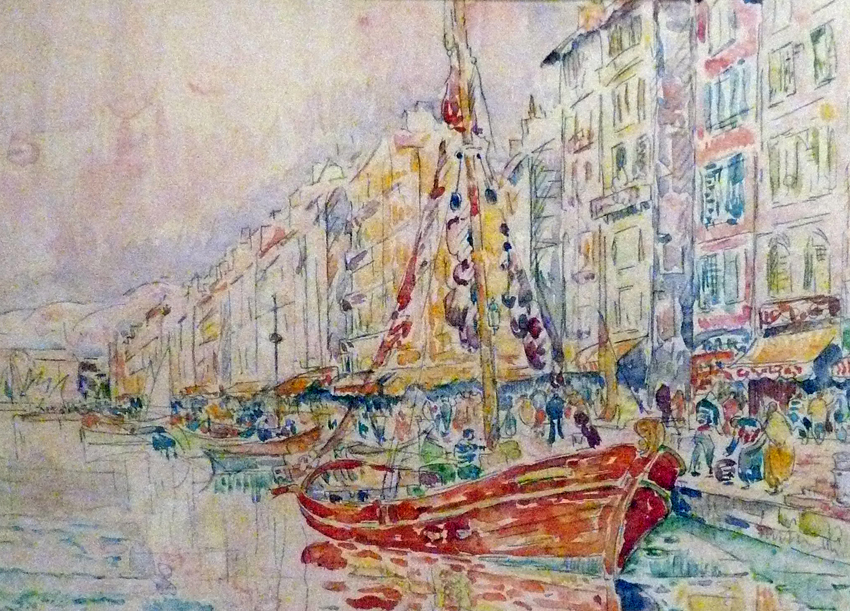
Paul Signac (1863-1935), Antibes (1917), watercolour and crayon, 29.85 x 45.1 cm, Private collection. WikiArt.
Some of the older generation joined in with unusual combinations of media. Late in his life, the former Divisionist Paul Signac painted many brilliantly coloured views of the south of France using combinations of watercolour and crayons, such as Antibes (1917) above, and The Old Port of Marseilles (1931) below.
Paul Signac (1863-1935), The Old Port of Marseilles (1931), watercolour and crayon, Musée Albert André, Bagnols-sur-Cèze, France. WikiArt, Wikimedia Commons.Joseph Stella (1877–1946), Kathleen Millay (c 1923-24), crayon and metalpoint on paper, 71.1 x 55.9 cm, Cheekwood Museum of Art, Nashville, TN. The Athenaeum.
On the other side of the Atlantic, also late in his career, Joseph Stella developed a novel drawing technique combining traditional metalpoint with modern crayons, which he used in his intimate portrait of Kathleen Millay from about 1923-24, above, and Eggplant, one of his last works, completed in 1944, below.
Metalpoint uses fine metal wire, most commonly silver, mounted in a holder, and is a slow and meticulous method of drawing or painting; its marks on paper are only faint to begin with, but they darken slowly as the fine tracks of silver tarnish.
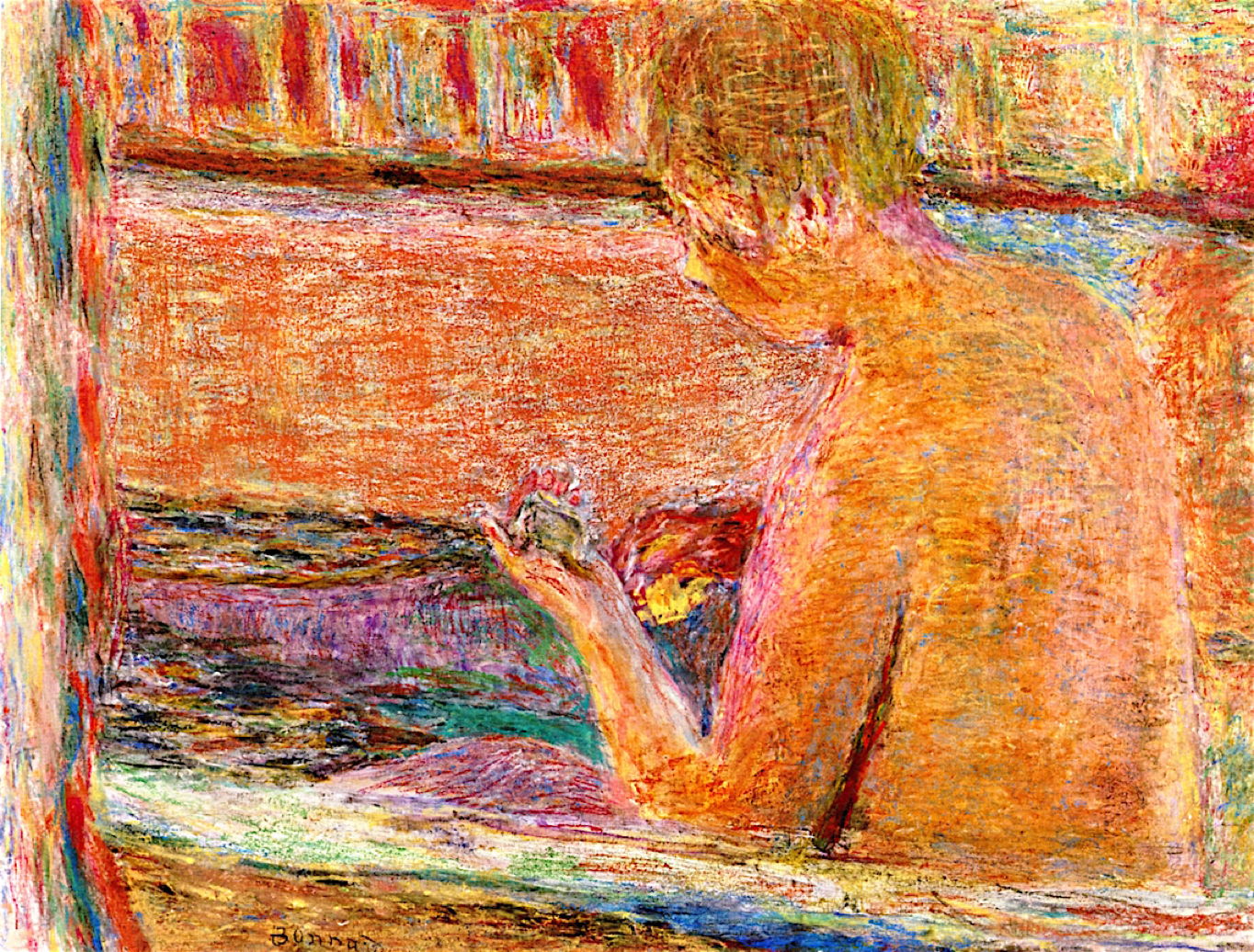
Joseph Stella (1877–1946), Eggplant (1944), crayon and silverpoint on paper, 53.3 x 42.9 cm, Private collection. Wikimedia Commons.Pierre Bonnard (1867-1947), The Bath (1942), gouache, pastel and colored crayon on paper, 50.2 x 65.4 cm, Private collection. The Athenaeum.
Late in his career, Pierre Bonnard incorporated stick media in some of his paintings. The richly textured marks in this painting of his wife Marthe in The Bath from 1942 are strokes of coloured crayon, worked over gouache and pastels.
Paul Nash added both graphite and crayon marks to his 1937 watercolour of Three Rooms, a painting with strong graphic elements.
In the nineteen-twenties and -thirties, several art suppliers developed new types of crayon, using proper binders intended to allow more extensive effects and working, greater versatility, and improved longevity. These mixed conventional pigments with a bewildering array of waxes, oils and other substances, including:
waxes and gums, to make crayons (sheathed in paper) and pencils (in wood);
waxes, to make grease pencils;
waxes and oils, to make lithographic crayons;
mineral wax (paraffin), to make wax crayons;
synthetic wax (polyethylene), to make water-dispersible wax crayons, such as Caran d’Ache Neocolor crayons;
waxes and non-drying oils, to make oil pastels;
waxes and drying oils, to make oil sticks and oil bars, that can form polymerised paint layers similar to conventional oil paints.
Their physical properties, determined by the binders used, in turn determine how they can be applied, appropriate grounds, fragility of the stick and its suitability for sharpening, whether diluents are organic solvents or water, and the depth and robustness of the resulting paint layer.
Unfortunately, even reputable manufacturers seem reluctant to provide detailed information on the lightfastness of pigments used, and to achieve high chroma level in attractive colours they often resort to pigments known to be fugitive on exposure to light. During the twentieth century in particular, this resulted in many fine paintings being made using media that rapidly became a conservation nightmare, either because the paint film has proved unstable, or their initially brilliant colours have faded rapidly.
Some types of media, in particular coloured pencils, have been vulnerable to irresponsible suppliers and artists who have put blind faith in products that have proved ephemeral. Sadly, few artists have obeyed the exhortation for the buyer to beware, and assessed the permanence of the media they have used in paintings which have been sold for large sums.
Among the most recent, and still unproven, media are oil pastels, which work into creamy layers, and undergo only limited hardening because they don’t incorporate drying oils like linseed or walnut. Their origins are controversial: first developed in Japan, and slightly later in Europe, it’s claimed that Pablo Picasso preferred them.
Robert Clark Templeton (1929–1991), Sketch of an Overview of the Courtroom (1971), tan oil pastels on paper, 35.7 x 28.0 cm, Beinecke Rare Book & Manuscript Library, Yale University, New Haven, CT. Wikimedia Commons.
Oil pastels have certainly shown themselves capable in some unusual circumstances, such as Robert Clark Templeton’s court paintings, including his Sketch of an Overview of the Courtroom from 1971. Few courts would have even considered him using watercolours, for example, and for this case he chose modern and unobtrusive oil pastels. This sketch has been executed briskly, with effective use of gestures and marks.
Robert Clark Templeton (1929–1991), Drawing for CBS Evening News of Bobby G. Seale and others (1971), oil pastels on paper, 24.6 x 20.3 cm, Beinecke Rare Book & Manuscript Library, Yale University, New Haven, CT. Wikimedia Commons.
Once a sketch has been laid down in oil pastels, it’s quick to work that up into a more detailed portrait like Templeton’s Drawing for CBS Evening News of Bobby G. Seale and others (1971).
Copyright restrictions prevent me from showing examples of stick media in the hands of modern artists, but I conclude by showing a couple of my own amateur efforts.
Howard Oakley (b 1954), Villard Reculas (2008), Sennelier oil pastels on Daler Rowney Ingres pastel paper, 22.9 x 30.5 cm, private collection. EHN & DIJ Oakley.
This Alpine landscape was painted in the studio using Sennelier oil pastels on Daler Rowney Ingres pastel paper.
Howard Oakley (b 1954), Pont Royal, Paris (2010), Caran d’Ache Neocolor crayons on paper, 26 x 36 cm, private collection. EHN & DIJ Oakley.
This dawn view of the Pont Royal in the centre of Paris was painted with Caran d’Ache water-dispersible Neocolor crayons on paper. This uses base washes brought out from an initial dry crayon sketch, with superimposed texturing using dry crayon – something hard to achieve in watercolour.
Modern stick-based media look alluring, and are persuasively marketed by their vendors. However, those are seldom the traditional art materials suppliers that they might seem: most have been bought up by large companies that are primarily driven by increasing sales revenues, and may have little understanding of the requirements and problems of painting media.
Modern vendors are often secretive over the composition of their products, and although good standards exist for lightfastness, few publish data for their product ranges. Finally, their advantages in the making of art are often marred by the need to protect these paintings under glass.

 Login
Login