Police want to speak to these four men after more than 600 artefacts were stolen
More than 600 artefacts "of significant cultural value" have been stolen from Bristol Museum's archive in a "high-value" raid, police say.
Four men gained entry to a building in the Cumberland Basin area of the city in the early hours of 25 September, Avon and Somerset Police said.
Items from the museum's British Empire and Commonwealth collection were stolen and detectives are now trying to trace four males captured in the area on CCTV.
"The theft of many items which carry a significant cultural value is a significant loss for the city," Det Con Dan Burgan said.
Avon and Somerset Police
The men are described as being white and were all wearing jackets and baseball caps
"These items, many of which were donations, form part of a collection that provides insight into a multi-layered part of British history, and we are hoping that members of the public can help us to bring those responsible to justice," he added.
"So far, our enquiries have included significant CCTV enquiries as well as forensic investigations and speaking liaising with the victims."
Police are keen to speak to anyone who recognises the men captured on CCTV, or who may have seen possible stolen items being sold online.
All of the men are thought to be white. The first was described as of medium to stocky build and was wearing a white cap, black jacket, light-coloured trousers and black trainers.
The second was described as being of slim build and was wearing a grey, hooded jacket, black trousers and black trainers.
The third was wearing a green cap, black jacket, light-coloured shorts and white trainers. Police said he appeared to walk with a slight limp in his right leg.
The fourth was described as being of large build and was wearing a two-toned orange and navy or black puffy jacket, black trousers and black and white trainers.
Nvidia boss Jensen Huang is among the tech bosses the magazine has put on its biggest cover of the year
Time Magazine's Person of the Year for 2025 is not a single person.
Instead, the magazine has given its annual award recognising the year's most influential figure to "the architects" of artificial intelligence (AI).
Nvidia boss Jensen Huang, Meta head Mark Zuckerberg, X owner Elon Musk and AI "godmother" Fei-Fei Li are among those depicted on one of the magazine's two covers.
Experts say it highlights how quickly AI,and the firms behind it, are reshaping society.
It comes as a boom in the technology, ushered in by OpenAI's launch of ChatGPT in late 2022, continues at pace.
The firm said in September its chatbot is used by around 700 million people every week.
Big tech firms are pouring billions of dollars into AI and the infrastructure behind it in a bid to stay ahead of rivals.
There are two covers this year - one a piece of art depicting the letters AI surrounded by workers, and another a painting focused on the tech leaders themselves.
Time
The cover references the classic New York photograph "Lunch atop a Skyscraper" - but with tech figures in place of ironworkers
At Meta, Zuckerberg has reportedly focused the firm around the tech, including its AI chatbot, which it has embedded in its popular apps.
He, along with Huang, Musk and Li, appeared on the cover alongside Lisa Su, boss of chipmaker AMD, OpenAI head Sam Altman, Anthropic chief Dario Amodei, and Google's AI lab lead Sir Demis Hassabis.
"This year, the debate about how to wield AI responsibly gave way to a sprint to deploy it as fast as possible," Time said as it announced its new covers.
"But the risk-averse are no longer in the driver's seat.
"Thanks to Huang, Son, Altman, and other AI titans, humanity is now flying down the highway, all gas no brakes, toward a highly automated and highly uncertain future."
And the magazine's editor-in-chief Sam Jacobs said "no one" had as great an impact in 2025 than "the individuals who imagined, designed, and built AI".
"Humanity will determine AI's path forward, and each of us can play a role in determining AI's structure and future," he said.
Time
Forrester analyst Thomas Husson said 2025 could be seen as a "tipping point" for how frequently AI is now used in our day-to-day lives.
"Most consumers use it without even being aware of it," he told the BBC.
He said AI is now being crammed into hardware, software and services - meaning it its uptake is "much faster than during the Internet or mobile revolutions".
Nik Kairinos, founder and chief executive of lab Fountech AI, said the honour was "an honest assessment" of the tech's influence, but he felt "recognition should not be confused with readiness".
"At this moment, AI can still be a saviour or scourge to humanity," he said.
"We are still in the early stages of building AI systems that are dependable, accountable, and aligned with human values.
"For those of us developing the technology and bringing AI tools to market, there is huge responsibility."
Austria has passed a law banning headscarves in schools for girls under the age of 14.
The conservative-led coalition of three centrist parties, the ÖVP, the SPÖ and the Neos, says the law is a "clear commitment to gender equality", but critics say it will fuel anti-Muslim feeling in the country and could be unconstitutional.
The measure will apply to girls in both public and private schools.
In 2020, a similar headscarf ban for girls under 10 was struck down by the Constitutional Court, because it specifically targeted Muslims.
The terms of the new law mean girls under 14 will be forbidden from wearing "traditional Muslim" head coverings such as hijabs or burkas.
If a student violates the ban, they must have a series of discussions with school authorities and their legal guardians. If there are repeated violations, the child and youth welfare agency must be notified.
As a last resort, families or guardians could be fined up to €800 (£700).
Members of the government say this is about empowering young girls, arguing it is to protect them "from oppression".
Speaking ahead of the vote, the parliamentary leader of the liberal Neos party, Yannick Shetty said it was "not a measure against a religion. It is a measure to protect the freedom of girls in this country," and added that the ban would affect about 12,000 children.
The opposition far-right Freedom Party of Austria, the FPÖ, which voted in favour of the ban, said it did not go far enough.
It described the ban as "a first step", which should be widened to include all pupils and school staff.
"There needs to be a general ban on headscarves in schools; political Islam has no place here", the FPÖ's spokesperson on families Ricarda Berger said.
Sigrid Maurer from the opposition Greens called the new law "clearly unconstitutional".
The official Islamic Community in Austria, the IGGÖ, said the ban violated fundamental rights and would split society.
In a statement on its website, it said "instead of empowering children, they will be stigmatised and marginalised."
The IGGÖ said it would review "the constitutionality of the law and take all necessary steps."
"The Constitutional Court already ruled unequivocally in 2020 that such a ban is unconstitutional, as it specifically targets a religious minority and violates the principle of equality," the IGGÖ said.
The government says it has tried to avoid that.
"Will it pass muster with the Constitutional Court? I don't know. We have done our best," Shetty said.
An awareness-raising trial period will start in February 2026, with the ban fully going into force next September - the beginning of the new school year.
Jennifer Lawrence and Josh Hutcherson were last seen in 2015's Mockingjay Part 2
Jennifer Lawrence and Josh Hutcherson are reportedly set to return to the Hunger Games in next year's highly anticipated prequel.
The pair last starred together in Mockingjay - Part 2, the climactic installment of the original film series.
US magazines The Hollywood Reporter and Deadline reported that Jennifer, 35, return as Katniss Everdeen while Josh, 33, will reprise his role of Peeta Mellark in The Hunger Games: Sunrise on the Reaping.
They suggest the actors will appear in a flash-forward sequence which features in the novel the new film's based on.
BBC Newsbeat's approached production company Lionsgate for comment.
Lawrence, who became a household name playing Katniss, previously said she'd be "totally" up for coming back as the character.
And last month Josh Hutcherson told US magazine Variety he'd "be there in a heartbeat" if he was asked to come back.
"It would not take any convincing at all," he said.
Hunger Games fans were ecstatic at news the beloved characters would be making a new appearance.
One wrote: "For non-Hunger Games fans this is like Rihanna returning to music."
Another added: "It's basically Jesus returning to Earth."
But there were some who weren't happy to see the information revealed, saying it could have been kept an "emotional" surprise.
Getty Images
The Hunger Games is a global best-selling franchise which still lasts in popular culture today
The Hunger Games: Sunrise on the Reaping also stars McKenna Grace, Maya Hawke and Ralph Fiennes and is due to hit cinemas in November 2026.
Author Suzanne Collins' book of the same name sold more than 1.5 million copies worldwide during its release week earlier this year - the biggest debut for one of her books.
Venezuelan opposition leader María Corina Machado appeared in Oslo, Norway after winning the Nobel Peace Prize, waving from the balcony of the Grand Hotel after months in hiding.
Machado made the covert journey despite a travel ban, and has mostly laid low since Venezuela's disputed presidential election in 2024. She last appeared in public in January.
From a balcony on Wednesday with a crowd cheering below, Machado placed her hand on her heart and sang with her supporters, before walking outside to greet them in person.
The Nobel Institute awarded Machado the Peace Prize this year for "her struggle to achieve a just and peaceful transition from dictatorship to democracy" in Venezuela.
Afterwards, Machado went the outside to greet her supporters, who waited behind metal barricades on the street.
"Maria!" "Maria, here!" they shouted in Spanish, as many held their phones aloft to record the historic moment.
At one point, Machado climbed over the barriers to join them.
Reuters
Maria Corina Machado jumps over barricades outside the Grand Hotel in Oslo to greet cheering supporters.
Her appearance was preceded by speculation that she would travel to Norway for the award ceremony.
The Nobel committee shared audio of Machado declaring, "I will be in Oslo, I am on my way."
After her Peace Prize win, Machado made a point to praise US President Donald Trump, who is open about his own ambitions for the Peace Prize and is locked in ongoing military tension with Venezuela.
Venezuelan opposition leader María Corina Machado appeared in Oslo, Norway after winning the Nobel Peace Prize, waving from the balcony of the Grand Hotel after months in hiding.
Machado made the covert journey despite a travel ban, and has mostly laid low since Venezuela's disputed presidential election in 2024. She last appeared in public in January.
From a balcony on Wednesday with a crowd cheering below, Machado placed her hand on her heart and sang with her supporters, before walking outside to greet them in person.
The Nobel Institute awarded Machado the Peace Prize this year for "her struggle to achieve a just and peaceful transition from dictatorship to democracy" in Venezuela.
Afterwards, Machado went the outside to greet her supporters, who waited behind metal barricades on the street.
"Maria!" "Maria, here!" they shouted in Spanish, as many held their phones aloft to record the historic moment.
At one point, Machado climbed over the barriers to join them.
Reuters
Maria Corina Machado jumps over barricades outside the Grand Hotel in Oslo to greet cheering supporters.
Her appearance was preceded by speculation that she would travel to Norway for the award ceremony.
The Nobel committee shared audio of Machado declaring, "I will be in Oslo, I am on my way."
After her Peace Prize win, Machado made a point to praise US President Donald Trump, who is open about his own ambitions for the Peace Prize and is locked in ongoing military tension with Venezuela.
Alexander Butyagin works at the world famous Hermitage Museum in St Petersburg.
Polish authorities have arrested a prominent Russian academic from St Petersburg's world-famous Hermitage Museum who is sought by Ukraine for allegedly conducting illegal excavations and partially destroying the ancient city of Myrmekion in Crimea.
The suspect, identified under Polish law as Aleksandr B, is the head of the Ancient Archaeology of the Northern Black Sea region at the museum, according to Ukrainian prosecutors.
Ukrainian prosecutors accuse him of conducting illegal excavations at the site in Kerch between February 2014 and November 2025.
"As a result of these excavations, from 2014-2019, he illegally partially destroyed the 'Ancient City of Myrmekion' archaeological complex," Prosecutor Piotr Skiba, a spokesman for the Warsaw District Prosecutor's Office told the BBC, citing information from Ukrainian prosecutors.
Ukraine estimates the damage at UAH 201.6 million ($4.77 million).
Russia invaded Crimea in February 2014 and annexed it. Russia's foreign ministry identified the man as Alexander Butyagin, an employee of the State Hermitage Museum and condemned his detention.
"This is absolute legal tyranny. We will of course demand through diplomatic channels the right to protect the interests of our citizen," Kremlin spokesman Dmitry Peskov said.
Myrmekion was an Ancient Greek colony founded by the Ionians in the first half of the Sixth Century BCE located in contemporary Crimea.
Prosecutor Skiba said the man was detained in Poland on 4 December and was later questioned by prosecutors in Warsaw, "where he refused to provide explanations".
The Ukrainian Prosecutor's Office issued an extradition request for Aleksandr B in November, Skiba said.
According to the request: "He searched for movable objects on cultural heritage sites without the appropriate permit to conduct excavations at the 'Ancient City of Myrmekion' archaeological complex in Kerch….and conducted illegal excavations at this cultural heritage site from the beginning of the temporary occupation of the territory of Crimea".
Russia's foreign ministry said Butyagin had been invited to deliver lectures on Pompeii in Warsaw and several other European cities.
Warsaw District Court has agreed to remand Aleksandr B in custody at the Warsaw-Białołęka detention centre for 40 days until 13 January whilst the extradition process goes ahead.
The Russian embassy in Warsaw has been informed of his arrest and pre-trial detention and are providing him with consular assistance, Prosecutor Skiba said.
The two big union federations are staging the strike, which will disrupt much of the country's services
Portugal is facing severe disruption to transport, flights, hospitals, schools and other public services on Thursday, as the two main union federations stage a general strike over unprecedented labour reforms.
The last time the CGTP and the generally less militant UGT joined forces was during the eurozone debt crisis in 2013, when a "troika" of international institutions demanded cuts in salaries and pensions as part of Portugal's bailout.
Twelve years later, Portugal's economy has become the fastest growing in the eurozone in recent months, but Prime Minister Luís Montenegro says it is still necessary to tackle "rigidities" in the labour market "so companies can be more profitable and workers have better salaries" as a result.
"I will not give up on having a country with the ambition to be at the forefront, to be at the vanguard of Europe," he said on the eve of the strike.
However, Montenegro appears to have been taken aback by the strength of feeling against his minority right-of-centre government's plans: one of his Social Democrat MPs is on the UGT executive and even he voted for a strike.
The prime minister tweaked some proposals after calling the federation in for talks late last month, but it was clearly not enough.
Among the most controversial of the more than 100 proposals are:
letting employers roll over temporary contracts for years on end
lifting a ban on sacking workers then immediately rehiring them indirectly via outsourcing
removing a requirement to reinstate employees who were unfairly dismissed.
It is Portuguese in their 20s who are likely to be most affected by the changes - and opinion is rather mixed.
Diogo Brito, who works as an air steward but has friends who do casual work in tourism, supports the right to strike but backs the package: "It has to be done. We have to catch up with richer countries and with these measures I think we can evolve more."
But self-employed photographer Eduardo Ferreira says he knows many people who already cannot find secure jobs and is pleased to see the unions unite at a "critical moment" for Portugal: "Things have been tough ever since the troika, and workers haven't reacted until now."
EPA
Prime Minister Luís Montenegro appears to have been taken aback by the scale of opposition to his reforms
The CGTP has condemned the package as "an assault on the rights of all workers, particularly women and young people", while the UGT calls it "so out of step, in a context of economic growth, financial stability and a strong labour market, that… it reflects a clear bias in favour of employers".
The UGT also complains that formal talks between unions, government and business were "unbalanced, restrictive and detrimental to workers".
Montenegro's governing coalition lacks a majority in parliament, and is seeking support for the bill not only from the small, free-market Liberal Initiative (IL) but from hard-right Chega, which since May's general election has been the second-largest party.
Its leader, André Ventura, has expressed reservations about the way some measures might affect family life, but looks open to negotiations.
Before the election, Montenegro had ruled out deals with Chega, and the unions and the third-biggest party, the Socialists, say the prime minister's mask has slipped.
They also warn that politicians on the right want to amend Portugal's 1976 constitution to loosen employment safeguards considered among Europe's strongest.
The issue has also become caught up in the campaign for January's presidential election, with several candidates arguing that the labour reform bill flouts Portugal's 1976 constitution.
Under Portugal's "semi-presidential" system, the head of state can decline to sign bills approved by parliament. Bills can instead be sent to the Constitutional Court for review or the president can exercise a veto that, while it can be overturned by a majority of elected MPs, delays the process, ensuring further discussion.
With the government seeking to overhaul so much of the labour code, such scrutiny might stoke voter unease about its radicalism, particularly since the plans were not in the coalition's election manifesto.
Unlike many strikes here, Thursday's day of action is not limited to the public sector.
At Portugal's largest factory, VW-owned Autoeuropa, south of Lisbon, almost 1,000 employees voted unanimously last week to back it.
"I believe there is no worker in this country unaffected by the negative measures in this reform," said UGT secretary-general Mário Mourão, after the Autoeuropa gathering. "It must be responded to appropriately."
Austria has passed a law banning headscarves in schools for girls under the age of 14.
The conservative-led coalition of three centrist parties, the ÖVP, the SPÖ and the Neos, says the law is a "clear commitment to gender equality", but critics say it will fuel anti-Muslim feeling in the country and could be unconstitutional.
The measure will apply to girls in both public and private schools.
In 2020, a similar headscarf ban for girls under 10 was struck down by the Constitutional Court, because it specifically targeted Muslims.
The terms of the new law mean girls under 14 will be forbidden from wearing "traditional Muslim" head coverings such as hijabs or burkas.
If a student violates the ban, they must have a series of discussions with school authorities and their legal guardians. If there are repeated violations, the child and youth welfare agency must be notified.
As a last resort, families or guardians could be fined up to €800 (£700).
Members of the government say this is about empowering young girls, arguing it is to protect them "from oppression".
Speaking ahead of the vote, the parliamentary leader of the liberal Neos party, Yannick Shetty said it was "not a measure against a religion. It is a measure to protect the freedom of girls in this country," and added that the ban would affect about 12,000 children.
The opposition far-right Freedom Party of Austria, the FPÖ, which voted in favour of the ban, said it did not go far enough.
It described the ban as "a first step", which should be widened to include all pupils and school staff.
"There needs to be a general ban on headscarves in schools; political Islam has no place here", the FPÖ's spokesperson on families Ricarda Berger said.
Sigrid Maurer from the opposition Greens called the new law "clearly unconstitutional".
The official Islamic Community in Austria, the IGGÖ, said the ban violated fundamental rights and would split society.
In a statement on its website, it said "instead of empowering children, they will be stigmatised and marginalised."
The IGGÖ said it would review "the constitutionality of the law and take all necessary steps."
"The Constitutional Court already ruled unequivocally in 2020 that such a ban is unconstitutional, as it specifically targets a religious minority and violates the principle of equality," the IGGÖ said.
The government says it has tried to avoid that.
"Will it pass muster with the Constitutional Court? I don't know. We have done our best," Shetty said.
An awareness-raising trial period will start in February 2026, with the ban fully going into force next September - the beginning of the new school year.
Pakistan's former spy chief has been sentenced to 14 years in prison by a military court, on charges including violation of state secrets and interfering in politics.
Faiz Hameed led Pakistan's Inter-Services Intelligence (ISI) agency from 2019 to 2021, during the tenure of now-jailed former prime minister Imran Khan.
He was known to be a staunch supporter of Khan, and took early retirement shortly after Khan was ousted in a no-confidence vote in 2022.
It is the first time that an ISI chief in Pakistan has been court martialled. His lawyer said he plans to appeal against the verdict.
The ISI chief is seen as the second most powerful position in Pakistan's military.
According to a press release issued by the public relations arm of Pakistani military (ISPR), the 15-month-long court martial proceeding began on August 12, 2024, under the Pakistan Army Act.
Hameed was tried on four charges, including "involvement in political activities, violation of the Official Secrets Act which harmed the interest of the state, misuse of his powers and government resources, and causing harm to citizens".
The ISPR statement added that Hameed had been given "the right to have a defence team of his choice" and that he has the right to appeal the decision in the "appropriate forum", which would be the Supreme Court of Pakistan.
The exact details of the case are not public as the hearing was held behind closed doors in a military court.
The statement says that Hameed's alleged involvement in fomenting political agitation and instability is being dealt with separately.
This is assumed to be regarding allegations that Hameed was tied to protests against Imran Khan's arrest on 9 May 2023.
Hameed's lawyer, Mian Ali Ashfaq, said his client was "1,000% innocent, but this is the court's decision".
"We were unaware of the judgement and only found out through the ISPR's press release. We are now applying to the relevant forum for a copy of the decision," he told the BBC.
"As soon as we receive it, we will review it and immediately file a petition to appeal. Right now, the first forum for appeal is the army chief, so that is what we will do. We are hopeful that at the next forum we will present our case and obtain justice."
Nvidia boss Jensen Huang is among the tech bosses the magazine has put on its biggest cover of the year
Time Magazine's Person of the Year for 2025 is not a single person.
Instead, the magazine has given its annual award recognising the year's most influential figure to "the architects" of artificial intelligence (AI).
Nvidia boss Jensen Huang, Meta head Mark Zuckerberg, X owner Elon Musk and AI "godmother" Fei-Fei Li are among those depicted on one of the magazine's two covers.
Experts say it highlights how quickly AI,and the firms behind it, are reshaping society.
It comes as a boom in the technology, ushered in by OpenAI's launch of ChatGPT in late 2022, continues at pace.
The firm said in September its chatbot is used by around 700 million people every week.
Big tech firms are pouring billions of dollars into AI and the infrastructure behind it in a bid to stay ahead of rivals.
There are two covers this year - one a piece of art depicting the letters AI surrounded by workers, and another a painting focused on the tech leaders themselves.
Time
The cover references the classic New York photograph "Lunch atop a Skyscraper" - but with tech figures in place of ironworkers
At Meta, Zuckerberg has reportedly focused the firm around the tech, including its AI chatbot, which it has embedded in its popular apps.
He, along with Huang, Musk and Li, appeared on the cover alongside Lisa Su, boss of chipmaker AMD, OpenAI head Sam Altman, Anthropic chief Dario Amodei, and Google's AI lab lead Sir Demis Hassabis.
"This year, the debate about how to wield AI responsibly gave way to a sprint to deploy it as fast as possible," Time said as it announced its new covers.
"But the risk-averse are no longer in the driver's seat.
"Thanks to Huang, Son, Altman, and other AI titans, humanity is now flying down the highway, all gas no brakes, toward a highly automated and highly uncertain future."
And the magazine's editor-in-chief Sam Jacobs said "no one" had as great an impact in 2025 than "the individuals who imagined, designed, and built AI".
"Humanity will determine AI's path forward, and each of us can play a role in determining AI's structure and future," he said.
Time
Forrester analyst Thomas Husson said 2025 could be seen as a "tipping point" for how frequently AI is now used in our day-to-day lives.
"Most consumers use it without even being aware of it," he told the BBC.
He said AI is now being crammed into hardware, software and services - meaning it its uptake is "much faster than during the Internet or mobile revolutions".
Nik Kairinos, founder and chief executive of lab Fountech AI, said the honour was "an honest assessment" of the tech's influence, but he felt "recognition should not be confused with readiness".
"At this moment, AI can still be a saviour or scourge to humanity," he said.
"We are still in the early stages of building AI systems that are dependable, accountable, and aligned with human values.
"For those of us developing the technology and bringing AI tools to market, there is huge responsibility."
A year for the history books for the Chinese AI beat. We began the year astonished by DeepSeek’s frontier model, and are ending in December with Chinese open models like Qwen powering Silicon Valley’s startup gold rush.
It’s a good time to stop and reflect on Chinese AI milestones throughout 2025. What really mattered, and what turned out to be nothingburgers?
This piece recaps:
The biggest model drops of the year
China’s evolving AGI discussion among Alibaba leadership and the Politburo
The biggest swings in the US-China chip war
Beijing’s answer to America’s AI Action plan and the MFA’s
Robots
Models
The DeepSeek Moment
Liang Wenfeng lit the fire
DeepSeek-R1 came out on January 20, thwarting everyone’s Chinese New Year plans. The cost-efficient LLM, which uses a Mixture-of-Experts (MoE) architecture, caused many in Silicon Valley to re-evaluate their bets on scaling — and on unfettered American dominance in frontier models. DeepSeek is powered by domestically trained Chinese engineering talent, an apparent belief in AGI, and no-strings-attached hedge fund money (it is owned by High-Flyer 幻方量化, a Hangzhou-based quantitative trading firm). There were initial concerns that such a recipe could not be replicated by more capital-constrained Chinese tech startups, but Kimi proved that wrong with K2 in July; Z.ai, Qwen, and MiniMax followed.
We translated Chinese tech media 36Kr’s interview with DeepSeek CEO Liang Wenfeng back in November 2024, and spent much of January 2025 on the DeepSeek beat (see Jordan’s conversations on DeepSeek with Miles Brundage here and with Kevin Xu of Interconnectedhere). Over at the newsletter, we covered how China reacted to DeepSeek’s rise, its secret sauce, and concerns around open-source as a strategy.
DeepSeek continues to be a big deal. For one, it paved the way for an open-source race dominated by Chinese models. Nearly every notable model released by Chinese companies in 2025 has been open source. In public blog posts, social media discussions, and private conversations, Chinese engineers and tech executives repeatedly attribute their open-source orientation to the example set by DeepSeek.
On the technical end, despite some remaining mystery surrounding the exact cost of training R1, DeepSeek’s viability was a shot in the arm for Chinese labs working under compute constraints. Going into 2026, with restrictions on H200s loosened and reporting that DeepSeek is still training on smuggled Nvidia, easier access to TSMC-fabbed Nvidia chips may be just what DeepSeek needs to get their mojo back.
Manus
Big deal, but not because of the product
On March 6, an unknown Chinese startup named Butterfly Effect 蝴蝶效应 launched Manus, the world’s first general-purpose AI agent. Revisiting the “Introducing Manus” video that went viral nine months ago is a reminder of how quickly technology has developed: the capabilities Manus demonstrated — reviewing a folder of résumé PDFs, researching stocks, and comparing real estate options — are now so common that we barely think of them as new or even particularly agentic. But back then, some thought Manus was a second “China Shock” of sorts after DeepSeek. Jordan discussed Manus on the podcast with (Strange Loop Canon), Swyx from , and (Mercatus, Hyperdimensional) on the podcast here.
Soon after, Manus didn’t want to be Chinese anymore. In July, the company scrubbed its internet presence inside China, relocated to Singapore, and laid off most of its staff in Beijing and Wuhan. An April funding round led by the American venture capital firm Benchmark had been scrutinized by the US Treasury Department over restrictions on investments into Chinese AI development. Manus may have decided that its Chinese base is a worthy sacrifice if it means access to American capital and the global market.
Since then, its market strategy has been anything but understated: from exclusive parties in San Francisco to conference keynotes in Singapore, Manus is trying to reinvent itself as a global force spearheading agents. Whether or not this rebrand is successful remains to be seen; in the meantime, it is no longer the only agent in the game, as major AI companies like OpenAI and ByteDance launched agent products of their own.
Looking back, Manus was the start of a wave of Chinese AI companies aggressively pursuing international expansion in the second half of this year. With DeepSeek providing that the world was interested in open-source Chinese models, other companies became eager for a slice of the lucrative global market. Whether or not their Chinese roots limit their growth potential will be up to regulators in 2026 and beyond.
The Open Source Race
The defining paradigm
With DeepSeek shooting the first shot, this year saw a significant number of Chinese companies contributing excellent models to the open source race. In the process of promoting their models, Chinese labs have also become much less secretive.
We covered Kimi K2, a “thinking” model whose architecture is inspired by DeepSeek, in July, with much of the reportage based on blogs and comments Kimi engineers shared online. Since then, we were also able to interview Li Zixuan, director of product at Z.ai (formerly Zhipu), which makes the popular GLM models. 2026 will almost certainly see more Chinese AI companies leverage open source as a mean of expanding influence.
China and AGI
Does China believe in AGI, and is it working to pursue it? It’s a question hotly debated by observers of China’s tech scene, and this year we were fortunate to be able to feature some excellent writing that probes at this topic.
In April, an anonymous contributor staged a Platonic debate between a believe and a skeptic, laying out arguments for and against the question of Chinese AGI belief.
In May, another anonymous writer covered the Politburo “study session” on AI. We learn from the invited guest list that “Xi’s hand-chosen experts on AI seem more like the Yoshua Bengios and Geoffrey Hintons of the Chinese AI world than the Yann LeCuns”:
Alibaba, whose family of Qwen models gained particular prominence in the latter half of this year, held its annual Yunqi Conference in September, and CEO Eddie Wu delivered a landmark speech sketching out his vision for transformative AI. Guest contributor Afra Wang argues that prophetic styles signal a “vibe shift” in Chinese tech, as the industry begins to see itself as pivotal for the nation’s destiny.
The Chip War
Just make up your mind already!
For most of the year, we waited with baited breath for the Trump administration to decide whether to export advanced AI chips to China — and for Beijing to make up its mind on whether it wants them after all. All this drama led to five emergency pods! A quick timeline to refresh our memory:
April: BIS closed loopholes in Biden-era chip and manufacturing equipment export controls, further restricting Chinese access;
May: Commerce Department kills the Biden Administration’s Diffusion Rule via Q&A but weirdly still hasn’t fully changed the reg…
July: America’s AI Action Plan called for stricter enforcement of export controls and exploration of location verification mechanisms (our coverage)
The Summer of Jensen (reported by ChinaTalk here and discussed with Lennart Haim and Chris Miller here):
July 15: Jensen Huang met Trump and secured permission to resume sales of H20s to China;
July 30: The Cyberspace Administration of China (CAC) summoned Nvidia’s representatives over risks of Nvidia being able to control H20s remotely, accusing them of having a “kill switch”;
August 11: The Trump administration reached a deal with AMD and Nvidia to resume exports of H20s and MI308s to China, with the US government receiving 15% of the resulting revenue;
August 12: The CAC summoned top Chinese tech firms to pressure them to reduce H20s orders and supplant with domestic alternatives;
August 13: Reutersreported that US officials have been secretly putting tracking devices into some high-end chips in order to track diversion to China;
August 21: Reports emerge that Nvidia has asked some suppliers to halt production of H20s.
September: BIS unveiled an Affiliates Rule, which would have hit many more Chinese companies with restrictions on chip access, including their ability to purchase legacy chips;
October: the Trump-Xi Summit produced a deal, with China suspending its new, dramatic rare earths export restrictions for one year in exchange for a temporary suspension of the Affiliates Rule (emergency pod)
November: The GAIN AI Act was introduced in the Senate, with the White House apparently lobbying against it;
December: Trump announced that he will permit Nvidia to sell H200s to China (emergency pod).
Huawei is Beijing’s champion for creating an alternative ecosystem to Nvidia’s. Guest contributor Mary Clare McMahon explored how Huawei is working to bypass the CUDA moat in May, and in June Jordan sat down with veteran journalist Eva Dou to discuss her new book, The House of Huawei. In October, Jordan also interviewed Chris McGuire, former Deputy Senior Director for Technology and National Security at the NSC, about where Huawei’s capabilities might be going.
The rise of reasoning models and inference training has also brought attention towards high-bandwidth memory (HBM), where China still currently relies on the Big Three: the US’s Micron, and South Korea’s SK Hynix and Samsung. Contributors Ray Wang and Aqib Zakaria covered China’s pursuit of indigenous HBM this year, exploring CXMT’s capabilities in the face of lithography export controls.
Robots
Too soon to tell…
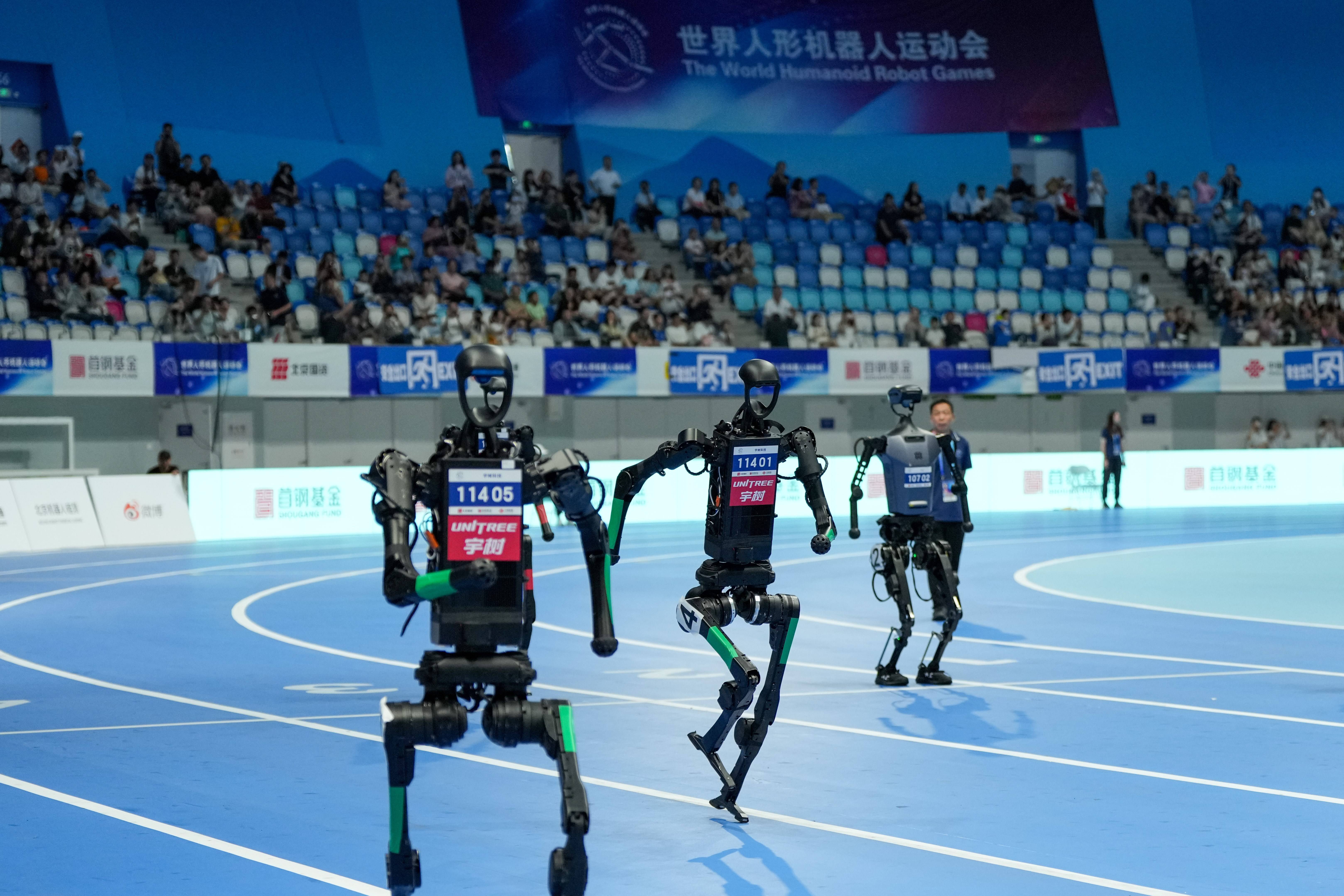
A wave of attention gathered around robotics and embodied AI in China this year. The Government Work Report this year explicitly mentioned embodied AI for the first time, placing it alongside longstanding tech aspirations like quantum and 6G. The Ministry of Industry and Information Technology (MIIT) specifically named humanoid robots in its list of work priorities for 2025. And throughout the second half of 2025, the Chinese Institute of Electronics has been working on standards for the humanoid robots industry, responding to an apparently “urgent” need for standardization in an increasingly competitive field.
Inside China, buoyed by media attention and Unitree’s Spring Festival Gala appearance in January, competition in humanoid robots turned white-hot this year. At least ten companies released humanoid robot models. Some compete by offering increasingly low per-unit prices, while others are starting to pursue specialization in terms of capabilities.
Embodied AI sits at the intersection of China’s longstanding manufacturing advantage and recent advances in machine learning research like vision-language models (VLMs). Jordan sat down with Ryan Julian of Google DeepMind to discuss some of these advances in robotics research this September. Some industry observers in China are worried that humanoids, and embodied AI in general, will turn out to be a bubble, given the sudden rush of investment and a lack of obvious business models. In the meantime, American policymakers are beginning to fret about Chinese robotics firms’ impressive market shares and Western academia’s reliance on affordable Chinese hardware. It’s too early to tell if 2025 was the start of something seismic in robotics.
Track and field at the inaugural World Humanoid Robot Games in Beijing this year.
Policy
AI+ Plan
Big deal; results unknown
On August 28, the State Council released its “Opinion on In-Depth Implementation of the ‘Artificial Intelligence+’ Initiative” (关于深入实施“人工智能+”行动的意见, hereafter abbreviated to “AI+ Plan”). The Plan is a landmark document addressing the integration of AI into China’s economy and society and pushes for thorough AI diffusion across sectors, ministries, and regions. It does not address geopolitical competition much, but clearly portrays AI integration as a strategic priority for the country.
We dove deeply into the AI+ Plan after it was released. Its extraordinarily comprehensive scope, intense sense of urgency, and framing of open-source models as geostrategic assets were remarkable then and remain relevant now. Going into next year, however, knock-on effects will reach Beijing’s doorsteps. How far is “emotional consumption,” greenlit as an application by the AI+ Plan, allowed to go, as AI companions become more alluring and mental health issues potentially proliferate? Will the state be able to keep frustrations around unemployment at bay amid deflation? If AI capabilities are “jagged,” to quote Helen Toner, will Beijing need to adjust expectations for how different industries’ productivities will change with AI?
The Global AI Governance Action Plan
Mid-sized deal with MFA characteristics
A follow-up from the 2023 Global AI Governance Initiative, the Global AI Governance Action Plan was released on July 26 at the World AI Conference (WAIC) in Shanghai. China has long sought to create an overarching narrative for international AI governance. The Global AI Governance Action Plan should be understood as part of its campaign to win hearts and minds around the globe, particularly among unaligned nations in the developing world seeking technology partners.
In hindsight, there is a link between the third item of the Global AI Governance Action Plan, which discusses integration of AI into nearly every industry internationally, and the “AI+” plan for domestic AI diffusion that was released later in the year (to be discussed next). Sector-agnostic, large-scale adoption is a conceptualization of AI that is articulated consistently in Chinese tech policy.
Beyond this, however, most of the other items in the Global AI Governance Action Plan are yet to be realized. Without naming the US, the Plan stresses “global solidarity” and warns against fragmentation. China seeks an active role in international AI governance, whether in standards, environmental management, or data sharing. Diplomatic currents move slowly, and we will likely see more AI policy outreach from Beijing towards developing countries in the coming months and years.
Labelling Requirements, and How to Evade Them
Nothingburger, sadly
Just one day after Manus on March 7, the Cyberspace Administration of China (CAC) released a draft of its “Measures for Labeling of AI-Generated Synthetic Content” (人工智能生成合成内容标识办法), which later came into force in September. The Measures require internet service providers to explicitly label AI-generated content on users’ feeds and add implicit labels to the metadata of synthetic content files. Platforms, in theory, should make it known to users whenever the latter interact with potentially AI-generated content, as well as make sure that creators proactively label their uploaded content as AI-generated. This makes China one of the first jurisdictions, and certainly the largest, to implement labelling or watermarking rules for AI-generated internet content.
The CAC is ostensibly well-placed to roll out AI content labelling regulations, given its unparalleled regulatory reach and China’s competitive position in AI technology. However, after a rush of actions by companies to comply in September, momentum has fallen by the wayside. ChinaTalk will have more coverage on this soon, but in a nutshell, the landscape for AI content labelling enforcement is uneven at best. (Anecdotally, I see unlabelled, AI-generated content on Xiaohongshu and WeChat almost every day. Especially in the case of AI-generated text, labelling is next to nonexistent.)
AI-assisted and -generated content is now so much more pervasive online than nine months ago, whether on global platforms or on the Chinese internet. It’s time to ask: what was the point of labelling as policy? Is it to actually protect users from misinformation and engender trust, or is it just a stopgap measure that lets platforms evade responsibility? What kinds of AI usage merit which kinds of mandated disclosures?
A clearly AI-generated video on Rednote/Xiaohongshu. The user’s self-chosen name is “Mimi Loves AI,” but apart from that there is no other indication that the video is AI-generated.
ChinaTalk is a reader-supported publication. To receive new posts and support our work, consider becoming a free or paid subscriber.
U.S. imports and exports ticked up from lows the previous month when the president’s global tariffs went into effect, while the trade deficit continued to fall
2025年4月2日|宣布“对等关税”:特朗普4月2日在白宫玫瑰花园举行“让美国再次富有”(Make America Wealthy Again)记者会,宣布“对等关税”措施。美国对大多数国家征收10%的基准关税,但针对特定国家征收更高税额。中国、欧盟和越南分别面临34%、20%和46%的关税; 日本、韩国、印度、柬埔寨和台湾,分别受到24%、25%、26%、49%和32%进口关税的打击。

 Login
Login