Normal view

There are new articles available, click to refresh the page.
Yesterday — 9 December 2025Main stream

Medium and Message: Oil on paper

By: hoakley
9 December 2025 at 20:30

Centuries of experience with painting using oil paints have proved the importance of a robust support and a ground that isolates the paint layer from its support. Older use of wood panels with a gesso ground consisting largely of gypsum or chalk ensured the paint layer wouldn’t be subjected to mechanical stress, and would remain isolated from the underlying wood. Canvases became popular because of their relative lightness particularly in larger sizes, but still require an isolating ground layer both to protect the canvas from damage by the paint, and to prevent discolouration of the paint.

When sketching in oils in front of the motif became increasingly popular in the late eighteenth century, those paintings weren’t intended for public view, but as an aid for the artist when composing finished paintings in the studio. Rather than gather hundreds of small oil sketched on canvas or panels, the first plein air painters usually used paper or cardboard as support and ground. Subsequently, when their studios were sold off following their death, surviving oil sketches were usually laid on canvas for preservation and display.

Pierre-Henri de Valenciennes, (Title not known) (c 1783), oil on paper laid on canvas, c 18 x 28 cm, Musée du Louvre, Paris. © 2015 EHN & DIJ Oakley.
Pierre-Henri de Valenciennes (1750-1819), (Title not known) (c 1783), oil on paper laid on canvas, c 18 x 28 cm, Musée du Louvre, Paris. © 2015 EHN & DIJ Oakley.

Although he probably wasn’t the first to compile a library of oil sketches, those gathered by Pierre-Henri de Valenciennes when he was painting in the Roman Campagna in the 1780s are among the most brilliant. This untitled view of the countryside near Rome is thought to have been painted in about 1783.
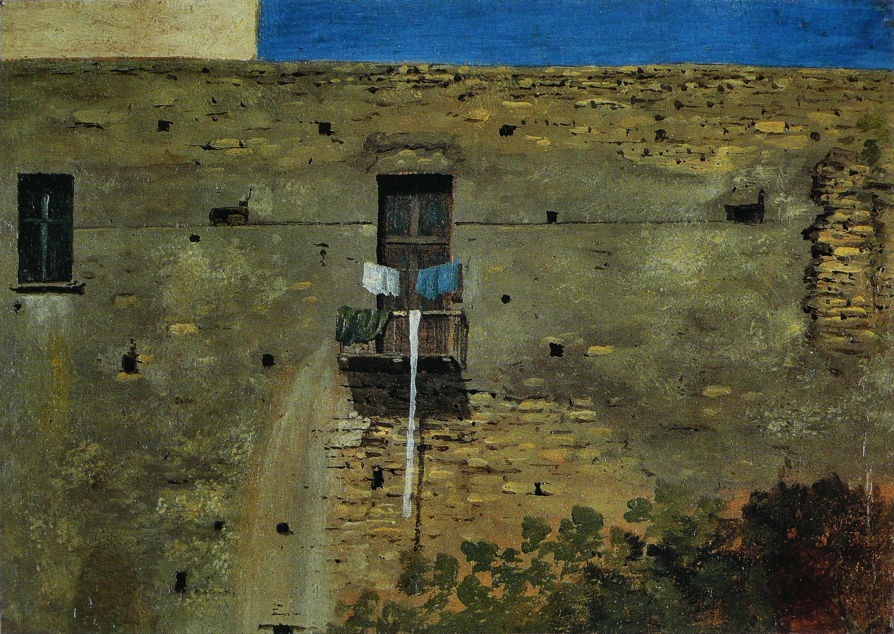
Thomas Jones, A Wall in Naples (c 1782), oil on paper laid on canvas, 11.4 x 16 cm, National Gallery, London. Wikimedia Commons.
Thomas Jones (1742-1803), A Wall in Naples (c 1782), oil on paper laid on canvas, 11.4 x 16 cm, National Gallery, London. Wikimedia Commons.

At about the same time, the Welsh painter Thomas Jones was doing the same thing in and around Naples as well. This tiny view of A Wall in Naples was painted in about 1782, and is now one of the gems in London’s National Gallery. Below is a detail.

Thomas Jones, A Wall in Naples (detail) (c 1782), oil on paper laid on canvas, 11.4 x 16 cm, National Gallery, London. Wikimedia Commons.
Thomas Jones (1742-1803), A Wall in Naples (detail) (c 1782), oil on paper laid on canvas, 11.4 x 16 cm, National Gallery, London. Wikimedia Commons.
Thomas Jones, The Capella Nuova outside the Porta di Chiaja, Naples (1782), oil on paper, 20 x 23.2 cm, Tate Britain, London. Wikimedia Commons.
Thomas Jones (1742-1803), The Capella Nuova outside the Porta di Chiaja, Naples (1782), oil on paper, 20 x 23.2 cm, Tate Britain, London. Wikimedia Commons.

Jones was taught by the Welsh artist Richard Wilson, but none of his oil sketches have survived. Jones’ Capella Nuova outside the Porta di Chiaja, Naples is another example that’s significantly larger, and now in the Tate Gallery.

Pierre-Henri de Valenciennes, (Title not known) (c 1783), oil on paper laid on canvas, c 18 x 25 cm, Musée du Louvre, Paris. © 2015 EHN & DIJ Oakley.
Pierre-Henri de Valenciennes (1750-1819), (Title not known) (c 1783), oil on paper laid on canvas, c 18 x 25 cm, Musée du Louvre, Paris. © 2015 EHN & DIJ Oakley.

Valenciennes went on to assemble a large library of his oil sketches that he used for his studio paintings following his return to Paris. He was admitted to the Academy in 1787, published an influential manual of perspective and painting in 1799, and became Professor of Perspective at l’École des Beaux-Arts in Paris in 1812.

Among the aspiring young landscape painters who followed in the footsteps of Valenciennes was Camille Corot, who was taught by Achille Etna Michallon, who in turn had been taught by Valenciennes. Corot painted in the Roman Campagna between 1825-28, using the same techniques of applying his oil paint direct to sheets of paper.

Jean-Baptiste-Camille Corot, View of Rome: The Bridge and Castel Sant'Angelo with the Cupola of St. Peter's (1826-7), oil on paper on canvas, 26.7 x 43.2 cm, Fine Arts Museums of San Francisco. WikiArt.
Jean-Baptiste-Camille Corot (1796-1875), View of Rome: The Bridge and Castel Sant’Angelo with the Cupola of St. Peter’s (1826-7), oil on paper on canvas, 26.7 x 43.2 cm, Fine Arts Museums of San Francisco. WikiArt.

Corot painted this View of Rome: The Bridge and Castel Sant’Angelo with the Cupola of St. Peter’s in 1826-27. This is one of the best-known bridges over the River Tiber, and not far from the centre of the city. The view is taken from the north-east of the bridge, on the ‘left’ bank, probably close to the Piazza di Ponte Umberto I, looking towards the south-west (‘right’ bank). The painting is sketchy rather than finely finished, and appears to have been painted en plein air onto a sheet of paper that has subsequently been laid on canvas.

Jean-Baptiste-Camille Corot, View of the Convent of S. Onofrio on the Janiculum, Rome (1826), oil on paper mounted on canvas, 22 x 33 cm, Fitzwilliam Museum, Cambridge, England. WikiArt.
Jean-Baptiste-Camille Corot (1796-1875), View of the Convent of S. Onofrio on the Janiculum, Rome (1826), oil on paper mounted on canvas, 22 x 33 cm, Fitzwilliam Museum, Cambridge, England. WikiArt.

This View of the Convent of S. Onofrio on the Janiculum, Rome is another from Corot’s first campaign in Rome.
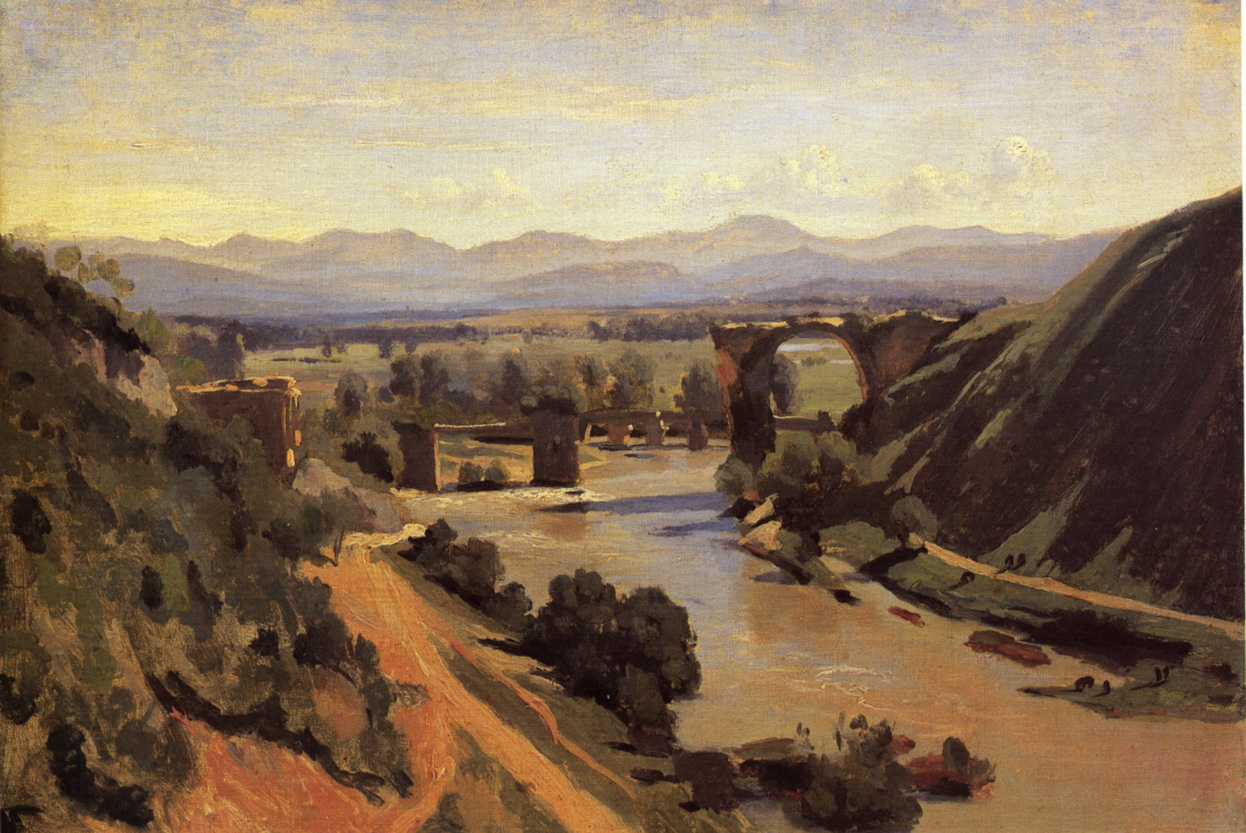
Jean-Baptiste-Camille Corot, The Bridge at Narni (1826), oil on paper, 34 x 48 cm, Musée du Louvre, Paris. WikiArt.
Jean-Baptiste-Camille Corot (1796-1875), The Bridge at Narni (1826), oil on paper, 34 x 48 cm, Musée du Louvre, Paris. WikiArt.

Corot’s years in Italy were formative in his own development, and one of the key elements he put in place to hand on to Camille Pissarro and other Impressionists. The Bridge at Narni is one of his finest oil sketches.
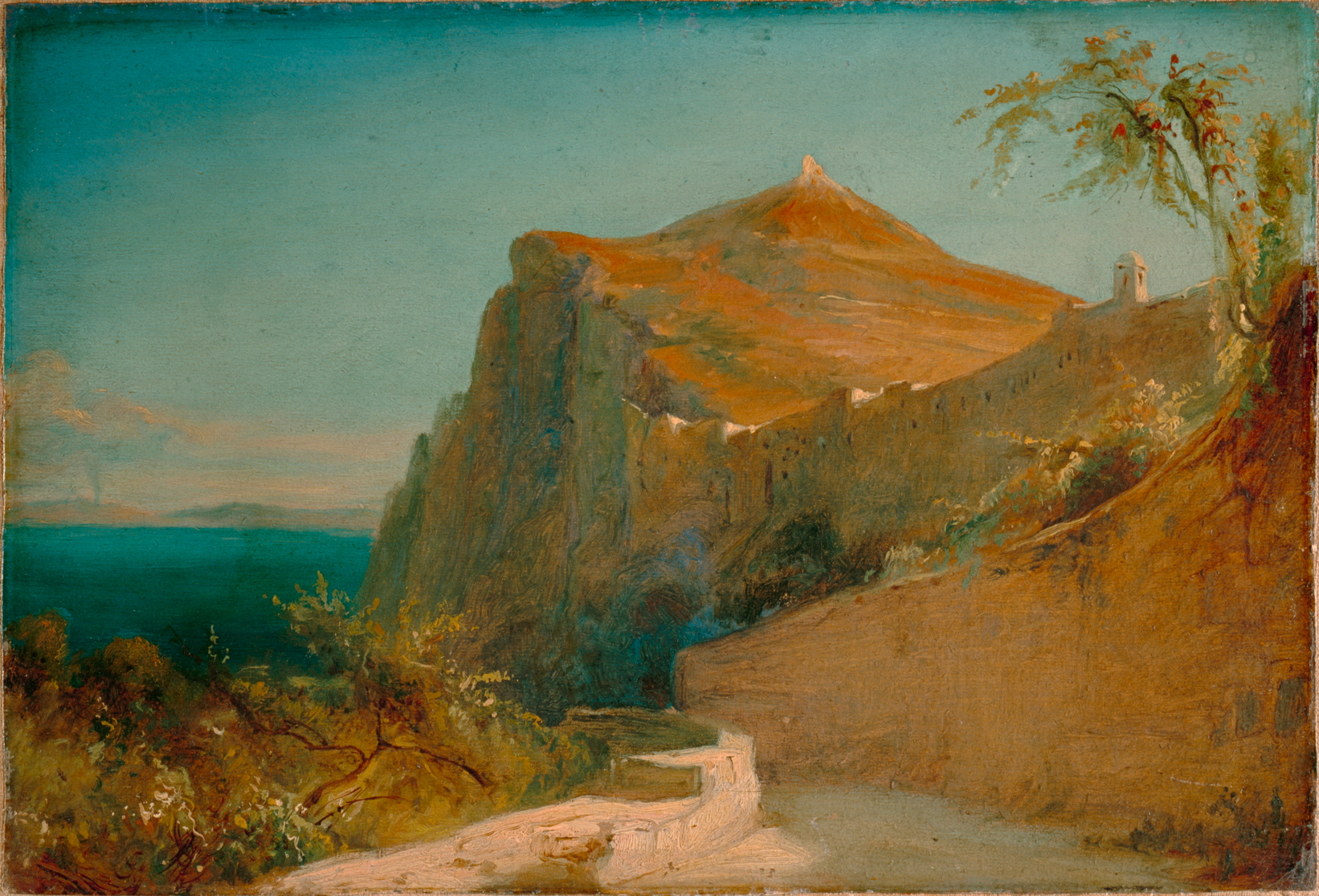
Carl Eduard Ferdinand Blechen, Tiberiusfelsen auf Capri (Tiberius Rocks, Capri) (1828-9), oil on paper mounted on canvas, 20.5 x 30 cm, Lower Saxony State Museum, Hanover. Wikimedia Commons.
Carl Eduard Ferdinand Blechen (1798-1840), Tiberiusfelsen auf Capri (Tiberius Rocks, Capri) (1828-9), oil on paper mounted on canvas, 20.5 x 30 cm, Lower Saxony State Museum, Hanover. Wikimedia Commons.

Others followed Valenciennes’ instructions, among them Carl Blechen, a brilliant German landscape painter who sketched the Tiberius Rocks, Capri during a visit in 1828-29, again on paper.

Carl Eduard Ferdinand Blechen, Galgenberg bei Gewitterstimmung (A Scaffold in a Storm) (c 1835), oil on paper mounted on board, 29.5 x 46 cm, New Masters Gallery, Dresden. Wikimedia Commons.
Carl Eduard Ferdinand Blechen, (1798-1840) Galgenberg bei Gewitterstimmung (A Scaffold in a Storm) (c 1835), oil on paper mounted on board, 29.5 x 46 cm, New Masters Gallery, Dresden. Wikimedia Commons.

Blechen’s late oil sketch of A Scaffold in a Storm was painted in about 1835, shortly before he succumbed to severe depression. This anticipates many elements of Impressionism: it appears to have been executed rapidly in front of the motif (although a view from his studio over Berlin and Brandenburg), with many brush-strokes plainly visible; details are composed of stylised marks; it is an everyday if not banal subject, with an informal composition.

However, the French Impressionists seldom if ever sketched in oils on paper, as their paintings made in front of the motif were intended to be sold to and viewed by the public, for which paper wasn’t considered suitable. Times had changed.

Before yesterdayMain stream

Fog on the Thames 1900-1926

By: hoakley
7 December 2025 at 20:30

Claude Monet had first visited London as he sought refuge from the Franco-Prussian War in 1870-71, when he painted one of the early impressions of the River Thames in mist, shown in yesterday’s article. He was to return just before the end of the century, when his fortunes had changed and he could afford to travel in search of motifs. Where better than the River Thames for the optical effects of mist, fog and smog?

Monet had started painting formal series during the 1880s, when he was enjoying commercial success at last. From about 1896, almost all his works were part of a series. He started travelling through Europe in search of suitable motifs for these, visiting Norway in 1895, and later Venice. When he returned to London in 1899, and in the following two years, Monet chose a different view of the Palace of Westminster, from a location at the opposite end of Westminster Bridge, for his series of 19 paintings. These were all started from the second floor of the Administrative Block at the northern end of the old Saint Thomas’s Hospital on the ‘south’ bank, and completed over the following three or four years.

Claude Monet (1840–1926), The Houses of Parliament, Sunlight Effect (1903), oil on canvas, 81.3 × 92.1 cm, Brooklyn Museum, New York, NY. Wikimedia Commons.

His The Houses of Parliament, Sunlight Effect (1903) is more radical than his painting of thirty years earlier, showing little more than the Palace in silhouette, the sun low in the sky, and its broken reflections in the water.

Claude Monet (1840–1926), The Houses of Parliament, Sunset (1903), oil on canvas, 81.3 × 92.5 cm, The National Gallery of Art, Washington, DC. Wikimedia Commons.

The Houses of Parliament, Sunset (1903) shows the same view in better visibility, but with the sun setting and a small boat on the move in front of the Palace.

monetwaterloobridgefog
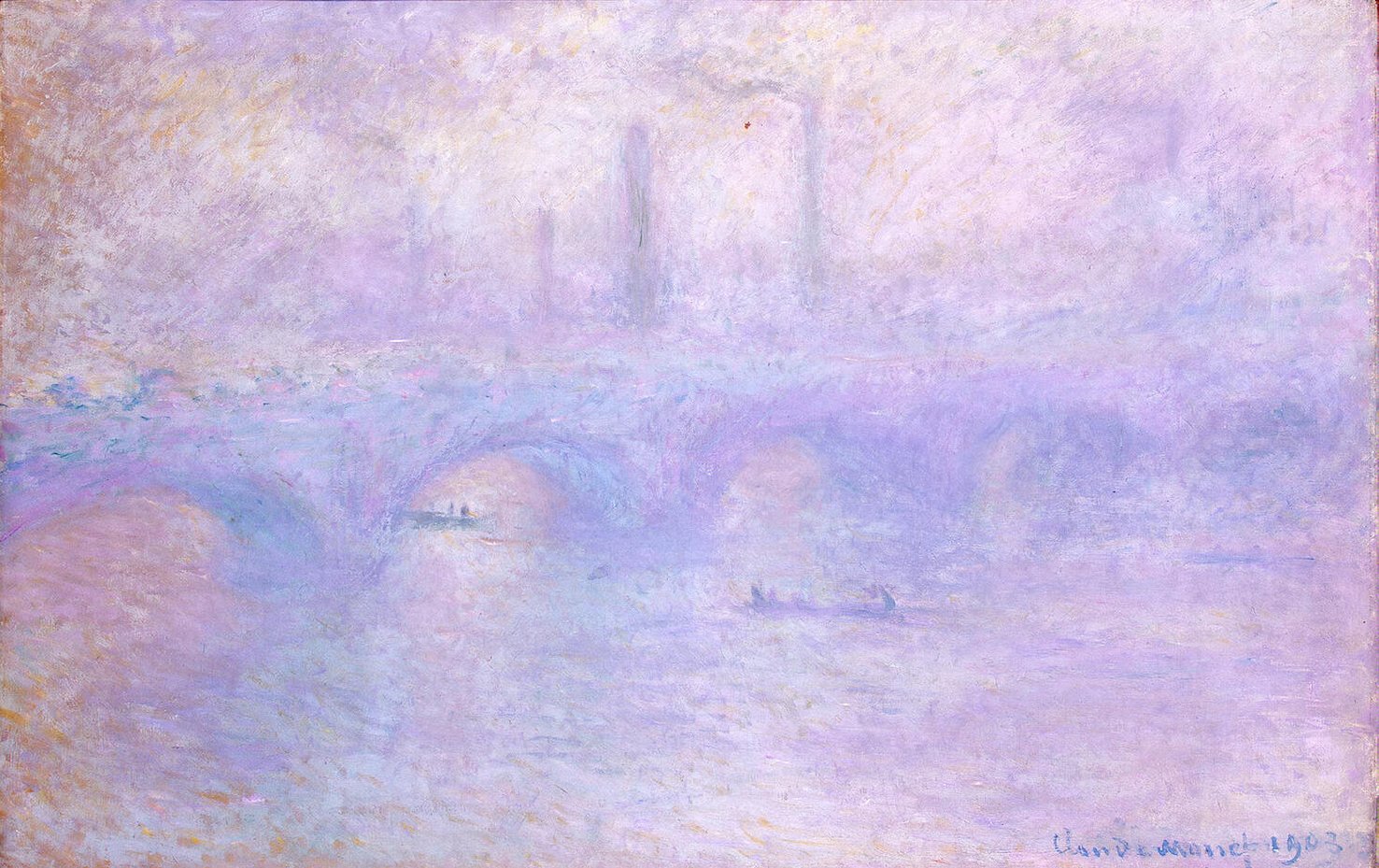
Claude Monet (1840–1926, Waterloo Bridge. Effect of Fog (1903), oil on canvas, 65.3 x 101 cm, Hermitage Museum Государственный Эрмитаж, Saint Petersburg, Russia. Wikimedia Commons.

Monet’s Waterloo Bridge from 1903 is the ultimate conclusion of his paintings of fog, in which only the softest of forms resolve in its pale purple and blue vagueness, his common destination with the paintings of Turner over fifty years earlier.

Claude Monet (1840–1926), The Houses of Parliament, Stormy Sky (1904), oil on canvas, 81.5 × 92 cm, Palais des Beaux-Arts de Lille, Lille. Wikimedia Commons.

In The Houses of Parliament, Stormy Sky (1904) the sun is higher and further to the south, allowing Monet to balance the silhouette of the Palace with its shadow cast on the water, and the brightness in the sky with its fragmented reflections.

lesidanerstpaulsfromriver
Henri Le Sidaner (1862–1939), St. Paul’s from the River: Morning Sun in Winter (1906-07), oil on canvas, 90 x 116 cm, Walker Art Gallery, Liverpool, England. Wikimedia Commons.

Henri Le Sidaner also visited Britain on several occasions, and in 1906-07 painted this view of St. Paul’s from the River: Morning Sun in Winter, which may have been inspired by Monet’s series paintings of Rouen Cathedral, here expressed using his own distinctive marks.

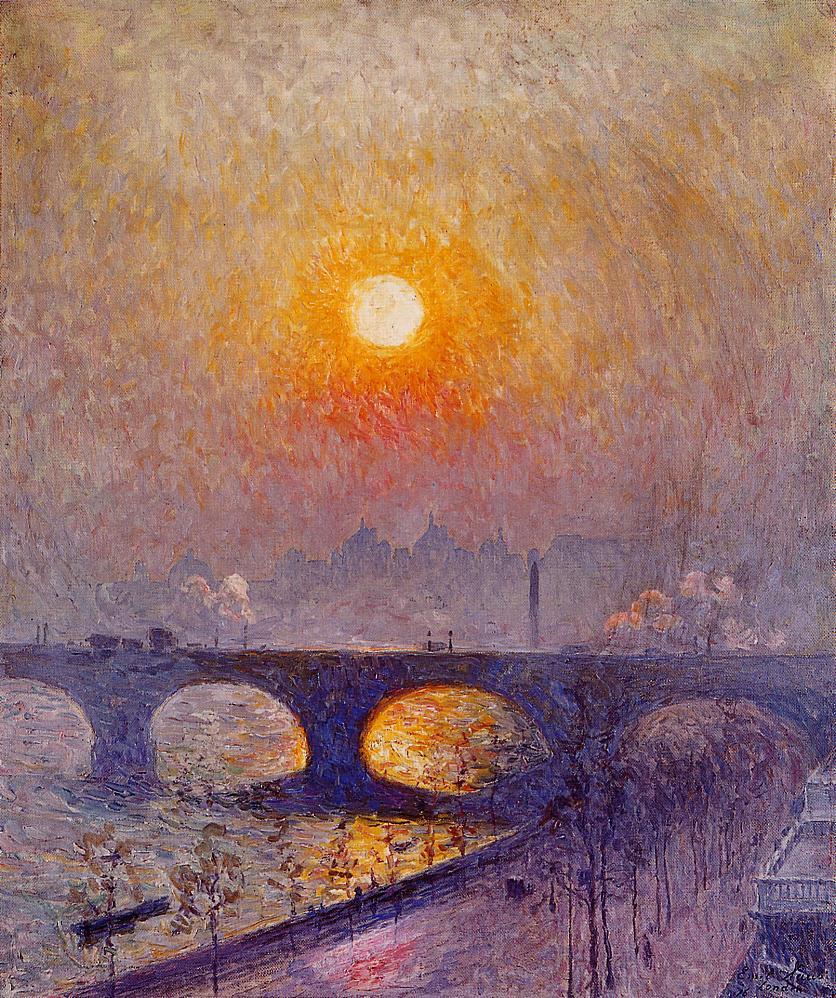
Émile Claus, (Sunset over Waterloo Bridge) (1916), oil on canvas, dimensions not known, location not known. WikiArt.
Émile Claus (1849-1924), (Sunset over Waterloo Bridge) (1916), oil on canvas, dimensions not known, location not known. WikiArt.

Emile Claus’s Sunset over Waterloo Bridge (1916) was painted from a location on the north bank of the Thames slightly to the east of Waterloo Bridge, the north end of which is prominent, and looks south-west into the setting sun, up river. Claus painted several views of Waterloo Bridge while he was in London, but doesn’t appear to have attempted any formal series, such as Monet’s.

Claus isn’t formulaic in his treatment. He uses billowing clouds of steam and smoke to great effect, and his inclusion of the road, trees and terraces in the foreground, on the Embankment, provides useful contrast with the crisp arches of the bridge, and the vaguer silhouettes in the distance. Like Monet’s series, this was probably painted from a temporary studio inside a building.

clausthamesreflection
Emile Claus (1849–1924), Morning Reflection on the Thames in London (1918), oil on canvas, 72 x 92 cm, Museum voor Schone Kunsten, Ghent, Belgium. Wikimedia Commons.

Claus’s Morning Reflection on the Thames in London, from 1918, is a view over the Embankment and river that’s desaturated and made vaguer by fog.

urylondonfog
Lesser Ury (1861–1931), London in Fog (1926), oil on canvas, 67 x 97 cm, location not known. Wikimedia Commons.

My last example is another view over the River Thames, this time by Lesser Ury. London in Fog from 1926 doesn’t appear to be a nocturne, but looks at the effects of fog on both lights and their reflections.

On 4 December 1952, a high pressure system settled over London. The wind fell away, and fog and smoke were trapped under a temperature inversion. The following day the whole of the city and an area totalling over one thousand square miles were blanketed in smog that remained until 9 December. It’s estimated that directly caused over ten thousand deaths. A succession of laws and a major campaign to eliminate open coal fires in London resulted in great improvement, although a decade later there was another lesser smog, perhaps the event I remember from my childhood. The beauty of those paintings can also be deadly.

Fog on the Thames 1844-1899

By: hoakley
6 December 2025 at 20:30

One of the enduring memories of my childhood, spent partly in London, is walking in smog, then commonly known as a pea-souper. The combination of dense fog and smoke was so thick I could barely make out street lights, and the streets were for once almost empty, as vehicles could only proceed at walking pace.

This weekend I present a selection of paintings of mist, fog and maybe even a touch of smog on the River Thames, in and near London. Today’s paintings come from the pioneers of the nineteenth century, and tomorrow’s from the twentieth.

Many of JMW Turner’s greatest paintings take advantage of the optical effects of mist and fog. Being a Londoner, he must have experienced these all too frequently.

turnerrainsteamspeed
Joseph Mallord William Turner (1775-1851), Rain, Steam, and Speed – The Great Western Railway (1844), oil on canvas, 91 x 121.8 cm, The National Gallery (Turner Bequest, 1856), London. Courtesy of and © 2018 The National Gallery, London.

These peaked in Turner’s famous painting of a Great Western Railway train crossing the River Thames at Maidenhead: Rain, Steam, and Speed, exhibited at the Royal Academy in 1844. The whole image is fogbound and vague, and proved a precursor to the approach of the Impressionists after his death.

Claude Monet (1840–1926), The Thames below Westminster (1871), oil on canvas, 47 x 73 cm, The National Gallery, London. Wikimedia Commons.

Less than thirty years later, when he was taking refuge from the Franco-Prussian War, Claude Monet’s The Thames below Westminster (1871) is less Impressionist. Painted from the Embankment to the north of Westminster Bridge, near what is now Whitehall, the three towers to the south are almost superimposed, and aerial perspective is exaggerated by the mist. The river is bustling with small paddleboat steamers. In the foreground a pier under construction is shown almost in silhouette. Small waves and reflections on the river are indicated with coarse brushstrokes, suggesting this is a rapid and spontaneous work.

Winslow Homer, The Houses of Parliament (1881), watercolour on paper, 32.3 x 50.1 cm, Hirshhorn Museum and Sculpture Garden, Washington, DC. Wikimedia Commons.
Winslow Homer (1836–1910), The Houses of Parliament (1881), watercolour on paper, 32.3 x 50.1 cm, Hirshhorn Museum and Sculpture Garden, Washington, DC. Wikimedia Commons.

A decade later, The Houses of Parliament is Winslow Homer’s faithful representation of the Palace of Westminster when viewed from the opposite bank of the Thames, to the north (downstream) of the end of Westminster Bridge. The tide is high under the arches of Westminster Bridge, and small boats are on the river. This classic watercolour makes an interesting contrast with Monet’s later oil paintings I show tomorrow: Homer provides little more detail, the Palace being shown largely in silhouette, but works with the texture of the paper and careful choice of pigment to add granularity. He provides just sufficient visual cues to fine detail, in the lamps and people on Westminster Bridge, and in the boats, to make this a masterly watercolour.

bastienlepagethameslondon
Jules Bastien-Lepage (1848–1884), The Thames, London (1882), oil on canvas, 54 x 74.3 cm, Philadelphia Museum of Art, Philadelphia, PA. The Athenaeum.

The following year, Jules Bastien-Lepage paid a return visit to the city, when he painted The Thames, London. This view of industrial docklands further downstream maintains detail into the far distance, except where it’s affected by the smoky and hazy atmosphere typical of the city at that time. It was this section of the river that was also painted on several occasions by James Abbott McNeill Whistler.

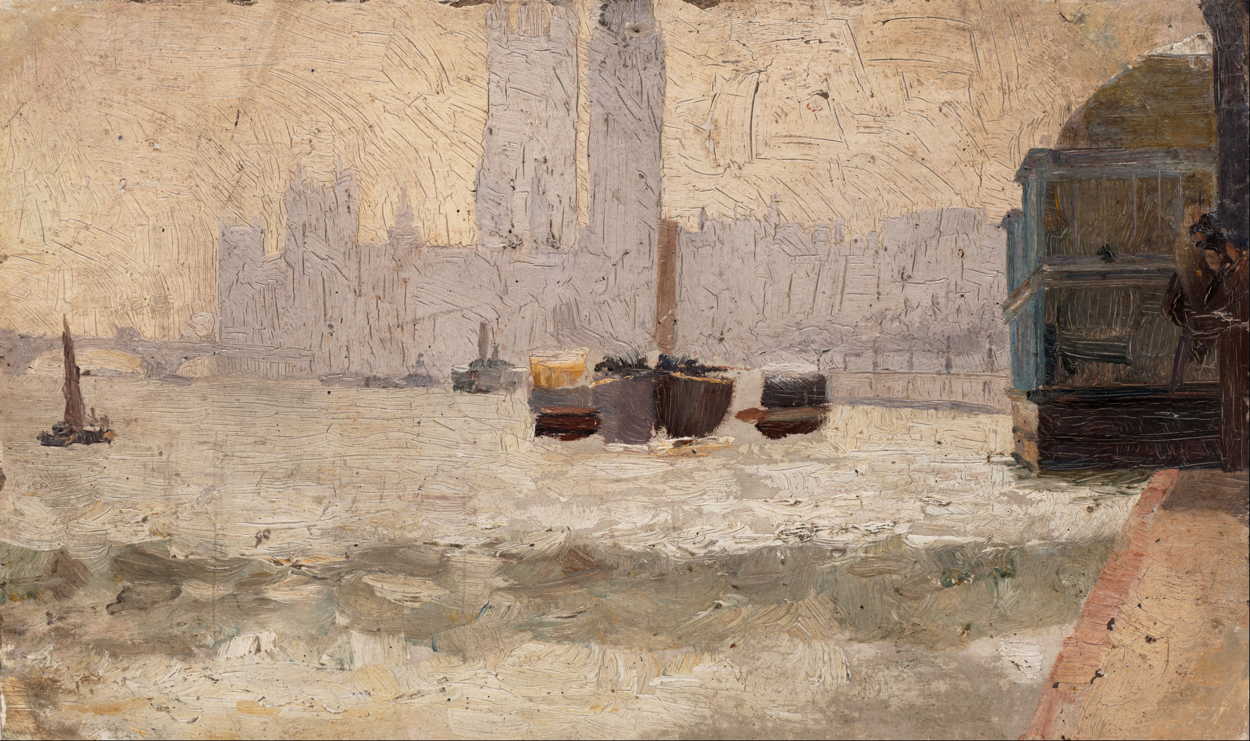
Tom Roberts, Fog, Thames Embankment (1884), oil on paperboard, 31.6 x 46 cm, Art Gallery of New South Wales, Sydney. Wikimedia Commons.
Tom Roberts (1856-1931), Fog, Thames Embankment (1884), oil on paperboard, 31.6 x 46 cm, Art Gallery of New South Wales, Sydney. Wikimedia Commons.

Tom Roberts’ Fog, Thames Embankment (1884) is painted from a similar location to Monet’s The Thames below Westminster above, on the Embankment to the north of Westminster Bridge, but is cropped more tightly, cutting off the tops of the Victoria and Elizabeth Towers. The Palace and first couple of arches of Westminster Bridge appear in misty silhouette, with moored barges and buildings on a pier shown closer and crisper. He renders the ruffled surface of the river with coarse brushstrokes, different from those of Monet.

A20754.jpg
Camille Pissarro (1830–1903), Charing Cross Bridge, London (1890), oil on canvas, 60 x 90 cm, National Gallery of Art, Washington, DC. Wikimedia Commons.

Among six paintings that Camille Pissarro started work on during his visit to England in 1890 was this view of Charing Cross Bridge, London from Waterloo Bridge. For this he made a sketch in front of the motif, then following his return to his studio in Éragny he painted this in oils. This looks south-west, towards a skyline broken by the Palace of Westminster and the familiar tower of Big Ben.

Frederick Childe Hassam, Houses of Parliament, Early Evening (1898), oil on canvas, 33 x 41.6 cm, Private collection. WikiArt.
Frederick Childe Hassam (1859-1935), Houses of Parliament, Early Evening (1898), oil on canvas, 33 x 41.6 cm, Private collection. WikiArt.

In Frederick Childe Hassam’s Houses of Parliament, Early Evening (1898), the sun has already set, and he is viewing the Palace in the gathering dusk from a point on the opposite (‘south’) bank, perhaps not as far south as Lambeth Palace. The Victoria Tower is prominent in the left of the painting, the Central Tower is in the centre, and the most distant Elizabeth Tower is distinctive with its illuminated clock face. Moored boats in the foreground provide the only other detail. His rough facture gives a textured surface to the water.

The Dutch Golden Age: Aelbert Cuyp 2

By: hoakley
27 November 2025 at 20:30

By about 1650, Aelbert Cuyp (1620–1691) had demonstrated his proficiency in painting a wide variety of subjects and genres, from mythological landscapes to farm animals. He had become influenced by Jan Dirksz Both (c 1610-52), who had recently returned from working with Claude Lorrain in Rome.

cuypmaasdordrecht
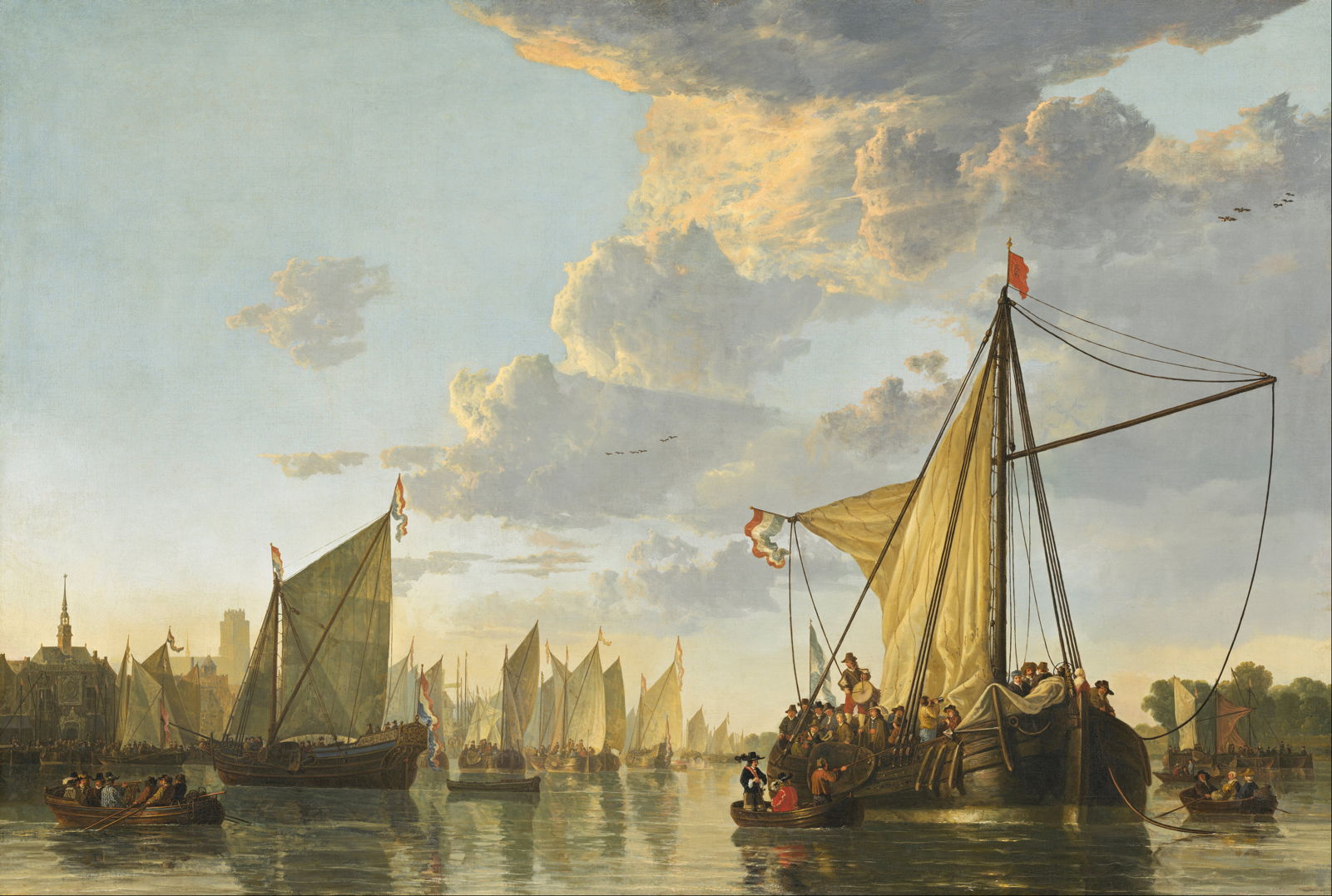
Aelbert Cuyp (1620–1691), The Maas at Dordrecht (c 1650), oil on canvas, 114.9 x 170.2 cm, National Gallery of Art, Washington, DC. Wikimedia Commons.

At their best, Cuyp’s coastal landscapes, such as The Maas at Dordrecht from about 1650, are full of rich light, earning him the title of the Dutch Claude Lorrain. This shows another passage boat packed with passengers, together with its drummer.

cuypcavalrytroopers
Aelbert Cuyp (1620–1691), Two Cavalry Troopers Talking to a Peasant (c 1650), oil, 36 x 46 cm, Royal Collection of the United Kingdom, UK. Wikimedia Commons.

Also thought to have been painted in about 1650, shortly before his father’s death, it’s possible that Two Cavalry Troopers Talking to a Peasant is a collaboration between father and son. Although there’s a slight awkwardness in the figures, the horses are finely painted with great detail on their saddlery, including glinting buckles.

cuypnigratingpeasants
Aelbert Cuyp (1620–1691), Migrating Peasants in a Southern Landscape (c 1652), oil on panel, 38.6 x 52.2 cm, Koninklijk Kabinet van Schilderijen Mauritshuis, The Hague, The Netherlands. Wikimedia Commons.

Some of his landscapes from this period appear to have been painted in very different terrain. His Migrating Peasants in a Southern Landscape from about 1652 shows people dressed for the more temperate climate of northern Europe in a landscape that could be further south.

cuypvalkhofnijmegen
Aelbert Cuyp (1620–1691), The Valkhof at Nijmegen (c 1652-54), oil on wood, 48.8 x 73.6 cm, Indianapolis Museum of Art, Indianapolis, IN. Wikimedia Commons.

Cuyp’s grand view of The Valkhof at Nijmegen from about 1652-54 shows the Imperial castle that was demolished in 1798, on its small hill beside the river. The landscape is bathed in golden light, and broken clouds are tinged with similar Claudean colour as they drift through its lucent sky.

Cuyp, Aelbert, 1620-1691; Saint Philip Baptising the Ethiopian Eunuch
Aelbert Cuyp (1620–1691), Saint Philip Baptising the Ethiopian Eunuch (c 1655), oil on canvas, 115.5 x 169 cm, National Trust, England. Wikimedia Commons.

In about 1655, Cuyp painted this narrative landscape with the story of Saint Philip Baptising the Ethiopian Eunuch, referring to the account of Philip the Evangelist in chapter 8 of the Acts of the Apostles. Following the instructions of an angel, Philip went to the road between Jerusalem and Gaza, where he met the treasurer to Candace, Queen of the Ethiopians. As the Ethiopian Eunuch was sitting reading Old Testament scripture in his chariot, Philip explained the text and taught him the Gospel of Jesus. The eunuch was converted and baptised as a result.

Cuyp sets this story in a golden Claudean landscape more akin to the south of France or even Italy, with rich detail in the riverside plants, the figures and animals.

cuypicehuistemerwededordrecht
Aelbert Cuyp (1620–1691), Ice Scene Before the Huis te Merwede near Dordrecht (c 1655), oil on panel, 64 x 89 cm, Private collection. Wikimedia Commons.

Although Cuyp doesn’t appear to have painted many winter scenes, his Ice Scene Before the Huis te Merwede near Dordrecht from about 1655 is up with the leaders. Notable here are his foreground reflections, and another wonderful sky with its warm clouds. This castle was built to the south-east of Dordrecht in the early fourteenth century, and ruined a hundred years later.

Jacob Mathieusen, and his wife, in the background the fleet in the roads of Batavia, by Aelbert Cuyp
Aelbert Cuyp (1620–1691), A Senior Merchant of the Dutch East India Company (1650-59), oil on canvas, 138 x 208 cm, Rijksmuseum Amsterdam, Amsterdam, The Netherlands. Wikimedia Commons.

A Senior Merchant of the Dutch East India Company is a fascinating double portrait painted during 1650-59. It’s thought to show Jacob Mathieusen and his wife, against a background of the company fleet in Batavia roads. This city in what was then the Dutch East Indies is now the site of Jakarta in Indonesia. There’s no record of Cuyp ever having visited this imagined location, and he appears to have painted the background on the basis of contemporary topographic images, then painted his subjects in the studio.

cuyproadnearriver
Aelbert Cuyp (1620–1691), A Road near a River (c 1660), oil on canvas, 113 x 176.6 cm, Dulwich Picture Gallery, London. Wikimedia Commons.

A Road near a River from about 1660 is the last of Cuyp’s paintings for which I have a date, and perhaps his finest closing summary. It’s a landscape in the style of Claude Lorrain, with long shadows and the warmth of the setting sun. There’s a small flock of sheep and a sleeping dog, the shepherd chatting with a friend. Further down that road are two more figures, one of them sat on a pony. On the other side of the river with its broken reflections, is a cottage and more people. In the distance is a thoroughly alien crag and the ruins of a castle. Above all this is the peaceful sky of settled weather, divided into two by a pair of finely crafted trees.

Aelbert Cuyp: Ladugårdsinteriör.NM 4441
Aelbert Cuyp (1620–1691), Interior of a Cowshed (date not known), oil on oak, 77.5 x 107.2 cm, Nationalmuseum, Stockholm, Sweden. Wikimedia Commons.

Cuyp’s undated Interior of a Cowshed is a fine portrait of a cow leading the herd into a shed, with good use made of chiaroscuro and details of the tools, tackle and equipment inside.

In 1658, Cuyp married Cornelia Bosman. Within two years, he had apparently stopped painting completely, and was a deacon of the Reformed Church. It has been speculated that it was his marriage that brought an end to his art. Whether that’s true or not, for the final thirty years of his life he seems not to have made another painting.

Reference

Wikipedia.

The Dutch Golden Age: Aelbert Cuyp 1

By: hoakley
26 November 2025 at 20:30

Artists like Rembrandt and Vermeer are exceptional in any period in history. Among the thousands of artists in the Dutch Republic, there were a few dozen who never achieved such greatness, but whose paintings have endured the collapse of the market in the late seventeenth century. Among them is Aelbert Cuyp (1620–1691), who is also a bit of a mystery in that he appears to have stopped painting soon after 1660, although he lived for another thirty years.

Cuyp was born into an artistic family, who were also quite rich. He was taught to paint by his father, Jacob Gerritsz Cuyp, who was primarily a portrait painter, and lived in Dordrecht. Trained as a landscape painter, he often used views as a platform for genre scenes, animal and human portraits, and more, and seems to have been both happy and highly proficient at painting almost anything. During his early career, he was mostly under the influence of the prolific artist Jan van Goyen (1596-1656), but doesn’t appear to have been his pupil.

cuyplandscapecattle
Aelbert Cuyp (1620–1691), Landscape with Cattle (c 1639), oil on wood panel, 65 x 90.8 cm, National Gallery of Victoria, Melbourne, Australia. Wikimedia Commons.

Cuyp is thought to have painted this Landscape with Cattle when he was only about nineteen, in 1639. It’s set against the background of the city of Dordrecht, situated on the Rhine-Meuse-Scheldt river delta. The herdsman and animals in the foreground are engaged in diversions from that landscape: the man is taunting a billy goat, while the cow at the far right is urinating copiously. Above them is a lucent sky with slightly unnatural clouds.

Orpheus charming the animals, by Aelbert Cuyp
Aelbert Cuyp (1620–1691), Orpheus with Animals in a Landscape (Orpheus Charming the Animals) (c 1640), oil on canvas, 113 x 167 cm, Museum of Fine Arts Boston, Boston, MA. Wikimedia Commons.

Cuyp was soon using his landscapes with more diverse themes. Orpheus with Animals in a Landscape from about 1640 is one of at least two different paintings he made of this story from mythology. Here he has included a wide range of both domestic and exotic animals and birds, including a distant elephant, an ostrich, herons and wildfowl.

cuyparnhemsouth
Aelbert Cuyp (1620–1691), View of Arnhem from the South (c 1642-46), grey wash, watercolour and black chalk on paper, dimensions not known, Albertina, Vienna, Austria. Wikimedia Commons.

Throughout his career, Cuyp seems to have made detailed sketches in front of the motif, to inform his studio paintings. This View of Arnhem from the South from about 1642-46 was made using grey wash, watercolour and black chalk.

cuypthunderstormdordrecht
Aelbert Cuyp (1620–1691), Thunderstorm over Dordrecht (c 1645), oil on panel, dimensions not known, Private collection. Wikimedia Commons.

His dramatic Thunderstorm over Dordrecht from about 1645 is amazingly effective and accurate, considering it was painted more than two centuries before anyone saw high-speed photographic images of lightning.

cuypherdsmencows
Aelbert Cuyp (1620–1691), Herdsmen with Cows (c 1645), oil on canvas, 99 x 144 cm, Dulwich Picture Gallery, London. Wikimedia Commons.

Many of Cuyp’s landscapes show more varied terrain than he could ever have seen in the Republic. Although the cliffs at the right of his Herdsmen with Cows (c 1645) may have been fairly local, the more substantial crags in the left distance are far from being Dutch. It’s not known whether he travelled to other countries, or perhaps relied on the paintings of artists who did.

cuypsheepstable
Aelbert Cuyp (1620–1691), Sheep in a Stable (c 1645), oil on panel, 41.1 x 49.9 cm, Private collection. Wikimedia Commons.

His paintings of domestic animals also took him indoors, for example in this fascinating painting of Sheep in a Stable from about 1645. The sheep are faithfully depicted, and surrounded by objects suggesting this was more of a still life. In the foreground are empty mussel shells, a couple of earthenware pots, and two wickerwork baskets with some scarlet cloth. He also renders the texture of the fleeces using painterly brushstrokes, particularly that of the standing ram.

cuyprhine
Aelbert Cuyp (1620–1691), View on the Rhine (c 1645), oil on panel, 27.4 x 36.8 cm, Fondation Custodia, Paris. Wikimedia Commons.

View on the Rhine also from about 1645 appears to have been the result of a trip up river into steeper terrain inland. It’s wonderfully painterly, and might even be mistaken for one of Turner’s landscapes from nearly two centuries later.

In the mid-1640s, Cuyp is believed to have come under the influence of Jan Dirksz Both (c 1610-52), who had returned to Utrecht by 1646 following a formative period spent in Rome. When he was in Italy, Both transformed his painting thanks to the work of, and working with, Claude Lorrain. As a result, Cuyp changed the direction of light in his landscapes to elongate shadows and enrich his colour ranges. His father was still alive for much of this period, and it’s thought that in some paintings prior to about 1650, the son painted the landscape and father the figures.

1975.1.768
Aelbert Cuyp (1620–1691), View of the Groote Kerk in Dordrecht from the River Maas (c 1647-48), black chalk and moistened black chalk, gray wash, greenish yellow and grayish green wash, and touches of brown chalk, 18.2 x 36.8 cm, Metropolitan Museum of Art, New York, NY. Wikimedia Commons.

Cuyp continued to make fine studies in front of the motif, such as this View of the Groote Kerk in Dordrecht from the River Maas from about 1647-48, made using a combination of black and brown chalk and watercolour washes. Like the previous study, it sadly wasn’t intended to be seen by the public.

cuypseamoonlight
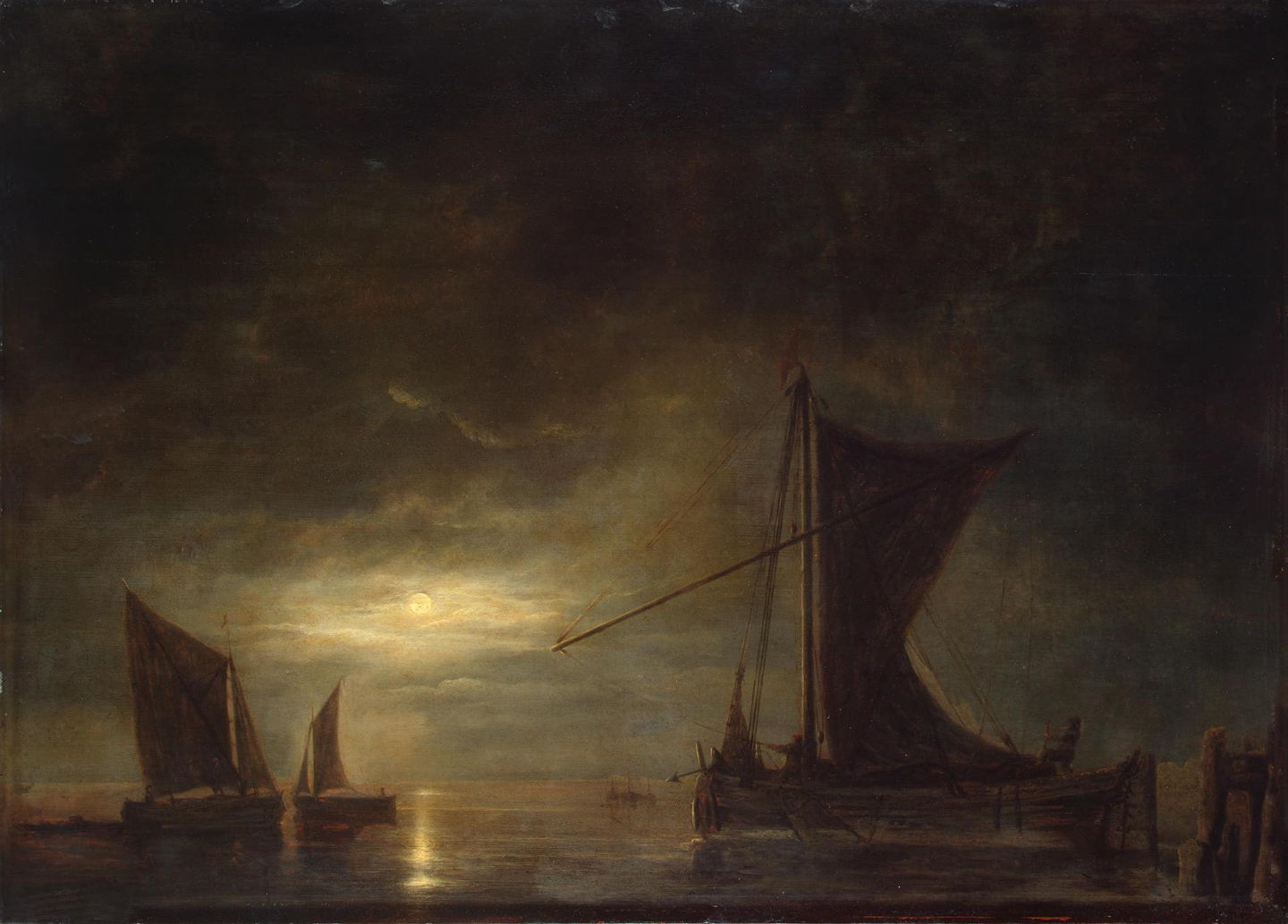
Aelbert Cuyp (1620–1691), Sea by Moonlight (c 1648), oil, 77 x 107.5 cm, Hermitage Museum Государственный Эрмитаж, Saint Petersburg, Russia. Wikimedia Commons.

He also painted a few nocturnes, including this view of the Sea by Moonlight from about 1648, where he extends his exploration of the effects of light.

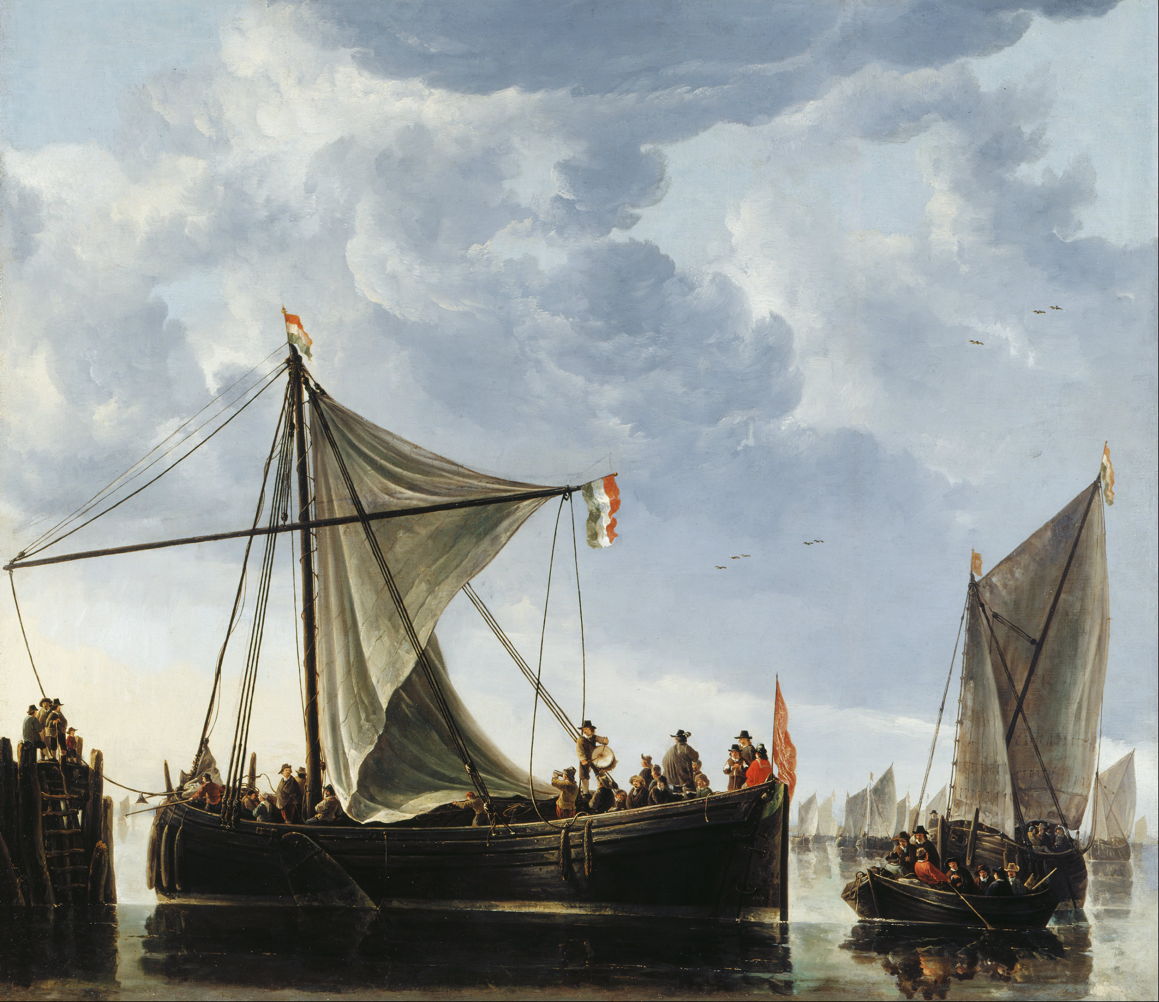
cuyppassageboat
Aelbert Cuyp (1620–1691), The Passage Boat (c 1650), oil on canvas, 124 x 144.4 cm, Royal Collection of the United Kingdom, UK. Wikimedia Commons.

Although Cuyp never seems to have become a more dedicated marine specialist, his paintings of ships including The Passage Boat from about 1650, are landmarks at the height of his career. This ferry was most probably run between Dordrecht and Rotterdam, a distance of little more than twelve miles (20 km) by river. The figures in the boat are finely detailed, including a drummer towards the stern, and the clouds are also finely crafted.
Reference

Wikipedia.

Medium and Message: En plein air

By: hoakley
25 November 2025 at 20:30

Paintings made in oils in front of the motif, en plein air, are a surprisingly recent innovation. Although often ascribed to the inconvenience of handling oil paint before it was offered in tubes in the middle of the nineteenth century, in fact it had become popular if not mandatory for the aspiring landscape painter well before that. Instead of taking their paints in tubes, those pioneers used pig bladders, that had become widely available from artists’ colourmen, as were used by Constable, Turner and many others.

Initially, plein air oil sketches weren’t intended to be seen by the public or patrons.

desporteslandscape
Alexandre-François Desportes (1661-1743), Landscape Study (c 1700), oil, dimensions not known, Palais des beaux-arts de Lille, Lille, France. Wikimedia Commons.

Among the earliest artists to paint regularly in front of their motif was Alexandre-François Desportes (1661-1743), a professional painter of hunting scenes and animals, whose Landscape Study was painted in about 1700.

Plein air oil sketching was described and recommended by Roger de Piles in his book Cours de Peinture, published in 1708, contemporary with Desportes’ sketches. Other books on painting and art in the eighteenth century also cover the topic, and Claude-Joseph Vernet was recorded as having painted oil sketches en plein air, but none have survived.

valenciennesvillafarnesepoplars
Pierre-Henri de Valenciennes (1750–1819), Farm Buildings at the Villa Farnese: the Two Poplar Trees (1780), oil on paper on cardboard, 25 x 38 cm, Musée du Louvre, Paris. Wikimedia Commons.

At Vernet’s suggestion, the young Pierre-Henri de Valenciennes made copious oil sketches such as this of Farm-buildings at the Villa Farnese: the Two Poplar Trees when he was painting in the Roman Campagna in 1782-85. He not only built himself a large visual library of sketches from nature, but published a widely used book on landscape painting in which he recommended the practice.

sabletconradgessner
Jacques Sablet (1749–1803) Portrait of the Painter Conrad Gessner in the Roman Campagna (1788), oil on canvas, 39 × 30 cm, Kunsthaus Zürich, Zürich. Wikimedia Commons.

Jacques Sablet’s Portrait of the Painter Conrad Gessner in the Roman Campagna shows one of the early plein air landscape painters in 1788, over fifty years before the first paint tubes became available.

quadroneeveryoccasiond1
Giovanni Battista Quadrone (1844–1898), Every Opportunity is Good (detail) (1878), other details not known. Wikimedia Commons.

Although this detail of Giovanni Battista Quadrone’s Every Opportunity is Good shows a studio in 1878, the low table at the left has several bladders containing oil paint. They remained popular with many artists until towards the end of the nineteenth century. Although not as convenient as tubes, the better colourmen still offered a wide range of pigments in bladders that were significantly less costly.

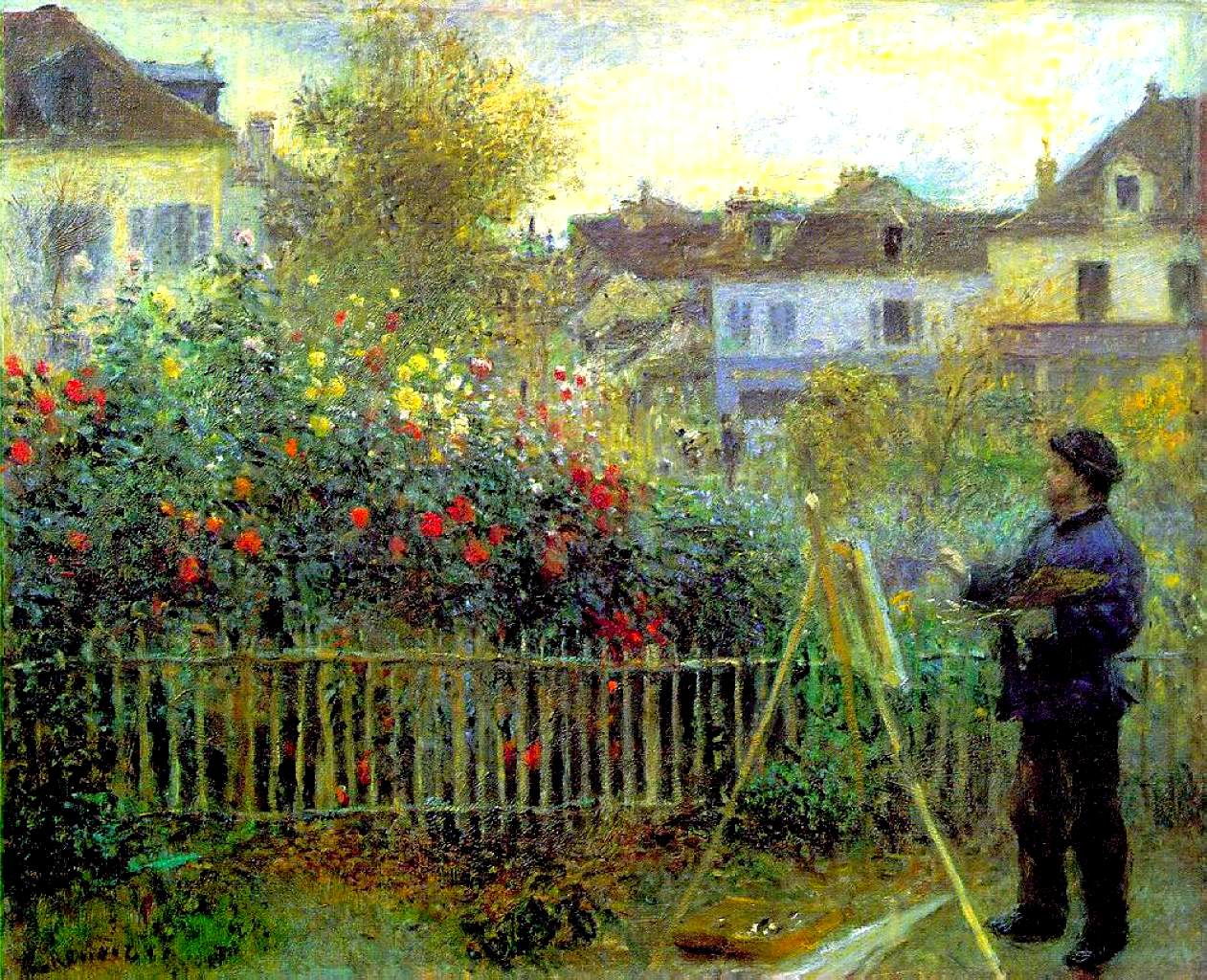
renoirmonetpainting
Pierre-Auguste Renoir (1841–1919), Monet Painting in his Garden in Argenteuil (1873), oil on canvas, 46 × 60 cm, Wadsworth Atheneum, Hartford, CT. Wikimedia Commons.

Pierre-Auguste Renoir painted Monet Painting in his Garden in Argenteuil in 1873. Claude Monet is using a conventional lightweight wooden easel, with a small canvas that allows him to work standing. His oil paints are in the pochade box under the easel. Although just outside his house, he would have used the same equipment when further from home.

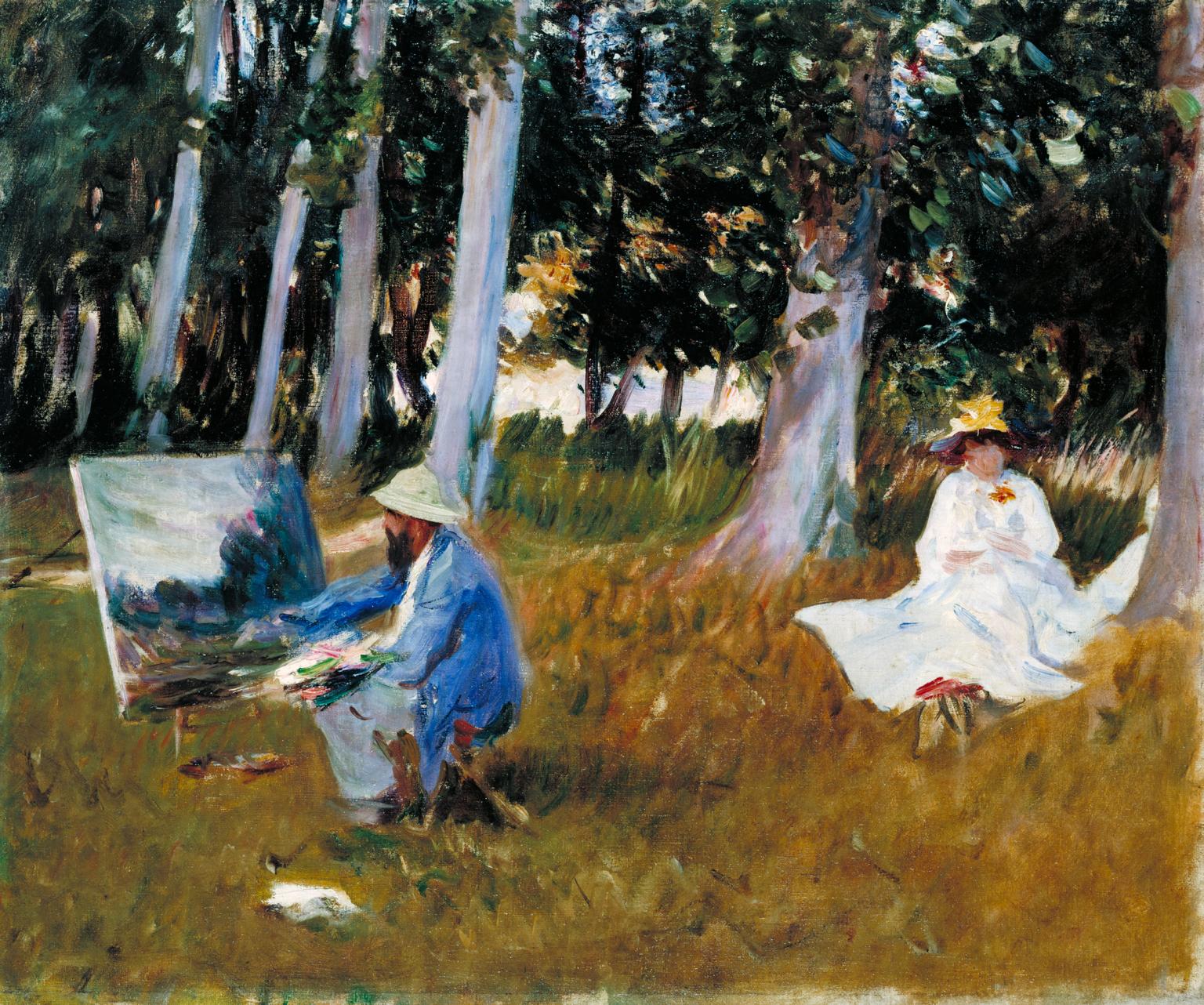
Claude Monet Painting by the Edge of a Wood ?1885 by John Singer Sargent 1856-1925
John Singer Sargent (1856–1925), Claude Monet Painting by the Edge of a Wood (c 1885), oil on canvas, 54 x 64.8 cm, The Tate Gallery (Presented by Miss Emily Sargent and Mrs Ormond through the Art Fund 1925), London. © The Tate Gallery and Photographic Rights © Tate (2017), CC-BY-NC-ND 3.0 (Unported), http://www.tate.org.uk/art/artworks/sargent-claude-monet-painting-by-the-edge-of-a-wood-n04103

In about 1885, when they were painting together, John Singer Sargent took this opportunity to paint Claude Monet Painting by the Edge of a Wood. Seated on a traditional three-legged folding stool, Monet is here working on a much larger canvas, his pochade box again under the easel for ready access.

demontbretonmarieduhem
Virginie Demont-Breton (1859–1935), Portrait of Marie Duhem (detail) (1889), oil on panel, dimensions not known, Musée de la Chartreuse de Douai, Douai, France. Wikimedia Commons.

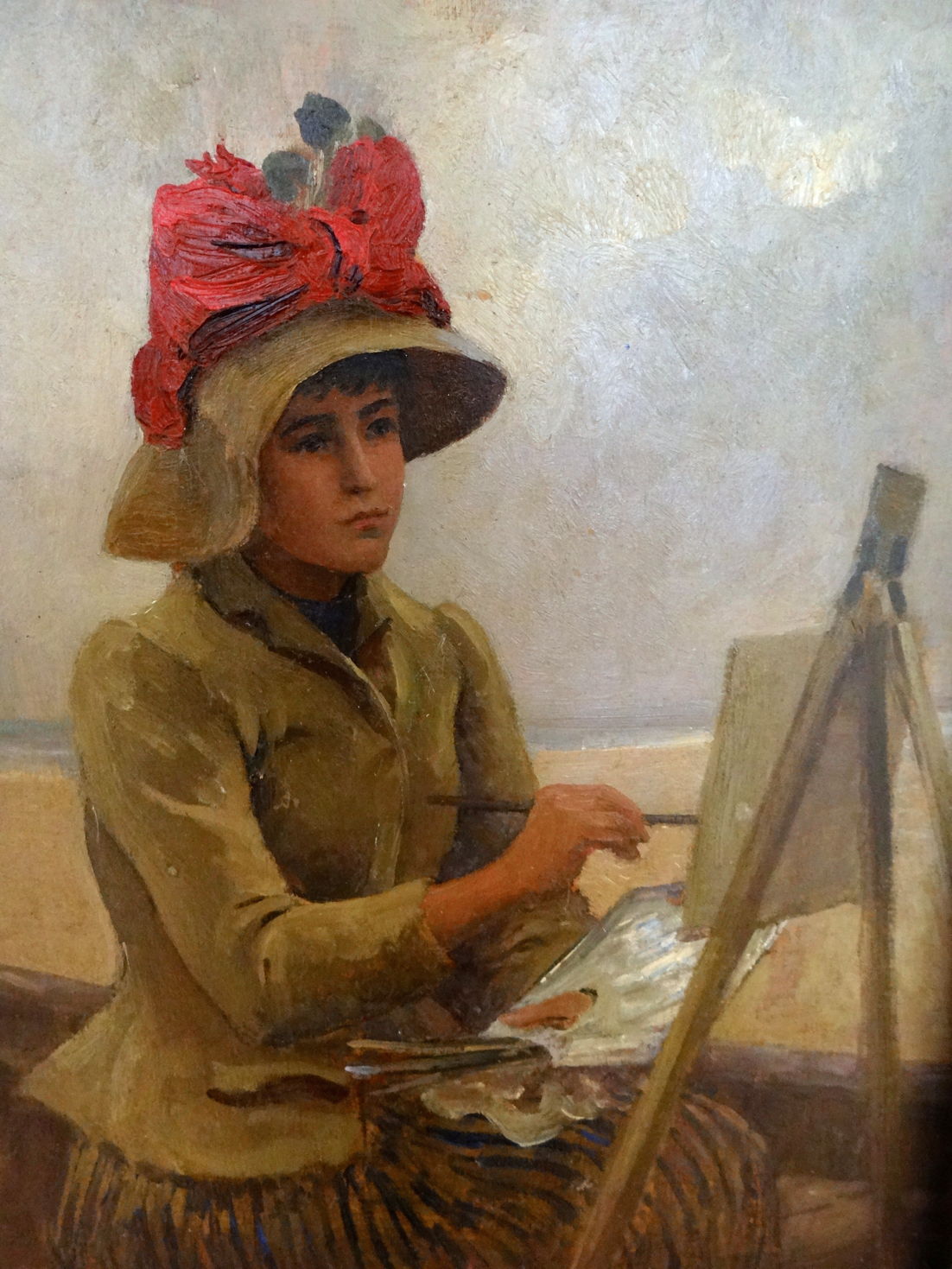
This detail of Virginie Demont-Breton’s Portrait of Marie Duhem (1889) shows one of her close friends and colleagues in the Wissant School, at work en plein air on the coast near their house. She appears to have set her easel up by a wooden groyne on the beach.

sargentoutofdoorsstudy
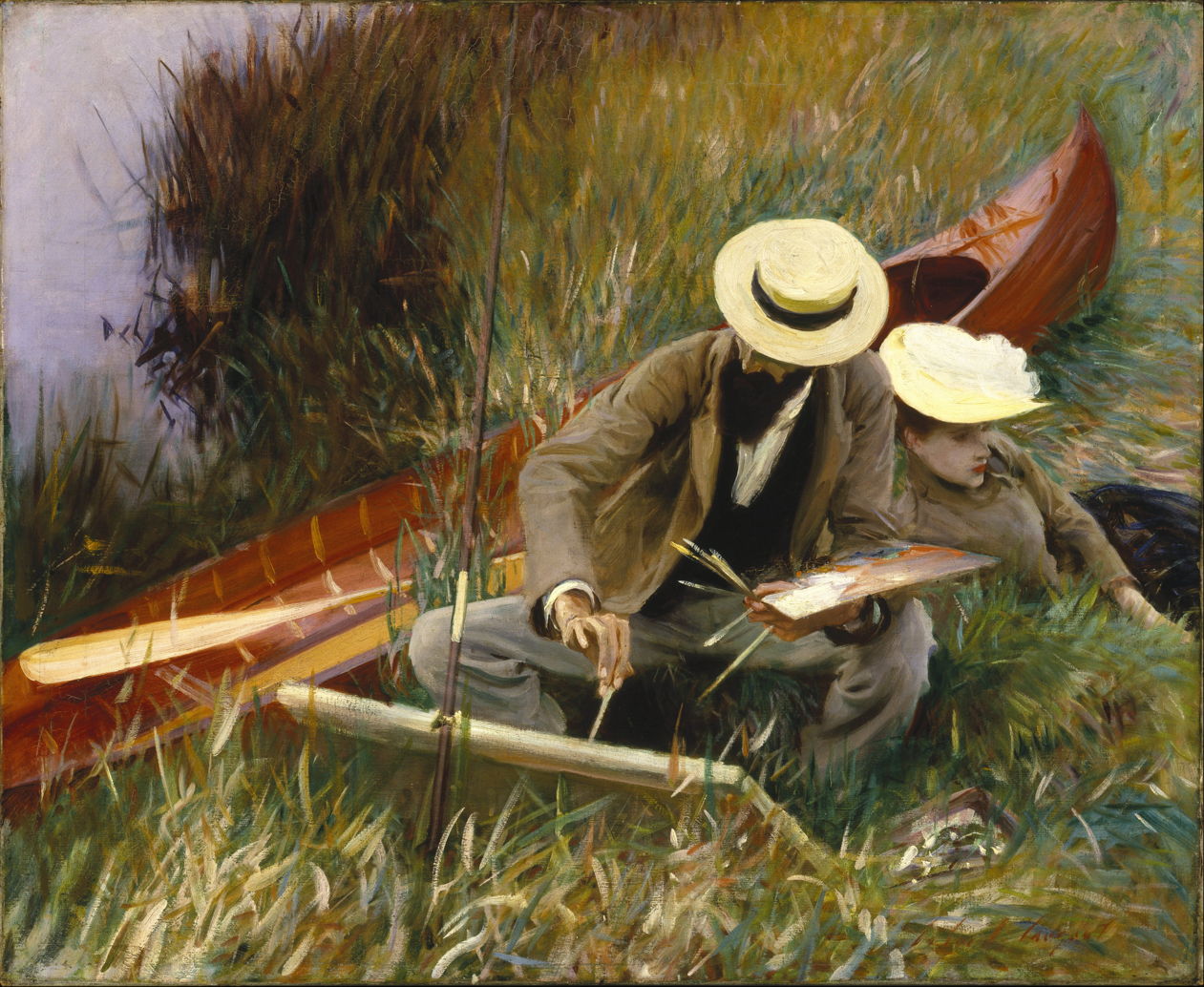
John Singer Sargent (1856–1925), An Out-of-Doors Study (c 1889), oil on canvas, 65.9 × 80.7 cm, Brooklyn Museum, New York, NY. Wikimedia Commons.

In John Singer Sargent’s An Out-of-Doors Study (c 1889) he shows his friend Paul César Helleu working on a canvas propped up in the grass by a single pole, a precarious arrangement only suitable for the calmest of days. It also forces him to work very low, and he squats in a position of tension, his pochade box in the grass below his left knee.

brendekildelaring
Hans Andersen Brendekilde (1857–1942), L.A. Ring Paints at Aasum Smithy (1893), oil on canvas, 107 x 140 cm, location not known. Wikimedia Commons.

Hans Andersen Brendekilde’s L.A. Ring Paints at Aasum Smithy (1893) shows his friend painting the primary school in the village of Åsum (or Aasum), to the east of Odense in Denmark. Clearly visible in the pochade box behind is a substantial collection of shiny paint tubes.

sargentfountainvillatorlonia
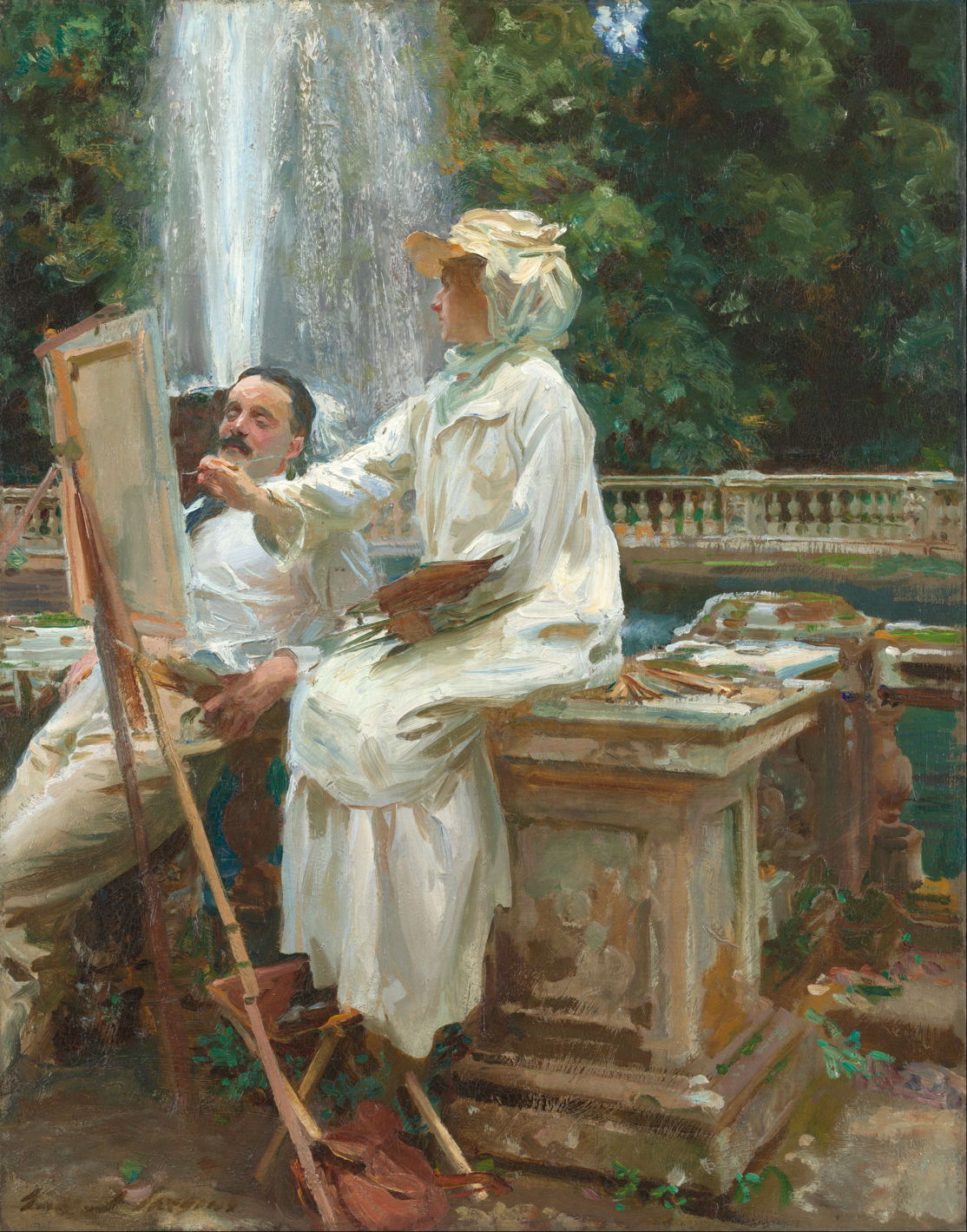
John Singer Sargent (1856–1925), The Fountain, Villa Torlonia, Frascati, Italy (1907), oil on canvas, 71.4 x 56.5 cm, The Art Institute of Chicago, Chicago, IL. Wikimedia Commons.

The American artists Jane de Glehn and her husband Wilfrid were long-standing friends of John Singer Sargent. His plein air oil sketch of The Fountain, Villa Torlonia, Frascati, Italy (1907) shows Jane working at a lightweight wooden easel in the grounds of this villa.

Joaquín Sorolla y Bastida, Maria Painting in El Pardo (1907), oil on canvas, 82 x 106 cm, Private collection. WikiArt.
Joaquín Sorolla y Bastida (1863–1923), Maria Painting in El Pardo (1907), oil on canvas, 82 x 106 cm, Private collection. WikiArt.

Joaquín Sorolla here shows his daughter Maria Painting in El Pardo in 1907. She’s painting with a pochade box, and has a large parasol with a specialist mount so that it can provide her with shade.

brendekildelaringfalleneasel
Hans Andersen Brendekilde (1857–1942), L A Ring by his Fallen Easel (1883), oil on canvas, 78 x 67 cm, Det Nationalhistoriske Museum på Frederiksborg Slot, Hillerød, Denmark. Wikimedia Commons.

One of Brendekilde’s earliest surviving paintings shows L A Ring by his Fallen Easel (1883). Both of them had a struggle achieving recognition, and at this stage Ring was verging on abandoning art altogether as a result. He is seen on the outskirts of a wood, looking down dejectedly at his easel that has dropped paint-first onto the fallen leaves on the road.

Plein air painting has many challenges. In fine sunny weather you’re normally limited to thirty to sixty minutes painting time. Any longer than that and the light and shadows have changed too much over the course of time, but overcast lighting allows greater tolerance. Even with modern portable lighting systems, painting en plein air at night is an astonishing feat that few even attempt.

dahldresdenatnight
Johan Christian Dahl (1788–1857), Dresden at Night (1845), oil on cardboard, 7 × 11.3 cm, Private collection. Wikimedia Commons.

This remarkable painting by JC Dahl of Dresden at Night appears to have been painted on a sheet of cardboard one night in 1845. There really is no limit to what can be achieved in front of the motif.

Painting along the Loing: Moret

By: hoakley
23 November 2025 at 20:30

While artists from around the world had gathered in the colony at Grez-sur-Loing, little more than 12 km (7 miles) downstream, French Impressionism was flourishing at Moret-sur-Loing. Alfred Sisley and his family moved there in 1880, and this was to be the centre of his painting for most of the rest of his life. Their first house there was in Veneux-Nadon (now Veneux-Les Sablons), on the road to the village of By.

Moret had good rail connections with central Paris, although in 1881 Sisley wrote that the journey took two hours, sufficiently long for him to excuse himself from visiting the city. He lived there in quiet isolation with his family; a few visitors including Berthe Morisot and Stéphane Mallarmé made their way out to see him. But the nineteen years that he lived in or near Moret were highly productive, with a total of 550 oil paintings, several sketchbooks, and a few pastels.

sisleyhillsmoretspring1880
Alfred Sisley (1839–1899), On the Hills of Moret in the Spring – Morning (1880), oil on canvas, 65 x 92.2 cm, Princeton University Art Museum, Princeton, NJ. Wikimedia Commons.

Sisley experimented with his facture and style at this time. On the Hills of Moret in the Spring – Morning from 1880 looks down from one of those low hills towards the town. The brushwork in the foreground is composed of short strokes of near-white and colour, giving the hillside a distinctive texture.

By the end of 1881, the Sisley family had moved into the town of Moret. This was apparently financed in part by a loan from his dealer Durand-Ruel. About a year later, Sisley decided that the air in Moret didn’t suit him, or possibly he needed to keep on the move from his creditors, and the family moved to Les Sablons until 1886.

Bemberg Fondation - Les bords du loing vers Moret - Alfred Sisley 1883
Alfred Sisley (1839–1899), The Banks of the Loing towards Moret (1883), oil on canvas, 50 x 73 cm, Fondation Bemberg, Toulouse, France. Wikimedia Commons.

During Sisley’s time at Moret, he explored the banks of the rivers and canal, producing some of his best-known paintings. The Banks of the Loing towards Moret from 1883 is one his earlier riverside views, showing unusual combinations of reflections of tall trees, working craft and small industry, and distant chalk cliffs.

Bemberg Fondation Toulouse - Le canal du Loing - Alfred Sisley 1884 Inv.2086 38x55
Alfred Sisley (1839–1899), The Loing Canal (1884), oil on canvas, 38 x 55 cm, Fondation Bemberg, Toulouse, France. Wikimedia Commons.

This view of The Loing Canal from 1884 is another fine example from near Saint-Mammès. This waterway runs parallel to the River Loing, connecting the Briare Canal to the River Seine, and is one of the series of waterways joining Paris to Lyon known as the Bourbonnais Route. These were constructed in the early eighteenth century, and still carry barges of grain from the farms in central France.

As with many of his waterside paintings, much of the canvas is occupied by the sky, which Sisley wrote that he always painted first so as to set the scene and mood for the whole painting.

sisleycanalloing
Alfred Sisley (1839–1899), Canal du Loing (1885), oil on canvas, 46.1 x 55.2 cm, location not known. Wikimedia Commons.

Although Sisley, unlike Monet and Pissarro, painted few formal series, some of his motifs group together. The Canal du Loing, here seen in 1885, is in one of those groups. These typically have a low horizon, and reiterate his emphasis on the sky setting the mood and tone of his paintings. Below that, the water shimmers with the reflected buildings and relatively coarse brushstrokes rather than the more staccato style seen developing in Pissarro’s landscapes of this time.

sisleymoretbanksloing1885
Alfred Sisley (1839–1899), Moret – The Banks of the River Loing (1885), oil on canvas, 52 × 74 cm, Albertina, Vienna. Wikimedia Commons.

Another group is exemplified by Moret – The Banks of the River Loing, probably painted in the autumn/fall of 1885, with its slightly coarser marks and strong colour contrasts. These bring the foreground closer, and push the background deep.

sisleymoretbridgestorm
Alfred Sisley (1839–1899), The Bridge at Moret, Storm Effect (1887), oil on canvas, dimensions not known, Musée Malraux (MuMa), Musée des Beaux-Arts, Le Havre, France. Wikimedia Commons.

Sisley also recognised the visual potential of the town of Moret and its bridge, a motif that was to dominate his later work. The Bridge at Moret, Storm Effect from 1887 is an early plein air sketch capturing the approach of a storm, with the sky remaining bright for the moment, but the gathering wind already driving up small waves on the River Loing.

sisleylanepoplarsmoret1888
Alfred Sisley (1839–1899), The Lane of Poplars at Moret-sur-Loing (1888), oil on canvas, 60 x 81 cm, Private collection. WikiArt.

Sisley seems to have started another group showing the avenue of poplars at Moret-sur-Loing in 1888.

sisleyloingcanal1892
Alfred Sisley (1839–1899), The Canal du Loing at Moret (1892), oil on canvas, 73 x 93 cm, Musée d’Orsay, Paris. Wikimedia Commons.

In 1892 he painted this barren winter landscape of The Canal du Loing at Moret, with its pale stand of poplars beating their rhythm across the canvas before curving into the distance.

Alfred Sisley, Moret Bridge in the Sunlight (1892), oil on canvas, 65 x 81 cm, Private collection. WikiArt.
Alfred Sisley (1839-1899), Moret Bridge in the Sunlight (1892), oil on canvas, 65 x 81 cm, Private collection. WikiArt.

In Moret Bridge in the Sunlight from the same year, Sisley settles on an angle of view over the town that was to prove his favourite, capturing the main spans of the bridge, the Porte de Bourgogne and the town’s Gothic church beyond.

Alfred Sisley, The Church at Moret (1893), oil on canvas, 65 x 81 cm, Musée des Beaux-Arts, Rouen. WikiArt.

Sisley’s most formal and conscious attempt at series painting is that of the Church at Moret-sur-Loing, a tight series with two branches consisting of fourteen paintings, completed in 1893-94, when Monet was reworking his Rouen series in the studio.

The Church at Moret (Evening)
Alfred Sisley (1839–1899), The Church at Moret, Evening (1894), oil on canvas, 100 x 81 cm, Musée des Beaux-Arts de la ville de Paris, Paris. Wikimedia Commons.

Sisley’s emphasis in this series is shown well in The Church at Moret, Evening, from 1894, and is quite different from Monet’s. As MaryAnne Stevens puts it, “Monet painted the air that lay between his eye and the façade”, while “Sisley focused on the physical mass of the structure, using different light conditions to accentuate his subject’s architectonic quality.”

Sisley remained in Moret, painting in poverty and isolation, until 1897, when he and his longstanding partner Eugénie visited South Wales and married at long last in Cardiff Town Hall. They arrived back in Moret-sur-Loing on 1 October 1897. On 8 October the following year, Eugénie Sisley died at Moret. By then, Alfred had developed his terminal illness, cancer of the throat, and was gravely ill himself. He died at Moret-sur-Loing on 29 January 1899, shortly before Asai Chū arrived in Grez-sur-Loing.

Painting along the Loing: Grez

By: hoakley
22 November 2025 at 20:30

One of the small villages on the southern edge of the Forest of Fontainebleau grew into an artist’s colony in the last quarter of the nineteenth century. Grez-sur-Loing is on the bend of the River Loing where it turns to the east to head for Moret-sur-Loing and empty into the River Seine at Saint-Mammès. The village lies between the road north from Nemours to Fontainebleau, and the river meandering in its floodplain.

Among those who painted there are John Singer Sargent, Carl Larsson who met his wife there, Bruno Liljefors the Swedish animal painter, PS Krøyer and other Nordic Impressionists of the Skagen group, Theodore Robinson and Willard Metcalf from the US, and the Glasgow Boys.

hawkinspeasant
Louis Welden Hawkins (1849–1910), A Peasant Woman (c 1880), further details not known. Wikimedia Commons.

Like many others, the British artist Louis Welden Hawkins came to Grez from Paris, in his case by about 1880. He painted rural scenes in a style strongly reminiscent of Jules Bastien-Lepage, who was only slightly older than Hawkins, and at the time making a great impression at the Salon. This is Hawkins’ Peasant Woman from about 1880.

hawkinsorphelins
Louis Welden Hawkins (1849–1910), Orphans (1881), oil on canvas, 125 x 160 cm, Musée d’Orsay, Paris. Wikimedia Commons.

Hawkins’ first success came with Orphans (1881), which shares Bastien-Lepage’s muted colours, attributed to the light supposedly peculiar to Grez. A young brother and sister are in a neglected graveyard, looking together at a pauper’s grave, apparently of one or both of their parents. This painting was awarded a third-class medal at the Salon that year, and marked the start of a run of his paintings exhibited at the following three Salons. It was purchased by the state in 1887 for 10,000 francs, and was also exhibited at the Paris World Exhibition in 1900.

hawkinslaststep
Louis Welden Hawkins (1849–1910), The Last Step (c 1882), oil on canvas, 129.5 x 83.8 cm, Owens Art Gallery, Mount Allison University, Sackville, Canada. The Athenaeum.

Hawkins continued this style in The Last Step (c 1882), showing an elderly woman walking slowly with a stick in what may be the same graveyard. In the distance, a gravedigger is digging a new grave through the stony soil. The two engage in conversation, probably discussing where she will be buried in the not too distant future.

By 1882, the colony at Grez was becoming popular with Nordic painters who were developing their skills in France. Among them were the Swedish artists Carl Larsson and Karin Bergöö, who met there and later married.

larssonoldmannursery1883
Carl Larsson (1853–1919), The Old Man and the Nursery Garden (1883), watercolour, 115 x 83 cm, Nationalmuseum, Stockholm, Sweden. Courtesy of Nationalmuseum, via Wikimedia Commons.

Larsson’s paintings from Grez also appear to have been influenced by Jules Bastien-Lepage. His watercolour of The Old Man and the Nursery Garden from 1883 shows similar muted colours, and common rural themes.

larssonbride1883
Carl Larsson (1853–1919), The Bride (1883), further details not known. Wikimedia Commons.

Larsson painted this touching portrait of The Bride at Grez the same year. It almost certainly shows his wife Karin, and was presumably intended as a wedding gift to her.

larssonincountry1883
Carl Larsson (1853–1919), À la Campagne (In the Country) (1883), further details not known. Wikimedia Commons.

In the Country (1883) is typical of a number of views that Larsson painted of the rural poor in and around Grez, in the same realist style with soft colours. That year, he had his first painting accepted by the Paris Salon, and was getting valuable commissions for book illustrations.

larssonautumn1884
Carl Larsson (1853–1919) Autumn (1884), watercolour, 92 x 60 cm, Nationalmuseum, Stockholm, Sweden. Courtesy of Nationalmuseum, via Wikimedia Commons.

The single figure in Larsson’s watercolour Autumn (1884) is dressed anachronistically in clothing from the previous century. This was most probably to please the Salon jury, as eighteenth century scenes were fashionable at the time. Its setting at Grez and his soft realism combine to make this one of his finest watercolours of this period.

Well before the Glasgow Boys came, John Lavery visited from Glasgow. Although he was born in Belfast, he moved to Glasgow when he was a child. After initially attending the Haldane Academy in Glasgow, he went to Paris in the early 1880s, where he was a student at the Académie Julian, where he was influenced by Jules Bastien-Lepage and Millet, and painted at Grez-sur-Loing in 1884.

laveryprincipalstgrez
John Lavery (1856–1941), The Principal Street at Grez (1884), further details not known. Wikimedia Commons.

Lavery’s plein air oil sketch of The Principal Street at Grez from 1884 shows one of the many artists at work in the village, which had become popular internationally. Although following the course recommended for Naturalist painters, Lavery’s style is here thoroughly Impressionist.

At its height, Grez drew artists from all over the world, including some of the pioneers from Japan. In 1889 Asai Chū founded the first group of western-style (yōga) painters in Japan, and in 1898 was appointed professor of the forerunner of the Tokyo University of the Arts. In 1900 he moved to Paris for two years of study of Impressionism, and went to Grez to paint en plein air.

Asai Chū, Washing Place in Grez-sur-Loing (1901), oil on canvas, 33.3 x 45.5 cm, Bridgestone Museum of Art, Tokyo. Wikimedia Commons.

His Washing Place in Grez-sur-Loing shows small huts used by the village women to wash laundry in 1901.

Asai Chū, Bridge in Grez-sur-Loing (1902), watercolour on paper, 28.4 x 43.5 cm, Bridgestone Museum of Art, Tokyo. Wikimedia Commons.

The following year he painted this Bridge in Grez-sur-Loing before returning to Japan.

For much of that time, just over 12 km (7 miles) downstream, one of the great landscape artists of French Impressionism had been painting alone.

The Dutch Golden Age: Winter

By: hoakley
19 November 2025 at 20:30

It happened that the Dutch Golden Age coincided with some of the coldest years during the Little Ice Age. In the previous century, the pioneering Flemish landscape painter Pieter Brueghel the Elder recorded the snow and ice during those exceptionally cold winters.

bruegelwinterlandscapeskaters
Pieter Brueghel the Elder (1526/1530–1569), Winter Landscape with Skaters and Bird Trap (1565), oil on panel, 37 x 55.5 cm, Royal Museums of Fine Arts of Belgium, Brussels. Wikimedia Commons.

Brueghel’s masterpiece Winter Landscape with Skaters and Bird Trap from 1565 is one of the first paintings to show Netherlandish people on the ice in the winter. Although a few similarly wintry views were painted in and around Antwerp, they didn’t really catch on until the middle of the following century. Among their earliest exponents in the Dutch Republic was Hendrick Avercamp, who was born in Amsterdam but painted for most of his career in Kampen, to the north-east, and was probably the first to specialise in winter landscapes.

avercampwinterlandscapeskaters1608
Hendrick Avercamp (1585–1634), Winter Landscape with Skaters (1608), oil on panel, 77.3 x 131.9 cm, Rijksmuseum Amsterdam, Amsterdam, The Netherlands. Wikimedia Commons.

Avercamp’s Winter Landscape with Skaters is seen in his 1608 version above, and from around 1630 below. The whole population seems to have spilled out from the warmth of buildings to take to the ice. The fashionable parade in their best clothes and company, children play, and the occasional less able skater ends up sitting on the ice.

avercampwinterlandscapeskaters1630
Hendrick Avercamp (1585–1634), Winter Landscape with Skaters (c 1630), oil on panel, 23 x 31.5 cm, Museum Boijmans Van Beuningen, Rotterdam, The Netherlands. Wikimedia Commons.
Hendrick Avercamp (1585–1634), Winter Scene on a Canal (c 1615), oil on panel, 49.9 x 95.6 cm, Toledo Museum of Art, Toledo, OH. Wikimedia Commons.

His Winter Scene on a Canal from about 1615 is even richer in detail. In the right of the painting are two tents with flags flying. These are popular koek-en-zopie, literally ‘cake and eggnog’ cafés, selling handheld snacks like cake and pancakes, together with alcoholic drinks such as beer laced with home-made rum.

Hendrick Avercamp (1585–1634), Kolf Players on Ice (1625), media and dimensions not known, Houston Museum of Fine Arts, Houston, TX. Wikimedia Commons.

Avercamp’s Kolf Players on Ice from 1625 features another common sight, the game of kolf, an ancestor of modern golf that became popular in the Netherlands during the thirteenth century, and has all but vanished today. Although also played indoors, it was played widely on frozen bodies of water during these cold winters. This involved striking a ball around a simple course with a club, with the aim of reaching the opponents’ starting point first. In this painting, the player about to strike their ball might be aiming for the post being held in the distance.

vandevennewinter
Adriaen van de Venne (c 1589–1662), The Winter (1614), oil on oak, 43 × 68 cm, Gemäldegalerie der Staatlichen Museen zu Berlin, Berlin. Wikimedia Commons.

Adriaen van de Venne’s early painting of The Winter from 1614 shows two ice yachts under full sail, and dense crowds in the distance.

cuypicehuistemerwededordrecht
Aelbert Cuyp (1620–1691), Ice Scene Before the Huis te Merwede near Dordrecht (c 1655), oil on panel, 64 x 89 cm, Private collection. Wikimedia Commons.

Although Aelbert Cuyp doesn’t appear to have painted many of these, his Ice Scene Before the Huis te Merwede near Dordrecht from about 1655 is among the finest. Notable here are his foreground reflections on the mirror-like surface, and the wonderful sky with its warm clouds. The castle seen here was built to the south-east of Dordrecht in the early fourteenth century, and ruined a hundred years later.

Skating on the ice using long curved blades of wood or metal, seen on the shoes of the man in the left foreground, was also popular. Younger adults made it a sport, and there were long-distance races.

vanderneersportsfrozenriver
Aert van der Neer (1604–1677), Sports on a Frozen River (c 1660), oil on panel, 23 x 35 cm, The Metropolitan Museum of Art, New York, NY. Wikimedia Commons.

Aert van der Neer’s beautifully-lit Sports on a Frozen River (c 1660) includes several kolf players. The reflection of the low sun on the ice is particularly well shown here, giving the ice a polished sheen.

Aert van der Neer (1604–1677), Winter Landscape (c 1660), oil on panel, 46.2 x 70.2 cm, Dorchester House, London. Wikimedia Commons.

Van der Neer was another specialist in painting these views. These contrasting Winter Landscapes show his command of light and skies in his mature works. That above dates from about 1660, and that below from about 1665-70.

Aert van der Neer (1604–1677), Winter Landscape (c 1665-70), oil on canvas, dimensions not known, Herzog Anton Ulrich-Museum, Braunschweig, Germany. Wikimedia Commons.
vandeveldegolfersonice
Adriaen van de Velde (1636–1672), Colf players on the Ice near Haarlem (1668), oil on oak, 30.3 x 36.4 cm, The National Gallery (Bought, 1871), London. Photo © The National Gallery, London.

Adriaen van de Velde’s Kolf Players on the Ice near Haarlem (1668) affords a closer view of a game in progress, with a koek-en-zopie tent in the distance, ready to warm the players up.

Impressionists at Argenteuil 2

By: hoakley
9 November 2025 at 20:30

Following their return to the outskirts of Paris after the Franco-Prussian war and Paris Commune, Alfred Sisley, Claude Monet and Auguste Renoir had painted in and around the Monets’ home in Argenteuil on the north bank of the River Seine. Monet commuted into the city by train, the Sisleys shared their house, and Renoir visited in the summer.

manetmonet
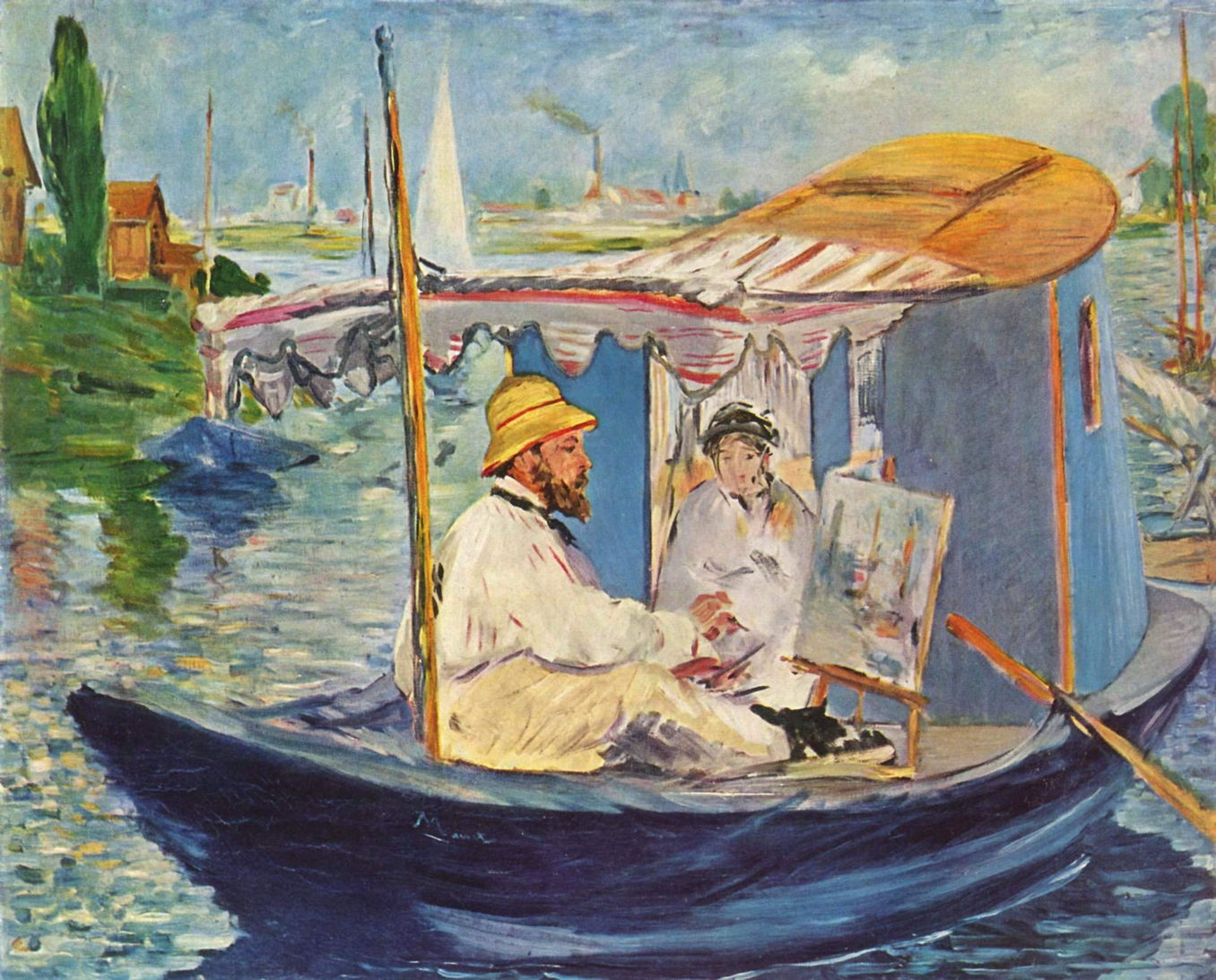
Édouard Manet (1832–1883), Claude Monet in Argenteuil (1874), oil on canvas, 80 × 98 cm, Neue Pinakothek, Munich, Germany. Wikimedia Commons.

Édouard Manet was another visitor, and painted this oil sketch of Claude Monet in Argenteuil in 1874, showing Monet working in his floating studio. His position in the boat appears relaxed, but would have become uncomfortable if maintained for long, as he would have had to keep bending forward to paint, suggesting he might have posed for this painting.

In 1876, Monet’s wife Camille became seriously ill, deteriorating further with the birth of their second son in 1878. The family moved to share a house with his patron Ernest Hoschedé in Vétheuil, further out to the north-west. The Sisleys moved to Moret-sur-Loing on the opposite side of Paris, leaving only Renoir to continue his summer visits.

renoircanotiers
Pierre-Auguste Renoir (1841–1919), Les Canotiers à Chatou (The Boating Party at Chatou) (1879), oil on canvas, 81 × 100 cm, The National Gallery of Art, Washington, DC. Wikimedia Commons.

Renoir’s The Boating Party at Chatou (1879) shows watersports taking place further down the river, with a combination of social rowing in the foreground, and two sports rowers further out in the river.

renoirbythewater
Pierre-Auguste Renoir (1841–1919), By the Water or Near the Lake (c 1880), oil on canvas, 46.2 × 55.4 cm, Art Institute of Chicago, Chicago, IL. Wikimedia Commons.

Renoir’s By the Water from about 1880 is believed to have been painted on the terrace of the Restaurant Fournaise on the Île de Chatou, which he was soon to use for his major work Luncheon of the Boating Party (below). If that’s the case, then what appears to be a lake in the background is really the River Seine.

renoirluncheonboatingparty
Pierre-Auguste Renoir (1841–1919), Luncheon of the Boating Party (1880-81), oil on canvas, 130.2 x 175.6 cm, The Phillips Collection, Washington, DC. Wikimedia Commons.

During the summer of 1880, Renoir started work on another of his masterpieces, that he didn’t complete until the following year: Luncheon of the Boating Party (1880-81), with its complex group of figures.

This was again set on the Île de Chatou at the Restaurant Fournaise, and funded by commissioned portraits over this period. Among his models are his partner and later wife Aline Charigot (left foreground, with affenpinscher dog), the actress Jeanne Samary (upper right), and fellow artist Gustave Caillebotte (seated, lower right). This was exhibited at the Seventh Impressionist Exhibition in 1882, where it was praised by several critics.

renoirbridgeargenteuilautumn
Pierre-Auguste Renoir (1841–1919), The Bridge at Argenteuil in Autumn (1882), oil on canvas, 54.3 x 65.8 cm, Private collection. Wikimedia Commons.

Later in 1882, Renoir painted The Bridge at Argenteuil in Autumn, close to another bridge over the river for which Monet had a particular affection.

In 1881, Gustave Caillebotte acquired a property at Petit-Gennevilliers, near Argenteuil, where he had a boatyard, and moved there permanently in 1888. He and Renoir maintained the tradition of painting this section of the River Seine.

caillebotteboatseineargenteuil
Gustave Caillebotte (1848–1894), Boat Moored on the Seine at Argenteuil (c 1884), oil on canvas, 65.4 × 54.2 cm, Nelson-Atkins Museum of Art, Kansas City, MO. Wikimedia Commons.

Caillebotte’s Boat Moored on the Seine at Argenteuil from about 1884 has thoroughly Impressionist style and facture, with its obvious brushstrokes forming the broken reflection of the boat on the water, and even detail through the depth of the painting.

Gustave Caillebotte, The Bridge at Argenteuil and the Seine (1885), oil on canvas, 65.5 x 81.6 cm, Private collection. WikiArt.
Gustave Caillebotte (1848–1894), The Bridge at Argenteuil and the Seine (1885), oil on canvas, 65.5 x 81.6 cm, Private collection. WikiArt.

Although Caillebotte didn’t make formal series of views that became such a feature of the art of Monet and Pissarro, in the mid-1880s he painted several views of the modern bridges over the River Seine near Argenteuil. The Bridge at Argenteuil and the Seine (1885) is Impressionist in style, with its broken water surface. This features a steam paddle tug towing a laden barge towards the next bridge, which I think is the railway bridge that Claude Monet painted at least twice.

In 1888, Renoir spent the summer painting at Argenteuil and Bougival, where he rediscovered his landscape form.

renoirseineargenteuil
Pierre-Auguste Renoir (1841–1919), The Seine at Argenteuil (1888), oil on canvas, 54 x 65 cm, Barnes Foundation, Philadelphia and Merion, PA. Wikimedia Commons.

Renoir’s The Seine at Argenteuil from 1888 is another view of leisure boating, painted in a style more similar to Sisley’s high Impressionist landscapes, with coarse high chroma brushstrokes laid to form the surface of the water.

Gustave Caillebotte, Sailboats on the Seine at Argenteuil (1892), oil on canvas, Private collection. WikiArt.
Gustave Caillebotte (1848-1894), Sailboats on the Seine at Argenteuil (1892), oil on canvas, Private collection. WikiArt.

For Gustave Caillebotte and his friends, this was the place to come to enjoy a day’s sailing, as shown in his late painting of Sailboats on the Seine at Argenteuil from 1892, just two years before his untimely death at the age of only forty-five. With that, Argenteuil and Chatou were abandoned and Impressionism moved on.

Impressionists at Argenteuil 1

By: hoakley
8 November 2025 at 20:30

When the French Impressionists reassembled after the Franco-Prussian War and the Paris Commune, they gathered a little further up river from Louveciennes and Bougival, at the small town of Argenteuil on the north bank of the River Seine. At the time it was just on the outer edge of the north-western suburbs of the city, about 12 km (7.6 miles) from the centre, and was only fifteen minutes by train to the Gare Saint-Lazare in Paris. Claude Monet was able to commute into the metropolis, and the Sisleys moved in with the Monets in 1872. This weekend I show a small selection of the best-known paintings that were made in and around Argenteuil, and particularly at Chatou, down river.

monetartistshouseargenteuil
Claude Monet (1840–1926), The Artist’s House at Argenteuil (1873), oil on canvas, 60.2 × 73.3 cm, The Art Institute of Chicago, Chicago, IL. Image by Rlbberlin, via Wikimedia Commons.

Although Monet was barely making a living from his art at this time, he was among the few who could afford to use cadmium yellow, which has been found in his painting of The Artist’s House at Argenteuil from 1873.

This marked the start of a highly productive period for Alfred Sisley, and, in conjunction with Monet and Renoir, changed his art. The three concentrated their efforts on the recording of transient effects of light using colour, removing black from their palettes, and abandoning the traditional ‘finish’ of their paintings.

sisleyfootbridgeargenteuil
Alfred Sisley (1839–1899), Footbridge at Argenteuil (1872), oil on canvas, 39 x 60 cm, Musee d’Orsay, Paris. Wikimedia Commons.

Sisley’s Footbridge at Argenteuil from 1872 is dominated by the perspective projection of the bridge itself, almost to the exclusion of the river below. His figures are gestural but look natural in their forms.

renoirmonetpainting
Pierre-Auguste Renoir (1841–1919), Monet Painting in his Garden in Argenteuil (1873), oil on canvas, 46 × 60 cm, Wadsworth Atheneum, Hartford, CT. Wikimedia Commons.

The Impressionists occasionally painted themselves at work, particularly during the earlier years of the movement. Above is Pierre-Auguste Renoir’s Monet Painting in his Garden in Argenteuil from 1873. He is using a conventional lightweight wooden easel, with a small canvas allowing him to work standing, with his oil paints in the pochade box under the easel.

monetpontcheminderferargenteuil1873
Claude Monet (1840–1926), The Railway Bridge at Argenteuil (1873), oil on canvas, 60 × 99 cm, Private collection. Wikimedia Commons.

Monet’s The Railway Bridge at Argenteuil (1873) is one of his several landscapes centred on the railway from the years immediately after the Franco-Prussian War. The following year, he painted the same bridge, as seen below in The Railway Bridge at Argenteuil (1874).

monetrailwaybridgeargenteuil1874
Claude Monet (1840–1926), The Railway Bridge at Argenteuil (1874), oil on canvas, 54 × 71 cm, Musée d’Orsay, Paris. Wikimedia Commons.

monetnormandytraingaresaintlazare
Claude Monet (1840–1926), Arrival of the Normandy Train, Gare Saint-Lazare (1877), oil on canvas, 59.6 x 80.2 cm, Art Institute of Chicago, Chicago, IL. Wikimedia Commons.

Monet’s commute ended at the Gare Saint-Lazare in Paris, where in 1877 he obtained permission to paint a series of works showing the station. By the third Impressionist Exhibition of April of that year, Monet had assembled seven views of the station, including one that even seemed to please the critics. Among the paintings from that campaign is his Arrival of the Normandy Train, Gare Saint-Lazare (1877).

renoirduckpond
Pierre-Auguste Renoir (1841–1919), The Duck Pond (1873), oil on canvas, 50.2 x 61 cm, Dallas Museum of Art, Dallas, TX. Wikimedia Commons.

One of the products of Renoir’s painting with Monet was this highly chromatic view of The Duck Pond (1873) at a farm near Argenteuil.

Facto
Pierre-Auguste Renoir (1841–1919), The Seine at Chatou (1874), oil on canvas, 50.8 x 63.5 cm, Dallas Museum of Art, Dallas, TX. Wikimedia Commons.

The following summer, Renoir visited Argenteuil again, to paint in the company of both Monet and Manet. The Seine at Chatou (1874) is one of his more vigorously crafted works, with a water surface similar to those being painted at the time by Sisley.

monetautumnonseine1873
Claude Monet (1840-1926), Autumn on the Seine, Argenteuil (1873), oil on canvas, 54.3 × 73.3 cm, High Museum of Art, Atlanta, GA. Wikimedia Commons.

Monet’s masterwork Autumn on the Seine, Argenteuil from 1873 is a textbook example of a river landscape in autumn painted in high Impressionist style, with high chroma and loose brushstrokes.

The Dutch Golden Age: Water

By: hoakley
5 November 2025 at 20:30

A glance at a map of the Dutch Republic during its Golden Age reveals that very little was far from the sea, or one of the large rivers that flow through its countryside and cities. In the middle was the Zuiderzee, a large inland sea only kept at bay by a great many dikes.

Fresheneesz, Map of the Low Countries, 1556-1648 (2006). Image by Fresheneesz, via Wikimedia Commons.

With the popularity of landscape painting, it was inevitable that the sea, rivers and other bodies of water became a common feature in those views. This article shows a small selection from some of the most famous artists of the time.

vangoyendordrecht
Jan Josefsz. van Goyen (1596-1656), View of Dordrecht with the Grote Kirk Across the Maas (1644), oil on oakwood, 64.8 x 96.8 cm, Walker Art Gallery, Liverpool, England. Wikimedia Commons.

Jan van Goyen’s View of Dordrecht with the Grote Kirk Across the Maas (1644) shows a familiar view of the city, with particular interest in its buildings. Its skyline is dominated by the still-unfinished 65 metre tower of the Grote Kerk, built between 1285-1470. There are many small boats at work on the choppy water, here depicted in an older fashion similar to works from the Renaissance.

cuyprhine
Aelbert Cuyp (1620–1691), View on the Rhine (c 1645), oil on panel, 27.4 x 36.8 cm, Fondation Custodia, Paris. Wikimedia Commons.

Aelbert Cuyp’s View on the Rhine from the following year appears to have been the result of a trip up river, into steeper terrain inland. It is wonderfully sketchy, and might even be mistaken for one of Turner’s landscapes from nearly two centuries later. In the Netherlands, the lower reaches of this river form part of the great Rhine–Meuse–Scheldt delta, which includes both the major port and city of Rotterdam, and Dordrecht.

cuypviewmaasdordrecht
Aelbert Cuyp (1620–1691), A View of the Maas at Dordrecht (c 1645-46), oil on panel, 50.2 x 107.3 cm, J. Paul Getty Museum, Los Angeles, CA. Wikimedia Commons.

Inevitably, many of Cuyp’s finest landscapes show his home city, such as this View of the Maas at Dordrecht from about 1645-46. This makes best use of an extreme panoramic panel, now commonly used for such marine landscapes.

cuypseamoonlight
Aelbert Cuyp (1620–1691), Sea by Moonlight (c 1648), oil, 77 x 107.5 cm, Hermitage Museum Государственный Эрмитаж, Saint Petersburg, Russia. Wikimedia Commons.

Cuyp also painted a few marine nocturnes, including this view of the Sea by Moonlight from about 1648, where he extended his exploration of the effects of light.

63.43.2
Philip de Koninck (1619–1688), Wide River Landscape (c 1648-49), oil on canvas, 41.3 x 58.1 cm, Metropolitan Museum of Art, New York, NY. Wikimedia Commons.

Philip de Koninck’s Wide River Landscape from about 1648-49 refers to a wide landscape rather than river, I believe. All seems at peace in the countryside, with livestock in the field in the foreground, and a small boat making its way under sail along the river.

cuyppassageboat
Aelbert Cuyp (1620–1691), The Passage Boat (c 1650), oil on canvas, 124 x 144.4 cm, Royal Collection of the United Kingdom, UK. Wikimedia Commons.

Although Cuyp never seems to have become a more dedicated marine specialist, his paintings of ships including The Passage Boat from about 1650, are landmarks at the height of his career. Passage boats were those engaged in regular ferry trips between set ports, in this case probably Dordrecht and Rotterdam, a distance of little more than twelve miles (20 km) by water. With the Republic’s extensive networks of rivers and canals, these were a popular means of transport at the time. The figures in the boat are finely detailed, and include a drummer towards the stern.

cuypmaasdordrecht
Aelbert Cuyp (1620–1691), The Maas at Dordrecht (c 1650), oil on canvas, 114.9 x 170.2 cm, National Gallery of Art, Washington, DC. Wikimedia Commons.

At their best, Cuyp’s coastal landscapes, such as The Maas at Dordrecht from about 1650, are full of rich light, earning him the title of the Dutch Claude Lorrain. This shows another passage boat packed with passengers, together with its drummer.

vanruysdaelalkmaar
Salomon van Ruysdael (c 1600/1603–1670), View of Alkmaar from the Sea (c 1650), oil on panel, 36 x 33 cm, Private collection. Wikimedia Commons.

Salomon van Ruysdael’s View of Alkmaar from the Sea (c 1650) is unusual in showing such a flat coastal landscape on a panel orientated not in landscape mode, but in portrait to include its fine cloudscape.

cuypvalkhofnijmegen
Aelbert Cuyp (1620–1691), The Valkhof at Nijmegen (c 1652-54), oil on wood, 48.8 x 73.6 cm, Indianapolis Museum of Art, Indianapolis, IN. Wikimedia Commons.

Cuyp’s grand view of The Valkhof at Nijmegen from about 1652-54 shows the Imperial castle that was to be demolished in 1798, on its small hill beside the river. The landscape is bathed in golden light, and broken clouds are tinged with similar Claudean colour as they drift through its lucent sky.

vanruisdaelegmondaanzee
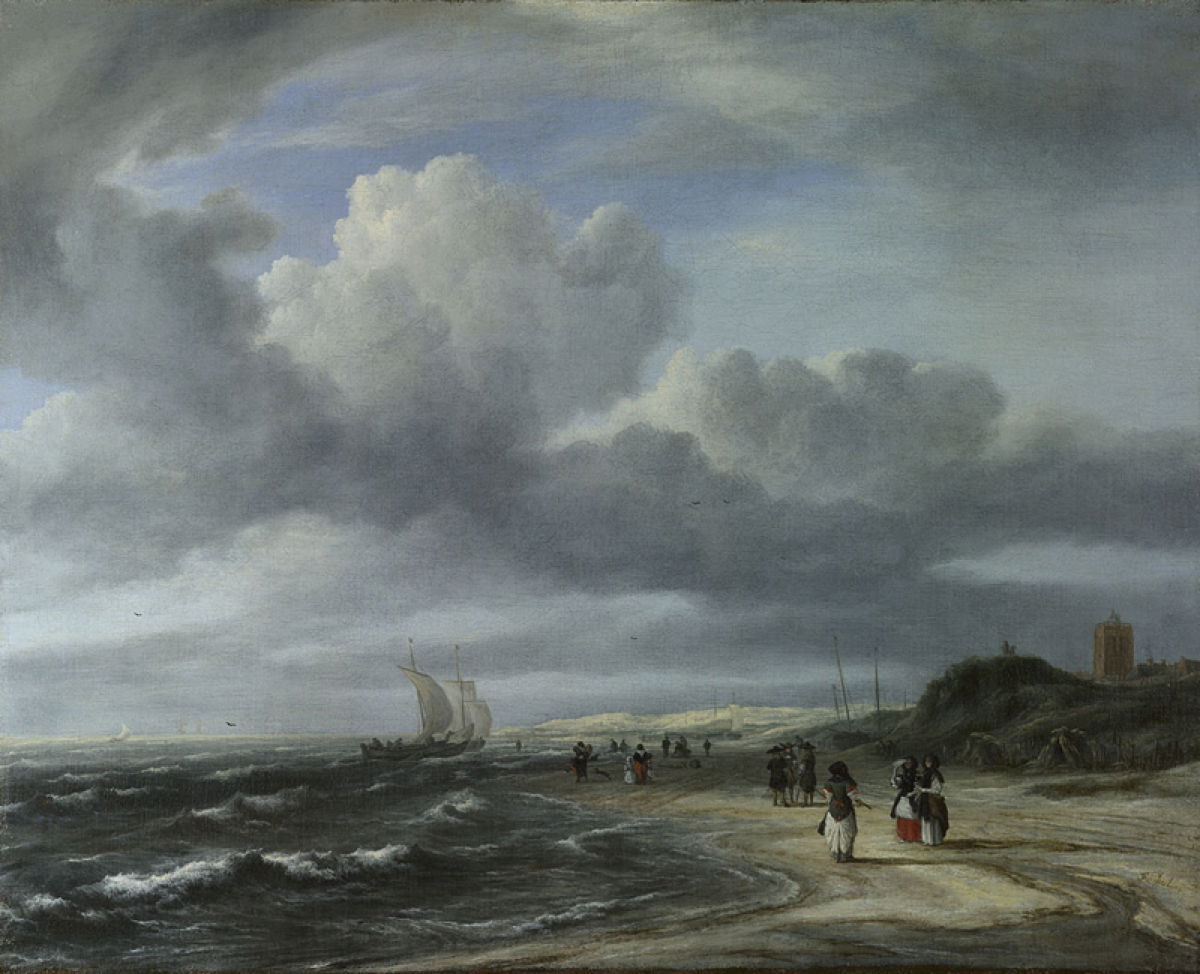
Jacob van Ruisdael (1628/9-1682), The Shore at Egmond-aan-Zee (c 1675), oil on canvas, 53.7 x 66.2 cm, The National Gallery (Bought, 1893), London. Image courtesy of and copyright The National Gallery.

Jacob van Ruisdael’s The Shore at Egmond-aan-Zee from about 1675 was painted to the west of Alkmaar, on the North Sea coast in North Holland, with its stormier weather.

Opnamedatum: 2010-01-11
Philip de Koninck (1619–1688), River Landscape (1676), oil on canvas, 92.5 x 112 cm, Rijksmuseum Amsterdam, Amsterdam, The Netherlands. Wikimedia Commons.

De Koninck’s River Landscape from the following year shows a single oarsman taking a small group of people along the river.

koninckflatbroadriver
Philip de Koninck (1619–1688), Flat Landscape With a Broad River (date not known), oil on canvas, 30 x 49 cm, Museum Boijmans Van Beuningen, Rotterdam, The Netherlands. Wikimedia Commons.

Many of de Koninck’s panoramas are painted on panels or canvases of normal proportions, and just look wide. Flat Landscape With a Broad River is more unusual for his use of a proper marine format. It also appears more sketchy, and has little staffage, as if it may even have been painted in front of the motif.

Gustave Doré’s paintings: After the war

By: hoakley
31 October 2025 at 20:30

With the outbreak of the Franco-Prussian War in 1870, Gustave Doré volunteered to serve in the National Guard. When he was trapped in the siege of Paris, he seized the opportunity to paint his friend the actress Sarah Bernhardt (1844-1923), in what was probably the first portrait in her long and glittering career.

dorebernhardt
Gustave Doré (1832–1883), Portrait of Sarah Bernhardt (1870), oil on canvas, 65.5 × 54 cm, location not known. Wikimedia Commons.

She was only twenty-six at the time, and was just starting a string of successful performances in the city’s Odéon theatre. During the siege she took charge of converting the theatre into a hospital that cared for more than 150 patients. When it re-opened as a theatre the following year, Bernhardt took the lead for a highly successful run. On its opening night, Victor Hugo, author of the play, knelt and kissed her hand.

Doré also produced a series of moving sketches showing the destruction and suffering in Paris at the time of its siege in the autumn of that year.

doresistercharity
Gustave Doré (1832–1883), Sister of Charity Saving a Child. An Episode of the Siege of Paris (1870-71), oil on canvas, 97 x 130 cm, Musée Malraux (MuMa), Musée des Beaux-Arts, Le Havre, France. Wikimedia Commons.

Among those is his Sister of Charity Saving a Child. An Episode of the Siege of Paris (1870-71).

doreenigma
Gustave Doré (1832–1883), The Enigma (souvenirs de 1870) (1871), oil on canvas, 128 x 194 cm, Musée d’Orsay, Paris. Wikimedia Commons.

The following year he committed some of his apocalyptic visions of the siege to canvas, in The Enigma (souvenirs de 1870), and two other major paintings. All three were made using grisaille, greys normally used to model tones in traditional layered technique.

This shows the shattered and still-burning remains of the city in the background, bodies of some of the Prussian artillery in the foreground, and two mythical beasts silhouetted in an embrace. The winged creature is female, and probably represents France, who clasps the head of a sphinx, who personifies the forces that determine victory or defeat. The enigmatic question would then relate to the Franco-Prussian War, and the reasons for France’s defeat.

dorecoupletwochildren
Gustave Doré (1832–1883), A Couple and Two Children Sleeping on a London Bridge (1871), print, 19 × 24.7 cm, Denver Art Museum, Denver, CO. Wikimedia Commons.

When Doré visited London he was shocked by its large population of vagrants and homeless. This print of A Couple and Two Children Sleeping on a London Bridge (1871) is one of several records he made at the time, from which a selection was included in his illustrated book on London published the following year.

dorechristsentryjerusalem
Gustave Doré (1832–1883), Christ’s Entry into Jerusalem (before 1876), oil on canvas, 98.4 x 131.4 cm, Private collection. Wikimedia Commons.

Doré continued to paint religious narrative works, in particular several versions of Christ’s Entry into Jerusalem. This, a preparatory sketch for his final huge version exhibited at the Salon in 1876, shows his brushwork at its loosest and most gestural. This shows the conventional Christian account in the Gospels, of Christ entering Jerusalem in triumph on the back of a donkey, as the start (‘Palm Sunday’ because of the palm fronds usually involved) of the series of processes leading to his Crucifixion. A popular biblical narrative in European painting, few finished works can match Doré’s at 6 by 10 metres (20 by 33 feet).

dorescottishhighlands
Gustave Doré (1832–1883), Scottish Highlands (1875), oil on canvas, 108.6 x 183.2 cm, Toledo Museum of Art, Toledo, OH. Wikimedia Commons.

In 1873 he visited the Scottish Highlands to fish for salmon, and fell in love with the country. Two of his best paintings of the Highlands are Scottish Highlands (1875) above, and Landscape in Scotland (c 1878) below. These were painted in his studio from the sketches and studies he had made during his tour.

dorelandscapescotland
Gustave Doré (1832–1883), Landscape in Scotland (c 1878), oil on canvas, 131 x 196 cm, Walters Art Museum, Baltimore, MD. Wikimedia Commons.

Doré also had good business reasons for being in Britain: in 1867, he held a major exhibition of his work in London, leading to the opening of his Doré Gallery in Bond Street, London. He additionally completed a five year contract with a publisher that required him to stay in London for three months each year.

dorvaleoftears
Gustave Doré (1832–1883), The Vale of Tears (unfinished) (1883), oil on canvas, 413.5 x 627 cm, Petit Palais, Paris. Wikimedia Commons.

At the time of his death in 1883, Doré was close to completing another huge painting showing The Vale of Tears. Drawn not from the Gospels but instead from Psalm 83, reinforced in the writings of Saints Jerome and Boniface, and in the mediaeval hymn Salve Regina (‘Hail Holy Queen’), it refers to the tribulations of worldly life left behind when the pious enter heaven. It’s sometimes known as the Valley of Tears.

Christ, bearing a full-sized cross, is in the distance, surrounded by an arch of light. He is beckoning a large crowd struggling up a steep and rough track leading towards him, and the rocky mountains behind. People in the crowd are of all ages, from infants to the aged, many with obvious physical disorders and ailments, all apparently suffering in their ascent up the Vale of Tears. I wonder whether Doré knew that his journey was also coming to a close.

Gustave Doré died in Paris on 23 January 1883 at the age of only 51. His illustrations live on today even though his paintings may have been sadly forgotten.

Gustave Doré’s paintings: Before the war

By: hoakley
30 October 2025 at 20:30

If you’ve read any of my articles retelling narratives like Dante’s Inferno, you’ll be familiar with the illustrations of Gustave Doré (1832–1883), who is among the most prolific and famous in Europe. His prints overshadow his paintings, the subject of this and tomorrow’s article, and he was also a sculptor. Some of his landscapes are outstanding, but as they were produced during the era of Impressionism have been cast aside by history. In these two articles I concentrate on his narrative oil paintings, for if anyone understood narrative art, it should surely be such a prolific and successful illustrator.

Doré was a precocious child, and started his career as a caricaturist for a newspaper at the age of 15. By the 1850s his illustrations were being commissioned by major publishers in both France and Britain, including those for a new illustrated English Bible. Here are two prints from that work published in 1866.

dorejudithholofernes
Gustave Doré (1832–1883), Judith and Holofernes (1866), print from illustrated edition of the Bible.

The first shows the popular story of Judith and Holofernes; Doré avoids the most powerful scene of the decapitation itself, but follows the more guarded approach adopted by Etty and others, to make it more acceptable to a Victorian publisher.

dordeathonpalehorse
Gustave Doré (1832–1883), Death on the Pale Horse (1865), print from illustrated edition of the Bible.

His Death on the Pale Horse, accompanying the book of Revelation 6:8, remains one of the most popular and perhaps iconic portraits of the ‘Grim Reaper’, whose visits to families were all too frequent at the time.

Doré first illustrated Dante Alighieri’s Divine Comedy as early as 1857, and returned to it in the mid 1860s. He painted several works derived from the first part Inferno. This describes Dante becoming lost in a wood and unable to find the way to salvation. He is rescued by the classical Roman poet Virgil, and the pair then descend and travel through the underworld together. By convention, Dante himself is shown dressed in red robes with a distinctive hat, and Virgil with a laurel wreath on his head.

doredantelostinforest
Gustave Doré (1832–1883), Dante Lost in the Forest (1861), gouache, dimensions not known, location not known. Image by Gastair, via Wikimedia Commons.

When he reaches the foot of a hill, Dante sees its upper slopes already lit by the first rays of the sun. As he starts walking up, his way is blocked first by a leopard, then by a lion, and finally by a wolf.

doredantevergil
Gustave Doré (1832–1883), Dante and Virgil in the ninth circle of hell (1861), oil on canvas, 311 x 428 cm, Musée de Brou, Bourg-en-Bresse, France. Wikimedia Commons.

The sinners in hell are divided according to the type of sin; in this oil painting, Doré shows Virgil (left) and Dante at the last of these ‘circles’, the ninth, for those who committed sins of malice, such as treachery. These sinners are shown partially frozen into an icy lake, with additional blocks of ice scattered around, just as described by Dante.

dorepaolofrancesca
Gustave Doré (1832–1883) Paolo and Francesca da Rimini (1863), oil on canvas, 280.7 x 194.3 cm, Private collection. Wikimedia Commons.

Among the side-stories related by Dante is that of Paolo and Francesca da Rimini, who are in the second circle for sins of lust. She committed adultery with her husband’s brother, Paolo Malatesta. Her husband Giovanni (or Gian Cotto) then killed them both. In this oil painting Doré shows the lovers, Francesca’s stab wound visible near the middle of her chest, Paolo’s still bleeding, as they are blown around and buffeted for their sins. At the lower right he shows Dante and Virgil looking on. This was first shown at the Salon in 1863, and was praised highly by the critics.

Doré also illustrated Miguel de Cervantes’ Don Quixote in a lengthy set that has been used by others as the basis for further illustrated editions.

28.113
Gustave Doré (1832–1883), Don Quixote and Sancho Panza Entertained by Basil and Quiteria (c 1863), oil on canvas, 92.1 x 73 cm, Metropolitan Museum of Art, New York, NY. Wikimedia Commons.

When the newlyweds Basil and Quiteria entertain Don Quixote and Sancho Panza for three days, they visit the Cave of Montesinos and the Lakes of Ruidera nearby. To mark this well-known episode, Doré painted this non-narrative scene of Don Quixote and Sancho Panza Entertained by Basil and Quiteria in oils in about 1863.

Many of Doré’s easel paintings were independent of his illustrations.

doresummer
Gustave Doré (1832–1883), Summer (c 1860-70), oil on canvas, 266.4 x 200.1 cm, Museum of Fine Arts Boston, Boston, MA. Wikimedia Commons.

One of the few paintings that I have seen that captures the experience of dense clouds of butterflies is his Summer from about 1860-70. Set in what appears to be an upland or alpine meadow, its butterflies look like large flowers that have taken to the air.

dorbetweenskyearth
Gustave Doré (1832–1883), Between Sky and Earth (1862), oil on canvas, 61 x 51 cm, Musée des Beaux-Arts de Belfort, Belfort, France. Wikimedia Commons.

Between Sky and Earth (1862) remains more of a mystery. The viewer is high above the fields outside Doré’s native Strasbourg, where several small groups are flying kites. The kite shown at the upper left has just been penetrated by a flying bird. Another unseen kite, off the top of the canvas, has a traditional tail, at the end of which is tied an anxious frog by a hindleg. However, a stork appears to have designs on seizing the opportunity to eat the frog, and is approaching from behind, its bill wide open and ready for the meal.

This could be an allegory, of course, but is probably a humorous depiction of kite-flying at the time, when people were still puzzled as to what happened to living creatures as they ascended higher in the atmosphere.

doretriumphchristianity
Gustave Doré (1832–1883) The Triumph Of Christianity Over Paganism (c 1868), oil on canvas, 300 x 200 cm, Art Gallery of Hamilton, Ontario. Wikimedia Commons.

By the late 1860s Doré was tackling more heavyweight narratives on very large canvases. The Triumph Of Christianity Over Paganism (c 1868) has become as elaborately symbolic as the paintings of the younger Gustave Moreau. In the upper part of this painting, Christ, bearing his cross, is surrounded by an angelic host flying out, swords drawn and shields borne, to fight the pagan evils on the earth below. Among those are recognisable gods of the Classical pantheon, with Zeus/Jupiter at the centre, holding a thunderbolt in his left hand.

doreeveningalsace
Gustave Doré (1832–1883), Evening in Alsace (1869), oil on canvas, 191.8 x 127 cm, Musée d’art moderne et contemporain de Strasbourg (MAMCS), Strasbourg, France. Wikimedia Commons

In his humorous Evening in Alsace from 1869, four young men are squeezed into an open window as they try to charm the four young women standing below. Along comes a flock of geese to join in and ruin their chances.

The Dutch Golden Age: Jacob van Ruisdael’s trees

By: hoakley
29 October 2025 at 20:30

Of the several hundred landscape painters of the Dutch Golden Age, the best-known and most influential is Jacob van Ruisdael, whose paintings were described by Vincent van Gogh as “sublime”. Van Ruisdael was starting his career just as Nicolas Poussin was reaching his zenith in Rome, and the two were major influences on all subsequent landscape artists, particularly Thomas Gainsborough, John Constable and JMW Turner.

Jacob Isaackszoon van Ruisdael (1628/9-1682) was born in Haarlem into a family of painters. Presumably apprenticed within the family workshop, he was admitted to the local Guild of Saint Luke in 1648, and from the outset appears to have specialised in landscape painting.

vanruisdaellandscapechurch
Jacob Isaakszoon van Ruisdael (1628/9–1682), Landscape with a Church (c 1645), oil on panel, 43.7 x 53.9 cm, Dulwich Picture Gallery, London. Wikimedia Commons.

Van Ruisdael’s earliest landscapes contained trees, as they would at a time when trees and woods were more extensive in their coverage across the whole of Europe. The view in Landscape with a Church (c 1645) looks familiar, as its composition was used by Gainsborough, Constable, and many other later artists. Prominent at the left, and forming repoussoir, is the hulk of an old tree, younger branches sprouting from the remains, a recurrent theme in Gainsborough as well as van Ruisdael. A recession in depth on the right leads to the brighter-lit church in the middle distance.

The trees here are painstakingly constructed from the anatomy of their branches, with leaves painted individually in the foreground, but delicately en masse in the further distance. Bark colour, texture, and rich lichen growth are also shown in fine detail.

vanruisdaelroadthroughoakforest
Jacob Isaakszoon van Ruisdael (1628/9–1682), Road through an Oak Forest (c 1646-7), oil on canvas, 65 x 85 cm, Statens Museum for Kunst, København, Denmark. Wikimedia Commons.

Van Ruisdael soon showed a deep understanding of the stages in the life and looks of oak trees. In Road through an Oak Forest (c 1646-7) he captures the later life of a stag-headed oak, that long ago lost its crown, on the left, a flush of new growth on a fallen trunk, and another still clinging onto life despite a great split at its base.

Judging from the girth of their trunks, the oak trees shown here are around 400 years old, making it likely that they were saplings in the thirteenth century, possibly even earlier. They form a remarkable window back in time to the late Middle Ages.

vanruisdaellandscapestonebridge
Jacob Isaakszoon van Ruisdael (1628/9–1682), Landscape with a Stone Bridge (c 1647), black chalk and grey wash on paper, 16 x 20 cm, Hermitage Museum, Sanit Petersburg. Wikimedia Commons.

Some of van Ruisdael’s sketches and drawings have also survived, among them Landscape with a Stone Bridge (c 1647). This shows his development of foliage from branch structure quite clearly, and the fact that he didn’t block in that foliage, preferring gestural squiggles and other marks.

vanruisdaewoodedlandscapepond
Jacob Isaakszoon van Ruisdael (1628/9–1682), A Wooded Landscape with a Pond (c 1648), oil on panel, 34.8 x 46 cm, Museum of Fine Arts, Houston, TX. Wikimedia Commons.

Van Ruisdael was a faithful observer of the different species of tree and their forms, as shown in his timeless A Wooded Landscape with a Pond from about 1648. He has maintained careful, anatomical construction even in the prominent tree at the centre right, in the middle distance, and the canopies appear light and leafy.

vanruisdaellandscapemill-runruins
Jacob Isaakszoon van Ruisdael (1628/9–1682), Landscape with a Mill-run and Ruins (c 1653), oil on canvas, 59.3 x 66.1 cm, Art Gallery of South Australia, Adelaide. Wikimedia Commons.

Gentle rural decay is shown not only in the ruined buildings in Landscape with a Mill-run and Ruins (c 1653), but also in the stag-head tree in the centre of the painting.

He moved to Amsterdam in 1657, to take advantage of its growing prosperity. He appears to have travelled little, remaining within the European lowlands and venturing only just over the border into Germany. His only known student was Meindert Hobbema, who became an accomplished landscape painter who also depicted trees as important elements within his works.

vanruisdaelgreatforest
Jacob Isaakszoon van Ruisdael (1628/9–1682), The Great Forest (c 1655-60), oil on canvas, 139 x 180 cm, Kunsthistorisches Museum, Vienna. Wikimedia Commons.

Probably painted soon after he had moved to Amsterdam, The Great Forest (c 1655-60) shows travellers along a track passing at the edge of an ancient woodland, with an assortment of trees in various states of advancing age, including some reduced to stag-heads.

vanruisdaelforeststream
Jacob Isaakszoon van Ruisdael (1628/9–1682), The Forest Stream (c 1660), oil on canvas, 99.7 x 129.2 cm, Metropolitan Museum of Art, New York, NY. Wikimedia Commons.

The upland landscape shown in The Forest Stream (c 1660) was clearly not one that van Ruisdael had ever seen, but must have been composed from studying the paintings of others, and talking to those more widely travelled. His trees remain much as before, with a gnarled and twisted stag-head at the right, and at the left a near-dead trunk poised in slow-motion collapse into the stream.

vanruisdaelmarshforestdusk
Jacob Isaakszoon van Ruisdael (1628/9–1682), A Marsh in a Forest at Dusk (c 1660), oil on canvas, 77.7 x 92.2 cm, Bilbao Fine Arts Museum, Bilbao. Wikimedia Commons.

Although most of van Ruisdael’s paintings are in full daylight, as with his contemporaries he also explored more transient light effects, in A Marsh in a Forest at Dusk (c 1660). Now the ancient trees launching themselves out from the bank at the right have engaged with those growing in the marsh. The effect of the late dusk light on their canopies is spectacular, as are the thin banks of cloud above, lit by the setting sun. His careful leaf-by-leaf depiction of canopies of different tree species generates distinct and life-like textures.

vanruisdaelandscapewaterfall
Jacob Isaakszoon van Ruisdael (1628/9–1682), Landscape with Waterfall (c 1660-70), oil on canvas, 142.5 x 196 cm, Rijksmuseum, Amsterdam. Wikimedia Commons.

In Landscape with Waterfall (c 1660-70), van Ruisdael revisited the distant church framed by nearer trees theme of Landscape with a Church above. Perhaps this time the church is a little too far away, though still an inspiration to Constable and Gainsborough. At the right a birch collapses off the edge, and there is a pair of ancient wizened oaks filling the centre.

vanruisdaeoakslakewaterlilies
Jacob Isaakszoon van Ruisdael (1628/9–1682), Oaks at a Lake with Water Lilies (c 1665), oil on canvas, 116.6 x 142.2 cm, Gemäldegalerie, Berlin. Wikimedia Commons.

He continued to develop the theme of old oaks and water in Oaks at a Lake with Water Lilies in about 1665. Again a dying ancient hulk stands like a prow from the bank at the left, and he shows bright flowers on the water-lilies.

vanruysdaelroadoakwood
Jacob Isaakszoon van Ruisdael (1628/9–1682), A Road through an Oak Wood (date unknown), oil on canvas, 102.5 x 127 cm, National Museum of Western Art, Tokyo. Wikimedia Commons.

Many of his woods are either unpopulated, or the few people providing staffage are barely visible against their surroundings. His undated A Road through an Oak Wood is different, with a couple of travellers on its road, and woodland activities of clearing and burning at the left.

The Golden Age was primarily based on prosperity from trade, not home production, but increasing demand from the affluent cities led to greater timber production, particularly for ships and buildings, and the clearing of woods to augment farmland.

varuisdaelthreegreattreesmountainouslandscape
Jacob Isaakszoon van Ruisdael (1628/9–1682), Three Great Trees in a Mountainous Landscape with a River (c 1665-70), oil on canvas, 138.1 x 173.1 cm, The Norton Simon Museum, Pasadena, CA. Wikimedia Commons.

My final selection is perhaps his most detailed essay on the effects of advanced age on trees, Three Great Trees in a Mountainous Landscape with a River (c 1665-70). Although the mountains are borrowed or imaginary, the three trees of the title seem almost impossibly intertwined. The nearest is struggling to survive, remains of its former glory resting, limbs in the air, at its foot.

When the Dutch economy collapsed in 1672, he appears to have remained relatively prosperous, and continued to work in Amsterdam until his death a decade later, in 1682.

References

Wikipedia
Slive, S (2005) Jacob van Ruisdael: Master of Landscape, Royal Academy of Arts, London. ISBN 978 1 903973 24 0.
Ashton, PS, Davies, AI & Slive, S (1982). “Jacob van Ruisdael’s trees”. Arnoldia 42 (1): 2–31; available from JSTOR.

Louveciennes landscapes: After the war

By: hoakley
26 October 2025 at 20:30

With the Paris Commune crushed in 1871, and order being restored to France under the new Republic, the Pissarros returned to live a more settled life in Louveciennes again, after the shock of discovering that most of his 1500 or so paintings had been damaged or destroyed by occupying Prussian soldiers. There Pissarro lived close to Alfred Sisley, and the two often painted in company. Renoir’s mother also lived in the village, enabling the three painters to meet frequently.

Among Pissarro’s favourite motifs in this post-war period were numerous views of the Route de Saint-Germain and other roads around Louveciennes, and the River Seine at Bougival.

pissarrolouveciennesroutestgermain
Camille Pissarro (1830–1903), Louveciennes, Route de Saint-Germain (1871), watercolour over black chalk, 30.2 x 49.2 cm, J. Paul Getty Museum, Los Angeles, CA. Wikimedia Commons.

Less known are his watercolours, such as this view of Louveciennes, Route de Saint-Germain from 1871, and are reminiscent of the paintings of Johan Jongkind.

Camille Pissarro (1830-1903), Avenue in the Parc de Marly (c 1871), oil on canvas, 45 x 55 cm, Museo Thyssen-Bornemisza, Madrid. Wikimedia Commons.

Pissarro painted this woodland view of an Avenue in the Parc de Marly in the autumn of 1871. It looks towards the village of Marly-le-Roi from the Port du Phare, inside the grounds of the Château de Marly. His skilful use of staffage draws the eye towards the far end of the avenue. The artist seems to have sold this painting quite quickly to an unknown buyer, from whom Durand-Ruel bought it in early 1873.

sisleyseinebougival1872
Alfred Sisley (1839–1899), The Seine at Bougival (1872), oil on canvas, 50.8 x 65.5 cm, Yale University Art Gallery, New Haven, CT. Wikimedia Commons.

Alfred Sisley also painted here en plein air, as seen in The Seine at Bougival from 1872. The water surface is mirror-smooth, and Sisley has been careful to paint the reflection of the buildings with optical precision.

pissarrorouteversailleslouveciennessnow
Camille Pissarro (1830–1903), The Post-House, the Route de Versailles, Louveciennes, Effect of Snow (1872), oil on canvas, 55 x 91 cm, location not known. Wikimedia Commons.

This is Pissarro’s wintry scene of The Post-House, the Route de Versailles, Louveciennes, Effect of Snow from 1872. This looks from the ‘Royal Gate’ of the Château de Marly towards the post-house, a landmark featured in several of his works from this period. This painting was bought that Spring by Durand-Ruel, who sold it a year later to Jean-Baptiste Faure, the opera singer, Pissarro’s first collector and Sisley’s enduring patron.

pissarrochestnutslouveciennes
Camille Pissarro (1830–1903), Chestnut Grove at Louveciennes (1872), oil on canvas, 41.5 x 53.3 cm, Nelson-Atkins Museum of Art, Kansas City, MO. Wikimedia Commons.

Pissarro must have taken delight in the weird forms of the trees in this Chestnut Grove at Louveciennes, painted in 1872. In the far distance is the massive warm cream stone of Marly Aqueduct.

Although the Pissarros were able to live on the money generated by Camille’s painting, they must have got by in relative poverty. However, in 1872, he sold four stretched canvas overdoor panels depicting the seasons to the banker Achille Arosa for 100 Francs each. Pissarro tried to buy them back when they came up for auction in 1891, but despite appealing to Vincent van Gogh’s brother Theo, they were sold for just over a thousand Francs to the Bernheim-Jeune Gallery, and have remained in private collections since.

In April 1872, the Pissarros moved from Louveciennes to Pontoise, where they rented a house and Camille established his studio.

sisleysnowroadlouveciennes
Alfred Sisley (1839–1899), Snow on the Road, Louveciennes (1874), 38 × 56 cm, Private collection. Wikimedia Commons.

Sisley wasn’t as prolific as Pissarro in either ‘road’ or snow scenes. His Snow on the Road, Louveciennes (1874) clearly comes from the same school, but his trees and buildings remain distinctive.

sisleyaqueductmarly
Alfred Sisley (1839–1899), The Aqueduct at Marly (1874), oil on canvas, 54.3 x 81.3 cm, Toledo Museum of Art, Toledo, OH. Wikimedia Commons.

Sisley’s Aqueduct at Marly (1874) shows the massive form of this aqueduct which appeared in the distance in Pissarro’s Chestnut Grove at Louveciennes above. This and the nearby Machine de Marly, which Sisley also painted, were part of a monumental hydraulic network built in the 1680s for Louis XIV, to supply water to the Château de Marly and the royal gardens of the Palace at Versailles. The stone tower at the right end of the aqueduct is the Tour de Levant, used by Prussian troops as a vantage point for observing the besieged city of Paris, a point that won’t have escaped Sisley’s attention.

Alfred Sisley, Forge at Marly-le-Roi (1875), oil on canvas, 55 x 73.5 cm, Musée d'Orsay, Paris. EHN & DIJ Oakley.
Alfred Sisley (1839-1899), Forge at Marly-le-Roi (1875), oil on canvas, 55 x 73.5 cm, Musée d’Orsay, Paris. EHN & DIJ Oakley.

Sisley’s Forge at Marly-le-Roi from 1875 shows the village blacksmiths at work.

ropssundaybougival
Félicien Rops (1833–1898), Sunday in Bougival (1876), media and dimensions not known, Musée Provincial Félicien Rops, Namur, Belgium. Image by Paul Hermans, via Wikimedia Commons.

In 1876, Félicien Rops must have visited one of the popular bathing resorts nearby, to paint his Sunday in Bougival. This shows a lecherous old man watching two young women preparing to bathe there, a mere 15 km (10 miles) from the heart of Paris.

By this time, the Impressionists had moved away from Louveciennes, and were painting elsewhere.

64.154.2
Alfred Sisley (1839–1899), The Road from Versailles to Louveciennes (c 1879), oil on canvas, 45.7 x 55.9 cm, The Metropolitan Museum of Art, New York, NY. Wikimedia Commons.

Although Sisley was now living near Sèvres, he must have returned in about 1879 for one last painting in front of the motif, on The Road from Versailles to Louveciennes. This is an example of his more sketchy plein air paintings from his time at Sèvres, and a more traditional perspective view of a road of the time. This section of the road is close to Louveciennes, on the main route between Versailles and Saint-Germain-en-Laye.

At that point, the Impressionists finally left Élisabeth Louise Vigée Le Brun to rest in peace.

Louveciennes landscapes: Before the war

By: hoakley
25 October 2025 at 19:30

When the prolific portraitist in pastels Élisabeth Louise Vigée Le Brun retired to live near Paris, she chose a small hamlet to the west of the city, between the palace at Versailles and Saint-Germain-en-Laye, Louveciennes. She died there in 1842, and is buried in the graveyard not far from her house.

Twenty-seven years later it became the focus for a group of friends, who went on to become the core of the French Impressionists. For the next few years Louveciennes and the adjacent villages of Bougival and Marly-le-Roi were to appear in well over a hundred of their paintings, a few of which I show this weekend.

Just beyond Chatou, the River Seine sweeps to the right in a bend with a series of long islands with popular bathing houses, among them the famous La Grenouillère. In the summer of 1869, Auguste Renoir was living at his parents’ house in Louveciennes, just to the south of this bend, where Camille Pissarro and his family were renting a house. He visited Claude Monet and his family, who were living near Bougival, also on that bend, and they often painted together.

Some of the formative moments in Impressionism if not European art occurred when Monet and Renoir visited La Grenouillère.

renoirgrenouillerestock
Pierre-Auguste Renoir (1841–1919), La Grenouillère (1869), oil on canvas, 66.5 x 81 cm, Nationalmuseum, Stockholm, Sweden. Wikimedia Commons.

Renoir painted at least three different views of La Grenouillère that summer: that above is now in Stockholm, and that below, which is most similar to Monet’s, is in the Oskar Reinhart Collection in Switzerland; the third (not shown here) is in the Pushkin Museum in Moscow. Originally conceived as plein air sketches preparatory to more finished paintings for submission to the Salon the following year, they came to define these brilliant shimmering images formed from high chroma brushstrokes as Impressionist style.

renoirgrenouillerereinhart
Pierre-Auguste Renoir (1841–1919), La Grenouillère (1869), oil on canvas, 65.1 x 92 cm, Oskar Reinhart Collection, Winterthur, Switzerland. Wikimedia Commons.

If Impressionism has to have a single moment of birth, it’s surely in the summer of 1869 at La Grenouillère.

Claude Monet, Bathers at la Grenouillère (1869), oil on canvas, 73 x 92 cm, The National Gallery, London. WikiArt.

Monet’s Bathers at la Grenouillère is his early statement of his Impressionist agenda. The pair realised that Impressionism was about these sketched instants. This also reveals Monet’s preference for modern pigments, as most of the brighter mid-blues here use cobalt blue, introduced earlier in the nineteenth century.

Claude Monet, Bathers at la Grenouillère (detail) (1869), oil on canvas, 73 x 92 cm, The National Gallery, London. WikiArt.

In addition to Renoir, Pissarro and Monet, Alfred Sisley maintained a studio nearer the river in Bougival, where the four artists painted, starved and fought off despair together.

pissarroroadversailles1869
Camille Pissarro (1830–1903), Road to Versailles at Louveciennes (Snow Effect) (1869), oil on canvas, 38.4 × 46.3 cm, Walters Art Museum, Baltimore, MD. Wikimedia Commons.

Pissarro painted a succession of views of the roads around the village. His Road to Versailles at Louveciennes (Snow Effect) (1869) is typical of his earlier ‘road’ paintings, showing an avenue of tall, bare-branched trees, brushed in coarsely.

Camille Pissarro (1830-1903), Route de Versailles, Louveciennes, Winter Sun and Snow (c 1870), oil on canvas, 46 x 55.3 cm, Museo Thyssen-Bornemisza, Madrid. Wikimedia Commons.

The following winter his paintings concentrated on road scenes around Louveciennes, a theme which continued for many years, spanning the seasons.

Camille Pissarro (1830-1903), Winter Landscape at Louveciennes (c 1869), oil on canvas, 37 x 46 cm, Musée d'Orsay, Paris. EHN & DIJ Oakley.
Camille Pissarro (1830-1903), Winter Landscape at Louveciennes (c 1869), oil on canvas, 37 x 46 cm, Musée d’Orsay, Paris. EHN & DIJ Oakley.

As many artists before him, Pissarro used trees to frame his motifs in repoussouir, but during the late 1860s they started to invade more central areas of the canvas. In about 1869, in his Winter Landscape at Louveciennes for the first time tree trunks and branches spread across his canvas, breaking up the motif behind into small sections.

pissarrohousesbougival
Camille Pissarro (1830–1903), Houses at Bougival, Autumn (1870), oil on canvas, 88.9 x 115.9 cm, J. Paul Getty Museum, Los Angeles, CA. Wikimedia Commons.

Pissarro’s Houses at Bougival, Autumn is clearly dated 1870, although by that time he had moved from Louveciennes. It is also thought to have been exhibited at the Salon that year, suggesting it may have been started in late 1869.

sisleyearlysnowlouveciennes
Alfred Sisley (1839–1899), Early Snow in Louveciennes (1870), oil on canvas, 54 x 73 cm, Museum of Fine Arts Boston, Boston, MA. Wikimedia Commons.

Like Pissarro, Sisley started depicting the streets of suburbs, including Early Snow in Louveciennes. This has been dated to 1870, although it appears more likely that it was painted en plein air late the previous year.

Following the outbreak of the Franco-Prussian War, in September 1870 the Pissarros’ house in Louveciennes was requisitioned by the invading Prussians. The family fled first to their friends in Montfoucault, then in December travelled on to England, where they settled in Norwood, at that time an outer suburb of London. When in England, Pissarro met Paul Durand-Ruel, who became his dealer, and Claude Monet, who had also fled to London.

Bougival was also overrun by Prussian soldiers, who commandeered Sisley’s studio; many of his early works were lost, as Pissarro’s were in Louveciennes, just over a mile away. The Sisleys were forced into the city of Paris, and despite Alfred’s British nationality, they remained trapped through the siege of the city into the following year. Worse still, the Sisley family business collapsed and his parents were in no position to support the artist.

In the Forest of Fontainebleau: Impressionism

By: hoakley
12 October 2025 at 19:30

By the early 1860s, the large and ancient Forest of Fontainebleau, to the south-east of Paris, had been attracting those of the Barbizon School, who painted realist landscapes in front of the motif. The next generation started visiting in 1865, and went on to form the French Impressionists.

bazillelandscapechailly
Frédéric Bazille (1841–1870), Landscape at Chailly (1865), oil on canvas, 81 x 100.3 cm, The Art Institute of Chicago, Chicago, IL. Wikimedia Commons.

In May 1865, the young Frédéric Bazille left the city of Paris for the Forest of Fontainebleau, where he painted Landscape at Chailly (1865) in company with Claude Monet, and possibly Auguste Renoir and Alfred Sisley. Although clearly influenced by the Barbizon School, his colours are much brighter, and escape the rather sombre browns and greens that dominated much of the work of that earlier art.

sisleyavenuechestnuts
Alfred Sisley (1839–1899), Avenue of Chestnut Trees in La Celle-Saint-Cloud (1865), oil on canvas, 125 x 205 cm, Petit Palais, Paris. Wikimedia Commons.

Sisley painted this Avenue of Chestnut Trees in La Celle-Saint-Cloud to the west of the forest in 1865, again in Barbizon style. He didn’t submit it to the Salon until 1867, when it was refused. It then remained unsold for ten years before being bought by Sisley’s patron Jean-Baptiste Faure, a celebrated opera singer.

The following year, Sisley walked through the forest with Renoir. He then stayed in the village of Marlotte, where Renoir, Monet, Bazille, Pissarro and Cézanne also visited to paint.

sisleywomentowoods
Alfred Sisley (1839–1899), Women Going to the Woods (1866), oil on canvas, 65.2 x 92.2 cm, Bridgestone Museum of Art ブリヂストン美術館, Tokyo, Japan. Wikimedia Commons.

Sisley was more successful with Women Going to the Woods, completed in 1866. This was one of his two paintings exhibited at the Salon that year, and shows the main street in the village of Marlotte with a little rustic staffage.

renoirclearing
Pierre-Auguste Renoir (1841–1919), Clearing in the Woods (1865), oil on canvas, 57.2 x 82.6 cm, Detroit Institute of Arts, Detroit, MI. Wikimedia Commons.

Clearing in the Woods (1865) is Renoir’s first substantial (surviving) landscape painting, and shows strong influence from Corot. He adopts quite a detailed realist style in this view of a clearing in the midst of massive chestnut trees. These are believed to be near the small village of La Celle-St-Cloud, to the west of Paris not far from Bougival, rather than in the forest. It’s likely that he painted there in the company of Alfred Sisley, who made two views of the same site in very different style.

renoirlecoeurhunting
Pierre-Auguste Renoir (1841–1919), Jules Le Coeur and his Dogs in the Forest of Fontainebleau (1866), oil on canvas, 112 x 90 cm, Museu de Arte de São Paulo (MASP), São Paulo, Brazil. Wikimedia Commons.

The following year Renoir painted his friend Jules Le Coeur and his Dogs in the Forest of Fontainebleau. This is unusual among his works, as it was preceded by two studies, and all three were made using the palette knife rather than brushes. This makes it most likely to have been painted before Renoir abandoned the knife and returned to the brush, by the middle of May 1866.

thayerfontainebleau
Abbott Handerson Thayer (1849–1921), Landscape at Fontainebleau Forest (c 1876), oil on cardboard, 54.6 x 45.7 cm, Private collection. Wikimedia Commons.

The following year Abbott Handerson Thayer, an American artist who trained in Paris, painted this wonderful oil sketch of Landscape at Fontainebleau Forest (c 1876). This is probably the loosest and most Impressionist painting of his career.

rouartfontainebleau
Henri Rouart (1834–1912), In Fontainebleau Forest (date not known), oil on canvas, 59.5 x 73.2 cm, Private collection. Wikimedia Commons.

At some time in the late nineteenth century, the wealthy industrialist, amateur painter and patron of Impressionism, Henri Rouart painted In Fontainebleau Forest. This may have been inspired by Corot, but is a realist study in light, shade, and the texture of bark.

weirjffontainebleau
John Ferguson Weir (1841-1926), Forest of Fontainebleau (c 1902), oil on canvas, 48.9 x 61 cm, Private collection. The Athenaeum.

John Ferguson Weir was another American painter who had trained in Paris, and became the first director of the School of Fine Arts at Yale University. He visited in about 1902, when he painted Forest of Fontainebleau (c 1902), with its tiny solitary figure against the fallen trunk.

In 1867 Théodore Rousseau died in the village of Barbizon, and he was followed in 1875 by Jean-François Millet. By the twentieth century the forest had fallen out of favour with the new generation.

In the Forest of Fontainebleau: Barbizon

By: hoakley
11 October 2025 at 19:30

The Forest of Fontainebleau covers an area of about 250 square kilometres (almost 100 square miles) to the south-east of Paris. It’s mixed deciduous woodland, much of it ancient, with a royal castle at its centre. Around the edge of the forest are several small villages that have attracted painters since the early nineteenth century, and inspired two schools of painting: Barbizon, named after the village where most of its adherents gathered, and Impressionism. This weekend I show some of their paintings, starting today with examples from the Barbizon period up to the early 1860s.

The forest has been a favourite hunting ground for French kings, and for the Emperor Napoleon.

flamengnapoleonhunting
François Flameng (1856–1923), Napoleon hunting in the forest of Fontainebleau (date not known), further details not known. Wikimedia Commons.

Among the paintings of François Flameng showing the Napoleonic period, one of the most striking is this scene of Napoleon Hunting in the Forest of Fontainebleau, where the pack is closing in on a cornered stag as the sun sets.

The royal castle, Château de Fontainebleau, was later used by Napoleon III for receptions.

geromesiameseambassadors
Jean-Léon Gérôme (1824–1904), Reception of Siamese Ambassadors by Napoleon III (1864), oil on canvas, 128 x 260 cm, Château de Versailles, Versailles, France. The Athenaeum.

Jean-Léon Gérôme articulated Napoleon III’s aspirations for empire in his elaborate formal painting of the Reception of Siamese Ambassadors by Napoleon III (1864), depicting the grand reception held at Fontainebleau on 27 June 1861. Gérôme attended in the role of semi-official court painter, made sketches of some of the key figures, and was further aided by photographs made by Nadar. He also included himself, and the older artist Ernest Meissonier (1815-1891), in the painting: I believe that they are both at the back, at the far left.

michallonbranchfontainebleau
Achille Etna Michallon (1796–1822), The Fallen Branch, Fontainebleau (c 1816), oil on canvas on card, dimensions not known, Minneapolis Institute of Art, Minneapolis, MN. Wikimedia Commons.

Achille Etna Michallon was one of the first great landscape artists to paint en plein air in the forest. His study of The Fallen Branch, Fontainebleau from about 1816 anticipates the Barbizon School in its motif, style and location. This large branch looks more like a dying animal.

boningtonforestatfontainebleau
Richard Parkes Bonington (1802–1828), In the Forest at Fontainebleau (c 1825) (188), oil on millboard, 32.4 x 24.1 cm, Yale Center for British Art, New Haven, CT. Wikimedia Commons.

A decade later, the British artist Richard Parkes Bonington visited briefly and both sketched and painted In the Forest at Fontainebleau (c 1825). The rocks here are particularly painterly, suggesting that this may have been started, if not completed, in front of the motif.

Towards 1830, inspired by the paintings of John Constable, several young French landscape painters started visiting the forest. The first was probably Camille Corot, who first painted there in 1822, and returned in earnest in the Spring of 1829, after his long stay in Italy to learn plein air painting technique in the Roman campagna.

Jean-Baptiste-Camille Corot (1796–1875), Fontainebleau Forest (The Oak) (c 1830), oil on canvas, 48 x 59 cm, Private collection. Wikimedia Commons.

In Corot’s Fontainebleau Forest (The Oak) from about 1830, the twisted limbs of the oak have taken time and care, sufficient to give texture and shadows to the trunks and branches. Where the canopy is more broken he painted the leaves in considerable detail.

Corot was joined by Théodore Rousseau, Constant Troyon, Jean-François Millet, Paul Huet, and later Charles-François Daubigny and Henri Harpignies. Although many of their paintings were made in the forest, few have been located with certainty.

1975.1.183
Henri Harpignies (1819–1916), Fir Trees in Les Trembleaux, near Marlotte (1854), oil on canvas, 41.3 x 32.1 cm, Metropolitan Museum of Art, New York, NY. Wikimedia Commons.

When Harpignies was on the edge of the Forest of Fontainebleau, he painted largely en plein air, including this fine view of Fir Trees in Les Trembleaux, near Marlotte from 1854.

bonheurdeerfontainebleau
Rosa Bonheur (1822–1899), Deer in the Forest of Fontainebleau (1862), pencil, watercolor and gum arabic, 34.4 × 50 cm. Private collection. Wikimedia Commons.

The great animalière Rosa Bonheur lived on the edge of the forest, where she painted some fine watercolours, including her Deer in the Forest of Fontainebleau (1862). By that time, the next generation was getting ready to take over from the Barbizon School.

The Dutch Golden Age: Nocturnes

By: hoakley
8 October 2025 at 19:30

Before the Dutch Golden Age, painting scenes at night had been restricted to religious and other narrative works, and very few if any landscapes had been depicted during the hours of darkness. After all, what’s the point of a view if it’s all dark and you can’t admire it?

The Dutch Republic changed that, in part because it was in Northern Europe, where for several months each year it’s mostly dark, and these nocturnes had novelty value. Among those of the middle class who could afford to, it was fashionable to cover the walls inside your house with paintings, and nocturnes, known then as maneschijntjes (moonshines), certainly brought variety to those collections.

cuypseamoonlight
Aelbert Cuyp (1620–1691), Sea by Moonlight (c 1648), oil, 77 x 107.5 cm, Hermitage Museum Государственный Эрмитаж, Saint Petersburg, Russia. Wikimedia Commons.

Aelbert Cuyp’s view of the Sea by Moonlight from about 1648 is one of the earlier maritime nocturnes, something of a sub-sub-genre that must have been sought after. Unlike many others, this appears to be faithful to the original light.

During the 1640s, Aert van der Neer, a landscape painter in Amsterdam, started experimenting with his first nocturnes, and came to specialise in them.

Aert van der Neer (c 1604–1677), River View by Moonlight (c 1650-55), oil on panel, 55 x 103 cm, Rijksmuseum Amsterdam, Amsterdam, The Netherlands. Wikimedia Commons.

His River View by Moonlight from about 1650-55 shows a bustling village on a river, with several boats under way and two windmills in the distance. The moon appears to be depicted faithfully in terms of size, without the common tendency to exaggerate that as a result of the Moon Illusion. Surviving studies for some of these nocturnes demonstrate that van der Neer initially sketched a landscape in daylight, and based the detail in his finished studio painting on that.

Aert van der Neer (c 1604–1677), River Landscape with Moonlight (c 1655), oil on panel, 24.1 x 39.7 cm, Gemäldegalerie der Staatlichen Museen zu Berlin, Berlin, Germany. Wikimedia Commons.

In about 1655, he painted this finely detailed River Landscape with Moonlight, with a larger moon lighting clouds dramatically.

vanderneerestuarymoonlight
Aert van der Neer (c 1604–1677), Estuary Landscape by Moonlight (date not known), oil on panel, 63 x 76 cm, Private collection. Wikimedia Commons.

Some of his best nocturnes are lit by a combination of the moon and the warmer light from a fire. This undated Estuary Landscape by Moonlight uses light from both sources to great effect. Landscape details are shown largely in silhouette, and lack internal detail except in the group gathered around the fire in the foreground. Van der Neer is unusually faithful to reality in this monochrome, the result of the severely impaired colour vision we all suffer in conditions of low light, when there’s insufficient to enable colour vision using the cone cells in the human retina.

Aert van der Neer (c 1604–1677), Fire in Amsterdam by Night (date not known), oil on canvas, 58.8 x 71.7 cm, Statens Museum for Kunst (Den Kongelige Malerisamling), Copenhagen, Denmark. Wikimedia Commons.

At some stage, van der Neer started painting more destructive fires, including this undated Fire in Amsterdam by Night, leading to another sub-sub-genre that was taken up by others.

beerstraatenoldtownhallamsterdam
Jan Abrahamsz Beerstraaten (1622–1666), The Old Town Hall of Amsterdam on Fire, 7 July 1652 (1652-55), oil on panel, 89 x 121.8 cm, Amsterdam Museum, Amsterdam, The Netherlands. Wikimedia Commons.

In mid 1652, Jan Abrahamsz Beerstraaten seems to have witnessed the destruction by fire of part of the centre of Amsterdam, which formed the basis of his studio painting of The Old Town Hall of Amsterdam on Fire, 7 July 1652 (1652-55). Local inhabitants are walking in orderly queues to boats, in which they escape from the scene. This may have been the same fire painted by van der Neer, above.

Egbert van der Poel specialised in these brandjes,, and probably painted more than any other artist in history. He moved to Delft in 1650, and four years later was a victim of the massive explosion in a gunpowder store there on 12 October 1654. That killed one of his children, and he moved again to Rotterdam.

vanderpoelfirechurch
Egbert van der Poel (1621–1664), Fire of a Church with Staffage and Cattle (1658), oil on oak, 46.3 × 62 cm, Muzeum Narodowe w Warszawie, Warsaw, Poland. Wikimedia Commons.

It has been thought that most of van der Poel’s Fire of a Church with Staffage and Cattle from 1658 is a carefully-composed composite of his experiences. A small church at the edge of a village is well ablaze, and the inhabitants are abandoning it, taking all the possessions they can, including their horses and livestock, and leaving the fire to burn itself out.

vanderpoelfireatnight
Egbert van der Poel (1621–1664), A Fire at Night (date not known), oil, dimensions not known, Kelvingrove Art Gallery and Museum, Glasgow, Scotland. Wikimedia Commons.

Van der Poel’s undated A Fire at Night shows a similar scene and composition, set this time on the bank of a canal.

vanderpoelfirderijp
Egbert van der Poel (1621–1664), Fire in De Rijp of 1654 (1662), oil, dimensions and location not known. Wikimedia Commons.

One established exception to this is van der Poel’s Fire in De Rijp of 1654, completed in 1662. This shows a fire that worked its way through more than eight hundred buildings in the town of De Rijp during the night of 6 January 1654. This left only the northern section of the town standing and inhabitable, and resulted in more casualties than did the more famous explosion in Delft at the end of that year.

vanderpoelfirenieuwekerk
Egbert van der Poel (1621–1664), The Fire in the Nieuwe Kerk, Amsterdam, in 1645 (c 1645), brush and gray wash and black wash with touches of pen and brown ink, 12.5 × 19.4 cm, location not known. Wikimedia Commons.

Doubt is cast on this received account of van der Poel’s work by sketches such as this, of The Fire in the Nieuwe Kerk, Amsterdam, in 1645, made in front of the motif using washes with touches of pen and brown ink. Perhaps he was the first ‘ambulance chaser’ who travelled out to sketch fires, from which he later painted his famous brandjes in the studio.

For the non-specialist like Jacob van Ruisdael, winter was an ideal opportunity to explore the effect of negative images, where objects that would normally be seen as dark on a light background were reversed to white on dark.

vanruisdaelwinterlandscape
Jacob Isaakszoon van Ruisdael (1628/9–1682), Winter Landscape (c 1660-70), oil on canvas, 37.3 x 32.5 cm, Royal Picture Gallery Mauritshuis, The Hague. Wikimedia Commons.

Van Ruisdael painted at least two such landscapes featuring trees. Both are now known by the same name, and are believed to be from the same decade. This Winter Landscape (c 1660-70), in the Mauritshuis, picks out frosted leaves in the half-light of dusk or dawn, by a hamlet at the water’s edge. In the far distance, to the left of the buildings, there is a church with a spire.

vanruisdaelwinterlandscape2
Jacob Isaakszoon van Ruisdael (1628/9–1682), Winter Landscape (c 1660-70), oil on canvas, 36.5 x 32.4 cm, Birmingham Museum of Art, Birmingham, AL. Photo by Sean Pathasema, via Wikimedia Commons.

The other version of Winter Landscape (c 1660-70) is in Birmingham, Alabama. With similar sky, cloud, lighting, and composition, the water here appears to have frozen over. The frost on the trees is just as delicately handled.

Impressionists at Pontoise: 1876-81

By: hoakley
28 September 2025 at 19:30

This weekend we’re visiting what used to be a small village on the bank of the River Oise, where several of the French Impressionists developed their skills in painting landscapes en plein air. In yesterday’s first article we had reached 1876, the year of the second Impressionist Exhibition in Paris.

pissarrobargespontoise
Camille Pissarro (1830–1903), Barges at Pontoise (1876), oil on canvas, 46 x 54.9 cm, The Metropolitan Museum of Art, New York, NY. Wikimedia Commons.

In complete contrast to his few landscapes influenced by Paul Cézanne, in 1876 Pissarro also painted some views of the commercial barges trading on the River Oise, including this of Barges at Pontoise, the only canvas in which the boats dominate his composition. This painting remained unsold at the time of the artist’s death, and wasn’t even exhibited until 1936.

pissarrooisepontoisegreyweather
Camille Pissarro (1830–1903), The Oise near Pontoise in Grey Weather (1876), oil on canvas, 53.5 x 64 cm, Museum Boijmans Van Beuningen, Rotterdam, The Netherlands. Wikimedia Commons.

The Oise near Pontoise in Grey Weather is another of Pissarro’s views of the River Oise from 1876.

pissarrorainbowpontoise1877
Camille Pissarro (1830–1903), The Rainbow, Pontoise (1877), oil on canvas, 53 x 81 cm, Kröller Müller Museum, Otterlo, The Netherlands. Wikimedia Commons.

The Rainbow, Pontoise, which Pissarro painted in 1877, was shown at the Third Impressionist Exhibition that year. It’s a panoramic view of the fields around the neighbouring area of Épluches viewed from Pontoise, with a modest and realistic rainbow.

Camille Pissarro (1830-1903), Côte des Bœufs, Pontoise (1877), oil on canvas, 114.9 x 87.6 cm, The National Gallery, London. Wikimedia Commons.

Around 1877, when Pissarro was probably in company with Paul Cézanne at Pontoise, the pair of them painted the same motif hidden or revealed by the same trees. Pissarro’s version of Côte des Bœufs, Pontoise, above, is the more famous, and captures texture in everything, from the smoother surface of the track to the smaller branches, and presents an essay on the form and structure of trunks and branches.

cézanneorchardcotesaintdenis1877
Paul Cézanne (1839–1906), La Côte Saint-Denis à Pontoise, (c 1877), oil on canvas, 66 x 54.5 cm, Museum of Fine Arts, St. Petersburg, FL. Wikimedia Commons.

Cézanne’s La Côte Saint-Denis à Pontoise shows little or no anatomical basis to the construction of his trees, whose branches are only loosely related to foliage. He simplifies throughout, with little or no texture, and more basic shadows, on the trunks, and the foliage is depicted as amorphous areas of leaf colour.

beliardmoulindechauffour1878
Édouard Béliard (1832-1912), Moulin de Chauffour, Effect of Snow (1878), oil on canvas, dimensions not known, Musée d’Étampes, Étampes, France. Photo by corpusetampois, via Wikimedia Commons.

Béliard’s Moulin de Chauffour, Effect of Snow (1878) is another winter scene from the area near Pontoise, and is significantly less painterly than Pissarro or Cézanne.

pissarrovalhermeilauvers1880
Camille Pissarro (1830–1903), Landscape at Le Valhermeil, Auvers-sur-Oise (1880), oil on canvas, 54 x 65 cm, Musée d´Orsay, Paris. Wikimedia Commons.

By 1880, when Pissarro painted this Landscape at Le Valhermeil, Auvers-sur-Oise, his work was losing its conventional Impressionist facture, as he adopted smaller, staccato brushstrokes and his style became more ‘pointillist’.

pissarrocottagesvalhermeil1880
Camille Pissarro (1830–1903), Cottages at Le Valhermeil, Auvers-sur-Oise (1880), oil on canvas, 59 x 73 cm, Private collection. Wikimedia Commons.

Pissarro also started to transfer his attention from the land to its inhabitants, here the rural poor of these Cottages at Le Valhermeil, Auvers-sur-Oise (1880).

pissarrowomandiggingpontoise1881
Camille Pissarro (1830–1903), Peasant Woman Digging, the Jardin de Maubuisson, Pontoise (1881), oil on canvas, 46 x 55 cm, Private collection. Wikimedia Commons.

Pissarro’s Peasant Woman Digging, the Jardin de Maubuisson, Pontoise (1881) shows two women working in the vegetable garden of this large house in the village. This painting was first shown at the seventh Impressionist Exhibition the following year.

pissarroharvestpontoise1881
Camille Pissarro (1830–1903), The Harvest, Pontoise (1881), oil on canvas, 46 x 56 cm, Private collection. Wikimedia Commons.

The Harvest, Pontoise, from 1881, is one of several of Pissarro’s paintings focussing more closely on agricultural activities, and now becoming overtly ‘pointillist’. Because of the brushwork involved, he couldn’t have painted this in front of the motif, and it turns out to be a second copy of an earlier and apparently identical painting.

pissarrowomanchildauvers1881
Camille Pissarro (1830–1903), Peasant Woman and Child Returning from the Fields, Auvers-sur-Oise (1881), oil on canvas, 45.5 x 55 cm, Národní galerie v Praze, Prague, Czech Republic. Wikimedia Commons.

This increasingly human content, in paintings such as his Peasant Woman and Child Returning from the Fields, Auvers-sur-Oise from 1881, drew comparisons with Millet, from whom Pissarro sought to distance himself in terms of modernity. This painting was bought by Durand-Ruel later that year, and shown at the seventh Impressionist Exhibition.

Pissarro later concentrated his attention on Éragny, then cityscapes of Paris. Cézanne returned to his family home in Aix-en-Provence, and Béliard became the mayor of Étampes further south. Today Pontoise is part of the ‘new town’ of Cergy-Pontoise, and its population has grown to well over 30,000, within an urban area of nearly a quarter of a million.

Impressionists at Pontoise: 1867-76

By: hoakley
27 September 2025 at 19:30

This weekend we travel to what used to be a small village of around six thousand on the bank of the River Oise, to the north-west of Paris. Pontoise was the centre of early Impressionist landscape painting in front of the motif, and appears in hundreds of works painted there from the late 1860s. It’s where Camille Pissarro lived and developed his skills, Paul Cézanne learned to paint en plein air, and others including Vincent van Gogh and Charles Daubigny painted.

The country around Pontoise has also been painted extensively. In these two articles, I include some from Auvers-sur-Oise, a little upstream, but exclude those from Ennery to the south, Éragny down river, where Pissarro settled later, and Osny to the north-west, all names you’ll see in the titles of significant Impressionist paintings.

pissarrojalaispontoise
Camille Pissarro (1830–1903), Côte de Jalais, Pontoise (1867), oil on canvas, 87 x 114.9 cm, Metropolitan Museum of Art, New York, NY. Wikimedia Commons.

We start in 1867, in the early days of the development of Impressionism, with Camille Pissarro’s Côte de Jalais, Pontoise. This realist view shows the hill of Les Jalais at l’Hermitage, where Pissarro lived at the time, viewed from the Chemin des Mathurins in Pontoise.

Camille Pissarro (1830-1903), Apple Trees at Pontoise, the House of Père Gallien (1868), oil on canvas, 38.3 x 46.4 cm, Private collection. Wikimedia Commons.

The year after he painted these Apple Trees at Pontoise, the House of Père Gallien (1868), the Pissarro family moved to Louveciennes, also to the north-west of Paris, where they intended to settle down in a large rented house. It was here that Pissarro first got to know Alfred Sisley well, when they painted in company, and alongside Monet and Renoir, all four of them starving and fighting off despair from their lack of sales.

beliardboulevarddesfosses
Édouard Béliard (1832-1912), Boulevard de Fossés in Pontoise (1872-3), media and dimensions not known, location not known. Photo by postlucemtenebrae, via Wikimedia Commons.

The forgotten Impressionist Édouard Béliard may well have painted Boulevard de Fossés in Pontoise alongside Pissarro, Cézanne and Guillaumin in 1872.

beliardpontoise1875
Édouard Béliard (1832-1912), Pontoise, View of the Lock (1872-5), oil on canvas, 38 x 65 cm, Musée Camille Pissarro, Pontoise, France. Photo by postlucemtenebrae, via Wikimedia Commons.

Béliard’s Pontoise, View of the Lock (1872-5) was probably among his paintings shown at the first Impressionist Exhibition in 1874. Its composition is reminiscent of Sisley’s The Canal Saint-Martin, Paris from 1872, and its style is similar to those of Pissarro and Sisley at that time.

cezmaisonpere1873
Paul Cézanne (1839–1906), La maison du Père Lacroix, Auvers-sur-Oise (1873) R201, oil on canvas, 61.5 x 51 cm, National Gallery of Art, Washington DC, Chester Dale Collection. Wikimedia Commons.

Paul Cézanne started learning to paint en plein air alongside Pissarro’s easel in 1873, when he painted this view of the House of Père Lacroix, Auvers-sur-Oise. As with all beginners, he took a long time getting the painting to look right, so different sections of the roof were painted several hours apart, as reflected in the orientation of the shadows here.

cézannebordsdeloise
Paul Cézanne (1839–1906), Paysage des Bords de l’Oise (Landscape on the Banks of the Oise) (1873-4) (R224), oil on canvas, 73.5 x 93 cm, Palais Princier, Monaco. WikiArt.

This view from Cézanne’s first campaign along the River Oise shows the northern bank near the hamlet of Valhermeil, slightly up-river from Pontoise.

cezannehangedmanshouse
Paul Cézanne (1839–1906), La Maison du pendu, Auvers-sur-Oise (The Hanged Man’s House) (c 1874), oil on canvas, 55.5 x 66.3 cm, Musée d’Orsay, Paris. Wikimedia Commons.

Of all the paintings shown at the first Impressionist Exhibition in Paris in 1874, Cézanne’s The Hanged Man’s House, Auvers-sur-Oise (1874) was among the most successful, as he sold it to the collector Count Doria for three hundred francs.

beliardquaipothuispontoise1875
Édouard Béliard (1832-1912), Pothuis Quay in Pontoise, Effect of Snow (1875), oil on canvas, 72 x 91 cm, Musée d’Étampes, Étampes, France. Photo by postlucemtenebrae, via Wikimedia Commons.

Béliard’s Pothuis Quay in Pontoise, Effect of Snow from 1875 may have been exhibited at the second Impressionist Exhibition in 1876, and is similar in subject and style to the winter scenes painted around Louveciennes by Pissarro and Sisley from 1870 onwards.

pissarroeffetdeneigehermitage1875
Camille Pissarro (1830–1903), Effect of Snow at L’Hermitage, Pontoise (1875), oil on canvas, 54 × 65 cm, Private collection. Wikimedia Commons.

In February 1875, with snow still falling, the Pissarros returned to their house in Pontoise, for Camille to paint there again. Effect of Snow at L’Hermitage, Pontoise (1875) strikes a fine balance between an impression captured in haste, and sufficient detail to make it more than just a passing moment.

pissarrosmallbridge1875
Camille Pissarro (1830–1903), The Small Bridge, Pontoise (1875), oil on canvas, 65 x 81 cm, Städtische Kunsthalle, Mannheim, Germany. Wikimedia Commons.

That year a few of Pissarro’s paintings appear to have been influenced by Cézanne. Perhaps the best example is The Small Bridge, Pontoise, which could easily be mistaken for one of Cézanne’s views in the woods of northern France.

pissarrocotegrattecoqspontoise1875
Camille Pissarro (1830–1903), View of the Côte des Gratte-Coqs, Pontoise (1875), oil on canvas, 39 x 55.5 cm, Private collection. Wikimedia Commons.

View of the Côte des Gratte-Coqs, Pontoise from the same year is also less distinctively one of Pissarro’s works.

pissarrojardinmathurinspontoise1876
Camille Pissarro (1830–1903), The Garden of Les Mathurins at Pontoise (1876), oil on canvas, 113 x 165 cm, Nelson-Atkins Museum of Art, Kansas City, MO. Wikimedia Commons.

In 1876, Pissarro painted this large view of one of the gardens in Pontoise: The Garden of Les Mathurins at Pontoise, belonging to the Deraismes Sisters. In fact, the sisters were only renting this large and impressive property, just down the road from where the Pissarros lived, in the Hermitage district of Pontoise. It had formerly been a convent until the French Revolution.

❌
❌