Normal view

There are new articles available, click to refresh the page.
Before yesterdayMain stream

Reading Visual Art: 236 Carpenter

By: hoakley
21 November 2025 at 20:30

Until the Industrial Revolution brought the wide availability of iron, and even well into the twentieth century, the carpenter who worked wonders in wood was one of the key trades. It’s thus odd that remarkably few paintings show carpenters at work, at least until the middle of the nineteenth century.

They also play no role in the best-known classical myths, with the exception of one painting by Piero di Cosimo.

SSI481345
Piero di Cosimo (1462–1522), Vulcan and Aeolus (c 1490), tempera and oil on canvas, 155.5 × 166.5 cm, National Gallery of Canada Musée des beaux-arts du Canada, Ottawa, Canada. Wikimedia Commons.

Piero sometimes assembled his own mythical narratives, such as that in Vulcan and Aeolus from about 1490. From the left the figures are a river god, Vulcan forging a horseshoe, a figure (possibly Aeolus, keeper of the winds) riding a horse, a man curled asleep in a foetal position, a couple and their infant son, and four carpenters erecting the frame of a building. Among the animals are a giraffe and a camel. It’s thought this shows early humans developing crafts at the dawn of civilisation.

Christian religious painting has a better opportunity, with Joseph, husband of the Virgin Mary, the most famous carpenter in European history.

tintorettoannunciationsanrocco
Jacopo Tintoretto (c 1518-1594), The Annunciation (E&I 264) (c 1582), oil on canvas, 440 x 542 cm, Sala terrena, Scuola Grande di San Rocco, Venice, Italy. Wikimedia Commons.

Tintoretto’s Annunciation is thought to have been painted in about 1582. Its composition is unusual by any contemporary standards, with natural rendering of brickwork, a wicker chair, and a splendidly realistic carpenter’s yard at the left. This is coupled with an aerial swarm of infants, at the head of which is the dove of the Holy Ghost in a small mandorla. Christ’s origins are here very real, tangible, and contemporary, in stark contrast to most traditional depictions of this scene.

Christ in the House of His Parents ('The Carpenter's Shop') 1849-50 by Sir John Everett Millais, Bt 1829-1896
John Everett Millais (1829–1896), Christ in the House of His Parents (‘The Carpenter’s Shop’) (1849–50), oil on canvas, 86.4 x 139.7 cm, The Tate Gallery (Purchased with assistance from the Art Fund and various subscribers 1921), London. © The Tate Gallery and Photographic Rights © Tate (2016), CC-BY-NC-ND 3.0 (Unported), http://www.tate.org.uk/art/artworks/millais-christ-in-the-house-of-his-parents-the-carpenters-shop-n03584

John Everett Millais’ painting of Christ in the House of His Parents, also known as The Carpenter’s Shop, is one of the foundational paintings of the Pre-Raphaelite Brotherhood, from 1849-50. It was exhibited at the Royal Academy in 1850 with a quotation from the Old Testament book of Zechariah 13:6: “And one shall say unto him, What are those wounds in thine hands? Then he shall answer, Those with which I was wounded in the house of my friends.” It shows an entirely imagined scene, one not even alluded to in the Gospels, in which the young Jesus Christ is being comforted by his kneeling mother, after he has cut the palm of his left hand on a nail.

It’s rich with symbols of Christ’s life and future crucifixion: the cut on his palm is one of the stigmata, and blood dripped from that onto his left foot is another. The young Saint John the Baptist has fetched a bowl of water, indicating his future baptismal role. A triangle above Christ’s head symbolises the Trinity, and a white dove perched on the ladder is the Holy Spirit. A flock of sheep outside represents the Christian flock.

huntshadowdeath
William Holman Hunt (1827–1910), The Shadow of Death (1870-73), oil on canvas, 214.2 x 168.2 cm, Manchester Art Gallery, Manchester, England. Wikimedia Commons.

In William Holman Hunt’s later painting of The Shadow of Death from 1870-73, the young Jesus Christ is seen in his father’s carpentry workshop, holding his arms up to savour the bright sunlight. His cast shadow on the rack of tools and wall behind shows him crucified on the cross, with his mother Mary already on her knees, as shown in so many paintings of the crucifixion.

Christian allusions to carpentry became more popular from the start of the nineteenth century.

blakechristasleeponcrossva
William Blake (1757–1827), The Christ Child Asleep on the Cross, or Our Lady Adoring the Infant Jesus Asleep on the Cross (1799-1800), tempera on canvas, 27 x 38.7 cm, Victoria and Albert Museum, London. Image courtesy of and © Victoria and Albert Museum, London.

William Blake’s The Christ Child Asleep on the Cross, or Our Lady Adoring the Infant Jesus Asleep on the Cross from 1799-1800 is among the few of his glue tempera paintings that has retained its colours. This shows at best an apocryphal if not invented scene, in which the young Jesus anticipates his eventual fate by sleeping on a wooden cross, surrounded by the carpenter’s tools, including compasses or dividers.

vonuhdedifficultjourney
Fritz von Uhde (1848–1911), A Difficult Journey (Transition to Bethlehem) (1890), oil on canvas, 117 × 127 cm, Neue Pinakothek, Munich, Germany. Wikimedia Commons.

Fritz von Uhde’s A Difficult Journey from 1890 imagines Joseph and the pregnant Mary walking on a rough muddy track to Bethlehem, in a wintry European village. Joseph has his carpenter’s saw on his back as the tired couple move on through dank mist.

brendekildecountryroad
Hans Andersen Brendekilde (1857–1942), People by a Road (1893), oil on canvas, 200 x 263 cm, Statens Museum for Kunst (Den Kongelige Malerisamling), Copenhagen, Denmark. Wikimedia Commons.

There’s a more complex story behind Hans Andersen Brendekilde’s People by a Road from 1893. The group at the left are old road-workers, breaking larger rocks into coarse gravel. They lived out under the wooden shelter behind them, as they made their way slowly around the country roads. The woman holds what is either a small shovel or spade used in their work. Standing and apparently preaching to them is a cleanly dressed carpenter, his saw held in his left hand. The building behind them, on the opposite side of the road, is a church, from which a large congregation has just emerged.

henningsenevicted
Erik Henningsen (1855–1930), Evicted (1892), oil on canvas, dimensions not known, Statens Museum for Kunst (Den Kongelige Malerisamling), Copenhagen, Denmark. Wikimedia Commons.

This association with the Holy Family may extend to Erik Henningsen’s Evicted from 1892 with its family of four being evicted into the street in the winter snow. With them are their meagre possessions, including a saw suggesting the father may be a carpenter. In the background he is still arguing with a policeman.

It was only then, at the end of the nineteenth century, that artists started to paint portraits of carpenters at work.

ringworkerswaterpipe
Laurits Andersen Ring (1854–1933), Workers at a Water Pipe at Søndersø (1891), oil on canvas, 155 x 185 cm, Fuglsang Art Museum, Lolland, Denmark. Wikimedia Commons.

In 1891 Laurits Andersen Ring painted these Workers at a Water Pipe at Søndersø, in the north of the central Danish island of Fyn (Funen). Two are skilled carpenters, who are sawing a plank of wood to be used in the construction work in progress behind them. The third worker, in his light blue jacket, wears rubber overboots on his wooden clogs, implying he has been working down in the trench. This is one of a series painted by Ring showing trades and crafts.

Medium and Message: Painting with egg yolk

By: hoakley
30 September 2025 at 19:30

If you’ve left plates coated with egg for a while, you’ll know how difficult its residue can be to remove. No one knows when people first took advantage of this in paints, but earliest surviving examples date from late classical times. By the Renaissance, egg yolk was popular as a binder in artists’ paints, and the technique of egg tempera was used to create many of the masterpieces of the day.

Pure egg tempera technique uses the proteins, fats and other constituents of the yolk of fresh hens’ eggs as its binder; being water-based, water is its diluent. Applied thinly to an absorbent ground such as powdered chalk in a gesso, this quickly sets to form a hard if not brittle paint layer which, unlike glue tempera, can’t readily be removed by water.

Because egg tempera forms such a hard paint layer but is applied thinly, it’s prone to cracking unless the support is rigid and doesn’t change dimensions over time. Early egg tempera paintings were almost exclusively made on wood, but more recently stretched canvas has been used instead. That can lead to cracks and eventual mechanical failure of the paint layer. Egg tempera on wood panel was the favoured combination for easel paintings during the early Renaissance, particularly in Italy.

The finest paintings in egg tempera use only fresh eggs; as eggs age, particularly when they’re not refrigerated, separating the yolk becomes more difficult, and the resulting paint layer doesn’t appear as strong.

Since the nineteenth century, some paint manufacturers such as Sennelier have offered tubed paints with egg as their main binder, but with the addition of some drying oil to form an egg-oil emulsion. These have some of the properties of pure egg tempera, but are more versatile in their handling, and can be used like gouache and even, to a degree, like oil paints. These appear to have been derived from recipes recorded during the Renaissance.

margaritomadonna
Margarito d’Arezzo (fl c 1250-1290), The Virgin and Child Enthroned, with Scenes of the Nativity and the Lives of the Saints (c 1263-4), egg tempera on wood, 92.1 x 183.1 cm, The National Gallery, London. Wikimedia Commons.

Earliest European examples of egg tempera, such as Margarito d’Arezzo’s The Virgin and Child Enthroned, with Scenes of the Nativity and the Lives of the Saints from the middle of the thirteenth century, often incorporate extensive gilding and today might appear ‘primitive’.

ducciohealingblind
Duccio (fl 1278-1319), The Healing of the Man born Blind (Maestà Predella Panels) (1307/8-11), egg tempera on wood, 45.1 x 46.7 cm, The National Gallery (Bought, 1883), London. Courtesy of and © The National Gallery, London.

Even the earliest paintings in egg tempera can be remarkably well preserved, such as Duccio’s Healing of the Man born Blind from the early fourteenth century. Although it only forms a thin paint layer, egg yolk is sufficient to preserve high levels of chroma in the pigments.

aretinovirginenthroned
Spinello Aretino (1350/52-1410), Virgin Enthroned with Angels (c 1380), tempera and gold leaf on panel, 195.3 x 113 cm, Harvard Art Museums/Fogg Museum (Gift of Mrs. Edward M. Cary), Cambridge, MA. Courtesy of Harvard Art Museums/Fogg Museum.

As the modelling of flesh and clothing became more realistic, egg tempera proved more than sufficient for the task.

Anonymous, The Wilton Diptych (c 1395-9), egg tempera on panel, each panel 53 x 37 cm, The National Gallery, London. Wikimedia Commons.
Artist not known, The Wilton Diptych (c 1395-9), egg tempera on panel, each panel 53 x 37 cm, The National Gallery, London. Wikimedia Commons.

One of the finest early works painted entirely in egg tempera is the anonymous Wilton Diptych in London’s National Gallery. Thought to have been made in France at the end of the fourteenth century, its exquisite detail would have been painted in multiple thin layers using fine brushes, much like miniatures painted on vellum.

Anonymous, The Wilton Diptych (detail of inner right panel) (c 1395-9), egg tempera on panel, each panel 53 x 37 cm, The National Gallery, London. Wikimedia Commons.
masacciojeromejohn
Masaccio (c 1401-1428/9), Saints Jerome and John the Baptist, from the Santa Maria Maggiore Altarpiece (c 1428-29), egg tempera on poplar, 125 x 58.9 cm, The National Gallery (Bought with a contribution from the Art Fund, 1950), London. Courtesy of and © The National Gallery, London.

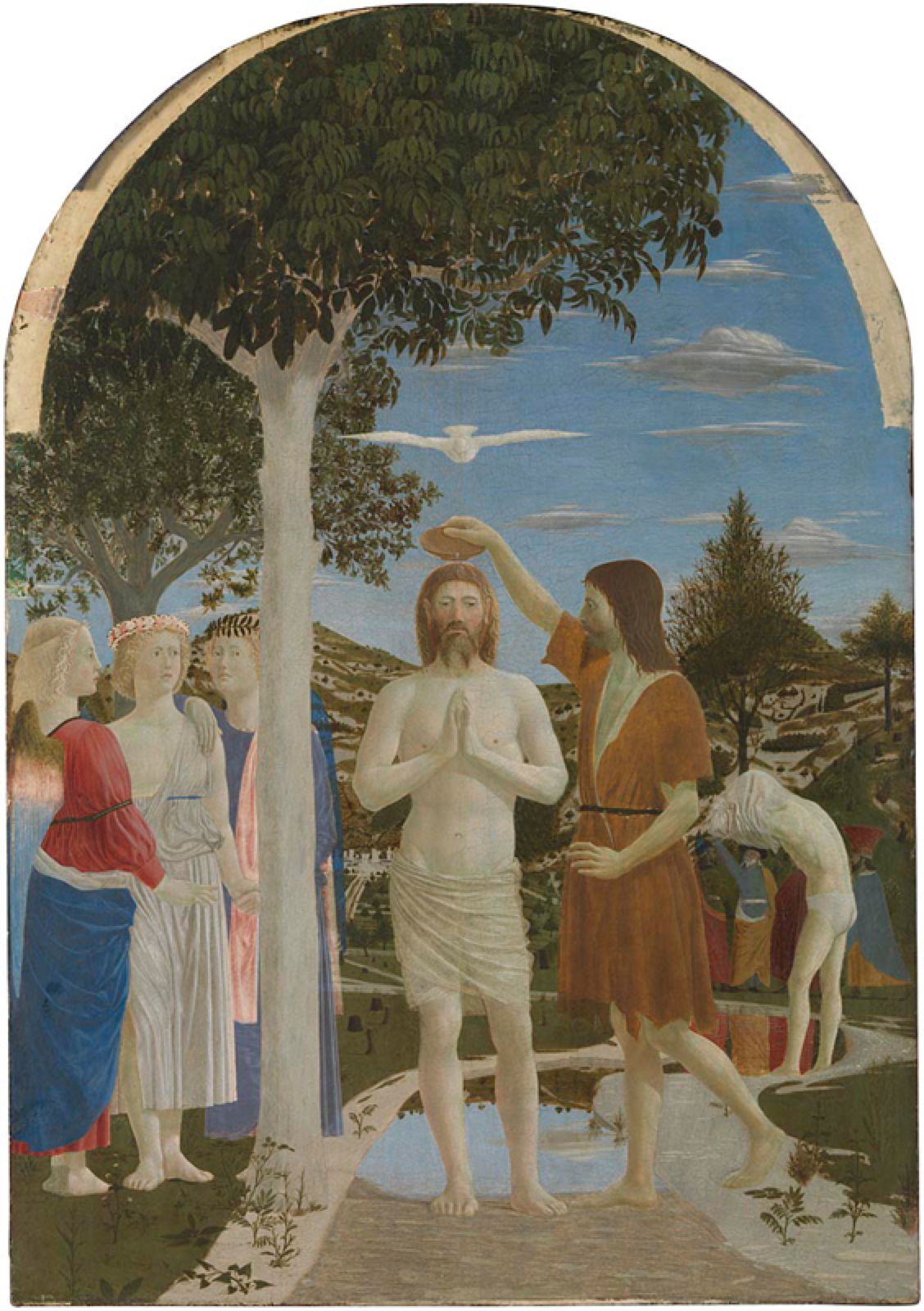
But it was in Italy that painting in egg tempera reached its apogee, with masters like Masaccio, in his Santa Maria Maggiore Altarpiece from about 1428-29 (above) and Piero della Francesca’s Baptism of Christ (below) of a decade later.

dellafrancescabaptismchrist
Piero della Francesca (c 1415/20-1492), The Baptism of Christ (after 1437), egg on poplar, 167 x 116 cm, The National Gallery (Bought, 1861), London. Courtesy of and © The National Gallery, London.

During the fifteenth century, egg tempera was progressively replaced by oils in Italy, as it had been earlier in the Northern Renaissance.

uccellobattlesanromano
Paolo Uccello (c 1397-1475), Niccolò Mauruzi da Tolentino at the Battle of San Romano (c 1438-40), egg tempera with walnut oil and linseed oil on poplar, 182 x 320 cm, The National Gallery (Bought, 1857), London. Courtesy of and © The National Gallery, London.

Uccello’s large panel of the Battle of San Romano incorporated some drying oils, including walnut and linseed, although it was still fundamentally painted in egg tempera.

Sandro Botticelli (Alessandro di Mariano di Vanni Filipepi), Primavera (Spring) (c 1482), tempera on panel, 202 x 314 cm, Galleria degli Uffizi, Florence. Wikimedia Commons.

By the end of the fifteenth century, many studios had changed to oils. Among the last large egg tempera paintings are Botticelli’s Primavera (above) and The Birth of Venus (below), from the 1480s. The craft labour involved in producing these large works must have been enormous. Although Primavera was painted on a panel, Venus is on canvas, making it more manageable given its size of nearly 2 x 3 metres (79 x 118 inches).

Sandro Botticelli (Alessandro di Mariano di Vanni Filipepi), The Birth of Venus (c 1486), tempera on canvas, 172.5 x 278.9 cm, Galleria degli Uffizi, Florence. WikiArt.
michelangelovirginchild
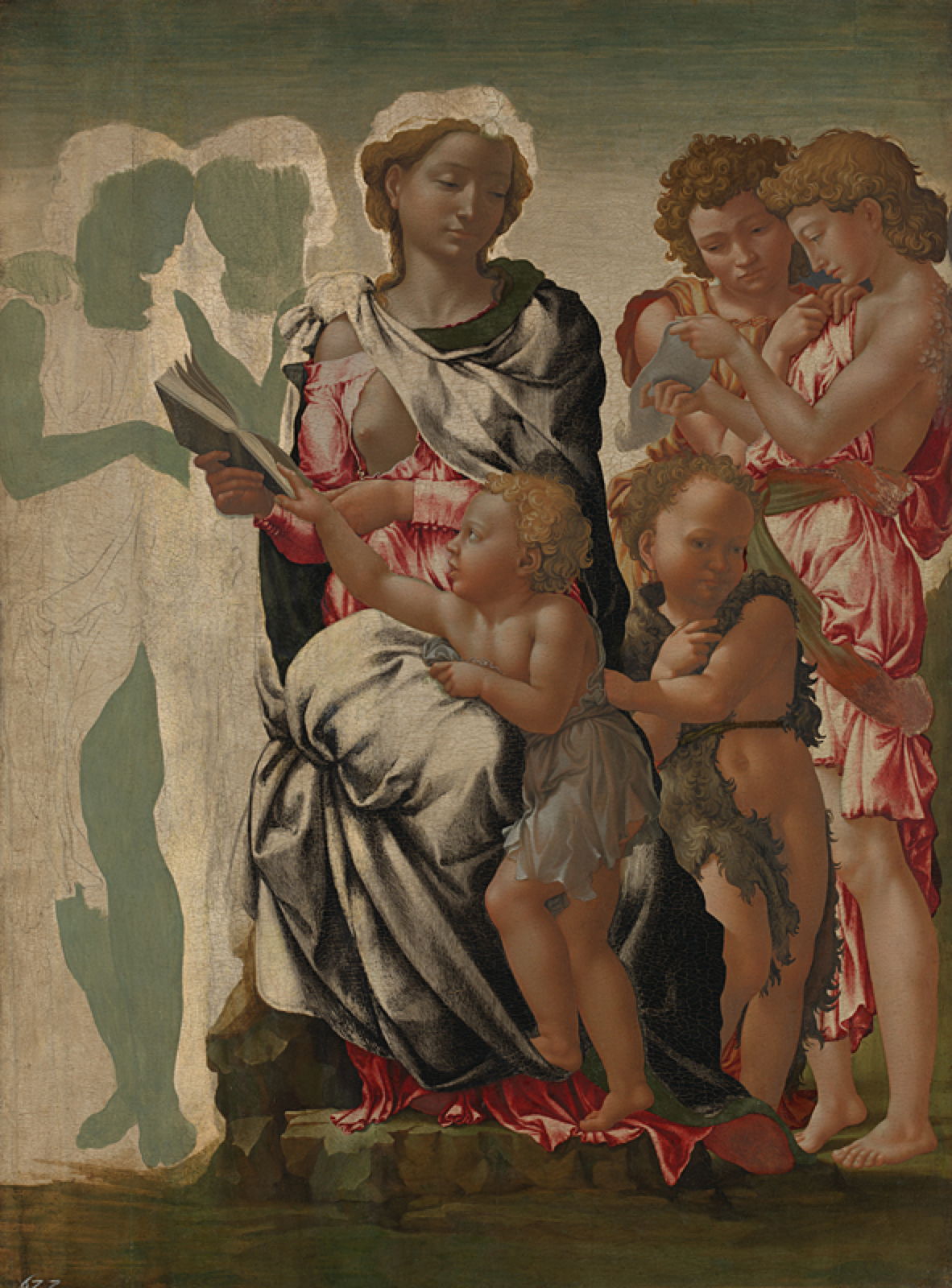
Michelangelo (1475-1564), The Virgin and Child with Saint John and Angels (‘The Manchester Madonna’) (c 1497), tempera on wood, 104.5 x 77 cm, The National Gallery (Bought, 1870), London. Courtesy of and © The National Gallery, London.

In the closing years of the fifteenth century, Michelangelo kept to the hallowed tradition of egg tempera on wood in this unfinished painting of the Virgin and Child known now as The Manchester Madonna. This shows how he painstakingly completed each of the figures before moving onto the next, and the characteristic green earth ground.

By this time, the only common use for egg tempera was in the underpainting before applying oils on top. This remains a controversial practice: performed on top of gesso ground it can be successful, but increasingly studios transferred to oils. Egg tempera didn’t completely disappear, though. With so many fine examples of how good its paintings both look and age, there were always some artists who have chosen it over oils.

spencerstanhopelovemaiden
John Roddam Spencer Stanhope (1829–1908), Love and the Maiden (1877), tempera, gold paint and gold leaf on canvas, 86.4 cm × 50.8 cm, Fine Arts Museums of San Francisco, San Francisco, CA. Wikimedia Commons.

Some nineteenth century movements that aimed to return to the more wonderful art of the past experimented again with egg tempera. In the late 1870s, John Roddam Spencer Stanhope started to use the medium, and made one of his finest works, Love and the Maiden (1877), using it.

Autumn in the Mountains exhibited 1903 by Adrian Stokes 1854-1935
Adrian Stokes (1854–1935), Autumn in the Mountains (1903), tempera on canvas, 80.0 x 106.7 cm, The Tate Gallery (Presented by the Trustees of the Chantrey Bequest 1903), London. Photographic Rights © Tate 2016, CC-BY-NC-ND 3.0 (Unported), http://www.tate.org.uk/art/artworks/stokes-autumn-in-the-mountains-n01927

A later exponent who was rigorous in his technique was Adrian Stokes, who used it to great effect in this landscape of Autumn in the Mountains in 1903.

But for my taste, the greatest painter in egg tempera since the Renaissance has to be one of the major artists of the twentieth century: Andrew Wyeth (1917–2009). As his works remain in copyright, I recommend that you browse his official site, where you can see just how effective egg tempera can be in the hands of a great master. It may not be as popular as in the past, but egg tempera still has a great deal to offer.

❌
❌