
Normal view

There are new articles available, click to refresh the page.
Before yesterdayMain stream

Medium and Message: Glazes and optical effects

By: hoakley
18 November 2025 at 20:30

Many of the greatest paintings succeed in part because they use optical effects in their paint layer. This takes advantage of the fact that thinner layers of paint aren’t completely opaque, so allow some light to pass through them. In watercolours, transparent paints are often referred to as transparent watercolour, while those that are opaque are known as gouache or body colour. In oils, different pigments result in degrees of opacity, expressed as their covering power.

daumierstrongman
Honoré Daumier (1808-1879), The Strongman (c 1865), oil on wood panel, 26.9 x 35 cm, The Phillips Collection, Washington, DC. Microscopic paint cross-section by Elizabeth Steele at http://blog.phillipscollection.org/2014/02/26/happy-birthday-honore-daumier/. Courtesy of The Phillips Collection.

This cross-section of the paint layer from Honoré Daumier’s The Strongman (c 1865) demonstrates how many oil paintings consist of a series of layers, with several pigments present through their depth. Generally, the most opaque are applied first, and on top of those come a series of thinner transparent layers or glazes. Together these allow complex combinations of reflection and refraction of light, generating optical effects.

Layered oil painting technique is best seen in paintings that have been abandoned before completion.

The British portrait painter Sir Joshua Reynolds received a conventional training in traditional and conservative methods with roots dating back to the late 1600s. He painted in layers, starting with dead colouring, the laying in of shadows and lights, then blending in transitions of shading and colour wet-on-wet. Highlights were then brought out, and shadows glazed, to produce a series of thin layers of oil paint, and a smooth, finished paint surface.

reynoldsmrsrobinson
Sir Joshua Reynolds (1723–1792), Mrs. Robinson (c 1784), oil on canvas, 88.6 x 68.9 cm, Yale Center for British Art, New Haven, CT. Wikimedia Commons.

Those early stages are shown well in this abandoned portrait of Mrs Robinson from about 1784, where most of the paint layer is sufficiently thin as to allow the texture of the canvas to show through. When used with ‘lean’ paint, this dried quickly and complies with the longstanding edict of applying ‘fat’ over ‘lean’, so that the lowest layers dry first.
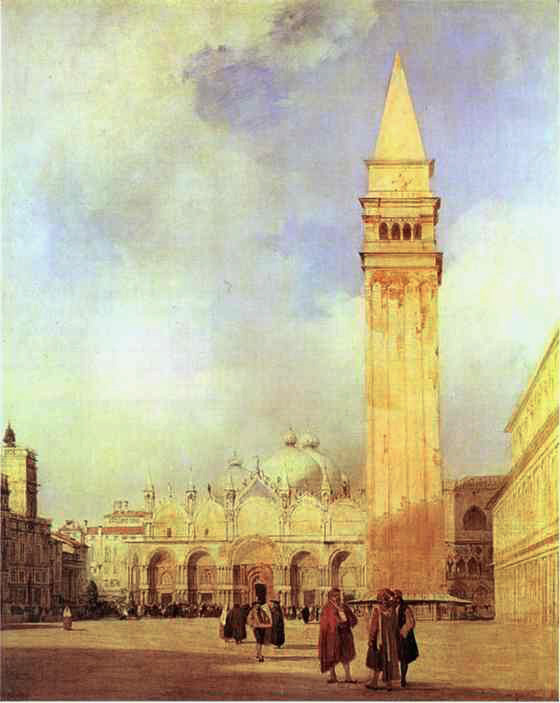
Richard Parkes Bonington (1802-28), Venice: The Piazza San Marco (1827-8), oil on canvas, 99.4 x 80.3 cm, Wallace Collection, London. WikiArt.

Richard Parkes Bonington’s unfinished Venice: The Piazza San Marco (1827-28) shows signs that it might have been among his best. Its buildings have a golden glow from the setting sun, but those colours would undoubtedly have been enhanced by rich glazes had he lived long enough to complete it.

Occasionally the paint layer develops problems that demonstrate the effects of glazes.

bloemaertadorationofmagi
Abraham Bloemaert (1564–1651), The Adoration of the Magi (1624), oil on canvas, 168.8 x 193.7 cm, Centraal Museum, Utrecht, The Netherlands. Wikimedia Commons.

In Abraham Bloemaert’s The Adoration of the Magi from 1624, the cloak of the Virgin Mary appears to use two different blues, with its lower passages painted in the duller hue of indigo, which has faded. The dullest areas are those that had the thinnest ultramarine glazes applied, much of which have now abraded away during subsequent cleaning of the painting. The unprotected indigo has therefore suffered sufficient exposure to fade, as well as losing those rich glazes.

turnerapproachtovenice
Joseph Mallord William Turner (1775–1851), Approach to Venice (1844), oil on canvas, 62 x 94 cm, The National Gallery of Art, Washington, DC. Courtesy of The National Gallery of Art, via Wikimedia Commons.

JMW Turner’s Approach to Venice (1844) was painted with very thin transparent glazes over thick white impasto, creating a distinctive flickering effect in its highlights.

turnerapproachtoveniced1
Joseph Mallord William Turner (1775–1851), Approach to Venice (detail) (1844), oil on canvas, 62 x 94 cm, The National Gallery of Art, Washington, DC. Courtesy of The National Gallery of Art, via Wikimedia Commons.

Despite the artist’s efforts to get the white impasto to dry more quickly, the glazes dried first, and cracked as they became stressed over the white that was still wet. This hasn’t been helped by the later conservation process of lining, which places an additional layer on the back of the canvas to help the support do its job.

Although a wide range of pigments have been used successfully in glazes, some were developed specifically for the purpose. From the fifteenth century onwards, verdigris pigment was mixed with natural resins for use in glazes. This produces a different pigment from regular verdigris, as the copper combines with the resin acids to form what is known as copper resinate.

A popular technique among many masters to produce an intense green was to paint an underlayer using verdigris, over which several glazing layers of copper resinate were then applied. Although generally reliable and stable, verdigris and copper resinates have a tendency to turn brown on the surface. Thankfully this affects relatively few paintings.

tintorettostgeorgedragon
Tintoretto (1519–1594), Saint George and the Dragon (c 1555), oil on canvas, 158.3 x 100.5 cm, The National Gallery, London. Wikimedia Commons.

Tintoretto used copper resinate glazes in several of his paintings, most notably the rich, varied, and often lush vegetation in his Saint George and the Dragon from about 1555.

veroneseallegoryloverespect
Paolo Veronese (1528–1588), The Allegory of Love, Respect (c 1575), oil on canvas, 186.1 x 194.3 cm, The National Gallery, London. Wikimedia Commons.

Studies at the National Gallery, London, have found copper resinate in three of the four paintings in Paolo Veronese’s series The Allegory of Love. In the third of these, Respect (c 1575), the pigment was found in the man’s intense green cloak, and the duller gold-brown brocade patterning on the wall behind his hand (detail below). The surface of that wall has superficial brown discoloration of the paint layer.

veroneseallegoryloverespectd1
Paolo Veronese (1528–1588), The Allegory of Love, Respect (detail) (c 1575), oil on canvas, 186.1 x 194.3 cm, The National Gallery, London. Wikimedia Commons.
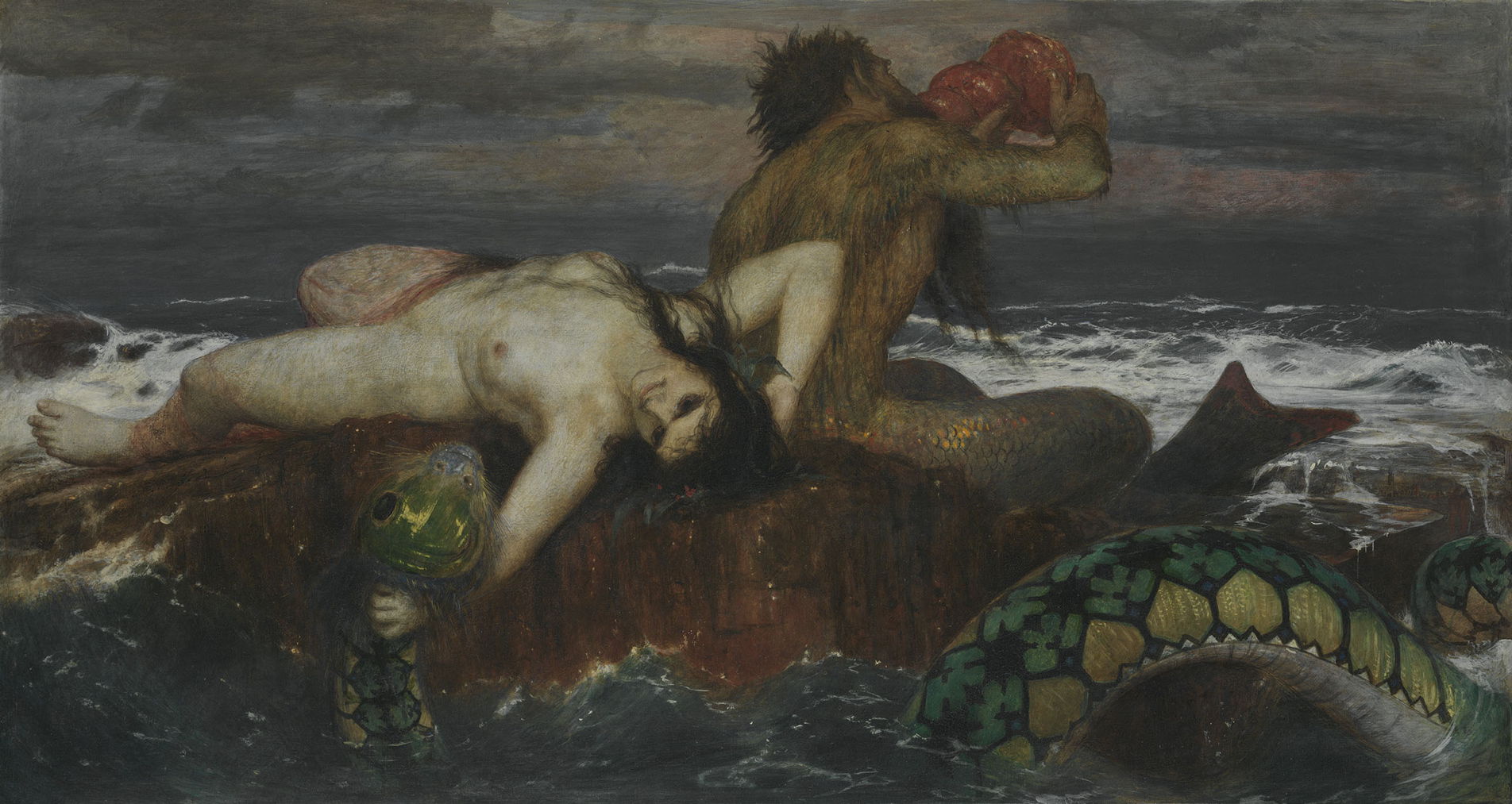
bocklintritonnereid
Arnold Böcklin (1827–1901), Triton and Nereid (1874), tempera on canvas, 105.3 × 194 cm, Sammlung Schack, Bayerische Staatsgemäldesammlungen, Munich, Germany. Wikimedia Commons.

One of the last major uses of copper resinate is in Arnold Böcklin’s Triton and Nereid from 1874. This is reported as being painted in tempera, but copper resinate glaze appears to have been used to develop the intense green patterns on the sea monster in the foreground. This is consistent with Böcklin adhering to traditional techniques despite working in the late nineteenth century.

During that century, painting slowly in multiple layers with glazes progressively fell from favour. By the end, many oil painters had adopted techniques in which much or all of a painting was made at once, known as direct, alla prima or au premier coup.

Reading Visual Art: 233 Sirens

By: hoakley
6 November 2025 at 20:30

Sirens are mythical woman-like creatures with alluring voices, best-known from their appearance in Homer’s Odyssey, but also featuring in other tales including that of Jason and the Argonauts. Typically their singing lures sailors to their death, and that reputation has led them to represent anything that’s dangerously attractive. Originally they weren’t described in any physical detail, but visual representations soon envisaged them as having the upper bodies of beautiful young women, and the lower bodies and legs of birds, and that has been incorporated and elaborated in later accounts and retelling.

At the end of the year that Odysseus and his crew stayed with the sorceress Circe, she helpfully advised him that he would have to sail past the sirens, two to five creatures who lured men to their death with their singing. In preparation, Odysseus got his sailors to plug their ears with beeswax before they reached the sirens, so they couldn’t hear their song, and to bind him to the mast. He gave them strict instructions that under no circumstances, no matter what he said at the time, were they to loosen his bonds, as he would be listening to the sirens’ song.

As the group reached the sirens, Odysseus told his men to release him, but instead they bound him even more closely to the mast. Once they had passed safely from earshot of the sirens, Odysseus used his facial expression to inform his men, who then released him, and they sailed on.

(c) Manchester City Galleries; Supplied by The Public Catalogue Foundation
William Etty (1787–1849), The Sirens and Ulysses (c 1837), oil on canvas, 297 x 442.5 cm, Manchester Art Gallery, Manchester, England. Wikimedia Commons.

William Etty’s The Sirens and Ulysses from about 1837 is one of the pioneering accounts in paint of this story from the Odyssey. His three naked sirens are all woman, one playing a lyre, another holding double pipes aloft, all three doing their best to draw the sailors from Odysseus’ ship to a shore where there are the remains of earlier victims.

poyntersiren
Edward Poynter (1836–1919), The Siren (c 1864), oil on canvas, dimensions not known, Private collection. Wikimedia Commons.

Edward Poynter’s The Siren from about 1864 has Aesthetic overtones in the lyre she is playing.

boecklinsirens
Arnold Böcklin (1827–1901), Sirens (1875), tempera on canvas, 46 × 31 cm, Alte Nationalgalerie, Berlin. Wikimedia Commons.

Arnold Böcklin takes an unusual approach of almost dereferencing Odysseus in his painting of Sirens from 1875, although there is an approaching vessel that could be his. The two sirens filling the canvas are very human down to the waist, below which they resemble birds. One sits facing us, clearly in full voice, and highly alluring in looks. The other, her back towards us, is playing an aulos and looks rather obese, to the point of almost being comical, her right breast laid upon a flat-topped rock. At their feet are three human skulls and other bones to indicate their graver intentions.

moreausirens
Gustave Moreau (1826–1898), The Sirens (1882), watercolor and gouache, brown ink, and black chalk on cream wove paper, 32.8 x 20.9 cm, Harvard Art Museums/Fogg Museum (Bequest of Grenville L. Winthrop), Cambridge, MA. Courtesy of Harvard Art Museums.

Gustave Moreau’s The Sirens (1882) shows them as beautiful figures in a static scene, with a saturnine setting sun. There is, though, a lone sail on the horizon that hasn’t yet attracted their attention. Their lower legs turn into the writhing coils of sea serpents.

moreausirens1885
Gustave Moreau (1826–1898), The Sirens (c 1885), oil on canvas, 89 x 118 cm, Musée National Gustave-Moreau, Paris. Wikimedia Commons.

Moreau’s slightly later group portrait of The Sirens from about 1885 is more complete, with Odysseus sailing past, but its three figures are clearly all woman and no bird.

thomaeightdancingwomen
Hans Thoma (1839–1924), Eight Dancing Women with Bird Bodies (1886), oil on panel, 38 × 58.5 cm, location not known. Wikimedia Commons.

Eight Dancing Women with Bird Bodies (1886) is one of Hans Thoma’s unusual mythological paintings. The best-known women with bird bodies were the sirens, who range in number from two to five. In another painting showing the sirens trying to lure a passing ship, Thoma paints similar figures, suggesting these are intended to be sirens.

waterhouseulyssessirens
John William Waterhouse (1849–1917), Ulysses and the Sirens (1891), oil on canvas, 100.6 x 201.7 cm, National Gallery of Victoria, Melbourne, Australia. Wikimedia Commons.

John William Waterhouse’s Ulysses and the Sirens (1891) is closer to the Homeric account, although he provides a total of seven sirens, shown as large eagle-like birds of prey with only the head and neck of beautiful women. He has added bandage wrappings around the head of each sailor to make it clear that their ears are stopped from hearing sound, a visual device that links neatly with the text. His sirens are clearly singing, particularly the one closest to the viewer, who is challenging the hearing protection of one of the sailors. Another sailor, at the stern of the ship (left of the painting), is seen clutching his ears.

waterhousesiren1900
John William Waterhouse (1849–1917), The Siren (1900), oil on canvas, 81 x 53 cm, location not known. Wikimedia Commons.

Almost a decade later, Waterhouse painted this non-narrative portrait of The Siren (1900).

raesirens
Henrietta Rae (1859–1928), The Sirens (1903), oil on canvas, 114.3 × 254 cm, Private collection. Wikimedia Commons.

The Sirens (1903) marked Henrietta Rae’s return to painting narrative works featuring classical nudes. Odysseus’ ship is in the distance, as three beautiful sirens use their aulos and lyre to lure its occupants.

Late mythology suggests an unpleasant end for these sirens: Hera challenged them to a singing contest against the Muses. When the latter won, the penalty they exacted of the sirens was to have all their feathers plucked out to turn into crowns. As a result of that disgrace, the sirens turned white, fell into the sea, and formed the islands including modern Souda, on the north-west coast of Crete in the Mediterranean.

Sirens have steadily spread their presence into other paintings, particularly during the twentieth century.

jannybadendesirenen
Georg Janny (1864–1935), Sirens Bathing by the Sea (1922), gouache on cardboard, further details not known. Wikimedia Commons.

Georg Janny’s fantasy painting of Sirens Bathing by the Sea from 1922 is throughly other-worldly, and there’s no trace of their bird legs.

nashpnestsiren
Paul Nash (1892–1946), Nest of the Siren (1930), oil on canvas, 77 x 51.2 cm, HM Treasury, London, England. The Athenaeum.

More cryptic is Paul Nash’s Surrealist Nest of the Siren (1930), which brings together the incongruous, and hardly refers to Homer’s story. The painting is framed by brightly-painted walls with pillared decorations, perhaps ornate wainscot panelling. In the middle of these is what might be a painting, but also seems to be a three-dimensional plant trough containing sinuous shrubs. In the middle of those is a small nest, like an acorn cup.

Standing in front of this is a structure resembling a weather-vane, mounted on a turned wooden shaft. At the weather end of the vane is the faceless figure of a siren; the leeward end appears purely decorative. Three red rods appear to have detached themselves from the walling, two protruding from the plant trough, the third resting on the floor.

They even manage to sneak symbolically into other classical stories.

girodetmeetingoresteshermione
Anne-Louis Girodet de Roucy-Trioson (1767-1824), The Meeting of Orestes and Hermione (c 1800), pen and brown and black ink, point of brush and brown and gray wash, with black chalk and graphite, heightened with white gouache on cream wove paper, 28.5 x 21.8 cm, Cleveland Museum of Art (Leonard C. Hanna, Jr. Fund), Cleveland, OH. Courtesy of Cleveland Museum of Art.

In Girodet’s ink and chalk drawing of The Meeting of Orestes and Hermione (c 1800), Hermione is seen at the right, her arms folded, looking coy as Orestes approaches her. The second woman, with Orestes, is presumably Hermione’s maid. This is one of a series of illustrations made by Girodet to accompany Racine’s play, and has subtleties you might expect from a great narrative artist. Visible in the gap between the figures is a table-leg in the form not of a Fury foretelling Orestes’ fate, but of a siren, implying that Hermione is luring Orestes to her. Hermione, for all her apparent coyness, has let the right shoulder-strap of her robe slip, in her enticement of Orestes. She has assumed the role of femme fatale, as portrayed by Euripides and Racine.

In more recent literature, sirens appear in the less-known second part of Goethe’s play Faust.

hofheinzdoringsirens
Margret Hofheinz-Döring (1910–1994), With the Sirens (1962), pastel, 34 x 25 cm, Galerie Brigitte Mauch Göppingen. Image by Peter Mauch, courtesy of Margret Hofheinz-Döring/ Galerie Brigitte Mauch Göppingen, via Wikimedia Commons.

Margret Hofheinz-Döring is one of the few artists who has painted from this second part. With the Sirens from 1962 is her pastel painting showing the sirens among rocky inlets of the Aegean Sea, a sub-scene concluding the second act.

Medium and Message: Surface texture

By: hoakley
14 October 2025 at 19:30

We’re remarkably good at perceiving different surface textures, but find it harder to imagine them in two-dimensional images. While the overwhelming majority of paintings, at least until the twentieth century, consist of a paint layer on a flat ground, there’s nothing that requires the surface of the paint layer to be flat and smooth. But if all you look at are images of paintings, you generally won’t see their surface texture, where the artist has applied and shaped paint in thick layers of impasto, or incised into some of the layer in sgraffito. This article looks in detail at four examples where surface texture in the paint layer is important.

boecklinsirens
Arnold Böcklin (1827–1901), Sirens (1875), tempera on canvas, 46 × 31 cm, Alte Nationalgalerie, Berlin. Wikimedia Commons.

Arnold Böcklin’s unusual painting of Sirens from 1875 was made in tempera on canvas, with the ground and paint layers thin enough to let the texture of the canvas weave show through. This image was fortuitously taken with lighting that allows the texture to show.

Another famous tempera painting wasn’t painted on a textured ground, but is one of the earlier paintings to feature impasto as a technique.

Anonymous, The Wilton Diptych (c 1395-9), egg tempera on panel, each panel 53 x 37 cm, The National Gallery, London. Wikimedia Commons.
Artist not known, The Wilton Diptych (c 1395-9), egg tempera on panel, each panel 53 x 37 cm, The National Gallery, London. Wikimedia Commons.

The Wilton Diptych was painted on two small panels of oak wood in the final years of the fourteenth century. That wood was first assembled into the panels, then carved down from a thickness of about 2.5 cm (1 inch) to form an integral frame with a recessed painting surface. A smooth gesso ground was then laid on the wood before the gilded areas were laid onto it using thin sheets of gold leaf, and patterned using a range of punches.

wiltondiptychd2
Artist not known, The Wilton Diptych (detail) (c 1395-9), egg tempera on panel, each panel 53 x 37 cm, The National Gallery, London. Image by Sailko, via Wikimedia Commons.

Details of jewels and similar objects such as the white hart brooches were raised using thicker areas of lead white paint, to give the impression of enamelling. Coupled with mordant gilding, they mimic the three-dimensional form of jewels and act as point reflectors of light, sparkling as if they really were gems in the paint layer, as shown in the details above and below.

wiltondiptychd3
Artist not known, The Wilton Diptych (detail) (c 1395-9), egg tempera on panel, each panel 53 x 37 cm, The National Gallery, London. Image by Sailko, via Wikimedia Commons.

The finest strokes of paint seen here are less than 0.5 mm (1/50th of an inch) across.

From those early days of modern painting until the decline of ‘academic’ painting in the late nineteenth century, patrons, Salon juries and critics expected paint surfaces to be smooth and flat. But there were rebels.

Many of Rembrandt’s paintings from before 1650 have fairly conventional ‘finished’ surfaces, his monumental Night Watch being a good example. By about 1660, though, many of his paintings had quite rough surfaces that significantly alter their optical properties.

Rembrandt Harmenszoon van Rijn, The Jewish Bride (c 1667), oil on canvas, 121.5 x 166.5 cm, Rijksmuseum, Amsterdam. Wikimedia Commons.
Rembrandt Harmenszoon van Rijn (1606–1669), The Jewish Bride (c 1667), oil on canvas, 121.5 x 166.5 cm, Rijksmuseum, Amsterdam. Wikimedia Commons.

One of the best examples of Rembrandt’s use of texture in the paint layer is The Jewish Bride from about 1667, just a couple of years before his death. This is among his works studied by the Rembrandt Research Project.

rembrandtjewishbridedet
Rembrandt Harmenszoon van Rijn (1606–1669), The Jewish Bride (detail) (c 1667), oil on canvas, 121.5 x 166.5 cm, Rijksmuseum Amsterdam. Wikimedia Commons.

In this detail, highlights on the sleeve and jewellery have been applied roughly, although it’s still a matter for speculation as to exactly how he achieved that. Lower down, on the red dress of the bride, the duller top layer of paint has been scraped through to reveal lighter lower layers. The end result is a painting that creates its visual effects as much by its surface textures, as by form or colour.

One of Rembrandt’s secrets that have been sought by so many since lies in how he was able to exploit surface texture in his paint. That is the ‘secret recipe’ which Maroger, Redelius, and others claimed to have discovered. Systematic analyses of Rembrandt’s paint layers by White at the National Gallery in London and the Research Project soundly rebutted the ‘secrets’ claimed. In the main, Rembrandt used linseed oil as his binder, occasionally using walnut oil as well, and just once poppy seed oil.

In some passages the oil had been thickened by heat treatment, but this was by no means widespread. Traces of pine resin found in some samples may have been introduced during retouching, and don’t appear to be a feature of Rembrandt’s impasto work; neither is there any evidence that he added wax to his oil paint to give it body, as some had asserted.

As you might expect, JMW Turner was another such rebel.

turnerseapiecefishingboats
Joseph Mallord William Turner (1775–1851), Seapiece with Fishing Boats off a Wooden Pier, a Gale Coming In (date not known, possibly c 1801), oil on panel, 31.8 x 44.5 cm, Private collection. Wikimedia Commons.

For example, in his Seapiece with Fishing Boats off a Wooden Pier, a Gale Coming In, possibly from as early as 1801, Turner made extensive use of sgraffito, made using a knife, brush handle, or even his fingernails for all we know.

Later that century, Vincent van Gogh developed a more radical approach, in his initial version of Wheat Field with Cypresses from 1889, the year before his death.

vangoghwheatfieldcypresses
Vincent van Gogh (1853–1890), Wheat Field with Cypresses (1889), oil on canvas, 73.2 × 93.4 cm, Metropolitan Museum of Art, New York, NY. Wikimedia Commons.

It’s possible that he completed this painting in a single sitting, as this seems to have been intended as an oil sketch for a more finished version which he painted later that summer.

1993.132
Vincent van Gogh (1853–1890), Wheat Field with Cypresses (detail) (1889), oil on canvas, 73.2 × 93.4 cm, Metropolitan Museum of Art, New York, NY. Wikimedia Commons.

The detail above shows the tops of the wheat towards the lower left of the field, in the foreground. Over his initial thin layers of paint, van Gogh laid thick gestural strokes of highly chromatic paint, orientating those strokes according to the object they show. In the golden yellow of the wheat there are blues and greens, mostly showing through from his underpainting, with superimposed impasto of pale straw, ochre, and pale greens.

1993.132
Vincent van Gogh (1853–1890), Wheat Field with Cypresses (detail) (1889), oil on canvas, 73.2 × 93.4 cm, Metropolitan Museum of Art, New York, NY. Wikimedia Commons.

This detail, taken from the edge of the wheatfield at the lower right corner of the painting, shows three distinct areas of brushwork: the diagonal strokes forming the standing wheat, swirling loops to form the grasses and weeds below, and shorter marks forming a more random pattern for the heads of the wheat in the upper section.

1993.132
Vincent van Gogh (1853–1890), Wheat Field with Cypresses (detail) (1889), oil on canvas, 73.2 × 93.4 cm, Metropolitan Museum of Art, New York, NY. Wikimedia Commons.

At the centre of the canvas, from where this detail is taken, impasto blue and white have mixed with the green and yellow of the fields below. This shows that much of the painting was painted wet on wet, either in the same session or on consecutive days. Some of the darker green at the right may have been painted later, onto paint that had by then become touch dry.

1993.132
Vincent van Gogh (1853–1890), Wheat Field with Cypresses (X-ray) (1889), oil on canvas, 73.2 × 93.4 cm, Metropolitan Museum of Art, New York, NY. Wikimedia Commons.

An X-ray image of the whole painting shows in white those passages likely to contain the most lead white, and some other pigments which are most radio-opaque. This also reveals the pattern of brushstrokes well.

With the introduction of acrylic paints in the latter half of the twentieth century, painters have been able to apply even heavier impasto, and some have used this to paint what are in effect reliefs.

This is why so many paintings have to be seen in the flesh, up close, and in the right light for their full appreciation.

❌
❌