Normal view

There are new articles available, click to refresh the page.
Before yesterdayMain stream

Medium and Message: En plein air

By: hoakley
25 November 2025 at 20:30

Paintings made in oils in front of the motif, en plein air, are a surprisingly recent innovation. Although often ascribed to the inconvenience of handling oil paint before it was offered in tubes in the middle of the nineteenth century, in fact it had become popular if not mandatory for the aspiring landscape painter well before that. Instead of taking their paints in tubes, those pioneers used pig bladders, that had become widely available from artists’ colourmen, as were used by Constable, Turner and many others.

Initially, plein air oil sketches weren’t intended to be seen by the public or patrons.
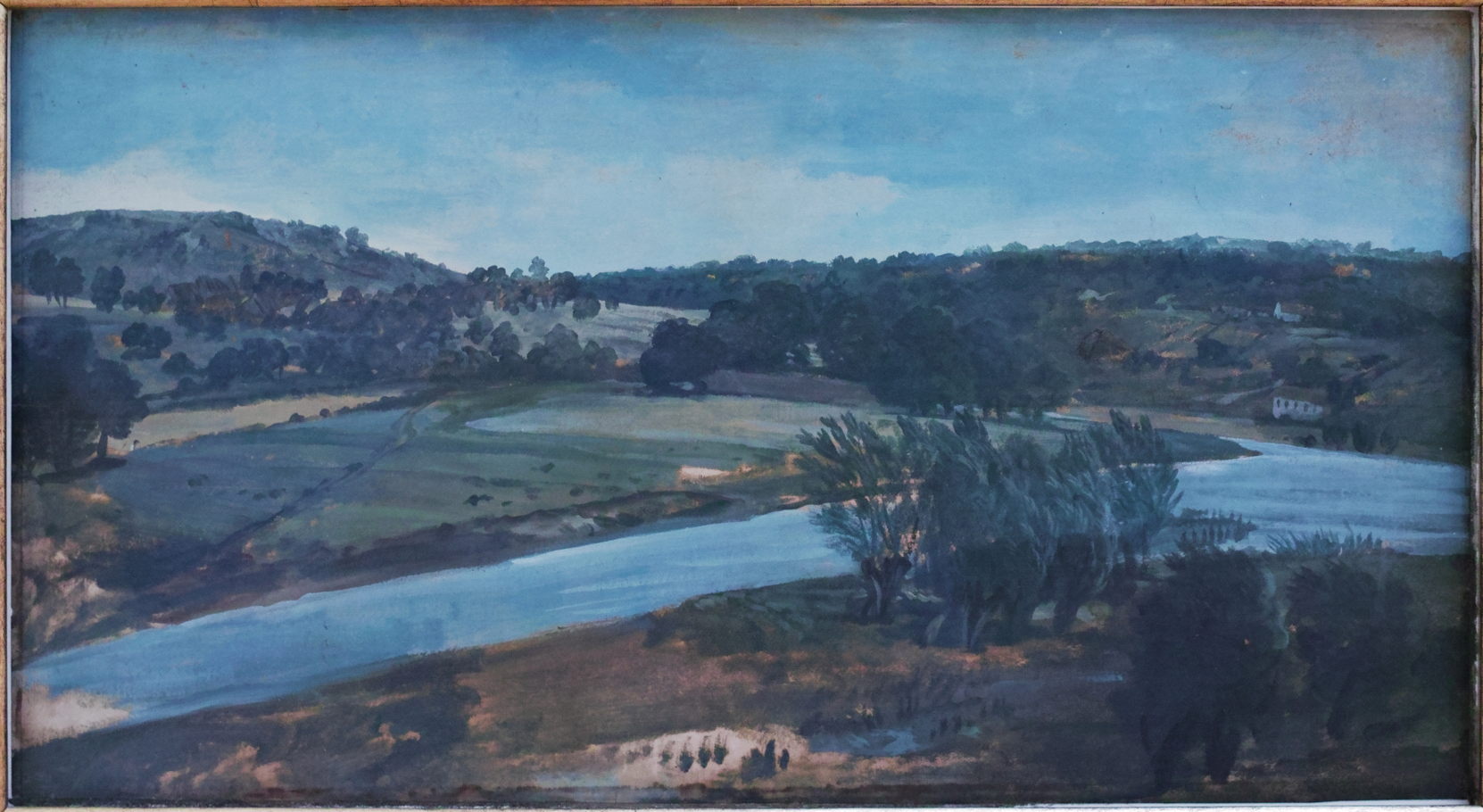
desporteslandscape
Alexandre-François Desportes (1661-1743), Landscape Study (c 1700), oil, dimensions not known, Palais des beaux-arts de Lille, Lille, France. Wikimedia Commons.

Among the earliest artists to paint regularly in front of their motif was Alexandre-François Desportes (1661-1743), a professional painter of hunting scenes and animals, whose Landscape Study was painted in about 1700.

Plein air oil sketching was described and recommended by Roger de Piles in his book Cours de Peinture, published in 1708, contemporary with Desportes’ sketches. Other books on painting and art in the eighteenth century also cover the topic, and Claude-Joseph Vernet was recorded as having painted oil sketches en plein air, but none have survived.

valenciennesvillafarnesepoplars
Pierre-Henri de Valenciennes (1750–1819), Farm Buildings at the Villa Farnese: the Two Poplar Trees (1780), oil on paper on cardboard, 25 x 38 cm, Musée du Louvre, Paris. Wikimedia Commons.

At Vernet’s suggestion, the young Pierre-Henri de Valenciennes made copious oil sketches such as this of Farm-buildings at the Villa Farnese: the Two Poplar Trees when he was painting in the Roman Campagna in 1782-85. He not only built himself a large visual library of sketches from nature, but published a widely used book on landscape painting in which he recommended the practice.

sabletconradgessner
Jacques Sablet (1749–1803) Portrait of the Painter Conrad Gessner in the Roman Campagna (1788), oil on canvas, 39 × 30 cm, Kunsthaus Zürich, Zürich. Wikimedia Commons.

Jacques Sablet’s Portrait of the Painter Conrad Gessner in the Roman Campagna shows one of the early plein air landscape painters in 1788, over fifty years before the first paint tubes became available.

quadroneeveryoccasiond1
Giovanni Battista Quadrone (1844–1898), Every Opportunity is Good (detail) (1878), other details not known. Wikimedia Commons.

Although this detail of Giovanni Battista Quadrone’s Every Opportunity is Good shows a studio in 1878, the low table at the left has several bladders containing oil paint. They remained popular with many artists until towards the end of the nineteenth century. Although not as convenient as tubes, the better colourmen still offered a wide range of pigments in bladders that were significantly less costly.
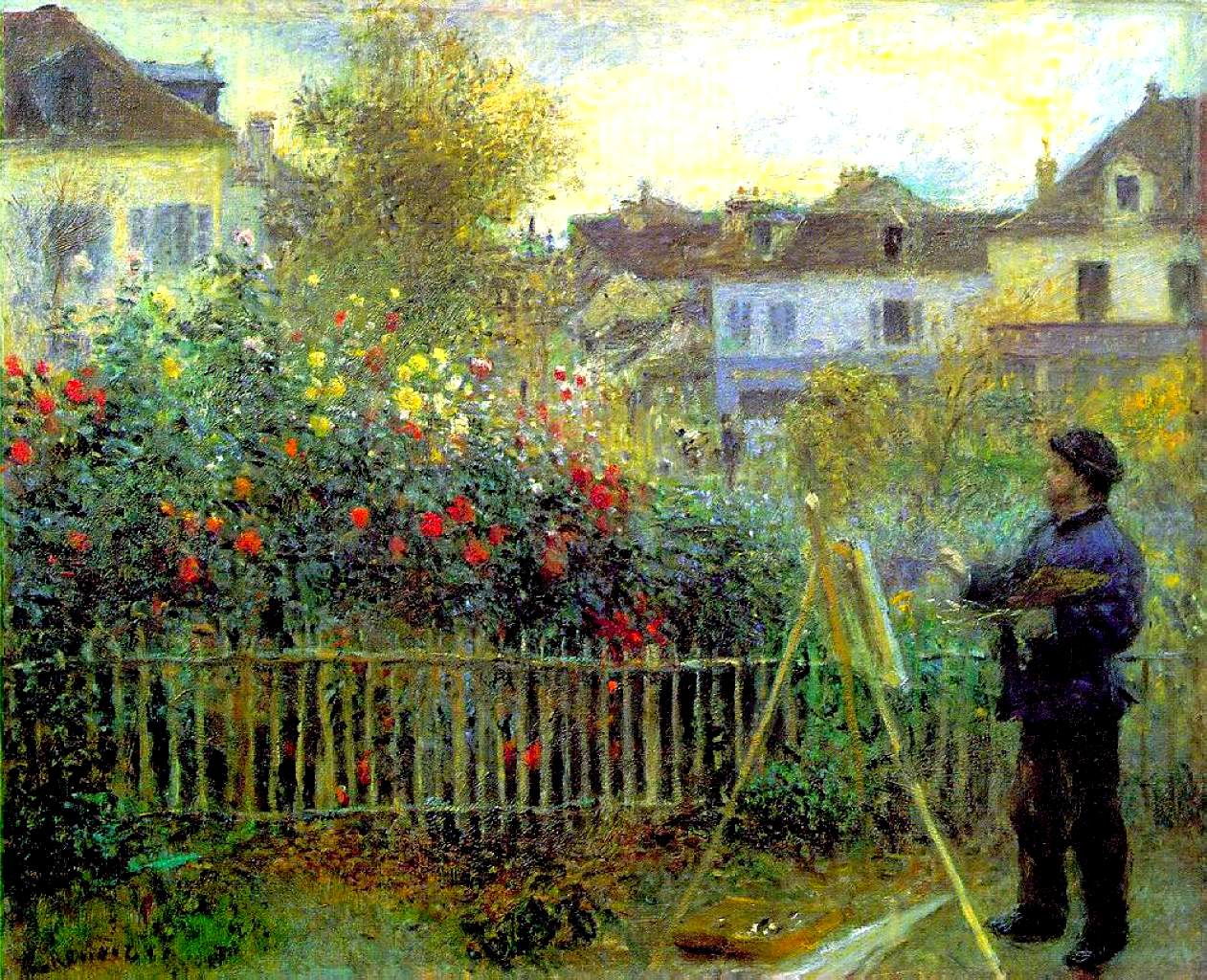
renoirmonetpainting
Pierre-Auguste Renoir (1841–1919), Monet Painting in his Garden in Argenteuil (1873), oil on canvas, 46 × 60 cm, Wadsworth Atheneum, Hartford, CT. Wikimedia Commons.

Pierre-Auguste Renoir painted Monet Painting in his Garden in Argenteuil in 1873. Claude Monet is using a conventional lightweight wooden easel, with a small canvas that allows him to work standing. His oil paints are in the pochade box under the easel. Although just outside his house, he would have used the same equipment when further from home.
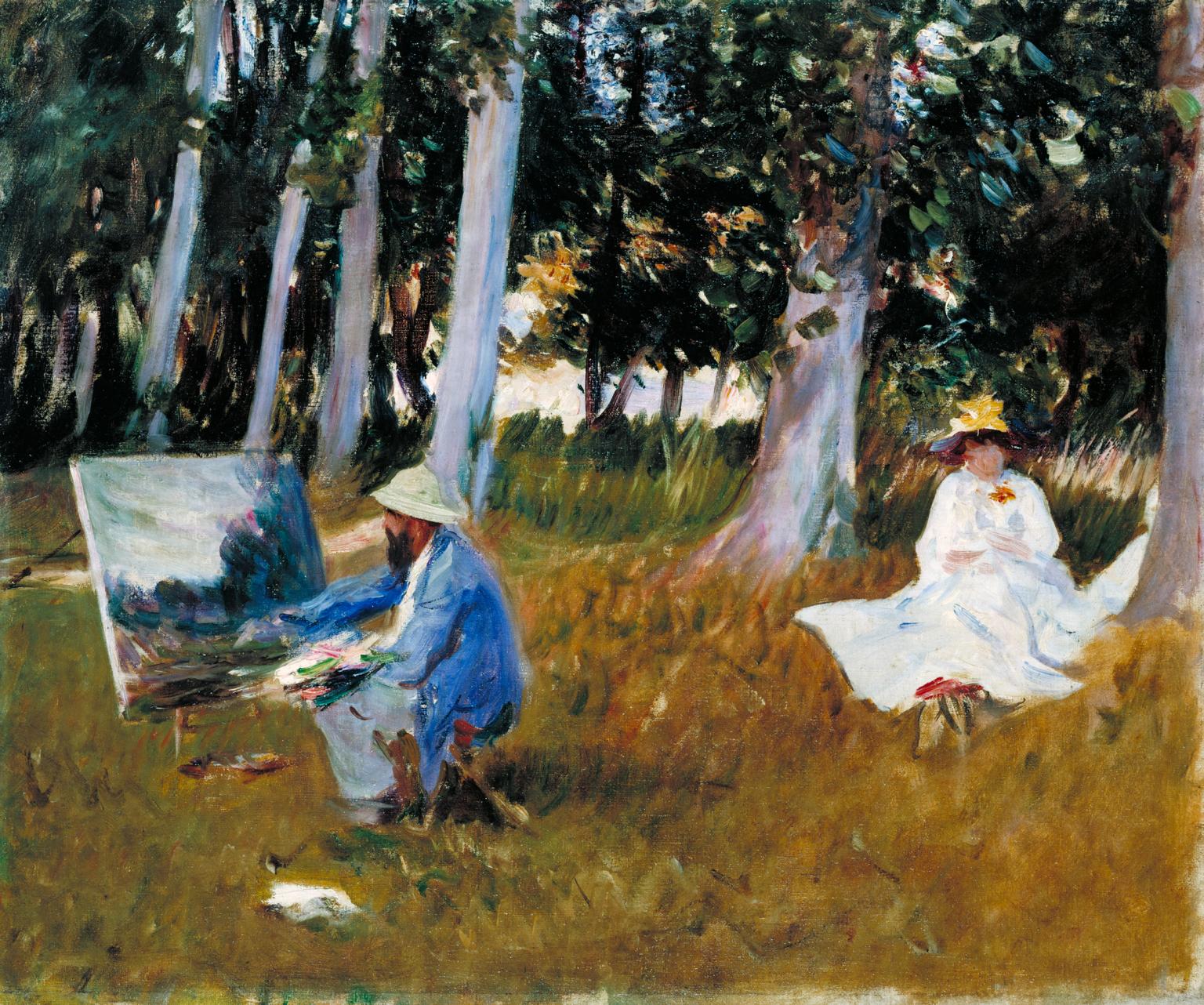
Claude Monet Painting by the Edge of a Wood ?1885 by John Singer Sargent 1856-1925
John Singer Sargent (1856–1925), Claude Monet Painting by the Edge of a Wood (c 1885), oil on canvas, 54 x 64.8 cm, The Tate Gallery (Presented by Miss Emily Sargent and Mrs Ormond through the Art Fund 1925), London. © The Tate Gallery and Photographic Rights © Tate (2017), CC-BY-NC-ND 3.0 (Unported), http://www.tate.org.uk/art/artworks/sargent-claude-monet-painting-by-the-edge-of-a-wood-n04103

In about 1885, when they were painting together, John Singer Sargent took this opportunity to paint Claude Monet Painting by the Edge of a Wood. Seated on a traditional three-legged folding stool, Monet is here working on a much larger canvas, his pochade box again under the easel for ready access.
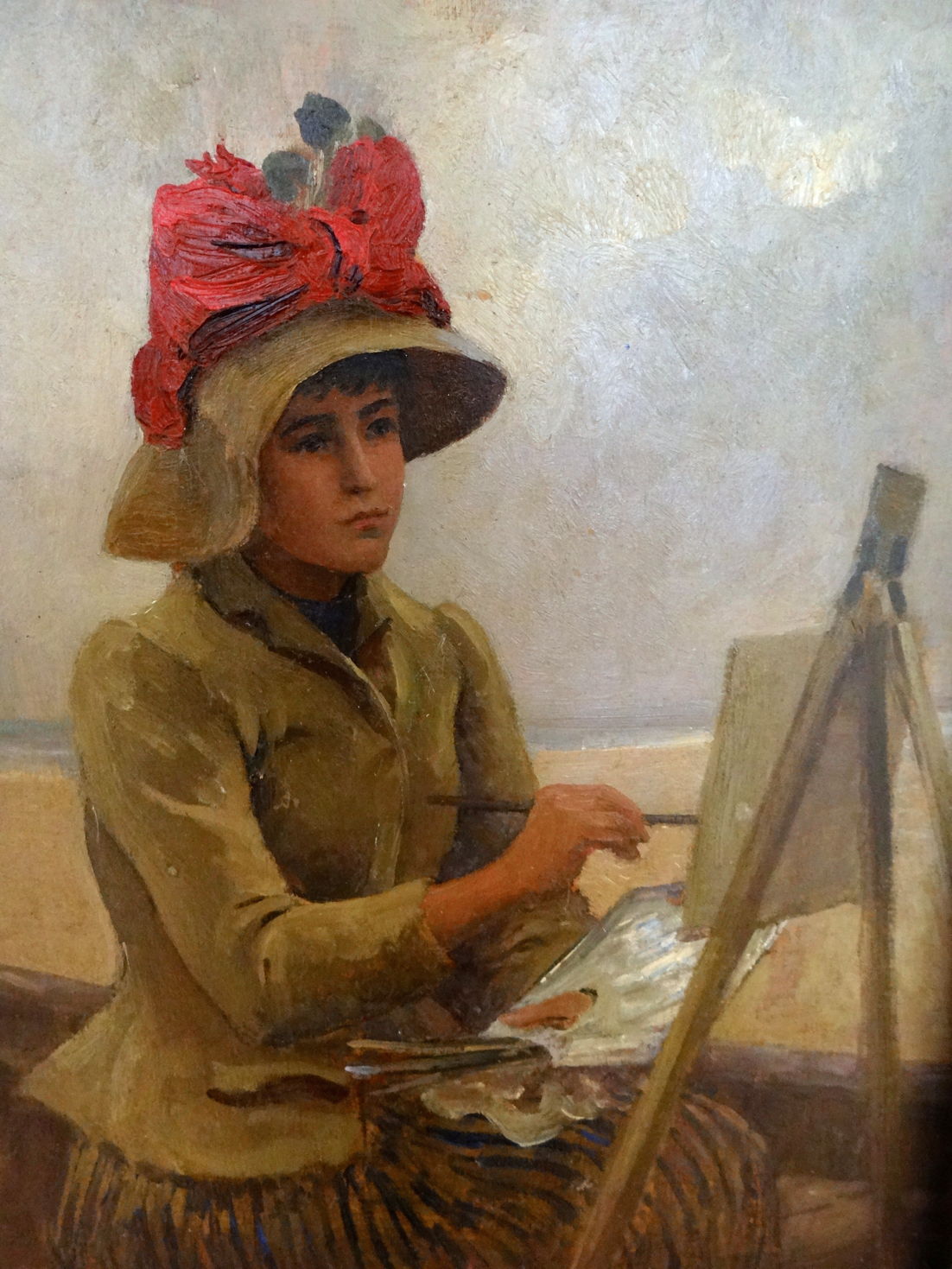
demontbretonmarieduhem
Virginie Demont-Breton (1859–1935), Portrait of Marie Duhem (detail) (1889), oil on panel, dimensions not known, Musée de la Chartreuse de Douai, Douai, France. Wikimedia Commons.

This detail of Virginie Demont-Breton’s Portrait of Marie Duhem (1889) shows one of her close friends and colleagues in the Wissant School, at work en plein air on the coast near their house. She appears to have set her easel up by a wooden groyne on the beach.
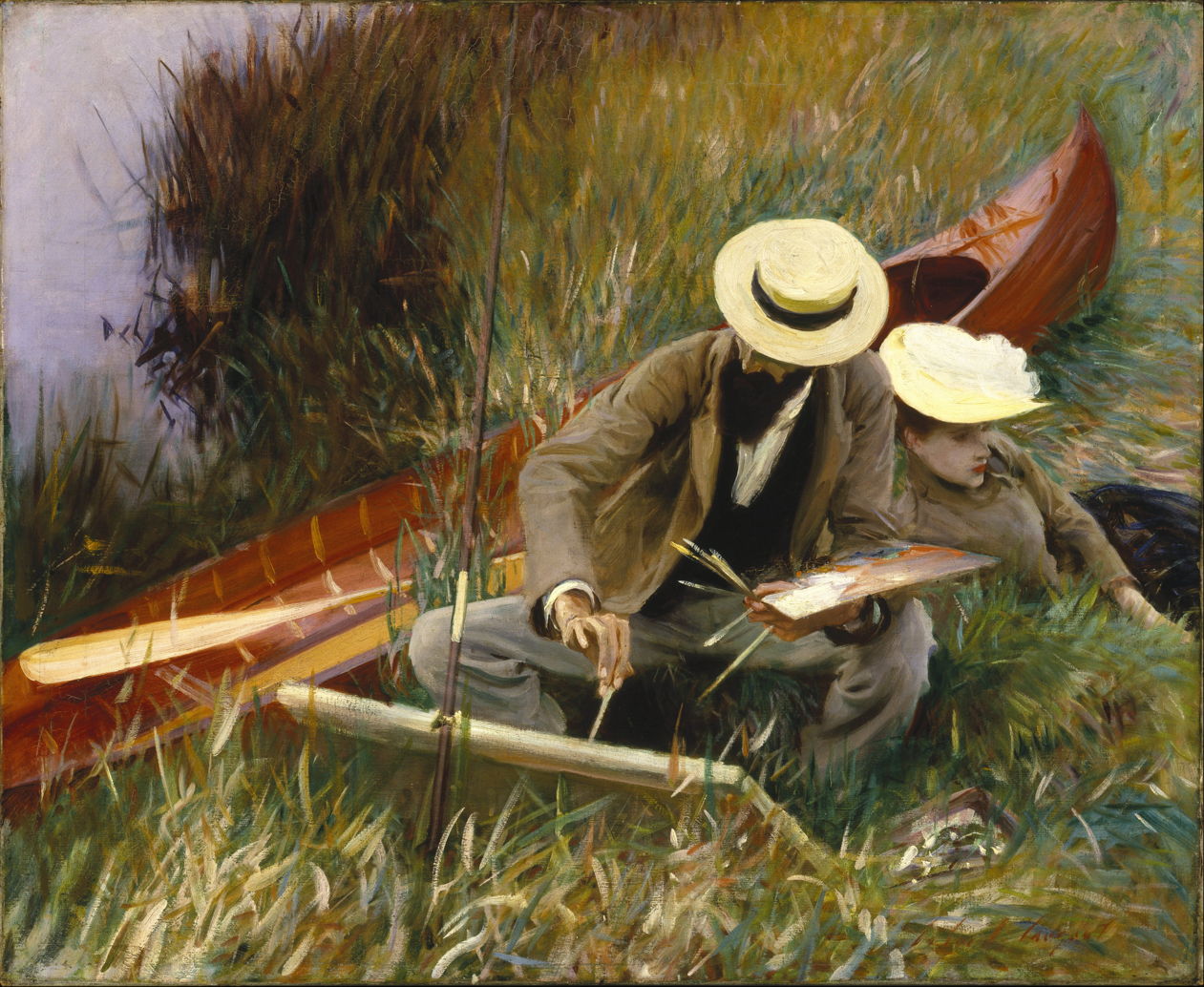
sargentoutofdoorsstudy
John Singer Sargent (1856–1925), An Out-of-Doors Study (c 1889), oil on canvas, 65.9 × 80.7 cm, Brooklyn Museum, New York, NY. Wikimedia Commons.

In John Singer Sargent’s An Out-of-Doors Study (c 1889) he shows his friend Paul César Helleu working on a canvas propped up in the grass by a single pole, a precarious arrangement only suitable for the calmest of days. It also forces him to work very low, and he squats in a position of tension, his pochade box in the grass below his left knee.

brendekildelaring
Hans Andersen Brendekilde (1857–1942), L.A. Ring Paints at Aasum Smithy (1893), oil on canvas, 107 x 140 cm, location not known. Wikimedia Commons.

Hans Andersen Brendekilde’s L.A. Ring Paints at Aasum Smithy (1893) shows his friend painting the primary school in the village of Åsum (or Aasum), to the east of Odense in Denmark. Clearly visible in the pochade box behind is a substantial collection of shiny paint tubes.
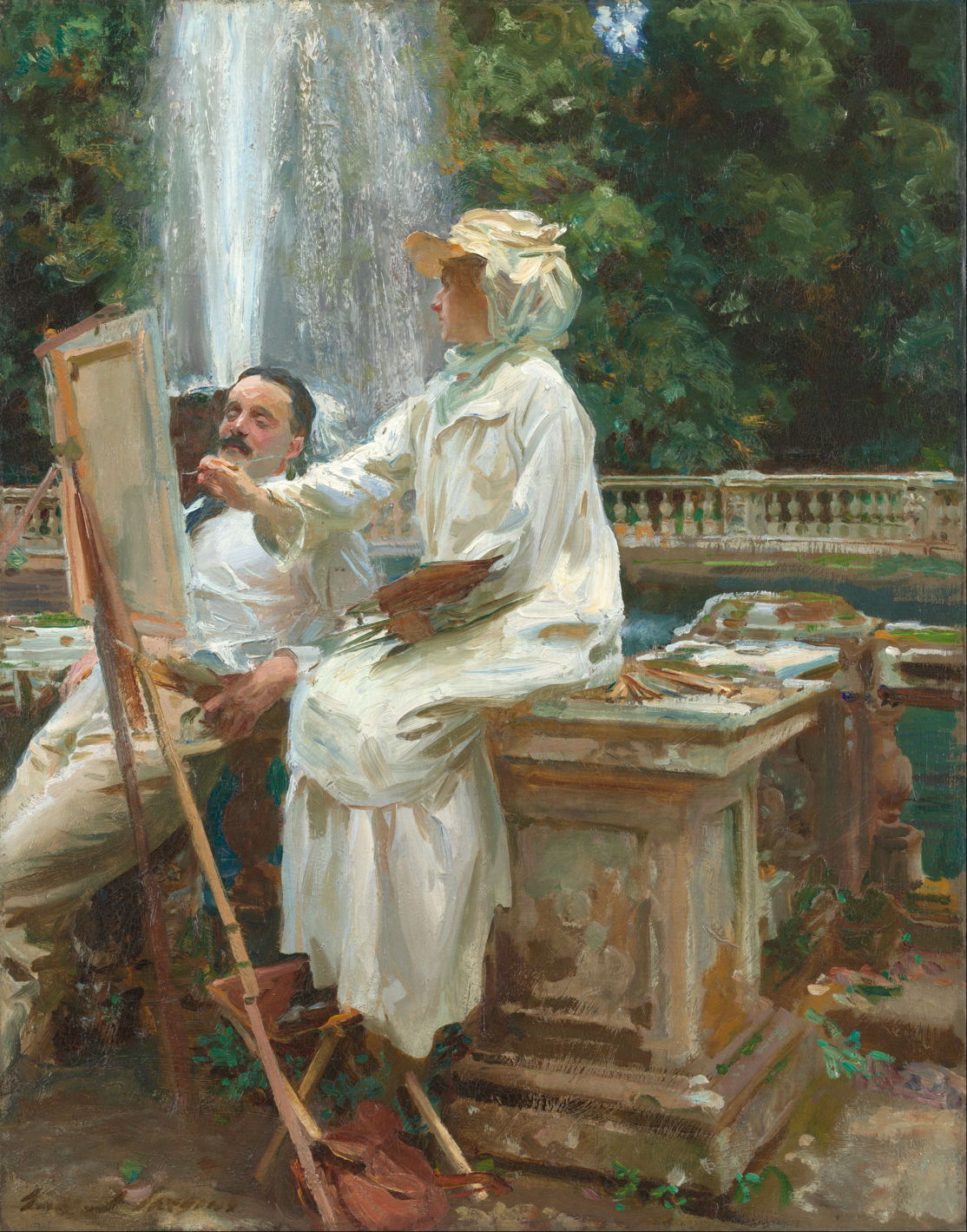
sargentfountainvillatorlonia
John Singer Sargent (1856–1925), The Fountain, Villa Torlonia, Frascati, Italy (1907), oil on canvas, 71.4 x 56.5 cm, The Art Institute of Chicago, Chicago, IL. Wikimedia Commons.

The American artists Jane de Glehn and her husband Wilfrid were long-standing friends of John Singer Sargent. His plein air oil sketch of The Fountain, Villa Torlonia, Frascati, Italy (1907) shows Jane working at a lightweight wooden easel in the grounds of this villa.

Joaquín Sorolla y Bastida, Maria Painting in El Pardo (1907), oil on canvas, 82 x 106 cm, Private collection. WikiArt.
Joaquín Sorolla y Bastida (1863–1923), Maria Painting in El Pardo (1907), oil on canvas, 82 x 106 cm, Private collection. WikiArt.

Joaquín Sorolla here shows his daughter Maria Painting in El Pardo in 1907. She’s painting with a pochade box, and has a large parasol with a specialist mount so that it can provide her with shade.

brendekildelaringfalleneasel
Hans Andersen Brendekilde (1857–1942), L A Ring by his Fallen Easel (1883), oil on canvas, 78 x 67 cm, Det Nationalhistoriske Museum på Frederiksborg Slot, Hillerød, Denmark. Wikimedia Commons.

One of Brendekilde’s earliest surviving paintings shows L A Ring by his Fallen Easel (1883). Both of them had a struggle achieving recognition, and at this stage Ring was verging on abandoning art altogether as a result. He is seen on the outskirts of a wood, looking down dejectedly at his easel that has dropped paint-first onto the fallen leaves on the road.

Plein air painting has many challenges. In fine sunny weather you’re normally limited to thirty to sixty minutes painting time. Any longer than that and the light and shadows have changed too much over the course of time, but overcast lighting allows greater tolerance. Even with modern portable lighting systems, painting en plein air at night is an astonishing feat that few even attempt.

dahldresdenatnight
Johan Christian Dahl (1788–1857), Dresden at Night (1845), oil on cardboard, 7 × 11.3 cm, Private collection. Wikimedia Commons.

This remarkable painting by JC Dahl of Dresden at Night appears to have been painted on a sheet of cardboard one night in 1845. There really is no limit to what can be achieved in front of the motif.

Reading Visual Art: 235 Fish B

By: hoakley
14 November 2025 at 20:30

In the first of these two articles I showed paintings of fish in myth and other narrative, and had reached examples of fish for sale when it had been landed on the beach.

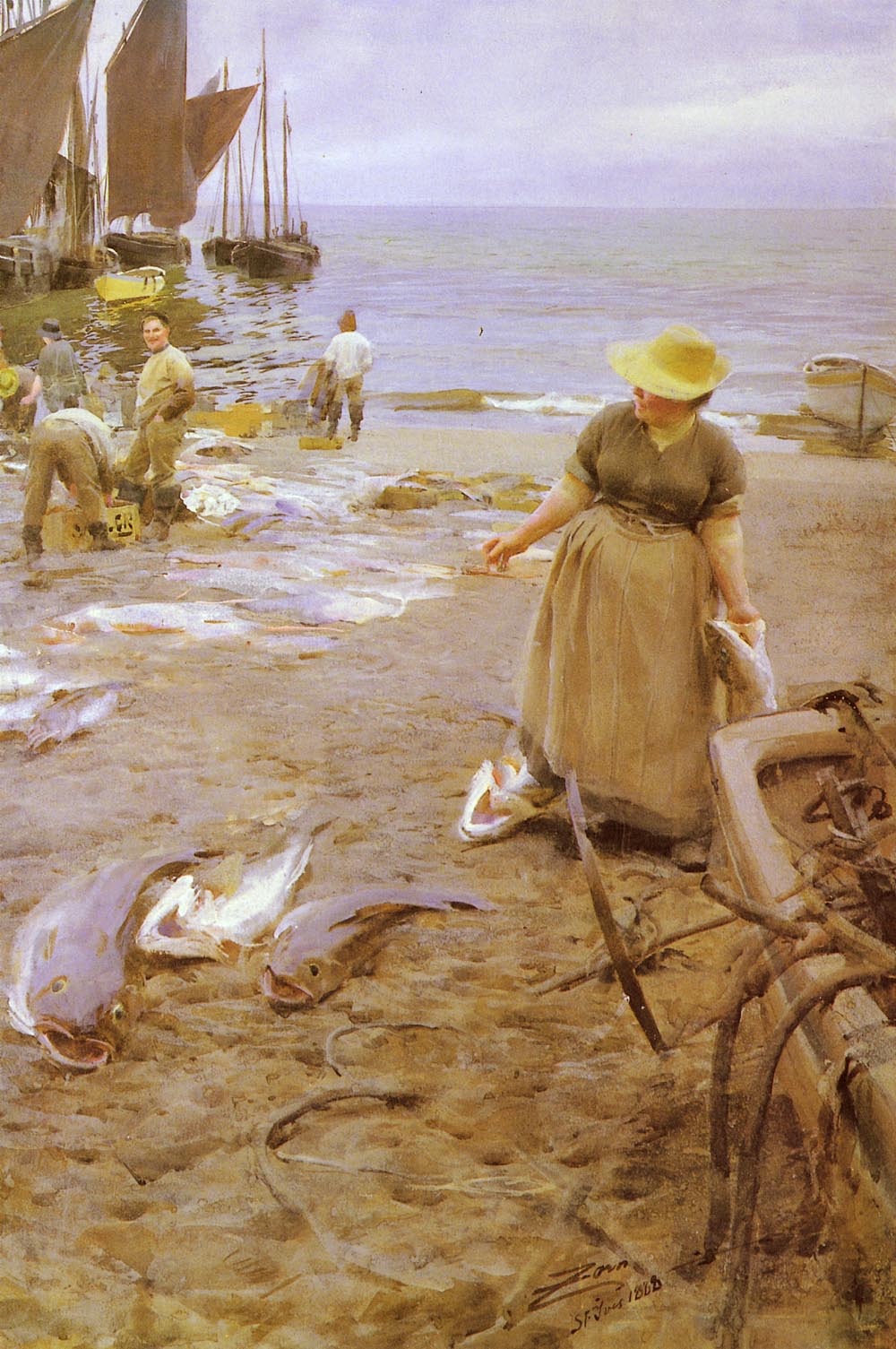
Anders Zorn, Fish Market in Saint Ives (1888), watercolour, 100 x 76.5 cm, Private collection. Wikimedia Commons.
Anders Zorn (1860-1920), Fish Market in Saint Ives (1888), watercolour, 100 x 76.5 cm, Private collection. Wikimedia Commons.

When Anders Zorn was making the transition from watercolour to oil painting, he travelled to the fishing village of Newlyn, near Penzance in Cornwall, where there was an artist’s colony. When there in 1888 he visited the fishing port of Saint Ives, where he painted this Fish Market in Saint Ives.

Although Joaquín Sorolla had been brought up in Valencia and painted its fishing industry and beaches extensively, remarkably few of his paintings show fish.

sorollaayamonte
Joaquín Sorolla y Bastida (1863–1923), Ayamonte, Tuna Fishing (1919), oil on canvas, 349 x 485 cm, Hispanic Society of America, New York, NY. Wikimedia Commons.

In 1919, when he was painting his series of views of Spain for the Hispanic Society of America, those included the tuna market in Ayamonte, Tuna Fishing.

Fish have also appeared in more unusual settings.

sichulskifish
Kazimierz Sichulski (1879–1942), Fish (1908), pastel on paperboard, 63 x 82 cm, Muzeum Narodowe w Poznaniu, Poznań, Poland. Wikimedia Commons.

Kazimierz Sichulski’s Fish (1908) is a startlingly original pastel painting, a virtuoso combination of reflections from and views through this water surface, to the fish beneath.

lesliegoldfishseller
George Dunlop Leslie (1835–1921), The Goldfish Seller (date not known), oil on canvas, 74.9 x 110.5 cm, location not known. Wikimedia Commons.

George Dunlop Leslie’s undated Goldfish Seller shows a hawker trying to sell goldfish to an upper middle class Victorian family. He may have arrived in the horse-drawn cart glimpsed outside the gate, and wears a bowler hat typical of itinerant traders, with a long green smock. The daughter and young son appear particularly unimpressed.

corinthwomanwithfishtank
Lovis Corinth (1858–1925), Woman with a Fishtank (the Artist’s Wife) (1911), oil on canvas, 74 × 90.5 cm, Österreichische Galerie Belvedere, Vienna, Austria. Wikimedia Commons.

Lovis Corinth’s Woman with a Fishtank from 1911 shows the artist’s wife Charlotte in their flat on Klopstockstraße in Berlin. The aquarium, full of goldfish, is surrounded by quite a jungle of indoor plants, her little corner of vegetation within their city flat.

Walter Crane (1845–1915), A Diver (date not known), watercolour and gouache on paper mounted on canvas, 55.9 x 66 cm, location not known. Wikimedia Commons.

Painted in a combination of transparent watercolour and gouache, Walter Crane’s undated Diver is an unusual and challenging motif.

Finally, fish have been popular objects included in still life paintings, in what has become termed fruits de mer, the fruit of the sea.

peetersfishcandlestick
Clara Peeters (fl 1607-1621), Still Life of Fish and a Candlestick (1611), oil on panel, 50 x 72 cm, Museo Nacional del Prado, Madrid. Wikimedia Commons.

Clara Peeters’ Still Life of Fish and a Candlestick is one of the earliest and most accomplished such paintings. She painted this in 1611, when she was in Amsterdam.

chardinraylouvre
Jean-Baptiste-Siméon Chardin (1699–1779), The Ray (1727), oil on canvas, 114.5 x 146 cm, Musée du Louvre, Paris. Wikimedia Commons.

Among the first of Jean-Baptiste-Siméon Chardin’s successful still lifes is The Ray from 1727, exhibited the following year to secure his place in the Académie Royale de Peinture et de Sculpture. This is an extraordinary combination of objects, dominated by the ghostly ‘face’ of the hanging fish, ably supported by the anger of the cat.

vallayercostermackerelglassware
Anne Vallayer-Coster (1744–1818), A Still Life of Mackerel, Glassware, a Loaf of Bread and Lemons on a Table with a White Cloth (1787), further details not known. Wikimedia Commons.

After Chardin’s death in 1779, his successor Anne Vallayer-Coster reached her zenith, in brilliant displays such as A Still Life of Mackerel, Glassware, a Loaf of Bread and Lemons on a Table with a White Cloth from 1787. Although reminiscent of Clara Peeters’ fish, these lack the open-mouthed gawp.

The one artist who probably painted more fish than any other was William Merritt Chase, who characteristically dashed off a fish still life to warm up his brushes each day when he was teaching.

chaseyieldofwaters
William Merritt Chase (1849–1916), The Yield of the Waters (A Fishmarket in Venice) (1878), oil on canvas, 124.5 x 165.1 cm, Detroit Institute of Arts, Detroit, MI. Wikimedia Commons.

After completing his studies in Munich, Chase spent several months in Venice, where he painted one of his best-known still lifes, The Yield of the Waters, also known as A Fishmarket in Venice, (1878). This was probably his most complex and detailed still life, showing a wide variety of the fish and seafood available in the Mediterranean. It also established his own specialist sub-genre of still life: fish, characteristically set against a dark background.

Medium and Message: Knives, fingers and long brushes

By: hoakley
7 October 2025 at 19:30

Almost all who paint in oils use conventional brushes, but there’s a significant minority who sometimes, or frequently, use different tools to apply and shape the paint layer. Of those, the most popular are palette knives, generally used to move and mix paint on the palette. Others have used the other end of the brush stick to incise, or their fingers.

bashkirtseffinthestudio
Marie Bashkirtseff (1858–1884), In the Studio (1881), oil on canvas, 188 x 154 cm, Dnipro State Art Museum, Dnipro, Ukraine. Wikimedia Commons.

Marie Bashkirtseff’s painting of a class in the Académie Julien in Paris in 1881 demonstrates how oil painting should be done by the textbook. The artist, shown in her self-portrait in the centre foreground, is using a long-bladed palette knife to prepare the paint on her palette. At her feet, on an old sheet of newspaper, are her brushes, all with handles of typical length, and the pupil behind her is using a maul stick to rest her right hand while painting with her brush.

courbetgrottosarrazine
Gustave Courbet (1819–1877), The Grotto of Sarrazine near Nans-sous-Sainte-Anne (c 1864), oil on canvas, 50.2 x 60 cm, J. Paul Getty Museum, Los Angeles, CA. Wikimedia Commons.

Gustave Courbet applied his paint using a palette knife for some of his paintings. This has been identified from the facture in some of his paintings of caves that he made from about 1864, including The Grotto of Sarrazine near Nans-sous-Sainte-Anne above.

Another enthusiast for painting with a knife was Auguste Renoir.

renoirlecoeurhunting
Pierre-Auguste Renoir (1841–1919), Jules Le Coeur and his Dogs in the Forest of Fontainebleau (1866), oil on canvas, 112 x 90 cm, Museu de Arte de São Paulo (MASP), São Paulo, Brazil. Wikimedia Commons.

In 1866, Renoir painted his friend Jules Le Coeur and his Dogs in the Forest of Fontainebleau. This is unusual among his works, as it was preceded by two studies, and all three were made using the palette knife rather than brushes. This makes it most likely to have been painted before Renoir abandoned the knife and returned to the brush, by the middle of May 1866.

renoirmosque
Pierre-Auguste Renoir (1841–1919), The Mosque (1881), oil on canvas, 73 x 92 cm, Musée d’Orsay, Paris. Wikimedia Commons.

Renoir returned to the technique in The Mosque, also known as Arab Festival, in 1881. Small strokes of bright colour and energetic work with the palette knife give it a strong feeling of movement, and it so impressed Claude Monet that he bought it from Durand-Ruel in 1900.

hillsfallorangecopark
Anna Althea Hills (1882-1930), Fall, Orange County Park (1916), oil on board, 35.6 x 45.7 cm, Private collection. The Athenaeum.

Anna Althea Hills’ Fall, Orange County Park (1916) is a classic and highly accomplished plein air painting that appears to have been made with extensive and deft use of the knife, particularly in the foreground.

Perhaps the most famous artist who is known to have painted with his fingers is Leonardo da Vinci.

davinciannunciation
Leonardo da Vinci (1452–1519), Annunciation (c 1473-75), oil and tempera on poplar, 100 x 221.5 cm, Galleria degli Uffizi, Florence, Italy. Wikimedia Commons.

This Annunciation, painted in oil and tempera on a poplar panel, is generally agreed to be one of the earliest of Leonardo’s own surviving paintings. When it was painted is in greater doubt, but a suggestion of around 1473-75 seems most appropriate. There are numerous pentimenti, particularly in the head of the Virgin. Its perspective projection is marked in scores in its ground and Leonardo used his spontaneous and characteristic technique of fingerpainting in some of its passages.

Finally, some painters are well-known for their use of brushes with exceptionally long handles. These enabled them to stand back, sometimes almost on the opposite side of their studio, get an overall view of their canvas, and paint from the same distance as a viewer.

sargentoutofdoorsstudy
John Singer Sargent (1856–1925), An Out-of-Doors Study (c 1889), oil on canvas, 65.9 × 80.7 cm, Brooklyn Museum, New York, NY. Wikimedia Commons.

Like all plein air painters, Paul César Helleu (1859–1927) shown in John Singer Sargent’s An Out-of-Doors Study from about 1889, is using brushes with handles of modest length. His canvas is fairly small, and he’s working close-in while clutching a brace of brushes in his left hand. Some designed for use when painting in front of the motif have even shorter handles, but when back in the studio Helleu would almost certainly have opted for longer.

James Abbott McNeill Whistler, Symphony in White No. 1: The White Girl (1862), oil on canvas, 214.6 x 108 cm, National Gallery of Art, Washington, DC. WikiArt.
James Abbott McNeill Whistler (1834-1903), Symphony in White No. 1: The White Girl (1862), oil on canvas, 214.6 x 108 cm, National Gallery of Art, Washington, DC. WikiArt.

Whistler was renowned for using brushes with handles over one metre (39 inches) long, and appears to have used them when painting Symphony in White No. 1: The White Girl in 1862 on a canvas just over two metres (78 inches) tall. He reworked it between 1867-72 to make it more ‘spiritual’ and reduce its original realism.

sorollasewingsail
Joaquín Sorolla y Bastida (1863–1923), Sewing the Sail (1896), oil on canvas, 220 x 302 cm, Museo d`Arte Moderna di Ca’ Pesaro, Venice, Italy. Image by Flaviaalvarez, via Wikimedia Commons.

Early in his career, Joaquín Sorolla established his reputation of painting ‘voraciously’, often using brushes with extremely long handles and large canvases. Although Sewing the Sail from 1896 may look a spontaneous study of the effects of dappled light, Sorolla composed this carefully with the aid of at least two drawings and a sketch, and given its 2.2 metre (87 inches) height, he was almost certainly using brushes of similar length.

❌
❌