Normal view

There are new articles available, click to refresh the page.
Before yesterdayMain stream

The Dutch Golden Age: Jacob van Ruisdael’s trees

By: hoakley
29 October 2025 at 20:30

Of the several hundred landscape painters of the Dutch Golden Age, the best-known and most influential is Jacob van Ruisdael, whose paintings were described by Vincent van Gogh as “sublime”. Van Ruisdael was starting his career just as Nicolas Poussin was reaching his zenith in Rome, and the two were major influences on all subsequent landscape artists, particularly Thomas Gainsborough, John Constable and JMW Turner.

Jacob Isaackszoon van Ruisdael (1628/9-1682) was born in Haarlem into a family of painters. Presumably apprenticed within the family workshop, he was admitted to the local Guild of Saint Luke in 1648, and from the outset appears to have specialised in landscape painting.

vanruisdaellandscapechurch
Jacob Isaakszoon van Ruisdael (1628/9–1682), Landscape with a Church (c 1645), oil on panel, 43.7 x 53.9 cm, Dulwich Picture Gallery, London. Wikimedia Commons.

Van Ruisdael’s earliest landscapes contained trees, as they would at a time when trees and woods were more extensive in their coverage across the whole of Europe. The view in Landscape with a Church (c 1645) looks familiar, as its composition was used by Gainsborough, Constable, and many other later artists. Prominent at the left, and forming repoussoir, is the hulk of an old tree, younger branches sprouting from the remains, a recurrent theme in Gainsborough as well as van Ruisdael. A recession in depth on the right leads to the brighter-lit church in the middle distance.

The trees here are painstakingly constructed from the anatomy of their branches, with leaves painted individually in the foreground, but delicately en masse in the further distance. Bark colour, texture, and rich lichen growth are also shown in fine detail.

vanruisdaelroadthroughoakforest
Jacob Isaakszoon van Ruisdael (1628/9–1682), Road through an Oak Forest (c 1646-7), oil on canvas, 65 x 85 cm, Statens Museum for Kunst, København, Denmark. Wikimedia Commons.

Van Ruisdael soon showed a deep understanding of the stages in the life and looks of oak trees. In Road through an Oak Forest (c 1646-7) he captures the later life of a stag-headed oak, that long ago lost its crown, on the left, a flush of new growth on a fallen trunk, and another still clinging onto life despite a great split at its base.

Judging from the girth of their trunks, the oak trees shown here are around 400 years old, making it likely that they were saplings in the thirteenth century, possibly even earlier. They form a remarkable window back in time to the late Middle Ages.

vanruisdaellandscapestonebridge
Jacob Isaakszoon van Ruisdael (1628/9–1682), Landscape with a Stone Bridge (c 1647), black chalk and grey wash on paper, 16 x 20 cm, Hermitage Museum, Sanit Petersburg. Wikimedia Commons.

Some of van Ruisdael’s sketches and drawings have also survived, among them Landscape with a Stone Bridge (c 1647). This shows his development of foliage from branch structure quite clearly, and the fact that he didn’t block in that foliage, preferring gestural squiggles and other marks.

vanruisdaewoodedlandscapepond
Jacob Isaakszoon van Ruisdael (1628/9–1682), A Wooded Landscape with a Pond (c 1648), oil on panel, 34.8 x 46 cm, Museum of Fine Arts, Houston, TX. Wikimedia Commons.

Van Ruisdael was a faithful observer of the different species of tree and their forms, as shown in his timeless A Wooded Landscape with a Pond from about 1648. He has maintained careful, anatomical construction even in the prominent tree at the centre right, in the middle distance, and the canopies appear light and leafy.

vanruisdaellandscapemill-runruins
Jacob Isaakszoon van Ruisdael (1628/9–1682), Landscape with a Mill-run and Ruins (c 1653), oil on canvas, 59.3 x 66.1 cm, Art Gallery of South Australia, Adelaide. Wikimedia Commons.

Gentle rural decay is shown not only in the ruined buildings in Landscape with a Mill-run and Ruins (c 1653), but also in the stag-head tree in the centre of the painting.

He moved to Amsterdam in 1657, to take advantage of its growing prosperity. He appears to have travelled little, remaining within the European lowlands and venturing only just over the border into Germany. His only known student was Meindert Hobbema, who became an accomplished landscape painter who also depicted trees as important elements within his works.

vanruisdaelgreatforest
Jacob Isaakszoon van Ruisdael (1628/9–1682), The Great Forest (c 1655-60), oil on canvas, 139 x 180 cm, Kunsthistorisches Museum, Vienna. Wikimedia Commons.

Probably painted soon after he had moved to Amsterdam, The Great Forest (c 1655-60) shows travellers along a track passing at the edge of an ancient woodland, with an assortment of trees in various states of advancing age, including some reduced to stag-heads.

vanruisdaelforeststream
Jacob Isaakszoon van Ruisdael (1628/9–1682), The Forest Stream (c 1660), oil on canvas, 99.7 x 129.2 cm, Metropolitan Museum of Art, New York, NY. Wikimedia Commons.

The upland landscape shown in The Forest Stream (c 1660) was clearly not one that van Ruisdael had ever seen, but must have been composed from studying the paintings of others, and talking to those more widely travelled. His trees remain much as before, with a gnarled and twisted stag-head at the right, and at the left a near-dead trunk poised in slow-motion collapse into the stream.

vanruisdaelmarshforestdusk
Jacob Isaakszoon van Ruisdael (1628/9–1682), A Marsh in a Forest at Dusk (c 1660), oil on canvas, 77.7 x 92.2 cm, Bilbao Fine Arts Museum, Bilbao. Wikimedia Commons.

Although most of van Ruisdael’s paintings are in full daylight, as with his contemporaries he also explored more transient light effects, in A Marsh in a Forest at Dusk (c 1660). Now the ancient trees launching themselves out from the bank at the right have engaged with those growing in the marsh. The effect of the late dusk light on their canopies is spectacular, as are the thin banks of cloud above, lit by the setting sun. His careful leaf-by-leaf depiction of canopies of different tree species generates distinct and life-like textures.

vanruisdaelandscapewaterfall
Jacob Isaakszoon van Ruisdael (1628/9–1682), Landscape with Waterfall (c 1660-70), oil on canvas, 142.5 x 196 cm, Rijksmuseum, Amsterdam. Wikimedia Commons.

In Landscape with Waterfall (c 1660-70), van Ruisdael revisited the distant church framed by nearer trees theme of Landscape with a Church above. Perhaps this time the church is a little too far away, though still an inspiration to Constable and Gainsborough. At the right a birch collapses off the edge, and there is a pair of ancient wizened oaks filling the centre.

vanruisdaeoakslakewaterlilies
Jacob Isaakszoon van Ruisdael (1628/9–1682), Oaks at a Lake with Water Lilies (c 1665), oil on canvas, 116.6 x 142.2 cm, Gemäldegalerie, Berlin. Wikimedia Commons.

He continued to develop the theme of old oaks and water in Oaks at a Lake with Water Lilies in about 1665. Again a dying ancient hulk stands like a prow from the bank at the left, and he shows bright flowers on the water-lilies.

vanruysdaelroadoakwood
Jacob Isaakszoon van Ruisdael (1628/9–1682), A Road through an Oak Wood (date unknown), oil on canvas, 102.5 x 127 cm, National Museum of Western Art, Tokyo. Wikimedia Commons.

Many of his woods are either unpopulated, or the few people providing staffage are barely visible against their surroundings. His undated A Road through an Oak Wood is different, with a couple of travellers on its road, and woodland activities of clearing and burning at the left.

The Golden Age was primarily based on prosperity from trade, not home production, but increasing demand from the affluent cities led to greater timber production, particularly for ships and buildings, and the clearing of woods to augment farmland.

varuisdaelthreegreattreesmountainouslandscape
Jacob Isaakszoon van Ruisdael (1628/9–1682), Three Great Trees in a Mountainous Landscape with a River (c 1665-70), oil on canvas, 138.1 x 173.1 cm, The Norton Simon Museum, Pasadena, CA. Wikimedia Commons.

My final selection is perhaps his most detailed essay on the effects of advanced age on trees, Three Great Trees in a Mountainous Landscape with a River (c 1665-70). Although the mountains are borrowed or imaginary, the three trees of the title seem almost impossibly intertwined. The nearest is struggling to survive, remains of its former glory resting, limbs in the air, at its foot.

When the Dutch economy collapsed in 1672, he appears to have remained relatively prosperous, and continued to work in Amsterdam until his death a decade later, in 1682.

References

Wikipedia
Slive, S (2005) Jacob van Ruisdael: Master of Landscape, Royal Academy of Arts, London. ISBN 978 1 903973 24 0.
Ashton, PS, Davies, AI & Slive, S (1982). “Jacob van Ruisdael’s trees”. Arnoldia 42 (1): 2–31; available from JSTOR.

The Journey of Life 1

By: hoakley
4 October 2025 at 19:30

Series paintings of times of the day and the seasons have been popular, but those trying to depict the whole of life are unusual and challenging. This weekend I look at some of the better attempts to tell the story of the journey of life. Because some of these series consist of more than five paintings, I here show selections of those longer accounts.

One of the earliest painted accounts of life is Nicolas Poussin’s series The Seven Sacraments. His first version of this was started in about 1636 as a commission for his patron and mentor Cassiano dal Pozzi, and was completed four years later.

poussinbaptism
Nicolas Poussin (1594–1665), The Baptism of Christ (Seven Sacraments I, Baptism) (c 1636-40), oil on canvas, 95.5 x 121 cm, National Gallery of Art, Washington, DC. Wikimedia Commons.

The first in the series shows The Baptism of Christ, as an unusual example of a baptismal scene. The white dove of the Holy Spirit above the figure of Christ is one link across some of the others in the series.

poussinmarriage
Nicolas Poussin (1594–1665), Marriage (Seven Sacraments I) (c 1636-40), oil on canvas, 95.5 x 121 cm, The Fitzwilliam Museum, Cambridge, England. Wikimedia Commons.

The white dove reappears in Poussin’s genteel account of Marriage.

poussinextremeunction
Nicolas Poussin (1594–1665), Extreme Unction (Seven Sacraments I) (c 1636-40), oil on canvas, 95.5 x 121 cm, The Fitzwilliam Museum, Cambridge, England. Wikimedia Commons.

The series is completed by Extreme Unction, showing the sacrament being administered to a cadaveric man as his family are gathered around his deathbed.

Although several of William Hogarth’s series were biographical, such as his first two of A Harlot’s Progress (c 1731) and its compliment A Rake’s Progress (1732-5), none attempted to depict the whole journey of life from birth to death.

The next is probably Thomas Cole’s Voyage of Life, painted in 1839-42. Like Poussin before him, Cole wasn’t satisfied with painting this cycle of four phases. When he was in Rome in 1842, fearing that he wouldn’t see his series again, nor be allowed to exhibit it, he painted a second version, now in the National Gallery of Art in Washington, DC, and shown here. He had already painted a precursor cycle, The Course of Empire, in 1833-36, telling the story of an idealised civilisation, inspired by Byron’s poem Pilgrimage (1812-8).

Cole’s first series The Voyage of Life was commissioned to show a Christian allegory of the stages of life. He divided this into childhood, youth, manhood, and old age.

colevol1childhood
Thomas Cole (1801–1848), The Voyage of Life: Childhood (1842), oil on canvas, 134.3 × 195.3 cm, The National Gallery of Art, Washington, DC. Wikimedia Commons.

Childhood establishes the scene: the lush coastal undercliff, rich in flowers and the vibrant green of vegetation. A boat has emerged from a large cave in the cliff, symbolising the mother’s birth canal and the process of birth. A young baby is standing in the boat, with an angel at its tiller. A carved angelic figure forming the prow holds out an hourglass as the symbol for time.

colevol2youth
Thomas Cole (1801–1848), The Voyage of Life: Youth (1842), oil on canvas, 134.3 × 194.9 cm, The National Gallery of Art, Washington, DC. Wikimedia Commons.

In Youth, the young man has taken the helm of the boat, leaving the angel on the bank. The morning light is bright, and the weather fair. The young man is navigating the boat along the river, through lush waterside meadows and avenues, towards a distant vision of a celestial temple. The coastal cliffs are now in the background on the right, and in the centre distance is a rocky mountain spire.

colevol3manhood
Thomas Cole (1801–1848), The Voyage of Life: Manhood (1842), oil on canvas, 134.3 × 202.6 cm, The National Gallery of Art, Washington, DC. Wikimedia Commons.

By Manhood, the hero has noticeably matured, and his boat is on a fast-flowing river just approaching dangerous rapids passing through a rocky chasm. It is now dusk, and the angel is watching over from a break in the dark and forboding clouds. The man no longer holds the tiller, indeed the rudder is missing altogether, but both hands are clasped in prayer, as he looks anxiously up towards the heavens. In the foreground on the right are twisted trees, splintered by storms, with autumnal leaves.

colevol4oldage
Thomas Cole (1801–1848), The Voyage of Life: Old Age (1842), oil on canvas, 133.4 × 196.2 cm, The National Gallery of Art, Washington, DC. Wikimedia Commons.

Old Age shows the man in the boat far older, bald and with a grey beard. His boat is now in placid waters at the coast again, making no way. The boat itself is battered, its figurehead missing. He sits in the boat talking with the angel, who beckons him up through a parting in the black clouds, to a distant angel, far up in the heavens, rising through beams of sunshine towards brightness at the top left.

The painter who came closest to creating an epic in his works must be Louis Janmot, whose series Le Poème de l’âme (Poem of the Soul) consists of no less than 34 images, of which the first eighteen are painted in oils, and the remaining sixteen are in charcoal. Miraculously, the complete series is still together in the Musée des Beaux-Arts in Lyon, France. Although the captions don’t report it, each of the oil paintings is 130-145 cm in height, and 140-145 cm in width, although I have also seen them stated as being much larger, approximately 394 x 500 cm.

Like Blake and Dante Gabriel Rossetti, Janmot was also an accomplished poet, and his series is accompanied by an epic poem of nearly three thousand lines. He had a deep Catholic faith, and both the poem and the paintings are framed within his beliefs.

janmotpoemedelame01
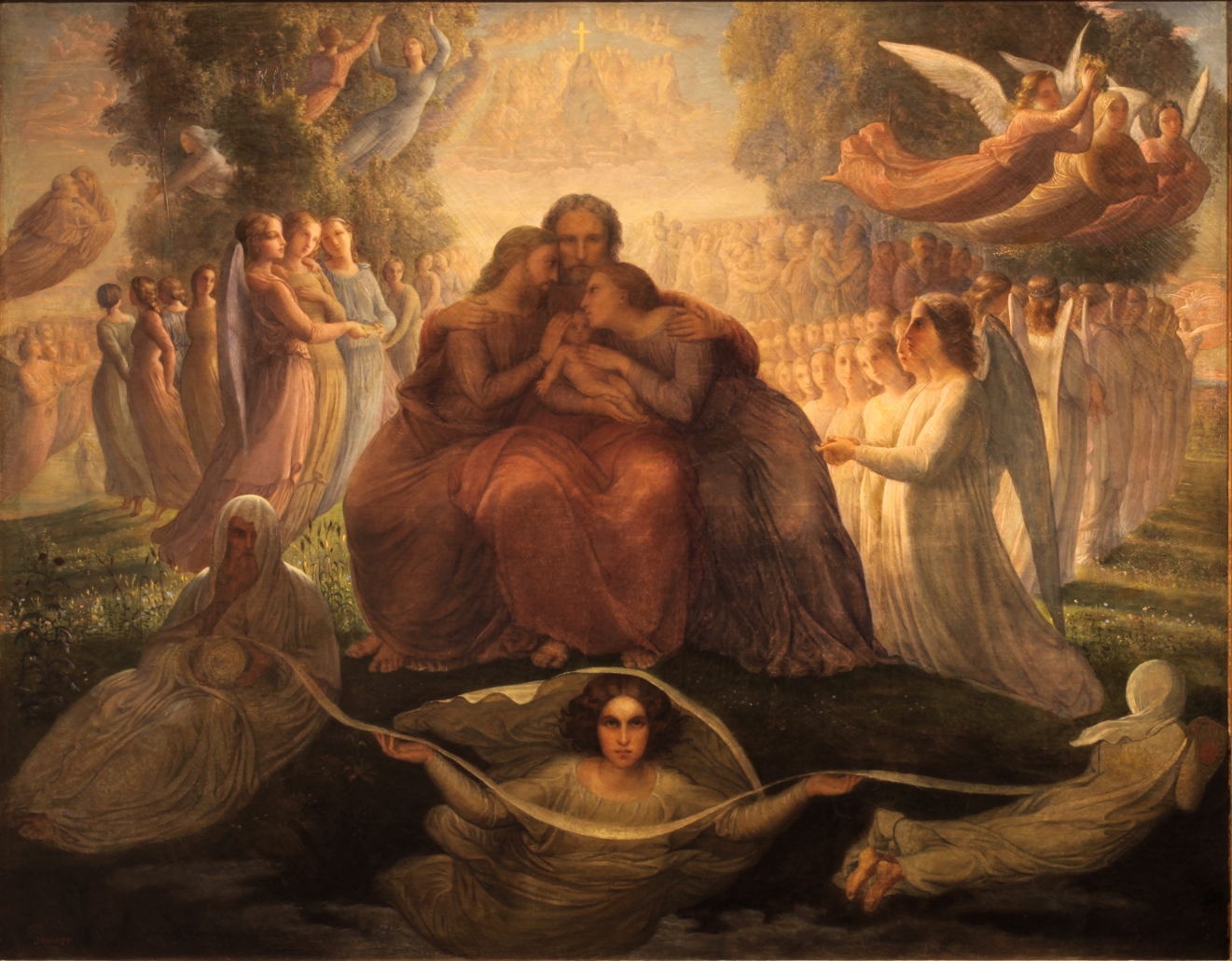
Louis Janmot (1814–1892), Divine Generation (Poem of the Soul 1) (1854), oil on panel, dimensions not known, Musée des Beaux-Arts, Lyon, France. Courtesy of Musée des Beaux-Arts, via Wikimedia Commons.

The series opens in heaven, with the mystical formation of a human soul, shown in symbolic form as a baby. This takes place under the watch of the Holy Trinity, although the three figures surrounding the newborn soul include a woman who represents love. Around this tight group are seemingly endless ranks of angels.

janmotpoemedelame02
Louis Janmot (1814–1892), Passage of the Souls (Poem of the Soul 2) (1854), oil on panel, dimensions not known, Musée des Beaux-Arts, Lyon, France. Courtesy of Musée des Beaux-Arts, via Wikimedia Commons.

The newborn soul is brought down to earth by its guardian angel. This view, midway between heaven and earth, shows the succession of newborn souls being taken down to earth in the centre, and the judgement of the dead taking place at the side. The souls of the virtuous are seen being accompanied back up to heaven by their guardian angels, at the left. On the right are those destined for hell.

Below, on the right, is the figure of Prometheus bound, being attacked by an eagle. Prometheus is a strange figure from classical mythology to appear in this series, but a strong symbol of eternal suffering.

janmotpoemedelame03
Louis Janmot (1814–1892), The Angel and the Mother (Poem of the Soul 3) (1854), oil on panel, dimensions not known, Musée des Beaux-Arts, Lyon, France. Courtesy of Musée des Beaux-Arts, via Wikimedia Commons.

This is set by the Lake of Moras, where the mother sits with the newborn soul on her lap. Its guardian angel is kneeling in prayer for the mother and the soul of her new child. This painting combines the images of the annunciation to the Virgin Mary, and the Virgin Mary with the infant Jesus, in a unique way.

janmotpoemedelame04
Louis Janmot (1814–1892), Spring (Poem of the Soul 4) (1854), oil on panel, dimensions not known, Musée des Beaux-Arts, Lyon, France. Courtesy of Musée des Beaux-Arts, via Wikimedia Commons.

As the child grows up, Janmot represents it as a duality of boy, shown here in pink, and girl, in white symbolising purity and innocence. The pair are shown at play, picking flowers, in an idyllic country landscape during the spring.

This mystical duality continues through most of the rest of the oil paintings. At times, the pair appear to be brother and sister, or even lovers, but as we will see in tomorrow’s sequel, in the end they represent the earthly body (boy) and the spirit (girl). They are usually colour-coded, the boy wearing pink, and the girl white.

References

Poussin’s Sacraments
Cole’s Voyage of Life
Janmot’s Poem of the Soul 1
Janmot’s Poem of the Soul 2
Janmot’s Poem of the Soul 3
Janmot’s Poem of the Soul 4

❌
❌