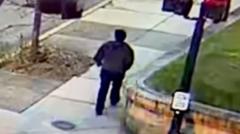
Watch: Police issue video of suspect in Brown University shooting
A manhunt is under way after two students were killed and nine other people were injured in a mass shooting at Brown University in Providence, Rhode Island.
The gunman opened fire in a classroom at around 16:00 local time (21:00 GMT) on Saturday, in a building where exams were taking place.
The university, one of the oldest and most prestigious in the US, was placed into lockdown as police searched for the gunman, who remains at large.
Students in parts of the campus are continuing to be told to shelter in place until police can escort them out of the area.
Officials from Rhode Island Hospital said most of the injured are in a "critical but stable" condition.
The identities of those killed or injured have not yet been released by officials.
"This is a day that we hoped never would come to our community. It is deeply devastating for all of us," said Brown University President Christina Paxson in a statement.
Police have released limited information about the male suspect, including an identity or motive. It is not known if he has links to the university.
CCTV footage showed the suspect walking out of the building after the attack but the his face can not be seen.
Providence Deputy Police Chief Tim O'Hara said the suspect was dressed all in black and may have been wearing a mask. It is not known what type of firearm he used and it has not been recovered.
"We're utilising every resource possible to find this suspect," he added, with extra armed police resources drafted into to search the area.
The shooting happened at the Barus and Holley building, part of Brown University's engineering school. The attack happened in a large classroom on the first floor.
An economics professor told local public media outlet Ocean State Radio that the shooting took place during a review session for her course, which was led by her teaching assistant.
"He said that the shooter came in the doors, yelled something - he couldn't remember what he yelled - and started shooting," Rachel Friedberg said.
"Students started to scramble to try to get away from the shooter, trying to get lower down in the stadium seating, and people got shot," she added.
Officials cleared the building on Saturday afternoon but found neither the suspect nor a weapon.
Watch: Aerial footage of Brown University shows huge police presence
Residents in the greater Brown University area have been told to stay inside, or to stay away until the shelter-in-place order is lifted.
In a statement, the university said police would enter non-residential buildings to escort people to safe locations.
Steph Machado, a reporter for the Boston Globe, told BBC News that restaurants around the campus have locked their doors with staff and customers waiting inside until the emergency order is lifted.
"There are flashing lights everywhere," she said.
In the immediate aftermath of the shooting, it was reported that a suspect had been taken into custody but it was quickly confirmed the man held had no involvement in the attack.
Mari Camara, 20, a Brown University student from New York City, told the Associated Press that she was coming out of the library and rushed inside a restaurant to seek shelter during the shooting. She spent the next three hours hiding there.
"Everyone is the same as me, shocked and terrified that something like this happened," Camara said.
Reuters
University exams scheduled for Saturday have been cancelled, provost Frank Doyle said.
President Donald Trump, speaking to reporters as he returned to the White House from attending the annual Army and Navy football game, described the shooting as "a terrible thing".
"All we can do right now is pray for the victims and for those that were very badly hurt," he said.
Rhode Island Governor Dan McKee said in a statement: "Our capital city experienced an unthinkable tragedy today. Our hearts are with the people of Providence and all those impacted."
Brown University, one of the one of the oldest higher education institutions in the US, is part of the Ivy League, a group of elite universities in the northeast of the country.
The university, which has more than 11,000 students, is located in Providence, Rhode Island's capital city, located about 50 miles (80km) from Boston and 180 miles (290km) from New York City.
The attack on the campus brings the number of mass shootings in the US to 389 for this year, according to the independent analysis website Gun Violence Archive (GVA).
It defines mass shootings as having four or more victims killed or injured, not including the attacker.
I suppose it had to happen that search engines and AI were exploited to deliver malware to the unsuspecting. As that article prompted a brief discussion of the usefulness and reliability of AI-based troubleshooting, I’ve been doing a little checking.
To examine this, I’ve posed Google’s AI some test questions. Rather than run through a long list, I’ve focussed on five that are reasonably frequent but have catches in them. Some are embedded in the question itself, others are inherent in the solution. My aim here isn’t to focus on the strengths of AI, but to understand its weaknesses better, just as you might with a human expert. After all, it doesn’t take much expertise to get the straightforward answers right.
1. How to reduce system data on mac
This question is framed carefully to reveal that the questioner has already used Storage settings, and has been confronted with a great deal of space being used by System Data, an unhelpful category and a situation that’s all too common, as I’ve considered here and elsewhere.
Google’s overview started well, telling me that “System Data includes caches, logs, and temporary files that build up over time and aren’t easily removable like regular documents.” Once it progressed to suggesting actions, though, it repeated a formula it seems to like, but is sadly well out of date: “Use Built-in Storage Management. Click the Apple menu () $gt; About This Mac $gt; Storage $gt; Manage. Use recommendations like ‘Store in iCloud,’ ‘Optimize Storage,’ and ‘Empty Trash Automatically’.” If you try to follow those, you’ll immediately discover that Storage has moved elsewhere. Furthermore, those recommendations won’t tackle the problem framed in the question.
It continues on safer ground, with procedures to clear caches and logs, but those are conducted in Terminal, and there’s no mention of booting in Safe mode. It also directs the user to Terminal to remove snapshots using tmutil rather than Disk Utility. After that, it loses the direction in the question, recommending the user to “remove unused applications and files”, despite the fact that they aren’t included in System Data. Finally, and still off the subject, it mentions using DaisyDisk.
This demonstrates how Google’s AI can’t maintain a logical sequence in troubleshooting, and prefers to direct the user to command tools rather than familiar bundled utilities like Disk Utility, or one of the primary purposes of Safe mode.
2. How to reset home permissions on mac
This has long been a contentious issue, but for the last few years has been fairly settled, as explained here. We no longer reset or repair permissions.
This was Google’s most obvious disaster, as it advised: “To reset home folder permissions on a Mac, boot into Recovery Mode (Command-R), open Terminal, type resetpassword , and use the ‘Reset Home Directory Permissions and ACLs’ button in the utility to fix ownership and permissions for your user account, then restart. For newer macOS versions, Apple also suggests using the repairHomePermissions tool in Recovery, followed by a macOS reinstallation for a full fix, but the resetpassword utility is the primary way to reset the main permissions.”
Of course, Apple silicon Macs don’t use Command-R to enter Recovery Mode, and as you might expect, the resetpassword command opens Recovery Assistant where you can reset your password in the event that you forgot it. That has absolutely nothing to do with permissions, and demonstrates that Google hasn’t understood the question. There’s no such button in that utility, so it’s making things up. It’s also worth nothing that it later recommends that after running repairHomePermissions, you reinstall macOS.
Perhaps the fundamental problem here is the linked support content dating back to 2011, and a failure to recognise how this has changed in the years since. This suggests that its LLM doesn’t take time and change into account, which is deeply concerning when deriving advice on macOS.
3. How to identify clone files in macos
This has been a longstanding problem since the introduction of APFS. Note, though, that question isn’t posed to test whether two or more files are clones of one another, simply how to identify whether files are clones.
Google’s AI Overview is pretty good, and points out that “you need specialized tools or command-line tricks because Finder just sees copies”.
However, the next section is titled “Using Finder (for general duplicates)” and gives a facile answer that’s completely inappropriate to that question. This demonstrates how AI always tries to answer, even when it doesn’t know an answer. After that it offers a Terminal solution that again finds duplicates but not clone files, as it doesn’t even check whether the files found have been cloned. It then suggests using specialised apps, including Precize and Sparsity, but lacks useful detail. It ends with pointing out the differences between hard links and clone files, but clearly hasn’t understood a word.
Humans are far more willing to admit they don’t know, and to ask follow-up questions to help them understand exactly what you’re asking.
4. How to run an unsigned app in macos
One of the well-known features of Apple silicon Macs is that, from their first release five years ago, they have only ever run code that has been signed, even if using just an ad-hoc signature, while Intel Macs remain able to run apps and code that has no signature at all. There’s also an important distinction between unsigned code, and code that has been signed by an ad-hoc signature rather than a developer signature.
Those are missed entirely by Google’s AI, as a result of which its answer is riddled with misunderstandings. It recommends what it terms ‘The Standard “Open Anyway”‘ method, which still can’t run unsigned code on Apple silicon. Its final recommendation is to use sudo spctl --master-disable, which disables Gatekeeper and XProtect checks but still doesn’t allow unsigned code to run on Apple silicon.
Given that LLMs are all about language rather than facts or knowledge, it’s surprising that it failed to see the distinction here. This topic was also widely discussed when Apple silicon Macs were introduced, so it’s puzzling that Google was unable to recall any discussion from that time.
5. How to remove com.apple.macl in macos
I’ve only recently revisited this topic, although it dates back to Catalina. This particular extended attribute is frequently added to files, and can have unpleasant consequences when opening or saving them is blocked. Unlike the ordinary quarantine xattr, when macOS applies this one it’s usually protected by SIP, which makes its removal fraught unless you know the trick.
Google AI’s answer made a promising start, writing that “you can use the xattr command in the Terminal, but you might need to use a specific approach depending on your macOS version and file location, as this attribute is often protected by System Integrity Protection (SIP) or file access permissions.” It then ignores the problems posed by SIP protection, and recommends trying the xattr command. As an alternative for “stubborn cases”, it recommends booting into Recovery, and using xattr from there, which should work if you can locate and access the file, which can be quite an achievement in Recovery.
In a bid to remain helpful, it next suggests granting the Terminal app Full Disk Access, although that’s irrelevant. It tries again with: “A common workaround involves moving the file using an application that doesn’t propagate the com.apple.macl attribute, or transferring it to a non-Mac file system.” It finally gets lost when trying to use iCloud Sync.
In common with other answers, Google’s AI started off well, as if it understood the heart of the problem, but quickly demonstrated that it was unable to recall a solution, and stopped making any sense.
Reproducibility
Before you rush off and try the same questions in your favourite AI, a word of warning: the answers you’ll be given will be different from mine, even if you use exactly the same words with Google. This is because randomisation is at the heart of AI, and each time you elicit a response from an LLM, it will differ. Sometimes those differences can be subtle and linguistic, others can manipulate different ‘facts’, or fabricate conflicting answers. This is, apparently, intentional, and hopefully never affects any human expert you consult.
Conclusions
These five questions have demonstrated that Google’s AI can produce some surprisingly accurate information that appears insightful and can match human expertise. In some cases, recommended solutions are sound and well-explained, but in others they appear based on outdated information that may conflict with the opening Overview. Where there aren’t readymade solutions it can quote, it will always try to be helpful in providing an answer, no matter how illogical or flawed that might be. In some cases those could lead an unsuspecting user into danger, and often ignore what was seeded in the original question.
The only way to use Google AI safely is to double-check everything carefully with authoritative sources before trying any of its suggestions, which surely removes much or all of its value.
"Starmer rocked by new Andy Burnham coup plot" is the Mail on Sunday's top story, detailing the Manchester Labour mayor's apparent "deal" to become an MP. Citing unnamed sources, the paper claims Burnham is close to striking "a deal to fight a by-election to return to the Commons and mount a leadership challenge" against Prime Minister Sir Keir Starmer.
Relatives of Virginia Giuffre proclaim "justice has not been served" after the Metropolitan Police dropped an investigation into Andrew Mountbatten-Windsor, the Sun reports. The former prince was accused of asking his personal police officer to dig up information about Giuffre. Andrew has consistently denied all allegations against him.
Health Secretary Wes Streeting warns "Britain facing tsuanmi of flu", writes the Sunday People in its top story. Hospital admissions are up 50% "with the worst to come", the paper writes, quoting Streeting.
Hospital paediatric units are full due to a "spike in flu cases" across the UK, the Independent reports, leading to "children's operations being cancelled", including cardiac procedures. Overcrowded wards are "increasing the risk of medical emergencies", the paper writes.
Conservative leader Kemi Badenoch will "ditch the 2030 ban on the sale of new petrol and diesel cars" if she defeats Labour at the next election, the Sunday Telegraph says. Writing for the paper, Badenoch calls the government's electric vehicles quota an "economic act of self-harm", as she vows to unwind the commitment. The paper says Downing Street has insisted it will press ahead with the ban.
The Sunday Express leads with its investigation into an alleged government scheme for "failed asylum seekers and foreign criminals to leave voluntarily". According to the paper, "illegal migrants are getting help setting up businesses and are being handed accommodation, food, and travel assistance" on returning to their "home country". A Home Office spokesperson says the claims are "untrue", telling the paper: "This scheme ensures migrants return to their home country, settle and don't re-enter the UK for a fraction of the price."
"Home Sec to announce crackdown on violence against women", writes the Sunday Mirror in its top story, declaring it a "national emergency". The paper says offences "will be disclosed to new partners, all police forces will get specialist units, and squads will track down online predators".
"Tens of thousands of people have followed the King's advice to check their eligibility for cancer screening", writes the Sunday Times on its front page. It follows, in the paper's words, King Charles's "heartfelt speech on Friday about his diagnosis".
The Observer depicts the government's social media debate on its front page as a Shakespearean dilemma: "to ban or not to ban". Australia became the first country to impose a 16-year-old age limit on social media earlier this week and the UK government is now "split" over whether to pursue a similar measure.
"TV star Jeremy Clarkson reckons he has picked up a swathe of female admirers since he started hosting Who Wants To Be A Millionaire" according to the Daily Star. The paper calls it the "unlikeliest showbiz exclusive of the year".
Host Stassi Schroeder reunites the cast to explore scandals in the Season 3 Reunion
Infidelity, divorce, even "soft-swinging" - not words traditionally associated with Christianity, but just some of the themes in the hit US reality show, The Secret Lives of Mormon Wives.
The TV series follows a group of female influencers in Utah - the home of the Church of Jesus Christ of Latter-day Saints (LDS) - as they deal with friendship fall-outs, romantic problems, and their relationship with their faith.
"These Latter-day Saints are no angels," last month's trailer for season three declared, setting the tone for what was to come. The show became the most-watched unscripted season premiere of 2024 on Hulu and continues to attract millions of global viewers there and on Disney+.
And the cast of women, who previously gained notoriety on TikTok under their "MomTok" banner, have gained scores of social media followers.
But do Mormons living in the UK think the show gives a fair portrayal of their religion? BBC News has spoken to some, many of whom prefer to be referred to as members of the Latter-day Saints rather than Mormons.
"We're normal people," Ben, a podcast producer who lives near Burnley, says.
"So there is still infidelity, there are still extramarital affairs, probably at a significantly lower percentage because we are intentionally trying not to do that. But those things still happen."
The show is appointment viewing for Ben's wife Olivia, who he says "loves it" - having put the new season in their calendar so she didn't miss it.
Olivia and Ben say Mormons' lives are not as dramatic as the show suggests
When the first series aired last year, Ben, 27, feels there was "hesitancy" in the LDS community about it. Now, he says people are mostly supportive of the women on the programme and wouldn't say they are "embarrassed" by them - "because we're not".
"In the UK, if you spend a week with a Latter-day Saint family, it will probably be generally quite boring and average," he says.
Ben and Olivia are among the approximately 185,000 LDS members in the UK. The church was founded by Joseph Smith in the US in 1830, who said he received a revelation from God, which he translated to become the Book of Mormon.
Members of the LDS believe the Book is the word of God, like the Bible. Unlike other branches of Christianity, members do not believe Jesus is himself God, rather that they are separate beings.
They are perhaps best known for their missionary tradition, where every year thousands of young Mormons are sent by the LDS to different locations around the world to recruit others to the religion.
Traci says she sometimes worries about how Mormons are being represented
In Buckinghamshire, Traci, 57, tells BBC News after growing up in the LDS, she moved away from the faith aged 17 when her mother died. About a decade later, pregnant with twins, she says she prayed every night, scared and asking for help. When her sons were born, and missionaries knocked on the door, she says she "felt the Holy Ghost's presence".
Since then, she's been a practising member of the LDS - which, among other things, means abiding by a health code that prohibits drinking tea, coffee and alcohol, and eating meat sparingly.
Traci, a psychotherapist based in Olney, decided not to watch the Secret Lives of Mormon Wives, but from what she's been told about it, says "it's not representative of the women" she knows in the LDS. "It's not the way that they live their life."
She says she understands "sometimes people do have a curiosity about members of our church, they do want to know what makes us tick", but adds: "Sometimes I worry, how are we being represented? How do you see us?"
Disney/Natalie Cass
Influencer Taylor Frankie Paul features heavily in a storyline about 'soft-swinging' in the show
One of the major themes of the TV show is the pressure the women feel in their family lives. Jessi, a woman in the show whose storyline revolves around an emotional affair she had, says avoiding to deal with issues in her marriage contributed to infidelity - and blamed Utah's Mormonism for creating "a lot of pressure to have the perfect relationship, the perfect family and everything's great".
Back in the UK, we also spoke to Ben and Olivia's friend Ashlyn who went to university in Utah and now lives in Burnley with her husband Joe, and their nine-month-old son.
She says the show is "a really accurate representation of the church in Utah, and culturally what Utah looks like, where belief meets cultural practices".
The sheer number of Mormons there means that pressure to have a family comes not just from the Church, but from "everybody that you interact with", Ashlyn, 25, adds.
"That pressure is very real. A lot of us call it the Utah bubble."
Becy/Bell Art Photography
Ashlyn and Joe say there are some differences between the LDS in Utah and the UK
But she says it's not the same in the UK. She describes the show's US cast as "probably more culturally members" of the LDS, rather than devout believers.
Ashlyn describes her experiences of the LDS as encouraging, rather than pressuring. "Some people view a lot of the commandments, and what people might label 'rules', as very confining and almost like there's all these gates holding me in," Ashlyn says, "whereas for us, it's viewed a little bit more as safety. It helps direct us in the right way."
'Soft-swinging' and race issues in the show
And so-called "soft swinging", one of the show's scandals, would "definitely" be "discouraged" by the Church, she says.
Influencer Taylor Frankie Paul was at the centre of the story in series one of the show, when she described her and her then-husband as being sexually intimate - but stopping short of "going all the way" - with two other couples at various parties.
Ashlyn explains how in the LDS, "we have something called the law of chastity that says we should really save sexual relations within our marriages".
She says her lifestyle in Burnley is "very family-centered, very healthy, trying to focus on going to church on Sunday, serving others, being a really good example to others, and helping in the community".
Ashlyn adds: "I don't think it would be as entertaining if The Secret Lives of Mormon Wives was actually just them bringing cookies to their neighbours and just living very wholesome family lives."
Another theme in the show centres on Layla, a black member of the LDS, who stops attending because she says the Church didn't "resonate" with her any more as a person of colour, having converted to LDS and moved to Utah when she was 16.
"There is an old scripture in the Book of Mormon that states that black skin is a curse. It's something that I am aware of now that I wasn't aware of when I first converted," she says in the latest series.
In 2013 the LDS "disavowed" those teachings, and now believes "everyone is an equal child of God regardless of race".
BBC News spoke to Naomi, a 'Young Women's President' in her local congregation in London, meaning she looks after girls between the ages of 12 and 18 in her area. She told us how as "a black female", she hopes the children "can see me and my example and know what's possible".
Naomi says she hasn't "had any negative experiences" in the Church based on her race, and says the teachings "have been denounced".
Naomi feels accepted by the LDS despite its old teachings on race
The members of the LDS in Britain we spoke to had mixed opinions on whether The Secret Lives of Mormon Wives represents their way of life, with most agreeing that parts of it were exaggerated depictions.
Ahead of the first series of the show last year, the Church of Jesus Christ of Latter-day Saints in the UK released a statement titled, "When entertainment media distorts faith".
While it didn't name the show, it said: "A number of recent productions depict lifestyles and practices blatantly inconsistent with the teachings of the Church.
"We understand the fascination some in the media have with the Church, but regret that portrayals often rely on sensationalism and inaccuracies that do not fairly and fully reflect the lives of our Church members or the sacred beliefs that they hold dear."
Naomi, who is a TV producer working on reality shows, knows all too well that it's a classic of the genre that "things are going to be heightened, things are going to be produced to get the desired effect".
"Starmer rocked by new Andy Burnham coup plot" is the Mail on Sunday's top story, detailing the Manchester Labour mayor's apparent "deal" to become an MP. Citing unnamed sources, the paper claims Burnham is close to striking "a deal to fight a by-election to return to the Commons and mount a leadership challenge" against Prime Minister Sir Keir Starmer.
Relatives of Virginia Giuffre proclaim "justice has not been served" after the Metropolitan Police dropped an investigation into Andrew Mountbatten-Windsor, the Sun reports. The former prince was accused of asking his personal police officer to dig up information about Giuffre. Andrew has consistently denied all allegations against him.
Health Secretary Wes Streeting warns "Britain facing tsuanmi of flu", writes the Sunday People in its top story. Hospital admissions are up 50% "with the worst to come", the paper writes, quoting Streeting.
Hospital paediatric units are full due to a "spike in flu cases" across the UK, the Independent reports, leading to "children's operations being cancelled", including cardiac procedures. Overcrowded wards are "increasing the risk of medical emergencies", the paper writes.
Conservative leader Kemi Badenoch will "ditch the 2030 ban on the sale of new petrol and diesel cars" if she defeats Labour at the next election, the Sunday Telegraph says. Writing for the paper, Badenoch calls the government's electric vehicles quota an "economic act of self-harm", as she vows to unwind the commitment. The paper says Downing Street has insisted it will press ahead with the ban.
The Sunday Express leads with its investigation into an alleged government scheme for "failed asylum seekers and foreign criminals to leave voluntarily". According to the paper, "illegal migrants are getting help setting up businesses and are being handed accommodation, food, and travel assistance" on returning to their "home country". A Home Office spokesperson says the claims are "untrue", telling the paper: "This scheme ensures migrants return to their home country, settle and don't re-enter the UK for a fraction of the price."
"Home Sec to announce crackdown on violence against women", writes the Sunday Mirror in its top story, declaring it a "national emergency". The paper says offences "will be disclosed to new partners, all police forces will get specialist units, and squads will track down online predators".
"Tens of thousands of people have followed the King's advice to check their eligibility for cancer screening", writes the Sunday Times on its front page. It follows, in the paper's words, King Charles's "heartfelt speech on Friday about his diagnosis".
The Observer depicts the government's social media debate on its front page as a Shakespearean dilemma: "to ban or not to ban". Australia became the first country to impose a 16-year-old age limit on social media earlier this week and the UK government is now "split" over whether to pursue a similar measure.
"TV star Jeremy Clarkson reckons he has picked up a swathe of female admirers since he started hosting Who Wants To Be A Millionaire" according to the Daily Star. The paper calls it the "unlikeliest showbiz exclusive of the year".
The leaders of the AfD, Tino Chrupalla, front left, and Alice Weidel, front center, have defended the party against accusations of compromising national security.

 Login
Login