
 Login
Login

The Temptation of Saint Anthony 1660-1908
In the first of these two articles tracing the history of depictions of the temptation of Saint Anthony, I had reached 1650, when the bizarre composite creatures that flourished in Hieronymus Bosch’s triptych of about 1500-10 were becoming common.

The prolific David Teniers the Younger painted several versions of the Temptation of Saint Anthony after about 1650. Most, like this painting now in Lille, show an ordinary landscape with the saint, with the addition of his own species of daemons. Some of these re-use ideas first seen in Bosch’s triptych, such as that of a single figure on the back of a flying narwhal; that figure is wearing an inverted funnel on its head.

Another of Teniers’ paintings, currently in the Prado, shows three fairly normal humans in a menagerie of daemons, some of which clearly have their origins in Bosch’s work. The figure flying on a fish has changed from the previous painting, but still wears its distinctive inverted funnel.

This third version, now in Tokyo, repeats many of the same daemons in a different setting, retaining the figure wearing the inverted funnel in close aerial combat.

Almost two centuries after Bosch’s triptych, more radically different and inventive approaches appear, here in Domenicus van Wijnen’s painting of about 1685. Its daemons are much more human in form, and have proliferated in a way more common in the ‘fairie paintings’ seen around 1840, including some by Richard Dadd. Van Wijnen was a prolific painter of scenes of witchcraft and the ‘dark arts’.

Southern European painters were more likely to keep to more traditional figurative compositions, as used by Tiepolo in about 1740. This is surprising, given the presence of Bosch’s paintings in major collections in both Madrid and Venice.

Depictions of the Temptation of Saint Anthony remained popular even through the 1800s, although by this time Bosch’s triptych seems to have become long forgotten, and painters seemed no longer to need such excuses to exercise their imagination and inventiveness. The long-awaited publication of Gustave Flaubert’s book The Temptation of Saint Anthony, written in 1874 as a script for a play, brought renewed interest, and a succession of paintings from Henri Fantin-Latour (c 1875, above), Paul Cézanne (c 1875, below), Gustave Moreau (a watercolour), and Fernand Khnopff (1883).

Cézanne shows the shadowy figure of Saint Anthony slumped against a bush at the left, his arms held out to shield himself from the temptations. The devil is shown in stereotypical form, wearing red robes, with an animal head and horns, behind the saint. In front of them is the naked Queen of Sheba, her right arm held high to accentuate her form. Around her are naked children. In front of Saint Anthony is a black bag presumably containing money, and a book.
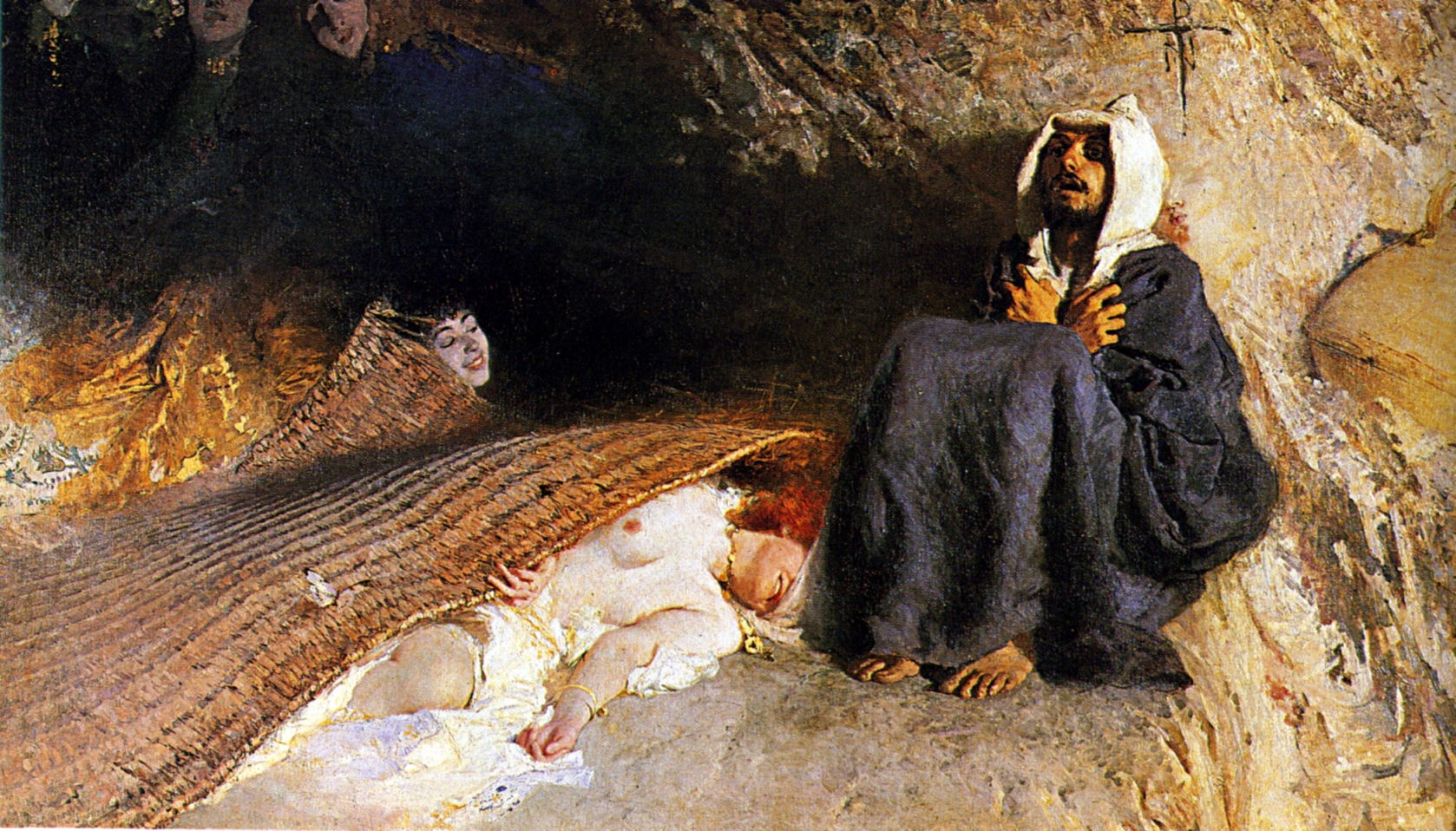
The influential Neapolitan realist Domenico Morelli painted this stark work in 1878, perhaps the exact antithesis of the rich imagery that had developed since the Renaissance.

That same year, Félicien Rops painted his satirical and irreverent version with more subtle details. Bound to the cross in Saint Anthony’s tempting vision is a visibly voluptuous woman, the word EROS replacing the normal initialism of INRI (Iēsūs/Iēsus Nazarēnus, Rēx Iūdaeōrum, meaning Jesus of Nazareth, the King of the Jews) shown above Christ’s head. Christ himself, with full stigmata, has been knocked sideways to accommodate the woman’s naked body. Behind the cross the horned devil wears scarlet robes and pulls faces. Behind him is a pig, Anthony’s attribute. The two daemonic putti are most definitely not references to Bosch.

Lovis Corinth painted two versions of the Temptation. The earlier, from 1897, shows Anthony surrounded by beautiful and naked women, offering him fruit, other food, and their bodies. The daemons have faded into the background, and are caricatures based on humans.

His later canvas, explicitly painted after Gustave Flaubert, in 1908, brings in the Queen of Sheba, an elephant and monkey, but is also notable for depicting Anthony as a young man. Even Salvador Dalí’s 1946 painting of the Temptation steers clear of Bosch’s imagery, although it does at least return to the concept of an individualistic and inventive vision.


