 Login
Login
No Quick Fix for Our Housing Crisis
14 December 2025 at 22:00
Sampling the many responses to a column by Ezra Klein.

In the first of these two articles tracing the history of depictions of the temptation of Saint Anthony, I had reached 1650, when the bizarre composite creatures that flourished in Hieronymus Bosch’s triptych of about 1500-10 were becoming common.

The prolific David Teniers the Younger painted several versions of the Temptation of Saint Anthony after about 1650. Most, like this painting now in Lille, show an ordinary landscape with the saint, with the addition of his own species of daemons. Some of these re-use ideas first seen in Bosch’s triptych, such as that of a single figure on the back of a flying narwhal; that figure is wearing an inverted funnel on its head.

Another of Teniers’ paintings, currently in the Prado, shows three fairly normal humans in a menagerie of daemons, some of which clearly have their origins in Bosch’s work. The figure flying on a fish has changed from the previous painting, but still wears its distinctive inverted funnel.

This third version, now in Tokyo, repeats many of the same daemons in a different setting, retaining the figure wearing the inverted funnel in close aerial combat.

Almost two centuries after Bosch’s triptych, more radically different and inventive approaches appear, here in Domenicus van Wijnen’s painting of about 1685. Its daemons are much more human in form, and have proliferated in a way more common in the ‘fairie paintings’ seen around 1840, including some by Richard Dadd. Van Wijnen was a prolific painter of scenes of witchcraft and the ‘dark arts’.

Southern European painters were more likely to keep to more traditional figurative compositions, as used by Tiepolo in about 1740. This is surprising, given the presence of Bosch’s paintings in major collections in both Madrid and Venice.

Depictions of the Temptation of Saint Anthony remained popular even through the 1800s, although by this time Bosch’s triptych seems to have become long forgotten, and painters seemed no longer to need such excuses to exercise their imagination and inventiveness. The long-awaited publication of Gustave Flaubert’s book The Temptation of Saint Anthony, written in 1874 as a script for a play, brought renewed interest, and a succession of paintings from Henri Fantin-Latour (c 1875, above), Paul Cézanne (c 1875, below), Gustave Moreau (a watercolour), and Fernand Khnopff (1883).

Cézanne shows the shadowy figure of Saint Anthony slumped against a bush at the left, his arms held out to shield himself from the temptations. The devil is shown in stereotypical form, wearing red robes, with an animal head and horns, behind the saint. In front of them is the naked Queen of Sheba, her right arm held high to accentuate her form. Around her are naked children. In front of Saint Anthony is a black bag presumably containing money, and a book.
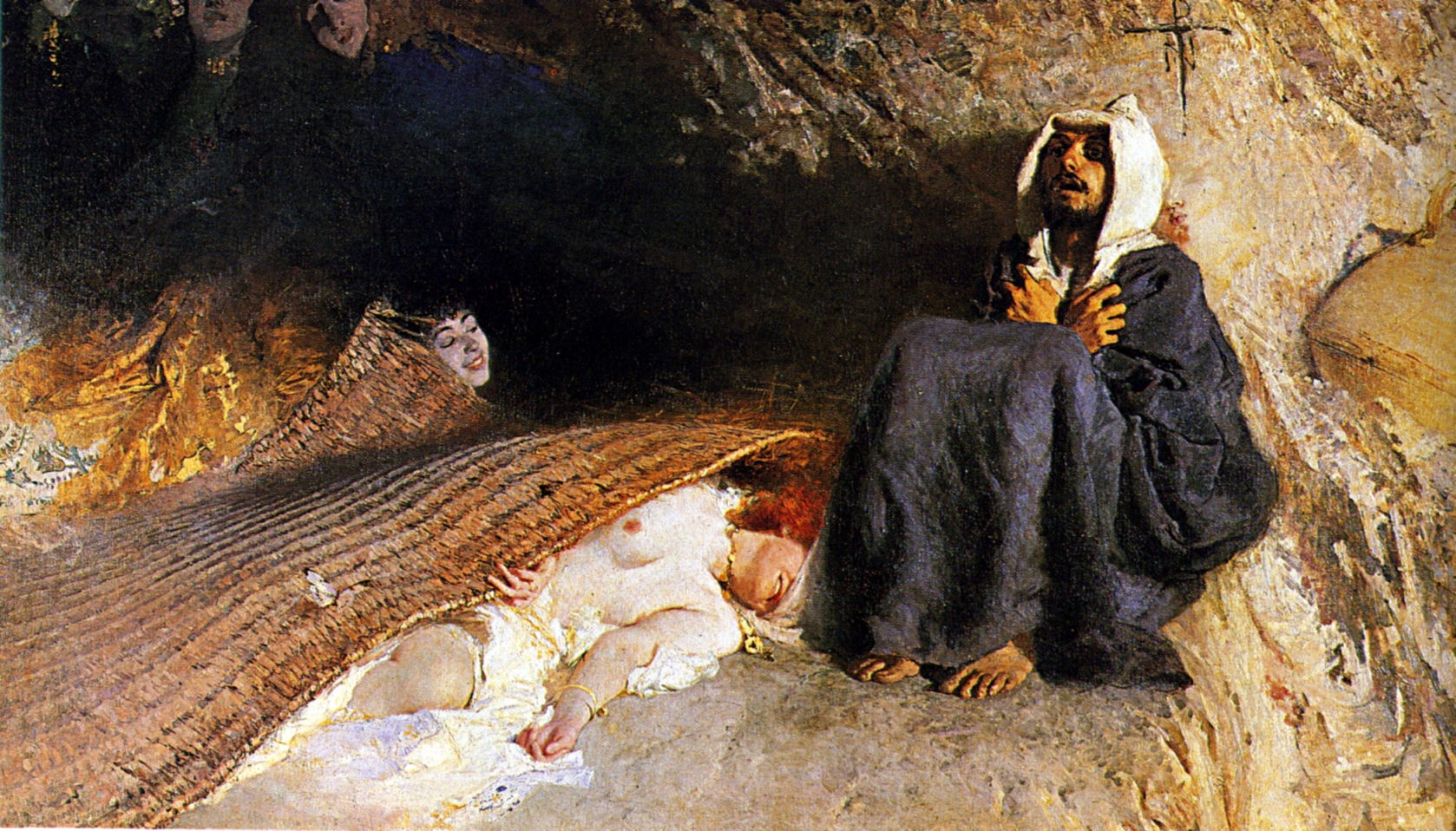
The influential Neapolitan realist Domenico Morelli painted this stark work in 1878, perhaps the exact antithesis of the rich imagery that had developed since the Renaissance.

That same year, Félicien Rops painted his satirical and irreverent version with more subtle details. Bound to the cross in Saint Anthony’s tempting vision is a visibly voluptuous woman, the word EROS replacing the normal initialism of INRI (Iēsūs/Iēsus Nazarēnus, Rēx Iūdaeōrum, meaning Jesus of Nazareth, the King of the Jews) shown above Christ’s head. Christ himself, with full stigmata, has been knocked sideways to accommodate the woman’s naked body. Behind the cross the horned devil wears scarlet robes and pulls faces. Behind him is a pig, Anthony’s attribute. The two daemonic putti are most definitely not references to Bosch.

Lovis Corinth painted two versions of the Temptation. The earlier, from 1897, shows Anthony surrounded by beautiful and naked women, offering him fruit, other food, and their bodies. The daemons have faded into the background, and are caricatures based on humans.

His later canvas, explicitly painted after Gustave Flaubert, in 1908, brings in the Queen of Sheba, an elephant and monkey, but is also notable for depicting Anthony as a young man. Even Salvador Dalí’s 1946 painting of the Temptation steers clear of Bosch’s imagery, although it does at least return to the concept of an individualistic and inventive vision.

将博客从Jekyll迁到Hugo,是我几年前就想做的事了,然而积重难返,力有不逮,这几年也就逐渐淡忘了。为什么想要抛弃Jekyll呢,喜新厌旧的心态远胜于实际需要,Jekyll所被诟病的性能差的问题,在我的环境中并不关键,构建速度从8s提升到2s,看似有4倍之巨,实则并没有那么大的吸引力,还是对未知事物的探索更诱人。
如今有了AI,又有闲心,便想重启这一工程。我想要的是1:1复刻,AI并不能一步到位进行转化,但90%的工作确实都是由它完成。从一种形态切换到另一种形态,最重要的是观念的转变。Jekyll和Hugo虽然相似,但并非完全对应,当了解Hugo构建网页的逻辑后,很多问题也便迎刃而解了,对不懂编程的我来说,这是一个艰难的过程,也有事先未阅读官方文档的原因。
第一步是模板的迁移,Hugo有自己内置的引用逻辑,不如Jekyll用layout指定那么直观,主页、文章、页面需要用什么模板都得重整,对我来说是整个迁移过程中学习曲线最陡峭的部分了。AI的信息有点落后,它提供的架构是老版本的,而新版本进行了结构和逻辑的优化,不管是ChatGPT还是Gemini似乎都不太了然。幸亏我在迷惑之时想到了官方文档,否则就被AI带入落后版本的境地里了。
第二步在迁移资源文件时遇到了最大问题,是Sass一直编译不成功,和AI“讨论”了一两个小时,尝试了不同编译写法、文件结构和语法检查,最终的怀疑点在Sass的解析器上,看过官方文档后确认如此。因为我用了@use的新语法,需要用Dart Sass解析,而Hugo默认使用LibSass。在编译函数上,ChatGPT用的是已废弃的resources.ToCSS,Gemini却知道用新的toCss,这大概是在此次任务中Gemini唯一胜出的一处。
后面都是一些具体而微的问题,捡一些主要的来说。非常重要的一步是posts的适配,Hugo的语法要求更为严格,而我旧文的front matter无法通过检查。文章有几百篇,当然是让AI帮忙写脚本批量处理,Gemini写的脚本引入了新问题,而ChatGPT的脚本一次性就成功了。想来这一步若无AI而让我自己抠脚本,不知要忙到何时。
Hugo更为严格的一个地方在于不能在markdown中执行模板语言,比如partial等,而我在Jekyll中大量使用了此类写法,所以很多页面要重写。Hugo采用的方法是将其编写为shortcode,再在markdown中引用,相比Jekyll多了一步,也完全可以接受。对于图片的插入,我在Jekyll中使用了include的方法,自然也要转换为shortcode,并让AI对功能进行了扩展,支持插入单张或多张图片,这却只是因为某篇文章在新环境中无法再使用模板语言的循环结构。
有一处让人遗憾的功能是Hugo不支持csv格式的数据集,对我来说这是维护读书列表最简单的方式。Hugo也可以处理csv文件,但AI提供的data.GetCSV方式已废弃,用transform.Unmarshal却遇到了csv文件的BOM问题,怎么也修复不了,只能忍痛将读书列表转成了json格式。
Hugo的链接格式生成也不如Jekyll符合心意。我已养成了2025-12-14-hello-world.md风格的文件命名习惯,觉得如此更为条理,但Hugo的:contentbasename不能像Jekyll一样自动取文件名中的英文标题加入链接,:title又带有中文,唯有在front matter中多加一个 slug字段来指定链接内容。
还有一个无伤大雅的功能便是字数统计,前几天才刚让AI写了能较准确统计中英文混排字数的Jekyll插件,现在却突然改弦易帜了,插件也无用武之地。虽说Hugo也能编码实现相同功能,但我图省事就用内置的{{ .WordCount }},在站点配置hasCJKLanguage = true的情况下也还堪用,不过会虚高一些。
Hugo也是老人了,难怪AI掌握的多是一些过时信息,最新的静态博客引擎是什么,我暂时没有兴趣。Hugo就是我以前心中的“白月光”,如今已达夙愿,也可安稳一段时间——Jekyll不也用了七年吗,难道是七年之痒——即便博客再写好多年,Hugo的性能也足够。我觉得Jekyll和Hugo各有千秋,正如开头所说,此一番折腾不过是喜新厌旧而已。而此次工程的两位帮手,俱是免费版的ChatGPT和Gemini两相比较,我觉得ChatGPT写的代码更简洁、更健壮、也更有效。至于一开始订立的1:1还原目标,实际并未完全做到,不是不能,而是没有必要了。
© Mark Harris
Paintings of scenes from the hagiographies of Christian saints have been enduring favourites, particularly for churches dedicated to that saint, and for sponsors named after them. The lives of some saints are sufficiently complicated as to offer the artist a choice of different scenes, but in the case of Saint Anthony the Great (of Egypt, the Abbot, etc.), paintings are almost confined to his temptation by the devil.
Saint Anthony was born in 251 CE to wealthy parents in Lower Egypt. His parents died when he was 18. He then became an evangelical Christian, and gave his inheritance away to follow an ascetic life. For fifteen years he lived as a hermit. During this time the devil fought with him, afflicting him with boredom, laziness, and dreams of lustful women, before beating him unconscious.
Friends found him and brought him back to health, so he returned to the desert for another twenty years. This time the devil afflicted him with visions of wild beasts, snakes and scorpions, but again he fought back, eventually emerging serene and healthy. He went to Alexandria during the persecution of Christians there, to comfort those in prison. He returned to the desert, where he built a monastic system with his followers.
His attributes are a bell, a pig, a book, the Tau cross (like a capital T), sometimes with a bell pendant. He is commonly shown being tempted in a wilderness, often by naked women, and is associated with fire (“Saint Anthony’s Fire”).
The visionary nature of his temptation, and the temptations offered him, give a painter a wonderful opportunity to exercise their imagination, and to include content that might otherwise be excluded from places of worship. This weekend I show a selection of paintings of this unique story. This article covers paintings before 1650, and the next will cover the period from 1660 to the early twentieth century.

Painted in 1430-32, Stefano di Giovanni’s St Antony Beaten by the Devils identifies the saint by his Tau crucifix. Three devils, clearly fallen angels by their wings, are beating him with clubs. Those devils are fairly conventional figures, part animal and part man, with horns.

Michelangelo’s The Torment of Saint Anthony (c 1487–88) continues the theme. Saint Anthony is now being held aloft by ten or so devils, including a weird fish with many spines and a trunk-like snout. The devil at the lower left of the group has breasts and a face in its perineum, which almost makes it double-ended.
We then reach a watershed in the unique paintings of Hieronymus Bosch. Records make it clear that he painted several different versions of the Temptation of Saint Anthony, of which it appears that the Lisbon triptych from about 1500-10 is the sole complete survivor, and there’s also the remains of another in a fragment in Kansas City.

Inside the triptych now in Lisbon, the left panel shows Saint Anthony being assisted by three others, as he crosses a small wooden bridge, in a state of complete exhaustion, perhaps after being beaten unconscious by the devil. In the countryside around that group are weird human and portmanteau animal figures. In the sky above, Saint Anthony is seen again, being flown around on the back of another invented animal.
The centre panel shows Saint Anthony in the middle, kneeling in prayer and surrounded by bizarre figures, creatures, and objects, as if in a vision of temptation. In the background a town is burning.
The foreground shows more scenes involving bizarre figures, creatures, and objects. At the left, a jumble of them emerges from the huge shell of a strawberry-like fruit. One of those figures is astride a goose, and playing a harp. In the middle is a small pond, in which a hybrid between a fish and a boat is floating, and a man is seen inside another strange creature.
The right panel shows Saint Anthony seated, with a book open in front of him. He is again surrounded by strange figures and creatures from a vision of temptation. The background shows a prominent windmill and towers, behind which is a wintry landscape with snow on the ground.
In the foreground, in front of the saint, is a circular table, half-covered with a white tablecloth. The table is supported by naked human figures, one of whom has his left foot in a large pot. Another wears an armoured glove brandishing a heavy scimitar, but a creature has passed a thin-bladed sword through its neck. At the left edge of the table, another naked human is blowing a curiously curved trumpet. To the right an abdomen with ears and legs, wrapped in a red cloth hat, has a sword stuck into it.

Matthias Grünewald’s slightly later diptych provides useful contrast between the conventional Visit of St Anthony to St Paul on the left, and his Temptation of St Anthony (c 1515) on the right. These daemons are different from Bosch’s, but are nevertheless highly imaginative in their appearance.

The outside of the left panel of Niklaus Manuel’s Antonius altar shows Demons Tormenting St. Anthony (1520). Its daemons, and the wooden clubs with which they attack the saint, are inventive, but still rooted in Stefano di Giovanni’s of a century before.

Lucas van Leyden’s painting of about 1530 appears to have been directly influenced by Bosch. Leading its small procession of strange creatures is a man with a bird’s head, and a long bill, wearing ice-skates, clearly derived from the creature bearing a note in the foreground of the left wing of Bosch’s triptych. There are several other familiar features in those creatures, but the rest of the painting is more conventional.

By about 1540, Cornelis Massijs was still content to paint an almost completely realist image, showing Saint Anthony with two naked women, and another who may be their procuress. But once again there are some small decorations – a pot-bellied man, a creature with an inverted funnel on its head, and a little group at the right – that seem to have invaded from the mind of Bosch.

When we reach Pieter Coecke van Aelst in 1543-1550, the emphasis has changed completely. There are still three normal human figures, of the saint, a tempting nude, and her procuress behind, but the rest of the painting is filled with Bosch derivatives, such as the nun with wings biting someone’s leg, in the foreground. The burning town also makes an appearance in the left distance.

Paolo Veronese’s interpretation from 1552-53 is difficult to read, but the saint is almost completely obscured under a well-muscled devil and a woman whose left breast is exposed. Anthony is sprawled on his back, in his brown habit, his left hand fending off the woman’s hand, his right clutching a book. The devil is holding him down with his left hand, and about to strike him with a club held in his right.

Pieter Huys’s painting of 1577 is more obviously a derivative from Bosch. Saint Anthony could almost have been copied from one of the earlier paintings, and most of the strange figures and creatures have been borrowed and re-interpreted. Musical instruments such as the lute and harp make an appearance, but many of the symbols have been changed. For example, where Bosch’s triptych features round tables with a white cloth, Huys opts for a rectangular table, and the background has a town burning even more violently.
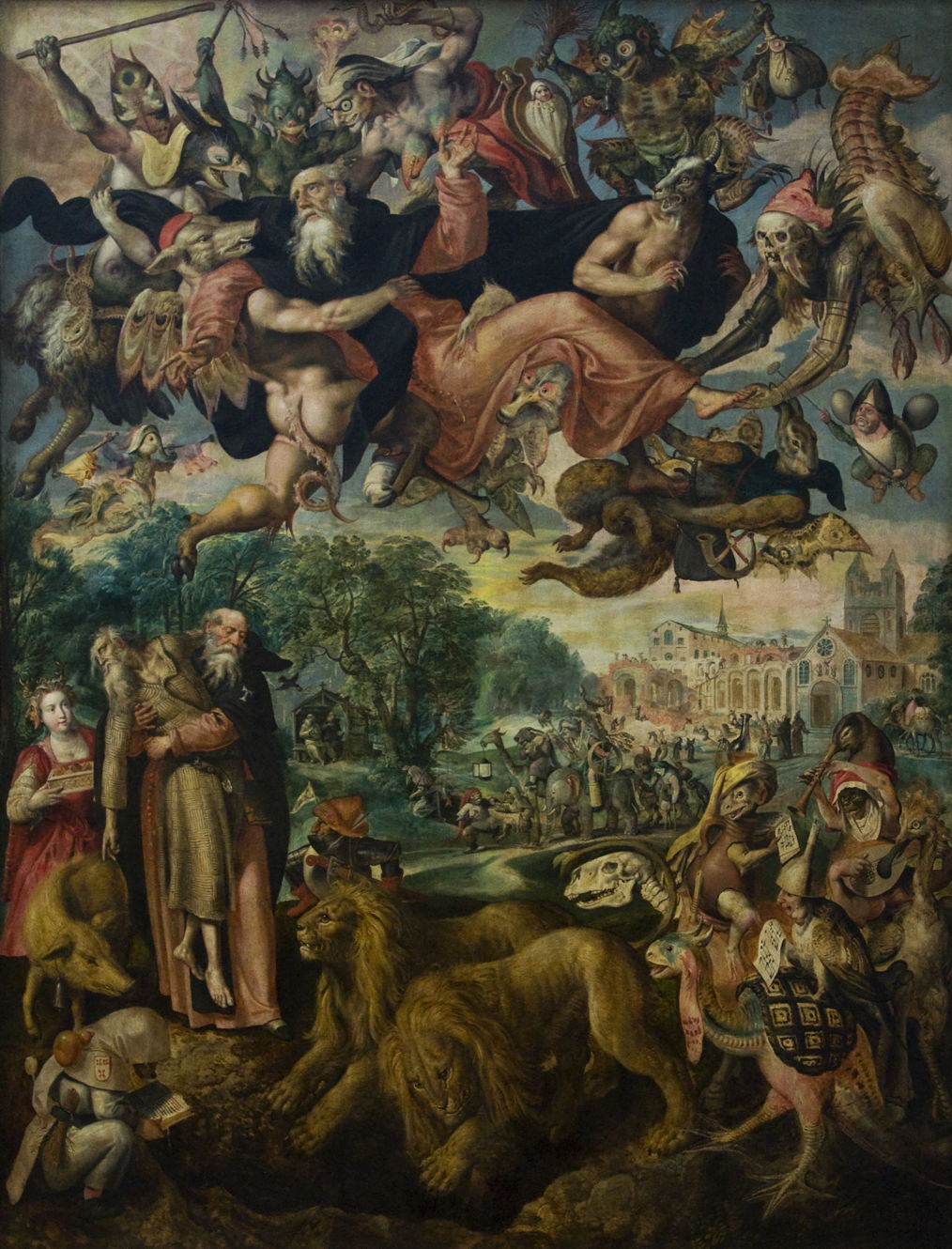
Maerten de Vos’s vision of 1591-4 follows a more traditional line again, although it contains some strange elements that appear more personal. He shows one Saint Anthony apparently carrying another, unconscious Saint Anthony in his arms, rather than the saint supported by friends. There’s a third version of the saint flying in the air, surrounded by daemons, too. That unconscious saint points to a pig, a recognised attribute, but nearby is a pair of lions. One of the more Bosch-like creatures in the right foreground is a portmanteau of human and bird, wears an inverted funnel on its head, and is reading sheet music.

Just a century after Bosch painted his triptych, Jan Brueghel the Elder combines a cavalcade of more traditional figures with a foreground of more bizarre ones derived from Bosch, including an old person’s head with four human legs, and a bird with two heads, one of a cockerel and the other a duck with a clarinet-like bill. A second image of the saint appears in the sky, surrounded by daemons, and a church is on fire in the background.

By about 1650, Joos van Craesbeeck was using some of Bosch’s iconography with his own developments. The use of a human head as a container is probably derived from Bosch’s tree-man and similar devices, but here has become even more realistic. To the right of that, a naked man sits facing backwards on a duck-horse: he is playing a stringed musical instrument, and wearing an inverted funnel on his head. Van Craesbeeck’s humans seem to have grown small red tails too. Oddly, van Craesbeeck doesn’t place the Greek letter Tau on the saint’s robes, but the Roman letter A, perhaps monogrammed with Tau. That appears unique to this painting.
Here are this weekend’s Mac riddles to entertain you through family time, shopping and recreation.
1: The first macOS from the mountains around Tahoe.
2: The eighth came from the App Store with Mission Control and a mane.
3: The sixth came with a time machine and spots.
To help you cross-check your solutions, or confuse you further, there’s a common factor between them.
I’ll post my solutions first thing on Monday morning.
Please don’t post your solutions as comments here: it spoils it for others.
During the first few years of the twentieth century, the former Nabi painter and print-maker Félix Vallotton had concentrated on painting mysterious interiors, as well as portraits and other figurative works.

By 1907, when he painted this Orientalist Turkish Bath, his figures had become modern in appearance. With their tied-up hair, it would be easy to mistake this as a painting from fifty years later.

That same year, he started painting scenes from classical myth, here Andromeda Standing with Perseus (1907). This shows the sea monster Cetus heading for a defenceless Andromeda, as hero Perseus charges to her aid through a cleft in the black sky. He has lost his classical attribute of the head of Medusa, and here rides the winged horse Pegasus while holding a knight’s lance. The horse’s wings form an edge to the black sky as it carves through the air. Each figure is colour coded: green for the sea monster, pink for the near-victim, and blue for the hero, against a straw-coloured sea.

The following year, he again broke with convention in his painting of The Rape of Europa (1908). In this clean and simplified account, we look out to sea as the naked Europa clambers onto the back of Jupiter disguised as a brown bull. Given the long-established literary and artistic tradition of the bull being white, this can only have been a deliberate choice on his part.

In addition to mythological narratives, Vallotton started painting more landscapes, some of which are unusual and innovative, like La Mare, Honfleur (1909), showing a pond at night near the north coastal town of Honfleur. The black plane of the water has ripples travelling from a point at the right edge. In the left foreground is a stand of long grass and weeds bowed over in an arc, and behind the blossom on a tree glows in the dark.

Vallotton returned to the story of Perseus and Andromeda in 1910, in his Perseus Killing the Dragon, which is no sequel to his earlier work. Here he catches the height of peripateia and action, as Perseus is slaying Cetus. Andromeda, long freed from her chains, squats, her back towards the action, at the far left. Her face shows a grimace of slightly anxious disgust towards the monster. Perseus is also completely naked, with no sign of winged sandals, helmet of Hades, or any bag containing Medusa’s head. He is braced in a diagonal, his arms reaching up to exert maximum thrust through the shaft of a spear impaling Cetus through the head. The monster is shown as an alligator, its fangs bared from an open mouth.

In Sauciness from 1911, we see a young woman still undressed in her white chemise, her unmade bed behind. She looks at herself in the mirror of a small dressing table, wondering what to wear.
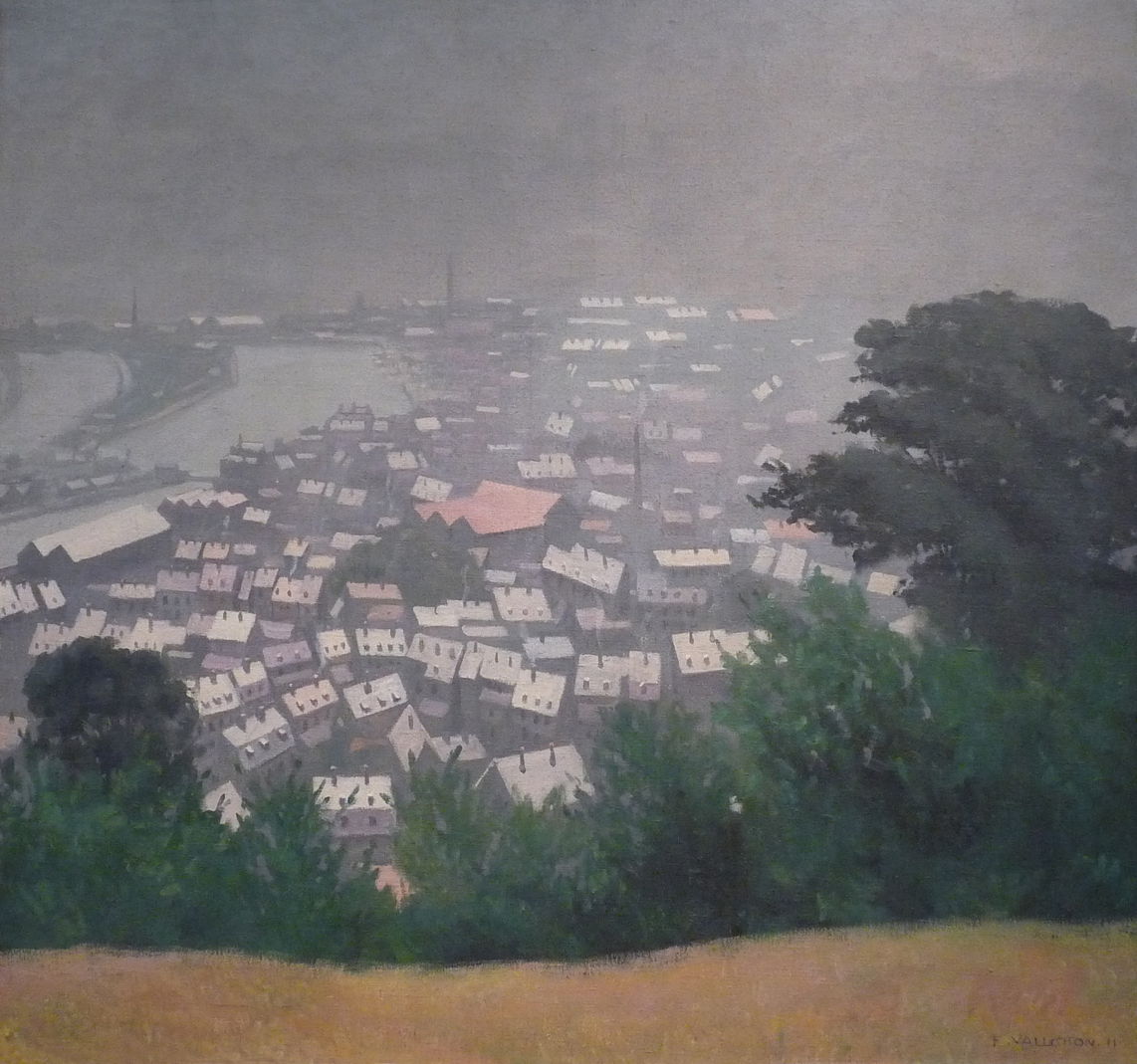
His Honfleur in Fog from 1911 isn’t a conventional view of this small port on the north French coast, as it looks down from Mont-Joli to the west of the town centre. It captures exactly the sort of transient effects that had been the concern of Impressionism, but in Vallotton’s distinctive style.

In 1913, Vallotton returned to transient atmospheric effects in Night With Light Fog. Influenced by his print-making, he distils this scene into simple geometry, with almost two-thirds of his canvas the vague purple forms of the town and sky, and three simple bands below it. The lone lamppost and figure at the extreme left restore context.

He painted this Self-portrait in a Dressing Gown at a turning point in 1914, just as the world was about to enter the Great War, and he was to enter his fifties, the start of the next and final article in this account of his career and art.
© Evan Vucci/Associated Press
Throughout much of Europe, bread has been a staple food for the whole of recorded history, and has become a symbol of life in both language and visual art.

For the classical civilisations of the Mediterranean, this was embodied in the goddess of Jean-François Millet’s Ceres (The Summer) from about 1864-65. She stands, her breasts swollen and ready for lactation, her hair adorned with ripe ears of wheat, a sickle in her right hand to cut the harvest, and a traditional winnow to separate grain from chaff in her left hand. At her feet is a basketful of bread, with ground flour and cut sheaves of wheat behind. The background shows the wheat harvest in full swing, right back to a group of grain- or hay-stacks and an attendant wagon in the distance.
Bread and its sharing is one of the central symbols of Christian beliefs, most notably in the Last Supper, the meal shared by Christ with his disciples before his crucifixion.

The most famous painting of The Last Supper, and one of the best-known works in the European canon, is of course Leonardo da Vinci’s. Giampietrino’s copy from about 1520 gives the closest impression today of what the original must have looked like. Even this copy has been horribly mutilated: the upper third was cut off, and its width reduced, but at least what remains gives a better idea of the original’s appearance.
Leonardo’s composition wasn’t entirely revolutionary for the time. Previous paintings of The Last Supper had spread the apostles along the length of a table, with Christ at its centre. However, Judas Iscariot was usually placed alone on the near side, his back to the viewer, and sometimes with his bag of silver visible behind his back.
Leonardo shows the moment of surprise and denial when Christ announces that one of those sat around the table would betray him. In this, he was perhaps the first artist to assemble the apostles into small groups, a feature that has been repeated in innumerable images following this. Arrayed along the front of the table is a series of round bread rolls and small glasses of red wine.

After his crucifixion and resurrection, Christ appeared several times to his disciples. In The Supper at Emmaus, painted here by Paolo Veronese, two disciples had travelled on the road from Jerusalem to Emmaus as pilgrims, and recognised Christ as he “sat at meat with them, he took bread, and blessed it, and brake, and gave it to them.”
The painting contains separate passages to cue this narrative: on the far left is an asynchronous ‘flashback’ referring to the journey to Emmaus. Christ is in the centre of the painting, identified by his halo, and in the midst of breaking bread. With him at the table are the two bearded figures of the disciples, dressed as pilgrims and bearing staves. On Christ’s right is a servant, acting as waiter to the group. The onlookers dressed in contemporary costume are an aristocratic Italian family of the day, whose portraits are combined.
Christian rites reiterate the Last Supper in Eucharist, and the blessing of bread plays other roles in its religious ceremonies.

Mykola Pymonenko’s Waiting for the Blessing (1891) shows the scene at a country church in Ukraine at dawn on Easter Sunday. The local population is crowding inside, while the women gather with their Paska, traditional ornamental bread that must be blessed before it can be eaten as a brunch.
Bread appears elsewhere as a symbol of life, particularly in the context of poverty and charity.

Edmund Blair Leighton’s Charity of Saint Elizabeth of Hungary from about 1895 shows a famous woman who built a hospital where she personally served the sick. Born in 1207, she died in 1231 at the age of only twenty-four. Leighton doesn’t show her in a nursing role, though, but handing out loaves to feed the poor.

Elizabeth Nourse painted some social realist works looking at the lives of the rural poor. Among these is The Family Meal from 1891, which was awarded a medal at the World’s Columbian Exposition in Chicago in 1893, and is seen here as an engraving in its catalogue. Parents sit with their two young children at an almost bare table. Their meal consists of a pot of soup and the remains of a loaf of what appears to be stale bread. The older child looks expectantly at her mother, who stares despondently at the table. Her husband stares down at his empty bowl.

The wonderfully named Philip Hermogenes Calderon painted his “Lord, Thy Will Be Done” in 1855. This quotation is derived from the Gospel account of what became the Lord’s Prayer, and has subsequently been used on many Christian religious occasions.
A young mother cradles her baby on her lap, looking up to the left. She’s living in difficult circumstances, but isn’t destitute, and wears a wedding ring on her left hand. The carpet is badly worn, and the coal scuttle empty, but there’s a loaf of bread on the table: she has her ‘daily bread’, another reference to the Lord’s Prayer. A portrait of a fine young man hangs above the mantlepiece, indicating her husband and the baby’s father is currently absent on military service. Several issues of The Times newspaper are scattered on the floor at the right, as if the woman has been following news of a military campaign overseas. Under the table is a letter, most probably from her husband.

Christian Krohg’s The Struggle for Existence, also translated as The Struggle for Survival from 1889 shows Karl Johan Street in Oslo in the depths of winter, almost deserted except for a tight-packed crowd of poor women and children queuing for free bread. These people are wrapped up in patched and tatty clothing, clutching baskets and other containers in which to put the food. A disembodied hand is passing a single bread roll out to them, from within the pillars at the left edge. That was yesterday’s bread; now stale, the baker is giving it away only because he cannot sell it.
Next week I will show paintings of bread as food.
© Kenny Holston/The New York Times
Google is so helpful now when you ask it to solve a problem, such as how to free up space on your Mac. Not only can it make its own suggestions, but it can tap into those from AIs like ChatGPT and Grok. This article shows how that can bring you malware, thanks to the recent research of Stuart Ashenbrenner and Jonathan Semon at Huntress.
Please don’t try anything you see in this article, unless you want AMOS stealer malware on your Mac.
I started by entering a common search request, clear disk space on macOS, the sort of thing many Mac users might ask.

At the top of Google’s sponsored results is an answer from ChatGPT, giving its trusted web address. When I clicked on that, it took me to ChatGPT, where there’s a nice clear set of instructions, described impeccably just as you’d expect from AI.

This helpfully tells me how to open Terminal using Spotlight, very professional.

It then provides me with a command I can copy with a single click, and paste straight into Terminal. It even explains what that does.

When I press Return, I’m prompted for my password, which I enter.

Although I was a bit surprised to see this prompt, it looks genuine, so I allowed it.

Far from clearing space on my Mac, the malware, an AMOS stealer, has gone to work, saving a copy of the password I gave it, in the /tmp folder, and installing its payload named update.

Scripts like .agent are installed in my Home folder, and my (virtual) Mac is now well and truly owned by its attacker.
Full technical details are given in this post from Huntress.
As Ashenbrenner and Semon point out, this marks a new and deeply disturbing change, that we’re going to see much more of. We have learned to trust many of the steps that here turn out to lead us into trouble, and there’s precious little that macOS can do to protect us. This exploit relies almost entirely on our human weakness to put trust in what’s inherently dangerous.
First, distrust everything you see in search engines. Assess what they return critically, particularly anything that’s promoted. It’s promoted for a reason, and that’s money, so before you click on any link ask how that’s trying to make money from you. If that’s associated with AI, then be even more suspicious, and disbelieve everything it tells you or offers. Assume that it’s a hallucination (more bluntly, a lie), or has been manipulated to trap you.
Next, check the provenance and authenticity of where that click takes you. In this case, it was to a ChatGPT conversation that had been poisoned to trick you. When you’re looking for advice, look for a URL that’s part of a site you recognise as a reputable Mac specialist. Never follow a shortened link without unshortening it using a utility like Link Unshortener from the App Store, rather than one of the potentially malicious sites that claims to perform that service.
When you think you’ve found a solution, don’t follow it blindly, be critical. Never run any command in Terminal unless it comes from a reputable source that explains it fully, and you have satisfied yourself that you understand exactly what it does. In this case the command provided was obfuscated to hide its true action, and should have rung alarm bells as soon as you saw it. If you were to spare a few moments to read what it contains, you would have seen the command curl, which is commonly used by malware to fetch their payloads without any quarantine xattr being attached to them. Even though the rest of the script had been concealed by base-64 encoding, that stands out.
If you did get as far as running the malicious script, then there was another good clue that it wasn’t up to anything good: it prompted you for a System Password:. The correct prompt should just be Password:, and immediately following that should be a distinctive key character that’s generated by macOS for this purpose. Then as you typed your password in, no characters should appear, whereas this malware showed them in plain text as you entered them, because it was actually running a script to steal your password.
Why can’t macOS protect you from this? Because at each step you have been tricked into bypassing its protections. Terminal isn’t intended to be a place for the innocent to paste obfuscated commands inviting you to surrender your password and download executable code to exploit your Mac. curl isn’t intended to allow malware to arrive without being put into quarantine. And ad hoc signatures aren’t intended to allow that malicious code to be executed.
As I was preparing this article Google search ceased offering the malicious sponsored links, but I expect they’ll be back another time.
AI is certainly transforming our Macs, in this case by luring us to give away our most precious secrets. This isn’t a one-off, and we should expect to see more, and more sophisticated, attacks in the future. Now is the time to replace trust with suspicion, and be determined not to fall victim.
中国商务部副部长凌激与美国电子付款巨头PayPal全球副总裁纳什会面时说,中国将支持跨境电商等新业态新模式持续健康发展,拓展外国游客入境消费。
据中国商务部网站消息,兼任国际贸易谈判副代表的凌激星期三(12月10日)与纳什(Richard Nash)会面,双方围绕PayPal在华投资经营、中国开放发展机遇进行交流。
凌激说,中国将支持跨境电商等新业态新模式持续健康发展,打造“购在中国”品牌,拓展外国游客入境消费,提升入出境游便利化水平。他欢迎PayPal持续拓展在华业务,创新跨境支付产品与服务,提升互联互通水平。
根据中方新闻稿,纳什说,得益于中国不断扩大开放的政策环境,PayPal在华业务持续扩大。PayPal将加强与中国电商企业合作,并深化支付系统国际合作,为“购在中国”做出贡献。
Painting in the Dutch Republic during the Golden Age was rich in landscapes, interiors and images of everyday life, but didn’t abandon storytelling. Many of Rembrandt’s finest works are religious narratives and tales drawn from classical mythology and history. This article shows a selection of paintings by the less famous, and how their stories extended beyond those that had been most popular in the Renaissance.

The Annunciation (1667) is a large canvas, and among the few religious paintings that Adriaen van de Velde made following his marriage to a Catholic woman, and his conversion to Catholicism. Although the angel is a little awkward, it seems hard to believe that this was painted by a landscape specialist.

Three years later, van de Velde painted a classical myth in his superb Vertumnus and Pomona (1670). Vertumnus was the Roman god of seasons and change, who could assume whatever form he wished. Book fourteen of Ovid’s Metamorphoses tells the story of his transformation into the form of an old woman, seen here on the left, so that he could gain entry to Pomona’s orchard and seduce her. Sadly, the yellow he used to mix greens has faded in parts, leaving some of his vegetation blue.

Jan Lievens’ painting of Quintus Fabius Maximus from 1656 may refer to this Roman’s victory at Tarentum, as told in Plutarch’s Lives. The great Carthaginian general Hannibal was only five miles away at the time of the Roman repossession of Tarentum, and this made Hannibal realise the impossibility of mastering Italy.
Paintings of fables, that had already started to become popular among Flemish artists at this time, appeared in the Republic to the north. Among them was the story of the Satyr and the Traveller, or the Man and the Satyr. A man made friends with a satyr; when the man’s hands were cold, he blew on them to warm them up. When the two were eating together, the man blew on his hot food in order to cool it down. The satyr decided that he couldn’t trust a creature whose breath blew both hot and cold, so broke off their friendship.
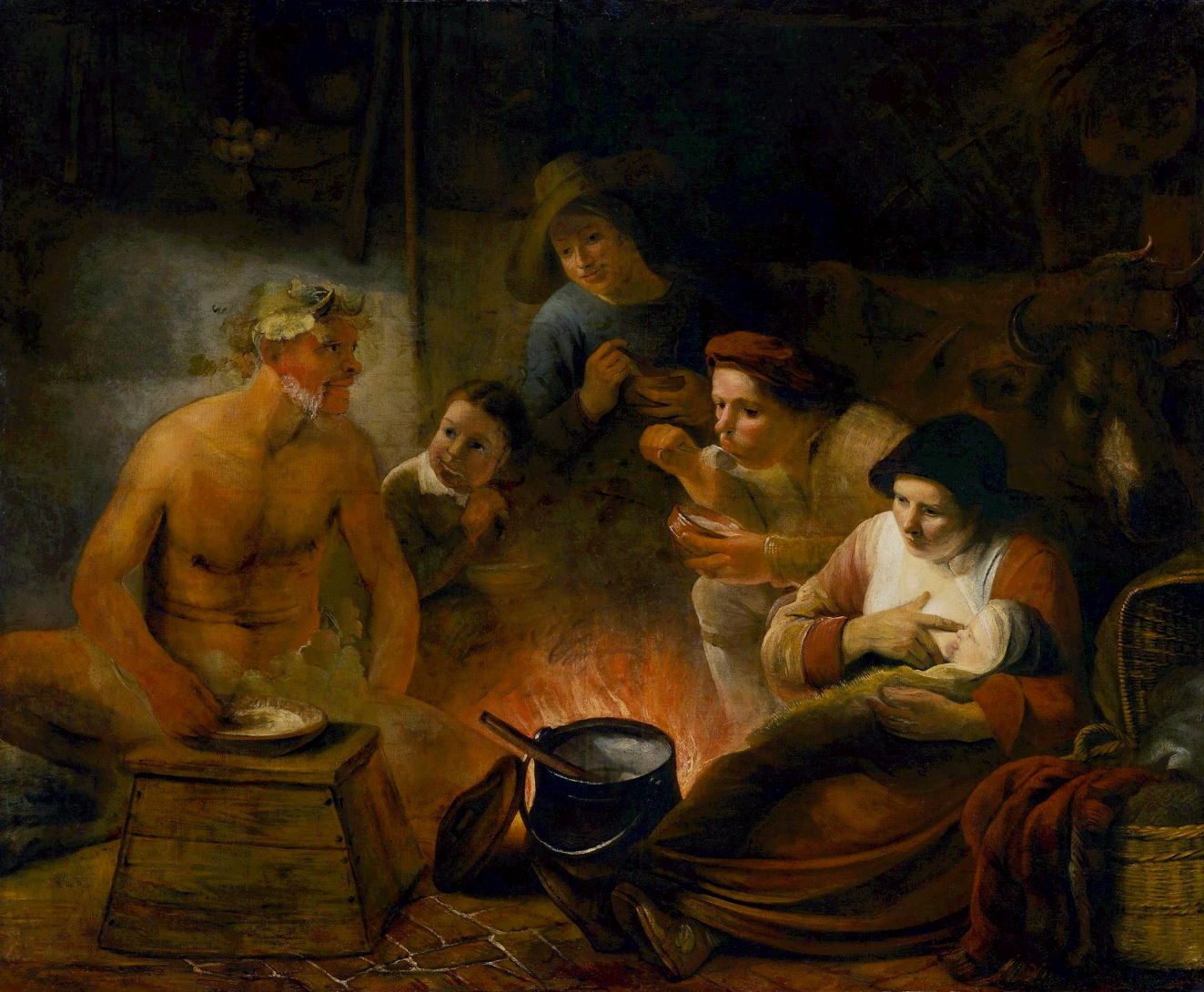
In 1653, Constantijn à Renesse, a former pupil of Rembrandt, painted his version of this fable in Satyr at the Peasant’s House. This shows one of the family blowing on the hot food in their spoon, although at this stage the satyr hasn’t reacted to the contradiction.
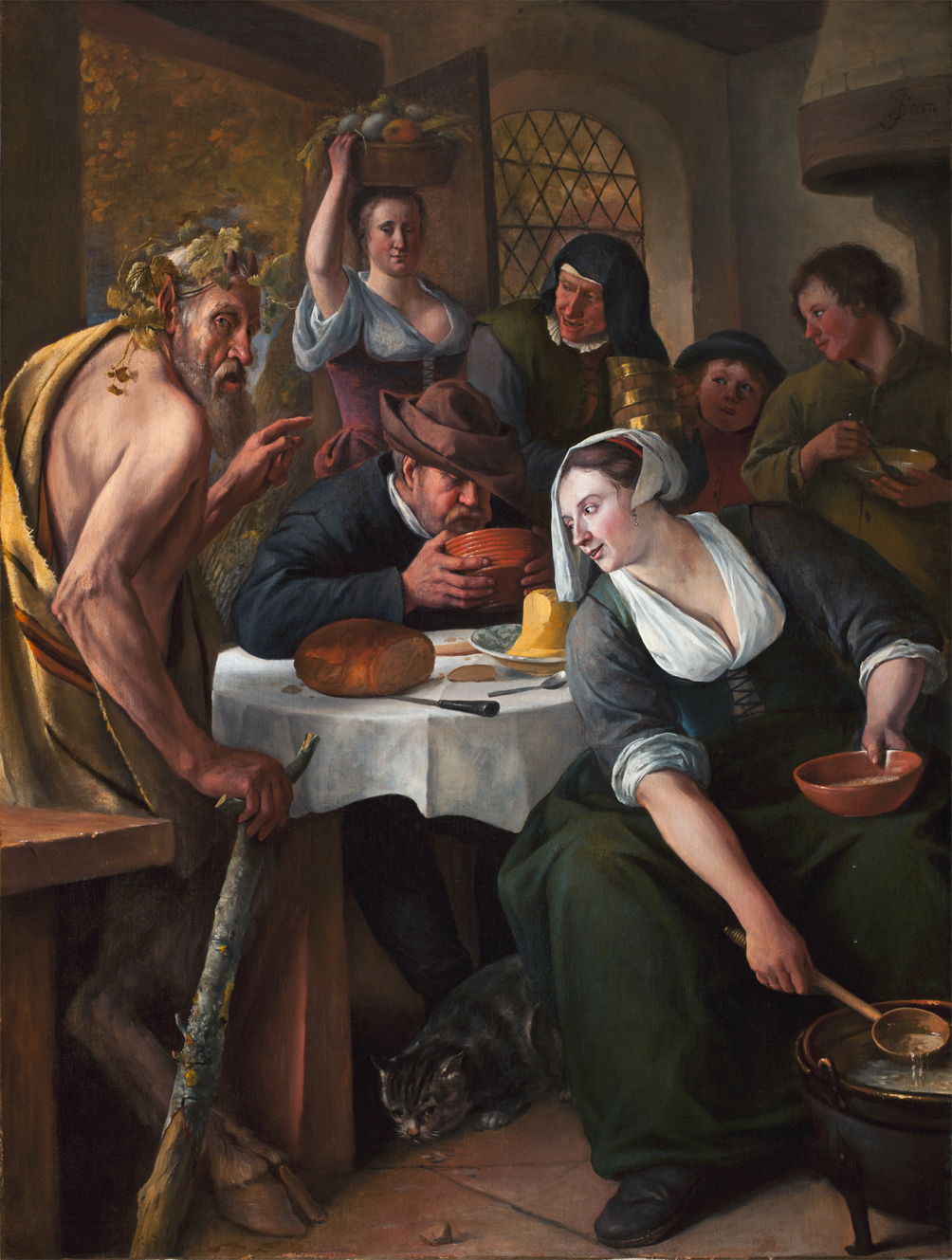
Jan Steen, in his telling of The Satyr and the Peasant “Who Blows Hot and Cold” from about 1660, gives a clearer account, with the satyr looking worried at the viewer, as a man (still wearing his hat) blows on a bowl of hot stew. He also pays attention to delightful details such as the cat skulking under the table, and a rich supporting cast.
Steen went on to paint two unusual accounts of what happened in schools across country districts in the Republic.

His The Village School from about 1665 shows physical punishment in a contemporary school. The child at the right holds out a hand for teacher to strike it with a wooden spoon, and is already wiping tears from his eyes. A girl in the middle of the canvas is grimacing in sympathy.

A few years later, Steen painted a scene in a larger and more chaotic classroom, in The Village School from about 1670. Although there are two staff sat at the teachers’ desk, the man is distracted, perhaps in cutting himself a fresh quill. The woman teacher sat next to him is engaged in explaining something to a pupil. Around them, all hell is breaking loose. In the distance, a boy is stood on one of the trestle tables. Older children are teaching younger ones, and a small group at a table at the right are trying to write while others get up to mischief. One younger child in the middle of the foreground has fallen asleep against a hat.

Gerrit Dou approaches social realism in his detailed account of The Young Mother from 1658. As she sits at her needlework, her child is attended in their wickerwork crib by a young nurse. Around them is an eclectic collection of objects, from a large cabbage, hanging game and a bundle of carrots at the right, to a bird cage and an upholstered chair at the left. Suspended above them is a chandelier, and a wooden spiral staircase ascends to the next floor. This family appears to be living in affluent squalor.
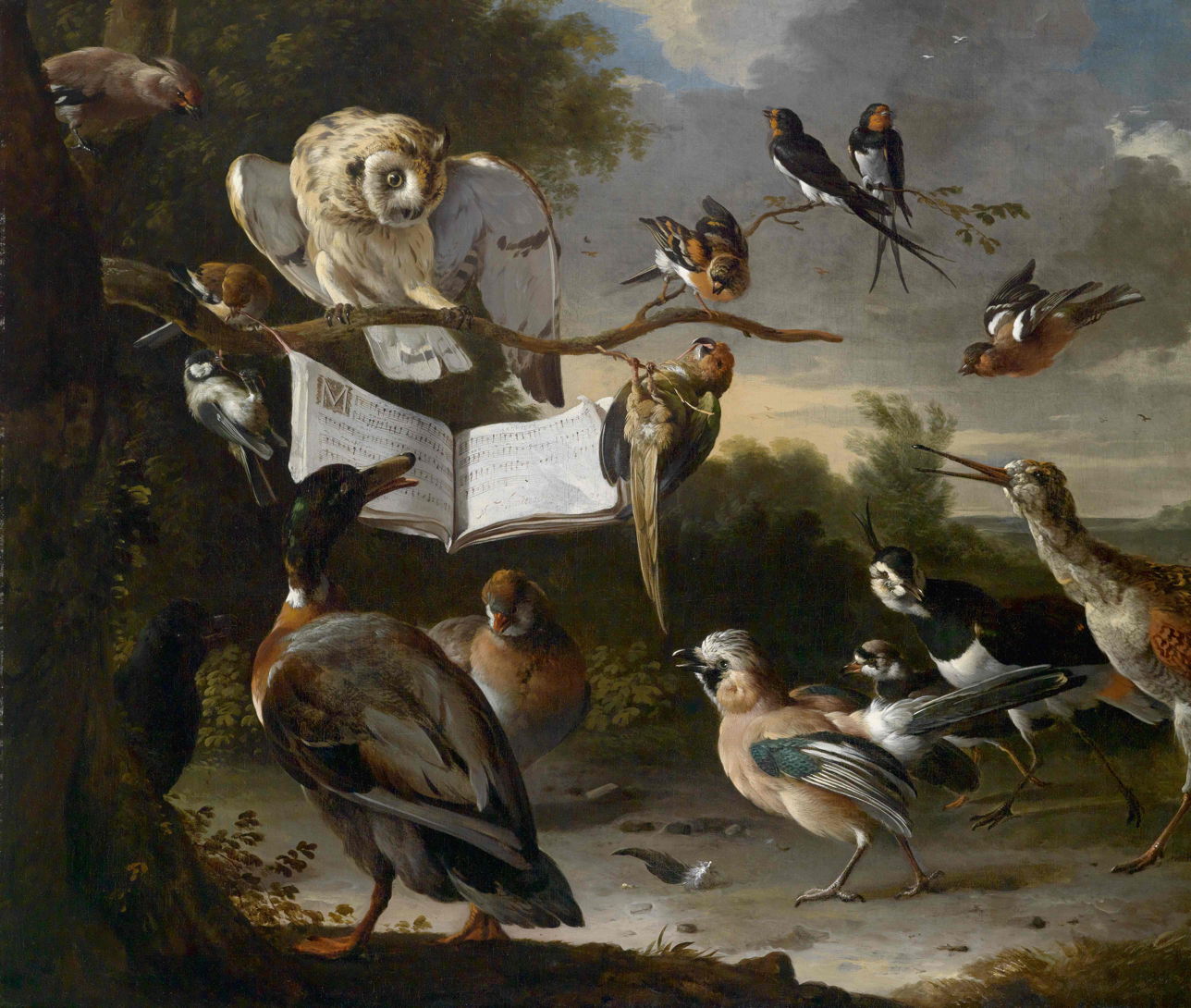
There was even an anthropomorphic fad for paintings showing gatherings of birds ‘singing’ together, and I think Melchior d’Hondecoeter’s Concert of the Birds from 1670 is probably the best example of those entertaining paintings.
Centuries of experience with painting using oil paints have proved the importance of a robust support and a ground that isolates the paint layer from its support. Older use of wood panels with a gesso ground consisting largely of gypsum or chalk ensured the paint layer wouldn’t be subjected to mechanical stress, and would remain isolated from the underlying wood. Canvases became popular because of their relative lightness particularly in larger sizes, but still require an isolating ground layer both to protect the canvas from damage by the paint, and to prevent discolouration of the paint.
When sketching in oils in front of the motif became increasingly popular in the late eighteenth century, those paintings weren’t intended for public view, but as an aid for the artist when composing finished paintings in the studio. Rather than gather hundreds of small oil sketched on canvas or panels, the first plein air painters usually used paper or cardboard as support and ground. Subsequently, when their studios were sold off following their death, surviving oil sketches were usually laid on canvas for preservation and display.

Although he probably wasn’t the first to compile a library of oil sketches, those gathered by Pierre-Henri de Valenciennes when he was painting in the Roman Campagna in the 1780s are among the most brilliant. This untitled view of the countryside near Rome is thought to have been painted in about 1783.
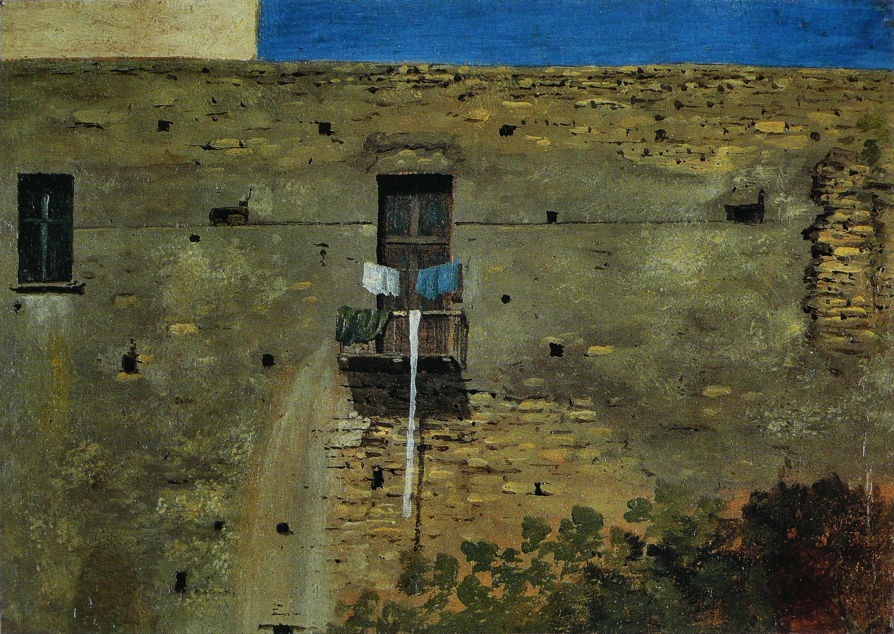
At about the same time, the Welsh painter Thomas Jones was doing the same thing in and around Naples as well. This tiny view of A Wall in Naples was painted in about 1782, and is now one of the gems in London’s National Gallery. Below is a detail.


Jones was taught by the Welsh artist Richard Wilson, but none of his oil sketches have survived. Jones’ Capella Nuova outside the Porta di Chiaja, Naples is another example that’s significantly larger, and now in the Tate Gallery.

Valenciennes went on to assemble a large library of his oil sketches that he used for his studio paintings following his return to Paris. He was admitted to the Academy in 1787, published an influential manual of perspective and painting in 1799, and became Professor of Perspective at l’École des Beaux-Arts in Paris in 1812.
Among the aspiring young landscape painters who followed in the footsteps of Valenciennes was Camille Corot, who was taught by Achille Etna Michallon, who in turn had been taught by Valenciennes. Corot painted in the Roman Campagna between 1825-28, using the same techniques of applying his oil paint direct to sheets of paper.

Corot painted this View of Rome: The Bridge and Castel Sant’Angelo with the Cupola of St. Peter’s in 1826-27. This is one of the best-known bridges over the River Tiber, and not far from the centre of the city. The view is taken from the north-east of the bridge, on the ‘left’ bank, probably close to the Piazza di Ponte Umberto I, looking towards the south-west (‘right’ bank). The painting is sketchy rather than finely finished, and appears to have been painted en plein air onto a sheet of paper that has subsequently been laid on canvas.

This View of the Convent of S. Onofrio on the Janiculum, Rome is another from Corot’s first campaign in Rome.
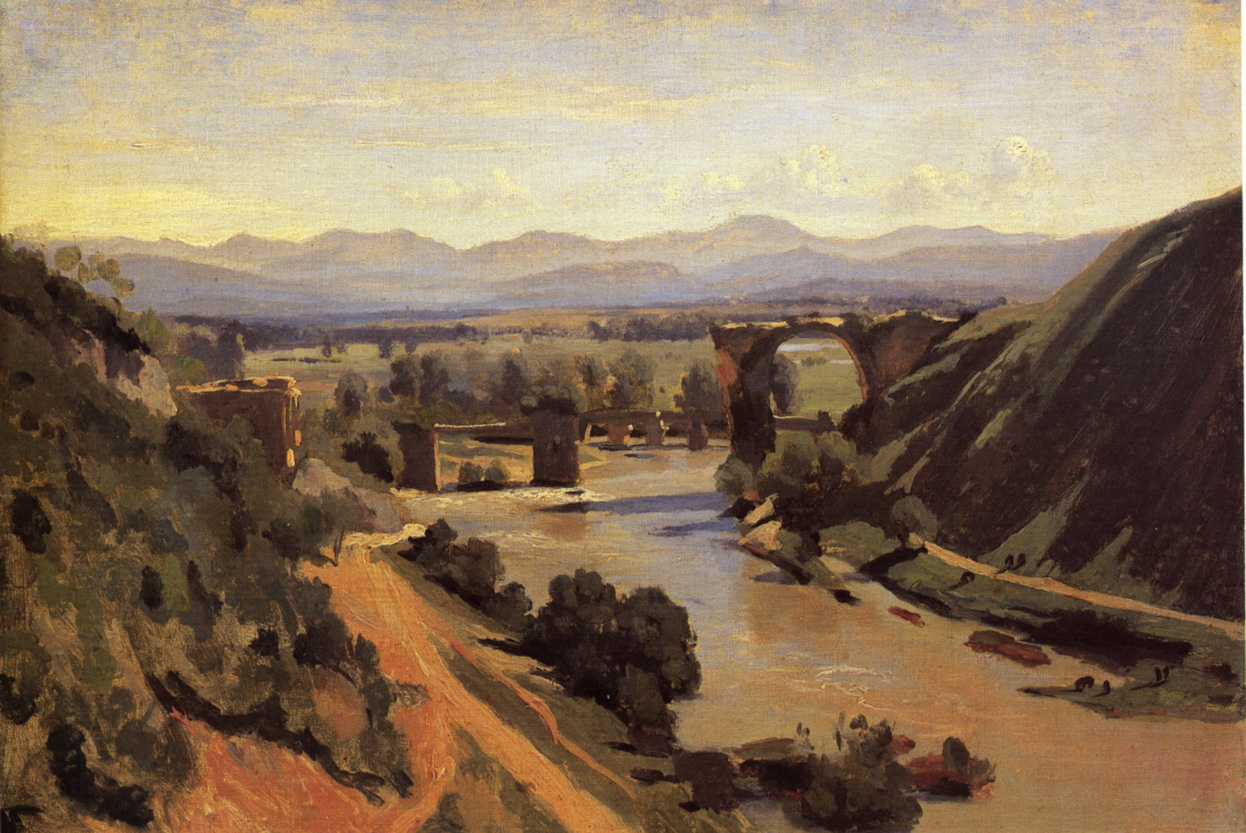
Corot’s years in Italy were formative in his own development, and one of the key elements he put in place to hand on to Camille Pissarro and other Impressionists. The Bridge at Narni is one of his finest oil sketches.
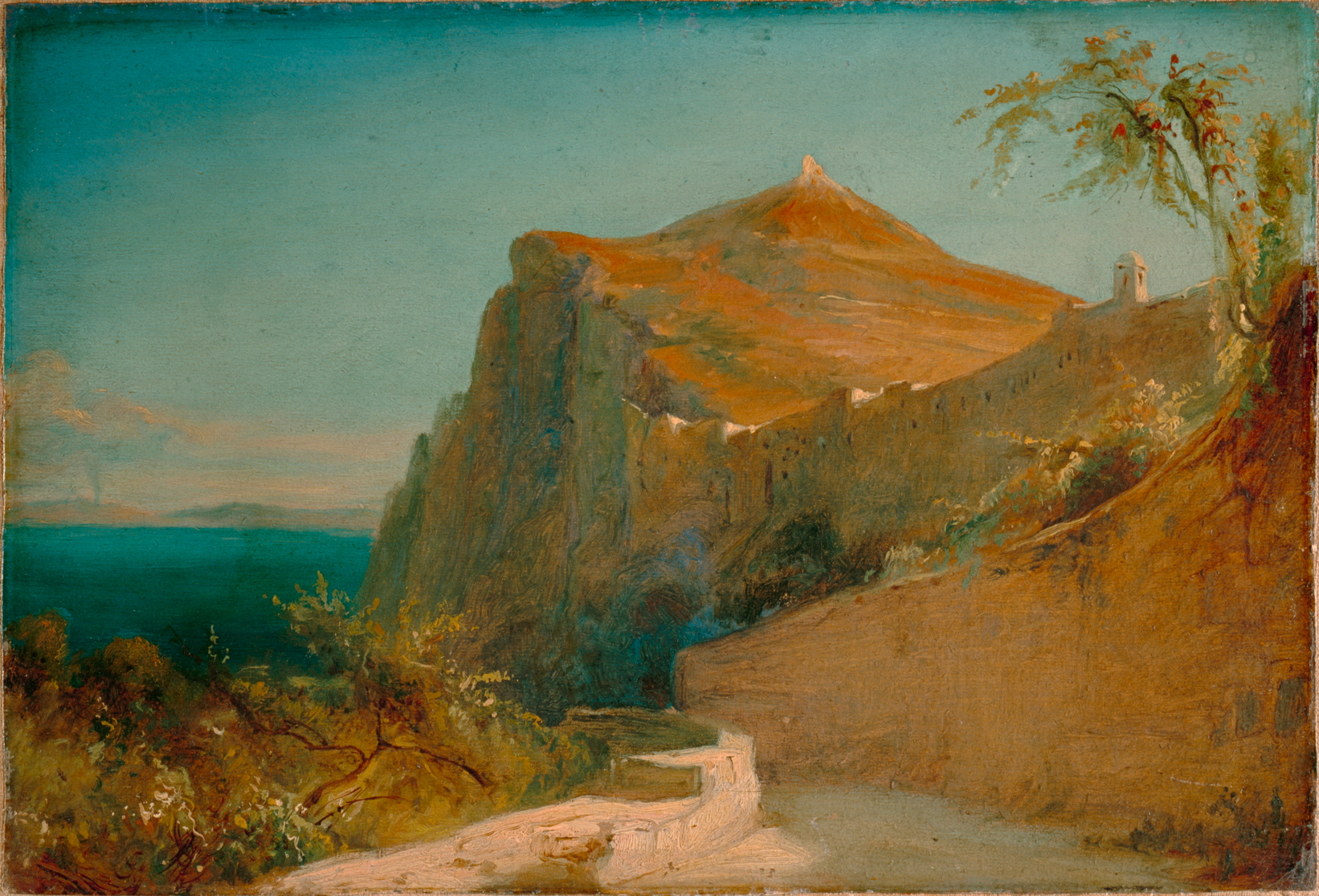
Others followed Valenciennes’ instructions, among them Carl Blechen, a brilliant German landscape painter who sketched the Tiberius Rocks, Capri during a visit in 1828-29, again on paper.

Blechen’s late oil sketch of A Scaffold in a Storm was painted in about 1835, shortly before he succumbed to severe depression. This anticipates many elements of Impressionism: it appears to have been executed rapidly in front of the motif (although a view from his studio over Berlin and Brandenburg), with many brush-strokes plainly visible; details are composed of stylised marks; it is an everyday if not banal subject, with an informal composition.
However, the French Impressionists seldom if ever sketched in oils on paper, as their paintings made in front of the motif were intended to be sold to and viewed by the public, for which paper wasn’t considered suitable. Times had changed.
Some stories in Boccaccio’s Decameron attained fame less in the original, more in their later retelling. A good example is the tragic tale of Lisabetta related by Filomena on the fourth day, when it was the fifth about those whose love ended unhappily.
In 1818, the British poet John Keats (1795-1821) wrote his version, titled Isabella, or the Pot of Basil, which was published two years later, shortly after the poet’s untimely death at the age of just twenty-five, and it quickly became one of his most popular works. Here I will tell Boccaccio’s original, using his version of the names, being mindful that Keats called his leading lady Isabella rather than Boccaccio’s Lisabetta. Her lover’s name, common to both accounts, is Lorenzo.
Following the death of a rich merchant of Messina, his three sons inherited his riches, while their sister remained unmarried despite her beauty and grace. Lisabetta and Lorenzo, a Pisan who directed operations in one of the family’s trading establishments, fell in love with one another, and their relationship was consummated.
The couple tried to keep their affair secret, but one night one of her brothers saw her making her way to Lorenzo’s bedroom, and Lisabetta remained unaware of her discovery. Her brother was distressed, but decided to keep quiet, and to discuss it with his brothers next morning.
The following day, the brothers decided that they would also keep quiet until the opportunity arose to end their sister’s relationship. Some time later they pretended they were going to the country for pleasure, and took Lorenzo with them. When they reached an isolated location, they murdered Lorenzo and buried his body. They then told their sister that they had sent him away on a trading mission.
Lisabetta was anxious for her lover’s return, and persistently asked her brothers for news of him. Eventually, one of them rebuked her for this nagging, so she stopped mentioning him altogether, but each night kept repeating his name and pining for him. One night, having finally fallen asleep in tears, she saw him in a dream, in which he said that her brothers had murdered him, and revealed where his body was buried.
In her grief, Lisabetta obtained the permission of her brothers to go to the country for pleasure. Once she had located where she thought Lorenzo was buried, she quickly found his corpse, which remarkably showed no signs of decay. As she couldn’t move his whole body for more appropriate burial, she cut off his head and concealed it in a towel.
When she returned home, Lisabetta cried greatly over Lorenzo’s head, washing it with her tears, then wrapped it in cloth and put it in a large pot. She covered it with soil and in that planted some sprigs of basil. These she watered daily with her tears, as she sat constantly beside the pot in between bouts of crying over it. As a result, the basil grew strong and lush, and richly fragrant.

William Holman Hunt’s Isabella and the Pot of Basil from 1867 is intricately detailed, with several references to the story, such as the relief of a skull on the side of the pot, a red rose on a tray by Lisabetta’s left foot, and a silver watering can at the bottom right. Behind her is the image of a bedroom, possibly showing Lorenzo coming to her in a flashback to their affair.

Joseph Severn’s Isabella, or the Pot of Basil from 1877 appears remarkably high in chroma, and shows Lisabetta fondly embracing the pot and crying over the basil. Severn had been a personal friend of John Keats, and painted this just a couple of years before his own death.

Edward Reginald Frampton’s Isabella, or the Pot of Basil was probably painted towards the end of the nineteenth century, or possibly in the early twentieth. Lisabetta is kneeling before her pot of basil at an altar, with a crucifix behind.

Ricciardo Meacci’s watercolour of Isabella and the Pot of Basil from 1890 shows Lisabetta embracing her pot of basil, as her three brothers watch with growing anger at her behaviour.
Her brothers began to suspect something, so had the pot removed from her room. This deepened their sister’s grief, and she kept asking after the pot.

John Melhuish Strudwick’s Isabella from about 1886 shows Lisabetta staring in grief at the stand on which her pot of basil had stood. Through the window, two of her brothers are seen making off with the pot, and looking back at her.
The brothers examined its contents and discovered Lorenzo’s head. Scared that his murder might cause them problems, they reburied the head, wound up their business, and left Messina for Naples. Lisabetta’s grief only grew deeper, and destroyed her health completely. Still asking for her pot of basil, she finally cried herself to death. Although the brothers had done everything to keep these events secret, eventually they became widely known, and were celebrated in folk verse.

The first and still greatest depiction of Keats’ retelling is John Everett Millais’ Isabella (Lorenzo and Isabella) from 1848-49, completed before he was twenty, and one of the earliest examples of Pre-Raphaelite art. This is a composite of references to Keats’ poem and Boccaccio’s story, set at an imaginary family meal which the three brothers, Lisabetta and Lorenzo are taking together.
Lorenzo is sharing a blood orange with Lisabetta, white roses and passion flowers climbing from behind their heads. The dog, acting as a surrogate for Lorenzo, is being petted by Lisabetta, but one of her brothers aims a kick at it. Other symbols are shown of the plot to kill Lorenzo: a brother staring at a glass of red wine, spilt salt on the table, and a hawk pecking at a white feather. The pot of basil is already on the balcony, awaiting Lorenzo’s head. When exhibited at the Royal Academy in 1849, it was accompanied by verses 1 and 21 of Keats’ poem.
I hope that you enjoyed Saturday’s Mac Riddles, episode 337. Here are my solutions to them.
Passing time (what a clock does) at the far right (it’s the item at the far right of the menu bar).
Winks at you when toggling extensions (switch show filename extensions off or on in the Finder, and this icon disappears briefly, then returns).
A pair of contradictory toggles (its icon shows two toggle switches, one on and the other off) for more settings (it displays the Control Centre).
They are all shown in the right side of the menu bar.
I look forward to your putting alternative cases.
Claude Monet had first visited London as he sought refuge from the Franco-Prussian War in 1870-71, when he painted one of the early impressions of the River Thames in mist, shown in yesterday’s article. He was to return just before the end of the century, when his fortunes had changed and he could afford to travel in search of motifs. Where better than the River Thames for the optical effects of mist, fog and smog?
Monet had started painting formal series during the 1880s, when he was enjoying commercial success at last. From about 1896, almost all his works were part of a series. He started travelling through Europe in search of suitable motifs for these, visiting Norway in 1895, and later Venice. When he returned to London in 1899, and in the following two years, Monet chose a different view of the Palace of Westminster, from a location at the opposite end of Westminster Bridge, for his series of 19 paintings. These were all started from the second floor of the Administrative Block at the northern end of the old Saint Thomas’s Hospital on the ‘south’ bank, and completed over the following three or four years.

His The Houses of Parliament, Sunlight Effect (1903) is more radical than his painting of thirty years earlier, showing little more than the Palace in silhouette, the sun low in the sky, and its broken reflections in the water.

The Houses of Parliament, Sunset (1903) shows the same view in better visibility, but with the sun setting and a small boat on the move in front of the Palace.
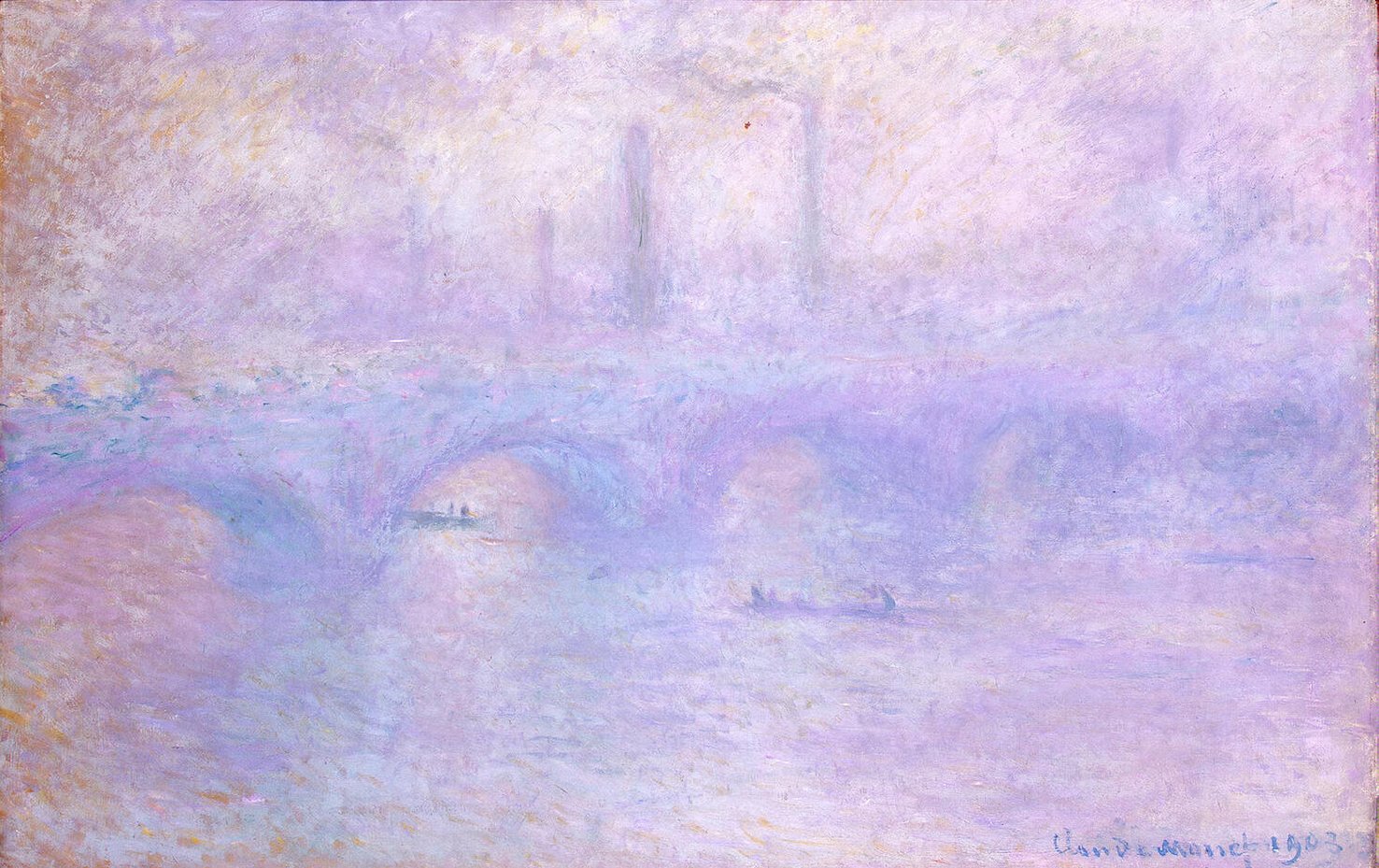
Monet’s Waterloo Bridge from 1903 is the ultimate conclusion of his paintings of fog, in which only the softest of forms resolve in its pale purple and blue vagueness, his common destination with the paintings of Turner over fifty years earlier.

In The Houses of Parliament, Stormy Sky (1904) the sun is higher and further to the south, allowing Monet to balance the silhouette of the Palace with its shadow cast on the water, and the brightness in the sky with its fragmented reflections.

Henri Le Sidaner also visited Britain on several occasions, and in 1906-07 painted this view of St. Paul’s from the River: Morning Sun in Winter, which may have been inspired by Monet’s series paintings of Rouen Cathedral, here expressed using his own distinctive marks.
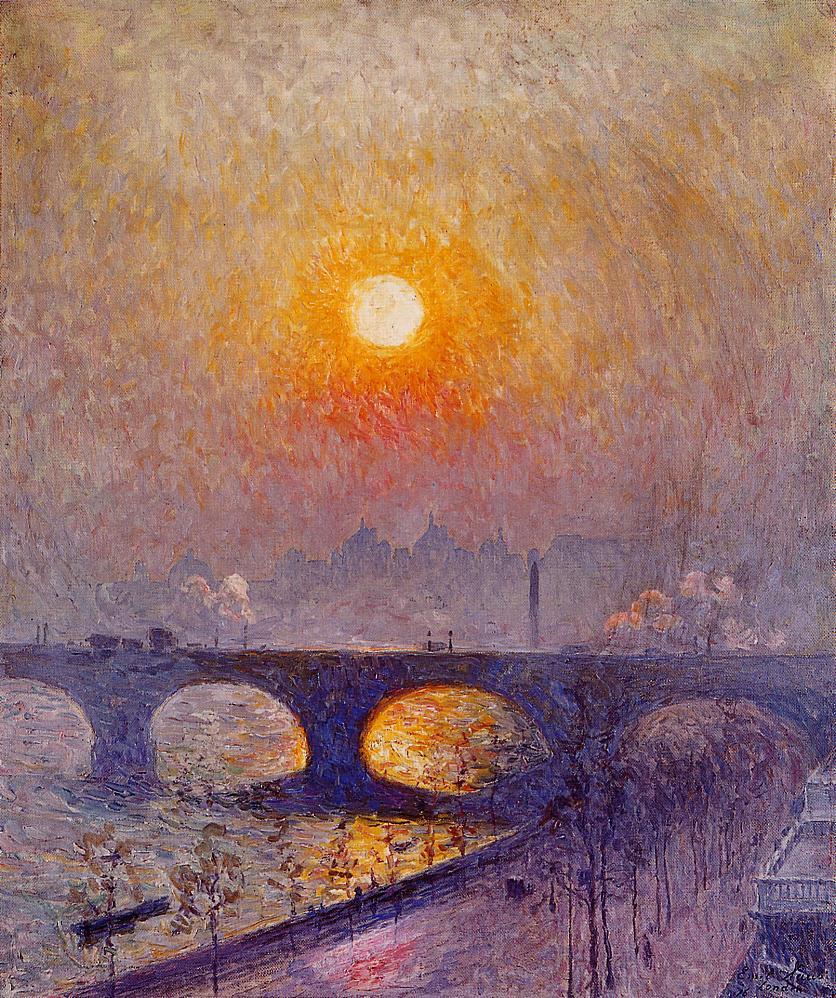
Emile Claus’s Sunset over Waterloo Bridge (1916) was painted from a location on the north bank of the Thames slightly to the east of Waterloo Bridge, the north end of which is prominent, and looks south-west into the setting sun, up river. Claus painted several views of Waterloo Bridge while he was in London, but doesn’t appear to have attempted any formal series, such as Monet’s.
Claus isn’t formulaic in his treatment. He uses billowing clouds of steam and smoke to great effect, and his inclusion of the road, trees and terraces in the foreground, on the Embankment, provides useful contrast with the crisp arches of the bridge, and the vaguer silhouettes in the distance. Like Monet’s series, this was probably painted from a temporary studio inside a building.

Claus’s Morning Reflection on the Thames in London, from 1918, is a view over the Embankment and river that’s desaturated and made vaguer by fog.

My last example is another view over the River Thames, this time by Lesser Ury. London in Fog from 1926 doesn’t appear to be a nocturne, but looks at the effects of fog on both lights and their reflections.
On 4 December 1952, a high pressure system settled over London. The wind fell away, and fog and smoke were trapped under a temperature inversion. The following day the whole of the city and an area totalling over one thousand square miles were blanketed in smog that remained until 9 December. It’s estimated that directly caused over ten thousand deaths. A succession of laws and a major campaign to eliminate open coal fires in London resulted in great improvement, although a decade later there was another lesser smog, perhaps the event I remember from my childhood. The beauty of those paintings can also be deadly.
One of the enduring memories of my childhood, spent partly in London, is walking in smog, then commonly known as a pea-souper. The combination of dense fog and smoke was so thick I could barely make out street lights, and the streets were for once almost empty, as vehicles could only proceed at walking pace.
This weekend I present a selection of paintings of mist, fog and maybe even a touch of smog on the River Thames, in and near London. Today’s paintings come from the pioneers of the nineteenth century, and tomorrow’s from the twentieth.
Many of JMW Turner’s greatest paintings take advantage of the optical effects of mist and fog. Being a Londoner, he must have experienced these all too frequently.

These peaked in Turner’s famous painting of a Great Western Railway train crossing the River Thames at Maidenhead: Rain, Steam, and Speed, exhibited at the Royal Academy in 1844. The whole image is fogbound and vague, and proved a precursor to the approach of the Impressionists after his death.

Less than thirty years later, when he was taking refuge from the Franco-Prussian War, Claude Monet’s The Thames below Westminster (1871) is less Impressionist. Painted from the Embankment to the north of Westminster Bridge, near what is now Whitehall, the three towers to the south are almost superimposed, and aerial perspective is exaggerated by the mist. The river is bustling with small paddleboat steamers. In the foreground a pier under construction is shown almost in silhouette. Small waves and reflections on the river are indicated with coarse brushstrokes, suggesting this is a rapid and spontaneous work.

A decade later, The Houses of Parliament is Winslow Homer’s faithful representation of the Palace of Westminster when viewed from the opposite bank of the Thames, to the north (downstream) of the end of Westminster Bridge. The tide is high under the arches of Westminster Bridge, and small boats are on the river. This classic watercolour makes an interesting contrast with Monet’s later oil paintings I show tomorrow: Homer provides little more detail, the Palace being shown largely in silhouette, but works with the texture of the paper and careful choice of pigment to add granularity. He provides just sufficient visual cues to fine detail, in the lamps and people on Westminster Bridge, and in the boats, to make this a masterly watercolour.

The following year, Jules Bastien-Lepage paid a return visit to the city, when he painted The Thames, London. This view of industrial docklands further downstream maintains detail into the far distance, except where it’s affected by the smoky and hazy atmosphere typical of the city at that time. It was this section of the river that was also painted on several occasions by James Abbott McNeill Whistler.
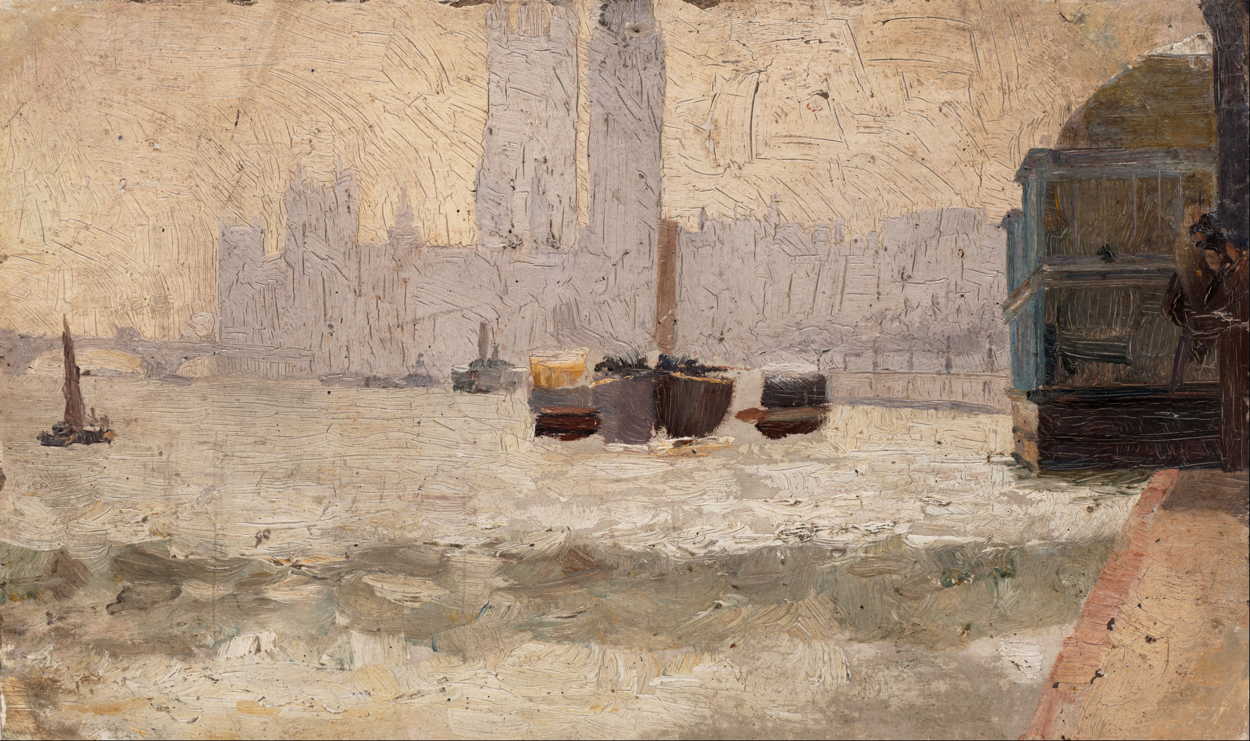
Tom Roberts’ Fog, Thames Embankment (1884) is painted from a similar location to Monet’s The Thames below Westminster above, on the Embankment to the north of Westminster Bridge, but is cropped more tightly, cutting off the tops of the Victoria and Elizabeth Towers. The Palace and first couple of arches of Westminster Bridge appear in misty silhouette, with moored barges and buildings on a pier shown closer and crisper. He renders the ruffled surface of the river with coarse brushstrokes, different from those of Monet.

Among six paintings that Camille Pissarro started work on during his visit to England in 1890 was this view of Charing Cross Bridge, London from Waterloo Bridge. For this he made a sketch in front of the motif, then following his return to his studio in Éragny he painted this in oils. This looks south-west, towards a skyline broken by the Palace of Westminster and the familiar tower of Big Ben.

In Frederick Childe Hassam’s Houses of Parliament, Early Evening (1898), the sun has already set, and he is viewing the Palace in the gathering dusk from a point on the opposite (‘south’) bank, perhaps not as far south as Lambeth Palace. The Victoria Tower is prominent in the left of the painting, the Central Tower is in the centre, and the most distant Elizabeth Tower is distinctive with its illuminated clock face. Moored boats in the foreground provide the only other detail. His rough facture gives a textured surface to the water.
最近我重新开始玩宝可梦系列作品《走吧!皮卡丘》,玩着玩着发现了一个小彩蛋:在玉虹市的玉虹大厦三楼走廊尽头,有个专门为「游戏狂想家」这家公司安排的小空间。
我当时就想:
“哇,这家游戏工作室专门埋了一个独属于自己的小彩蛋?任天堂没有意见吗?他们俩背后到底有什么故事呢?”
我一开始查资料,就停不下来了 —— Game Freak(游戏狂想家)、HAL、任天堂、宝可梦 IP,这些名字背后的历史和关系,远比我以为的要复杂得多。与此同时我还发现,这其实是一个很生动的案例,告诉我们,创意如何在制度化、战略化的环境下持续落地。这套逻辑对做品牌和设计咨询,也特别有启发。
先从 Game Freak 说起。很多人以为宝可梦一出世就是大团队作品,其实它的起源很有意思:
看到这,你可能会想:“哇,他们是从杂志直接跳到宝可梦吗?”其实不是,他们先做了几款外包软件,尝到商业开发的甜头后才真正走上这条路。这个过程告诉我们:独立创意很重要,但商业化和持续发展,需要制度和经验的积累。
接着是宝可梦的版权问题,很多人理解错了。宝可梦可不是任天堂的独家 IP,它的结构是这样的:
所以任天堂虽然不是唯一版权方,但它独占主机平台的全球发行权,并持 TPC 股份约三分之一。手游、卡牌之类的授权则由 TPC 直接处理。换句话说,版权和发行权分开、责任和利益明确,创意团队既有自由又有制度支撑,这也是宝可梦能长期保持高质量的关键。
相似的案例,我们再来说说《星之卡比》的主要开发团队,HAL 研究所。1992 年,他们负债约 15 亿日元,任天堂没有直接收购,而是通过追加订单、提前支付版税和信用担保来帮他们渡过难关[3][4]。
1993 年,临危受命的岩田聪出任 HAL 社长,他做了几个关键动作:
结果,1995 年游戏销量突破 100 万套,公司成功扭亏[4][5]。星之卡比的版权归任天堂,但 HAL 保留开发署名权(© Nintendo / HAL Laboratory)[5]。2000 年,岩田聪入职任天堂,两年后出任社长,任天堂与 HAL 的关系更进一步。
整个逻辑很清楚:制度化支持 + 资源集中 = 危机管理成功。任天堂既保证了关键 IP 安全,又保留了 HAL 的创新能力。
顺便说一下任天堂的独家 IP 案例,你可以看到规律:
规律是:开发分散,版权集中,生态稳固。换句话说,创意团队有空间,战略和商业被制度化保障。这一点对品牌和设计咨询来说特别值得学习。
知道了这些,你可能会问:那和我们的品牌/设计咨询有什么关系?其实你看,任天堂的做法和庞大的 IP 收益已经明确告诉了我们,想要长久高效地产出创意,必须有清晰规则 + 制度化支持 + 战略长期稳定。
这里有几个关键点:
就像宝可梦里,开发团队可以自由设计游戏机制、精灵、玩法创新,但发行和品牌逻辑有统一的规则,保证整个生态长期稳定。
这样可以保证方向不跑偏,创意不散乱,也让各个团队知道自己在做什么。
简单来说,如果我们把任天堂三方合作、版权集中、创意独立的逻辑搬到品牌/设计咨询里。核心就应该是:
实践大概分四步:
最后总结一下,我自己体会最深的四点:
如果你的品牌希望在快速变化的市场里保持方向清晰、创意可持续、执行高效,这套逻辑很值得参考。
我是从业 16 年的工业设计师苏志斌,乙方甲方都有相当从足的从业体会:服务过的客户中,既有创客类型的初创小团队,也有世界 500 强的领军企业;设计落地的产品中既有成熟行业的精准创新,也有新领域新品类的挖掘和探索。
如果你的团队需要 产品创新/工业设计/品牌策略 等帮助,可以私信或邮件联系我:
suithink.su@gmail.com
我更多关于产品/设计/企业的思考和见解,欢迎在这里收看我的节目:
尾注
Here are this weekend’s Mac riddles to entertain you through family time, shopping and recreation.
1: Passing time at the far right.
2: Winks at you when toggling extensions.
3: A pair of contradictory toggles for more settings.
To help you cross-check your solutions, or confuse you further, there’s a common factor between them.
I’ll post my solutions first thing on Monday morning.
Please don’t post your solutions as comments here: it spoils it for others.
In 1900, the Swiss painter and print-maker Félix Vallotton was granted French citizenship. He had cut back on his prints to paint more, and the paintings that he made were no longer Nabi, but explored themes and ideas that were to prove influential later in the twentieth century. He also broadened his interests: in the early years of the new century, he wrote eight plays and three novels, although none achieved much success.

In 1900, he followed his earlier mysterious interiors with The Laundress, Blue Room, set in the Vallotton apartment in Paris, with two of his step-children squatting on the folds of large fabric sheets, inside a bedroom with blue decor. Two women are sat working, one apparently on the sheets, the other on separate fabrics.

Vallotton’s view of the oldest of the great bridges of central Paris, in Le Pont Neuf from 1901, is strange. Like some of the unconventional views of bridges painted in the late nineteenth century, its emphasis is on unusual perspective form, but it manages to avoid showing Pissarro’s dense throng of people, or its place among prominent buildings, and is almost unrecognisable.

Woman Searching in a Cupboard from 1901 shuts out half its image with black screens and the doors to the cupboard, giving it a strongly geometric tone. The woman, in spite of a lamp by her side, is little more than a black silhouette too, who appears to absorb the light falling on her. The lamp itself is strange, with a shade showing some sailing ships at sea, its stand being a vertical statuette of Truth, perhaps?

Maybe we should read Vallotton’s lamps more carefully. For the following year (1902), he painted this quartet of gamblers in a Poker session. Tucked away in a plush back-room behind a club or bar, these four are in full evening dress, playing for stakes that could be breathtaking and bankrupting. In the centre foreground is another lamp with a patterned shade, showing sailing boats, I think.

Then in 1902-03, Vallotton painted one of the seminal records of the Nabis: Five Painters, showing Pierre Bonnard (seated, left), Félix Vallotton (standing, left), Édouard Vuillard (seated), Charles Cottet and Ker-Xavier Roussel (standing, right).
His next views of interiors I find quite cinematic, as if stills from a movie, perhaps reflecting his modern approach to composition and lighting, more akin to those developed by cinematographers of the future rather than painters of the past. They also appear to have been influences over the New Objectivity that developed in central Europe in the 1920s, and later American artists like Edward Hopper.

For his Interior, Woman in Blue Searching in a Cupboard from 1903, Vallotton painted his wife Gabrielle from the back as she stood searching in a cupboard of books.

Vallotton’s Interior with Woman in Red from 1903 develops the framing effect of multiple sets of doors, drawing the eye deeper towards a distant bedroom. The woman wearing a red dress looks away, her skirts swept back as if she has been moving towards the three steps dividing this interior into foreground and background. There are tantalising glimpses of detail on the way: discarded fabric on a settee, clothing on a chair in the next room, and half a double bed with a bedside lamp in the distance.

There’s dispute as to whether this painting shows a Woman Reading in an Interior, as given by its French title, or a woman writing, which appears to be its translation. Vallotton painted this in 1904, and charged it with rather less mystery, although I wonder if the lower of the paintings on the wall might be one of Degas’ works showing horseriding. As usual, the single figure doesn’t show her face as she sits at the small bureau, backlit by the window and its stained glass.

Interior, Bedroom with Two Figures from 1904 is one of the last of his series of mysterious interiors, and worthy of the sub-genre of the ‘problem picture’. This is another bedroom, in which the lady of the house is standing over her maid as the latter is sewing up an evening gown for her. The mistress stands with her back to the viewer, but her face is revealed in her reflection in the large mirror on the wardrobe at the back of the room. In that, the maid is all but invisible. These three figures appear in a perspective recession, and to the right of the wardrobe is a doorway, presumably leading through to the master’s bedroom.

In this period before the Great War, Vallotton also painted portraits, and several nudes. But the figurative painting from 1905 that I find most fascinating is this, of The Models’ Smoke Break. In an era when most adults smoked, rest periods for models, like those for other workers, were usually termed ‘smoke breaks’ even though neither woman is smoking.
Instead, one model is reclined in a pose (not a pose, as it’s a break) reminiscent of Manet’s Olympia (1863). Instead of her maid bringing her a bouquet, though, she holds a single wilted blue flower, and chats idly to another model who sits by her feet. I wish I could identify the paintings reflected in the mirror behind them, although I think the upper double portrait is that of Vallotton’s parents painted in 1886. That below looks like a coastal landscape, perhaps of Honfleur.
To follow these, Vallotton turned to classical myths.


