Login
Login
Four great women painters after Sofonisba Anguissola
Tomorrow, 16 November, marks the four-hundredth anniversary of the death of one of the first great women painters, Sofonisba Anguissola. In preparation, this article looks at four of those who followed in her brushstrokes, and succeeded in a world so dominated by men.
Lavinia Fontana was a precocious painter in the late sixteenth century, the only child of the successful artist Prospero Fontana. With no son to take the family workshop on, it was a relief to her father that she showed strong artistic ability at an early age; so early that by the time she was thirteen, she may have been generating much of the family’s income.

Her paintings provide unusual insights into contemporary family life, as in her Portrait of a Newborn in a Cradle (c 1583). This is clearly a child of a rich family, wearing a string of pearls in their ornate crib.

Fontana set a tradition that successful women painters should make several works showing Judith with the Head of Holofernes. This version, from 1600, avoids gore and puts the severed head discreetly in half-light, while Judith brandishes the sword with pride, and her maid appears delighted. Her use of rich colours and chiaroscuro were advanced for painting in Bologna at the time.
Her workshop in Bologna was successful and prosperous, but ultimate recognition came in 1603, when Pope Clement VIII invited her to move to Rome. She quickly acquired powerful patronage, painted a portrait of Pope Paul V and became his court portraitist, and was even awarded a bronze medallion made for her by Casone in 1611.

When in Rome, she painted this remarkable family Portrait of Bianca degli Utili Maselli with six of her children (1604-5), showing this wife who died within a year of its completion, five of her sons, and her daughter Verginia. As in many of her portraits, the lapdog was a sign of fidelity, and her depiction of clothing exquisite.
Fontana died in Rome in 1614, leaving the largest oeuvre of any woman painter prior to 1700. Unlike the few who had gone before her, she had succeeded at the highest level in a range of different genres, including mythology, religious works (with some large-scale altarpieces), and portraiture.
While she was painting for the Pope in Rome, in northern Europe still life painting was developing rapidly, thanks to the quiet brilliance of Clara Peeters. We don’t even know when she was born, but she seems to have trained in Antwerp, then pursued her career successfully in the Dutch Republic to the north. She’s thought to have been internationally successful by 1611, when at least four of her paintings were sold to Spain. Her last reliably dated works are from 1621, although there are a few attributed to her from later. No one knows whether she stopped painting when she married, or when she died.

Her Still Life of Fish and a Candlestick is one of the earliest and most accomplished paintings of the fruits de mer, which were to find favour with William Merritt Chase nearly three centuries later.

The following year, her still life with Flowers and Gold Cups of Honour (1612) reveals multiple miniature self-portraits reflected in the gold cup at the right. These are shown more clearly in the detail below.

Her short career overlapped with that of the most famous of all the early women painters, Artemisia Gentileschi. She was the eldest child of the renowned Tuscan painter Orazio Gentileschi, learned to draw at an early age, and soon worked in her father’s workshop. Her father was strongly influenced by the work and friendship of Caravaggio, which in turn was an early influence on Artemisia.
She was taught by Agostino Tassi, when he was working with her father on murals in a palace in Rome, when Artemisia was already painting her own works in oils. Tassi raped Artemisia, and continued to have sexual relations with her in the expectation that they would marry. Her father pressed charges against Tassi, who was eventually convicted after a long trial that was profoundly traumatic physically, mentally, and emotionally for Artemisia.
Her father arranged for her marriage to a modest Florentine painter, and the couple moved to Florence where she started receiving commissions. They worked there between 1614 and 1620, when she became the first woman ever to be accepted into the Accademia delle Arti del Disegno. She enjoyed good relationships with other prominent artists and intellectuals, including Galileo Galilei. In 1618 the only one of her four children to survive into adult life was born, Prudentia, who also became a painter. However, in 1621 she separated from her husband and moved back to Rome. This didn’t prove a success, so she moved to Venice, and on to Naples in 1630.

Her first painting of Susanna and the Elders from 1610 remains her best-known, and with Tintoretto’s is one of its canonical depictions. Gone are the decorations, symbols, and diversions of earlier artists, in favour of a close-up of the three actors at the crucial moment that the elders tell Susanna of their ‘generous offer’. They’re as thick as thieves, one whispering into the ear of the other, who holds his left hand to his mouth as he commits his crime. Susanna is naked, distressed, and her arms are trying to fend the elders off. Her face tells of her pain and refusal to succumb to their blackmail.
She is most famous for her paintings of Judith Slaying Holofernes, her first version being painted at about the same time as her rape and Tassi’s subsequent trial. It’s generally believed that Tassi was the model for Holofernes, she cast herself as Judith, and a female companion who failed to come to her aid during the rape (and failed to give evidence in her support at the trial) was the maid. It would therefore be natural to interpret this painting as part of her very understandable response to her own traumatic events.
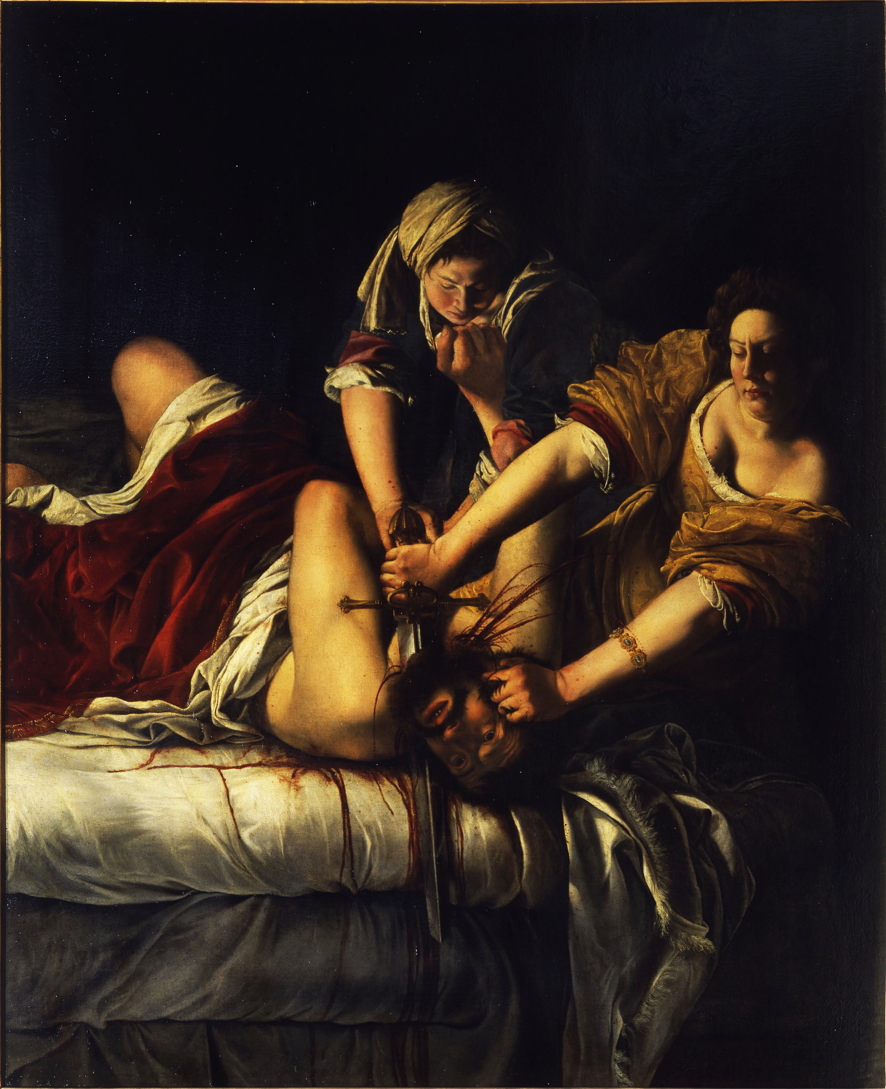
Her second version, painted in 1620-21 and now in the Uffizi in Florence, is similar in most respects, although the view isn’t as tightly cropped on the three figures, so that it shows Holofernes’ legs and a deep red wrap around his lower body. The lower section of the blade is also executed better. Judith’s face shows intense concentration and effort, both arms thrust out straight in front of her. The left grips Holofernes by the hair, the right pushes the blade onwards. Her maid is seen holding Holofernes down, pushing hard with both her arms out straight too. Holofernes’s right hand seems to be pushing the maid back, but his left arm is folded over his body.

There’s more uncertainty as to whether her brilliant painting of the Allegory of Painting (c 1638-9) is a self-portrait. This striking angle of view can be accounted for if this was a self-portrait composed using two mirrors, one placed above and on the left of the painter, the other directly in front of her, where she is gazing so intently. If so, it was particularly ingenious because the reflection in the second mirror would have normal chirality (left and right would not be reversed).
However, it has been suggested that this isn’t a self-portrait, in which case her choice of view would have been most unusual. It’s believed to have been painted during her stay in London, possibly for King Charles I, as it appears to have passed straight into the Royal Collection, where it has remained ever since.
Returning to Italy, my last great woman painter is Elisabetta Sirani, oldest child of the Bolognese painter Giovanni Andrea Sirani (1610–1670), who had been a pupil of Guido Reni (1575–1642). She was running the family workshop by the time she was only seventeen. Her success was meteoric until she collapsed and died suddenly in August 1665, aged twenty-seven, and has since lapsed into obscurity.

Her Penitent Magdalene is a powerful painting using a wide tonal scale to heighten its emotive effect.

Her Portia Wounding her Thigh (1664) refers not to the Portia of Shakespeare’s play The Merchant of Venice, but to Portia or Porcia Catonis, wife of Marcus Junius Brutus, one of Julius Caesar’s assassins in 44 BCE.
Getting wind of the plot to murder Caesar, Portia asked Brutus what was wrong. He didn’t answer, fearing that she might reveal any secret under torture. She therefore inflicted wounds to her thigh using a barber’s knife to see if she could endure the pain. As she overcame the pain of her wounds, she declared to Brutus that she had found that her body could keep silence, and implored him to tell her. When he saw her wounds, Brutus confided all in her.
By August 1665 Sirani had completed nearly 200 paintings, many fine drawings, and various prints. She died so suddenly that it was at first suspected that she might have been murdered, but it transpired that she had suffered fulminating peritonitis as the result of a burst peptic ulcer.
In tomorrow’s article I will look at the life and work of their forerunner, Sofonisba Anguissola.