
Normal view

There are new articles available, click to refresh the page.
Before yesterdayMain stream

Painted stories of the Decameron: Abducted brides

By: hoakley
15 December 2025 at 20:30

On the fifth day of the Decameron’s stories, Fiammetta chose the theme of the adventures of lovers who survived calamities or misfortunes and reached a state of happiness. The first of those concerns Cimon (or Cymon) and Iphigenia, and was told by Panfilo. This has been painted more than any other story in the whole of the Decameron, by masters from Rubens to Frederic, Lord Leighton, none of whom attempts to tell any more than its opening. Also note that Iphigenia here isn’t the daughter of Agamemnon who had to be sacrificed to bring favourable winds for the Greek fleet to sail against Troy.

Cimon’s father was a wealthy Cypriot, but Cimon, a nickname given in honour of his apparent simplicity and uncouthness, was his problem child. He was exceedingly handsome and had a fine physique, but behaved like a complete imbecile. He appeared unable to learn anything, even basic manners, so was sent to live with the farm-workers on his father’s large estates.

One afternoon in May, Cimon was out walking when he reached a fountain in a clearing surrounded by tall trees. Lying asleep on the grass by that fountain was a beautiful young woman, Iphigenia, wearing a flimsy dress that left nothing to the imagination. Sleeping by her were attendants, two women and a man. Cimon was immediately enraptured, leaned on his stick, and stared at her. As he did so, his simple mind started to change.

anoncymonIphigenia
Master of the Campana Panels (dates not known), Cymon and Iphigenia (c 1525), tempera on panel, 58 x 170 cm, location not known. Wikimedia Commons.

As with many of Boccaccio’s stories, this is shown on a wedding cassone, here from about 1525. It’s relatively simple: there’s no sign of the attendants, but there is a second image of Cimon walking along a path at the far right.
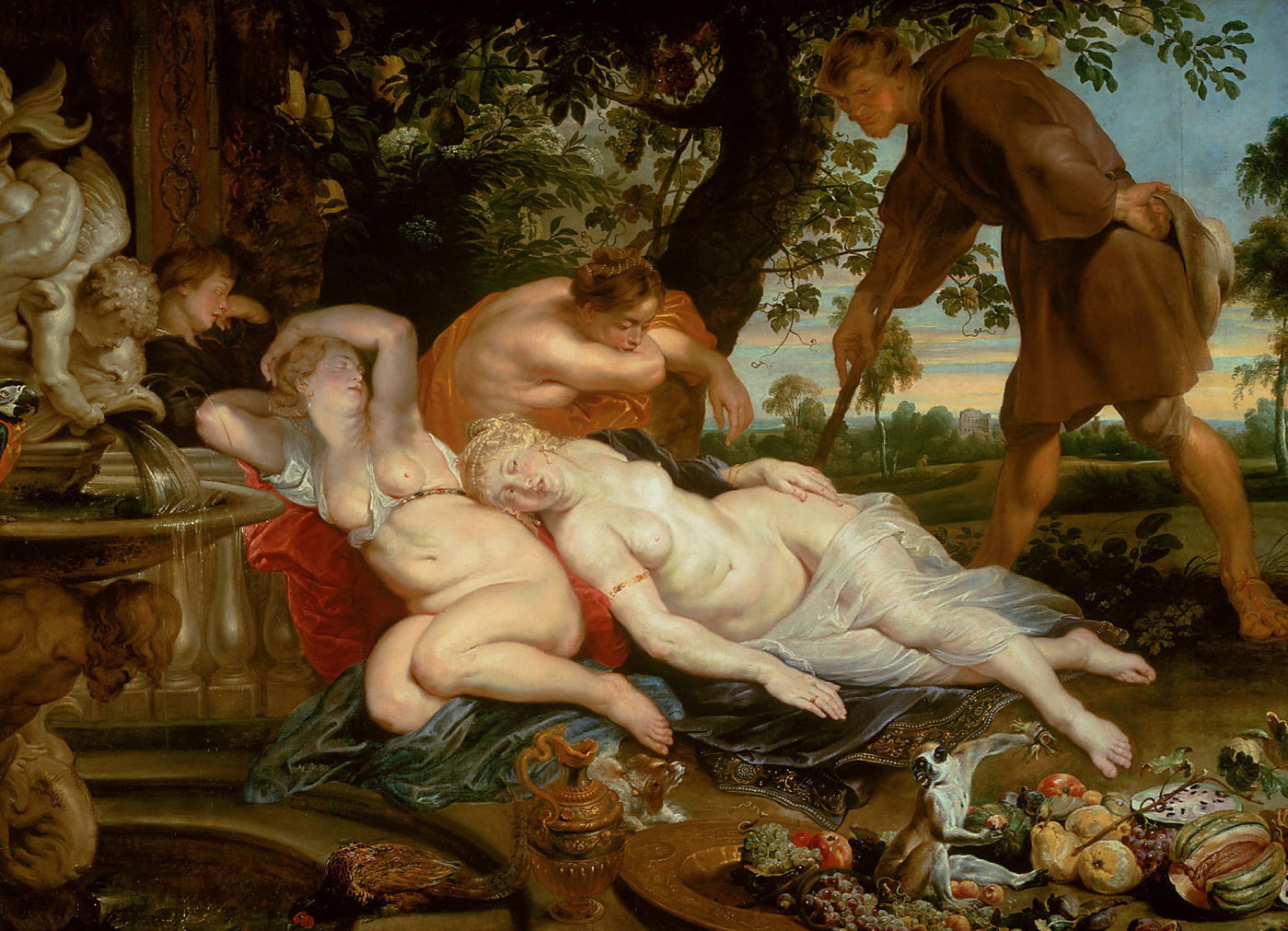
rubenscymonIphigenia
Peter Paul Rubens (1577–1640), Frans Snyders (1579–1657) and Jan Wildens (1584/86–1653), Cymon and Iphigenia (c 1617), oil on canvas, 208 × 282 cm, Kunsthistorisches Museum, Vienna, Austria. Wikimedia Commons.

In about 1617, Peter Paul Rubens joined with Frans Snyders (who painted the still life with monkeys at the lower right) and Jan Wildens (who painted the landscape background) in their marvellous Cymon and Iphigenia. This is accurate in its details too, with the correct quota of attendants, and a splendid fountain at the left. Cimon really looks like Boccaccio’s uncouth simpleton.

vanmieriscymonIphigenia
Willem Van Mieris (1662-1747), Cymon and Iphigenia (1698), oil on canvas, 27 x 34.8 cm, Museo Poldi Pezzoli, Milan, Italy. Wikimedia Commons.

Willem Van Mieris’ Cymon and Iphigenia from 1698 treats the scene more in the vein of Poussin or Claude, and again remains faithful to Boccaccio’s details.

westcymoniphigenia
Benjamin West (1738–1820), Cymon and Iphigenia (c 1766), oil on panel, 61.3 × 82.6 cm, Yale Center for British Art, New Haven, CT. Wikimedia Commons.

Benjamin West was more coy in both of his depictions of this scene. His earlier Cymon and Iphigenia from about 1766 (above) was well-received at the time. Six years later, in 1773, he reversed the composition, and was even more restrained in the display of flesh, as shown below.

westcymonIphigenia1773
Benjamin West (1738–1820), Cymon and Iphigenia (1773), oil on canvas, 127 x 160.3 cm, Los Angeles County Museum of Art (LACMA), Los Angeles, CA. Wikimedia Commons.
kauffmancymonIphigenia
Angelica Kauffman (1741–1807), Cymon and Iphigenia (c 1780), oil on canvas, diam 62.2 cm, Gibbes Museum of Art, Charleston, SC. Wikimedia Commons.

A few years later, in about 1780, Angelica Kauffman painted this delightful tondo of Cymon and Iphigenia, another variation on the same theme. The cultural contrast between the young man and woman is not so stark.

millaiscymonIphigenia
John Everett Millais (1829–1896), Cymon and Iphigenia (1848), oil on canvas, dimensions not known, Lady Lever Art Gallery, Liverpool, England. Wikimedia Commons.

When he was only eighteen, John Everett Millais painted what was to be his last work before he embraced Pre-Raphaelite style: Cymon and Iphigenia (1848). At first sight this bears little resemblance to Boccaccio’s story, which is to be expected, as Millais didn’t use the Decameron as his literary reference, but a later re-telling by the English poet John Dryden, to which this is more faithful.

leightoncymonIphigeniastudy
Frederic, Lord Leighton (1830-1896), Cymon and Iphigenia (study) (1884), oil on canvas, 43.1 x 66.2 cm, Art Gallery of New South Wales, Sydney, Australia. Wikimedia Commons.

In 1884, Frederic, Lord Leighton painted what must be the most luxuriant and sensuous version of this scene. This study shows Leighton confirming his composition and use of colour.

leightoncymoniphigenia
Frederic, Lord Leighton (1830-1896), Cymon and Iphigenia (1884), oil on canvas, 218.4 x 390 cm, Art Gallery of New South Wales, Sydney, Australia. Wikimedia Commons.

The finished painting, Cymon and Iphigenia from 1884, shows Iphigenia stretched out languidly in her sleep, in the warmth of the last light of the day; behind her the full moon is just starting to rise. Leighton has changed the season to autumn, with the leaves already brown but the days still hot. Cymon stands in shadow on the right, idly scratching his left knee, gazing intently at Iphigenia.

The story that follows those painted idylls is very different.

When Iphigenia finally awoke, she was surprised to see Cimon there, and recognised him immediately. He insisted on accompanying her to her house, then went to his family home, where he turned a new leaf, and over the following four years transformed himself into the best-dressed, most cultured and refined young man on Cyprus. Despite this transformation, Cimon was unable to persuade Iphigenia’s father to allow him to marry the young woman, but was told she was betrothed to a noble on the island of Rhodes.

When the time came for her marriage, Cimon took an armed vessel and gave chase to the ship carrying Iphigenia to Rhodes. He boarded her ship and abducted her.

With Iphigenia on board, Cimon headed for the island of Crete, where he and his crew had relatives and friends. But shortly after they had altered course, a storm blew up, so violent that it threatened to sink the ship. Unable to tell where they were heading, they ended up taking shelter off the coast of Rhodes, where they were caught up by the ship from which they had just abducted Iphigenia.

When their vessel ran aground, Cimon and his crew were forced ashore, where they were quickly rounded up and thrown into prison, and Iphigenia was returned to her family ready for her wedding. Iphigenia’s fiancé implored the chief magistrate of Rhodes, Lysimachus, to put Cimon to death, but he was held in custody with the rest of his crew.

It happened that Lysimachus was deeply in love with a young woman of Rhodes, who was betrothed to Iphigenia’s future brother-in-law. To Lysimachus’ relief, that marriage had been postponed several times, but it was then decided to hold both weddings in the same ceremony. Lysimachus was aggrieved by this, and decided the only way he could marry the Rhodian woman that he loved was to abduct her. In order to do so, he needed the help of Cimon and his crew, who would undoubtedly be delighted to be able to abduct Iphigenia again.

Lysimachus offered Cimon a deal whereby they would together make off with their partners from the scene of the joint wedding, and they agreed to proceed with that.

Two days later, at dusk, as the weddings were just getting under way, Lysimachus, Cimon and his crew entered the house of the two bridegrooms and seized their brides. Unfortunately, it turned out that both grooms were armed and mounted a determined resistance. Cimon killed Iphigenia’s fiancé with a single blow to the head, and the other woman’s intended husband fell dead following a blow by Lysimachus.

Lysimachus, Cimon, their crew and the two abducted brides then fled to a ship which they sailed to exile in Crete, where the two couples were married, amid great and joyous celebrations. In time, the people of Cyprus and Rhodes forgave them for the violent way they had stolen their brides; Lysimachus and his wife were able to return to Rhodes, and Cimon and Iphigenia returned to live happily ever after on Cyprus.

Sadly, none of the masters who had painted Cimon and Iphigenia seems to have been tempted to depict any of the rest of Panfilo’s story.

Reading Visual Art: 238 Bread of life

By: hoakley
11 December 2025 at 20:30

Throughout much of Europe, bread has been a staple food for the whole of recorded history, and has become a symbol of life in both language and visual art.

milletsummerceres
Jean-François Millet (1814–1875), Ceres (The Summer) (c 1864-65), oil on canvas, Musée des Beaux-Arts, Bordeaux, France. Wikimedia Commons.

For the classical civilisations of the Mediterranean, this was embodied in the goddess of Jean-François Millet’s Ceres (The Summer) from about 1864-65. She stands, her breasts swollen and ready for lactation, her hair adorned with ripe ears of wheat, a sickle in her right hand to cut the harvest, and a traditional winnow to separate grain from chaff in her left hand. At her feet is a basketful of bread, with ground flour and cut sheaves of wheat behind. The background shows the wheat harvest in full swing, right back to a group of grain- or hay-stacks and an attendant wagon in the distance.

Bread and its sharing is one of the central symbols of Christian beliefs, most notably in the Last Supper, the meal shared by Christ with his disciples before his crucifixion.

giampietrinocopylastsupper
Giampietrino (1495–1549), copy after Leonardo da Vinci (1452–1519), The Last Supper (c 1520), oil on canvas, 298 x 770 cm, The Royal Academy of Arts, London. Wikimedia Commons.

The most famous painting of The Last Supper, and one of the best-known works in the European canon, is of course Leonardo da Vinci’s. Giampietrino’s copy from about 1520 gives the closest impression today of what the original must have looked like. Even this copy has been horribly mutilated: the upper third was cut off, and its width reduced, but at least what remains gives a better idea of the original’s appearance.

Leonardo’s composition wasn’t entirely revolutionary for the time. Previous paintings of The Last Supper had spread the apostles along the length of a table, with Christ at its centre. However, Judas Iscariot was usually placed alone on the near side, his back to the viewer, and sometimes with his bag of silver visible behind his back.

Leonardo shows the moment of surprise and denial when Christ announces that one of those sat around the table would betray him. In this, he was perhaps the first artist to assemble the apostles into small groups, a feature that has been repeated in innumerable images following this. Arrayed along the front of the table is a series of round bread rolls and small glasses of red wine.

veronesesupperemmaus
Paolo Veronese (1528–1588), The Supper at Emmaus (c 1559), oil on canvas, 241 × 415 cm, Musée du Louvre, Paris. Wikimedia Commons.

After his crucifixion and resurrection, Christ appeared several times to his disciples. In The Supper at Emmaus, painted here by Paolo Veronese, two disciples had travelled on the road from Jerusalem to Emmaus as pilgrims, and recognised Christ as he “sat at meat with them, he took bread, and blessed it, and brake, and gave it to them.”

The painting contains separate passages to cue this narrative: on the far left is an asynchronous ‘flashback’ referring to the journey to Emmaus. Christ is in the centre of the painting, identified by his halo, and in the midst of breaking bread. With him at the table are the two bearded figures of the disciples, dressed as pilgrims and bearing staves. On Christ’s right is a servant, acting as waiter to the group. The onlookers dressed in contemporary costume are an aristocratic Italian family of the day, whose portraits are combined.

Christian rites reiterate the Last Supper in Eucharist, and the blessing of bread plays other roles in its religious ceremonies.

pymonenkowaitingblessing
Mykola Pymonenko (1862–1912), Waiting for the Blessing (1891), oil on canvas, 133 x 193 cm, Rybinsk Museum-Preserve Рыбинский историко-архитектурный и художественный музей-заповедник, Rybinsk, Russia. Wikimedia Commons.

Mykola Pymonenko’s Waiting for the Blessing (1891) shows the scene at a country church in Ukraine at dawn on Easter Sunday. The local population is crowding inside, while the women gather with their Paska, traditional ornamental bread that must be blessed before it can be eaten as a brunch.

Bread appears elsewhere as a symbol of life, particularly in the context of poverty and charity.

leightonebelizabethhungary
Edmund Blair Leighton (1852–1922), The Charity of Saint Elizabeth of Hungary (c 1895), oil on panel, 26.7 x 20.3 cm, location not known. Wikimedia Commons.

Edmund Blair Leighton’s Charity of Saint Elizabeth of Hungary from about 1895 shows a famous woman who built a hospital where she personally served the sick. Born in 1207, she died in 1231 at the age of only twenty-four. Leighton doesn’t show her in a nursing role, though, but handing out loaves to feed the poor.

noursefamilymeal
Elizabeth Nourse (1859–1938), The Family Meal (1891), engraving from Charles M. Kurtz, ‘Illustrations from the Art Gallery of the World’s Columbian Exposition’, Philadelphia, 1893, further details not known. Wikimedia Commons.

Elizabeth Nourse painted some social realist works looking at the lives of the rural poor. Among these is The Family Meal from 1891, which was awarded a medal at the World’s Columbian Exposition in Chicago in 1893, and is seen here as an engraving in its catalogue. Parents sit with their two young children at an almost bare table. Their meal consists of a pot of soup and the remains of a loaf of what appears to be stale bread. The older child looks expectantly at her mother, who stares despondently at the table. Her husband stares down at his empty bowl.

calderonlordthywillbedone
Philip Hermogenes Calderon (1833–1898), “Lord, Thy Will Be Done” (1855), oil on canvas, 55.9 x 46.4 cm, The Yale Center for British Art, New Haven, CT. Wikimedia Commons.

The wonderfully named Philip Hermogenes Calderon painted his “Lord, Thy Will Be Done” in 1855. This quotation is derived from the Gospel account of what became the Lord’s Prayer, and has subsequently been used on many Christian religious occasions.

A young mother cradles her baby on her lap, looking up to the left. She’s living in difficult circumstances, but isn’t destitute, and wears a wedding ring on her left hand. The carpet is badly worn, and the coal scuttle empty, but there’s a loaf of bread on the table: she has her ‘daily bread’, another reference to the Lord’s Prayer. A portrait of a fine young man hangs above the mantlepiece, indicating her husband and the baby’s father is currently absent on military service. Several issues of The Times newspaper are scattered on the floor at the right, as if the woman has been following news of a military campaign overseas. Under the table is a letter, most probably from her husband.

krohgstruggleforsurvival
Christian Krohg (1852–1925), The Struggle for Existence (1889), oil on canvas, 300 x 225 cm, Nasjonalgalleriet, Oslo, Norway. Wikimedia Commons.

Christian Krohg’s The Struggle for Existence, also translated as The Struggle for Survival from 1889 shows Karl Johan Street in Oslo in the depths of winter, almost deserted except for a tight-packed crowd of poor women and children queuing for free bread. These people are wrapped up in patched and tatty clothing, clutching baskets and other containers in which to put the food. A disembodied hand is passing a single bread roll out to them, from within the pillars at the left edge. That was yesterday’s bread; now stale, the baker is giving it away only because he cannot sell it.

Next week I will show paintings of bread as food.

Painted stories of the Decameron: Introduction

By: hoakley
17 November 2025 at 20:30

Many great literary works are compilations of shorter tales, set in a framing story. Among the best known are One Thousand and One Nights and Sanskrit epics including Mahabharata. Among the most enduring in post-classical Europe is Boccaccio’s Decameron, whose stories have also proved popular with painters. Over the next couple of months I’m going to summarise those that have been well depicted in this new series, and show those paintings.

Despite the number of scholars who have researched Giovanni Boccaccio’s life over the last seven hundred years, much of it remains vague. He was either born in Florence, or perhaps near the village of Certaldo to the south-west of the city. His father worked for the Bardi bank, but he is thought to have been illegitimate and his mother hasn’t been identified.

We do know that he was born on 16 June 1313, and while still a child his father married a woman from a rich family, then moved to Naples. At the time, that was a major cultural centre, and as a young man Boccaccio immersed himself in that. His father expected him to become a banker, and Giovanni started work as an apprentice in his father’s bank in the city.

Boccaccio had no interest in banking though, and persuaded his father to let him study canon (ecclesiastical) law at the city’s university. When he was in his twenties, his father introduced him to the Neapolitan court and cultural circles around Robert the Wise, King of Naples. Among Boccaccio’s most important influences at this time was the scholar Paolo da Perugia, who had amassed much information about classical myths. Boccaccio became a scholar, particularly of the classical world, a writer rather than an ecclesiastical lawyer, and his future started to crystallise when he wrote his first poetry.

His early works became sources for Chaucer’s Troilus and Criseyde (Troilus and Cressida), and the Knight’s Tale.

Boccaccio left Naples in 1341, as tensions were growing between its king and the city-state of Florence, and returned to live mainly in Florence, although he also spent time in Ravenna. He developed great admiration for the work of Dante Alighieri, who had died in Ravenna twenty years earlier, and the great poet Francesco Petrarca (Petrarch) (1304-1374), whom he regarded as his teacher.

vasarisixtuscanpoets
Giorgio Vasari (1511–1578), Six Tuscan Poets (1544), oil on panel, 132 x 131.1 cm, Minneapolis Institute of Arts, Minneapolis, MN. Wikimedia Commons.

Giorgio Vasari is now more famous for his biographies of the important painters of the Renaissance and earlier, but was also an accomplished artist himself. His tribute to some of the greatest writers of the period is Six Tuscan Poets from 1544. From left to right, I believe these to be Dante Alighieri, Francesco Petrarca (Petrarch), Guido Cavalcanti, Giovanni Boccaccio, Cino da Pistoia, and Guittone d’Arezzo.

scottboccacciotodantesdaughter
William Bell Scott (1811–1890), Boccaccio’s Visit to Dante’s Daughter (date not known), oil on canvas, further details not known. Wikimedia Commons.

William Bell Scott’s undated painting of Boccaccio’s Visit to Dante’s Daughter shows the writer paying indirect homage to his illustrious predecessor. Boccaccio wrote the first biography of Dante, at about the same time he was writing the Decameron.

During the 1340s Boccaccio appears to have been developing the idea of a book in which seven characters take it in turns to tell stories. When the Black Death struck Florence in 1348, killing Boccaccio’s stepmother, this provided him with its framing story. He was already building his collection of tales to form the bulk of the book, and it’s thought he started its writing shortly after the Black Death. What is more doubtful is whether Boccaccio was living in Florence when the epidemic struck. However, as it raged through the whole of Tuscany in that year, hardly sparing a village, it’s most unlikely that he didn’t observe its effects somewhere, perhaps in Ravenna.

In 1349, Boccaccio’s father died, leaving Giovanni as the head of the household. In spite of that, he pressed on and had largely completed the first version in 1352. He revised it in 1370-71, and ever since it has been widely read, translated into all major languages, and its stories have inspired many works of art.

wappersboccaccioreading
Egide Charles Gustave Wappers (1803–1874), Boccaccio Reading from the Decameron to Queen Johanna of Naples (1849), oil on canvas, 171 x 228 cm, Koninklijke Musea voor Schone Kunsten van België / Musées Royaux des Beaux Arts de Belgique, Brussels, Belgium. Image by Georges Jansoone, via Wikimedia Commons.

Egide Charles Gustave Wappers painted Boccaccio Reading from the Decameron to Queen Johanna of Naples in 1849. Queen Joanna I of Naples (1328-1382) had a reputation that was more than controversial, but Boccaccio was a supporter, and wrote a complementary account in his collection of biographies of famous women, De Mulieribus Claris (On Famous Women).

master1482boccaccioflorentines
Master of 1482 and Follower (fl 1485), Giovanni Boccaccio and Florentines who have Fled from the Plague (c 1485), miniature on vellum, in The Decameron, translated by Laurent de Premierfait, Koninklijke Bibliotheek, The Hague, The Netherlands. Wikimedia Commons.

This miniature by the Master of 1482 and Follower conflates Boccaccio, the Black Death in Florence, and the framing story of the Decameron: Giovanni Boccaccio and Florentines who have Fled from the Plague was painted in about 1485 on vellum, in what must have been one of its first illustrated editions.

The Decameron opens with a description of the horrific conditions and events that overwhelmed Florence when the Black Death struck, then takes us to a group of seven young women who are sheltering in one of its great churches. They decide to leave the city rather than waiting amid its rising pile of corpses, to spend some time in the country nearby. They take some servants and three young men to accompany them there.

Once settled in an abandoned mansion, the ten decide that one of the means they will use to pass their self-imposed exile is to tell one another stories. Over the next two weeks, each tells one story on every weekday, delivering a total of one hundred, hence the title of the book.

sorbidecameron
Raffaello Sorbi (1844–1931), The Decameron (1876), oil on canvas, 45.5 x 88.7 cm, Private collection. Wikimedia Commons.

Raffaello Sorbi show the group of ten during one of the story-telling sessions in The Decameron from 1876, with the city of Florence in the distance.

postiglionedecameron
Salvatore Postiglione (1861–1906), Scene of the Narration of the Decameron (date not known), oil on canvas, 100 x 151 cm, location not known. Wikimedia Commons.

Salvatore Postiglione’s undated, ornate and almost illustrative Scene of the Narration of the Decameron is unusual for omitting one of the seven young women, but links visually to their other musical and craft activities.

Relatively few of the hundred tales in the Decameron have been committed to paint. Some are little more than brief fables, or what used to be known as shaggy dog stories. Others are more lengthy novellas with intricate twisting plots. But many have been painted from the Renaissance until well into the twentieth century, and were particularly popular with the Pre-Raphaelites.

pesellinolifegriseldis
Francesco Pesellino (1422–1457), Scene from the Life of the Griseldis (c 1450), tempera on panel, 42 × 47 cm, Accademia Carrara, Bergamo, Italy. Wikimedia Commons.

The tale of Griselda has cropped up in folk stories across Europe before it was told as the final tale (Day 10, Story 10) of the Decameron. It was then taken up by Chaucer in the Clerk’s Tale, and by Charles Perrault. Francesco Pesellino painted it in this Scene from the Life of the Griseldis from around 1450.

botticellinastagliodeglionesti1
Sandro Botticelli (1445–1510), The Story of Nastagio Degli Onesti I (1482-83), tempera on panel, 83 x 138 cm, Museo Nacional del Prado, Madrid, Spain. Wikimedia Commons.

One of the most significant series of paintings of the Decameron is Sandro Botticelli’s Story of Nastagio Degli Onesti, of which this is the first. Boccaccio includes this horrific tale as the eighth story on Day 5, shown by Botticelli in four panels that were commissioned as a wedding gift for a couple whose marriage was partly arranged by Lorenzo the Magnificent (Lorenzo de’ Medici), ruler of the Florentine Republic in the late fifteenth century, and Botticelli’s patron.

millaisisabella
John Everett Millais (1829–1896), Isabella (Lorenzo and Isabella) (1848-49), oil on canvas, 103 x 142.8 cm, Walker Art Gallery, Liverpool, England. Wikimedia Commons.

One of the earliest and greatest examples of Pre-Raphaelite painting is John Everett Millais’ Isabella (Lorenzo and Isabella) from 1848-49. When exhibited at the Royal Academy in 1849, it was accompanied by lines from John Keats’ poem Isabella or the Pot of Basil, referring to the story of the ill-fated love of Lisabetta for Lorenzo, the fifth told on Day 4.

stillmanenchantedgardenmesseransaldo
Marie Spartali Stillman (1844–1927), The Enchanted Garden of Messer Ansaldo (1889), watercolour and gouache on paper mounted on panel, 72.4 × 102.9 cm, Private collection. Image courtesy of Julian Hartnoll, Pre‑Raphaelite Inc., via Wikimedia Commons.

Later in the nineteenth century, Marie Spartali Stillman painted The Enchanted Garden of Messer Ansaldo (1889), showing a scene from the fifth story of Day Ten. This was also painted by John William Waterhouse in 1916-17.

leightoncymoniphigenia
Frederic, Lord Leighton (1830-1896), Cymon and Iphigenia (1884), oil on canvas, 218.4 x 390 cm, Art Gallery of New South Wales, Sydney, Australia. Wikimedia Commons.

Perhaps the most popular of all the stories in the Decameron with visual artists has been the romance of Cymon and Iphigenia, here shown in Frederic, Lord Leighton’s luscious and languid painting from 1884.

I hope that you will join me in looking at many more wonderful paintings exploring Boccaccio’s stories from the Decameron in the coming weeks.

❌
❌