Patients are being told to expect disruption as doctors start their five-day strike in England, with NHS bosses saying they are struggling to keep as many services going as they have done in recent walkouts.
NHS England said with a wave of flu placing pressure on hospitals, non-urgent services would be affected by the strike which begins at 07:00 Wednesday.
This is the 14th walkout by resident doctors, the new name for junior doctors, in the long-running pay dispute.
Health Secretary Wes Streeting said the strike had been timed to inflict most damage on the NHS and put patients at risk, but the British Medical Association said it would work with NHS bosses to ensure patient safety.
The strike is being held after the two sides held last-minute talks on Tuesday afternoon.
The talks were described as "constructive" by the government, but not enough progress had been made to call off the strike.
Resident doctors represent nearly half of the doctors working in the NHS. They will walk out of both emergency and non-urgent care with senior doctors drafted in to provide cover.
In the two most recent strikes – in July and November – NHS England said it was able to keep the majority of non-urgent operations and treatments, such as hip and knee replacements, going.
But NHS England said it expected more disruption this time. Concern has also been expressed that hospitals may struggle to discharge patients in time for Christmas as the doctors who are working concentrate on providing strike cover.
Medical director Prof Meghana Pandit said: "These strikes come at an immensely challenging time for the NHS, with record numbers of patients in hospital with flu for this time of year.
"Staff will come together as they always do, going above and beyond to provide safe care for patients and limit disruption.
"But sadly more patients are likely to feel the impact of this round of strikes than in the previous two – and staff who are covering will not get the Christmas break they deserve with their families."
Streeting added: "We have been working right up to today to try and avert these strike actions.
"Everyone knows the period leading up to Christmas and into the New Year are always the busiest for the NHS. With super flu, this year is harder.
"And that double whammy of flu plus strikes means that there is an additional burden now on other NHS staff."
NHS England said GP practices will continue to be open and urgent and emergency care services will be available for those who need them.
But even then there is likely to be some disruption. Cheltenham General Hospital's emergency department is closing for emergencies during the strike - it will remain open for minor injuries - with patients advised to use nearby Gloucestershire Royal Hospital.
NHS England said the public should use 111 online as the first port of call for urgent, but not life-threatening issues during the strike.
Patients who need emergency medical care should continue to use 999 or come forward to A&E as normal, it added.
The strike is going ahead despite a new offer from the government being made last week, which included increasing the number of speciality training posts and covering out-of-pocket expenses like exam fees.
Getting job is 'nightmare'
The speciality training jobs, which resident doctors start in year three of their training after completing medical school, have become highly competitive.
This year 30,000 applicants went for 10,000 jobs – although some of the applicants were doctors from abroad.
Dr Tom Twentyman is one of those who lost out after trying to secure an emergency medicine post. He says finding a job is an "absolute nightmare".
Since then he has been struggling to find work, juggling a handful of locum shifts each month at the same time as applying for more than 40 short-term contracts at hospitals across the country – one of which he now secured.
But this will not count towards his training, so he will now look to reapply next year.
"Some of the job adverts were coming down within two hours of going up after they received 650 applications, which is clearly an enormous number to shortlist," he says.
On Monday the BMA announced its members had voted to continue with the strike – effectively rejecting the offer in the process – after the union agreed to hold an online poll of members.
BMA resident doctor leader Dr Jack Fletcher described it as a "resounding response" and said the government needed to go further on jobs as well as pay.
Streeting has maintained he will not discuss pay as doctors have received pay rises totalling nearly 30% over the past three years.
The BMA argues that, despite the pay rises, resident doctors' pay is still a fifth lower than it was in 2008, once inflation is taken into account.
Dr Fletcher added: "It is well past the time for ministers to come up with a genuinely long-term plan.
"If they can simply provide a clear route to responsibly raise pay over a number of years and enough genuinely new jobs instead of recycled ones, then there need not be any more strikes for the remainder of this government."
But the BMA said it was committed to ensuring patient safety.
"We will be in close contact with NHS England throughout the strikes to address safety concerns if they arise," the union added.
Andrea Egan was expelled from the Labour Party three years ago
Left-wing candidate Andrea Egan has been elected as the new leader of Unison, the UK's biggest trade union, in a blow to Sir Keir Starmer.
Ms Egan, who was expelled from the Labour Party three years ago, beat the union's current general secretary Christina McAnea, an ally of the prime minister.
Following her election, Ms Egan promised to "stand up to any employer, politician or cabinet minister who acts against our interests".
During her campaign, she had pledged to hold Labour's "feet to the fire" and refuse to write the party "blank cheques".
Congratulating Ms Egan on her victory, Sir Keir said he looked forward to working with her.
The PM also praised Ms McAnea's "outstanding contribution to the Labour and trade union movement".
"She played an important role in securing the landmark Employment Rights Bill and her work has ensured this Labour government will bring in a fair pay agreement to boost the wages of social care workers," he added.
With more than 1.3 million members working in sectors providing public services, including education, local government, the NHS and the police, Unison is the UK's biggest trade union.
Ms Egan won just under 60% of the vote, although turnout was low, with fewer than 100,000 of the union's members taking part.
She will begin her five-year term in January.
In a statement following her victory, Ms Egan said: "This result means ordinary Unison members are at long last taking charge of our union.
"We will put faith in members' decisions and stand up to any employer, politician or cabinet minister who acts against our interests."
Ms Egan's election was welcomed by former Labour leader Jeremy Corbyn and his new left-wing group, Your Party.
A Your Party spokesperson said: "Andrea's victory on an anti-austerity ticket shows that working-class people won't take more cuts and more decline.
"Unison members have said no to Starmer's crumbs off the table, no to chronic low pay, no to underfunding and no to privatisation."
Chalamet is known for his roles in films such as Dune, Wonka and Call Me By Your Name
Hollywood star Timothée Chalamet is compiling his list of five Brits who he considers to be all-time greats.
"Lewis Hamilton, David and Victoria," he begins, referring to the seven-time Formula One champion and the Beckhams.
"Fakemink," he continues, naming the underground London rapper who recently teamed up with EsDeeKid, the anonymous Liverpool drill artist who many have linked to Chalamet.
("No comment," is his reply when pressed on this. "All will be revealed.")
But Chalamet's final pick of someone who demonstrated British greatness comes totally out of left field.
After a long pause and some deep thought, he reveals his answer: "Susan Boyle."
Yes, it turns out that one of the biggest movie stars on the planet is an admirer of the 64-year-old former Britain's Got Talent star, who went on to have two US number one albums.
"She dreamt bigger than all of us," he explains, without any hint of irony.
"Who wasn't moved by that?" he says about the 2009 viral clip of the Scottish singer performing I Dreamed A Dream from Les Misérables on the talent show.
"I remember that like it was yesterday," the actor says. "That was like the advent of YouTube, you know."
Getty Images
Chalamet names the newly knighted Sir David and Victoria Beckham as two of his five great Britons
Chalamet, 29, knows a lot about using social media to advance a career.
The reason he is selecting great Britons, is due to one of the many ways he has found to promote his new 1950s table tennis film, Marty Supreme.
For the last month, he has been presenting jackets bearing the film's title to people he deems as being a great.
Honourees so far include swimmer Michael Phelps, NFL legend Tom Brady and Barcelona's Spanish wonder kid Lamine Yamal.
Now his promotional tour has taken him to London, where he opened a pop-up store and is now sitting in a hotel bar looking out over Hyde Park.
I had asked him which Brits would be worth of receiving a jacket, resulting in the SuBo surprise.
Andrew Yates/AFP via Getty Images
Susan Boyle "dreamt bigger than all of us", says Chalamet
Chalamet's frenetically entertaining performance in Marty Supreme has already landed him best actor nominations at both the Golden Globes and the Critics Choice Awards, and the Oscar race is currently seen as a head-to-head between him and Leonardo DiCaprio.
The film is based on real life post-war table tennis star, Marty Reisman. The semi-fictionalised film version Marty Mauser, however, has some dubious morals, getting involved in a heist and trying to destroy the marriage of his biggest sponsor, who he resents.
Despite his questionable on-screen actions, Chalamet is a big fan of his character.
"You know, when you're in your early twenties, you're an idiot," he laughs. "And this movie, in large part, is about being an idiot in your early twenties.
"And if on top of that, you have a passion that you're singular about, you risk looking foolish in addition to being an idiot."
A24
Chalamet stars as table tennis player Marty Mauser in his latest film Marty Supreme
During his acceptance speech he pontificated: "I'm really in pursuit of greatness. I know people don't usually talk like that, but I want to be one of the greats," before listing Daniel Day Lewis, Marlon Brando, Viola Davis and Michael Jordan, as actors who inspired him.
I ask where his confidence comes from.
"You know, it ebbs and flows. And I feel like that's kind of what keeps me on my toes," he says, in a far more humble way that he demonstrated on stage at the SAGs, wearing a bright green suit.
"It's my New York mentality insofar as if I'm on a movie or in a social situation, if things are going well, you feel great. And if not, the world's falling apart," he says, becoming far more introspective than I had expected.
"And I think increasingly in my life, like as I approach 30 here in a couple weeks, you want to be more on your feet. You want to grow into yourself. But that is a constant learning process. And it's a huge learning curve. And I try not to be too hard on myself or those around me who are also growing."
Getty Images
At the SAG Awards in February, Chalamet said he wanted to be "one of the greats"
The actor's landmark birthday presents the perfect chance to ask him how he looks back at his twenties, a decade in which he has twice been nominated for best actor at the Oscars, and starred in huge box office hits including Dune and Wonka.
A huge smile comes over his face as he says: "It's been great. You know, it's been awesome.
"I feel like I'm living in a dream. I'm on top of a fancy hotel in London and talking about a film I'm deeply passionate about.
"And, you know, I got to offend somebody from Scotland the second they walked in with my English shirt," he jokes, referencing my barely disguised displeasure at his choice of interview garb.
Chalamet's dedication to roles is part of his success. He spent five years learning to play the guitar to play Bob Dylan; for Marty Supreme he embarked on seven years of table tennis lessons.
"I got approached with this project in 2018. So that basically gave me six, seven years to prepare on and off. In all my downtime, I would train as much as possible," he enthuses.
"I think the responsibility in this movie, like in the Bob Dylan movie, if you were a Dylan fan or a guitar player, that that looks real to you on screen. Similarly here, if you're a ping-pong aficionado, that that looks believable to you."
His dedication included taking his table tennis table into the desert during Dune and it was oompah-loompah ping-pong between takes on Wonka.
And he's already learning skills for film roles way in the future.
"I can't give anything away, but I do have a couple of white rabbits up my sleeve."
Getty Images
Marty Supreme also marks Gwyneth Paltrow's first film role for seven years
One thing that is totally clear, is his love of the big screen.
In the same month that Netflix has announced its intention to buy one of the major film studios, Warner Bros, Marty Supreme is a film which will have a wide cinema release and has not been made for any streaming service.
It has been produced by A24, the independent film company behind recent Oscar favourites Moonlight, Past Lives and The Brutalist.
"That is an intense question," Chalamet muses after I ask him if he thinks cinemas will actually survive the length of his career.
"I do think with streaming stuff, there's less incentive for these streaming companies to try to put things in theatres, which is dangerous.
"But equally, I do think cinemas will survive and thrive. And that's not to be a false optimist."
And he wants to play his part.
"I feel like my responsibility as a young actor especially, is less to go, 'Hey, how do we get people to revisit this traditional form?' And rather to go, "Hey, how do we take this traditional form and bring it to people?"
Chalamet sincerely believes that Marty Supreme will, in its own way, help cinemas be saved.
"This is an original film at a time where a lot of original films aren't made.
"And there's no part of me that's a salesman that's saying this, but I've never been more confident in saying, "Hey, if you bring yourself to see this movie, you won't be let down. It's really like a slingshot."
Timothée Chalamet – about to turn 30 and more than ready to channel his inner Susan Boyle and dream his dream.
Miss Finland Sarah Dzafce said in the viral photo that she was "eating with a Chinese".
Finland's delegate to last month's Miss Universe pageant held in Thailand has sparked a racism firestorm over a viral photo that showed her pulling the corners of her eyes.
Sarah Dzafce, who has been dethroned, uploaded the photo with the caption "eating with a Chinese". The slanted-eyes pose is often seen as disrespectful to East Asians.
The post drew backlash in Japan, South Korea and China against the 22-year-old and even against her country's flag carrier, Finnair.
Back home in Finland, the prime minister said on Monday making such gestures was "thoughtless and stupid" and that the controversy that ensued was "damaging" to the country.
Ms Dzafce claimed the gesture was her reaction to a headache during dinner. She said a friend added the offensive caption to the 11 December post without her consent, according to local tabloid Ilta-Sanomat.
Ms Dzafce has apologised for the photo, noting it has "caused ill will in many people".
"That was not my intention in any way... One of the most important things for me is respect for people, their backgrounds and differences," she wrote on an Instagram post.
The apology still drew criticism, with some calling it "insincere" given it was written in Finnish.
"Not sure Chinese outside of Finland would understand it. Such considerate and sincere apology," one wrote in a comment on her post.
Another wrote: "That was uncalled for, Asian people didn't do anything to you... We [are] still disappointed in you."
Two right-wing MPs in Finland, Juho Eerola and Kaisa Garedew, posted photos of themselves mimicking Ms Dzafce's gesture to show their support for the beauty queen.
The posts were taken down after backlash. Eerola apologised adding he felt Ms Dzafce was given "disproportionately harsh punishment".
Finnish Prime Minister Petteri Orpo condemned the MPs' actions as "childish", adding that lawmakers should set an example of proper conduct.
The Finns Party is deliberating whether the MPs should face any sanctions for their actions, local media reported.
Finland's flag carrier Finnair told public broadcaster Yle that the controversy had affected the company, and that there had been calls for tourists to boycott Finland.
"The statements or posts mentioned by some Finnish members of parliament do not represent the values of Finnair," the airline wrote on its Japanese X account on Tuesday.
"As an airline supported by employees from diverse backgrounds and customers around the world, we promise to welcome everyone with respect," it wrote.
The debacle has also drawn attention in Japan, South Korea and China, among other East Asian countries.
A Japanese man living in Finland launched an petition calling for an investigation into anti-Asian discrimination, which had gathered more than 7,000 signatures as of Sunday evening, the Asahi Shimbun reported.
The Finnish embassy in Japan said it had received "numerous opinions and questions" on Finland's efforts to address racism.
"Racism remains a challenge in Finnish society, and its resolution requires continuous and resolute efforts," it acknowledged in an X post early this week.
The Miss Finland Organisation said dethroning Ms Dzafce was a "difficult but necessary" move.
"Miss Finland holds a position of role-model status, which requires respecting all people regardless of their origin, background, or appearance," the organisation said in a statement.
"We are deeply sorry for the harm these events have caused. Especially to the Asian community, but also to everyone affected. Racism is never acceptable in any form," it wrote.
England battled hard to stay in the Ashes as Alex Carey's century led Australia to 326-8 on the first day of the third Test.
On a dramatic, poignant and emotional day in Adelaide, Carey's composed 106 ensured Australia did not waste the opportunity to bat first on a slow pitch in baking temperatures.
Carey's knock was not without controversy. On 72 England failed with a review for caught behind off Josh Tongue, which Carey later admitted to edging.
Australia's effort means England, who must win to keep their hopes of regaining the Ashes alive, will be batting under pressure on the second day.
Even before the Adelaide Oval paid tribute to the victims of the shooting at Bondi Beach, Steve Smith was ruled out of the Test with symptoms of dizziness and nausea.
Smith's replacement Usman Khawaja took his unexpected opportunity with 82 after being dropped by Harry Brook on five. Khawaja steadied the home side amid some loose Australian shots against some mixed England bowling.
Jofra Archer was outstanding for his 3-29 from 16 overs, including taking two wickets in the first over after lunch.
Khawaja and Carey added 91 for the fifth wicket, yet when Australia were reduced to 271-7 England had a real opportunity.
Once again, Mitchell Starc found a way to contribute, adding 50 for the eighth wicket with Carey.
England will return on Thursday with a second new ball only three overs old. They have the chance to dismiss Australia for a par total, then could potentially bat themselves back into the series.
To play this video you need to enable JavaScript in your browser.
This video can not be played
Media caption,
'Terrific' Carey brings up first Test century against England
To play this video you need to enable JavaScript in your browser.
This video can not be played
Media caption,
Australia and England players unite in minute's silence for Bondi shooting victims
For all the talk of England errors in the first two Tests, the wisdom of their holiday in Noosa and a change of approach in this match, the tourists cannot be faulted for their effort or attitude in the 34-degree heat.
There were times when the bowling was ragged and part-time off-spinner Will Jacks struggled to contain.
But Archer stepped up as the attack leader and, bar the Brook drop, England's fielding was largely blemish-free.
They were helped by the wastefulness of the Australians, who had to deal with the loss of Smith. The hosts' premier batter is expected to be fit for the fourth Test on Boxing Day.
The mood at the Adelaide Oval - one of the most beautiful grounds in world cricket – was initially sombre as the victims of Bondi were mourned. A moment's silence was observed and Australian singer John Williamson performed 'True Blue'.
From then on the cricket was nip-and-tuck, an arm-wrestle for supremacy. Both sides mixed moments of quality with self-inflicted errors.
Even in such good conditions for batting, there was a suspicion this was a good toss for England to lose. They are a good chasing team and Thursday is forecast to be even hotter. Still, there is the extra heat of batting to stay in the Ashes.
Khawaja and Carey stand up for Australia
To play this video you need to enable JavaScript in your browser.
This video can not be played
Media caption,
Khawaja reaches half-century on return to Australia side
Their respective innings would have carried plenty of meaning for both Khawaja and Carey.
A day short of his 39th birthday, Khawaja may have thought his Test career was over until Smith's illness. For Carey, a South Australian, this was a first Test on his home ground since the passing of his father in September.
Both men arrived after two wickets fell in quick succession. Khawaja looked nervous at first and a flashing drive at Tongue should have been held by Brook diving to his left at second slip.
From there, left-hander Khawaja waited for England to drift straight and tucked off his pads – barely a run came in front of square on the off side. He eventually fell sweeping Jacks into the hands of deep square leg.
Carey is proving a thorn in England's side and a third Test century came with crisp drives and aggression against Jacks.
He was almost caught on 52, only for Carse to put down an extremely difficult chance, then came the huge moment of the review.
With Australia 245-6, Carey aimed a cut at Tongue that ended in the gloves of Jamie Smith. Denied the decision on field, the tourists called for a review.
Carey even appeared to nod towards the England players, suggesting he hit the ball. Despite evidence of sound on the technology, TV umpire Chris Gaffaney did not overturn the decision of Ahsan Raza.
Carey drove Ben Stokes through the covers to reach three figures, celebrating with a look to the sky. His crucial knock was ended when he miscued Jacks into the hands of wicketkeeper Smith.
England improve, but face defining day
To play this video you need to enable JavaScript in your browser.
This video can not be played
Media caption,
'What a stunner' - Crawley takes brilliant one-handed catch to dismiss Head for 10
Stokes has said his dressing room is "no place for weak men" and called this the most important Test of his captaincy. His words certainly drew a show of character from his team.
Archer was a constant threat, bowling with high pace and miserly economy. He bounced out Jake Weatherald in the first hour, then produced leg-side pokes from both Marnus Labuschagne and Cameron Green in the over after lunch.
Carse typified England's ups and downs. He was far too short with the new ball, yet still took the wicket of Travis Head thanks to Zak Crawley's stunning one-handed catch at short cover.
The Durham paceman leaked runs at more than five an over and bowled six no-balls, though still took two catches, almost held Carey and had returning Australia captain Pat Cummins caught at short leg.
Tongue deserved more on his recall to the England side, especially as the victim of Brook's drop. The most obvious issue for the tourists was part-time spinner Jacks' inability to hold an end – he returned 2-105 from his 20 overs.
But even when the day looked like it could get away from England when Carey and Starc were together, Stokes' men stuck at it. They are in this Test and now face a day of reckoning with the bat.
Ella Purnell returns as Lucy in season two of Fallout
The second season of Fallout - Prime Video's mega-hit based on the popular video game series - has landed.
Set in a post-apocalyptic future where Earth has been ravaged by nuclear war, the first series was a commercial and critical hit, impressing long-time fans and viewers who'd never played before.
Its surprising success had a huge impact on Bethesda Softworks, the developer of its source material, bringing back lapsed players and creating new ones along the way.
Key creatives from the company have told BBC Newsbeat about working with the show's producers, and what the success of the programme means for the future of the games.
The first season of Fallout arrived at a turning point for Hollywood video game adaptations.
Often far-removed from their source material, and often just a bit rubbish, they'd gained a reputation as low-quality cash grabs.
Then The Last of Us came along.
The 2023 adaptation of the PlayStation blockbuster, released ten years earlier, was a smash hit.
It impressed fans of the games, as well as winning over critics and viewers who'd never picked up a controller.
But there were those who argued the show's creators were running on easy mode.
Because the post-apocalyptic story of bounty hunter Joel and his adoptive daughter Ellie drew heavy influences from prestige TV shows, there was an obvious road map for bringing it to the screen.
The drama's story closely followed the game's, with a few deviations, and fans pointed out shot-for-shot comparisons where sequences were almost identical to their pixelated inspiration.
While The Last of Us was wowing audiences, the producers of Fallout were putting the finishing touches to the first season of their adaptation, one which took a different approach to its source material.
Bethesda
Fallout takes place in a post-nuclear world full of hostile factions and a sprinkling of satire
Unlike The Last of Us, which guides the player through a linear story experience, the Fallout games drop them into a more freeform world.
The branching narratives, full of side quests and incidental characters, offer plenty of material to draw from, but deciding what to bring to the screen is a mammoth task.
Todd Howard, director of developer Bethesda Game Studios, tells Newsbeat he was first approached about a filmed version of the game in 2009.
He was agreeable to the idea, he says, but didn't push ahead until meeting executive producer Jonathan Nolan.
Todd says he was a fan of the Briton's work on HBO's Westworld, and impressed by his co-writer credits on films such as The Dark Knight and Interstellar directed by his brother, Christopher Nolan.
The feeling was mutual.
"It turned out he was a huge fan of Fallout," says Todd.
He says the two have become "very close friends" while working on the show together, and he believes it's helped to create trust between the TV and gaming side.
"Everyone involved is on the same page with how they want to treat it with authenticity," he says.
'TV's an entirely different medium'
One of the people in charge of keeping the TV show authentic was studio design director Emil Pagliarulo, a Bethesda veteran who's been closely involved with the Fallout series since its breakout third instalment, released in 2008.
He tells Newsbeat there was an early decision to keep the TV show "canon" - that would become a guiding principle.
That meant "everything that happens in the show happened in the games, or will happen in the games," says Emil.
Fallout, first launched in 1997, has a deep well of established lore the series' biggest fans know well and feel protective of.
Emil admits there was some "back-and-forth" between the TV and gaming sides, especially earlier on.
"It's difficult because TV's an entirely different medium," he says.
"It's really about getting the tone right, but they were very respectful of where we wanted to take it."
He says the strict adherence to the video games' timeline did result in the "occasional late-night text" from the TV show's set.
"Hey, we're filming tomorrow, we had this question," recalls Emil.
"Is this… canonically right?"
"It was always a back-and-forth. It's really fun."
Bethesda
Bethesda developers Emil Pagliarulo, Jon Rush and Bill Lacoste were wowed by the popularity of the TV adaptation
For all the thrill of seeing world you dreamed up realised in another medium, there's a less romantic reason for TV and game studios to get behind adaptations.
As the first season of Fallout was released, prices on most of the games in the series were slashed, appealing to curious new players, and content updates and upgrades aimed at enticing lapsed players were also launched.
It had the desired effect - Fallout 4, the most recent big title, topped sales charts nine years after its original release.
But one of the most significant bumps came to Fallout 76, an online multiplayer spin-off launched in 2018.
The game was poorly received when it first came out, with players complaining of technical issues and a lack of activities in the world.
Bethesda's spent time since addressing those complaints, and managed to attract a healthy number of regular players.
When the first season of Fallout dropped, those numbers skyrocketed to an all-time high.
"We always knew that players would come in after seeing the show," production director Bill Lacoste tells Newsbeat.
But, creative director Jon Rush says "it's safe to say the amount of players that we saw come in, that was… a fun surprise."
Prime Video
The second season of Fallout heads to fan-favourite location New Vegas
With game-makers becoming more directly involved in adaptation work, fans often wonder what impact it has on future game instalments.
Jon says some new Fallout 76 players have stuck around, and it would be "impossible" for them to not have influenced the decisions developers make about regular updates and tweaks.
"Exactly which ways that is, I can't really say. It's kind of an organic process," says Jon.
"We don't make the game in a vacuum. We make it hand-in-hand with the folks that are playing it."
The big question for fans awaiting Fallout 5 - which is likely to still be years away from release - is whether the TV show will have an impact on the game.
"In short, yes," says Todd.
"Fallout 5 will be existing in a world where the stories and events of the show happened or are happening.
"We are taking that into account."
As for whether he's expecting a similar surge in new players in the wake of season two, Todd's not so sure.
"There's still so many people that won't play a game - I think that's getting better but there's still people who are intimidated," he says.
"They still get to experience Fallout and I think that's really important because they're now equal fans of the world."
Listen to Newsbeat live at 12:45 and 17:45 weekdays - or listen back here.
The US seized an oil tanker off the coast of Venezuela on 10 December
In a further escalation of tension between the United States and Venezuela, President Donald Trump has ordered a naval blockade to stop sanctioned oil tankers from entering and leaving the South American country.
Venezuela - which has the world's largest proven oil reserves - is highly dependent on revenues from its oil exports to finance its government spending.
But US sanctions targeting Venezuela's state-run oil company PDVSA have made exporting oil difficult for the Venezuelan government, leading them to resort to a fleet of "ghost ships".
So what do we know about these vessels and how they operate?
'Total and complete blockade'
As of last week, more than 30 of the 80 ships in Venezuelan waters or approaching the country were under US sanctions, according to data compiled by TankerTrackers.com.
Trump imposed sanctions on Venezuela's oil industry as far back as 2019, during his first term as president.
That year, Venezuelan crude exports fell by more than half from roughly 1.1 million barrels per day in January to about 495,000 by the end of 2019, according to the US Energy Information Administration.
Six years later, the sanctions remain in place but Venezuela's oil exports have grown again to around 920,000 barrels per day as of November, according to the news agency Reuters.
While this falls far short of the country's peak level of oil exports of 3 million barrels per day in 1998, this partial recovery indicates that the sanctions against Venezuela are not working as the US hoped.
It indicates that the government of Nicolás Maduro has found new ways to sell Venezuelan oil with the "ghost fleet" at their centre.
Not unique to Venezuela
Ghost fleets are a growing phenomenon, used not just by Venezuela but also by two other oil-producing countries under Western sanctions - Russia and Iran.
Financial intelligence firm S&P Global estimates that one in five oil tankers worldwide are used to smuggle oil from sanctioned countries.
Of these, 10% carry only Venezuelan oil, 20% carry Iranian oil, while 50% are exclusively dedicated to Russian oil. The remaining 20% are not tied to any particular country and can transport oil from more than one of these nations.
Oil sanctions aim to discourage countries or companies from buying or dealing with crude oil from sanctioned nations.
Companies and nations caught buying oil from sanctioned countries like Venezuela risk being sanctioned themselves by the US.
Sanctioned countries offer their oil at steep discounts so that companies or nations are willing to take the risk of buying it whilst applying tricks to disguise its origin.
One of the most common strategies ghost tankers use is to frequently change their name or flag - sometimes several times in a month.
For example, the tanker seized this Wednesday is called The Skipper, according to CBS News, the BBC's US partner.
The ship has been sanctioned by the US Treasury since 2022 for its alleged role in an oil-smuggling network that helps finance Iran's Revolutionary Guard and the Lebanese militia Hezbollah, according to CBS.
At that time, the tanker was named Adisa, but it was originally called Toyo. It was one of the vessels linked to Russian oil tycoon Viktor Artemov, who is also under sanctions.
The Skipper is a 20-year-old vessel - another common trait among ghost fleet tankers. Major shipping companies usually dispose of ships after 15 years of service, and after 25 years they are typically scrapped.
Watch: Video shows US military seizing oil tanker off Venezuela coast
'Zombie ships'
Another trick these ships use is to steal the identity of scrapped vessels by using their unique registration numbers assigned by the International Maritime Organization – similar to criminals using the identity of a dead person.
These are known as "zombie ships".
Last April, a ship called Varada arrived in Malaysian waters after a two-month journey from Venezuela.
It raised suspicions because it was a 32-year-old boat and flew the flag of the Comoros, an island nation off east Africa, which is a popular choice among ships that want to avoid detection.
According to a Bloomberg investigation, it was a zombie ship, as the real Varada had been scrapped in Bangladesh in 2017.
The news agency compared satellite images with historical photos to detect four zombie ships carrying Venezuelan crude oil.
Other common tactics include disguising the origin of crude oil by transferring it in international waters to legally compliant tankers with other flags.
These then deliver the oil to its destination, presenting it as coming from a country that is not sanctioned.
This happened with Venezuelan oil exports to China during Trump's first term when sanctions were tightened.
Another common trick among these tankers is disabling the Automatic Identification System, which transmits data including the vessel's name, flag, position, speed or route.
This allows ships to hide their identity and location.
Maritime risk company Vanguard Tech says it believes The Skipper was "spoofing its position for a long time" - that is, transmitting a false signal, making it appear to be in a different location.
Planet Labs PBC / Reuters
A satellite image taken on 18 November off Venezuelan waters shows The Skipper, on the right, alongside another vessel
According to a report in October by the anti-corruption NGO Transparencia Venezuela, there were 71 foreign tankers at the ports of Venezuelan state oil company PDVSA - of which 15 are under sanctions and nine are linked to ghost fleets.
It found that 24 tankers were operating under stealth, with their mandatory location signals deactivated.
The NGO says it detected six ship-to-ship cargo transfers in waters off western Venezuela.
Most of the ships flew flags of countries considered regulatory havens with lax oversight of sanctions, including Panama, Comoros and Malta.
Many spent more than 20 days without docking at an oil terminal, unlike the Chevron-operated ships that the US has authorised in Venezuela, which load and leave within six days.
"The extended stay in port areas without directly reaching oil terminals raises serious doubts about the type of operations these vessels are conducting," said Transparencia Venezuela in its report.
Given that the operation to seize the ship on 10 December came from the USS Gerald Ford aircraft carrier - the largest in the world - which is now part of the massive US military deployment in Caribbean waters, Maduro's ability to rely on the ghost fleet is likely to be significantly curtailed.
Nativity play nerves, Santa's grotto queues and Christmas lights crowds can make the festive season a sensory overload for children even before the big day arrives.
And their mini-meltdowns only add to the stresses of parents dashing between school plays, present shopping and masterminding the family feast.
Comedian and dad-of-three George Lewis tells CBeebies Parenting Download that while his children "love the thought of Christmas", the disruption in routine can make December "a real inner conflict" for them.
Parenting and child behaviour specialist San Mehra explains the mismatch of high excitement layered with unpredictability is the perfect recipe for "Christmas overwhelm". George and San share four ways to create a calmer Christmas for your children.
1. Stick to some routine
George Lewis
George says his children enjoy Christmas more when events are spaced out as they feel less overwhelmed
Christmas disrupts normal routines, but San stresses that keeping anchor points like wake-ups, mealtimes and bedtimes the same helps children feel grounded.
"Chaos all day is hard for kids to cope with," she says. "If one part of the routine changes, it's manageable but if everything changes, overwhelm builds quickly."
She recommends putting up a calendar and marking on events like relatives arriving or a trip to see Santa so children can see what's coming up and ask questions.
"If you've got a child who's got anxiety around change you can have conversations around that and talk about any worries," she says.
And crucially, she adds, parents should schedule downtime as deliberately as activities as it will help you anticipate if you do or don't have time for certain events.
2. Build your own traditions
Getty Images
George once clung to an idealised, movie-style Christmas - perfectly wrapped presents, big meals and a bustling house.
But two of his children have autism and the unpredictability and crowds quickly became overwhelming.
"I always had this version of the perfect Christmas in my head," he says. "But when my son spent an entire family gathering standing alone at the end of the garden, I thought: if this isn't for him, then who is it for?"
Now he builds Christmas around comfort and predictability: staying at home, keeping numbers low and spreading activities out.
One major change was the meal itself.
"We've stopped having Christmas dinner on Christmas Day," he explains and instead they cook it on Christmas Eve or Boxing Day.
"Then on the day itself we're not stressing about a big project and we just play with the kids and order a curry in the evening."
3. Acknowledge their overwhelm
Getty Images
Even with careful planning, festive outings can tip into overload quickly.
And when a meltdown hits, often after a long queue or an overstimulating attraction, San says the first step for parents is to check in with yourself.
"Your first instinct is panic and you might feel embarrassed or stressed and that's okay," she says. But it's important to first make yourself calm.
Then she recommends getting down to the child's level and helping them feel understood.
A simple acknowledgement like: "You've been waiting for ages, haven't you? You're probably fed up right now" can ease the tension.
"If you can name what they are feeling, like frustration or boredom, it will reduce the intensity by 50%," she says.
George adds that his family often chooses SEND-friendly sessions with reduced noise and fewer people to help keep outings enjoyable rather than overwhelming.
4. . Teach children to navigate conflict
Getty Images
With routines off-kilter and excitement running high squabbles can break out between siblings as well as cousins or friends they may not see regularly.
When kids clash, San says parents don't always need to dive in immediately. But if things look like they're escalating she suggests guiding them through these stages:
Separate the children and ask: "Do you want my help, or do you want to sort it out yourselves?"
Set the rules: "They have to be quiet while the other person is speaking and they have to listen and empathise."
Let each child explain what happened, then briefly clarify the sequence.
Brainstorm solutions together and agree on one
Check back later to see how it's working.
After a while San says that children will "start to sort it out themselves" using the same method.
BBC outside Rabbi Schlanger's funeral as mourners pay tribute
The first funeral for one of the victims of the Bondi Beach shooting has taken place in Sydney, with thousands gathering to mourn Rabbi Eli Schlanger.
He was among 15 people killed when two gunmen, alleged to have been motivated by Islamic State ideology, opened fire on a festival marking the first day of Hanukkah.
Rabbi Schlanger, who was known as the "Bondi Rabbi" and had helped organise Sunday's event, was born in the UK. His wife gave birth to their fifth child just two months ago.
Rabbi Levi Wolff, who opened the service, said his death as an "unspeakable loss" for the community, the Chabad of Bondi and "the entire Jewish nation".
Associated Press
The family of Rabbi Eli Schlanger mourn over his coffin during his funeral
"Eli was ripped away from us, doing what he loved best," he said.
"Spreading love and joy and caring for his people with endless self-sacrifice in his life and in his death, he towered above as one of the highest and holiest souls."
He was mourned by his father-in-law as a person beloved by the community. The 41-year-old was "my son, my friend, my confidant," Rabbi Yehoram Ulman told the congregation at the Chabad of Bondi.
"My biggest regret was, apart from the obvious, to tell Eli more often how much we love him, how much I love him, how much we appreciate everything that he does and how proud we are of him," Rabbi Ulman said.
"I hope he knew that but I think it should have been said more often."
Ulman also urged Jewish people not to hide in the aftermath of the attack and said that on Sunday night - the final night of Hanukkah - they would continue a 31-year-old tradition, and light the final candle on Bondi Beach.
"All the rabbis together, under the banner of our Chabat house of Bondi, to which Eli dedicated his life, we are going to gather in Bondi Beach," he said.
The funeral of Rabbi Yaakov Levitan is also expected to take place on Wednesday afternoon, while the funeral of 10-year-old Matilda, the youngest victim, is to take place on Thursday.
Speaking to reporters in Bondi on Wednesday, Matilda's father praised lifesavers, bystanders and police officers who came to their assistance as they struggled to save their daughter's life, and a woman who helped their younger daughter, Summer.
"I must say the biggest thank you to the lady that saved Summer," he said. "I don't know who she was but she literally hugged her for the whole ten minutes of shooting."
Watch: 10-year-old victim's parents speak at Bondi flower tribute
Opposition leader Sussan Ley, New South Wales Premier Chris Minns, former prime minister Scott Morrison and Israeli Ambassador Amir Maimon were among those attending Schlanger's funeral.
Anthony Albanese was not present. Asked on ABC NewsRadio about his absence, the prime minister said, "I would attend anything that I'm invited to. These are funerals that are taking place to farewell people's loved ones."
The Jewish community has criticised Albanese for not taking enough action on antisemitism.
The prime minister defended himself against those accusations on Wednesday, telling ABC NewsRadio he had taken a series of measures including appointing the country's first antisemitism envoy, toughening hate speech laws and increasing funding for social cohesion projects and Jewish institutions.
He also said that one of the two men accused of carrying out Sunday's attack would be charged later on Wednesday, although NSW Police Commissioner Mal Lanyon later said this may depend on his medical condition.
"It's important he has appropriate cognitive ability. For his fairness, we need him to understand what is exactly happening," he told reporters in Sydney.
Naveed Akram reportedly woke from a coma on Tuesday afternoon after being shot and critically injured by police in Sunday's attack. His father, 50-year-old Sajid Akram was shot dead.
The pair, who allegedly fired on people attending the Hanukkah festival for around 10 minutes, reportedly travelled to the Philippines in November and police are investigating whether they met with Islamic extremists.
Two police officers were critically injured in the shooting and police on Wednesday confirmed that one of them had lost the sight in one eye as a result.
Jack Hibbert, 22, had only been in the police force for four months when he was shot, police said in a statement. During the attack he had "responded with courage, instinct, and selflessness, continuing to protect and help others whilst injured, until he was physically no longer able to."
The second officer, constable Scott Dyson, underwent further surgery this morning and is in a critical but stable condition, Lanyon added.
US President Donald Trump has said he is ordering a "a total and complete" blockade of all sanctioned oil tankers going into and out of Venezuela.
In a post on Truth Social, he accused Venezuela of stealing US assets, such as oil and land, and of "Terrorism, Drug Smuggling, and Human Trafficking".
"Therefore, today, I am ordering A TOTAL AND COMPLETE BLOCKADE OF ALL SANCTIONED OIL TANKERS going into, and out of, Venezuela," he added.
His post came a week after the US seized an oil tanker off the coast of Venezuela – a move that marked a sharp escalation Washington's pressure campaign against Venezuelan leader Nicolás Maduro's government.
In the post, the US president said Venezuela was "completely surrounded by the largest Armada ever assembled in the History of South America".
He added that it will "only get bigger" and "be like nothing they have ever seen before".
Trump also accused Maduro's government of using stolen oil to "finance themselves, Drug Terrorism, Human Trafficking, Murder, and Kidnapping".
Venezuela has not yet responded to Trump's latest remarks.
The Trump administration has repeatedly accused Venezuela of drug smuggling and since September the US military has killed at least 90 people in strikes on boats it has alleged were carrying fentanyl and other illegal drugs to the US.
In recent months, the US has also moved warships into the region.
Venezuela - home to some of the world's largest proven oil reserves - has, in turn, accused Washington of seeking to steal its resources.
This breaking news story is being updated and more details will be published shortly. Please refresh the page for the fullest version.
You can receive Breaking News on a smartphone or tablet via the BBC News App. You can also follow @BBCBreaking on X to get the latest alerts.
The US has prioritised white South Africans despite reducing overall refugee numbers
South Africa has accused the US of using Kenyan nationals who did not have work permits at a facility processing applications by white South Africans for refugee status.
Seven Kenyans were arrested after intelligence reports revealed that people "had recently entered South Africa on tourist visas and had illegally taken up work" at the centre, said a statement from South Africa's department of home affairs.
The BBC has approached the US State Department for comment.
While the US is trying to reduce overall levels of migration, it says that members of South Africa's white Afrikaner community can get asylum because they face persecution - a claim South Africa's government strongly rejects.
The US has reduced its yearly intake of refugees from around the world from 125,000 to 7,500, but says it will prioritise Afrikaners, who are mostly descendants of Dutch and French settlers.
South Africa says the Kenyan nationals arrested in Tuesday's raid will now be deported and will be banned from entering the country for five years.
They had previously been denied work visas but were found "engaging in work despite only being in possession of tourist visas, in clear violation of their conditions of entry into the country", the statement said.
South Africa said the raid showcased the commitment that the country shared "with the United States to combating illegal immigration and visa abuse in all its forms", it said.
It added that "formal diplomatic engagements" had been started with both the United States and Kenya.
No US officials were arrested and the operation was not at a diplomatic site, it said.
Kimi Antonelli finished seventh in the F1 2025 drivers' championship
F1 driver Kimi Antonelli has surprised local go-karters by going incognito at a packed racing session.
Antonelli attended Daytona Milton Keynes on Saturday and registered under the name "Henry Shovlin".
The 19-year-old Italian, who drives professionally for Mercedes, set the fastest lap of the session in the main race but did not win.
Daniel Prince, from Daytona, said Antonelli failed to make the podium because he got "two penalties" for "pushing too hard" but was happy to pose for a photo until he was mobbed by fans.
Daytona Milton Keynes
Kimi Antonelli clocked a time of 1:25.5 and was happy to pose next to the celebrity leaderboard
Mr Prince said Antonelli did the usual briefing and then raced with everyone else but "no-one had a clue" who he was.
"He actually got two penalties for pushing too hard so didn't finish on the podium at the end of it," he told Roberto Perrone on BBC Three Counties Radio.
"But he did get the fastest lap of the race by at least three seconds."
Mr Prince said the star was not recognised because he was wearing a helmet, but when he went back inside and removed it "everyone realised who they'd been racing against".
"Everyone really mobbed him so a member of staff quickly rescued him and put him behind the desk for a cheeky photo by our celebrity leaderboard, and then he ran away and left."
F1 drivers including Alexander Albon, Isack Hadjar and Yuki Tsunoda have visited the track due to its proximity to Silverstone.
Daytona Milton Keynes
Youngsters competing at the Daytona track in Milton Keynes back in September
The US seized an oil tanker off the coast of Venezuela on 10 December
In a further escalation of tension between the United States and Venezuela, President Donald Trump has ordered a naval blockade to stop sanctioned oil tankers from entering and leaving the South American country.
Venezuela - which has the world's largest proven oil reserves - is highly dependent on revenues from its oil exports to finance its government spending.
But US sanctions targeting Venezuela's state-run oil company PDVSA have made exporting oil difficult for the Venezuelan government, leading them to resort to a fleet of "ghost ships".
So what do we know about these vessels and how they operate?
'Total and complete blockade'
As of last week, more than 30 of the 80 ships in Venezuelan waters or approaching the country were under US sanctions, according to data compiled by TankerTrackers.com.
Trump imposed sanctions on Venezuela's oil industry as far back as 2019, during his first term as president.
That year, Venezuelan crude exports fell by more than half from roughly 1.1 million barrels per day in January to about 495,000 by the end of 2019, according to the US Energy Information Administration.
Six years later, the sanctions remain in place but Venezuela's oil exports have grown again to around 920,000 barrels per day as of November, according to the news agency Reuters.
While this falls far short of the country's peak level of oil exports of 3 million barrels per day in 1998, this partial recovery indicates that the sanctions against Venezuela are not working as the US hoped.
It indicates that the government of Nicolás Maduro has found new ways to sell Venezuelan oil with the "ghost fleet" at their centre.
Not unique to Venezuela
Ghost fleets are a growing phenomenon, used not just by Venezuela but also by two other oil-producing countries under Western sanctions - Russia and Iran.
Financial intelligence firm S&P Global estimates that one in five oil tankers worldwide are used to smuggle oil from sanctioned countries.
Of these, 10% carry only Venezuelan oil, 20% carry Iranian oil, while 50% are exclusively dedicated to Russian oil. The remaining 20% are not tied to any particular country and can transport oil from more than one of these nations.
Oil sanctions aim to discourage countries or companies from buying or dealing with crude oil from sanctioned nations.
Companies and nations caught buying oil from sanctioned countries like Venezuela risk being sanctioned themselves by the US.
Sanctioned countries offer their oil at steep discounts so that companies or nations are willing to take the risk of buying it whilst applying tricks to disguise its origin.
One of the most common strategies ghost tankers use is to frequently change their name or flag - sometimes several times in a month.
For example, the tanker seized this Wednesday is called The Skipper, according to CBS News, the BBC's US partner.
The ship has been sanctioned by the US Treasury since 2022 for its alleged role in an oil-smuggling network that helps finance Iran's Revolutionary Guard and the Lebanese militia Hezbollah, according to CBS.
At that time, the tanker was named Adisa, but it was originally called Toyo. It was one of the vessels linked to Russian oil tycoon Viktor Artemov, who is also under sanctions.
The Skipper is a 20-year-old vessel - another common trait among ghost fleet tankers. Major shipping companies usually dispose of ships after 15 years of service, and after 25 years they are typically scrapped.
Watch: Video shows US military seizing oil tanker off Venezuela coast
'Zombie ships'
Another trick these ships use is to steal the identity of scrapped vessels by using their unique registration numbers assigned by the International Maritime Organization – similar to criminals using the identity of a dead person.
These are known as "zombie ships".
Last April, a ship called Varada arrived in Malaysian waters after a two-month journey from Venezuela.
It raised suspicions because it was a 32-year-old boat and flew the flag of the Comoros, an island nation off east Africa, which is a popular choice among ships that want to avoid detection.
According to a Bloomberg investigation, it was a zombie ship, as the real Varada had been scrapped in Bangladesh in 2017.
The news agency compared satellite images with historical photos to detect four zombie ships carrying Venezuelan crude oil.
Other common tactics include disguising the origin of crude oil by transferring it in international waters to legally compliant tankers with other flags.
These then deliver the oil to its destination, presenting it as coming from a country that is not sanctioned.
This happened with Venezuelan oil exports to China during Trump's first term when sanctions were tightened.
Another common trick among these tankers is disabling the Automatic Identification System, which transmits data including the vessel's name, flag, position, speed or route.
This allows ships to hide their identity and location.
Maritime risk company Vanguard Tech says it believes The Skipper was "spoofing its position for a long time" - that is, transmitting a false signal, making it appear to be in a different location.
Planet Labs PBC / Reuters
A satellite image taken on 18 November off Venezuelan waters shows The Skipper, on the right, alongside another vessel
According to a report in October by the anti-corruption NGO Transparencia Venezuela, there were 71 foreign tankers at the ports of Venezuelan state oil company PDVSA - of which 15 are under sanctions and nine are linked to ghost fleets.
It found that 24 tankers were operating under stealth, with their mandatory location signals deactivated.
The NGO says it detected six ship-to-ship cargo transfers in waters off western Venezuela.
Most of the ships flew flags of countries considered regulatory havens with lax oversight of sanctions, including Panama, Comoros and Malta.
Many spent more than 20 days without docking at an oil terminal, unlike the Chevron-operated ships that the US has authorised in Venezuela, which load and leave within six days.
"The extended stay in port areas without directly reaching oil terminals raises serious doubts about the type of operations these vessels are conducting," said Transparencia Venezuela in its report.
Given that the operation to seize the ship on 10 December came from the USS Gerald Ford aircraft carrier - the largest in the world - which is now part of the massive US military deployment in Caribbean waters, Maduro's ability to rely on the ghost fleet is likely to be significantly curtailed.
Mayor Adams took notable steps toward improving reading instruction in New York. But families and advocates say many students with dyslexia are still struggling.
Towards the end of each year, I take a look back at some of the paintings that were completed a century ago. In histories of painting, that was a time of late Cubism, Surrealism, Expressionism and abstraction, but most of those works remain protected by copyright. In this and the next two articles you will see a broader range of styles.
Laurits Andersen Ring (1854–1933), Ole Ring looks over Roskilde (1925), oil on canvas, 36.5 x 28 cm, Ordrupgaard, Jægersborg Dyrehave, Denmark. Wikimedia Commons.
When his son was twenty-three, the Danish painter LA Ring painted him in Ole Ring looks over Roskilde. This is reminiscent of Ring’s Young Girl Looking out of a Roof Window that he had painted in Copenhagen back in 1885, forty years earlier at the start of his career. The church shown here is, I believe, Roskilde Cathedral.
Félix Vallotton (1865–1925), The Dordogne at Carennac (1925), oil on canvas, 60 x 73 cm, Kunsthaus Zürich, Zürich, Switzerland. Wikimedia Commons.
In 1925, Félix Vallotton painted the last of his late landscapes, showing The Dordogne at Carennac. The town of Carennac is on the banks of the River Dordogne in the south-west of France.
From 1924 until 1930, Paul Signac spent most summers in Brittany, where he sketched and painted the island of Groix.
Paul Signac (1863-1935), Lighthouse at Groix (Cachin 568) (1925), oil on canvas, 74 x 92.4 cm, Metropolitan Museum of Art, New York, NY. Wikimedia Commons.
From those, he painted Lighthouse at Groix in the studio. This shows a tuna boat returning to port in the evening, by which time the rest of the fleet are drying their sails in harbour. This wasn’t exhibited until 1930. The detail below shows his evolving facture, which remained steadfastly pointillist in his oil paintings.
Paul Signac (1863-1935), Lighthouse at Groix (Cachin 568) (detail) (1925), oil on canvas, 74 x 92.4 cm, Metropolitan Museum of Art, New York, NY. Wikimedia Commons.Paul Signac (1863-1935), Le Pont des Arts (Paris) (Cachin 569) (1925), oil on canvas, 89 x 115 cm, Private collection. Wikimedia Commons.
From his Paris apartment, Signac sketched many views of the River Seine and its bridges in watercolour. From those came this painting of Le Pont des Arts (Paris), with its reference to his much earlier views of industrial sites along the river’s banks.
Paul Signac (1863-1935), Lézardrieux (1925), watercolour over Conté crayon, dimensions not known, Honolulu Museum of Art, Honolulu, HI. Wikimedia Commons.
He also combined Conté crayon (a proprietary type of hard pastel) with watercolour for this view of Lézardrieux. This is a village at the far western end of the French Channel coast, and a popular port with yachtsmen. He appears to have sharpened the Conté crayon to use it to sketch the outlines before applying watercolour wash, in a manner not unlike the late watercolours of Paul Cézanne.
Paul Signac (1863-1935), L’île-aux-Moines (1925), further details not known. Wikimedia Commons.
That year, he travelled south from there to the northern end of the Bay of Biscay, where he painted this view of L’île-aux-Moines, one of two islands off that section of the coast of Brittany.
While Signac was painting in the north-west, Pierre Bonnard was active in the far south.
Pierre Bonnard (1867-1947), View of Cannes (c 1925), oil on canvas, 28 x 55 cm, Private collection. The Athenaeum.
Most of Bonnard’s finest landscapes from this period, like this View of Cannes, were painted on or near the Mediterranean coast, in the special light of le Midi.
Pierre Bonnard (1867-1947), Boats at Antibes (1925), oil on canvas, 36.2 x 44.1 cm, Private collection. The Athenaeum.
Some local harbours there had become very popular during the summer, as he shows in Boats at Antibes.
The American artist Marsden Hartley returned to Europe in 1921, then based himself in Aix-en-Provence, Paul Cézanne’s home town, between about 1925-28.
Marsden Hartley (1877–1943), Landscape (1925), oil on panel, 36.8 x 46.4 cm, Herbert F. Johnson Museum of Art, Ithaca, NY. Wikimedia Commons.
Many of his landscapes from those years were strongly influenced by Cézanne’s later paintings, such as his Landscape. This shows extensive use of Cézanne’s constructive stroke, patches of parallel brushstrokes that are relatively independent of an object’s form.
Lesser Ury (1861–1931), Nollendorfplatz Station at Night (1925), media and dimensions not known, Märkisches Museum, Berlin, Germany. Image by anagoria, via Wikimedia Commons.
In Germany, Lesser Ury was continuing his successful urban nocturnes with his masterly oil sketch of Nollendorfplatz Station at Night. This busy railway station is to the south of the Tiergarten, in one of Berlin’s shopping districts.
Most coverage of China’s pandemic response has focused on its handling of COVID. Far less attention has been paid to what China has done in its aftermath, during which the country has been making interesting moves to prepare for the next large-scale biological threat.
Since 2023, Beijing has revised the Infectious Disease Law (IDL) and the Biosecurity Law and launched new frameworks like the Public Health Emergency Response Law (PHERL). Their rhetoric has also been increasingly telling, with criticism of the US’s pandemic response and self-proclamations of China as a global leader in pandemic oversight.
Pandemic prevention in China has moved from emergency reaction to long-term system design.
Chinese officials appear determined to ensure the next COVID doesn’t start within their borders. That determination increasingly stands in contrast to the United States, where public health institutional capacity has lost steam since 2020, especially during Trump 2.0.
Today’s installment examines governance initiatives, but this is only one part of a much larger ecosystem. Future pieces hope to explore PPE stockpiles, vaccine production, early-warning surveillance, research and lab standards, and the AI-bio crossover.
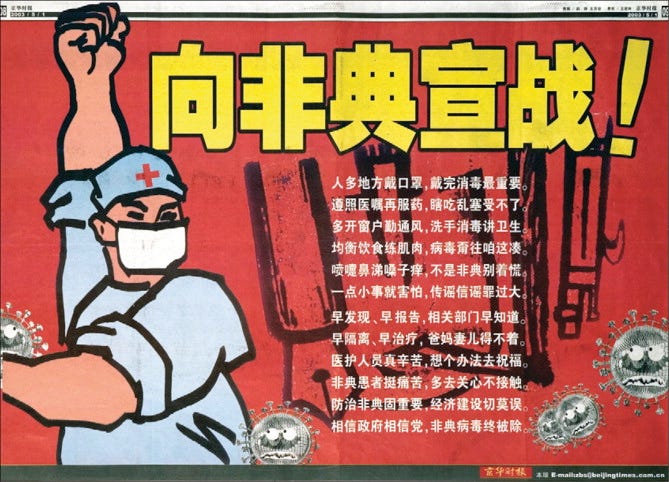
At the start of COVID: “China’s National Health Commission Advises Medical Institutions to Use Traditional Chinese Medicine (TCM) to Treat Coronavirus,” March 2020. Source.
Main Takeaways
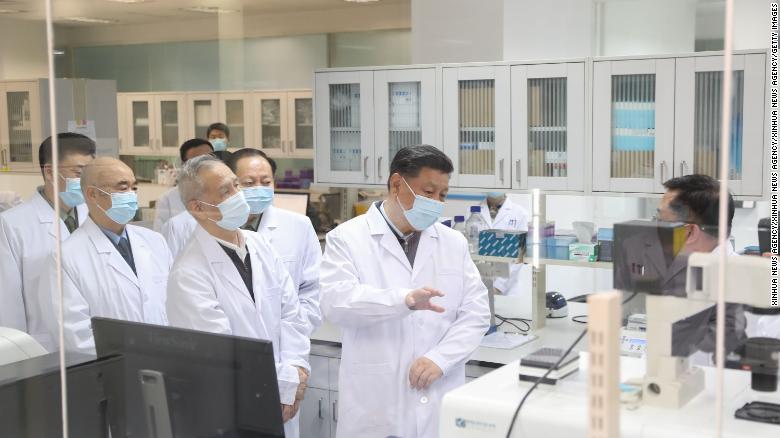
The CCP looks to be taking pandemic risk seriously. After China’s public-health system was shown unfit for purpose when COVID hit, Beijing has now enacted some of the most actionable steps of any major country to bolster its pandemic-readiness system.
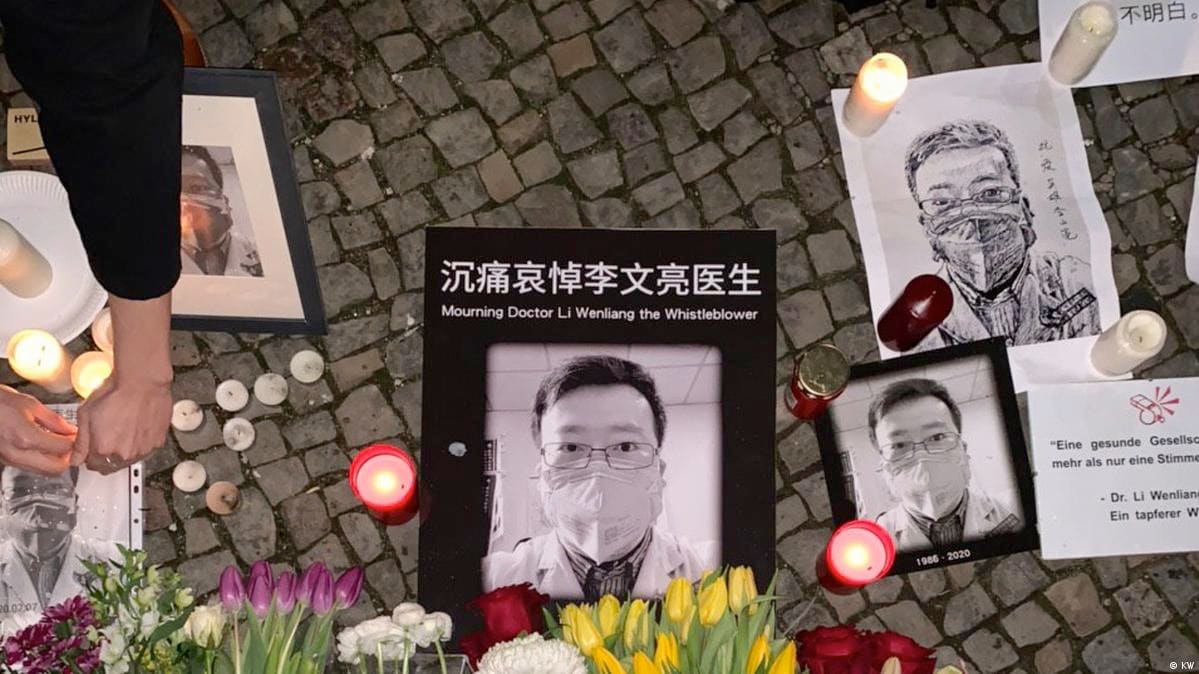
COVID exposed how costly Beijing’s old instincts were: burying early signals, punishing whistleblowers, and relying on improvised crackdowns left the center blind and politically exposed. The new reforms try to fix this by giving local officials clearer rules, reporting guidelines, and more room to act early without fear of punishment. Beijing appears willing to trade some information-control for a more rule-bound, faster-moving system, though whether officials feel empowered to speak up remains uncertain.
A more centralized domestic monitoring and command system gives China greater ability to manage potential outbreaks internally, reducing pressure to depend on international organizations. That avoids reputational costs and protects “face,” which helps explain why China can buy-in heavily to pandemic preparedness while still resisting meaningful collaboration or data sharing with groups like the WHO.
Globally, Chinese state rhetoric casts the U.S. as the country that bungled COVID while downplaying its own early missteps. And Beijing is positioning itself as an international leader on health governance, especially for the Global South.
*Starting with “Recent Government Initiatives,” each section ends with a grade. Taken together, China earns a C+ overall, which is an improvement over the D I would have given it pre-COVID, though still shy of the B- I’d give the US.
Since 2023, the major players in China’s pandemic readiness system have received new mandates, budgets, or planning documents to strengthen their roles.
At a high level, China’s system runs on a clear hierarchy. The State Council directs national strategy, the National Health Commission (NHC) leads implementation, and a network of technical and support agencies (at both federal and provincial levels) executes the work.
Key Players
State Council (国务院) — the top command centre in any outbreak. It activates the “Joint Prevention and Control Mechanism” (联防联控机制), created during COVID, to coordinate ministries across health, industry, and emergency management. Since 2023, the State Council has signalled an effort to bolster its coordinating role for pandemic response.
National Health Commission (国家卫健委, NHC) — China’s main health authority and a cabinet-level executive department of the State Council. It drafts and enforces key laws, oversees the China CDC and the National Health Emergency Response Center, and manages early-warning and emergency-medical systems.
National Administration of Disease Control and Prevention (国家疾控局, NADC) — created in 2021 to strengthen disease control and biosafety. It sets national standards for surveillance and builds modern early-warning/data systems. It’s one of the key additions of China’s post-COVID infrastructure.
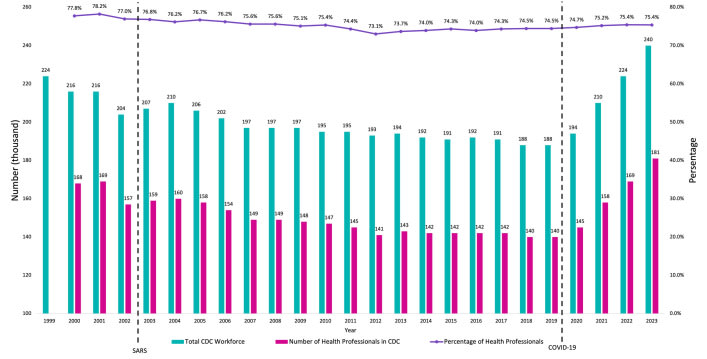
China CDC(中国疾控中心) — the technical core of the system. It collects and analyzes infectious disease data, runs testing labs, and provides guidance to local CDCs. The CDC workforce numbers surged during COVID, increasing by about 20% to reach 240,000 in 2022, the highest level ever. This was preceded by years of post-SARS neglect, which left the system understaffed and unprepared for COVID (see graph below).
“The total workforce of CDCs in China (1999–2023), determined based on China Statistical Yearbooks published between 2000 and 2024.” Source.
There are also many supporting ministries that handle logistics, funding, and research, such as
National Health Emergency Response Center (国家卫生应急中心) - coordinates emergency medical teams and logistics during crises.
National Biosecurity Work Coordination Mechanism (国家生物安全工作协调机制) - coordinates biosecurity-specific policy and emergency response across ministries.
Ministry of Industry and Information Technology (工业和信息化部, MIIT) - manages medical supply production and logistics.
Ministry of Science and Technology (科学技术部, MOST) - supports new R&D programs in pathogen detection and modelling.
National Medical Products Administration (国家药品监督管理局, NMPA) - fast-tracks new countermeasures.
People’s Liberation Army (中国人民解放军, PLA) - deploys medical units and runs military R&D in pandemic-related situations.
How Does the US Compare?
In China, authority flows from the State Council through the National Health Commission and its affiliated agencies. Provinces largely mirror this structure, which makes it easier to coordinate and implement national policy quickly once priorities are set in Beijing.
The US system is much less centralized. The Department of Health and Human Services — mainly through the CDC and the Administration for Strategic Preparedness and Response (ASPR) — leads at the federal level, but state and local governments hold most of the practical authority over public health measures. In practice, the federal government provides funding, guidance, and aggregates data, yet in a major pandemic, it’s less clear that the US could quickly coordinate a unified national response.
Centralization, on the other hand, has trade-offs. China’s unified chain of command can move quickly, but a bad call at the top can misdirect the entire system. The U.S.’s decentralized model is more heterogeneous, since one state’s mistakes don’t necessarily drag everyone else down. China’s approach, therefore, relies heavily on accurate information flowing upward and on giving localities enough room to adapt policies to local conditions, which many of the initiatives below attempt to do.
Recent Government Initiatives
In September 2025, China’s top legislature (NPCSC seventeenth session) passed the Public Health Emergency Response Law (突发公共卫生事件应对法, PHERL). It’s the country’s most significant effort since COVID-19 to overhaul how it manages outbreaks, arriving alongside a substantial revision of the Infectious Disease Law (传染病防治法, IDL) earlier this year. Together, the two laws do a good job of weaving in many of the major pandemic readiness updates in recent years, and are meant to give China a more coordinated and legally coherent framework for handling future epidemics.1
One surprising feature of both PHERL and IDL is that neither substantively mentions the Biosecurity Law (生物安全法). Since its introduction in 2020/2021, the Biosecurity Law has been China’s main legal framework for managing biological risks, specifically, from pathogen labs to zoonotic disease surveillance. The law divides biotechnology research and development activities into three risk categories — high, medium, and low — requiring approval for high-risk and medium-risk activities. It also establishes classified management of pathogenic microorganisms and hierarchical administration of pathogenic microorganism laboratories. The law was mildly amended in 2024, though many of its weak spots remain.
The gist of these recent moves is an attempt to correct the legal and regulatory weaknesses that became apparent during COVID. At the time, SARS-CoV-2 was classified too slowly, lines of authority in emergencies were poorly defined, and rigid central control over information disclosure left local governments hesitant to act.
All Talk?
Do these reforms have any teeth? There are a few ways to parse this out.
The Biosecurity Law, IDL, and PHERL are binding laws (法律) passed by the NPC Standing Committee. This makes them more authoritative than the guiding opinions (指导意见) and plans (方案) that often crowd China’s policy space. Responsibility for their implementation also increasingly falls under the State Council, the top executive body of the land, giving these measures more political backing than if they were purely the responsibility of various lower-ranking ministries.
Still, the NPC passes many laws that aren’t effective. This is because (1) people don’t know they exist, or (2) they are not clear enough to be actionable. Therefore, what’s more important is enforcement clarity. Can local officials, hospitals, and labs actually understand what these laws require and act on them in real time? Here, the picture is mixed.
Many provisions are more explicit than previous drafts, but some remain vague or lack operational detail. For example, Article 74 of the IDL allows private entities to file complaints (申诉) if they believe emergency measures are excessive, a gesture to remediate the lack of voice many people felt during Zero-COVID. However, Article 74 offers little guidance on how such complaints will be handled or whether they provide meaningful recourse, making it unclear to people tempted to complain whether they will face consequences. By contrast, more fleshed-out stipulations like the updated early-reporting requirements (explained in the next section) clearly spell out responsibilities, timelines, and penalties, making them more obviously enforceable.
After reviewing the earlier versions of the IDL and Biosecurity Law and comparing them with the updated texts and the addition of PHERL, the system as a whole has gained some enforcement clarity. My rough sense is that only about 20–30% of the original provisions felt truly actionable, meaning that, as a local official or doctor, you could read them and understand what you were expected to do. In their current form, it feels closer to 40%.
Enforceability is jagged, though. The revised Biosecurity Law doesn’t feel meaningfully clearer to me, while PHERL and IDL seem to have made big strides.
Finally, we can look to historical analogues. The post-SARS reforms significantly reshaped China’s pandemic response system. Before 2003, the public health apparatus was fragmented and underfunded; the China CDC had only been established a year before, and case reports were still handwritten and faxed to Beijing. SARS prompted the government to carry out a wave of initiatives, such as building a real-time reporting network that linked clinics and hospitals across the country. The SARS reforms were incomplete, of course, given China’s lack of preparation for COVID, but it was a significant evolution from what little previously existed. The post-COVID reform wave feels like a similar energy stemming from a similar realization that their pandemic readiness system was far behind where it should have been.
The Content
*Graded from Best to Worst: Partly Post-COVID Improvements, Partly Overall Performance
Interagency Coordination
PHERL and IDL stress interagency coordination. The “joint prevention and control mechanism” (联防联控机制) created by the State Council during COVID is now written into law. It brings together more than 30 ministries and agencies across health, industry, and emergency management. At least a dozen civilian and military departments must share surveillance data, coordinate logistics, and build a unified national information platform for early warning.The aim is to keep ministries from working in silos and ensure outbreaks are met with synchronized mobilization.
Before COVID, no comparable command structure existed. Outbreak response rested with the NHC and China CDC, agencies without the authority to pull in heavyweight ministries or compel timely reporting from local governments. Coordination was improvised and slow. By placing the joint mechanism under the State Council, PHERL and the IDL give epidemic response a body that can enforce nationwide logistics and require all relevant ministries and provinces to report upward, ensuring that at least one institution has a complete, real-time picture of the entire situation.
Grade: A-
Mobilizing dozens of ministries and a national response is something the CCP can do better than anyone. The key caution is avoiding excessive uniformity; provincial conditions vary, and a highly centralized system must take care not to impose directives that could overlook unique situational circumstances.
Classification
The IDL updates China’s three-tier disease classification system (Classes A, B, C). Class A diseases, such as plague and cholera, trigger the highest-level emergency responses: immediate reporting, mandatory isolation, and broad quarantine powers. Class B diseases, like SARS or COVID (once it was officially listed), require strong but somewhat less sweeping interventions. Class C diseases, being the least concerning, are monitored primarily for trends and local containment, such as influenza or the mumps.
Previously, new or unknown pathogens couldn’t trigger a response until they were formally classified, a flaw made clear by how long it took to classify COVID. The revision tries to fix this by adding “sudden outbreaks of unknown origin [突发原因不明的传染病]” as an event that can be treated as Class A for response purposes. This designation prompts the State Council to rapidly investigate and issue a formal recommendation, allowing containment measures to begin before full classification is complete.
The concern for diseases of unknown origin reflects China’s growing rhetorical emphasis on “Disease X (X疾病)” (coined by the WHO in 2018), which calls for proactive preparation against future, as-yet-unidentified pathogens. As a government white paper put it earlier this year, China now aims to “draw on the experience of COVID-19 prevention and control, and make proactive preparations for future pandemics such as Disease X.”
Grade: A-
This lets officials act preemptively rather than reactively, but I’m docking half a grade as the incentives around sounding the alarm early are still uncertain. It’s unclear whether people will actually feel safe triggering a potential Class A response even when they’re technically allowed to do so.
Monitoring and Surveillance
Surveillance has taken on a more prominent role in the new framework. IDL Article 42 now mandates what’s called “sentinel surveillance” (哨点监测), a system in which selected hospitals and clinics continuously report data on specific diseases or symptoms to detect unusual spikes early. The revisions also strengthen requirements for identifying and reporting clusters of unknown or emerging illnesses, bringing China’s procedures more in line with the World Health Organization’s revised International Health Regulations (IHR).
Article 13 forbids excessive data collection and limits the use of personal information (like digital travel codes) to infectious-disease prevention and control. In theory, that’s a privacy safeguard; in practice, it’s anyone’s guess how strictly those boundaries will be enforced.
More speculatively, China’s ‘AI Plus’ Plan and related AI + Medical/Healthcare guidelines envision using artificial intelligence to enhance this surveillance network. The health-industry guideline lists public health services as one of four key application areas for AI, and pilot programs in cities like Shanghai are experimenting with AI systems that use citizens’ health data for lifelong health monitoring or proactive symptom detection. These efforts, however, remain largely aspirational.
Grade: B+
China already has the world’s most capable general surveillance system, so it will likely be able to implement this effectively. It’s still surprising that disease-specific surveillance measures weren’t firmly in place before COVID.
Local Authority
Under the IDL, local authority is also expanded. County- and city-level governments can now issue early warnings (Arts. 9, 53) and activate emergency responses when dealing with a sudden outbreak of unknown origin (Art. 65). This aligns the IDL with the Emergency Response Law, closing the gap between local initiative and national oversight. In theory, it allows quicker reaction on the ground while keeping reporting lines to Beijing intact.
Grade: B
Local officials can now move faster while Beijing deliberates — just not too fast, given an early move might look bad optically and provoke backlash from Beijing if it turns out to be a false alarm, given how vague the ostensible protections are.
Government Accountability
When it comes to checking central government power after some of the most controversial Zero-COVID measures — such as sealing residents in their homes, welding apartment doors shut, mass quarantine transfers, and imposing citywide lockdowns that lasted weeks — the recent reforms offer only modest adjustments. New provisions require local governments to ensure food and water supplies, maintain medical access, protect vulnerable groups, publish emergency hotlines, and keep workers employed during lockdowns (Arts. 64–67).
These steps are intended to prevent the worst excesses, but they do not meaningfully limit the state’s authority to impose sweeping restrictions in the first place. It is stated multiple times that decision-making remains centralized, and local officials must still carry out whatever directives Beijing issues.
Grade: B-
The CCP won’t be publicly apologizing for Zero-COVID anytime soon. But these reforms tacitly acknowledge its excesses and theoretically prevent future worst practices, like quarantined residents being locked in their homes without food.
Punishment
The revisions further strengthen enforcement but aim to channel it through clear legal authority. Individuals or institutions that refuse to cooperate with legitimate disease-control orders can now face fines of up to 1,000 yuan (~US$140), and entities up to 20,000 yuan (~US$2,810) (Art. 111 of IDL). Previously, Chinese law didn’t penalize most violations of epidemic orders, forcing police to repurpose unrelated statutes — such as those meant for constitutional “states of emergency” — to enforce zero-COVID restrictions. The fine is small, but “refusing to cooperate” is defined so broadly that even something like declining to wear a face mask could trigger a penalty.
Grade: C+
If this were aimed at punishing officials who bury crucial information — like those in Wuhan who hid early COVID signals — it would be a big upgrade. Instead, it mostly adds small fines that feel more suited to policing minor noncompliance, which risks echoing the punitive instincts of Zero-COVID rather than fixing the real failures.
Dual-Use Technologies
TheRegulations on the Export Control of Dual-Use Items(中华人民共和国出口管制法), updated in late 2024, fold biological materials, technologies, and associated equipment into the same export-control framework that governs chemical, nuclear, and other sensitive goods. Under the new update, biological exports are managed through MOFCOM, under the State Council, which now appears to have greater authority over licensing and enforcement. Still, it’s unclear what exactly has changed — the specific list of what qualifies as “dual-use” biological items has yet to be clearly defined.2
Grade: C
This feels more about restricting what China sells abroad than about tightening its own safeguards around creating dual-use biological tools to begin with. It’s good as a nonproliferation measure, but the issue of creating clear research norms and controls over dual-use work inside China is still largely unaddressed.
Early Reporting
A core reform is early reporting. Under IDL, hospitals, blood banks, and local CDCs must report suspected outbreaks, clusters of unknown illness, or abnormal health events within two hours through the national Direct Reporting System. Those who report in good faith are protected from punishment (and eligible for some sort of award) even if their alerts later turn out to be wrong (Art. 51), while any official or institution that interferes with or delays reporting can now be penalized.
These provisions appear to respond directly to the early weeks of COVID-19, when local officials in Hubei delayed or suppressed information about the emerging virus — most infamously in the case of Dr. Li Wenliang, the Wuhan physician reprimanded by police for spreading “false information” after trying to warn colleagues about an unusual respiratory illness. Tragically, he later died from COVID.
However, it’s never really explained what disease reporting is supposed to include, and the promise of protection for “good-faith” reporting also feels fuzzy, since no one has defined what counts as good faith.
Grade: C-
If I were a doctor, I’d still be somewhat uneasy reporting early warnings. The protections are vague, and the precedent for punishment is much higher than in other countries.
Li Wenliang’s death triggered a rare nationwide outpouring of grief and anger. Source.
Biotechnology Risks
The biggest shortcoming with China’s pandemic readiness system, in my opinion, is that it has not made substantial progress in addressing the safety risks posed by biotechnology — meaning the dangers that arise when genetic engineering, synthetic biology, or laboratory manipulation of organisms could unintentionally create or amplify biological threats.
The 2021 Biosecurity Law was the first statute that gestures at governance in this space. It formally divided biotechnology R&D into three risk tiers — high, medium, and low — with high- and medium-risk projects requiring approval or registration and restricted to legally incorporated domestic entities. The law also established security management rules for human genetic resources and biological resources.
The law was amended with updates that took effect in April 2024, but the changes appear largely procedural rather than substantive. There are still no specific ethical guidelines for biotechnology R&D; the three-tier risk system (high, medium, low) lacks concrete criteria for how projects should be classified; and the vague references to “relevant departments” (有关部门) leave unclear which agencies are responsible for what. In practice, this means ethical oversight is likely to devolve to institutional review boards or ministry-level discretion. These bodies vary widely in capacity, and because biotech research is competitive, institutions may have incentives to adopt more permissive review practices to maintain an edge.
This gap is likely related to the fact that Beijing also views biotechnology as a strategic growth sector. Much of the Biosecurity Law reads more like a biotech development agenda with biosecurity sprinkled on top. Article 5, for instance:
“The state shall encourage innovation in biotechnology, strengthen the building of biosecurity infrastructure and the biotechnology workforce, support the development of the bioindustry, raise the level of biotechnology through innovation, and enhance the capabilities to guarantee biosecurity.”
Grade: D
Synthetic pathogens are one of the most plausible routes to a truly catastrophic outbreak, yet Beijing’s biotech push largely ignores these safety concerns. However, in the US and other countries, ethical oversight also seems to fall to institutional review boards or ministry-level discretion, so I can’t give this a completely failing grade.
To sum up, China’s recent policy initiatives reflect a system trying to learn from its own COVID contradictions. Beijing wants a more unified and legally codified pandemic readiness system, one that detects and contains outbreaks before they spread, but also one that avoids repeating harsh crackdowns and which made provincial authorities feel powerless to national authorities. It’s a tough balance to strike.
Overall Grade: C+
Many of the laws and local incentives are still unclear, but Beijing is at least increasingly turning abstract goals into concrete procedures and has an unmatched capacity to trigger a unified response. And unlike some countries, its rhetoric does not actively denigrate public health measures.
For reference, I would give the US a B-. Even with its issues, the US does better at dual-use tech governance [pdf] and has better incentives for early reporting and information sharing.
Funding
Funding is an indicator of whether these statements have backing to them, but data is limited.
Our best piece of evidence comes from the Chinese Ministry of Finance, which shows that major infectious-disease prevention funding rose from about ¥16.98 billion ($2.38 billion) in 2018 to ¥23.82 billion ($3.34 billion) in 2023 — an increase of roughly 40% over five years. These funds are meant to expand things like vaccine-production capacity, surveillance systems, and hospital preparedness.
There’s no visible COVID-era spike in 2020–21 because much of that emergency spending flowed through temporary epidemic-response channels — one-off MOF transfers and provincial emergency budgets — rather than this regular subsidy line. The subsidies in the graph instead indicate Beijing’s effort to institutionalize emergency spending within its normal public-health budget.
Small bits of additional evidence tentatively point in the same direction. China launched a multi-billion-dollar reconstruction of the national CDC system in 2023, alongside major provincial investments in places like Shanghai and Guangdong. Data beyond 2023, however, is limited, so drawing further conclusions would be premature.
Grade: B-
They’re on an upward trend, but the total still looks modest relative to China’s GDP and population. In 2023, ¥23.8 billion (~US$3.3 billion) works out to only about US$2–3 per Chinese citizen per year. By contrast, OECD estimates put average pandemic prevention, preparedness, and response spending at around US$101 per capita, with the United States at US$279 and Germany at US$209. The true gap must be smaller, since China adds money through provincial budgets, immunization programs, and other health lines that don’t show up in the MOF subsidies, but I estimate that the sum of these monetary investments still falls well below the OECD average.
How China Talks About the US
One interesting factor shaping China’s pandemic governance has been its rhetorical positioning vis-à-vis the United States.
Beijing has leaned heavily on the narrative that America’s COVID response was chaotic, politicized, and unscientific, using US failings as a foil to validate its own system. The strategy deflects criticism of China’s early missteps and reinforces the idea that China’s centralized model is not only legitimate but superior.
For example:
A People’s Daily editorial from May 2025 calls the US the “全球第一抗疫失败国” (literally: “world’s No. 1 failure in pandemic response”), citing CDC death totals and arguing that the outcome exposes pseudo-science.
A Global Times editorial said, “As the world’s most developed country, its response to the pandemic has been a complete failure, offering no positive lessons.”
This narrative has political uses, but it could also make Beijing overconfident. By defining itself in opposition to the US, China has built a pandemic story that depends on its own perceived success, which could also make addressing institutional shortcomings difficult.
For instance, Chinese state media outlets have often disparaged the effectiveness of US vaccines, framing Western rollout efforts as reckless or unsafe. Yet beneath those critiques lies the unspoken acknowledgment that during COVID-19, China’s vaccine sector fell far behind its Western counterparts in both technology and trust. Beijing’s decision to reject mRNA vaccines like Moderna, despite their demonstrated efficacy, left millions reliant on weaker domestic shots.
Meta-Grade: China is grading its own paper here, and giving itself full marks despite doing a lousy job of handling COVID. Revising history, rather than addressing one’s mistakes, tends to be a bad idea.
International Moves
China has also engaged in a series of international initiatives on pandemic preparedness, though international communiqués on public health are rarely binding. Xi’s Global Security Initiative, for example, claims China will lead international biosecurity, but says little about how it will actually accomplish this.
Funding is a clearer signal. In May 2025, China pledged $500 million to the WHO over five years, effectively becoming the organization’s largest funder after the US withdrawal. China has also contributed to many other initiatives, like the World Bank’s Pandemic Fund, and hasn’t abstained from other multilateral health financing mechanisms (unlike the US).
A substantial portion of China’s health funding targets the Global South, particularly in Africa. China committed $80 million for constructing an Africa CDC headquarters in Ethiopia, a project that became operational during the pandemic, and $2 billion in assistance for COVID-19 response and economic recovery in developing countries. China’s WHO funding notably includes the condition of “a certain amount of voluntary contribution and projects support through the Global Development and South-South Cooperation Fund” — terminology tied to China’s Health Silk Road initiative, essentially the public health dimension of the BRI. 52 out of 54 African countries have participated in these health programs.
The China-aided Africa CDC Headquarters in Addis Ababa, Ethiopia. Source.
China has also recently convened ASEAN Conferences on biosecurity governance in conjunction with the UN Office of Disarmament Affairs. These talks emphasize lab safety, pathogen-sharing, and early-warning systems between South East Asian countries.
Despite positioning itself as a global health leader, China consistently fails to report the specifics of its assistance activities to international agencies like the OECD’s Common Reporting System or the International Aid Transparency Initiative. Tensions have also flared with organizations like the WHO over China’s lack of timeliness, completeness, and durability of data sharing, especially around origins-relevant evidence for COVID and during recent disease surges. In November 2023, for instance, the WHO formally requested detailed information on pneumonia clusters among children following reports of cases in northern China. Beijing eventually provided data, but only after a significant delay, underscoring a pattern of reactive rather than proactive disclosure. China furthermore does not participate in Joint External Evaluation Assessments, where a team of independent international experts evaluates a country’s health security capabilities across 19 technical areas.
CDC report, May 2024. Green countries participate. Grey countries do not. Source.
I believe this kind of behavior makes sense when accounting for how central reputation and “saving face” are to China’s public-health motivations. Reporting outbreaks quickly or exposing gaps in its own system can be embarrassing; projecting itself as a global public health advocate and generous benefactor to the Global South is not. If China can manage its own health problems internally and fund other systems externally, it (1) looks good and (2) reduces outside scrutiny — a bit like a boyfriend who pays for dinner so his girlfriend doesn’t go through his phone.
Grade: C
They say all the right things, and it’s good they’re helping the Global South’s public health infrastructure, but they still avoid building the deeper collaborative foundations we’d need for a globally unified response to a major infectious outbreak.
The CCP is taking pandemic readiness seriously, but the through line isn’t a coherent strategy so much as a collection of post-COVID impulses: prevent another global pandemic from originating in China, avoid another round of draconian lockdowns, and do it all without loosening Beijing’s grip while empowering people to speak up.
Call to action
If you know anything about this topic or think I’ve missed something important, please reach out. I’m particularly interested in hearing from people with knowledge about China’s vaccine development capacity, high-end PPE manufacturing, biosurveillance systems, or research and safety standards for future installments.
I did not find nearly as many experts on Biosecurity x China as I would have liked. China’s pandemic preparedness apparatus remains surprisingly under-studied, especially compared to the extensive analysis of its COVID response or the pandemic readiness systems of other countries. The expert on this could be YOU.
The broader Emergency Response Law (突发事件应对法) still seems to be responsible for certain types of pandemic emergency situations, but the two new laws appear to have taken over many of the responsibilities this law originally covered.
Chloe Lee wrote a strong analysis of the Biosecurity Law and Regulations on the Export Control of Dual-Use Items as they existed before the 2024 updates, laying out some of their weak points.

 Login
Login