Normal view

There are new articles available, click to refresh the page.
Before yesterdayMain stream

Medium and Message: En plein air

By: hoakley
25 November 2025 at 20:30

Paintings made in oils in front of the motif, en plein air, are a surprisingly recent innovation. Although often ascribed to the inconvenience of handling oil paint before it was offered in tubes in the middle of the nineteenth century, in fact it had become popular if not mandatory for the aspiring landscape painter well before that. Instead of taking their paints in tubes, those pioneers used pig bladders, that had become widely available from artists’ colourmen, as were used by Constable, Turner and many others.

Initially, plein air oil sketches weren’t intended to be seen by the public or patrons.
desporteslandscape
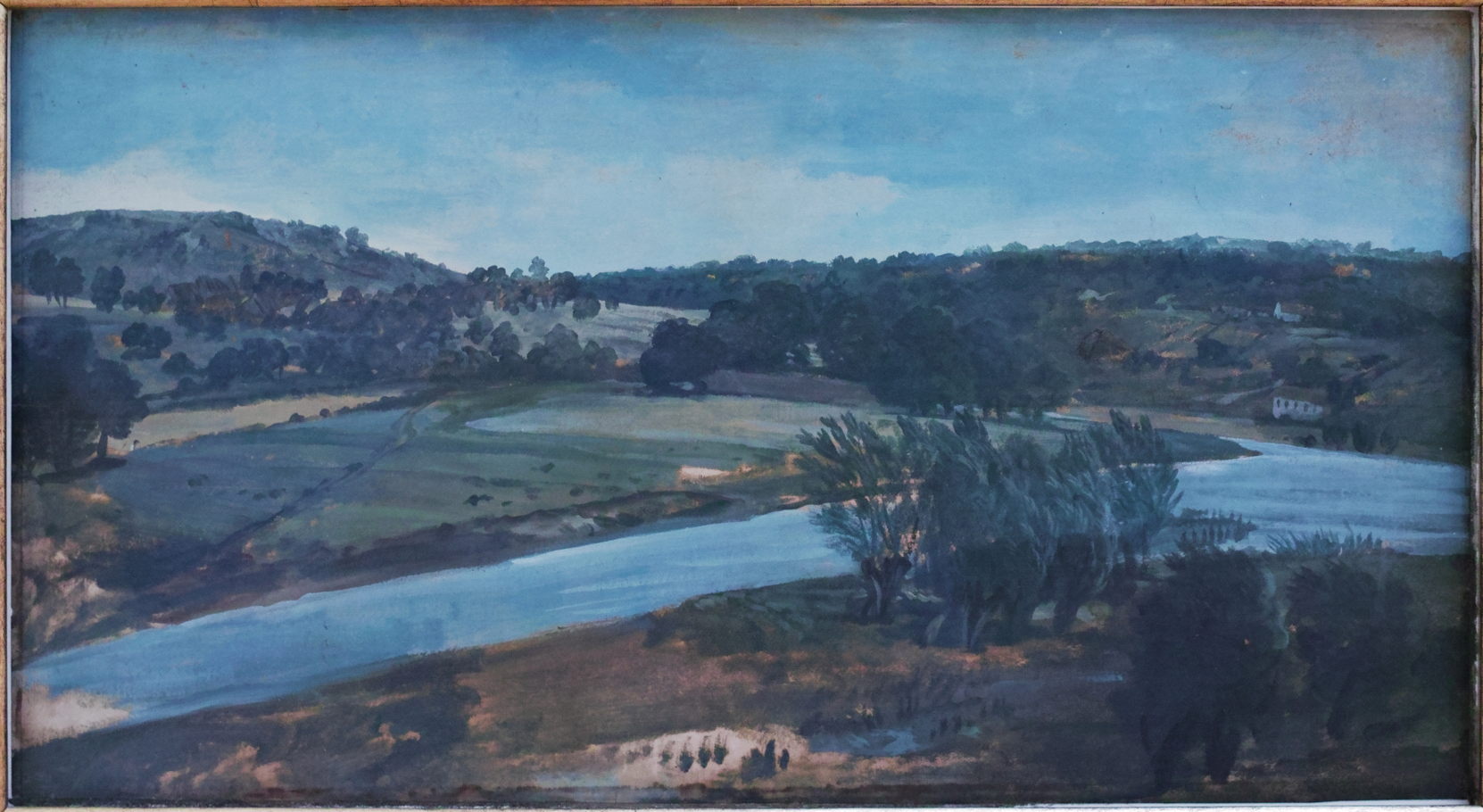
Alexandre-François Desportes (1661-1743), Landscape Study (c 1700), oil, dimensions not known, Palais des beaux-arts de Lille, Lille, France. Wikimedia Commons.

Among the earliest artists to paint regularly in front of their motif was Alexandre-François Desportes (1661-1743), a professional painter of hunting scenes and animals, whose Landscape Study was painted in about 1700.

Plein air oil sketching was described and recommended by Roger de Piles in his book Cours de Peinture, published in 1708, contemporary with Desportes’ sketches. Other books on painting and art in the eighteenth century also cover the topic, and Claude-Joseph Vernet was recorded as having painted oil sketches en plein air, but none have survived.

valenciennesvillafarnesepoplars
Pierre-Henri de Valenciennes (1750–1819), Farm Buildings at the Villa Farnese: the Two Poplar Trees (1780), oil on paper on cardboard, 25 x 38 cm, Musée du Louvre, Paris. Wikimedia Commons.

At Vernet’s suggestion, the young Pierre-Henri de Valenciennes made copious oil sketches such as this of Farm-buildings at the Villa Farnese: the Two Poplar Trees when he was painting in the Roman Campagna in 1782-85. He not only built himself a large visual library of sketches from nature, but published a widely used book on landscape painting in which he recommended the practice.

sabletconradgessner
Jacques Sablet (1749–1803) Portrait of the Painter Conrad Gessner in the Roman Campagna (1788), oil on canvas, 39 × 30 cm, Kunsthaus Zürich, Zürich. Wikimedia Commons.

Jacques Sablet’s Portrait of the Painter Conrad Gessner in the Roman Campagna shows one of the early plein air landscape painters in 1788, over fifty years before the first paint tubes became available.

quadroneeveryoccasiond1
Giovanni Battista Quadrone (1844–1898), Every Opportunity is Good (detail) (1878), other details not known. Wikimedia Commons.

Although this detail of Giovanni Battista Quadrone’s Every Opportunity is Good shows a studio in 1878, the low table at the left has several bladders containing oil paint. They remained popular with many artists until towards the end of the nineteenth century. Although not as convenient as tubes, the better colourmen still offered a wide range of pigments in bladders that were significantly less costly.
renoirmonetpainting
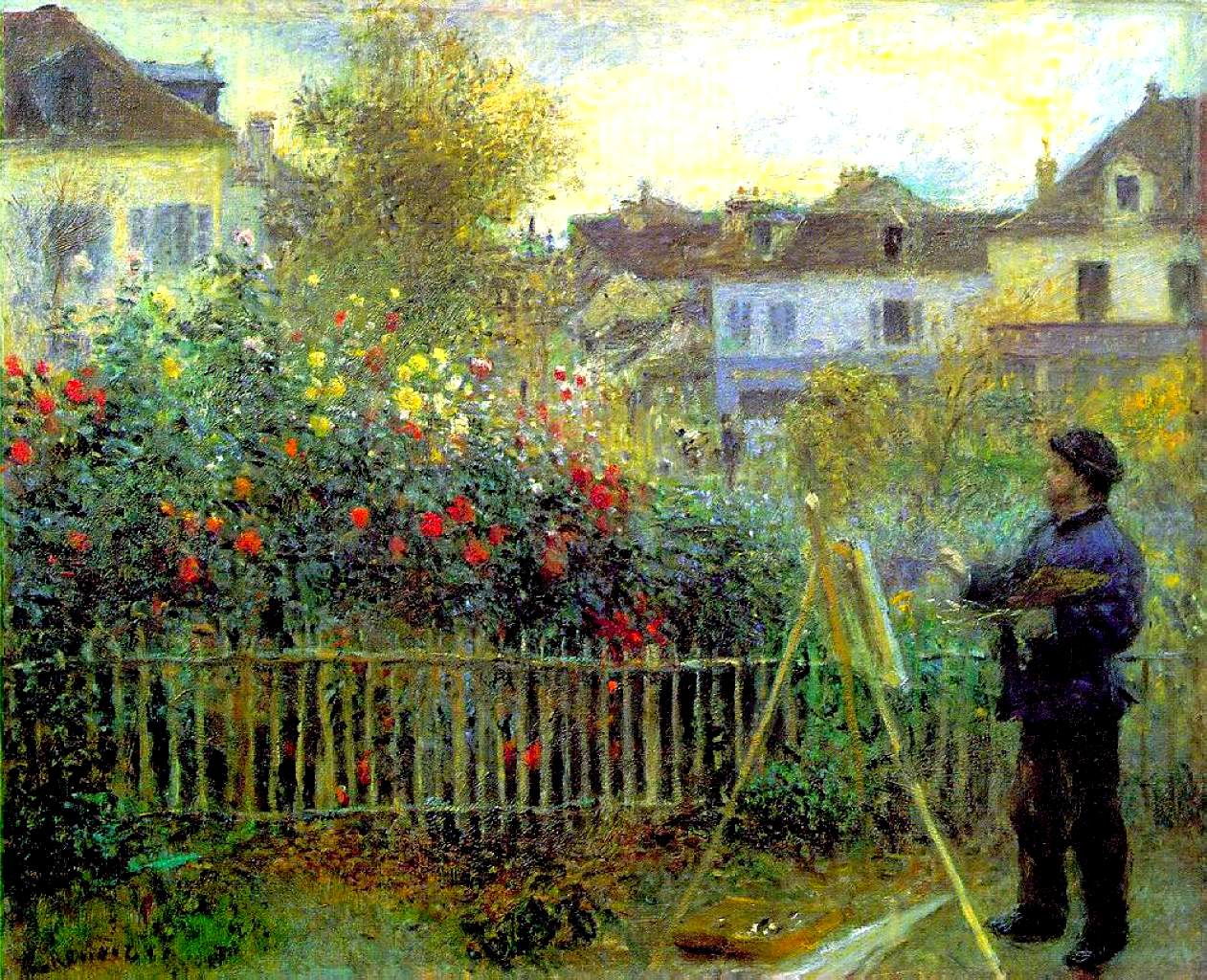
Pierre-Auguste Renoir (1841–1919), Monet Painting in his Garden in Argenteuil (1873), oil on canvas, 46 × 60 cm, Wadsworth Atheneum, Hartford, CT. Wikimedia Commons.

Pierre-Auguste Renoir painted Monet Painting in his Garden in Argenteuil in 1873. Claude Monet is using a conventional lightweight wooden easel, with a small canvas that allows him to work standing. His oil paints are in the pochade box under the easel. Although just outside his house, he would have used the same equipment when further from home.
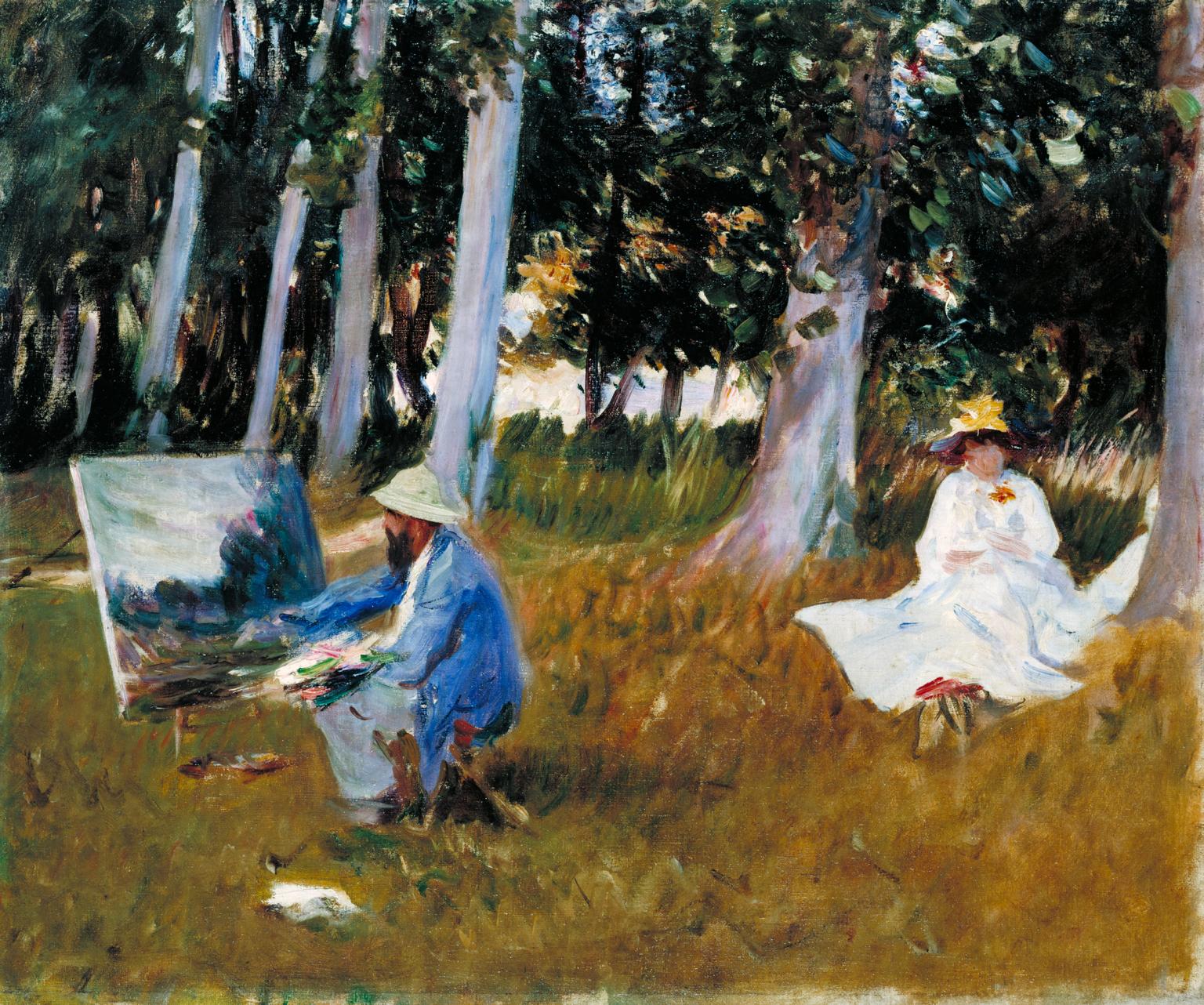
Claude Monet Painting by the Edge of a Wood ?1885 by John Singer Sargent 1856-1925
John Singer Sargent (1856–1925), Claude Monet Painting by the Edge of a Wood (c 1885), oil on canvas, 54 x 64.8 cm, The Tate Gallery (Presented by Miss Emily Sargent and Mrs Ormond through the Art Fund 1925), London. © The Tate Gallery and Photographic Rights © Tate (2017), CC-BY-NC-ND 3.0 (Unported), http://www.tate.org.uk/art/artworks/sargent-claude-monet-painting-by-the-edge-of-a-wood-n04103

In about 1885, when they were painting together, John Singer Sargent took this opportunity to paint Claude Monet Painting by the Edge of a Wood. Seated on a traditional three-legged folding stool, Monet is here working on a much larger canvas, his pochade box again under the easel for ready access.
demontbretonmarieduhem
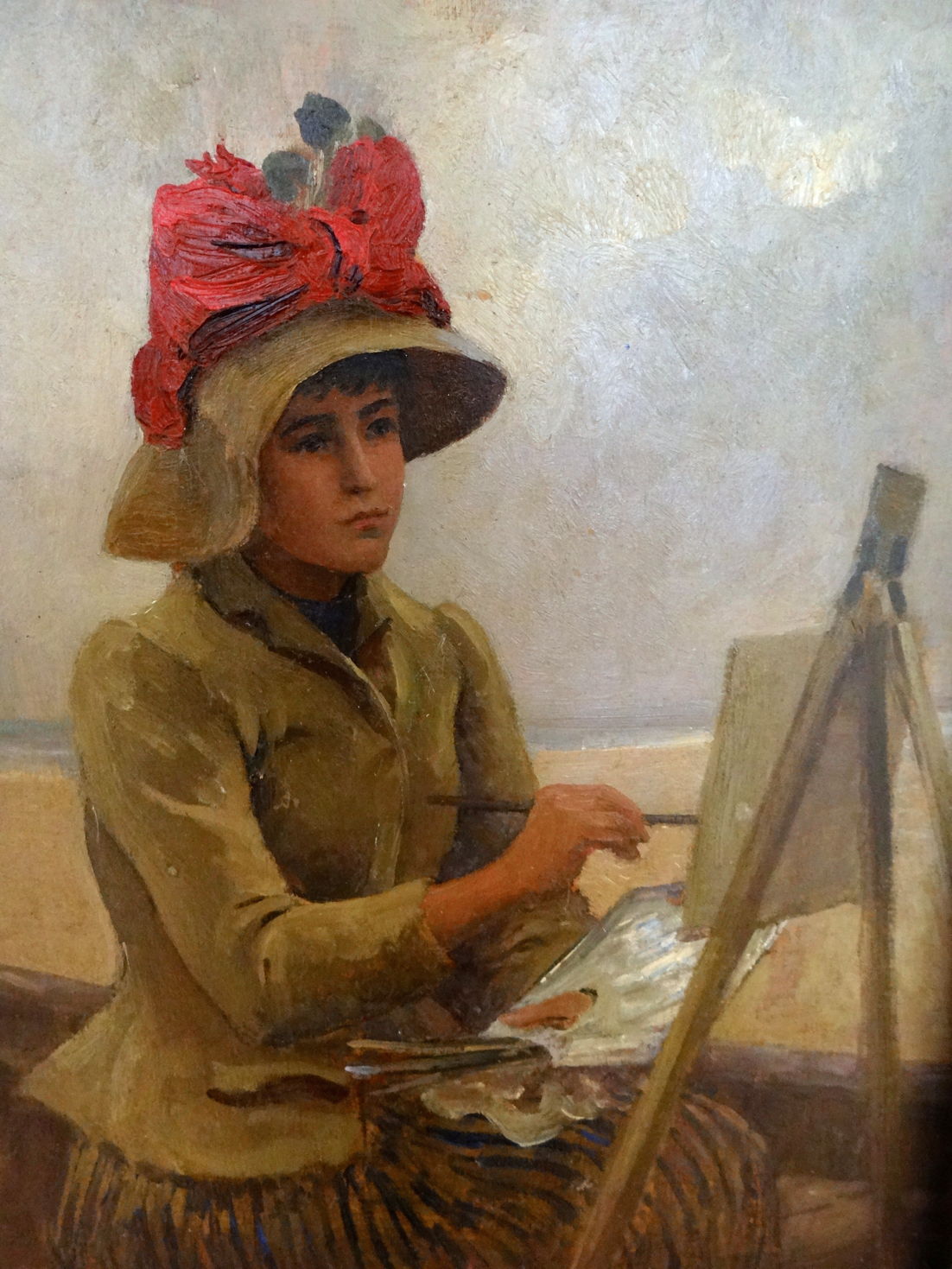
Virginie Demont-Breton (1859–1935), Portrait of Marie Duhem (detail) (1889), oil on panel, dimensions not known, Musée de la Chartreuse de Douai, Douai, France. Wikimedia Commons.

This detail of Virginie Demont-Breton’s Portrait of Marie Duhem (1889) shows one of her close friends and colleagues in the Wissant School, at work en plein air on the coast near their house. She appears to have set her easel up by a wooden groyne on the beach.
sargentoutofdoorsstudy
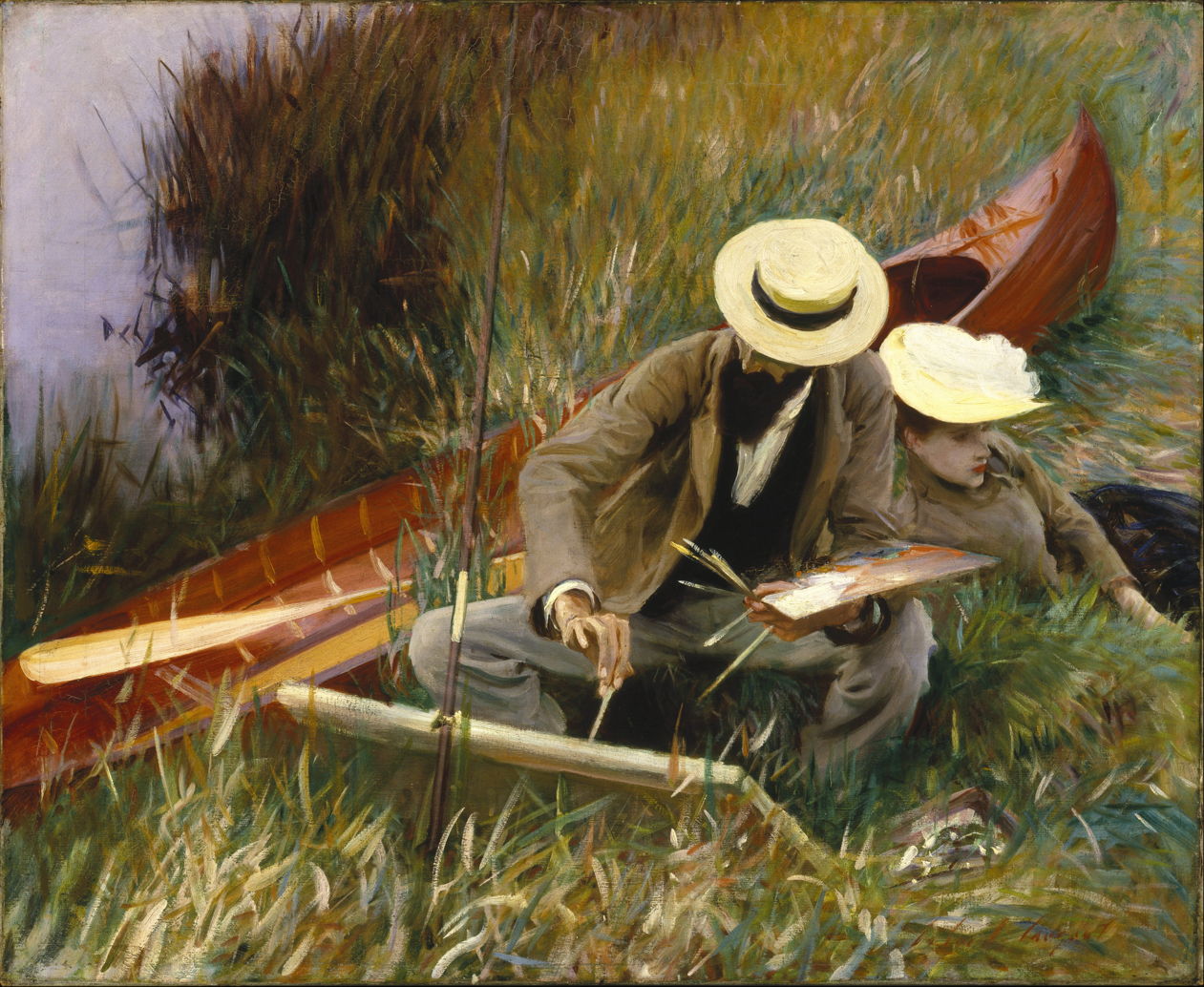
John Singer Sargent (1856–1925), An Out-of-Doors Study (c 1889), oil on canvas, 65.9 × 80.7 cm, Brooklyn Museum, New York, NY. Wikimedia Commons.

In John Singer Sargent’s An Out-of-Doors Study (c 1889) he shows his friend Paul César Helleu working on a canvas propped up in the grass by a single pole, a precarious arrangement only suitable for the calmest of days. It also forces him to work very low, and he squats in a position of tension, his pochade box in the grass below his left knee.

brendekildelaring
Hans Andersen Brendekilde (1857–1942), L.A. Ring Paints at Aasum Smithy (1893), oil on canvas, 107 x 140 cm, location not known. Wikimedia Commons.

Hans Andersen Brendekilde’s L.A. Ring Paints at Aasum Smithy (1893) shows his friend painting the primary school in the village of Åsum (or Aasum), to the east of Odense in Denmark. Clearly visible in the pochade box behind is a substantial collection of shiny paint tubes.
sargentfountainvillatorlonia
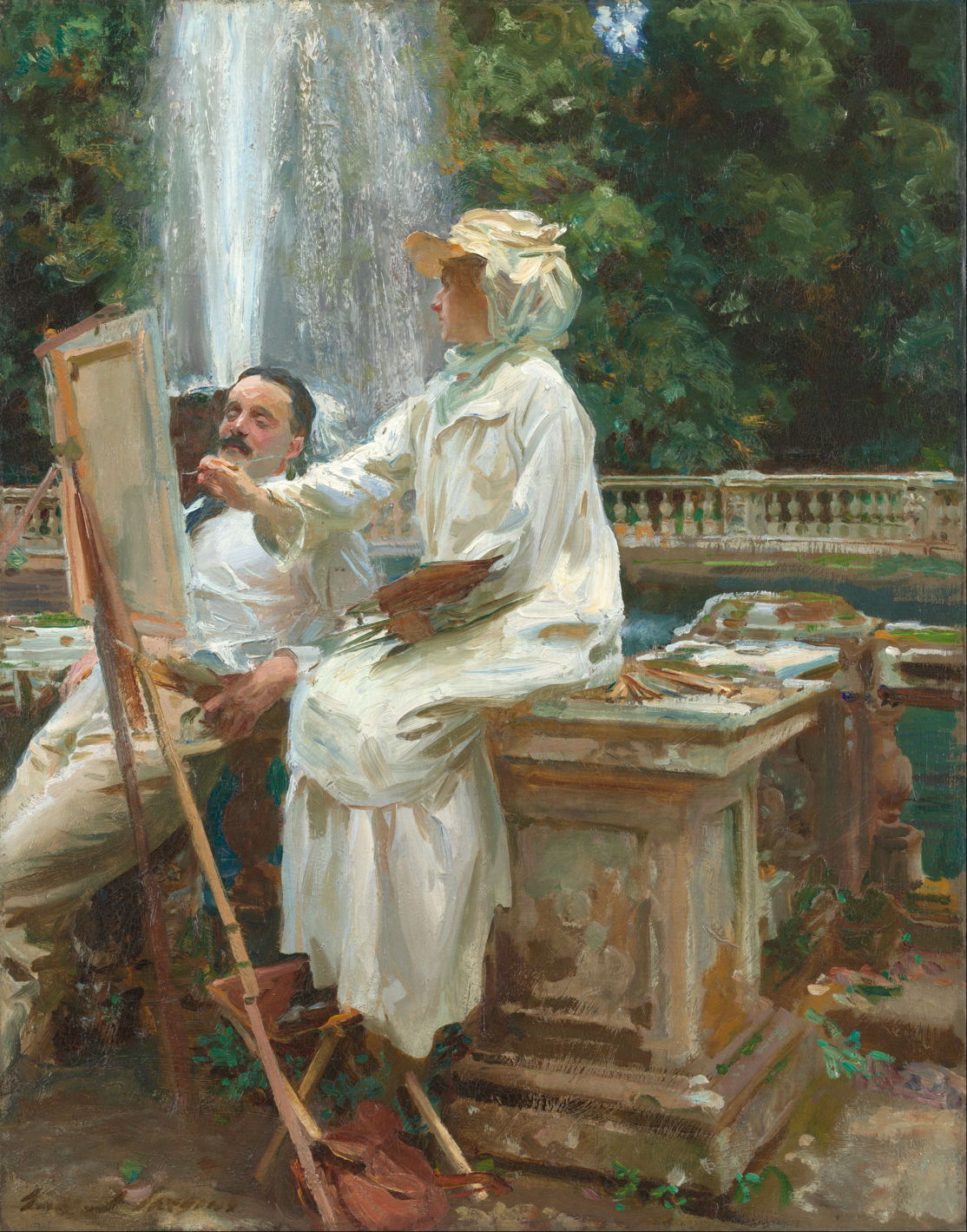
John Singer Sargent (1856–1925), The Fountain, Villa Torlonia, Frascati, Italy (1907), oil on canvas, 71.4 x 56.5 cm, The Art Institute of Chicago, Chicago, IL. Wikimedia Commons.

The American artists Jane de Glehn and her husband Wilfrid were long-standing friends of John Singer Sargent. His plein air oil sketch of The Fountain, Villa Torlonia, Frascati, Italy (1907) shows Jane working at a lightweight wooden easel in the grounds of this villa.

Joaquín Sorolla y Bastida, Maria Painting in El Pardo (1907), oil on canvas, 82 x 106 cm, Private collection. WikiArt.
Joaquín Sorolla y Bastida (1863–1923), Maria Painting in El Pardo (1907), oil on canvas, 82 x 106 cm, Private collection. WikiArt.

Joaquín Sorolla here shows his daughter Maria Painting in El Pardo in 1907. She’s painting with a pochade box, and has a large parasol with a specialist mount so that it can provide her with shade.

brendekildelaringfalleneasel
Hans Andersen Brendekilde (1857–1942), L A Ring by his Fallen Easel (1883), oil on canvas, 78 x 67 cm, Det Nationalhistoriske Museum på Frederiksborg Slot, Hillerød, Denmark. Wikimedia Commons.

One of Brendekilde’s earliest surviving paintings shows L A Ring by his Fallen Easel (1883). Both of them had a struggle achieving recognition, and at this stage Ring was verging on abandoning art altogether as a result. He is seen on the outskirts of a wood, looking down dejectedly at his easel that has dropped paint-first onto the fallen leaves on the road.

Plein air painting has many challenges. In fine sunny weather you’re normally limited to thirty to sixty minutes painting time. Any longer than that and the light and shadows have changed too much over the course of time, but overcast lighting allows greater tolerance. Even with modern portable lighting systems, painting en plein air at night is an astonishing feat that few even attempt.

dahldresdenatnight
Johan Christian Dahl (1788–1857), Dresden at Night (1845), oil on cardboard, 7 × 11.3 cm, Private collection. Wikimedia Commons.

This remarkable painting by JC Dahl of Dresden at Night appears to have been painted on a sheet of cardboard one night in 1845. There really is no limit to what can be achieved in front of the motif.

Impressionists at Argenteuil 2

By: hoakley
9 November 2025 at 20:30

Following their return to the outskirts of Paris after the Franco-Prussian war and Paris Commune, Alfred Sisley, Claude Monet and Auguste Renoir had painted in and around the Monets’ home in Argenteuil on the north bank of the River Seine. Monet commuted into the city by train, the Sisleys shared their house, and Renoir visited in the summer.

manetmonet
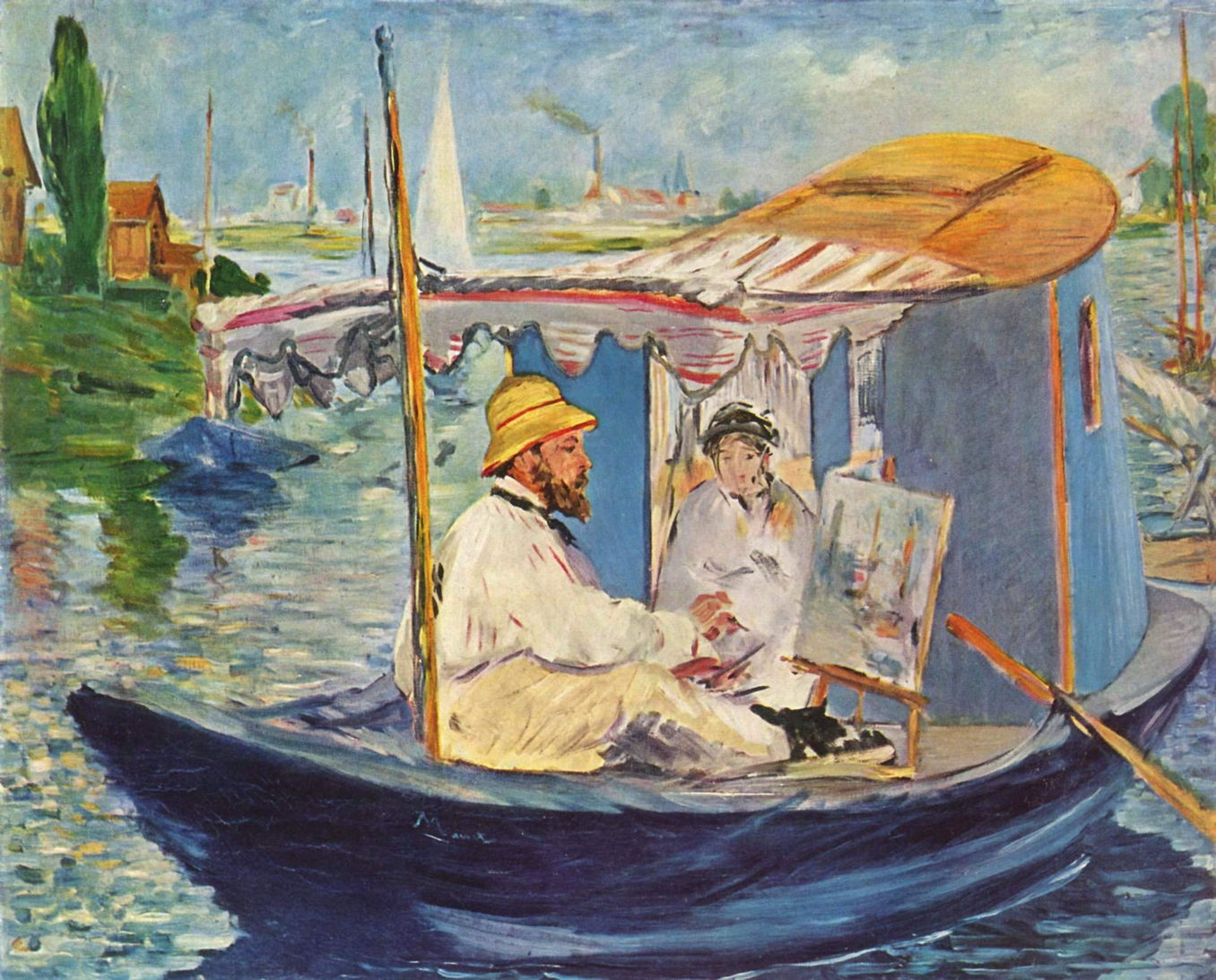
Édouard Manet (1832–1883), Claude Monet in Argenteuil (1874), oil on canvas, 80 × 98 cm, Neue Pinakothek, Munich, Germany. Wikimedia Commons.

Édouard Manet was another visitor, and painted this oil sketch of Claude Monet in Argenteuil in 1874, showing Monet working in his floating studio. His position in the boat appears relaxed, but would have become uncomfortable if maintained for long, as he would have had to keep bending forward to paint, suggesting he might have posed for this painting.

In 1876, Monet’s wife Camille became seriously ill, deteriorating further with the birth of their second son in 1878. The family moved to share a house with his patron Ernest Hoschedé in Vétheuil, further out to the north-west. The Sisleys moved to Moret-sur-Loing on the opposite side of Paris, leaving only Renoir to continue his summer visits.

renoircanotiers
Pierre-Auguste Renoir (1841–1919), Les Canotiers à Chatou (The Boating Party at Chatou) (1879), oil on canvas, 81 × 100 cm, The National Gallery of Art, Washington, DC. Wikimedia Commons.

Renoir’s The Boating Party at Chatou (1879) shows watersports taking place further down the river, with a combination of social rowing in the foreground, and two sports rowers further out in the river.

renoirbythewater
Pierre-Auguste Renoir (1841–1919), By the Water or Near the Lake (c 1880), oil on canvas, 46.2 × 55.4 cm, Art Institute of Chicago, Chicago, IL. Wikimedia Commons.

Renoir’s By the Water from about 1880 is believed to have been painted on the terrace of the Restaurant Fournaise on the Île de Chatou, which he was soon to use for his major work Luncheon of the Boating Party (below). If that’s the case, then what appears to be a lake in the background is really the River Seine.

renoirluncheonboatingparty
Pierre-Auguste Renoir (1841–1919), Luncheon of the Boating Party (1880-81), oil on canvas, 130.2 x 175.6 cm, The Phillips Collection, Washington, DC. Wikimedia Commons.

During the summer of 1880, Renoir started work on another of his masterpieces, that he didn’t complete until the following year: Luncheon of the Boating Party (1880-81), with its complex group of figures.

This was again set on the Île de Chatou at the Restaurant Fournaise, and funded by commissioned portraits over this period. Among his models are his partner and later wife Aline Charigot (left foreground, with affenpinscher dog), the actress Jeanne Samary (upper right), and fellow artist Gustave Caillebotte (seated, lower right). This was exhibited at the Seventh Impressionist Exhibition in 1882, where it was praised by several critics.

renoirbridgeargenteuilautumn
Pierre-Auguste Renoir (1841–1919), The Bridge at Argenteuil in Autumn (1882), oil on canvas, 54.3 x 65.8 cm, Private collection. Wikimedia Commons.

Later in 1882, Renoir painted The Bridge at Argenteuil in Autumn, close to another bridge over the river for which Monet had a particular affection.

In 1881, Gustave Caillebotte acquired a property at Petit-Gennevilliers, near Argenteuil, where he had a boatyard, and moved there permanently in 1888. He and Renoir maintained the tradition of painting this section of the River Seine.

caillebotteboatseineargenteuil
Gustave Caillebotte (1848–1894), Boat Moored on the Seine at Argenteuil (c 1884), oil on canvas, 65.4 × 54.2 cm, Nelson-Atkins Museum of Art, Kansas City, MO. Wikimedia Commons.

Caillebotte’s Boat Moored on the Seine at Argenteuil from about 1884 has thoroughly Impressionist style and facture, with its obvious brushstrokes forming the broken reflection of the boat on the water, and even detail through the depth of the painting.

Gustave Caillebotte, The Bridge at Argenteuil and the Seine (1885), oil on canvas, 65.5 x 81.6 cm, Private collection. WikiArt.
Gustave Caillebotte (1848–1894), The Bridge at Argenteuil and the Seine (1885), oil on canvas, 65.5 x 81.6 cm, Private collection. WikiArt.

Although Caillebotte didn’t make formal series of views that became such a feature of the art of Monet and Pissarro, in the mid-1880s he painted several views of the modern bridges over the River Seine near Argenteuil. The Bridge at Argenteuil and the Seine (1885) is Impressionist in style, with its broken water surface. This features a steam paddle tug towing a laden barge towards the next bridge, which I think is the railway bridge that Claude Monet painted at least twice.

In 1888, Renoir spent the summer painting at Argenteuil and Bougival, where he rediscovered his landscape form.

renoirseineargenteuil
Pierre-Auguste Renoir (1841–1919), The Seine at Argenteuil (1888), oil on canvas, 54 x 65 cm, Barnes Foundation, Philadelphia and Merion, PA. Wikimedia Commons.

Renoir’s The Seine at Argenteuil from 1888 is another view of leisure boating, painted in a style more similar to Sisley’s high Impressionist landscapes, with coarse high chroma brushstrokes laid to form the surface of the water.

Gustave Caillebotte, Sailboats on the Seine at Argenteuil (1892), oil on canvas, Private collection. WikiArt.
Gustave Caillebotte (1848-1894), Sailboats on the Seine at Argenteuil (1892), oil on canvas, Private collection. WikiArt.

For Gustave Caillebotte and his friends, this was the place to come to enjoy a day’s sailing, as shown in his late painting of Sailboats on the Seine at Argenteuil from 1892, just two years before his untimely death at the age of only forty-five. With that, Argenteuil and Chatou were abandoned and Impressionism moved on.

Impressionists at Argenteuil 1

By: hoakley
8 November 2025 at 20:30

When the French Impressionists reassembled after the Franco-Prussian War and the Paris Commune, they gathered a little further up river from Louveciennes and Bougival, at the small town of Argenteuil on the north bank of the River Seine. At the time it was just on the outer edge of the north-western suburbs of the city, about 12 km (7.6 miles) from the centre, and was only fifteen minutes by train to the Gare Saint-Lazare in Paris. Claude Monet was able to commute into the metropolis, and the Sisleys moved in with the Monets in 1872. This weekend I show a small selection of the best-known paintings that were made in and around Argenteuil, and particularly at Chatou, down river.

monetartistshouseargenteuil
Claude Monet (1840–1926), The Artist’s House at Argenteuil (1873), oil on canvas, 60.2 × 73.3 cm, The Art Institute of Chicago, Chicago, IL. Image by Rlbberlin, via Wikimedia Commons.

Although Monet was barely making a living from his art at this time, he was among the few who could afford to use cadmium yellow, which has been found in his painting of The Artist’s House at Argenteuil from 1873.

This marked the start of a highly productive period for Alfred Sisley, and, in conjunction with Monet and Renoir, changed his art. The three concentrated their efforts on the recording of transient effects of light using colour, removing black from their palettes, and abandoning the traditional ‘finish’ of their paintings.

sisleyfootbridgeargenteuil
Alfred Sisley (1839–1899), Footbridge at Argenteuil (1872), oil on canvas, 39 x 60 cm, Musee d’Orsay, Paris. Wikimedia Commons.

Sisley’s Footbridge at Argenteuil from 1872 is dominated by the perspective projection of the bridge itself, almost to the exclusion of the river below. His figures are gestural but look natural in their forms.

renoirmonetpainting
Pierre-Auguste Renoir (1841–1919), Monet Painting in his Garden in Argenteuil (1873), oil on canvas, 46 × 60 cm, Wadsworth Atheneum, Hartford, CT. Wikimedia Commons.

The Impressionists occasionally painted themselves at work, particularly during the earlier years of the movement. Above is Pierre-Auguste Renoir’s Monet Painting in his Garden in Argenteuil from 1873. He is using a conventional lightweight wooden easel, with a small canvas allowing him to work standing, with his oil paints in the pochade box under the easel.

monetpontcheminderferargenteuil1873
Claude Monet (1840–1926), The Railway Bridge at Argenteuil (1873), oil on canvas, 60 × 99 cm, Private collection. Wikimedia Commons.

Monet’s The Railway Bridge at Argenteuil (1873) is one of his several landscapes centred on the railway from the years immediately after the Franco-Prussian War. The following year, he painted the same bridge, as seen below in The Railway Bridge at Argenteuil (1874).

monetrailwaybridgeargenteuil1874
Claude Monet (1840–1926), The Railway Bridge at Argenteuil (1874), oil on canvas, 54 × 71 cm, Musée d’Orsay, Paris. Wikimedia Commons.

monetnormandytraingaresaintlazare
Claude Monet (1840–1926), Arrival of the Normandy Train, Gare Saint-Lazare (1877), oil on canvas, 59.6 x 80.2 cm, Art Institute of Chicago, Chicago, IL. Wikimedia Commons.

Monet’s commute ended at the Gare Saint-Lazare in Paris, where in 1877 he obtained permission to paint a series of works showing the station. By the third Impressionist Exhibition of April of that year, Monet had assembled seven views of the station, including one that even seemed to please the critics. Among the paintings from that campaign is his Arrival of the Normandy Train, Gare Saint-Lazare (1877).

renoirduckpond
Pierre-Auguste Renoir (1841–1919), The Duck Pond (1873), oil on canvas, 50.2 x 61 cm, Dallas Museum of Art, Dallas, TX. Wikimedia Commons.

One of the products of Renoir’s painting with Monet was this highly chromatic view of The Duck Pond (1873) at a farm near Argenteuil.

Facto
Pierre-Auguste Renoir (1841–1919), The Seine at Chatou (1874), oil on canvas, 50.8 x 63.5 cm, Dallas Museum of Art, Dallas, TX. Wikimedia Commons.

The following summer, Renoir visited Argenteuil again, to paint in the company of both Monet and Manet. The Seine at Chatou (1874) is one of his more vigorously crafted works, with a water surface similar to those being painted at the time by Sisley.

monetautumnonseine1873
Claude Monet (1840-1926), Autumn on the Seine, Argenteuil (1873), oil on canvas, 54.3 × 73.3 cm, High Museum of Art, Atlanta, GA. Wikimedia Commons.

Monet’s masterwork Autumn on the Seine, Argenteuil from 1873 is a textbook example of a river landscape in autumn painted in high Impressionist style, with high chroma and loose brushstrokes.

Louveciennes landscapes: After the war

By: hoakley
26 October 2025 at 20:30

With the Paris Commune crushed in 1871, and order being restored to France under the new Republic, the Pissarros returned to live a more settled life in Louveciennes again, after the shock of discovering that most of his 1500 or so paintings had been damaged or destroyed by occupying Prussian soldiers. There Pissarro lived close to Alfred Sisley, and the two often painted in company. Renoir’s mother also lived in the village, enabling the three painters to meet frequently.

Among Pissarro’s favourite motifs in this post-war period were numerous views of the Route de Saint-Germain and other roads around Louveciennes, and the River Seine at Bougival.

pissarrolouveciennesroutestgermain
Camille Pissarro (1830–1903), Louveciennes, Route de Saint-Germain (1871), watercolour over black chalk, 30.2 x 49.2 cm, J. Paul Getty Museum, Los Angeles, CA. Wikimedia Commons.

Less known are his watercolours, such as this view of Louveciennes, Route de Saint-Germain from 1871, and are reminiscent of the paintings of Johan Jongkind.

Camille Pissarro (1830-1903), Avenue in the Parc de Marly (c 1871), oil on canvas, 45 x 55 cm, Museo Thyssen-Bornemisza, Madrid. Wikimedia Commons.

Pissarro painted this woodland view of an Avenue in the Parc de Marly in the autumn of 1871. It looks towards the village of Marly-le-Roi from the Port du Phare, inside the grounds of the Château de Marly. His skilful use of staffage draws the eye towards the far end of the avenue. The artist seems to have sold this painting quite quickly to an unknown buyer, from whom Durand-Ruel bought it in early 1873.

sisleyseinebougival1872
Alfred Sisley (1839–1899), The Seine at Bougival (1872), oil on canvas, 50.8 x 65.5 cm, Yale University Art Gallery, New Haven, CT. Wikimedia Commons.

Alfred Sisley also painted here en plein air, as seen in The Seine at Bougival from 1872. The water surface is mirror-smooth, and Sisley has been careful to paint the reflection of the buildings with optical precision.

pissarrorouteversailleslouveciennessnow
Camille Pissarro (1830–1903), The Post-House, the Route de Versailles, Louveciennes, Effect of Snow (1872), oil on canvas, 55 x 91 cm, location not known. Wikimedia Commons.

This is Pissarro’s wintry scene of The Post-House, the Route de Versailles, Louveciennes, Effect of Snow from 1872. This looks from the ‘Royal Gate’ of the Château de Marly towards the post-house, a landmark featured in several of his works from this period. This painting was bought that Spring by Durand-Ruel, who sold it a year later to Jean-Baptiste Faure, the opera singer, Pissarro’s first collector and Sisley’s enduring patron.

pissarrochestnutslouveciennes
Camille Pissarro (1830–1903), Chestnut Grove at Louveciennes (1872), oil on canvas, 41.5 x 53.3 cm, Nelson-Atkins Museum of Art, Kansas City, MO. Wikimedia Commons.

Pissarro must have taken delight in the weird forms of the trees in this Chestnut Grove at Louveciennes, painted in 1872. In the far distance is the massive warm cream stone of Marly Aqueduct.

Although the Pissarros were able to live on the money generated by Camille’s painting, they must have got by in relative poverty. However, in 1872, he sold four stretched canvas overdoor panels depicting the seasons to the banker Achille Arosa for 100 Francs each. Pissarro tried to buy them back when they came up for auction in 1891, but despite appealing to Vincent van Gogh’s brother Theo, they were sold for just over a thousand Francs to the Bernheim-Jeune Gallery, and have remained in private collections since.

In April 1872, the Pissarros moved from Louveciennes to Pontoise, where they rented a house and Camille established his studio.

sisleysnowroadlouveciennes
Alfred Sisley (1839–1899), Snow on the Road, Louveciennes (1874), 38 × 56 cm, Private collection. Wikimedia Commons.

Sisley wasn’t as prolific as Pissarro in either ‘road’ or snow scenes. His Snow on the Road, Louveciennes (1874) clearly comes from the same school, but his trees and buildings remain distinctive.

sisleyaqueductmarly
Alfred Sisley (1839–1899), The Aqueduct at Marly (1874), oil on canvas, 54.3 x 81.3 cm, Toledo Museum of Art, Toledo, OH. Wikimedia Commons.

Sisley’s Aqueduct at Marly (1874) shows the massive form of this aqueduct which appeared in the distance in Pissarro’s Chestnut Grove at Louveciennes above. This and the nearby Machine de Marly, which Sisley also painted, were part of a monumental hydraulic network built in the 1680s for Louis XIV, to supply water to the Château de Marly and the royal gardens of the Palace at Versailles. The stone tower at the right end of the aqueduct is the Tour de Levant, used by Prussian troops as a vantage point for observing the besieged city of Paris, a point that won’t have escaped Sisley’s attention.

Alfred Sisley, Forge at Marly-le-Roi (1875), oil on canvas, 55 x 73.5 cm, Musée d'Orsay, Paris. EHN & DIJ Oakley.
Alfred Sisley (1839-1899), Forge at Marly-le-Roi (1875), oil on canvas, 55 x 73.5 cm, Musée d’Orsay, Paris. EHN & DIJ Oakley.

Sisley’s Forge at Marly-le-Roi from 1875 shows the village blacksmiths at work.

ropssundaybougival
Félicien Rops (1833–1898), Sunday in Bougival (1876), media and dimensions not known, Musée Provincial Félicien Rops, Namur, Belgium. Image by Paul Hermans, via Wikimedia Commons.

In 1876, Félicien Rops must have visited one of the popular bathing resorts nearby, to paint his Sunday in Bougival. This shows a lecherous old man watching two young women preparing to bathe there, a mere 15 km (10 miles) from the heart of Paris.

By this time, the Impressionists had moved away from Louveciennes, and were painting elsewhere.

64.154.2
Alfred Sisley (1839–1899), The Road from Versailles to Louveciennes (c 1879), oil on canvas, 45.7 x 55.9 cm, The Metropolitan Museum of Art, New York, NY. Wikimedia Commons.

Although Sisley was now living near Sèvres, he must have returned in about 1879 for one last painting in front of the motif, on The Road from Versailles to Louveciennes. This is an example of his more sketchy plein air paintings from his time at Sèvres, and a more traditional perspective view of a road of the time. This section of the road is close to Louveciennes, on the main route between Versailles and Saint-Germain-en-Laye.

At that point, the Impressionists finally left Élisabeth Louise Vigée Le Brun to rest in peace.

Louveciennes landscapes: Before the war

By: hoakley
25 October 2025 at 19:30

When the prolific portraitist in pastels Élisabeth Louise Vigée Le Brun retired to live near Paris, she chose a small hamlet to the west of the city, between the palace at Versailles and Saint-Germain-en-Laye, Louveciennes. She died there in 1842, and is buried in the graveyard not far from her house.

Twenty-seven years later it became the focus for a group of friends, who went on to become the core of the French Impressionists. For the next few years Louveciennes and the adjacent villages of Bougival and Marly-le-Roi were to appear in well over a hundred of their paintings, a few of which I show this weekend.

Just beyond Chatou, the River Seine sweeps to the right in a bend with a series of long islands with popular bathing houses, among them the famous La Grenouillère. In the summer of 1869, Auguste Renoir was living at his parents’ house in Louveciennes, just to the south of this bend, where Camille Pissarro and his family were renting a house. He visited Claude Monet and his family, who were living near Bougival, also on that bend, and they often painted together.

Some of the formative moments in Impressionism if not European art occurred when Monet and Renoir visited La Grenouillère.

renoirgrenouillerestock
Pierre-Auguste Renoir (1841–1919), La Grenouillère (1869), oil on canvas, 66.5 x 81 cm, Nationalmuseum, Stockholm, Sweden. Wikimedia Commons.

Renoir painted at least three different views of La Grenouillère that summer: that above is now in Stockholm, and that below, which is most similar to Monet’s, is in the Oskar Reinhart Collection in Switzerland; the third (not shown here) is in the Pushkin Museum in Moscow. Originally conceived as plein air sketches preparatory to more finished paintings for submission to the Salon the following year, they came to define these brilliant shimmering images formed from high chroma brushstrokes as Impressionist style.

renoirgrenouillerereinhart
Pierre-Auguste Renoir (1841–1919), La Grenouillère (1869), oil on canvas, 65.1 x 92 cm, Oskar Reinhart Collection, Winterthur, Switzerland. Wikimedia Commons.

If Impressionism has to have a single moment of birth, it’s surely in the summer of 1869 at La Grenouillère.

Claude Monet, Bathers at la Grenouillère (1869), oil on canvas, 73 x 92 cm, The National Gallery, London. WikiArt.

Monet’s Bathers at la Grenouillère is his early statement of his Impressionist agenda. The pair realised that Impressionism was about these sketched instants. This also reveals Monet’s preference for modern pigments, as most of the brighter mid-blues here use cobalt blue, introduced earlier in the nineteenth century.

Claude Monet, Bathers at la Grenouillère (detail) (1869), oil on canvas, 73 x 92 cm, The National Gallery, London. WikiArt.

In addition to Renoir, Pissarro and Monet, Alfred Sisley maintained a studio nearer the river in Bougival, where the four artists painted, starved and fought off despair together.

pissarroroadversailles1869
Camille Pissarro (1830–1903), Road to Versailles at Louveciennes (Snow Effect) (1869), oil on canvas, 38.4 × 46.3 cm, Walters Art Museum, Baltimore, MD. Wikimedia Commons.

Pissarro painted a succession of views of the roads around the village. His Road to Versailles at Louveciennes (Snow Effect) (1869) is typical of his earlier ‘road’ paintings, showing an avenue of tall, bare-branched trees, brushed in coarsely.

Camille Pissarro (1830-1903), Route de Versailles, Louveciennes, Winter Sun and Snow (c 1870), oil on canvas, 46 x 55.3 cm, Museo Thyssen-Bornemisza, Madrid. Wikimedia Commons.

The following winter his paintings concentrated on road scenes around Louveciennes, a theme which continued for many years, spanning the seasons.

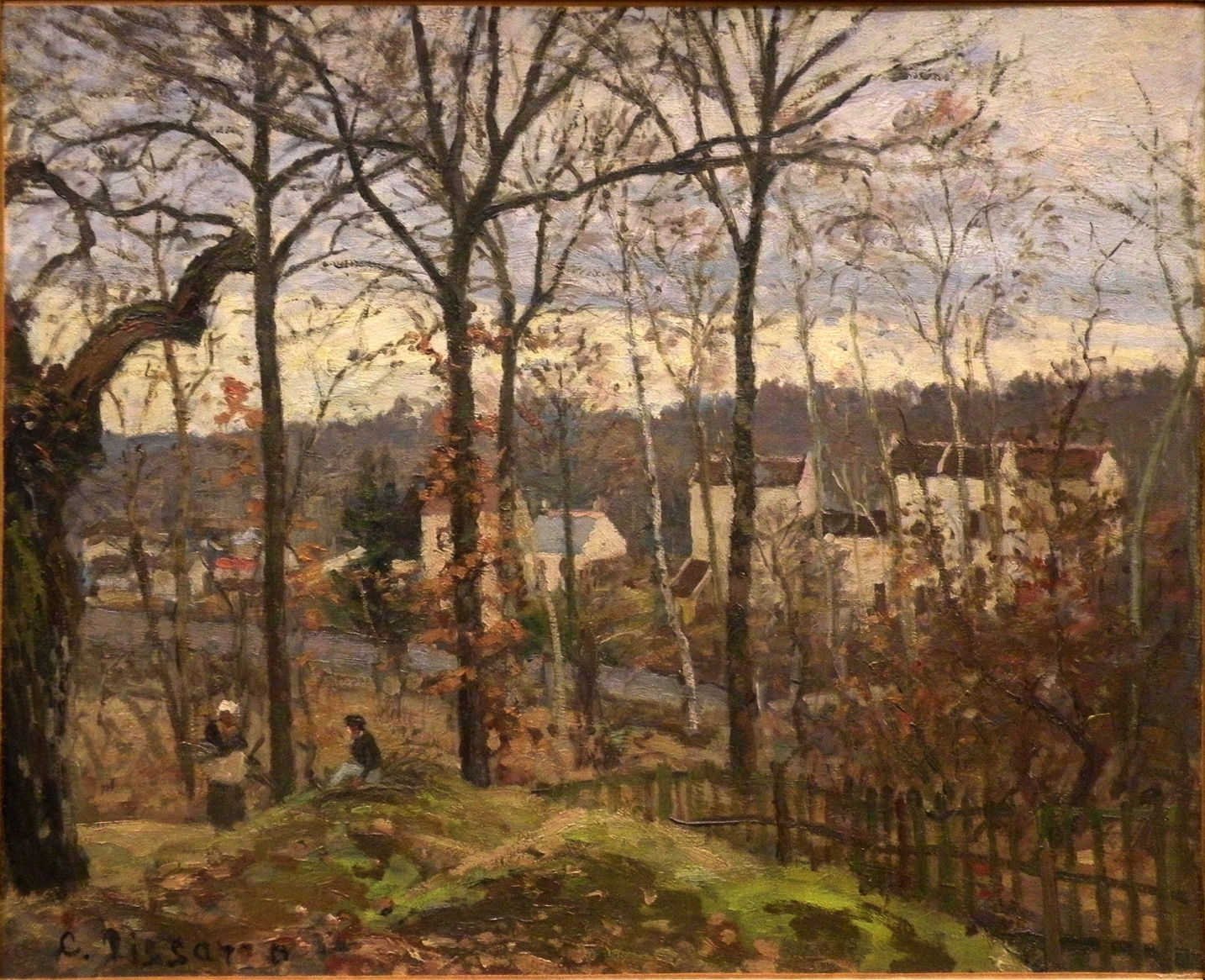
Camille Pissarro (1830-1903), Winter Landscape at Louveciennes (c 1869), oil on canvas, 37 x 46 cm, Musée d'Orsay, Paris. EHN & DIJ Oakley.
Camille Pissarro (1830-1903), Winter Landscape at Louveciennes (c 1869), oil on canvas, 37 x 46 cm, Musée d’Orsay, Paris. EHN & DIJ Oakley.

As many artists before him, Pissarro used trees to frame his motifs in repoussouir, but during the late 1860s they started to invade more central areas of the canvas. In about 1869, in his Winter Landscape at Louveciennes for the first time tree trunks and branches spread across his canvas, breaking up the motif behind into small sections.

pissarrohousesbougival
Camille Pissarro (1830–1903), Houses at Bougival, Autumn (1870), oil on canvas, 88.9 x 115.9 cm, J. Paul Getty Museum, Los Angeles, CA. Wikimedia Commons.

Pissarro’s Houses at Bougival, Autumn is clearly dated 1870, although by that time he had moved from Louveciennes. It is also thought to have been exhibited at the Salon that year, suggesting it may have been started in late 1869.

sisleyearlysnowlouveciennes
Alfred Sisley (1839–1899), Early Snow in Louveciennes (1870), oil on canvas, 54 x 73 cm, Museum of Fine Arts Boston, Boston, MA. Wikimedia Commons.

Like Pissarro, Sisley started depicting the streets of suburbs, including Early Snow in Louveciennes. This has been dated to 1870, although it appears more likely that it was painted en plein air late the previous year.

Following the outbreak of the Franco-Prussian War, in September 1870 the Pissarros’ house in Louveciennes was requisitioned by the invading Prussians. The family fled first to their friends in Montfoucault, then in December travelled on to England, where they settled in Norwood, at that time an outer suburb of London. When in England, Pissarro met Paul Durand-Ruel, who became his dealer, and Claude Monet, who had also fled to London.

Bougival was also overrun by Prussian soldiers, who commandeered Sisley’s studio; many of his early works were lost, as Pissarro’s were in Louveciennes, just over a mile away. The Sisleys were forced into the city of Paris, and despite Alfred’s British nationality, they remained trapped through the siege of the city into the following year. Worse still, the Sisley family business collapsed and his parents were in no position to support the artist.

In the Forest of Fontainebleau: Impressionism

By: hoakley
12 October 2025 at 19:30

By the early 1860s, the large and ancient Forest of Fontainebleau, to the south-east of Paris, had been attracting those of the Barbizon School, who painted realist landscapes in front of the motif. The next generation started visiting in 1865, and went on to form the French Impressionists.

bazillelandscapechailly
Frédéric Bazille (1841–1870), Landscape at Chailly (1865), oil on canvas, 81 x 100.3 cm, The Art Institute of Chicago, Chicago, IL. Wikimedia Commons.

In May 1865, the young Frédéric Bazille left the city of Paris for the Forest of Fontainebleau, where he painted Landscape at Chailly (1865) in company with Claude Monet, and possibly Auguste Renoir and Alfred Sisley. Although clearly influenced by the Barbizon School, his colours are much brighter, and escape the rather sombre browns and greens that dominated much of the work of that earlier art.

sisleyavenuechestnuts
Alfred Sisley (1839–1899), Avenue of Chestnut Trees in La Celle-Saint-Cloud (1865), oil on canvas, 125 x 205 cm, Petit Palais, Paris. Wikimedia Commons.

Sisley painted this Avenue of Chestnut Trees in La Celle-Saint-Cloud to the west of the forest in 1865, again in Barbizon style. He didn’t submit it to the Salon until 1867, when it was refused. It then remained unsold for ten years before being bought by Sisley’s patron Jean-Baptiste Faure, a celebrated opera singer.

The following year, Sisley walked through the forest with Renoir. He then stayed in the village of Marlotte, where Renoir, Monet, Bazille, Pissarro and Cézanne also visited to paint.

sisleywomentowoods
Alfred Sisley (1839–1899), Women Going to the Woods (1866), oil on canvas, 65.2 x 92.2 cm, Bridgestone Museum of Art ブリヂストン美術館, Tokyo, Japan. Wikimedia Commons.

Sisley was more successful with Women Going to the Woods, completed in 1866. This was one of his two paintings exhibited at the Salon that year, and shows the main street in the village of Marlotte with a little rustic staffage.

renoirclearing
Pierre-Auguste Renoir (1841–1919), Clearing in the Woods (1865), oil on canvas, 57.2 x 82.6 cm, Detroit Institute of Arts, Detroit, MI. Wikimedia Commons.

Clearing in the Woods (1865) is Renoir’s first substantial (surviving) landscape painting, and shows strong influence from Corot. He adopts quite a detailed realist style in this view of a clearing in the midst of massive chestnut trees. These are believed to be near the small village of La Celle-St-Cloud, to the west of Paris not far from Bougival, rather than in the forest. It’s likely that he painted there in the company of Alfred Sisley, who made two views of the same site in very different style.

renoirlecoeurhunting
Pierre-Auguste Renoir (1841–1919), Jules Le Coeur and his Dogs in the Forest of Fontainebleau (1866), oil on canvas, 112 x 90 cm, Museu de Arte de São Paulo (MASP), São Paulo, Brazil. Wikimedia Commons.

The following year Renoir painted his friend Jules Le Coeur and his Dogs in the Forest of Fontainebleau. This is unusual among his works, as it was preceded by two studies, and all three were made using the palette knife rather than brushes. This makes it most likely to have been painted before Renoir abandoned the knife and returned to the brush, by the middle of May 1866.

thayerfontainebleau
Abbott Handerson Thayer (1849–1921), Landscape at Fontainebleau Forest (c 1876), oil on cardboard, 54.6 x 45.7 cm, Private collection. Wikimedia Commons.

The following year Abbott Handerson Thayer, an American artist who trained in Paris, painted this wonderful oil sketch of Landscape at Fontainebleau Forest (c 1876). This is probably the loosest and most Impressionist painting of his career.

rouartfontainebleau
Henri Rouart (1834–1912), In Fontainebleau Forest (date not known), oil on canvas, 59.5 x 73.2 cm, Private collection. Wikimedia Commons.

At some time in the late nineteenth century, the wealthy industrialist, amateur painter and patron of Impressionism, Henri Rouart painted In Fontainebleau Forest. This may have been inspired by Corot, but is a realist study in light, shade, and the texture of bark.

weirjffontainebleau
John Ferguson Weir (1841-1926), Forest of Fontainebleau (c 1902), oil on canvas, 48.9 x 61 cm, Private collection. The Athenaeum.

John Ferguson Weir was another American painter who had trained in Paris, and became the first director of the School of Fine Arts at Yale University. He visited in about 1902, when he painted Forest of Fontainebleau (c 1902), with its tiny solitary figure against the fallen trunk.

In 1867 Théodore Rousseau died in the village of Barbizon, and he was followed in 1875 by Jean-François Millet. By the twentieth century the forest had fallen out of favour with the new generation.

Medium and Message: Knives, fingers and long brushes

By: hoakley
7 October 2025 at 19:30

Almost all who paint in oils use conventional brushes, but there’s a significant minority who sometimes, or frequently, use different tools to apply and shape the paint layer. Of those, the most popular are palette knives, generally used to move and mix paint on the palette. Others have used the other end of the brush stick to incise, or their fingers.

bashkirtseffinthestudio
Marie Bashkirtseff (1858–1884), In the Studio (1881), oil on canvas, 188 x 154 cm, Dnipro State Art Museum, Dnipro, Ukraine. Wikimedia Commons.

Marie Bashkirtseff’s painting of a class in the Académie Julien in Paris in 1881 demonstrates how oil painting should be done by the textbook. The artist, shown in her self-portrait in the centre foreground, is using a long-bladed palette knife to prepare the paint on her palette. At her feet, on an old sheet of newspaper, are her brushes, all with handles of typical length, and the pupil behind her is using a maul stick to rest her right hand while painting with her brush.

courbetgrottosarrazine
Gustave Courbet (1819–1877), The Grotto of Sarrazine near Nans-sous-Sainte-Anne (c 1864), oil on canvas, 50.2 x 60 cm, J. Paul Getty Museum, Los Angeles, CA. Wikimedia Commons.

Gustave Courbet applied his paint using a palette knife for some of his paintings. This has been identified from the facture in some of his paintings of caves that he made from about 1864, including The Grotto of Sarrazine near Nans-sous-Sainte-Anne above.

Another enthusiast for painting with a knife was Auguste Renoir.

renoirlecoeurhunting
Pierre-Auguste Renoir (1841–1919), Jules Le Coeur and his Dogs in the Forest of Fontainebleau (1866), oil on canvas, 112 x 90 cm, Museu de Arte de São Paulo (MASP), São Paulo, Brazil. Wikimedia Commons.

In 1866, Renoir painted his friend Jules Le Coeur and his Dogs in the Forest of Fontainebleau. This is unusual among his works, as it was preceded by two studies, and all three were made using the palette knife rather than brushes. This makes it most likely to have been painted before Renoir abandoned the knife and returned to the brush, by the middle of May 1866.

renoirmosque
Pierre-Auguste Renoir (1841–1919), The Mosque (1881), oil on canvas, 73 x 92 cm, Musée d’Orsay, Paris. Wikimedia Commons.

Renoir returned to the technique in The Mosque, also known as Arab Festival, in 1881. Small strokes of bright colour and energetic work with the palette knife give it a strong feeling of movement, and it so impressed Claude Monet that he bought it from Durand-Ruel in 1900.

hillsfallorangecopark
Anna Althea Hills (1882-1930), Fall, Orange County Park (1916), oil on board, 35.6 x 45.7 cm, Private collection. The Athenaeum.

Anna Althea Hills’ Fall, Orange County Park (1916) is a classic and highly accomplished plein air painting that appears to have been made with extensive and deft use of the knife, particularly in the foreground.

Perhaps the most famous artist who is known to have painted with his fingers is Leonardo da Vinci.

davinciannunciation
Leonardo da Vinci (1452–1519), Annunciation (c 1473-75), oil and tempera on poplar, 100 x 221.5 cm, Galleria degli Uffizi, Florence, Italy. Wikimedia Commons.

This Annunciation, painted in oil and tempera on a poplar panel, is generally agreed to be one of the earliest of Leonardo’s own surviving paintings. When it was painted is in greater doubt, but a suggestion of around 1473-75 seems most appropriate. There are numerous pentimenti, particularly in the head of the Virgin. Its perspective projection is marked in scores in its ground and Leonardo used his spontaneous and characteristic technique of fingerpainting in some of its passages.

Finally, some painters are well-known for their use of brushes with exceptionally long handles. These enabled them to stand back, sometimes almost on the opposite side of their studio, get an overall view of their canvas, and paint from the same distance as a viewer.

sargentoutofdoorsstudy
John Singer Sargent (1856–1925), An Out-of-Doors Study (c 1889), oil on canvas, 65.9 × 80.7 cm, Brooklyn Museum, New York, NY. Wikimedia Commons.

Like all plein air painters, Paul César Helleu (1859–1927) shown in John Singer Sargent’s An Out-of-Doors Study from about 1889, is using brushes with handles of modest length. His canvas is fairly small, and he’s working close-in while clutching a brace of brushes in his left hand. Some designed for use when painting in front of the motif have even shorter handles, but when back in the studio Helleu would almost certainly have opted for longer.

James Abbott McNeill Whistler, Symphony in White No. 1: The White Girl (1862), oil on canvas, 214.6 x 108 cm, National Gallery of Art, Washington, DC. WikiArt.
James Abbott McNeill Whistler (1834-1903), Symphony in White No. 1: The White Girl (1862), oil on canvas, 214.6 x 108 cm, National Gallery of Art, Washington, DC. WikiArt.

Whistler was renowned for using brushes with handles over one metre (39 inches) long, and appears to have used them when painting Symphony in White No. 1: The White Girl in 1862 on a canvas just over two metres (78 inches) tall. He reworked it between 1867-72 to make it more ‘spiritual’ and reduce its original realism.

sorollasewingsail
Joaquín Sorolla y Bastida (1863–1923), Sewing the Sail (1896), oil on canvas, 220 x 302 cm, Museo d`Arte Moderna di Ca’ Pesaro, Venice, Italy. Image by Flaviaalvarez, via Wikimedia Commons.

Early in his career, Joaquín Sorolla established his reputation of painting ‘voraciously’, often using brushes with extremely long handles and large canvases. Although Sewing the Sail from 1896 may look a spontaneous study of the effects of dappled light, Sorolla composed this carefully with the aid of at least two drawings and a sketch, and given its 2.2 metre (87 inches) height, he was almost certainly using brushes of similar length.

❌
❌