Login
LoginEurope Begins to Tiptoe Away From Key Climate Policies
19 December 2025 at 03:59
Europe has some of the world’s most ambitious climate goals, but in recent months it has backtracked on rules governing automobile emissions and deforestation.


© Alessandra Montalto/The New York Times
© Kenny Holston/The New York Times
© Eric Lee for The New York Times


© Getty Images
© Ricardo Arduengo/Reuters
© Kenny Holston/The New York Times
© Adriana Loureiro Fernandez for The New York Times
© Adriana Loureiro Fernandez for The New York Times
© Adriana Loureiro Fernandez for The New York Times
© Adriana Loureiro Fernandez for The New York Times
Paintings made in oils in front of the motif, en plein air, are a surprisingly recent innovation. Although often ascribed to the inconvenience of handling oil paint before it was offered in tubes in the middle of the nineteenth century, in fact it had become popular if not mandatory for the aspiring landscape painter well before that. Instead of taking their paints in tubes, those pioneers used pig bladders, that had become widely available from artists’ colourmen, as were used by Constable, Turner and many others.
Initially, plein air oil sketches weren’t intended to be seen by the public or patrons.
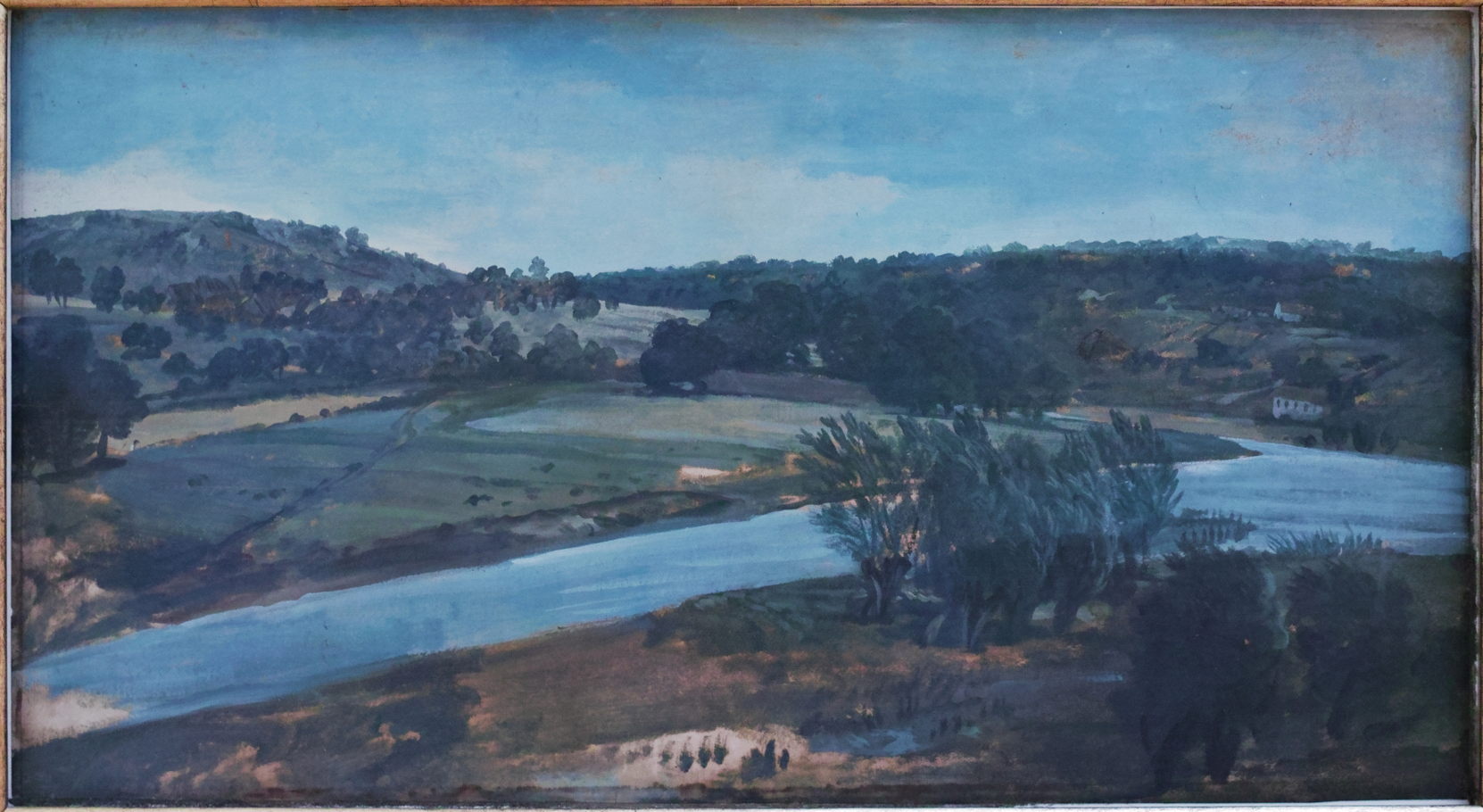
Among the earliest artists to paint regularly in front of their motif was Alexandre-François Desportes (1661-1743), a professional painter of hunting scenes and animals, whose Landscape Study was painted in about 1700.
Plein air oil sketching was described and recommended by Roger de Piles in his book Cours de Peinture, published in 1708, contemporary with Desportes’ sketches. Other books on painting and art in the eighteenth century also cover the topic, and Claude-Joseph Vernet was recorded as having painted oil sketches en plein air, but none have survived.

At Vernet’s suggestion, the young Pierre-Henri de Valenciennes made copious oil sketches such as this of Farm-buildings at the Villa Farnese: the Two Poplar Trees when he was painting in the Roman Campagna in 1782-85. He not only built himself a large visual library of sketches from nature, but published a widely used book on landscape painting in which he recommended the practice.

Jacques Sablet’s Portrait of the Painter Conrad Gessner in the Roman Campagna shows one of the early plein air landscape painters in 1788, over fifty years before the first paint tubes became available.

Although this detail of Giovanni Battista Quadrone’s Every Opportunity is Good shows a studio in 1878, the low table at the left has several bladders containing oil paint. They remained popular with many artists until towards the end of the nineteenth century. Although not as convenient as tubes, the better colourmen still offered a wide range of pigments in bladders that were significantly less costly.
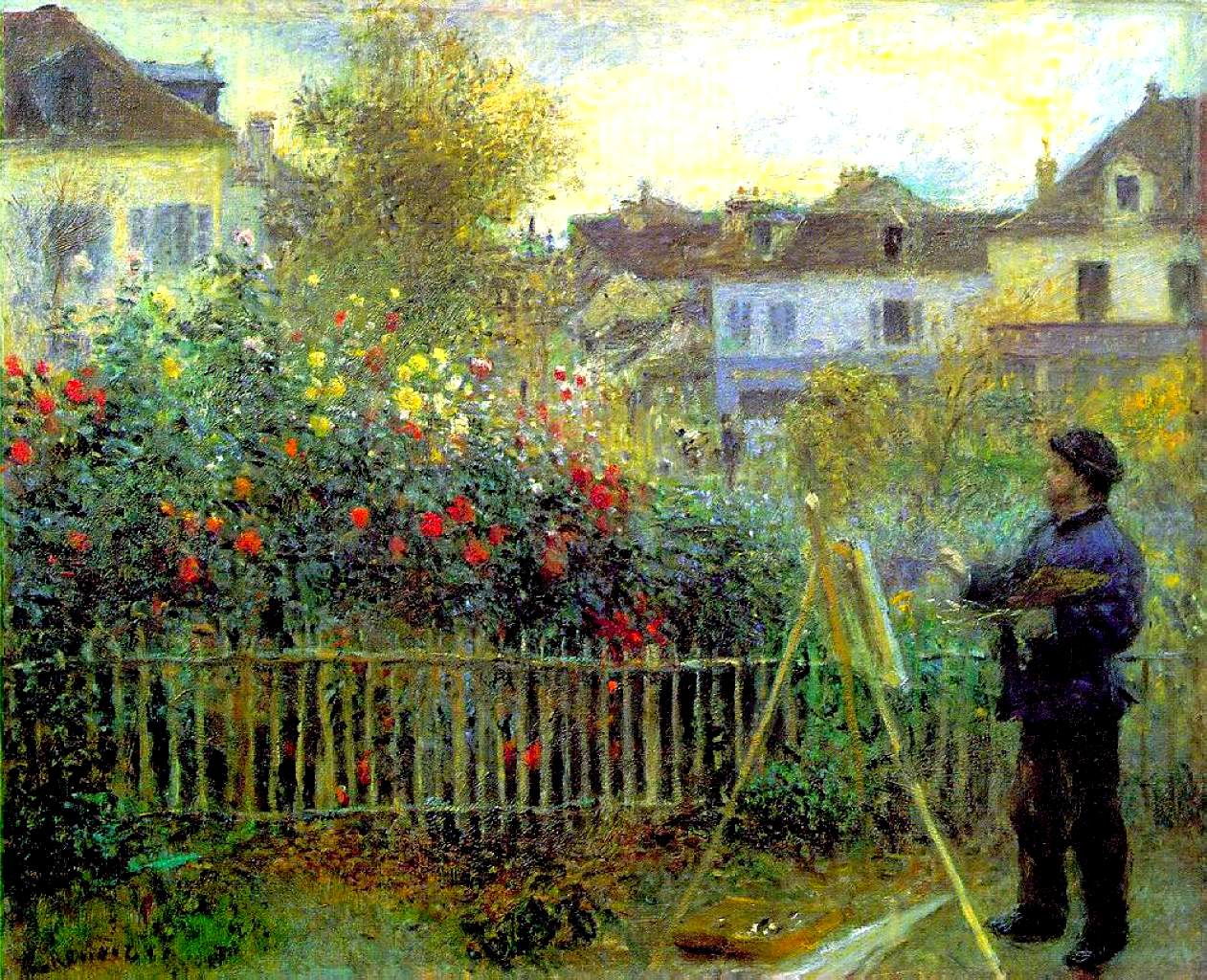
Pierre-Auguste Renoir painted Monet Painting in his Garden in Argenteuil in 1873. Claude Monet is using a conventional lightweight wooden easel, with a small canvas that allows him to work standing. His oil paints are in the pochade box under the easel. Although just outside his house, he would have used the same equipment when further from home.
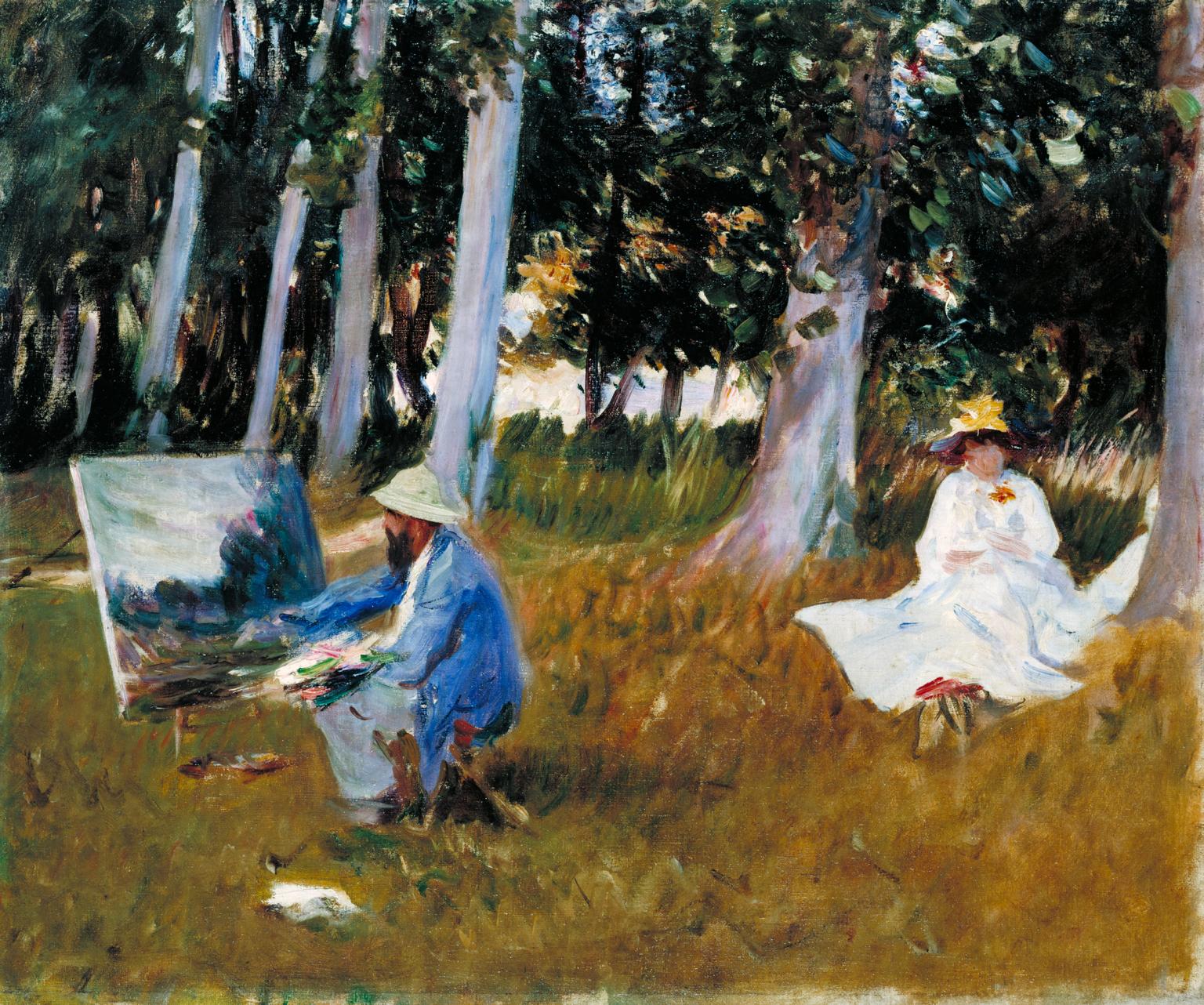
In about 1885, when they were painting together, John Singer Sargent took this opportunity to paint Claude Monet Painting by the Edge of a Wood. Seated on a traditional three-legged folding stool, Monet is here working on a much larger canvas, his pochade box again under the easel for ready access.
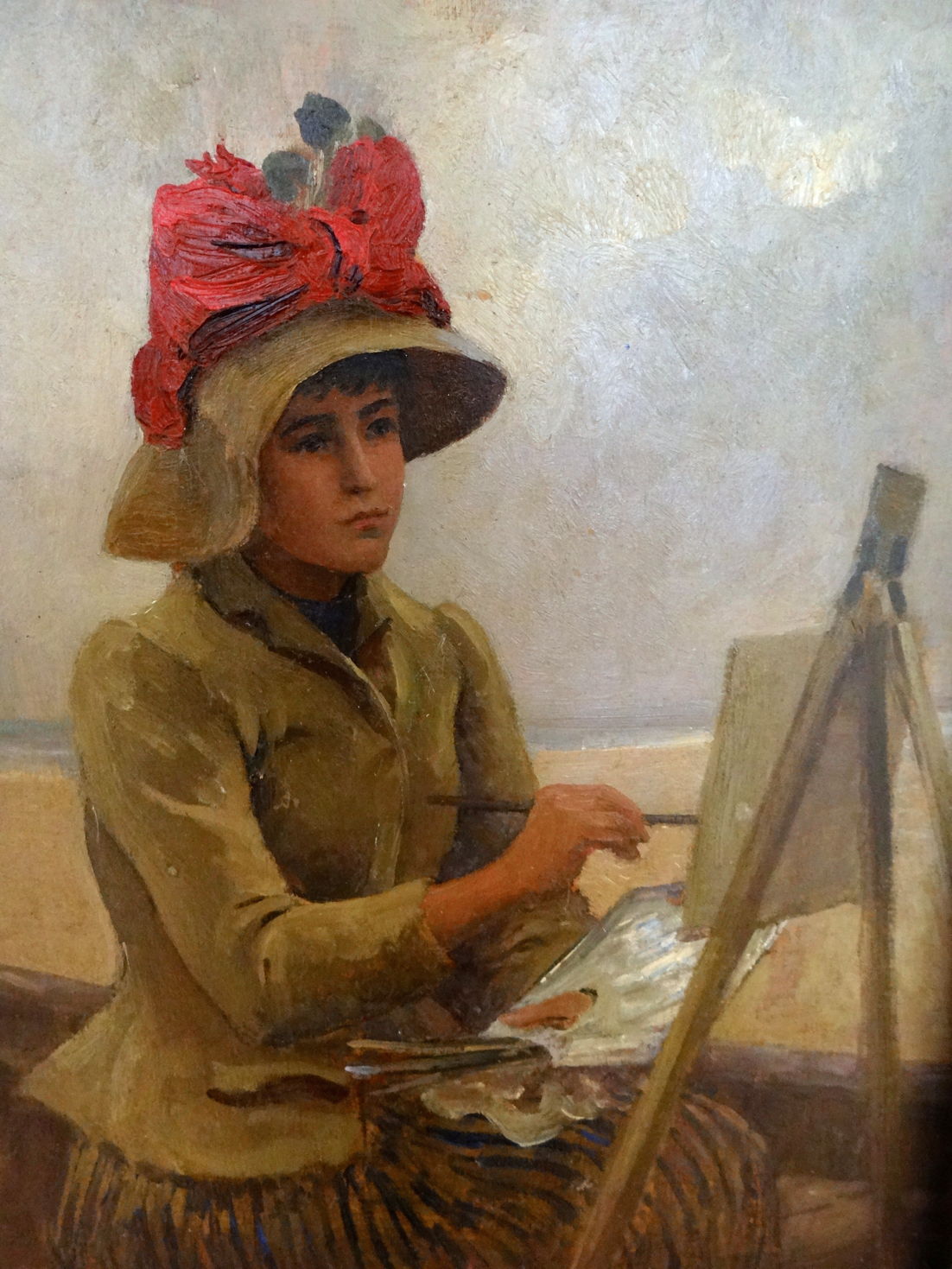
This detail of Virginie Demont-Breton’s Portrait of Marie Duhem (1889) shows one of her close friends and colleagues in the Wissant School, at work en plein air on the coast near their house. She appears to have set her easel up by a wooden groyne on the beach.
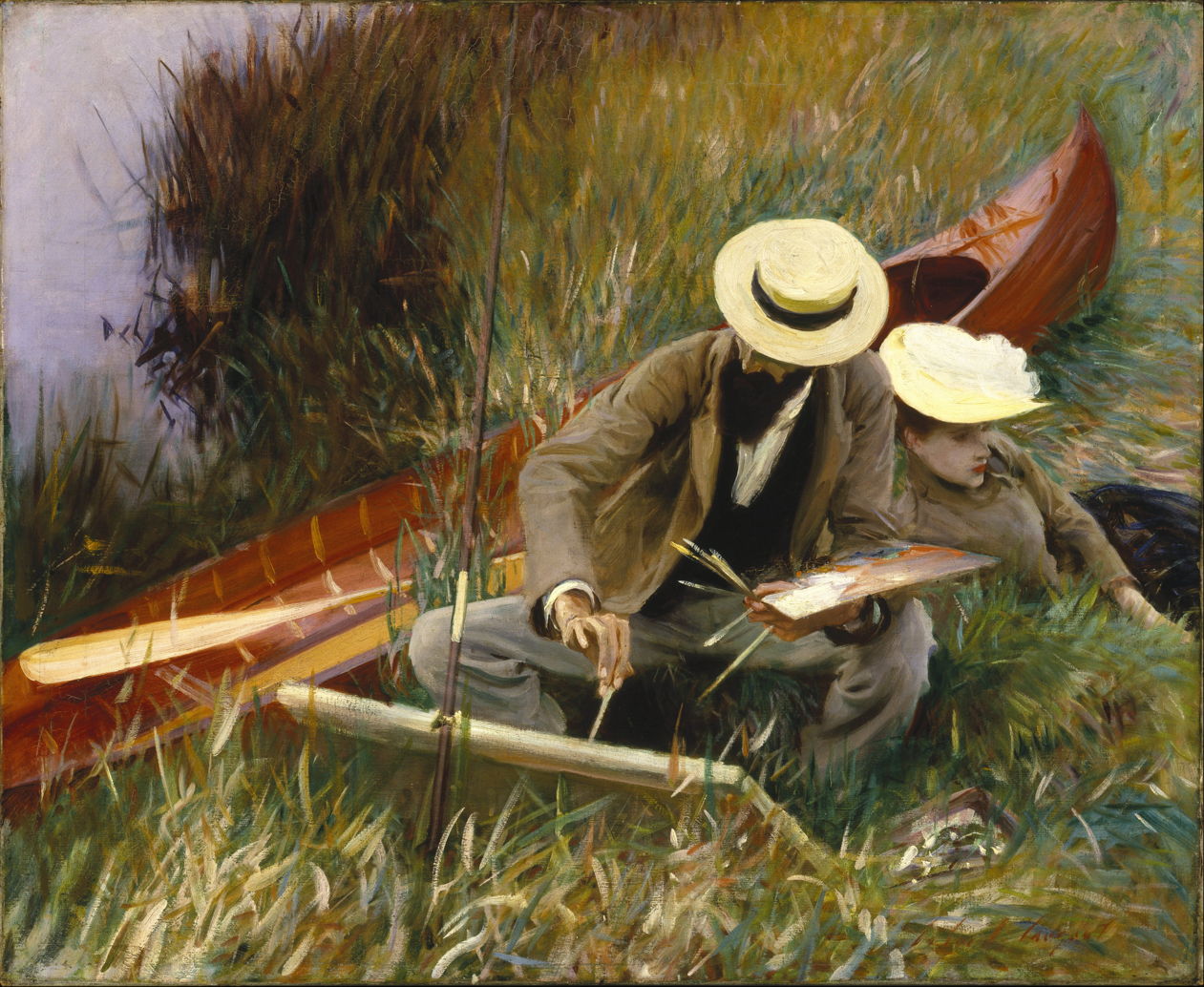
In John Singer Sargent’s An Out-of-Doors Study (c 1889) he shows his friend Paul César Helleu working on a canvas propped up in the grass by a single pole, a precarious arrangement only suitable for the calmest of days. It also forces him to work very low, and he squats in a position of tension, his pochade box in the grass below his left knee.

Hans Andersen Brendekilde’s L.A. Ring Paints at Aasum Smithy (1893) shows his friend painting the primary school in the village of Åsum (or Aasum), to the east of Odense in Denmark. Clearly visible in the pochade box behind is a substantial collection of shiny paint tubes.
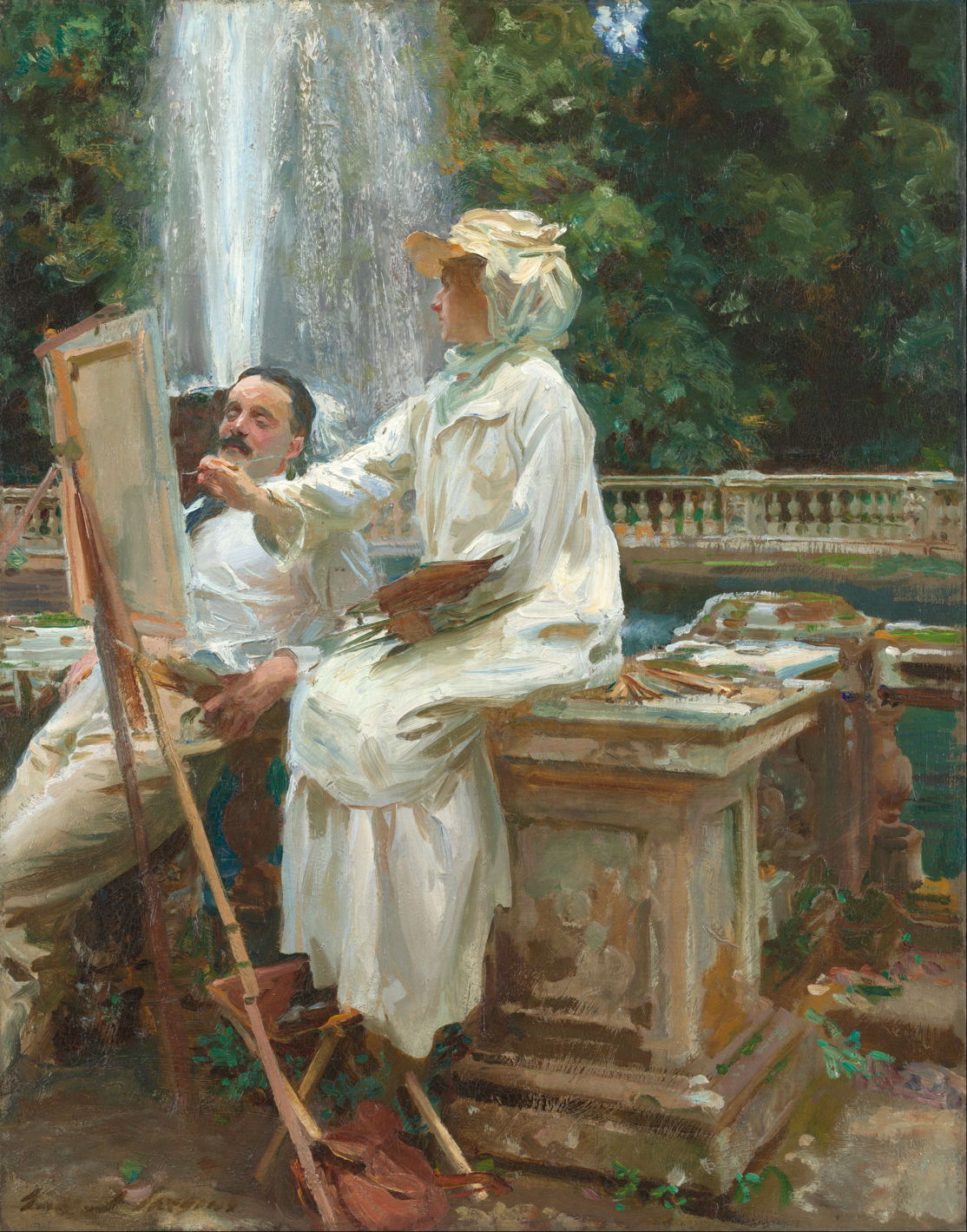
The American artists Jane de Glehn and her husband Wilfrid were long-standing friends of John Singer Sargent. His plein air oil sketch of The Fountain, Villa Torlonia, Frascati, Italy (1907) shows Jane working at a lightweight wooden easel in the grounds of this villa.

Joaquín Sorolla here shows his daughter Maria Painting in El Pardo in 1907. She’s painting with a pochade box, and has a large parasol with a specialist mount so that it can provide her with shade.

One of Brendekilde’s earliest surviving paintings shows L A Ring by his Fallen Easel (1883). Both of them had a struggle achieving recognition, and at this stage Ring was verging on abandoning art altogether as a result. He is seen on the outskirts of a wood, looking down dejectedly at his easel that has dropped paint-first onto the fallen leaves on the road.
Plein air painting has many challenges. In fine sunny weather you’re normally limited to thirty to sixty minutes painting time. Any longer than that and the light and shadows have changed too much over the course of time, but overcast lighting allows greater tolerance. Even with modern portable lighting systems, painting en plein air at night is an astonishing feat that few even attempt.

This remarkable painting by JC Dahl of Dresden at Night appears to have been painted on a sheet of cardboard one night in 1845. There really is no limit to what can be achieved in front of the motif.
奔驰是一家可以定义什么是「车」的公司。
这当然是因为一百多年前,奔驰创始人卡尔·奔驰发明了现代意义上的汽车,当然也是因为如今 AMG 定义了什么是性能车的典范,或者迈巴赫定义了什么是豪华车的标准,不信就看看现在有多少国产品牌在高端化的时候,有意无意地模仿迈巴赫。
定义什么是新时代的电车?看起来对于奔驰有点难,但,奔驰并不是没有准备答案。
梅赛德斯-AMG GT XX 概念车,就是奔驰回答什么是这个时代极致电车的答案。
前不久在意大利传奇赛道—纳多(Nardò)赛道上,梅赛德斯-AMG GT XX 概念车在三电性能和耐久可靠性的极致试炼中验证其成果:以平均 300 公里/小时的行驶速度、超 850 千瓦的平均充电功率和纯电领域前所未有的持续性能输出能力,在 7 天 13 时 24 分的时间内行驶40075km(≈赤道周长),并以 5479km 的成绩打破电动车 24 小时行驶里程世界纪录。
这辆还带着纳多赛道尘土的汽车,在广州车展前夕的 2025 梅赛德斯-奔驰 XX 科技创新日进行了中国首秀,在首秀后,爱范儿和董车会与梅赛德斯-奔驰集团股份公司董事会成员,负责大中华区业务的佟欧福(Oliver Thöne),以及梅赛德斯-奔驰(中国)投资有限公司高级执行副总裁,梅赛德斯-奔驰中国研发和采购负责人庄睦德(Drummond Jacoy)进行了采访,聊了聊什么才是奔驰定义里的极致电动车。
▲从左到右分别是庄睦德(Drummond Jacoy),佟欧福(Oliver Thöne)和北京梅赛德斯-奔驰销售服务有限公司总裁兼首席执行官段建军
很明显,梅赛德斯-AMG GT XX 概念车并没有去比拼极速或者零百加速这样大家最喜闻乐道的参数,因为类似的纪录奔驰创造了无数次,毕竟在 1938 年的时候,奔驰的 W 125 Rekordwagen 就创造了 432.7 公里/小时的汽车极速纪录,这个纪录保持了 80 年之久。
梅赛德斯-AMG GT XX 概念车想要证明的是一辆车能够以怎样快的速度跑怎样久,换言之,就是奔驰从百米赛道下来,又站在了马拉松赛道了,然后,又,夺冠了。
佟欧福告诉爱范儿和董车会:
对奔驰来说,真正重要的不是某一次的冲刺,而是能不能在长时间、连续的高强度驾驶中依然保持高性能表现。
他说:
性能车爱好者会知道,在燃油车时代,一辆真正的性能车之所以迷人,是因为它不仅能跑得快,更能在长时间、高负载的情况下保持稳定的输出。当然,即使是燃油车,在极限状态下也同样会遇到热衰减或其他性能限制。
进入电动车时代,如果我们希望打造一款能够达到甚至超越以往性能标准的车型,那就必须重新思考整套系统。所以我们从零开始为梅赛德斯-AMG GT XX 概念车开发了电驱系统、电池、轴向磁通电机和充电系统。
我们与 F1 工程团队一起打造了高性能方案。对我们来说,这正是梅赛德斯-奔驰一贯坚持的理念:我们不是为了噱头、不是为了高端价格、也不是为了抢头条,而是从客户的需求出发,反推应该采用怎样的技术,再按照奔驰准把它做到最好。最后呈现在大家面前的,就是今天的这款概念车,而这些技术也将随 AMG.EA 平台陆续进入量产。
如前面所说,对于极致的时速或者极致的零百加速这些数据纪录,奔驰已经相对淡然了,毕竟奔驰曾经创造过一骑绝尘的成绩。
▲梅赛德斯-AMG GT XX 概念车团队在意大利纳多赛道
但奔驰在电动车时代考虑的是,自己已然成为过博尔特,能不能再成为基普乔格(马拉松世界纪录保持者,第一位马拉松跑进 2 小时以内的人类选手)。
庄睦德曾经在 AMG 部门工作,对什么是性能车有深刻的感受,他告诉爱范儿和董车会:
我在 AMG 工作时,我们一直在讨论一个关键问题:一辆高性能电动车的本质是什么?答案很明确——必须具备可持续的高性能输出。过去我们打造过梅赛德斯-AMG GT 63 S E PERFORMANCE 这样的车型,超 600 马力的输出,再加上在赛道上连续多圈保持稳定圈速的能力,这是货真价实、可重复的性能。客户在实际使用中也能感受到这种稳定性。而这种「持续高性能」的能力,也是我们希望能够在电动时代呈现的。
他更具体地解释了,为了实现持续高性能的能力,奔驰具体做了什么:
要让电动车做到这一点,我们必须重新审视整个技术体系。首先是轻量化,这就需要足够高能量密度的解决方案,比如轴向磁通电机带来的高性能表现。其次是布局,例如后轴双电机,它让我们能够实现精准的扭矩矢量控制,进一步提升车辆在高性能场景下的操控与稳定性。
真正的挑战来自热管理。电动车在持续高性能输出时会产生大量热量,而车辆抵达充电站时,电池往往处于高温状态,这时是无法进行高功率快充的。所以一辆高性能电动车必须同时解决两个问题:激烈驾驶时如何稳定控温,以及在高热负载下如何依然保持快速补能能力。
围绕这两个问题,我们开始思考:怎样才能让电动车像传统高性能车一样,实现可重复、可持续的赛道表现?最终答案,就是现在采用的这套电池系统。电芯直冷技术是支撑这一目标的核心,它能在极限工况下保持电池温度稳定,让车辆既能持续输出赛车级别的动力,又能在充电环节迅速恢复状态。
当然,即使只看参数,这辆梅赛德斯-AMG GT XX 概念车也有一种简单直接的暴力美学:
风阻系数 0.198,3 部轴向磁通电机,峰值功率可突破 1000 千瓦(1360 马力),最高车速超过 360 公里/小时,源自 F1 赛车技术的圆柱形镍钴锰铝(NCMA)四元电芯能量密度达到了 300 瓦时/千克,并且智能直接冷却系统可以为每个电芯提供独立的冷却,同时充电约 5 分钟续航可增加 400 公里(WLTP 工况)。
▲可变叶片空气动力学轮毂
在与空气的竞合关系里,奔驰在这款概念车用两个新技术与空气进行沟通:
全球首创的可变叶片空气动力学轮毂能够根据车速自动调节开合:巡航时关闭,抚平车轮紊流,使车辆在高速区域更省力、更稳定;激烈驾驶时打开,提升制动散热和车尾下压力,让车辆在连续弯道中保持更扎实的操控反馈。
AMG 也首次尝试将等离子激励器技术应用于整车研发,通过布置在车尾曲面的微电极主动干预尾流分离点,使高速尾流更加平顺,有效减少涡旋阻力,带来更清晰的高速指向性,同时在关闭时还能进一步降低风阻、提升能效。
▲轴向磁通电机拆解
梅赛德斯-AMG GT XX 概念车的部分技术,将会在 2026 年于 AMG.EA 纯电架构平台的首款量产车型——梅赛德斯-AMG 全新高性能四门跑车上实现量产。
前不久奔驰电动车的重磅车型纯电 CLA 正式上市,这是一款奔驰直面残酷中国新能源市场给出的本土化产品。
这款车型用到了 VISION EQXX 能效概念车的部分量产成果,比如说同源的 800V 电气架构、碳化硅逆变器与多源热泵,并衍生出采用创新化学成分的高压电池和同级唯一的电动两挡变速箱,实现同级唯一低于 11kWh/100 公里的能耗(10.9kWh/100 公里)。
▲奔驰 VISION EQXX 能效概念车
更早之前的 VISION EQXX 能效概念车肩负的使命,则是怎么用最低的能耗,跑出最长的距离,2022 年 6 月,VISION EQXX 从斯图加特出发,最终成功抵达英国银石赛道,以平均百公里 8.3kWh 的能耗,完成一次充电续航 1202 公里的真实路况挑战。
简言之,因为通过电机获取马力远比内燃机简单,所以奔驰对于电动车的追求已经不单纯是「快」,「久」和「远」因为更难,所以摆在了更重要的位置。
不过对于中国市场来说,CLA 欣然迎战的底气也不光源自 VISION EQXX 能效概念车的量产化成果,还有奔驰的合作方:字节跳动、思必驰以及 Momenta,奔驰与字节跳动及思必驰的携手为座舱提供了更聪明的奔驰虚拟助手,采用豆包 AI 大模型和思必驰语音交互技术,实现 0.2 秒超快唤醒和 0.8 秒执行速度。奔驰则和 Momenta 一道,为纯电 CLA 带来了城区及高速领航辅助驾驶系统。
8 年前,奔驰就投资了还是创业企业的 Momenta,佟欧福说:
梅赛德斯-奔驰早在 2017 年就发现了当时还是初创企业的 Momenta 的潜力。此后,我们对其进行投资,助力他们发展壮大,并和 Moment 展开合作,携手共创出色的辅助驾驶体验。
纯电 CLA 上的这套辅助驾驶系统拥有行业独一无二的「人机共驾」体验,可在人驾和辅助驾驶之间过渡丝滑。通过与 Momenta 的深度合作,我们将辅助驾驶体验提升到新的高度——形成「1+1>2」的合力。而这一切的核心前提是双方始终遵守严苛的奔驰标准,这也是我们合作的核心理念与基本原则。
这就是奔驰尝试「定义」电动车的另一个补充答案,这家曾经定义了现代意义上汽车的公司,并不介意引入外部合作伙伴,让电动车的智能体验变得更好。
前提是,这辆车本身足够好,这个好的定义不仅是快,更在于在快的基础上,能跑得远,也跑得久,因为奔驰手上有跑得最远和跑得最久的两款概念车。
#欢迎关注爱范儿官方微信公众号:爱范儿(微信号:ifanr),更多精彩内容第一时间为您奉上。
Making a highly successful career for yourself as a woman artist in the Renaissance was an extraordinary if not unique feat. It’s one of the many accomplishments of Sofonisba Anguissola (c 1532-1625), who also managed to survive the ravages of infectious disease, and died in her early nineties, four centuries ago today.
Even more unusually, she wasn’t born into an artistic family, but into minor nobility in Cremona, Lombardy, Italy. The oldest of Amilcare Anguissola’s seven children, the family claimed ancestry going back to ancient Carthage. Amilcare and his wife Bianca educated and encouraged their daughters to develop their abilities, resulting in four of their six girls becoming painters, but it was only Sofonisba who persisted long enough to make a career of her art.
When she was fourteen, Sofonisba went to study in Bernardino Campi’s workshop, then to Bernardino Gatti’s. She probably completed her training in about 1553, but by then was already painting outstanding works in oils.

One of her earliest surviving paintings is also one of her most remarkable and ingenious, this Self-portrait with Bernardino Campi, painted in 1550 when she was just eighteen. This double portrait is fascinating in her depiction of two left hands on the portrait that Campi is shown working on: one reaches up to meet his right hand, holding a brush, and the other holds her own brushes.

Only five years later she transformed Renaissance portraiture with her superb The Chess Game (1555), showing her sisters playing chess, with their mother (probably) making an appearance at the right edge. Her sisters Lucia, Minerva and Europa are shown dressed in their finest, but the informality of their poses and expressions is striking, and innovative in portraits at that time. Her attention to detail in clothing and on the table is also notable, and perhaps more characteristic of the Northern Renaissance. Her other portraits are just as finely detailed.

In addition to painting her family, she also completed a series of self-portraits in her early career, including this Self-portrait from 1554, when she was twenty-two. The contrast with the fine dress and relaxed informality of her family portraits is interesting, and may reflect her almost austere devotion to her art.

A couple of years later, Self-portrait at the Easel (1556) shows her working on an exquisite devotional painting which may have been of the Virgin and Child, showing the deep relationship between a mother and her infant, and another painting within a painting.

This small undated Self-portrait on a tondo is no more relaxed.

Her Portrait of the Artist’s Family of 1557-58 maintains her style of informality in poses, although its composition is more typical of the day. This shows her younger sister Minerva, father Amilcare, and young brother Asdrubale, with a fantasy landscape of classical ruins and the rising towers of distant castles, receding to a dramatic mountain.
She stayed in Rome in 1554, where she met Michelangelo and several other artists. Michelangelo seems to have mentored her for a while. She became an established portraitist, and in 1559 was invited by King Philip II of Spain to teach painting to his wife, the young Queen Elisabeth of Valois. Anguissola painted many important portraits while in Philip’s court, and prospered as a result.

This fine Portrait of Prince Alessandro Farnese from about 1560 has been attributed to her. The prince, who later became Duke of Parma and Piacenza, lived from 1545-1592, and this portrait conforms to more standard practice.

Her Portrait of Anna of Austria of 1573 was one of her more important commissions. Anna (1549-1580) was the fourth wife of her uncle, King Philip II of Spain, and the daughter of the Holy Roman Emperor Maximilian II. She married the king in 1570 following the death of Queen Elisabeth of Valois, who had been Anguissola’s pupil. Among Anna’s other portrait painters was Giuseppe Arcimboldo, later famous for his unique ‘vegetable’ portraits.
Although she had married a noble in 1571, she continued to paint professionally, and the couple moved to Paternò, near Catania on the east coast of Sicily. Her first husband died eight years later, and in 1584 she married again, moving to Genoa.

This unusual Portrait of Julius Caesar Aged 14 from about 1586 shows, according to its inscription, the famous Roman emperor, who lived from 100-44 BCE. She has approached it as another of her informal portraits rather than as a history painting.

Her religious paintings broke new ground in the intimacy with which she shows family scenes, as in The Holy Family with Saints Anne and John the Baptist (1592).
She taught and provided advice to other painters throughout her later career, and in 1624 was visited by the young Anthony van Dyck. Her sight was failing by that time, but she was still able to give him good advice. Finally, Anguissola moved to Palermo, where she died at the age of 92 or 93 in 1625. She had no children, but left a generation of artists who had benefitted from her innovation and influence. Among those directly inspired by her example and work was Lavinia Fontana. Over two centuries later, Ella Sophonisba Hergesheimer pursued her painting career bearing Anguissola’s name.
Reference
Tomorrow, 16 November, marks the four-hundredth anniversary of the death of one of the first great women painters, Sofonisba Anguissola. In preparation, this article looks at four of those who followed in her brushstrokes, and succeeded in a world so dominated by men.
Lavinia Fontana was a precocious painter in the late sixteenth century, the only child of the successful artist Prospero Fontana. With no son to take the family workshop on, it was a relief to her father that she showed strong artistic ability at an early age; so early that by the time she was thirteen, she may have been generating much of the family’s income.

Her paintings provide unusual insights into contemporary family life, as in her Portrait of a Newborn in a Cradle (c 1583). This is clearly a child of a rich family, wearing a string of pearls in their ornate crib.

Fontana set a tradition that successful women painters should make several works showing Judith with the Head of Holofernes. This version, from 1600, avoids gore and puts the severed head discreetly in half-light, while Judith brandishes the sword with pride, and her maid appears delighted. Her use of rich colours and chiaroscuro were advanced for painting in Bologna at the time.
Her workshop in Bologna was successful and prosperous, but ultimate recognition came in 1603, when Pope Clement VIII invited her to move to Rome. She quickly acquired powerful patronage, painted a portrait of Pope Paul V and became his court portraitist, and was even awarded a bronze medallion made for her by Casone in 1611.

When in Rome, she painted this remarkable family Portrait of Bianca degli Utili Maselli with six of her children (1604-5), showing this wife who died within a year of its completion, five of her sons, and her daughter Verginia. As in many of her portraits, the lapdog was a sign of fidelity, and her depiction of clothing exquisite.
Fontana died in Rome in 1614, leaving the largest oeuvre of any woman painter prior to 1700. Unlike the few who had gone before her, she had succeeded at the highest level in a range of different genres, including mythology, religious works (with some large-scale altarpieces), and portraiture.
While she was painting for the Pope in Rome, in northern Europe still life painting was developing rapidly, thanks to the quiet brilliance of Clara Peeters. We don’t even know when she was born, but she seems to have trained in Antwerp, then pursued her career successfully in the Dutch Republic to the north. She’s thought to have been internationally successful by 1611, when at least four of her paintings were sold to Spain. Her last reliably dated works are from 1621, although there are a few attributed to her from later. No one knows whether she stopped painting when she married, or when she died.

Her Still Life of Fish and a Candlestick is one of the earliest and most accomplished paintings of the fruits de mer, which were to find favour with William Merritt Chase nearly three centuries later.

The following year, her still life with Flowers and Gold Cups of Honour (1612) reveals multiple miniature self-portraits reflected in the gold cup at the right. These are shown more clearly in the detail below.

Her short career overlapped with that of the most famous of all the early women painters, Artemisia Gentileschi. She was the eldest child of the renowned Tuscan painter Orazio Gentileschi, learned to draw at an early age, and soon worked in her father’s workshop. Her father was strongly influenced by the work and friendship of Caravaggio, which in turn was an early influence on Artemisia.
She was taught by Agostino Tassi, when he was working with her father on murals in a palace in Rome, when Artemisia was already painting her own works in oils. Tassi raped Artemisia, and continued to have sexual relations with her in the expectation that they would marry. Her father pressed charges against Tassi, who was eventually convicted after a long trial that was profoundly traumatic physically, mentally, and emotionally for Artemisia.
Her father arranged for her marriage to a modest Florentine painter, and the couple moved to Florence where she started receiving commissions. They worked there between 1614 and 1620, when she became the first woman ever to be accepted into the Accademia delle Arti del Disegno. She enjoyed good relationships with other prominent artists and intellectuals, including Galileo Galilei. In 1618 the only one of her four children to survive into adult life was born, Prudentia, who also became a painter. However, in 1621 she separated from her husband and moved back to Rome. This didn’t prove a success, so she moved to Venice, and on to Naples in 1630.

Her first painting of Susanna and the Elders from 1610 remains her best-known, and with Tintoretto’s is one of its canonical depictions. Gone are the decorations, symbols, and diversions of earlier artists, in favour of a close-up of the three actors at the crucial moment that the elders tell Susanna of their ‘generous offer’. They’re as thick as thieves, one whispering into the ear of the other, who holds his left hand to his mouth as he commits his crime. Susanna is naked, distressed, and her arms are trying to fend the elders off. Her face tells of her pain and refusal to succumb to their blackmail.
She is most famous for her paintings of Judith Slaying Holofernes, her first version being painted at about the same time as her rape and Tassi’s subsequent trial. It’s generally believed that Tassi was the model for Holofernes, she cast herself as Judith, and a female companion who failed to come to her aid during the rape (and failed to give evidence in her support at the trial) was the maid. It would therefore be natural to interpret this painting as part of her very understandable response to her own traumatic events.
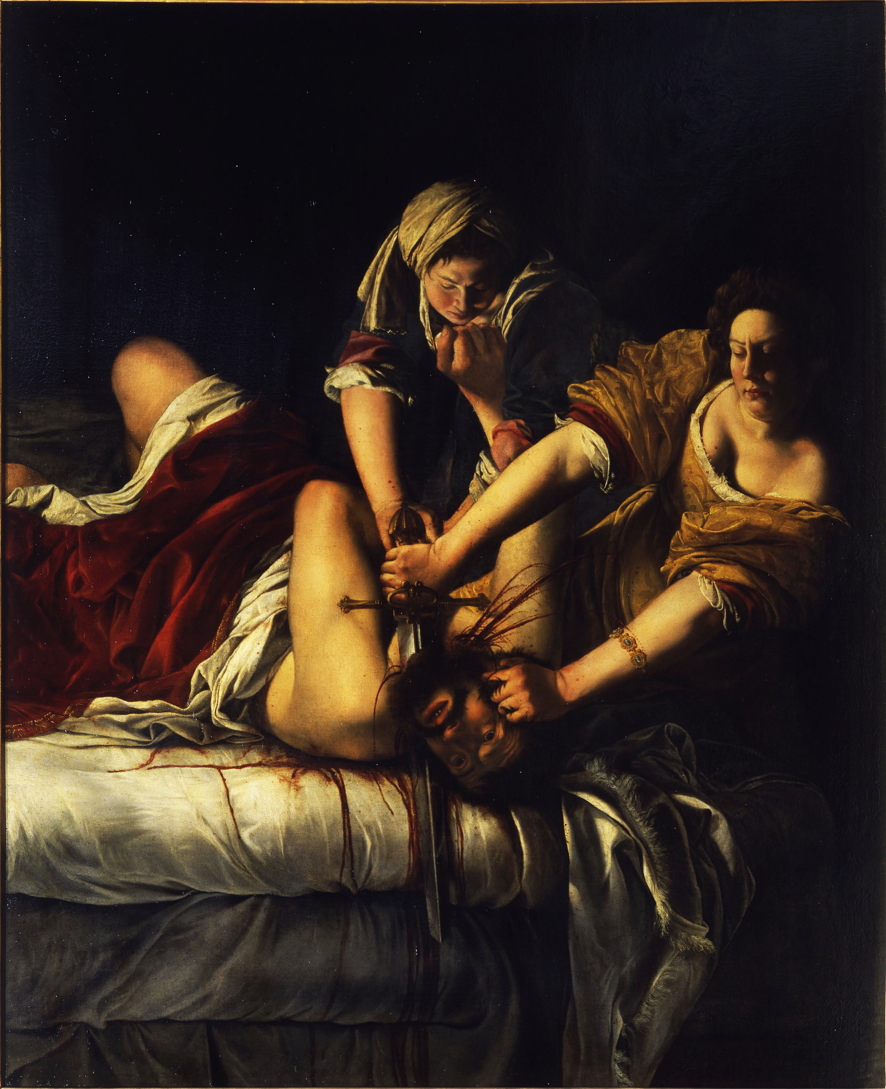
Her second version, painted in 1620-21 and now in the Uffizi in Florence, is similar in most respects, although the view isn’t as tightly cropped on the three figures, so that it shows Holofernes’ legs and a deep red wrap around his lower body. The lower section of the blade is also executed better. Judith’s face shows intense concentration and effort, both arms thrust out straight in front of her. The left grips Holofernes by the hair, the right pushes the blade onwards. Her maid is seen holding Holofernes down, pushing hard with both her arms out straight too. Holofernes’s right hand seems to be pushing the maid back, but his left arm is folded over his body.

There’s more uncertainty as to whether her brilliant painting of the Allegory of Painting (c 1638-9) is a self-portrait. This striking angle of view can be accounted for if this was a self-portrait composed using two mirrors, one placed above and on the left of the painter, the other directly in front of her, where she is gazing so intently. If so, it was particularly ingenious because the reflection in the second mirror would have normal chirality (left and right would not be reversed).
However, it has been suggested that this isn’t a self-portrait, in which case her choice of view would have been most unusual. It’s believed to have been painted during her stay in London, possibly for King Charles I, as it appears to have passed straight into the Royal Collection, where it has remained ever since.
Returning to Italy, my last great woman painter is Elisabetta Sirani, oldest child of the Bolognese painter Giovanni Andrea Sirani (1610–1670), who had been a pupil of Guido Reni (1575–1642). She was running the family workshop by the time she was only seventeen. Her success was meteoric until she collapsed and died suddenly in August 1665, aged twenty-seven, and has since lapsed into obscurity.

Her Penitent Magdalene is a powerful painting using a wide tonal scale to heighten its emotive effect.

Her Portia Wounding her Thigh (1664) refers not to the Portia of Shakespeare’s play The Merchant of Venice, but to Portia or Porcia Catonis, wife of Marcus Junius Brutus, one of Julius Caesar’s assassins in 44 BCE.
Getting wind of the plot to murder Caesar, Portia asked Brutus what was wrong. He didn’t answer, fearing that she might reveal any secret under torture. She therefore inflicted wounds to her thigh using a barber’s knife to see if she could endure the pain. As she overcame the pain of her wounds, she declared to Brutus that she had found that her body could keep silence, and implored him to tell her. When he saw her wounds, Brutus confided all in her.
By August 1665 Sirani had completed nearly 200 paintings, many fine drawings, and various prints. She died so suddenly that it was at first suspected that she might have been murdered, but it transpired that she had suffered fulminating peritonitis as the result of a burst peptic ulcer.
In tomorrow’s article I will look at the life and work of their forerunner, Sofonisba Anguissola.