Normal view

There are new articles available, click to refresh the page.
Before yesterdayMain stream

Paintings of 1925: landscapes

By: hoakley
17 December 2025 at 20:30

Towards the end of each year, I take a look back at some of the paintings that were completed a century ago. In histories of painting, that was a time of late Cubism, Surrealism, Expressionism and abstraction, but most of those works remain protected by copyright. In this and the next two articles you will see a broader range of styles.

ringoleringoverroskilde1925
Laurits Andersen Ring (1854–1933), Ole Ring looks over Roskilde (1925), oil on canvas, 36.5 x 28 cm, Ordrupgaard, Jægersborg Dyrehave, Denmark. Wikimedia Commons.

When his son was twenty-three, the Danish painter LA Ring painted him in Ole Ring looks over Roskilde. This is reminiscent of Ring’s Young Girl Looking out of a Roof Window that he had painted in Copenhagen back in 1885, forty years earlier at the start of his career. The church shown here is, I believe, Roskilde Cathedral.

vallottondordognecarennac
Félix Vallotton (1865–1925), The Dordogne at Carennac (1925), oil on canvas, 60 x 73 cm, Kunsthaus Zürich, Zürich, Switzerland. Wikimedia Commons.

In 1925, Félix Vallotton painted the last of his late landscapes, showing The Dordogne at Carennac. The town of Carennac is on the banks of the River Dordogne in the south-west of France.

From 1924 until 1930, Paul Signac spent most summers in Brittany, where he sketched and painted the island of Groix.

signaclighthousegroix568
Paul Signac (1863-1935), Lighthouse at Groix (Cachin 568) (1925), oil on canvas, 74 x 92.4 cm, Metropolitan Museum of Art, New York, NY. Wikimedia Commons.

From those, he painted Lighthouse at Groix in the studio. This shows a tuna boat returning to port in the evening, by which time the rest of the fleet are drying their sails in harbour. This wasn’t exhibited until 1930. The detail below shows his evolving facture, which remained steadfastly pointillist in his oil paintings.

signaclighthousegroix568d1
Paul Signac (1863-1935), Lighthouse at Groix (Cachin 568) (detail) (1925), oil on canvas, 74 x 92.4 cm, Metropolitan Museum of Art, New York, NY. Wikimedia Commons.
signacpontdesarts569
Paul Signac (1863-1935), Le Pont des Arts (Paris) (Cachin 569) (1925), oil on canvas, 89 x 115 cm, Private collection. Wikimedia Commons.

From his Paris apartment, Signac sketched many views of the River Seine and its bridges in watercolour. From those came this painting of Le Pont des Arts (Paris), with its reference to his much earlier views of industrial sites along the river’s banks.

signaclezardrieux
Paul Signac (1863-1935), Lézardrieux (1925), watercolour over Conté crayon, dimensions not known, Honolulu Museum of Art, Honolulu, HI. Wikimedia Commons.

He also combined Conté crayon (a proprietary type of hard pastel) with watercolour for this view of Lézardrieux. This is a village at the far western end of the French Channel coast, and a popular port with yachtsmen. He appears to have sharpened the Conté crayon to use it to sketch the outlines before applying watercolour wash, in a manner not unlike the late watercolours of Paul Cézanne.

signacileauxmoines
Paul Signac (1863-1935), L’île-aux-Moines (1925), further details not known. Wikimedia Commons.

That year, he travelled south from there to the northern end of the Bay of Biscay, where he painted this view of L’île-aux-Moines, one of two islands off that section of the coast of Brittany.

While Signac was painting in the north-west, Pierre Bonnard was active in the far south.

bonnardviewcannes1925
Pierre Bonnard (1867-1947), View of Cannes (c 1925), oil on canvas, 28 x 55 cm, Private collection. The Athenaeum.

Most of Bonnard’s finest landscapes from this period, like this View of Cannes, were painted on or near the Mediterranean coast, in the special light of le Midi.

bonnardboatsantibes1925
Pierre Bonnard (1867-1947), Boats at Antibes (1925), oil on canvas, 36.2 x 44.1 cm, Private collection. The Athenaeum.

Some local harbours there had become very popular during the summer, as he shows in Boats at Antibes.

The American artist Marsden Hartley returned to Europe in 1921, then based himself in Aix-en-Provence, Paul Cézanne’s home town, between about 1925-28.

hartleylandscape
Marsden Hartley (1877–1943), Landscape (1925), oil on panel, 36.8 x 46.4 cm, Herbert F. Johnson Museum of Art, Ithaca, NY. Wikimedia Commons.

Many of his landscapes from those years were strongly influenced by Cézanne’s later paintings, such as his Landscape. This shows extensive use of Cézanne’s constructive stroke, patches of parallel brushstrokes that are relatively independent of an object’s form.

urynollendorfplatzstation
Lesser Ury (1861–1931), Nollendorfplatz Station at Night (1925), media and dimensions not known, Märkisches Museum, Berlin, Germany. Image by anagoria, via Wikimedia Commons.

In Germany, Lesser Ury was continuing his successful urban nocturnes with his masterly oil sketch of Nollendorfplatz Station at Night. This busy railway station is to the south of the Tiergarten, in one of Berlin’s shopping districts.

Fog on the Thames 1900-1926

By: hoakley
7 December 2025 at 20:30

Claude Monet had first visited London as he sought refuge from the Franco-Prussian War in 1870-71, when he painted one of the early impressions of the River Thames in mist, shown in yesterday’s article. He was to return just before the end of the century, when his fortunes had changed and he could afford to travel in search of motifs. Where better than the River Thames for the optical effects of mist, fog and smog?

Monet had started painting formal series during the 1880s, when he was enjoying commercial success at last. From about 1896, almost all his works were part of a series. He started travelling through Europe in search of suitable motifs for these, visiting Norway in 1895, and later Venice. When he returned to London in 1899, and in the following two years, Monet chose a different view of the Palace of Westminster, from a location at the opposite end of Westminster Bridge, for his series of 19 paintings. These were all started from the second floor of the Administrative Block at the northern end of the old Saint Thomas’s Hospital on the ‘south’ bank, and completed over the following three or four years.

Claude Monet (1840–1926), The Houses of Parliament, Sunlight Effect (1903), oil on canvas, 81.3 × 92.1 cm, Brooklyn Museum, New York, NY. Wikimedia Commons.

His The Houses of Parliament, Sunlight Effect (1903) is more radical than his painting of thirty years earlier, showing little more than the Palace in silhouette, the sun low in the sky, and its broken reflections in the water.

Claude Monet (1840–1926), The Houses of Parliament, Sunset (1903), oil on canvas, 81.3 × 92.5 cm, The National Gallery of Art, Washington, DC. Wikimedia Commons.

The Houses of Parliament, Sunset (1903) shows the same view in better visibility, but with the sun setting and a small boat on the move in front of the Palace.

monetwaterloobridgefog
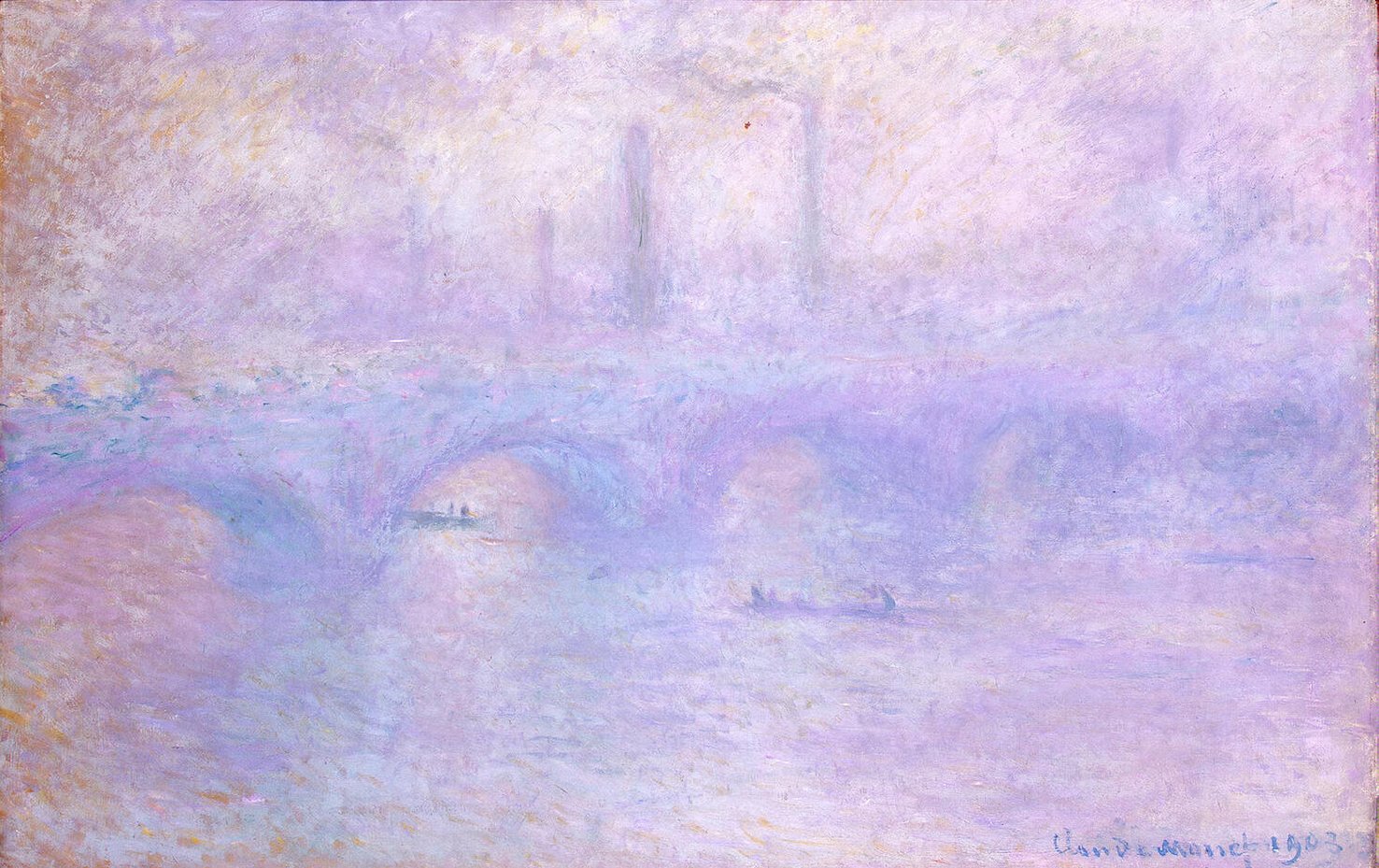
Claude Monet (1840–1926, Waterloo Bridge. Effect of Fog (1903), oil on canvas, 65.3 x 101 cm, Hermitage Museum Государственный Эрмитаж, Saint Petersburg, Russia. Wikimedia Commons.

Monet’s Waterloo Bridge from 1903 is the ultimate conclusion of his paintings of fog, in which only the softest of forms resolve in its pale purple and blue vagueness, his common destination with the paintings of Turner over fifty years earlier.

Claude Monet (1840–1926), The Houses of Parliament, Stormy Sky (1904), oil on canvas, 81.5 × 92 cm, Palais des Beaux-Arts de Lille, Lille. Wikimedia Commons.

In The Houses of Parliament, Stormy Sky (1904) the sun is higher and further to the south, allowing Monet to balance the silhouette of the Palace with its shadow cast on the water, and the brightness in the sky with its fragmented reflections.

lesidanerstpaulsfromriver
Henri Le Sidaner (1862–1939), St. Paul’s from the River: Morning Sun in Winter (1906-07), oil on canvas, 90 x 116 cm, Walker Art Gallery, Liverpool, England. Wikimedia Commons.

Henri Le Sidaner also visited Britain on several occasions, and in 1906-07 painted this view of St. Paul’s from the River: Morning Sun in Winter, which may have been inspired by Monet’s series paintings of Rouen Cathedral, here expressed using his own distinctive marks.

Émile Claus, (Sunset over Waterloo Bridge) (1916), oil on canvas, dimensions not known, location not known. WikiArt.
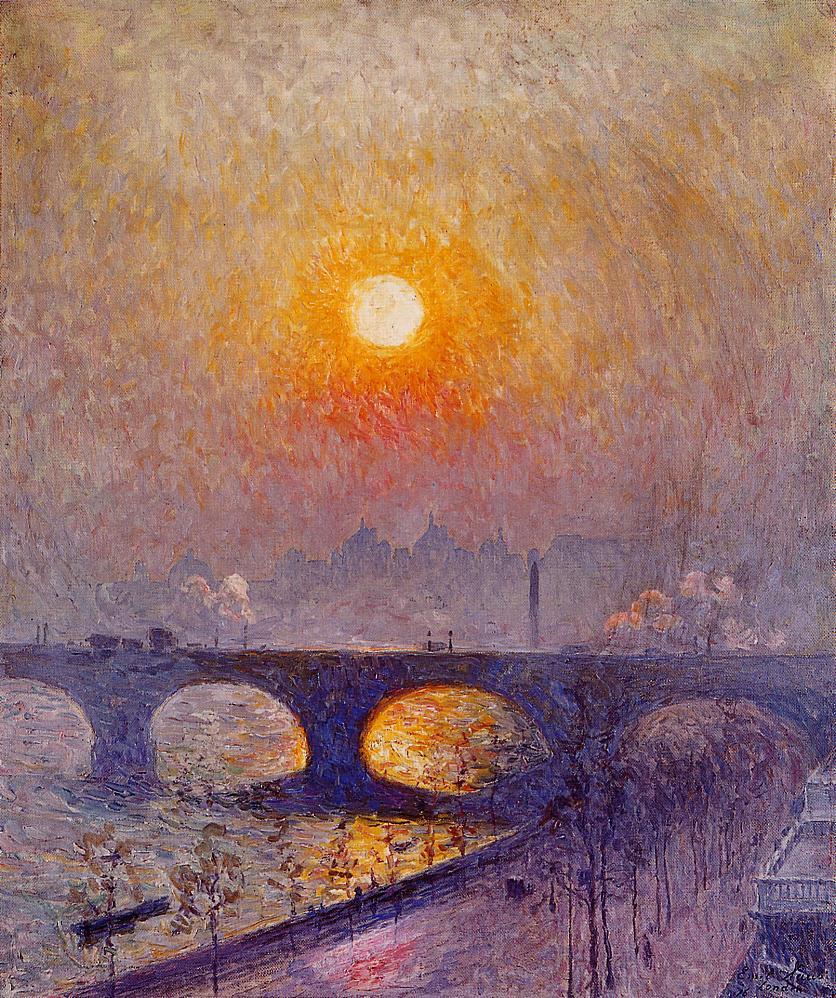
Émile Claus (1849-1924), (Sunset over Waterloo Bridge) (1916), oil on canvas, dimensions not known, location not known. WikiArt.

Emile Claus’s Sunset over Waterloo Bridge (1916) was painted from a location on the north bank of the Thames slightly to the east of Waterloo Bridge, the north end of which is prominent, and looks south-west into the setting sun, up river. Claus painted several views of Waterloo Bridge while he was in London, but doesn’t appear to have attempted any formal series, such as Monet’s.

Claus isn’t formulaic in his treatment. He uses billowing clouds of steam and smoke to great effect, and his inclusion of the road, trees and terraces in the foreground, on the Embankment, provides useful contrast with the crisp arches of the bridge, and the vaguer silhouettes in the distance. Like Monet’s series, this was probably painted from a temporary studio inside a building.

clausthamesreflection
Emile Claus (1849–1924), Morning Reflection on the Thames in London (1918), oil on canvas, 72 x 92 cm, Museum voor Schone Kunsten, Ghent, Belgium. Wikimedia Commons.

Claus’s Morning Reflection on the Thames in London, from 1918, is a view over the Embankment and river that’s desaturated and made vaguer by fog.

urylondonfog
Lesser Ury (1861–1931), London in Fog (1926), oil on canvas, 67 x 97 cm, location not known. Wikimedia Commons.

My last example is another view over the River Thames, this time by Lesser Ury. London in Fog from 1926 doesn’t appear to be a nocturne, but looks at the effects of fog on both lights and their reflections.

On 4 December 1952, a high pressure system settled over London. The wind fell away, and fog and smoke were trapped under a temperature inversion. The following day the whole of the city and an area totalling over one thousand square miles were blanketed in smog that remained until 9 December. It’s estimated that directly caused over ten thousand deaths. A succession of laws and a major campaign to eliminate open coal fires in London resulted in great improvement, although a decade later there was another lesser smog, perhaps the event I remember from my childhood. The beauty of those paintings can also be deadly.

❌
❌