Login
Login
Commemorating the bicentenary of the death of Jacques-Louis David 1: Before the Revolution
Shortly after Christmas we will commemorate the two hundredth anniversary of the death of the great French painter Jacques-Louis David, born in Paris in 1748, who died in self-imposed exile in Brussels. David was the leading Neoclassicist artist, and became embroiled in politics from the time of the French Revolution. His paintings are overwhelmingly narrative, and include some of the leading history paintings in the European canon.
David was born into an affluent family, but when he was only nine his father was killed fighting a duel. Although his guardian uncles and mother wanted him to be an architect, he managed to train as a painter in the Royal Academy under Joseph-Marie Vien. He set himself the target of winning the Prix de Rome, the pinnacle of achievement for any history painter in training. His first entry in 1771, Minerva Fighting Mars, was runner-up, and David wasn’t happy.
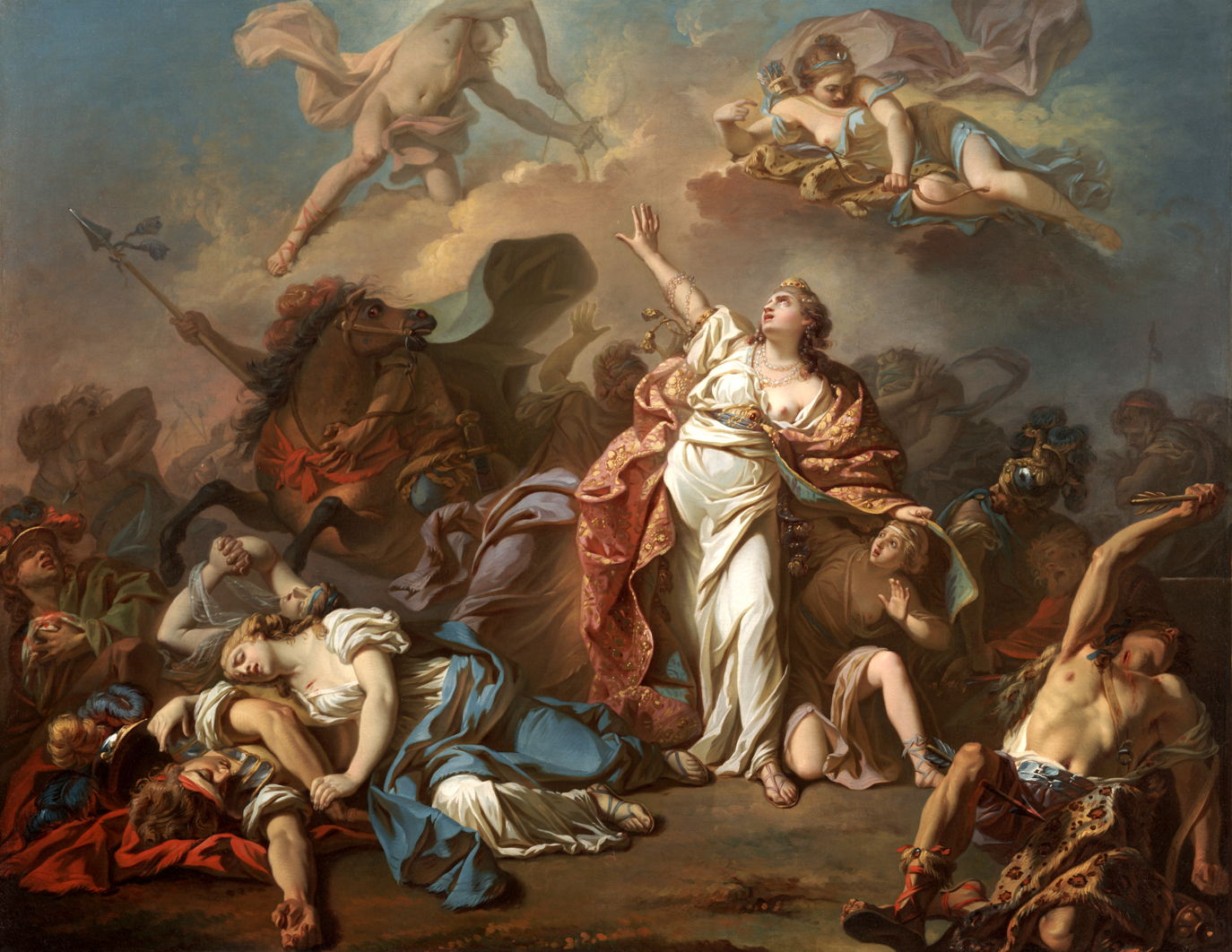
The following year he was so shocked that his Apollo and Diana Attacking the Children of Niobe (1772) wasn’t the winner that he went on hunger strike for a few days. David’s canvas is a mass of dead bodies, sheltering daughters, horses, carnage, and death. Amid all this Niobe stands, her right hand held up to the gods, imploring them to spare her last remaining daughter. Apollo still seems busy with his bow, although Diana seems to have finished her task.
David was eventually persuaded to resume eating and painting, failed a third time the following year with The Death of Seneca, but was finally successful in winning the prize in 1774.
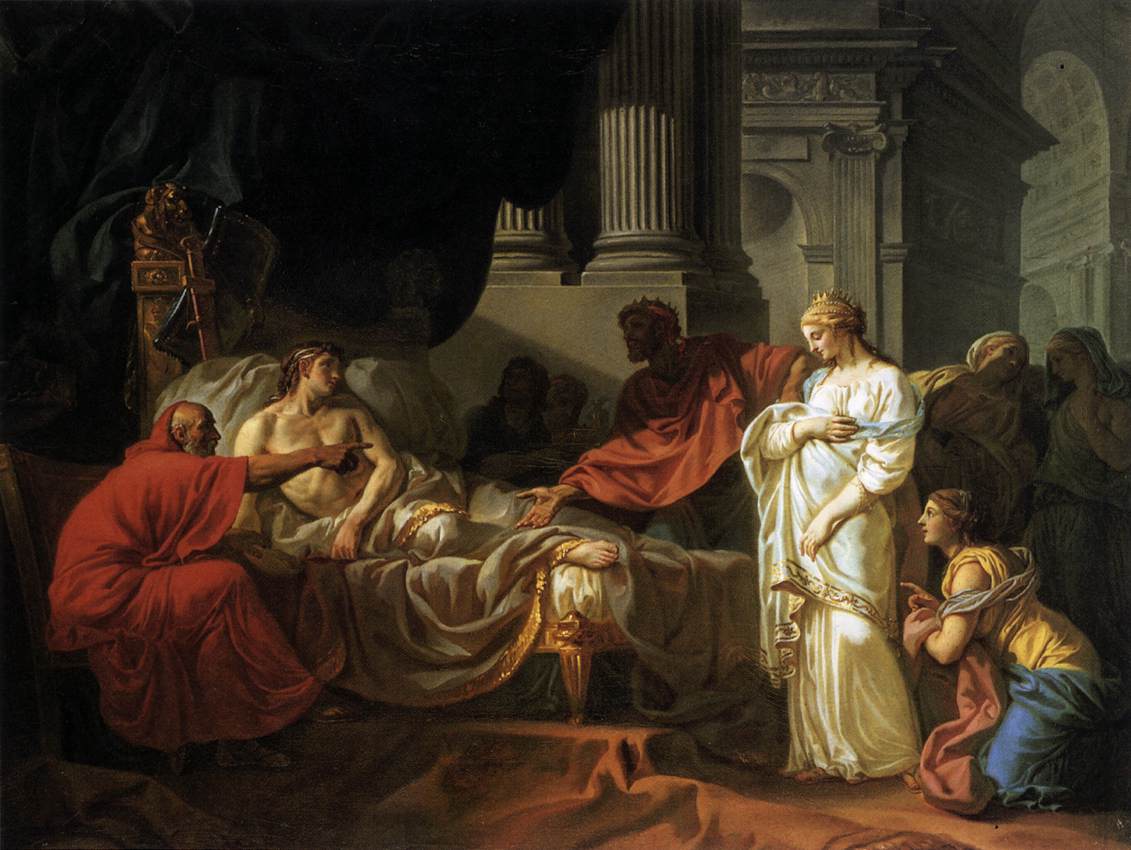
The painting that won David the Prix de Rome shows Antiochus propped up in bed, Erasistratus (in a red cloak) by him and pointing to the beautiful Stratonice at the foot of the bed. Erasistratus’ pointing index finger helps put Stratonice metaphorically and literally in the spotlight, as does her brilliant white robe.
In October 1775, David travelled to Rome to train there, the winner’s reward, and returned to Paris in the summer of 1780.
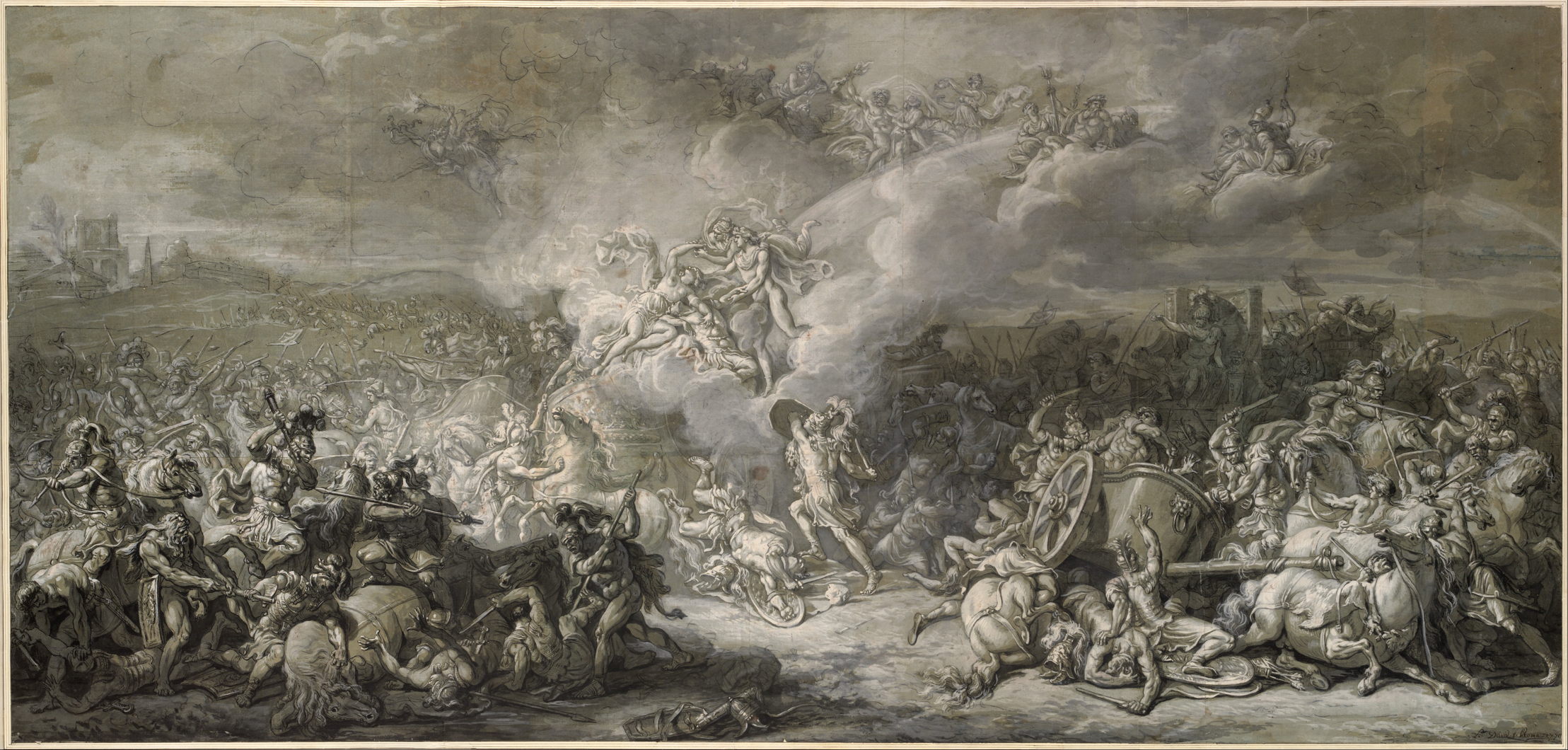
David’s extraordinarily detailed pen and ink drawing of The Combat of Diomedes from 1776 gives a vivid impression of the chaos of war, with a cluster of gods and goddesses joining in, while the rest of Olympus watches from above. The central group of figures tangled above Diomedes includes the injured Aphrodite and Ares.
Following success at the Salon of 1781, the King awarded David the privilege of lodging in the Louvre, where he married and taught his own pupils. He returned to Rome in 1784, where he painted his first masterwork.

In David’s Oath of the Horatii, the three brothers express their loyalty to the state as they reach out to take the swords they’ll use to fight the Curiatii, combining that gesture with a salute. This was commissioned for King Louis XVI, as an allegory about loyalty to the state and the monarch, interpreted by David as a message about the nobility of patriotic sacrifice. He cunningly left the viewer to decide where that loyal patriotism should be directed.

Socrates (470/469-399 BCE) was a major Greek philosopher known still for the Socratic Method, although none of his writings have survived. At the time when Athens was trying to recover from its defeat in the Peloponnesian War, Socrates was openly critical of Athenian politics and society, and made prominent Athenians appear foolish. He was tried, ostensibly for corrupting the minds of the young and for being impious, found guilty, and sentenced to death by drinking the poison hemlock.
Plato’s Phaedo describes Socrates’ execution. Although several encouraged him to escape, he refused. After drinking the hemlock from a bowl, he was told to walk around until his legs became numb. He then lay down, and the numbness slowly ascended until it reached his heart, and caused his death.
David shows Socrates half-sitting on a bed, his right hand over the bowl of hemlock, his left gesticulating with his index finger pointing upwards. His face is expressionless. By the head of the bed, five friends are distraught at what is happening, although only one shows grief on his face. Another friend (Crito) sits by Socrates, his right hand resting on Socrates’ left thigh.
The bowl of hemlock is held out by a young man, who is turned away, averting and shielding his eyes from the bowl. At the foot of the bed, an old man (Plato, who told the story) is sat asleep, but behind him, under an arch, another of Socrates’ friends (Apollodorus) is pressing his face to the wall in his anguish. In the far distance, a small group of patricians are seen walking away, upstairs, the lowermost holding his right hand up as if to bid Socrates farewell.

The following year David expressed his opinion on Helen’s supposed abduction that sparked the war against Troy, in The Love of Helen and Paris (1788). The couple pose in front of their bed with its rumpled sheets. He is naked and playing his lyre, his cheeks flushed. She wears diaphanous clothing that has slipped off her right shoulder, and her cheeks are distinctly flushed too. Watching over them is a small statue of Aphrodite.
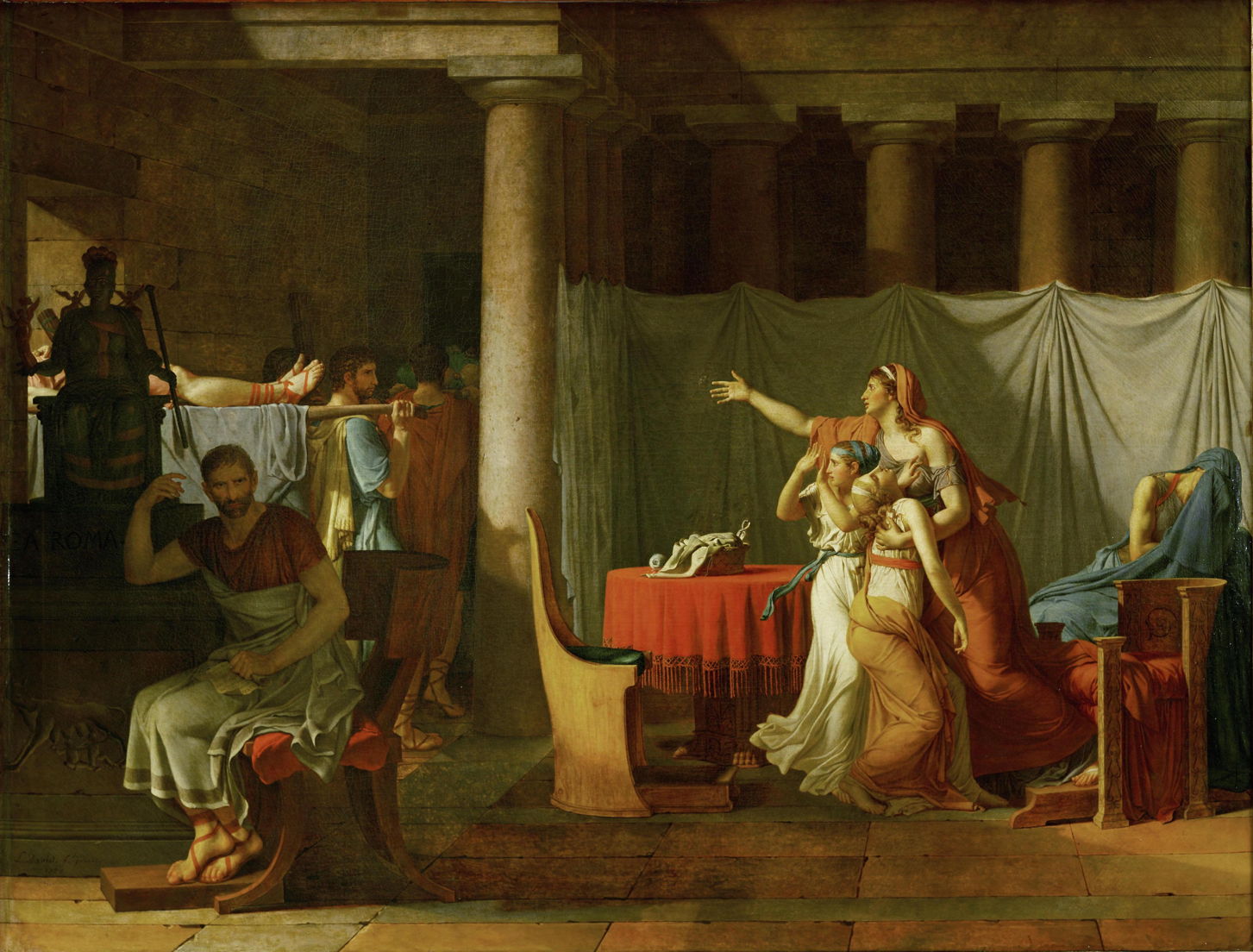
David was completing The Lictors Bring to Brutus the Bodies of His Sons (1789) at the start of the French Revolution, which turned out to be a highly appropriate moment for the work. When it was rumoured in the press that the monarchy intended to prevent this painting from being shown in the 1789 Salon, there was uproar, and it was permitted. It was quickly seen as showing the values required of the French people in supporting the revolution, even if they had to see members of their own family die in the process.
When the French Revolution started, David became an early supporter and friend of Maximilien Robespierre. As he became more involved in revolutionary politics, he painted ancient Spartan rites.

David’s Lycurgus of Sparta from 1791 shows the examination by elders at Lesche, with a queue of young parents. A newly-born infant is being presented to the elders for their verdict as to its fitness, perhaps with Lycurgus acting as the organiser. Those deemed unhealthy were sent to a chasm at the foot of Mount Taygetus and abandoned there.