It’s time to head off for a weekend away from the January gloom in Granada, Andalusia, southern Spain, where we’ll visit the Alhambra. It’s one of the oldest, grandest, most fascinating and beautiful palaces in Europe.
It started as one of many hill forts used by the Romans in a series of campaigns to control a succession of tribal revolts, and stamp the Empire’s presence close to North Africa. It was rebuilt in 889 CE, but nothing palatial became of it until around 1250, when the ruling Nasrid emir started to turn it into something much grander.
At that time, much of the south of the Iberian peninsula wasn’t ruled by people from Europe to the north, but by Muslim dynasties who had swept up from the south. The Emirate of Granada was the last substantial part of Iberia to remain under Muslim rule, and in 1333 the Sultan of Granada, Yusuf I, decided to transform the Alhambra into a royal palace. In doing so, he and his successors built one of the most exquisite expressions of Arabic Muslim art and architecture along a ridge about half a mile (0.7 km) long overlooking the city of Granada.
This plan from Openstreetmap and its contributors shows the modern site, as of 2013.
Constantin Uhde (1836–1905), Plan of the Nasrid Palaces, Alhambra (1892), illustration, further details not known. Wikimedia Commons.
Constantin Uhde’s plan of 1892 shows the layout of the Nasrid palaces:
Red is the site of the Palace of Comares and the Palaces of the Ambassadors.
Green is the Palace of the Lions.
Yellow is the Mexuar.
Blue is the Garden of Lindajar and later quarters of the Emir.
This article shows a selection of views of the palace up to 1883, and tomorrow’s sequel brings that up to the start of the First World War in 1914.
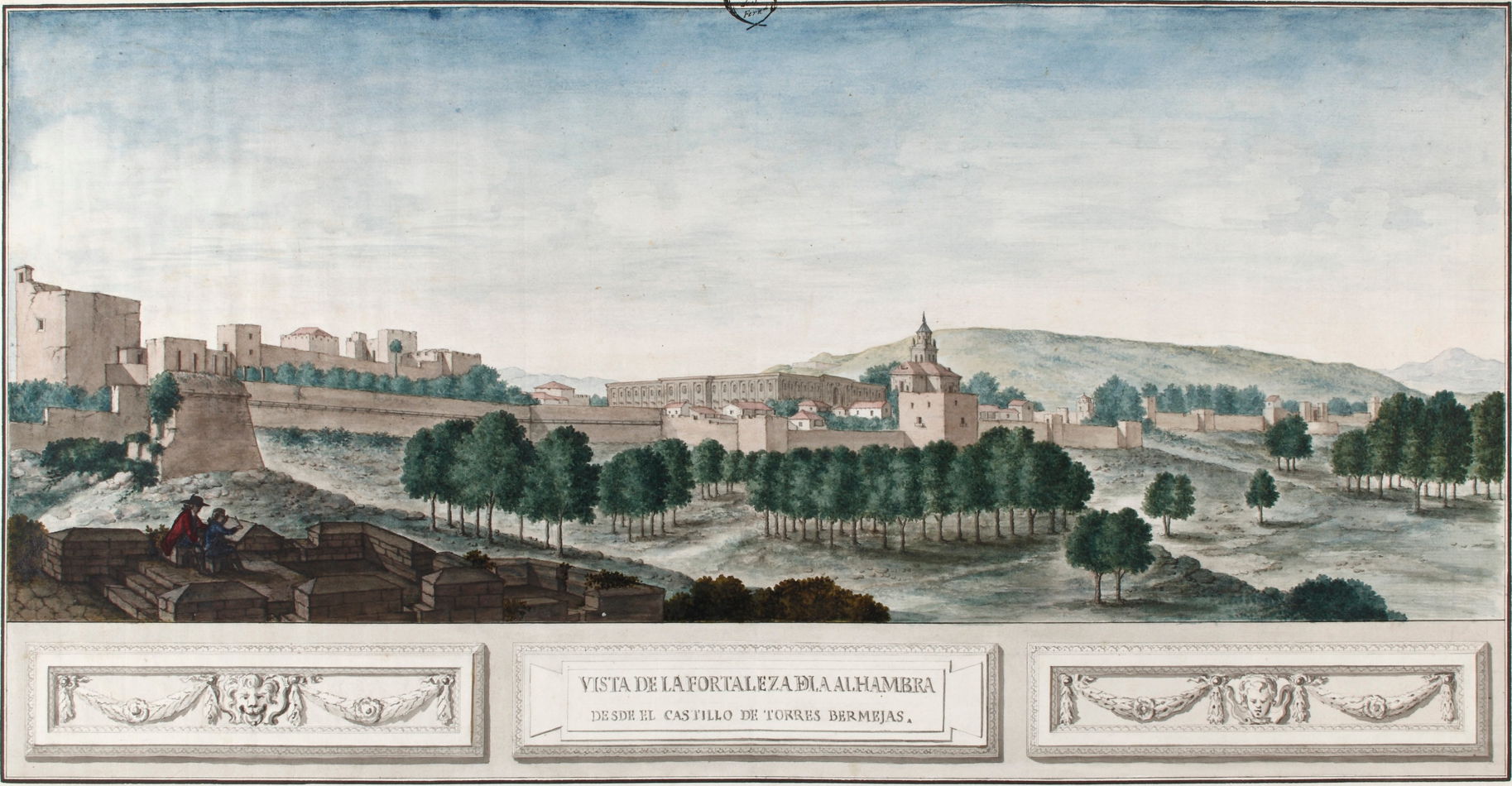
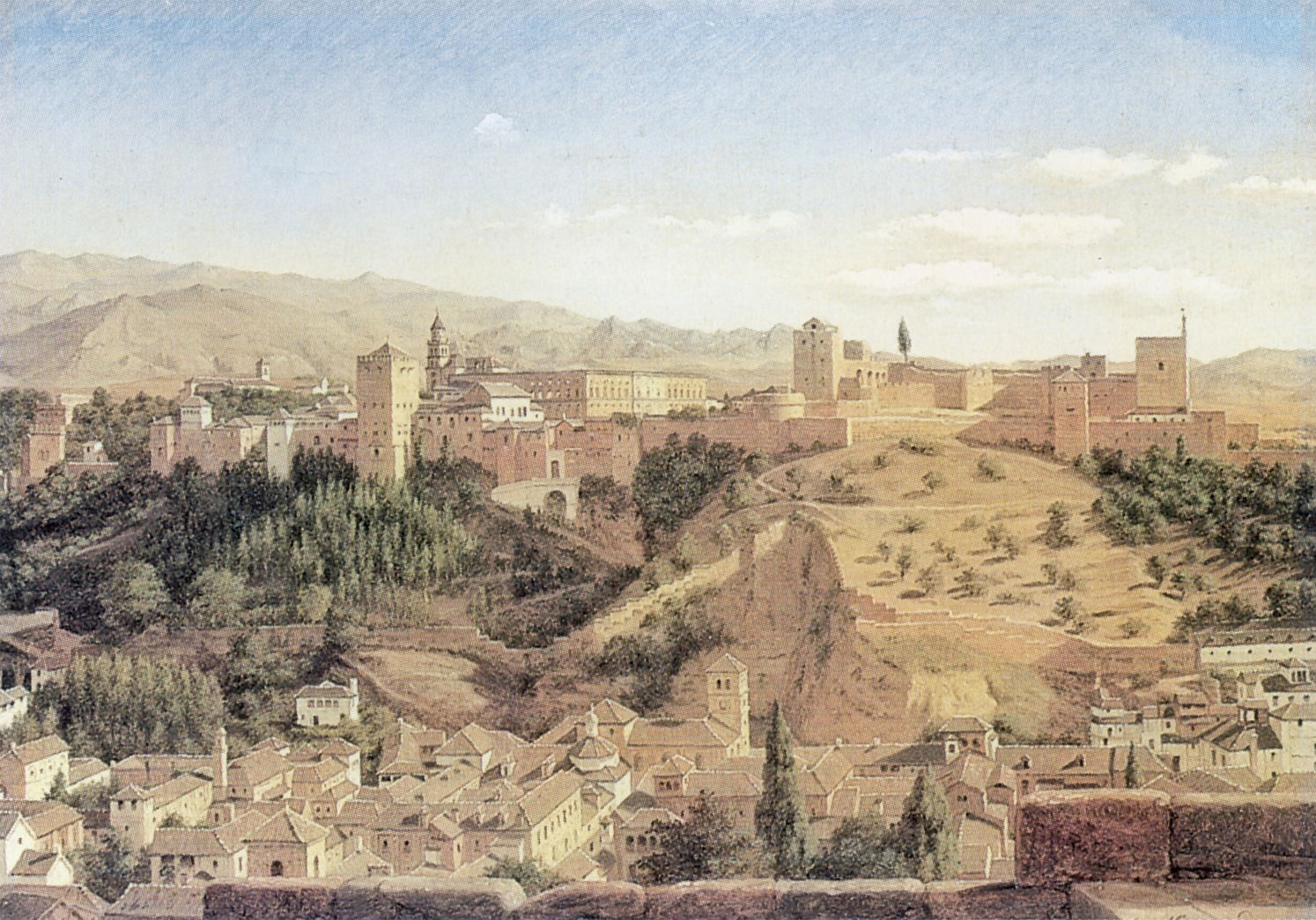
José de Hermosilla (1715-1776), View of the Alhambra from the Torres Bermejas Castle (1767), watercolour, dimensions not known, Real Academia de Bellas Artes de San Fernando, Madrid, Spain. Wikimedia Commons.
Early paintings of the Alhambra were mainly topographic views, painted in watercolour during the eighteenth century, such as José de Hermosilla’s View of the Alhambra from the Torres Bermejas Castle of 1767. These are similar to views of landmarks being produced in Britain at the time.
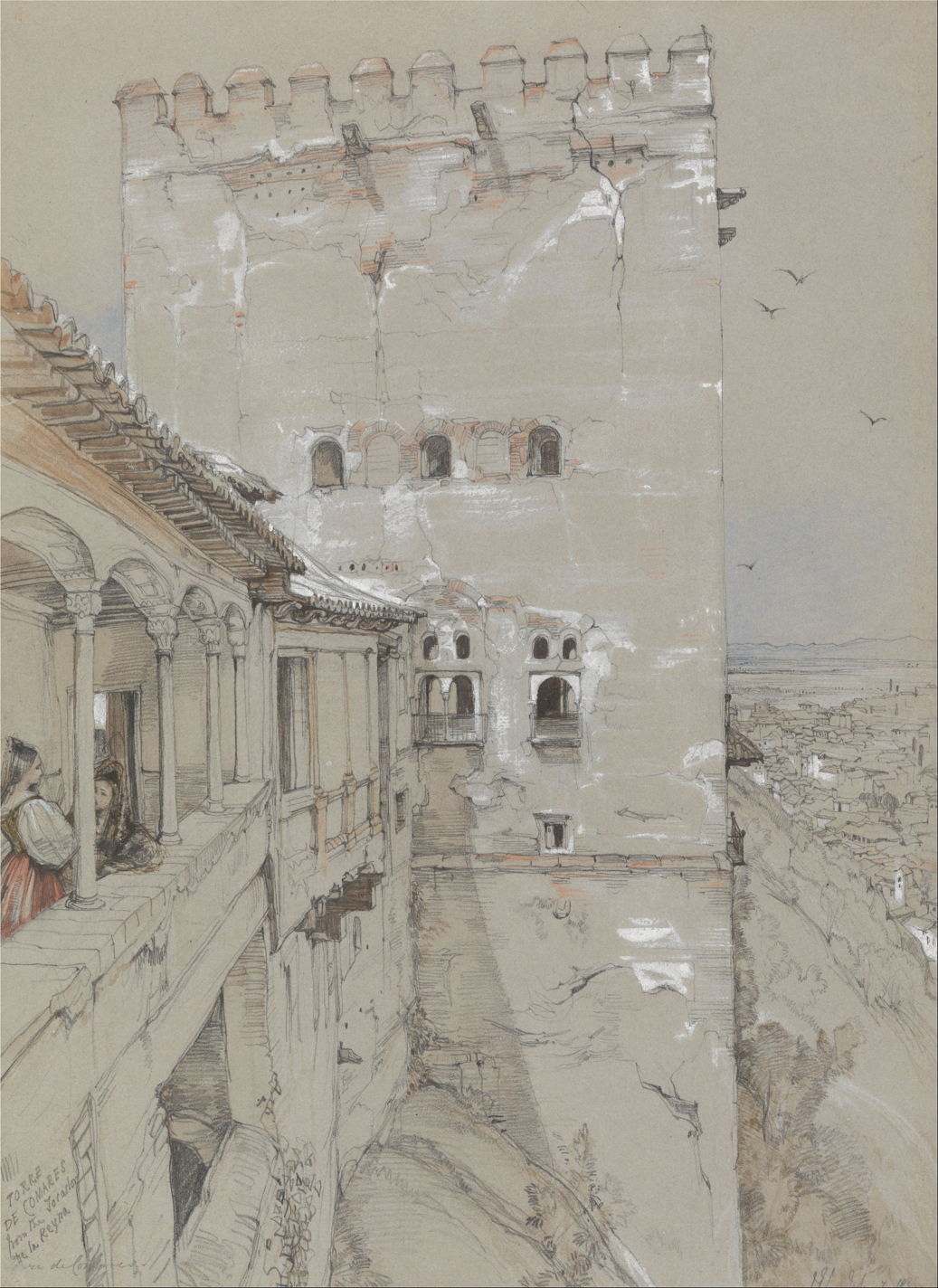
John Frederick Lewis (1805–1876), The Torre de Comares, Alhambra (1835), graphite, watercolour, white gouache and scratching out on medium, slightly textured, gray wove paper, 37.1 x 27 cm, Yale Center for British Art, New Haven, CT. Wikimedia Commons.
Others, like John Frederick Lewis in 1835, came to record details of the remains of the Alhambra’s buildings, as in The Torre de Comares, Alhambra, drawn carefully in graphite and only slightly highlighted and coloured with watercolour and gouache.
While every seriously aspiring landscape painter was flocking to paint en plein air in the Roman Campagna in the early nineteenth century, the Alhambra seems not to have been included in the circuit.
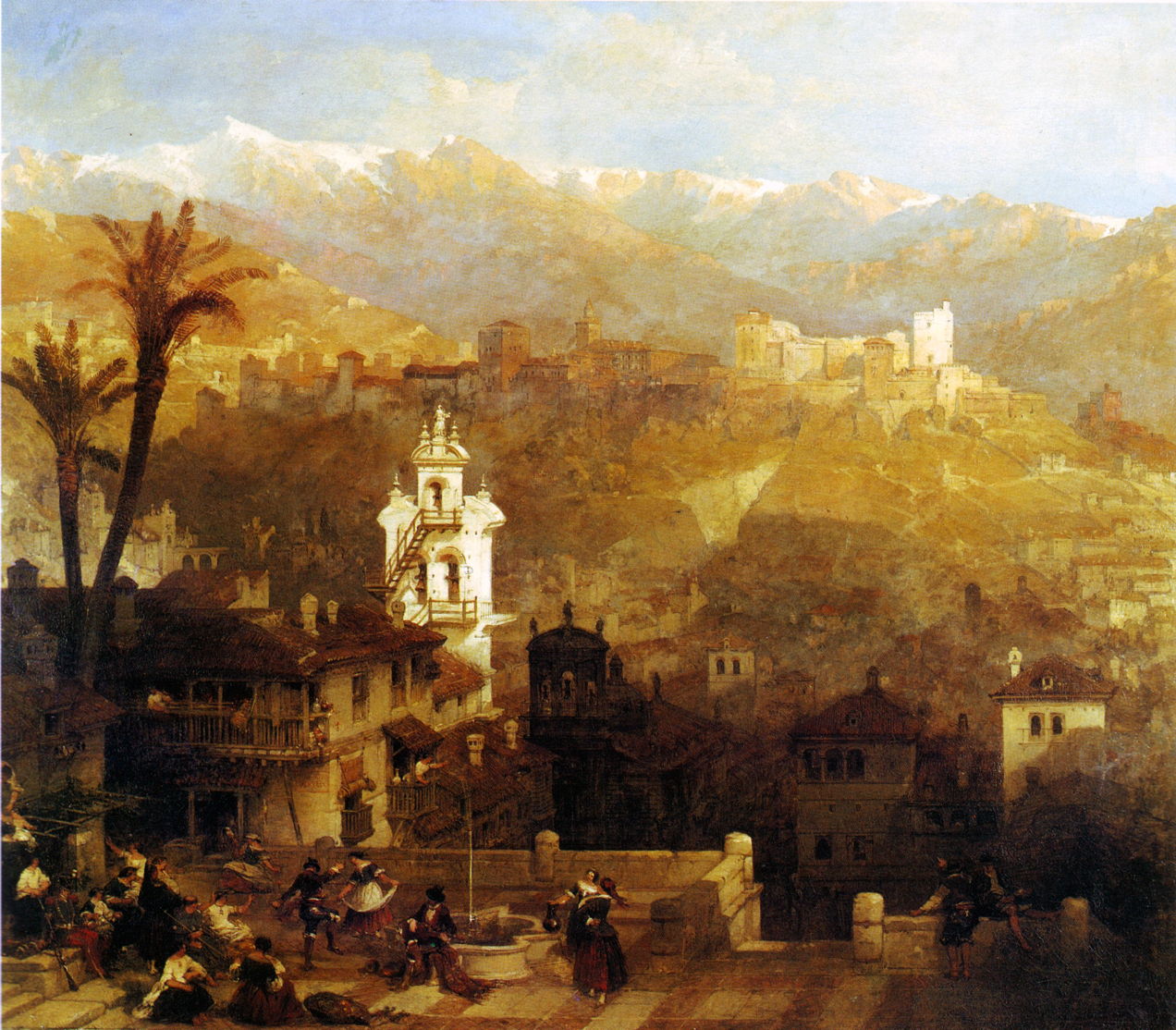
David Roberts (1796–1864), Alhambra and Albaicin (date not known), further details not known. Wikimedia Commons.
It was the vogue for Orientalist views in the middle of the nineteenth century that first attracted artists to paint the Alhambra in oils. This is David Roberts’ undated view of Alhambra and Albaicin. Roberts is much better-known for his sketches turned into prints from multiple tours of Egypt and the ‘near east’ made between 1838-40. This work probably originated in sketches made when he visited Spain in 1832, and would have then been painted in this form back in Britain after about 1833, and turned into a print by 1837.
Achille Zo (1826–1901), Patio in the Alhambra (1860), media and dimensions not known, Musée des beaux-arts de Pau, Pau, France. Wikimedia Commons.
Achille Zo was a Basque painter who specialised in views of Spain during the 1860s, such as this Patio in the Alhambra from 1860. These were well received at the Salon in Paris, earning him a gold medal in 1868, following which he too turned to Orientalism.
Franz von Lenbach (1836–1904), The Alhambra in Granada (1868), oil on canvas, 72.1 × 91.5 cm, Sammlung Schack, Bayerische Staatsgemäldesammlungen, Munich, Germany. Wikimedia Commons.
It was the fine collection of paintings of the Prado in Madrid that attracted many great artists to Spain. In 1867, Franz von Lenbach and a student of his travelled to Madrid to copy the masters there for his patron Baron Adolf von Schack. The following year, he painted two works in Granada: The Alhambra in Granada (1868) is a magnificent sketch including the backdrop of the distant mountains, and appears to have been painted in front of the motif.
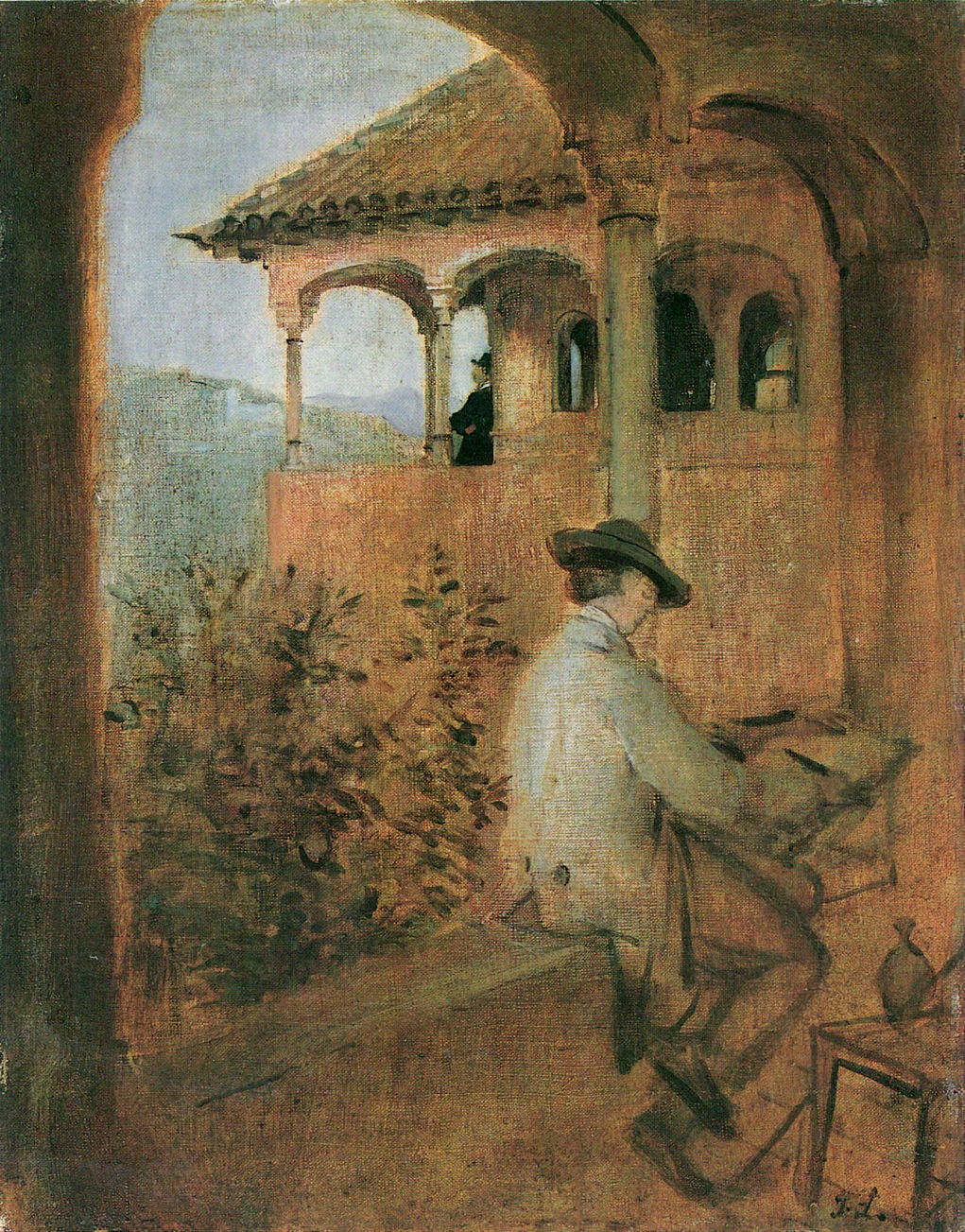
Franz von Lenbach (1836–1904), Tocador de la Reina (Queen’s Dressing Room) in the Alhambra (1868), oil on canvas, 33.1 × 26.2 cm, Sammlung Schack, Bayerische Staatsgemäldesammlungen, Munich, Germany. Wikimedia Commons.
Von Lenbach’s Tocador de la Reina shows the exterior of the Queen’s Dressing Room in the palaces, with his student sketching.
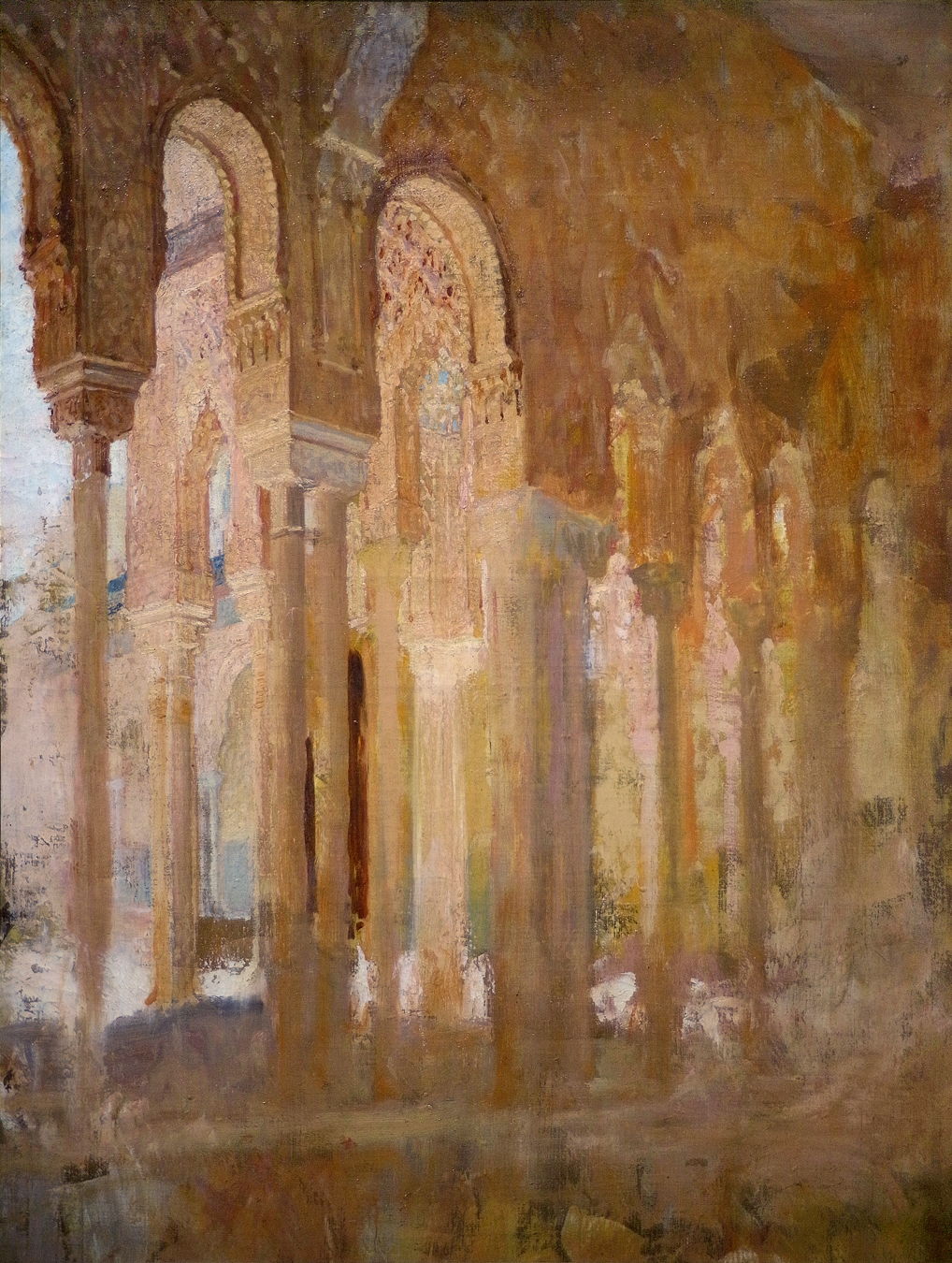
Henri Regnault (1843–1871), Colonnade of the Court of the Lions at the Alhambra (1869), oil on canvas, dimensions not known, Musée des Augustins de Toulouse, Toulouse, France. Wikimedia Commons.
Just two years before he was killed in the Franco-Prussian War, Henri Regnault toured Spain, and when he was in Granada he painted this view of the Colonnade of the Court of the Lions at the Alhambra (1869). I suspect this is unfinished, and he intended to complete the detail in its lower half.
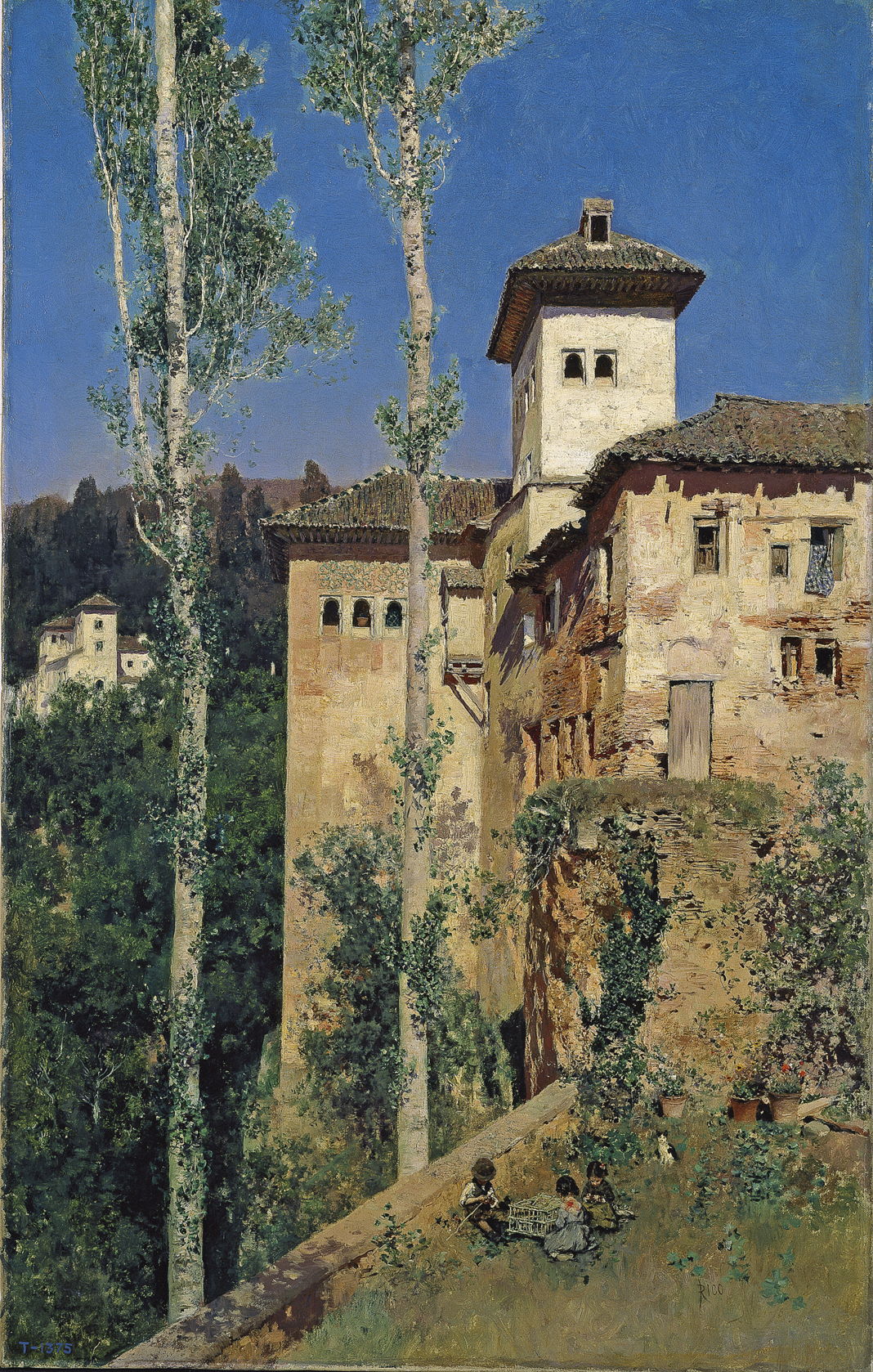
Martín Rico y Ortega (1833–1908), La Torre de las Damas en la Alhambra de Granada (The Tower of the Ladies in the Alhambra) (1871-72), oil on canvas, 62.5 x 39 cm, Museo Nacional del Prado, Madrid, Spain. Wikimedia Commons.
Martín Rico was one of the most important painters in Spain at this time. Influenced mainly by the Barbizon school, he painted this finely-detailed view of The Tower of the Ladies in the Alhambra in 1871-72. It captures the dilapidation the Alhambra had fallen into before more recent work to restore it to its former glory.
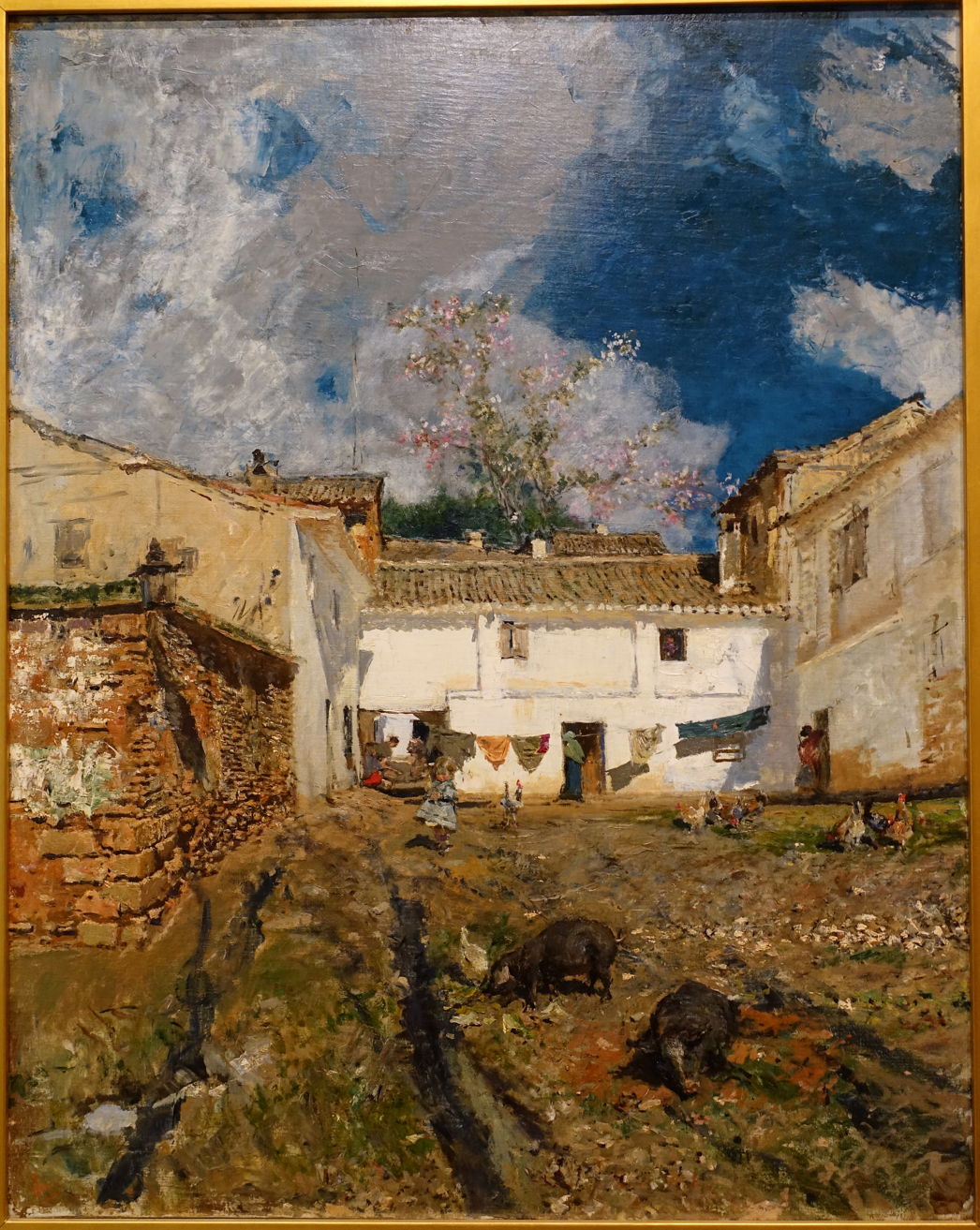
Marià Fortuny (1838–1874), Courtyard at Alhambra (Patio in Granada) (1873), oil on canvas, 111.4 x 88.9 cm, The Fogg Art Museum, Harvard University, Cambridge, MA. Wikimedia Commons.
If Marià Fortuny’s more Impressionist view of a Courtyard at Alhambra (Patio in Granada) from 1873 is to be believed, some parts of the Alhambra had been turned into smallholdings, with free-ranging chickens.
Heinrich Hansen (1821-1890), Granada with the Alhambra in the Nineteenth Century (date not known), further details not known. Image by Sir Gawain, via Wikimedia Commons.
More distant views of the ridge, such as Heinrich Hansen’s undated painting of Granada with the Alhambra in the Nineteenth Century, show its imposing grandeur.
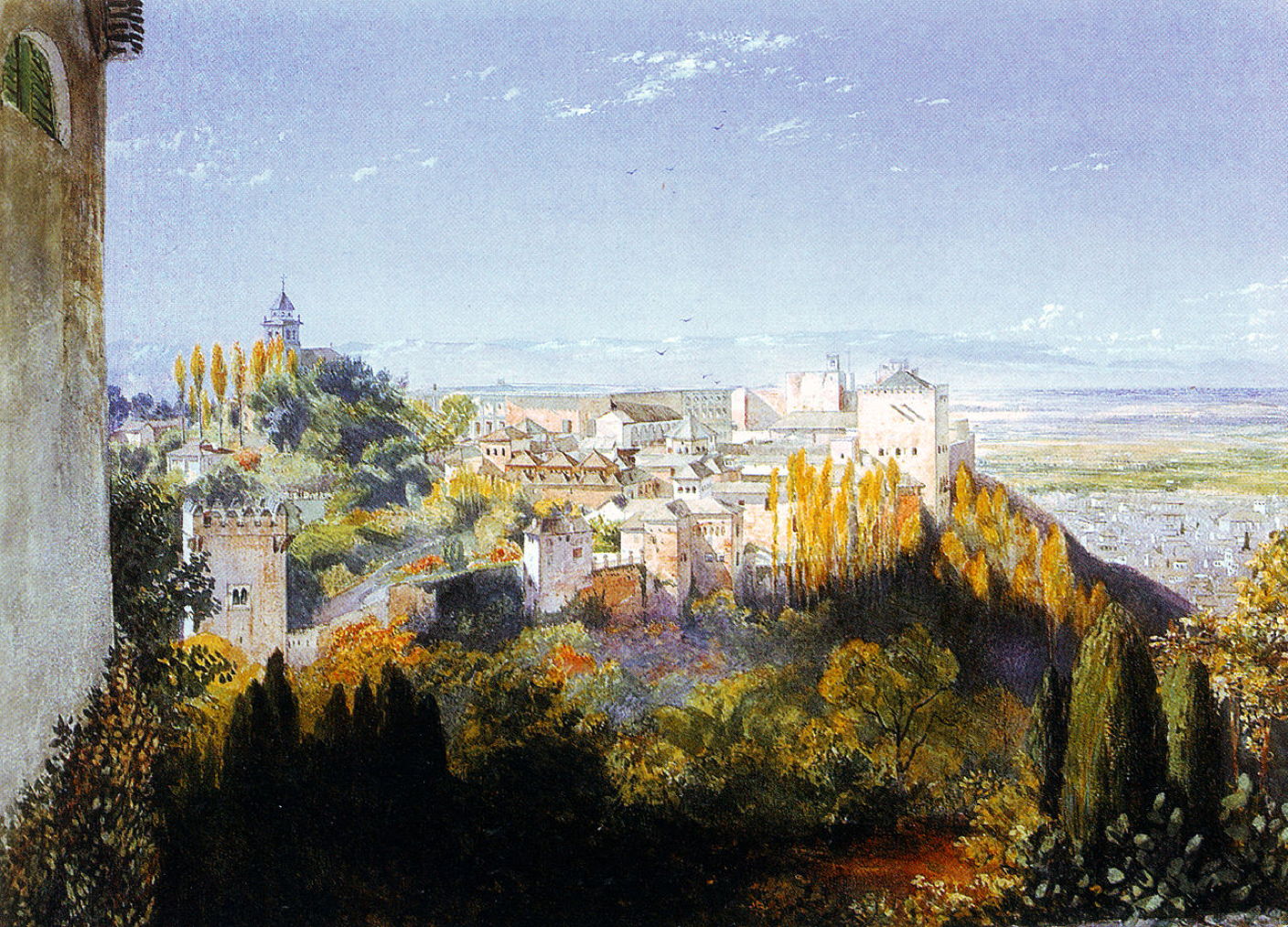
John Haynes Williams (1836-1908), Albaicin from the Alhambra (date not known), further details not known. Wikimedia Commons.
John Haynes Williams (or Haynes-Williams) recognised the merits of views painted from the Alhambra as a high point, in his undated Albaicin from the Alhambra.
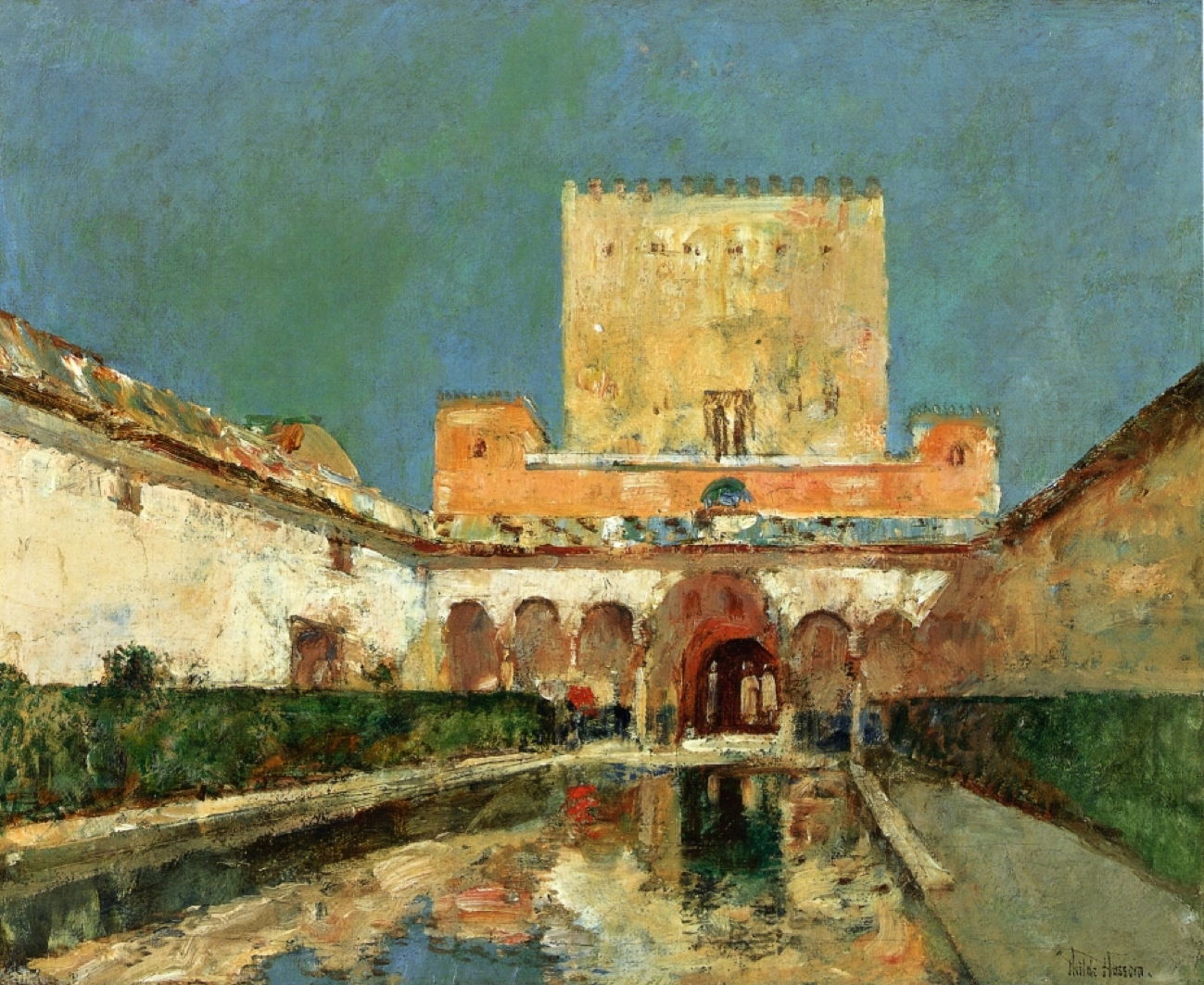
Childe Hassam (1859–1935), The Alhambra (1883), oil on canvas, 33 x 40.6 cm, Private Collection. Wikimedia Commons.
The late nineteenth century saw new visitors to copy masters at the Prado: those Americans who came to study painting in France and Germany. Among then, Childe Hassam visited during the summer of 1883, with his friend Edmund H Garrett, and sketch this view of The Alhambra then. This shows the Palace of the Ambassadors, and remains one of the most frequently painted parts of the site.
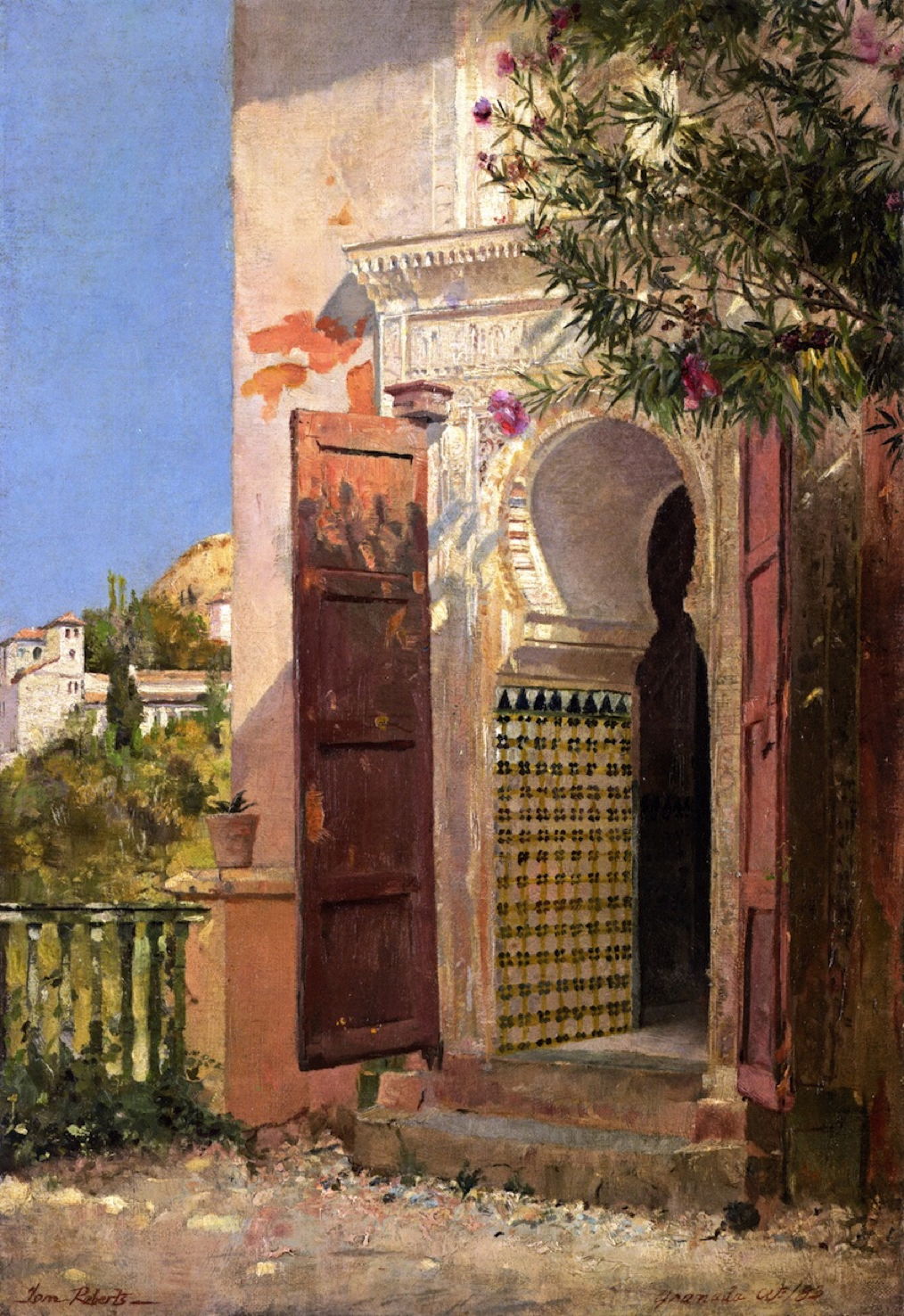
Tom Roberts (1856–1931), A Moorish Doorway, Alhambra (1883), further details not known. Wikimedia Commons.
From even further afield, the Anglo-Australian Tom Roberts visited Granada when he was in Spain in 1883, when he painted this detailed realist view of A Moorish Doorway, Alhambra. Roberts had migrated with his family in 1869, returned to Britain to study at the Royal Academy Schools from 1881, then went to Spain with the Australian John Peter Russell. He returned to Australia in 1884, becoming one of the early Australian Impressionists.
据本台法广非洲组(RFI Afrique)报道,卢旺达现任外长奥利维耶·恩杜洪吉雷海(Olivier NDUHUNGIREHE)本周在接受非洲媒体采访时表示,基加利(Kigali)提名穆希基瓦博夫人(Mme Louise Mushikiwabo)争取[法语国家及地区国际组织](OIF)秘书长一职的第三个任期。
本台法广(RFI)通讯员露西(Lucie)于2026年01月13日周二从该国首都基加利(Kigali)发回消息说,在距离计划将于2026年11月中旬在东南亚国家柬埔寨首都金边(Phnom Penh)举行的第20届[法语国家及地区国际组织](OIF)首脑峰会还有十个月之际。卢旺达方面于本星期一(2026年01月12日)在与《青年非洲》杂志(Jeune Afrique)的一个访谈中宣布,基加利将提名穆希基瓦博夫人(Mme Louise Mushikiwabo)竞选[法语国家及地区国际组织](OIF)的总干事,寻求三连任。
-- 卢旺达外长称赞OIF现任秘书长 --
同一法文报道指出,主管外交与合作事务的卢旺达部长奥利维耶·恩杜洪吉雷海(Olivier NDUHUNGIREHE)表示,现任秘书长穆希基瓦博夫人(Mme Louise Mushikiwabo)在领导[法语国家及地区国际组织]期间,获得“受到极大认可和赞誉”(largement reconnu et salué)的成果,足以证明(卢旺达)政府支持她再次连任的合理性。
Desk Nicolas 16/01/2026 v soir_le Rwanda propose la candidature de Mme Mushikiwabo à sa réélection.
01:01
RWANDA _Papier Desk Nicolas 16/01/2026 v soir_le Rwanda propose la candidature de sa secrétaire actuelle à sa réélection.
尼古拉
-- OIF现任秘书长已获得多国支持 --
本台法广(RFI)非洲通讯员在这篇法文报道的最后一个段落中指出,穆希基瓦博夫人(Mme Louise Mushikiwabo)担任[法语国家及地区国际组织](OIF)秘书长七年后,其第二个任期将于2026年年底结束。[法语国家及地区国际组织](OIF)于2025年11月召开部长级会议期间,穆希基瓦博夫人(Mme Louise Mushikiwabo)透露,已有多个国家提议,邀请她再次竞选秘书长的职务。候选人的申请截止日期应该是2026年4月。
... 德国因此陷入了两难境地。克林拜尔必须在华盛顿捍卫德国的利益,但他既不能得罪特朗普,也不能得罪习近平。杜伊斯堡埃森大学的中国问题专家陶波( Markus Taube)认为,从根本上化解这一矛盾是不可能的事情:‘短期内,这一难题无解。’他表示,概括而言,德国只有两个选项,而且两个选项都有明显弊端:要么,同美国一道,采取对华强硬路线。要么,则对中国采取更为友好的路线。”
The Trump administration has named US Secretary of State Marco Rubio and former UK prime minister Sir Tony Blair as two of the founding members of its "Board of Peace" for Gaza.
Trump's Middle East envoy Steve Witkoff and the president's son-in-law Jared Kushner will also sit on the "founding executive board", the White House said in a statement on Friday.
Trump will act as chairman of the board, which forms part of his 20-point plan to end the war between Israel and Hamas.
It is expected to temporarily oversee the running of Gaza and manage its reconstruction.
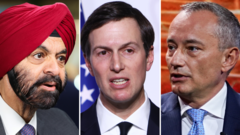
Also on the founding executive board are Marc Rowan, the head of a private equity firm, World Bank chief Ajay Banga and a US national security adviser, Robert Gabriel.
Each member would have a portfolio "critical to Gaza's stabilisation and long-term success", the White House statement said.
Trump had said on Thursday that the board had been formed, calling it the "Greatest and Most Prestigious Board ever assembled at any time, any place".
Further members of the board would be named in the coming weeks, the White House said.
Sir Tony was UK prime minister from 1997 to 2007 and took the UK into the Iraq War in 2003. After leaving office, he served as Middle East envoy for the Quartet of international powers (the US, EU, Russia and the UN).
It comes after the announcement of a separate 15-member Palestinian technocratic committee, the National Committee for the Administration of Gaza (NCAG), charged with managing the day-to-day governance of post-war Gaza.
Ali Shaath, a former deputy minister in the Palestinian Authority (PA) which governs parts of the occupied West Bank not under Israeli control, will head that new committee.
The statement also said that Nickolay Mladenov, a Bulgarian politician and former UN Middle East envoy, would be the board's representative on the ground in Gaza working with the NCAG.
Trump's plan says an International Stabilisation Force (ISF) will also be deployed to Gaza to train and support vetted Palestinian police forces and the White House statement said that US Major General Jasper Jeffers would head this force to "establish security, preserve peace, and establish a durable terror-free environment".
The White House said that a separate "Gaza executive board" was being formed that would help support governance and includes some of the same names as the founding executive board as well as further appointees.
The US peace plan came into force in October and has since entered its second phase, but there remains a lack of clarity about the future of Gaza and the 2.1 million Palestinians who live there.
Under phase one, Hamas and Israel agreed a ceasefire in October, as well as a hostage-prisoner exchange, a partial Israeli withdrawal, and an aid surge.
Earlier this week Witkoff said phase two would see the reconstruction and full demilitarisation of Gaza, including the disarmament of Hamas and other Palestinian groups.
"The US expects Hamas to comply fully with its obligations," he warned, noting these include the return of the body of the last dead Israeli hostage. "Failure to do so will bring serious consequences."
However the ceasefire is fragile, with both sides accusing each other of repeated violations.
Almost 450 Palestinians have been killed in Israeli strikes since it came into force, according to Gaza's Hamas-run health ministry, while the Israeli military says three of its soldiers have been killed in attacks by Palestinian groups during the same period.
And humanitarian conditions in the territory remain dire, according to the UN, which has stressed the need for the unrestricted flow of critical supplies.
The exiled son of the last Iranian shah (king) has called on the world to help protesters topple Iran's government, saying he is confident "the Islamic Republic will fall - not if, but when".
Reza Pahlavi, an opposition leader based in the US, called for "surgical" strikes on Iran's Revolutionary Guards which he said "will facilitate our task and prevent more loss of life".
More than 2,000 protesters have been killed, according to human rights groups, in demonstrations that started over the economy on 28 December and turned into calls for the end of the rule of Iran's Supreme Leader Ali Hosseini Khamenei.
The Iranian government has called the protests "riots" backed by Iran's enemies.
Pahlavi has emerged as a prominent figure in Iran's fragmented opposition and has previously urged Iranians to escalate their protests.
However protesters have been met with deadly force by authorities, masked by a near total shutdown of the internet and communication services.
Speaking at a news conference in Washington, Pahlavi vowed to return to Iran and laid out a plan for creating a new constitution in the country.
He claimed that sections of Iran's security apparatus had refused to take part in the crackdown and that the Iranian authorities had brought in fighters from foreign militias to quell the protests.
Asked about future leadership in Iran, Pahlavi said: "It's for the Iranian people to decide."
"I am trying to help them liberate themselves."
He said he supported a governing programme based on the principles of Iran's territorial integrity, a separation of religion and state, individual liberties and the right of the Iranian people to decide on the form of democratic government they want.
The current wave of protests began after shopkeepers in Tehran went on strike over the rising cost of living and the depreciating value of the currency.
They quickly spread across the country and turned against Iran's clerical establishment, particularly the Supreme Leader, Ayatollah Ali Khamenei. The slogans chanted by demonstrators have included "Death to the dictator" and "Seyyed Ali [Khamenei] will be toppled this year".
According to the US-based Human Rights Activists News Agency (HRANA), at least 2,453 protesters have been killed since the unrest began, as well as 14 children, 156 people affiliated with the security forces or government, and 14 uninvolved civilians.
It reports that another 18,470 protesters have been arrested.
Mayor Yamanaka has been accused by officials of workplace harassment
The mayor of Yokohama has apologised for insulting colleagues after an official publicly accused him of making offensive remarks.
At a news conference, the Japanese city's human resource chief, Jun Kubota, alleged that Mayor Takeharu Yamanaka had used terms such as "idiot" and "human scum" to disparage staff.
It is highly unusual in Japan for a serving city official to openly accuse a sitting mayor and demand an apology.
Yamanaka initially denied the allegations, but later admitted to some of them. "I want to frankly apologise for placing a psychological burden on the personnel director," he said.
At a news conference on Thursday, Kubota accused Mayor Yamanaka of repeatedly making remarks towards officials - including himself - that could amount to workplace harassment.
The mayor was accused of calling officials "useless", "silly" and "low-spec", as well as making comments about colleagues' appearance and likening them to animals.
He is also accused of threatening Kubota, saying he would have to "commit seppuku" - a Japanese ritual suicide by disembowelment - if he failed to secure an international conference bid.
Kubota demanded an apology from Yamanaka and called for an investigation.
Yamanaka initially published a statement on his personal website, denying the allegations.
But on Friday, he publicly acknowledged some remarks - such as using words like "idiot" and "human scum" - and apologised.
"I am reflecting on this. I will be more careful with my words and behaviour," Yamanaka said.
He said those comments were made during discussions over personnel evaluations.
However, the mayor denied other accusations, including insulting colleagues' appearance.
Yamanaka said an investigation was being considered under the supervision of the deputy mayor, adding that he would co-operate "sincerely" if an investigation takes place.
In response, Kubota insisted Yamanaka had made the comments he has not admitted to, saying: "The mayor doesn't understand anything. I cannot accept that as an apology. I want him to change."
Bobi Wine, President Museveni's main rival, has questioned the credibility of the results
Police in Uganda have denied allegations that presidential candidate Bobi Wine was abducted on Friday evening as vote counting continues in the East African nation amid an internet blackout.
Wine's party said a helicopter landed in the grounds of his house in the capital, Kampala, and forcibly took him to an unknown location.
Initially Wine's son, Solomon Kampala, said both his parents had been seized, but later claimed his father "escaped" and his mother was still under house arrest, leading to confusion over the whereabouts of the opposition leader.
The latest electoral figures from Thursday's vote give Museveni 72% of the vote, with Wine on 24%, based on returns from 94% of polling stations.
Speaking at a press conference on Saturday morning, police spokesman Kituuma Rusoke said the National Unity Platform (NUP) party leader was still in his home in Kampala and that it was Wine's family members who were spreading "untrue" and "unfounded" claims.
He said Wine's movements were restricted because his home was an area of "security interest".
"We have controlled access to areas which are security hotspots," Uganda's Daily Monitor paper quoted him as saying.
"We cannot allow people to use some places to gather and cause chaos. All our actions are intended to prevent anybody from creating violence or destabilising our security," he said.
On Friday, Wine had told his supporters to ignore the "fake results" that have been announced, saying the authorities have been "stealing the vote". He did not provide any evidence to back up his claim and the authorities have not responded to his allegations.
Wine's son Solomon Kampala, who has been posting updates on social media, admitted overnight he was getting conflicting reports about the security situation at his parents' home.
"Amidst the raid my father was able to escape, my mother is still currently under [house] arrest, still nobody is allowed to enter the house," he posted on X on Saturday morning.
Difficulty accessing the internet in the country has made it hard for people to verify information.
News that at least seven opposition supporters were killed in disputed circumstances in Butambala, about 55km (35 miles) south-west of the capital, on Thursday only emerged later on Friday.
The US embassy then issued an alert to its citizens because of reports the security forces were "using tear gas and firing into the air to disperse gatherings".
During Thursday's vote, voting was delayed by up to four hours in many polling stations around the country as ballot boxes were slow to arrive and biometric machines, used to verify voters' identity, did not work properly.
Some have linked the problems to the network outage.
Electoral chief Simon Byabakama said on Friday that the vote counting had not been affected by the internet blackout and the final results would be out before 17:00 local time (14:00 GMT] on Saturday.
Thursday's election followed an often violent campaign, with President Museveni, 81, seeking a seventh term in office. He first took power as a rebel leader in 1986.
Wine, a 43-year-old pop star-turned-politician, who says he represents the youth in a country where most of the population is aged under 30, has promised to tackle corruption and impose sweeping reforms, while Museveni argues he is the sole guarantor of stability and progress in Uganda.
Although there are six other candidates, the presidential poll is a two-horse race between Museveni and Wine.
The campaign period was marred by the disruption of opposition activities - security forces have been accused of assaulting and detaining Wine's supporters.
Rusoke, the police spokesperson, dismissed these complaints, accusing opposition supporters of being disruptive.
Internet access was suspended on Tuesday, with Uganda's Communications Commission saying the blackout was necessary to prevent misinformation, fraud and the incitement of violence - a move condemned by the UN human rights office as "deeply worrying".
Taking paracetamol while pregnant is safe and there's no evidence it raises the risk of autism, ADHD and developmental issues in children, say experts behind a major new review.
Pregnant women "should feel reassured" by the findings, they say, which contradict controversial claims from US President Donald Trump last year that paracetamol "is no good" and pregnant women should "fight like hell" not to take it.
His views were criticised at the time by medical organisations worldwide. Experts say this latest review, in a Lancet journal, is rigorous and should end the debate over its safety.
But US health officials maintain that "many experts" have expressed concern over its use during pregnancy.
The US President shocked many doctors worldwide when he and his administration claimed paracetamol or a branded version called Tylenol - which is seen as the go-to painkiller for pregnant women - could be linked to autism in children, if taken during pregnancy.
Those claims led to confusion among women and concern among health experts, and prompted this new research.
Published in The Lancet Obstetrics, Gynaecology & Women's Health, it looked at 43 of the most robust studies into paracetamol use during pregnancy, involving hundreds of thousands of women, particularly those comparing pregnancies where the mother had taken the drug to pregnancies where she hadn't.
The researchers say using these high-quality studies of siblings means they can dismiss other factors such as different genes and family environments, which makes their review "gold-standard".
The research also looked at studies with a low risk of bias and those that followed children for more than five years to check for any link.
"When we did this analysis, we found no links, there was no association, there's no evidence that paracetamol increases the risk of autism," lead study author and consultant obstetrician Professor Asma Khalil, told the BBC.
"The message is clear – paracetamol remains a safe option during pregnancy when taken as guided," she added.
This reinforces guidance from major medical organisations in the UK, US and Europe on the safety of the common painkiller.
Any previously-reported links between the drug and an increased risk of autism are likely to be explained by other factors, rather than a direct effect of the paracetamol itself, the review says.
"This is important as paracetamol is the first-line medication we recommend for pregnant women in pain or with a fever," said Prof Khalil, professor of maternal fetal medicine at City St George's, University of London.
Health advice warns that women can run the risk of harming their baby if they don't take paracetamol to bring down a high temperature or relieve pain when pregnant. This can increase the risk of miscarriage, premature birth or developmental problems in babies.
Medical experts not involved in the research have welcomed the study's findings, saying it will help reduce worry among women.
Prof Grainne McAlonnan, from King's College London, said expectant mothers "do not need the stress of questioning whether medicine most commonly used for a headache could have far reaching effects on their child's health".
"I hope the findings of this study bring the matter to a close," she said.
Prof Ian Douglas, from the London School of Hygiene and Tropical Medicine, said the review was "well-conducted" because it excluded studies of lower quality, where no account was taken of important differences between mothers who use or don't use paracetamol during pregnancy, such as underlying illnesses.
According to Prof Jan Haavik, molecular neuroscientist and clinical psychiatrist at the University of Bergen, the study provides "strong evidence" that use of paracetamol during pregnancy does not increase the risk of autism, ADHD or intellectual disability and "should effectively put this question to rest".
It is widely believed by scientists working in this field that autism is the result of a complex mix of factors, including genetic and environmental ones.
Getty Images
In a speech in September 2025, President Trump said his administration was linking paracetamol (or acetaminophen) to autism and urging pregnant women to largely avoid the pain reliever
A spokesman from the US Department of Health and Human Services said "many experts" had expressed concern over the use of acetaminophen - the US name for paracetamol - during pregnancy.
For example, a review in August 2025 led by Dr Andrew Baccarelli, dean of the Harvard T.H. Chan School of Public Health, found that using acetaminophen during pregnancy may increase children's autism and ADHD risk, and urged caution over "especially heavy or prolonged use".
Months earlier, Health Secretary Robert F Kennedy Jr had pledged to find out the cause of a steep rise in reported autism cases.
In a controversial speech in the Oval Office in September, the US president said doctors would be advised not to prescribe the pain reliever to pregnant women.
The US Food and Drug Administration (FDA) then issued a letter to clinicians urging them to be cautious about the use of acetaminophen in pregnancy, while also saying it was still the only drug approved for treating fevers during pregnancy.
On its website, the FDA says "a causal relationship" between the drug and neurological conditions "has not been established".
Health officials in the UK have stressed that paracetamol remains the safest painkiller available to pregnant women.
Customs and Border Patrol agents gather as protests continue outside Minneapolis' Whipple Federal Building, which has become a de-facto ICE headquarters
The US justice department is investigating two prominent Minnesota officials over alleged attempts to impede federal immigration agents, in an escalation of the Trump's administration's clash with Democrats.
Governor Tim Walz and Minneapolis Mayor Jacob Frey are facing an inquiry over statements they have made about Immigration and Customs Enforcement (ICE), reports the BBC's US partner CBS.
It comes as fresh details emerged in the death of a Minneapolis woman shot last week by an ICE agent in the city, sparking nationwide protests.
Renee Good, 37, was found with at least three gunshot wounds and possibly a fourth to the head, according to official reports viewed by CBS.
Governor Walz responded on Friday to news of the inquiry against him by posting on X: "Weaponizing the justice system against your opponents is an authoritarian tactic.
"The only person not being investigated for the shooting of Renee Good is the federal agent who shot her."
The governor has urged Minnesotans to protest peacefully, although he has previously been accused by the Trump administration of inflammatory rhetoric for describing ICE as a "modern-day Gestapo". Frey has demanded that immigration agents get out of Minneapolis.
The Washington Post reports that the justice department has issued subpoenas to Walz and Frey.
The inquiry is focused on a federal statute, 18 U.S.C. § 372, which makes it a crime for two or more people to conspire to prevent federal officers from carrying out their official duties through "force, intimidation or threats", a US official told CBS.
Protests continued in Minneapolis on Friday after new details emerged about the death of Good, and local officials appealed for calm on the streets over this public holiday weekend.
An incident report from the Minneapolis Fire Department said when they responded to the shooting scene last week, it appeared Good had been shot twice in the chest, once in her left forearm and a fourth wound, possibly from a gunshot, was seen "on the left side of the patient's head".
Paramedics found Good unresponsive with an irregular pulse, and she was pronounced dead in the ambulance on the way to hospital, according to the report seen by CBS.
The Trump administration has said that Good was impeding federal law enforcement and tried to run the agent over. Local officials say Good was a legal observer who posed no danger.
Video of the incident show ICE agents approaching a car, which is blocking traffic and parked in the middle of the street. An officer instructs her to get out of the car.
As Good turns her wheel apparently trying to drive away, her Honda Pilot SUV pulls forward with one of the agents standing near the front of the vehicle. He pulls his gun and fires.
Reuters
Footage from the scene shows the agent walking off afterwards.
But Department of Homeland Security (DHS) officials have told CBS the officer suffered internal bleeding to the torso following the incident. No further details have been disclosed.
The FBI is investigating the incident, although there is no federal civil rights inquiry into the agent who opened fire.
Meanwhile, President Donald Trump blasted demonstrators and local leaders on Friday.
On Truth Social, he accused protesters of being "highly paid professionals", adding that Walz and Frey had "totally lost control".
Later, the Republican president told reporters at the White House that he did not plan to invoke the Insurrection Act and send in troops to quell unrest in Minnesota, after earlier this week suggesting he might do so.
"If I needed it, I'd use it. I don't think there's any reason right now to use it," he said. "It's very powerful," he added.
Bloomberg via Getty Images
Democratic lawmakers held a hearing and press conference in Minnesota on Friday, led by Washington Rep. Pramila Jayapal (center)
Thousands of ICE officers remain deployed in the state.
Democratic lawmakers travelled to the city and spent Friday condemning federal immigration operations in the state, accusing ICE of reckless and lawless actions.
Ilhan Omar, a congresswoman from Minnesota who has long feuded with Trump, claimed that ICE was trying to "provoke chaos and fear".
Adriano Espaillat, a congressman from New York, said ICE had become a "deadly weapon".
Washington congressman Pramila Jayapal said ICE agents should not be allowed to wear masks, or make arrests without warrants, and should be required to have body cameras and name tags.
The Democratic lawmakers also interviewed several residents who alleged they had been shackled and detained by ICE for hours until they could prove they were US citizens.
The BBC has contacted the DHS and ICE for comment.
DHS spokeswoman Tricia McLaughlin told CNN on Friday that if there was "reasonable suspicion" of someone who is "in the vicinity" of a person being detained by a DHS operation, they might be asked to confirm their identity.
She rejected suggestions such tactics could be discriminatory, saying "racial animus has no place in DHS".
Most Greenlanders are opposed to Trump's bid to buy their island or to seize it by force
A bipartisan group of members of the US Congress is visiting Denmark in what is seen as a show of support in the face of increasing pressure from President Donald Trump for the US to annex Greenland - a semi-autonomous region of Denmark in the Arctic.
The 11-member delegation is due to meet MPs as well as Danish Prime Minister Mette Frederiksen and her Greenlandic counterpart Jens-Frederik Nielsen.
The visit comes days after high-level talks in Washington failed to dissuade Trump from his plans.
He insists Greenland is vital for US security - and that Denmark cannot defend it against possible Russian or Chinese attacks. Both Denmark and Greenland say they are opposed to a US takeover.
Greenland is sparsely-populated but resource-rich and its location between North America and the Arctic makes it well placed for early warning systems in the event of missile attacks and for monitoring vessels in the region.
The US already has more than 100 military personnel permanently stationed at its Pituffik base - a facility that has been operated by the US since World War Two.
Under existing agreements with Denmark, the US has the power to bring as many troops as it wants to Greenland.
But Trump has said the US needs to "own" it to defend it properly.
He has consistently offered to buy it off - an offer rejected by Denmark and Greenland - whilst mooting the possibility of seizing it by force.
Denmark has warned that military action would spell the end of Nato - the trans-Atlantic defence alliance where the US is the most influential partner.
Nato works on the principle that allies have to aid each other in case of attack from outside - it has never faced an option where one member would use force against another.
European allies have rallied to Denmark's support.
They have also said the Arctic region is equally important to them and that its security should be a joint Nato responsibility - with the US involved.
To this end, several countries including France, Germany, Sweden, Norway, Finland, the Netherlands and the UK have sent a limited number of troops to Greenland in a so-called reconnaissance mission.
French President Emmanuel Macron said "land, air, and sea assets" would soon be sent.
Watch: Troops and vessels from European Nato allies arrive in Greenland
The US Congressional delegation includes senators and members of the US House of Representatives who are fervent supporters of Nato.
It is led by Senator Chris Coons who said earlier this week that "we need to draw closer to our allies, not drive them away".
Though Coons and the majority of the delegation are Democratic opponents of Trump, the group includes Republican Senators Thom Tillis and Lisa Murkowski, too.
Democratic and Republican lawmakers have introduced legislation to stop Trump seizing Greenland by force.
A Republican congressman has also introduced a rival bill in support of the plan to annex the island.
People and traffic still regularly cross the Iran-Iraq border
At the border crossing from Iran into Iraqi Kurdistan, the stern face of Iran's former supreme leader, Ayatollah Khomeini, peers down at the trickle of Iranians leaving the territory.
Thick snowflakes confetti the lorries and pedestrians arriving at this remote mountain pass.
Metres away, just beyond the border post, an Iranian flag flutters in the snow.
Iran has shut down the internet and blocked phone calls into the country, but its borders are still open.
Inside the arrivals hall, we find dozens of men, women and children – many arriving to visit family on the Iraqi side of the border.
No-one we met said they were fleeing Iran because of the recent protests and government crackdown, but one man – who asked us to hide his identity – told us security forces had shot him during a protest in central Iran last Friday.
"I was hit in the face by seven pellet rounds," he said, pointing out several weals and bruises on his face. "They struck above my eyelid, on my forehead, my cheek, my lip, under my ear and along my jaw. I had to use a razor blade to cut one of the pellets out."
He told us he was too afraid of being arrested to get medical help, and that others injured during the government crackdown on protestors were also avoiding treatment, out of fear that security forces would arrive and arrest them.
"One of my friends told me he was hit by a pellet round," he told us. "His son, who is around 12 or 13 years old, was struck twice in the leg by live ammunition. One of the bullets is lodged in the shin bone. They're terrified of going to hospital to have it removed."
Iran's regime has treated these protests as an existential threat. Its crackdown seems to be working, and protesters are now thought to be largely staying at home, for fear of being shot or arrested. Rights groups say at least around 2,500 people have been killed.
But several people here told us that demonstrations had continued, at least into this week. The protester we spoke to said security forces had crushed protests in his own town last Friday, but that they had continued elsewhere.
"Demonstrations were still going on in Fardis and Malard, and some areas of Tehran," he said. "My friends were there. We were constantly on the phone. On Tuesday night, the protests were still going on, but I haven't had any updates since then."
Iranians don't need a visa to cross here, and officials say there is regular traffic back and forth.
Another man we spoke to at the border said he had been in Tehran on Wednesday, and seen protesters on the street. It's not clear what form of protest that was, or how many were taking part.
The BBC has seen no hard evidence that street protests are still continuing. Very little footage at all is trickling out, and the reports we heard today are impossible to confirm. The BBC, along with other international media, is barred from reporting inside Iran.
The Iranian authorities imposed an internet blackout more than a week ago
The government's repression largely seems to be working. But the economic problems that sparked this crisis haven't gone away.
A teacher from a town close to the border told us she didn't care who the leader was, she just wanted the economic situation to improve.
"We don't want anything more than our basic rights," she told me. "To own a house, to own a car, to have a normal life. My salary lasts 10 days, and I have to borrow money to cover the rest of the month. It's very bad."
I ask about US President Donald Trump, and his threat of military strikes if the regime kept killing protesters.
"We're waiting to see what Trump does," he told me. "In the meantime, civilians are getting killed."
The force with which Iran's leaders have crushed this protest signals their weakness. The regional proxy groups they once used as defences against attack have been weakened by Israel's war with Hamas and Hezbollah, and by the fall of the former Syrian President, Bashar al-Assad.
And the Israeli-US war with Iran last year has depleted its military capabilities, and left it vulnerable to attack.
Hidden behind this mountainous border, Iran's regime is re-imposing its control.
But hidden behind that repressive control is the growing fear of the Islamic Republic, unable to meet its people's most basic demands: protection from foreign attacks, and prosperity at home.
Google has appealed a US district judge's landmark antitrust ruling that found the company illegally held a monopoly in online search.
"As we have long said, the Court's August 2024 ruling ignored the reality that people use Google because they want to, not because they're forced to," Google's vice president for regulatory affairs Lee-Anne Mulholland said.
In its announcement on Friday, Google said the ruling by Judge Amit Mehta didn't account for the pace of innovation and intense competition the company faces.
The company is requesting a pause on implementing a series of fixes - viewed by some observers as too lenient - aimed at limiting its monopoly power.
Judge Mehta acknowledged the rapid changes to the Google's business when he issued his remedies in September, writing that the emergence of generative artificial intelligence (AI) had changed the course of the case.
He refused to grant government lawyers their request for a Google breakup that would include a spin-off of Chrome, the world's most popular browser.
Instead, he pushed less rigorous remedies, including a requirement that Google share certain data with "qualified competitors" as deemed by the court.
That data was due to include portions of its search index, Google's massive inventory of web content that functions like a map of the internet.
The judge also called for Google to allow certain competitors to display the tech giant's search results as their own in a bid to give upstarts the time and resources they need to innovate.
On Friday, Mulholland balked at being forced to share search data and syndication services with rivals as she justified the request for a halt to implementing the orders.
"These mandates would risk Americans' privacy and discourage competitors from building their own products — ultimately stifling the innovation that keeps the U.S. at the forefront of global technology," Mulholland wrote.
While the company has invested growing sums of cash into AI, those ambitions have come under scrutiny.
Last month, the EU opened an investigation into Google over its AI summaries which appear above search results.
The European Commission said it would probe whether Google used data from websites to provide the service and failed to offer appropriate compensation to publishers.
Google said the investigation risked stifling innovation in a competitive market.
This week, Google parent Alphabet became the fourth company ever to reach a market capitalisation of $4tn.
Machado gave her Nobel Peace Prize medal to Donald Trump in Washington on Thursday
Venezuelan opposition leader María Corina Machado has vowed she will lead the country "when the right time comes".
"There's a mission, and we are going to turn Venezuela into that land of grace, and I believe I will be elected when the right time comes as president of Venezuela, the first woman president," she told Fox News.
The US seized Venezuela's President Nicolás Maduro in Caracas on 3 January and removed him to New York to face various drugs and weapons charges.
However Trump has declined to endorse Machado as Venezuela's new leader, saying she did not have enough domestic support - despite her opposition movement claiming victory in 2024's widely contested elections.
He has instead been dealing with the country's interim president Delcy Rodríguez, who had been Maduro's vice-president.
"I want to serve my country where I am more useful. I got a mandate, and I have that mandate," Machado added.
She also visited Congress to meet US senators during her visit to Washington, where her remarks to reporters were drowned out by supporters chanting "María, presidente" and waving Venezuelan flags.
"Director Ratcliffe discussed potential opportunities for economic collaboration and that Venezuela can no longer be a safe haven for America's adversaries," the official said.
The same day, Rodríguez said she was not afraid to face the US "diplomatically, through political dialogue" during her first state of the union address since becoming interim president.
She also said Venezuela needed to defend its "dignity and honour" and announced oil industry reforms to allow more foreign investment, in a step away from Maduro's policies.
Trump called Rodríguez a "terrific person" on Wednesday after the pair spoke on the phone, a conversation the Venezuelan leader called "productive and courteous".
Machado presented Trump with her Nobel Peace Prize medal on Thursday
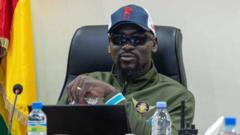
Official pictures of Mamadi Doumbouya have portrayed him in a more relaxed mode
From the moment he seized power in September 2021 Guinea's Mamadi Doumbouya struck an imposing figure.
Just 36 years old at the time, the broad-shouldered colonel, standing at well over six feet (1.8m), wearing military fatigues, mirrored sunglasses and a red beret certainly made an impression when announcing the coup.
A relatively unknown member of an elite army unit, he declared that the government of ousted President Alpha Condé had disregarded democratic principles and that citizens' rights were being trampled on.
After more than four years of acting as interim president, and going back on a promise not to run for leadership of the country, Doumbouya, now 41, is set to be sworn in as the elected head of state on Saturday.
The discreet, disciplined and private man won 87% of the vote in December's election against a severely depleted field.
Ex-Prime Minister Cellou Dalein Diallo, now in exile, described the process as a charade which generated "fabricated" results.
While seemingly enjoying some popular support, critics have questioned Doumbouya's democratic credentials as some political parties have been banned, activists have mysteriously disappeared and media outlets been shut down.
Reuters
Video footage shot in the aftermath of the 2021 coup showed Doumbouya being greeted by enthusiastic crowds
Scrolling back through the social media accounts from the president's office there is a sense of a carefully curated image.
The army man, now a general, has, for the main, ditched the camouflage in favour of the baseball cap and tracksuit, or a boubou - traditional Guinean attire of loose-fitting robes with elaborate embroidery. The shades though are still at times in evidence.
Pictures show him at the opening of schools, or transport and mining infrastructure or cycling through the streets of the capital, Conakry. The message is clear: this is a man of action who is working on behalf of the people.
"This was presenting an image of someone who can be close to civilians, someone who is a civilian leader and can be representative of the people," Beverly Ochieng, senior analyst with Dakar-based security intelligence firm Control Risks, told the BBC.
"In some ways this is distancing himself from what brought him to power – a coup - and the fact that his entire career has been in the military."
In the 15 years before he took power, Doumbouya gained extensive international experience, including being educated to master's level in France and serving in the French Foreign Legion. He was also in Afghanistan, Ivory Coast, Djibouti, Central African Republic and worked on close protection in Israel, Cyprus and the UK.
But the donning of civilian clothes may not be entirely sincere, according to some analysts.
"I'm not sure that he has transitioned from a military man. I think that the military costume will remain even if he is conducting the return to civilian order," argued Aïssatou Kanté, a researcher in the West Africa office of the Institute of Security Studies.
She referred to a ban on political demonstrations, the exclusion of Doumbouya's main challengers in December's election and the suspension of key opposition parties.
Human rights campaigners have demanded to know the whereabouts of two activists - Oumar Sylla (known as Foniké Menguè) and Mamadou Billo Bah – who have not been seen since July 2024. They suspect the men were taken by the military.
Press freedom organisation Reporters Without Borders has also expressed concern that journalist Habib Marouane Camara has been missing for more than a year. It has described how journalists are now censoring themselves and are fearful about what might happen to them.
Nevertheless, the 2021 coup was widely welcomed in the country and since then Doumbouya appears to have remained a popular figure.
Polling organisation Afrobarometer found that between 2022 and 2024 the proportion of people who trusted the president either "partially" or "a lot" grew from 46% to 53%.
Guinea Presidency
Doumbouya (R) welcomed Rwandan President Paul Kagame to the country in November for the start of operations at the Simandou iron-ore mine
The president-elect may not have a clearly defined ideology guiding him but for Kanté his emphasis on Guineans being in control of their own destiny has become very important.
"It's what keeps coming up in official speeches - this affirmation of political and economic sovereignty," she told the BBC.
In his address to the nation a few days into the new year, he struck a conciliatory tone, calling on all Guineans to build a nation of peace and "fully assumed" sovereignty.
In a country that continues to grapple with high levels of poverty despite plentiful natural resources – including the world's largest reserves of bauxite, which is used to make aluminium - this idea strikes a chord.
The government's messaging on the development of the vast iron-ore resources in Simandou underscores the possible benefits for the people.
The three billion tonnes of ore available in a remote southern part of the country, which began to be exported last month, could transform the global iron market, as well as Guinea's fortunes.
The authorities say earnings from the project, partly owned by Chinese miners as well as the British-Australian corporation Rio Tinto, will be invested in new transport infrastructure as well as health and education.
The success or otherwise of Simandou may define Doumbouya's presidency.
AFP via Getty Images
In 2021, Doumbouya wore formal military dress when he was sworn in as interim leader
He appears determined to keep some of the processing and added-value parts of the industry in Guinea to ensure greater benefits.
Across the broader mining sector, his government has cancelled dozens of contracts over the past year where it was felt that the companies were not investing in Guinea – a move that has led one UAE-based firm to take the country to an international court.
"This move towards resource nationalism makes him look like a local hero. He looks like he's really fighting for the rights of his citizens, even if that means business disruptions," said analyst Ochieng.
The emphasis on sovereignty has also led to a pragmatic approach to international relations, observers say. Unlike coup leaders elsewhere in West Africa, Doumbouya has not outrightly rejected the former colonial power France in favour of Russia.
Neither, despite his background in France and having a French wife, has he been accused of being a puppet of Paris.
Doumbouya very much wants to be seen as someone running things in the interests of the country.
Come Saturday, the president will preach a message of national unity and will hope that he can usher in a new era of prosperity for Guinea.
Venezuela's interim president Delcy Rodríguez has proposed new oil reforms in her first state of the union address since former president Nicolás Maduro was seized by the US.
Rodríguez said she wanted to reform the law that limits foreign involvement in the country's oil industry - a move away from Maduro's policies.
She said she was not afraid to face the US "diplomatically through political dialogue," adding Venezuela had to defend its "dignity and honour".
President Donald Trump has said US oil companies would move into Venezuela and make money that would go to people there and to the US, with a top official saying the US would control sales of sanctioned Venezuelan oil "indefinitely".
Trump has asked oil companies to invest at least $100bn (£75bn) in Venezuela, but one executive said last week the country is currently "uninvestable".
Rodríguez, the former vice-president, was sworn in on 5 January after US forces seized Maduro and his wife Cilia Flores in an operation in Caracas. They are now detained in New York, where they have pleaded not guilty to drug trafficking and other charges.
Rodríguez told Venezuelans it was "very difficult" to deliver Maduro's annual report, saying that the two were working on the speech together until six hours before his seizure on 3 January.
Noting the US is a nuclear power, the interim president said she was not afraid to engage in diplomacy, saying "we have to go together as Venezuelans to defend sovereignty, independence, territorial integrity and also defend our dignity and our honour".
She continued that if she needed to travel to Washington DC to meet with Trump, she would do so "walking on her feet, not dragged there".
She added that "all of Venezuela is threatened", and called for national unity to "wage the diplomatic battle".
In her address, Rodríguez announced the proposal to reform the country's hydrocarbon law, saying she had asked the legislative body to approve it.
Until now, Venezuela's hydrocarbon law has stated foreign partners must work with the country's state-owned oil and gas company, PDVSA - which must hold a majority stake.
The reforms, Rodríguez said, would allow investment to flow to new fields.
She said she had instructed her government to create two sovereign funds - one for social protection so that "foreign currency goes directly to hospitals, schools, food, housing" and the second for infrastructure and social development to invest in water, electricity and roads.
"We're more worried about food. Venezuela is in bad shape. Inflation is eating us alive," one man said.
Rodríguez's reforms come as Trump and American investors eye opportunity in Venezuela, which holds the world's largest proven oil reserves.
Bosses of the biggest US oil firms who attended a meeting at the White House last week acknowledged that Venezuela represented an enticing opportunity.
But they said significant changes would be needed to make the region an attractive investment.
Trump said his administration would decide which firms would be allowed to operate.
"You're dealing with us directly. You're not dealing with Venezuela at all. We don't want you to deal with Venezuela," he said.
Trump also said that "one of the things the United States gets out of this will be even lower energy prices".
Venezuela has had a complicated relationship with international oil firms since crude oil was discovered in its territory more than 100 years ago.
Chevron is the last remaining major American oil company still operating in the country.
Watch: BBC Verify examines claims Venezuela "stole" US oil
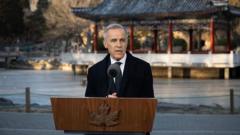
Mark Carney's visit to Chins is the first by a Canadian leader in nearly a decade
Chinese leader Xi Jinping and Canadian PM Mark Carney have announced lower tariffs, signalling a reset in their countries' relationship after a key meeting in Beijing.
China is expected to lower levies on Canadian canola oil from 85% to 15% by 1 March, while Ottawa has agreed to tax Chinese electric vehicles at the most-favoured-nation rate, 6.1%, Carney told reporters.
The deal is a breakthrough after years of strained ties and tit-for-tat levies. Xi hailed the "turnaround" in their relationship but it is also a win for Carney, the first Canadian leader to visit China in nearly a decade.
He has been trying to diversify Canadian trade away from the US, his country's biggest trading partner, following the uncertainty caused by Trump's on-again-off-again tariffs.
The deal could also see more Chinese investments in Canada, right on America's doorstep.
Carney himself seemed to allude to the fact that this was a result of Trump's tariffs, which have now pushed one of the US's key allies towards its biggest rival.
He told reporters that Canada's relationship with China had been more "predictable" in recent month and that he found talks with Beijing "realistic and respectful".
He also made clear Ottawa does not agree with Beijing on everything, adding that in his discussions with Xi he made clear Canada's "red lines", including human rights, concerns over election interference and the need for "guardrails".
Observers believe Carney's visit could set an example for other countries across the world who are also feeling the pain from Washington's tariffs.
In contrast, Xi has been trying to show that China is a stable global partner and has been urging more pragmatic ties - in the words of Beijing, "a win-win" for all.
And it seems to be working. The South Korean president and the Irish prime minister have both visited Beijing in recent weeks. The UK prime minister is expected to visit soon and so is the German Chancellor.
Carney said the "world has changed dramatically" and how Canada positions itself "will shape our future for decades to come," he added.
Earlier in his three-day visit, he had said that the Canada-China partnership sets the two countries up for a "new world order". He later added that the multilateral system had been "eroded, to use a polite term, or undercut".
As the Chinese and Canadian delegations sat down in the Great Hall of the People on Friday, Xi said: "The healthy and stable development of China-Canada relations is conducive to world peace, stability, development, and prosperity."
Getty Images
Carney in the Great Hall of the People during the meeting with Xi
A trade reset
Tariffs have been a key sticking point between the two sides.
In 2024, Canada imposed 100% tariffs on Chinese electric vehicles, following similar US curbs.
Last year, Beijing retaliated with tariffs on more than $2bn (£1.5bn) of Canadian farm and food products like canola seed and oil. As a result Chinese imports of Canadian goods fell by 10% in 2025.
China is Canada's second-largest trading partner, recording more than C$118bn ($85bn; £63bn) in two-way merchandise trade in 2024.
That's a long way behind the US, Canada's closest ally, which traded more than $761bn (£568bn) worth of goods with Ottawa in 2024.
But economic ties with China are increasingly important for Carney, who said ahead of his visit that Canada was focused on building a "more competitive, sustainable and independent economy" in the face of "global trade disruption".
Carney, who arrived in Beijing on Wednesday, met senior executives from prominent Chinese businesses, including an electric vehicle battery maker and an energy giant.
On Thursday the two countries signed several agreements on energy and trade cooperation.
The visit is a "reset of a relationship" that may be "modest in ambition" but "much more realistic about what we can reasonably obtain", said Colin Robertson, a former Canadian diplomat and vice-president at the Canadian Global Affairs Institute.
A frosty history
The last Canadian PM to visit China was Justin Trudeau, who met Xi in Beijing in 2017.
That visit took place before the relationship soured in 2018, following Canada's arrest of Meng Wanzhou, the chief financial officer at the Chinese tech giant Huawai, at the request of the US.
Days later, China detained Canadian citizens Michael Kovrig and Michael Spavor on espionage charges - a move critics saw as retaliation for Meng's arrest, which China denied.
Meng and both Michaels were released in 2021.
Ahead of the Carney-Xi meeting, Michael Kovrig wrote on X that the visit should not just be about warming ties but also "managing leverage".
Kovrig described Chinese negotiators as "extremely adroit, calculating, and always looking for leverage".
"That's why engagement has to be handled with discipline," he wrote, adding that Carney should also advocate for Canadians imprisoned in China. There are about 100 of them, according to Canadian media.
Speaking to reporters, Carney was clear that with countries that do not share the same values, Ottawa will engage on a "narrower, more specific" manner.
"We're very clear about where we cooperate, where we differ," he said, adding that Chinese claims over self-governed Taiwan and Hong Kong's jailed pro-democracy figure Jimmy Lai came up in "broad discussions".
Canada and China have "different systems", he said, which limits the breadth of their cooperation.
"But to have an effective relationship, we have direct conversations. We don't grab a megaphone and have the conversations that way."
Hundreds of thousands of Rohingya people fled Myanmar during an army crackdown in 2017
Myanmar has denied committing genocide against the Ronhingya people, saying The Gambia has failed to provide enough proof, as it begun its defence at the UN's top court.
Ko Ko Hlaing, a Myanmar government representative, told judges at the International Court of Justice (ICJ) that the allegation was "unsubstantiated".
Earlier this week, The Gambia's foreign minister Dawda Jallow told the court Myanmar wanted to erase the minority Muslim population through its use of "genocidal policies".
Thousands of Rohingya were killed and more than 700,000 fled to neighbouring Bangladesh during an army crackdown in Myanmar in 2017.
A damning report issued by the UN the following year said top military figures in Myanmar must be investigated for genocide in Rakhine state and crimes against humanity in other areas.
Myanmar - which has been under military control since it overthrew the civilian government in 2021 - rejected the report and has consistently said its operations targeted militant or insurgent threats.
On Friday, Hlaning told the ICJ that "Myanmar was not obliged to remain idle and allow terrorists to have free reign of northern Rakhine states", where the majority of Rohingya lived.
"These attacks were the reasons for the clearance operations, which is a military term referring to counter-insurgency or counter-terrorism operations," Hlaing said.
The Gambia launched its case against Myanmar in 2019, with Jallow telling the ICJ it did so out of a "sense of responsibility" following its own experience with a military government.
Jallow told the court on Monday that the Rohingya "had suffered decades of appalling persecution and years of dehumanising propaganda", which was followed by the military crackdown and "continual genocidal policies meant to erase their existence in Myanmar".
Lawyers for the Muslim-majority West African country also argued that the killing of women, children and the elderly, along with the destruction of their villages, was hard to justify under combatting terrorism.
"When the court considers... all of the evidence taken together, the only reasonable conclusion to reach is that a genocidal intent permeated and informed Myanmar's myriad of state-led actions against the Rohingya," said Philippe Sands, arguing for The Gambia, which has the backing of 57-nation Organisation of Islamic Cooperation in its action.
More than a million Rohingya refugees now live across the border in Bangladesh's Cox's Bazar region alone - some of the largest and most densely populated camps in the world, according to the UN's refugee agency.
Hlaing - the Myanmar government representative - said on Friday that it was committed to "achieving the repatriation to Myanmar of persons from Rakhine State currently living in camps in Bangladesh". But he also said external forces, such as Covid-19, had hampered those efforts.
"Myanmar's commitment and constant efforts since 2017 contradict Gambia's narrative that Myanmar's intention is to destroy or forcibly deport this population," Hlaing told the court.
He added that "a finding of genocide would place an indelible stain on my country and its people", so the outcome was of "fundamental importance for my country's reputation and future".
The court has also set aside three days to hear from witnesses, including Rohingya survivors, but these sessions will be closed to the public and media.
A final ruling is expected towards the end of 2026, Reuters news agency reported.
It is expected to set a precedent in other genocide cases, including one brought by South Africa against Israel over the war in Gaza, as it is the first to be heard in more than a decade - and is being seen as an opportunity for ICJ judges to refine rules around the definition of genocide.
The 1948 UN Genocide Convention, which The Gambia accuses Myanmar of breaching in its treatment of the Rohingya, was adopted following the mass murder of Jews by Nazi Germany during the Second World War. It defines genocide as crimes committed "with intent to destroy, in whole or in part, a national, ethnical, racial or religious group".
 Login
Login