Normal view

There are new articles available, click to refresh the page.
Before yesterdayMain stream

Paintings of human flight 2: Blériot to the Battle of Britain

By: hoakley
11 January 2026 at 20:30

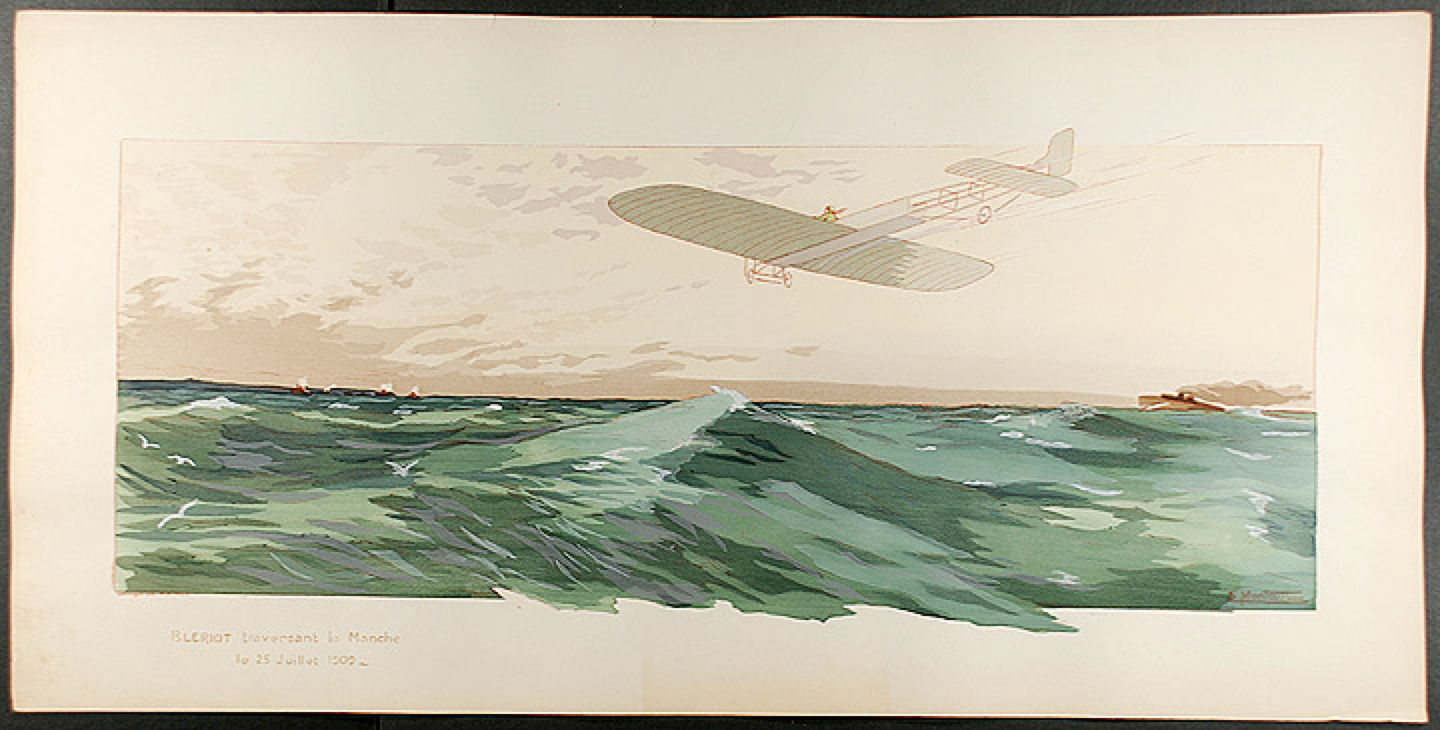
After the flurry of paintings showing early ballooning in the late eighteenth century, painters had left it to photographers to capture pioneering achievements of aviation. Then, on 25 July 1909, the Frenchman Louis Blériot was the first person to fly an aircraft from France to England over the Channel.
montautbleriot
Ernest Montaut (1878–1909), Blériot Crossing the Channel on 25 July 1909 (1909), hand-coloured pochoir print, 35.8 x 76.8 cm, location not known. Wikimedia Commons.

There were many prints made claiming to show Blériot’s great achievement. Ernest Montaut’s Blériot Crossing the Channel on 25 July 1909 (1909) is particularly poignant, as Montaut died later that year at the age of only thirty-one. This is a hand-coloured pochoir print, one of Montaut’s specialities using a lithographic stone. Montaut was best-known as a poster artist, and is believed to have been the first graphic artist to use speed lines and perspective distortion, derived from photography, to depict rapid movement. Both techniques are shown here.

delasprechannelflight
H. Delaspre (dates not known), The Channel Flight. Blériot, July 25th 1909 (1909), chromolithograph, dimensions not known, United States Library of Congress, Washington, DC. Wikimedia Commons.

H. Delaspre’s chromolithograph of The Channel Flight. Blériot, July 25th 1909 (1909) is another of the better prints produced at the time. In contrast to Montaut, he didn’t use any devices to indicate the aircraft was moving at speed, apart from showing a propellor disc, and it accordingly looks static in the air.

delaunaysuntowereroplane1913
Robert Delaunay (1885–1941), Sun, Tower, Airplane (1913), oil on canvas, 132.1 × 131.1 cm, Albright-Knox Art Gallery, Buffalo, NY. Wikimedia Commons.

Henri Rousseau had been ridiculed during his lifetime, but one artist who took him seriously and appreciated his paintings was Robert Delaunay. In the last couple of years before the First World War, Delaunay painted at least two works inspired by early aviation. Sun, Tower, Airplane from 1913 brings together two of the symbols of the early twentieth century: the Eiffel Tower in Paris, opened in 1889, and a Wright type aircraft in flight.

delaunayhomagebleriot1914
Robert Delaunay (1885–1941), Homage to Blériot (1914), media and dimensions not known, Musée de Grenoble, Grenoble, France. Wikimedia Commons.

The following year, Delaunay painted his Homage to Blériot (1914). The Eiffel Tower appears again in the top right corner, and a brilliantly coloured image of Blériot’s distinctive monoplane in the lower left.

The First World War wasn’t the first in which aircraft played a role in combat. Balloons had even been used in the American Civil War, and most of the aviation firsts were set by the Italo-Turkish War of 1911-12: the first aerial reconnaissance flight, first aerial bombing, and first aircraft shown down by rifle fire.

The First World War was painted by a host of war artists, many going to the front, some of them highly accomplished painters. Its scale, devastation, and sheer inhumanity were hard to depict in photographs, and the many fine paintings of the war form its most vivid visual record.
powellbe2caeroplanessomme
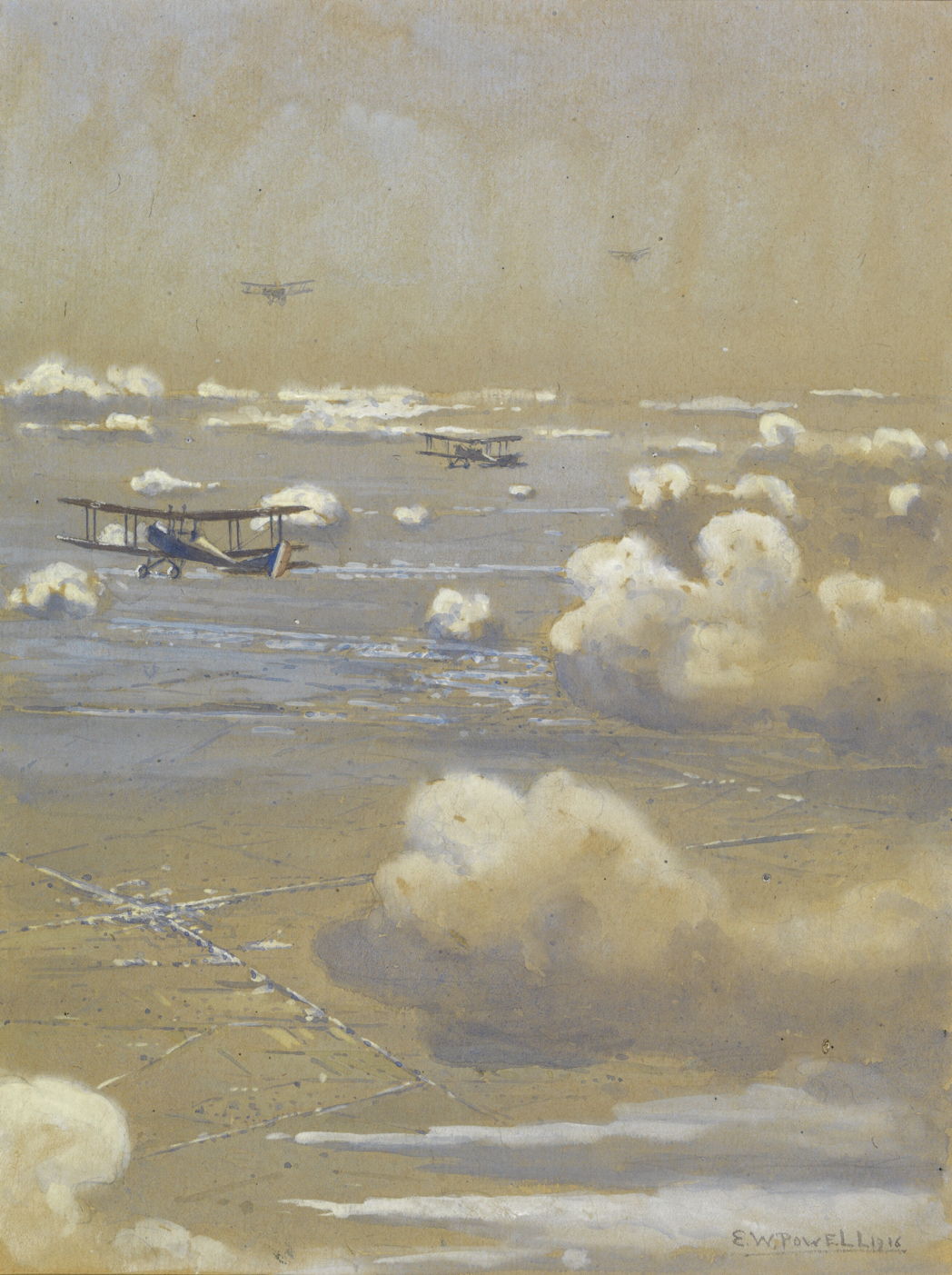
Eric Walter Powell (1886-1933), Be2c Aeroplanes over the Somme (1916), media and dimensions not known, The Imperial War Museum, London. Courtesy of The Imperial War Museum (IWM ART 5060), via Wikimedia Commons.

Eric Walter Powell’s view of BE2C Aeroplanes over the Somme from 1916 is one of the first paintings to show the world above the clouds. Although people had become used to views from mountains, when the first aerial photographs were made in about 1885, they showed the earth in a completely new way. Powell shows this unfamiliar landscape/cloudscape with its oblique view of the ground below, and the scattered small cumulus clouds of a fine day.

sargentcrashedaeroplane1918
John Singer Sargent (1856—1925), Crashed Aeroplane (1918), further details not known. Wikimedia Commons.

One of the most famous paintings of aviation during the war is John Singer Sargent’s Crashed Aeroplane (1918). Two farmers get on with the harvest, with that British biplane planted in the hillside behind.
weirteraerialfight
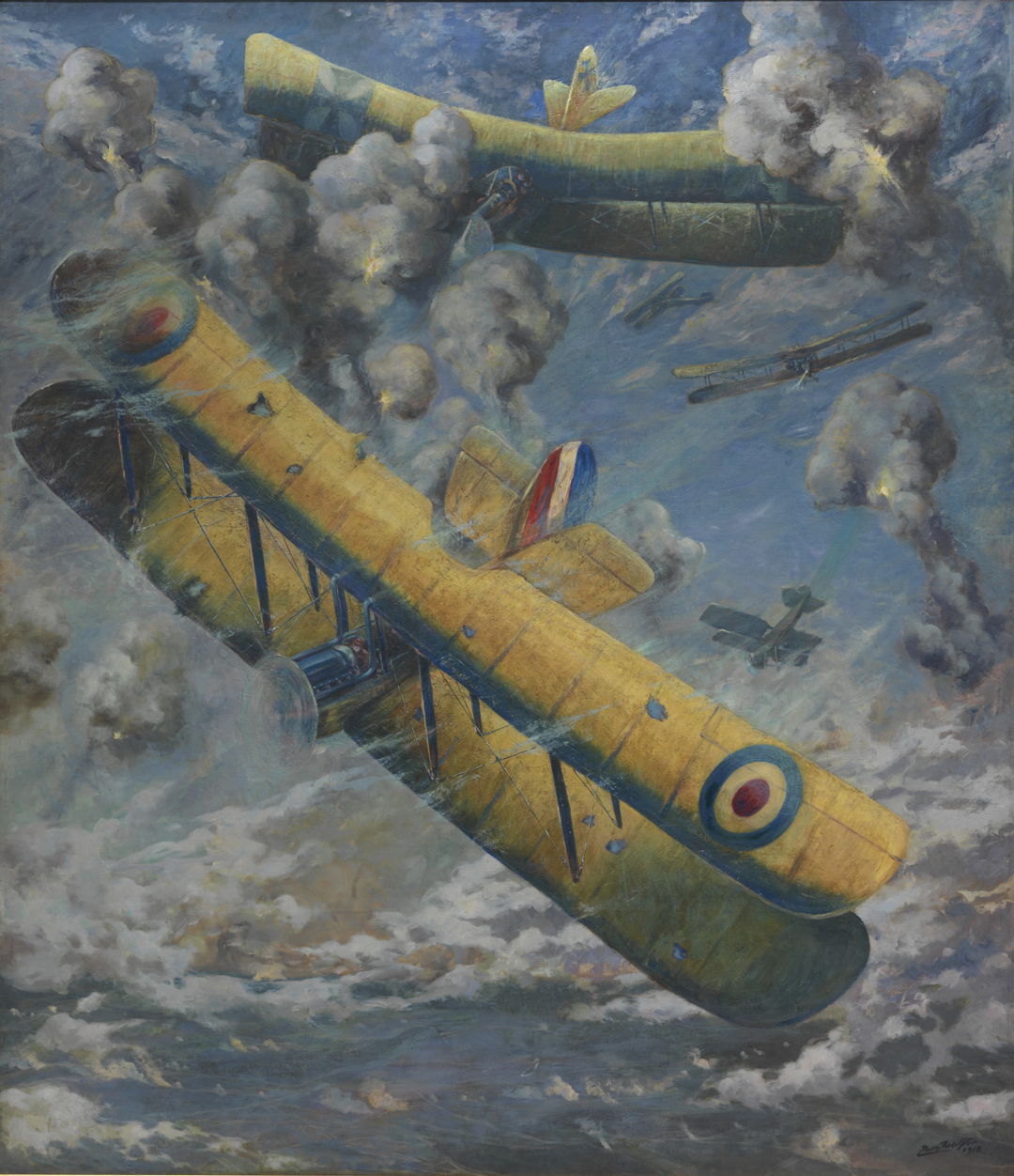
Louis Weirter (1873-1932), An Aerial Fight (1918), media and dimensions not known, The Imperial War Museum, London. Courtesy of The Imperial War Museum (IWM ART 654), via Wikimedia Commons.

Louis Weirter’s An Aerial Fight (1918) is one of the first paintings showing the war in the air, as British and German biplanes fight among scruffy clouds. Comparison with Montaut’s use of speed lines from ten years earlier shows how static aircraft in flight look without them.

carlilehunplanesearchlights
David M Carlile (dates not known), Hun Plane Caught in Searchlights – Arras-Cambrai Road – France – Sept 1918 (1918), watercolour on paper over card, 21.6 x 29.8 cm, Canadian War Museum, Ottawa, ON. Wikimedia Commons.

David M Carlile’s Hun Plane Caught in Searchlights – Arras-Cambrai Road – France – Sept 1918 (1918) is an atmospheric watercolour showing a scene from the final months of the war. I’ve been unable to discover anything about this artist other than that he was a Private at the time.
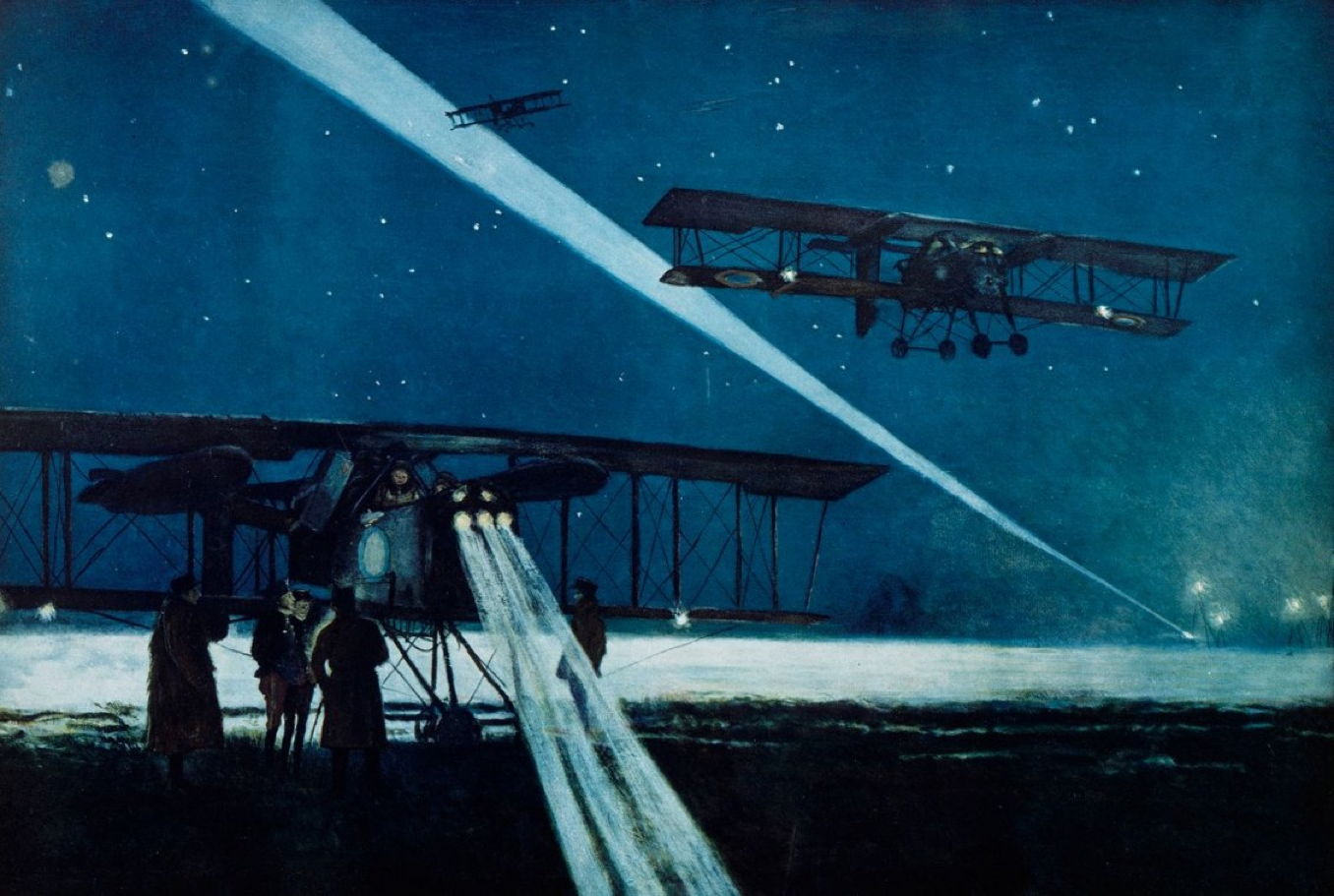
flamengreturnofflight
François Flameng (1856–1923), Return of a Night Bombing Flight of Voisin Aircraft (1918), watercolour and gouache on cardboard, 31 x 48 cm, Musée de l’Armée, Hôtel des Invalides, Paris. Wikimedia Commons.

François Flameng’s superb watercolour of Return of a Night Bombing Flight of Voisin Aircraft from 1918 is perhaps one of the best paintings of the war in the air. Flameng was a successful portraitist, and a close friend of John Singer Sargent and Paul Helleu, who distinguished himself during his time as a war artist.

With the war over, painting was hurtling into modernism, and hardly an appropriate place for motifs such as aircraft or flight.
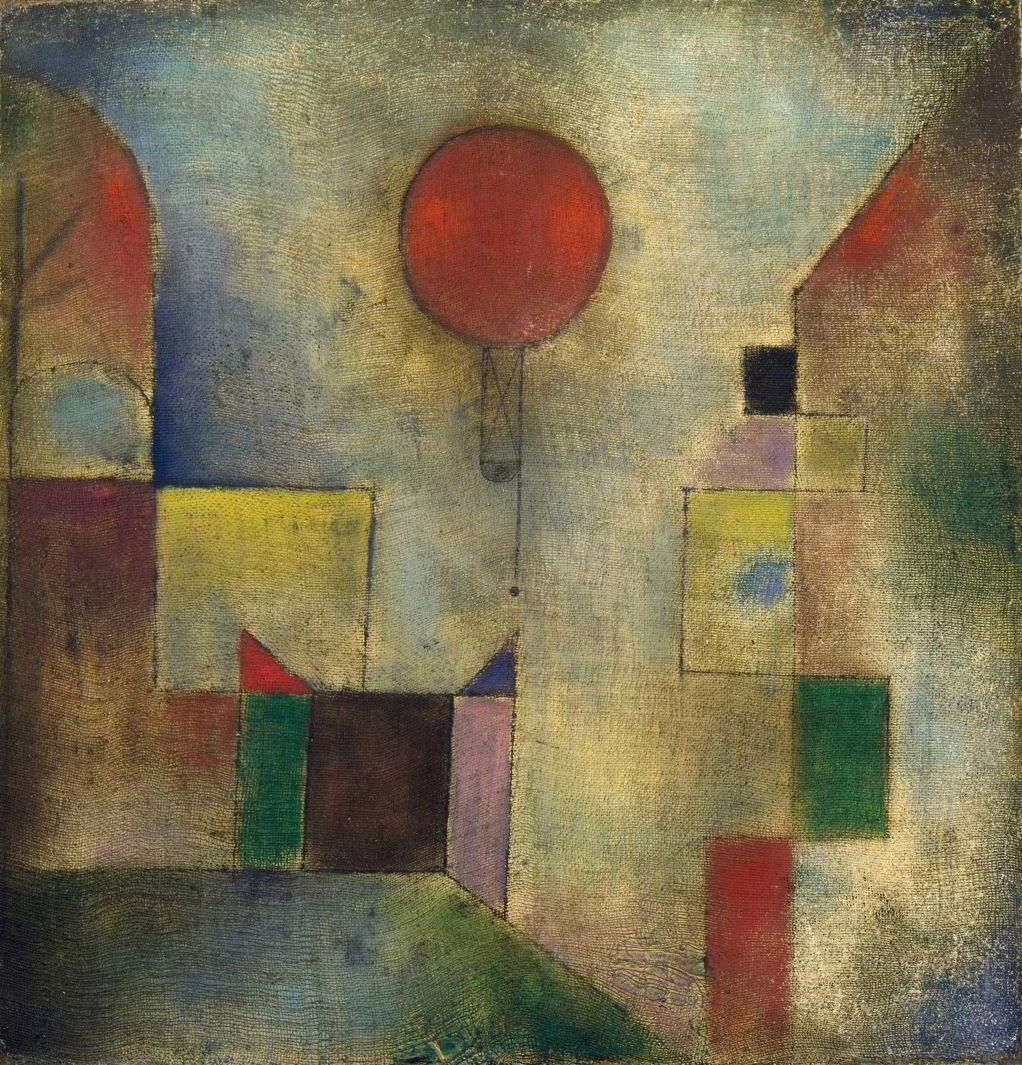
kleeredballoon1922
Paul Klee (1879–1940), Red Balloon (1922), oil and oil transfer drawing? on chalk-primed gauze, mounted on board, 31.7 × 31.1 cm, Solomon R. Guggenheim Museum, New York, NY. Wikimedia Commons.

Paul Klee painted some exceptions to that, in at least two works showing balloons. Red Balloon from 1922 was made using oil paint and probably some sort of transfer process onto a gauze that had been primed using chalk, like a gesso. The red balloon of the title is shown as a circular disc amid other geometrical shapes.

kleeluftballon1926
Paul Klee (1879–1940), Der Luftballon (1926), oil on black primed board, 32.5 x 33 cm, Private collection. Wikimedia Commons.

Four years later, Klee turned to a modification of that motif, in his Der Luftballon (1926). Here his board was primed in black, and appears to have extensive graffiti.

My last artist is even more recent, a war artist of the Second World War whose paintings came to explore the skies above us: Paul Nash.
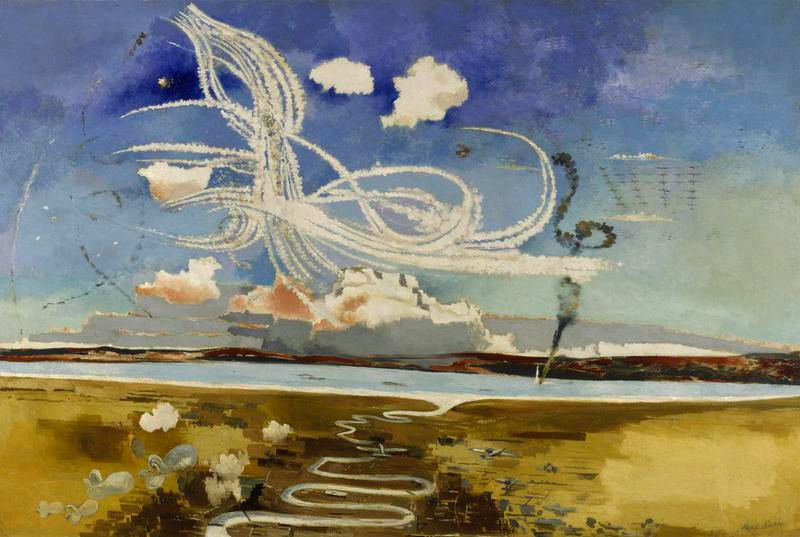
nashpbattleofbritain(Art.IWM_ART_LD_1550)
Paul Nash (1892–1946), Battle of Britain (1941), oil on canvas, 122.6 x 183.5 cm, The Imperial War Museum, London. By courtesy of The Imperial War Museums © IWM (Art.IWM ART LD 1550).

The startling distant view in Nash’s Battle of Britain (1941) incorporates many elements of air warfare, including vapour trails (contrails), smoke marking the spin and crash of a downed aircraft, formation flight, and defensive airships. Below this action are the low hills, estuary, and a winding river typical of much of the English south coast. By emphasising the forms and patterns made in the sky, as seen from high above the ground, Nash increases the distance from this air war, detaching the story of the battle from the people involved.
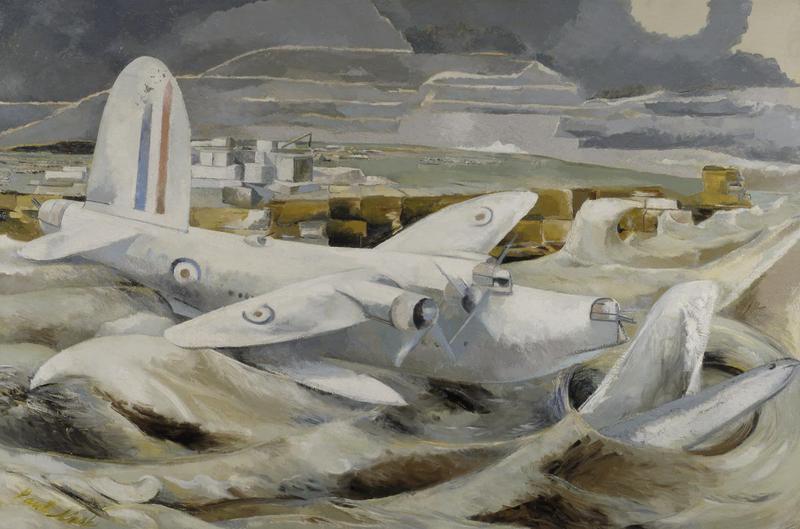
nashpdefenceofalbion(Art._IWM_ART_LD_1933)
Paul Nash (1892–1946), Defence of Albion (1942), oil on canvas, 121.9 x 182.8 cm, The Imperial War Museum, London. By courtesy of The Imperial War Museums © IWM (Art.IWM ART LD 1933).

Using another aerial location, Nash’s Defence of Albion (1942) shows a Sunderland ‘flying boat’ operating in rough seas off the Portland, Dorset, coast; cues for the location are given by the large blocks of limestone from the quarries in the distance. Among the duties of these aircraft were anti-submarine patrols, and part of a German U-boat is shown in the right foreground to emphasise this, in an unreal composite.

Paintings of human flight 1: before Blériot

By: hoakley
10 January 2026 at 20:30

Human aviation was born on 19 October 1783, when three men flew in Paris in a tethered balloon made by the Montgolfier brothers. By the end of that year, humans had flown to a height of about ten thousand feet (3 km). What had previously been a gift of the gods was now open to mankind. This weekend I trace the first couple of centuries of human flight in paintings, from those early balloons to the aerial warfare of the Second World War.

carniceroballooncharlesIV
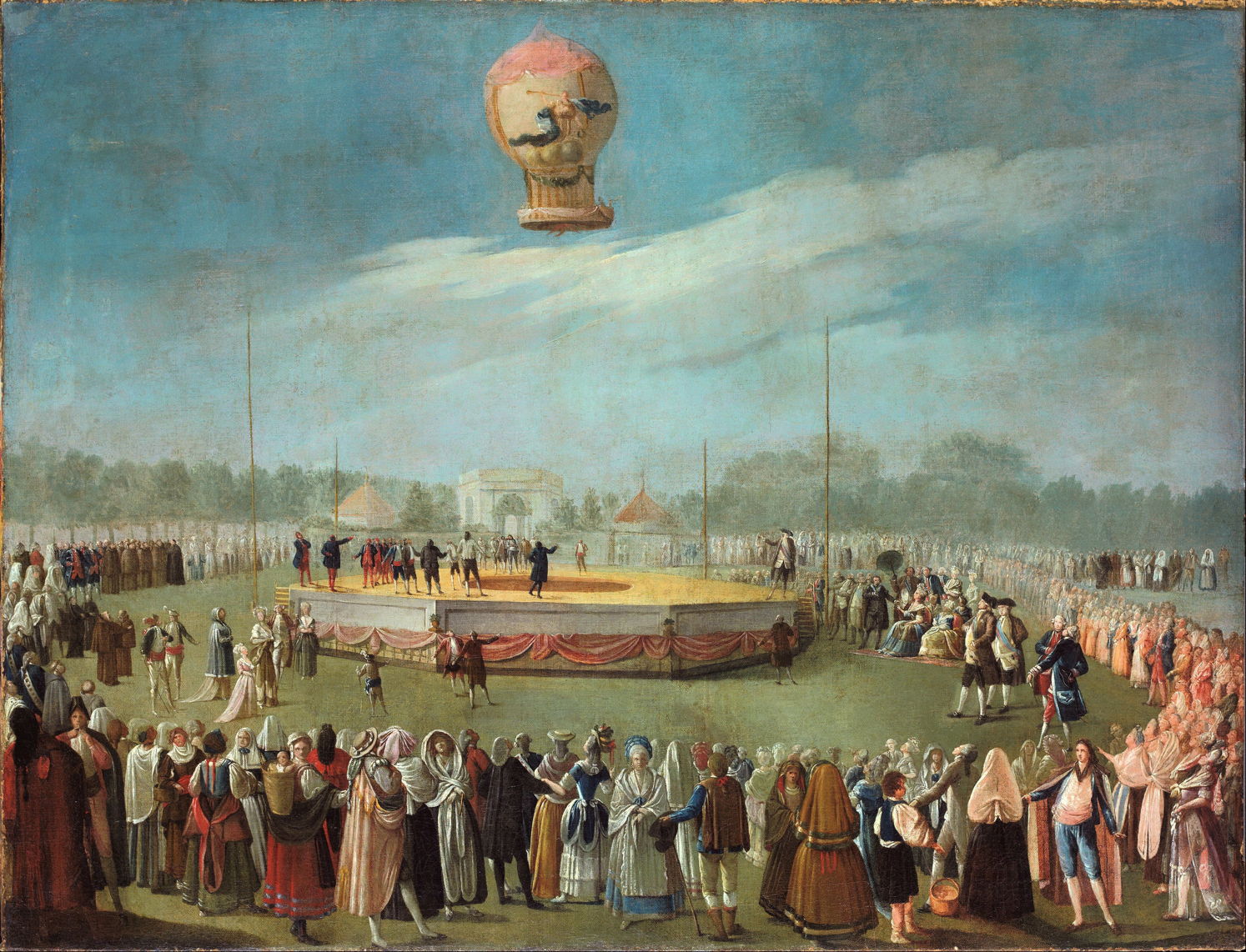
Antonio Carnicero (1748–1814), Ascent of a Balloon in the Presence of King Charles IV and his Court (c 1783), oil on canvas, 78 × 102 cm, Bilboko Arte Ederren Museoa / Museo de Bellas Artes de Bilbao, Bilbao, Spain. Wikimedia Commons.

The later eighteenth century saw a succession of high-profile balloon flights, including an Ascent of a Balloon in the Presence of King Charles IV and his Court in late 1783, painted here by Antonio Carnicero.

carniceroballoonranjuez
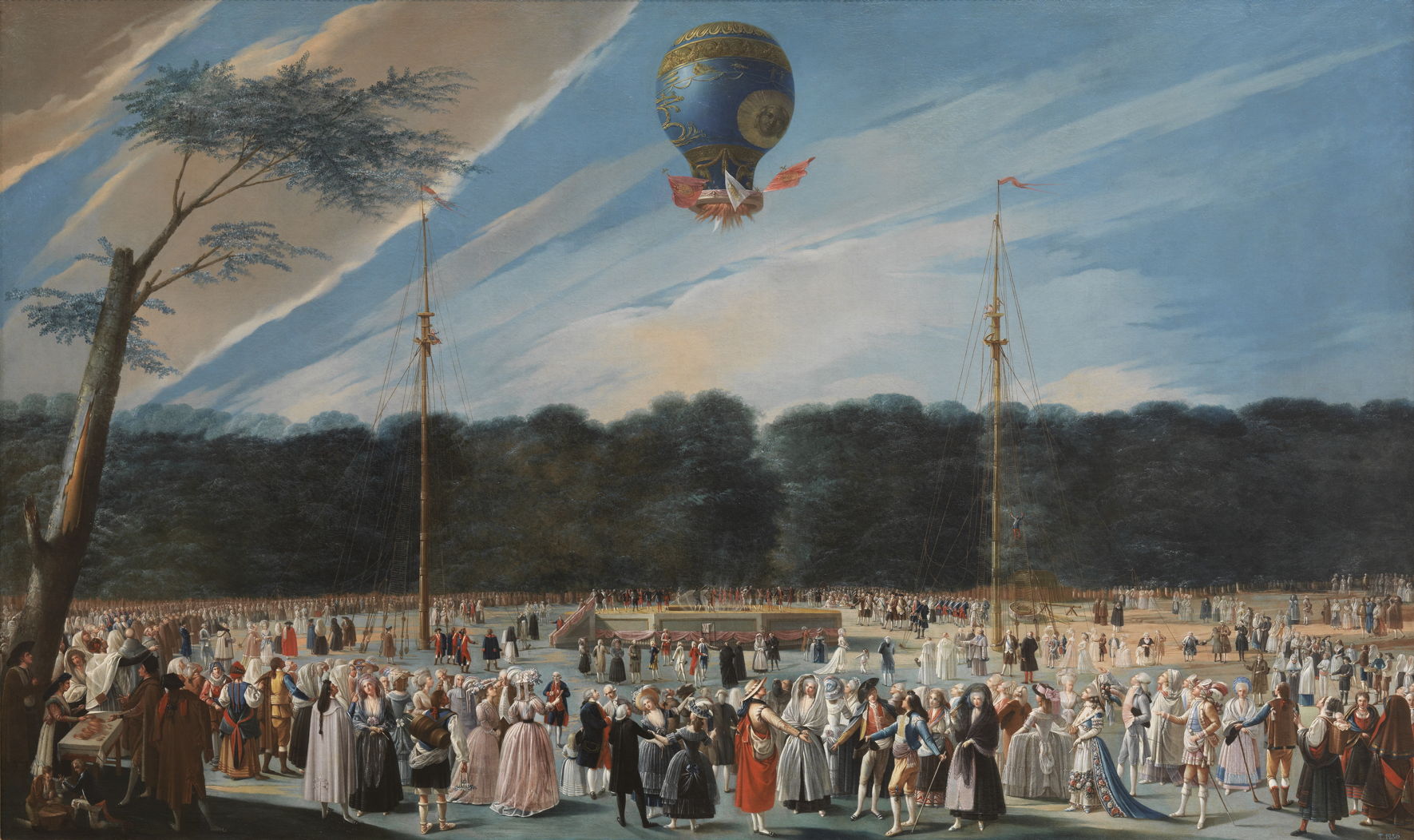
Antonio Carnicero (1748–1814), Ascent of Monsieur Bouclé’s Montgolfier Balloon in the Gardens of Aranjuez (c 1784), oil on canvas, 170 × 284 cm, Museo Nacional del Prado, Madrid, Spain. Wikimedia Commons.

Although only considered a minor painter of his time, Carnicero’s Ascent of Monsieur Bouclé’s Montgolfier Balloon in the Gardens of Aranjuez from 1784 is one of the most beautiful records of these early flights. In this case, it was the ascent of a Montgolfier balloon in the gardens of Aranjuez, a royal palace about fifty kilometres to the south of Madrid, Spain. This took place of 5 June 1784, and the pioneer aviator was a Frenchman, Bouclé. The spectators are members of the royal court and aristocracy, wearing dress typical of majos and majas, in keeping with their place in society.

watteau14flightblanchard
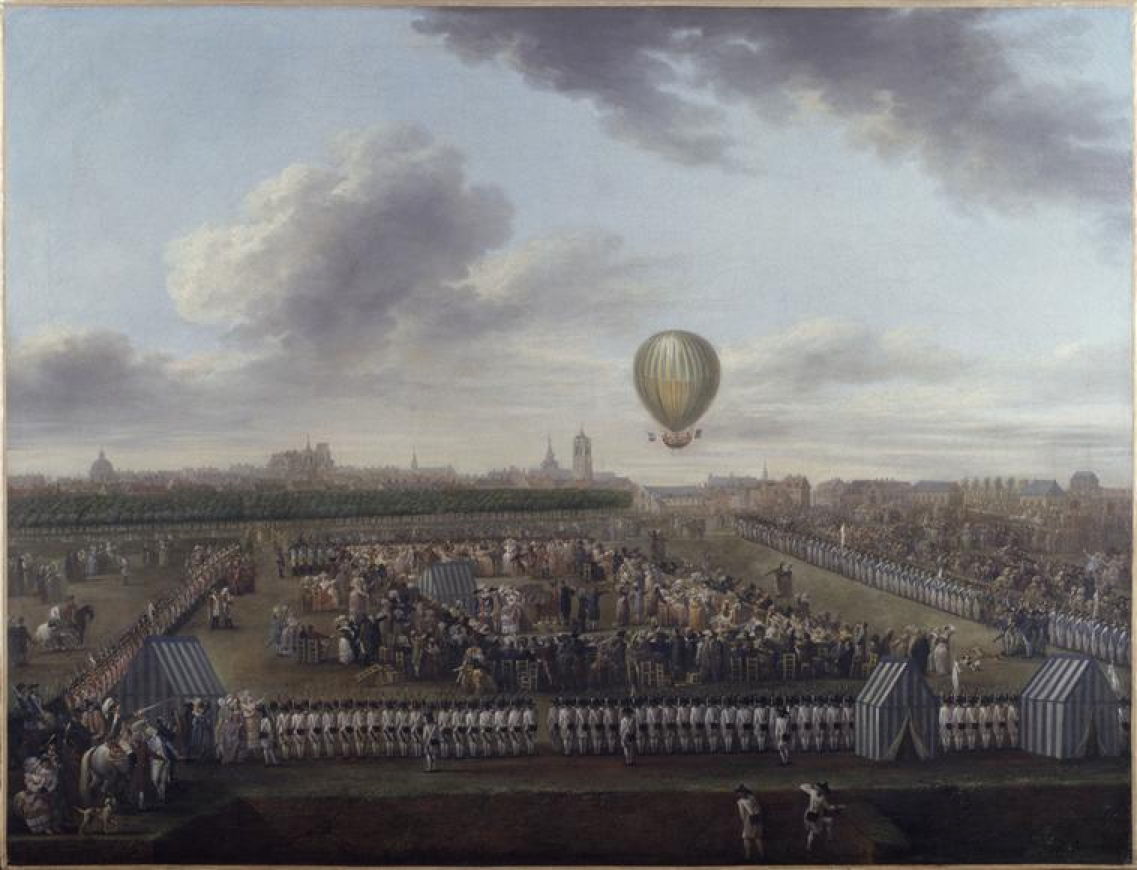
Louis Joseph Watteau (1731–1798), The Fourteenth Flight of Monsieur Blanchard (c 1785), oil on canvas, dimensions not known, Musée Hospice Comtesse, Lille, France. Wikimedia Commons.

Better-known artists such as Louis Joseph Watteau couldn’t miss this opportunity in The Fourteenth Flight of Monsieur Blanchard from about 1785. This took place in Lille, on the border between France and Belgium, on 26 August 1785. Blanchard was accompanied by the knight of Lépinard, known for his adventurous exploits. Five days later the pair returned to Lille to a gun salute and fanfares. Watteau painted two works, which were engraved by Helman and proved popular as prints.

ibbetsonlunardisballoon
Julius Caesar Ibbetson (1759–1817), George Biggin’s Ascent in Lunardi’s Balloon (1785-88), media and dimensions not known, Neue Pinakothek, Munich, Germany. Image by Ad Meskens, via Wikimedia Commons.

The French had stolen an early lead in aviation, and the British remained sceptical of its safety and merits. It took George Biggin’s Ascent in Lunardi’s Balloon, painted here by the wonderfully-named Julius Caesar Ibbetson in 1785-88, to break the ice for them.

meryonpontauchange
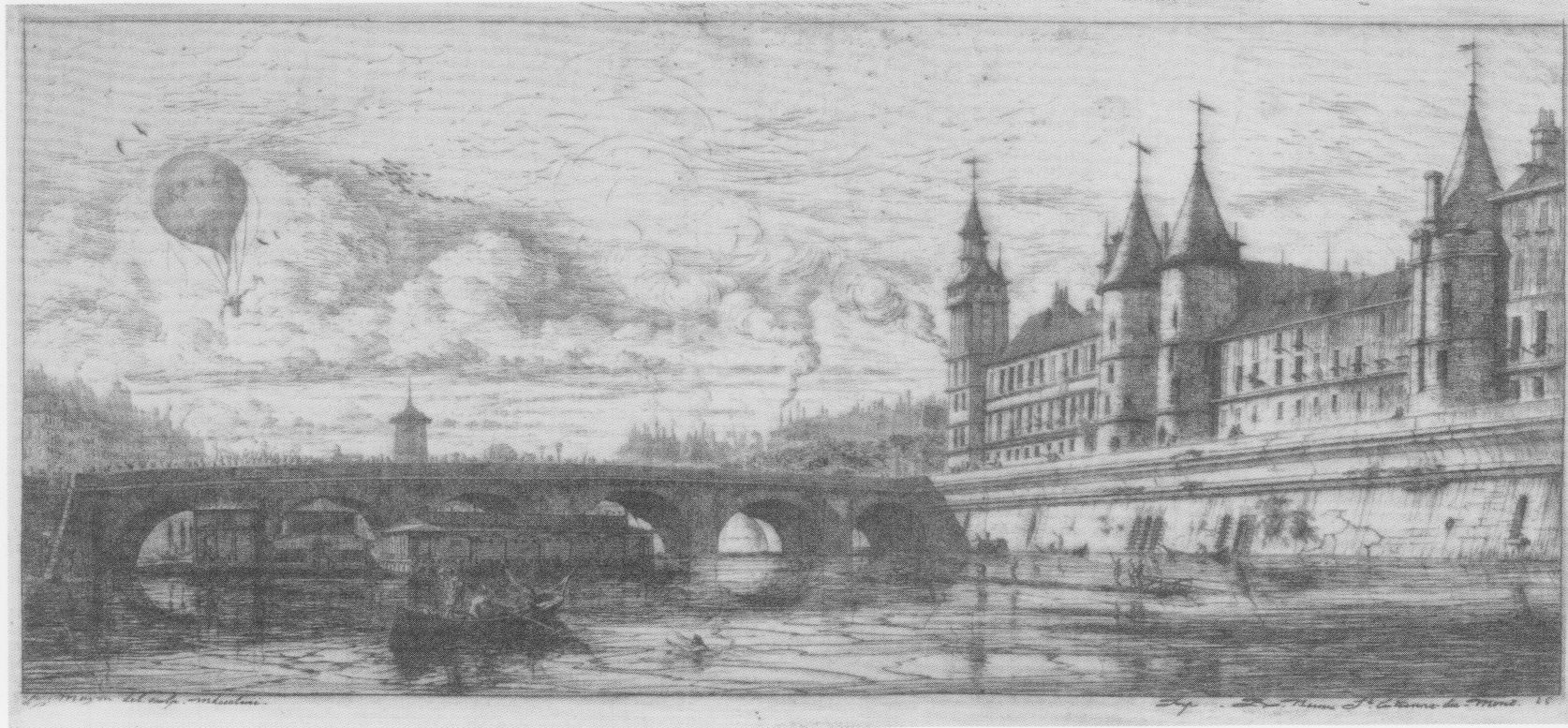
Charles Méryon (1821–1868), Pont-au-Change (1854), etching on paper, 31.5 x 47.8 cm, Albertina, Vienna, Austria. Wikimedia Commons.

By the middle of the nineteenth century, ballooning had become an unusual but by no means exceptional activity, with cities like Paris seeing fairly frequent ascents when the weather was favourable. Charles Méryon’s etching of Pont-au-Change from 1854 shows a balloon being flown over the city centre.

didierguiaudgambetta1870
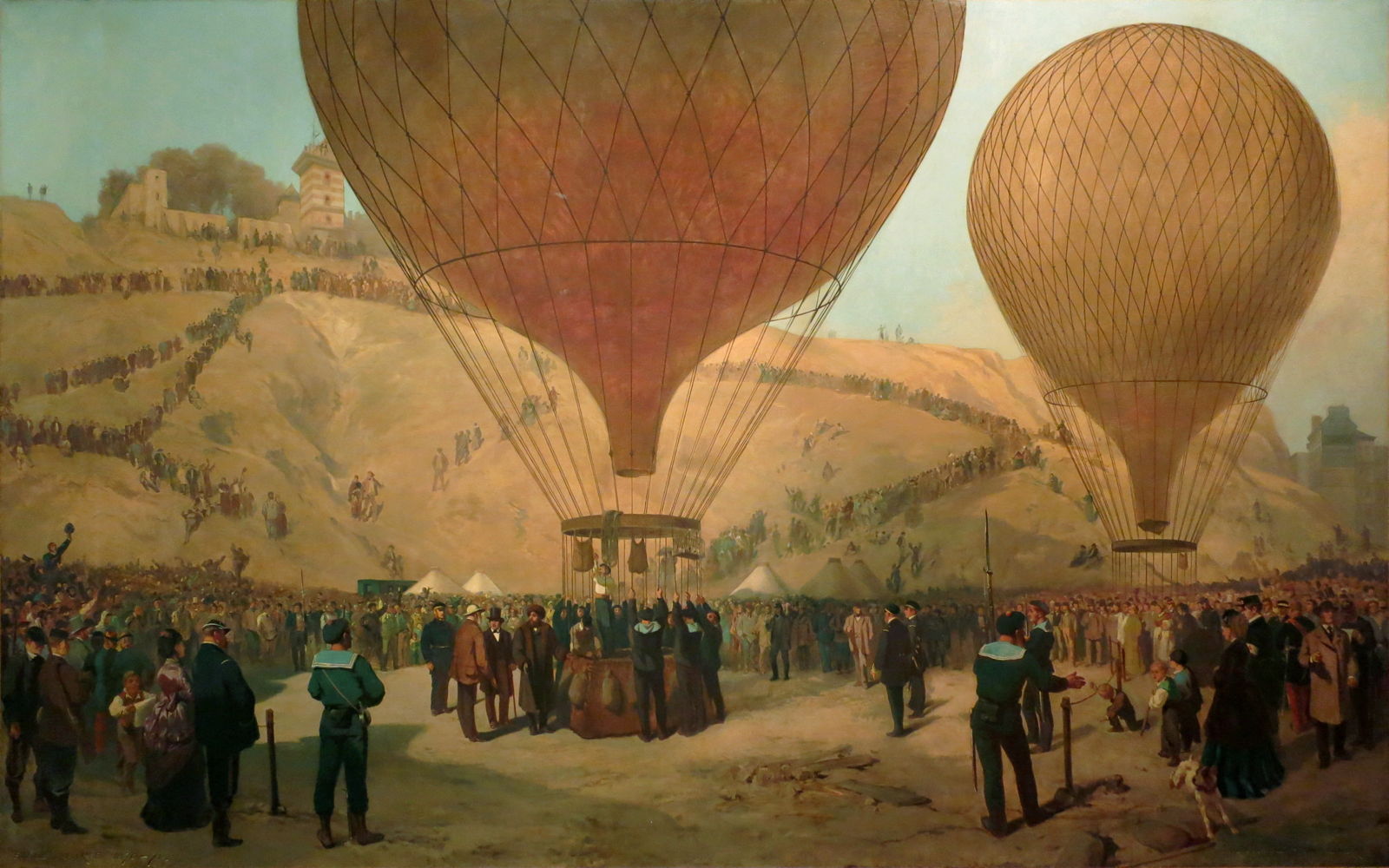
Jules Didier (1831-1892) and Jacques Guiaud (1811-1876), Departure of Gambetta in the Balloon ‘Armand-Barbès’ on 7 October 1870 (c 1870), media and dimensions not known, Musée Carnavalet, Paris. Wikimedia Commons.

Balloons started to play a part in everyday life, and in war. One of the more famous flights from Paris is shown in Jules Didier and Jacques Guiaud’s painting of the Departure of Gambetta in the Balloon ‘Armand-Barbès’ on 7 October 1870 (c 1870), during the Franco-Prussian War.

By the time that the Prussians had encircled Paris, the French government had fled to Tours, leaving Léon Gambetta, the Minister of the Interior, trapped in the city. Gambetta arranged to be flown from the foot of Montmartre in a hot-air balloon, escaping on 7 October 1870. His balloon, named Armand-Barbès, was one of over sixty that were being used to deliver mail and some essential supplies to Paris at the time, which gives an idea as to how popular ballooning had become. His balloon was named after Armand Barbès (1809-1870), a French Republican revolutionary who died in exile in the Netherlands just weeks before the fall of the Second Empire.

puvisdechavannesballoon
Pierre Puvis de Chavannes (1824–1898), The Balloon (1870), oil on canvas, dimensions not known, Musée d’Orsay, Paris. Image by Rama, via Wikimedia Commons.

The role of balloons during the siege of Paris was also the inspiration for Pierre Puvis de Chavannes’ The Balloon of 1870, which became popular as a lithograph made by Émile Vernier. The following year, Puvis de Chavannes painted a pendant The Pigeon showing another means of communication used during the siege.

A woman seen almost in silhouette waves at one of the balloons bearing news, as it flies near Mount Valérien. In her right hand she holds a musket, symbolic of the arming of the people of Paris at the time. The same woman appears in mourning in The Pigeon, collecting a carrier pigeon that had flown through the predatory hawks flown by the Prussians.

szinyeimerseballoon
Pál Szinyei Merse (1845–1920), The Balloon (1878), media and dimensions not known, Magyar Nemzeti Galéria, Budapest, Hungary. Wikimedia Commons.

One of the few European paintings showing ballooning in the years after that war is that of the Hungarian realist Pál Szinyei Merse, The Balloon from 1878.

beardlostballoon
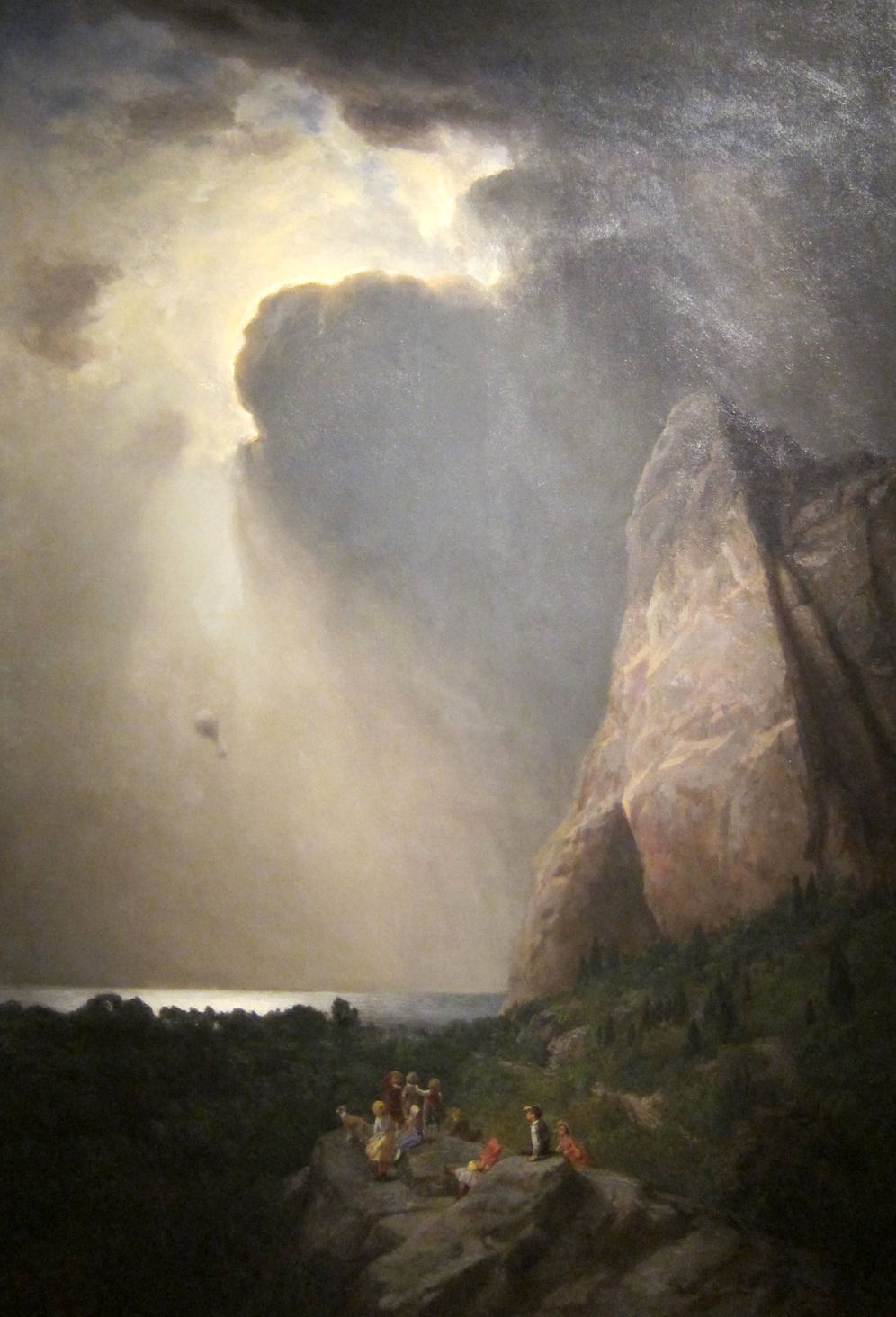
William Holbrook Beard (1825–1900), The Lost Balloon (1882), media and dimensions not known, Smithsonian American Art Museum, Washington, DC. Image by AgnosticPreachersKid, via Wikimedia Commons.

American art of the period also seems to have included few paintings of ballooning, the best-known being William Holbrook Beard’s romantic The Lost Balloon from 1882.

prendergastballoon
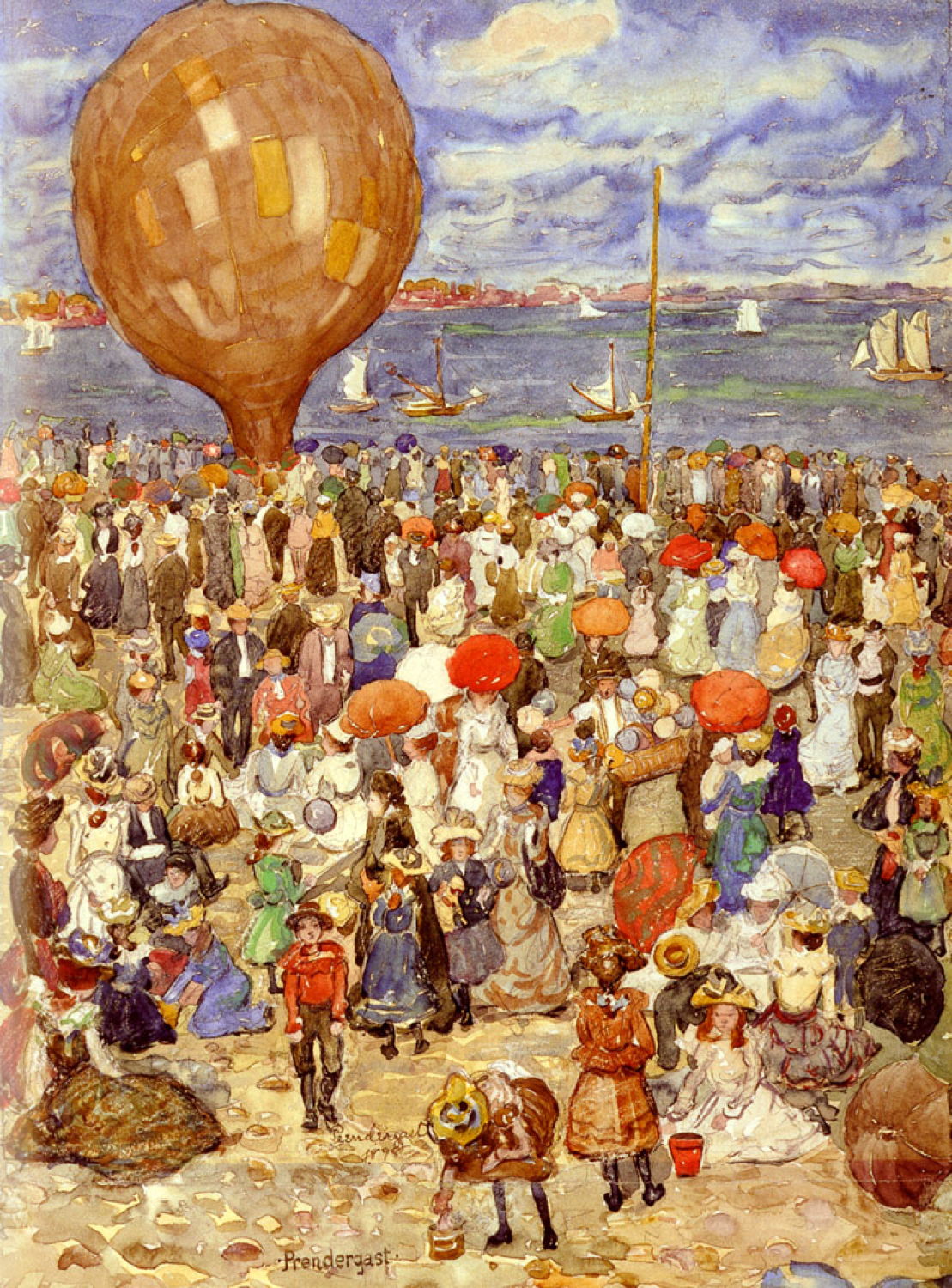
Maurice Prendergast (1858–1924), The Balloon (1898), further details not known. Wikimedia Commons.

The American post-Impressionist Maurice Prendergast found The Balloon on a beach in 1898. Although he may have painted this during a trip to Venice that year, I suspect the location is on the East Coast of the USA, where he had his studio in Boston.

friantjourneytoinfinity
Émile Friant (1863–1932), Journey to Infinity (1899), oil on canvas, 150 × 120 cm, location not known. Wikimedia Commons.

The first Naturalist painting of a balloon that I have found is Émile Friant’s Journey to Infinity (1899). In this extraordinary flight of fancy, the balloon soars high above a bank of grey clouds (or possibly a rugged mountain ridge) containing the forms of five nude women, one of whom is apparently performing a handstand.

This might appear to be a symbolist work, but I suspect that Friant painted this for the pioneer woman aviator Marie Marvingt (1875-1963). Friant himself co-founded the first aviation club in Nancy; Marvingt was already a successful athlete and mountaineer, and had moved to Nancy ten years earlier.

Between 1903 and 1905, pioneering flights were made by the Wright brothers in the USA, following which there was rapid development of aircraft. Unlike the early history of ballooning, heavier-than-air flight was captured overwhelmingly in photographs, not paintings.

rousseauquaidivry
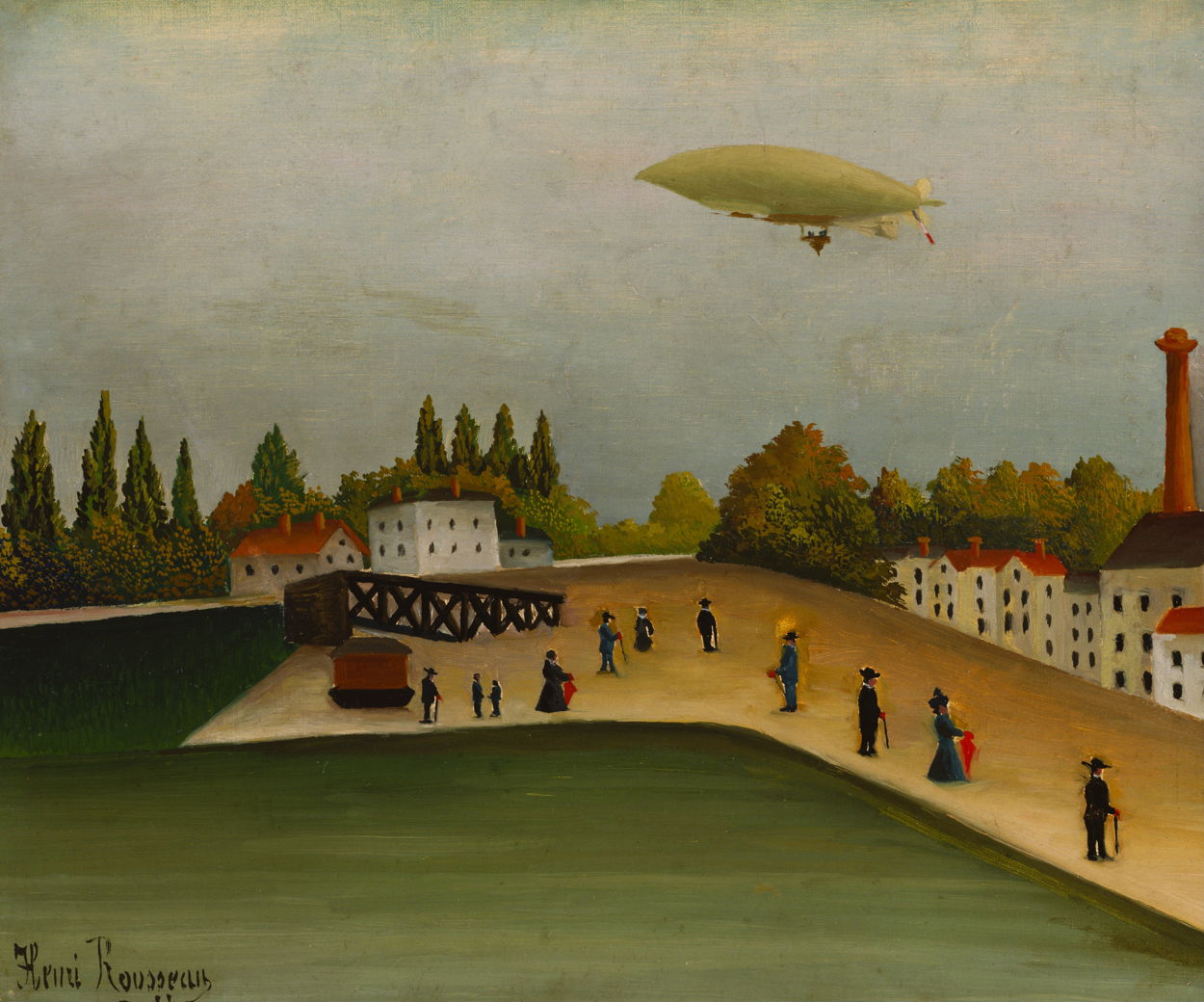
Henri Rousseau (1844–1910), Quai d’Ivry (c 1907), oil on canvas, 46.1 x 55 cm,, Bridgestone Museum of Art ブリヂストン美術館, Tokyo, Japan. Wikimedia Commons.

Ironically, it was the self-taught primitivist artist Henri Rousseau who painted landscapes incorporating aircraft in the early years of the twentieth century. This view of Quai d’Ivry in Paris from about 1907 shows an airship crossing its sky.

rousseaubridgesevres
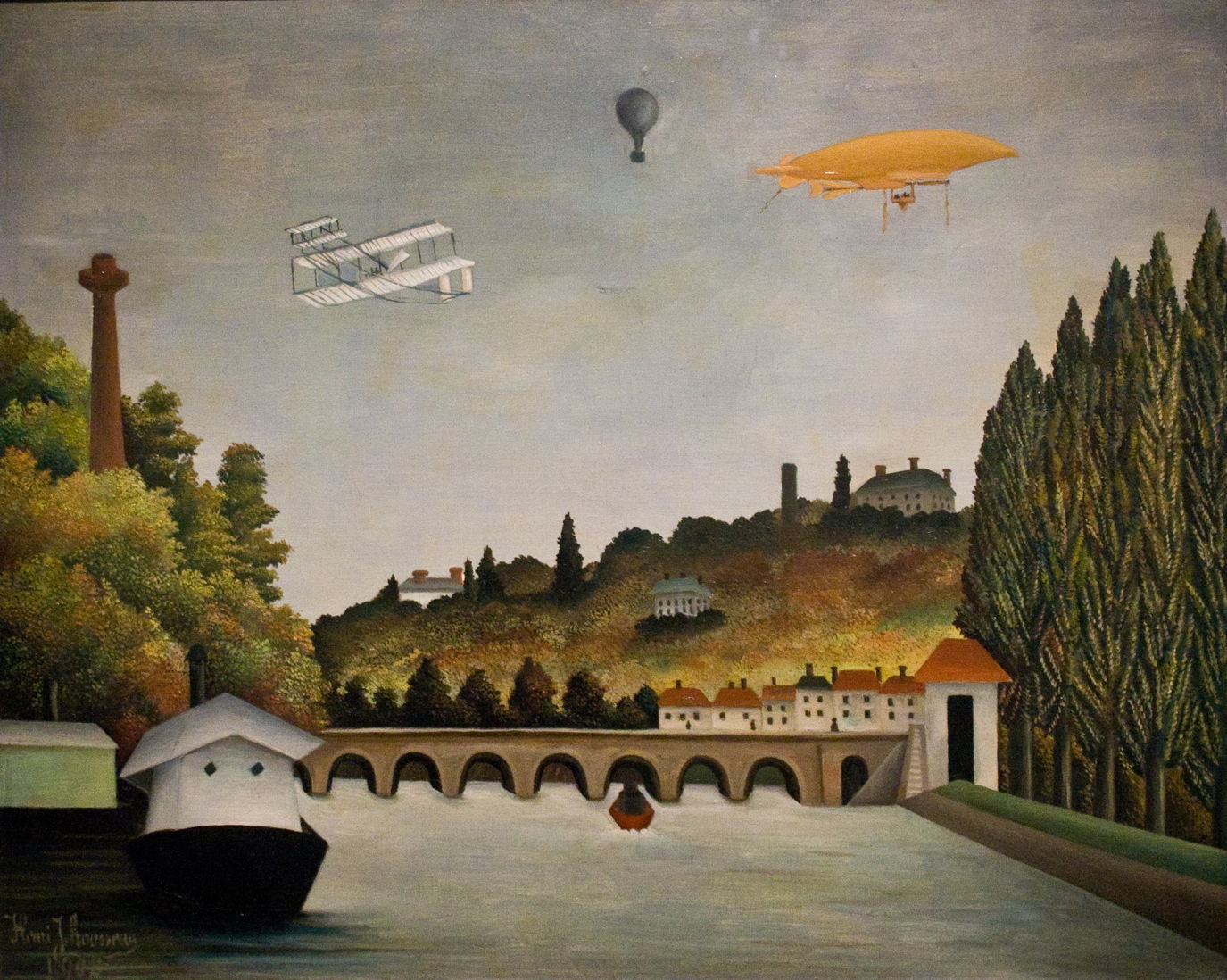
Henri Rousseau (1844–1910), View of the Bridge in Sèvres and the Hills of Clamart, Saint-Cloud and Bellevue with Biplane, Balloon and Dirigible (1908), oil on canvas, 81 x 100 cm, Pushkin Museum of Fine Arts Музей изобразительных искусств им. А.С. Пушкина, Moscow, Russia. Image by Szilas, via Wikimedia Commons.

The following year, Rousseau painted this View of the Bridge in Sèvres and the Hills of Clamart, Saint-Cloud and Bellevue with Biplane, Balloon and Dirigible (1908), in an excellent summary of the state of aviation in the years following the Wright brothers’ first flight.

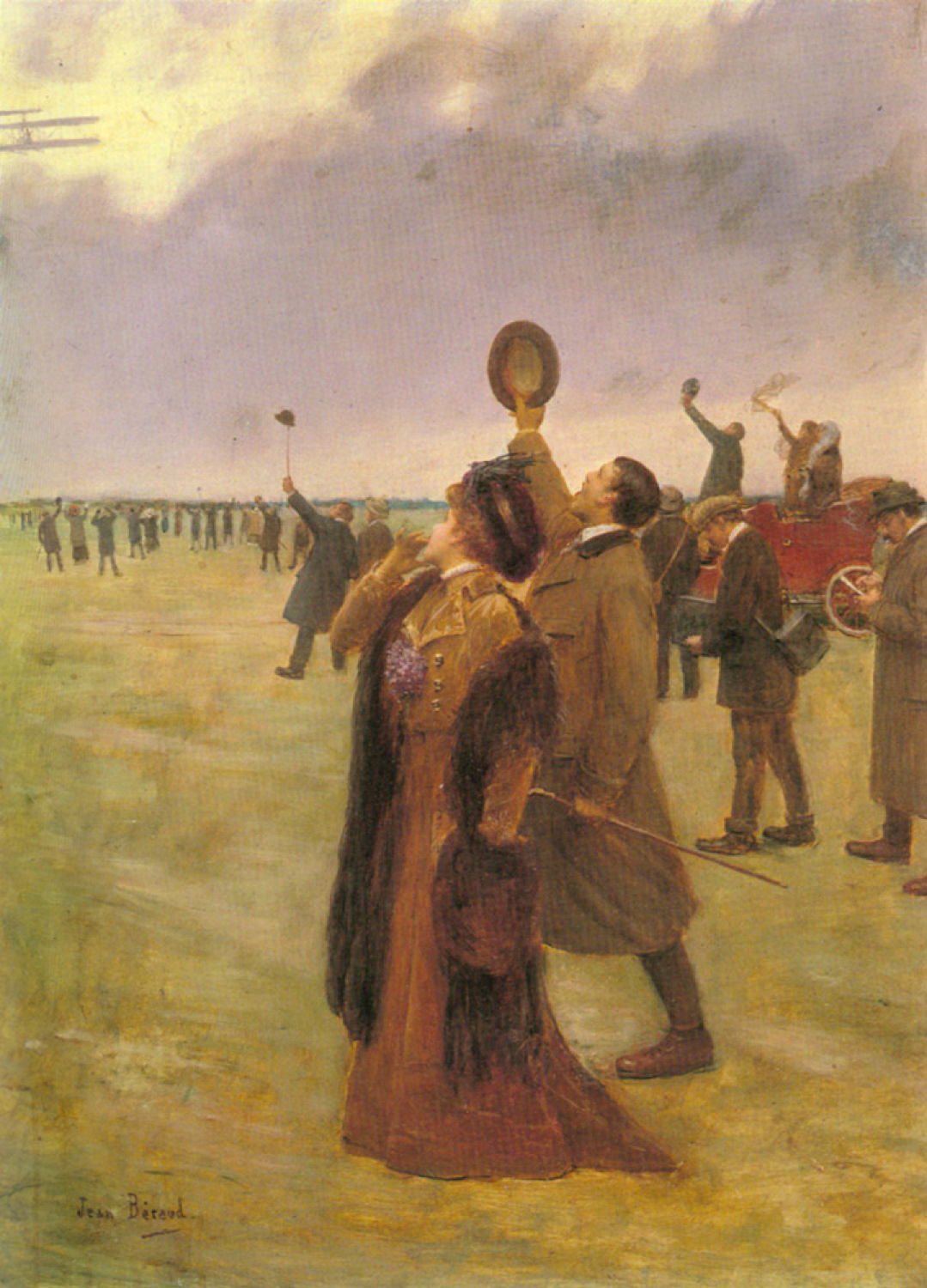
beraudflightbiplanewright
Jean Béraud (1849–1935), Flight of a Biplane of Wright Type (after 1904), oil on canvas, 70.5 × 48.2 cm, Private collection. Wikimedia Commons.

Jean Béraud painted another Naturalist work, Flight of a Biplane of Wright Type, at around this time. This is unusual in its attention not to the novel aircraft, which is cut off the left edge of his canvas, but on the scattered crowd below, waving at the plane.

By 1908, the traditional visual arts had paid surprisingly little attention to the revolution taking place up in the skies. Neither the Naturalists nor the Impressionists seem to have been interested in this aspect of modern life, but had left it to their photographic rivals to capture the story of early aviation. Thankfully, that was about to change.

❌
❌