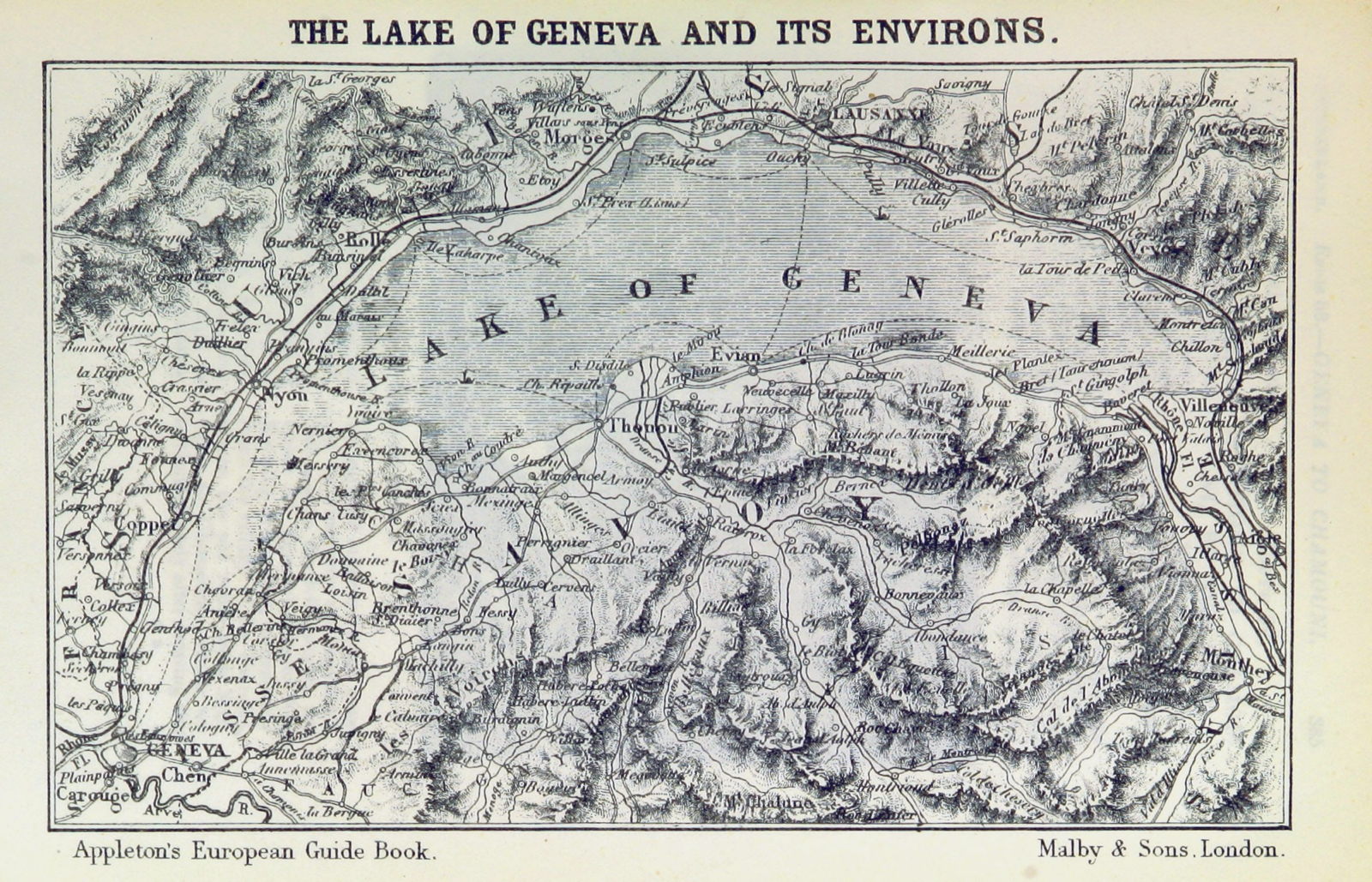
This weekend we’re off to visit Lake Geneva, also known by its French name of Lac Léman, the largest in Switzerland. It’s located in the far south-west of the country, where it forms much of its border with France. It makes a broad arc running north-east from the capital city of Geneva, with some of the highest peaks of the Alps to its south.
Daniel Appleton et al., Map of Lake Geneva (1877), p 521 in Appleton’s European Guide Book illustrated, 10th edition, D. Appleton & Co, New York. The British Library, London. Wikimedia Commons.
Today I start with a selection of paintings almost exclusively from the nineteenth century, when Switzerland was on the itinerary of the Grand Tour undertaken by aspiring young men of the upper class in both Europe and the Americas.
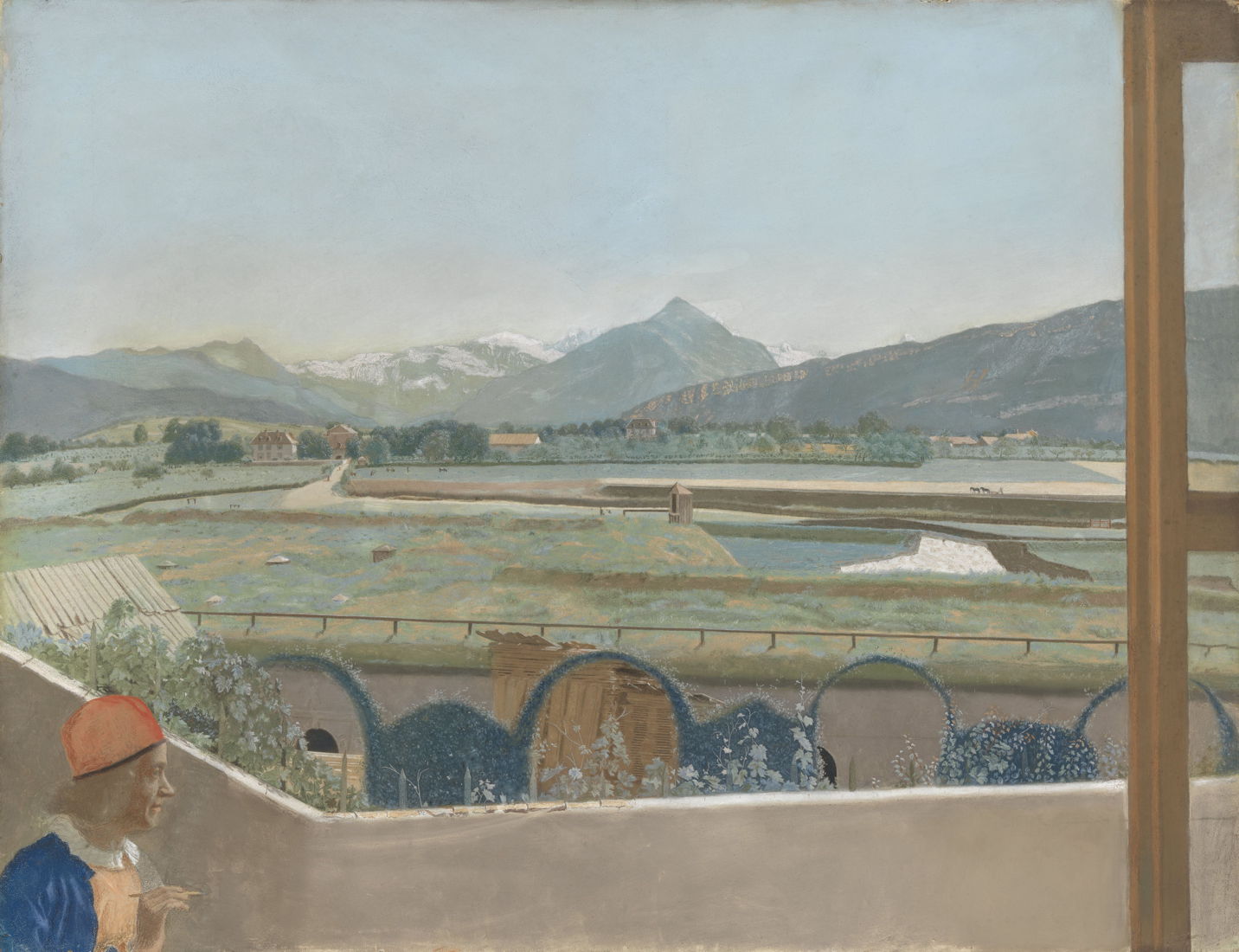
Jean-Étienne Liotard (1702-1789), View of the Mont Blanc Massif from the Artist’s Studio (1765-70), pastel on parchment, 46 x 59.7 cm, location not known. Wikimedia Commons.
The city of Geneva has long attracted artists, and it was here the eccentric pastellist Jean-Étienne Liotard was born and later kept his studio, and where he eventually retired. His View of the Mont Blanc Massif from the Artist’s Studio from 1765-70 reveals only a little of the southern extreme of the lake, with a cameo self-portrait.
Joseph Mallord William Turner (1775–1851), Lake Geneva and Mount Blanc (1802-05), watercolour, 90.5 x 128.6 cm, Yale Center for British Art, New Haven, CT. Wikimedia Commons.
JMW Turner was by no means the first to paint the lake, but his watercolour of Lake Geneva and Mount Blanc from 1802-05 is one of its earliest depictions by a major artist. This view looks south-east over the city of Geneva towards the Mont Blanc massif in the far distance.
Alexandre Calame (1810–1864), View of Bouveret (1833), oil on panel, 35 x 47.5 cm, location not known. Wikimedia Commons.
Alexandre Calame’s View of Bouveret from 1833 shows a grey heron fishing on the shore at the southern end of the lake, close to the border with France.
Alexandre Calame (1810–1864), View of Lake Geneva (Lac Léman) (1849), oil on wood, 67 x 86 cm, Villa Vauban, Musée d’art de la ville de Luxembourg, Luxembourg. Wikimedia Commons.
While Turner had toured the Alps once travel from England had become possible again in the early nineteenth century, Calame pioneered the painting of views like this of the lake, completed in his studio in 1849. It includes some of the distinctive sailing boats of the Swiss lakes, and a small bird in the shallows, but not a heron here.
John Ferguson Weir (1841-1926), Lake Leman (Lake Geneva), Switzerland (1869), oil on paper, 20.3 x 33 cm, Private collection. Wikimedia Commons.
In the middle of the nineteenth century, several major American artists visited Switzerland to develop their skills painting mountain views. Despite its finish, John Ferguson Weir’s Lake Leman (Lake Geneva), Switzerland may have been painted in front of the motif, on 11 June 1869.
Following Gustave Courbet’s release from prison for his involvement in the Paris Commune and destruction of the Vendôme Column in 1871, he was forced to flee to the safety of Switzerland, where he lived his remaining years there, unable to return to France.
Gustave Courbet (1819–1877), Sunset over Lac Leman (1874), oil on canvas, 55 x 65 cm, Musée Jenisch, Vevey, Switzerland. Image by Volpato, via Wikimedia Commons.
Courbet painted some of the finest landscapes of his career during his exile in Switzerland, like this Sunset over Lac Léman from 1874, the year of the First Impressionist Exhibition in Paris.
Gustave Courbet (1819–1877), Chillon Castle (1875), oil on canvas, dimensions not known, Private collection. Wikimedia Commons.
He became particularly obsessed with the island château at the extreme eastern end of Lake Geneva, Chillon Castle, here in 1875. This picturesque château dates back to a Roman outpost, and for much of its recorded history from about 1050 has controlled the road from Burgundy to the Great Saint Bernard Pass, a point of strategic significance. It has since been extensively restored, and is now one of the most visited mediaeval castles in Europe.
Gustave Courbet (1819–1877), Chillon Castle (1874-77), oil on canvas, 73 x 92 cm, location not known. Wikimedia Commons.
Chillon Castle from 1874-77 is another of the views he painted of the castle on the lake.
Gustave Courbet (1819–1877), Sunset on Lake Geneva (c 1876), oil on canvas, 74 x 100 cm, Kunstmuseum St. Gallen, St. Gallen, Switzerland. Wikimedia Commons.
Sunset on Lake Geneva from about 1876 is reminiscent of Courbet’s earlier seascapes with breaking waves, but now the water is calm once more.
In May 1877, the French government informed Courbet that the cost of rebuilding the Vendôme Column would be over 300,000 Francs, which he could pay in instalments of 10,000 Francs each year, starting on 1 January 1878. Courbet died in Switzerland the day before, on 31 December 1877, at the age of only 58.
Landscape painters came to the Alhambra in the Andalucian city of Granada relatively late. But once they started to visit the Prado in Madrid to view and copy its magnificent collection of masters, a steady succession travelled south to paint the Moorish palaces of the Alhambra.
To remind you, this plan from Openstreetmap and its contributors shows the modern site, as of 2013.
Constantin Uhde (1836–1905), Plan of the Nasrid Palaces, Alhambra (1892), illustration, further details not known. Wikimedia Commons.
Constantin Uhde’s plan of 1892 shows the layout of the Nasrid palaces:
Red is the site of the Palace of Comares and the Palaces of the Ambassadors.
Green is the Palace of the Lions.
Yellow is the Mexuar.
Blue is the Garden of Lindajar and later quarters of the Emir.
Edmund Wodick (1816–1886), Granada (1886), oil on canvas, dimensions not known, Kulturhistorisches Museum Magdeburg, Magdeburg, Germany. Wikimedia Commons.
For Edmund Wodick, who must have visited Granada to paint this spectacular landscape in early 1886, it was probably the last work that he completed. Shortly after this, he developed pneumonia and died at the age of 69. He painted this just outside the city walls, looking across at the Alhambra and its towers, down towards the lush green plain and the snow-capped peaks in the far distance.
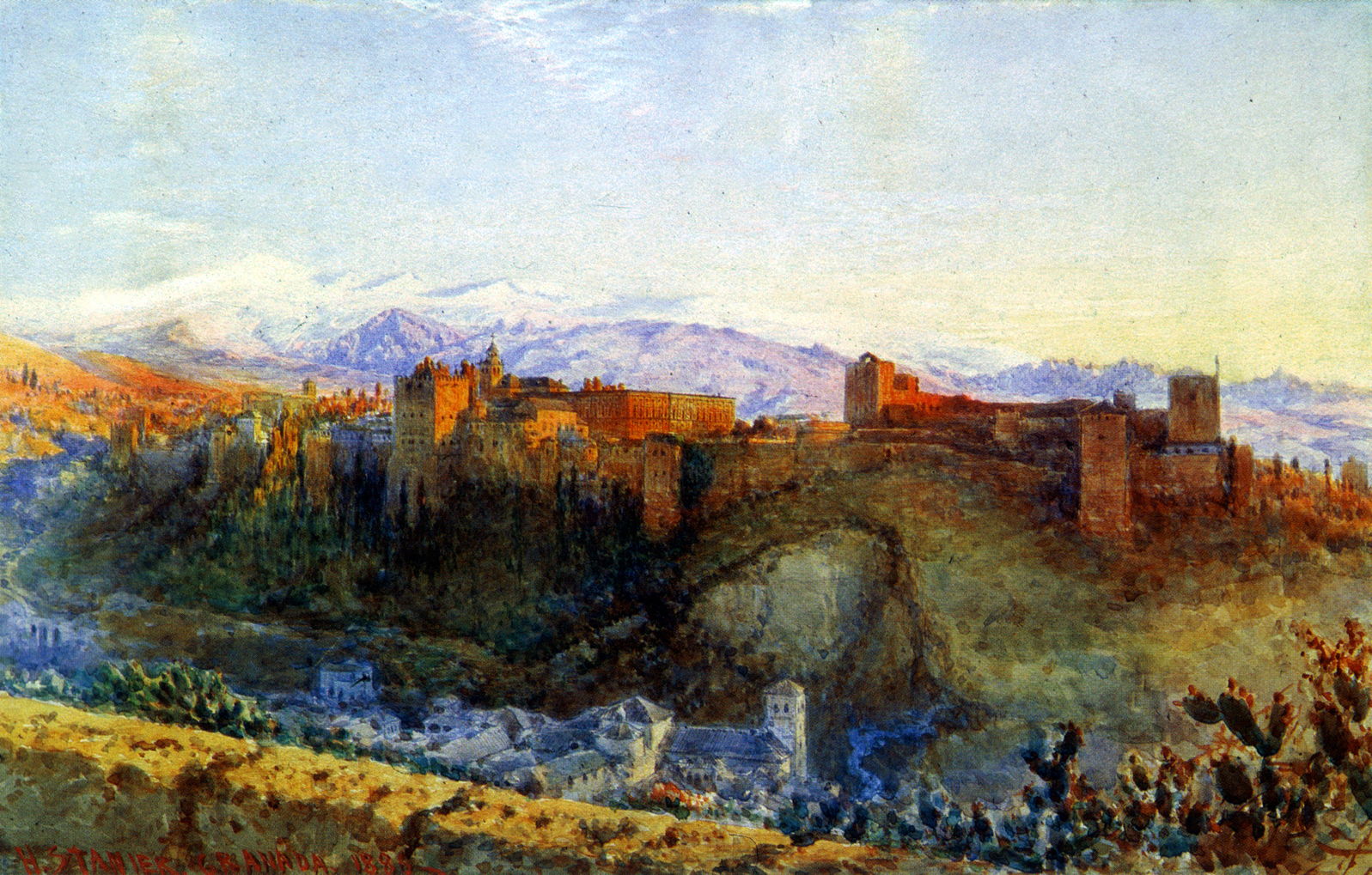
Henry Stanier (1832-1892), Alhambra from San Nicolas (1886), further details not known. Wikimedia Commons.
Long before the brash colours of the Fauves, those who painted the Alhambra in the rich light of dawn or dusk surprised viewers with the intensity of its colours. Henry Stanier’s view of the Alhambra from San Nicolas from 1886 is a good example, and another from late in an artist’s career. Stanier was a topographical draughtsman and sometime Orientalist from the city of Birmingham in England, whose work is now almost forgotten.
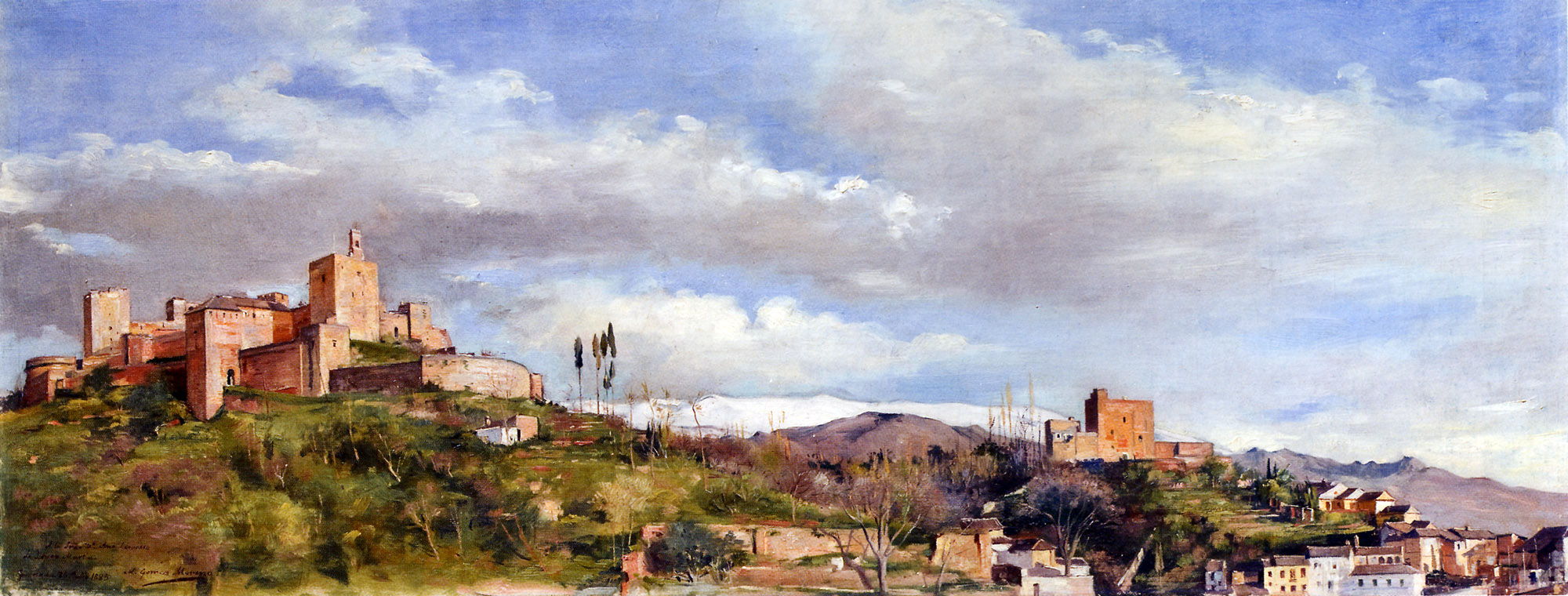
Manuel Gómez-Moreno González (1834–1918), La Alcazaba y Torres Bermejas (The Alhambra and Castle of Torres Bermejas) (c 1887), oil on canvas, 35.5 x 89.5 cm, Casa de los Tiros, Granada, Spain. Wikimedia Commons.
Local painter and amateur archaeologist Manuel Gómez-Moreno González was fascinated by the history of the Alhambra, and the first to compile an account of its depictions in paintings. His own works showing the site include The Alhambra and Castle of Torres Bermejas from about 1887, painted from an unusual viewpoint below its ridge.
The Alhambra dominates the left, with the much smaller castle to the right. The snow-clad peaks of the Sierra Nevada rise to over 3,000 metres (10,000 feet), and resemble a bank of white cloud peeking over the skyline in between.
Hernandez Miguel Vico (1850-1933), Alhambra and Cuesta de los Chinos (date not known), further details not known. Wikimedia Commons.
Hernandez Miguel Vico, another local artist, also favoured a view from below in his undated painting of Alhambra and Cuesta de los Chinos. In 1877, he exhibited an interior of the Alhambra at the Salon in Paris, but I have been unable to locate an image of that.
John Ferguson Weir (1841-1926), The Alhambra, Granada, Spain (c 1901), oil on canvas, 92.1 x 118.1 cm, The Metropolitan Museum of Art (Gift of David T. Owsley, 1964), New York, NY. Courtesy of The Metropolitan Museum of Art.
The founder of the School of Fine Arts at Yale University, John Ferguson Weir, had studied in Europe, and his brother Julian Alden Weir was a student at the École des Beaux-Arts in Paris. Later in his career, John Ferguson Weir returned to Europe on several trips, and in about 1901 painted this fine view of The Alhambra, Granada, Spain.
Laurits Tuxen (1853–1927), View of the Alhambra (1902), oil on canvas, 54 x 72 cm, location not known. Wikimedia Commons.
As far as I can tell, Laurits Tuxen was the first Danish artist to paint a View of the Alhambra, a year after marrying his second wife. He was one of the leading members of the Skagen Painters, ‘Danish Impressionists’, and completed this en plein air on 4 May 1902, in marvellously fine weather.
The early twentieth century brought two of the greatest artists to have painted the Alhambra: Joaquín Sorolla, who seems to have been most active in Granada in 1909, and John Singer Sargent, who visited in 1912 at least.
Sorolla came from Valencia, and is still best-known for his magnificent paintings of people and activities on the beach there. He travelled extensively during his career, but doesn’t seem to have painted in Granada until 1909, when he also spent five months in the USA. These four oil sketches are a marked contrast to the more familiar finished paintings that he exhibited.
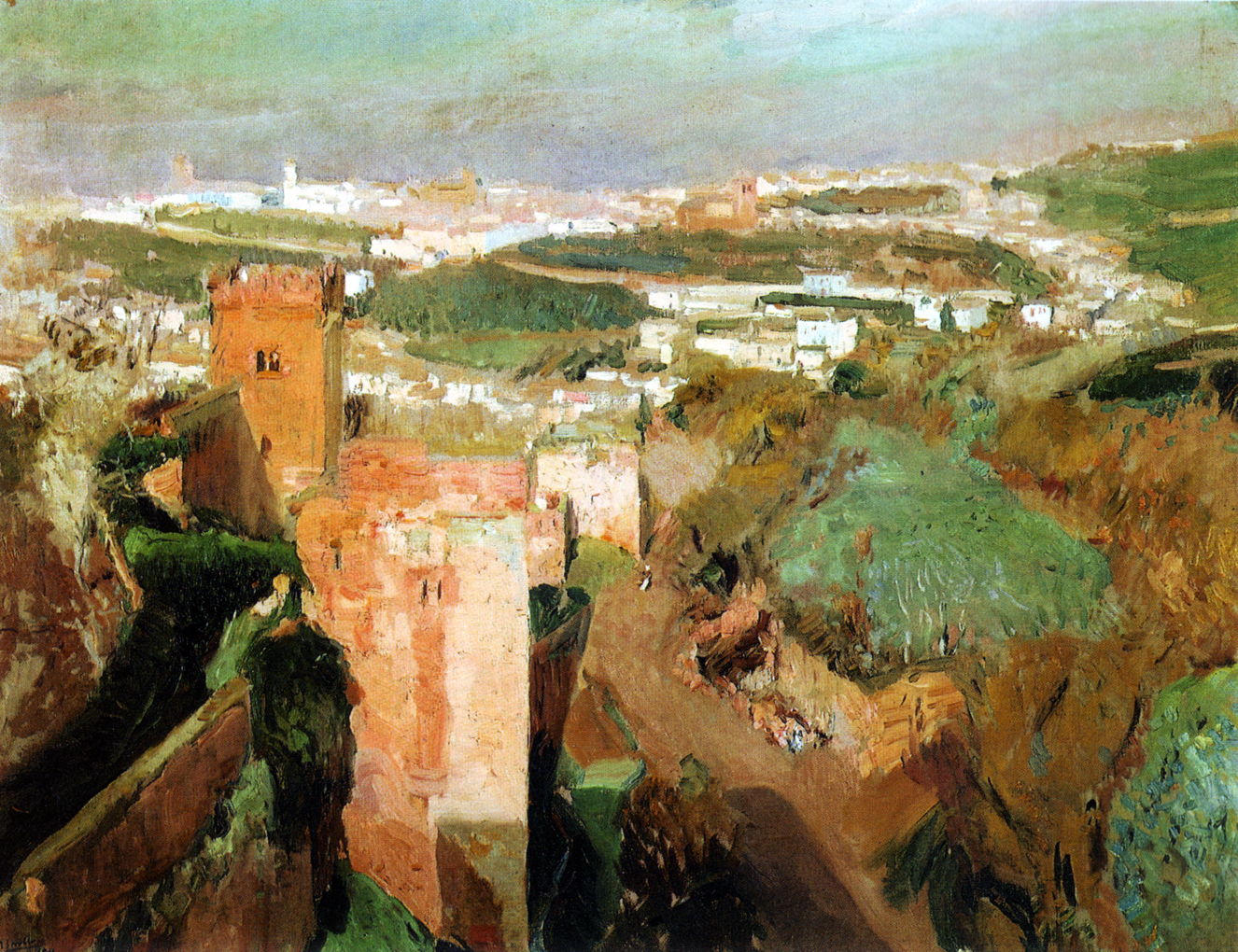
Joaquín Sorolla y Bastida (1863–1923), Los Picos Tower (date not known), further details not known. Wikimedia Commons.
Los Picos Tower is a virtuoso oil sketch looking along the precipitous walls and towers at the edge of the site, and beyond to the dazzling white buildings of the city.
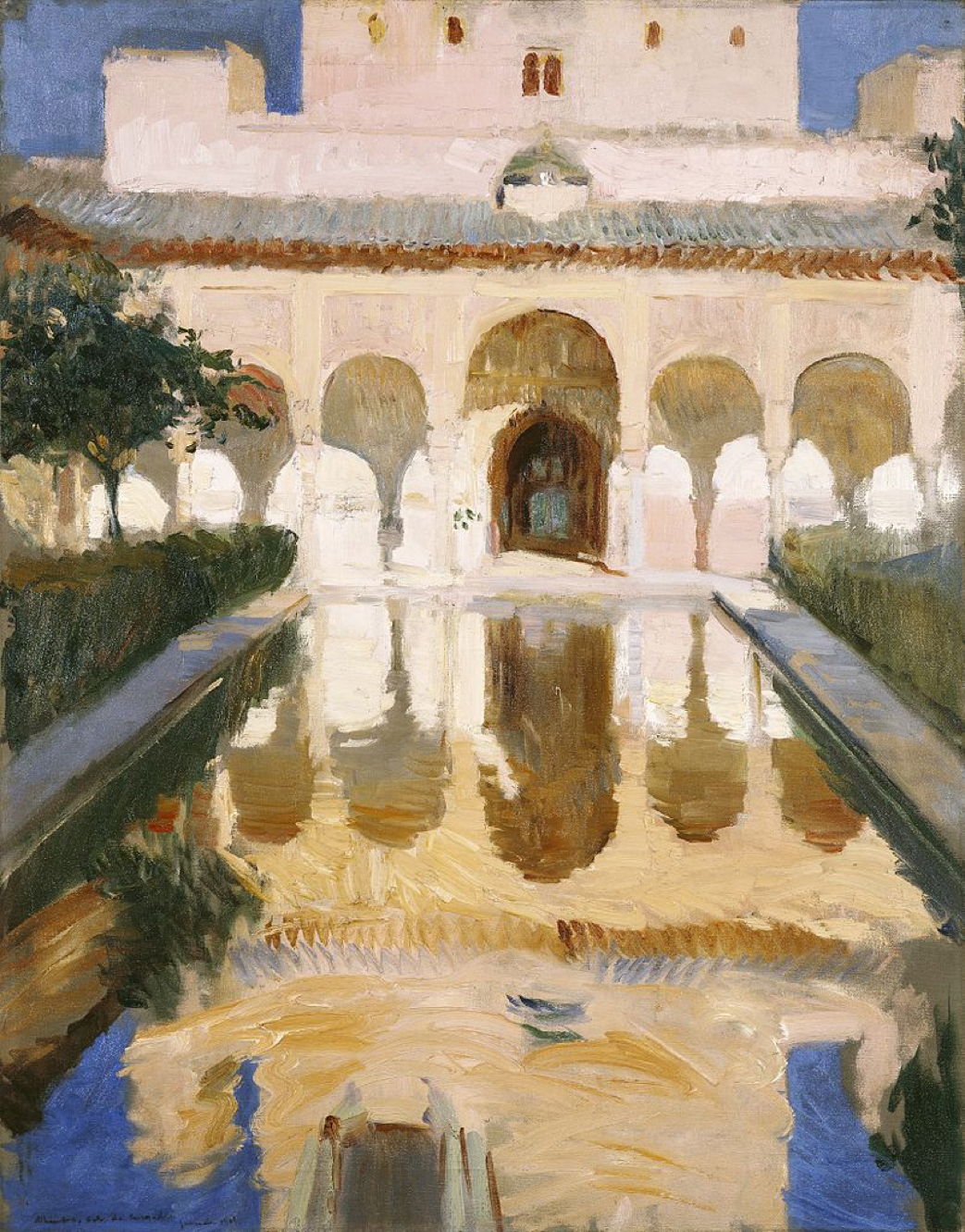
Joaquín Sorolla y Bastida (1863–1923), Hall of the Ambassadors, Alhambra, Granada (1909), oil on canvas, 104.1 x 81.2 cm, J. Paul Getty Museum, Los Angeles, CA. Wikimedia Commons.
Hall of the Ambassadors, Alhambra, Granada (1909) shows this classical view with some of Sorolla’s vigorous brushstrokes texturing the paint.
Joaquín Sorolla y Bastida (1863–1923), Torre de las Infantas de la Alhambra (Tower of the Children) (1909), dimensions not known, Museo Sorolla, Madrid, Spain. Image by Quinok, via Wikimedia Commons.
Tower of the Children (1909) looks past another tower towards the distant mountains, the sunlight filtering through a curtain of trees.
Joaquín Sorolla y Bastida (1863–1923), Albaicin (date not known), further details not known. Wikimedia Commons.
In Sorolla’s Albaicin, he looks down from one of the Alhambra’s towers at the bleached white buildings below.
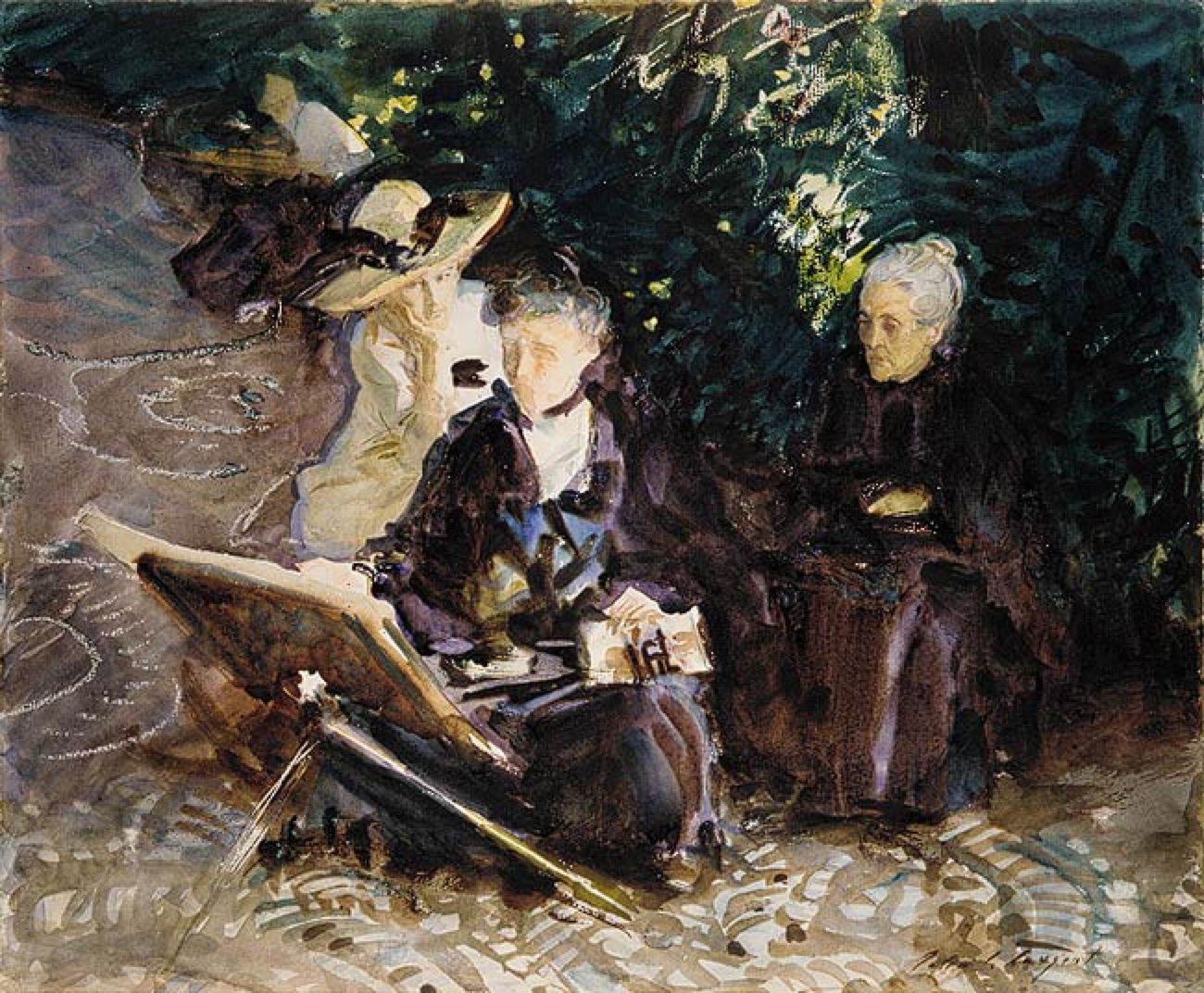
John Singer Sargent (1856–1925), In the Generalife (1912), watercolour and graphite on paper, 37.5 x 45.4 cm, The Metropolitan Museum of Art, New York, NY. Wikimedia Commons.
The only available image of Sargent’s paintings of the Alhambra I have able to find is this watercolour showing his sister Emily, also a keen artist, sketching In the Generalife (1912). Behind her is Jane de Glehn, and to the right is a Spanish friend known only as Dolores. The unusual highlight effect seen in bushes above them, and on parts of the ground, was produced by scribbling with a colourless beeswax crayon, which resists the watercolour paint.
Théo van Rysselberghe, Fountain at the Generalife in Granada (1913), oil on canvas mounted on cardboard, 65.8 x 46 cm, Private collection. WikiArt.
Théo van Rysselberghe had first visited Spain in 1881 or 82, when he too went to the Prado, and travelled on to Morocco. He visited Andalucia in company with John Singer Sargent in the Spring of 1884, but doesn’t appear to have painted the Alhambra until after his retirement to the Côte d’Azur in 1911. He then painted Fountain at the Generalife in Granada in 1913, in his late high-chroma style.
The last two paintings in my selection are both by the eclectic Valencian painter Antonio Muñoz Degrain, and demonstrate his wide range of styles.
Antonio Muñoz Degrain (1840-1924), View of the Alhambra (1914), oil on canvas, 125 x 83 cm, Museo de Málaga. Wikimedia Commons.
Muñoz Degrain’s view of the Alhambra from Albaicin District from 1914 is remarkable for the rhythm established by the poplar trees around its base, which become an integral part of the fortified ridge.
Antonio Muñoz Degrain (1840-1924), View of the Alhambra (date not known), further details not known. Wikimedia Commons.
His View of the Alhambra is one of my favourite paintings of this motif, for its intriguing foreground details, and the poplars lit as white-hot pokers in the fiery light of the sunset.
What better way to end our weekend away from the chill and gloom of winter.

 Login
Login