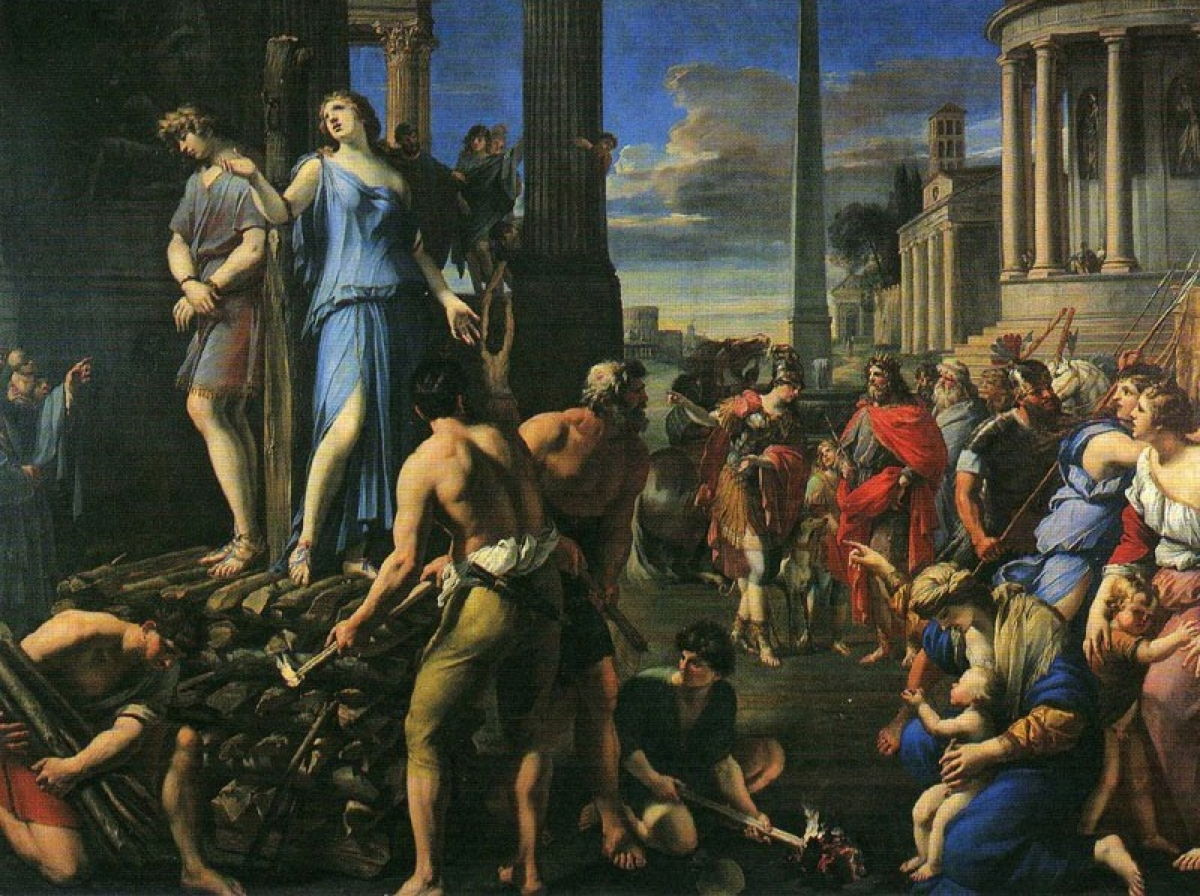
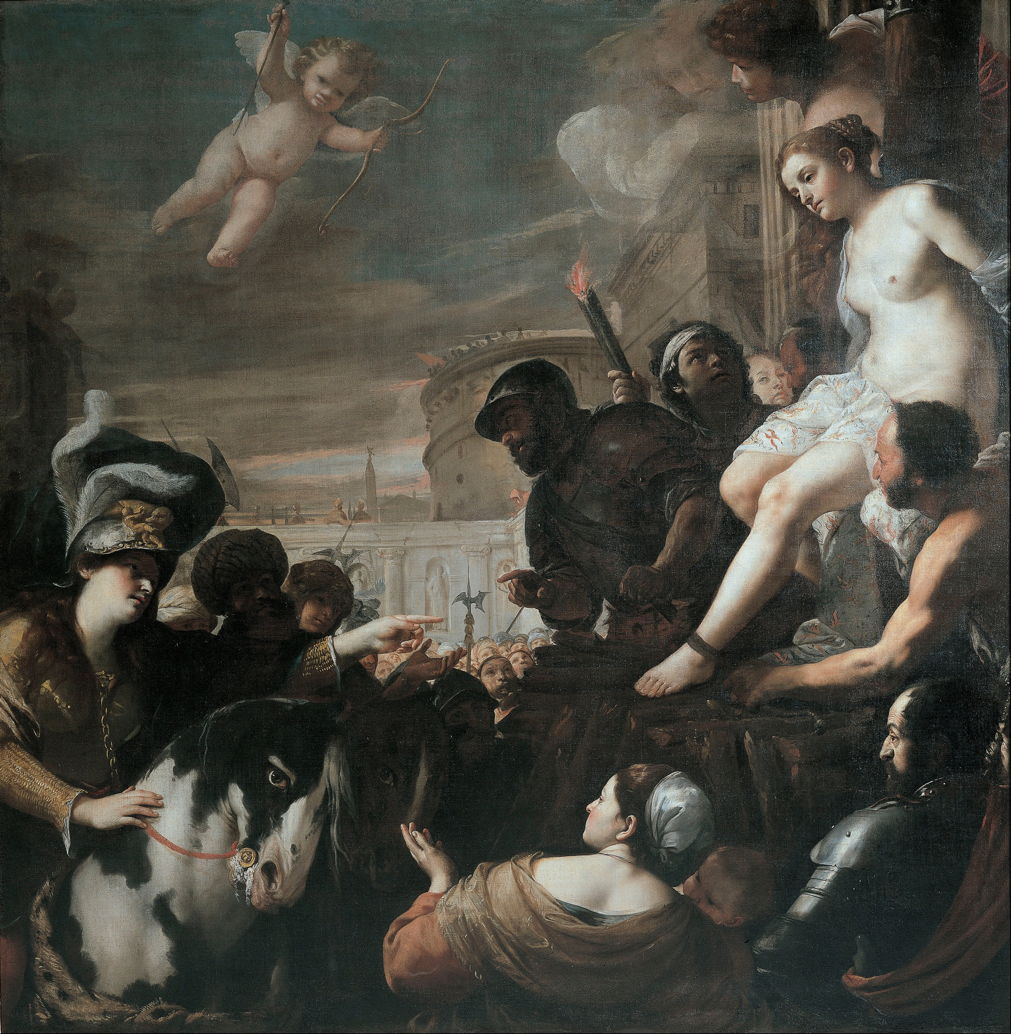
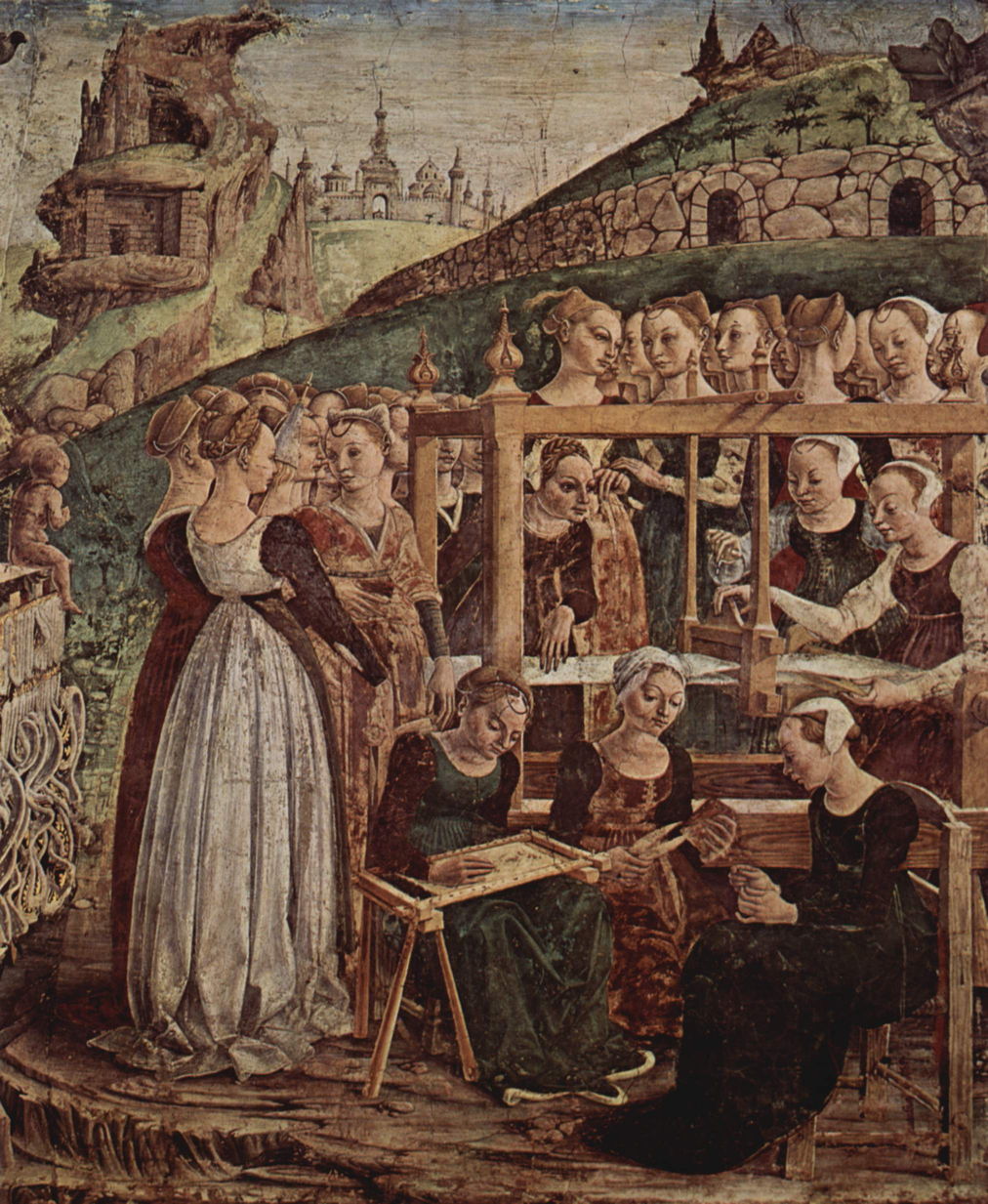
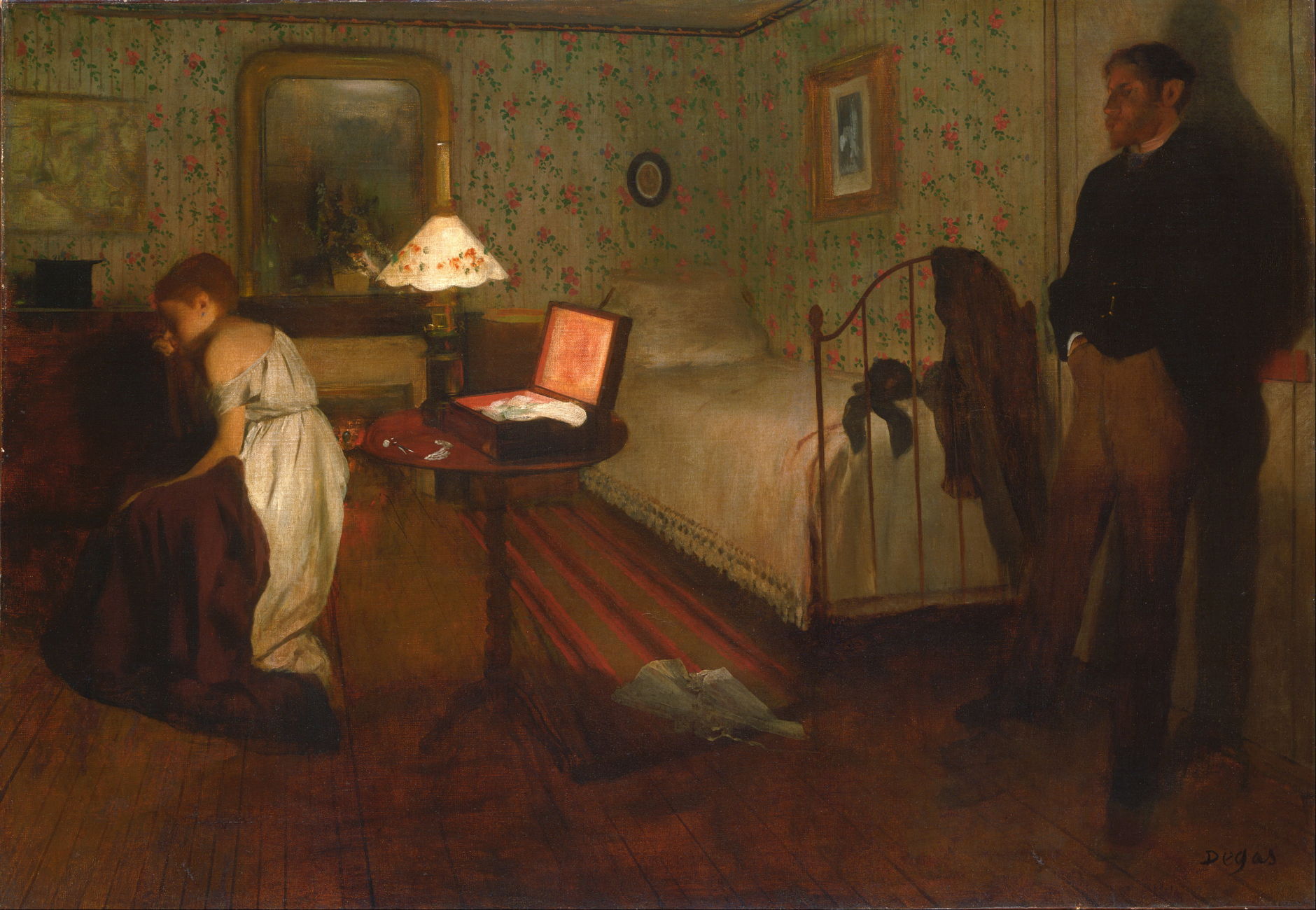
The ‘Saracen’ sorceress Armida had abducted the crusader knight Rinaldo to her enchanted garden on the Fortunate Isles, far to the west out in the Atlantic. A rescue team of the knights Charles and Ubaldo then sailed out in a magic ship piloted by a fair woman. After they had overcome a series of obstacles, Charles and Ubaldo found Rinaldo dressed and behaving as a woman’s dandy, and have the task of restoring his senses as a warrior knight, so they can take him back to rejoin the siege of Jerusalem.
By showing Rinaldo his own image in a highly polished shield, the knight is put to shame and realises what he has become. Ubaldo bids him rejoin the forces of Godfrey of Bouillon, and the holy war. They hasten away, leaving Armida weeping and choking with grief. She runs after them, calling him back. Rinaldo and his two companions wait for her, and the couple stare at one another in silence.
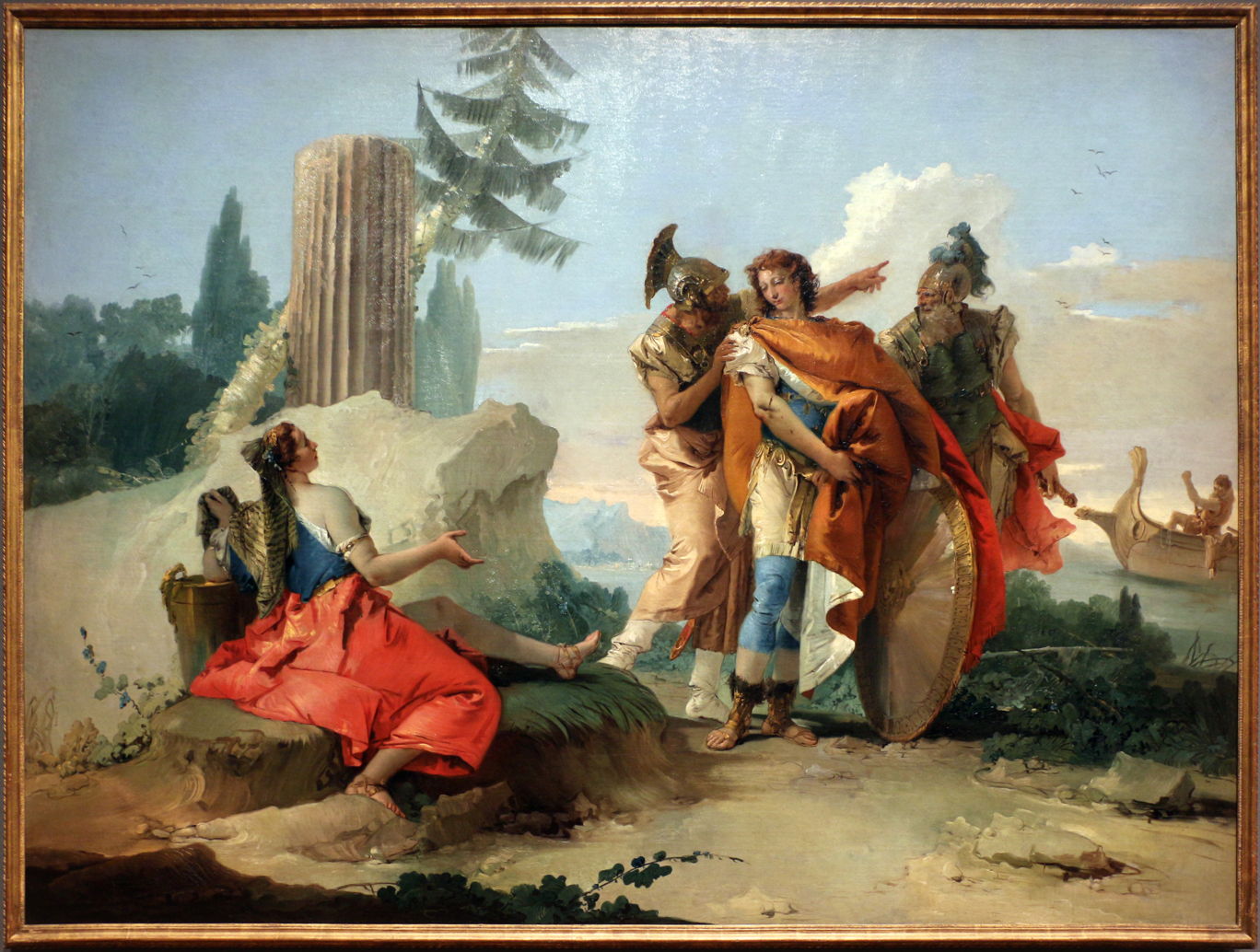
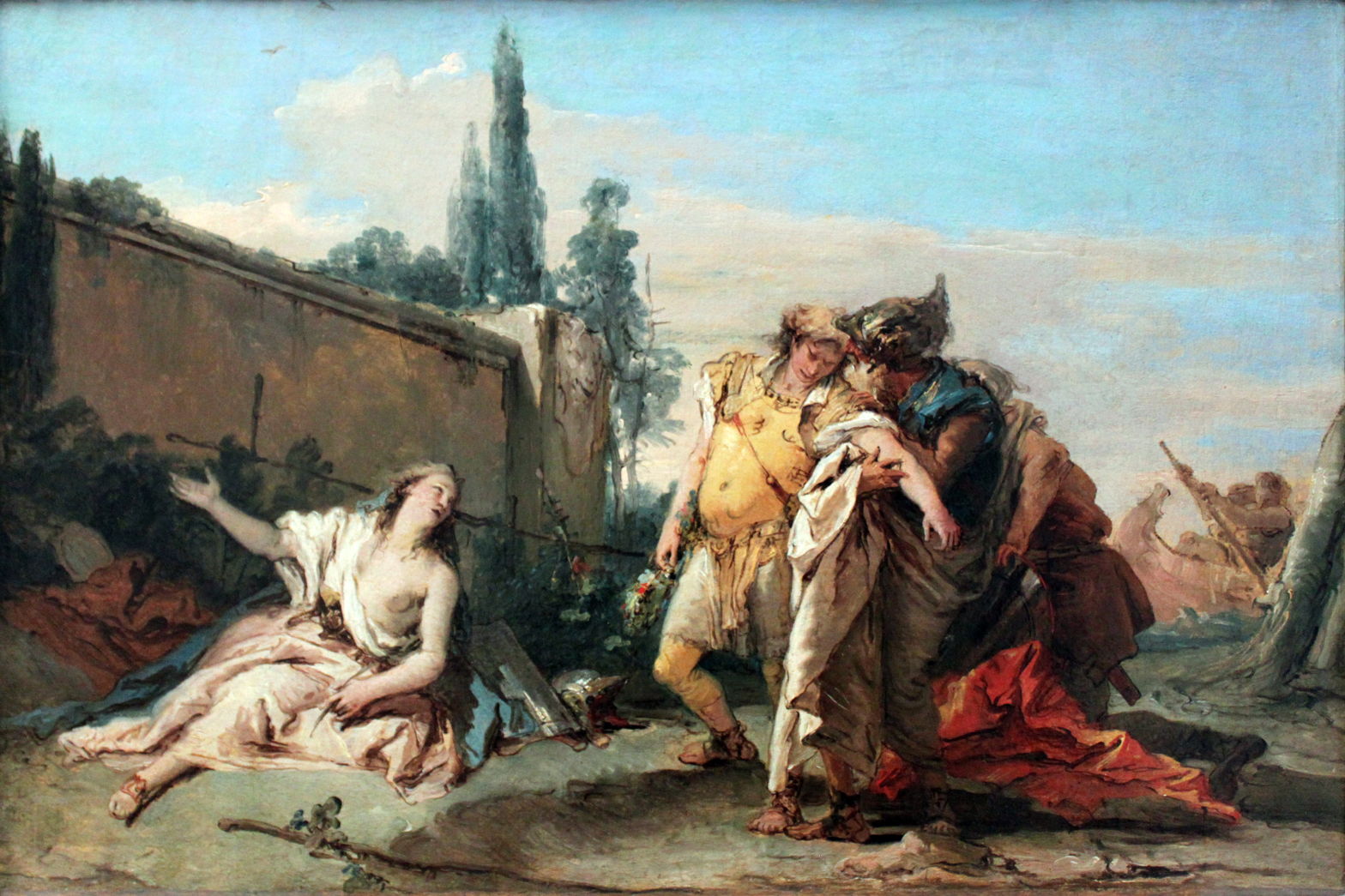
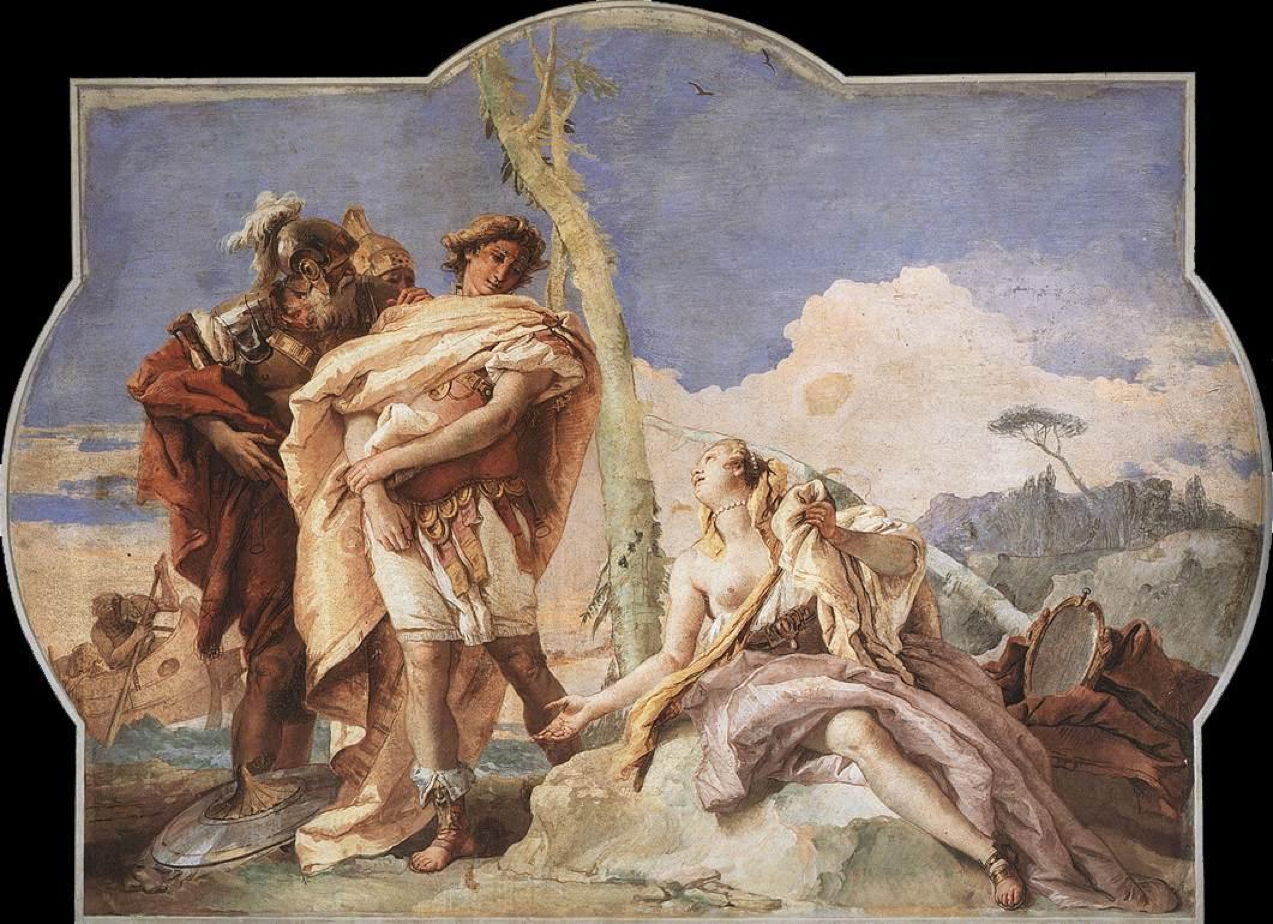
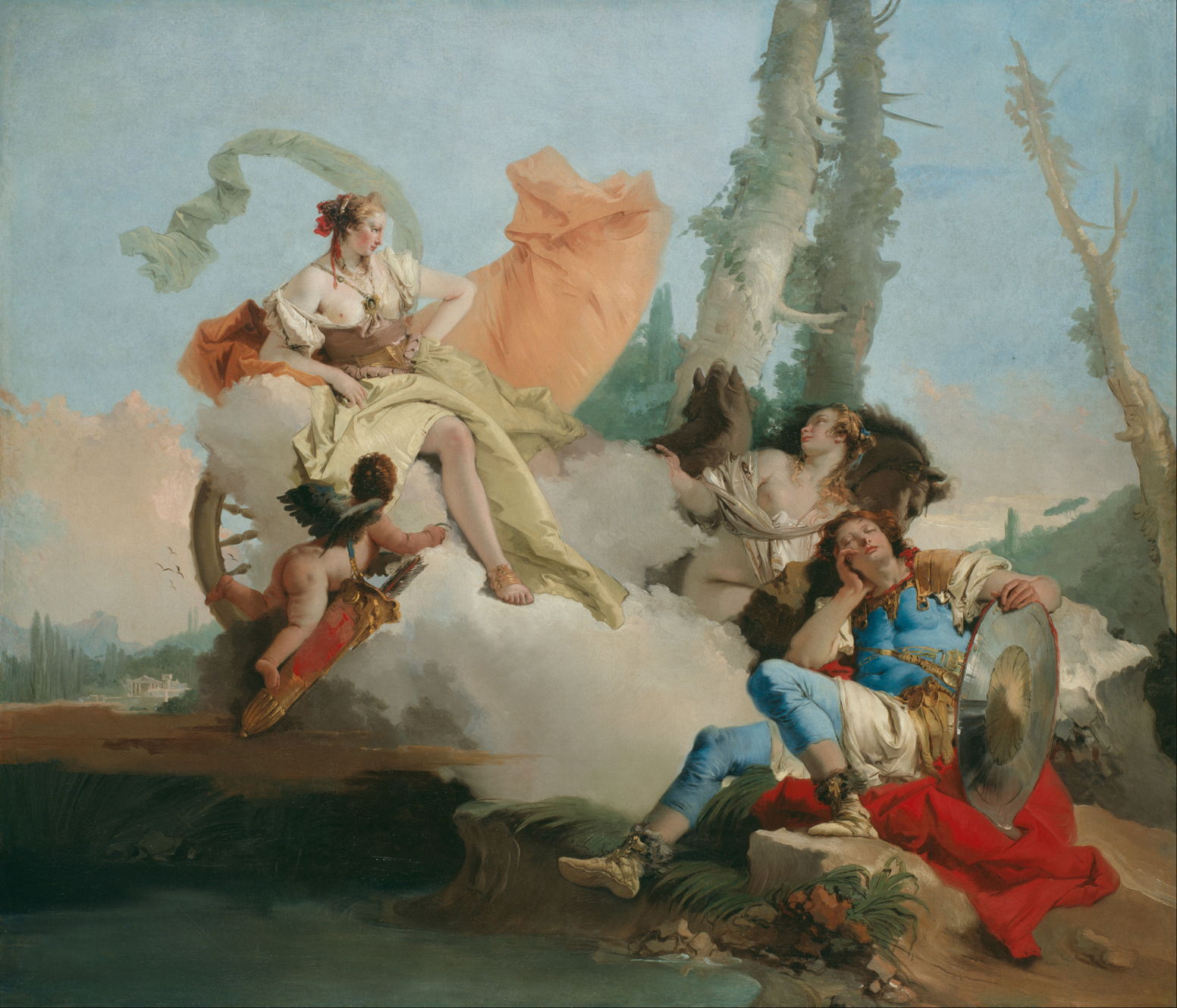
The scene of Armida and Rinaldo separating has proved another of Tasso’s great images for art. Its greatest exponents were the Tiepolos, father and son, who painted a succession of works showing this parting, in the eighteenth century. I show here four examples, each using the compositional device of collapsing Armida’s garden on one side, with the beach and ship on the other, and using that spatial and temporal merging to tell the whole sequence, from Rinaldo’s awakening to their departure by sea.
Giovanni Battista Tiepolo (1696–1770), Armida Abandoning Rinaldo (1742-45), oil on canvas, 186.7 x 259.4 cm, The Art Institute of Chicago, Chicago, IL. Image by Sailko, via Wikimedia Commons.
In this version for the Tasso Room in the palace of the Cormaro Family in Venice, painted in 1742-45, Charles and Ubaldo are stood in full armour, pointing to their ship which is waiting to take Rinaldo away. Armida lies back exposing a lot of leg, trying to persuade Rinaldo to stay with her.
Giovanni Battista Tiepolo (1696–1770), Rinaldo’s Departure from Armida (1755-60), oil on canvas, 39 x 62 cm, Gemäldegalerie der Staatlichen Museen zu Berlin, Berlin, Germany. Image by anagoria, via Wikimedia Commons.
In Tiepolo’s Rinaldo’s Departure from Armida from 1755-60, Rinaldo is still being woken from his enchantment, and Armida bares her breast as she is trying to lure him back.
Giovanni Domenico Tiepolo (1727–1804), Rinaldo Leaving the Garden of Armida (c 1770), fresco, dimensions not known, Ca’ Rezzonico, Venice, Italy. Wikimedia Commons.
His son, Giovanni Domenico, squeezed the three knights in tighter, and omitted Armida from his Rinaldo Leaving the Garden of Armida in about 1770. Rinaldo’s separation from Armida is marked by the hold he has over the blindfolded Cupid in his right arm. This was painted in a fresco in Ca’ Rezzonico in Venice, Italy.
Giovanni Battista Tiepolo (1696–1770), Rinaldo Abandoning Armida (1757), fresco, 220 x 310 cm, Villa Valmarana ai Nani, Vicenza, Italy. Wikimedia Commons.
The father Tiepolo had painted another variation in Rinaldo Abandoning Armida, from 1757, as a fresco in the Villa Valmarana ai Nani, in Vicenza, Italy. In this, the composition is reversed, with the ship at the left, and Armida pleading with Rinaldo at the right. This is perhaps Tiepolo’s most complete account, as it includes both Armida’s crystal mirror at the right, and the polished shield into which Rinaldo looked, at the feet of Charles and Ubaldo.
Tasso’s narrative, developed in this painting, may have a sub-text about looking and its power: for Armida looking in her crystal was a means of strengthening her allure over Rinaldo, but for him looking into the polished shield was a means of restoring his power by showing what he had become in her clutches.
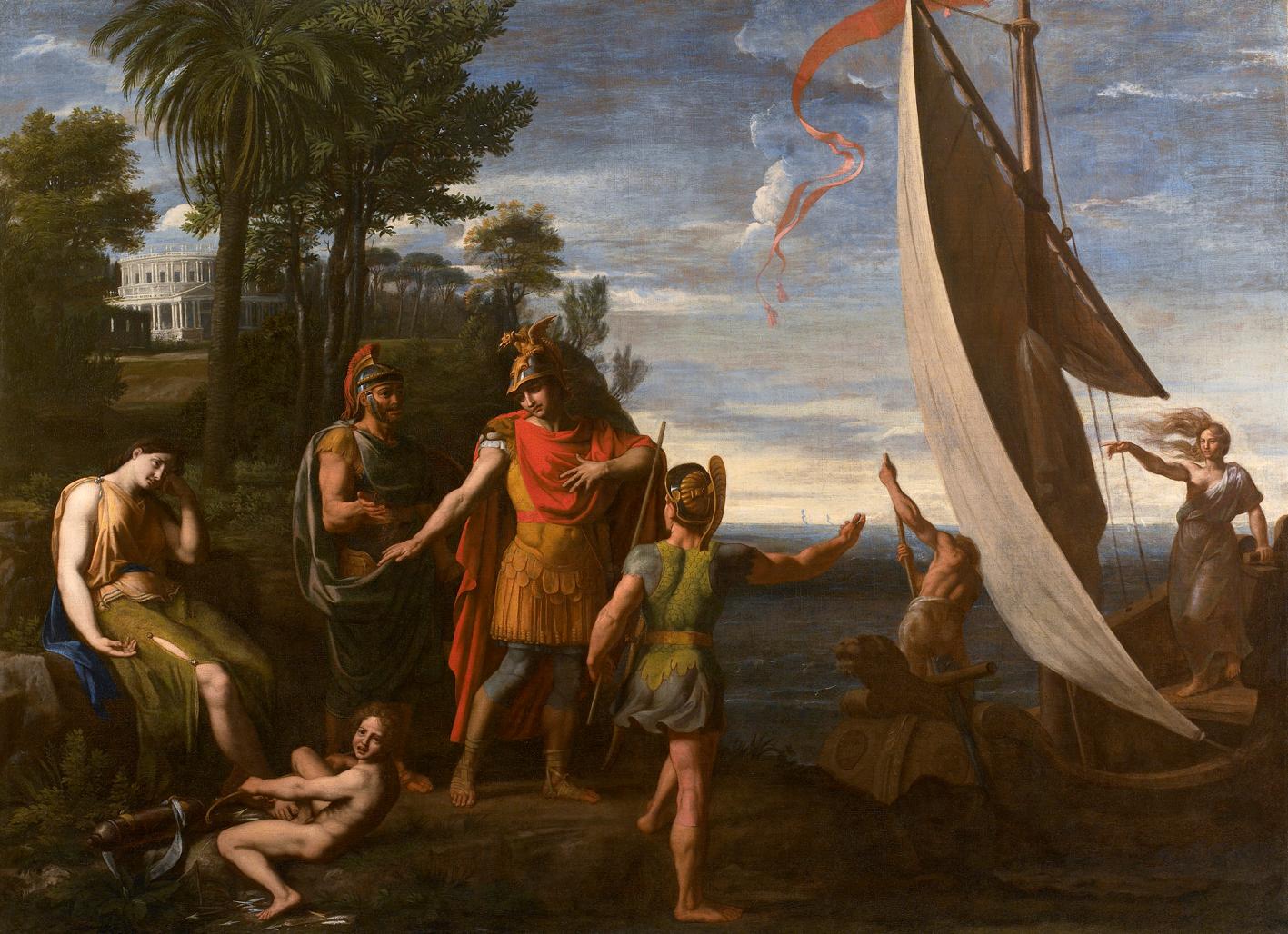
Nicolas Colombel (1644-1717), Rinaldo Abandoning Armida (date not known), oil on canvas, 118.1 x 170.2 cm, Private collection. Wikimedia Commons.
The Tiepolos were by no means the first to merge Armida’s garden with the sea and ship. Nicolas Colombel’s undated painting from the late 1600s showing Rinaldo Abandoning Armida has done much the same.
Armida then launches into a speech, asking Rinaldo to let her follow him back, and offering to be his shield. His love has been replaced by compassion for her, and he asks her to remain there in peace. The three knights then sail away on the magic ship, leaving Armida behind on the beach. Her grief now changes to anger at her loss, so she casts evil spells and conjures up her chariot. On that she departs for the battlefield in vengeance.
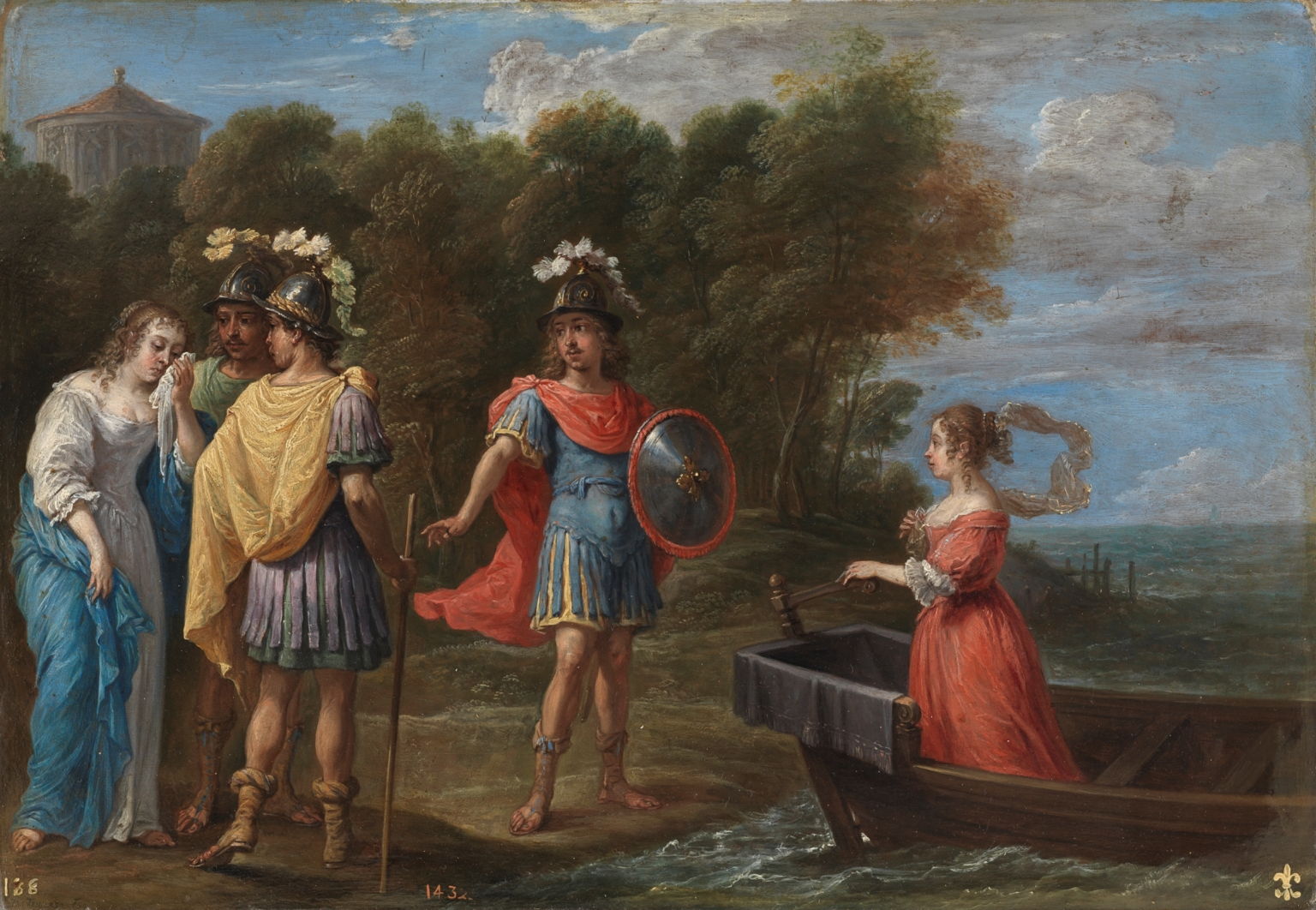
David Teniers the Younger (1610–1690), Armida and Rinaldo Separated (1628-30), oil on copper, 27 x 39 cm, Museo Nacional del Prado, Madrid, Spain. Wikimedia Commons.
David Teniers the Younger shows this section of the story in two of his small paintings on copper: in his Armida and Rinaldo Separated of 1628-30, Armida is weeping and being comforted by Charles and Ubaldo, as the woman pilot of their ship waits for them to board by its stern.
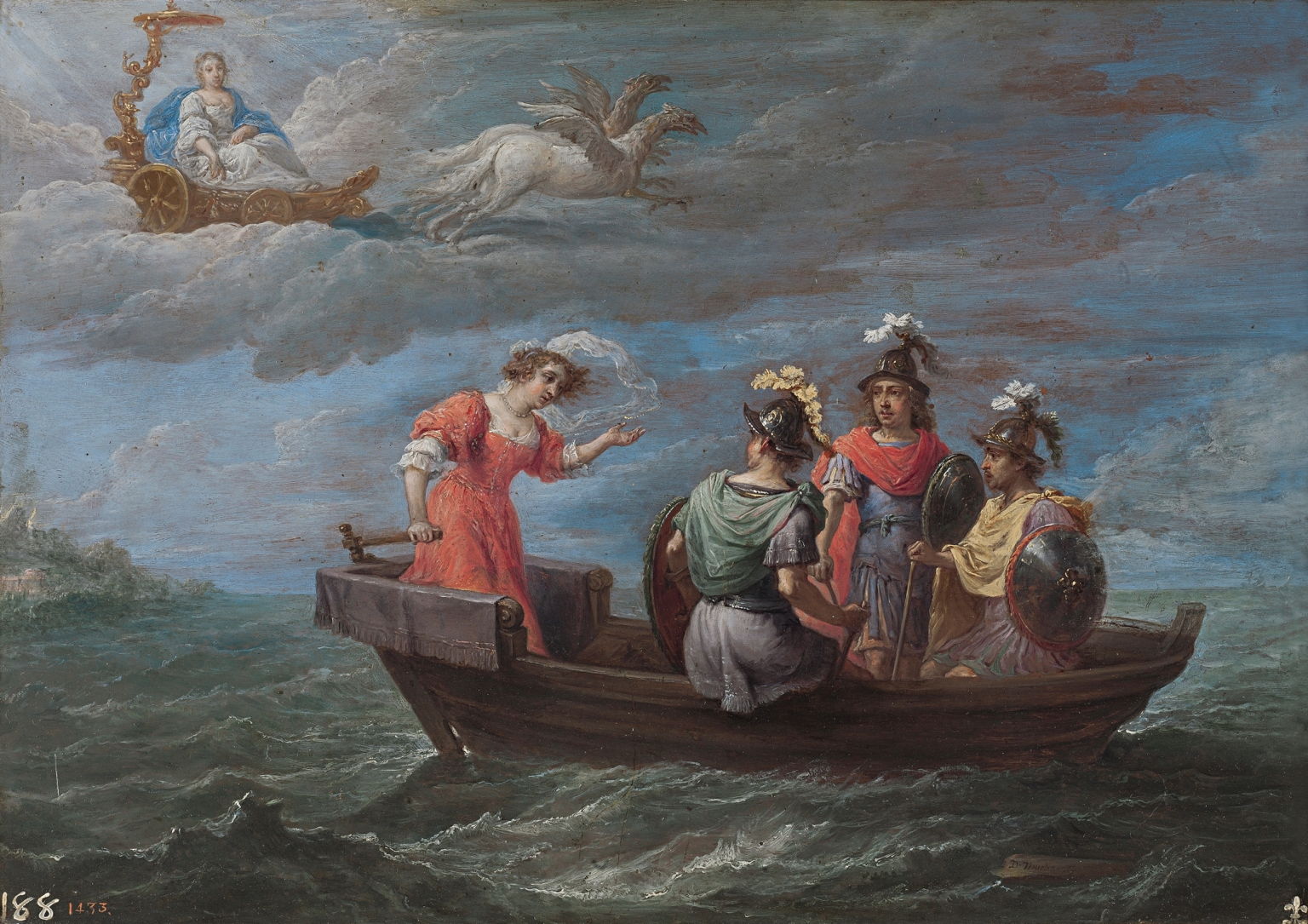
David Teniers the Younger (1610–1690), Rinaldo Flees from the Fortunate Isles (1628-30), oil on copper, 27 x 39 cm, Museo Nacional del Prado, Madrid, Spain. Wikimedia Commons.
Teniers’ sequel, Rinaldo Flees from the Fortunate Isles, shows the group returning to war, with Armida still looking disconsolate in her chariot above them.
Canto seventeen opens in Gaza, between Egypt and Jerusalem, where the King of Egypt is mustering his army ready to advance towards Godfrey’s forces. He sits on his throne to review his forces, which Tasso lists in procession much as he had done when the crusaders were setting out for Jerusalem at the start of the epic. These start with Egyptians, and progress through those from the coast of Asia, citizens of Cairo, those from the land to the south, men of Barca, those from the coast of Arabia, from the Persian Gulf, and the Indies. At the end, Armida appears riding in her chariot with her own forces who had been mustered in Syria by Hydrotes, together with Circassians and more.
The king then retires to a banquet, where Armida offers her forces in support of the king, and tells of her desire for vengeance against Rinaldo. Adrastus, a ‘Saracen’ leader of Indian troops, offers to rip Rinaldo’s heart out, and make a present of his head to Armida.
Thomas Asbridge (2004) The First Crusade, A New History, Free Press, ISBN 978 0 7432 2084 2.
Anthony M Esolen, translator (2000) Torquato Tasso, Jerusalem Delivered, Gerusalemme Liberata, Johns Hopkins UP. ISBN 978 0 801 863233. A superb modern translation into English verse.
John France (1994) Victory in the East, a Military History of the First Crusade, Cambridge UP. ISBN 978 0 521 589871.
Joanthan Riley-Smith, ed (1995) The Oxford Illustrated History of the Crusades, Oxford UP. ISBN 978 0 192 854285.
Jonathan Riley-Smith (2014) The Crusades, A History, 3rd edn., Bloomsbury. ISBN 978 1 4725 1351 9.
Johathan Unglaub (2006) Poussin and the Poetics of Painting, Pictorial Narrative and the Legacy of Tasso, Cambridge UP. ISBN 978 0 521 833677.
The great Symbolist painter Gustave Moreau was born almost two centuries ago, on 6 April 1826. To mark his bicentenary early next month, this short series outlines his career in a small selection of his more important paintings. They are at once history, symbolic explorations, as phantasmagoric as the most radical of William Blake or Odilon Redon, and torrents of figures and forms drawn from all human cultures. They’re elaborate, complex, and appear to defy reading.
Moreau was a precocious artist who started copying in the Louvre, in his native Paris, when he was only seventeen. A year later he started attending a private studio run by François-Édouard Picot, to prepare him for the entrance exam for the École des Beaux-Arts. In Picot’s studio, he learned the methods to which he adhered for the rest of his career: each painting started with a series of drawings, which developed both composition and details. The final drawing was squared up on a grid, to enable its transfer to canvas, where he painted conventionally in oils, using layers.
He was admitted to the École des Beaux-Arts in 1846, and decided to be a history painter. He competed twice for the Prix de Rome, which would have taken him to continue his studies in Rome, but was unsuccessful on both occasions. He therefore left the École in 1849, and started making a precarious living with small commissioned works including favourite scenes from the plays of Shakespeare. His work changed markedly in 1851, the year that JMW Turner died, when he befriended Théodore Chassériau, a former pupil of JAD Ingres; Moreau set up his first studio near Chassériau’s, and started painting more ambitious works to submit to the Salon.
Gustave Moreau (1826–1898), The Judgement of Paris (1852), watercolor on paper, 40.7 × 48.3 cm, Private collection. Wikimedia Commons.
The Judgement of Paris (1852) is one of his early watercolours, showing great promise of things to come. At its heart is a fairly faithful representation of this classical myth, in which Paris (right of centre) is deciding which of Hera, Athena, and Aphrodite is the most fair, and should be awarded the golden apple given by Eris from the Garden of the Hesperides.
Gustave Moreau (1826–1898), Apollo and the Nine Muses (1856), oil on canvas, dimensions not known, Private collection. The Athenaeum.
Apollo and the Nine Muses (1856) is another significant step towards his mature work. Apollo, a young and surprisingly androgynous figure, sits in the foreground, his distinctive lyre part-hidden under his right foot. To the right of him is a wild rose, with both white flowers and red hips. The muses cluster on a small mound behind that, equipped for and engaged in their respective arts.
That year, his friend and mentor Chassériau died at the age of only 37. Moreau was devastated, and decided to travel to Italy to complete his education as a painter and resolve his future. From October 1857 to June 1858, he copied Renaissance paintings in Rome, then moved on to Florence, Milan, and Venice. He finally returned to Paris in September 1859, having made about a thousand copies in less than two years. He had also met and made friends with several other artists, including Edgar Degas and James Tissot.
Gustave Moreau (1826–1898), Hesiod and the Muses (1860), oil on canvas, 155 × 236 cm, Musée National Gustave-Moreau, Paris. Wikimedia Commons.
Hesiod and the Muses (1860) is probably the first of Moreau’s novel history paintings, and the first of a series of works showing Hesiod, generally considered to be the first written poet in the Western tradition to exist as a real person, and to play an active role in his poetry. Hesiod is the young man holding a laurel staff in his right hand, to the left of centre.
There are four swans on the ground, and one in flight above Hesiod, a winged Cupid sat on the left wing of Pegasus, and a brilliant white star directly above the winged horse. However, the Cupid and Pegasus were only added in about 1883, when the canvas was extended.
Moreau met his mistress and muse Alexandrine Dureux (whom he never married, both remaining single) that year, and set her up in a nearby flat, where she lived until her death in 1890.
By 1864, he had abandoned three attempts to produce a radical work for the Salon. However, he had been working on something different, that he completed during the winter of 1863-4: Oedipus and the Sphinx (1864)
Gustave Moreau (1826–1898), Oedipus and the Sphinx (1864), oil on canvas, 206.4 x 104.8 cm, The Metropolitan Museum of Art (Bequest of William H. Herriman, 1920), New York, NY. Courtesy of The Metropolitan Museum of Art, via Wikimedia Commons.
This was a bold move. Not only was this painting startlingly original and different, but it visited a motif that had recently resulted in Ingres’ success at the Salon, in 1827. Just as Oedipus is seen to be staring out the fearsome sphinx, so Moreau was visibly challenging his seniors.
This shows a key scene from Sophocles’ tragedy Oedipus the King. The sphinx had effectively put the ancient Greek city of Thebes under siege, by sitting outside and refusing to let anyone pass unless they answered a riddle correctly. Those who failed to do that it killed by strangulation. When Oedipus arrived, intending to enter Thebes, the sphinx asked him “Which creature has one voice and yet becomes four-footed, two-footed, and three-footed?” Oedipus solved this in his answer of humans, who crawl when a baby, walk on two feet as an adult, then walk with a stick when old. The defeated sphinx then threw itself into the sea below, Oedipus entered Thebes, was awarded the throne of Thebes in return for destroying the sphinx, and married its queen Jocasta, who turned out to be his mother.
Gustave Moreau (1826–1898), Oedipus and the Sphinx (detail) (1864), oil on canvas, 206.4 x 104.8 cm, The Metropolitan Museum of Art (Bequest of William H. Herriman, 1920), New York, NY. Courtesy of The Metropolitan Museum of Art, via Wikimedia Commons.
The apparently emotionless faces of Oedipus and the sphinx are not an attempt to reject facial expression as a narrative tool. In fact, they confirm its value. The pair are engaged in staring intently into one another’s eyes, in the way that poker players might, almost eyeball to eyeball. The most plausible moment to be shown here is the brief interval between the sphinx asking its riddle, and Oedipus answering it.
The sphinx has already latched onto the front of what it comfortably assumes is going to be another, rather delectable victim. Its forelegs are ready to reach up and strangle him once he guesses the wrong answer, and its hindlegs are ready to unsheath claws and walk up, burying them in his flesh. The sphinx is ready to prove itself a femme fatale for Oedipus.
Oedipus knows that he cannot falter. A false guess, even a slight quaver in his voice, and this beautiful but lethal beast will be at his throat. His left hand clenches his javelin, knowing that what he is about to say should save his life, and spare the Thebans. He will then no longer be pinned with his back to the rock, and the threat of the sphinx will be gone.
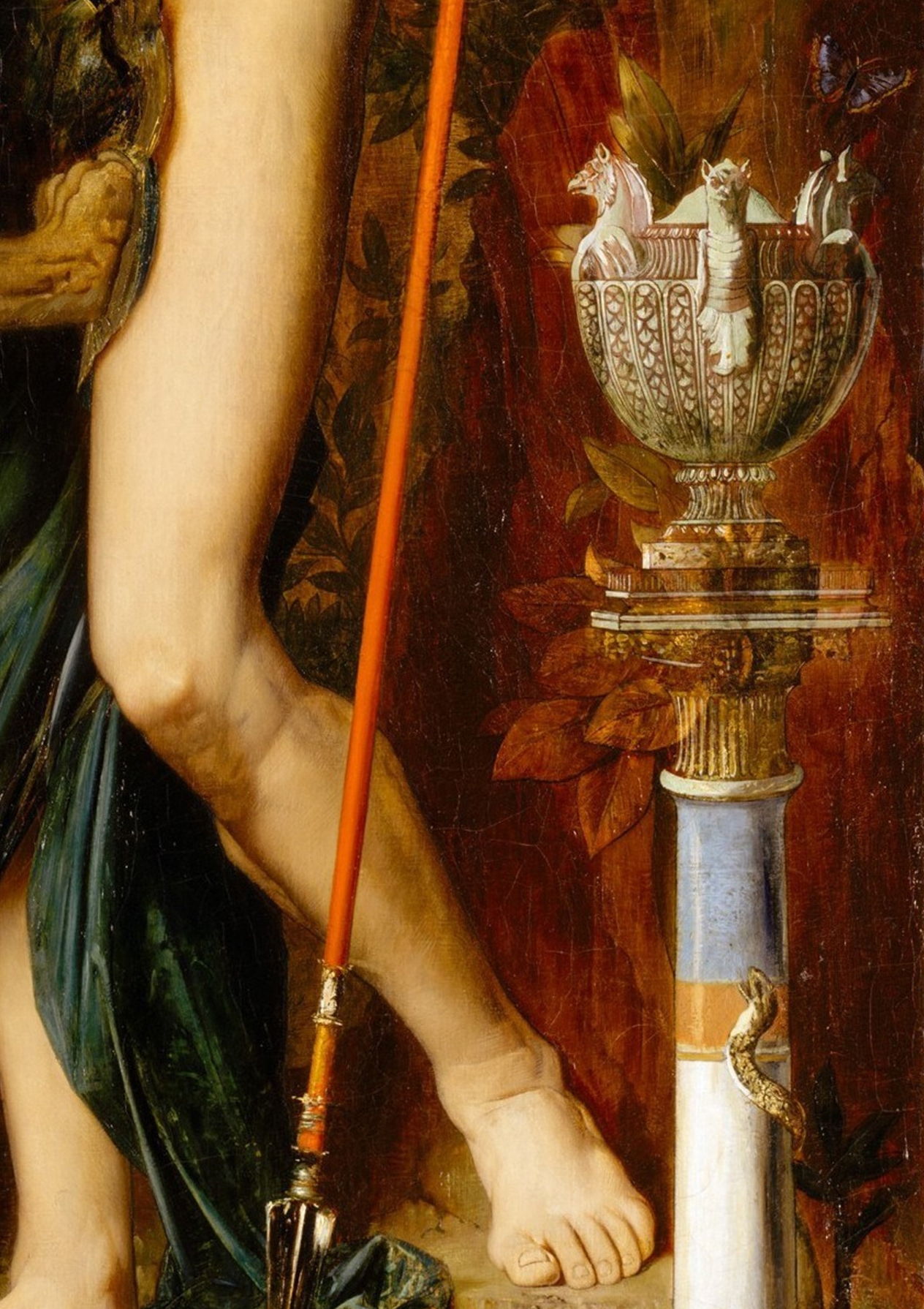
Gustave Moreau (1826–1898), Oedipus and the Sphinx (detail) (1864), oil on canvas, 206.4 x 104.8 cm, The Metropolitan Museum of Art (Bequest of William H. Herriman, 1920), New York, NY. Courtesy of The Metropolitan Museum of Art, via Wikimedia Commons.
Around this central narrative core, Moreau feeds us symbolic morsels to supplement that main course without supplanting it. Behind Oedipus is a bay tree, sacred to Apollo, representing man’s highest achievements; behind the sphinx is a fig tree, a traditional symbol of sin. The small polychrome column at the right is topped by a cinerary urn, symbolising death, and above it is a butterfly, representing the soul. Ascending the column is a snake, again associated with death, and through the biblical serpent, with sin.
Moreau’s bold move worked, as Oedipus and the Sphinx took the Salon of 1864 by storm, winning him a medal. The following year, he tried to consolidate that success with Jason.
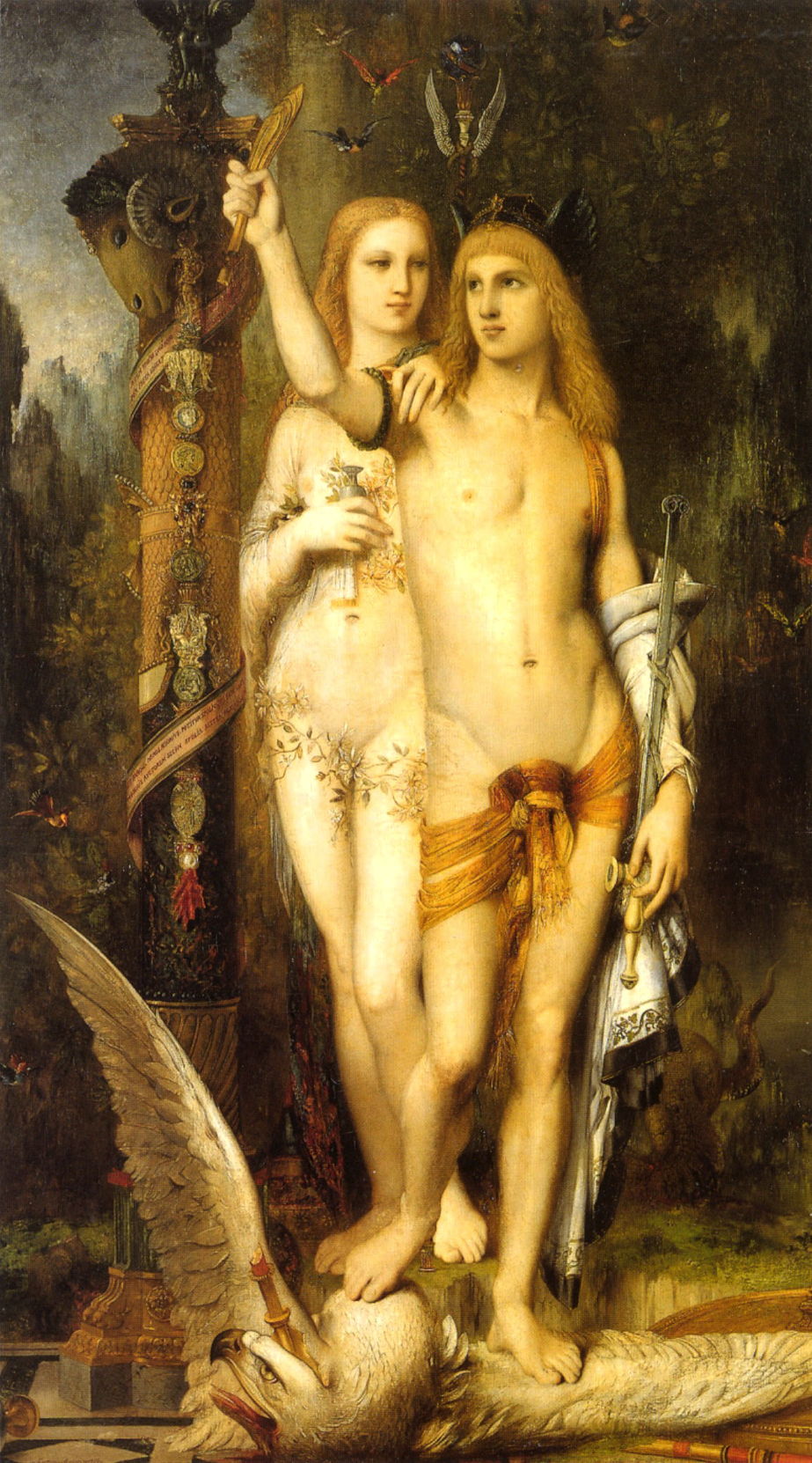
Gustave Moreau (1826–1898), Jason (1865), oil on canvas, 204 × 115 cm, Musée d’Orsay, Paris. Wikimedia Commons.
The name Jason refers, of course, to Jason of Golden Fleece and Argonauts fame, a series of swashbuckling adventures offering ample opportunities for theatrical narrative painting. Moreau avoids them all, and shows us a static Jason, with Medea stood behind him, not a Golden Fleece in sight. Instead of providing narrative, the artist offers us symbols as clues to what might be going on.
The broad outline of Jason’s story is simple. When he reached Colchis, he underwent a series of trials imposed by King Aeëtes, culminating in his victory over the dragon guarding the Golden Fleece. These were accomplished with the help of Medea, the King’s daughter, in return for a promise of marriage.
The almost naked woman behind Jason is Medea, the sorceress who has fallen in love with the hero. The ram’s head at the top of the pillar on the left signifies the Golden Fleece, and the dragon which guarded it is shown as the eagle on which Jason is standing, with the broken tip of his javelin embedded in it. This is the more confusing, as in the original story the dragon was put to sleep by one of Medea’s potions, rather than being killed with a javelin.
Yet Medea holds a vial in her right hand, and her body is swathed with the poisonous hellebore plant, a standard tool of witchcraft. These may allude to Jason’s future rejection of Medea and her poisoning of his replacement bride, but there is a lot of story between this moment and that later episode, so that is speculative and hardly clarified by the painting.
Moreau provided some clues to his intentions in this painting, in the almost illegible inscriptions on the two phylacteries wound around the column. These bear the Latin: nempe tenens quod amo gremioque in Iasonis haerens
per freta longa ferar; nihil illum amplexa timebo
(Nay, holding that which I love, and resting in Jason’s arms, I shall travel over the long reaches of the sea; in his safe embrace I will fear nothing) et auro heros Aesonius potitur spolioque superbus
muneris auctorem secum spolia altera portans
(And the heroic son of Aeson [i.e. Jason] gained the Golden Fleece. Proud of this spoil and bearing with him the giver of his prize, another spoil)
(Cooke, pp 55-56.)
These could be interpreted as suggesting that the painting should be read in terms of the conflict between Jason and Medea: Medea expresses her subjugate trust in him, while Jason considers her to be just another spoil won alongside the Golden Fleece. More puzzling is the spattering of other details, of hummingbirds, the sphinx on top of the pillar, medals decorating the shaft of that pillar, and more. Some appear merely to be decorative, but drawing the line between the decorative and the symbolic is impossible.
The end result in Jason is almost the opposite of Oedipus and the Sphinx: the latter consists of a clear narrative lightly embellished with symbols, the former relies on the interpretation of symbols to construct any narrative; as those symbols conflict with the original narrative, the viewer can readily become bewildered.
The 1865 Salon didn’t provide the consolidation for which Moreau had hoped, although much of that was the result of an accident of history: dominating all discussion that year was another painting, Manet’s Olympia. He needed to do better in 1866 if he wasn’t going to slip back into obscurity.
Gustave Moreau (1826–1898), Orpheus (1865), oil on panel, 154 × 99.5 cm, Musée d’Orsay, Paris. Wikimedia Commons.
In Moreau’s Orpheus (1865) a sombrely-dressed Thracian woman holds Orpheus’ lyre, on which rests his head, blanched in death, as if affixed to the lyre like the head of a hunting trophy. Her eyes are closed in reverie.
One version of the legend of Orpheus’ death holds that his head and lyre were borne by the river Hebrus, which is shown in the background landscape to the right. Again, though, Moreau pursues his own adjusted version of the written narrative, as according to that account (in Ovid’s Metamorphoses, book 11), the head and lyre were washed up on the coast of Lesbos.
Orpheus adopts a unified tonality, colour, form, character, and style that could be viewed as a ‘mode’, as conceived by Nicolas Poussin. The gentle and natural beauty of the Thracian woman, her ornate clothes, flowers, and the strange beauty of Orpheus’ head on the lyre contrast with a harsh and barren landscape, which might have been more appropriate in a Renaissance painting, perhaps by Leonardo da Vinci.
Moreau has carefully avoided elaborate symbols and decoration, although he has left us two further puzzles at the painting’s corners: the three figures, apparently shepherds, on the rocks at the upper left, and a pair of tortoises at the lower right. The figures refer to music, which seems in keeping with Orpheus and his lyre, but the significance of the tortoises is open to speculation.
Gustave Moreau (1826–1898), Orpheus (detail) (1865), oil on panel, 154 × 99.5 cm, Musée d’Orsay, Paris. Wikimedia Commons.
What Moreau lost in the absence of narrative, this painting gained in its remarkable tranquillity. Two faces, eyes closed, (don’t) look at one another. The intricate decoration of the lyre seems unified with the Thracian woman’s clothing, even the coiled braids of her hair. Although one of his most profoundly beautiful and moving paintings, this failed to impress the Salon.
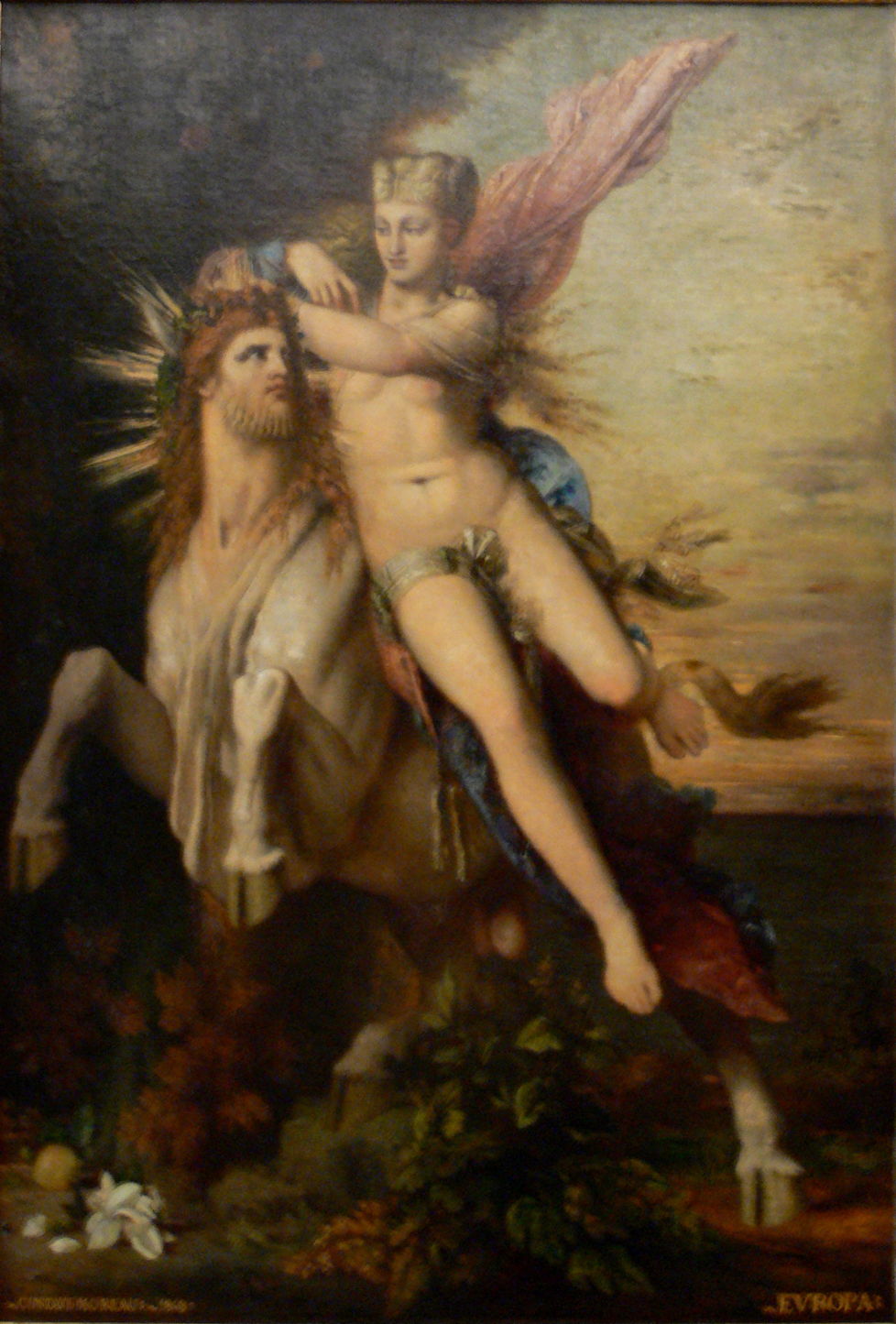
In 1868-9 he turned to one of the most frequently painted stories from Greek mythology, that of the abduction and rape of Europa. She was the mother of King Minos of Crete, and the story of Cretan origin; the bull was the main sacred animal in Crete. Zeus (Jupiter to the Romans), a notorious ravisher of women, lusted after the beautiful Europa. He therefore metamorphosed himself into a white bull, and hid among Europa’s father’s herd in Phoenicia. When Europa and other maidens came to gather flowers near this herd, she saw the white bull, caressed it, and climbed onto its back.
Zeus then ran to the sea and swam with Europa on his back until they reached the shores of Crete. There he revealed himself, and Europa became the first queen of the island. He gave her in return a necklace, Talos (a giant bronze automaton who protected Crete by circling its shores), Laelaps (an unfailing hunting dog), and a javelin that always struck its target.
Almost universally, previous depictions of this myth have shown the start of the abduction, from the pastures of Phoenicia to the bull heading off to sea. Moreau’s white bull, with Europa riding a precarious side-saddle, has just emerged from the sea, so is presumably now on the island of Crete.
Gustave Moreau (1826–1898), Jupiter and Europa (1868-9), oil on canvas, 175 x 130 cm, Musée National Gustave-Moreau, Paris. Wikimedia Commons.
The finished work, known as Jupiter and Europa (1868-9) (I apologise for the lack of sharpness in this image) but titled Europa, shows the bull with a human head, presumably as Zeus has revealed himself to Europa. The head of Zeus recalls those of sculptures of Assyrian kings.
It’s hard to see what Moreau brought in terms of originality to this well-worn motif, and the critics drew comparison with Veronese rather than Titian. Either way, this seems to be a painting in search of a reason, and the Salon agreed. As there was now a small but dedicated group of collectors who were prepared to purchase his paintings, Moreau decided to withdraw from exhibiting at the annual Salon.
In the Franco-Prussian War, Moreau joined the National Guard, and served in the defence of Paris in the autumn of 1870, besieged there with his mother. Over the winter his left shoulder and arm became immobile because of ‘rheumatism’, but he remained in the city. Finally, during the Commune in the spring of 1871, he defended the paintings he had amassed in his home, and watched his late friend Chassériau’s murals in the Cour des Comptes being destroyed by fire. He spent that summer recovering in the spa at Néris-les-Bains in the Auvergne.
References
Cooke P (2014) Gustave Moreau, History Painting, Spirituality and Symbolism, Yale UP. ISBN 978 0 300 20433 9.
Mathieu P-L (1998, 2010) Gustave Moreau, the Assembler of Dreams, PocheCouleur. ISBN 978 2 867 70194 8.
The crusaders led by Godfrey of Bouillon desperately need Rinaldo back if they are to resume their assault on Jerusalem. Guelph’s party, notably the knights Charles (Carlo) and Ubaldo, have gone in search of him. But Rinaldo has been lured into a trap by the sorceress Armida, who intended to kill him. At the last moment, though, she falls in love with him and abducts him in her chariot.
That flies the couple to the distant, deserted and enchanted Fortunate Isles, where she lives in her garden that is perpetually in Spring. The wizard explains this to Charles and Ubaldo, to aid them in their mission to rescue the knight.
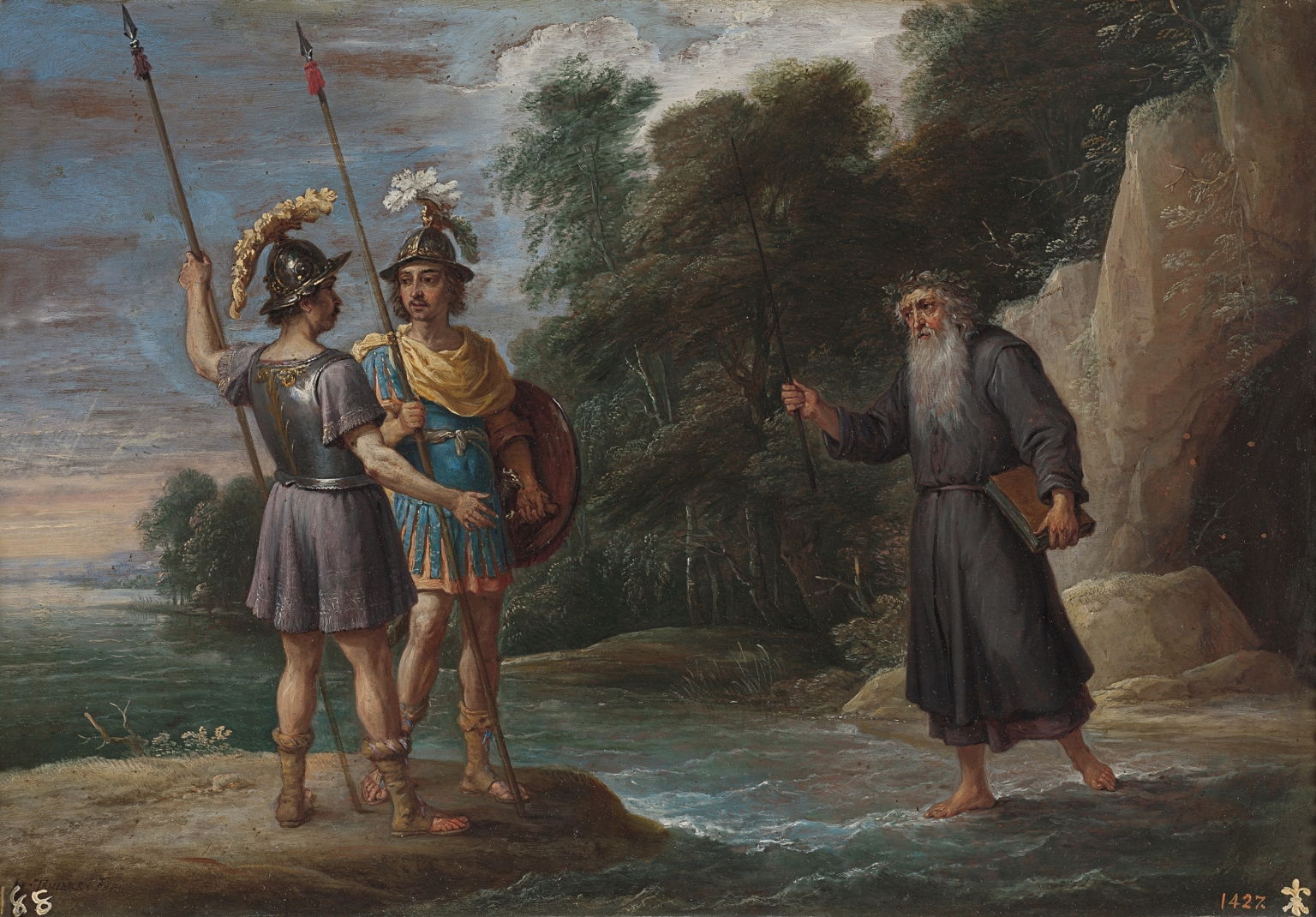
David Teniers the Younger (1610–1690), The Magician Shows Carlos and Ubaldo the Whereabouts of Rinaldo (The search for Rinaldo) (1628-30), oil on copper, 27 x 39 cm , Museo Nacional del Prado, Madrid, Spain. Wikimedia Commons.
David Teniers the Younger’s The Magician Shows Carlos and Ubaldo the Whereabouts of Rinaldo (The search for Rinaldo) from 1628-30 is a small oil on copper painting in his series telling this section of Tasso’s epic. Here the wizard despatches the two knights to the Fortunate Isles.
At the start of canto fifteen, Charles and Ubaldo set off to retrace their steps with the wizard as their guide. The river takes them gently down to the sea, where a ship awaits. They board, and sail at miraculous speed past Ascalon and the mouths of the River Nile, westward through the Mediterranean, and through the Pillars of Hercules into the Atlantic Ocean. They eventually approach the Fortunate Isles, pull into a harbour, and the two knights disembark.
They spend the night at the foot of the mountain they have to climb to reach Armida’s garden with the captive Rinaldo. They set off at dawn, only to encounter their first obstacle: a fearsome dragon blocking their passage up the mountain. Charles draws his sword ready to slay the dragon, but Ubaldo waves a golden wand, a gift of the wizard, which drives it away.
Nicolas Poussin (1594–1665), The Companions of Rinaldo (c 1633-4), oil on canvas, 119 x 101 cm, The Metropolitan Museum of Art, New York, NY. Wikimedia Commons.
Poussin’s The Companions of Rinaldo (c 1633-4) shows the two knights confronting this dragon. Charles stands in the centre with his sword ready, but Ubaldo behind him leaves his weapon in its scabbard and brandishes his golden wand instead. In the background at the left is the magic ship in which they sailed, and standing in its prow is the maiden who steered it.
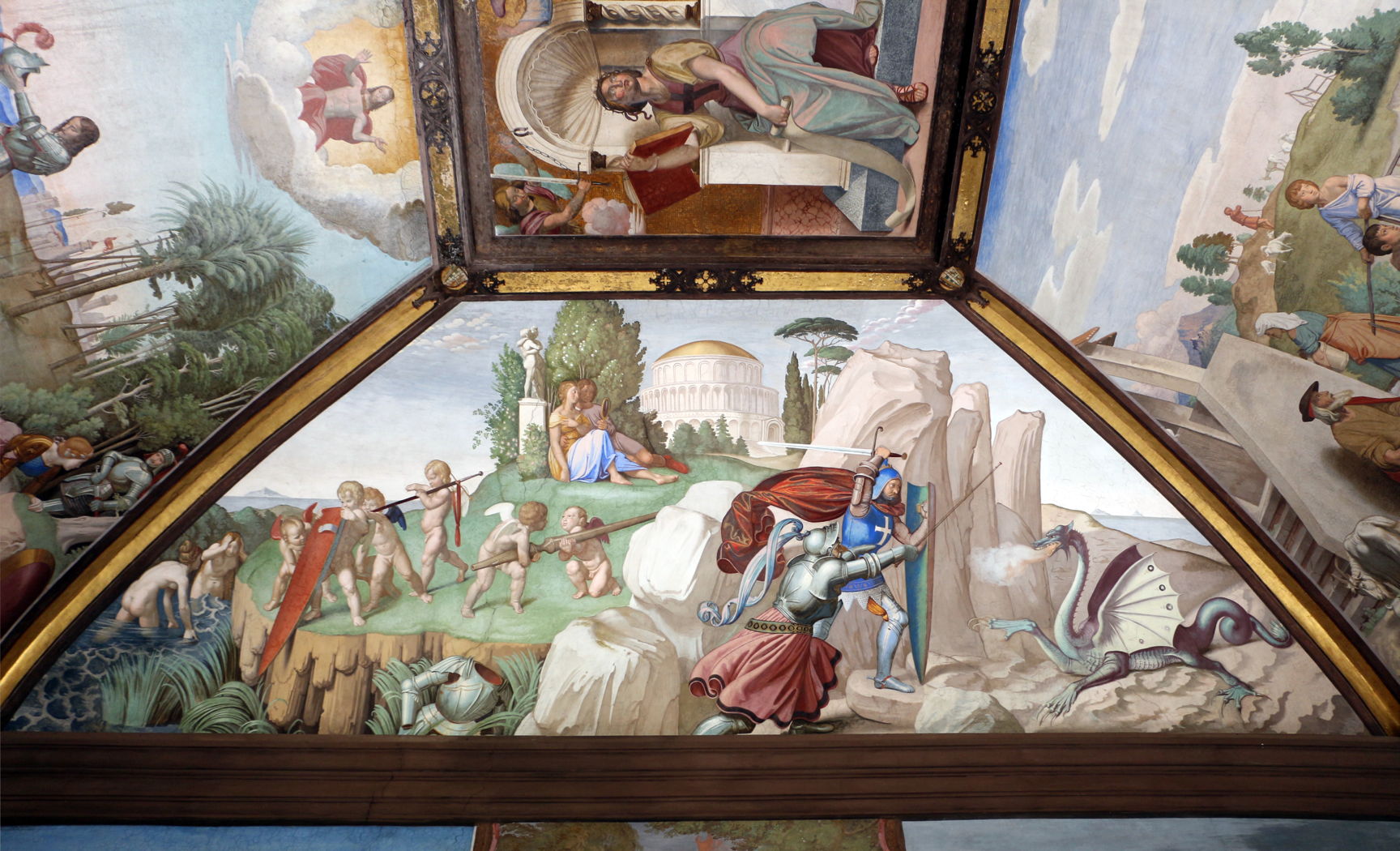
Johann Friedrich Overbeck (1789-1869), Ubaldo and Carlo free Rinaldo from Armida’s Castle (1819-27), fresco, dimensions not known, Casa Massimo, Rome, Italy. Image by Sailko, via Wikimedia Commons.
Johann Friedrich Overbeck’s fresco of Ubaldo and Carlo free Rinaldo from Armida’s Castle from 1819-27, in the Casa Massimo, Rome, shows an interesting composite scene. To the right of centre, Charles and Ubaldo wield their sword and wand, and in the distance are Armida and Rinaldo in the garden on the summit. Amorini are playing with Rinaldo’s weapons, and his empty suit of armour has been cast into the undergrowth.
Next the pair have to face a lion, which is similarly dismissed with a wave of the wand. After that comes an army of animals they disperse readily, and Charles and Ubaldo are on the ascent towards the stretch of snow and ice they must cross before reaching Armida’s eternal Spring. Once up at the top, the two knights pause from their strenuous climb, slaking their thirst in a mountain stream. Grassy banks either side of the stream have a fine banquet laid out on them, and there are two naked young women cavorting in the water.
David Teniers the Younger (1610–1690), Carlos and Ubaldo in The Fortunate Isles (1628-30), oil on copper, 27 x 39 cm, Museo Nacional del Prado, Madrid, Spain. Wikimedia Commons.
David Teniers the Younger’s Carlos and Ubaldo in The Fortunate Isles (1628-30) shows this moment, with the banquet laid out on a clean white tablecloth rather than grass. Surrounded by trees and standing proud on the skyline is Armida’s palace, their destination.
Charles-Alexandre Coëssin de la Fosse (1829–1910), Danish Warriors in the Garden of Armida (1848), others detail unknown, but believed to be oil on canvas and the original in colour. By Salon 1913, via Wikimedia Commons.
I only have this monochrome image of Charles-Alexandre Coëssin de la Fosse’s painting of Danish Warriors in the Garden of Armida from 1848. The two knights are dallying rather longer than their mission had intended.
Once Charles and Ubaldo can tear themselves away from these nymphs, they press on to the circular outer wall of the palace, which opens the sixteenth canto as they enter Armida’s garden.
Édouard Muller (1823-1876), The Garden of Armida (1854), block-printed wallpaper, 386.1 x 335.3 cm, Philadelphia Museum of Art, Philadelphia, PA. Wikimedia Commons.
In the eighteenth and nineteenth centuries, Armida’s garden appeared on all manner of products. This wallpaper designed by Édouard Muller in 1854 is now in the Philadelphia Museum of Art, while smaller images appeared on coffee cups and much else.
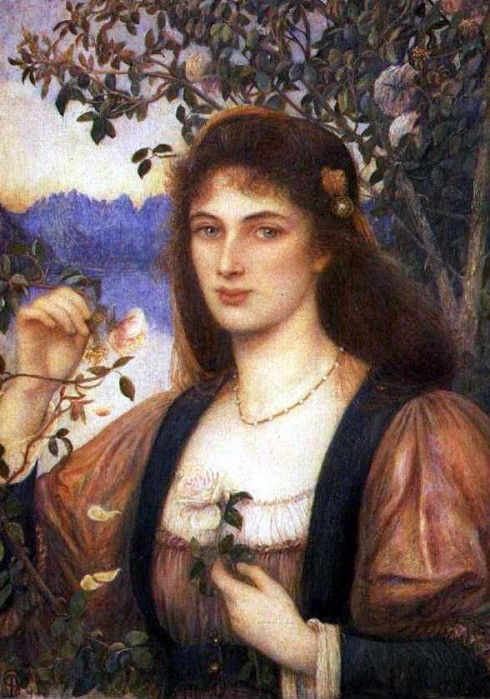
Tasso gives a brief description of the garden with its figs, apples and grape vines. Birds sing, and the wind murmurs softly. One bird speaks to the two knights, telling of the chaste and modest rose flower that springs virgin from its green leaves.
Marie Spartali Stillman (1844–1927), A Rose in Armida’s Garden (1894), watercolour and graphite on paper, 64.8 x 43.2 cm, Private collection. Wikimedia Commons.
This passage about the rose was the inspiration for Marie Spartali Stillman’s exquisite watercolour of A Rose in Armida’s Garden from 1894, given by the artist as a wedding gift to a family friend.
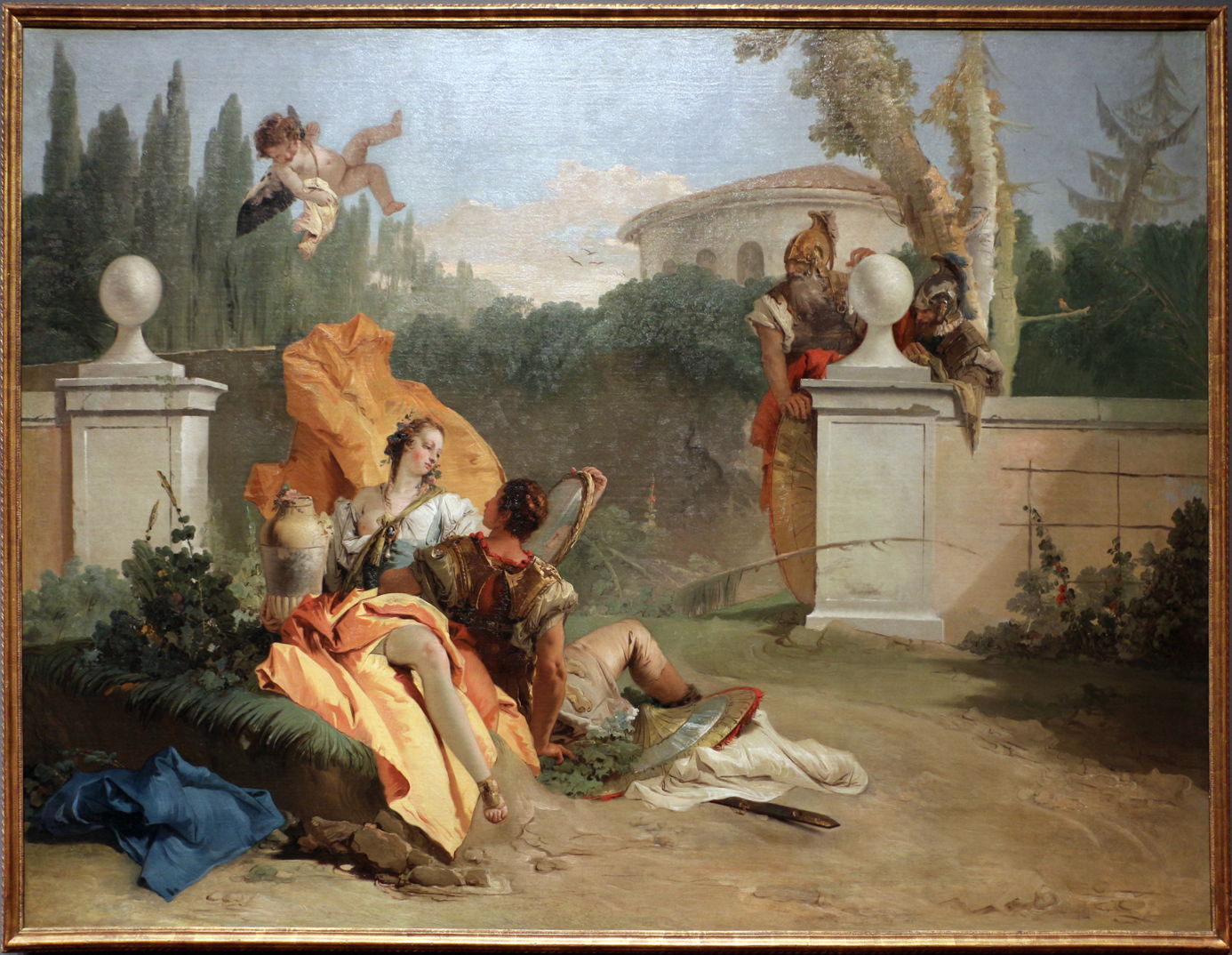
Charles and Ubaldo then peer through the leaves and spot a loving couple, who they presume to be Rinaldo and Armida. The knight’s head rests in Armida’s lap. He then stands up and takes a crystal glass hanging at his side. Armida uses this as a mirror to adjust her hair, telling Rinaldo to keep looking into her eyes.
Giovanni Battista Tiepolo (1696–1770), Rinaldo and Armida in Her Garden (1742-45), oil on canvas, 187 x 260 cm, The Art Institute of Chicago, Chicago, IL. Image by Sailko, via Wikimedia Commons.
Tiepolo paints this clearly in his Rinaldo and Armida in Her Garden from 1742-45, now in The Art Institute of Chicago. It was originally hung in a special room dedicated to Tasso’s epic in the Palazzo Corner a San Polo in Venice, where it belonged to the noble Serbelloni family.
Angelica Kauffman (1741–1807), Rinaldo and Armida (1771), oil on canvas, 130.8 x 153 cm, Yale Center for British Art, New Haven, CT. Wikimedia Commons.
In Angelica Kauffman’s Rinaldo and Armida from 1771, the crystal glass is ready at Armida’s feet, and she is busy distracting him by sprinkling flowers over his head.
Francesco Hayez (1791–1881), Rinaldo and Armida (1812-13), oil on canvas, dimensions not known, Gallerie dell’Accademia, Venice, Italy. Wikimedia Commons.
Francesco Hayez shows a variation in his Rinaldo and Armida from 1812-13. Anticipating the next part of Tasso’s narrative, instead of Rinaldo wearing the crystal glass at his side, his circular shield rests on the ground next to Armida. Charles and Ubaldo are shown peering from behind a tree trunk, safely in the distance.
Armida then kisses Rinaldo goodbye and leaves. Charles and Ubaldo see their opportunity and step out from the bushes, dressed in full armour. Ubaldo holds a highly polished shield up so that Rinaldo can see himself for what he has become, a woman’s dandy, not a warrior knight.
Thomas Asbridge (2004) The First Crusade, A New History, Free Press, ISBN 978 0 7432 2084 2.
Anthony M Esolen, translator (2000) Torquato Tasso, Jerusalem Delivered, Gerusalemme Liberata, Johns Hopkins UP. ISBN 978 0 801 863233. A superb modern translation into English verse.
John France (1994) Victory in the East, a Military History of the First Crusade, Cambridge UP. ISBN 978 0 521 589871.
Joanthan Riley-Smith, ed (1995) The Oxford Illustrated History of the Crusades, Oxford UP. ISBN 978 0 192 854285.
Jonathan Riley-Smith (2014) The Crusades, A History, 3rd edn., Bloomsbury. ISBN 978 1 4725 1351 9.
Johathan Unglaub (2006) Poussin and the Poetics of Painting, Pictorial Narrative and the Legacy of Tasso, Cambridge UP. ISBN 978 0 521 833677.
In the middle of the night following the crusaders’ first major assault on the city of Jerusalem, Clorinda had burned their siege towers down. Tancred then mortally wounded her in a fight before realising who she was, but baptised her just before she died in his arms.
The wounded Tancred feels disgust at his killing of Clorinda, and the pair are carried back to his tent. In spite of his injuries, he makes his farewell to her corpse. She later appears to him in a dream and his emotions are reconciled following her burial.
Canto thirteen returns to the siege, and the crusaders’ need to replace their wooden towers. Ismen visits the ancient wood that’s the closest source of timber, and casts a spell to prevent any more of its trees from being felled. He then reassures Aladine that he is safe, particularly as he forecasts the weather is set to turn very hot and dry, and advises Aladine he should sit tight in the city rather than try to force an end to the siege as Argante wants.
Godfrey wants to rebuild his siege towers quickly, before the defenders of Jerusalem have had time to repair the damage to the city’s defences. He dispatches men to the woods to cut down the timber required for the new towers, but they’re now repelled by the bewitched trees. Godfrey sends troops on three successive days, but each time they’re driven out by the dire effects of Ismen’s spell.
Finally, Tancred, recovered from his wounds, plucks up courage and enters the enchanted wood. He feels no ill-effects, and makes his way to its centre, where there’s a cryptic inscription written on an ancient tree. The trees then speak to him, claiming to be the spirit of Clorinda and others, warning him not to try cutting any of them down. Tancred reports this to Godfrey, who turns to other plans.
As Ismen had forecast, the weather becomes unrelentingly hot and dry. Even the nights remain hot, and crusaders are dying as a result. The nearby stream of Siloa, which had been a major supply of water, dries up, and there are deaths from dehydration. Morale collapses, with many of the crusaders questioning Godfrey’s inaction. The remaining Greeks desert and start their journey home. Godfrey prays for divine assistance and succeeds with a torrential rainstorm and the return to more comfortable conditions at last.
Canto fourteen opens with nightfall, when at last the cooler conditions enable everyone to sleep properly again. Godfrey has a vision in which he is told to recall Rinaldo from his self-imposed exile, and to absolve him from his error. No sooner does Godfrey awake the following morning than Guelph asks him for Rinaldo’s pardon, in the hope that the knight will be brave enough to overcome Ismen’s spell and cut wood to build their siege towers.
Godfrey agrees, leaving Guelph and a team of volunteers to locate and recover the missing knight. As the group are discussing where to look, Peter the Hermit interrupts and advises them to travel to Ascalon, and to ask the man they meet there.
When they reach Ascalon, a wizard with a white beard, beech crown and wand tells them to follow him as their guide. He takes them into hidden caves beneath a stream, where they see the sources of the great rivers of the world, set in a huge cavern whose walls are speckled with jewels. The wizard tells them this is the womb of the earth. He then reveals what happened to Rinaldo after he had freed the other knights who had been made captive by Armida, and how Rinaldo’s armour came to be made to look as if the knight had been killed.
Armida had been waiting for Rinaldo at the ford on the river Orontes. When he arrived, he found a column with an inscription that enticed him to go further, leaving his esquires behind as he boarded a boat. He then came to an island that appeared deserted, so decided to rest there, and put his helmet down beside him.
A little later, he heard a sound from the river, and spied a beautiful woman emerging naked from the water. She sang a song that lulled Rinaldo to sleep, then came over intending to kill him. But when she saw him breathing gently in his sleep, her anger melted away and she fell in love with him instead. She then put garlands of flowers around his neck, arms and feet that she had bewitched to act as bonds, had him lifted into her chariot, and abducted him.
This remarkable turn of events has been a favourite among painters, and a particular challenge to depict in a single image. As a classical example of what Aristotle in his Poetics refers to as peripeteia, it has led to some superb narrative paintings.
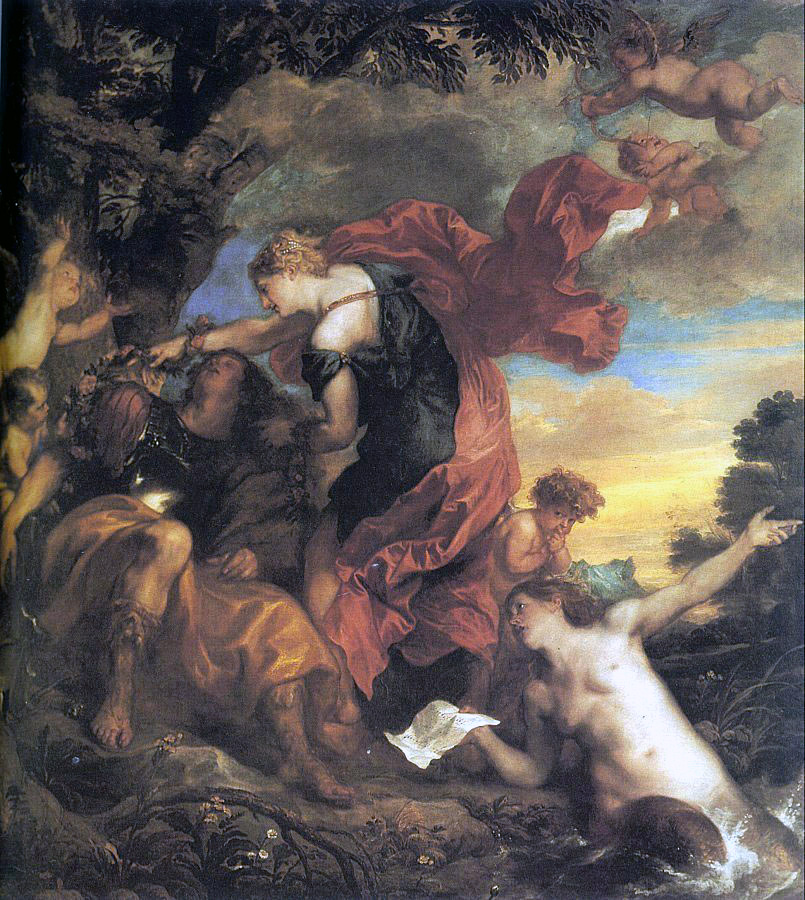
Anthony van Dyck (1599–1641), Rinaldo and Armida (1629), oil on canvas, 235.3 x 228.7 cm, Baltimore Museum of Art, Baltimore, MD. Wikimedia Commons.
In Anthony van Dyck’s Rinaldo and Armida of 1629, the key elements of the couple and attendant symbolic amorino are enriched by a second woman with non-human legs still immersed in the river and clutching a sheet of paper, and additional amorini. Armida appears unarmed but starting to bind him with garlands, and it’s possible the letter represents her commission to murder him, which the woman in the water, perhaps a nymph, is reminding her about.
Nicolas Poussin (1594–1665), Rinaldo and Armida (c 1630), oil on canvas, 82.2 x 109.2 cm, Dulwich Picture Gallery. Wikimedia Commons.
The most brilliant account to date is Nicolas Poussin’s justly famous Rinaldo and Armida from about 1630.
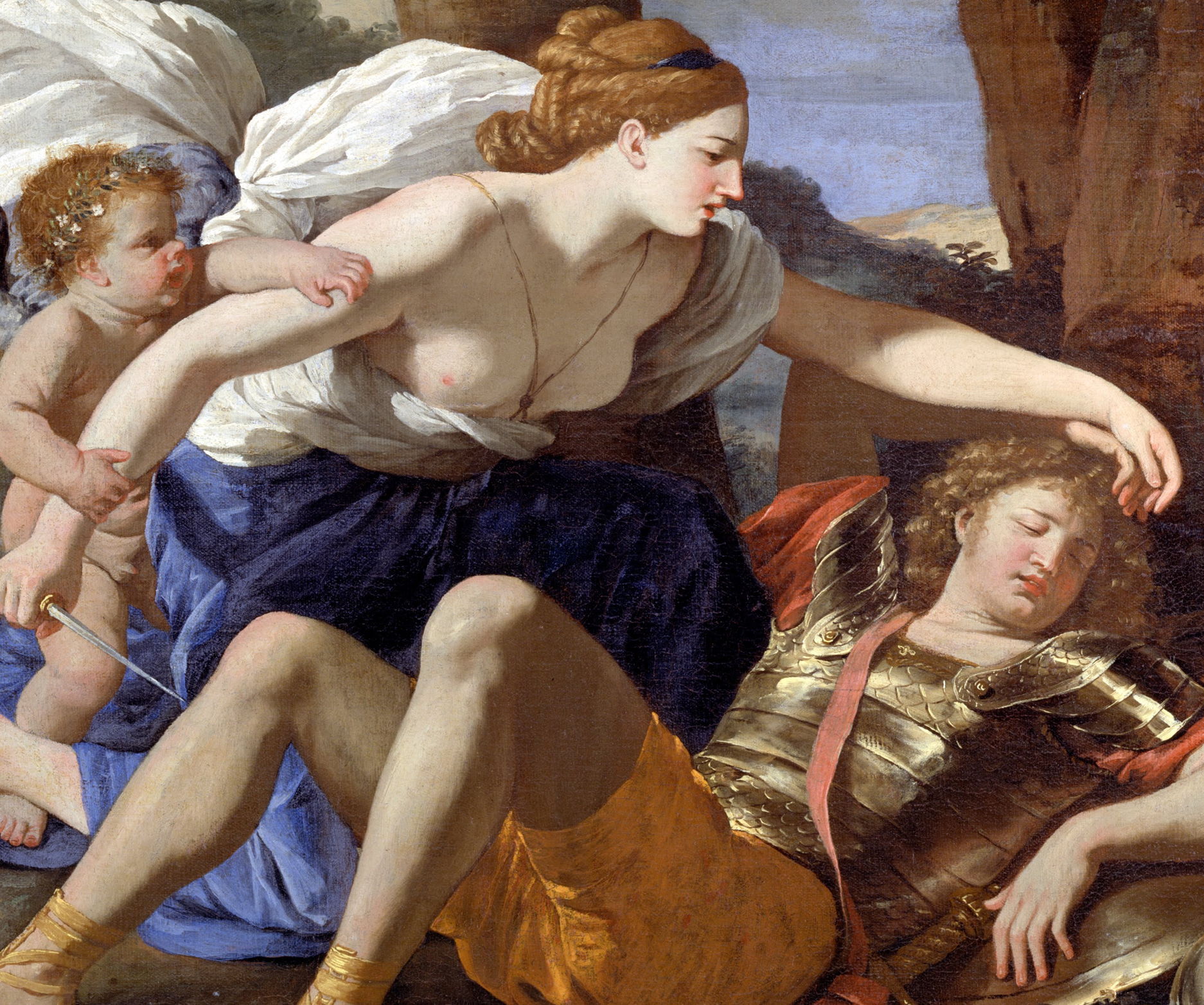
Nicolas Poussin (1594–1665), Rinaldo and Armida (detail) (c 1630), oil on canvas, 82.2 x 109.2 cm, Dulwich Picture Gallery. Wikimedia Commons.
There are two distinctive elements within Poussin’s depiction, Armida’s facial expression, and her posture, particularly the conflict between her arms. Armida’s expression is key to understanding the narrative, as she is perplexed, in a quandary, unsure whether to kill or kiss the young knight. Armida’s right hand represents her original intent, to murder him with her dagger, an action the amorino is trying to stop. Her left hand, though, reaches down to touch his hand in a loving caress. Poussin manages to tell us what she had intended to do in the immediate past, and what she is going to do next in the future: three moments in time conveyed in a single image.
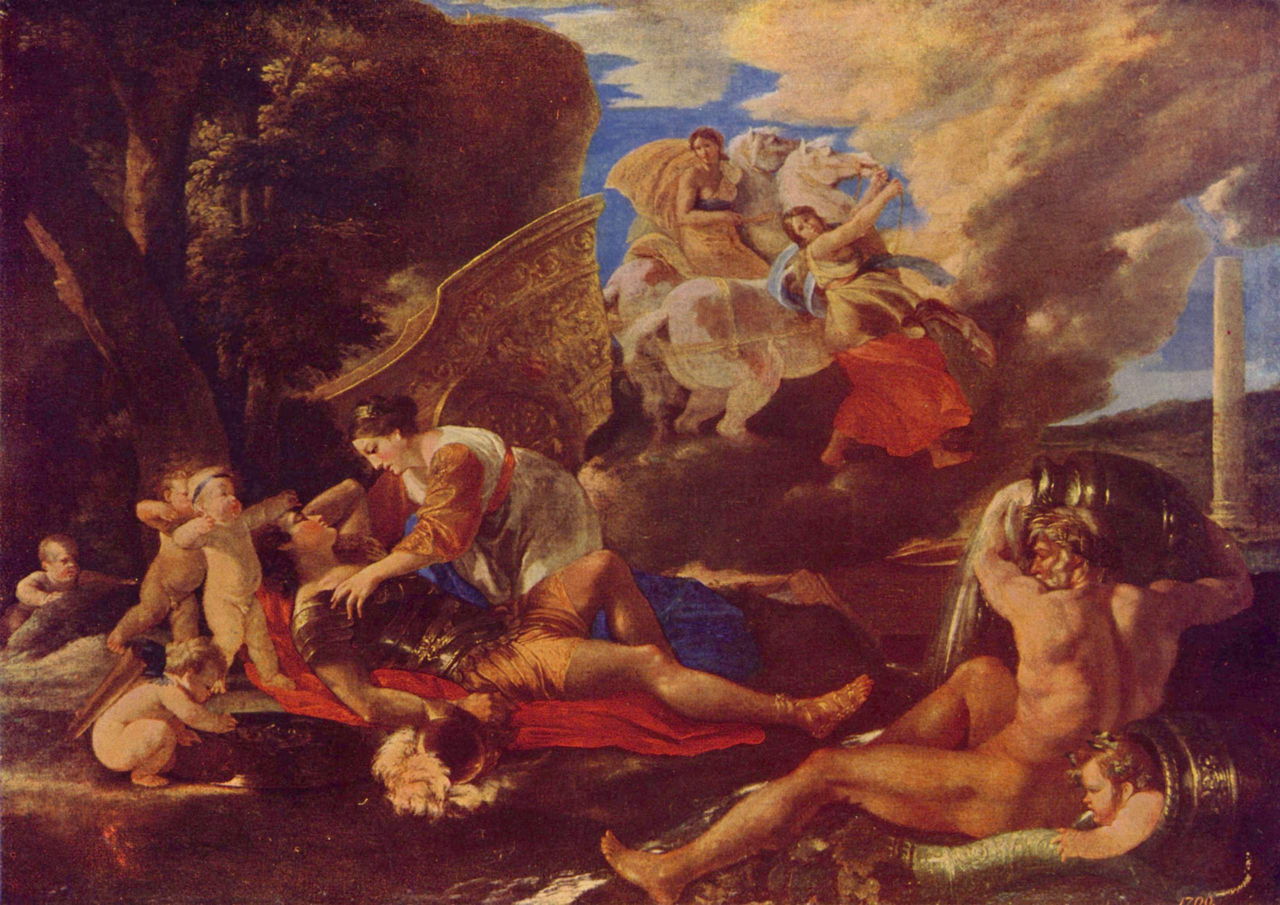
Nicolas Poussin (1594–1665), Rinaldo and Armida (c 1635), oil on canvas, 95 × 133 cm, Pushkin Museum, Moscow. Wikimedia Commons.
Poussin’s Rinaldo and Armida (c 1635) is a later and more explicit version of this same episode, in which Armida is falling in love with Rinaldo. There are many amorini who seem less engaged in the action. A river-god pours his river from a pitcher. In the background, Armida’s chariot is already prepared for the abduction of Rinaldo.
Sebastiano Conca (1680–1764) (attr), Rinaldo and Armida (c 1725), oil on canvas, 99.1 × 135.9 cm, Saint Louis Art Museum, St. Louis, MO. Wikimedia Commons.
Sebastiano Conca’s Rinaldo and Armida from about 1725 is a return to simpler composition, based on a central triangle, and content. Armida is drawing her sword, and looking pensive, as the sole amorino reaches from above to intervene.
Giovanni Battista Tiepolo (1696–1770), Rinaldo Enchanted by Armida (1742-45), oil on canvas, 187.5 x 216.8 cm, Art Institute of Chicago, Chicago, IL. Wikimedia Commons.
Tiepolo’s Rinaldo Enchanted by Armida (1742-45) is another permutation of the elements in Tasso’s story. Armida has already brought her enchanted flying chariot, in which there is another woman, perhaps Venus herself, with an accompanying amorino. Armida is almost undressed and unarmed, and her facial expression is more of unhappy pleading than internal conflict, while her female companion appears cold and unaffected.
Jean-Honoré Fragonard (1732–1806), Rinaldo and Armida (c 1760-65), oil on canvas, 221.5 x 256.5, National Gallery of Armenia, Yerevan, Armenia. Wikimedia Commons.
Fragonard’s Rinaldo and Armida from 1760-65 is another elaborate painting with an abundance of amorini. Armida’s right hand clutches a dagger, and is restrained by two of the amorini, although it’s hard to determine her facial expression.
With Guelph’s party searching for Rinaldo, Armida now whisks him away in her chariot, still fast asleep, and unaware of what’s in store for him.
Thomas Asbridge (2004) The First Crusade, A New History, Free Press, ISBN 978 0 7432 2084 2.
Anthony M Esolen, translator (2000) Torquato Tasso, Jerusalem Delivered, Gerusalemme Liberata, Johns Hopkins UP. ISBN 978 0 801 863233. A superb modern translation into English verse.
John France (1994) Victory in the East, a Military History of the First Crusade, Cambridge UP. ISBN 978 0 521 589871.
Joanthan Riley-Smith, ed (1995) The Oxford Illustrated History of the Crusades, Oxford UP. ISBN 978 0 192 854285.
Jonathan Riley-Smith (2014) The Crusades, A History, 3rd edn., Bloomsbury. ISBN 978 1 4725 1351 9.
Johathan Unglaub (2006) Poussin and the Poetics of Painting, Pictorial Narrative and the Legacy of Tasso, Cambridge UP. ISBN 978 0 521 833677.
As with many items of clothing, the term hood is applied to a wide range of garments. For the purposes of this selection of paintings, I confine it to a shaped covering for the head that is part of a garment also covering at least part of the upper body. This includes the cowl integrated into the robes of many monks, and the hooded cape known as a chaperon, described below. It would also include the modern hoodie that became popular in the 1970s.
Hoods are commonly worn by figures associated with death, such as the Grim Reaper, where they provide sinister concealment of the face.
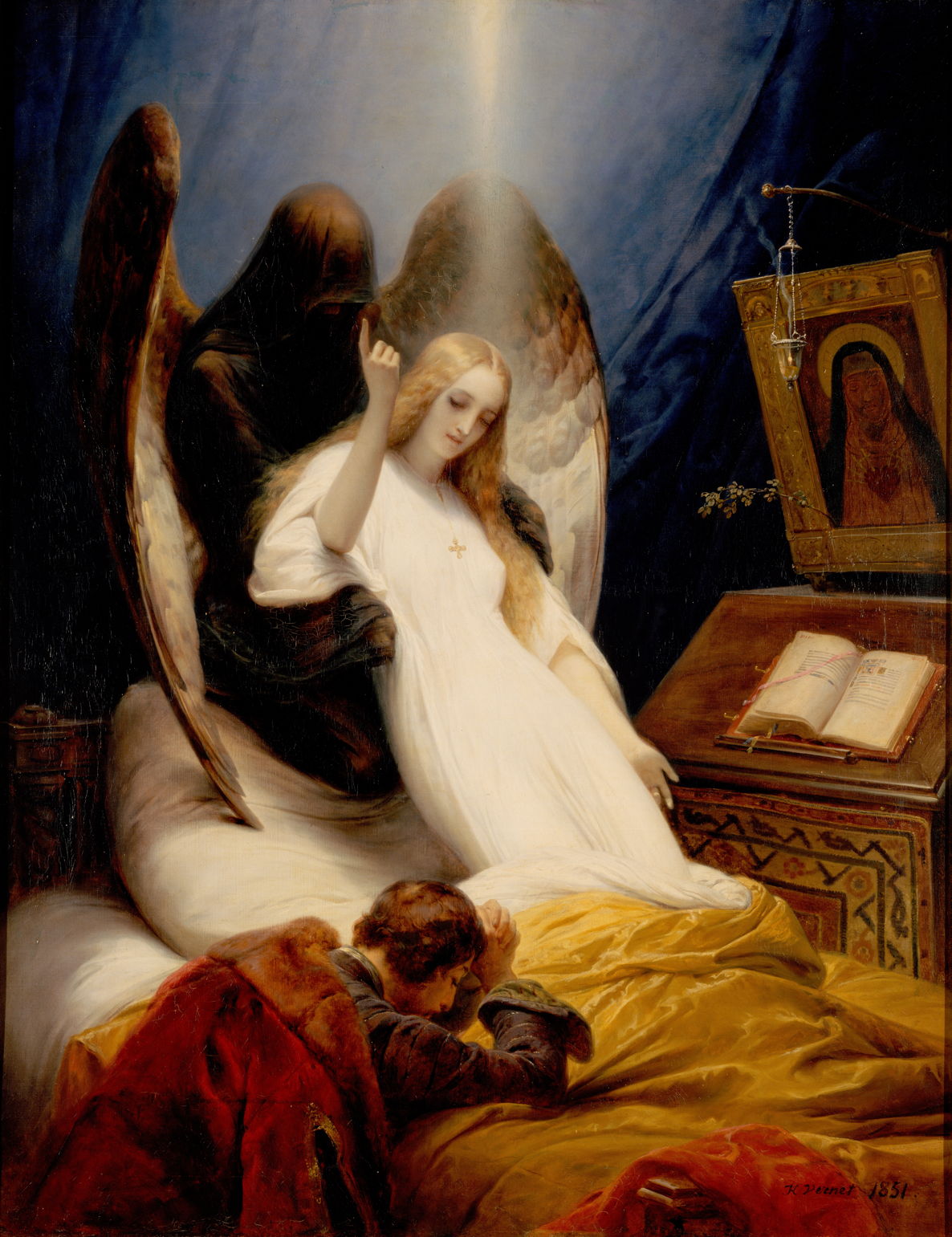
Horace Vernet (1789–1863), The Angel of Death (1851), oil on canvas, 146 x 113 cm, The Hermitage Museum, St. Petersburg, Russia. Wikimedia Commons.
In Horace Vernet’s The Angel of Death from 1851, a young man is praying over the side of a bed, kneeling, his hands clasped together. Opposite him, an illuminated Bible is open, above that an icon hangs on the wall, there’s a sprig of flowers, and a flame burns in prayer. But the occupant of the bed, a beautiful young woman, is being lifted out of it. Her right hand is raised, its index finger pointing upwards to heaven. Behind her, the Angel of Death, the outer surface of its wings black, and clad in long black robes, its face concealed beneath a hood, is lifting her out, to raise her body up towards the beam of light shining down from the heavens.
Cowls are a common feature of the robes worn by hermits as well as monks.
Hieronymus Bosch (c 1450–1516), Saint Wilgefortis Triptych (detail) (c 1495-1505), oil on oak panel, left wing 105.2 × 27.5 cm, central panel 105.2 × 62.7 cm, right wing 104.7 × 27.9 cm, Gallerie dell’Accademia, Venice. Photo Rik Klein Gotink and image processing Robert G. Erdmann for the Bosch Research and Conservation Project.
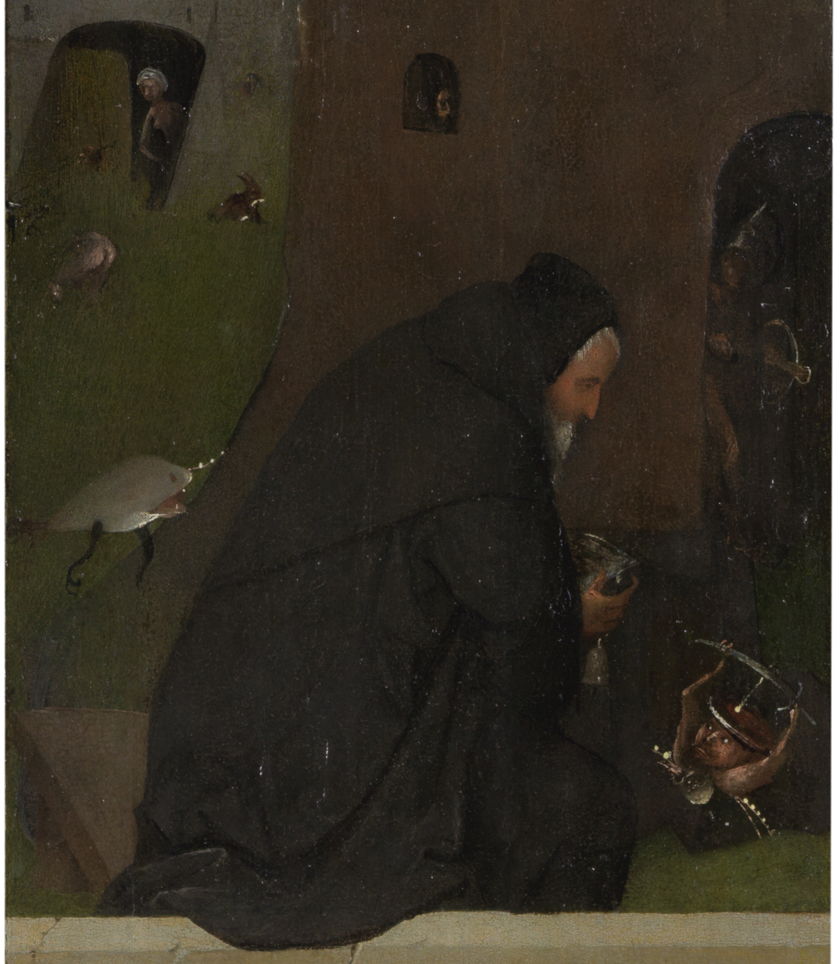
The figure at the foot of the left panel of Hieronymus Bosch’s Saint Wilgefortis Triptych (c 1495-1505) has some visual similarity with Saint Anthony in his Hermit Saints triptych, and appears to be holding a small bell, one of that saint’s attributes.
Richard Dadd (1817–1886), Portrait of a Monk (1857), watercolour over graphite on moderately thick, slightly textured, beige laid paper, 19.1 x 11.8 cm, Yale Center for British Art, Paul Mellon Collection, New Haven, CT. Courtesy of the Yale Center for British Art.
Richard Dadd painted this Portrait of a Monk on 11 April 1857, from memory of his previous travels in the Middle East.
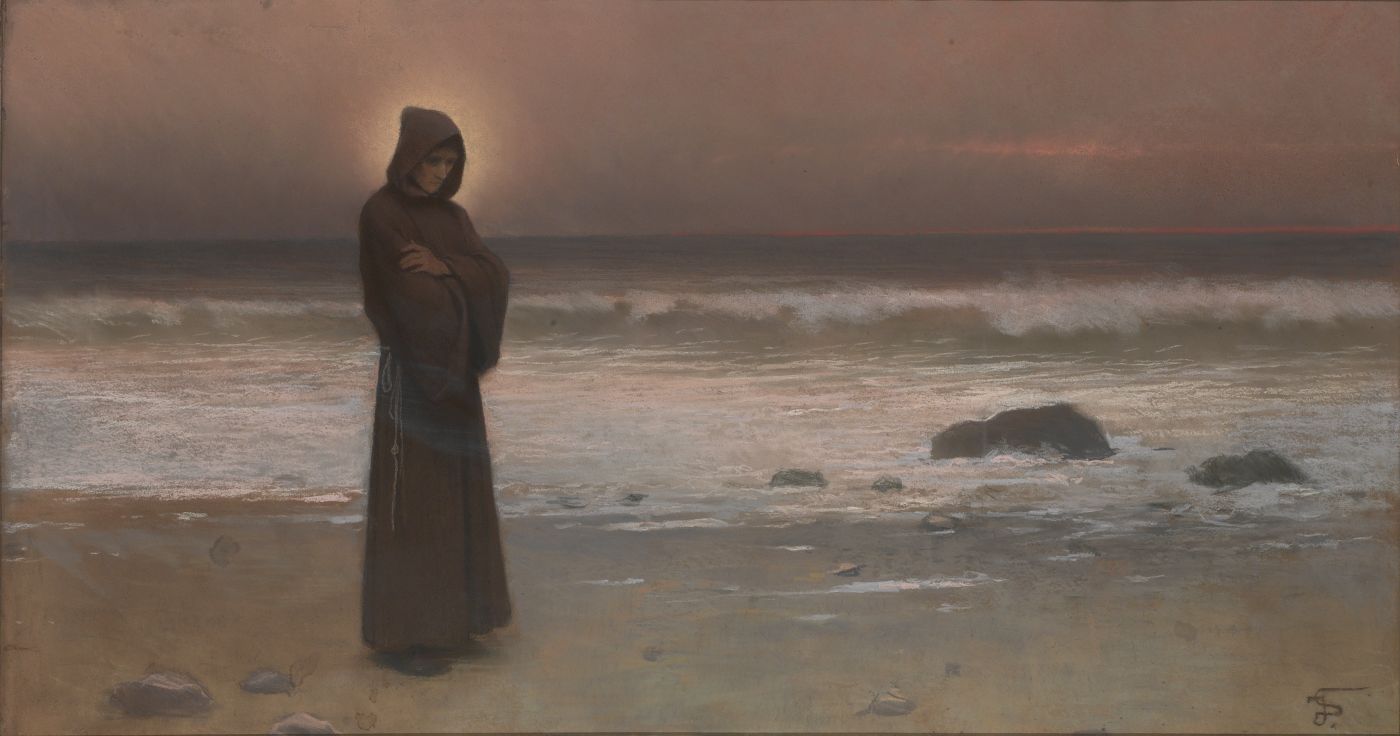
Jakub Schikaneder (1855–1924), Kontemplace, Mnich na mořském břehu (Contemplation, the Monk on the Seashore) (date not known), pastel on paper, further details not known. Wikimedia Commons.
Jakub Schikaneder’s undated Contemplation, the Monk on the Seashore shows a hooded monk on the foreshore, just in front of the water, apparently lost in thought.
Cowls have also been incorporated into other religious dress, where they’re often worn with hats, making them appear vestigial and primarily symbolic.
Raphael (1483–1520), Portrait of a Cardinal (1510-11), oil on panel, 79 x 61 cm, Museo Nacional del Prado, Madrid, Spain. Wikimedia Commons.
Raphael’s magnificent Portrait of a Cardinal from 1510-11 shows the elements of this cardinal’s choir dress: the soft matte surface of the biretta on his head, the subtly patterned sheen of his mozzatta (cape) with its hood, and the luxuriant folds of his white rochet (vestment).
Another uniform that incorporates symbolic hoods is formal academic dress, in which the colours and cut of the hood denote the university and degree.
Jean Béraud (1849–1935), The Thesis of Madeleine Brès (or The Doctoral Jury) (date not known), oil on canvas, 63.5 x 48.3 cm, Private collection. The Athenaeum.
In Jean Béraud’s undated The Thesis of Madeleine Brès (or The Doctoral Jury) he shows us one of the early woman doctoral students defending her thesis before the academic jury, who are wearing what might appear now to be fancy dress hats in addition to their colourful hoods. At the time, this was a major landmark in the improvements in women’s rights, and the archaic headwear serves to emphasise this change.
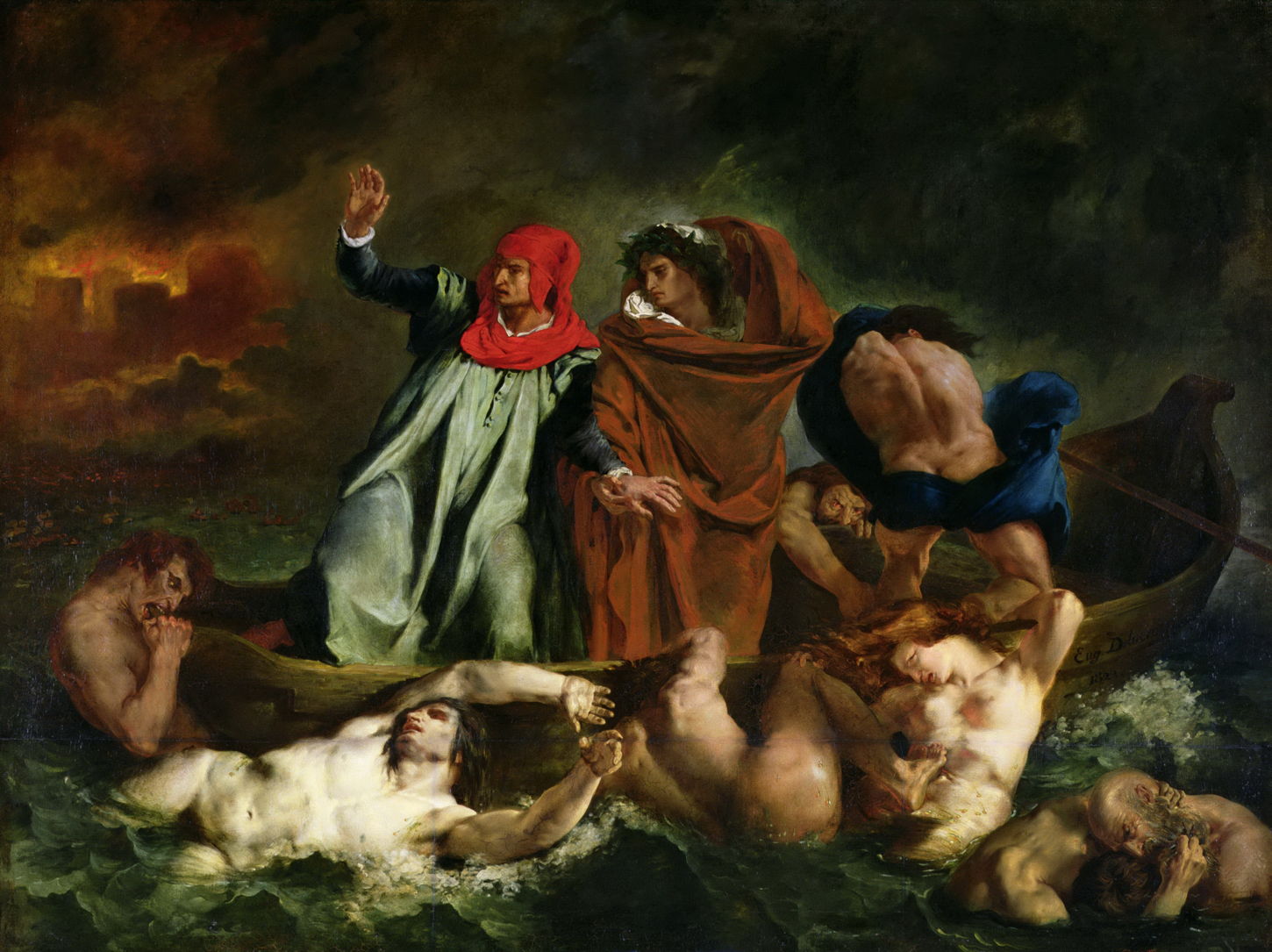
The chaperon had evolved before 1200 as a hooded short cape, then developed into variants that remained popular until becoming unfashionable in about 1500. In paintings it’s most strongly associated with Dante in accounts of his Divine Comedy.
Eugène Delacroix (1798–1863), The Barque of Dante (Dante and Virgil in Hell) (1822), oil on canvas, 189 x 241 cm, Musée du Louvre, Paris. Wikimedia Commons.
In Eugène Delacroix’s painting of The Barque of Dante from 1822, Dante is inevitably wearing his trademark red chaperon.
Louis Welden Hawkins (1849–1910), A Peasant Woman (c 1880), further details not known. Wikimedia Commons.
The woman’s equivalent of the chaperon persisted until modern times in the hooded cape worn by Louis Welden Hawkins’ Peasant Woman, from about 1880. She is seen near to the rustic village of Grez-sur-Loing, which had become an artist’s colony.
Strangely, the word chaperone (with an added e) is now most commonly used to describe an older woman who accompanies a younger one to ensure that no improper behaviour occurs when in the company of a man.
Before the decline in popularity of hats in the twentieth century, hoods had been relatively uncommon in the general population.
Carl Gustaf Hellqvist (1851–1890), Valdemar Atterdag holding Visby to ransom, 1361 (1882), oil on canvas, 200 × 330 cm, Nationalmuseum, Stockholm. Wikimedia Commons.
Carl Gustaf Hellqvist’s large history painting of Valdemar Atterdag holding Visby to ransom, 1361 from 1882 is an encyclopaedic guide to late medieval dress. Few of its crowd have hoods, and one of those few appears to be a monk, shown in the detail below.
Carl Gustaf Hellqvist (1851–1890), Valdemar Atterdag holding Visby to ransom, 1361 (detail) (1882), oil on canvas, 200 × 330 cm, Nationalmuseum, Stockholm. Wikimedia Commons.
Hoods have also been popular with travellers, and from the nineteenth century were incorporated into popular weatherproof capes.
Ford Madox Brown (1821–1893), The Last of England (1852/55), oil on panel, 82.5 x 75 cm, Birmingham Museum and Art Gallery, Birmingham, England. Wikimedia Commons.
Ford Madox Brown’s The Last of England (1852/55) shows a young couple with their infant emigrating from England. Tucked under the mother’s weatherproof hooded travelling cape is their baby son.
It seems extraordinary that in the twenty-first century hoodies have been banned as inappropriate items of clothing associated with anti-social behaviour. Perhaps there’s a market for reviving chaperons.
With Armida creating havoc among the crusaders, and leading ten of their best warriors out on a fool’s errand, Erminia had dressed in Clorinda’s armour, tried to help the wounded Tancred, then became lost in the countryside by the River Jordan. Tancred had left in pursuit of her, thinking she was his love Clorinda, but he too strays and loses her trail in a wood.
It’s dusk by the time Tancred emerges from the wood, and mindful of his battle to complete with Argante in the morning, he turns for home. As he does, a messenger comes galloping towards him, claiming to come from Bohemond. Tancred follows him to a moated castle, where the messenger blows his horn for its drawbridge to be lowered.
Tancred is wary, but as he approaches the castle, a familiar figure appears: Gascon Rambald, one of the ten knights who set off with Armida. But the knight tells Tancred to disarm, and admits to having been ‘turned’ to a ‘pagan’ by Armida. Tasso tells us what Tancred cannot see: Armida is watching and listening to this from a throne high above them in her castle.
Tancred’s only option is to kill Gascon Rambald, who runs out onto the drawbridge. Once Tancred is there with him, the castle and its burning brands vanish into the darkness. Tancred walks on into the black night, steps through a gate, and is sealed in a trap. From behind the dungeon’s bars he recalls his duty to face Argante at dawn.
The following day Argante is getting himself ready before dawn. Godfrey is woken by Argante’s herald blowing fiercely on his horn, only to discover that Tancred and many of his best fighters are missing. His first task is to find a substitute for Tancred to resume the battle with Argante. He draws lots in the end, and pulls out the name of Raymond of Toulouse, who at least has the advantage of a guardian angel.
The contest between Argante and Raymond starts with the former missing his opponent altogether, thanks to the angel’s intervention. With his great experience in combat, Raymond proves a match for the Circassian, and is saved repeatedly by angelic force. However, Argante has already made a pact with the devil, and his guardian intervenes by asking a nearby archer to shoot Raymond in the eye.
The arrow is loosed and strikes Raymond by the belt, its force attenuated by his angel. This breach of the code of chivalry provokes the watching armies into immediate battle: soldiers from the city are forced to defend Argante, as crusaders rush in to kill as many as they can. When the enemy forces are forced to flee, only Argante remains.
Then the hand of God intervenes, as the sky turns black in a terrific storm, with violent wind, torrential rain, thunder and lightning.
At the start of the eighth canto the storm has abated, but there is more bad news for Godfrey. Reinforcements led by Sven, son of the King of Denmark, have been slaughtered by King Soliman’s far larger army before they could reach the main force. Only one hundred survive out of the original two thousand.
Then a foraging party returns and reports they found the headless corpse of Rinaldo, whose armour had been shattered and cut through in battle. Although Godfrey isn’t entirely convinced by their story, it’s sufficient to keep him awake for much of the night. He’s disturbed by sudden insurrection within the camp, led by Argillan, and driven by one of the Furies. The riot is settled, but Godfrey now realises that he must attack Jerusalem soon.
The ninth canto opens with a night attack by Arab forces on the crusaders’ camp, which is initially very successful, and puts French troops to flight. But Godfrey quickly responds and leads his main army in a counter-attack. Jerusalem then becomes aware of the battle, and Clorinda and Argante bring their army out to join in.
Godfrey rallies his men as some turn to run, and leads them into the mêlée. The archangel Michael arrives, and commands the devil’s forces to disengage, as God has ordained that they may not intervene directly. Argante and Clorinda continue to fight, though, claiming many crusaders’ lives. Argillan, freed from prison, joins in, only to be killed by Soliman himself. The tide turns in favour of the crusaders, and the Arab army is put to rout when fifty knights who had followed Armida unexpectedly return. The crusaders pursue the Arabs, slaughtering all they can catch, and Soliman withdraws.
In the tenth canto, Soliman is saved by the sorceror Ismen, who inspires him with the promise of success, and carries him in a magic chariot. They pass over the crusaders, who are now salvaging weapons and armour from the battlefield. They land on a hill, from where they walk, hidden in a cloud, to Mount Sion. There, they enter a cave, and Ismen leads them, invisible, to a meeting of Aladine’s council in the city of Jerusalem. Soliman and Ismen then reveal themselves to the meeting.
Godfrey has paid his fallen warriors their last respects, and then turns his attention to debriefing his knights who had returned from Armida, with the help of Peter the Hermit. They tell him of their journey to Armida’s castle near Sodom, its surrounding swamp in which nothing sinks [possibly a reference to the Dead Sea], and the bewitching meal that Armida served them.
She changed some of them into creatures, like fish, to demonstrate her evil powers, and demanded they became ‘pagans’. They refused, but also saw her take Tancred prisoner. Armida then despatched them to Egypt, but Rinaldo killed their guards and rescued them. In the process, his armour became too damaged to wear, so he discarded it.
Peter the Hermit then has a vision of the future, in which he declares that Rinaldo is still alive, and will survive.
The eleventh canto opens with the crusaders celebrating mass on Mount Olivet, as the citizens of Jerusalem watch first in silence, then break into jeers and blasphemous shouts. Afterwards, Godfrey briefs his commanders to prepare to attack at first light the next day.
As the crusaders ready themselves first thing in the morning, Aladine moves his troops to defend the city’s most vulnerable western wall, where Argante and Clorinda position themselves. She is ready with her bow and a full load of arrows. The crusaders then array themselves, the infantry being covered in the rear by cavalry, with mobile units all around. Siege engines are moved in, and towers made of oak.
Argante, Clorinda, and the city’s defenders rain boulders and arrows on the crusaders, who batter the defences with a ram and climb the towers, to loose arrows and spears at those on the city’s walls. Some of the leaders, including Guelph and Raymond, fall, to the dismay of the crusaders. Argante proclaims “This is not Antioch!” Even Godfrey finds himself pierced by an arrow, but that’s soon removed and his wound dressed.
As night starts to fall, the towers are drawn back for protection, and battle comes to a halt for the day, under the code of chivalry. Godfrey’s engineers work through the night repairing the damage to their siege engines and towers. At the same time, those inside the walls are shoring them up from the damage they have suffered.
Canto twelve opens with Clorinda walking with Argante, asking him to take care of her dearest in the event that she doesn’t survive. The Circassian is taken aback at this, but agrees. The two then put a proposal to Aladine to set fire to the siege towers when everyone has gone to sleep. Ismen offers them incendiary materials to help.
Clorinda’s eunuch then tells of her origins and birth in Ethiopia, as the white daughter of the black Christian queen, and how she was never baptised but raised a ‘pagan’. The eunuch pleads with his mistress to lay down her arms.
Argante and Clorinda then sneak out of the city and set the siege towers alight, burning each to the ground. The pair retreat to the city, where Aladine has the Golden Gate thrown open to receive them. But only Argante makes his way in: Clorinda has wandered off, and by the time she returns the gate is shut with her outside, in the midst of the enemy.
Tancred then appears, and assuming that Clorinda is a man, challenges her to fight. She tries to escape, to find another way back into the city, but can’t refuse his challenge. They fight one another in the darkness of the night, so close they can’t even swing their swords.
Tancred finally asks who she is. She refuses to tell, and they fight on, to the inevitable moment when Tancred sinks his sword deep into her chest. Her legs collapse from under her. In a frail voice she tells him she forgives him, and asks that he baptises her. Tancred runs over to a nearby stream and fills his helmet with water. When he gets back to her, he removes her helmet and sees that it is his love Clorinda dying in his arms. He baptises her, and in her last breath she says that she goes in peace.
One of the most moving moments in the whole of Tasso’s epic, this has proved a challenge to paint: it’s still night, perhaps with the faintest light of dawn to the east, and there’s a complex sequence of events and details.
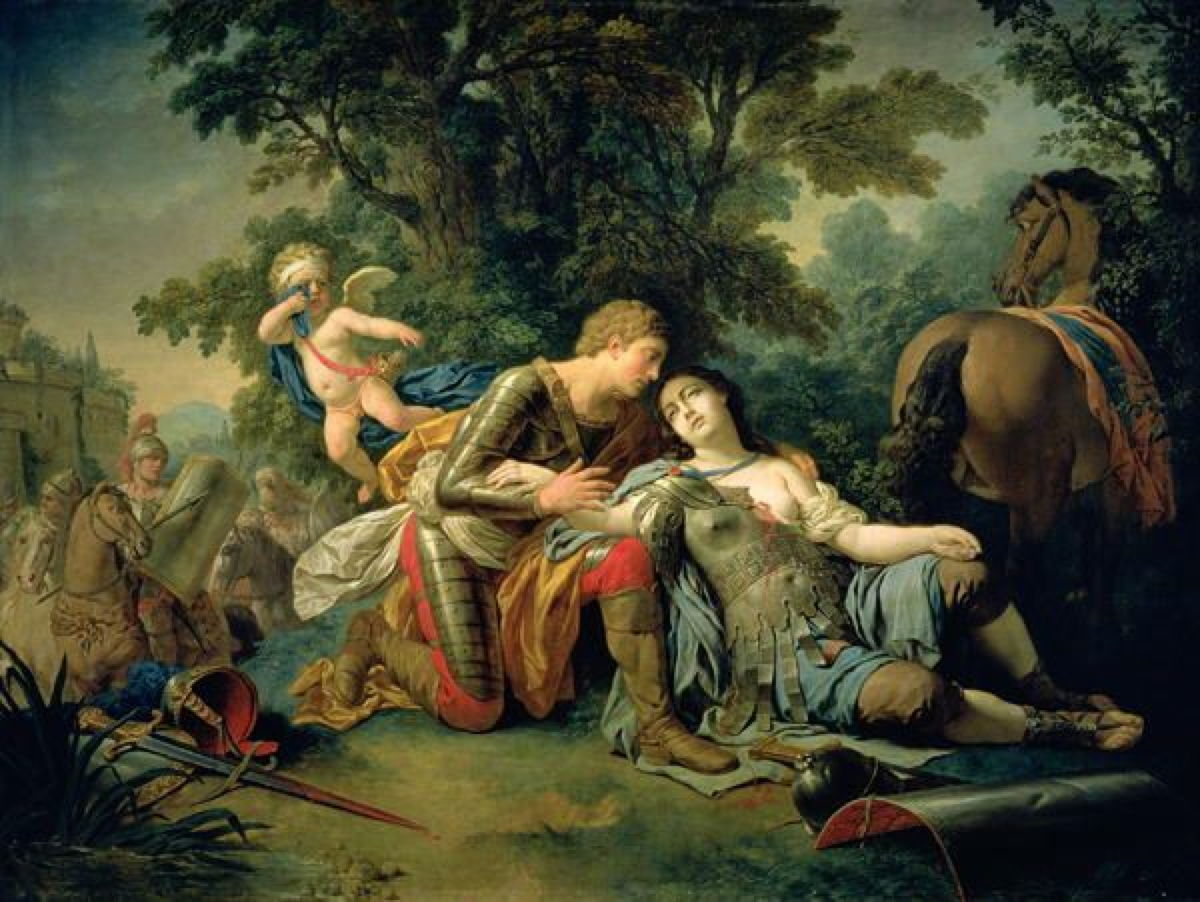
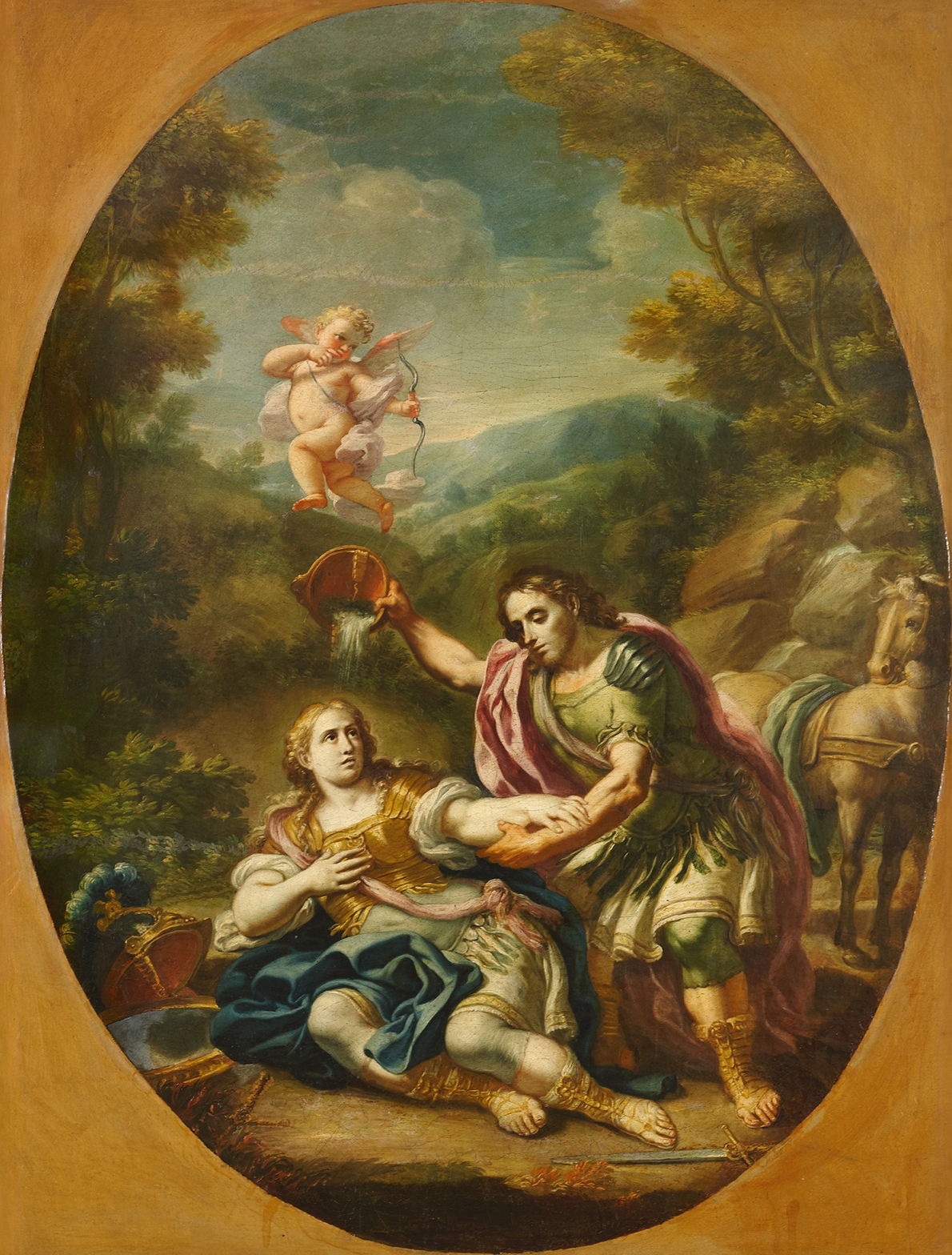
Louis-Jean-François Lagrenée (1725–1805), Tancred and Clorinda (1761), further details not known. Wikimedia Commons.
Louis-Jean-François Lagrenée’s Tancred and Clorinda from 1761 shows this in daylight, and without reference to Clorinda’s baptism. Tancred’s helmet and bloodied sword lie at the left, and the only slightly bloodied Clorinda swoons away against his left knee. Above them is Cupid, in a pose suggestive of his bow and arrow but actually wiping a tear from his eye. Oddly, Lagrenée balances him against the hindquarters of Tancred’s horse, an unfortunate compositional choice.
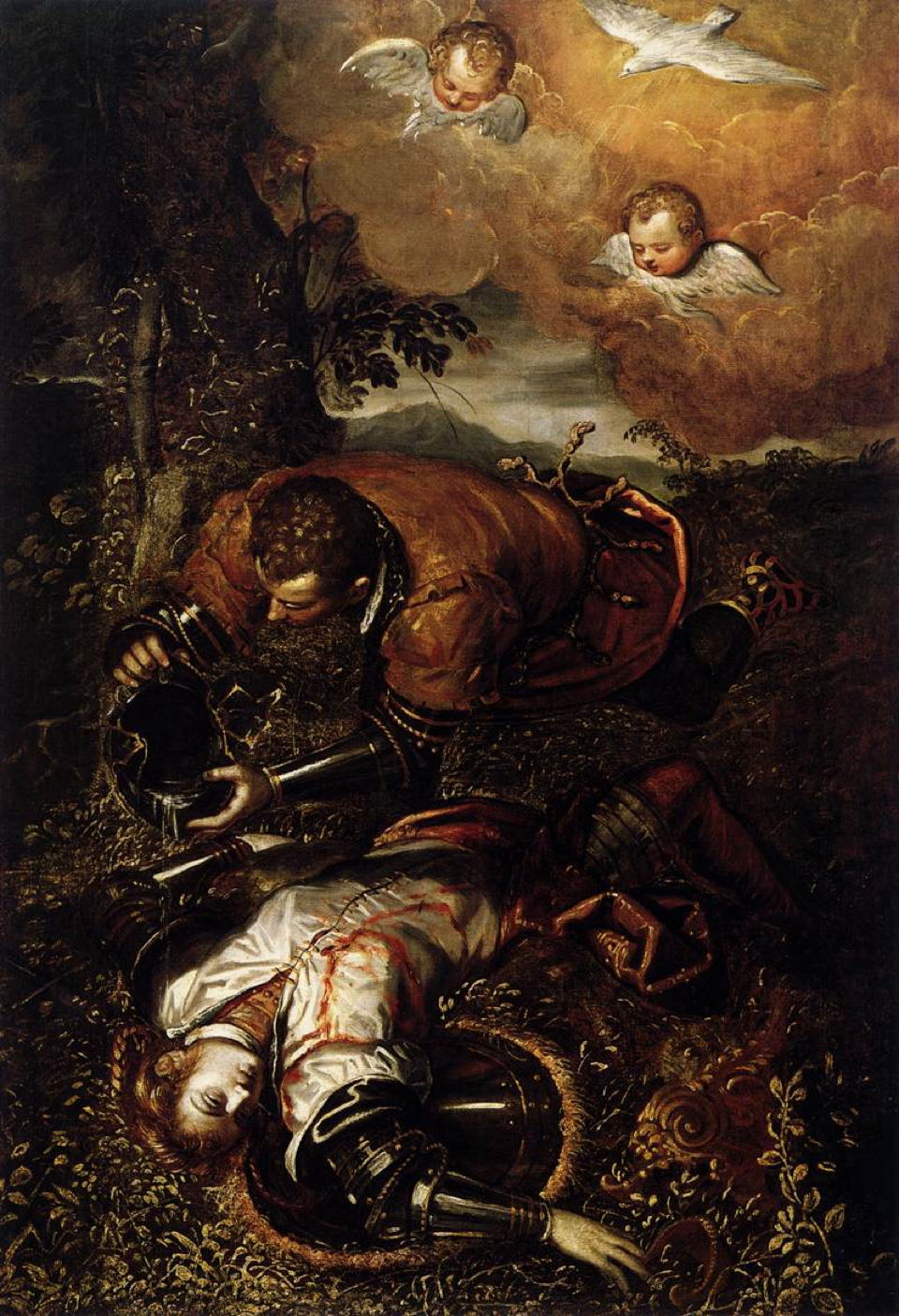
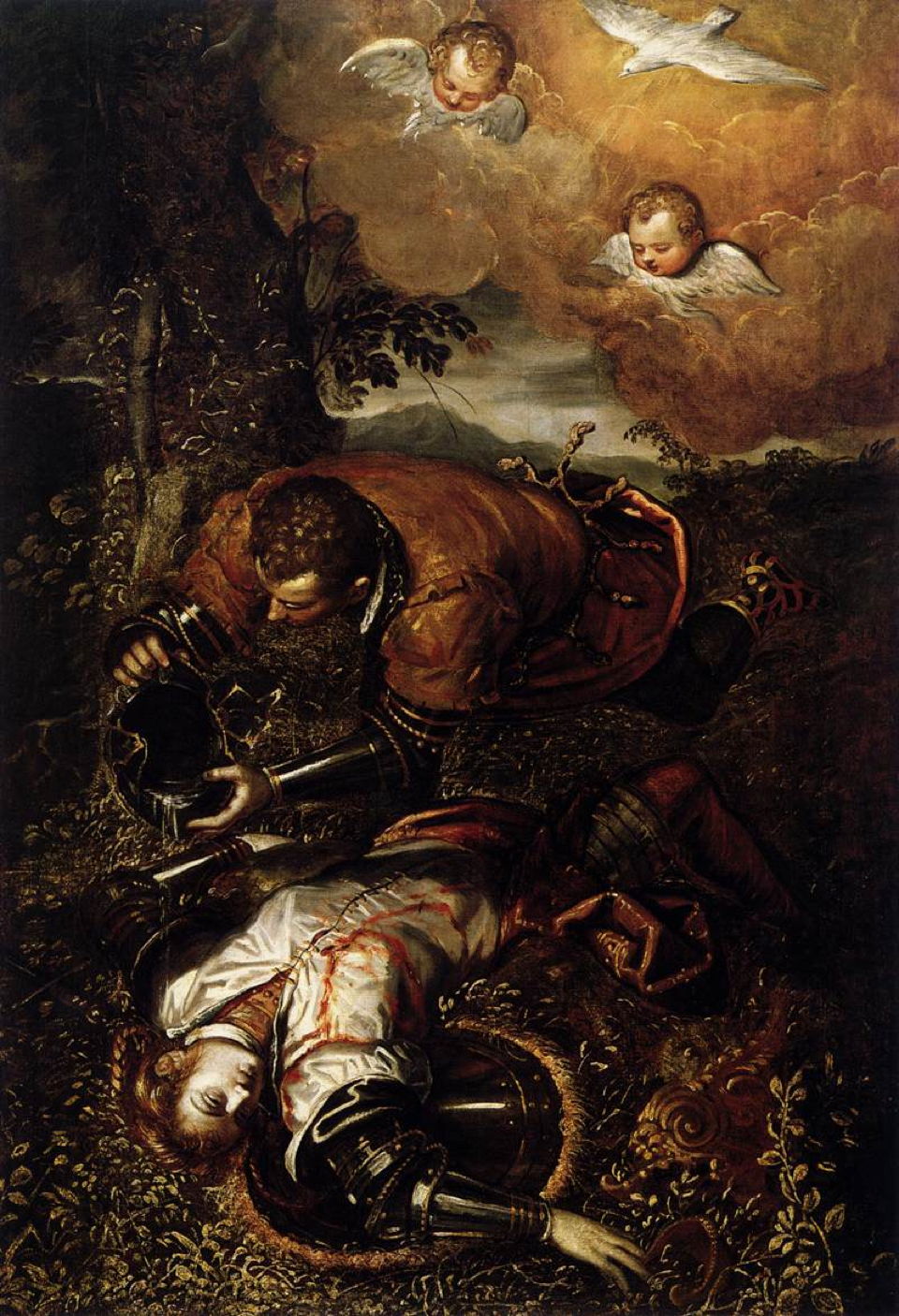
Domenico Tintoretto (1560–1635), Tancred Baptizing Clorinda (c 1585), oil on canvas, 168 x 115 cm, Museum of Fine Arts, Houston, TX. Wikimedia Commons.
Jacopo Tintoretto’s son Domenico must have painted his Tancred Baptizing Clorinda in about 1585, just a few years after the epic’s first publication. Although generally rated far below his father, this painting is rather special. It captures the light well, and Tancred’s rushed baptism under the watchful eye of the white dove of the Holy Spirit and two cherubic angels.
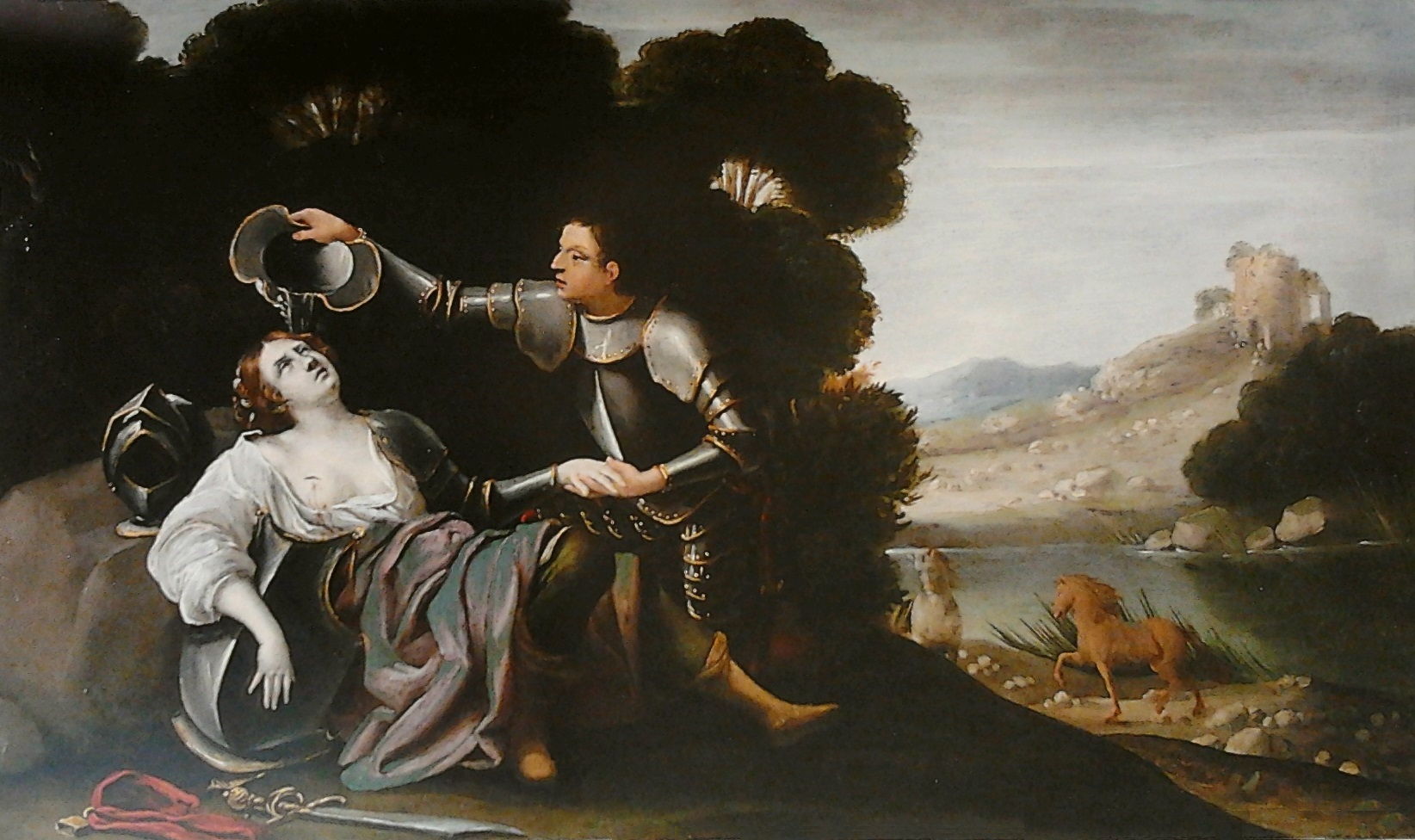
Artist not known, The Baptism of Clorinda (c 1625), oil on canvas, dimensions not known, Zamek Królewski w Warszawie, Warsaw, Poland. Wikimedia Commons.
This anonymous painting of The Baptism of Clorinda thought to be from about 1625 tells the story fairly faithfully, and provides a source of water in the distance.
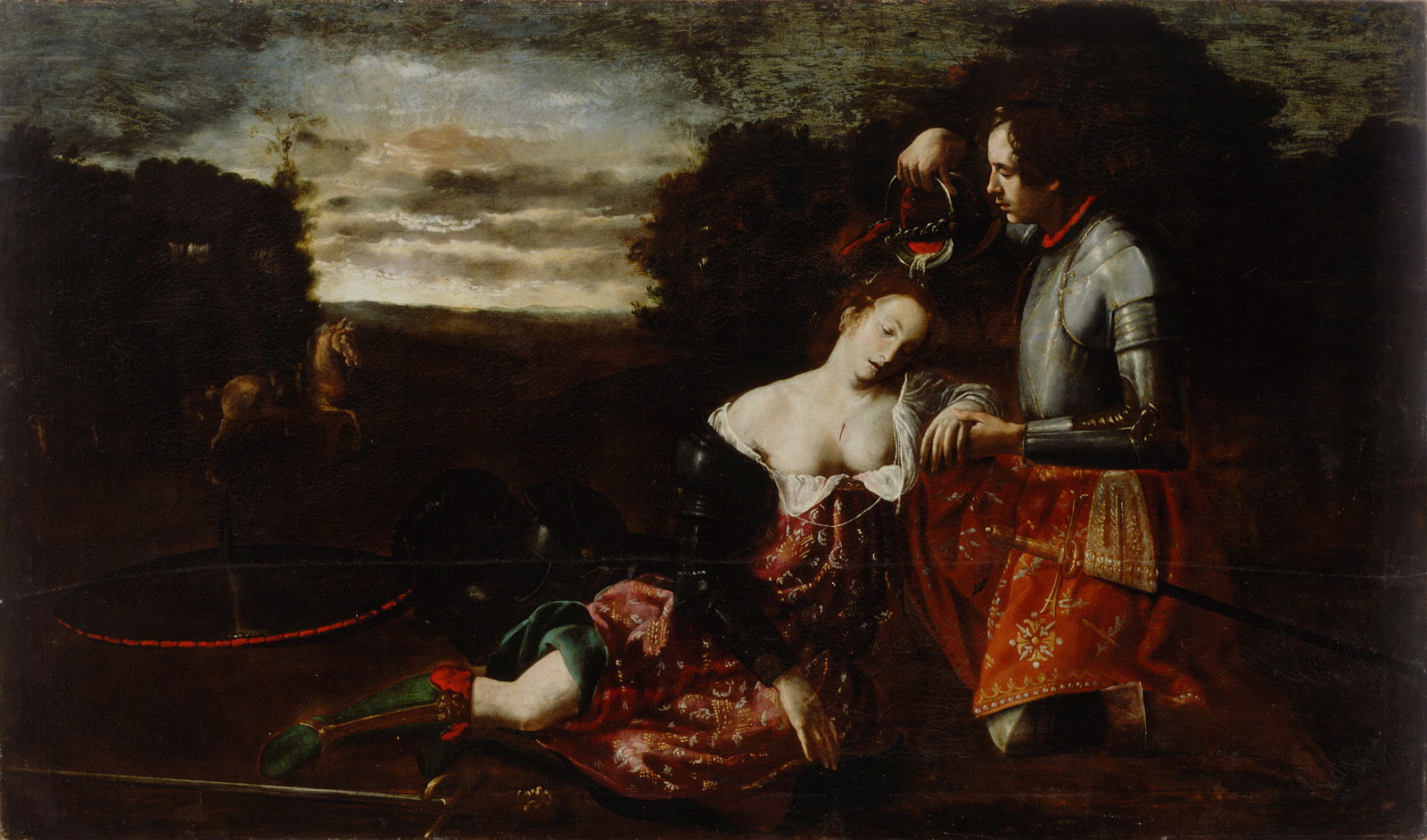
Artist not known, Tancred Baptises Clorinda (c 1650), oil on canvas, 107 x 181 cm, Narodna galerija Slovenije, Ljubljana, Slovenia. Wikimedia Commons.
Another painting by an unidentified artist, Tancred Baptises Clorinda from about 1650, is more faithful to the time of day. The strange red arc at the left is the edging of a circular shield resting on the ground.
Andrey Ivanovich Ivanov (1775–1848), Tancred and Clorinda (c 1798), oil on canvas, 114 x 87.5 cm, Ekaterinburg Museum of Fine Arts Екатеринбургский музей изобразительных искусств, Yekaterinburg, Russia. Wikimedia Commons.
Andrey Ivanovich Ivanov’s Tancred and Clorinda from about 1798 again sets this in daylight, and avoids any trace of blood.
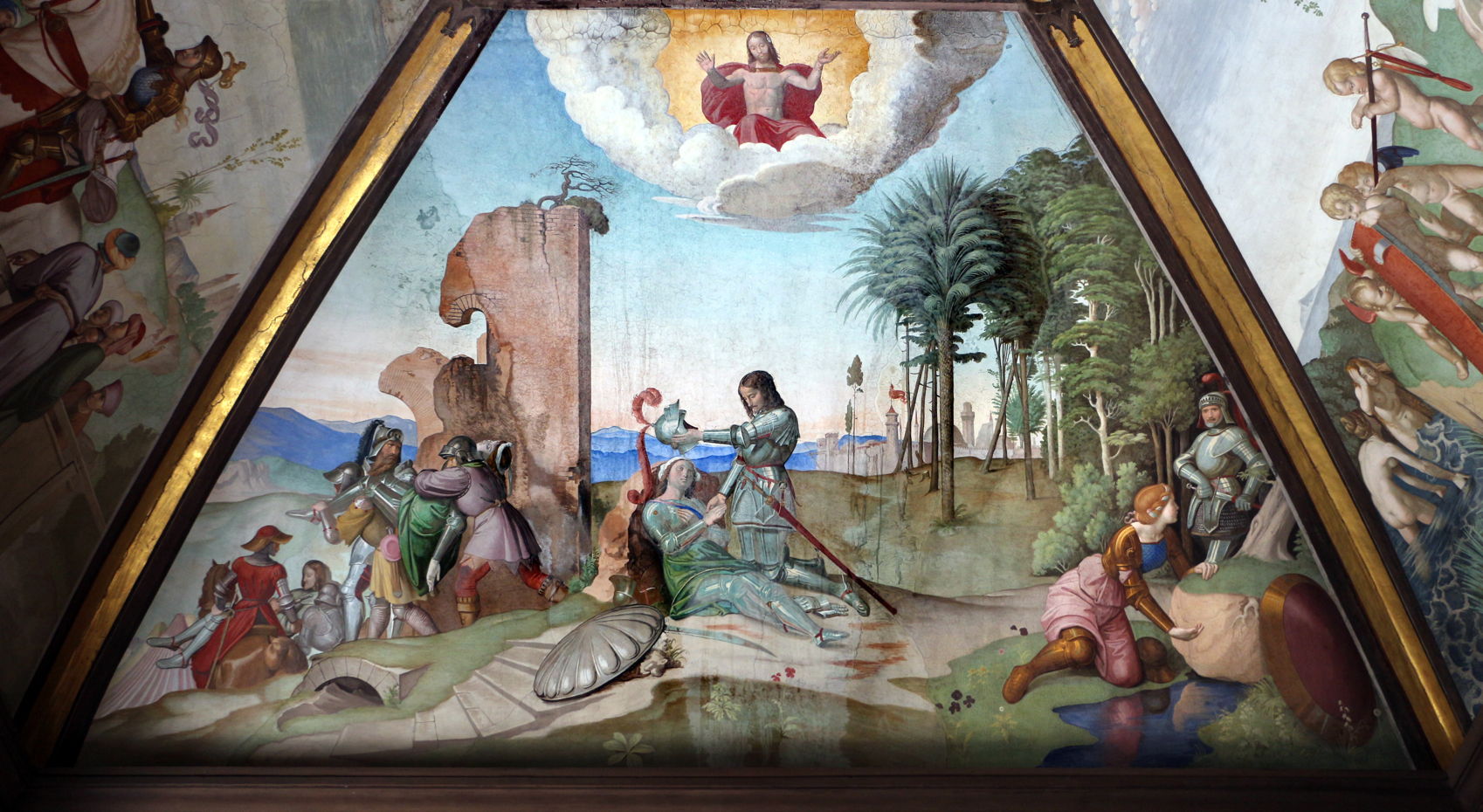
Johann Friedrich Overbeck (1789-1869), The Death of Clorinda (1819-27), fresco, dimensions not known, Casa Massimo, Rome, Italy. Image by Sailko, via Wikimedia Commons.
By far the most fascinating depiction, though, is that of Johann Friedrich Overbeck’s fresco in the Casa Massimo, Rome, painted between 1819-27. The section showing The Death of Clorinda features her baptism in the centre, and places the city of Jerusalem in the distance. It also includes two other scenes involving other characters from the epic, and the unmistakable figure of Christ watching from heaven above.
Thomas Asbridge (2004) The First Crusade, A New History, Free Press, ISBN 978 0 7432 2084 2.
Anthony M Esolen, translator (2000) Torquato Tasso, Jerusalem Delivered, Gerusalemme Liberata, Johns Hopkins UP. ISBN 978 0 801 863233. A superb modern translation into English verse.
John France (1994) Victory in the East, a Military History of the First Crusade, Cambridge UP. ISBN 978 0 521 589871.
Joanthan Riley-Smith, ed (1995) The Oxford Illustrated History of the Crusades, Oxford UP. ISBN 978 0 192 854285.
Jonathan Riley-Smith (2014) The Crusades, A History, 3rd edn., Bloomsbury. ISBN 978 1 4725 1351 9.
Johathan Unglaub (2006) Poussin and the Poetics of Painting, Pictorial Narrative and the Legacy of Tasso, Cambridge UP. ISBN 978 0 521 833677.
The seductive ‘pagan’ sorceress Armida has just told Godfrey of Bouillon, leader of the First Crusade’s siege on the city of Jerusalem, a long sob story, leading to her request for ten of his best knights to go and sort her problems out.
Godfrey predictably turns her down, in view of his mission to deliver the city. Armida plays on emotion, and weeps. She has won over the young knight Eustace, who asserts that helping all ladies is chief among the duties of a knight. The others around Godfrey concur, and their leader is forced to acquiesce. Armida then plays the field with great skill and success, winning over the hearts of all the knights, in her bid to take away more than just the ten that she asked for.
Canto five continues in the camp of the crusaders, with Armida’s influence eating away at their resolve to fight. Godfrey’s next problem is to select a knight to replace the dead Dudon, who in turn can choose the ten to go with Armida. This sows dissent, with Prince Gernando wanting to lead the army of ‘Adventurers’. This brings him into direct conflict with Rinaldo, who accuses Gernando of being a liar.
The two knights must settle this immediately in combat, and Rinaldo quickly kills Gernando. Godfrey goes straight there, and on hearing what happened, condemns Rinaldo to death for breaking the crusaders’ laws. Tancred speaks in favour of Rinaldo, then Raymond too. Tancred rides off to Rinaldo’s tent, where the latter makes clear that he has no intention of staying around in prison awaiting his trial. Rinaldo dons his armour and rides off.
Guelph goes to Godfrey to plead Rinaldo’s case, but the leader stands firm. Next, Godfrey has to face Armida, who goes to him with two of her ladies and two knights in attendance. With Godfrey’s single-minded determination for his mission, she finds him much less malleable than his knights. Armida finally gets her way, and is allowed to take her ten knights.
With dozens of knights clamouring to accompany Armida, it’s decided to draw names from an urn. Tasso lists: Count of Pembroke Artemidorus, Gerard, Wenceslaus, Guasco, Rudolph, Olderic, William of Roncillon, Bavarian Eberard, French Henri, and Rambaldo. Those who were unsuccessful are left seething in envy, and many leave the following night to follow Armida as she leads her squad of ten away. This further divides the crusaders.
Back in camp, Godfrey hears that an Egyptian navy is at sea to prevent supply ships from reaching the coast, and that a convoy of supplies en route to the crusaders from one of the ports has been ambushed and lost. The leader has to comfort his men by affirming that God will look after them, but inwardly worries how he will feed his army.
The sixth canto opens inside the besieged city of Jerusalem, where its occupants are better-fed than those laying siege to it, because they have been able to bring in supplies by night. Work had been undertaken to strengthen its fortifications, particularly on the north, where there were also war machines stationed.
Argante urges Aladine to fight the enemy rather than sit waiting for starvation, but the ruler reveals that Soliman of Nicaea, who seeks vengeance for his own loss earlier in the Crusade, is gathering a force to attack by night. This angers Argante, who is an old rival of Soliman, and he asks permission to go out to meet a crusader in combat. Aladine gives his consent.
Argante then issues a challenge to Godfrey for one-to-one combat, which the latter cannot refuse.
Inside the city, Aladine instructs Clorinda to take a force of a thousand to ensure Argante’s safe passage. Godfrey feels unable to choose Argante’s opponent, but the consensus calls on Tancred, who is approved by Godfrey.
As Tancred makes his way to the field where they will fight, he sees Clorinda, who is sitting on her horse with her visor raised. This delays him, and Otto has already rushed forward to take on the Circassian in the arena. Otto is in full charge before Tancred realises what is happening. Otto and Argante make contact: although Otto strikes the Circassian’s helmet, the latter knocks Otto from his horse, cleaving his shield and breastplate.
Argante tells Otto to concede, but the crusader refuses. Argante charges at Otto, who manages to wound his enemy and draw blood, but insufficient to do anything more than anger him further. Argante then turns his horse, fells Otto, and his horse tramples him, in a cowardly act breaching the code of chivalry.
At this, Tancred calls out Argante’s cowardice and the two charge at one another. Their lances shatter, making their horses collapse from under them. They draw their swords to fight on foot. Tancred is the first to draw blood, and Argante is so stunned that he is too slow to return the strike, and takes another heavy blow to his shoulder. Argante’s rage then overcomes his injuries, and he rains blows on Tancred. Both are now wounded, their armour pierced in many places. At this point, heralds are put in to bring the vicious fight to a halt for the night.
Erminia, in Jerusalem behind them, has suffered this battle badly. When Antioch fell, it was Prince Tancred who had protected her, and honoured her as a queen. For this, she had fallen in love with him. As she had watched Tancred in combat, she felt every blow that Argante had laid on him. With her skills in preparing healing potions, she is torn between using them to nurse her love, or Argante who would surely then be able to finish the crusader off.
She had spent long hours with Clorinda, and decides to dress up in her armour so she can leave the city and give aid to Tancred in the crusaders’ camp. She engages the help of a trusty squire and her maid, although she doesn’t tell them where she is going. Erminia then plays the part of Clorinda, and commands the city gate is opened on the authority of its king.
Once near the camp, she realises her plan has one problem: being recognised as Clorinda, woman warrior of Aladine’s forces, probably won’t give her a good reception among those laying siege to the city. She therefore sends her squire on to locate the injured Tancred. As she waits for his return, she is spotted by a platoon who are there to intercept attempts to smuggle supplies into the city. The father of one of its leaders, Polyphernes, had been killed by Clorinda, so throws his spear at her, and misses.
Erminia and her maid flee in panic, followed later by her squire. When Tancred hears of this, he rides off in pursuit of the woman warrior identified to him as Clorinda.
At the start of the seventh canto, it’s still night as Erminia enters dark woods and continues her flight, even though those pursuing her have now given up and returned to camp. The following day, she continues to wander, lost until she reaches the River Jordan, where she is completely exhausted, so lies down to sleep.
When she wakes at the next dawn, she sees a small shepherds’ hut, and weeps, only to hear the sound of shepherds singing and playing their pipes. She gets up and walks towards the group consisting of a grey-bearded man and three youths. As she is still wearing Clorinda’s armour, they are fearful of her at first, but she explains what’s going on nearby, and asks how they can remain there in peace.
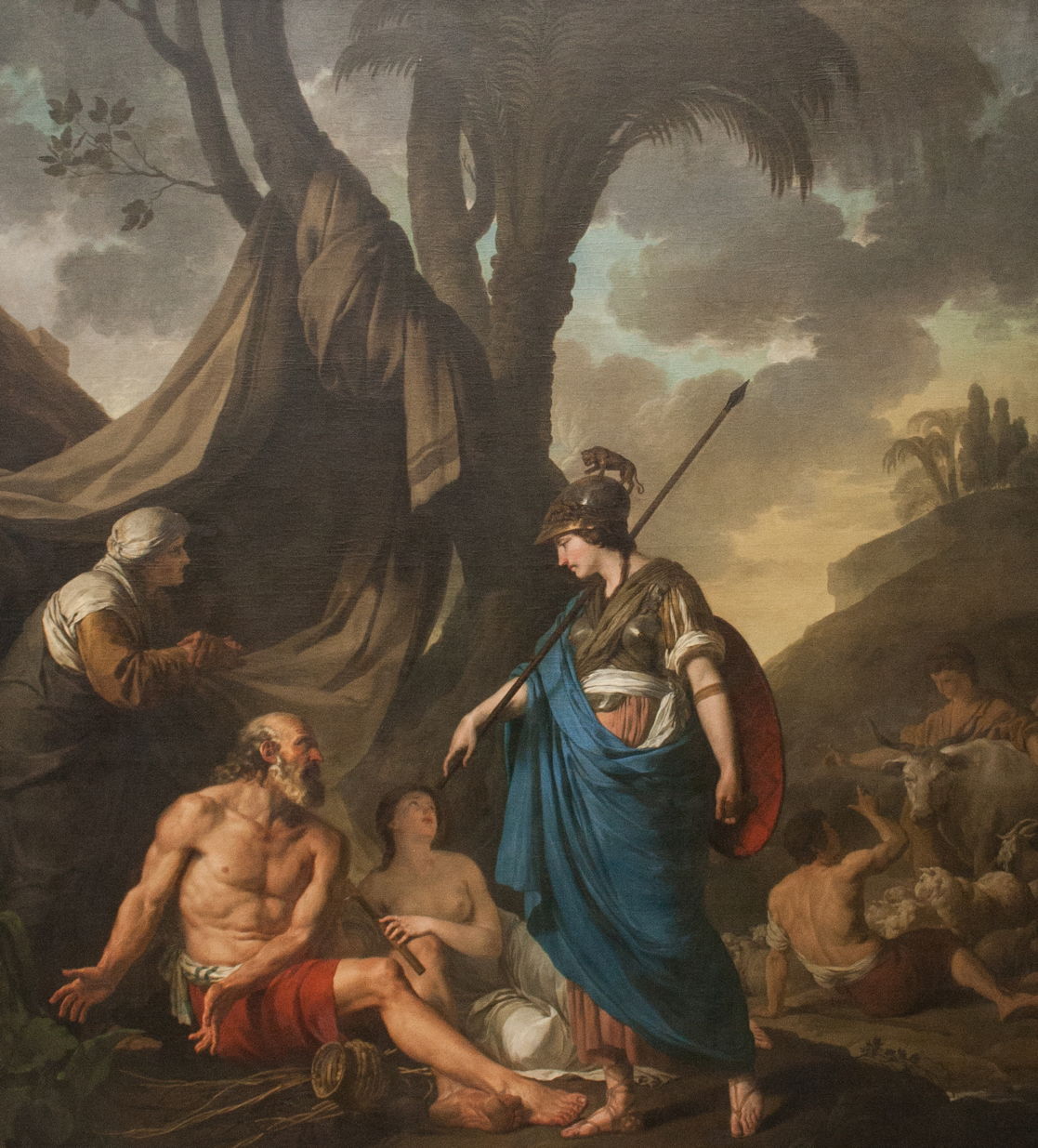
The old man explains that he had been the keeper of the grounds and member of the royal court at Memphis, but had left for a more peaceful life with his three sons in the country. He consoles her, and takes her to his elderly wife, who dresses her in country clothes.
Domenichino (1581–1641), Erminia and the Shepherds (1622-25), oil on canvas, 124 x 181 cm, Musée du Louvre, Paris. Image by Mbzt, via Wikimedia Commons.
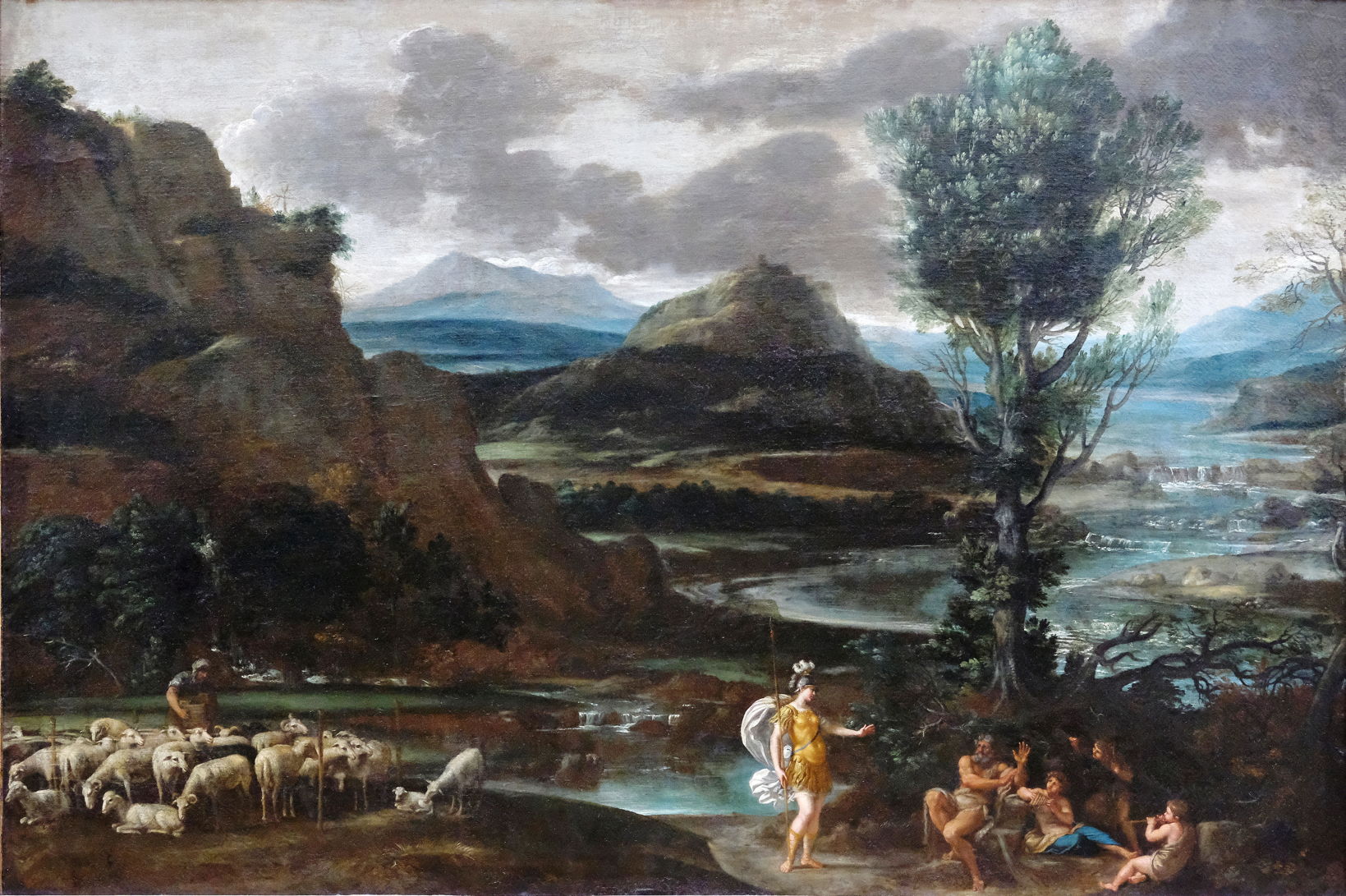
Domenichino appears to have been one of the earliest major painters to capture this scene, in his Erminia and the Shepherds, painted between 1622-25. He recasts the story in classical times, with Erminia appearing more Roman than Syrian, and the shepherds are straight out of an Ovidian myth (detail below). This is all set in a wonderfully imaginative riparian landscape.
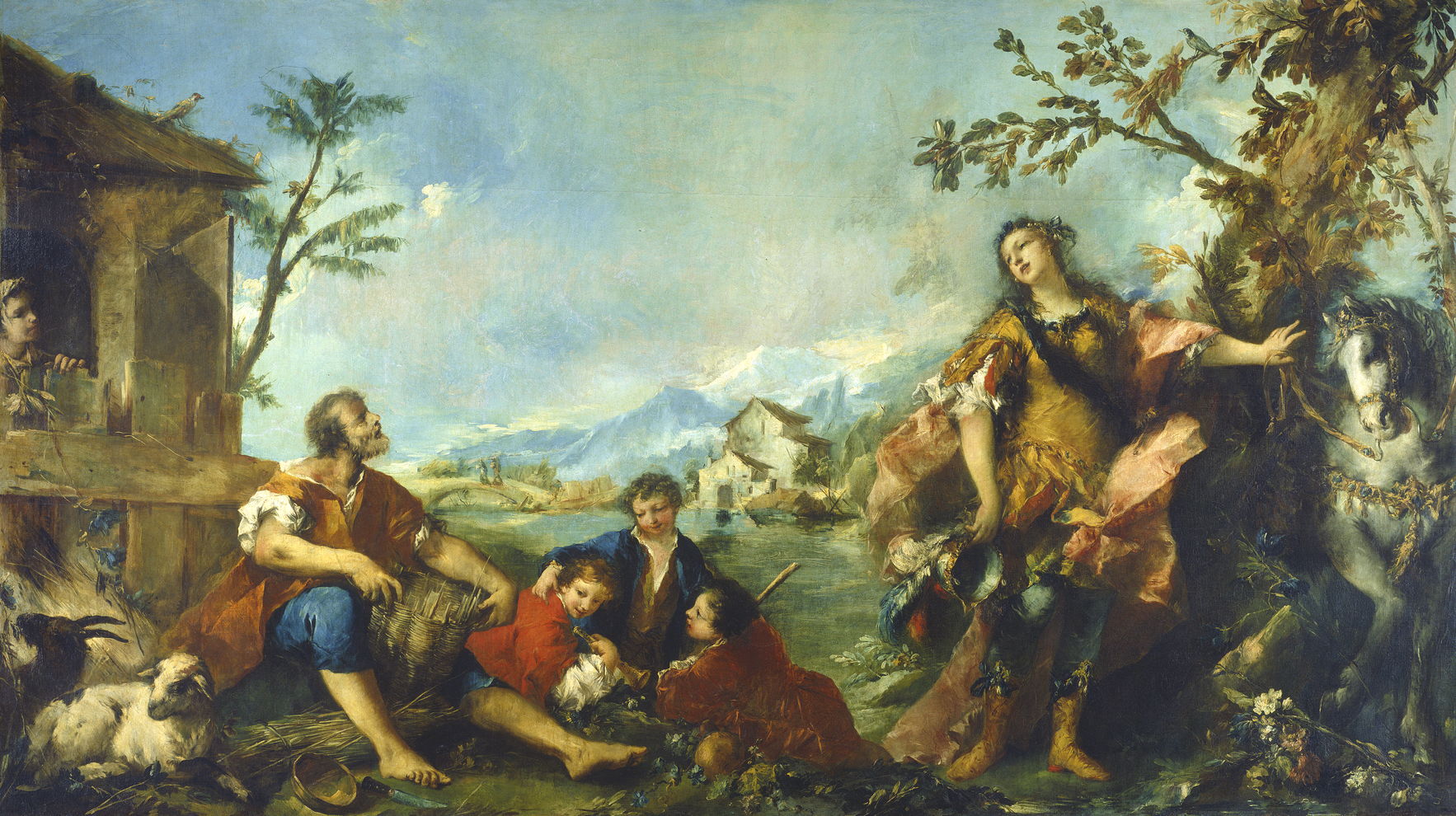
Domenichino (1581–1641), Erminia and the Shepherds (detail) (1622-25), oil on canvas, 124 x 181 cm, Musée du Louvre, Paris. Image by Mbzt, via Wikimedia Commons.Giovanni Antonio Guardi (1699–1760), Erminia and the Shepherds (1750-55), oil on canvas, 251.5 x 442.2 cm, The National Gallery of Art, Washington, DC. Wikimedia Commons.
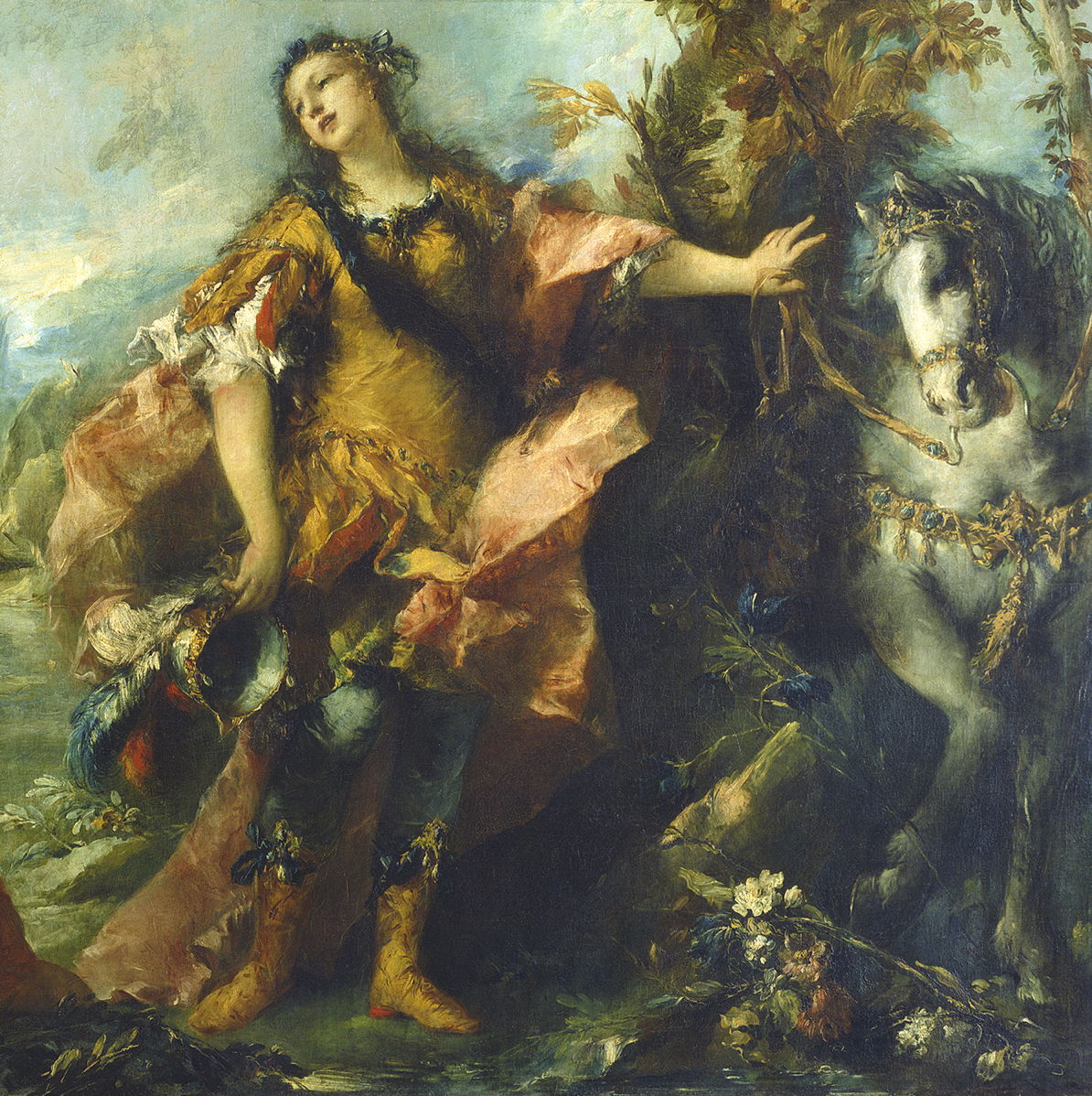
This sub-plot remained popular through the eighteenth century, when Giovanni Antonio Guardi painted his interpretation of Erminia and the Shepherds (1750-55). Erminia has by now changed out of Clorinda’s armour into the fetching outfit of an Alpine shepherdess. She stands holding the reins of her white horse, and Clorinda’s helmet (below).
Giovanni Antonio Guardi (1699–1760), Erminia and the Shepherds (detail) (1750-55), oil on canvas, 251.5 x 442.2 cm, The National Gallery of Art, Washington, DC. Wikimedia Commons.Joseph-Benoît Suvée (1743–1807), Erminia and the Shepherds (1776), oil on canvas, dimensions not known, Museum voor Schone Kunsten, Ghent, Belgium. Wikimedia Commons.
Joseph-Benoît Suvée’s Erminia and the Shepherds from 1776 is more basic and a little less literal. Her horse is nowhere to be seen, and the semi-naked young woman sat next to the old shepherd is a bit of a surprise. The setting is more Palestinian, though, with some palm trees.
Eugène Delacroix (1798–1863), Erminia and the Shepherds (1859), oil on canvas, 82 x 104.5 cm, Nationalmuseum, Stockholm, Sweden. Wikimedia Commons.
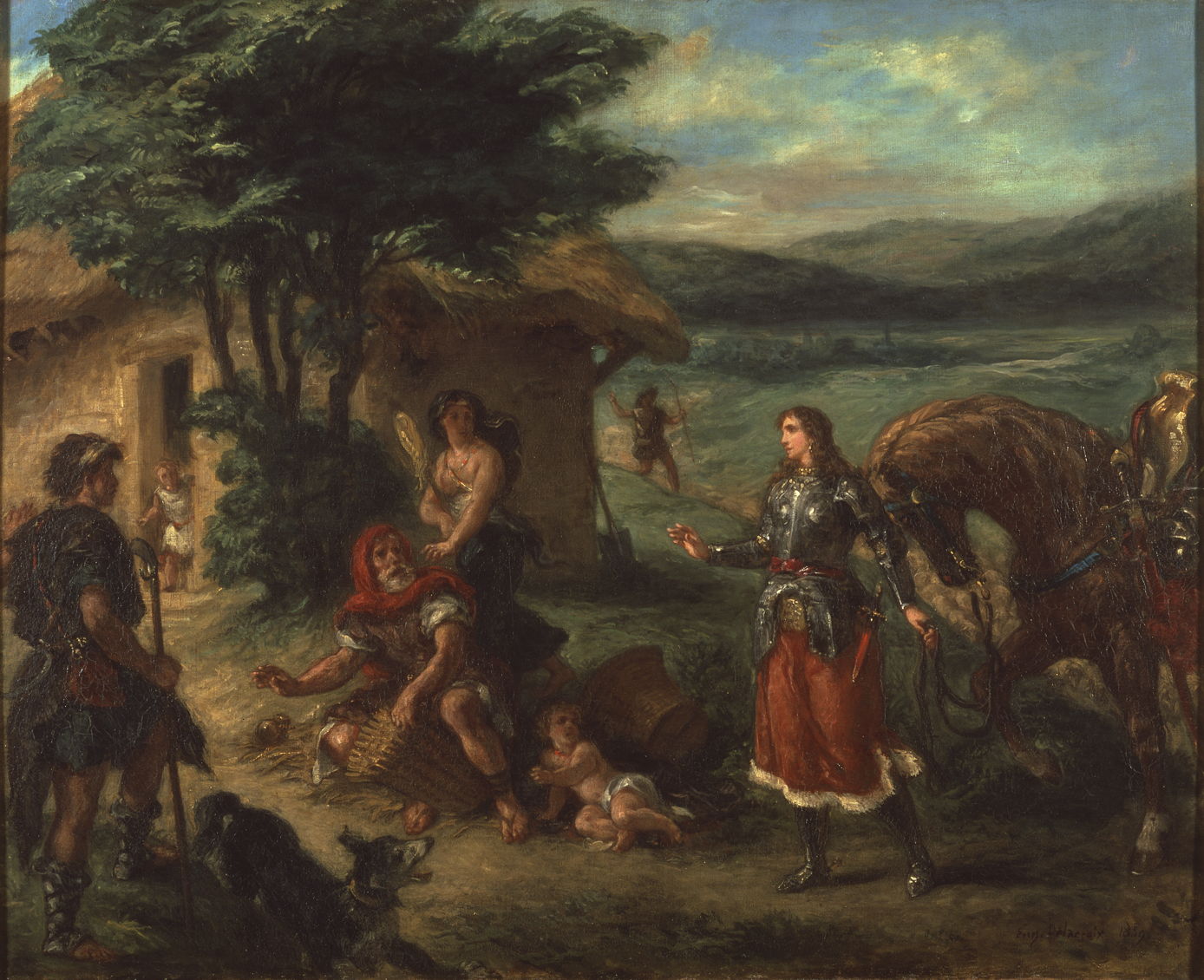
It’s Eugène Delacroix who renders this most faithfully, in his Erminia and the Shepherds of 1859. Erminia is still dressed as the warrior Clorinda, and her charger is convincing too (below). The farming family are taken aback, and their dog has rushed out to bark at the visitor. In the distance, behind the small farmhouse, is a figure who might be pursuing Erminia.
Eugène Delacroix (1798–1863), Erminia and the Shepherds (detail) (1859), oil on canvas, 82 x 104.5 cm, Nationalmuseum, Stockholm, Sweden. Wikimedia Commons.
Although Tancred had also strayed, he’s still in pursuit of the warrior he mistakenly thinks is Clorinda.
Thomas Asbridge (2004) The First Crusade, A New History, Free Press, ISBN 978 0 7432 2084 2.
Anthony M Esolen, translator (2000) Torquato Tasso, Jerusalem Delivered, Gerusalemme Liberata, Johns Hopkins UP. ISBN 978 0 801 863233. A superb modern translation into English verse.
John France (1994) Victory in the East, a Military History of the First Crusade, Cambridge UP. ISBN 978 0 521 589871.
Joanthan Riley-Smith, ed (1995) The Oxford Illustrated History of the Crusades, Oxford UP. ISBN 978 0 192 854285.
Jonathan Riley-Smith (2014) The Crusades, A History, 3rd edn., Bloomsbury. ISBN 978 1 4725 1351 9.
Johathan Unglaub (2006) Poussin and the Poetics of Painting, Pictorial Narrative and the Legacy of Tasso, Cambridge UP. ISBN 978 0 521 833677.
There are precious few paintings featuring European woodpeckers, but those few come with unusual stories. Of the three species that are common across the continent, it’s most likely that these refer to what’s now known as the great spotted woodpecker, responsible for the distinctive sound it makes when pecking the trunk of a tree.
John James Audubon (1785–1851), Great Spotted Woodpecker (date not known), media and dimensions not known, Houghton Library, Harvard University, Cambridge, MA. Wikimedia Commons.
When he was in Britain, the great American bird artist John James Audubon painted this fine example of a Great Spotted Woodpecker(Dendrocopos major).
The woodpecker has earned itself a place in ancient Roman legend, as one of the two guardians of the infant Romulus and Remus. They were abandoned shortly after birth, put in a trough to float down the River Tiber to their deaths. When the trough was washed up on a bank, they were adopted and fed by a she-wolf, while the woodpecker kept a close watch over the babies, until they were discovered by the swineherd Faustulus. And the rest is legendary Roman history. For its role in saving the co-founders of Rome, the woodpecker was later considered to be sacred to the god Mars.
Ludovico Carracci (1555–1619) and/or Annibale Carracci (1560–1609), She-Wolf Suckling Romulus and Remus (1589-92), fresco, dimensions not known, Palazzo Magnani, Bologna, Italy. Wikimedia Commons.
One of the frescoes in the Palazzo Magnani, probably painted by Ludovico Carracci and/or Annibale Carracci, shows the She-Wolf Suckling Romulus and Remus (1589-92). The twins are still inside the trough in which they had survived their trip down the river, and on the opposite bank a woodpecker is keeping a close watch. At the far right, a now rather diaphanous figure may be Faustulus, one of Amulius’ swineherds who discovered the twins, and took them to his wife.
Peter Paul Rubens (1577–1640), Romulus and Remus (1615-16), oil on canvas, 213 x 212 cm, Musei Capitolini, Rome, Italy. Wikimedia Commons.
Peter Paul Rubens shows Romulus and Remus being discovered by Faustulus in this painting of 1615-16. Not only is the she-wolf taking care of the twins, but a whole family of woodpeckers are bringing worms and grubs to feed them, and there are empty shells and a small crab on the small beach as additional tasty tidbits.
Several mythical figures seem to have been transformed into woodpeckers for various reasons. The sorceress Circe was also claimed to have turned at least one of her lovers into a woodpecker, a story celebrated by Dosso Dossi.
Dosso Dossi (–1542), Circe and her Lovers in a Landscape (c 1514-16), oil on canvas, 100 × 136 cm, National Gallery of Art, Washington, DC. Wikimedia Commons.
Dossi’s Circe and her Lovers in a Landscape (c 1514-16) is a remarkably early and realistic mythological landscape, with deep rustic lanes, trees, and a distant farmhouse. Circe leans, naked, at the foot of a tree as she goes through spells on a large tablet, with a book of magic open at her feet. Around her are some of the men who she took a fancy to and transformed into wild creatures. There’s a spoonbill, a small deer, a couple of dogs, a stag, and up in the trees an owl, and a woodpecker in the upper right corner.
Dosso Dossi (–1542), Melissa (Circe) (c 1518-1531), oil on canvas, 176 × 174 cm, Galleria Borghese, Rome. Wikimedia Commons.
There’s still dispute as to whether this painting of Dossi’s shows Circe again, or the sorceress Melissa from the epic Orlando Furioso. Painted in about 1518-1531, this sorceress sits inside a magic circle, around which are inscribed cabalistic words. In the upper left corner are small homunculi apparently growing on a tree. On the left is a large dog, and perched on top of a suit of armour is another woodpecker.
Finally, the great spotted woodpecker is one of the birds that can be identified in Hieronymus Bosch’s fantastic menageries.
Hieronymus Bosch (c 1450–1516), The Temptation of Saint Anthony (Lisbon) (right wing) (c 1500-10), oil on oak panel, left wing 144.8 x 66.5 cm, central panel 145.1 × 132.8 cm, right wing 144.8 × 66.7 cm, Museu Nacional de Arte Antiga, Lisbon. Wikimedia Commons.
The right panel of Bosch’s Temptation of Saint Anthony, now in Lisbon, shows Saint Anthony seated, with a book open in front of him. He is again surrounded by strange figures and creatures from a vision of temptation. The background shows a prominent windmill and towers, behind which is a wintry landscape with snow on the ground.
Deeper into the painting, behind and to the left of the saint, is a group of figures, daemons, and objects, clustered around the hollow trunk of a dead tree. Inside the hollow, a naked woman peers out. The tree is draped with a scarlet sheet, under and on which are several daemons. At the top, an old person pours liquid from a ewer into the bowl held up by a daemon below. A woodpecker is perched on one of the upper branches.
I leave you to speculate on the significance of that woodpecker.
Those able-bodied Christians who were banished from the city of Jerusalem, together with Sophronia and Olindo, are gathering at the nearby town of Emmaus, where the crusaders have just arrived on their way to lay siege to the city.
As the crusaders are camping there at dusk, two ambassadors arrive from the king of Egypt: Alete, and Argante the Circassian. They are taken to meet Godfrey, and Tasso devotes the remainder of the second canto to their discussions. Alete courteously and diplomatically invites Godfrey to call a halt to the crusade before he attacks Jerusalem. He warns that continuing on his current course could bring the king of Egypt against him, and when united with Persian and Turkish forces, he would be heavily outnumbered. In return for stopping short of Jerusalem, Alete offers a truce and free passage to safety.
Godfrey politely rejects the offer, stressing how it is God’s hand that directs the crusaders. Argante is brief and blunt, and tells Godfrey that his rejection means war. When they leave, Alete returns to Egypt, and Argante to Jerusalem. That night, Godfrey and his army cannot sleep.
The third canto opens at dawn on the following day, as the crusaders march onward, and get their first sight of Jerusalem the Holy City. Within its walls, a sentinel sees the approaching army, first from the cloud of dust it throws up as it draws closer. He calls the citizens to defend their city; the old, young, and those unable to help in the defence go and shelter in its mosques.
Jerusalem’s ruler Aladine does his rounds of the defences, and calls for the company of Erminia, daughter of the dead former king of Antioch, who managed to flee to safety in Jerusalem when her father’s city fell to the crusaders.
Mattia Preti (1613–1699), Erminia, Princess of Antioch (date not known), oil on canvas, 98 x 73 cm, location not known. Wikimedia Commons.
Mattia Preti’s Erminia, Princess of Antioch, painted in the middle of the seventeenth century, shows her exuding nobility, with shoulder-length hair. She is reading an unintelligible inscription on a tree.
Clorinda leads the city’s troops out to attack the French crusaders, with Argante the Circassian holding himself in reserve in a secret gate in the city’s wall. She heads an attack on an advance party of crusaders who have been sent on to scavenge for livestock and crops to feed the army.
The captain of the city’s defenders is quickly knocked to the ground, but Clorinda weighs in and forces the French into retreat. They regroup on a hill, just as Godfrey sends Tancred and his troops to support them. Aladine is watching this with Erminia alongside him, and asks her to identify Prince Tancred from her experience at Antioch. Erminia cannot reply, as she chokes back tears, but finally tells Aladine of her desire to make him captive for her “sweet revenge”.
On the battlefield in front of them, Clorinda and Tancred charge at one another. Their lances strike the other’s visor and shatter, but Tancred’s blow knocks Clorinda’s helmet off, unfurling her long, golden hair. Tancred is thunderstruck by this revelation.
She charges at him a second time, but he turns away and attacks others with his sword. She chases after him, brandishing her sword and calling for him to turn and fight her. He refuses to respond to the blows from her sword, but calls on her to settle the matter away from the main battle. He then asks her to agree the terms on which she will fight. He proposes that she should remove his heart, drops his weapon, and bares his chest to her.
Paolo Domenico Finoglia (1590–1645), Tancred Faces Clorinda (1640-45), media and dimensions not known, Palazzo Acquaviva, Conversano, Italy. Wikimedia Commons.
Paolo Domenico Finoglia’s painting of Tancred Faces Clorinda from 1640-45 shows this tense moment, when Tancred, his sword held low and away from Clorinda (who surprisingly has dark brown hair), makes clear his love for her. The battle rages on behind them.
Elsewhere, the crusaders are getting the better of Jerusalem’s forces, and the latter are starting to retreat to the city. One of the crusaders prepares to strike Clorinda from behind with his sword, but Tancred parries it away. It still strikes her neck a glancing blow, and blood from a small wound starts to colour her blonde hair. Clorinda seizes the opportunity to run back to her troops and join their retreat.
As the city troops reach the walls, they stop and wheel round to attack the rear of their pursuers. At the same time, Argante sends a small team out to attack their front. Argante leads them, and he and Clorinda start to gain victims from among overreaching crusaders. These are from Dudon’s ‘Adventurers’, with Rinaldo in the lead. Erminia tells Aladine about Rinaldo’s great skills in battle, and then points out their leader Dudon, and Gernando, brother of the king of Norway, and a married couple, Edward and Gildippe, who always fight side by side.
Johann Friedrich Overbeck (1789-1869), Argante, Rinaldo and Clorinda in Battle (1819-27), fresco, dimensions not known, Casa Massimo, Rome, Italy. Image by Sailko, via Wikimedia Commons.
Johann Friedrich Overbeck’s fresco of Argante, Rinaldo and Clorinda in Battle (1819-27), in the Casa Massimo in Rome, may show another scene from this battle, although here it would make more sense if the unhelmeted Clorinda were with Tancred rather than Rinaldo. Another puzzle is the white smock bearing the red cross of a crusader, being worn by Clorinda.
Rinaldo and Tancred now break through, and Rinaldo strikes Argante so hard he can barely get up again. Rinaldo’s horse is then struck, and he’s forced to pause while he extracts his foot from underneath it. The remaining city troops make the safety of the walls, leaving Argante and Clorinda to guard their rear. Dudon presses on, killing four of Argante’s men and threatening Argante himself, who manages to sink the blade of his sword deep into Dudon’s body.
Argante doesn’t hang around, but gets back to the wall, as the citizens start hurling rocks and loosing arrows at the crusaders. Rinaldo, free at last from his horse, is fired by the death of Dudon, and charges at the city troops despite the hail of rocks and arrows. He and the other crusaders pull up short, and they too turn away from the fight, recovering the body of Dudon on the way.
Godfrey has taken the opportunity to study the city and its defences, and notes that its approach is difficult on three of its four sides, but easiest from the north, where it’s most strongly fortified.
As he is weighing up where best to pitch camp, Erminia points him out to Aladine, who recognises him from a meeting when he was an Egyptian diplomat to the court of France. Also identified, standing next to Godfrey, is his brother Baldwin, and on his other side Raymond, William son of the king of England, and Guelph, but Bohemond (who killed Erminia’s family) is nowhere to be seen.
Godfrey decides that, as he has insufficient troops to encircle the city, he will station them at all its points of entry, and that they will dig in using ditches to prevent surprise attacks. He then goes off to join those mourning the death of Dudon in the dark night.
Overnight, Godfrey makes further plans. Recognising the strength of the city’s walls, he tries to work out where he can acquire timber to build siege towers. At first light, he joins Dudon’s funeral. After that, he has a Syrian take him to the only woods in the area, where he sets men to work felling those trees in preparation. That ends the third canto.
The fourth canto opens with a long and florid account of pagan visions of the underworld conjured up in Aladine’s mind, and an accompanying speech by Satan to inspire the “pagans” of Jerusalem to defeat the crusaders. This leads to the introduction of Hydrotes, a “magician” who rules Damascus and its neighbouring cities, whose niece is the beautiful sorceress Armida.
Jacques Blanchard (1600–1638), Armida (date not known), oil on canvas, dimensions not known, Musée de Beaux-Art de Rennes, Rennes, France. Image by Caroline Léna Becker, via Wikimedia Commons.
Jacques Blanchard’s undated portrait of Armida, probably from around 1630, shows her dangerously alluring like Circe.
Hydrotes sees Armida as central to his grand plan to defeat the crusaders, and directs her to the enemy camp, to win the warriors over, and make Godfrey infatuated with her. Armida rises to the challenge, and travels through the night to enter the crusaders’ camp. She quickly beguiles the men there, and can twist them around her little finger.
Armida spins the crusaders a story of how she has fallen on bad times, and calls on Godfrey to shelter her. She bumps into his brother, and in no time is speaking with Godfrey himself.
David Teniers the Younger (1610–1690), Armida before Godfrey of Bouillon (1628-30), oil on copper, 27 x 39 cm, Museo Nacional del Prado, Madrid, Spain. Wikimedia Commons.
David Teniers the Younger shows this scene in this wonderful painting in oil on copper of Armida before Godfrey of Bouillon, from 1628-30. The sorceress is seen with a small lapdog and a couple of young maids, as might befit a contemporary woman of her standing. Next to the young Godfrey is Peter the Hermit, with his long white beard.
After introductory flattery, Armida proceeds to tell Godfrey a long sob story, from the death of her mother just prior to her birth, to the threat of torture and death for her and her friends because she was alleged to have conspired to poison a tyrant. All she needs are ten of Godfrey’s best knights to go and sort that king out.
Thomas Asbridge (2004) The First Crusade, A New History, Free Press, ISBN 978 0 7432 2084 2.
Anthony M Esolen, translator (2000) Torquato Tasso, Jerusalem Delivered, Gerusalemme Liberata, Johns Hopkins UP. ISBN 978 0 801 863233. A superb modern translation into English verse.
John France (1994) Victory in the East, a Military History of the First Crusade, Cambridge UP. ISBN 978 0 521 589871.
Joanthan Riley-Smith, ed (1995) The Oxford Illustrated History of the Crusades, Oxford UP. ISBN 978 0 192 854285.
Jonathan Riley-Smith (2014) The Crusades, A History, 3rd edn., Bloomsbury. ISBN 978 1 4725 1351 9.
Johathan Unglaub (2006) Poussin and the Poetics of Painting, Pictorial Narrative and the Legacy of Tasso, Cambridge UP. ISBN 978 0 521 833677.
Aprons are protective garments normally worn over the front of the body and upper legs, where they’re intended to prevent other clothes from soiling, and sometimes the wearer underneath. Although frequently seen in paintings, their absence must be interpreted with caution: most figurative paintings are made in the studio, where the only folk likely to be wearing aprons are the artist and their assistants. The wear of aprons is also markedly gendered; although in real life many men wear them at work, those most likely to be depicted with them are overwhelmingly women.
Aprons have been strongly associated with those in domestic service, and appear in folk tales such as Cinderella.
Edward Burne-Jones (1833–1898), Cinderella (1863), watercolour and gouache on paper, 65.7 x 30.4 cm, Museum of Fine Arts, Boston, MA. Wikimedia Commons.
Edward Burne-Jones’ Cinderella from 1863 shows her reverted to her plain clothes after the ball, but still wearing one glass slipper on her left foot. She is seen in a scullery with a dull, patched and grubby working dress and apron.
Évariste Carpentier (1845–1922), Intimate Conversation (c 1892), oil on canvas, 50.5 x 60.5 cm, Broelmuseum, Kortrijk, Belgium. Wikimedia Commons.
Intimate Conversation from about 1892 shows a young couple talking idly outdoors in the sun. Évariste Carpentier puts a prominent tear in the young woman’s apron to emphasise their poverty.
Probably the most famous painted apron is that worn by Johannes Vermeer’s Milkmaid in about 1658-59.
Johannes Vermeer (1632–1675), The Milkmaid (c 1658-59), oil on canvas, 45.5 x 41 cm, The Rijksmuseum Amsterdam, Amsterdam, The Netherlands. Wikimedia Commons.
This woman, seen in three-quarter view, wears working dress: a stiff, white linen cap, a yellow jacket laced at the front, a brilliant ultramarine blue apron, with a dull red skirt underneath. Her work sleeves are pushed up to lay both her weathered forearms bare to the elbow. Her strong-featured face and eyes are cast down, watching the milk as it runs into the pot.
Jean-Baptiste Greuze (1725-1805), The Laundress (1761), oil on canvas, 40.6 x 32.7 cm, The J. Paul Getty Museum, Los Angeles, CA. Wikimedia Commons.
Jean-Baptiste Greuze’s Laundress (1761) is in the dilapidated servants’ area, probably in a cellar, where this flirtaceous young maid is washing the household linen, with her coarse white apron rolled up to enable her to lean forward and down.
Aprons were also common in women working outdoors, such as gleaners.
Jules Breton (1827–1906), Calling in the Gleaners (1859), oil on canvas, 90 x 176 cm, Musée d’Orsay, Paris. Wikimedia Commons.
Those in Jules Breton’s Calling in the Gleaners (also known as The Recall of the Gleaners, Artois) (1859) are using theirs to carry their gleanings. Most are frayed and tatty, faded blue in colour.
Jules Bastien-Lepage (1848–1884), October: Potato Gatherers (1878), oil on canvas, 180.7 x 196 cm, National Gallery of Victoria, Melbourne. Wikimedia Commons.
They’re being worn by the two women in Jules Bastien-Lepage’s October: Potato Gatherers from 1878.
Hans Andersen Brendekilde (1857–1942), Cowed (1887), media not known, 126 x 152.3 cm, Fyns Kunstmuseum, Odense, Denmark. Wikimedia Commons.
Some aprons could have more than one purpose, and may need more careful reading. Hans Andersen Brendekilde’s Cowed from 1887 shows gleaners at work in a field after the harvest. The family group in the foreground consists of three generations: mother is still bent over, hard at work gleaning her handful of corn. Her husband is taking a short break, sitting on the sack in his large blue wooden clogs. Stood looking at him is their daughter, engaged in a serious conversation with her father, as her young child plays on the ground. The daughter is finely dressed under her apron, and wears a hat more appropriate to someone in domestic service in a rich household in the nearby town.
Hans Andersen Brendekilde (1857–1942), Springtime; The First Anemones (1889), oil on canvas, 125.7 x 158.7 cm, Private collection. Wikimedia Commons.
Another painting of Brendekilde’s from this period, his Springtime; The First Anemones from 1889, shows a young woman walking with a small girl in a wood in the early Spring. The woman is unlikely to be the girl’s mother. Instead, she wears the black dress and white apron of a woman ‘in service’, in this case probably as the little girl’s maid or nanny.
Camille Pissarro (1830–1903), Apple-Picking, Éragny (1887-1888), oil on canvas, 60.9 x 73.9 cm, Dallas Museum of Art, Dallas, TX. Wikimedia Commons.
Camille Pissarro’s famous depiction of Apple Picking, Éragny, from 1887-88 shows a typical country scene, with three women wearing aprons, but the man still in a waistcoat and trousers.
Maximilien Luce (1858–1941), A Kitchen (1888-89), oil on canvas, 65.1 x 54 cm, location not known. Wikimedia Commons.
A Kitchen is one of Maximilien Luce’s early Divisionist paintings, dating from 1888-89. It’s an unusual motif, showing domestic servants at work in the kitchen of a large bourgeois house, both of them wearing long white aprons. Kitchens have become one place where men are also expected to wear aprons.
Jehan Georges Vibert (1840–1902), The Marvelous Sauce (c 1890), oil on panel, 63.5 x 81.2 cm, Albright-Knox Art Gallery, Buffalo, NY. Wikimedia Commons.
Jehan Georges Vibert’s meticulously realist painting of The Marvelous Sauce from about 1890 shows its rotund hero wearing an apron and tasting a sauce with his chef in a palatial kitchen.
As they were painted at work during the late nineteenth century, it became clear how many men had been wearing aprons: blacksmiths, butchers, shoemakers, coopers and many other trades.
Maximilien Luce (1858–1941), Charleroi Foundry, Casting (1896), oil on canvas, 130 x 162 cm, Musée de l’hôtel-Dieu, Mantes-la-Jolie (Yvelines), France. By Pierre Poschadel, via Wikimedia Commons.
Maximilien Luce made many paintings of people at work, as his style moved on from Neo-Impressionism to Post-Impressionism during the 1890s. His Charleroi Foundry, Casting (1896) shows this well, and is one of a long series he painted showing those working in heavy industry in this city in the mining area of Belgium. Several of these metalworkers are wearing heavy leather aprons to protect their bodies from burns and injury.
Constantin Meunier (1831–1905), Foundry (1902), media not known, 80 x 67 cm, Kansallisgalleria, Ateneum, Helsinki, Finland. Wikimedia Commons.
One of Constantin Meunier’s later paintings, Foundry from 1902, shows a worker stripped to the waist to cope with the heat, while wearing a protective leather apron.
Jean-Léon Gérôme (1824–1904), The Artist’s Model (1895), oil on canvas, 50.8 x 39.6 cm, Dahesh Museum of Art, New York, NY. Wikimedia Commons.
In The Artist’s Model (1895), Jean-Léon Gérôme shows himself at work on a marble figure, and wearing a faded blue apron.
My previous articles in this series provided a short summary of the First Crusade, setting the context for Torquato Tasso’s epic Jerusalem Delivered, which opens with a conventional dedication to the muse, and homage to his patron, Alfonso II of Este.
Tasso’s narrative starts with events six years after the Pope’s call to crusade (actually in late 1095), and briefly mentions the capture of Nicaea and Antioch, to set the opening scene in the following winter (1098-99), with the crusaders in their quarters at ‘Tortosa’. That is now known as Tartus in Syria, a port on the Mediterranean coast well to the south of Antioch.
Tasso gives an overview of the main figures of the First Crusade through the eyes of God:
Godfrey of Bouillon, whom he praises as a hero;
Baldwin, with his ‘vain ambition’;
Tancred, who is suffering the pangs of love;
Bohemond, who is bringing law and order to Antioch as its ruler;
Rinaldo, the courageous and restless warrior.
Merry-Joseph Blondel (1781–1853), Tancred of Hauteville, Prince of Galilee (1840), oil on canvas, 167 x 78 cm, Château de Versailles, Versailles, France. Wikimedia Commons.
Three of these figures are well-known, and appear in various paintings, but Tasso reinvents those of Tancred and Rinaldo, the heroes of his epic. Merry-Joseph Blondel’s painting of Tancred of Hauteville, Prince of Galilee from 1840 shows Tancred rather later during the Crusade, looking suitably grand.
God therefore sends down the Archangel Gabriel to spur Godfrey to lead the Crusaders onwards to free Jerusalem, which the archangel does just as Godfrey is at his morning prayers.
Johann Friedrich Overbeck (1789-1869), The Archangel Gabriel Appears to Godfrey of Bouillon (1819-27), fresco, dimensions not known, Casa Massimo, Rome, Italy. Image by Sailko, via Wikimedia Commons.
In this section of Johann Friedrich Overbeck’s magnificent frescoes in the Casa Massimo, in Rome, The Archangel Gabriel Appears to Godfrey of Bouillon. His companions are still asleep as Gabriel speaks to Godfrey, clutching what most would now recognise as a flag of the Cross of Saint George, in red on a white background.
Francesco Guardi (1712–1793), Godfrey of Boulogne Summons His Chiefs to Council (c 1755), oil on canvas, 250.2 x 109.9 cm, Norton Simon Museum, Pasadena, CA. Wikimedia Commons.
Francesco Guardi shows a slightly later moment, as the archangel flies away from the scene, and Godfrey of Boulogne Summons His Chiefs to Council (c 1755).
All the leaders except Bohemond attend this meeting, at which Godfrey reminds them of their primary mission, to deliver the Holy City of Jerusalem, and the need to make haste towards it. Peter the Hermit then speaks in support, castigating the individual leaders for their in-fighting and rivalry. The leaders agree to Godfrey being in overall command.
The following morning, their troops parade as they prepare to set off to travel south along the coast. This provides Tasso with the opportunity to enumerate them:
French, from the Île de France, formerly led by Hugh, now by Clothar, one thousand;
Norman cavalry under Robert, one thousand;
former priests from the Low Countries under Bishops William and Ademar, totalling eight hundred;
forces of Godfrey and his brother Baldwin, with the Count of Chartres too, 1600 in all;
Germans from between the Danube and the Rhine, under Guelph, less than two thousand;
Dutch and Flemish, under another Robert, two thousand total;
English, under William, the son of the king, slightly more than two (or one?) thousand;
Irish, no leader or number given;
from Campania, under Tancred, eight hundred;
Greece, led by Tatin, just two hundred;
‘adventurers’, or unattached and mercenaries, led by Dudin of Contz, no number given;
men from the Pyrenees, under Raymond of Toulouse, four thousand;
men from Blois and Tours, under Stephen of Ambois, five thousand;
Swiss, under Alcasto, six thousand;
Italians, under Camillus, seven thousand.
Tasso gives a grand total of around thirty-five thousand, which is probably more than double the number of surviving crusaders at this stage.
In his remarks about Tancred, Tasso tells the story of him falling in love at first sight with a young girl clad in armour, during a battle in which Persians were put to flight. Tancred had gone to a brook to cool off afterwards, when this ‘pagan’ arrived for the same purpose. She then left, donning her helmet, without Tasso even revealing her name at this stage.
The army’s departure is made the more urgent as Godfrey has heard the ruler of Egypt with his army is on his way to his fortress at Gaza, which could be used to attack the crusaders as they approach Jerusalem. Godfrey then sends his trusty messenger by boat to Greece, to obtain reinforcements promised by the king.
The next day they depart to the sound of trumpets and drums. Godfrey sends lightly-armoured knights to scout in advance and ensure the main army isn’t ambushed, and field engineers to ensure their route of march is free from obstacles. The crusaders meet little opposition as they make their way south: even the King of Tripoli capitulates and welcomes them into his well-defended city.
As they march down the coast, they receive ships from several of their supporting countries bringing them provisions.
Word of their progress reaches Aladine, ruler of Jerusalem, who, being newly in charge of the city, already has other concerns. He had raised taxes on the Christian minority in Jerusalem, and harbours ideas of killing them all. He doesn’t attempt that, but burns their harvest, demolishes their huts, and poisons their wells, while strengthening the city’s fortifications.
The second Canto starts with Aladine in Jerusalem. A former Christian soothsayer, Ismen, warns the ruler to prepare for the arrival of the crusaders, but predicts that Aladine will be triumphant. Ismen then asks for a sacred icon of the Virgin Mary to be secretly stolen and hidden away to protect the ruler.
Aladine has this done, but the theft is noticed by a guard, who reports it to the ruler. The latter then claims that it must have been stolen by a Christian, and has the city searched. He decrees that the thief will die, but if no thief is found, it provides him with an excuse for killing all the Christians. He incites a mob, calling for them to “burn and kill”.
A young Christian woman named Sophronia, who is in love with the Christian Olindo, then comes forward and tells Aladine that it was she, and she alone, who stole the icon. When the ruler asks her where it is hidden she responds that she burned it. Sophronia is condemned to death by being burned at the stake.
As the crowds are gathering to watch her die, Olindo arrives, and insists that she is not the thief. Although he gives Aladine an account of how he accomplished this, the ruler of course knows that neither did. But he cannot back down, and sentences Olindo to die at the same stake, tied with his back to his love, so they cannot see one another as they die.
Lubin Baugin (1612–1663), Olindo and Sophronia on the Pyre (c 1645), oil on canvas, 157.5 × 111.8 cm, location not known. Wikimedia Commons.
Lubin Baugin’s dramatically simple painting from about 1645 shows Olindo and Sophronia on the Pyre.
Just as Aladine’s men are about to light the kindling and kill the Christian couple, who are making their farewell speeches, a warrior rides up. This is Clorinda, a beautiful young woman, who is moved by the sight of the two lovers about to die together. When a bystander explains what is happening, she instructs the executioners to stop their preparations as she speaks to Aladine.
Clorinda introduces herself to Aladine, and offers her services. In return, she asks that he frees Sophronia and Olindo, on the grounds that no Christian would have stolen such a holy icon. This has proved a popular scene with a succession of artists, from shortly after the publication of Tasso’s epic up to the middle of the nineteenth century.
Antonio Tempesta (1555–1630), illustration from Tasso’s ‘Gerusalemme Liberata’ (c 1597), engraving, further details not known. Wikimedia Commons.
Antonio Tempesta’s engraved illustration from about 1597 puts Clorinda in the centre foreground, as she talks to Aladine at the left. The couple are shown at a stake to the far right, in the background.
François Perrier (1594–1649), Olindo and Sophronia (c 1639), media and dimensions not known, Musée des beaux-arts de Reims, Reims, France. Wikimedia Commons.
François Perrier’s Olindo and Sophronia from about 1639 reverses this, with Clorinda and Aladine in the distance at the right, and the young couple standing as their executioners prepare the pile of wood for burning.
Mattia Preti (1613–1699), Clorinda rescues Olindo and Sophronia (1646), media not known, 248 x 245 cm, Musei di Strada Nuova, Genoa, Italy. Wikimedia Commons.
Mattia Preti brings them all together in Clorinda Rescues Olindo and Sophronia from 1646, with a man stood behind Aladine bearing a burning brand. In the sky is a Cupid, and Sophronia is almost unclad.
Cornelius van Poelenburgh (1594/95–1667), Clorinda Saving Olindo and Sophronia from the Stake (date not known), further details not known. Wikimedia Commons.
Cornelius van Poelenburgh’s undated Clorinda Saving Olindo and Sophronia from the Stake is less structured and more expansive. Clorinda is on her horse at the right, and a naked Sophronia stands at the stake in the centre.
Johann Friedrich Overbeck (1789-1869), Sophronia and Olindo Saved by Clorinda (1819-27), fresco, dimensions not known, Casa Massimo, Rome, Italy. Image by Sailko, via Wikimedia Commons.
Although painted almost two centuries later, Overbeck’s fresco of Sophronia and Olindo Saved by Clorinda (1819-27) is less cluttered and easier to read. Unusually, Clorinda is shown riding a white charger, and with golden rather than black armour.
Eugène Delacroix (1798–1863), Clorinda Rescues Olindo and Sophronia (1856), oil on canvas, 101 x 82 cm, Neue Pinakothek, Munich, Germany. Wikimedia Commons.
Eugène Delacroix’s Clorinda Rescues Olindo and Sophronia from 1856 is a minor masterpiece. Clorinda has just arrived, wearing her more conventional black armour, as one of the enemies of the crusaders, and holds up her right hand to tell the executioners to stay as they are. The stake is raised high, putting the couple in full view, although Aladine is nowhere to be seen.
Aladine cannot refuse Clorinda, nor refute her reasoning, so he decrees that the couple be freed. However, he imposes the condition that they are banished from Jerusalem, and must live outside Palestine. He also banishes all other able-bodied Christians, who could pose a threat when the crusaders arrive. They mostly find their way to the town of Emmaus, which the crusaders have just reached.
Thomas Asbridge (2004) The First Crusade, A New History, Free Press, ISBN 978 0 7432 2084 2.
Anthony M Esolen, translator (2000) Torquato Tasso, Jerusalem Delivered, Gerusalemme Liberata, Johns Hopkins UP. ISBN 978 0 801 863233. A superb modern translation into English verse.
John France (1994) Victory in the East, a Military History of the First Crusade, Cambridge UP. ISBN 978 0 521 589871.
Joanthan Riley-Smith, ed (1995) The Oxford Illustrated History of the Crusades, Oxford UP. ISBN 978 0 192 854285.
Jonathan Riley-Smith (2014) The Crusades, A History, 3rd edn., Bloomsbury. ISBN 978 1 4725 1351 9.
Johathan Unglaub (2006) Poussin and the Poetics of Painting, Pictorial Narrative and the Legacy of Tasso, Cambridge UP. ISBN 978 0 521 833677.
Scissors, including shears, are hand tools use for cutting by bringing two cutting edges to bear on the sheet or object being cut. Originally they were all shears, effectively hinged at the end further from the blades, when open like a V. They have been largely replaced by scissors that rotate around a pivot between their handles and blades, when open like an X. However, in normal usage terminology is inconsistent, with heavyweight X-based scissors used in gardening and horticulture being referred to as shears. Scissors weren’t made in large numbers until the later half of the eighteenth century, since when they have become widely used.
In this article I will ignore farming and industrial uses of shears, for example to harvest wool from sheep or cut sheet metal (also known as snips), and concentrate more on domestic uses of lightweight shears and scissors. These are most strongly associated with cutting fabrics, yarn and threads, and all forms of fibre craft.
In classical myth, they appear in the weaving contest between Arachne and the goddess Minerva.
Francesco del Cossa (1436–1487), The Triumph of Minerva, March (1467-70), fresco in the Room of the Months, Palazzo Schifanoia, Ferrara, Italy. Wikimedia Commons.
Several of the surviving paintings of this myth show Arachne and Minerva at their looms, weaving like fury. Francesco del Cossa’s The Triumph of Minerva (1467-70) was chosen for the month of March in his fresco for the Room of the Months in the Palazzo Schifanoia in Ferrara, Italy. The trio of women in the foreground are engaged in allied crafts, including embroidery and sewing, and the middle one is using a pair of shears to cut some fabric. Behind them are the two weavers working at what is shown as a single loom, the traditional boxwood shuttle just being inserted by the left hand of the woman at the right.
The three Fates are often depicted with one of them, traditionally Atropos, cutting the thread of life using shears.
Edward Burne-Jones (1833–1898), The Feast of Peleus (1872-81), oil on canvas, 36.9 x 109.9 cm, Birmingham Museum and Art Gallery, Birmingham, England. Wikimedia Commons.
Edward Burne-Jones’ painting of The Feast of Peleus from 1872-81 uses a composition based on classical representations of the Last Supper. Every head has turned towards Eris (Discord) as she brings her golden apple, apart from that of the centaur behind her right wing. Even the three Fates, seen in the left foreground with the nude Atropos wielding her shears, have for once paused momentarily in their work.
Paul Thumann (1834–1908), The Three Fates (c 1880), oil on canvas, dimensions not known, location not known. Wikimedia Commons.
This Salon-style depiction of the Fates by Paul Thumann from about 1880 became extremely popular throughout Europe, and was often reproduced on mass-produced porcelain. It’s unusual for drawing such marked distinctions between the women: Atropos, on the left, is shown as a morose older woman armed with her shears; Clotho stands to weave, and is young, very pretty, and bare down to the waist; Lachesis is modestly dressed and holding sprigs of vegetation, at the right.
Walter Crane (1845–1915), The Bridge of Life (1884), oil on canvas, dimensions not known, Private collection. Wikimedia Commons.
This transferred into Walter Crane’s unique allegorical narrative The Bridge of Life from 1884. Below the right end of the bridge, Atropos is seen as she is just about to cut the thread of life, so bringing death.
The Old Testament story of Samson depends on him losing his prodigious strength when his hair is cut off by the seductress Delilah.
William Blake (1757–1827), Samson Subdued (c 1800), pen and ink and watercolour over graphite on paper, 39.1 x 35.2 cm, Philadelphia Museum of Art (Gift of Mrs. William Thomas Tonner, 1964), Pennsylvania, PA. Courtesy of Philadelphia Museum of Art.
William Blake’s Samson Subdued is one of the large series of biblical watercolours he painted for Thomas Butts in around 1800-03. It shows the naked figure of Delilah holding a pair of modern scissors in her left hand, having apparently cut Samson’s hair off with them to destroy his strength.
Although by no means universal, they are also used as a sign of the Virgin Mary’s domestic activity at the time of the Annunciation, where X-based scissors might also be a symbol of the Crucifixion to come.
Oleksandr Murashko (1875–1919), Annunciation (1907-08), oil on canvas, 198 x 169 cm, National Art Museum of Ukraine Національний художній музей України, Kyiv, Ukraine. Wikimedia Commons.
Oleksandr Murashko’s breathtaking Annunciation, painted probably in 1907-08 or 1909, captures her at work on a tapestry, with a pair of scissors and thread on the carpet in the right foreground.
Jacek Malczewski (1854–1929), Annunciation (1923), oil on plywood, 61 x 79 cm, Muzeum Narodowe w Warszawie, Warsaw, Poland. Wikimedia Commons.
Jacek Malczewski’s Mary (right) is a modern young woman of 1923, whose thimble and scissors rest on a bare wooden table behind. Gabriel is in the midst of breaking the news to her, his hands held together as he speaks.
Many other paintings include scissors as a reference to their domestic use.
Edgar Degas (1834–1917), Interior (‘The Rape’) (1868-9), oil on canvas, 81.3 x 114.3 cm, Philadelphia Museum of Art, Philadelphia, PA. Wikimedia Commons.
In Edgar Degas’ Interior (1868-9), also known as The Interior and even The Rape, they may be one of the clues to its reading. Between the man and woman, and just behind her, is a small occasional table, on which there’s a table-lamp and a small open suitcase. Some of the contents of the suitcase rest over its edge. In front of it, on the table top, is a pair of scissors and other items that appear to be from a clothing repair kit or ‘housewife’, indicating she has travelled away from her home to this meeting.
James Tissot (1836–1902), The Farewells (1871), oil on canvas, 100.3 x 62 cm, Bristol Museums and Art Gallery, Bristol, England. Wikimedia Commons.
James Tissot painted The Farewells soon after his flight to London in the summer of 1871. This couple, separated by the iron rails of a closed gate, are in late eighteenth century dress. The man stares intently at the woman, his gloved left hand resting on the spikes along the top of the gate, and his ungloved right hand grasps her left. She plays idly with her clothing with her other hand, and looks down, towards their hands. She is plainly dressed with a pair of scissors suspended by string on her left side, implying she may be a governess.
Paul Signac (1863-1935), Les Modistes (Two Milliners in the Rue du Caire, Paris) (Op 127) (1885-86), oil on canvas, 111.8 x 89 cm, Private collection. Wikimedia Commons.
These two young milliners in Paul Signac’s Les Modistes (Two Milliners in the Rue du Caire, Paris), from 1885-86, are busy making fashionable hats. The nearer of the two women is bent down retrieving her scissors as a symbol of her craft.
Christian Krohg (1852–1925), Tired (1885), oil on canvas, 79.5 x 61.5 cm, Nasjonalgalleriet, Oslo, Norway. Wikimedia Commons.
The Norwegian artist Christian Krohg’s Tired from 1885 shows an exhausted seamstress, one of the many thousands working at home at that time, toiling for long hours by lamplight for a pittance. On the table in front of her is a small pair of scissors.
Moritz Stifter (1857–1905), The New Dress (1889), oil on panel, 30.5 x 40 cm, location not known. Wikimedia Commons.
Moritz Stifter’s The New Dress from 1889 shows a scene set in the dressmaker’s, with a pair of scissors resting between fabric on the table at the right.
My last pair of scissors appears as part of the sewing kit on the table of Robert Braithwaite Martineau’s painting of Kit’s Writing Lesson (1852), showing a less than memorable scene from Charles Dickens’ The Old Curiosity Shop, with its elaborately detailed interior.
In early 1099, the main body of ‘armed pilgrims’ who had obeyed Pope Urban II’s call to Holy War, left the city of Antioch and started their long march to Jerusalem. They leave Prince Bohemond I behind, ruling another of the new Crusader territories.
Gustave Doré (1832–1883), Peter Barthelemy Undergoing Ordeal by Fire (1877), illustration for Joseph François Michaud’s ‘History of the Crusades’, further details not known. Wikimedia Commons.
On the march, the mystic Peter Bartholomew (or Barthelemy), who had discovered the Holy Lance in Antioch, continues to have visions. Faced with growing scepticism from others, he volunteers to undergo ordeal by fire to prove his veracity. Gustave Doré captures this dramatic event in his Peter Barthelemy Undergoing Ordeal by Fire. Although initially claimed that he survives the ordeal unscathed, he dies less than two weeks later from the severe burns he sustained.
This march takes the crusaders southward along the Mediterranean coast, in parts on quite a narrow coastal corniche. They have local assistance, and most of the towns and cities that they pass capitulate peacefully, enabling them to move quite quickly. They take Beirut on 19 May, Tyre on 23 May, and Caesarea on 26 May.
News has already reached Jerusalem of their intentions; there, the city’s governor expels all its Christians, who had previously been living peaceably and were hardly oppressed. This is to ensure that no one would betray the city to the Crusaders. He also has most of the local wells poisoned, to frustrate any attempts at siege.
A total of about 1,250 knights and twelve thousand other armed men arrive and start putting the city of Jerusalem under siege on 7 June. Despite the greatly diminished size of this army, it’s split into factions which co-ordinate poorly. Tancred has already left to respond to calls of help from Bethlehem, which he then seizes before returning to the siege.
Following consultations with a hermit on the Mount of Olives, the Crusaders attack the city near its Damascus Gate on 13 June, but are repulsed from its inner walls, and retreat quickly. Then on 17 June, Genoese sailors arrive in the port of Jaffa, bringing with them their engineering skills and some timber; wood is also obtained from Nablus to the north.
Francesco Guardi (1712–1793), Godfrey of Boulogne Summons His Chiefs to Council (c 1755), oil on canvas, 250.2 x 109.9 cm, Norton Simon Museum, Pasadena, CA. Wikimedia Commons.
Francesco Guardi’s romantic fantasy showing Godfrey of Boulogne Summons His Chiefs to Council from about 1755 most probably shows this noble preparing to attend one of the many military Council meetings held during the siege. Other than his capture of Bethlehem, Godfrey’s achievements had been limited, but his reputation is growing.
Two great wooden siege towers are constructed, one under the command of Count Raymond of Toulouse and funded from his own wealth, the other by the Crusaders from the north of France, paid for from common funds. Visions reported by a priest, Peter Desiderius, inspire the Crusaders to process around the city walls on 8 July, reminiscent of the story of Joshua during the siege of Jericho. On this occasion, the walls don’t come tumbling down, but have to wait until the siege towers are ready for use a few days later.
On 13 July, those towers are moved into place and assault starts on the city’s defences. After two days, the outer rampart has fallen, and the inner rampart is then captured. The defenders panic, and at long last Crusaders enter the city.
Ignazio Lucibello (1904-1970), The Speech of Roger II of Sicily to the People of Amalfi (left) and The Capture of Jerusalem (right) (date not known), fresco, dimensions not known, Palazzo Castriota, Amalfi, Italy. Wikimedia Commons.
In the right of Ignazio Lucibello’s two frescoes, he shows The Capture of Jerusalem, with the monastic soldier in the foreground displaying the distinctive cross of Saint John on his shield. This was associated with the later Knights of the Order of Saint John, which survives as an order of chivalry and continues today to provide aid in many countries, including medical support to Palestinians in Gaza.
In the north of the city, Tancred and his forces pursue the city’s defenders to the Temple Mount, where they start massacring them. Tancred calls a halt to this, allowing them a safe refuge in the Al-Aqsa Mosque. In the south, the commander of the garrison agrees to surrender the citadel to Count Raymond in return for safe passage from Jerusalem to Ascalon.
Notwithstanding those efforts to control it, Crusaders continued to massacre the population of Jerusalem. Even Jews who had sought safety in their synagogue were killed when it was burned to the ground, and eye-witness accounts refer to parts of the city becoming knee-deep in blood. The few citizens who survive either fled early, or are held as prisoners for ransom.
Émile Signol (1804–1892), Taking of Jerusalem by the Crusaders, 15th July 1099 (1847), oil on canvas, dimensions not known, Château de Versailles, Versailles, France. Wikimedia Commons.
Émile Signol’s Taking of Jerusalem by the Crusaders, 15th July 1099 from 1847 shows an idealised and expurgated version of what must have been carnage. At its centre, the knight on a white charger might be Godfrey of Bouillon, with a priest, perhaps Peter Desiderius, to the left. There are bodies littering the ground, and that in the centre is holding the severed head of a woman, and there is the smoke of a burning building, perhaps the synagogue. But there are also many figures apparently giving thanks to their ‘saviours’ for delivering the Holy City from occupation.
Gustave Doré (1832–1883), The Discovery of the True Cross (1877), illustration for Joseph François Michaud’s ‘History of the Crusades’, further details not known. Wikimedia Commons.
Following the ‘delivery’ of Jerusalem, one subsidiary mission is to locate a relic, a fragment of wood claimed to be from the cross on which Christ had been crucified. This had been hidden by Eastern Orthodox priests following the destruction of the Church of the Holy Sepulchre in 1009. Soon after the city had been taken by the Crusaders, Arnulf of Chocques was made Latin Patriarch of Jerusalem, and sets about finding the precious relic.
Arnulf is reputed to have tortured the Orthodox priests who had hidden the True Cross until they revealed its location. Doré shows this with uncharacteristically wild exaggeration in The Discovery of the True Cross. The relic was actually just a small piece of wood set in a larger cross of gold, and has now been returned to the rebuilt Church of the Holy Sepulchre.
When Count Raymond of Toulouse initially refuses to become king of the new Crusader city of Jerusalem, Godfrey of Bouillon is chosen to be its leader, and Raymond storms off in anger with his troops.
The military action is still not complete, for on 10 August Godfrey leads his remaining troops to Ascalon, where on 12 August in a short battle they put a much larger Fatimid army to flight. Following that, most of the Crusaders return to Jerusalem, from where many, but by no means all, set off on their long journey back to Europe.
Godfrey of Bouillon dies the following year (1100) in Jerusalem, by which time he had already become the folk hero of the ‘armed pilgrims’ who responded to Pope Urban II’s call. He is succeeded by his brother Baldwin, who becomes King Baldwin I of Jerusalem.
Merry-Joseph Blondel (1781–1853), Baldwin I of Jerusalem (1844), oil on canvas, 167 x 112 cm, Château de Versailles, Versailles, France. Wikimedia Commons.
Merry-Joseph Blondel’s portrait of Baldwin I of Jerusalem from 1844 shows a surprisingly effete figure. The younger brother of Godfrey of Bouillon, he enjoyed substantial military success during his reign, dying in 1118. Like many others in the First Crusade, he never returned home.
Carl Friedrich Lessing (1808–1880), The Return of the Crusader (1835), oil on canvas, 66 × 64 cm, LVR-LandesMuseum Bonn, Rheinisches Landesmuseum für Archäologie, Kunst- und Kulturgeschichte, Bonn, Germany. Wikimedia Commons.
For those who did leave Jerusalem and try to make their way back to Europe, their experience was very different from that shown in Carl Friedrich Lessing’s romantic Return of the Crusader from 1835. Many were killed before they even got to Constantinople, or died from the harsh environment or disease. Those who did survive were, not surprisingly, welcomed as major heroes.
Thomas Asbridge (2004) The First Crusade, A New History, Free Press, ISBN 978 0 7432 2084 2.
John France (1994) Victory in the East, a Military History of the First Crusade, Cambridge UP. ISBN 978 0 521 589871.
Joanthan Riley-Smith, ed (1995) The Oxford Illustrated History of the Crusades, Oxford UP. ISBN 978 0 192 854285.
Jonathan Riley-Smith (2014) The Crusades, A History, 3rd edn., Bloomsbury. ISBN 978 1 4725 1351 9.
The axe is one of the oldest hand tools used by humans, with stone axes dating back to the dawn of the species and those made from metal being prominent relics of the ancient past. Most consist of a heavy wedged blade mounted at the end of a wooden haft used to swing the blade to cleave wood, or wielded as a weapon. Hafts vary in length from short in compact hatchets to over two metres (six feet) in halberds used to attack cavalry.
Although uncommon in paintings, as in real life, an axe can’t be ignored.
Domenichino (1581–1641), The Sacrifice of Iphigenia (c 1609), fresco, dimensions not known, Palazzo Giustiniani-Odescalchi, Viterbo, Italy. Wikimedia Commons.
Most more recent paintings of the sacrifice of Agamemnon’s daughter Iphigenia at the start of the war against Troy show the use of a ceremonial knife. A notable exception is Domenichino’s fresco in Viterbo, Italy, from about 1609, one of its earliest post-classical depictions. The princess kneels, her wrists bound together, as an axe is about to be swung at her neck. Onlookers at the left are distraught, as her father Agamemnon at the right watches impassively.
Unknown follower of Giovanni Battista Tiepolo, Horatius Cocles Defending Rome Against the Etruscans (date not known), oil on canvas, 137.2 x 208.3 cm, Private collection. Wikimedia Commons.
Much later in the history of classical Rome, an axe is seen being used to demolish the Sublicius bridge as it was defended by the Roman hero, in Horatius Cocles Defending Rome Against the Etruscans, painted by a follower of Giovanni Battista Tiepolo. This bridge is made to look quite flimsy and ad hoc, when in fact it was more substantial at the time.
In Roman times, axes became incorporated in symbols of authority, notably those borne by lictors, bodyguards and attendants to magistrates and all with imperial powers, including the emperor himself.
Henryk Siemiradzki (1843–1902), Christian Dirce (1897), oil on canvas, 263 x 530 cm, Muzeum Narodowe w Warszawie, Warsaw, Poland. Wikimedia Commons.
Henryk Siemiradzki’s Christian Dirce of 1897 is an account of the killing of a Christian woman in a re-enactment of the death of Dirce, in which a woman’s near-naked body is draped over the body of a bull. This shows the emperor and his entourage, including two lictors holding their fasces, symbolic rods and axes, gazing at the grim aftermath. The word Fascism is derived from those fasces, which are themselves often symbolic of Fascist groups.
Giuseppe Sciuti (1834–1911), Proclamation of the Republic of Sassari (The Council of the Republic of Sassari) (1880), fresco, dimensions not known, Palazzo della Provincia, Sassari, Italy. Wikimedia Commons.
In 1284, the city of Sassari became the first and only independent city-state of Sardinia, joining more famous city-states such as Florence on the mainland. Proclamation of the Republic of Sassari (The Council of the Republic of Sassari) (1880) is Giuseppe Sciuti’s fresco in the Palazzo della Provincia, Sassari, showing his re-imagining of the moment of creation of that city-state, complete with knights in armour bearing long-hafted halberds.
One of the most unusual paintings of an axe being swung is Richard Dadd’s phantasmagoric Fairy Feller’s Master-Stroke, completed over the period 1855-64 during his stay in Bethlem psychiatric hospital.
This has its origins in Shakespeare’s plays, with inspiration from Mercutio in Romeo and Juliet, and its main content drawn from A Midsummer Night’s Dream. We see Dadd’s scene through fine stalks of Timothy grass, the foreground with scattered hazelnuts and plane tree fruit. Although its perspective is flattened, the figures in the lower half of the painting are stood on a gently rising grassy sward, behind which is a steeper bank and stone walling (prominent at the right). Those in the upper third of the painting appear to be on another level, which rises more steeply towards the top edge.
The scene is set in the night-time, although daisy flowers are still unnaturally open, and there is night sky visible at the upper left. The feller himself, a hewer or fellow, seen at the centre (in the detail below), is about to cleave a hazelnut with his axe to provide a new carriage for Queen Mab (pronounced Maeve, to rhyme with rave), the queen of fairyland.
Lawrence Alma-Tadema’s The Education of the Children of Clovis (also known as The School of Vengeance, or The Training of Clotilde’s Sons) (1861) is a scene from Merovingian history, showing Saint Clotilde watching her young sons being taught the royal art of axe-throwing. It’s no wonder that later one of them was to murder two of her grandchildren.
Axe-throwing has recently been revived as a sport, although axes have a more sinister history in their use for executions.
Léon Bonnat (1833–1922), The Martyrdom of Saint Denis (1874-88), oil on canvas marouflée, dimensions not known, The Panthéon, Paris. Wikimedia Commons.
Léon Bonnat’s ornate showpiece in the Panthéon of The Martyrdom of Saint Denis (1874-88) tells this celebrated legend. Saint Denis, patron saint of Paris, was martyred by beheading on Montmartre hill at the edge of the city. It’s claimed that after his head had been cut off, Denis picked it up and walked around preaching a sermon. The legendary location became a place of veneration, then the Saint Denis Basilica, and the burial place for the kings of France.
Paul Delaroche (1797–1856), The Execution of Lady Jane Grey (1833), oil on canvas, 246 x 297 cm, The National Gallery, London. Courtesy of The National Gallery, bequeathed by the Second Lord Cheylesmore, 1902.
Paul Delaroche’s convincing painting of The Execution of Lady Jane Grey (1833) shows the fate of a contender for the crown of England following the early death of King Edward VI at the age of just 15 in 1553. As he had no natural successor, he had drawn up a plan for a cousin, Lady Jane Grey, to become Queen. Her rule started on 10 July 1553, but King Edward’s half sister Mary deposed her on 19 July. She was committed to the Tower of London, convicted of high treason in November 1553, and executed on Tower Green by beheading on 12 February 1554 at the age of just 16 (or 17).
Lady Jane Grey and the Lieutenant of the Tower, Sir John Bridges, take the centre of the canvas. She is blindfolded, the rest of her face almost expressionless. As she can no longer see, the Lieutenant is guiding her towards the executioner’s block, in front of her. Her arms are outstretched, hands with fingers spread in their quest for the block. Under the block, straw has been placed to take up her blood.
At the right, the executioner stands high and coldly detached, his left hand holding the haft of the axe he will shortly use to kill the young woman. Coils of rope hang from his waist, ready to tie his victim down if necessary. At the left, two of Lady Jane Grey’s attendants or family are resigned in their grief.
Émile Bin (1825–1897), The Hamadryad (1870), oil on canvas, Musée Thomas-Henry, Cherbourg-Octeville, France. Wikimedia Commons.
Axes are sometimes shown in their primary role for felling trees, as seen in Émile Bin’s The Hamadryad from 1870, shown in yesterday’s article.
François-Auguste Biard (1799–1882), In a Mountain Hut (date not known), oil on paper mounted on canvas, 31 × 37 cm, location not known. Wikimedia Commons.
They also make an occasional appearance as a commonplace tool of those who live in wilder surroundings. François-Auguste Biard’s sketchy view In a Mountain Hut may have been made in front of the motif. This has a strong vein of social realism, showing the abject poverty and spartan conditions of many who lived in the more remote areas of France, with an axe beside a well-worn besom in the left foreground.
Most mythologies have tree spirits, although those in Asia tend to be expressed in sculpture rather than painted images. In European art, these are most usually termed Dryads or Hamadryads, drawing from classical Greek and Roman myth.
Strictly speaking, a Dryad is the spirit of a specific oak tree, although the term is normally used more broadly for the nymph associated with any specific tree, of whatever type, or a wood nymph. A Hamadryad is a Dryad who is irreversibly bonded to and in a tree, such that the death of the tree brings about the death of the Hamadryad. The term also seems to be used for a Dryad associated with a specific species of tree, such as Balanos for the oak. However, I suspect the terms are used interchangeably in the titles of most paintings.
Paintings of classical myths were most frequent and popular during and after the Renaissance, but at that time, few if any depicted tree spirits or Dryads.
They became more popular in the nineteenth century, in association with the growing interest in ‘faerie’ paintings and the like. Francis Danby, a contemporary of JWM Turner, painted this magnificent view of The Wood Nymph’s Hymn to the Rising Sun (1845), in which the Dryads are all but invisible, I think.
Émile Bin (1825–1897), The Hamadryad (1870), oil on canvas, Musée Thomas-Henry, Cherbourg-Octeville, France. Wikimedia Commons.
Their first clear expression seems to have been in Émile Bin’s The Hamadryad in 1870. Being nymphs, of course, they must be shown nude. When I first saw this painting, I thought it was a depiction of Erysichthon chopping down Ceres’ sacred oak, from Book 8 of Ovid’s Metamorphoses. However, the man is far too young to have an adult daughter, and this tree doesn’t appear to be an oak, nor is it in a sacred grove.
Evelyn De Morgan (1855–1919), The Dryad (1884-85), oil on panel, 107.8 × 43.8 cm, The De Morgan Centre, London. Wikimedia Commons.
Evelyn De Morgan’s The Dryad (1884-85) looks worryingly sad and lonely as she stares into the distance from within the trunk of her ancient ash. There are delightful details too: the flowers at the foot of the tree, a cat and a bird in its branches, and a pale lizard beside the Dryad’s right leg.
Félicien Rops (1833-1898), Hamadryad (c 1885), gouache, watercolour, ink wash, crayon, pen and ink, grattage, dimensions not known, Montreal Museum of Fine Arts, Montreal, Canada. Image by Daderot, via Wikimedia Commons.
Even the renegade and often sacrilegious Félicien Rops seems to have taken his Hamadryad (c 1885) quite seriously. But, as usual with Rops, nothing is quite as straightforward as it seems.
The nude woman is seen embracing the trunk of a tree, and is definitely not a part of it. In her left arm, she holds a blue cape, and scattered around the foot of the tree are white garments or pieces of fabric. There’s a green furled umbrella on the ground, with a woman’s hat on top. Around the base of the tree, and decorating the woman’s hair, are scarlet flowers. Rops has written at the top of the sheet about ‘Le Grand Pan’ singing, and at the lower left about travels to the countries of the ‘vieux dieux’, or old gods. Perhaps the woman has come to visit her lover the Hamadryad, and has undressed ready to make love?
Walter Crane (1845–1915), Nyads and Dryads (date not known), watercolour on paper, 23.5 × 16.5 cm, location not known. Wikimedia Commons.
Walter Crane’s more illustrative watercolour of Nyads and Dryads, probably painted between 1880-1900, is less enigmatic. He melds the Dryads in with their trees, puts the Naiads or water nymphs in the water, and has a river god watch from the reeds in the distance.
Gabriel Guay (1848–1923) The Last Dryad (date not known), oil on canvas, 272 x 136 cm, Musée des Augustins de Toulouse, Toulouse, France. Wikimedia Commons.
Painted at about the same time, Gabriel Guay’s autumnal vision of The Last Dryad has her embracing a herm or term (a bust of a god on a rectangular pillar). Her deep copper hair matches the paler yellows and browns of the leaves falling around her.
John William Waterhouse (1849–1917), Hamadryad (1893-95), oil on canvas, 158 × 59.5 cm, Plymouth City Museum and Art Gallery, Plymouth, England. Wikimedia Commons.
John William Waterhouse’s Hamadryad from 1893-95 is watching a young faun, perhaps Pan himself, playing reed pipes. At his feet is a thyrsus tipped with a pine cone, referring to Maenads or Bacchantes.
Henry John Stock (1853–1930), The Dryad (1913), oil on canvas, 62.3 × 39.4 cm, location not known. Wikimedia Commons.
Henry John Stock’s painterly portrait of The Dryad from 1913 skilfully blends her hair and torso with the tree. Almost forgotten today, Stock trained in the Royal Academy Schools in London, and made a living painting portraits. However, he also had a leaning towards painting more imaginative and narrative works, influenced by William Blake and George Frederic Watts. Stock’s paintings are starting to become popular again, and now fetch substantial prices at auction.
The other great tradition of visual art which features tree spirits as motifs is Japanese painting.
Ogata Gekkō (1859–1920), Nihon hana zue (1896), pigments on mulberry paper, 36 × 24 cm, Walters Art Museum, Baltimore, MD. Wikimedia Commons.
Ogata Gekkō painted his Nihon hana zue (which may just mean In Japan!) in 1896, using pigments on mulberry paper, and this was apparently published by Sasaki Toyokichi. The painting refers to a play Love Story at the Snow-covered Barrier, with a story similar to that of Erysichthon in Ceres’ sacred grove. Its villain wants to cut down a huge black cherry tree in full blossom. Just as he is about to swing his axe, the spirit of the tree appears as a courtesan, and freezes the villain’s hands. The spirit of the tree then overcomes him, and the tree is left unscathed.
I would have loved to show paintings of tree spirits from other mythologies. One I find particularly interesting is the Gille Dubh or Ghillie Dhu of Scottish (Gaelic) mythology, who is a solitary male faerie devoted to children. In addition to stories about him in the birch woods near Gairloch, in the Highlands, his name has become associated with the camouflage suit worn by military snipers, known as a Ghillie Suit. These were originally developed by Scottish gamekeepers for camouflage when hunting, and were then used by the Lovat Scouts, a Highland regiment of the British Army, during the second Boer War.
It is 1095, another anonymous year between the collapse of the Roman Empire and the start of the Renaissance. There are only about fifty million people in the whole of Europe, and their life expectancy is around thirty years, little more than it was at the height of the Roman Empire. Famines are frequent, and death by starvation common even when crops don’t fail.
Christendom is under threat. Much of Spain and Asia Minor is under the control of Caliphates, and the Byzantine Empire consists of little more than Constantinople and Greece. The major powers in western Europe are France, and the Holy Roman Empire extending from the North Sea to central Italy. Since 1054, Christians in the Byzantine Empire had separated into the Eastern Orthodox Church, while those in the west of Europe still follow Rome in its Catholicism.
For the whole population, death is only a matter of time, and usually not that far away either. Their only hope in life is to go to heaven as their only chance of self-improvement. Opportunities to gain a place in heaven come seldom, though, and most fear deeply that they will only suffer worse torment in hell.
Pope Urban II has a plan. Having travelled through France to attend a meeting in Clermont, on 27 November he delivers a sermon calling for a holy war against the Caliphates occupying the Middle East, to return the Holy City of Jerusalem to Christian rule. The grounds given for this are paradoxical: he describes European society accurately as being violent, and the need for maintaining the Peace of God, but then calls upon all faithful Christians to undertake an ‘armed pilgrimage’ to bring them remission of sins, even if they die in the process.
Francesco Hayez (1791–1881), Pope Urban II Preaching the First Crusade in the Square of Clermont (1835), oil on canvas, 157 x 265 cm, Gallerie di Piazza Scala, Milan, Italy. Wikimedia Commons.
Francesco Hayez painted Pope Urban II Preaching the First Crusade in the Square of Clermont in 1835. Inspired by Michaud’s account of the Crusades (illustrated later by Gustave Doré), it gives an apocryphal version of the sermon, in which Peter the Hermit also preached, and distributed crosses of red cloth to those joining the ‘armed pilgrimage’.
There are two other key ingredients which are added later: a charismatic preacher known as Peter the Hermit adopts the Pope’s call as his mission in life, and starts his own highly successful campaign to recruit ‘armed pilgrims’, and these pilgrims will travel and fight under the sign of the cross.
Urban’s intention is for the warring peers and knights of Europe to unite in this cause, assemble armies of pilgrims, and depart in the middle of August 1096. Peter the Hermit, though, has other ideas, and forthwith sets out on a tour of France and the Holy Roman Empire recruiting anyone and everyone who will ‘take up the cross’ and head overland through central and eastern Europe to Asia Minor. This forms the ill-fated “People’s Crusade” that leaves early, gets into enormous difficulties wherever it goes, and ends up mostly being slaughtered before they even reach the Caliphates in Asia Minor.
One of the many failings of this People’s Crusade is its misinterpretation of their mission. Even before they leave the Holy Roman Empire, they take to killing anyone who wasn’t a devout Christian, particularly whole communities of Jews. While the main Crusade is still raising funds to sustain itself during its long journey to the east, the penniless and unprepared peasants in the People’s Crusade can only steal and ravage as they travel, giving rise to a succession of battles with locals on the way. These become particularly severe as they pass through Hungary.
Gustave Doré (1832–1883), The Army of Priest Volkmar and Count Emicio Attacks Mersbourg (1877), illustration for Joseph François Michaud’s ‘History of the Crusades’, further details not known. Wikimedia Commons.
In about 1877, the great French painter and illustrator Gustave Doré made a set of one hundred illustrations to accompany a new edition of Joseph François Michaud’s History of the Crusades. In The Army of Priest Volkmar and Count Emicio Attacks Mersbourg, he shows a battle that broke out in what is now Germany, between some of the People’s Crusaders and locals.
Eventually, the main bodies of the ‘armed pilgrimage’ assemble outside Constantinople during the winter of 1096-97. The Pope is represented by the first to ‘take the cross’, Adhemar of Le Puy, and its leaders include Raymond IV, the Count of Toulouse, Bohemond of Taranto and his nephew Tancred, and three aristocratic brothers Godfrey of Bouillon, Baldwin of Boulogne, and Eustace Count of Boulogne.
The Byzantine Emperor Alexios, whose pleas to Pope Urban had been part of the cause of this First Crusade, appears surprisingly disinterested in the campaign, refuses to join it, and is most interested in moving the 30,000-35,000 crusaders on into Asia Minor. He also insists that the leaders swear an oath to return to him all the territory they recover from the Caliphates. In return for that allegiance, he reluctantly provides the ‘armed pilgrims’ with food and supplies.
The main armies merge with the survivors of the People’s Crusade under Peter the Hermit in Asia Minor in early 1097. Their first objective is the city of Nicaea, which they put under siege. The Crusaders are then attacked by the Sultanate army, which they beat back in mid-May, with both sides suffering heavy casualties. The city falls on 18 June, but Crusaders are forbidden from entering, and it’s handed over to a Byzantine force as required by the earlier oaths made with Alexios.
Gustave Doré (1832–1883), After the Battle of Nicea (1877), illustration for Joseph François Michaud’s ‘History of the Crusades’, further details not known. Wikimedia Commons.
Doré’s After the Battle of Nicea shows one of the early atrocities of the First Crusade, in which the severed heads of massacred inhabitants were thrown into those who had survived the siege.
On 1 July, a larger Seljuk army attacks the Crusaders at Dorylaeum, but flees when reinforcements arrive.
Gustave Doré (1832–1883), The Battle of Dorylaeum in 1097 (1877), illustration for Joseph François Michaud’s ‘History of the Crusades’, further details not known. Wikimedia Commons.
Doré’s vision of The Battle of Dorylaeum in 1097 shows hand-to-hand combat that preceded the invention of gunpowder and firearms.
The Crusaders then march through the heat of the summer, Seljuks having destroyed all crops in their retreat. Among the many who die during this arduous journey is the wife of Baldwin of Boulogne, who abandons his pilgrimage to find a fiefdom locally. In March 1098, Baldwin becomes the ruler of the new crusader state of Edessa.
Joseph-Nicolas Robert-Fleury (1797-1890), Baldwin of Boulogne Entering Edessa in February 1098 (1840), further details not known. Wikimedia Commons.
Joseph-Nicolas Robert-Fleury, father of Tony Robert-Fleury who became an influential teacher of painting, shows Baldwin of Boulogne Entering Edessa in February 1098 in this painting from 1840.
The city of Antioch is the midpoint between Constantinople and Jerusalem, and the next military objective of the Crusade. Heavily fortified and defended, the Crusaders put the city under siege and hope for an insider to turn traitor and let them in. The siege starts on 20 October 1097, but the walls are so long they can’t be fully guarded, and those inside are kept partially supplied.
Jean Colombe (1430–1493), The Siege of Antioch (c 1474), miniature for Sébastien Mamerot’s ‘Les Passages d’Outremer’, Bibliothèque Nationale de France, Paris. Wikimedia Commons.
There are many miniatures showing scenes from the Crusades. Those of Jean Colombe are among the finest, and The Siege of Antioch from about 1474 is one of the very best. This was painted in Sébastien Mamerot’s Les Passages d’Outremer.
The armies outside the walls probably suffer worse privation than those they have put under siege. They’re also attacked by two armies attempting to relieve the siege, but manage to repel them both.
Jean-Joseph Dassy (1796–1865), Robert de Normandie at the Siege of Antioch 1097–1098 (1850), further details not known. Wikimedia Commons.
In 1850, Jean-Joseph Dassy painted this spirited and imaginative view of Robert de Normandie at the Siege of Antioch 1097–1098. Given the desperate shortage of horses and the appalling state of the men, this is entertainment rather than history.
In early March, supplies for the Crusaders arrive from the coast at last. Finally, Bohemond of Taranto manages to bribe one of the city’s defenders to let the Crusaders in; in June, Bohemond makes the first ascent of the ladders to lead an attack on the city, which quickly overwhelms its defenders.
Gustave Doré (1832–1883), Bohemond Climbs the Walls of Antioch Alone (1877), illustration for Joseph François Michaud’s ‘History of the Crusades’, further details not known. Wikimedia Commons.
Doré captures this in his Bohemond Climbs the Walls of Antioch Alone.
The Crusaders then slaughter almost every one of Antioch’s inhabitants in a bloodbath.
Gustave Doré (1832–1883), The Massacre of Antioch (1877), illustration for Joseph François Michaud’s ‘History of the Crusades’, further details not known. Wikimedia Commons.
Doré may have romanticised some of his scenes of the Crusades, but he didn’t shrink from pointing out its atrocities, in this plate showing The Massacre of Antioch.
A few days later, Kerbogha of Mosul arrives with a large army and the Crusaders find themselves under siege in the city they have only just captured, in even more desperate straits. When morale is at it lowest ebb, Peter Bartholomew, a monk, has a vision leading to his discovery of what he claims to be the Holy Lance, a relic which was the spear used to pierce the side of Christ when he was crucified.
Jean Colombe (1430–1493), Discovery of the Holy Lance (c 1474), miniature for Sébastien Mamerot’s ‘Les Passages d’Outremer’, Bibliothèque Nationale de France, Paris. Wikimedia Commons.
Jean Colombe shows the Discovery of the Holy Lance (c 1474) inside the cathedral of Antioch, where the monk’s vision revealed it to be. Inevitably, it has since been deemed an imposter.
The starving Crusaders see this as a sign of their victory over Kerbogha’s army, and on 28 June 1098 they leave the city and put their enemy to flight, largely because half of Kerbogha’s army mutiny on the battlefield.
Before the weakened army can leave Antioch, though, there’s a major dispute over who will become the city’s ruler. Bohemond claims it for himself, as it was he who had led its capture, and their oaths to Emperor Alexios are invalidated because he had deserted the Crusade. Others, most importantly Raymond of Toulouse, cannot agree, and argument delays their departure.
At the height of the summer, an epidemic strikes the city, killing many of the army and its dependents, including the Pope’s representative Adhemar of Le Puy. Local farmers then refuse to supply the Crusaders with food, and by December there are reports of Crusaders turning cannibal on eight thousand inhabitants of a nearby town whom they had massacred.
The main body of Crusaders finally leaves Antioch on foot for Jerusalem in early 1099. They have lost almost all their horses to the arduous journey, extreme heat, and starvation. Bohemond remains in the city as its first Prince.
In the next episode I will conclude this brief summary of the First Crusade.
Thomas Asbridge (2004) The First Crusade, A New History, Free Press, ISBN 978 0 7432 2084 2.
John France (1994) Victory in the East, a Military History of the First Crusade, Cambridge UP. ISBN 978 0 521 589871.
Joanthan Riley-Smith, ed (1995) The Oxford Illustrated History of the Crusades, Oxford UP. ISBN 978 0 192 854285.
Jonathan Riley-Smith (2014) The Crusades, A History, 3rd edn., Bloomsbury. ISBN 978 1 4725 1351 9.
Apelles of Kos is one of the most renowned of the great painters of ancient Greece. Claimed to have been active around 330 BCE, he has been attributed at least eight major works. Among these are Aphrodite Anadyomene, in which the goddess Aphrodite rises from the sea. This achieved fame in part because his model for Aphrodite was Campaspe, a former mistress of Alexander the Great, according to the writings of Pliny the Elder. Another was a great allegory of Calumny, he also painted several myths and legends, and portraits of both Alexander the Great and his father Philip.
The only trouble with Apelles’ paintings is that none survive.
Unknown, The Venus Anadyomenes (before 79 CE), fresco, dimensions not known, The House of Venus, Pompeii. By MatthiasKabel, via Wikimedia Commons.
Although several were taken to Rome, and it’s claimed at least one survived as a copy in the ruins of Pompeii (above), all that remains of Apelles’ works are the verbal descriptions in classical writings. Nevertheless, on the strength of that limited evidence, it has long been accepted that Apelles was a great Master, and there are many paintings either depicting Apelles at work, usually painting Campaspe, or revisiting the allegory of Calumny.
Apelles and Campaspe
The story of Apelles and Alexander’s former mistress (or concubine) is straightforward. When Apelles was sketching or painting Campaspe, he fell in love with her. Alexander, in his generosity and as a mark of appreciation of Apelles’ work, presented Campaspe to Apelles. She is claimed to have been the model for his famous painting of Aphrodite, and much later the inspiration to Botticelli for his Birth of Venus, below.
Sandro Botticelli (Alessandro di Mariano di Vanni Filipepi), The Birth of Venus (c 1486), tempera on canvas, 172.5 x 278.9 cm, Galleria degli Uffizi, Florence. WikiArt.Willem van Haecht (1593–1637), Apelles painting Campaspe (c 1630), oil on panel, 104.9 cm x 148.7 cm, The Royal Picture Gallery Mauritshuis, The Hague. Wikimedia Commons.
Willem van Haecht’s extraordinary Apelles painting Campaspe (c 1630) tucks the story down in its lower left, where Apelles is shown painting a rather bored Campaspe while Alexander, wearing distinctive armour, looks on. That’s set in a painted account of the subsequent history of painting, with miniature versions of nearly forty paintings in that room alone, and more in further rooms beyond. Although an enormous anachronism, it develops the core narrative into something more worthy.
Antonio Balestra (1666–1740), circle of, Alexander the Great in the Painter Apelles’ Studio (c 1700), oil on canvas, 90 x 85 cm, Private collection. Wikimedia Commons.
A member of the circle of Antonio Balestra painted an even simpler story, in their Alexander the Great in the Painter Apelles’ Studio (c 1700), by omitting Campaspe altogether. Although their faces show emotion in their expressions, and there is good body language, it’s hard to assemble those into anything more than their astonishment at how faithful Apelles’ painting is.
Nicolas Vleughels (1668–1737), Apelles Painting Campaspe (1716), oil on canvas, 126 x 97 cm, Musée du Louvre, Paris. Wikimedia Commons.
Nicolas Vleughels’ Apelles Painting Campaspe from 1716 is perhaps a little closer to any underlying truth in the story. A servant leans down to adjust a cushion on which Campaspe’s right foot rests. Apelles concentrates on the painting in progress, while Alexander and one of his colleagues watch, whispering to one another. However, Vleughels has interesting ideas as to how Apelles would dress when working in his studio.
Giovanni Battista Tiepolo (1696–1770), Alexander the Great and Campaspe in the Studio of Apelles (c 1740), oil on canvas, 42.5 x 54 cm, Getty Center, Los Angeles, CA. Wikimedia Commons.
Tiepolo’s Alexander the Great and Campaspe in the Studio of Apelles (c 1740) perhaps reflects his own troubles with ennui among his models, with Campaspe, her maid, and Alexander looking thoroughly unimpressed with the artist’s slow progress, working at an anachronistic tondo.
Charles Meynier (1768–1832), Alexander the Great Gives Campaspe to Apelles (1822), oil on canvas, dimensions not known, Museum of Fine Arts, Rennes, France. By Caroline Léna Becker, via Wikimedia Commons.
Charles Meynier, in his Alexander the Great Gives Campaspe to Apelles (1822), is one of the few painters to have taken the story to its conclusion, as Alexander gives Campaspe to a supplicant Apelles, his right hand clutching his breast to express his love for her, and his brushes scattered in symbolic disarray on the carpet.
The Calumny of Apelles
Rivalry between painters in Apelles’ day could become intense, and at times underhand methods were called into play. One of Apelles’ rivals accused him of taking part in a conspiracy against Ptolemy, one of Alexander’s generals. This almost led to Apelles’ execution, but the artist instead expressed himself in his painting of Calumny, in which an innocent youth is falsely accused by Ignorance, Envy, Treachery, and Deceit.
Sandro Botticelli (1445–1510), Calumny of Apelles (c 1496-7), tempera on panel, 62 x 91 cm, Galleria degli Uffizi, Florence. Wikimedia Commons.
Inspired by Lucian’s description of the painting, in his ekphrasis, Botticelli’s intricate Calumny of Apelles (c 1496-7) tries to reconstruct the allegory.
The youth who is the victim of the calumny is being dragged by his hair, clad only in a loincloth, with his hands pressed in prayer. On the throne at the right, perched on a dais, sits Midas with his ass’s ears, extending his right hand towards the distant figure of Slander. On either side of Midas are Ignorance and Suspicion, speaking simultaneously into those ears.
Slander is shown as a beautiful woman, holding a blazing torch in her left hand, and the accused’s hair in her right. At her left, between Slander and Midas, is Envy, who reaches his left hand out towards Midas’ eyes. The two women attending Slander are Fraud and Conspiracy. To the left is Repentance, dressed in deep mourning, her clothing in tatters. She glances back at the naked Truth, who looks up to the gods.
In almost every collection of paintings from before 1900, you’ll come across works bearing mystifying titles like Tancred Baptizing Clorinda. Those names don’t come from mythology, nor are they Biblical. I suspect that most just abandon trying to read that painting, and pass on by.
Domenico Tintoretto (1560–1635), Tancred Baptizing Clorinda (c 1585), oil on canvas, 168 x 115 cm, Museum of Fine Arts, Houston, TX. Wikimedia Commons.
In about 1585, Domenico Tintoretto, son of the famous Jacopo, painted just that, Tancred Baptizing Clorinda. Tancred was a fictional prince who fell in love with a pagan female warrior, Clorinda, but later mortally wounded her, and at her request baptised her just before she died.
They are among the leading figures in what was, until about 1900, one of the most widely-read epic poems in the western world: Torquato Tasso’s Gerusalemme Liberata – Jerusalem Delivered. Being so well known and loved, it was the basis for hundreds, perhaps thousands, of paintings, many by the masters. After Ovid’s Metamorphoses, it has probably been the source for more narrative paintings than any other literary work, apart from the Bible.
Nicolas Poussin (1594–1665), Rinaldo and Armida (c 1630), oil on canvas, 82.2 x 109.2 cm, Dulwich Picture Gallery. Wikimedia Commons.
One of the greatest of the narrative artists to paint stories from this epic is Nicolas Poussin, whose Rinaldo and Armida from about 1630 remains one of the most brilliant narrative paintings ever made. Contemporary accounts of Poussin’s life record that his copy of Tasso’s epic was almost worn out through repeated use.
Unless you’re a scholar of Italian Renaissance literature, all you’ll see here is a pretty young woman on the one hand about to murder a sleeping knight with a dagger, and on the other hand caressing his brow.
The sleeping knight is Rinaldo, the greatest of Tasso’s Christian knights, who has stopped to rest near the ford of the Orontes. On hearing a woman singing, he goes to the river, where he catches sight of Armida swimming naked. Armida, though, has an evil aim. As a ‘Saracen’ witch, she has been secretly following Rinaldo, intending to murder him with her dagger. Having revealed herself to him, she sings and lulls him into an enchanted sleep so that she can thrust her dagger home.
Just as she’s about to do this, she falls in love with him instead, and this is the instant, the twist or peripeteia (Aristotle’s term), shown here. A winged amorino, lacking the bow and arrows of a true Cupid, restrains her right arm bearing her weapon. Her facial expression and left hand reveal her new intent to enchant and abduct Rinaldo in her chariot, so he can become infatuated with her, and forget his mission of war.
Giovanni Battista Tiepolo (1696–1770), Rinaldo and Armida in Her Garden (1742-45), oil on canvas, 187 x 260 cm, The Art Institute of Chicago, Chicago, IL. Image by Sailko, via Wikimedia Commons.
This couple are central to the complex intertwined threads within Jerusalem Delivered. Tiepolo was another artist who became obsessed with its stories and painted them on many occasions. This example shows Rinaldo and Armida in Her Garden (1742-45), and is now in The Art Institute of Chicago. It was originally hung in a special room dedicated to this epic in the Palazzo Corner a San Polo in Venice, where it belonged to the noble Serbelloni family.
Johann Friedrich Overbeck (1789-1869), Ubaldo and Carlo free Rinaldo from Armida’s Castle (1819-27), fresco, dimensions not known, Casa Massimo, Rome, Italy. Image by Sailko, via Wikimedia Commons.
Johann Friedrich Overbeck worked for eight years painting this magnificent fresco of Ubaldo and Carlo free Rinaldo from Armida’s Castle (1819-27) in another room dedicated to the epic, in Rome’s Casa Massimo.
Marie Spartali Stillman (1844–1927), A Rose in Armida’s Garden (1894), watercolour and graphite on paper, 64.8 x 43.2 cm, Private collection. Wikimedia Commons.
For over three centuries, artists retold Tasso’s stories. Marie Spartali Stillman painted A Rose in Armida’s Garden as late as 1894. More of an aesthetic portrait than the depictions of others before her, Stillman gave this to a family friend for their wedding.
John Collier (1850–1934), The Garden of Armida (1899), oil on canvas, 262 x 178 cm, Private collection. WikiArt.
In 1899, John Collier tried his interpretation of The Garden of Armida in contemporary setting and dress. Although it wasn’t a success, Collier was one of the few who tried to adapt Tasso for the twentieth century.
Édouard Muller (1823-1876), The Garden of Armida (1854), block-printed wallpaper, 386.1 x 335.3 cm, Philadelphia Museum of Art, Philadelphia, PA. Wikimedia Commons.
Images inspired by the epic appeared in some of the most surprising places. This wallpaper designed by Édouard Muller in 1854 shows yet again The Garden of Armida, and is now in the Philadelphia Museum of Art. Smaller images were to be found on coffee cups and all manner of other objects.
Jerusalem Delivered is set in the midst of the First Crusade, which for many today makes it even more difficult to access. It’s a curious fact that most Europeans and North Americans are more familiar with the history, figures, and mythology of classical Rome, than with the crusades that dominated much of European society in mediaeval times and later.
David Teniers the Younger (1610–1690), Armida in the Battle Against the Saracens (1628-30), oil on copper, 27 x 39 cm, Museo Nacional del Prado, Madrid, Spain. Wikimedia Commons.
David Teniers the Younger shows this clearly in this oil on copper painting of Armida in the Battle Against the Saracens from 1628-30. Armed as an archer, the ‘Saracen’ witch rides on a chariot into battle outside a large city. It’s a painting that makes no sense at all without knowing Tasso’s epic, a bit of background about the First Crusade, and the fact that the city is Jerusalem.
Next week I set the scene for this new series by looking at paintings of that First Crusade, summarising its real history, and introducing some of the characters Tasso wrote into his poetry. I hope that you’ll join me then in the town of Clermont, France, in late 1095.
Anthony M Esolen, translator (2000) Torquato Tasso, Jerusalem Delivered, Gerusalemme Liberata, Johns Hopkins UP. ISBN 978 0 801 863233. A superb modern translation into English verse.
Johathan Unglaub (2006) Poussin and the Poetics of Painting, Pictorial Narrative and the Legacy of Tasso, Cambridge UP. ISBN 978 0 521 833677.
Sculptors and painters are kindred spirits. Although their tools and skills differ, they are all visual artists, and many have mastered both means of expressing their art. In today’s selection of paintings I include depictions of sculptors at work, rather than those merely showing the fruit of their labour in the form of sculpture.
The best-known sculptor in classical mythology is Pygmalion, whose quest for the perfect woman was only satisfied by the statue he made of her.
Edward Burne-Jones (1833–1898), Pygmalion and the Image – The Hand Refrains (1878), oil on canvas, 98.7 x 76.3 cm, Birmingham Museum and Art Gallery, Birmingham, England. Wikimedia Commons.
The Hand Refrainsis one of Edward Burne-Jones’s series telling this myth. Pygmalion stands back, his tools still in his hands and scattered at the foot of his work. Too scared to touch the statue now, he looks longingly at it, as if falling in love, which he did when it came to life.
Jean-Léon Gérôme (1824–1904), Pygmalion and Galatea (study) (1890), oil on canvas, 94 x 74 cm, Private collection. Wikimedia Commons.
Jean-Léon Gérôme’s study for Pygmalion and Galatea from 1890 was an early attempt at its composition, where the sculptor’s future bride is still a marble statue at her feet, but very much flesh and blood from the waist up. That visual device was perfect, but Gérôme recognised his painting could be shunned because of its full-frontal nudity, so reversed the view.
Jean-Léon Gérôme (1824–1904), Pygmalion and Galatea (c 1890), oil on canvas, 88.9 x 68.6 cm, Metropolitan Museum of Art, New York, NY. Wikimedia Commons.
His finished Pygmalion and Galatea (c 1890) extends the marble effect a little higher, and by showing Galatea’s buttocks and back and concealing the kiss, it stays on the right side of contemporary standards of decency. His attention to detail is delightful, with two masks against the wall at the right, Cupid ready with his bow and arrow, an Aegis bearing the head of Medusa, and a couple of statues about looking and seeing. For Gérôme recognised other stories about sculpture and seeing that could be brought in to enrich Ovid’s original narrative.
Lawrence Alma-Tadema (1836–1912), Phidias Showing the Frieze of the Parthenon to his Friends (1868), oil on canvas, 72 × 110.5 cm, Birmingham Museum and Art Gallery, Birmingham, England. Wikimedia Commons.
Lawrence Alma-Tadema imagined ancient Greeks admiring this painted frieze as it neared completion in his beautiful painting of its sculptor Phidias Showing the Frieze of the Parthenon to his Friends (1868). The admiring figures include Pericles (at the right), Aspasia, Alcibiades and Socrates.
Thomas Eakins (1844–1916), William Rush Carving His Allegorical Figure of the Schuylkill River (1876-77), oil on canvas mounted on Masonite, 51.2 x 66.4 cm, Philadelphia Museum of Art, Philadelphia, PA. Wikimedia Commons.
William Rush Carving His Allegorical Figure of the Schuylkill River (1876-77) is the first of three paintings by Thomas Eakins showing William Rush, a wood sculptor, carving his Water Nymph and Bittern for a fountain in Philadelphia’s waterworks, in 1808. The water nymph is an allegory of the Schuylkill River, the city’s primary source of water at that time.
Rush had been a founder of the Pennsylvania Academy of the Fine Arts, and an enthusiast for the use of nude models in art, as was Eakins. This painting was therefore, at least in part, an attempt to promote Rush’s name, and the practice of working from nude models. Rush prepared thoroughly, as usual, in carving wax studies, and making a series of drawings and oil sketches.
Seated at the right of the model is a chaperone, more interested in her knitting. The model’s complicated clothing is hung and scattered in the light, as if to emphasise her total nudity (apart from a hair-band!), and the sculptor is working in the gloom at the left. Eakins anachronistically included several later works by Rush, as if to provide a resumé of his output. Unfortunately, the scattered garments didn’t go down well, and were deemed scandalous at the time.
Jean-Léon Gérôme (1824–1904), Michelangelo (1849), oil on canvas, 51.4 x 37.5 cm, Dahesh Museum of Art, New York, NY. The Athenaeum.
Gérôme’s relatively small and simple painting of Michelangelo from 1849 shows Michelangelo in his dotage, hunched over and blind, being led by a young boy whose dress would have aroused his master’s homoerotic desires. The broken sculpture is the Belvedere Torso, a huge fragment of marble statuary so loved by the sculptor that it was nicknamed the School of Michelangelo. The young boy is leading his master’s hands to stroke and caress the marble, now that he was unable to enjoy looking at its classical and very male form.
This is perhaps the first step in his developing theme of sight, and the role of vision in establishing truth. In his blindness, Michelangelo can only feel what we can see, and cannot see the figure of the young boy. This is particularly appropriate to Gérôme, who later in his career became a successful sculptor himself, and whose later paintings referred to his sculptures and the act of creating them.
Jean-Léon Gérôme (1824–1904), The End of the Pose (1886), oil on canvas, 48.3 x 40.6 cm, Private collection. Wikimedia Commons.
The End of the Pose (1886) is the first of Gérôme’s series of unusual compound paintings, at the same time self-portraits of the artist as a sculptor, studies in the relationship between a model and their sculpted double, and forays into issues of what is seen, visual revelation, and truth. Here, while Gérôme cleans up, his model is seen covering up her sculpted double with sheets, as she remains naked. Apart from various diversionary entertainments, including a couple of stuffed birds and a model boat, there is a single red rose on the wooden platform on which the model and statue stand. Presumably this is a symbol of thanks from the artist to his model.
Jean-Léon Gérôme (1824–1904), The Artist’s Model (1895), oil on canvas, 50.8 x 39.6 cm, Dahesh Museum of Art, New York, NY. Wikimedia Commons.
In The Artist’s Model (1895), Gérôme paints himself at work on his marble figure of Tanagra (1890), currently in the Musée d’Orsay, already included among the figurines in his painting Sculpturae Vitam Insufflat Pictura. He thus painted himself making a sculpture that he had previously painted in a painting as a sculpture. Not only that, but his model is his favourite Emma Dupont, who over a period of twenty years posed for many of his best-known Orientalist and other works.
Scattered in the image are reminders of gladiatorial armour and other props used for his paintings, one of his paintings of Pygmalion and Galatea, together with one of his polychrome sculptures of a woman with a hoop, at the right edge. In this single image, Gérôme has captured much of his professional career.
Lovis Corinth (1858–1925), Portrait of the Sculptor Nikolaus Friedrich (1912), oil on canvas, 101.7 × 81 cm, Private collection. Wikimedia Commons.
This wonderful Portrait of the Sculptor Nikolaus Friedrich (1912) at work wasn’t the first to be painted by Lovis Corinth, who had made a previous portrait in 1904, when the sculptor was young and muscular. Eight years later he’s seen in the midst of a broad and representative range of his work. Friedrich died two years later, when he was only 48.
Gustave Courbet (1819–1877), The Sculptor (1845), oil on canvas, 55 x 41 cm, Private collection. Wikimedia Commons.
Early in his career, Gustave Courbet planted a gaudily-dressed figure at the foot of some cliffs near his home town of Ornans, put a small mallet in his right hand and a chisel in the other, and painted The Sculptor (1845). The subject of this sculptor’s inattention is the emerging form of a woman in the rock just above his left knee, over a small pipe from which water is pouring into the stream.
Antoine Watteau (1684–1721), The Monkey Sculptor (c 1710), oil on canvas tondo, 22 × 21 cm, Musée des Beaux-Arts, Orléans, Loiret, France. Wikimedia Commons.
Antoine Watteau’s tondo of The Monkey Sculptor from about 1710 is a singerie set in the sculptor’s studio, as if to say that even a monkey can be a good sculptor.
Boccaccio’s Decameron consists of a hundred stories told ten each day for a total of ten days. But there’s a bonus, the hundred-and-first story buried in Filostrato’s introduction to the fourth day. In some ways, this is the best known of all these stories as it has made its way into the French language, through one of La Fontaine’s fables, and is generally known as Brother Philippe’s Geese. Filostrato, though, claims this isn’t a complete story, only part of one.
Filippo Balducci was a good man, knowledgeable, and deeply in love with his wife, who was equally in love with him. She died tragically young, when their only child, a son, was but two years old. Filippo was broken by this loss, and decided to withdraw from life to devote his remaining years to the service of God.
He therefore gave all his possessions to charity, and went to live in a cave on the slopes of Mount Asinaio with his young son. For many years, he kept his son in the cave, seeing only the walls around him, their meagre possessions, and his father. From time to time, Filippo travelled alone down to the city of Florence, where generous people gave him the small things that he needed to live, but his son always remained in their cave.
When Filippo’s son reached the age of eighteen, and his father was preparing to travel down to Florence again, the son asked his father if he could accompany him. He argued that the time would come when his father was no longer able to undertake the journey, so it was important that the younger man learned what to do. Filippo agreed, and the two went down to the city together.
The son had never seen another living thing apart from his father, and was taken aback when he saw the crowded buildings and bustle of Florence. He repeatedly asked his father about the new things which he saw, and what each was called.
The pair then came across a group of beautiful young ladies who had just been to a wedding. The son asked his father what they were, but Filippo just told him to keep looking at the ground, as they were evil. His son wasn’t content with that, and asked his father again what they were called. At a loss for words, Filippo said that they were goslings.
The son immediately lost interest in everything else in the city, and asked his father to get him one of those goslings. Filippo told him again that they were evil, to which his son said that he couldn’t see any evil in them, and pleaded again for them to take a gosling back so that he could pop things in its bill.
Filippo told his son that their bills are not where the son might think, and that they required a special diet, a very ribald remark that abruptly terminated Filostrato’s story.
La Fontaine’s fable, the first in his second book, is a faithful retelling of this abbreviated story, but omits the double entendre of the punchline, which is perhaps just as well given his readership when it was first published in 1668. As those fables became popular throughout France and Europe, they attracted the attention of artists, and this has been painted at least thrice now.
François Boucher (1703-1770), Brother Philippe’s Geese (c 1720-28), gouache, 21 x 42 cm, Musée des Beaux-Arts et d’Archéologie de Besançon, Besançon, France. The Athenaeum.
The first painting is this small gouache by François Boucher from about 1720-28, with its marked contrast in the dress between the reclusive pair and the goslings or geese.
Nicolas Lancret (1690–1743), Brother Philippe’s Geese (c 1736), oil on copper, 27..3 x 35.2 cm, The Metropolitan Museum of Art (Purchase, Walter and Leonore Annenberg and The Annenberg Foundation Gift, 2004), New York, NY. Courtesy of The Metropolitan Museum of Art.
Then in about 1736, Nicolas Lancret painted it in oil on copper, as one of a pair, among a larger group of his paintings of La Fontaine’s fables. The father is shown here dressed as a monk, which is more in keeping with La Fontaine’s account than Boccaccio’s original, but the facial expressions are marvellous, particularly that of the son.
Artist not known, Scene from Brother Philippe’s Geese (1745), Chinese painted porcelain plate, 22.9 cm diam, The Metropolitan Museum of Art (Friends of European Sculpture and Decorative Arts Gifts, 2016), New York, NY. Courtesy of The Metropolitan Museum of Art.
That became so popular that it was reproduced in prints, such as those by Nicolas de Larmessin (1684–1755) in which the image is naturally reversed, but here seen unreversed on a porcelain plate exported from China in 1745.
Pierre Hubert Subleyras (1699–1749), Brother Philippe’s Geese (c 1745), oil on canvas, 29.5 x 21.9 cm, The Museum of Fine Arts, Boston, MA. Courtesy of the Museum of Fine Arts, Boston.
At the same time, Pierre Hubert Subleyras painted a different composition telling the story, short of its punchline of course. He restores a thoroughly rustic appearance to the father and son, but surprisingly the young man isn’t staring in wonder at the goslings or geese.
Artist not known, Brother Philippe’s Geese (date not known), hand-coloured etching and engraving, dimensions not known, National Gallery of Victoria, Melbourne, Australia. Courtesy of the National Gallery of Victoria.
And here’s an undated hand-coloured print apparently based on another composition altogether.
The phrase Brother Philippe’s geese, which in modern English might be best rendered as Philip’s birds, then entered French idiom as a reference to young and pretty women. Abbreviated further to geese, its origins have often been misunderstood as being derogatory. It certainly seems to have been well-understood by Paul Gauguin.
When Gauguin stayed at Le Pouldu in Brittany from 1889, he and others were accommodated by Marie Henry in her inn. Gauguin and his colleagues decorated the interior for her with their paintings. In 1893, when Marie Henry rented the building out, she removed as much as possible of the paintings made there by Gauguin and others, but some were left behind. Over the years, they were covered with wallpaper and vanished, until they were rediscovered in 1924.
Paul Gauguin (1848-1903), The Goose (1889), tempera on plaster, 53 x 72 cm, Musée des Beaux-Arts de Quimper / Kemper, mirdi an Arzoù-Kaer, Quimper, France. Wikimedia Commons.
Among them is this wonderful painting of a goose, intended as a complement to Marie Henry, in its allusion to the fable of La Fontaine, and its original telling as the hundred-and-first story in Boccaccio’s Decameron.

 Login
Login