Estate agents have accused Rightmove of charging "unsustainable" fees, with some saying their charges have more than doubled in recent years.
The online listing portal is now being pursued in a class action, launched by accountant Jeremy Newman on behalf of potentially hundreds of estate agents.
The BBC understands a letter of claim has been sent to Rightmove seeking just under £1.5bn in damages, claiming the website has "abused a dominant position" in the online property portal market.
Rightmove said the claim was "without merit, and we will defend it vigorously", adding it is "confident in the value we provide to our partners and consumers."
The claim alleges that Rightmove has charged thousands of estate agents and new home developers excessive and unfair subscription fees, and action has been filed in the Competition Appeal Tribunal.
Jeremy Newman said agents were having to employ fewer people due to high Rightmove fees
Newman claims hundreds of estate agents are reporting a rise in fees with little change in the services they are receiving while they have been "squeezed" over the past few years by flat property prices.
"Estate agents are having to employ fewer people because they can't afford them alongside their fees to Rightmove," said Newman, who is also a former Competition and Markets Authority (CMA) panel member. "As a result, their services can't be as effective."
'Charging too much'
Rightmove has consistently reported a profit margin of around 70%, making it one of the most profitable companies in the FTSE 100.
The company's own consumer research suggests it has an 80% share of time spent on property portals.
Newman said the class action was not about arguing Rightmove should not exist, as it has "an important function in the property market".
But he added: "Rightmove is exploiting a self-evident dominant market position, and are charging too much for it."
The BBC has reviewed evidence from five estate agents suggesting there have been sharp rises in fees.
Many other agents report that Rightmove is significantly more expensive than other platforms, yet acknowledge it delivers most of their leads.
Many say they are struggling to absorb the costs but feel they have little choice.
On its website, Rightmove claims it gives agents "access and brand exposure to the UK's largest and most engaged home-moving audience."
A Rightmove spokesperson said the firm was "confident in the value we provide to our partners and consumers, who are at the core of our business solutions and digital platform."
"As one of the most efficient parts of the UK housing market, we help people across the UK to move home by bringing buyers, sellers, renters, landlords and agents together.
"Our platform continues to provide a growing range of constantly evolving products and features which facilitate market transparency, liquidity and confidence."
'It's like David and Goliath'
Alisa Zotimova is founder of AZ Real Estate, a London-based Bespoke Property Consultants and Estate Agents.
Alisa Zotimova is founder of AZ Real Estate, a London-based Bespoke Property Consultants and Estate Agents.
Zotimova said her fees have "more than doubled" in seven years.
She started with a reduced promotional rate which later increased significantly.
Whilst this was "no secret", she described this rise as "unsustainable".
"You don't have to sign up but it feels like I'm pushed into a bit of a corner with my customers expecting me to use it," she said.
If smaller agents cannot afford these sorts of fees, Zotimova said that would have knock-on effects for the housing market.
"For buyers, sellers, tenants and landlords there will be higher fees, less choice of agents if smaller ones can't compete," she said.
When Zotimova heard about the legal action she decided she didn't want to opt out.
"It feels a bit David and Goliath, now it seems there is maybe a chance," she said.
'I'm charged over £5,000 a month'
Chris, who owns two estate agents in Northamptonshire, is being charged more than £5000 a month for a basic membership, allowing him to advertise about 30-50 properties online.
He says his fees are the equivalent of two full time members of staff salaries per month.
"It's a lot of money to find every single month," he said, adding that the costs ultimately get passed on to clients.
"When you're trying to run and operate a small business and a particular company has complete control of that business, is a challenge," Chris said.
He accepts Rightmove is the "number one portal" but said costs shouldn't be determined by the company.
"We just have to continue to cut back and make savings in other areas to facilitate the juggernaut that is Rightmove," he said.
'Value for money'
Andy Keogh, an estate agent in the Midlands, believes the platform gives "value for money". He said 80% of his leads come from Rightmove which has a "monopoly on the market".
From June, his fees will go up from £1710 to £1850 a month, for up to 40 properties in sales and lettings.
"If you don't like it, don't use them. Agents who are moaning would struggle with their business if they decided to come off it," Keogh said.
He acknowledged that for lettings, Zoopla is much cheaper, which charges £450-500 a month.
The Treasury said around 2.7 million people are on minimum wage
Around 2.7 million people are set to receive a pay rise this week as the national minimum wage goes up by 50p to £12.71 for over 21s.
Workers aged 18-20 will see an 85p rise to £10.85, and under-18s and apprentices will get 45p more to £8 an hour.
Campaigners have welcomed the increases, but businesses have said the higher wage bills will force them to increase prices or cut staff.
The Low Pay Commission, the government agency which recommended the increases, said previous minimum wage rises for over-21s had "not had a significant negative impact on jobs".
Prime Minister Sir Keir Starmer said wages were going up "for the lowest paid" but said the government "must go further to bear down on costs".
Spencer Bowman is the managing director of of Mettricks, a chain of four coffee shops in Southampton. He says he would normally be "thrilled" to pay staff more, but "the cost increases have got to be sustainable".
"There's nothing that I'd want more than to ensure that my team can earn a really fair amount of money for a fair day's work. And it's been one of my long-term ambitions to see hospitality workers, my employees, paid far more."
But Spencer says his business is being squeezed from every angle – as well as minimum wage, he has had increases in business rates, national insurance, and statutory sick pay. He also expects energy bills to go up because of the war in the Middle East.
"We're running on a minimum number of staff on shift. We can't run on fewer people," he says.
"If something doesn't give somewhere, we will be closing sites.
Spencer Bowman says he may have to close one of his four coffee shops due to cost pressures
"It doesn't make any sense. Revenue is up. Our customer numbers are up. But our costs everywhere have hit a point where we're not financially sustainable and if that continues, there's only one outcome for that."
The minimum wage increases are on top of a 6.7% rise for over-21s and a 16.3% rise for 18 to 20-year-olds respectively last year, when there was also a rise in employers' National Insurance contributions.
Labour committed in their election manifesto to remove "discretionary age bands" and increase the wages of 18 to 20-year-olds so they are paid the same as those over 21.
Ifunanya Ezechukwu, 25, calls the minimum wage rise a "step in the right direction".
"Especially with the cost of living being really bad, people need more money so they can actually afford the basics," she tells BBC Newsbeat.
She doesn't think employers paying staff more will necessarily translate to fewer job opportunities.
"I feel like they're probably just going to up the prices of their services, so I don't think there'll be less job opportunities," she says.
"I just feel like some things might get more expensive, which is unfortunate, and then the cycle just continues."
Ifunanya says people need more money to afford the basics
Alex McCarthy, a university student who works part-time in a pub, says he is feeling "very, very happy" about the rise.
But the 18-year-old says it probably won't be enough for some of his friends, who are working while living at university but are still struggling to do weekly shops and are having to borrow money off their parents.
Amelia Evans, 18, believes the rise is necessary because "everything is going up in price". But she is concerned it will limit her job opportunities.
"So far this year I think I've done maybe 20 applications, and haven't got any. I feel like it's going to impact me even more now."
When Chancellor Rachel Reeves announced the increases in the Budget last year, she said the cost of living was still the biggest issue for working people.
"The economy isn't working well enough for those on the lowest incomes," she added.
At the time, the Treasury said the new minimum wage rates for 2026 struck a balance between "the needs of workers, the affordability for businesses and the opportunities for employment".
The Living Wage Foundation has welcomed the rises but says they do not go far enough.
The Foundation calculates what is known as the Real Living Wage, which it says is a more accurate reflection of the cost of living in the UK. It currently stands at £13.45 across the UK and £14.80 in London.
Kate Chapman, the executive director of the Living Wage Foundation, said one in seven businesses now pay the Real Living Wage.
"That's because they know the Living Wage is good for people, good for society and good for business," she said.
The British Chamber of Commerce has said that tax and labour costs are the biggest concerns for British businesses.
In its quarterly survey of 4,000 firms, 73% said labour costs are putting pressure on them to raise prices.
Additional reporting by Georgia Levy-Collins, Lizzy Bella, and Jemma Crew
Several household bills have gone up in April - although energy costs have fallen for now.
At the same time, minimum wage has gone up and and there are upcoming increases in benefits for many lower-income billpayers.
Prescription charges in England have also been frozen, and councils will be able to give cash payouts people struggling with the rising cost of living from a Crisis and Resilience Fund.
Here's a guide to the bill changes and how they affect you.
Nearly everyone in England, Wales and Scotland is benefiting from the cut irrespective of their tariff, although the amounts will vary between households.
For a household on a tariff governed by regulator Ofgem's price cap, and using a typical amount of gas and electricity, the annual bill will drop to £1,641.
The bill drop will only be temporary. The impact of the Iran war means that prices will increase sharply in July.
The latest forecast by analysts at energy consultancy Cornwall Insight suggests the household with typical energy use will pay £1,929 a year from July, an 18% rise.
2. Council tax
Council tax is a compulsory charge on properties in England, Scotland and Wales.
It is rising by an average of 4.9% for households in England. That means the average council tax for a Band D property in England will increase to £2,392 a year, up £111 on last year.
Many councils are allowed to increase bills by up to 5%, but seven have been given government permission to implement bigger hikes to help address a "challenging financial position".
There are some exemptions and discounts, for example for someone living alone and homes occupied only by students, which helps lower the cost for some.
A host of local authorities in Scotland have increased council tax sharply.
Northern Ireland uses a domestic rates system instead of council tax. All of Northern Ireland's councils have reported increases in their district rates.
3. Water bills
The average annual water bill in England and Wales has increased by £33 to £639, according to industry trade body, Water UK.
The amounts vary sharply in different areas, and come after hefty rises in large parts of the country a year ago.
Water bills in Scotland have risen by an average of £42 a year (up 8.7%), taking the average bill to £532 a year.
Consumer groups say people can cut bills by checking if they are eligible for discounted tariffs, trialling a water meter, and by saving water, for example, by setting a time limit on showers.
4. Internet and TV
BT, EE, Plusnet and Virgin Media are all hiking broadband prices by £4 a month, Sky by £3, and Vodafone by £3.50 - adding nearly £50 per year to bills.
Additionally, one in four broadband customers are out of contract, paying up to £9 per month more than those in contract.
Mobile phone providers also tend to have mid-contact price rises written into contracts, so many billpayers face increases.
The cost of a TV licence has increased from £174.50 to £180 a year.
5. Car tax
Standard Vehicle Excise Duty (VED), for cars registered after April 2017, has increased from £195 to £200.
The exact amount for your vehicle excise duty will depend on the year your car was registered.
It applies to all fuel types, including electric vehicles which lost their tax-free status last year.
In addition, an annual supplement of £440 should be paid on cars with a list price of more than £40,000, or £50,000 for EVs.
6. Air passenger duty
Air Passenger Duty is a tax on flights which depart from the UK, paid by aircraft operators. The cost is usually passed onto passengers with their ticket price.
The government has kept in place the freeze on tax thresholds on income tax.
This means more people start paying tax - or move into higher tax brackets - as wages rise.
The Conservatives initially froze thresholds until 2028-29 and then in November Labour extended that until 2031.
The move raises additional revenue to pay for public services but is often called a stealth tax by economists because it increases the tax take without a government having to put up rates.
The calculator applies to employees in England, Wales and Northern Ireland. Tax bands in Scotland are different, and self-employed workers are taxed differently.
Xi Jinping is trying to mediate in the Middle East conflict
As the war in the Middle East enters its second month, choking the world's energy supply and sending oil prices soaring, China is trying to step in as a peacemaker.
It comes as President Donald Trump says US military action in Iran could end in "two to three weeks", but there is no clear sense yet of how that will happen or what comes after.
China joins Pakistan, which has emerged as an unlikely mediator in the US-Israel war against Iran. Officials in Beijing and Islamabad have presented a five-point plan with the aim of bringing about a ceasefire and re-opening the vital Strait of Hormuz.
Pakistan, which has been a US ally in the past, seems to have won over Trump to mediate this conflict.
Beijing, however, is entering the fray as a rival to Washington, and ahead of a crucial trade talks between Xi Jinping and Donald Trump next month.
China's backing on this is "very important," says Zhu Yongbiao, a Middle East expert and director of the Centre for Afghanistan Studies at Lanzhou University.
"Morally, politically and diplomatically, China is providing comprehensive support with the hope that Pakistan can play a more distinctive role."
It is also a turnaround for Beijing, whose official response to the war has so far been quite muted. So why is China stepping in now?
Getty Images
Conflict across the Middle East continues to rage after the US and Israel launched wide-ranging strikes on Iran on 28 February
The peace plan was drafted after Pakistan's foreign minister flew to Beijing to ask for Chinese support for the country's efforts to negotiate an end to this conflict.
His efforts appear to have worked. China's Foreign Ministry said the two were making "new efforts towards advocating for peace." The joint statement agreed that dialogue and diplomacy were "the only viable option to resolve conflicts", and it called for waterways, including the blockaded strait, to be protected.
It's not just about oil, although that will be a concern. China, the biggest importer of crude oil in the world, has enough stockpiled to get it through the next few months.
Beijing will likely have decided to play the role of peacemaker because the war in Iran jeopardises something Xi covets: stability. China needs a stable global economy as it is heavily reliant on selling goods around the world as it tries to revive an ailing domestic economy.
"If the rest of the world begins to slow down economically because of an energy shock, that's going to be tough for China's factories and exporters," says Matt Pottinger, Chairman of the Foundation for Defense of Democracy's China Program.
"That's why I think when I see China's foreign minister just this week advising Iran that we need to find a way to end this war, I think there's some sincerity there. I think that Beijing is a little bit worried about where this could lead if it turns into a real energy shock that is protracted."
There are already fears that China's industrial heartland, which serves as the factory of the world, will be impacted in the long term if this crisis continues.
Paying a higher price for oil affects the whole supply chain, from the plastics needed to make toys and games, to the raw materials for modern synthetic fabrics, to the hundreds of components that go into phones, electric cars and semiconductors.
Reuters
Pakistan's Foreign Minister Mohammad Ishaq Dar with his Chinese counterpart Wang Yi
The US trade war with China during Trump's first term led many business owners across the country to look for new markets around the world.
As a result, China's exports to the Middle East grew nearly twice as fast as its exports to the rest of the world last year. The region has become the fastest growing market for electric cars, and China is also the largest investor in desalination in the Middle East, where potable water is scarce.
The Power Construction Corporation of China has projects in Saudi Arabia, the Emirates, Oman and Iraq.
As a result of its economic ties, China has cultivated relationships across the region with both US allies, such as Saudi Arabia, and foes, such as Iran.
Tehran and Beijing have a partnership dating back decades. China is Iran's leading trade partner and it buys around 80% of Iranian oil.
The Chinese government has played the role of peacemaker in the Middle East before, with limited success.
In 2023 it brokered a deal between bitter rivals Saudi Arabia and Iran, which lave long stood on opposing sides in proxy wars in the Middle East. They severed ties in 2016 when Saudi Arabia executed a prominent Shia Muslim scholar, triggering protests in Iran with crowds attacking its embassy in Tehran.
After China took up the mantel as mediator, the two sides agreed to re-establish diplomatic relations. This was in China's interest. Beijing will have hoped that better diplomatic relations between Saudi Arabia and Iran would reduce the likelihood for regional tensions.
A year later, Beijing played host to the leaders of 14 Palestinian factions, including Fatah and Hamas. The talks resulted in a national unity government for the occupied West Bank and Gaza.
The declaration was more an expression of intent rather than a comprehensive agreement, but once again, it highlighted the role China can play in the region, and its interest in stability in the Middle East.
NurPhoto via Getty Images
China is the world's biggest importer of crude oil
China's partnerships across the world come with no security guarantees or military backing.
For Beijing, its economy comes first - and it is this economic interdependence with countries across the region which gives it leverage and helps it project some influence.
"China is cautious about being drawn into broader conflicts," says Zhu. "Its priority, both domestically and in foreign policy, is economic development. There is a broad consensus that China shouldn't recklessly get involved in a war."
But this approach has its limits. China doesn't have the military capabilities in the region to step in even if it wished to do so.
The US has bases in each of the Gulf states. China's closest base is in Djibouti in East Africa and was only established in 2017. It is a logistics hub for anti-piracy operations rather than a base for projecting power.
During the Israel-Iran war in 2025, China stayed on the sidelines and offered minimal support revealing the limitations of its role as a partner.
As for this latest peace plan, both the US and Iran have yet to respond, but pushing forward this initiative allows Xi to play the role of neutral broker and peacemaker - and once again stand in contrast to the leader of the other major superpower, the US.
Beijing's credibility to portray itself as a pragmatic international player comes with plenty of caveats. Its alignment with Russia has consistently sparked questions about its neutrality. Its increasing control of Hong Kong and its repeated threats to take self-governed Taiwan by force if required are still huge concerns.
And China's authoritarian leaders avoid any discussion about human rights, and never condemn regimes for rights abuses or misuse of power. All of this makes it President Xi an unlikely spokesperson for a global rules-based order.
But China is a powerful global player driven by strategic interests. It has shown it has some influence in the Middle East, and it certainly has ambitions to gain more leverage in the future.
各位听众,中国腾讯在国内和国际市场上大幅增加了对电子游戏行业的收购和投资。受到玩家追捧的电子游戏从《使命召唤 (Call of Duty)》到《战地风云系列(Battlefield)》,一般他们都会根据地缘政治和市场情况调整其“反派”和英雄角色;通常是俄罗斯或中国或伊朗或日本,甚至是一些虚拟国家,因为如今市场利益为导向的视频游戏开发商,试图在不断变化的地缘政治格局中避免冒犯某些市场。
战争题材电子游戏长期以来一直主导着全球电子游戏市场,直至如今仍是该市场的旗舰类型之一。从销量超过5亿份的《使命召唤 (Call of Duty)》系列,到全球销量达数千万份的《战地风云系列(Battlefield)》系列,这一类型具备了游戏所有成功的要素,例如:紧张刺激的节奏、好莱坞式的壮观画面,以及毫不迟疑地打出令人惊艳的大阵仗的宏伟戏剧手法。
中国集团腾讯也通过其内部团队开发游戏,其中最著名的当属天美工作室,该工作室打造了《王者荣耀 Honor of Kings 》和《使命召唤手游》等全球热门游戏。但腾讯的影响力远不止 于此:该公司在中国和国际市场上都大幅增加了对电子游戏行业的收购和投资。例如,腾讯持有法国发行商育碧 Ubisoft 的股份(约10%),此外还持有育碧旗下首个创意工作室Vantage Studios的 25%股份,该工作室负责开发《刺客信条》、《孤岛惊魂》和《彩虹六号》等系列游戏),这表明腾讯在游戏这一高度战略性行业中的重要性日益凸显。
简而言之,当游戏开发工作室由中国公司所有时,很难塑造出中国为反派角色的游戏。但本土玩家也不甘示弱。几周前,一款名为《十四年烈焰》(Fourteen Years of Flames)的中国电子游戏的首支预告片在网上发布,该游戏被宣传为“一款以故事驱动的第一人称射击游戏,重现了中国在第二次中日战争(1931-1945)期间的艰苦斗争”。
Watch: Chancellor Rachel Reeves speaks to BBC about energy bill support plans
Any support the government offers to help people with high energy bills pushed up by the Iran war would be based on household income, the chancellor has told the BBC.
Wholesale oil and gas prices have soared over the past month, with supply from the Middle East severely disrupted. While household energy bills are set to fall in April under Ofgem's price cap, there is likely to be a big jump over the summer.
Rachel Reeves said it was "too early" to say exactly who would get help but hinted any support would not arrive until the autumn.
However, she refused to promise any immediate support for drivers, emphasising the need to keep the public finances under control.
Last week, Reeves confirmed that any help with gas and electricity bills would be targeted at "those who need it most", rather than the universal support that was rolled out by Liz Truss's government in 2022.
In a new interview with BBC Breakfast, she said: "I want to learn the lessons of the past because when Russia invaded Ukraine, the richest, the best-off third of households got more than a third of the support. That makes no sense at all."
Reeves acknowledged that gas usage would go up in the autumn – when Ofgem's current price cap for households in England, Scotland and Wales expires. The next price cap is yet to be announced but is expected to increase significantly.
"From July to September, gas usage, especially by families and pensioners, is the lowest of any months of the year because it is the summer months," she said.
When asked if support could go beyond people who receive benefits, Reeves said: "We're looking at ways in which we can support people based on their household income."
But the chancellor refused to commit to cutting fuel duty or VAT on petrol, saying she had to be "careful" with promises to lower prices for everyone because it risked pushing up inflation, interest rates and taxes in the future.
She added that the best way to bring prices down for people was for the conflict to come to an end and for the Strait of Hormuz to reopen. The Strait is a key waterway that usually carries a fifth of the world's oil and liquefied natural gas but has been effectively closed since the war began.
"That is why Keir Starmer is absolutely right to not get us dragged into a war that we didn't start because of the impact it has on people here at home," she said.
The Green Party has said ministers should guarantee bills will not rise in July, when the price cap is updated, with the costs funded by hiking taxes on capital gains, and tightening an existing tax on energy firms' profits.
Plaid Cymru has also called for broader direct support for households when bills rise above the current price cap. It also supports long-term investment in renewables to break the link between electricity and gas prices.
The SNP argues that Holyrood should control energy policy and claims that independence is the best route to lowering Scotland's energy bills.
Hundreds of thousands of people are expected to watch the rocket launch
"People going up to the Moon is kind of cool," eight-year-old Isiah says.
He is among the 400,000 people expected to cram the causeways, beaches and motel balconies of Florida's Space Coast for the launch attempt of Artemis II tonight.
They will watch as four astronauts blast into space in the hope of flying around the Moon and potentially travelling further from Earth than anyone has ever been before.
Nasa's 10-day test flight will not land on the Moon. However, the crew may witness views of the lunar landscapes that have never been seen by human eyes.
Amanda Garcia has travelled more than 1,000 miles from New Mexico to witness the launch. "I'm pretty excited about it," she tells us.
"I came out here to see it, and I heard it's gonna be a great show. A lot of people are going to be here."
Kevin Church/BBC News
Amanda Garcia has travelled more than 1,000 miles to watch the launch, while Isiah, 8, said it was "kind of cool"
Beyond the Kennedy Space Centre launch site, along the lagoon and beaches of Titusville and Cocoa Beach, bars are advertising "moonshots" and hotels are warning guests to expect long delays getting to and from viewing spots.
Local officials talk of a "historic influx" of tourists and an economic impact of around $160m (£121m), putting traffic plans in place for a night when the highway lights will compete with the glow of floodlit launch towers as well as camper van barbecues.
A mile or so from the pads where Artemis II will light up the sky, Brenda Mulberry, owner of Space Shirts, has been selling Nasa T-shirts and souvenirs for 40 years.
In her small shop on Merritt Island, racks of orange, blue and black T-shirts depict hand drawn rockets, mission patches and moonscapes, ready for the crowds who arrive on regular launch days. But this launch is different, she tells us. "We've wanted to go back to the Moon since the '70s. People are excited. People are beyond excited," she said.
Brenda says she has stocked up for the biggest surge of customers she has ever seen.
"I want to have the first T-shirt shop on the Moon," she says. "Because if you've been there, you get the T-shirt, right?" she adds, laughing.
Pallab Ghosh/BBC News
Brenda Mulberry (left) has been selling Nasa souvenirs for 40 years and ambitiously wants to open the first T-shirt shop on the Moon
Future Artemis missions plan to land humans on the Moon for the first time since 1972. But this time, the goal is to build a permanent Moon base to exploit its natural resources and provide a springboard for an attempt to reach Mars.
Artemis II's mission commander, Reid Wiseman, said he hoped the effort to return to the Moon would inspire a new generation.
"In our lifetime, we've looked at the Moon knowing that people had been there. And now in the Artemis generation, kids will walk out and look at the Moon going, we are there. We are there now, and we are going further into our solar system."
Joe Raedle/Getty Images
The astronauts want their mission to inspire a new generation to follow in their footsteps
Tonight, all attention will turn to Launch Pad 39B - the same historic stretch of concrete from which the US Apollo programme first landed men on the Moon in 1969. Standing on the pad is Nasa's Space Launch System (SLS) rocket.
At 98m (321ft) tall, the white and orange giant is the heaviest rocket the agency has ever launched. At its top sits Orion, a capsule about the size of a small van, where the four astronauts will spend the next 10 days in close proximity. It will be the first time the capsule has been put through its paces with a human crew on board.
If all goes to schedule, the rocket will launch between 18:24-20:24 local time (23:24-01:24 BST) on Wednesday.
The astronauts who will strap into Orion about four hours before launch have spent years training together.
Up front, on the left hand side will be Wiseman, the Artemis II commander, while pilot Victor Glover will sit beside him. Behind them will be Christina Koch and Jeremy Hansen, a Canadian fighter pilot turned astronaut. This will be his first trip into space.
After reaching orbit, Orion spends its first day in high Earth orbit practising manual flying and testing life support before shaping its path towards the Moon.
On Day 2, a long trans-lunar injection burn puts the spacecraft onto a free return trajectory that would naturally loop it around the Moon and back to Earth, with small correction burns fine tuning the course.
AFP via Getty Images
Astronauts Jeremy Hansen, Christina Koch, Commander Reid Wiseman and Pilot Victor Glover arrive in style at Kennedy Space Centre on their Nasa jets with shades to match
Each day of the mission involves different tests and challenges for the crew.
Day 6 stands out because Orion is due to fly around the far side of the moon. All radio contact will be lost for about 40 minutes, meaning flight controllers won't know what is happening on board.
Orion will be travelling about 4,000–6,000 miles above the Moon's surface and may slightly exceed Apollo 13's record distance of about 250,000 miles (400,000km) from Earth, depending on the exact trajectory.
In the days that follow, Orion will be pulled naturally back towards Earth by the same free return trajectory that sent it out, with small course adjustment burns ensuring the capsule hits the atmosphere at just the right angle.
On the final day, the crew will strap in for the most brutal part of the trip: re-entry into Earth's atmosphere at about 25,000mph (40,000 km/h), when Orion's heat shield must again face temperatures hot enough to char rock.
NASA
Rise, the Artemis II "zero‑g indicator" – a soft toy the crew will release inside Orion to show when they've reached weightlessness – sits ready for its first trip to space
After the first uncrewed test flight, Artemis I, engineers found that chunks of the heat shield's coating had cracked and broken away during a two‑stage "skip" re‑entry manoeuvre. This saw the capsule dip into the upper atmosphere, briefly climb again, then plunge back in so as to best cope with the heat, G-forces and splashdown accuracy needed.
For Artemis II they are keeping this two‑step re-entry, but changing the angle and timing so Orion spends less time in the initial, gentler dip. Modelling suggests this should reduce the heating and loads that caused extra charring, but this will be the first time the revised descent is flown with a crew.
If Artemis II is a success, the next time the Space Coast fills up like this it will be for another test flight – another step closer to people actually walking on the Moon again, half a century after the last footprints were made.
And somewhere between the marsh grass and the launch pads, there will almost certainly be someone wearing one of Brenda Mulberry's shirts, already dreaming of the day when her logo appears not just on Florida cotton, but in a photograph taken on the Moon.
Megan Thee Stallion wows audiences on opening night of Moulin Rouge! The Musical on 24 March
Rapper Megan Thee Stallion had to be taken to hospital mid-way through her performance of Moulin Rouge! The Musical, in New York on Tuesday night, her representative has confirmed.
"Megan started feeling very ill and was promptly transported to a local hospital, where her symptoms are currently being evaluated," the spokesperson told US media outlets.
"We will share additional updates as more information becomes available."
The musician, 31, is performing as Zidler – the show's eccentric master of ceremonies – marking her highly anticipated Broadway debut.
Her hair stylist, Kellon Deryck, wrote on X: "Everyone say a prayer for Megan, we are all at the hospital."
Megan Thee Stallion, whose real name is Megan Pete, is scheduled to play Zidler until 17 May, the Moulin Rouge website says. Ahead of her premiere, she expressed excitement for briefly substituting concerts with theatre performances.
'HOTTIES IM ON BROADWAY!!" she wrote on social media after her first performance on 24 March, referencing her fanbase, called the "hotties".
Megan Thee Stallion is best-known for hits including Savage, WAP and Body.
In 2021, she won three Grammy awards for Best Rap Song, Best New Artist and Best Rap Performance. The following year she was nominated for Album of the Year.
Harold Zidler was first played by Danny Burstein in the original Broadway cast of Moulin Rouge, and won a coveted Tony award in 2020 for it. More recently, celebrity drag artist Bob the Drag Queen played Zidler in the musical for eight weeks earlier this year.
The BBC has contacted Megan Thee Stallion's team for comment.
Artemis II Crew: left Christina Koch, back Victor Glover (pilot), front Reid Wiseman (commander), right Jeremy Hansen
Nasa's target of a March launch for the first crewed mission around the Moon in more than 50 years has been delayed after a fault was detected.
Nasa had set a target of 6 March, but 24 hours later said the newly discovered fault made a March launch "out of consideration".
The Artemis II mission, which will last about 10 days, could take its astronauts further into space than anyone has been before.
It aims to set the stage for an eventual human landing on the lunar surface for the first time since the Apollo missions of the 1960s and 70s.
When will Artemis II launch?
With a March launch no longer being considered, the next possible dates are April 1, 3, 4, 5 and 6.
A potential February launch was ruled out after a pre‑flight test - known as a wet dress rehearsal - was cut short when hydrogen rocket fuel leaked from an umbilical connection linking the launch tower to the rocket.
Beyond resolving the technical issues, mission planners also have to wait until the Moon is in the right part of its orbit, so launch windows are timed accordingly.
In practice, this creates a pattern of roughly one week at the start of each month when the rocket can be pointed in the right direction, followed by about three weeks with no launch opportunities.
Watch: Timelapse shows Nasa rocket's 12-hour journey to launch pad
Who are the Artemis II crew?
Artemis II's crew of four is made up of Nasa commander Reid Wiseman, pilot Victor Glover and mission specialist Christina Koch. A second mission specialist, Jeremy Hansen of the Canadian Space Agency, will also be on board.
Wiseman is a US Navy veteran of 27 years. A pilot and engineer, he lives in Baltimore, Maryland. He was selected as an astronaut by Nasa in 2009 and served as Flight Engineer aboard the International Space Station (ISS) for Expedition 41 in 2014.
Gloverwas selected as a Nasa astronaut in 2013. He previously served as the pilot of SpaceX Crew-1 and holds three master's degrees. He was born in California and is married with four children.
Koch grew up in Michigan and became an astronaut in 2013. She worked on the International Space Station in 2019, setting a record for the longest single spaceflight by a woman. She also participated in the first all-female spacewalk.
Hansen joined the Canadian Space Agency in 2009 after a career as a fighter pilot. He became the first Canadian to lead astronaut training at Nasa's Johnson Space Centre and will be the first Canadian to go to the Moon.
What will the Artemis crew do during the Moon mission?
The mission involves the first crewed flight of Nasa's gigantic Space Launch System (SLS) rocket and the Orion space capsule.
Once they are safely in orbit, the astronauts will test how the Orion handles. This will involve manually flying the capsule in Earth orbit to practise steering and lining up the spacecraft for future Moon landings.
They will then head out to a point thousands of kilometres beyond the Moon to check Orion's life‑support, propulsion, power and navigation systems.
The crew will also act as medical test subjects, sending back data and imagery from deep space.
They will work in a small cabin in weightlessness. Radiation levels will be higher than on the ISS, which is in low‑Earth orbit, but still safe.
On return to Earth, the astronauts will experience a bumpy return through the atmosphere and a splashdown off the west coast of the US, in the Pacific.
Will Artemis II land on the Moon?
No. This mission is to lay the ground for a lunar landing by astronauts in the Artemis III mission.
Nasa says the launch of Artemis III will take place by 2028. But experts believe that is a very ambitious timeline.
The final choice of a spacecraft to take the crew down to the lunar surface has not yet been made. It will either be SpaceX's Starship lander or a craft designed by Jeff Bezos's Blue Origin.
New spacesuits made by US company Axiom are also not ready.
When Artemis III finally flies, the astronauts will be heading to the Moon's south pole.
After this, the aim is to have a sustained human presence on the Moon.
Artemis IV and V will begin building Gateway, a small space station circling the Moon. That will be followed by more Moon landings, extra sections being added to Gateway, and new robotic rovers operating on the surface.
More countries will be involved in keeping people living and working on and around the Moon for longer periods.
When was the last Moon mission?
The last crewed Moon mission was Apollo 17, which landed in December 1972 and returned to Earth later that month.
In all, 24 astronauts have travelled to the Moon and 12 of them have walked on its surface, all during the Apollo programme. Of the 24 to have been to the Moon, just five are still alive.
America first went in the 1960s, primarily to beat the Soviet Union to assert its geopolitical and technological dominance. Once that goal was achieved, political enthusiasm and public interest ebbed, as did the money for future Moonshots.
The Artemis programme grew out of a desire to return humans to the Moon, but this time for a longer-term presence built around new technology and commercial partnerships.
Do other countries plan to send astronauts to the Moon?
Several other countries have ambitions to put people on the Moon in the 2030s.
European astronauts are set to join later Artemis missions and Japan has also secured seats.
China is building its own craft, targeting a first landing near the Moon's south pole by 2030.
Russia continues to talk about flying cosmonauts to the surface and building a small base sometime between about 2030 and 2035. However, sanctions, funding pressures and technical setbacks mean its timetable is highly optimistic.
India has also expressed ambitions to one day see its own astronauts walking on the Moon.
Following the success of Chandrayaan 3's landing near the lunar south pole in August 2023, India's space agency set out a goal of sending astronauts to the Moon by about 2040. This would be part of a push to move its human spaceflight programme beyond low Earth orbit.
Additional reporting by Kevin Church and Emily Selvadurai.
The Artemis II crew celebrate with fans while watching a university basketball final in a packed arena in Houston, Texas
Four astronauts are about to become the most closely watched crew since Apollo.
They will be the first to orbit the moon for more than 50 years, testing the path back for the next generation.
The crew includes three Nasa astronauts - Commander Reid Wiseman, Victor Glover and Christina Koch - along with Jeremy Hansen of the Canadian Space Agency.
Not only are they accomplished pilots, engineers and scientists, they are also spouses and parents balancing a heroic adventure against the risks they and their loved ones will face.
Here's what we know about them.
Reid Wiseman - Commander
NASA/BBC News
Reid Wiseman is a US Navy test pilot turned astronaut, who spent six months on the International Space Station in 2014 as a flight engineer on Expedition 40. Wiseman says he has a lifelong love of flying, but on the ground he's afraid of heights.
He will command Artemis II in what is the second flight of the Orion spacecraft, and the first to carry people around the Moon in more than 50 years.
Born in Baltimore, Maryland, Wiseman lost his wife to cancer in 2020 and has raised their two teenage daughters alone. He describes being a single parent as his "greatest challenge and the most rewarding phase" of his life.
He has not shielded his children from the realities of risk, however. While out on a walk with them, he said: "Here's where the will is, here's where the trust documents are, and if anything happens to me, here's what's going to happen to you… That's part of this life."
He says he wishes more families had that conversation – because "you never know what the next day is going to bring".
NASA
Wiseman spent six months as a flight engineer aboard the International Space Station for Expedition 41 in 2014
Although he carries the title of commander, he is careful not to make Artemis II sound like his mission alone.
"When I look at Victor, Christina and Jeremy, they want to go do this mission, they are keenly driven, they are humble to a fault. It is so cool to be around them," he says, hoping that in decades to come their flight will be seen as a "tiny step" towards people living on the Moon and, eventually, walking on Mars.
For the personal item Nasa allows astronauts to take up with them, Wiseman plans to take a small notepad so that he can jot down his thoughts during the mission.
Christina Koch - Mission specialist
NASA/BBC News
Christina Koch is an engineer and physicist who became an astronaut in 2013 and went on to set the record for the longest single spaceflight by a woman, spending 328 days aboard the International Space Station in 2019. During that mission she also took part in the first all-female spacewalk.
Born in Grand Rapids, Michigan, and raised in North Carolina, she will become the first woman to travel to the Moon.
Her journey to Artemis II began with a photograph. As a child she kept a poster of the Earth rising above the lunar surface – Bill Anders' famous Earthrise picture from Apollo 8 – on her bedroom wall, and decided she wanted to become an astronaut when she learnt that a human, not an automatic camera, had squeezed the shutter.
"The fact that it was a human behind that lens made that picture so much more profound and changed the way we thought of our own home," she says. "The Moon was not just a symbol for thinking about our place in the Universe, it is a beacon for science and understanding where we came from."
Koch has spent more than 25 years around Apollo veterans through a scholarship foundation and Nasa remembrance events, and says that what the former astronauts have really taught her is camaraderie.
Koch is taking handwritten notes from people close to her for her personal item, which she has described as a "tactile connection" to loved ones back on Earth.
NASA
Astronauts Jessica Meir (left) and Christina Koch prepare for their first spacewalk together
At home, spaceflight is a running conversation with her husband. She says he's inquisitive about "what the big milestones are, what the risky parts are, when he can sigh a sigh of relief, when he needs to be glued to the TV".
One of the more prosaic preparations has been to persuade him that Artemis is not like her ISS mission - there will be no casual phone calls from orbit, no quick check-ins to locate a missing item in a cupboard. "He's not going to be able to ring me and ask where something is in the house," she laughs. "He's going to have to find it."
Jeremy Hansen - Mission specialist
NASA/BBC News
Jeremy Hansen is a former Royal Canadian Air Force fighter pilot and physicist who joined the Canadian Space Agency in 2009. Although he has never flown in space before, he has played a key role in training new astronauts at Nasa's Johnson Space Centre, becoming the first Canadian to lead that work.
He is married with three children and enjoys sailing, rock climbing and mountain biking.
Like Koch, Hansen traces his fascination with space back to Apollo 8. Growing up in rural Canada, he turned his treehouse into an imaginary spaceship after seeing a photograph of Buzz Aldrin standing on the lunar surface.
The risks the Apollo astronauts took has shaped how he talks to his own family about Artemis II. Over the Christmas holidays they watched footage of the uncrewed Artemis I launch together so he could warn them that, when the main engines light, it can briefly look and sound like the rocket is exploding – and reassure them that this is normal.
He has told them, too, that when they hear engineers on the loop discussing "worst case scenarios" or unusual sensor readings, it will often sound scarier than it is; it is simply how teams probe the edges of safety on a first crewed flight.
If all goes to plan, Hansen will become the first non-American to travel to the Moon – a milestone he sees as a sign of how far international cooperation in space has come since Apollo. "The Artemis missions have set such an ambitious goal for humanity that… nations around the globe are coming together," he says.
Hansen will carry four Moon-shaped pendants for his wife and three children, engraved with the phrase "Moon and back" and set with their birthstones. The Canadian will also be taking maple syrup and maple cookies on his lunar voyage.
Victor J Glover - Pilot
NASA/BBC News
Victor Glover is a former US Navy fighter pilot and test pilot who was selected as a Nasa astronaut in 2013. He served as pilot of Nasa's SpaceX Crew 1 mission and spent nearly six months on the International Space Station as part of Expedition 64. Born in Pomona, California, he is married with four children and is set to become the first black person to travel to the Moon.
Those who know him say he is the most charismatic of the quartet and the most sharply dressed, with designer brown leather boots that somehow look good even with an orange flight suit. His call sign, "IKE", is reputedly short for "I Know Everything", a nod to his three master's degrees in flight test engineering, systems engineering and military operational art and science.
At a red carpet event in 2023, in New York, he looked every inch the modern astronaut celebrity, alongside his wife Dionna.
Preparing for Artemis II, Glover has been working through original Gemini and Apollo journal papers from the 1960s, hunting for engineering and piloting lessons that might still apply. Between the graphs and equations, he says, you glimpse the people behind the missions; what their families were going through, what they knew and did not yet know as they pushed into the unknown.
"Pushing ourselves to explore is core to who we are," he says. "It is part of being human… We go out to explore, to learn where we are, why we are, understanding the big questions about our place in the universe."
Glover has said he will take with him a Bible, his wedding rings and family heirlooms, along with a collection of inspirational quotations compiled by Apollo 9 astronaut Rusty Schweickart.
Getty Images
Glover and his wife Dionna arrive on the red carpet at a gala celebrating rising stars in science, culture and public life
In a Nasa video, each of the astronauts distil the mission into a single phrase. "We are ready," says Koch; "We are going," adds Hansen; "To the Moon," says Glover. Wiseman, completes the sentence: "For all humanity!"
A successful Artemis mission could give Trump's administration a boost
The first journey to deep space since 1972 comes at a crucial time in Donald Trump's presidency.
The US is bitterly divided on topics ranging from the ongoing US strikes in Iran to immigration and the economy.
So a successful Artemis mission, sending four astronauts to the Moon on Wednesday, could give Trump's administration a boost. The potential benefits are huge - a competitive edge with China, the possibility of a lunar gold rush, and a rare moment of national unity.
Officially, the mission - which will take the crew further into space than anyone has ever been before - is a stepping stone, Nasa says, towards a permanent lunar base and eventually, Mars.
'Stars and Stripes on the planet Mars'
While US interest in returning to the Moon pre-dates his entry into politics, Trump directly created what became Artemis in his first term, vowing to "launch American astronauts to plant the Stars and Stripes on the planet Mars". He also saw military opportunities and launched a new arm of the Pentagon, Space Force.
In his second term, however, Trump's goal has shifted to the Moon. In December last year, he signed an executive order calling for a US return to the Moon by 2028 and the establishment of a permanent outpost there by 2030. The order said that US superiority in space was a measure of national vision and willpower, contributing to the nation's strength, security and prosperity.
Miguel J. Rodriguez CARRILLO / AFP via Getty Images
Three Americans and one Canadian head to the Moon on Wednesday
Not mentioned in the executive order was lunar competition from China - a factor that Nasa administrator Jared Isaacman has laid out explicitly.
"We find ourselves with a real geopolitical rival, challenging American leadership in the high ground of space," Isaacman said at a Nasa event on 24 March. "This time, the goal is not flags and footprints," he added. "This time, the goal is to stay. America will never again give up the Moon."
Battle for ideological influence on Earth
During the Cold War space race with the Soviets, the point of getting to the Moon was almost entirely geopolitical.
With Washington and Moscow locked in a battle for ideological influence on Earth, space became another arena in which to demonstrate technological superiority, which for the US became increasingly urgent after the 1957 Soviet launch of Sputnik - the world's first satellite - sent shockwaves through the US.
Universal History Archive/Universal Images Group via Getty Images
The 1957 Soviet launch of Sputnik - the world's first satellite - was a wake-up call for the US
John F Kennedy made the mission explicitly political, both publicly and in private.
"This is important for political reasons," Kennedy said in a declassified 1962 recorded White House conversation with Nasa administrator James Webb. "This is, whether we like it or not, a race."
Space race with China
The new Moon race is between the US and China, which has its own fast-moving plans to put a crew on the lunar surface in the next few years.
This exploration could have a vast, potentially lucrative economic angle at a time when both countries are locked in trade tensions.
Former Nasa administrator Sean O' Keefe told the BBC that the nations that land on the Moon will have the advantage of exploring and developing the resources that are there.
"After all these years of thinking it was nothing more than a dust bowl, we have come to realise it has a significant amount of helium 3," he said, adding that the element can be potentially used to operate small, compact nuclear fusion reactors with relatively long lifespans. "That opens up all sorts of other opportunities."
Additionally, the moon is home to water ice, which can be used for rocket propulsion, as well as rare earth minerals such as lithium, platinum and other materials critical to electronics and clean energy technology.
On Earth, these markets are currently dominated by Chinese mining operations, a key concern of the Trump administration.
The value of these resources remains unknown, but could be massive. Helium 3 alone currently trades at more than $20,000 per kilogram, making it one of the most valuable resources on earth.
Clayton Swope, a veteran of the CIA's Directorate of Science and Technology and former adviser on space affairs on Capitol Hill, compared the "lunar gold rush" to the Lewis and Clark expedition across the western US in the early 1800s.
"We didn't quite know the value of the western part of the US, or the Pacific Northwest, but we thought it was there," he said. "Part of [the mission] is trying to figure out what that value is. We can't quite put a price tag or a dollar amount on the Moon, but you can't get away from that competition and rivalry with China."
The White House certainly views space as another arena for the US to exert its dominance.
"With President Trump's America-First policies, the United States will lead humanity into space and enter a new era of groundbreaking achievements in space technology and exploration," said spokeswoman Liz Huston.
Trump's generation grew up with images of astronaut Neil Armstrong taking his historic first steps on the moon in July 1969 - they are etched on their collective consciousness.
NASA/Newsmakers
Trump's generation grew up with images of astronaut Neil Armstrong taking his historic first steps on the moon in July 1969
At the time, the US was in turmoil.
American soldiers were fighting and dying in an unpopular war in Vietnam; civil rights tensions were rife; the assassinations of Martin Luther King and Robert Kennedy were still being felt; and the polarising figure of Richard Nixon was sat in the White House.
Despite those divisions, an estimated 125 to 150 million Americans tuned in to watch the Apollo 11 Moon landing, providing a rare moment of collective national pride at a difficult time in US history.
Collective national pride
Some experts say that the Artemis mission could replicate that again in 2026, at a time when Americans are polarised once more, and again the US is at war.
"Space is one of the few areas that Americans with different political views can enjoy and watch together," said Esther Brimmer, a senior fellow at the Council of Foreign Relations who specialises in space policy.
"The space programme is something that most Americans have grown up with and see as a point of pride," she added. "It's by and large unifying, in terms of the social impact."
Joe Raedle/Getty Images
"The space programme is something that most Americans have grown up with and see as a point of pride," says Esther Brimmer, a senior fellow at the Council of Foreign Relations
Astrophysicist David Gerdes was five years old when Armstrong walked on the moon.
"One of my very earliest memories was being allowed to stay up way past my usual bedtime, dozing on a blanket in front of our black-and-white television, watching Walter Cronkite report on the Apollo 11 landing," said Gerdes, now a professor at Case Western Reserve University in Ohio.
"Many, many people of all ages were inspired by the technology, the boldness, and the spirit of the astronauts."
For a moment, he adds, it transcended partisan divisions.
"I would certainly hope that a return to the Moon by a group of Americans that is more diverse than those who took part in the 1960s can really help bring the country together."
In just a few days Nasa is planning to launch the Artemis II mission, sending four astronauts on their way to the Moon.
Their voyage around our nearest neighbour will pave the way for a lunar landing and, eventually, a Moon base.
Nasa's Artemis programme has taken years of work, involved thousands of people and is estimated to have cost $93bn to date.
But for some, there's a distinct feeling of "been there, done that".
More than 50 years ago, America's Apollo missions made history when the first people set foot on the lunar surface. With six landings in total, it felt like the Moon had been well and truly ticked off the space to-do list.
So why is the US spending so much time, effort and money racing to return?
Valuable resources
NASA
"The Moon has got the same elements in it that we have here on Earth," says Prof Sara Russell
The terrain might look dry, dusty and seems rather barren, but it's far from that.
"The Moon has got the same elements in it that we have here on Earth," says Prof Sara Russell, a planetary scientist at the Natural History Museum.
"An example is rare earth elements, which are very scarce on Earth, and there might be parts of the Moon where these are concentrated enough to be able to mine them."
There are metals too, like iron and titanium, and also helium, which is used in everything from superconductors to medical equipment.
But the resource that's the biggest draw is the most surprising: water.
"It has water trapped in some of its minerals, and it also has substantial amounts of water at the poles," says Russell.
There are craters that are permanently in shadow, she says, where ice can build up.
Having access to water is vital if you want to live on the Moon. It not only provides drinking water, but can also be split into hydrogen and oxygen to provide air for astronauts to breathe, and even fuel for spacecraft.
Race for space dominance
Getty Images
Astronaut Buzz Aldrin salutes an American flag on the Moon's surface in 1969
America's Apollo missions of the 1960s and 1970s were driven by a race for space dominance with the Soviet Union. This time around China is the competition.
China has been making fast progress with its space programme. It's successfully landed robots and rovers on the Moon, and says it will get humans there by 2030.
There's still prestige in being the first to plant your flag in the lunar dust. But now it really matters where you plant it.
Both the US and China want access to the areas with the most abundant resources, which means securing the best lunar real estate.
CNSA HANDOUT via EPA
China put its flag on the Moon when it landed a robotic spacecraft in 2020
The United Nations 1967 Outer Space Treaty says that no country can own the Moon. But when it comes to what's found on the Moon, it's not quite so straightforward.
"Although you can't own a piece of the land because of the UN treaty, you can basically operate on that land without anybody interfering with it," says Dr Helen Sharman, the first British astronaut.
"So the big thing right now is to try to grab your piece of land. You can't own it, but you can use it. And once you're there, you've got it for as long as you want it."
Paving the way to Mars
NASA
Living on Mars will be much harder than the Moon
Nasa has its sights set on Mars and wants to send people there by the 2030s.
Given the technological hurdles it needs to overcome, it's a pretty ambitious timeline.
But you have to start somewhere, and the US has decided the Moon is that place.
"Going to the Moon and staying there for a sustained period is much safer, much cheaper and much easier to be a test bed for learning how to live and work on another planet," says Libby Jackson, head of space at the Science Museum.
On a Moon base, Nasa can perfect the tech to provide the air and water astronauts need. They'll have to work out how to generate power and build habitats to protect people from extreme temperatures as well as dangerous space radiation.
"These are all technologies that if you try them for the first time on Mars and they go wrong, it's potentially catastrophic. It's much safer and much easier to try them out on the Moon," Jackson says.
Mysteries yet to be unlocked
NASA
The Apollo astronauts collected samples of rock during their missions
Scientists can't wait to get their (gloved) hands on material from the Moon.
The rocks brought home by the Apollo astronauts transformed our understanding of our celestial neighbour.
"They told us that the Moon was formed by this incredibly dramatic event, where a Mars-sized body smashed into the Earth and the bits that came off formed the Moon. We know about that because of the Apollo rocks," says Prof Sara Russell.
But she says there is still much to discover.
Because the Moon was once a part of the Earth, it holds a record of 4.5bn years of our own planet's history. And with no plate tectonics, or wind and rain to wipe this record away, the Moon is a perfect time capsule.
"The Moon is a fantastic archive of the Earth," says Russell. "A new haul of rocks from a different area of the Moon would be amazing."
Inspiring a new generation
Joe Raedle/Getty Images
It's hoped that the Artemis missions will excite people about careers in science, technology and engineering
The grainy black-and-white footage beamed back from the Apollo missions transformed the dream of space into a reality.
And while only a lucky few watching would become astronauts themselves, many went on to careers in science, technology and engineering.
NASA
Black-and-white footage beamed back from the Apollo missions transformed science fiction into reality
It's hoped that the Artemis missions - streamed live and in 4k - will inspire a new generation.
"We live in a world of technology. We need scientists, engineers and mathematicians - and space has a brilliant ability to excite people about those subjects," says Libby Jackson.
New jobs and a thriving space economy will give the US a return on the billions of dollars it's poured into Artemis. As will any spin-offs from the technology developed for the missions that have a use on Earth.
But Helen Sharman says a return to the Moon will also give the world a much-needed boost.
"If we really come together, we can produce so much that's beneficial to humankind," says Sharman.
"It shows us what humans are capable of."
Top image shows a digital illustration of the surface of Mars.
Darren Scott is a full-time carer for his daughter Sophia, who is now 15
Just before her fourth birthday Sophia Scott's parents were told she had a condition that causes childhood dementia.
They walked away with a single sheet of paper and were advised to make the most of the time they had left with her.
Now 15, Sophia can no longer speak and cannot walk unaided. She may not live past her 16th birthday.
Her dad Darren and mum Amanda are now separated but both help care for Sophia.
Darren juggles this with his job as a hospitality manager while Amanda left her job to look after her.
Darren also campaigns to raise awareness of Sophia's condition, Sanfilippo syndrome.
It is an inherited, rare, progressive and incurable condition.
Darren Scott
Sophia, who was diagnosed at the age of four, had a happy early childhood
Sophia's early childhood was happy. Darren, from Glasgow, said she loved dancing, cooking, playing and going to school.
Although there were some delays in her development, there was nothing to suggest the scale of what was to come.
"We didn't have any concerns there was something remotely wrong," he told BBC Scotland News.
"There were some delays on her markers, but we didn't think anything this huge.
"We were basically given a life sentence, this progressive incurable disease was going to take our only child.
"We were given a piece of A4 paper, and essentially told to make the most of the time we had."
Darren Scott
Initially Sophia showed no signs of the condition but there were later some delays in her development.
Darren said the couple were given no support or expertise.
"We were told to make memories," he said.
Darren, and Sophia's mum Amanda, were so shocked and devastated at the news that they threw up in the street outside the hospital.
"We were collapsed outside - we were told our daughter is going to die," Darren said.
"In that moment we both were broken, our lives had been shattered.
"We were in a complete state of shock and left feeling like what do we do now? Our life had changed forever and we felt alone."
Darren Scott
Darren Scott campaigns to raise awareness of Sophia's condition
What made the diagnosis even more difficult for the family was that, for a while, life still felt normal.
The condition is initially very gradual so for the next few years, Sophia, who is an only child, was still very much herself.
It left her family living with the knowledge of what was coming, while trying to hold on to everyday life.
As she got older, the disease began to progress.
Darren said that by the age of six or seven, changes in Sophia's behaviour had become more noticeable, including hyperactivity and mood swings.
About 140 children in the UK are believed to have the condition
Over time, her condition continued to worsen and she can now no longer speak.
"We would look at Sophia, this perfectly happy little girl and think why her? Why? And how is this all going to change?' he said.
"We just kept looking at every little thing she did and thought will that be the last time she does that? Or will this be the last time she says that?"
Darren said it was very hard to cope with the fact that Sophia could no longer tell them when something was wrong.
But he said one of the hardest parts was not hearing her voice anymore.
"As for her last words, like much of her loss, it's all rather cloudy and painful," he said.
"It's all such a slow decline but we would sing together as much as possible as she'd remember the words of her favourite songs and smile.
"She always said I love you a lot and we have a video late on of her still just managing to say this."
Darren Scott
Sophia's behaviour began to change when she was about six or seven
Darren Scott
Sophia's development has gradually declined and she is no longer able to walk unaided
Campaigners say childhood dementia remains one of the least understood and least recognised life-limiting conditions affecting children.
According to Alzheimer Scotland, around 380 families in Scotland are affected by childhood dementia
There are estimated to be 204 deaths a year of people with childhood dementia. The figure for childhood cancer (0-14 years) is 260
Half of those with childhood dementia die by the age of 10 and 70% before their 18th birthday
The charity says the condition is caused by more than 145 rare genetic disorders, including Sanfilippo syndrome, and that children and families are too often left to navigate it without a clear pathway of care or support.
As well as caring for Sophia, Darren has become an advocate for families affected by childhood dementia, working with Alzheimer Scotland and speaking at the Scottish Parliament to push for better awareness and practical support.
He also raises awareness through his Instagram page @hundredsofpromises and has connected with families around the world facing similar experiences, including in Australia, where he says support for children with dementia and their carers is far more developed.
Darren Scott
Sophia may not live past 16
Although Sophia's family receives some support, Darren says it falls far short of what is needed.
They are entitled to about 20 hours of care a week but outside that, the responsibility falls almost entirely on him and Sophia's mum.
The Scottish government recently announced it was providing £118,873 to Alzheimer Scotland to support the employment of two new childhood dementia development officers - making Scotland the first country in the UK to fund this kind of dedicated support.
Darren Scott
Darren wants whatever time Sophia has left to be as comfortable as possible
The development officers will be responsible for raising awareness of childhood dementia, developing understanding among professionals, and ensuring a support network is in place for families affected by it.
Health Secretary Neil Gray said: "Childhood dementia may still be considered rare but for many it can be life-limiting.
"That's why we're doing all we can to maximise life expectancy and to ensure families have access to the support and care they need."
While Darren welcomed the move, he said it highlighted what little help there had been available to families like his.
Darren Scott
Darren says no family should have to receive the diagnosis they did
In a report published in December 2025, Alzheimer Scotland called for childhood dementia to be included in the Scottish government's national dementia strategy, alongside a nationally standardised framework of care and increased research investment.
Alzheimer Scotland said the newly funded roles were an important step, but campaigners believe much more still needs to be done.
Jim Pearson, the charity's deputy chief executive and chairman of Childhood Dementia Scotland, said in the report that childhood dementia remained "largely invisible" within health, social care and education systems.
He said: "Families cannot wait. Scotland must act now so every child gets timely, compassionate support."
For Darren, the issue is not only about awareness but about making whatever time Sophia has left as supported and comfortable as possible.
He added that no family should ever receive a diagnosis like his daughter's and be left to face it alone.
A federal judge required the president to seek lawmakers’ input and pursue traditional approvals before proceeding with the $400 million replacement for the East Wing.
With macOS Tahoe already more than half way through its cycle, and Apple’s WWDC announced, now is a good time to plan your Mac’s calendar. This article peeks at what lies ahead for macOS over the next six months.
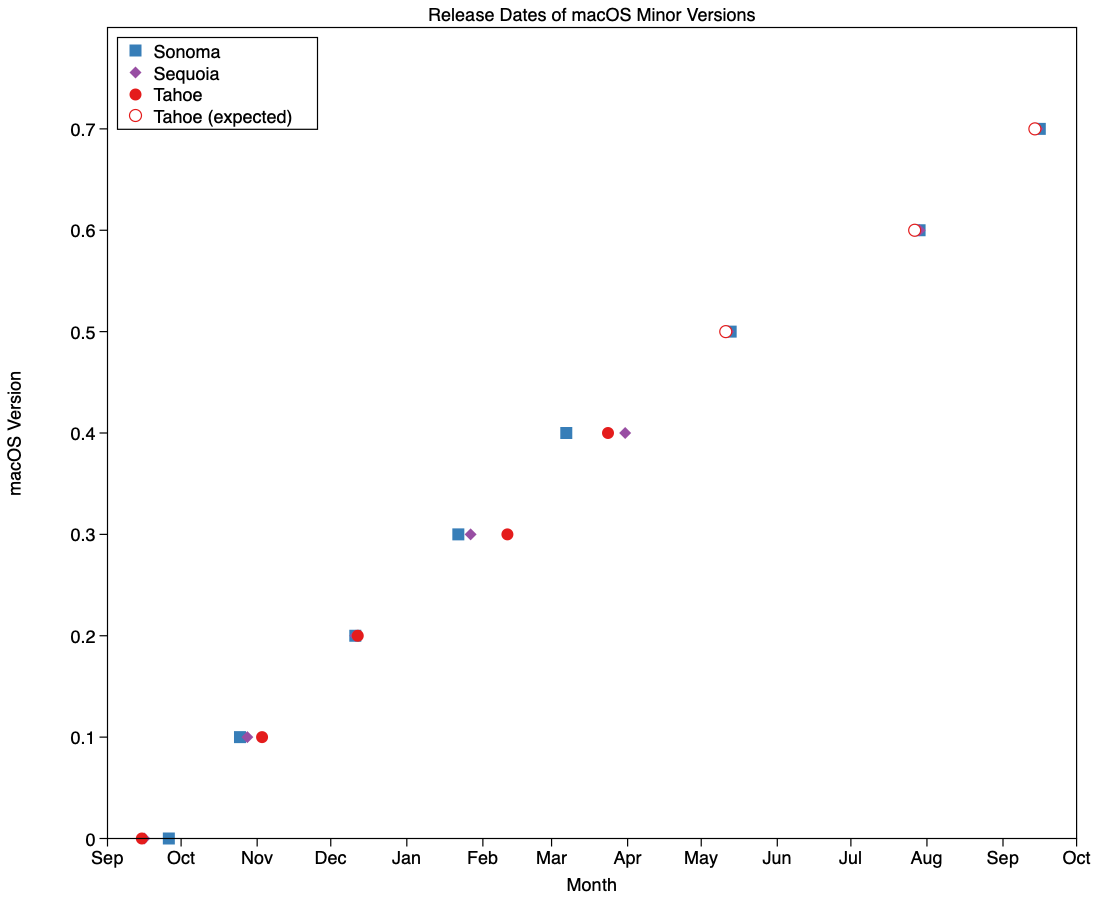
Since the pandemic disruption settled, minor version updates to macOS have become more regular. Looking across Sonoma, Sequoia and Tahoe, greatest variation in their timing has been in their x.3 and x.4 releases, that have varied between 22 Jan – 11 Feb, and 7 – 31 March, respectively. x.5 to x.7 have been more consistent, as they’re more tightly constrained by events including WWDC, the subsequent new beta season, and for some maybe even a vacation.
Those are summarised in the chart above, together with my predictions for the dates we should expect the remaining minor versions of Tahoe. Those should bring its cycle to look like:
26.0 – 15 September 2025
26.1 – 3 November 2025
26.2 – 12 December 2025
26.3 – 11 February 2026
26.4 – 24 March 2026
26.5 – 11 May 2026
26.6 – 27 July 2026
26.7 – 14 September 2026.
Where my forecasts are given in italics. Patch releases, such as 26.3.1, and BSIs occur outside that schedule. While we’re on the topic of BSIs, all indications are that Apple only intends to provide them for the current release of macOS, as it did with RSRs, which means that those Macs staying with Tahoe from 26.7 will no longer get them. It’s unclear how significant a loss that might prove.
WWDC this year is being held between 8-12 June, and will almost certainly bring the first developer beta release of macOS 27.0 (and all Apple’s other OSes). That’s likely to be made available to public beta-testers in early July. This is particularly significant this year, as it will be the first version of macOS to run exclusively on Apple silicon Macs.
For those with Intel Macs, or intending to remain with older versions of macOS, likely dates of release for scheduled security updates to Sonoma and Sequoia are:
15.7.6, 14.8.6 – 11 May 2026
15.7.7, 14.8.7 – 27 July 2026
15.7.8, 14.8.8 – 25 August 2026
15.8 – 14 September 2026.
The date at the end of August is possible, but less likely than the previous two. So far this year, security updates for Sonoma and Sequoia have been keeping reasonably close to those for Tahoe, in terms of vulnerabilities addressed, so the security gap between them has been rather less than in previous cycles.
However, the important message here is that it’s unlikely that Sonoma will receive any further security updates after the end of August this year. If your Mac is capable of being upgraded to Sequoia, now is the time to plan that, or it’ll all too quickly be September and your macOS will have lost its last support.
Similarly, if you’ve been holding back from upgrading to Tahoe in the hope that it will undergo interface improvements, I’m afraid that’s now looking increasingly unlikely. If it’s an Intel Mac capable of running Tahoe, there’s little point in avoiding making that decision any longer. There’s only limited time and scope left for improvement in macOS 26, with most engineers now more focussed on getting macOS 27 ready for WWDC.
Megan Thee Stallion wows audiences on opening night of Moulin Rouge! The Musical on 24 March
Rapper Megan Thee Stallion had to be taken to hospital mid-way through her performance of Moulin Rouge! The Musical, in New York on Tuesday night, her representative has confirmed.
"Megan started feeling very ill and was promptly transported to a local hospital, where her symptoms are currently being evaluated," the spokesperson told US media outlets.
"We will share additional updates as more information becomes available."
The musician, 31, is performing as Zidler – the show's eccentric master of ceremonies – marking her highly anticipated Broadway debut.
Her hair stylist, Kellon Deryck, wrote on X: "Everyone say a prayer for Megan, we are all at the hospital."
Megan Thee Stallion, whose real name is Megan Pete, is scheduled to play Zidler until 17 May, the Moulin Rouge website says. Ahead of her premiere, she expressed excitement for briefly substituting concerts with theatre performances.
'HOTTIES IM ON BROADWAY!!" she wrote on social media after her first performance on 24 March, referencing her fanbase, called the "hotties".
Megan Thee Stallion is best-known for hits including Savage, WAP and Body.
In 2021, she won three Grammy awards for Best Rap Song, Best New Artist and Best Rap Performance. The following year she was nominated for Album of the Year.
Harold Zidler was first played by Danny Burstein in the original Broadway cast of Moulin Rouge, and won a coveted Tony award in 2020 for it. More recently, celebrity drag artist Bob the Drag Queen played Zidler in the musical for eight weeks earlier this year.
The BBC has contacted Megan Thee Stallion's team for comment.
President Trump told reporters on Tuesday that he had attained his goal of dealing with Iran’s nuclear program and that gasoline prices in the United States would be coming down.

 Login
Login