The original intent of the French Impressionists was to paint quickly in front of the motif so as to capture its impression. Although many Impressionist depictions of reflections aren’t optically faithful, in practice there’s nothing to prevent them from that. This was amply demonstrated by the grandfather of Impressionism, Camille Corot, during his formative years spent developing his skills in Rome.
Jean-Baptiste-Camille Corot (1796-1875), The Island and Bridge of San Bartolomeo (1825/8), oil on paper on canvas, 27 x 43.2 cm, National Gallery of Art, Washington DC. WikiArt.
Corot’s earliest plein air works are truly prodigious in their quality, and his development of the art. By the time that the Impressionists were painting outdoors, after 1841, oil paint was widely available in far more convenient metal tubes. But when Corot was in Italy he enjoyed no such luxuries: paint came in small bladders that were far less portable and messier to work with. Despite that, his view of The Island and Bridge of San Bartolomeo from 1825/8 appears optically accurate.
Jean-Baptiste-Camille Corot (1796-1875), View of Rome: The Bridge and Castel Sant’Angelo with the Cupola of St. Peter’s (1826-7), oil on paper on canvas, 26.7 x 43.2 cm, Fine Arts Museums of San Francisco. WikiArt.
Corot’s View of Rome: The Bridge and Castel Sant’Angelo with the Cupola of St. Peter’s from 1826-7 is another brilliant example painted on paper in front of the motif.
Claude Monet’s reflections are generally shown on broken water, and appear intended to be optically correct.
Claude Monet (1840–1926), The Thames below Westminster (1871), oil on canvas, 47 x 73 cm, The National Gallery, London. Wikimedia Commons.
Monet painted The Thames below Westminster while he was in London in 1871, and returned over thirty years later to paint more radical series of views in different lighting conditions.
Claude Monet (1840–1926), Impression, Sunrise (1872), oil on canvas, 48 x 63 cm, Musée Marmottan Monet, Paris. Wikimedia Commons.
The following year, he painted this view of his home port of Le Havre, which gave rise to the movement’s name, Impression, Sunrise. This appears to be a brisk oil sketch of fog and the rising sun, and is one of his series depicting the port at different times and in varying lights, exhibited in the First Impressionist Exhibition two years later.
Alfred Sisley (1839–1899), The Canal Saint-Martin, Paris (1872), oil on canvas, 38 x 46 cm, Musée d’Orsay, Paris. EHN & DIJ Oakley.
The same year, Alfred Sisley’s view of The Canal Saint-Martin, Paris shows a placid and almost disused stretch of canal near the centre of Paris. This too appears to be optically correct.
Claude Monet (1840-1926), Autumn on the Seine, Argenteuil (1873), oil on canvas, 54.3 × 73.3 cm, High Museum of Art, Atlanta, GA. Wikimedia Commons.
In 1873, Monet painted his masterwork Autumn on the Seine, Argenteuil, a textbook example of a river landscape in autumn painted in high Impressionist style, with high chroma, loose brushstrokes and faithful reflections.
Claude Monet (1840-1926), View of the Church at Vernon (1883), oil on canvas, 65 x 81 cm, Yamagata Museum of Art, Japan. (WikiArt)
Although Monet’s View of the Church at Vernon from 1883 doesn’t appear entirely optically accurate, its intent is clear. The reflection of the large house at the right is extended a little too far to the right, as if there had been a tall tree beside it on the bank, where the original image shows another lower house set further back.
Some of Monet’s later series relied on reflections for their visual effects, although they also take more optical liberties.
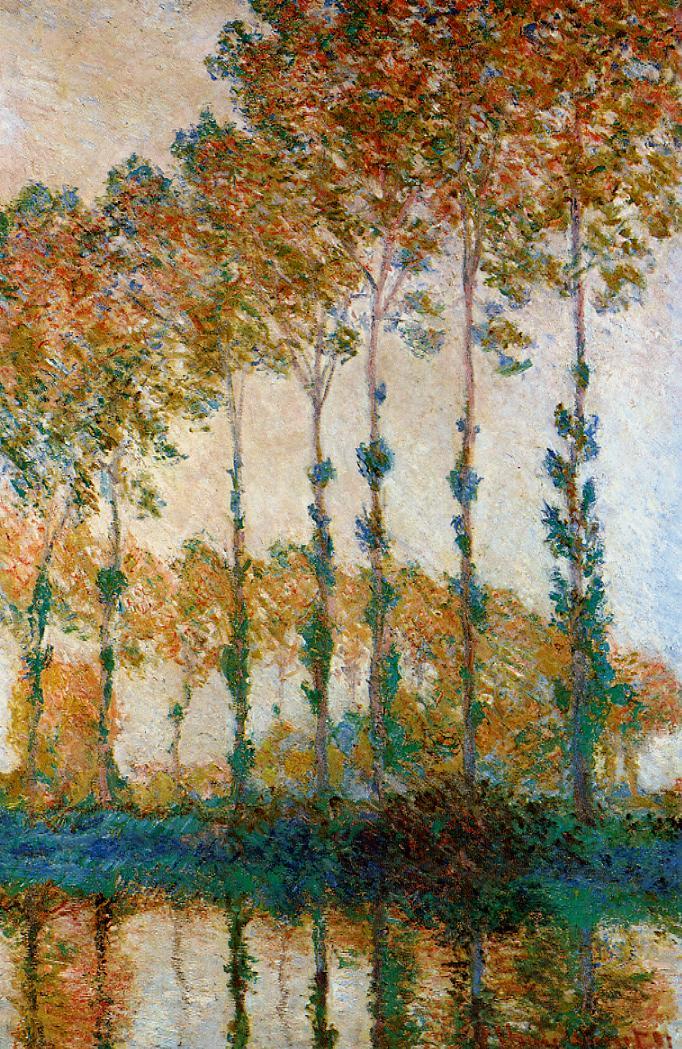
Claude Monet (1840-1926), Poplars on the Bank of the Epte, Autumn (1891) W1297, oil on canvas, 100 x 65 cm, Museum of Fine Arts, Boston. WikiArt.
In 1891, Monet painted his first formal series showing poplars, including Poplars on the Bank of the Epte, Autumn. These articulate the contrasts in form within each tree, with sections of bare trunk, and those of extensive canopy, the colours cast by light and those of the leaves themselves, the rhythmic assembly of the line of trees, their reflections on the water, and the formation of the line of poplars into sweeping curves in depth.
Alfred Sisley (1839–1899), The Bend on the Loing at Moret (1886), oil on canvas, 54 x 74 cm, Private collection. Wikimedia Commons.
The broken water surface in Sisley’s Bend on the Loing at Moret from 1886 remains surprisingly faithful.
Alfred Sisley (1839-1899), Moret Bridge in the Sunlight (1892), oil on canvas, 65 x 81 cm, Private collection. WikiArt.
In Moret Bridge in the Sunlight from 1892, Sisley captures the reflections of the buildings dominating the centre of this small town on the River Loing.
Claude Monet (1840–1926), The Houses of Parliament, Sunset (1903), oil on canvas, 81.3 × 92.5 cm, The National Gallery of Art, Washington, DC. Wikimedia Commons.
Claude Monet’s return to London in 1903 revisits The Houses of Parliament, Sunset fairly faithfully.
In the late nineteenth century, Realist landscape painters challenged themselves with increasingly difficult reflections, where the water surface isn’t mirror-like, but broken.
Gustave Caillebotte (1848–1894), Rain on the Yerres (1875), oil on canvas, 81 x 59 cm, Indiana University Art Museum, Bloomington IN. WikiArt.
Gustave Caillebotte’s Rain on the Yerres (1875) is an innovative study of a reflective water surface disrupted by circles projected by raindrops.
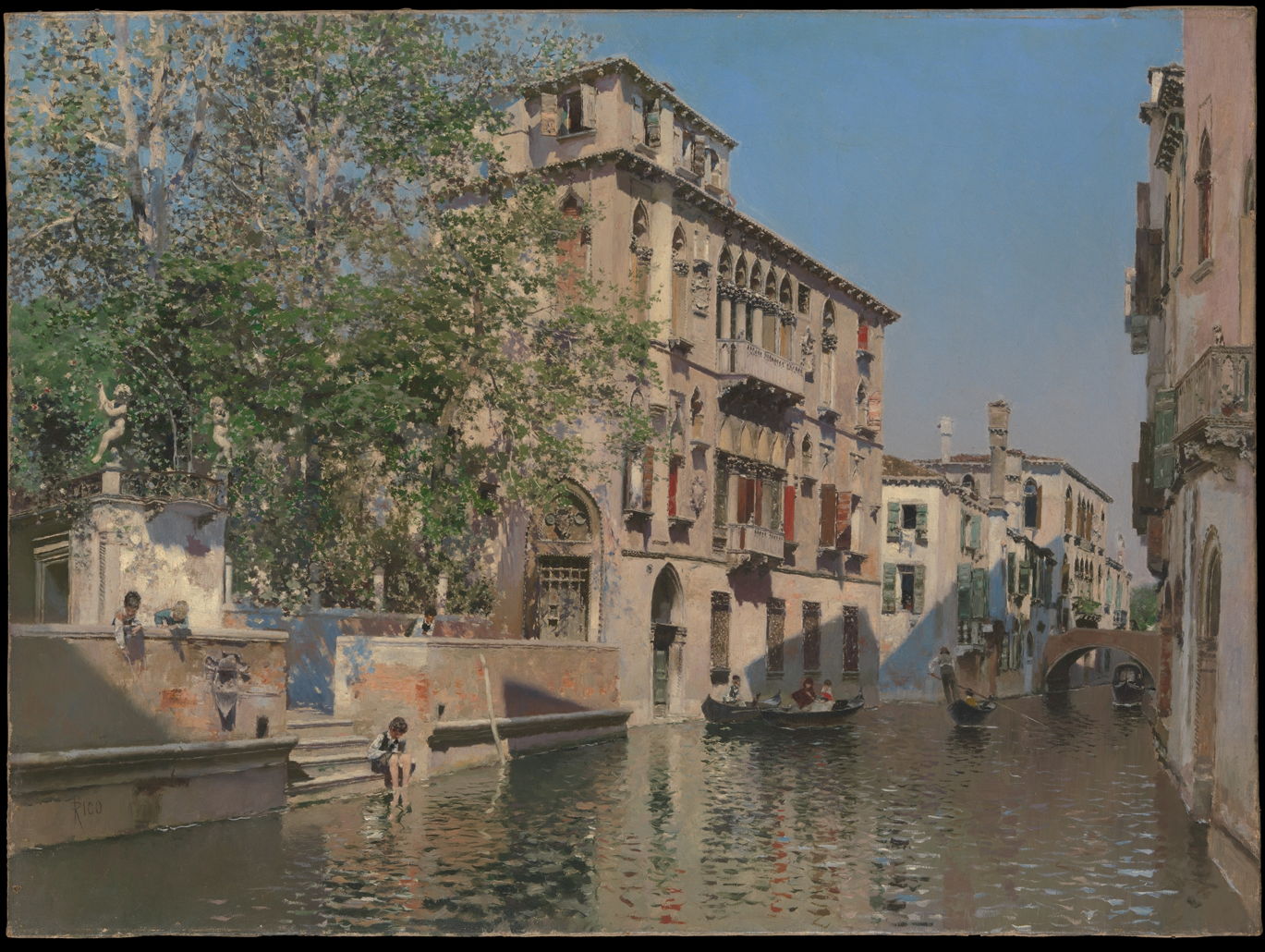
Martín Rico y Ortega (1833–1908), A Canal in Venice (c 1875), oil on canvas, 50.2 x 67.9 cm, The Metropolitan Museum of Art, New York, NY. Wikimedia Commons.
The broken reflections in Martín Rico’s A Canal in Venice from about the same time may have been painted mostly en plein air, despite their fine detail.
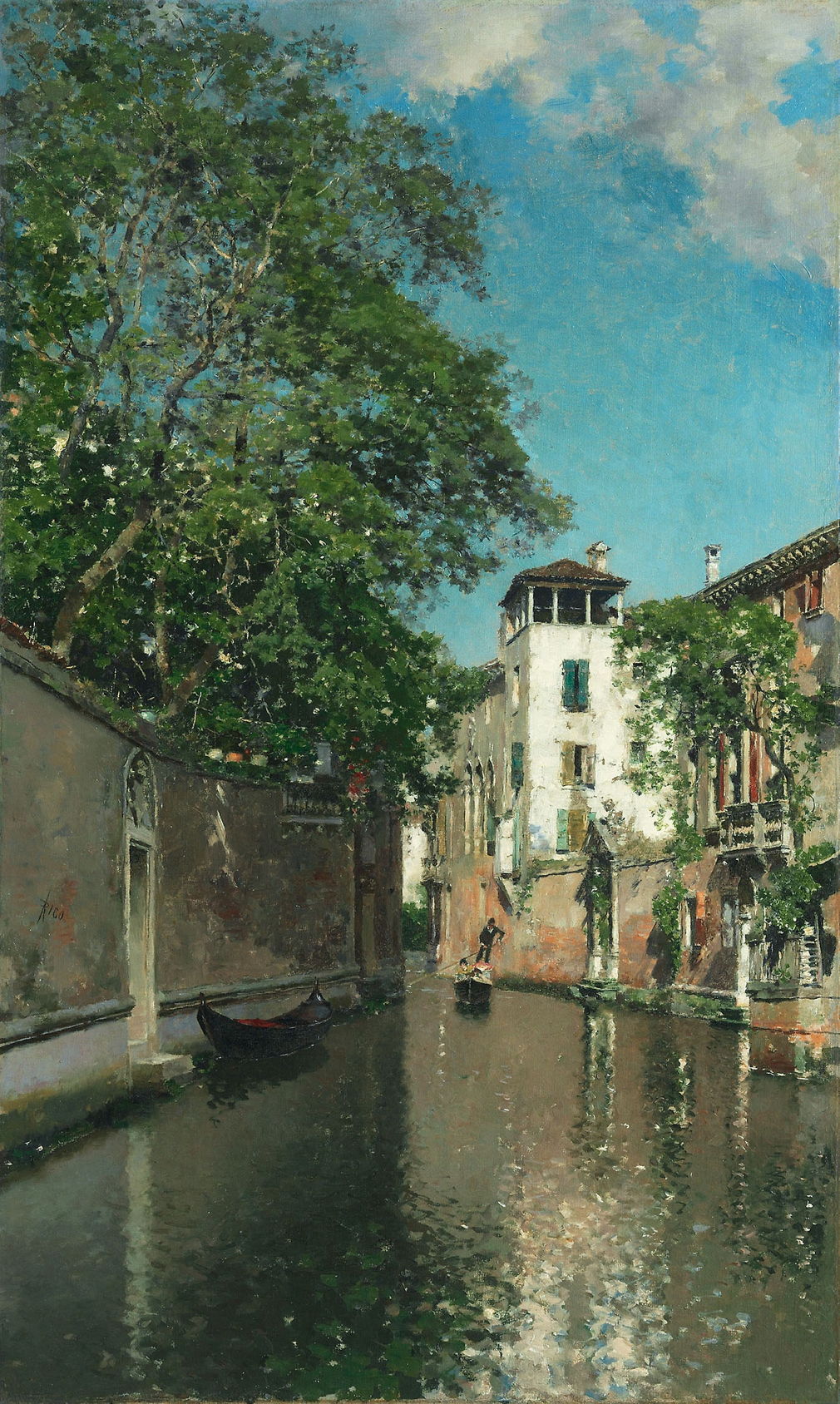
Martín Rico y Ortega (1833–1908), Canal in Venice (date not known), oil on canvas, dimensions not known, The Art Institute of Chicago, Chicago, IL. Wikimedia Commons.
Rico’s Canal in Venice uses more painterly marks in its reflections.
At the same time, Eilert Adelsteen Normann was painting the grander effects seen in the fjords of Norway.
Eilert Adelsteen Normann (1848–1918), From Romsdal Fjord, 1875 (1875), oil on canvas, dimensions not known, Bergen kunstmuseum (Kunstmuseene i Bergen), Bergen, Norway. Wikimedia Commons.
Normann’s From Romsdal Fjord, also from 1875, shows the ninth longest fjord in Norway as it carves its way through this huge mountain gorge. Although much of the water surface is glassy calm, there’s a slight blur of fine ripples, and patches where it’s more disrupted by gentle breeze.
Eilert Adelsteen Normann (1848-1918), The Steamship (date not known), further details not known. Wikimedia Commons.
The unidentified fjord in Normann’s undated The Steamship shows a similar repertoire of subtle optical effects.
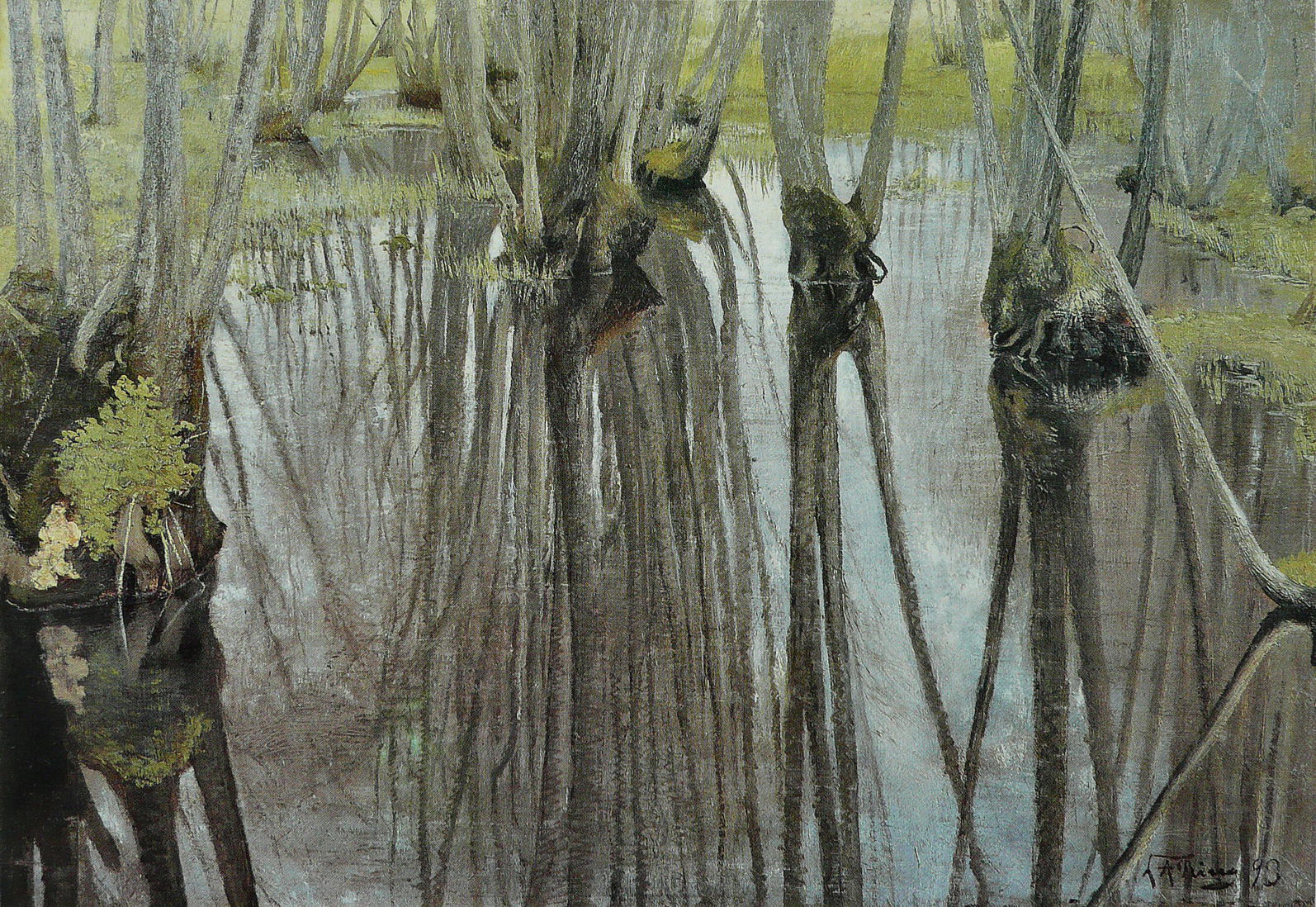
Laurits Andersen Ring (1854–1933), Alder Trunks (1893), oil on canvas, 52.9 x 73.5 cm, Collection of Her Majesty the Queen Margrethe II, Copenhagen, Denmark. Wikimedia Commons.
Alder Trunks from 1893 is one of Laurits Andersen Ring’s finest landscapes, and has earned its place in the Danish Royal Collection. He shows these old coppiced alders mainly in reflection. Although their details are quite painterly, the overall effect is that of meticulous realism.
The specialist of this period is the Norwegian Frits Thaulow.
Frits Thaulow (1847–1906), Winter at the River Simoa (1883), oil on canvas, 49.5 x 78.5 cm, Nasjonalgalleriet, Oslo, Norway. Wikimedia Commons.
Thaulow seems to have discovered what was going to be his recurrent theme for much of his career by 1883, when he painted this scene of Winter at the River Simoa. A lone woman, dressed quite lightly for the conditions, is rowing her tiny boat over the quietly flowing river, towards the tumbledowns on the other side. The surface of the river shows the glassy ripples so common on semi-turbulent water, and the effect on reflections is visibly complex. The distant side of the river is also partly frozen, breaking the reflections further.
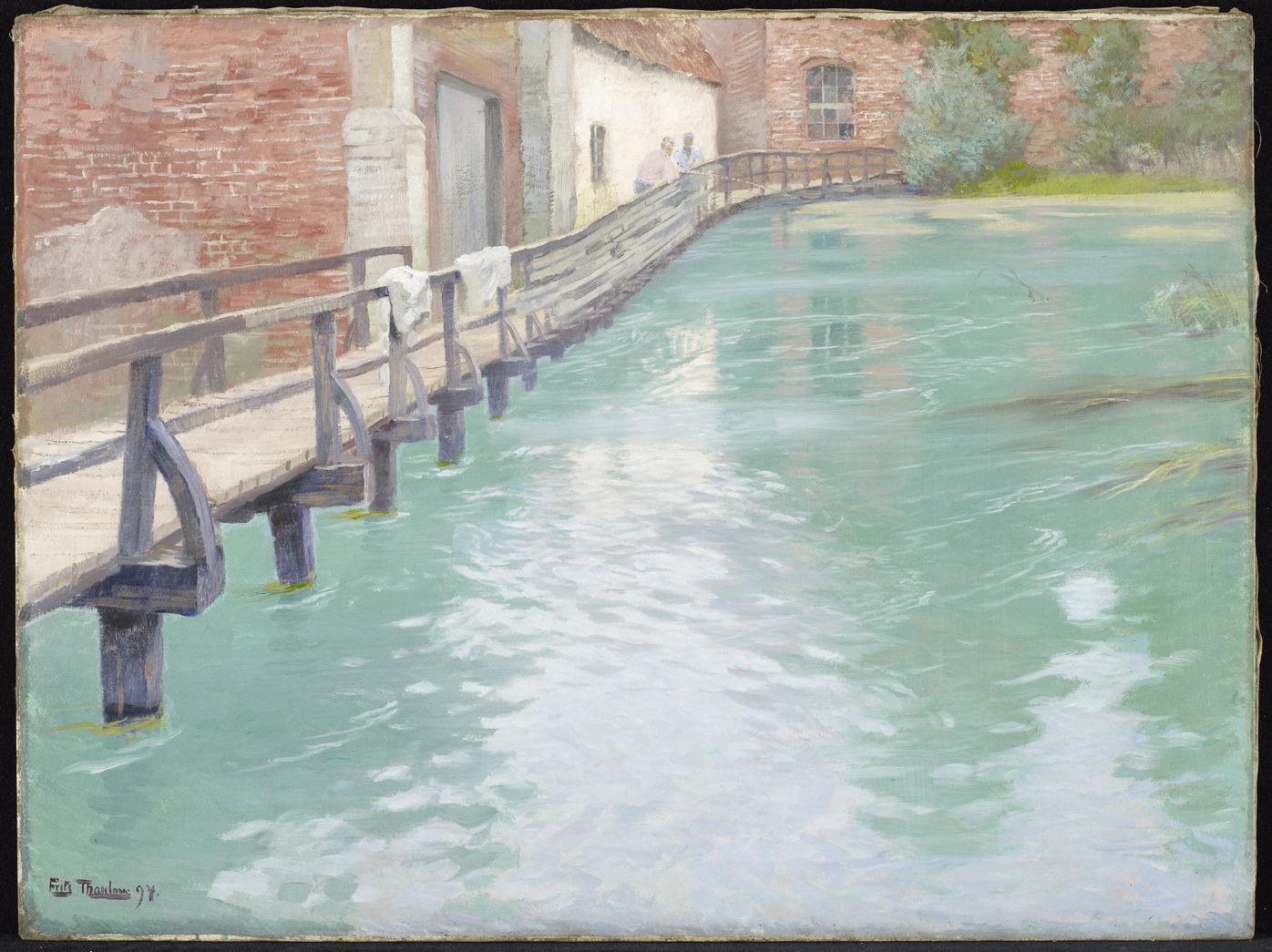
Frits Thaulow (1847–1906), The Mills at Montreuil-sur-Mer, Normandy (1894), oil on canvas, dimensions not known, Minneapolis Institute of Art, Minneapolis, MN. Wikimedia Commons.
Thaulow later returned to his studies of flowing rivers, for example in The Mills at Montreuil-sur-Mer, Normandy. This painting has been claimed to date from 1891, before the artist moved to Montreuil, but I think that its date reads 1894.
Frits Thaulow (1847–1906), The Adige River at Verona (c 1894), oil on canvas, 81 x 100 cm, Walters Art Museum, Baltimore, MD. Wikimedia Commons.
In 1894, Thaulow travelled across northern Italy to Venice, stopping off to paint The Adige River at Verona. This shows the five arches of the Ponte della Pietra, with wonderfully disrupted reflections describing the river’s turbulent flow.
Frits Thaulow (1847–1906), La Dordogne (1903), oil, further details not known. Wikimedia Commons.
Soon after Thaulow had settled at Beaulieu in central France, he found form with the magnificent river surface and lighting of La Dordogne (1903), whose precise detail in the foreground quickly yields to a more sketchy background.
A few artists rose to the challenge of combined reflected and refracted images, among them Kazimierz Sichulski.
Kazimierz Sichulski (1879–1942), Fish (1908), pastel on paperboard, 63 x 82 cm, Muzeum Narodowe w Poznaniu, Poznań, Poland. Wikimedia Commons.
Sichulski’s Fish (1908) is a startlingly unusual pastel painting, a virtuoso combination of reflections from and views through this water surface. It’s an essay in practical optics.
As landscape painters increasingly came to rely on studies made in front of the motif, and their views came closer to reality, faithful depictions of reflections on water increased. But the fundamental challenges of painting accurate reflections remained. Both John Constable and JMW Turner started their careers drawing, trained in the Royal Academy Schools, and should have had a thorough grounding in 3D projection and reflections, as well as ample experience recording what they saw.
Several of Constable’s major works include reflected passages, painted slowly in the studio following extensive studies made of the motif.
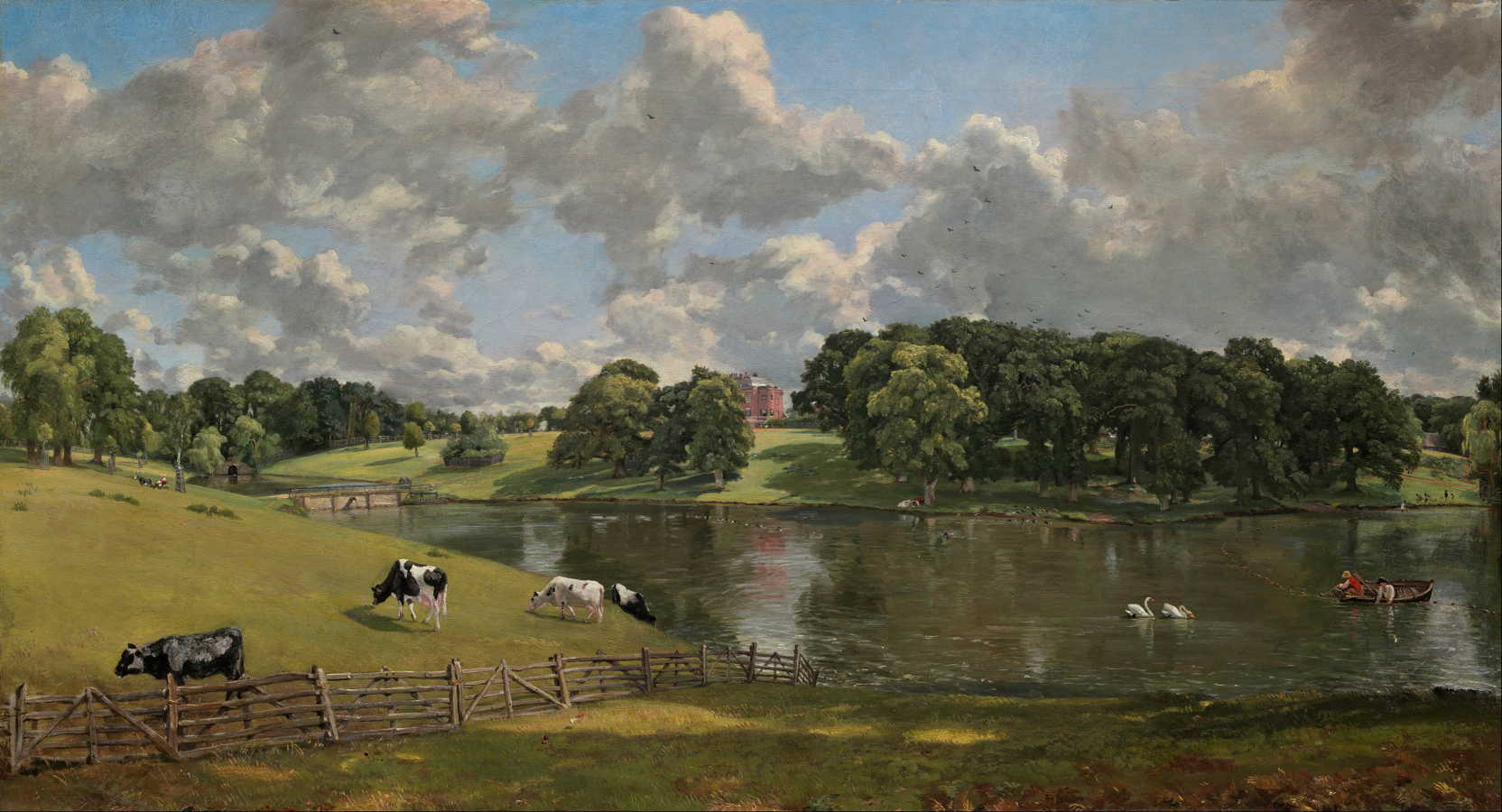
John Constable (1776–1837), Wivenhoe Park, Essex (1816), oil on canvas, 56.1 x 101.2 cm, The National Gallery of Art, Washington, DC. Wikimedia Commons.
Constable’s commissioned painting of the house and estate at Wivenhoe Park, Essex from 1816 is an oddly distant view of Major-General Francis Slater-Rebow’s country seat. Given the expanse of mirror-like lake, he might have been expected to include meticulous reflections. There are obvious anomalies, such as the brick-red reflection of the modest section of the house visible through a break in the trees in the centre of the canvas. The house is sufficiently distant that little or none of it would have been visible in reflection, let alone the two large areas of brick red stretching well over half way across the water. That was in all probability painted for effect.
John Constable (1776–1837), Wivenhoe Park, Essex (detail with reflection) (1816), oil on canvas, 56.1 x 101.2 cm, The National Gallery of Art, Washington, DC. Wikimedia Commons.
Reflections of the pair of swans and boatmen are also out of kilter. Constable may well have neither seen nor sketched them from life, and then struggled to envision their reflections in the studio.
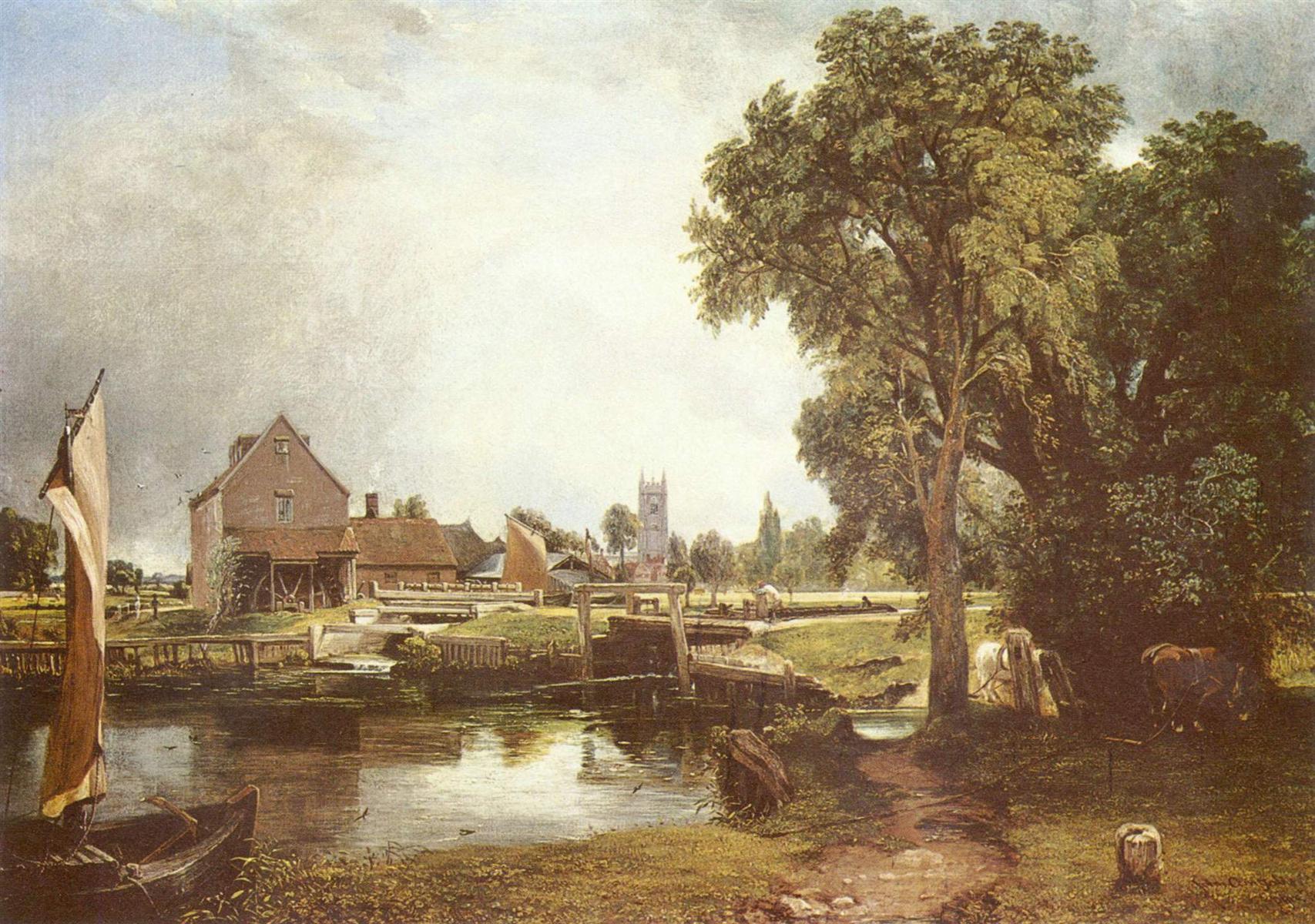
John Constable (1776–1837), Dedham Lock and Mill, 1820, oil on canvas, 53.7 x 76.2 cm, Victoria and Albert Museum, London. WikiArt.
Four years later, this painting of Dedham Lock and Mill (1820) is more familiar territory from the artist’s home ground. His family owned this lock on the River Stour, and he would have worshipped in the village church of Dedham seen in the distance. His reflections here appear accurate throughout.
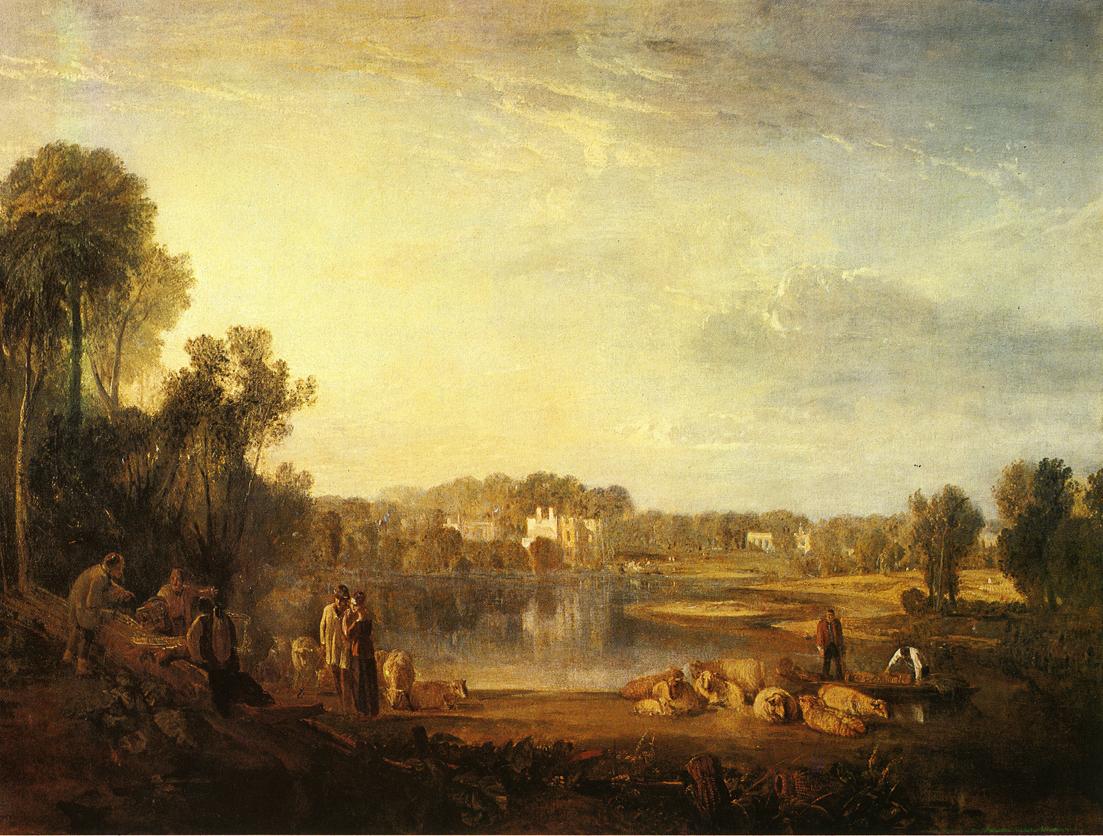
Joseph Mallord William Turner (1775–1851), Pope’s Villa, at Twickenham (1808), oil on canvas, 120.6 x 92.5 cm, Private Collection. WikiArt.
Turner’s approach to reflections changed over the course of his career. In Pope’s Villa, at Twickenham from 1808, he depicted complex and intricate reflections in careful detail.
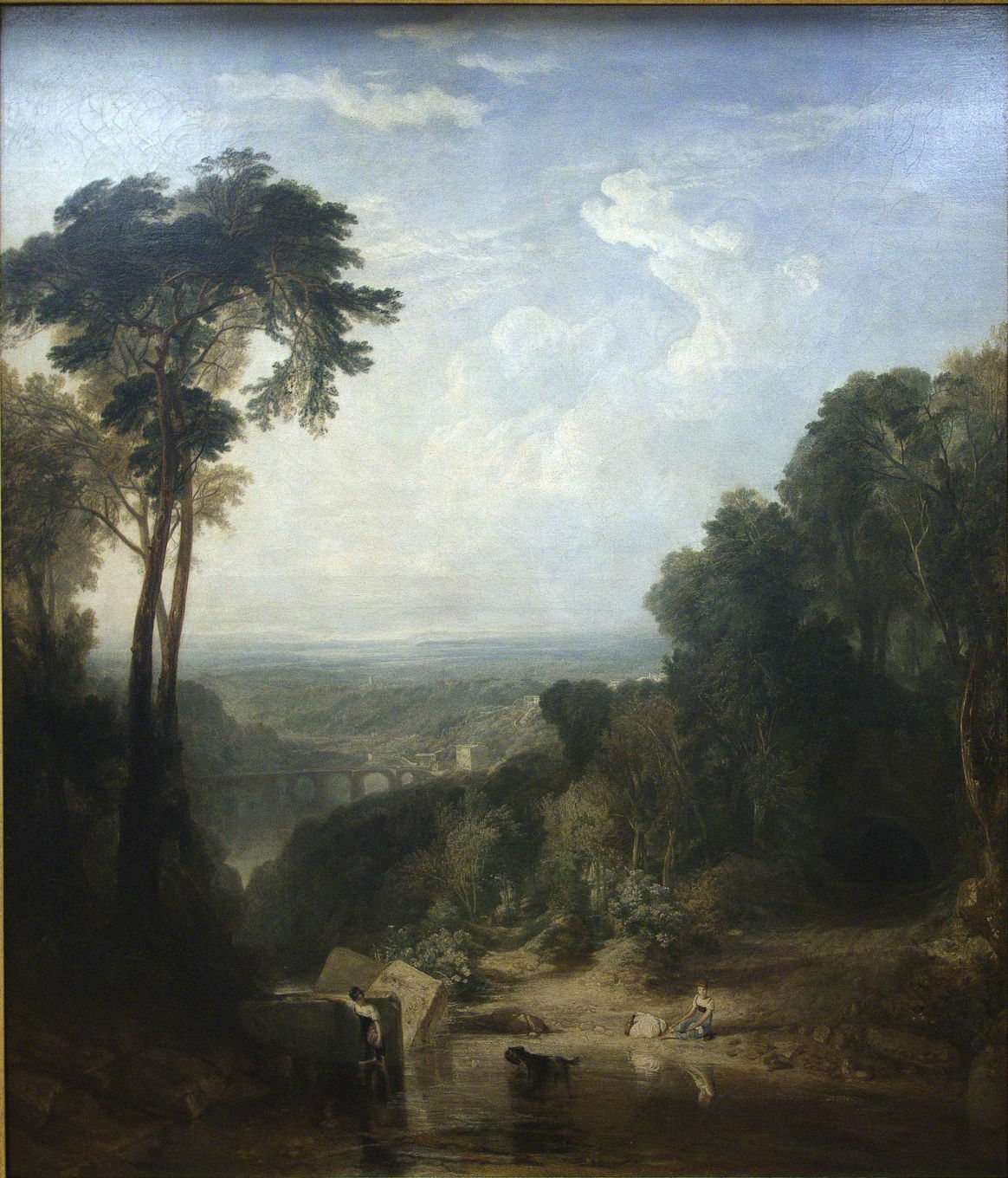
I’ve previously considered the relatively small anomalies in another of his early oil paintings, Crossing the Brook from 1815.
Joseph Mallord William Turner (1775-1851), Crossing the Brook (1815), oil on canvas, 193 x 165.1 cm, Tate Britain, London (N00497). EHN & DIJ Oakley.
These could be accounted for by the figures being staffage added in the studio without the benefit of plein air studies.
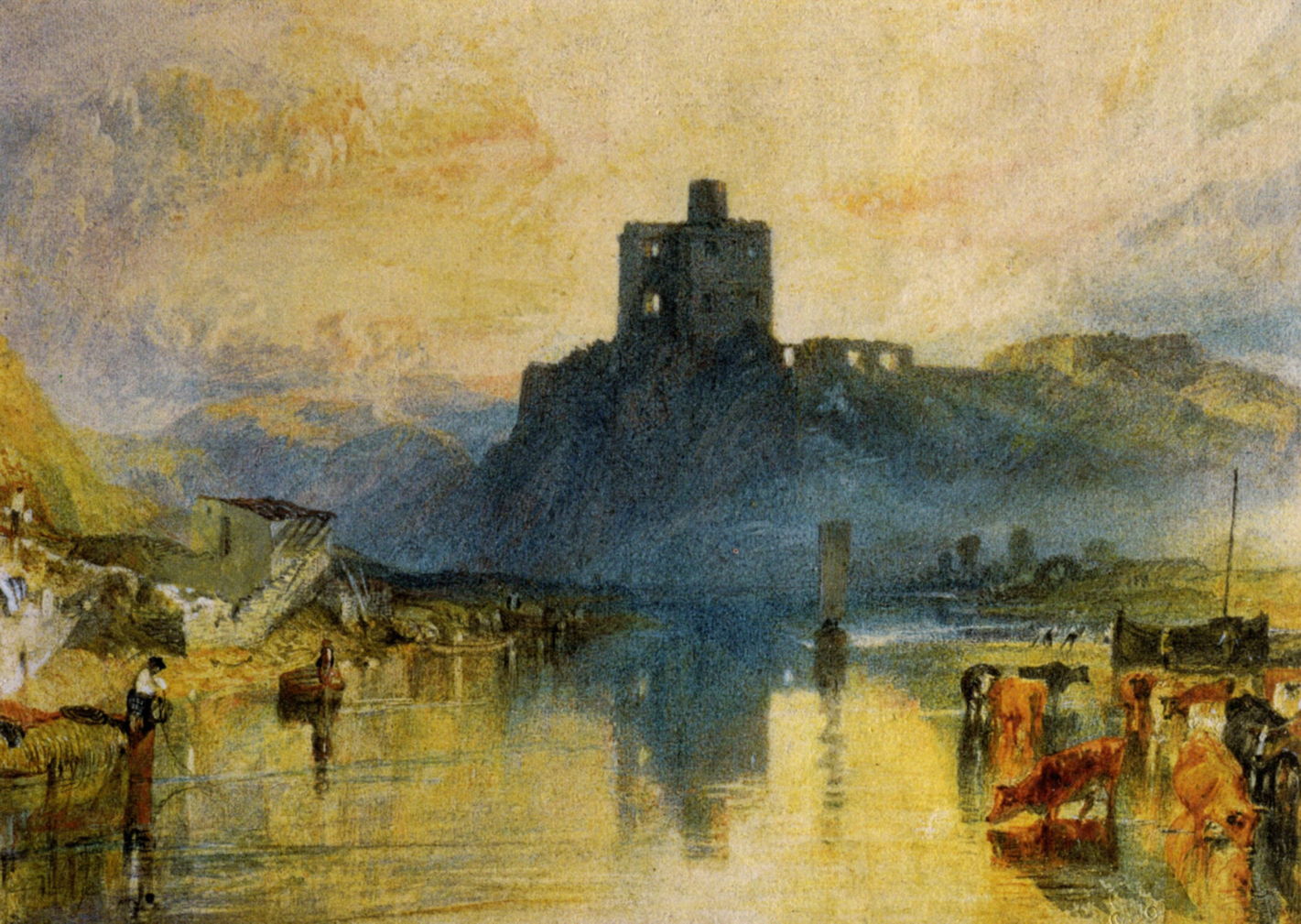
Joseph Mallord William Turner (1775–1851), Norham Castle, on the River Tweed (1823), watercolour on paper, 15.6 x 21.6 cm, British Museum, London. WikiArt.
Some of his later watercolours, such as Norham Castle, on the River Tweed (1823), have obvious quirks in their reflections: here the reflection appears to show another high point at the left edge of the castle that isn’t matched by an equivalent high point in the real castle.
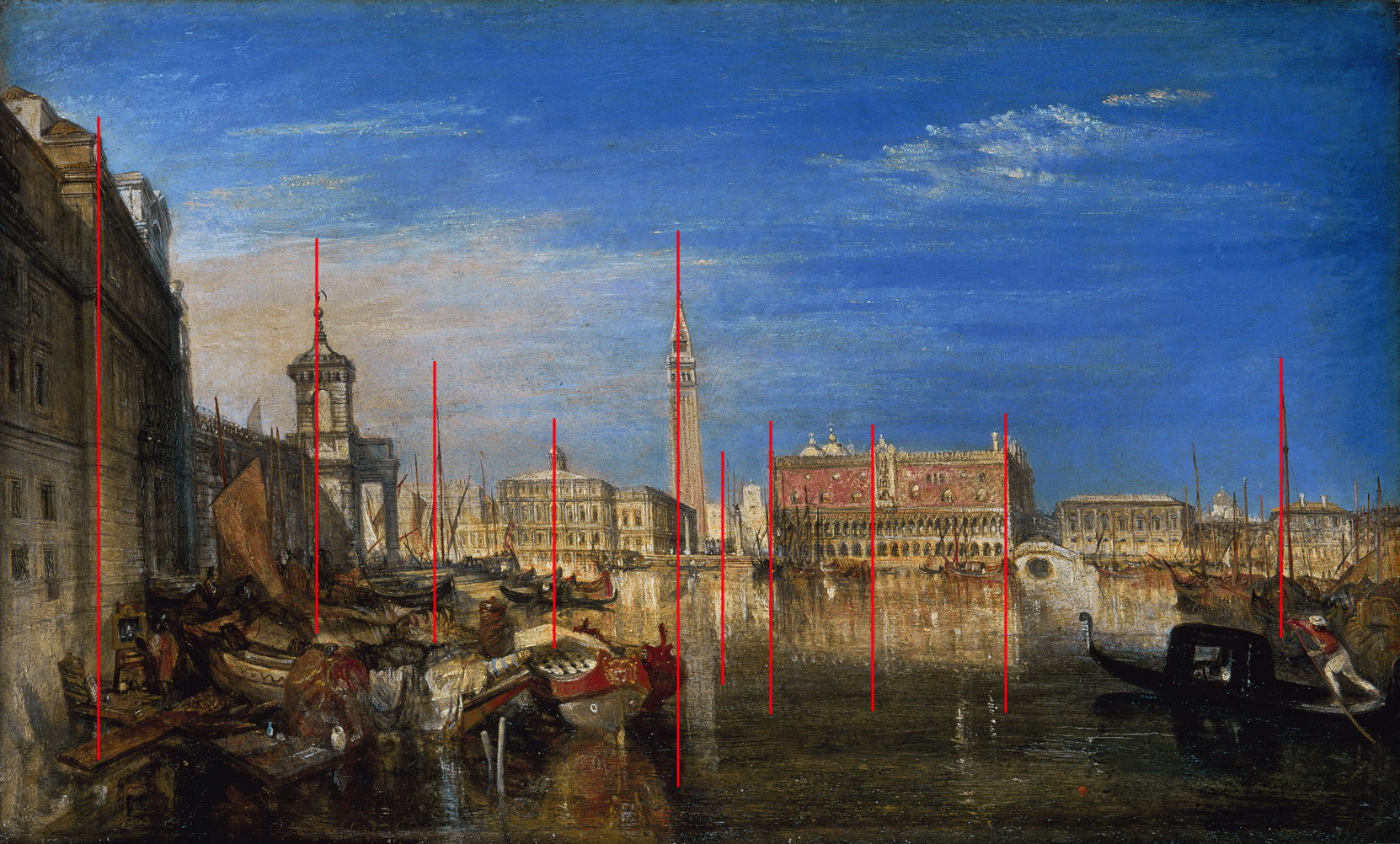
Joseph Mallord William Turner (1775–1851), Bridge of Sighs, Ducal Palace and Custom-House, Venice: Canaletti Painting (1833), oil on mahogany, 51.1 x 81.6 cm, Tate Britain, London (N00370). Wikimedia Commons. Perpendiculars have been superimposed to show failure in vertical alignment of the unreflected and reflected images.
Some of his paintings show other optical oddities. His Bridge of Sighs, Ducal Palace and Custom-House, Venice: Canaletti Painting (1833), his first oil painting of Venice, places all the buildings leaning to the left, with their reflections leaning in the opposite direction. Had this painting been on a canvas support, there might have been distortion applied by its stretching or subsequent treatment, but unusually Turner painted this on a mahogany panel. I have checked this image matches those from other sources, to ensure this isn’t a photographic artefact.
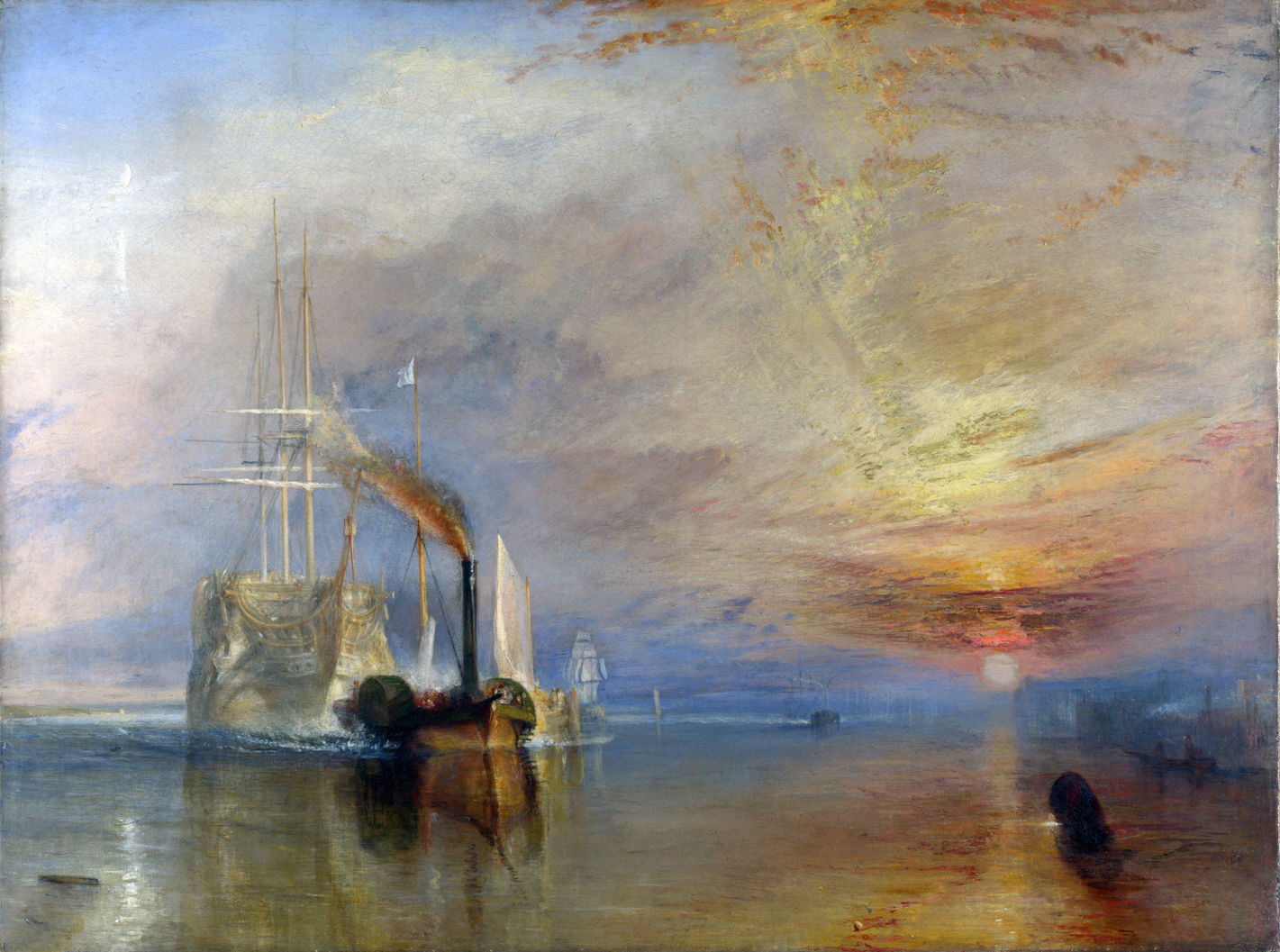
Joseph Mallord William Turner (1775–1851), The Fighting Temeraire tugged to her last Berth to be broken up (1839), oil on canvas, 90.7 × 121.6 cm, The National Gallery, London. Wikimedia Commons.
Turner’s famous Fighting Temeraire from 1839 breaks most of the optical rules of reflections, most obviously in the extraordinary reflected image of the tug’s prow. The tip of the bowsprit isn’t vertically aligned between original and reflection, and there’s gross vertical exaggeration, as there is in the ghostly reflection of the Temeraire under tow.
Joseph Mallord William Turner (1775–1851), Campo Santo, Venice (1842), oil on canvas, 62.2 x 92.7 cm, Toledo Museum of Art, Toledo. WikiArt.
Several of Turner’s later paintings appear founded in sound optical principles, then exaggerated for artistic effect. While many of the reflections in his Campo Santo, Venice from 1842 appear faithful, he has grossly exaggerated the vertical axis of the reflections of the white sails to the left of centre. But the effect is wonderful.
The Dogano, San Giorgio, Citella, from the Steps of the Europa, from the same year, takes a few gentle liberties with optics without becoming too obviously inaccurate. Again this is mainly in vertical scaling, and Turner has been careful to ensure good vertical alignment throughout.
Joseph Mallord William Turner (1775–1851), War. The Exile and the Rock Limpet (1842), oil on canvas, 79.4 x 79.4 cm, Tate Britain, London (N00529). WikiArt.
I have already pointed out some of the apparently deliberate optical anomalies seen in the reflections in Turner’s late oil painting War. The Exile and the Rock Limpet (1842).
Given Turner’s experience and record, I don’t think those discrepancies are errors, but are devices he has successfully used for their effect.
There are only two ways a painter can depict reflections on water in accordance with optical reality: they can paint exactly what they see when in front of the motif, or they can understand optical principles sufficiently to recreate what they would have seen. This article looks at how those worked out in landscape paintings to the end of the eighteenth century.
Jan van Eyck (c 1390–1441), The Madonna of Chancellor Rolin (detail) (c 1435) oil on panel, 66 x 62 cm. Musée du Louvre, Paris (WikiArt).
Look in the landscape behind Jan van Eyck’s Madonna of Chancellor Rolin (c 1435) and you’ll see one of the earliest examples of the meticulously accurate depiction of reflections on water. These could only have resulted from careful studies made in front of the motif.
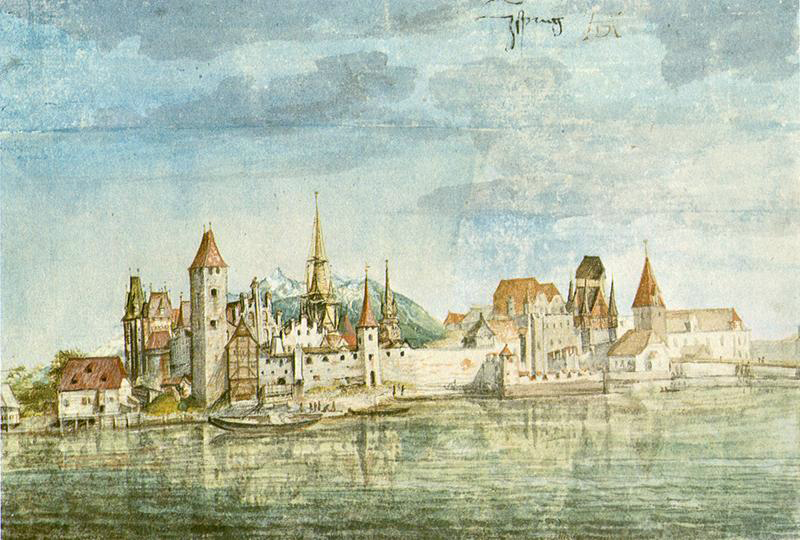
Albrecht Dürer (1471-1528), View of Innsbruck (c 1495), watercolour on paper, 12.7 x 18.7 cm. Albertina, Vienna (WikiArt).
For Albrecht Dürer painting this View of Innsbruck in about 1495, this watercolour is evidence that he both recognised the challenge, and went to the trouble to paint what he actually saw, even though the overall geometry isn’t perfect, with its downward slope to the left.
Following the Northern Renaissance, other landscape painters continued this tradition, into the Dutch Golden Age.
Aelbert Cuyp (1620–1691), View on the Rhine (c 1645), oil on panel, 27.4 x 36.8 cm, Fondation Custodia, Paris. Wikimedia Commons.
Although Aelbert Cuyp’s View on the Rhine from about 1645 isn’t optically perfect and must at least have been finished in the studio, it demonstrates his care in trying to be faithful in its reflections.
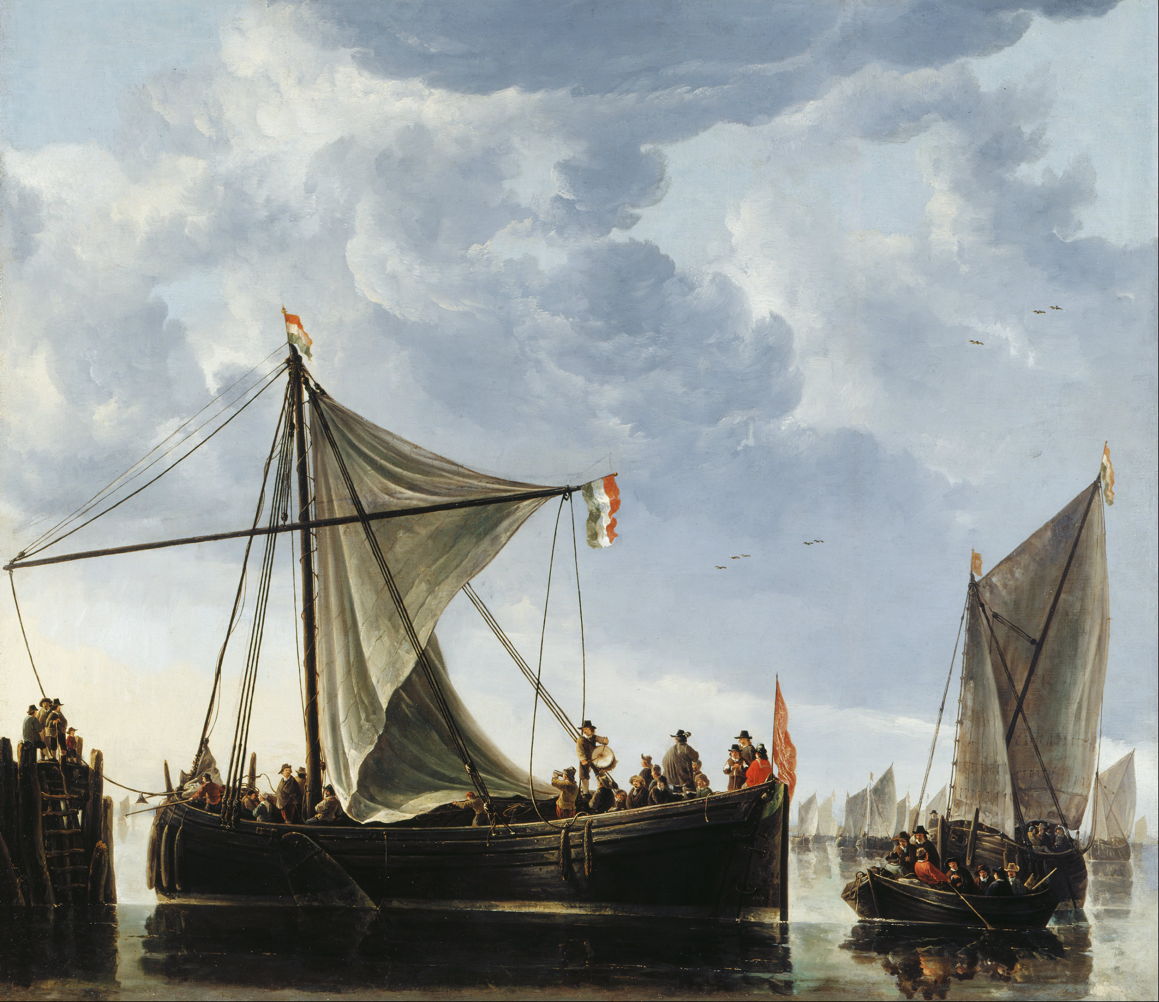
Aelbert Cuyp (1620–1691), The Passage Boat (c 1650), oil on canvas, 124 x 144.4 cm, Royal Collection of the United Kingdom, UK. Wikimedia Commons.
Cuyp’s larger and more detailed painting of The Passage Boat from about 1650 is similarly attentive, implying the use of careful studies made in front of the motif.
Aelbert Cuyp (1620–1691), The Valkhof at Nijmegen (c 1652-54), oil on wood, 48.8 x 73.6 cm, Indianapolis Museum of Art, Indianapolis, IN. Wikimedia Commons.
Cuyp’s grand view of The Valkhof at Nijmegen from about 1652-54 is a fine example from later in his career.
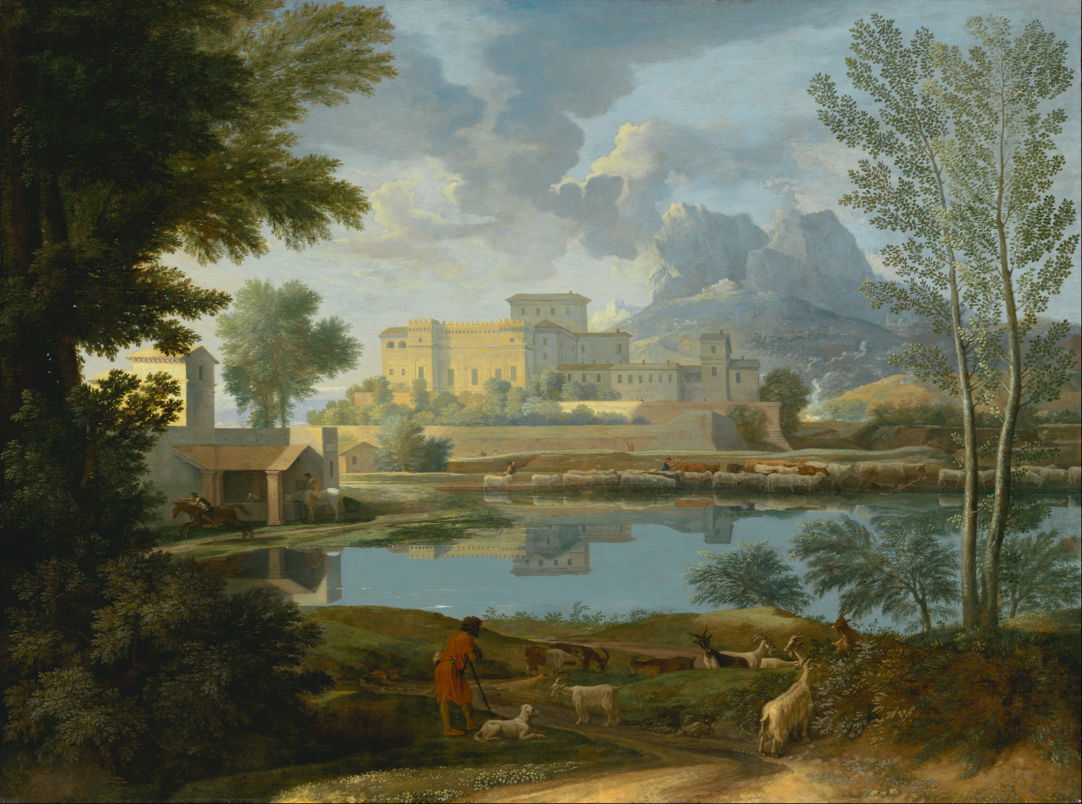
Nicolas Poussin (1694-1665), Landscape with a Calm (c 1651), oil on canvas, 97 x 131 cm, J. Paul Getty Museum, Los Angeles. Digital image courtesy of the Getty’s Open Content Program.
At about the same time, Nicolas Poussin used extensive reflections to augment the placid atmosphere in his idealised Landscape with a Calm (c 1651). The upper parts of the Italianate mansion, together with the livestock on the far bank of the lake, are painstakingly reflected on the lake’s surface, telling the viewer that there isn’t a breath of breeze to bring ripples to disturb those reflections.
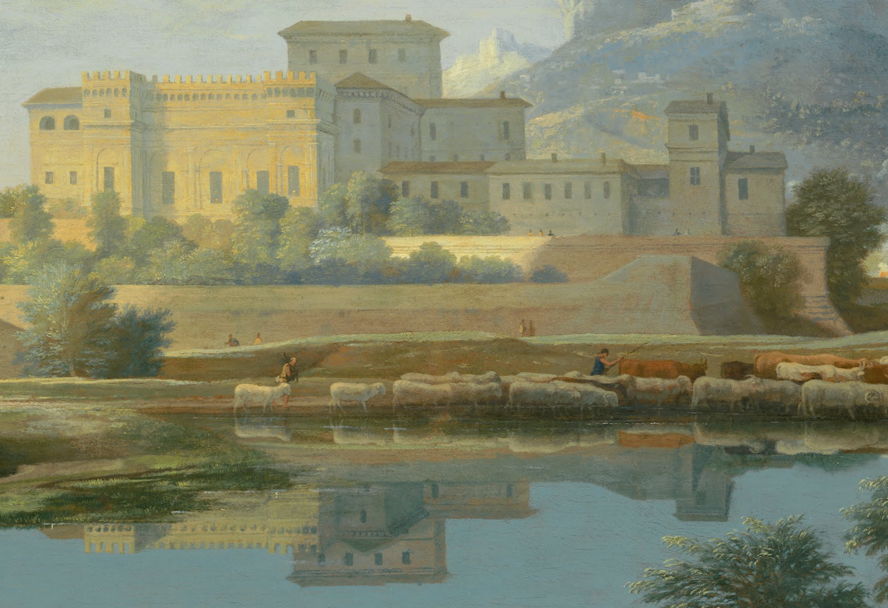
Nicolas Poussin (1594–1665), Landscape with a Calm (detail) (c 1651), oil on canvas, 97 x 131 cm, J. Paul Getty Museum, Los Angeles. Digital image courtesy of the Getty’s Open Content Program.
Closer examination of the reflections reveals small disparities, though. Poussin has broken the rule of depth order in painting the brown reflection of one of the cattle that is well behind the sheep at the edge of the lake, and there are inaccuracies obvious in the reflection of the villa. Those may well be the result of his assembling passages from the original plein air studies he used to build this composite.
Nicolas Poussin (1594–1665), Landscape with a Calm (detail) (c 1651), oil on canvas, 97 x 131 cm, J. Paul Getty Museum, Los Angeles. Digital image courtesy of the Getty’s Open Content Program.
His reflections appear most accurate in the passage showing horsemen at the left end of the lake. These make interesting comparison with Poussin’s contemporary Claude Lorrain, who appears to have avoided tackling the problems posed by reflections.
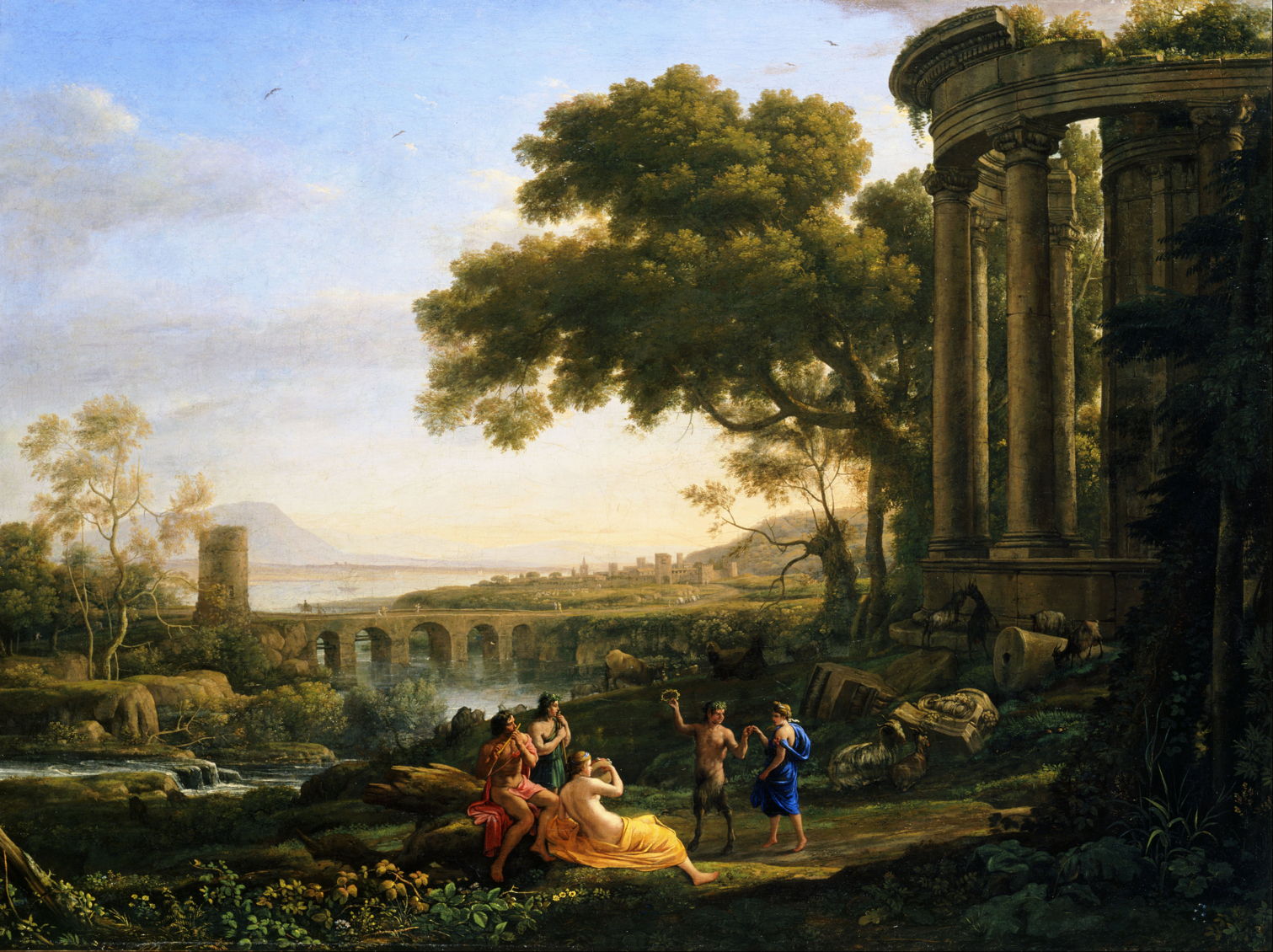
Claude Lorrain (1604/5–1682), Landscape with Nymph and Satyr Dancing (1641), oil on canvas, 99.7 x 133 cm, Toledo Museum of Art, Toledo, OH. Wikimedia Commons.
In Claude’s Landscape with Nymph and Satyr Dancing from 1641, another idealised composite assembled from the artist’s library of sketches, little attempt is made to depict the reflection of the prominent viaduct. What has been shown is unaccountably darker than the original, and vague in form. Most of Claude’s other paintings that could have included reflections show water surfaces sufficiently broken to avoid tackling the problem.
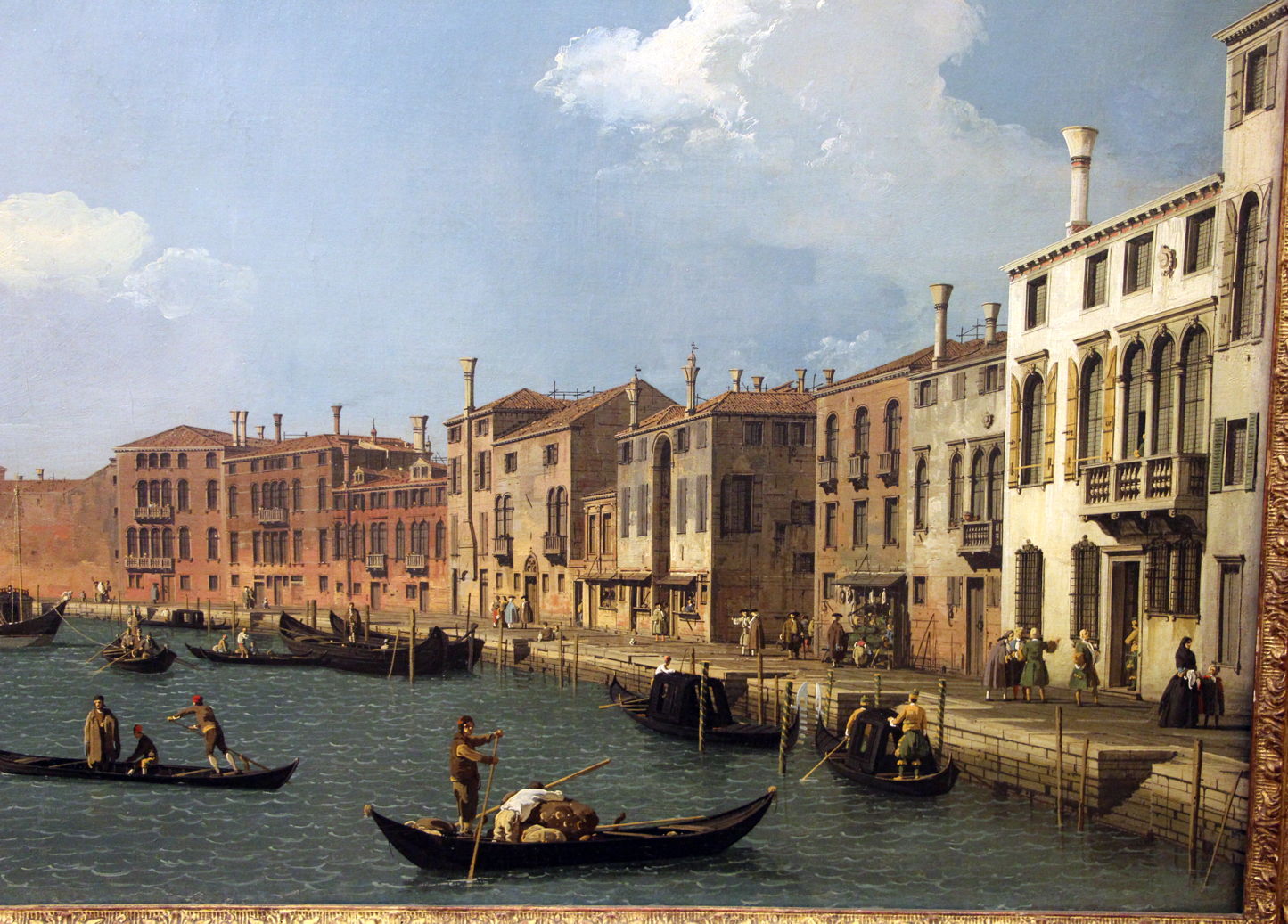
Canaletto (Giovanni Antonio Canal) (1697–1768), Canale di Santa Chiara, Venice (c 1730), oil, dimensions not known, Musée Cognacq-Jay, Paris. Image by Sailko, via Wikimedia Commons.
Paintings of Venice and London by Canaletto in the eighteenth century are also largely devoid of reflections. In his Canale di Santa Chiara, Venice from about 1730 the gondola in the left foreground has no reflection at all, and its three figures are similarly absent from the surface of the water.
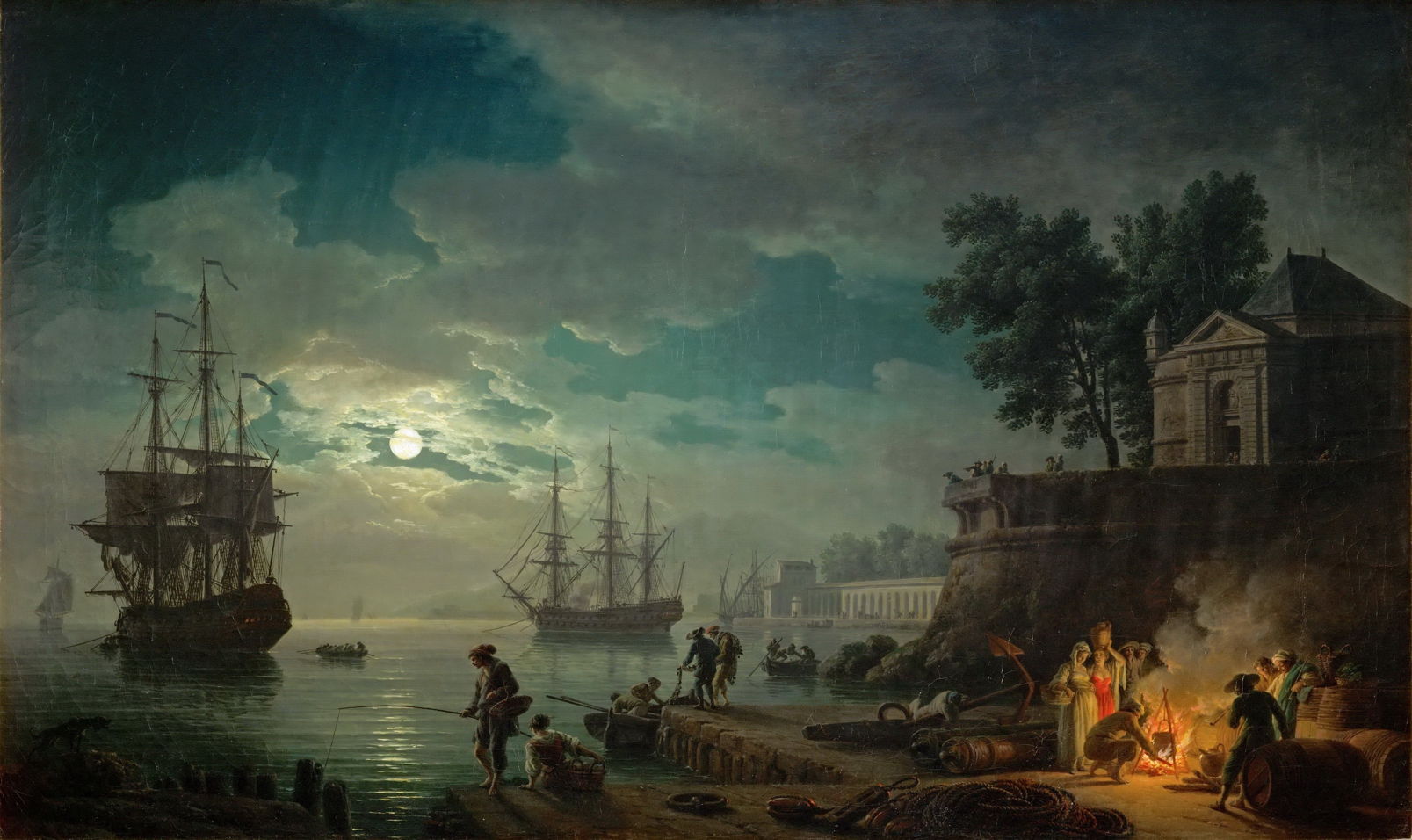
Claude-Joseph Vernet (1714–1789), Seaport by Moonlight (c 1771), oil on canvas, 98 x 164 cm, Musée du Louvre, Paris. Wikimedia Commons.
Reflections return in the studio paintings of those whose sketches made in front of the motif were sufficiently detailed to include them. Among them is Claude-Joseph Vernet, whose Seaport by Moonlight from about 1771 appears faithful. Sadly, none of his preparatory drawings or sketches appear to have survived, although they were a key influence on the next generation of landscape artists.
Understanding the optical principles involved in reflections is important for recognising when artists deviate from them, as in many cases that’s intentional. These can readily become complicated when considering mirrors that can be orientated at will, and are at their simplest when the reflecting surface is horizontal with respect to the earth, as with reflections on water.
Basic optics
The fundamental optical principles underlying reflections on water surfaces are:
light travels in a straight line when passing through a medium of constant refractive index;
when light reaches the interface between two media of different refractive indexes, some will be reflected from the boundary, and some will be refracted through that boundary;
the angle of reflection of a ray of light from a boundary surface is equal to the angle of incidence of that light on that boundary;
a water surface with air above it presents a suitable boundary at which reflection and refraction occur;
still water surfaces are horizontal planes that act as horizontal planar mirrors as far as incident light rays are concerned.
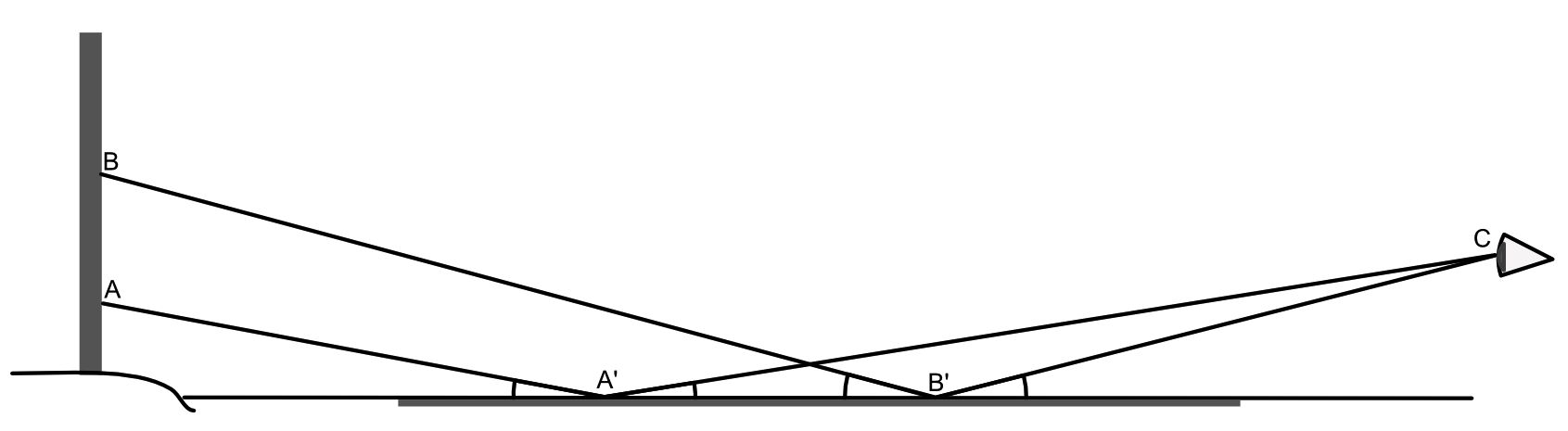
Basic diagram showing the geometry of reflections on water. EHN & DIJ Oakley.
Here a post (with marks A and B), on the left of the diagram, is on the bank of a completely flat lake, with the observer on the opposite side of the lake at C, looking over the lake towards the post. A ray of light scattered from point A on the post passes over the lake to point A’. There, in passing from air to water, it reaches a boundary between media of different refractive indexes, and most of that light will then be reflected towards the observer at C.
Measured at the point of reflection A’ on the lake, the angle of incidence (between the ray and the horizontal water surface) equals the angle of reflection (between the ray and the water surface). The same process of reflection occurs to light scattered from point B on the post, with respect to its reflection at point B’ and the observer’s eye at C, although the angles at point A’ are less than those at point B’.
The relationship between heights above the water plane and the distances from the reflection on the water are a matter of simple geometry. Taking first the right-angled triangle formed by the points B, B’, and the base of the post, the perpendicular height of B above the water (H) and the distance from the base of the post to the point of reflection B’ (D) is the tangent of the angle of incidence of the light ray at B’, as H/D.
As the angle of reflection at B’ must be the same as the angle of incidence (point 3 above), the ratios of the heights at B and C to the distances along the water surface from the base of the post to the point of reflection, and the point of reflection to the observer, must be equal. Hence if three of the four variables are known, the fourth can be calculated, e.g. H = H’.D/D’.
This may seem complex and confuddling, but it’s worth taking the time to understand these basic principles, as they make everything else clearer and more logical.
Putting it together
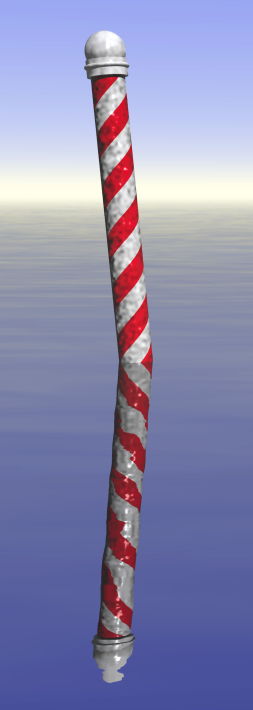
Ray-traced reflections of a barber’s pole. EHN & DIJ Oakley.
Repeating this simple tracing of light rays enables visualisation of more complex examples of reflection, such as that shown above. It quickly becomes tedious for humans to trace individual light rays in a three-dimensional model, but computers excel at the task of ray-tracing. The resulting image makes it clear that corresponding points in a reflection on water are vertically below their originals, although the slight waves seen here can result in limited lateral shift in the reflected points.
As is well known from real life, the reflected image in a horizontal mirror is effectively reflected on a local horizontal plane, so the left of the original remains on the left of the reflection, but the reflected image is inverted, where the top of the reflection shows the lowest part of the original; that’s unlike reflections in a mirror positioned vertically, such as those in which we inspect our face, shave, or apply make-up, which fortuitously remain uninverted. Whether a mirror is vertical or horizontal, the left of the reflected image shows the left of the real image, and similarly for the right.
The patterning and slant of the pole illustrates the differences between such a reflected image and one that has simply been rotated through 180˚, as might be achieved by a painter rotating the canvas on an easel. In the latter case the chirality (handedness) of the transformed image is opposite, the post would lean the opposite way, and its red spiral pattern would differ too. Surprisingly, rotating the canvas through 180˚ has often been recommended as an aid to painting faithful reflections, when all it can do is further confuse.
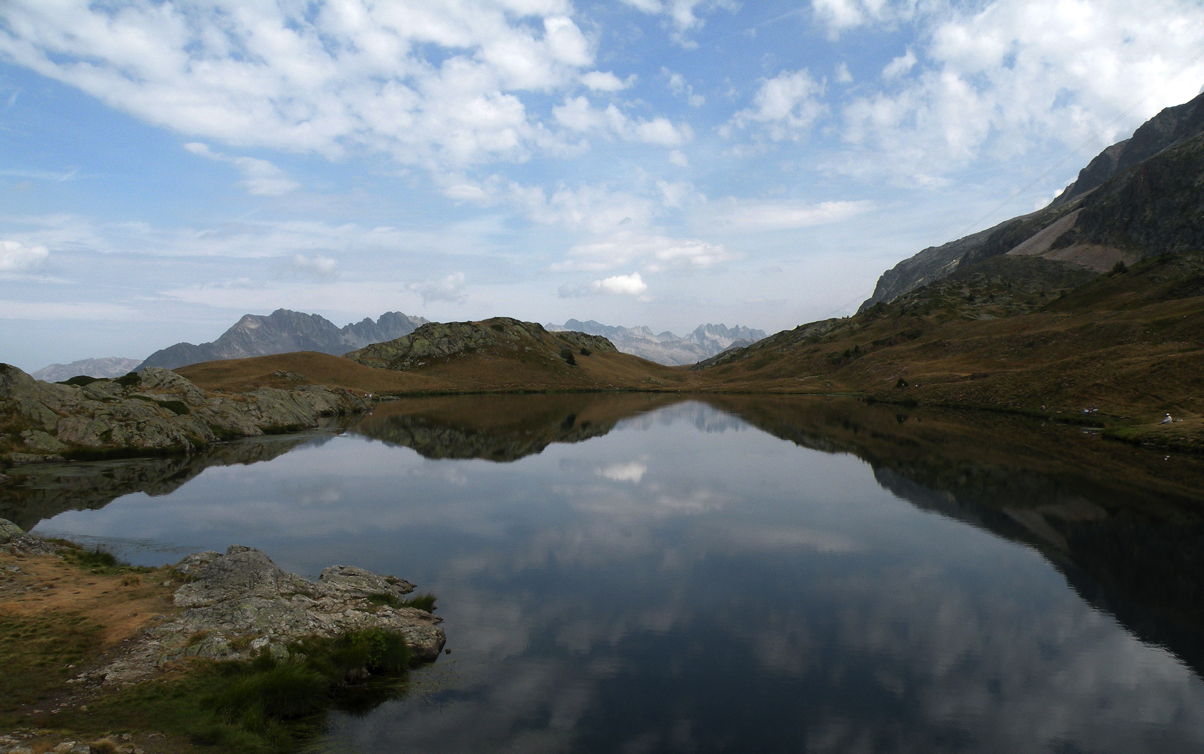
Photograph of extensive reflections on water, Lac Besson, Alpe d’Huez. EHN & DIJ Oakley.
Real world reflections can become complex, as the photo above demonstrates. One method I use to check for discrepancies between the unreflected and reflected images is to un-reflect the reflected image by reflecting it a second time, and align it above the unreflected image. It’s then easy to check the alignment and representation of objects shown in the reflection.
Composite image of extensive reflections on water, Lac Besson, Alpe d’Huez. EHN & DIJ Oakley.
JMW Turner, Crossing the Brook
In the summer of 1811, JMW Turner toured the west of England, where he made studies of the River Tamar, marking the boundary between Devon and Cornwall. The second major painting he exhibited in the summer of 1815 had been developed from one of those plein air studies of the river: Crossing the Brook.
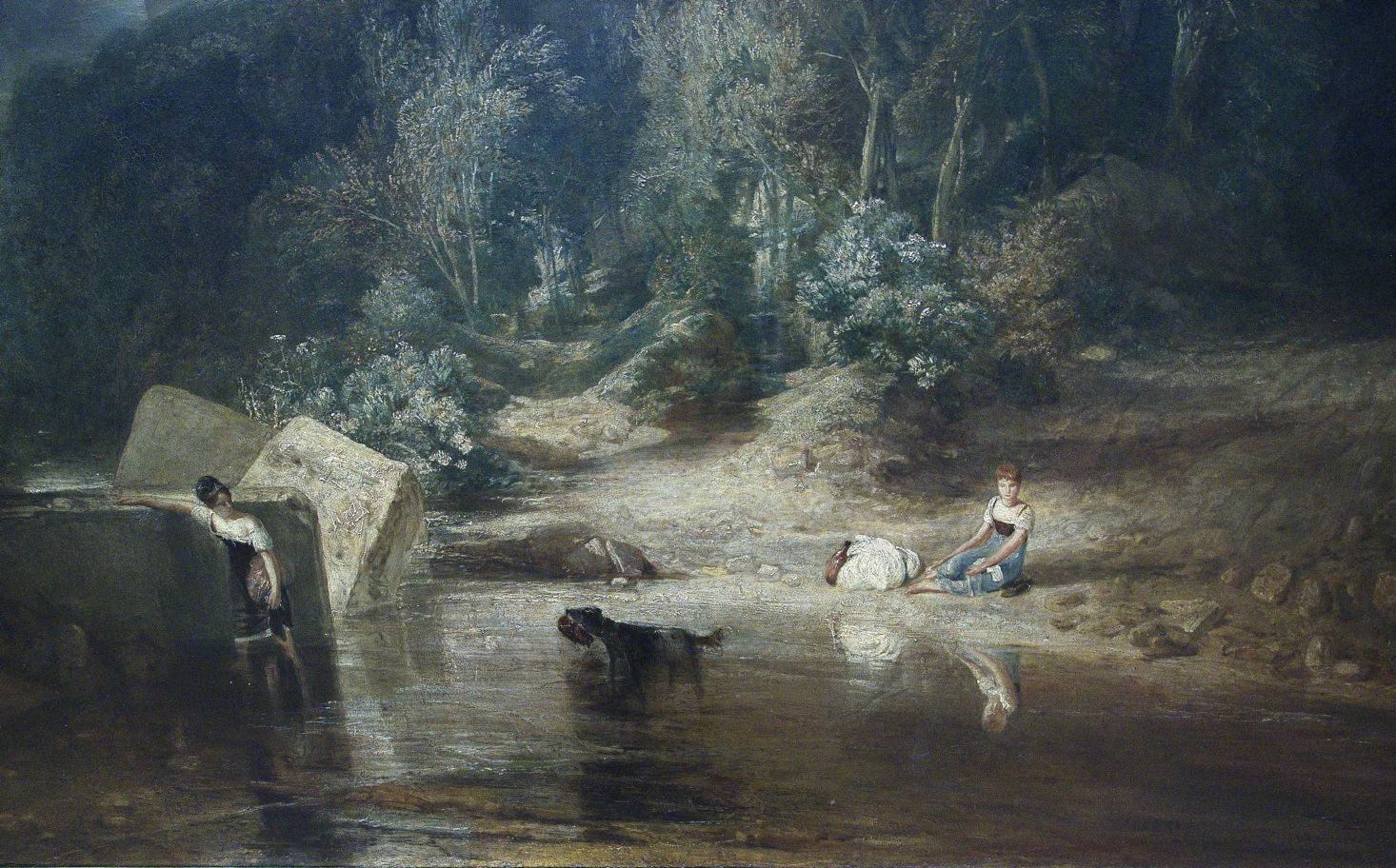
Joseph Mallord William Turner (1775-1851), Crossing the Brook (1815), oil on canvas, 193 x 165.1 cm, Tate Britain, London (N00497). EHN & DIJ Oakley.
It was inspired by Claude Lorrain, but is more conventional, revealing its influence from the landscape tradition, including the British line tracing back to Richard Wilson (1714-1782). In the light of Turner’s later and more overtly experimental paintings, Crossing the Brook may today seem tame and conservative. It shows two women at a ford across the brook, one (left of centre) wading in the river by some massive stone blocks, and in company with a black dog, seen with a large fish in its mouth. The other sits on the far bank, beside a large bundle wrapped in white cloth, with her shoes removed.
The ford is in an opening within a large wooded area, with tall trees providing repoussoir at both sides of the painting. This drops away to a long bridge with multiple arches in the middle distance, and the river (as it is by then) meanders through rolling and wooded countryside until it reaches the sea at Plymouth in the far distance.
Joseph Mallord William Turner (1775-1851), Crossing the Brook (detail) (1815), oil on canvas, 193 x 165.1 cm, Tate Britain, London (N00497). EHN & DIJ Oakley.
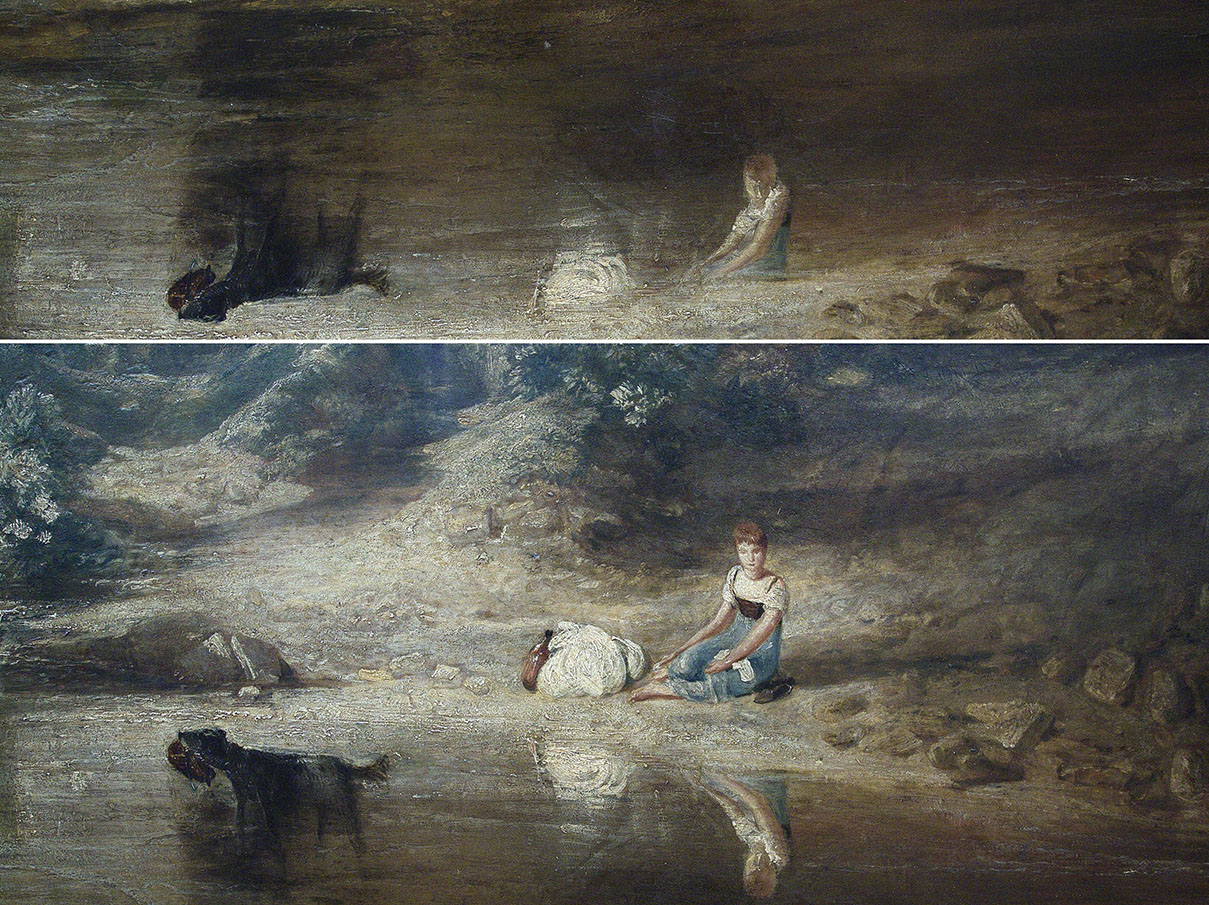
One of the most remarkable features of this painting is Turner’s depiction of the reflections in the water, because there are marked discrepancies between the unreflected image of the woman sat on the bank, and her reflection. Those are shown clearly in the composite detail below.
Joseph Mallord William Turner (1775-1851), Crossing the Brook (detail) (1815), oil on canvas, 193 x 165.1 cm, Tate Britain, London (N00497). EHN & DIJ Oakley. Shown as a composite view, to highlight the discrepancies between the original and reflected images.
Throughout his career, and most particularly in his later more radical works, Turner took liberties with optics. One of the best examples of this is in his late oil painting War. The Exile and the Rock Limpet, painted over twenty-five years later, in 1842.
Joseph Mallord William Turner (1775-1851), War. The Exile and the Rock Limpet (1842), oil on canvas, 79.4 x 79.4 cm, Tate Britain, London (N00529). WikiArt.
The left, more distant, figure (of the guard to Napoleon) shouldn’t have appeared in reflection at all, let alone been vertically aligned with Napoleon’s reflection. However, strict adherence to optics would have significantly detracted from the effect of this painting. Turner has also omitted shadows that would have been cast by the figures, presumably for the same reason.
3D scenes
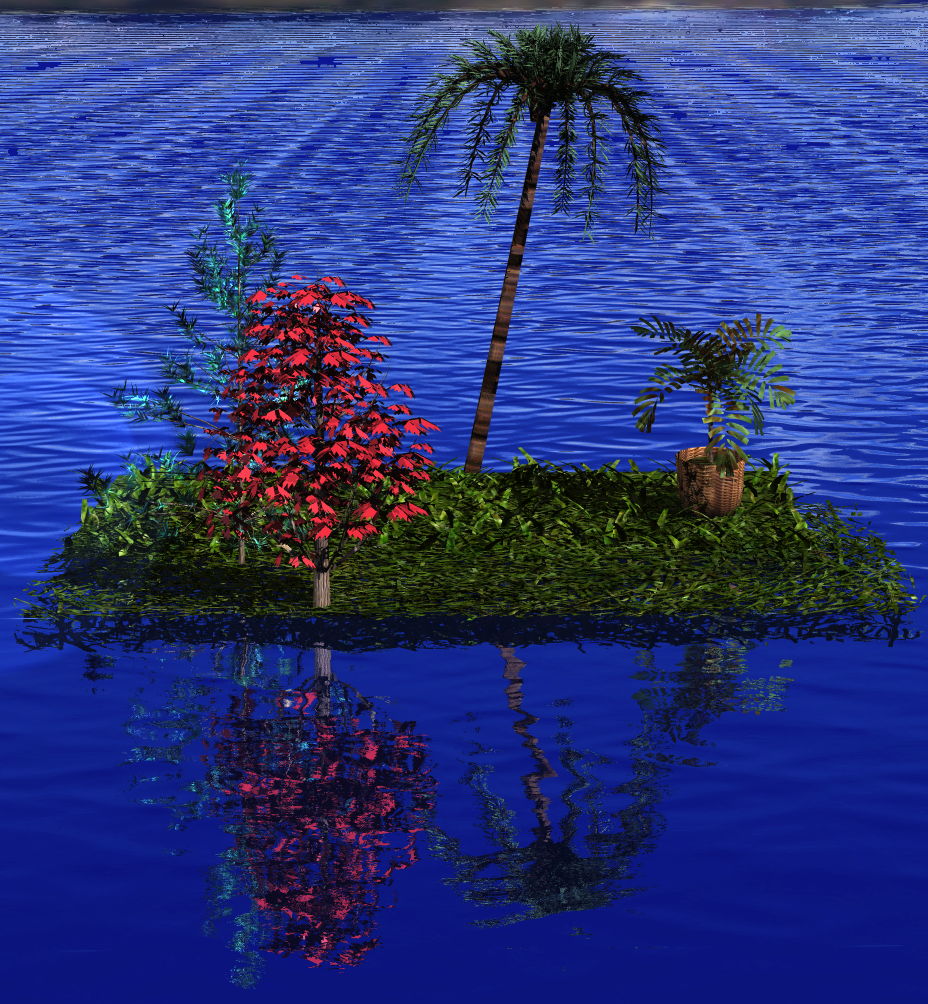
Ray-traced image showing a more complex 3D scene. A rectangular island consisting of a low bank of rough grass is situated in a lake, whose surface is highly reflective but has small, slight waves. On the island are three trees and a potted plant, of various heights and positioned at various distances from the edge of the bank. EHN & DIJ Oakley.
Reflections in a more complex 3D scene, above, show slight alteration in vertical dimensions, but remain strictly aligned with the original. Although the slight waves produce very small lateral displacements in the reflection, every point in the reflection corresponding to a point in the original remains in alignment across the width of the image.
Those objects at the front of the original remain at the front of the reflection: for example, the tree with red leaves retains its position relative to the green conifer tree behind it. The further back from the water’s edge that an object is situated, the more truncated is its reflection; truncation appears as if it occurred at the base of the original.
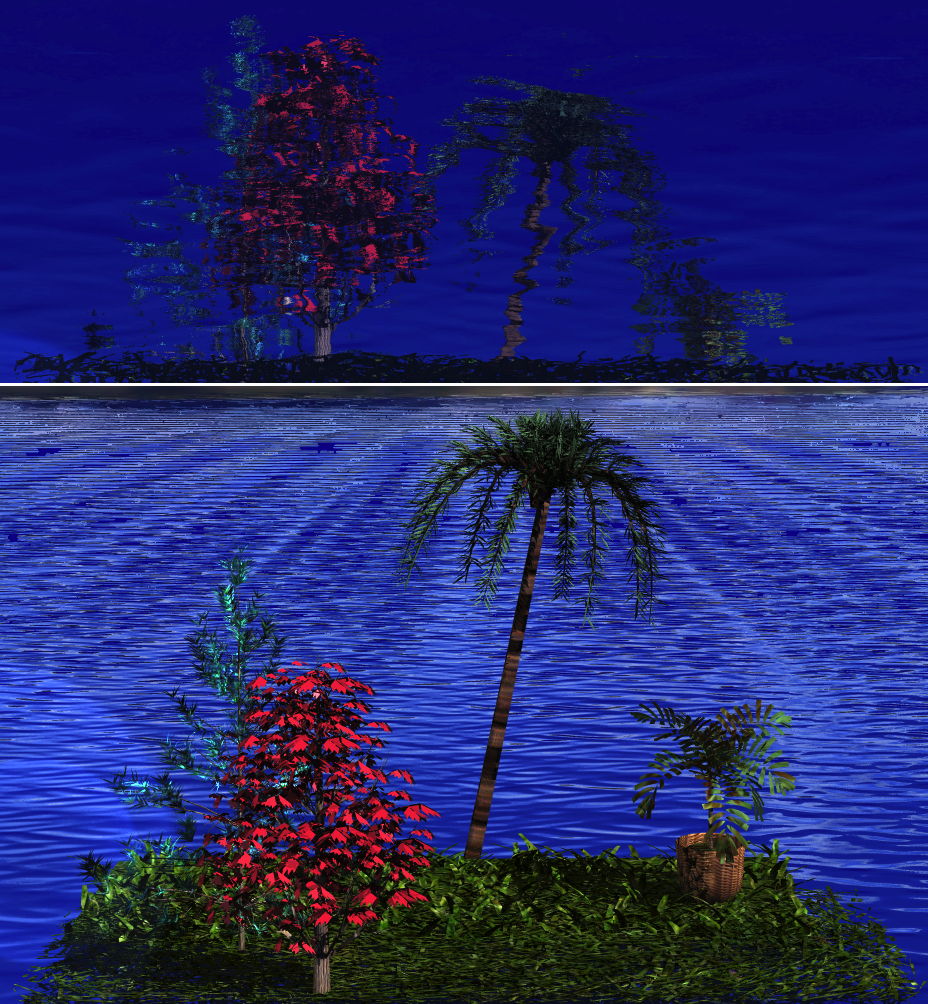
Composite image of ray-tracing of more complex 3D scene. EHN & DIJ Oakley.
One useful rule of thumb sometimes given to gauge the effect of truncation is to imagine that the water extends right back to the base of the original, then construct the reflection on that imaginary water surface, and to erase the reflection on the water where it doesn’t actually exist.
There are complex differences between the original and its reflection with respect to the position of details, tones and highlights. Although highlights are seen on the red leaves, their pattern isn’t the same, because the original leaves are seen direct, but those in the reflection are viewed as if from below and in front of the tree (from their points of reflection on the water).
This makes it impossible to create a completely accurate representation of a reflection unless you can see that reflection; even using modern ray-tracing software on a computer it is extremely difficult to construct or reconstruct a reflection from real life. Any painter who paints the original en plein air and later attempts to paint its reflection in the studio is only going to be able to guess its form and appearance, and will be unable to get tones and highlights correct with respect to those seen in nature.
Composite image of extensive reflections on water, Lac Besson, Alpe d’Huez. EHN & DIJ Oakley.
The difficulties encountered in extensive reflections on water in the real world are illustrated in the composite image above. Note how the distant mountains almost disappear from the reflection with the change in vertical dimensions, but rigorous vertical alignment is maintained across the entire image. Painting reflections in images such as this is an incredibly difficult task without the complete view in front of the painter at the time.
Practical principles
Any faithful depiction of reflections on water will therefore show the following features:
a line joining any point on the original with its equivalent on the reflection will be strictly vertical, allowing slight lateral shift resulting from the effects of small waves;
an object which is behind another object in the original will also remain behind that object in the reflection, as reflections preserve depth order;
the further back that an original object is from the water’s edge, the more its reflection will be cropped vertically;
vertical cropping loses the lower section of the original from the reflection, and the upper section remains in the reflection;
when the water surface is smooth, the position of reflections can be determined by simple geometry relating the height above the water surface to the distance between the point of reflection on the water and the perpendicular projection down onto the water plane (the tangent of the angle or incidence or reflection being equal to height/distance);
the view of each part of the original seen in the reflection will be that as seen from the points of reflection, those being lower than the observer and closer to the original;
what is seen on the (observer’s) left of the original appears on the left of the reflection, and what is seen on the right remains on the right of the reflection;
because the reflection is vertically inverted, what is seen at the top of the original appears at the bottom of the reflection;
the more the water surface departs from being a flat and smooth mirror, the more distortion will be introduced into the reflection, until eventually its form is lost in a series of vague areas of broken colour.
References
Brook Taylor (1719) New Principles of Linear Perspective, or the Art of Designing on a Plane the Representations of All Sorts of Objects, in a more General and Simple Method than has been done before, London. (Not available online, and later editions omit much of the material on reflections.)
Cole, Rex Vicat (1921) Perspective, Seeley, Service and Co, London. (Available in various reprints, and Archive.org.)
de Piles, Roger (1708) Cours de Peinture par Principes, Paris. (Available at Archive.org.)
de Valenciennes P-H (1820) Élémens de Perspective Pratique à l’usage des artistes, 2nd edn., Paris.
Until the middle of the nineteenth century almost every painter painted at least one reflection, that of their own face in a self-portrait. There’s even a gallery specialising in its unique collection, the Uffizi in Florence, Italy, where they go back six hundred years to Taddeo Gaddi in 1440-50 and Filippino Lippi in 1485. This article looks at a few of the more unusual ones that didn’t make it to the Uffizi.
Gustave Courbet (1819–1877), The Desperate Man (c 1843), oil on canvas, 45 x 54 cm, Private collection. Wikimedia Commons.
The most radical and impressive of Gustave Courbet’s early paintings is The Desperate Man from about 1843, in which the artist grimaces wildly at his own canvas. Augmented by his signature in bright red, it might as well have been his manifesto.
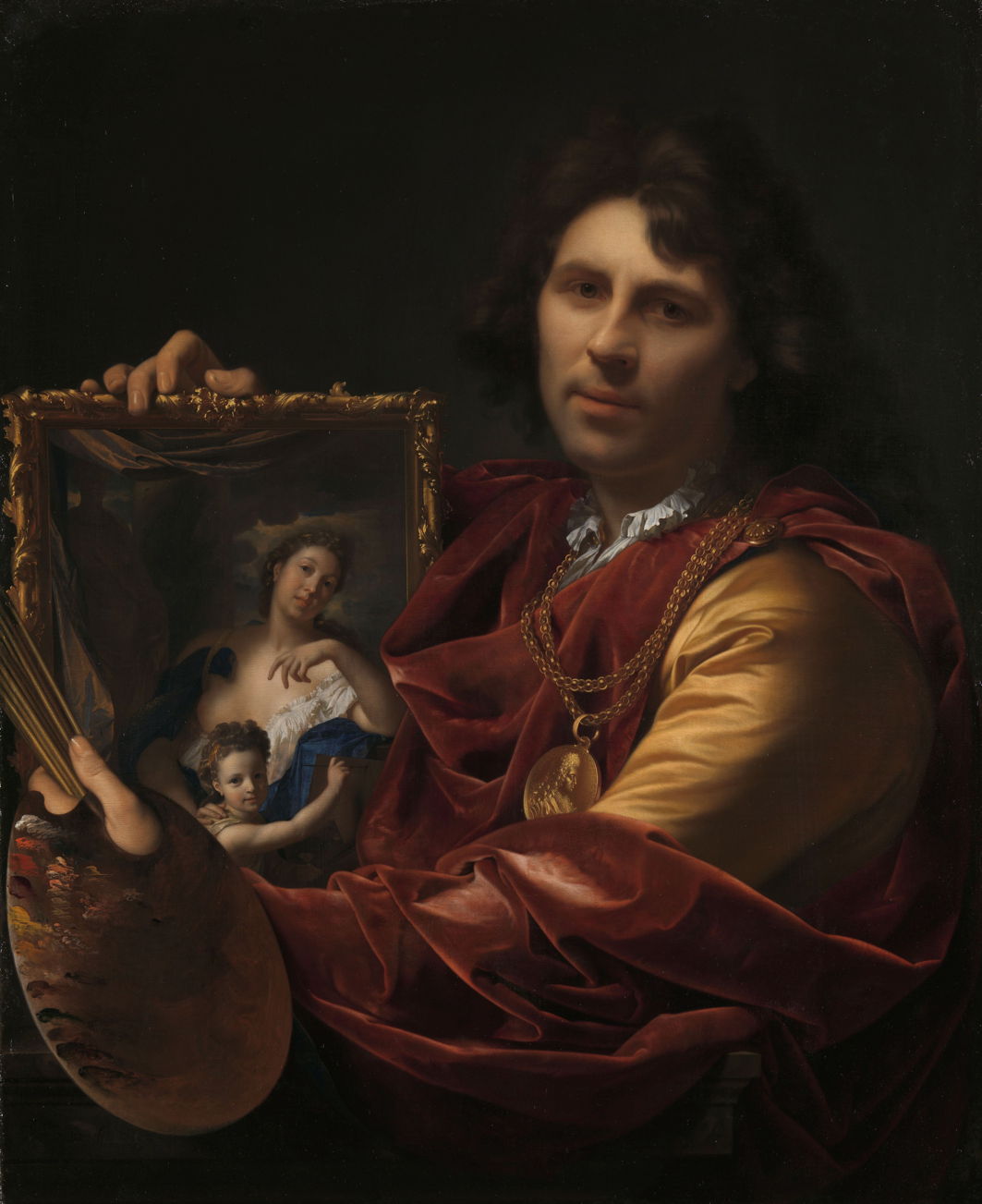
Adriaen van der Werff (1659–1722), Self-portrait with the Portrait of his Wife, Margaretha van Rees, and their Daughter Maria (1699), oil on canvas, 81 x 65.5 cm, Rijksmuseum, Amsterdam, The Netherlands. Wikimedia Commons.
Adriaen van der Werff’s Self-portrait with the Portrait of his Wife, Margaretha van Rees, and their Daughter Maria from 1699 is an ingenious family portrait. He holds his palette and brushes with his left hand, and around his neck is a medallion awarded by his patron, the Elector Palatine. His right hand supports a portrait of his wife Margaretha van Rees (1669-1732) and their daughter Maria (1692-1731).
Lovis Corinth (1858–1925), Last Self-Portrait (1925), oil on canvas, 80.5 × 60.5 cm, Kunsthaus Zürich, Zürich. Wikimedia Commons.
Lovis Corinth’s Last Self-Portrait, painted just two months before his death, is unusual in showing him with his reflection in a mirror. He is balding rapidly, his cheeks sunken, and his eyes are bloodshot and tired.
Pierre Bonnard (1867-1947), Interior (c 1905), oil on canvas, 49.8 x 37.8 cm, Private collection. The Athenaeum.
Pierre Bonnard’s unusual composition in this Interior from about 1905 doesn’t show the woman’s back in the mirror, but a chair placed deliberately in front of the mirror and Bonnard himself, not painting but sat at a table.
Artemisia Gentileschi (c 1593-1656), Allegory of Painting (c 1638-9), oil on canvas, 98.6 x 75.2 cm, The Queen’s Collection, England. Wikimedia Commons.
There’s more uncertainty as to whether Artemisia Gentileschi’s brilliant painting of the Allegory of Painting (c 1638-9) is a self-portrait. This striking angle of view can be accounted for if this was a self-portrait composed using two mirrors, one placed above and on the left of the painter, the other directly in front of her, where she is gazing so intently. If so, it was particularly ingenious because the reflection in the second mirror would have normal chirality (left and right would not be reversed).
However, it has been suggested that this isn’t a self-portrait, in which case her choice of view would have been most unusual. It’s believed to have been painted during her stay in London, possibly for King Charles I, as it appears to have passed straight into the Royal Collection, where it has remained ever since.
Clara Peeters (fl 1607-1621), Still Life with Flowers and Gold Cups of Honour (1612), oil on oak, 59.5 x 49 cm, Staatliche Kunsthalle Karlsruhe, Karlsruhe, Germany. Wikimedia Commons.
Clara Peeters’ still life with Flowers and Gold Cups of Honour from 1612 reveals multiple miniature self-portraits reflected in the gold cup at the right. These are shown more clearly in the detail below. To project the image of herself correctly for each of the facets I suspect she must have set up a convex mirror in the same alignment as that facet on the cup.
Clara Peeters (fl 1607-1621), Still Life with Flowers and Gold Cups of Honour (detail) (1612), oil on oak, 59.5 x 49 cm, Staatliche Kunsthalle Karlsruhe, Karlsruhe, Germany. Wikimedia Commons.
The most famous of all these elaborate self-portraits is surely that of Diego Velázquez in Las Meninas from about 1656-57.
Diego Velázquez (1599–1660), Las Meninas (The Maids of Honour, Velázquez and the Royal Family) (c 1656-57) [119], oil on canvas, 318 x 276 cm, Museo Nacional del Prado, Madrid, Spain. Wikimedia Commons.
Like many of his mature works, this is a portrait, but unlike any of the others it’s a group portrait of eleven people and a dog in a room in the Alcázar Palace, which is depicted faithfully, according to palace inventories of the time.
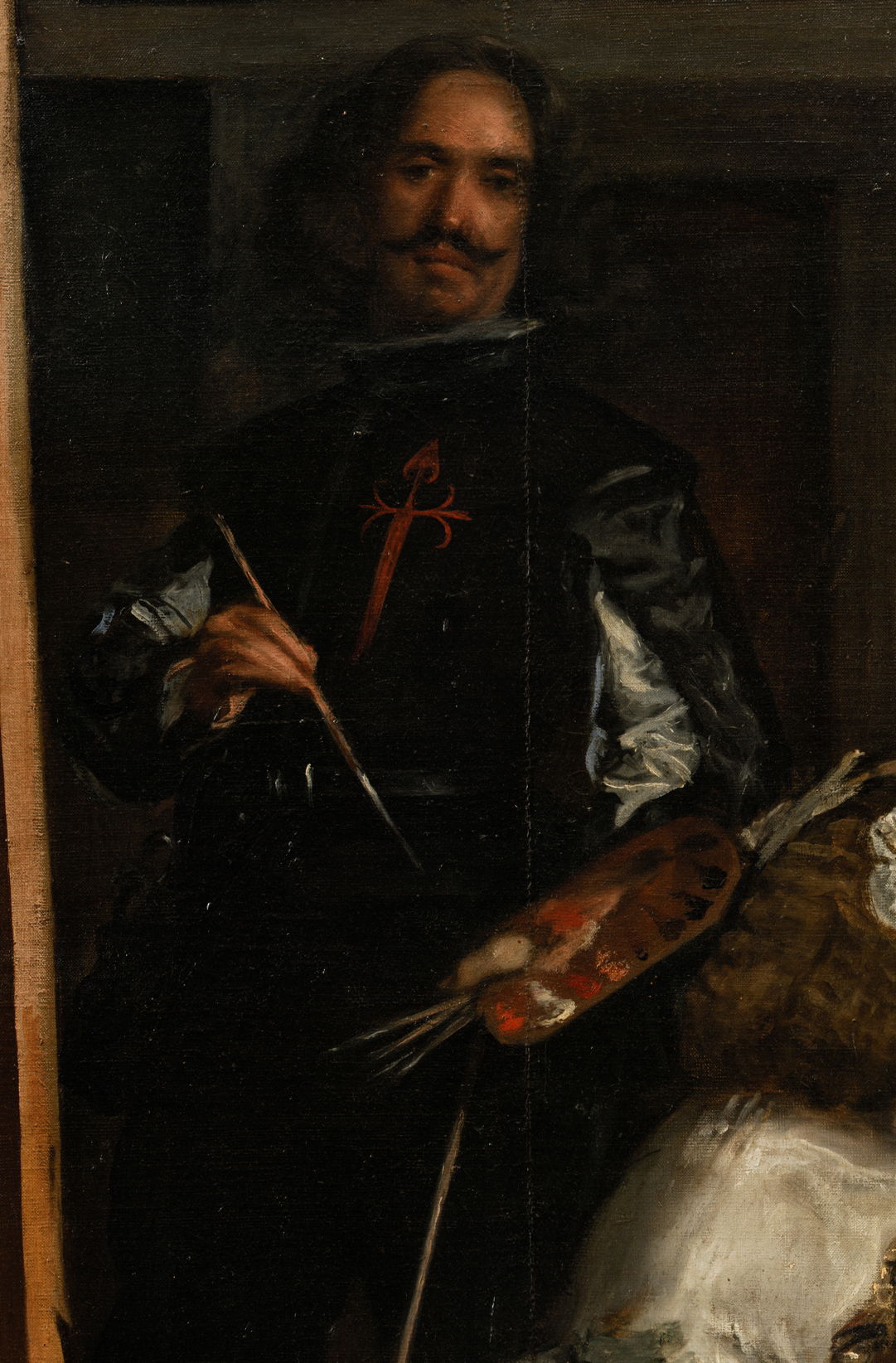
Diego Velázquez (1599–1660), Las Meninas (The Maids of Honour, Velázquez and the Royal Family) (detail) (c 1656-57) [119], oil on canvas, 318 x 276 cm, Museo Nacional del Prado, Madrid, Spain. Wikimedia Commons.
The largest figure, although out of the limelight and over to the left, is that of Velázquez himself. He looks towards the viewer, with a neutral face of concentration. His right hand holds a brush with his paint laid out on a wooden palette held by his left hand, which also clutches a bundle of other brushes. He is at work on the three metre (ten foot) high canvas in front him, which happens to be the same size as that on which he painted this work.
Diego Velázquez (1599–1660), Las Meninas (The Maids of Honour, Velázquez and the Royal Family) (detail) (c 1656-57) [119], oil on canvas, 318 x 276 cm, Museo Nacional del Prado, Madrid, Spain. Wikimedia Commons.
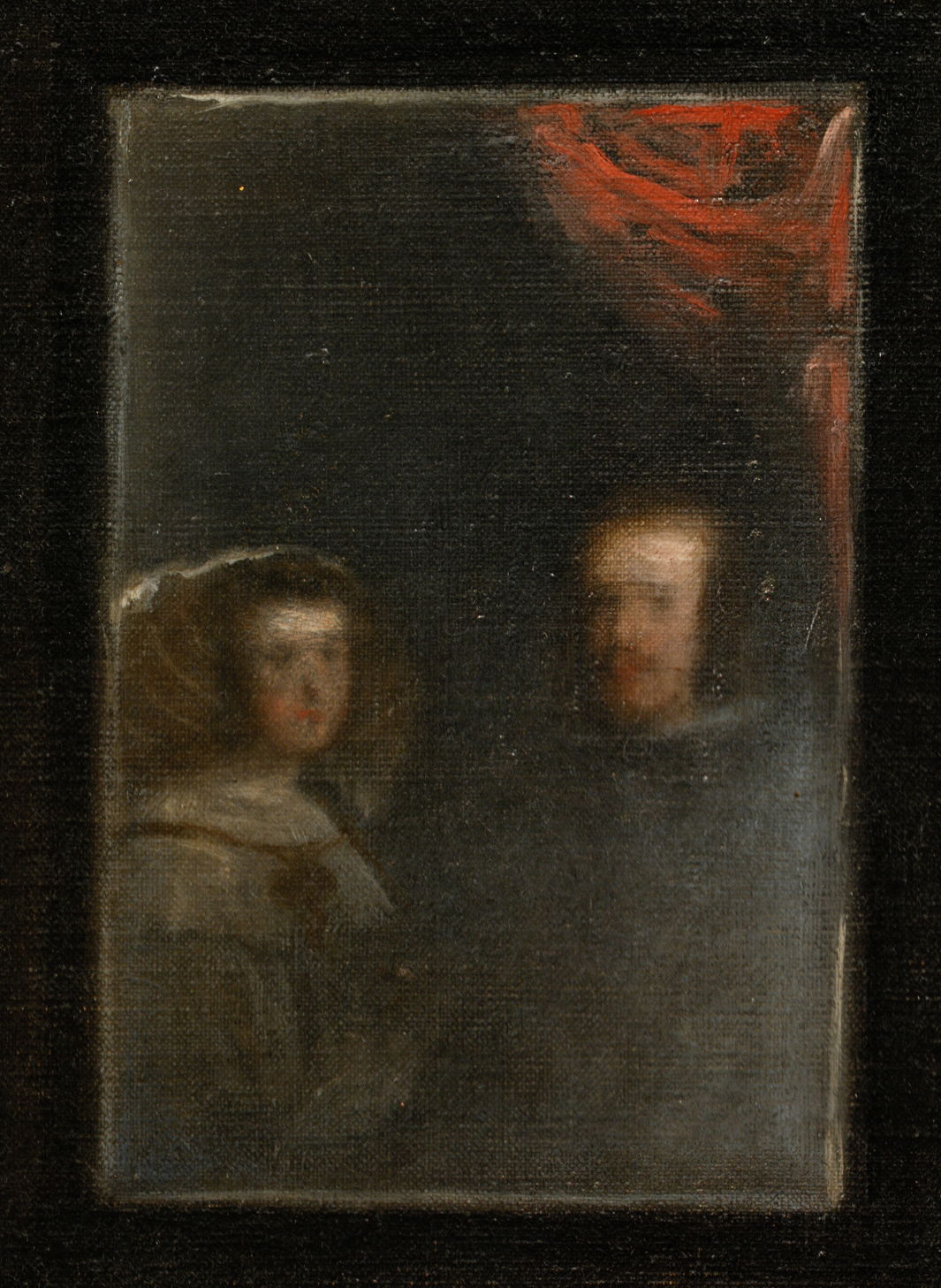
Two figures given a prominent and unusual place are the King and Queen, who are shown reflected in a rectangular plane mirror on the far wall. There has been dispute over whether the reflection shows the couple stood where the viewer is, or the mirror is reflecting their painted images on Velázquez’s canvas.
As the mirror is to the left of the centreline of the painting, it’s hard to see that its image of the royal couple could show them standing where the viewer is, and more likely that what appears there is part of Velázquez’s painting. However, the artist had previously been ‘creative’ in his use of reflections in the Rokeby Venus, and at least part of his body should here be obstructing a clear line of sight between what is on his canvas and the surface of the mirror.
Many humans and animals are fascinated by reflections. Whether they’re images of themselves seen in mirrors, or an inverted copy of a landscape seen on the surface of a lake, we can spend embarrassingly long periods just staring at them. For visual artists, those reflections have been a technical challenge and, for those who rise to it, an opportunity to display their painting skills. This series sets out to describe and illustrate how, from the early Renaissance to the twentieth century, masters have painted reflections.
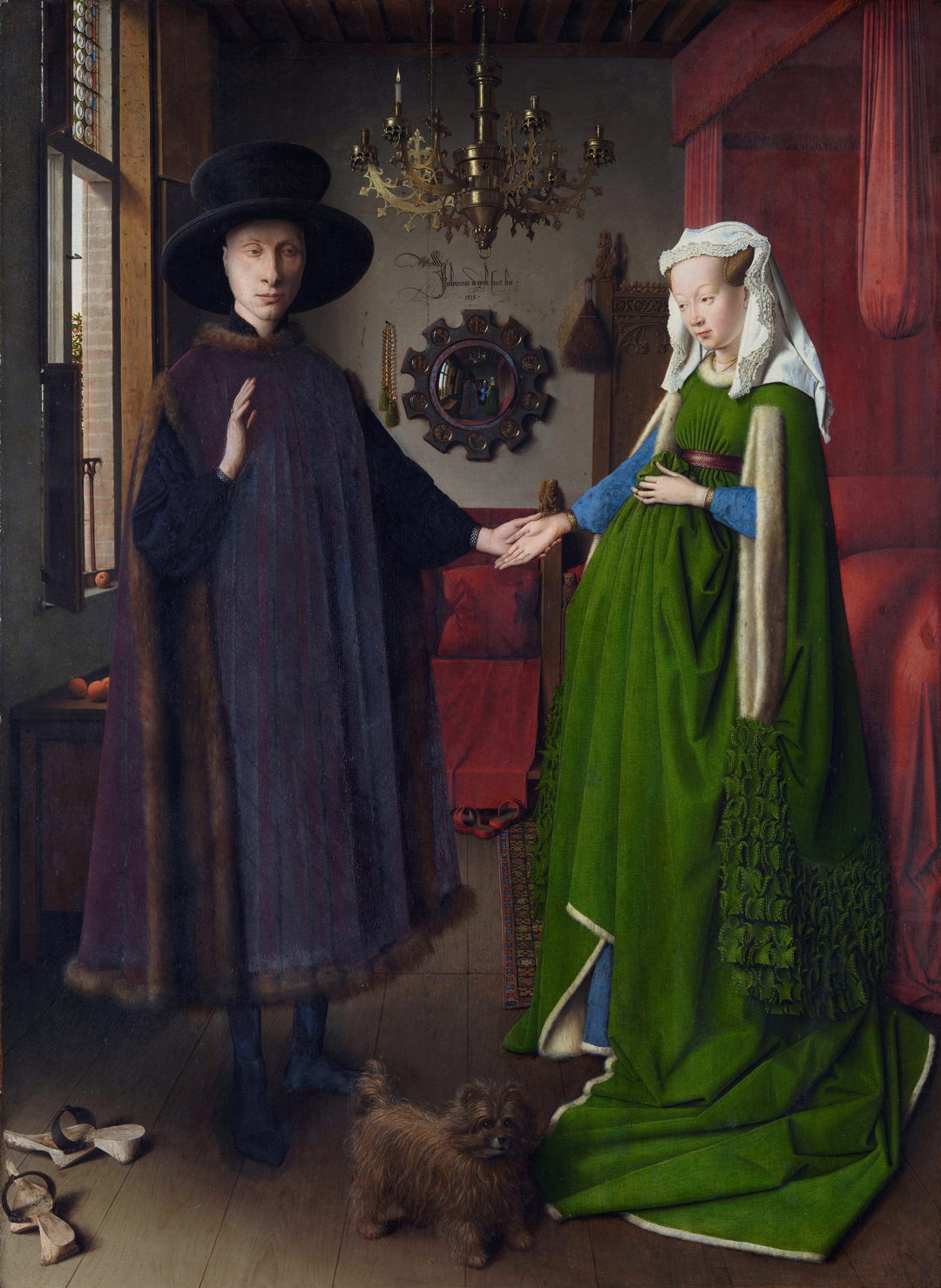
Jan van Eyck (c 1380/90-1441), Portrait of Giovanni Arnolfini (?) and his Wife (1434), oil on oak panel, 82 x 59.5 cm. The National Gallery, London. Wikimedia Commons.
Optical effects are one of the central themes in the Northern Renaissance, as seen in Jan van Eyck’s most famous painting The Arnolfini Wedding (or similar variations), completed in 1434. Between this newly-wed couple holding hands next to their marital bed, in the midline of the painting is a prominent circular convex mirror. The reflection is probably the first example of mirror-play in European art, as it shows a view of the room looking in the opposite direction, past the couple to another two figures, who might be the artist and another.
Jan van Eyck (c 1380-1441), Portrait of Giovanni(?) Arnolfini and his Wife (detail) (1434), oil on oak panel, 82.2 x 60 cm. National Gallery, London. WikiArt.Jan van Eyck (c 1390–1441), The Madonna of Chancellor Rolin (detail) (c 1435) oil on panel, 66 x 62 cm. Musée du Louvre, Paris (WikiArt).
Look in the landscape behind Jan van Eyck’s Madonna of Chancellor Rolin, probably painted the following year, and you’ll see one of the earliest examples of the meticulously accurate depiction of reflections on water.
Caravaggio (Michelangelo Merisi da Caravaggio) (1571–1610), Narcissus (1594-96), oil on canvas, 110 × 92 cm, Galleria Nazionale d’Arte Antica, Rome. Wikimedia Commons.
In some paintings, reflections are essential to their narrative. Caravaggio’s brilliant Narcissus of 1594-96 uniquely combines chiaroscuro with reflections to provide just enough visual clues to tell this myth so effectively.
The optics of reflections appear to have confounded some painters, while others have deliberately flouted physics for effect, in this case what has become known as the Venus Effect.
Diego Velázquez (1599–1660), Venus at Her Mirror, The Toilet of Venus (Rokeby Venus) (1644-48) [101], oil on canvas, 122.5 x 177 cm, The National Gallery, London. Image by Diego Delso, via Wikimedia Commons.
Although often illustrated by one of Titian’s paintings of Venus, the canonical example must be Velázquez’ Venus at Her Mirror, also known as The Toilet of Venus or the Rokeby Venus, from 1644-48. It shows the goddess Venus, whose face is blurred in a false reflection in a mirror being held by her son Cupid. The theme was common, seen in paintings by Titian and Rubens, with Venus sat upright. Giorgione and others had posed her reclining and facing the viewer, making her pose here unusual. Most other paintings of Venus set her in a landscape: here she rests on luxurious even sensuous fabrics.
No matter how convincing her face might appear in the mirror, a moment spent placing yourself in the same position confirms that the image in the mirror is wholly imaginary, and optically incorrect.
Pierre Bonnard is among the most prolific and inventive of mirror-players.
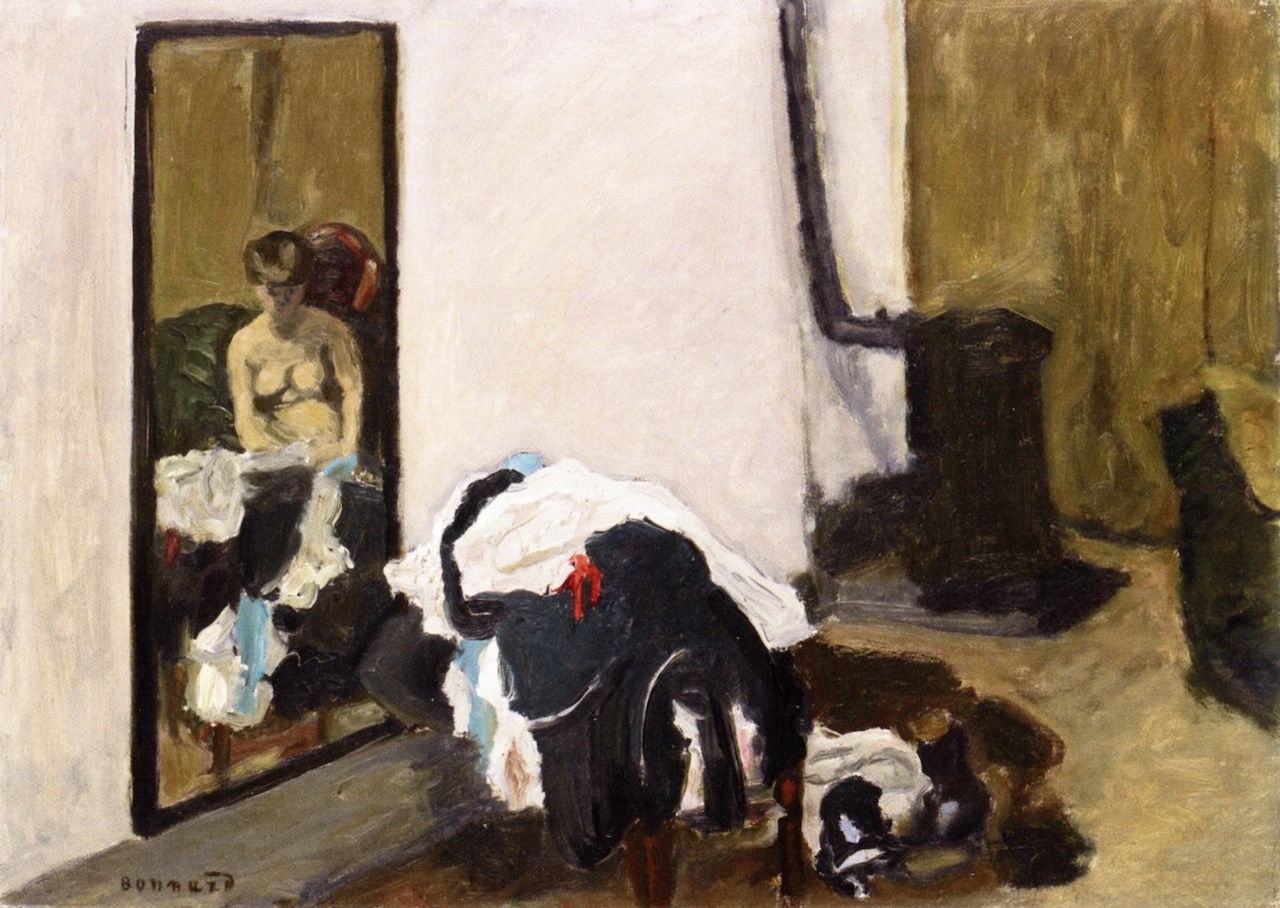
Pierre Bonnard (1867-1947), Woman Getting Dressed (1906), oil on canvas, 42 x 58.7 cm, Private collection. The Athenaeum.
In his Woman Getting Dressed from 1906, it’s the mirror at the left that reveals the subject, who is sat beyond the right edge of the painting, getting dressed. Venus has here become a pile of discarded clothing.
As landscape painting became popular, many of the most proficient sought out locations where they could demonstrate their skills at getting them right. Others used reflections as their theme.
Vincent van Gogh (1853–1890), Starry Night over the Rhône (1888), oil on canvas, 72.5 x 92 cm, Musée d’Orsay, Paris. WikiArt.
In the last two years of Vincent van Gogh’s life, he painted this landmark nocturne Starry Night over the Rhône (1888) with its many shimmering reflections.
Laurits Andersen Ring (1854–1933), Alder Trunks (1893), oil on canvas, 52.9 x 73.5 cm, Collection of Her Majesty the Queen Margrethe II, Copenhagen, Denmark. Wikimedia Commons.
Alder Trunks from 1893 is one of Laurits Andersen Ring’s finest landscapes, and has earned its place in the Danish Royal Collection. He shows these old coppiced alders almost entirely in reflection.
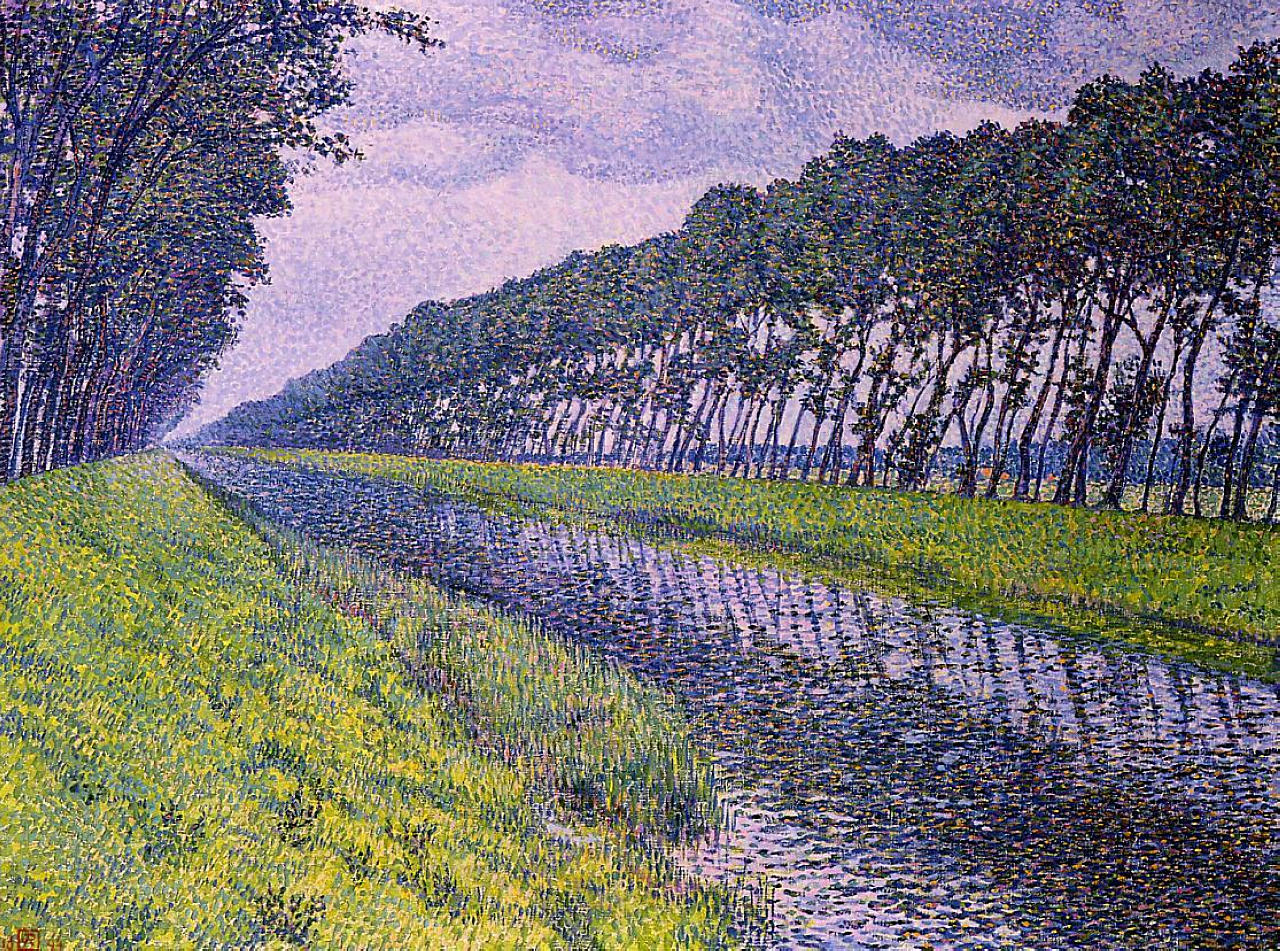
Théo van Rysselberghe (1862-1926), Canal in Flanders (1894), oil on canvas, 152.4 x 203.2 cm, Private collection. WikiArt.
Théo van Rysselberghe’s eye-catching geometry in his Canal in Flanders (1894) combines radical perspective projection, intense rhythm and meticulous broken reflections.
Reflections are also used by some of the Surrealists.
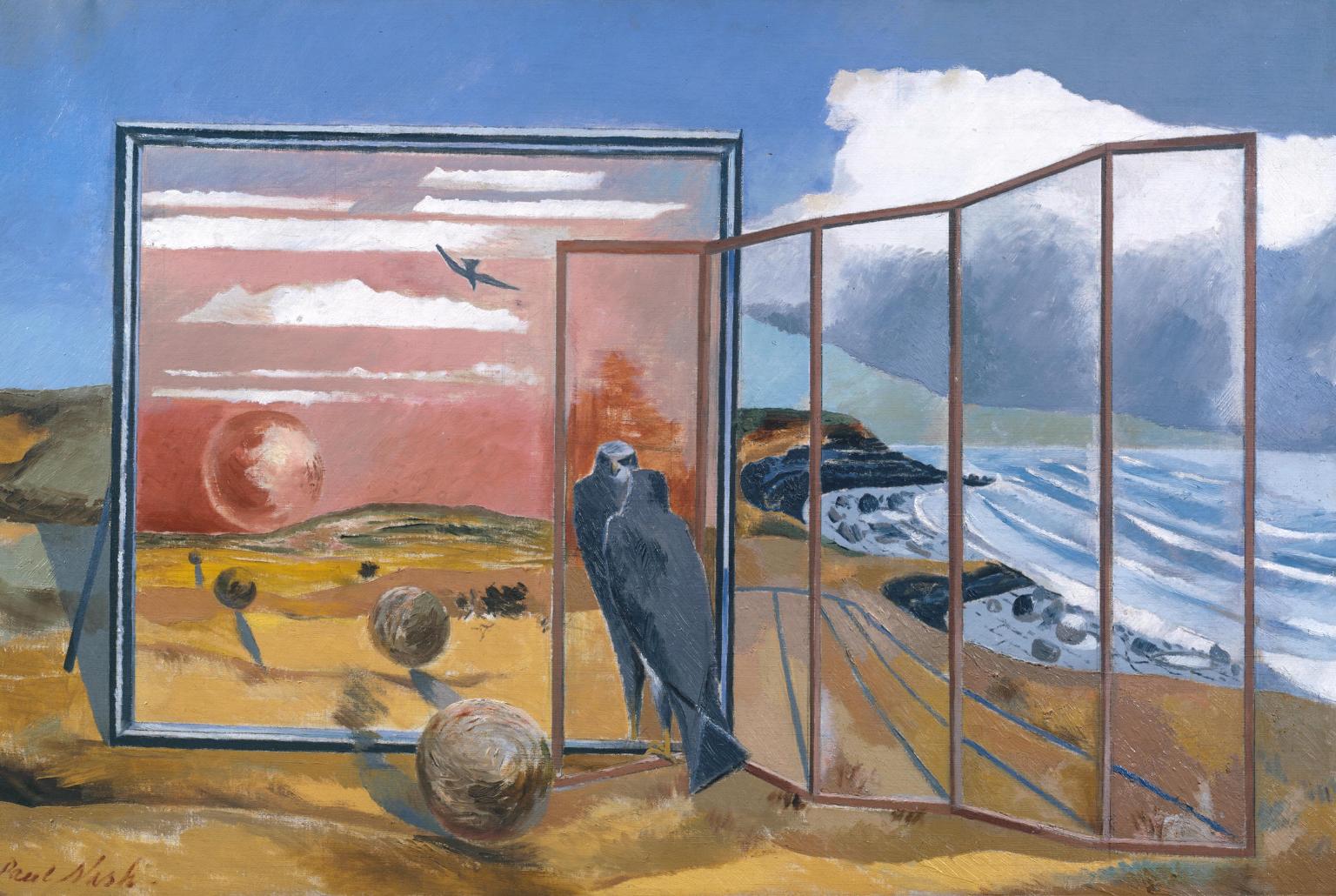
Paul Nash’s Landscape from a Dream (1936-38) was inspired by Freud’s theories of the significance of dreams as reflections of the unconscious. This collection of incongruous objects is gathered on the Dorset coast, a landscape Nash associated with the praeternatural. Dominating the scene is a large framed planar mirror, almost parallel with the picture plane. Stood at the right end of the mirror is a hawk staring at its own reflection, which Nash explained is a symbol of the material world. To the left, the mirror reflects several floating spheres, referring to the soul. The reflection shows that behind the viewer is a red sun setting in a red sky, with another hawk flying high, away from the scene.
I hope you’ll join me in the reflections to come in this series.

 Login
Login