Normal view

There are new articles available, click to refresh the page.
Before yesterdayMain stream

Reading Visual Art: 244 Axe

By: hoakley
6 February 2026 at 20:30

The axe is one of the oldest hand tools used by humans, with stone axes dating back to the dawn of the species and those made from metal being prominent relics of the ancient past. Most consist of a heavy wedged blade mounted at the end of a wooden haft used to swing the blade to cleave wood, or wielded as a weapon. Hafts vary in length from short in compact hatchets to over two metres (six feet) in halberds used to attack cavalry.

Although uncommon in paintings, as in real life, an axe can’t be ignored.

domenicinosacrificeiphigenia
Domenichino (1581–1641), The Sacrifice of Iphigenia (c 1609), fresco, dimensions not known, Palazzo Giustiniani-Odescalchi, Viterbo, Italy. Wikimedia Commons.

Most more recent paintings of the sacrifice of Agamemnon’s daughter Iphigenia at the start of the war against Troy show the use of a ceremonial knife. A notable exception is Domenichino’s fresco in Viterbo, Italy, from about 1609, one of its earliest post-classical depictions. The princess kneels, her wrists bound together, as an axe is about to be swung at her neck. Onlookers at the left are distraught, as her father Agamemnon at the right watches impassively.

anonhoratiuscoclesdefends
Unknown follower of Giovanni Battista Tiepolo, Horatius Cocles Defending Rome Against the Etruscans (date not known), oil on canvas, 137.2 x 208.3 cm, Private collection. Wikimedia Commons.

Much later in the history of classical Rome, an axe is seen being used to demolish the Sublicius bridge as it was defended by the Roman hero, in Horatius Cocles Defending Rome Against the Etruscans, painted by a follower of Giovanni Battista Tiepolo. This bridge is made to look quite flimsy and ad hoc, when in fact it was more substantial at the time.

In Roman times, axes became incorporated in symbols of authority, notably those borne by lictors, bodyguards and attendants to magistrates and all with imperial powers, including the emperor himself.

siemiradzkichristiandirce
Henryk Siemiradzki (1843–1902), Christian Dirce (1897), oil on canvas, 263 x 530 cm, Muzeum Narodowe w Warszawie, Warsaw, Poland. Wikimedia Commons.

Henryk Siemiradzki’s Christian Dirce of 1897 is an account of the killing of a Christian woman in a re-enactment of the death of Dirce, in which a woman’s near-naked body is draped over the body of a bull. This shows the emperor and his entourage, including two lictors holding their fasces, symbolic rods and axes, gazing at the grim aftermath. The word Fascism is derived from those fasces, which are themselves often symbolic of Fascist groups.
sciutiproclamationrepublic
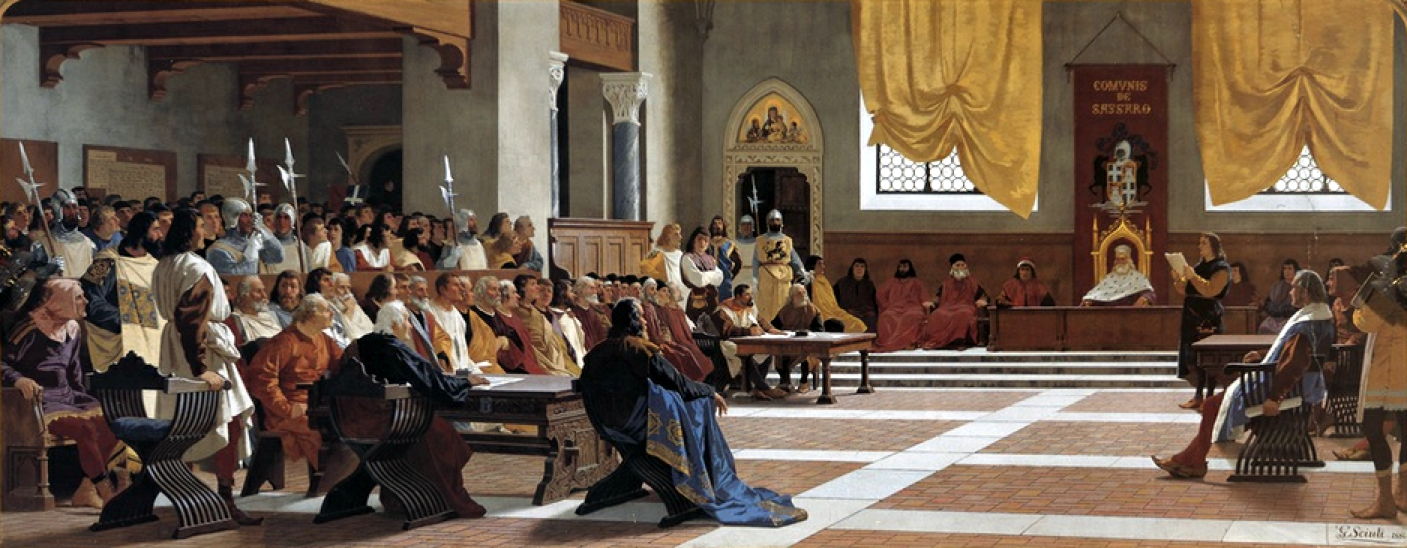
Giuseppe Sciuti (1834–1911), Proclamation of the Republic of Sassari (The Council of the Republic of Sassari) (1880), fresco, dimensions not known, Palazzo della Provincia, Sassari, Italy. Wikimedia Commons.

In 1284, the city of Sassari became the first and only independent city-state of Sardinia, joining more famous city-states such as Florence on the mainland. Proclamation of the Republic of Sassari (The Council of the Republic of Sassari) (1880) is Giuseppe Sciuti’s fresco in the Palazzo della Provincia, Sassari, showing his re-imagining of the moment of creation of that city-state, complete with knights in armour bearing long-hafted halberds.

One of the most unusual paintings of an axe being swung is Richard Dadd’s phantasmagoric Fairy Feller’s Master-Stroke, completed over the period 1855-64 during his stay in Bethlem psychiatric hospital.
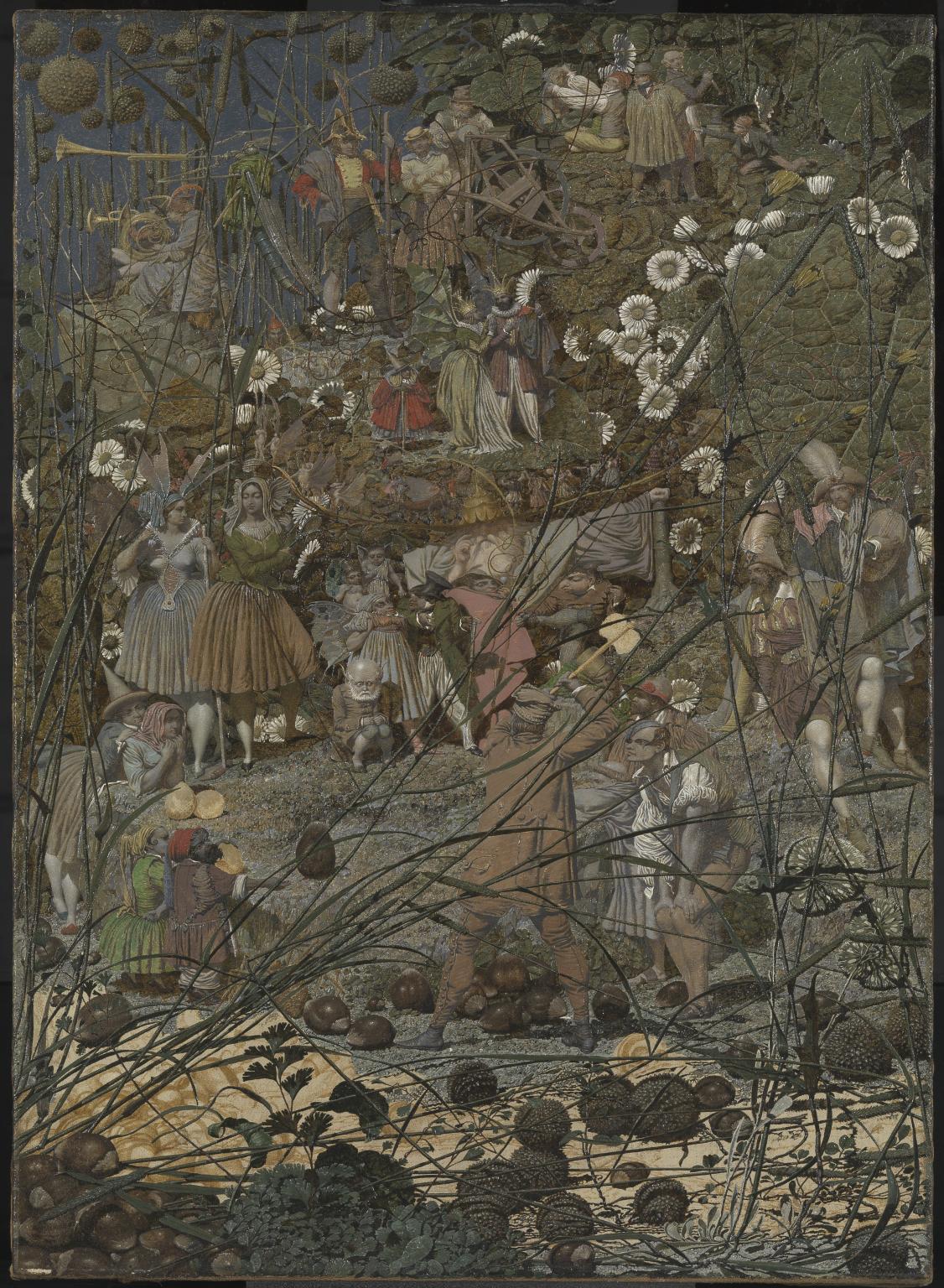
The Fairy Feller's Master-Stroke 1855-64 by Richard Dadd 1817-1886
Richard Dadd (1817–1886), The Fairy Feller’s Master-Stroke (1855-64), oil on canvas, 54 x 39.4 cm, The Tate Gallery, London (Presented by Siegfried Sassoon in memory of his friend and fellow officer Julian Dadd, a great-nephew of the artist, and of his two brothers who gave their lives in the First World War 1963). Photographic Rights © Tate 2016, CC-BY-NC-ND 3.0 (Unported), http://www.tate.org.uk/art/artworks/dadd-the-fairy-fellers-master-stroke-t00598

This has its origins in Shakespeare’s plays, with inspiration from Mercutio in Romeo and Juliet, and its main content drawn from A Midsummer Night’s Dream. We see Dadd’s scene through fine stalks of Timothy grass, the foreground with scattered hazelnuts and plane tree fruit. Although its perspective is flattened, the figures in the lower half of the painting are stood on a gently rising grassy sward, behind which is a steeper bank and stone walling (prominent at the right). Those in the upper third of the painting appear to be on another level, which rises more steeply towards the top edge.

The scene is set in the night-time, although daisy flowers are still unnaturally open, and there is night sky visible at the upper left. The feller himself, a hewer or fellow, seen at the centre (in the detail below), is about to cleave a hazelnut with his axe to provide a new carriage for Queen Mab (pronounced Maeve, to rhyme with rave), the queen of fairyland.

daddfairyfellersmaster-stroked1
Richard Dadd (1817–1886), The Fairy Feller’s Master-Stroke (detail) (1855-64), oil on canvas, 54 x 39.4 cm, The Tate Gallery, London (Presented by Siegfried Sassoon in memory of his friend and fellow officer Julian Dadd, a great-nephew of the artist, and of his two brothers who gave their lives in the First World War 1963). Photographic Rights © Tate 2016, CC-BY-NC-ND 3.0 (Unported), http://www.tate.org.uk/art/artworks/dadd-the-fairy-fellers-master-stroke-t00598
almatademaeducationchildrenclovis
Lawrence Alma-Tadema (1836–1912), The Education of the Children of Clovis (School of Vengeance, Training of Clotilde’s Sons) (1861), oil on canvas, 127 × 176.8 cm, Private Collection. Wikimedia Commons.

Lawrence Alma-Tadema’s The Education of the Children of Clovis (also known as The School of Vengeance, or The Training of Clotilde’s Sons) (1861) is a scene from Merovingian history, showing Saint Clotilde watching her young sons being taught the royal art of axe-throwing. It’s no wonder that later one of them was to murder two of her grandchildren.

Axe-throwing has recently been revived as a sport, although axes have a more sinister history in their use for executions.
bonnatmartyrdomstdenis
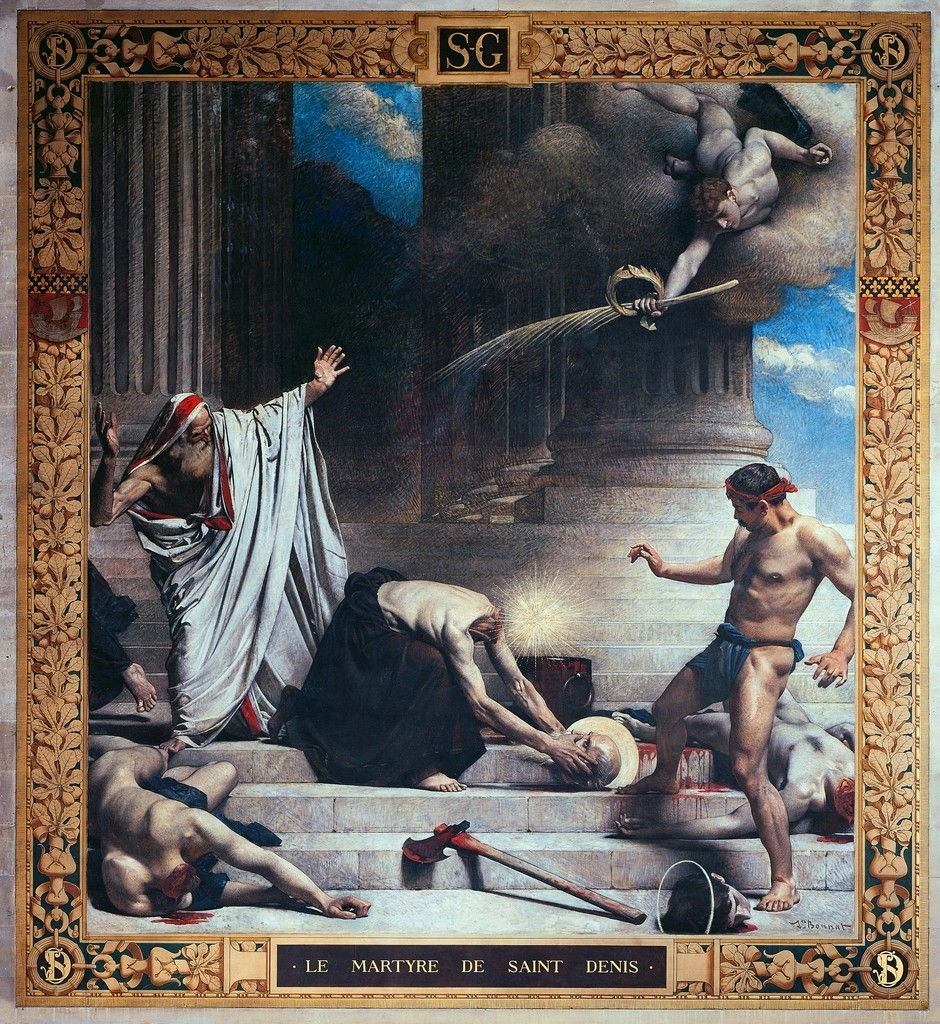
Léon Bonnat (1833–1922), The Martyrdom of Saint Denis (1874-88), oil on canvas marouflée, dimensions not known, The Panthéon, Paris. Wikimedia Commons.

Léon Bonnat’s ornate showpiece in the Panthéon of The Martyrdom of Saint Denis (1874-88) tells this celebrated legend. Saint Denis, patron saint of Paris, was martyred by beheading on Montmartre hill at the edge of the city. It’s claimed that after his head had been cut off, Denis picked it up and walked around preaching a sermon. The legendary location became a place of veneration, then the Saint Denis Basilica, and the burial place for the kings of France.

IF
Paul Delaroche (1797–1856), The Execution of Lady Jane Grey (1833), oil on canvas, 246 x 297 cm, The National Gallery, London. Courtesy of The National Gallery, bequeathed by the Second Lord Cheylesmore, 1902.

Paul Delaroche’s convincing painting of The Execution of Lady Jane Grey (1833) shows the fate of a contender for the crown of England following the early death of King Edward VI at the age of just 15 in 1553. As he had no natural successor, he had drawn up a plan for a cousin, Lady Jane Grey, to become Queen. Her rule started on 10 July 1553, but King Edward’s half sister Mary deposed her on 19 July. She was committed to the Tower of London, convicted of high treason in November 1553, and executed on Tower Green by beheading on 12 February 1554 at the age of just 16 (or 17).

Lady Jane Grey and the Lieutenant of the Tower, Sir John Bridges, take the centre of the canvas. She is blindfolded, the rest of her face almost expressionless. As she can no longer see, the Lieutenant is guiding her towards the executioner’s block, in front of her. Her arms are outstretched, hands with fingers spread in their quest for the block. Under the block, straw has been placed to take up her blood.

At the right, the executioner stands high and coldly detached, his left hand holding the haft of the axe he will shortly use to kill the young woman. Coils of rope hang from his waist, ready to tie his victim down if necessary. At the left, two of Lady Jane Grey’s attendants or family are resigned in their grief.
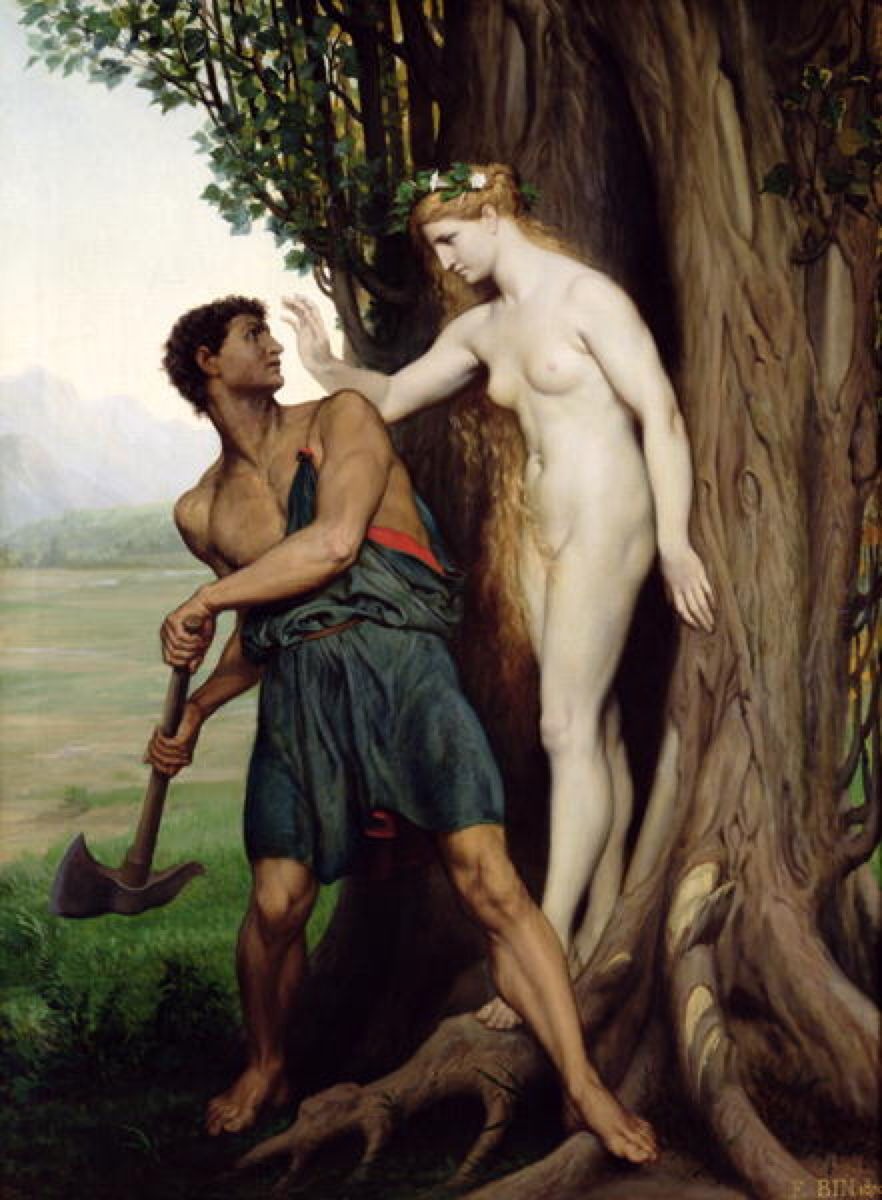
binhamadryad
Émile Bin (1825–1897), The Hamadryad (1870), oil on canvas, Musée Thomas-Henry, Cherbourg-Octeville, France. Wikimedia Commons.

Axes are sometimes shown in their primary role for felling trees, as seen in Émile Bin’s The Hamadryad from 1870, shown in yesterday’s article.

biardmountainrefuge
François-Auguste Biard (1799–1882), In a Mountain Hut (date not known), oil on paper mounted on canvas, 31 × 37 cm, location not known. Wikimedia Commons.

They also make an occasional appearance as a commonplace tool of those who live in wilder surroundings. François-Auguste Biard’s sketchy view In a Mountain Hut may have been made in front of the motif. This has a strong vein of social realism, showing the abject poverty and spartan conditions of many who lived in the more remote areas of France, with an axe beside a well-worn besom in the left foreground.

Reading Visual Art: 241 Sculptor

By: hoakley
23 January 2026 at 20:30

Sculptors and painters are kindred spirits. Although their tools and skills differ, they are all visual artists, and many have mastered both means of expressing their art. In today’s selection of paintings I include depictions of sculptors at work, rather than those merely showing the fruit of their labour in the form of sculpture.

The best-known sculptor in classical mythology is Pygmalion, whose quest for the perfect woman was only satisfied by the statue he made of her.

burne-joneshandrefrains
Edward Burne-Jones (1833–1898), Pygmalion and the Image – The Hand Refrains (1878), oil on canvas, 98.7 x 76.3 cm, Birmingham Museum and Art Gallery, Birmingham, England. Wikimedia Commons.

The Hand Refrainsis one of Edward Burne-Jones’s series telling this myth. Pygmalion stands back, his tools still in his hands and scattered at the foot of his work. Too scared to touch the statue now, he looks longingly at it, as if falling in love, which he did when it came to life.

geromepygmaliongalatea
Jean-Léon Gérôme (1824–1904), Pygmalion and Galatea (study) (1890), oil on canvas, 94 x 74 cm, Private collection. Wikimedia Commons.

Jean-Léon Gérôme’s study for Pygmalion and Galatea from 1890 was an early attempt at its composition, where the sculptor’s future bride is still a marble statue at her feet, but very much flesh and blood from the waist up. That visual device was perfect, but Gérôme recognised his painting could be shunned because of its full-frontal nudity, so reversed the view.

geromepygmaliongalatea
Jean-Léon Gérôme (1824–1904), Pygmalion and Galatea (c 1890), oil on canvas, 88.9 x 68.6 cm, Metropolitan Museum of Art, New York, NY. Wikimedia Commons.

His finished Pygmalion and Galatea (c 1890) extends the marble effect a little higher, and by showing Galatea’s buttocks and back and concealing the kiss, it stays on the right side of contemporary standards of decency. His attention to detail is delightful, with two masks against the wall at the right, Cupid ready with his bow and arrow, an Aegis bearing the head of Medusa, and a couple of statues about looking and seeing. For Gérôme recognised other stories about sculpture and seeing that could be brought in to enrich Ovid’s original narrative.

almatademaphidiasshowingfrieze
Lawrence Alma-Tadema (1836–1912), Phidias Showing the Frieze of the Parthenon to his Friends (1868), oil on canvas, 72 × 110.5 cm, Birmingham Museum and Art Gallery, Birmingham, England. Wikimedia Commons.

Lawrence Alma-Tadema imagined ancient Greeks admiring this painted frieze as it neared completion in his beautiful painting of its sculptor Phidias Showing the Frieze of the Parthenon to his Friends (1868). The admiring figures include Pericles (at the right), Aspasia, Alcibiades and Socrates.

eakinsrushcarvingallegoricalfigure1877
Thomas Eakins (1844–1916), William Rush Carving His Allegorical Figure of the Schuylkill River (1876-77), oil on canvas mounted on Masonite, 51.2 x 66.4 cm, Philadelphia Museum of Art, Philadelphia, PA. Wikimedia Commons.

William Rush Carving His Allegorical Figure of the Schuylkill River (1876-77) is the first of three paintings by Thomas Eakins showing William Rush, a wood sculptor, carving his Water Nymph and Bittern for a fountain in Philadelphia’s waterworks, in 1808. The water nymph is an allegory of the Schuylkill River, the city’s primary source of water at that time.

Rush had been a founder of the Pennsylvania Academy of the Fine Arts, and an enthusiast for the use of nude models in art, as was Eakins. This painting was therefore, at least in part, an attempt to promote Rush’s name, and the practice of working from nude models. Rush prepared thoroughly, as usual, in carving wax studies, and making a series of drawings and oil sketches.

Seated at the right of the model is a chaperone, more interested in her knitting. The model’s complicated clothing is hung and scattered in the light, as if to emphasise her total nudity (apart from a hair-band!), and the sculptor is working in the gloom at the left. Eakins anachronistically included several later works by Rush, as if to provide a resumé of his output. Unfortunately, the scattered garments didn’t go down well, and were deemed scandalous at the time.

geromemichelangelo
Jean-Léon Gérôme (1824–1904), Michelangelo (1849), oil on canvas, 51.4 x 37.5 cm, Dahesh Museum of Art, New York, NY. The Athenaeum.

Gérôme’s relatively small and simple painting of Michelangelo from 1849 shows Michelangelo in his dotage, hunched over and blind, being led by a young boy whose dress would have aroused his master’s homoerotic desires. The broken sculpture is the Belvedere Torso, a huge fragment of marble statuary so loved by the sculptor that it was nicknamed the School of Michelangelo. The young boy is leading his master’s hands to stroke and caress the marble, now that he was unable to enjoy looking at its classical and very male form.

This is perhaps the first step in his developing theme of sight, and the role of vision in establishing truth. In his blindness, Michelangelo can only feel what we can see, and cannot see the figure of the young boy. This is particularly appropriate to Gérôme, who later in his career became a successful sculptor himself, and whose later paintings referred to his sculptures and the act of creating them.

IF
Jean-Léon Gérôme (1824–1904), The End of the Pose (1886), oil on canvas, 48.3 x 40.6 cm, Private collection. Wikimedia Commons.

The End of the Pose (1886) is the first of Gérôme’s series of unusual compound paintings, at the same time self-portraits of the artist as a sculptor, studies in the relationship between a model and their sculpted double, and forays into issues of what is seen, visual revelation, and truth. Here, while Gérôme cleans up, his model is seen covering up her sculpted double with sheets, as she remains naked. Apart from various diversionary entertainments, including a couple of stuffed birds and a model boat, there is a single red rose on the wooden platform on which the model and statue stand. Presumably this is a symbol of thanks from the artist to his model.

geromeworkingmarble
Jean-Léon Gérôme (1824–1904), The Artist’s Model (1895), oil on canvas, 50.8 x 39.6 cm, Dahesh Museum of Art, New York, NY. Wikimedia Commons.

In The Artist’s Model (1895), Gérôme paints himself at work on his marble figure of Tanagra (1890), currently in the Musée d’Orsay, already included among the figurines in his painting Sculpturae Vitam Insufflat Pictura. He thus painted himself making a sculpture that he had previously painted in a painting as a sculpture. Not only that, but his model is his favourite Emma Dupont, who over a period of twenty years posed for many of his best-known Orientalist and other works.

Scattered in the image are reminders of gladiatorial armour and other props used for his paintings, one of his paintings of Pygmalion and Galatea, together with one of his polychrome sculptures of a woman with a hoop, at the right edge. In this single image, Gérôme has captured much of his professional career.

corinthnikolausfriedrich
Lovis Corinth (1858–1925), Portrait of the Sculptor Nikolaus Friedrich (1912), oil on canvas, 101.7 × 81 cm, Private collection. Wikimedia Commons.

This wonderful Portrait of the Sculptor Nikolaus Friedrich (1912) at work wasn’t the first to be painted by Lovis Corinth, who had made a previous portrait in 1904, when the sculptor was young and muscular. Eight years later he’s seen in the midst of a broad and representative range of his work. Friedrich died two years later, when he was only 48.

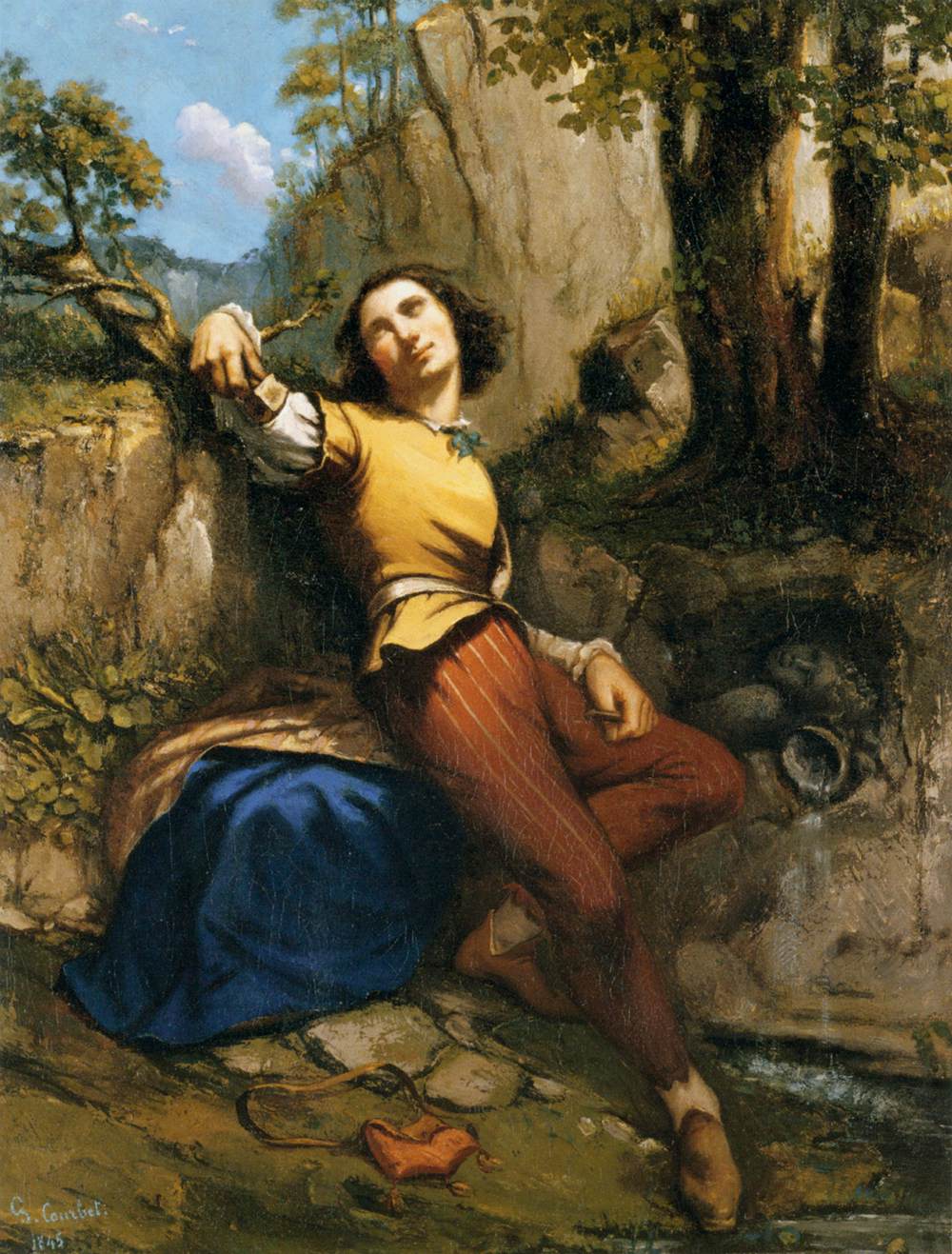
Gustave Courbet (1819–1877), The Sculptor (1845), oil on canvas, 55 x 41 cm, Private collection. Wikimedia Commons.

Early in his career, Gustave Courbet planted a gaudily-dressed figure at the foot of some cliffs near his home town of Ornans, put a small mallet in his right hand and a chisel in the other, and painted The Sculptor (1845). The subject of this sculptor’s inattention is the emerging form of a woman in the rock just above his left knee, over a small pipe from which water is pouring into the stream.

watteaumonkeysculptor
Antoine Watteau (1684–1721), The Monkey Sculptor (c 1710), oil on canvas tondo, 22 × 21 cm, Musée des Beaux-Arts, Orléans, Loiret, France. Wikimedia Commons.

Antoine Watteau’s tondo of The Monkey Sculptor from about 1710 is a singerie set in the sculptor’s studio, as if to say that even a monkey can be a good sculptor.

❌
❌