Login
Login
Jerusalem Delivered: 7 The death of Clorinda
With Armida creating havoc among the crusaders, and leading ten of their best warriors out on a fool’s errand, Erminia had dressed in Clorinda’s armour, tried to help the wounded Tancred, then became lost in the countryside by the River Jordan. Tancred had left in pursuit of her, thinking she was his love Clorinda, but he too strays and loses her trail in a wood.
It’s dusk by the time Tancred emerges from the wood, and mindful of his battle to complete with Argante in the morning, he turns for home. As he does, a messenger comes galloping towards him, claiming to come from Bohemond. Tancred follows him to a moated castle, where the messenger blows his horn for its drawbridge to be lowered.
Tancred is wary, but as he approaches the castle, a familiar figure appears: Gascon Rambald, one of the ten knights who set off with Armida. But the knight tells Tancred to disarm, and admits to having been ‘turned’ to a ‘pagan’ by Armida. Tasso tells us what Tancred cannot see: Armida is watching and listening to this from a throne high above them in her castle.
Tancred’s only option is to kill Gascon Rambald, who runs out onto the drawbridge. Once Tancred is there with him, the castle and its burning brands vanish into the darkness. Tancred walks on into the black night, steps through a gate, and is sealed in a trap. From behind the dungeon’s bars he recalls his duty to face Argante at dawn.
The following day Argante is getting himself ready before dawn. Godfrey is woken by Argante’s herald blowing fiercely on his horn, only to discover that Tancred and many of his best fighters are missing. His first task is to find a substitute for Tancred to resume the battle with Argante. He draws lots in the end, and pulls out the name of Raymond of Toulouse, who at least has the advantage of a guardian angel.
The contest between Argante and Raymond starts with the former missing his opponent altogether, thanks to the angel’s intervention. With his great experience in combat, Raymond proves a match for the Circassian, and is saved repeatedly by angelic force. However, Argante has already made a pact with the devil, and his guardian intervenes by asking a nearby archer to shoot Raymond in the eye.
The arrow is loosed and strikes Raymond by the belt, its force attenuated by his angel. This breach of the code of chivalry provokes the watching armies into immediate battle: soldiers from the city are forced to defend Argante, as crusaders rush in to kill as many as they can. When the enemy forces are forced to flee, only Argante remains.
Then the hand of God intervenes, as the sky turns black in a terrific storm, with violent wind, torrential rain, thunder and lightning.
At the start of the eighth canto the storm has abated, but there is more bad news for Godfrey. Reinforcements led by Sven, son of the King of Denmark, have been slaughtered by King Soliman’s far larger army before they could reach the main force. Only one hundred survive out of the original two thousand.
Then a foraging party returns and reports they found the headless corpse of Rinaldo, whose armour had been shattered and cut through in battle. Although Godfrey isn’t entirely convinced by their story, it’s sufficient to keep him awake for much of the night. He’s disturbed by sudden insurrection within the camp, led by Argillan, and driven by one of the Furies. The riot is settled, but Godfrey now realises that he must attack Jerusalem soon.
The ninth canto opens with a night attack by Arab forces on the crusaders’ camp, which is initially very successful, and puts French troops to flight. But Godfrey quickly responds and leads his main army in a counter-attack. Jerusalem then becomes aware of the battle, and Clorinda and Argante bring their army out to join in.
Godfrey rallies his men as some turn to run, and leads them into the mêlée. The archangel Michael arrives, and commands the devil’s forces to disengage, as God has ordained that they may not intervene directly. Argante and Clorinda continue to fight, though, claiming many crusaders’ lives. Argillan, freed from prison, joins in, only to be killed by Soliman himself. The tide turns in favour of the crusaders, and the Arab army is put to rout when fifty knights who had followed Armida unexpectedly return. The crusaders pursue the Arabs, slaughtering all they can catch, and Soliman withdraws.
In the tenth canto, Soliman is saved by the sorceror Ismen, who inspires him with the promise of success, and carries him in a magic chariot. They pass over the crusaders, who are now salvaging weapons and armour from the battlefield. They land on a hill, from where they walk, hidden in a cloud, to Mount Sion. There, they enter a cave, and Ismen leads them, invisible, to a meeting of Aladine’s council in the city of Jerusalem. Soliman and Ismen then reveal themselves to the meeting.
Godfrey has paid his fallen warriors their last respects, and then turns his attention to debriefing his knights who had returned from Armida, with the help of Peter the Hermit. They tell him of their journey to Armida’s castle near Sodom, its surrounding swamp in which nothing sinks [possibly a reference to the Dead Sea], and the bewitching meal that Armida served them.
She changed some of them into creatures, like fish, to demonstrate her evil powers, and demanded they became ‘pagans’. They refused, but also saw her take Tancred prisoner. Armida then despatched them to Egypt, but Rinaldo killed their guards and rescued them. In the process, his armour became too damaged to wear, so he discarded it.
Peter the Hermit then has a vision of the future, in which he declares that Rinaldo is still alive, and will survive.
The eleventh canto opens with the crusaders celebrating mass on Mount Olivet, as the citizens of Jerusalem watch first in silence, then break into jeers and blasphemous shouts. Afterwards, Godfrey briefs his commanders to prepare to attack at first light the next day.
As the crusaders ready themselves first thing in the morning, Aladine moves his troops to defend the city’s most vulnerable western wall, where Argante and Clorinda position themselves. She is ready with her bow and a full load of arrows. The crusaders then array themselves, the infantry being covered in the rear by cavalry, with mobile units all around. Siege engines are moved in, and towers made of oak.
Argante, Clorinda, and the city’s defenders rain boulders and arrows on the crusaders, who batter the defences with a ram and climb the towers, to loose arrows and spears at those on the city’s walls. Some of the leaders, including Guelph and Raymond, fall, to the dismay of the crusaders. Argante proclaims “This is not Antioch!” Even Godfrey finds himself pierced by an arrow, but that’s soon removed and his wound dressed.
As night starts to fall, the towers are drawn back for protection, and battle comes to a halt for the day, under the code of chivalry. Godfrey’s engineers work through the night repairing the damage to their siege engines and towers. At the same time, those inside the walls are shoring them up from the damage they have suffered.
Canto twelve opens with Clorinda walking with Argante, asking him to take care of her dearest in the event that she doesn’t survive. The Circassian is taken aback at this, but agrees. The two then put a proposal to Aladine to set fire to the siege towers when everyone has gone to sleep. Ismen offers them incendiary materials to help.
Clorinda’s eunuch then tells of her origins and birth in Ethiopia, as the white daughter of the black Christian queen, and how she was never baptised but raised a ‘pagan’. The eunuch pleads with his mistress to lay down her arms.
Argante and Clorinda then sneak out of the city and set the siege towers alight, burning each to the ground. The pair retreat to the city, where Aladine has the Golden Gate thrown open to receive them. But only Argante makes his way in: Clorinda has wandered off, and by the time she returns the gate is shut with her outside, in the midst of the enemy.
Tancred then appears, and assuming that Clorinda is a man, challenges her to fight. She tries to escape, to find another way back into the city, but can’t refuse his challenge. They fight one another in the darkness of the night, so close they can’t even swing their swords.
Tancred finally asks who she is. She refuses to tell, and they fight on, to the inevitable moment when Tancred sinks his sword deep into her chest. Her legs collapse from under her. In a frail voice she tells him she forgives him, and asks that he baptises her. Tancred runs over to a nearby stream and fills his helmet with water. When he gets back to her, he removes her helmet and sees that it is his love Clorinda dying in his arms. He baptises her, and in her last breath she says that she goes in peace.
One of the most moving moments in the whole of Tasso’s epic, this has proved a challenge to paint: it’s still night, perhaps with the faintest light of dawn to the east, and there’s a complex sequence of events and details.
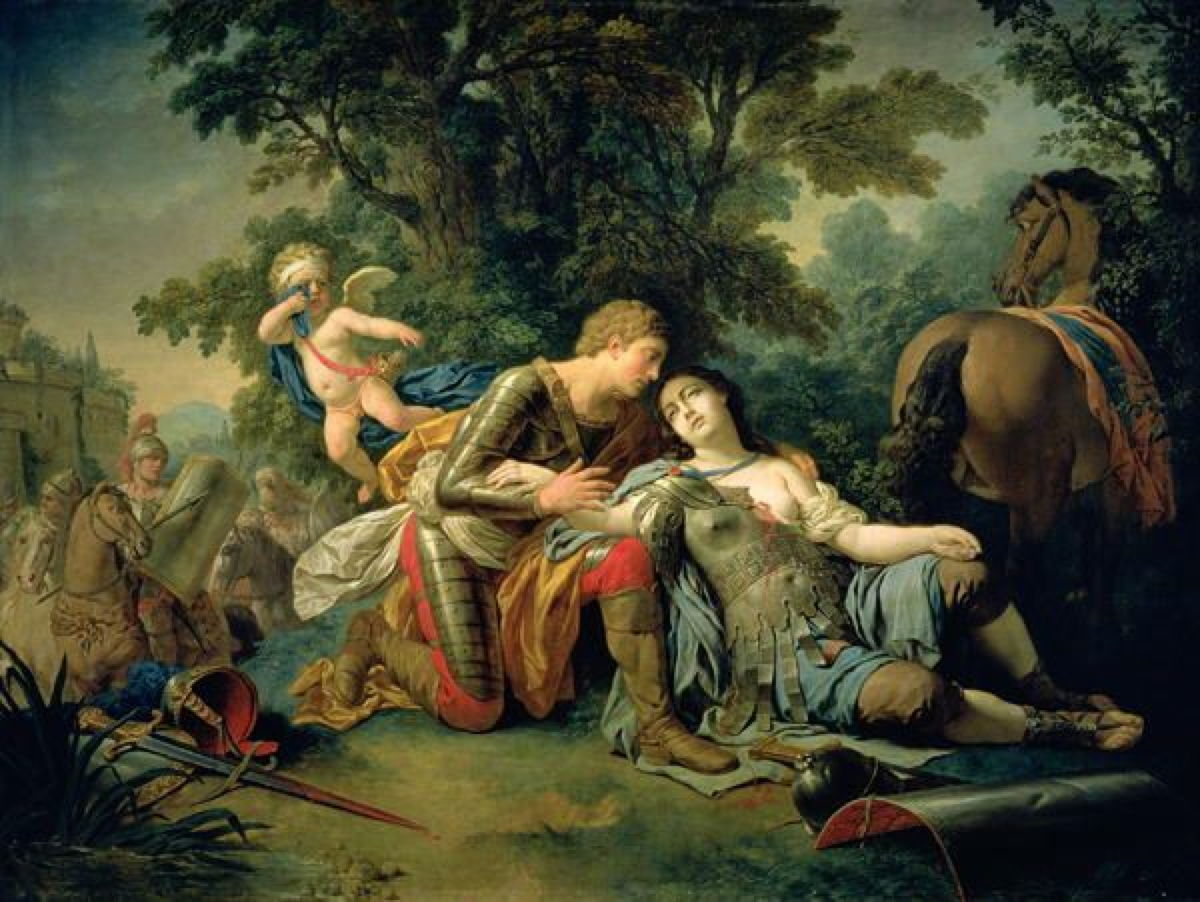
Louis-Jean-François Lagrenée’s Tancred and Clorinda from 1761 shows this in daylight, and without reference to Clorinda’s baptism. Tancred’s helmet and bloodied sword lie at the left, and the only slightly bloodied Clorinda swoons away against his left knee. Above them is Cupid, in a pose suggestive of his bow and arrow but actually wiping a tear from his eye. Oddly, Lagrenée balances him against the hindquarters of Tancred’s horse, an unfortunate compositional choice.
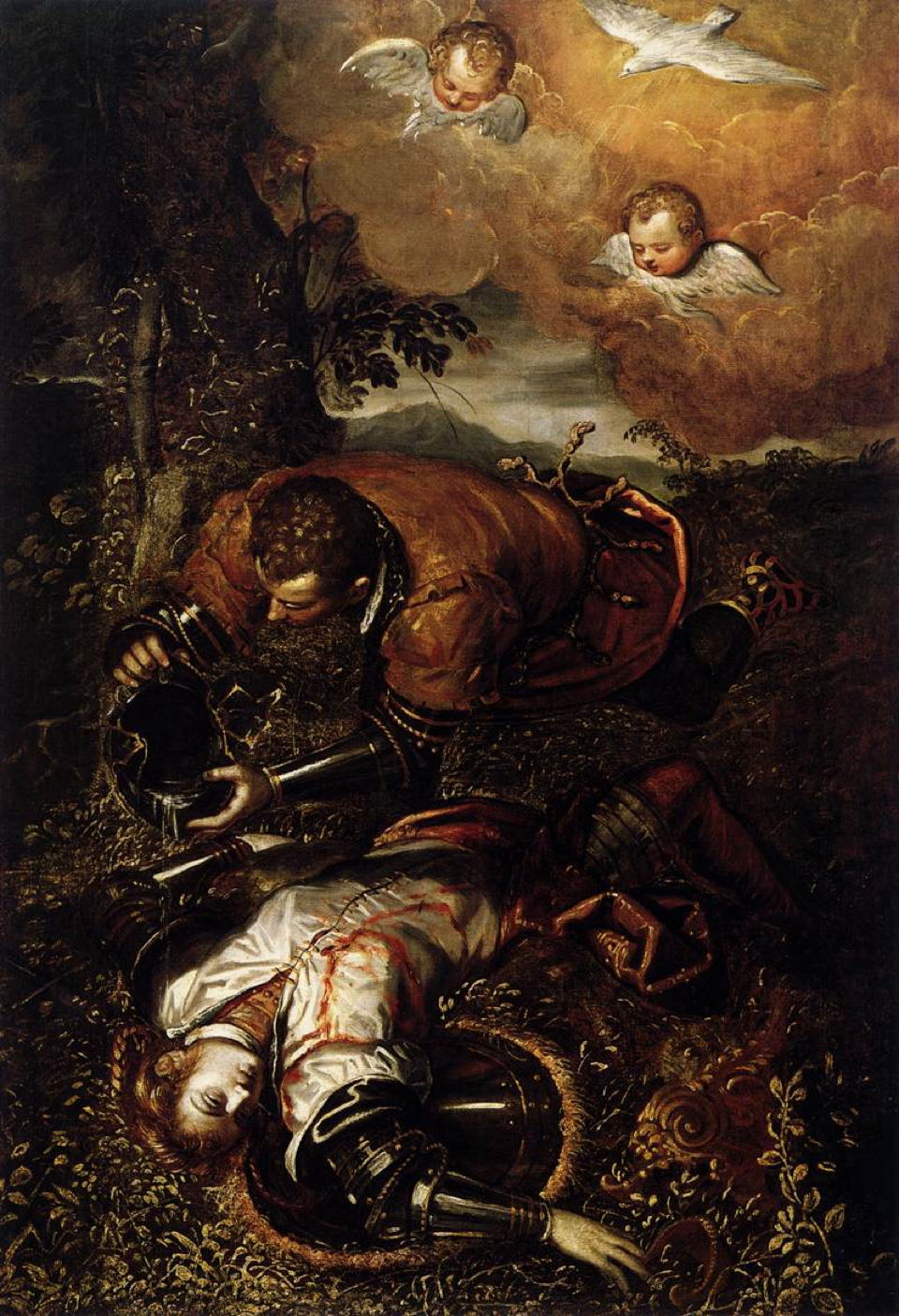
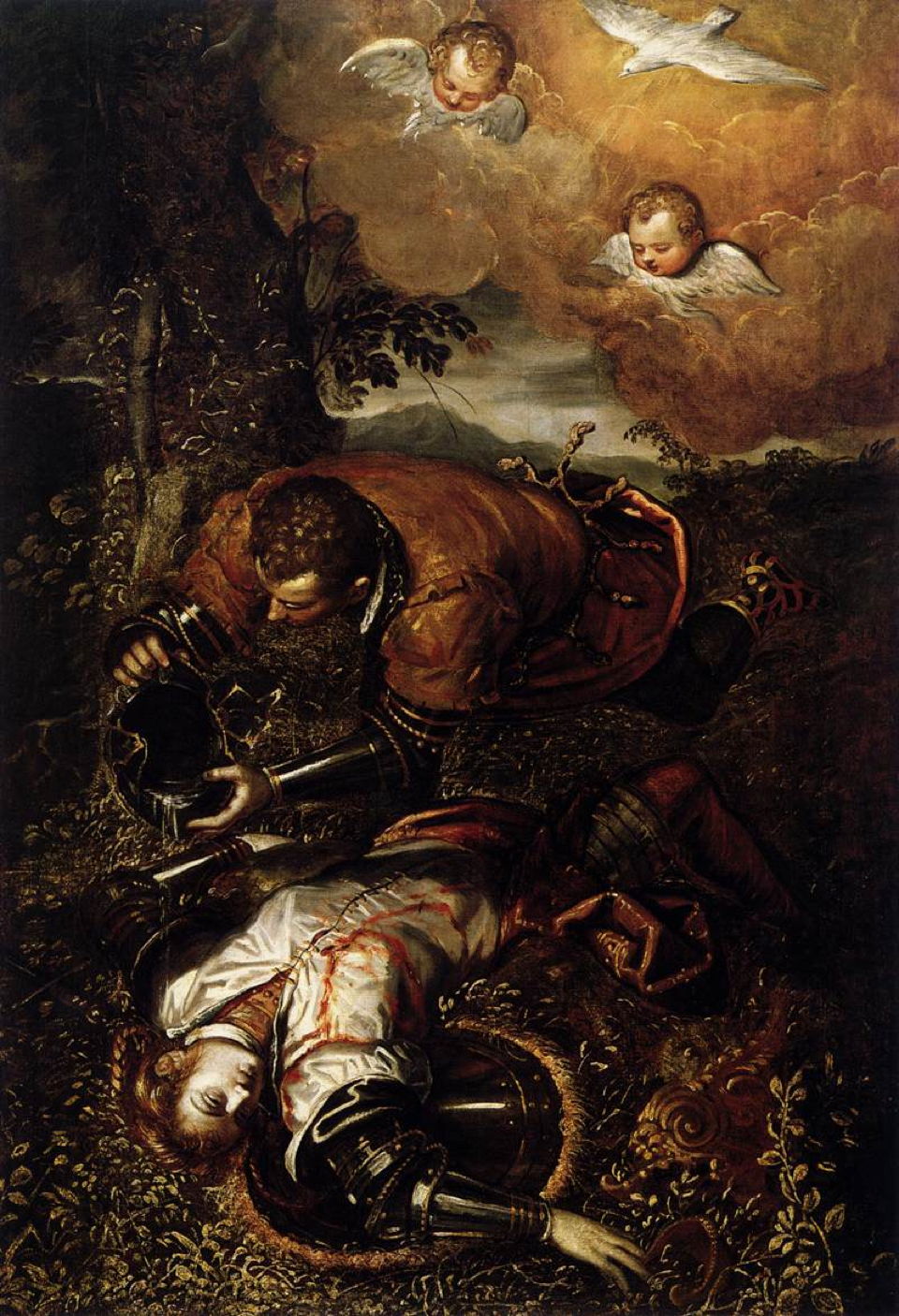
Jacopo Tintoretto’s son Domenico must have painted his Tancred Baptizing Clorinda in about 1585, just a few years after the epic’s first publication. Although generally rated far below his father, this painting is rather special. It captures the light well, and Tancred’s rushed baptism under the watchful eye of the white dove of the Holy Spirit and two cherubic angels.
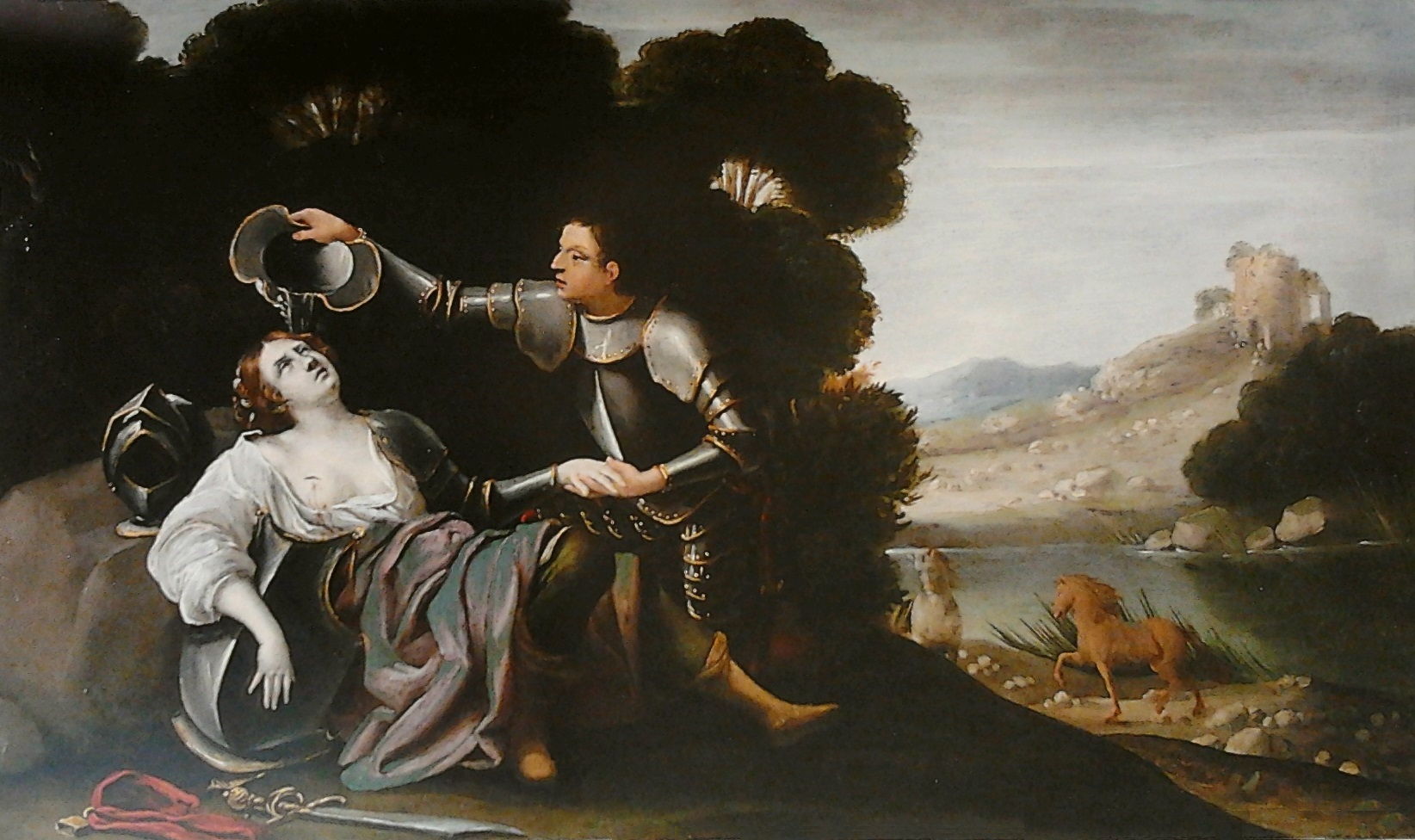
This anonymous painting of The Baptism of Clorinda thought to be from about 1625 tells the story fairly faithfully, and provides a source of water in the distance.
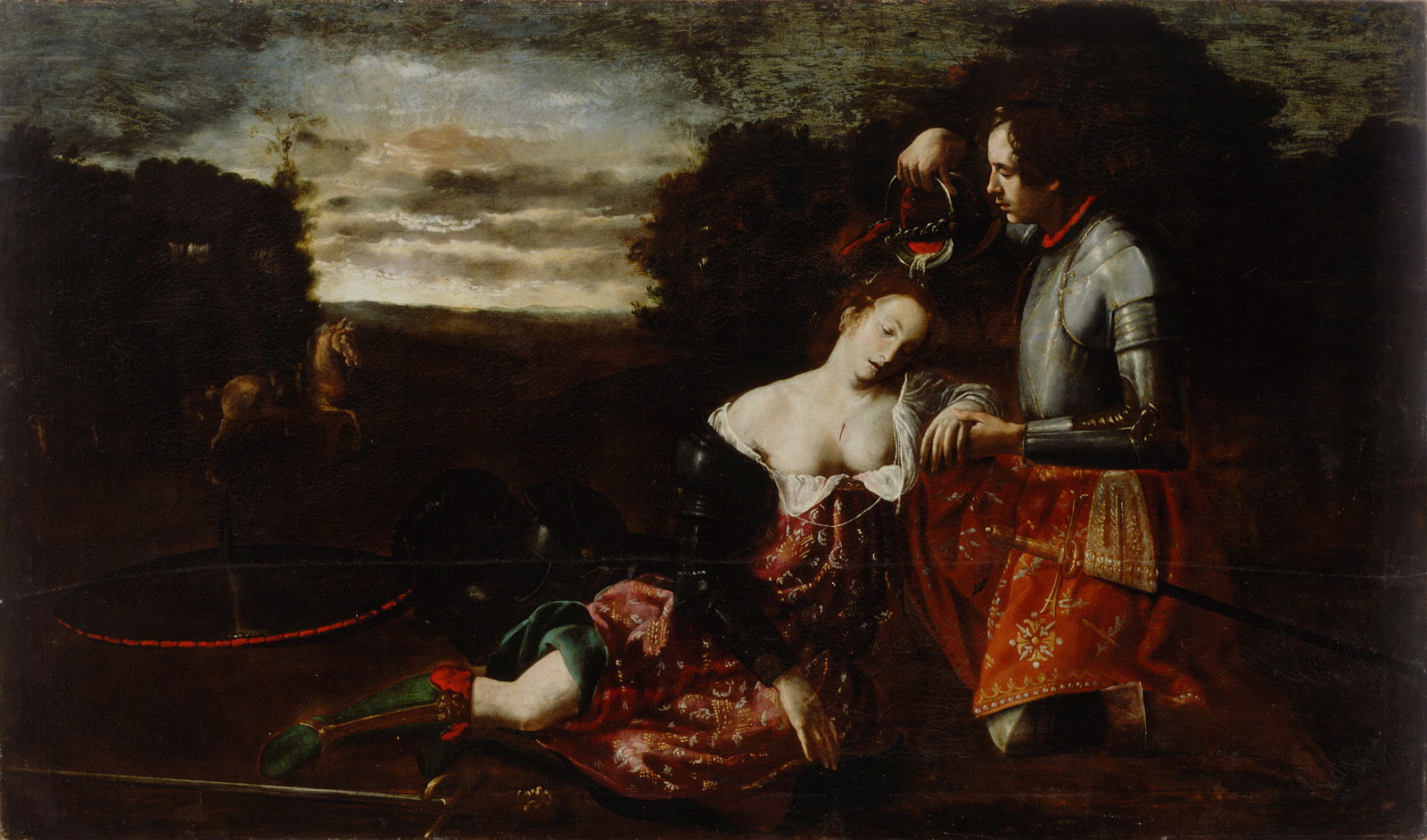
Another painting by an unidentified artist, Tancred Baptises Clorinda from about 1650, is more faithful to the time of day. The strange red arc at the left is the edging of a circular shield resting on the ground.
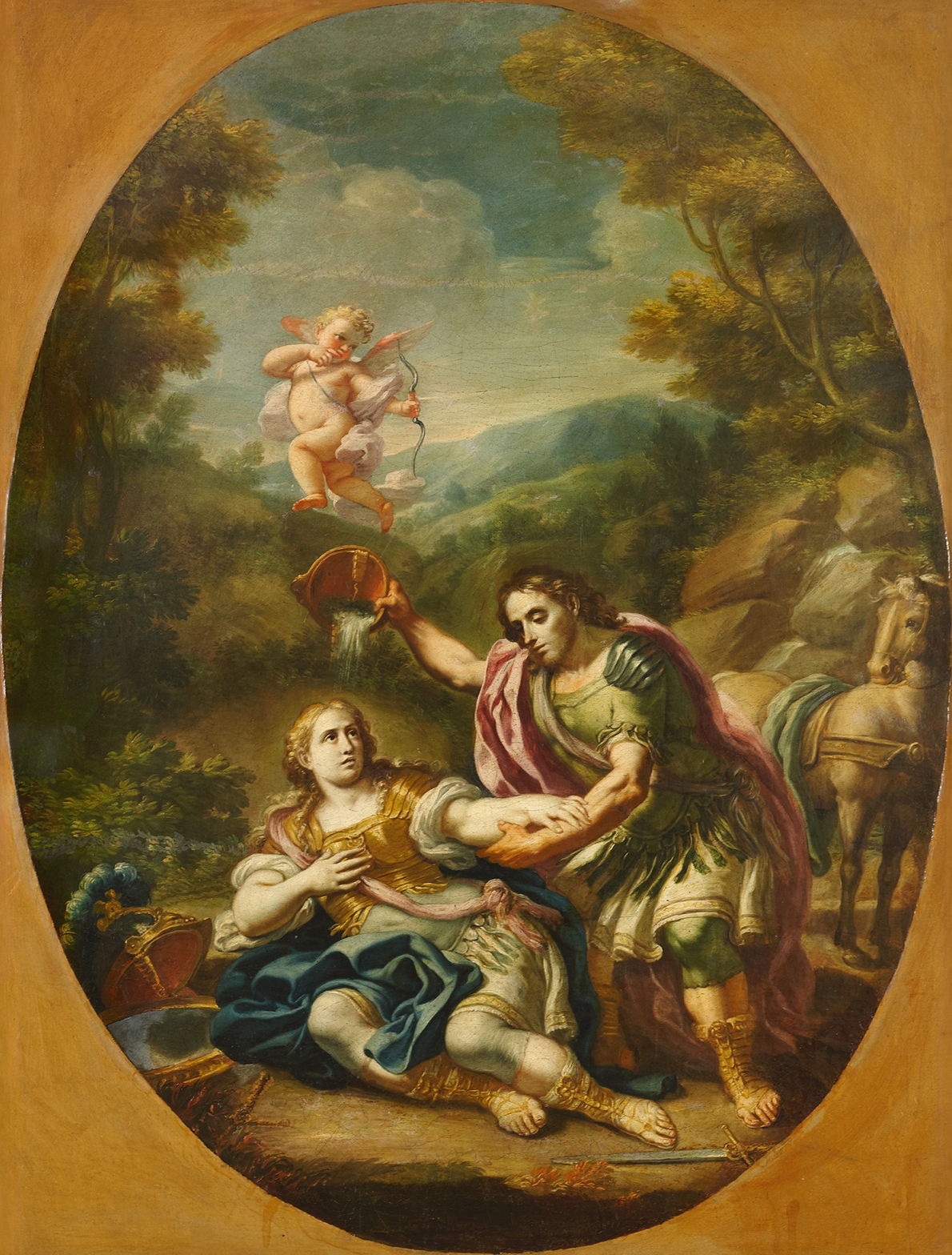
Andrey Ivanovich Ivanov’s Tancred and Clorinda from about 1798 again sets this in daylight, and avoids any trace of blood.
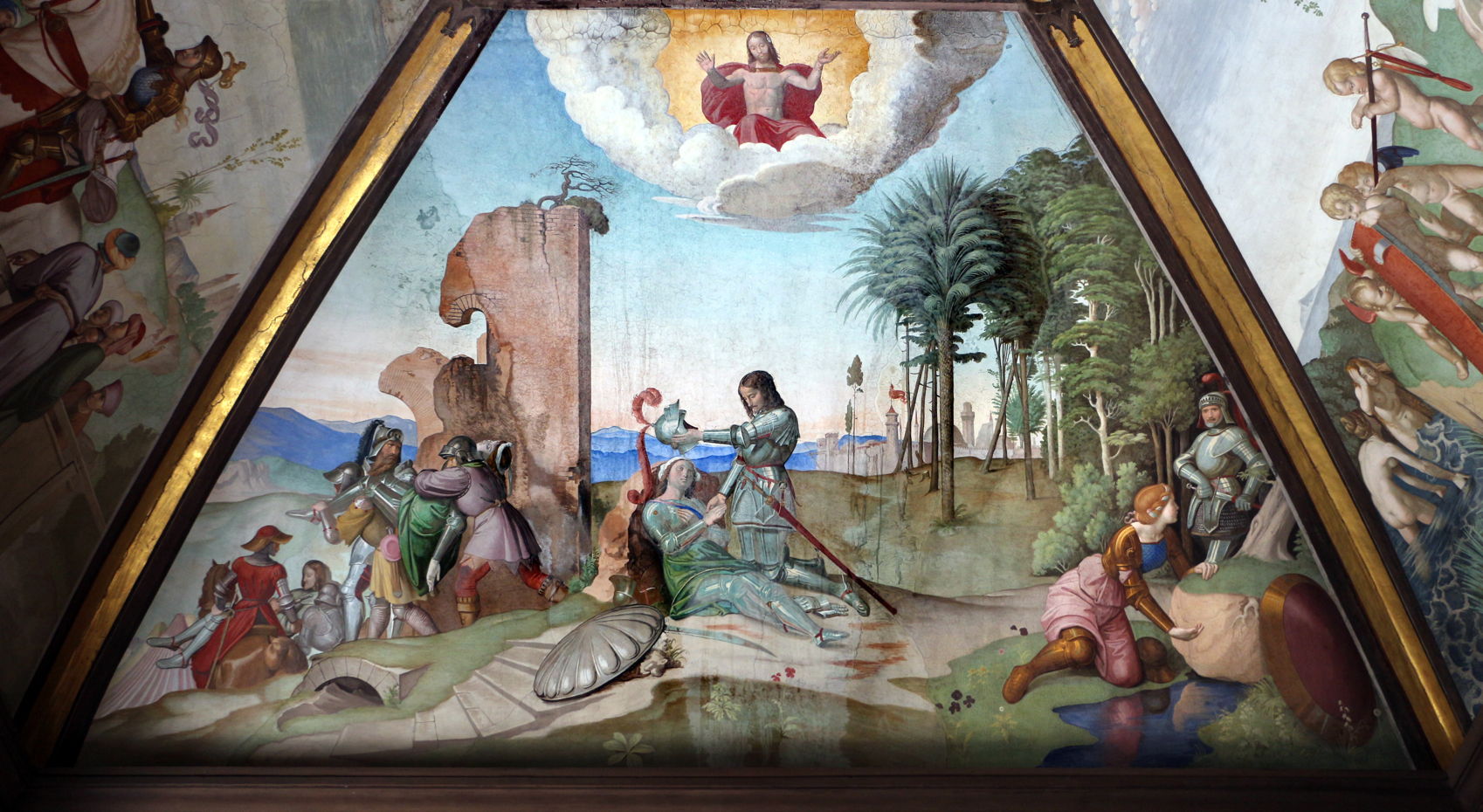
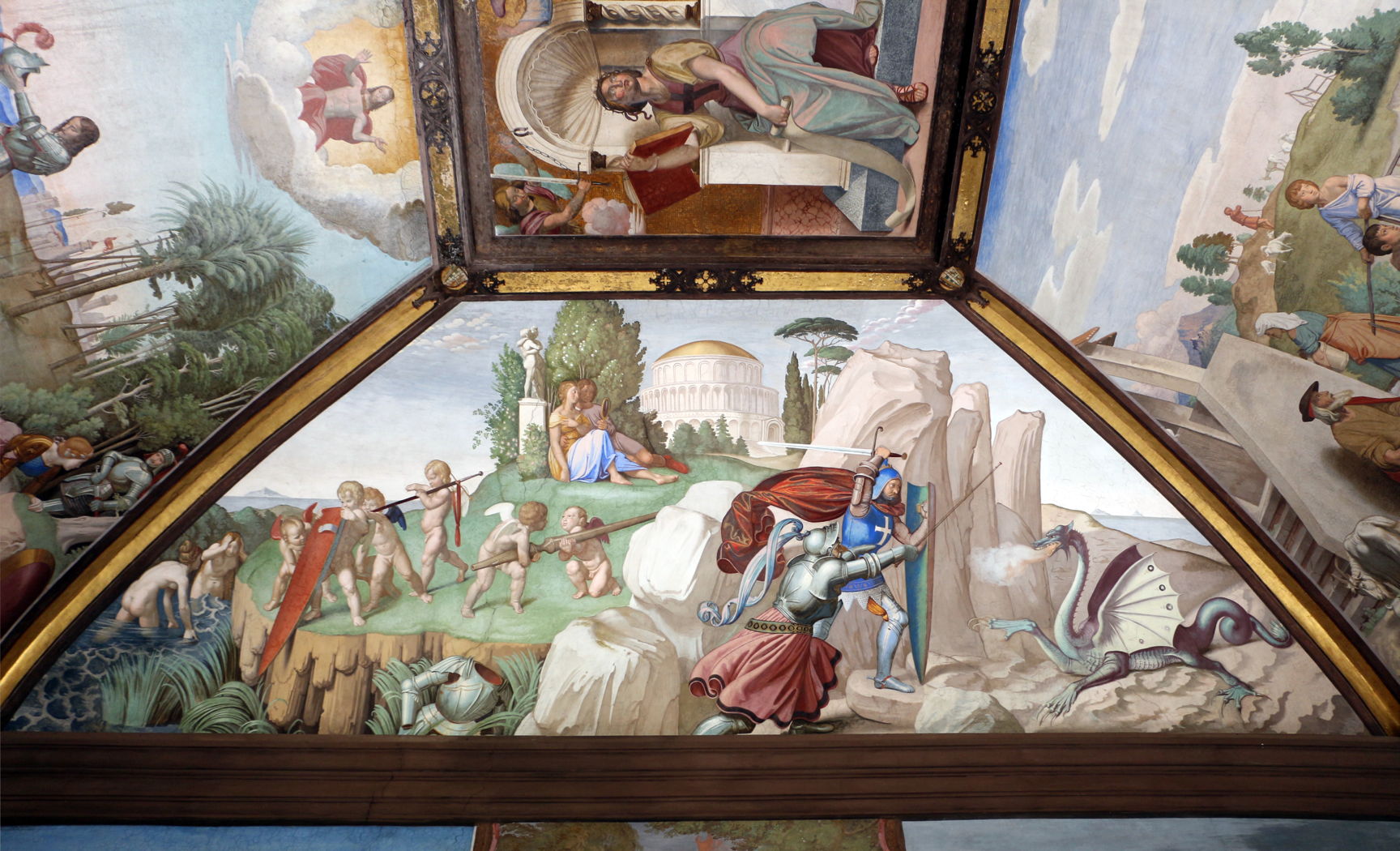
By far the most fascinating depiction, though, is that of Johann Friedrich Overbeck’s fresco in the Casa Massimo, Rome, painted between 1819-27. The section showing The Death of Clorinda features her baptism in the centre, and places the city of Jerusalem in the distance. It also includes two other scenes involving other characters from the epic, and the unmistakable figure of Christ watching from heaven above.
References
Wikipedia on Jerusalem Delivered.
Wikipedia on Torquato Tasso.
Project Gutenberg (free) English translation (Fairfax 1600).
Librivox audiobook of the Fairfax (1600) English translation (free).
Thomas Asbridge (2004) The First Crusade, A New History, Free Press, ISBN 978 0 7432 2084 2.
Anthony M Esolen, translator (2000) Torquato Tasso, Jerusalem Delivered, Gerusalemme Liberata, Johns Hopkins UP. ISBN 978 0 801 863233. A superb modern translation into English verse.
John France (1994) Victory in the East, a Military History of the First Crusade, Cambridge UP. ISBN 978 0 521 589871.
Joanthan Riley-Smith, ed (1995) The Oxford Illustrated History of the Crusades, Oxford UP. ISBN 978 0 192 854285.
Jonathan Riley-Smith (2014) The Crusades, A History, 3rd edn., Bloomsbury. ISBN 978 1 4725 1351 9.
Johathan Unglaub (2006) Poussin and the Poetics of Painting, Pictorial Narrative and the Legacy of Tasso, Cambridge UP. ISBN 978 0 521 833677.