Normal view

There are new articles available, click to refresh the page.
Before yesterdayMain stream

Reading Visual Art: 246 Apron

By: hoakley
20 February 2026 at 20:30

Aprons are protective garments normally worn over the front of the body and upper legs, where they’re intended to prevent other clothes from soiling, and sometimes the wearer underneath. Although frequently seen in paintings, their absence must be interpreted with caution: most figurative paintings are made in the studio, where the only folk likely to be wearing aprons are the artist and their assistants. The wear of aprons is also markedly gendered; although in real life many men wear them at work, those most likely to be depicted with them are overwhelmingly women.

Aprons have been strongly associated with those in domestic service, and appear in folk tales such as Cinderella.

burnejonescinderella
Edward Burne-Jones (1833–1898), Cinderella (1863), watercolour and gouache on paper, 65.7 x 30.4 cm, Museum of Fine Arts, Boston, MA. Wikimedia Commons.

Edward Burne-Jones’ Cinderella from 1863 shows her reverted to her plain clothes after the ball, but still wearing one glass slipper on her left foot. She is seen in a scullery with a dull, patched and grubby working dress and apron.

carpentierintimateconversation
Évariste Carpentier (1845–1922), Intimate Conversation (c 1892), oil on canvas, 50.5 x 60.5 cm, Broelmuseum, Kortrijk, Belgium. Wikimedia Commons.

Intimate Conversation from about 1892 shows a young couple talking idly outdoors in the sun. Évariste Carpentier puts a prominent tear in the young woman’s apron to emphasise their poverty.

Probably the most famous painted apron is that worn by Johannes Vermeer’s Milkmaid in about 1658-59.

vermeermilkmaid
Johannes Vermeer (1632–1675), The Milkmaid (c 1658-59), oil on canvas, 45.5 x 41 cm, The Rijksmuseum Amsterdam, Amsterdam, The Netherlands. Wikimedia Commons.

This woman, seen in three-quarter view, wears working dress: a stiff, white linen cap, a yellow jacket laced at the front, a brilliant ultramarine blue apron, with a dull red skirt underneath. Her work sleeves are pushed up to lay both her weathered forearms bare to the elbow. Her strong-featured face and eyes are cast down, watching the milk as it runs into the pot.

greuzelaundress
Jean-Baptiste Greuze (1725-1805), The Laundress (1761), oil on canvas, 40.6 x 32.7 cm, The J. Paul Getty Museum, Los Angeles, CA. Wikimedia Commons.

Jean-Baptiste Greuze’s Laundress (1761) is in the dilapidated servants’ area, probably in a cellar, where this flirtaceous young maid is washing the household linen, with her coarse white apron rolled up to enable her to lean forward and down.

Aprons were also common in women working outdoors, such as gleaners.

bretoncallingingleaners
Jules Breton (1827–1906), Calling in the Gleaners (1859), oil on canvas, 90 x 176 cm, Musée d’Orsay, Paris. Wikimedia Commons.

Those in Jules Breton’s Calling in the Gleaners (also known as The Recall of the Gleaners, Artois) (1859) are using theirs to carry their gleanings. Most are frayed and tatty, faded blue in colour.

blepageoctober
Jules Bastien-Lepage (1848–1884), October: Potato Gatherers (1878), oil on canvas, 180.7 x 196 cm, National Gallery of Victoria, Melbourne. Wikimedia Commons.

They’re being worn by the two women in Jules Bastien-Lepage’s October: Potato Gatherers from 1878.

brendekildecowed
Hans Andersen Brendekilde (1857–1942), Cowed (1887), media not known, 126 x 152.3 cm, Fyns Kunstmuseum, Odense, Denmark. Wikimedia Commons.

Some aprons could have more than one purpose, and may need more careful reading. Hans Andersen Brendekilde’s Cowed from 1887 shows gleaners at work in a field after the harvest. The family group in the foreground consists of three generations: mother is still bent over, hard at work gleaning her handful of corn. Her husband is taking a short break, sitting on the sack in his large blue wooden clogs. Stood looking at him is their daughter, engaged in a serious conversation with her father, as her young child plays on the ground. The daughter is finely dressed under her apron, and wears a hat more appropriate to someone in domestic service in a rich household in the nearby town.
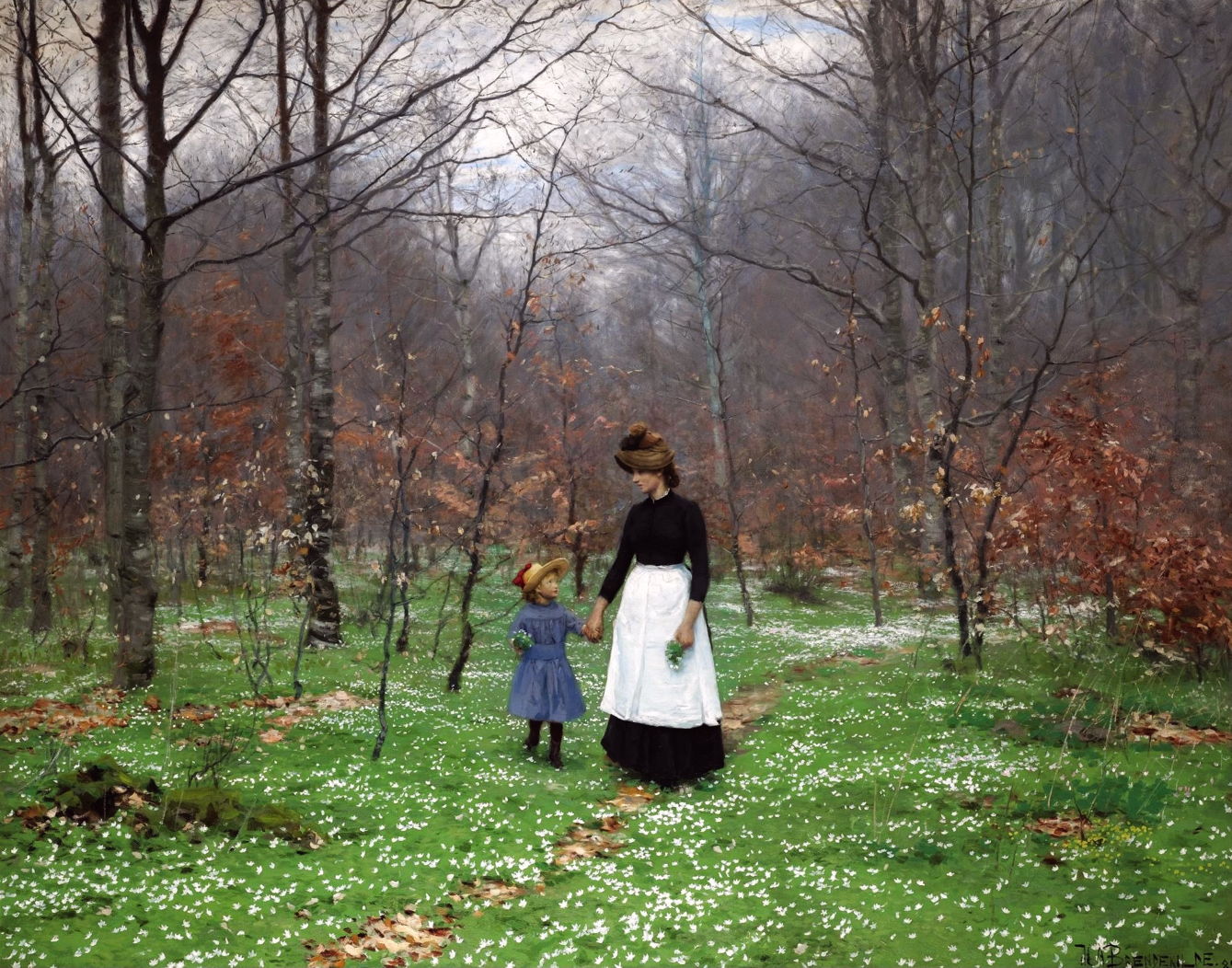
brendekildefirstanemones
Hans Andersen Brendekilde (1857–1942), Springtime; The First Anemones (1889), oil on canvas, 125.7 x 158.7 cm, Private collection. Wikimedia Commons.

Another painting of Brendekilde’s from this period, his Springtime; The First Anemones from 1889, shows a young woman walking with a small girl in a wood in the early Spring. The woman is unlikely to be the girl’s mother. Instead, she wears the black dress and white apron of a woman ‘in service’, in this case probably as the little girl’s maid or nanny.

pissarroapplepicking1888
Camille Pissarro (1830–1903), Apple-Picking, Éragny (1887-1888), oil on canvas, 60.9 x 73.9 cm, Dallas Museum of Art, Dallas, TX. Wikimedia Commons.

Camille Pissarro’s famous depiction of Apple Picking, Éragny, from 1887-88 shows a typical country scene, with three women wearing aprons, but the man still in a waistcoat and trousers.

lucekitchen
Maximilien Luce (1858–1941), A Kitchen (1888-89), oil on canvas, 65.1 x 54 cm, location not known. Wikimedia Commons.

A Kitchen is one of Maximilien Luce’s early Divisionist paintings, dating from 1888-89. It’s an unusual motif, showing domestic servants at work in the kitchen of a large bourgeois house, both of them wearing long white aprons. Kitchens have become one place where men are also expected to wear aprons.

vibertmarveloussauce
Jehan Georges Vibert (1840–1902), The Marvelous Sauce (c 1890), oil on panel, 63.5 x 81.2 cm, Albright-Knox Art Gallery, Buffalo, NY. Wikimedia Commons.

Jehan Georges Vibert’s meticulously realist painting of The Marvelous Sauce from about 1890 shows its rotund hero wearing an apron and tasting a sauce with his chef in a palatial kitchen.

As they were painted at work during the late nineteenth century, it became clear how many men had been wearing aprons: blacksmiths, butchers, shoemakers, coopers and many other trades.

lucecharleroifoundry
Maximilien Luce (1858–1941), Charleroi Foundry, Casting (1896), oil on canvas, 130 x 162 cm, Musée de l’hôtel-Dieu, Mantes-la-Jolie (Yvelines), France. By Pierre Poschadel, via Wikimedia Commons.

Maximilien Luce made many paintings of people at work, as his style moved on from Neo-Impressionism to Post-Impressionism during the 1890s. His Charleroi Foundry, Casting (1896) shows this well, and is one of a long series he painted showing those working in heavy industry in this city in the mining area of Belgium. Several of these metalworkers are wearing heavy leather aprons to protect their bodies from burns and injury.
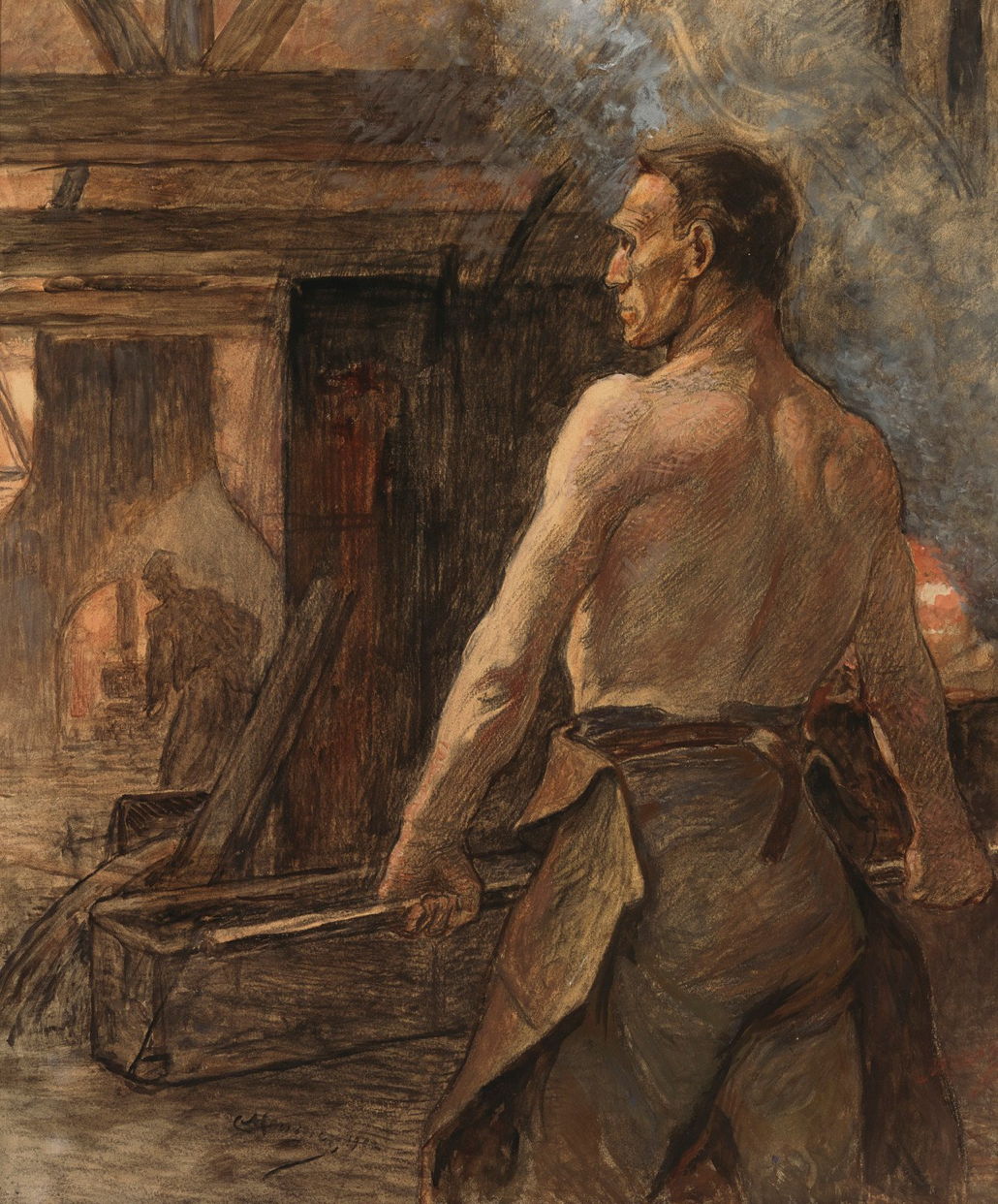
meunierfoundry
Constantin Meunier (1831–1905), Foundry (1902), media not known, 80 x 67 cm, Kansallisgalleria, Ateneum, Helsinki, Finland. Wikimedia Commons.

One of Constantin Meunier’s later paintings, Foundry from 1902, shows a worker stripped to the waist to cope with the heat, while wearing a protective leather apron.

geromeworkingmarble
Jean-Léon Gérôme (1824–1904), The Artist’s Model (1895), oil on canvas, 50.8 x 39.6 cm, Dahesh Museum of Art, New York, NY. Wikimedia Commons.

In The Artist’s Model (1895), Jean-Léon Gérôme shows himself at work on a marble figure, and wearing a faded blue apron.

The Dutch Golden Age: Historical context 1644-1674

By: hoakley
29 January 2026 at 20:30

This is the second article setting some of the finest paintings of the Golden Age in the context of major events in the history of the Dutch Republic, and resumes the account in 1644, shortly before the end of the Thirty Years’ War.

Fresheneesz, Map of the Low Countries, 1556-1648 (2006). Image by Fresheneesz, via Wikimedia Commons.

Constituents of the Dutch Republic are shown in red, orange and yellow in this map. Its centres of art included The Hague, its de facto capital, Utrecht, Leiden, Delft, Harlem, and Amsterdam. To the south were the lands composing the Spanish Netherlands, notably Flanders and Brabant, including the cities of Antwerp and Brussels.

1644-1659

1648 The Peace of Munster was ratified, ending the Thirty Years’ War and formally establishing the Dutch Republic as an independent country (see below).
1652 The United East India Company started settling Cape Colony, later known as the Cape of Good Hope, in South Africa.
1652-54 The First Anglo-Dutch War, ended with the Treaty of Westminster.

vangoyendordrecht
Jan Josefsz. van Goyen (1596-1656), View of Dordrecht with the Grote Kirk Across the Maas (1644), oil on oakwood, 64.8 x 96.8 cm, Walker Art Gallery, Liverpool, England. Wikimedia Commons.

Dutch landscape artists quickly realised that, even if they had relatively little earth and water to depict, the heavens above could be equally interesting. Horizons fell rapidly down their paintings, as seen in Jan van Goyen’s View of Dordrecht with the Grote Kirk Across the Maas from 1644.

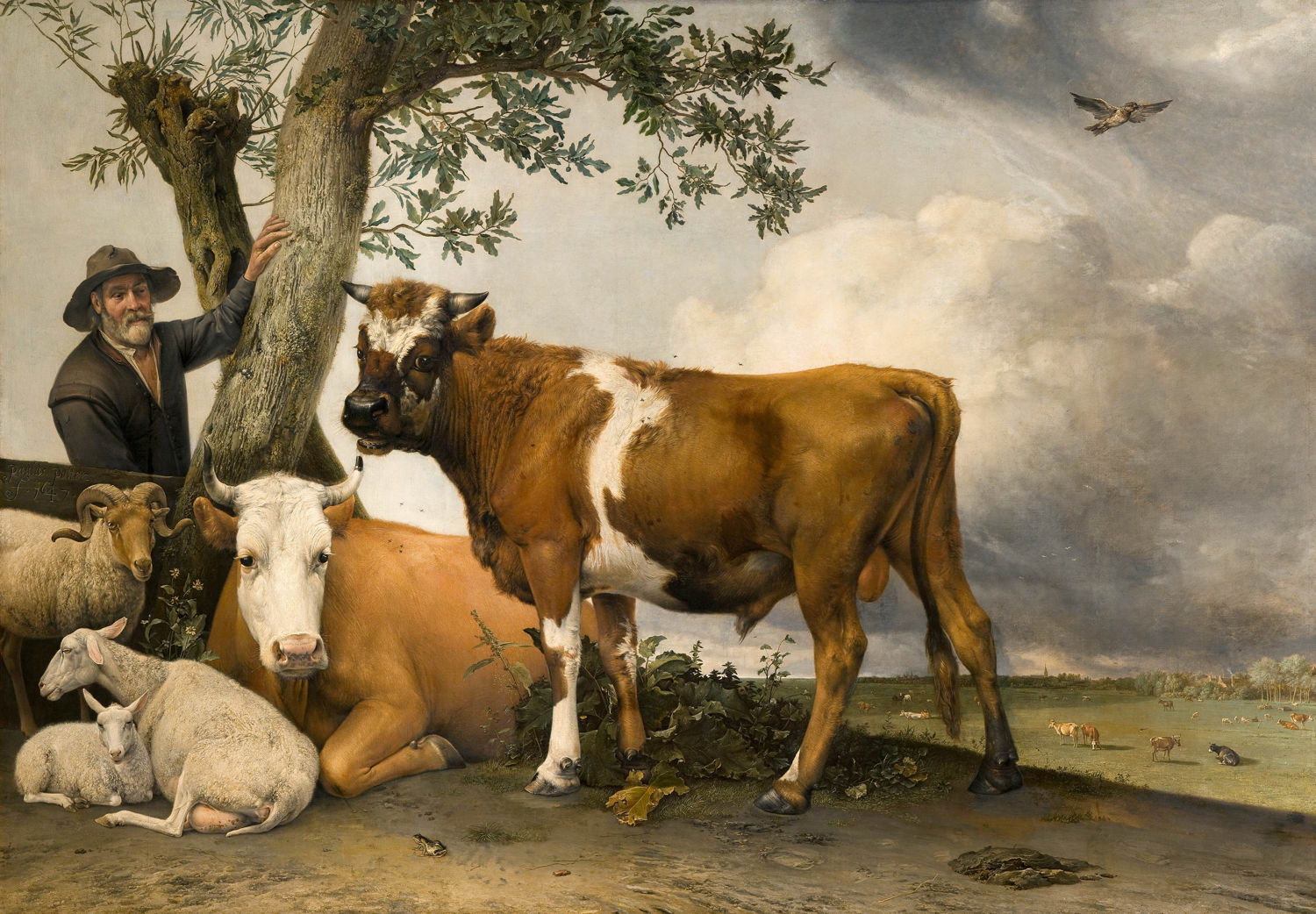
potterbull
Paulus Potter (1625–1654), The Bull (1647), oil on canvas, 235.5 x 339 cm, Koninklijk Kabinet van Schilderijen Mauritshuis, The Hague. Wikimedia Commons.

Paulus Potter, who became a member of the Guild of Saint Luke in Delft in 1646, founded the new genre of animal painting in 1647 with his almost life-size portrait of The Bull (also widely known as The Young Bull). Originally intended as a portrait of just the central bull, Potter enlarged the canvas to accommodate (from the left) a ram, lamb, ewe, herdsman, cow, and above them a bird of prey, possibly a buzzard. Beyond them are more cattle in the meadows receding to the church of Rijswijk, between Delft and The Hague.

terborchratificationoftreatymunster
Gerard ter Borch (1617–1681), The Ratification of the Treaty of Münster, 15 May 1648 (1648), oil on copper, 45.4 x 58.5 cm, Rijksmuseum Amsterdam, Amsterdam, The Netherlands. Wikimedia Commons.

For the thirty years between 1618-1648, central Europe had been engulfed in a bitter war between the Habsburg states, including the Holy Roman Empire and Spain, and their enemies, including the Dutch Republic. Gerard ter Borch’s magnificent painting of The Ratification of the Treaty of Münster, 15 May 1648 (1648) recorded the moment that the Thirty Years’ War ended, with the ratification of this treaty between the Dutch Republic and Spain.

baillyvanitas
David Bailly (1584–1657), Self-Portrait with Vanitas Symbols (1651), oil on panel, 65 x 97.5 cm, Museum De Lakenhal, Leiden, The Netherlands. Wikimedia Commons.

The son a of Flemish immigrant, David Bailly, who lived and worked in Leiden, painted this Self-Portrait with Vanitas Symbols in 1651, with its multiple portraits referring to the past. The figure shows him as a much younger man, holding the maulstick he used in painting. His actual self-portrait at the time is in the painting he is holding with his left hand. Next to that is a painting of his wife, who had already died, and a ghostly image of her is projected onto the wall behind the wine glass.

terborchglasslemonade
Gerard ter Borch (1617–1681), The Glass of Lemonade (1655-60), oil on canvas transferred from panel, 67 x 54 cm, Hermitage Museum Государственный Эрмитаж, Saint Petersburg, Russia. Wikimedia Commons.

Long before its value in preventing scurvy was realised (in 1747), or it was carbonated even later, still cloudy lemonade had become a popular soft drink. The extensive trade links of the Dutch Republic made the drink available to the middle classes, as celebrated in Gerard ter Borch’s The Glass of Lemonade (1655-60).

Johannes Vermeer, The Milkmaid (c 1658-1661), oil on canvas, 45.5 x 41 cm, The Rijksmuseum, Amsterdam. WikiArt.
Johannes Vermeer (1632-1675), The Milkmaid (c 1658-1661), oil on canvas, 45.5 x 41 cm, The Rijksmuseum, Amsterdam. WikiArt.

In Vermeer’s celebrated The Milkmaid (c 1658-1661) the maid is pouring milk from a jug, beside a tabletop with bread. In the left foreground the bread and pots rest on a folded Dutch octagonal table, covered with a mid-blue cloth. A wicker basket of bread is nearest the viewer, broken and smaller pieces of different types of bread behind and towards the woman, in the centre. Behind the bread is a dark blue studded mug with pewter lid, and just in front of the woman a brown earthenware ‘Dutch oven’ pot into which she is pouring milk.

1660-1672

1664-71 The Second Anglo-Dutch War.
1669 The United East India Company was the largest and richest private company in the world, with more than 150 merchant ships, 40 warships, 50,000 employees, and its own private army of 10,000.
1672 The Third Anglo-Dutch War; the Dutch Republic was invaded by France and others, following which its economy went into decline and the art market collapsed.

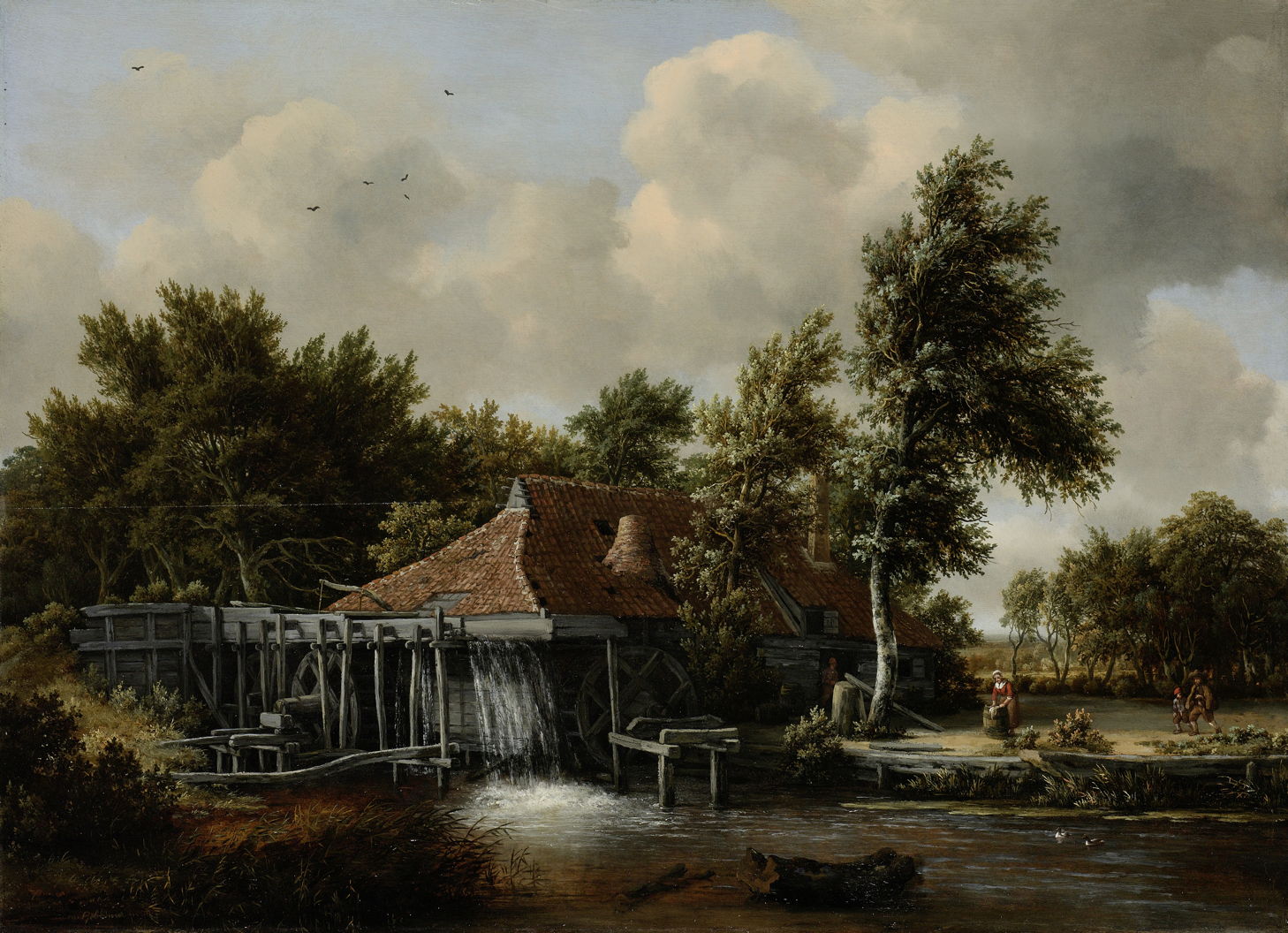
hobbemawatermill
Meindert Hobbema (1638–1709), A Watermill (c 1664), oil on panel, 62 x 85.2 cm, Rijksmuseum Amsterdam, Amsterdam, The Netherlands. Wikimedia Commons.

Meindert Hobbema’s magnificent Watermill from about 1664 accommodates a family: the wife is out doing the washing in a barrel, while the husband and son walk through their garden. It’s also relatively unusual in that the water here is fed through the elevated wooden aqueducts, making this watermill overshot, so capable of generating more power with a lower flow of water, because it uses the weight of water falling against the blades of the waterwheel.

vanruisdaelhaarlembleaching
Jacob van Ruisdael (1628/1629–1682), View of Haarlem with Bleaching Fields (c 1665), oil on canvas, 62.2 x 55.2 cm, Kunsthaus Zürich, Zürich, Switzerland. Wikimedia Commons.

Some painters, including Jacob van Ruisdael, turned their canvases to make portraits of towering clouds, as in his View of Haarlem with Bleaching Fields from about 1665. The distant town of Haarlem with its monumentally large church of Saint Bavo – works of man – is dwarfed by these high cumulus clouds, the works of God. This motif proved so popular that Van Ruisdael painted many variants of the same view, making it now one of the most widespread landscapes across the galleries of Europe.

vermeerartpainting
Johannes Vermeer (1632–1675), The Art of Painting (c 1666-68), oil on canvas, 120 x 100 cm, Kunsthistorisches Museum, Vienna, Austria. Wikimedia Commons.

Johannes Vermeer experimented with optical effects in his late The Art of Painting from about 1666-68, where greatest sharpness is slightly away from the geometrical centre of the canvas, in the woman holding a wind instrument. The high tonal contrast between the marble tiles on the floor is softened in the foreground, and sharpens as they recede deeper into the picture, as would be expected in a depth of field effect.

Rembrandt Harmenszoon van Rijn, The Jewish Bride (c 1667), oil on canvas, 121.5 x 166.5 cm, Rijksmuseum, Amsterdam. Wikimedia Commons.

Rembrandt continued to develop his mark-making right up to his death. It’s often at its most florid when he painted fabrics, such as the clothing of the couple shown in The Jewish Bride of about 1665. The Dutch Republic had long been a safe harbour for Jews fleeing from oppression in other European countries, and Rembrandt had cultivated close relationships with members of the large Jewish community in Amsterdam, some of whom had modelled for his depictions of Old Testament stories.

ruisdaelwindmillwijk
Jacob van Ruisdael (1628/1629–1682), The Windmill at Wijk bij Duurstede (c 1670), oil on canvas, 83 x 101 cm, Rijksmuseum Amsterdam, Amsterdam, The Netherlands. Wikimedia Commons.

One of Jacob van Ruisdael’s best-known paintings of windmills is this view of The Windmill at Wijk bij Duurstede from about 1670. This small town, now a city, is on the bank of the River Rhine, an ideal location for delivering grain by barge, and shipping the resulting flour.

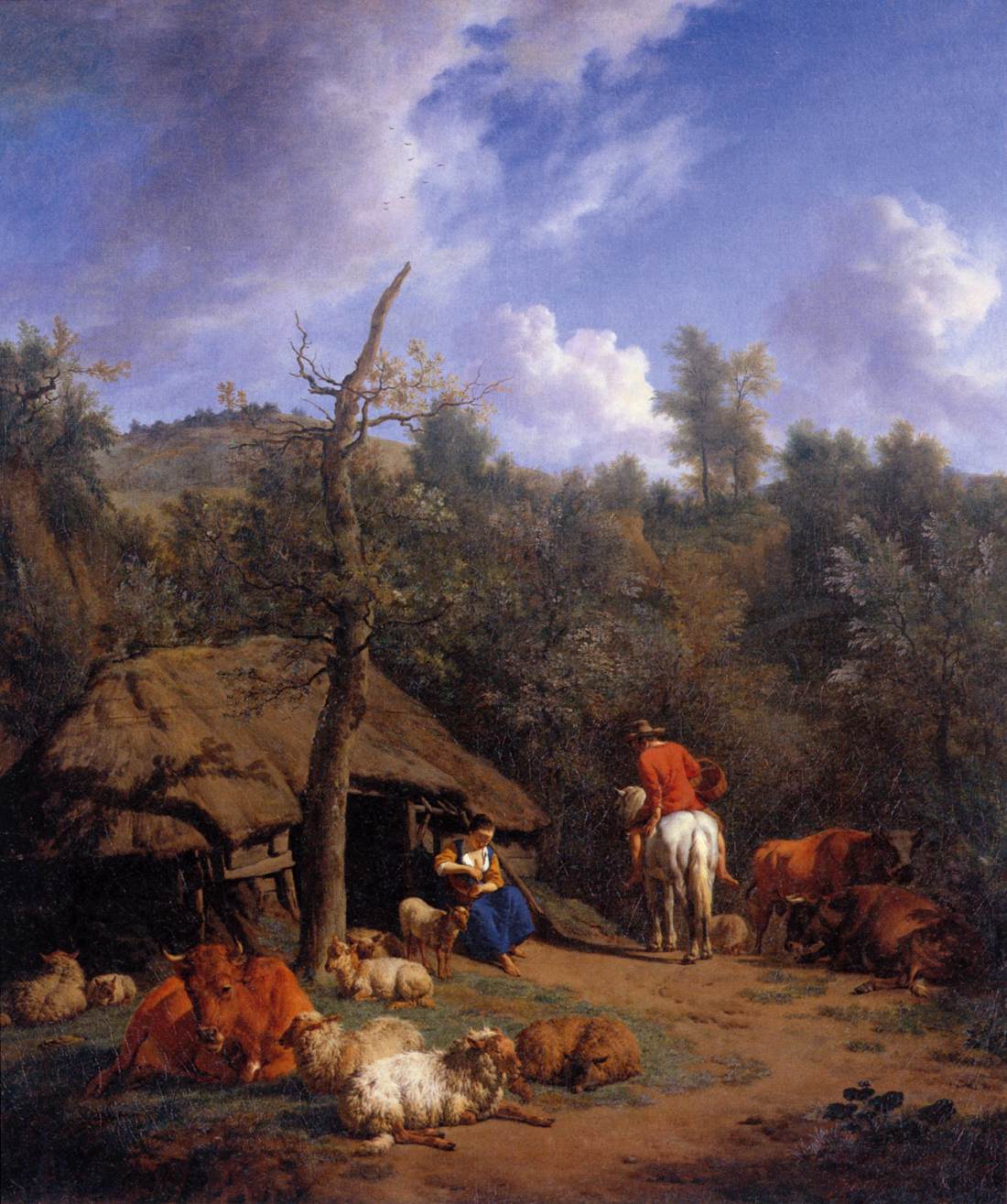
vandeveldethehut
Adriaen van de Velde (1636–1672), The Hut (1671), oil on canvas, 76 x 65 cm, Rijksmuseum Amsterdam, Amsterdam. Wikimedia Commons.

The Hut (1671) was one of Adriaen van de Velde’s last paintings, and has long been esteemed in the Netherlands. It’s one of his most natural compositions, sparkling with bright colour in the clothing and animals. The artist even adds the reality, perhaps as a touch of humour, of some fresh cowpats.

Gerrit Adriaensz Berckheyde, Groote Market in Haarlem, 1673, oil on panel, 42 x 61 cm, Hermitage Museum, St Petersburg. Wikimedia Commons. Shadows give strong depth cues.
Gerrit Adriaensz Berckheyde (1638-1698), Groote Market in Haarlem (1673), oil on panel, 42 x 61 cm, Hermitage Museum, St Petersburg. Wikimedia Commons.

Gerrit Berckheyde’s view of Groote Market in Haarlem from 1673 shows one the largest of the city’s marketplaces at the end of the Golden Age.

❌
❌