Jules Bastien-Lepage’s brilliant protégé was a young woman who started training in Paris in 1877, and who died from tuberculosis seven years later, just three months before him, Marie Bashkirtseff (1858–1884).
She was born and brought up in Havrontsi (Gavrontsi), to the north of Poltava in central Ukraine, between Kyiv and Kharkiv, where she first started to learn to draw and paint. Her affluent parents split up when she was twelve, following which she travelled around Europe with her mother, eventually settling in Paris. She originally hoped to be a singer, but after an illness ruined her voice, she decided to be an artist. She then studied with Robert-Fleury from 1877, and at the Académie Julian.
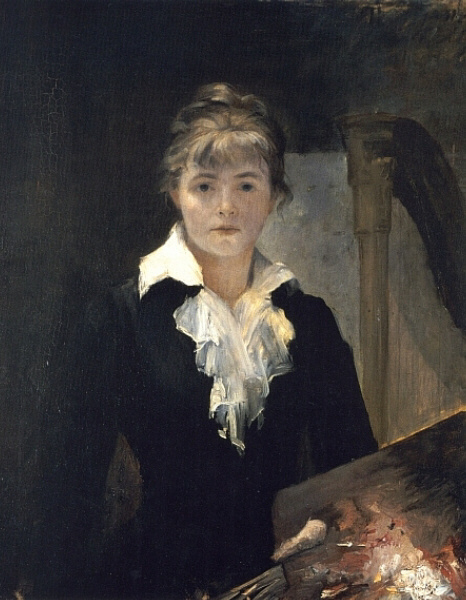
Marie Bashkirtseff (1858–1884), Self-portrait with Palette (1880), oil on canvas, dimensions not known, Musée des Beaux-Arts Jules Chéret, Nice, France. Wikimedia Commons.
A self-assured painter from the beginning, she set her sights high and had the ability and drive to paint excellently. Her early Self-portrait with Palette (1880) was painted in the same year that she first had a work accepted for exhibition at the Paris Salon, and she was successful again in every subsequent Salon until her death.
Marie Bashkirtseff (1858–1884), In the Studio (1881), oil on canvas, 188 x 154 cm, Dnipro State Art Museum, Dnipro, Ukraine. Wikimedia Commons.
While still studying at the Académie Julien in 1881, she painted In the Studio, which gives good insight into what her training was like. Her class was of course entirely female, and the Académie Julien was one of the few reputable schools that accepted women pupils at that time. The artist is seated in the centre foreground, holding her palette and knife as she looks up at one of her fellow pupils.
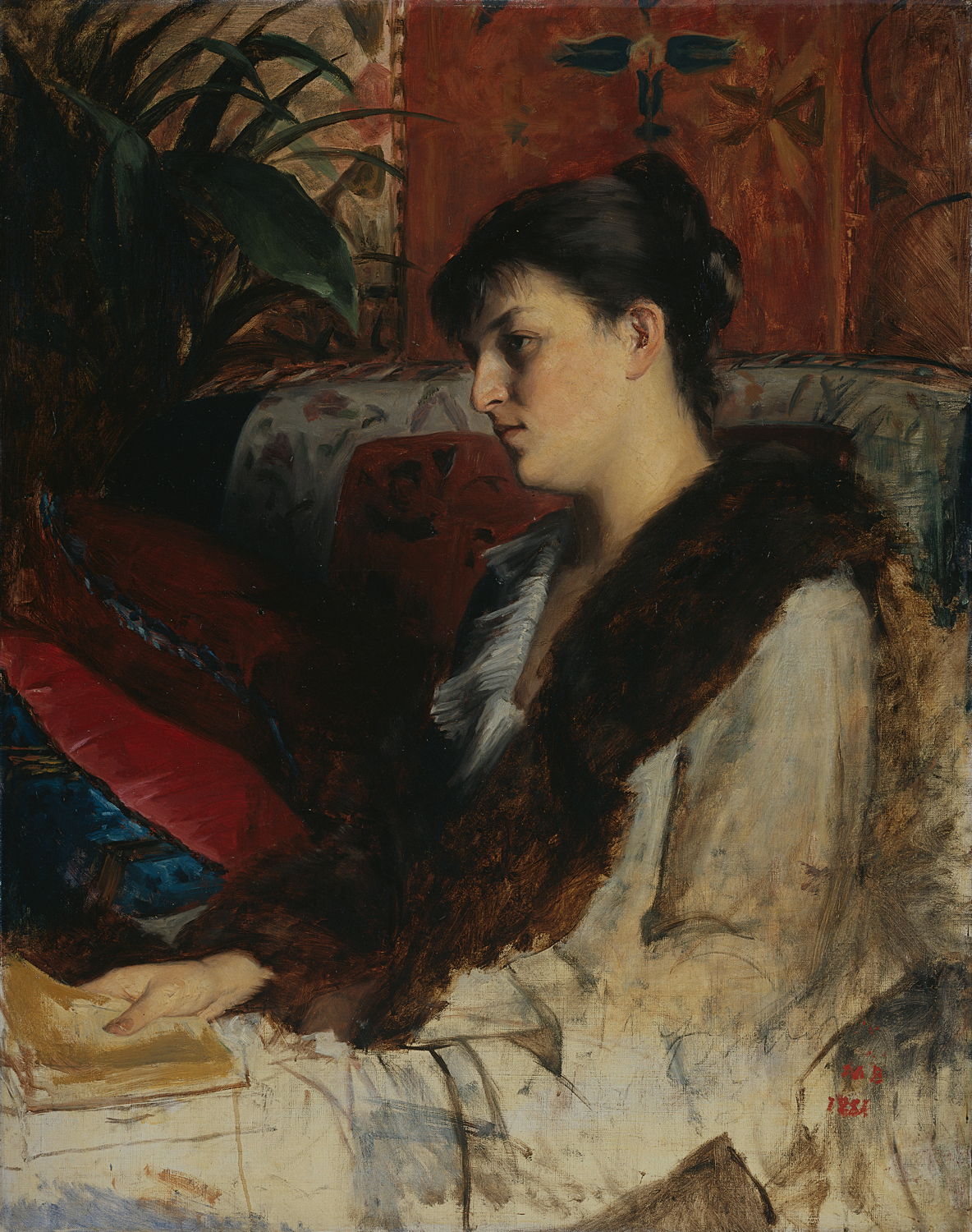
Marie Bashkirtseff (1858–1884), The Artist’s Sister (1881), oil on canvas, 92 x 73 cm, Rijksmuseum, Amsterdam. Wikimedia Commons.
Her early portraits are skilful if conventional, as is The Artist’s Sister from 1881. She started establishing herself in the art scene; it has been claimed that she wrote a column for the mysandrist newspaper La Citoyenne under the name of Pauline Orrel, but that appears to be unsupported by the original edited versions of her diaries.
She became a close friend of Jules Bastien-Lepage when visiting Nice in 1882, and he acted as her mentor if not teacher, as she described herself as his pupil. She also formed a close friendship with the writer Guy de Maupassant.
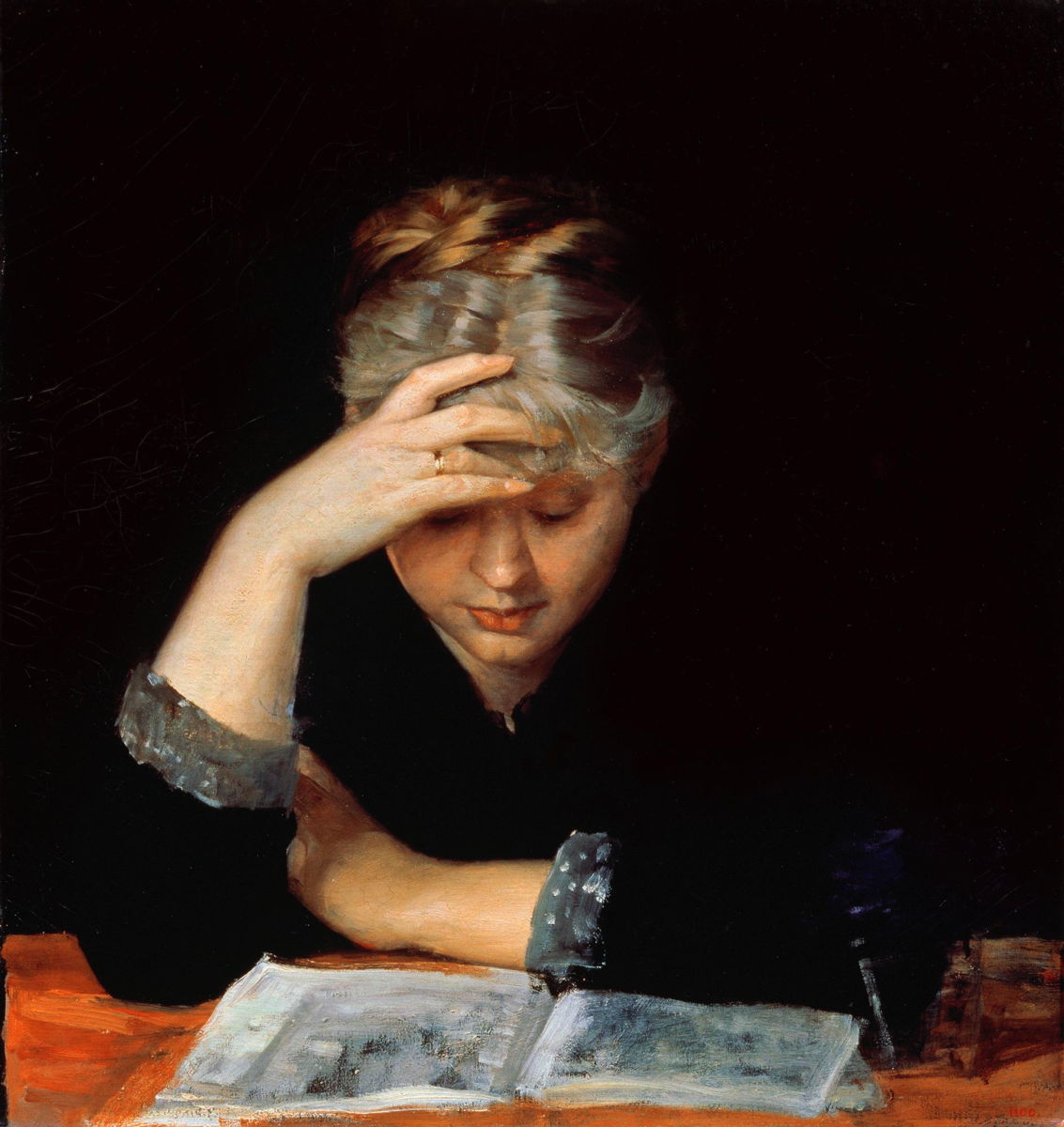
Marie Bashkirtseff (1858–1884), At a Book (c 1882), oil on canvas, 63 × 60.5 cm, Kharkiv Art Museum, Kharkiv, Ukraine. Wikimedia Commons.
As she developed a more distinctive style in her portraits, so her brushwork loosened. She was an astute observer of women’s life, as shown in At a Book (c 1882), with its emphasis on her model’s unusual hair.
Marie Bashkirtseff (1858–1884), Young Russian Girl (c 1882), other details not known. Wikimedia Commons.
Young Russian Girl (c 1882) is another delicate portrait, although I suspect the original isn’t as soft-focus as this image.
Marie Bashkirtseff (1858–1884), In the Mist (1882), oil on canvas, 47 x 55 cm, Österreichische Galerie Belvedere, Vienna, Austria. Wikimedia Commons.
Although Bashkirtseff accepted that her mentor Bastien-Lepage reigned supreme in the countryside, she felt that she was his match when it came to depicting the urban environment of Paris. In the Mist from 1882 is a good demonstration of how well she captures the almost deserted city streets on a foggy day, with a bright plume of flame from a fire in the centre of her canvas.
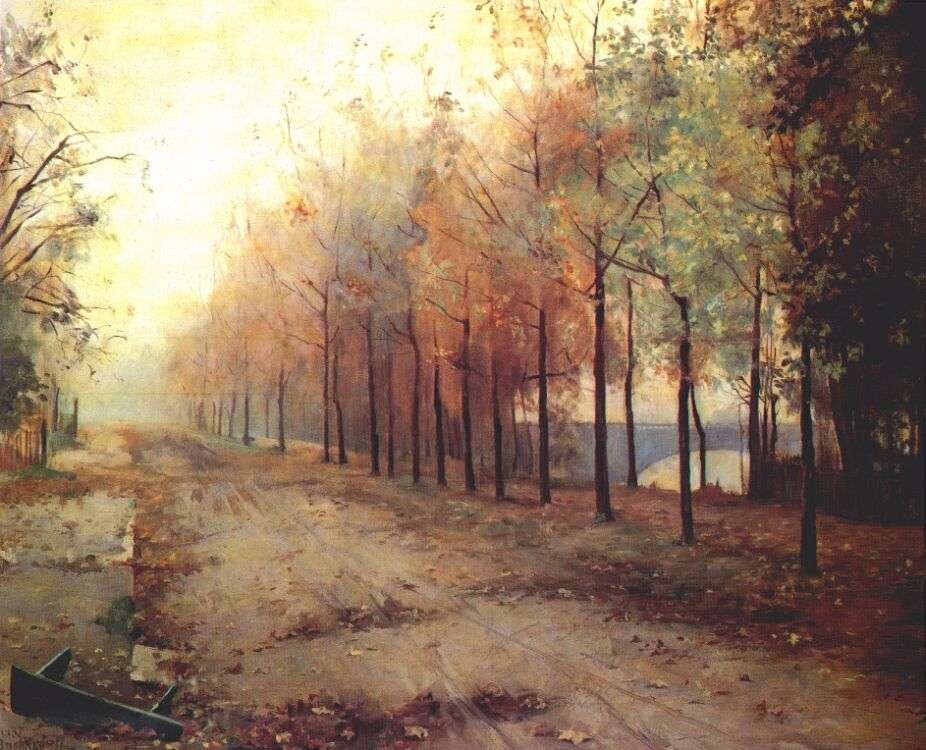
Marie Bashkirtseff (1858–1884), Autumn (1883), oil on canvas, dimensions not known, State Russian Museum, Saint Petersburg. The Athenaeum.
Autumn, from 1883, is an impressive and Impressionist depiction of a row of trees on the bank of the River Seine in the centre of Paris, but is unusual in being devoid of people. The leaf litter, occasional rubbish, and fallen bench strengthen its feeling of desolation in the midst of the bustling city.
Marie Bashkirtseff (1858–1884), The Umbrella (1883), oil on canvas, 93 × 74 cm, State Russian Museum, Saint Petersburg. Wikimedia Commons.
Bastien’s composite of detailed realism blended with more painterly passages shows in one of her best portraits, The Umbrella (1883). This girl’s tenacious stare at the viewer is quite unnerving. That year she was awarded an honourable mention from the Salon.
Marie Bashkirtseff (1858–1884), A Meeting (1884), oil on canvas, 193 x 177 cm, Musée d’Orsay, Paris. Wikimedia Commons.
A Meeting (1884) finally justified her claim to paint the urban poor, and to match Bastien-Lepage. This painting was a great success when shown at the Salon that year, and is probably her finest work.
Marie Bashkirtseff (1858–1884), Portrait of Madame X (1884), pastel and charcoal, 56 x 46.5 cm, Musée d’Orsay. Wikimedia Commons.
Her pastel Portrait of Madame X (1884), now in the Musée d’Orsay together with A Meeting, was also shown in the Salon that year.
By that summer, Bashkirtseff’s fragile health was deteriorating rapidly because of tuberculosis. She died on 31 October, less than a month before she would have turned twenty-six, and less than three months before her mentor died.
Her ambition was better fulfilled after her death than in life. Her huge mausoleum in Cimitière de Passy, Paris, designed by Bastien’s younger brother Émile, contains her artist’s studio complete with an unfinished painting of Holy Women by the Grave. Three years later, her copious and revelatory diaries were published, and propelled her to international fame.
It is 1095, another anonymous year between the collapse of the Roman Empire and the start of the Renaissance. There are only about fifty million people in the whole of Europe, and their life expectancy is around thirty years, little more than it was at the height of the Roman Empire. Famines are frequent, and death by starvation common even when crops don’t fail.
Christendom is under threat. Much of Spain and Asia Minor is under the control of Caliphates, and the Byzantine Empire consists of little more than Constantinople and Greece. The major powers in western Europe are France, and the Holy Roman Empire extending from the North Sea to central Italy. Since 1054, Christians in the Byzantine Empire had separated into the Eastern Orthodox Church, while those in the west of Europe still follow Rome in its Catholicism.
For the whole population, death is only a matter of time, and usually not that far away either. Their only hope in life is to go to heaven as their only chance of self-improvement. Opportunities to gain a place in heaven come seldom, though, and most fear deeply that they will only suffer worse torment in hell.
Pope Urban II has a plan. Having travelled through France to attend a meeting in Clermont, on 27 November he delivers a sermon calling for a holy war against the Caliphates occupying the Middle East, to return the Holy City of Jerusalem to Christian rule. The grounds given for this are paradoxical: he describes European society accurately as being violent, and the need for maintaining the Peace of God, but then calls upon all faithful Christians to undertake an ‘armed pilgrimage’ to bring them remission of sins, even if they die in the process.
Francesco Hayez (1791–1881), Pope Urban II Preaching the First Crusade in the Square of Clermont (1835), oil on canvas, 157 x 265 cm, Gallerie di Piazza Scala, Milan, Italy. Wikimedia Commons.
Francesco Hayez painted Pope Urban II Preaching the First Crusade in the Square of Clermont in 1835. Inspired by Michaud’s account of the Crusades (illustrated later by Gustave Doré), it gives an apocryphal version of the sermon, in which Peter the Hermit also preached, and distributed crosses of red cloth to those joining the ‘armed pilgrimage’.
There are two other key ingredients which are added later: a charismatic preacher known as Peter the Hermit adopts the Pope’s call as his mission in life, and starts his own highly successful campaign to recruit ‘armed pilgrims’, and these pilgrims will travel and fight under the sign of the cross.
Urban’s intention is for the warring peers and knights of Europe to unite in this cause, assemble armies of pilgrims, and depart in the middle of August 1096. Peter the Hermit, though, has other ideas, and forthwith sets out on a tour of France and the Holy Roman Empire recruiting anyone and everyone who will ‘take up the cross’ and head overland through central and eastern Europe to Asia Minor. This forms the ill-fated “People’s Crusade” that leaves early, gets into enormous difficulties wherever it goes, and ends up mostly being slaughtered before they even reach the Caliphates in Asia Minor.
One of the many failings of this People’s Crusade is its misinterpretation of their mission. Even before they leave the Holy Roman Empire, they take to killing anyone who wasn’t a devout Christian, particularly whole communities of Jews. While the main Crusade is still raising funds to sustain itself during its long journey to the east, the penniless and unprepared peasants in the People’s Crusade can only steal and ravage as they travel, giving rise to a succession of battles with locals on the way. These become particularly severe as they pass through Hungary.
Gustave Doré (1832–1883), The Army of Priest Volkmar and Count Emicio Attacks Mersbourg (1877), illustration for Joseph François Michaud’s ‘History of the Crusades’, further details not known. Wikimedia Commons.
In about 1877, the great French painter and illustrator Gustave Doré made a set of one hundred illustrations to accompany a new edition of Joseph François Michaud’s History of the Crusades. In The Army of Priest Volkmar and Count Emicio Attacks Mersbourg, he shows a battle that broke out in what is now Germany, between some of the People’s Crusaders and locals.
Eventually, the main bodies of the ‘armed pilgrimage’ assemble outside Constantinople during the winter of 1096-97. The Pope is represented by the first to ‘take the cross’, Adhemar of Le Puy, and its leaders include Raymond IV, the Count of Toulouse, Bohemond of Taranto and his nephew Tancred, and three aristocratic brothers Godfrey of Bouillon, Baldwin of Boulogne, and Eustace Count of Boulogne.
The Byzantine Emperor Alexios, whose pleas to Pope Urban had been part of the cause of this First Crusade, appears surprisingly disinterested in the campaign, refuses to join it, and is most interested in moving the 30,000-35,000 crusaders on into Asia Minor. He also insists that the leaders swear an oath to return to him all the territory they recover from the Caliphates. In return for that allegiance, he reluctantly provides the ‘armed pilgrims’ with food and supplies.
The main armies merge with the survivors of the People’s Crusade under Peter the Hermit in Asia Minor in early 1097. Their first objective is the city of Nicaea, which they put under siege. The Crusaders are then attacked by the Sultanate army, which they beat back in mid-May, with both sides suffering heavy casualties. The city falls on 18 June, but Crusaders are forbidden from entering, and it’s handed over to a Byzantine force as required by the earlier oaths made with Alexios.
Gustave Doré (1832–1883), After the Battle of Nicea (1877), illustration for Joseph François Michaud’s ‘History of the Crusades’, further details not known. Wikimedia Commons.
Doré’s After the Battle of Nicea shows one of the early atrocities of the First Crusade, in which the severed heads of massacred inhabitants were thrown into those who had survived the siege.
On 1 July, a larger Seljuk army attacks the Crusaders at Dorylaeum, but flees when reinforcements arrive.
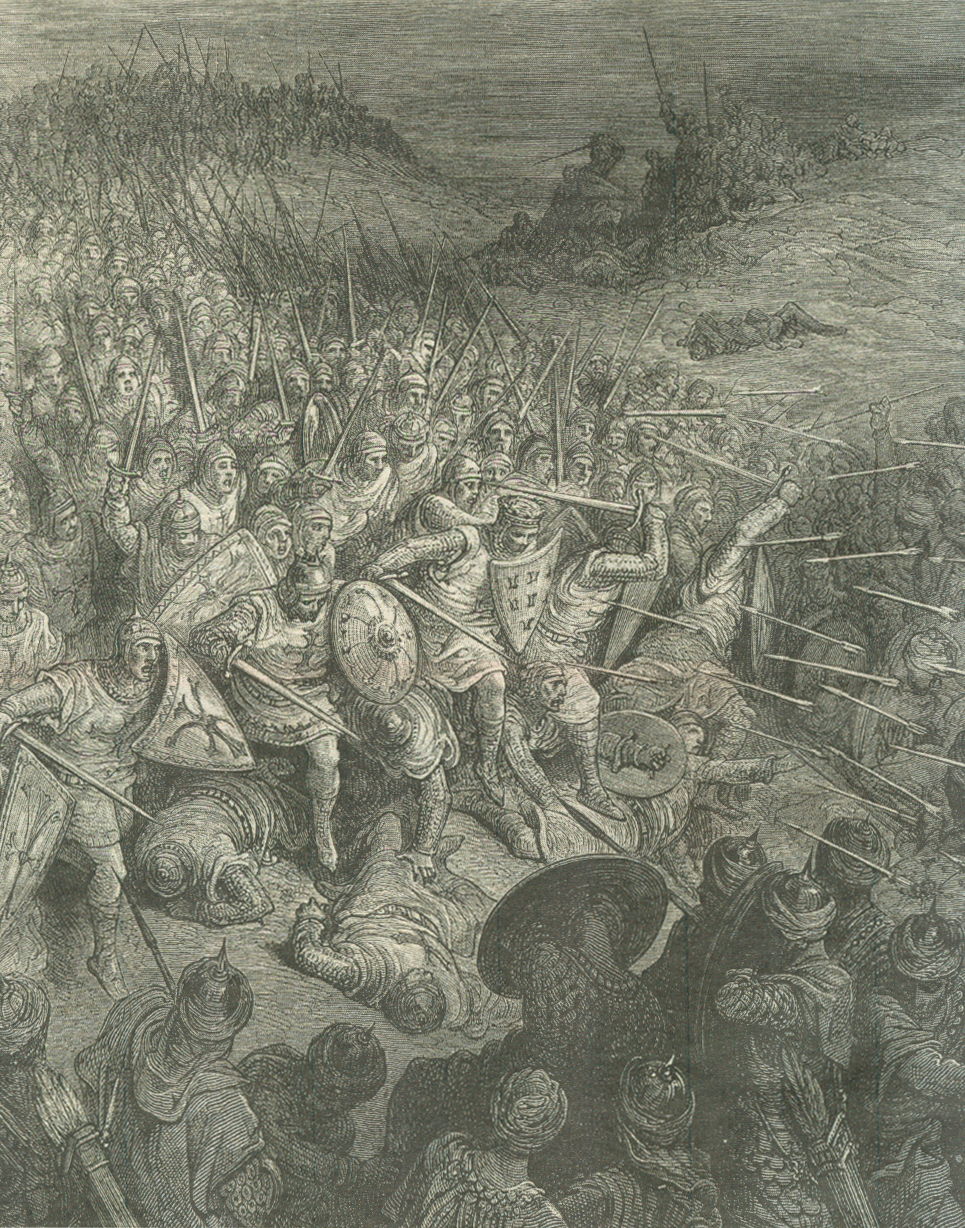
Gustave Doré (1832–1883), The Battle of Dorylaeum in 1097 (1877), illustration for Joseph François Michaud’s ‘History of the Crusades’, further details not known. Wikimedia Commons.
Doré’s vision of The Battle of Dorylaeum in 1097 shows hand-to-hand combat that preceded the invention of gunpowder and firearms.
The Crusaders then march through the heat of the summer, Seljuks having destroyed all crops in their retreat. Among the many who die during this arduous journey is the wife of Baldwin of Boulogne, who abandons his pilgrimage to find a fiefdom locally. In March 1098, Baldwin becomes the ruler of the new crusader state of Edessa.
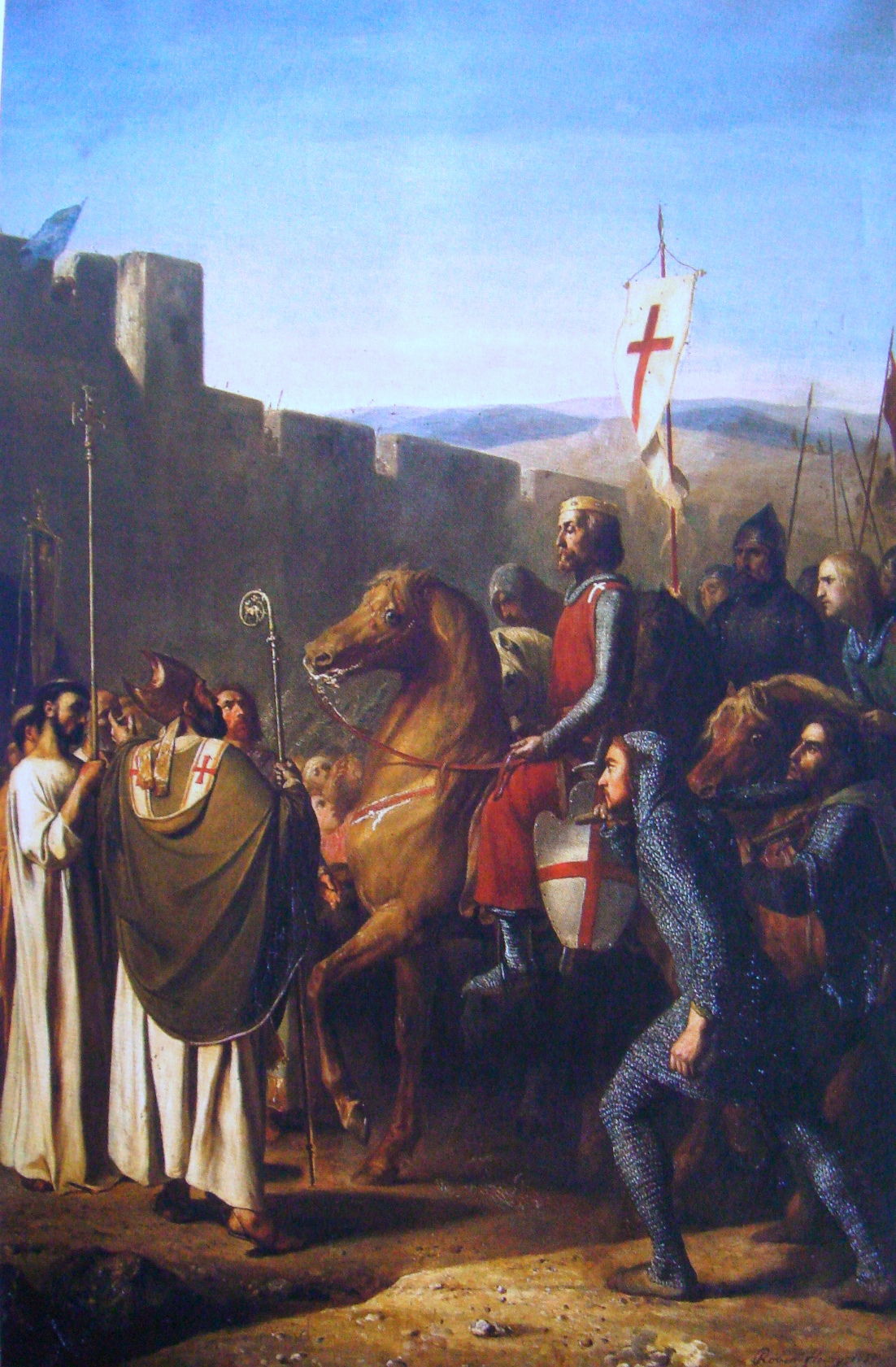
Joseph-Nicolas Robert-Fleury (1797-1890), Baldwin of Boulogne Entering Edessa in February 1098 (1840), further details not known. Wikimedia Commons.
Joseph-Nicolas Robert-Fleury, father of Tony Robert-Fleury who became an influential teacher of painting, shows Baldwin of Boulogne Entering Edessa in February 1098 in this painting from 1840.
The city of Antioch is the midpoint between Constantinople and Jerusalem, and the next military objective of the Crusade. Heavily fortified and defended, the Crusaders put the city under siege and hope for an insider to turn traitor and let them in. The siege starts on 20 October 1097, but the walls are so long they can’t be fully guarded, and those inside are kept partially supplied.
Jean Colombe (1430–1493), The Siege of Antioch (c 1474), miniature for Sébastien Mamerot’s ‘Les Passages d’Outremer’, Bibliothèque Nationale de France, Paris. Wikimedia Commons.
There are many miniatures showing scenes from the Crusades. Those of Jean Colombe are among the finest, and The Siege of Antioch from about 1474 is one of the very best. This was painted in Sébastien Mamerot’s Les Passages d’Outremer.
The armies outside the walls probably suffer worse privation than those they have put under siege. They’re also attacked by two armies attempting to relieve the siege, but manage to repel them both.
Jean-Joseph Dassy (1796–1865), Robert de Normandie at the Siege of Antioch 1097–1098 (1850), further details not known. Wikimedia Commons.
In 1850, Jean-Joseph Dassy painted this spirited and imaginative view of Robert de Normandie at the Siege of Antioch 1097–1098. Given the desperate shortage of horses and the appalling state of the men, this is entertainment rather than history.
In early March, supplies for the Crusaders arrive from the coast at last. Finally, Bohemond of Taranto manages to bribe one of the city’s defenders to let the Crusaders in; in June, Bohemond makes the first ascent of the ladders to lead an attack on the city, which quickly overwhelms its defenders.
Gustave Doré (1832–1883), Bohemond Climbs the Walls of Antioch Alone (1877), illustration for Joseph François Michaud’s ‘History of the Crusades’, further details not known. Wikimedia Commons.
Doré captures this in his Bohemond Climbs the Walls of Antioch Alone.
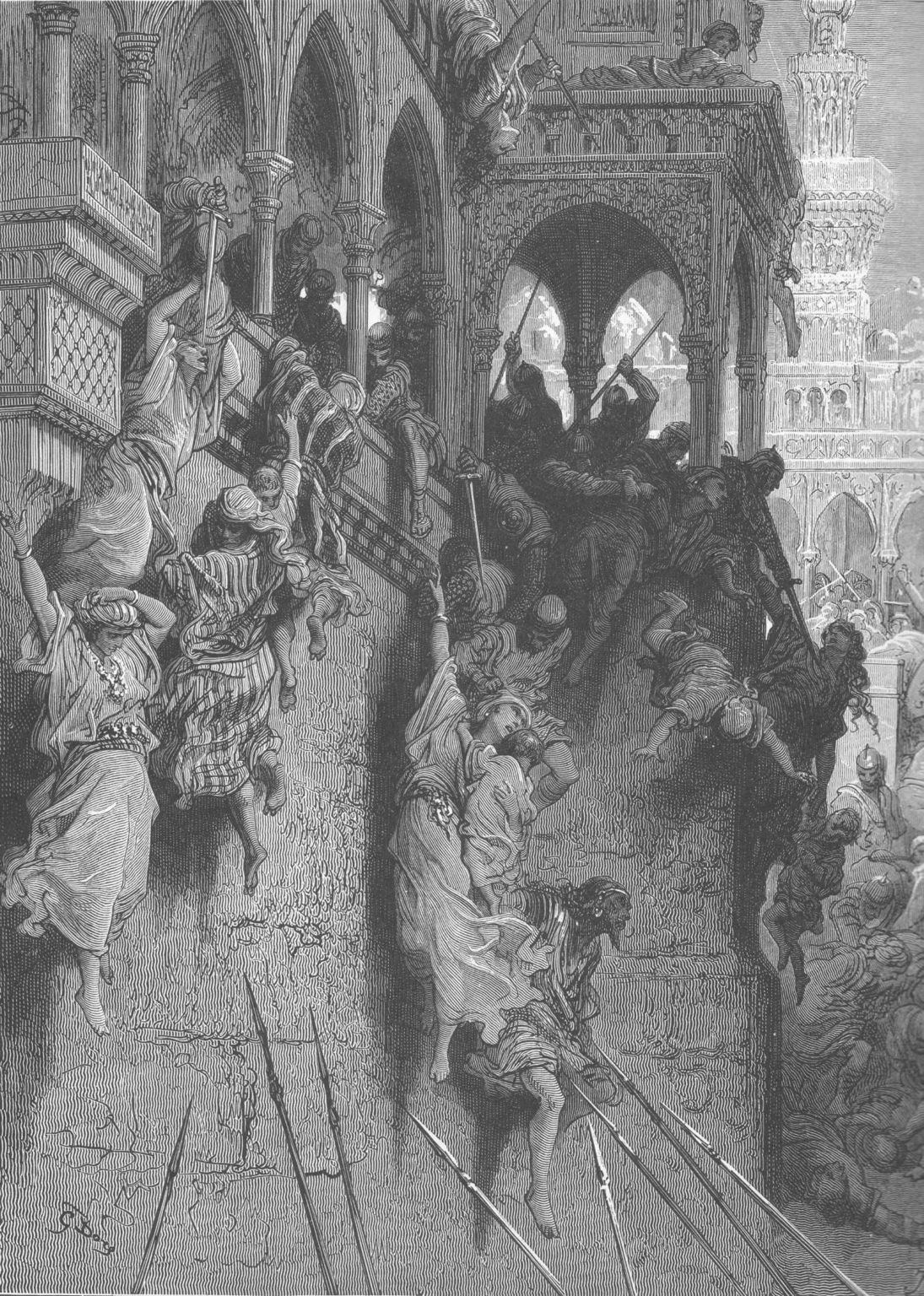
The Crusaders then slaughter almost every one of Antioch’s inhabitants in a bloodbath.
Gustave Doré (1832–1883), The Massacre of Antioch (1877), illustration for Joseph François Michaud’s ‘History of the Crusades’, further details not known. Wikimedia Commons.
Doré may have romanticised some of his scenes of the Crusades, but he didn’t shrink from pointing out its atrocities, in this plate showing The Massacre of Antioch.
A few days later, Kerbogha of Mosul arrives with a large army and the Crusaders find themselves under siege in the city they have only just captured, in even more desperate straits. When morale is at it lowest ebb, Peter Bartholomew, a monk, has a vision leading to his discovery of what he claims to be the Holy Lance, a relic which was the spear used to pierce the side of Christ when he was crucified.
Jean Colombe (1430–1493), Discovery of the Holy Lance (c 1474), miniature for Sébastien Mamerot’s ‘Les Passages d’Outremer’, Bibliothèque Nationale de France, Paris. Wikimedia Commons.
Jean Colombe shows the Discovery of the Holy Lance (c 1474) inside the cathedral of Antioch, where the monk’s vision revealed it to be. Inevitably, it has since been deemed an imposter.
The starving Crusaders see this as a sign of their victory over Kerbogha’s army, and on 28 June 1098 they leave the city and put their enemy to flight, largely because half of Kerbogha’s army mutiny on the battlefield.
Before the weakened army can leave Antioch, though, there’s a major dispute over who will become the city’s ruler. Bohemond claims it for himself, as it was he who had led its capture, and their oaths to Emperor Alexios are invalidated because he had deserted the Crusade. Others, most importantly Raymond of Toulouse, cannot agree, and argument delays their departure.
At the height of the summer, an epidemic strikes the city, killing many of the army and its dependents, including the Pope’s representative Adhemar of Le Puy. Local farmers then refuse to supply the Crusaders with food, and by December there are reports of Crusaders turning cannibal on eight thousand inhabitants of a nearby town whom they had massacred.
The main body of Crusaders finally leaves Antioch on foot for Jerusalem in early 1099. They have lost almost all their horses to the arduous journey, extreme heat, and starvation. Bohemond remains in the city as its first Prince.
In the next episode I will conclude this brief summary of the First Crusade.
Thomas Asbridge (2004) The First Crusade, A New History, Free Press, ISBN 978 0 7432 2084 2.
John France (1994) Victory in the East, a Military History of the First Crusade, Cambridge UP. ISBN 978 0 521 589871.
Joanthan Riley-Smith, ed (1995) The Oxford Illustrated History of the Crusades, Oxford UP. ISBN 978 0 192 854285.
Jonathan Riley-Smith (2014) The Crusades, A History, 3rd edn., Bloomsbury. ISBN 978 1 4725 1351 9.

 Login
Login